U.S. Pat. No. 6,932,708
COMMUNICATION GAME SYSTEM AND COMMUNICATION GAME PROCESSING METHOD
AssigneeSega Corp
Issue DateApril 23, 2004
Illustrative Figure
Abstract
This communication game system comprises a client system 1 and a game server system 2 for communicating with the client system 1. The game server system 2 comprises a database 21 for storing group information which relates a plurality of client systems to each other as a battle group. The game server system 2 is structured to decide a battle combination among the client systems 1 belonging to the same battle group, to perform a battle by managing the sending and receiving of data between the client systems determined by the above-mentioned combination, and to decide the next combination in accordance with the results of the battle. Each client system 1 has its own character select function and chat function when watching games.
Description
DETAILED DESCRIPTION OF THE PREFERRED EMBODIMENTS The preferred embodiments of this invention are hereinafter explained with reference to the attached drawings. (Embodiment 1) Embodiment 1 of this invention relates to a communication game system in which client systems form a battle group, a battle combination is determined from the client systems belonging to the same battle group, and the winner, loser, or both fixed players, or either one of the fixed players continues to battle with the other client systems. FIG. 1is a system diagram of a communication game system of this invention. The communication game system is configured, as shown inFIG. 1, in such a way that a plurality of client systems1are connected to a game server system2and a WWW server system3through a line network4. Each client system1has a configuration as a game device with so-called communication functions and is configured in such a way that a main game device10, a control pad11, and a monitor12are interconnected. The control pad11provides the main game device with operation signals output by the operations of each player. The main game device10has configurations as a computer device capable of conducting communications by including, for example, a CPU, a memory, a CD-ROM drive, a modem, an image-generating circuit, and an audio-generating circuit. The main game device10can read data from recording media such as CD-ROM's and operates as a client system of the communication game system by running a game program read from the recording medium. The main game device10proceeds the game processing based on the operation signals from the control pad11and connects to the game server system2via the line network4through a built-in modem when the communication game is specified by the player. As long as the game program recorded on the recording medium can perform communication game functions, there is no restriction on the ...
DETAILED DESCRIPTION OF THE PREFERRED EMBODIMENTS
The preferred embodiments of this invention are hereinafter explained with reference to the attached drawings.
(Embodiment 1)
Embodiment 1 of this invention relates to a communication game system in which client systems form a battle group, a battle combination is determined from the client systems belonging to the same battle group, and the winner, loser, or both fixed players, or either one of the fixed players continues to battle with the other client systems.
FIG. 1is a system diagram of a communication game system of this invention.
The communication game system is configured, as shown inFIG. 1, in such a way that a plurality of client systems1are connected to a game server system2and a WWW server system3through a line network4.
Each client system1has a configuration as a game device with so-called communication functions and is configured in such a way that a main game device10, a control pad11, and a monitor12are interconnected.
The control pad11provides the main game device with operation signals output by the operations of each player. The main game device10has configurations as a computer device capable of conducting communications by including, for example, a CPU, a memory, a CD-ROM drive, a modem, an image-generating circuit, and an audio-generating circuit. The main game device10can read data from recording media such as CD-ROM's and operates as a client system of the communication game system by running a game program read from the recording medium. The main game device10proceeds the game processing based on the operation signals from the control pad11and connects to the game server system2via the line network4through a built-in modem when the communication game is specified by the player. As long as the game program recorded on the recording medium can perform communication game functions, there is no restriction on the contents of the game. However, it is preferable that the game be programmed as a battle type game in which the player battles with another player and a winner and a loser are then decided. Moreover, the main game device10is designed to output image signals and audio signals as a result of the game processing. The monitor12is configured so as to provide the player with images and sounds corresponding to the image signals and audio signals from the main game device10.
The game server system2comprises a game server20and a storage area21.
The game server20comprises configurations as a general-purpose high-performance computer device by including, for example, a CPU, a memory, a hard disk, and a communication device. The game server20runs programs compatible with the game processing method of this invention to operate as a game server system that controls the communication game system. Namely, it controls the client system1which is connected to the access point of a game network40. The storage area21is the game server20itself or the area accessible by the game server20and is the area capable of storing as files the databases required to operate the communication game system.
The line network4is a normal public or private line to form a WAN such as the game network40and the Internet41.
The game network40is a network provided to operate the communication game system. For example, it is a dedicated network composed of the game server system2and each client system1by connecting the client systems1to particular access points controlled by the game system2. However, it does not have to be such a PPP connection, but it may have the connection configuration via the Internet where the client systems access the game server from any connection point. There is no restriction on protocols to be used, but general-purpose protocols such as TCP/IP may be used in consideration of the cases where the client systems1use WWW features of the Internet, and where the client systems1are designed to achieve general versatility.
The Internet41is a WAN to which any number of computer devices can connect, where file browsing, e-mail, and file transfer can be performed by using various kinds of commands defined by TCP/IP protocols. In particular, it uses the WWW feature of the Internet in this embodiment.
The WWW server system3comprises a WWW server30and an HTML (hyper-text format) storage area31.
The WWW server30has configurations as a general-purpose high-performance computer and is given a network address on the Internet41, and is configured to enable browsing hypertext files stored in the HTML storage area31by specifying the particular network address from a computer connected to the Internet41. The HTML storage area31is a storage area controlled by the WWW server30and stores in a given directory the HTML files created by the WWW server30or transferred by the game server system2in order to display the results of the communication game. The purpose of this WWW server is to inform battle histories, but the server does not have to be the Internet server, and a dedicated server may be provided to which the files recording the battle histories can be uploaded and the client systems can connect and browse.
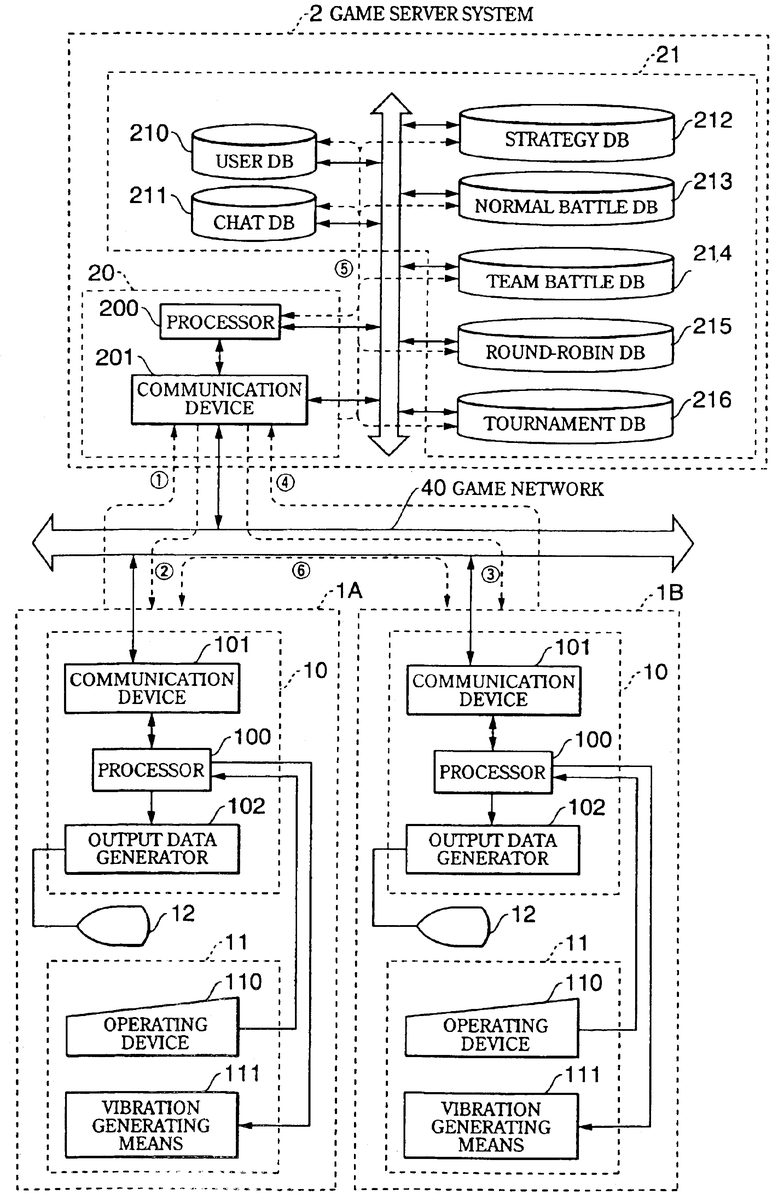
FIG. 2is a detailed feature block diagram of this communication game system. In each of the client systems1(A and B), a processor100and a communication device101belong to the main game device10. An output data generator102and a control pad11belong to the control pad11.
The processor100is a computing part which has a CPU as its central part and runs game programs. The processor100recognizes the operating signals from an operating device110, outputs vibration signals to a vibration generating means111, controls communications conducted by the communication device101, and controls the output data generator102. The communication device101is, for example, a modem or a terminal adapter and intermediates data transmissions between the game network40or the Internet41and the processor100. The operating device110comprises the operating functions necessary to operate a game, such as operation buttons and a cross key. The vibration generating means111can make the player who is operating the control pad11perceive the vibrations corresponding to the vibration signals of a given frequency by means of, for example, inverse piezoelectric effects of piezoelectric elements.
In the game server system2, a processor200and a communication device201belong to the game server20. The storage area21stores a user database (hereinafter abbreviated as “DB”)21, an easy lobby DB211, an expert lobby DB212, a normal DB213, a team battle DB214, a round-robin DB215, and a tournament DB216.
The user DB210stores personal information of a player who is allowed to use the communication game system, such as a unique control number of each main game device10, the player's address and contact as well as the player's personal battle history, winning average, registered comments, ranks, and character information.
The easy lobby DB211stores index information of an easy lobby, i.e., an easy battle mode. For example, battle combinations, dates and times, and chat information in the easy lobby are recorded.
The expert DB212stores index information of an expert lobby, i.e., an expert battle mode. For example, the name of each battle group (strategy name), the number of participants, a battle type, link information to DB213through DB216, and chart information in the expert lobby.
In the normal DB213, the team battle DB214, the round-robin DB215, and the tournament DB216, battle group information of each battle type is recorded. For example, the following information is recorded: the name of the battle group (strategy name), the number of participants, the number of battles, starting and finishing times of each strategy, member names (with ID's), ranks of each member, game rules, information of the determined combinations, battle histories, and chart information of the battle groups.
These databases can be cross-referenced and their relationships are set up so that all information can be read by key data.
The processor200is a computer part which controls the communication game system, and performs the battle control of the client system determined by the program by referring to each of the databases210through216and by controlling the communication device201. In particular, this embodiment uses the databases210through212common to the respective embodiments described later and the normal database213. The communication device201controls the access points on the game network40and intermediates data transmissions between each client system1and the communication system200.
(Actions of the Client System)
The actions of this embodiment are hereinafter described. The basic action of individual client systems1is first explained with reference to FIG.8.
Each client system1uses distinctively an independent mode where the game processing proceeds based on the operating signals generated by the program and the player, and a communication mode where the game processing mainly proceeds based on commands provided through communications.
In either operating mode, the main game device10interprets the operating signals from the control pad11and moves characters (operable segments or models) on the game screen. The above-mentioned two modes are different in that in the independent mode, the movements of a competitor's character in the game are determined by the program, while in the communication mode such movements are determined by commands sent from the client system1which has become a battle competitor via the game network40. In the communication mode, the main game device10changes the operating signals into commands and sends them out to the game network40.
Specifically, as shown inFIG. 8, the main game device10reads operating signals (S501) and verifies whether the details of the operation indicate the start of communications (S502). If it is not the start of communications (S502: NO), it is in the independent mode and the processing then proceeds as the normal game device (S503).
On the other hand, if the operating signals indicate the start of communications (S502: YES), the main game device10performs general procedures to establish connections to be in the communication mode. That is, the main game device10selects and calls a pre-registered server, and after the connection, the main game device10sends necessary information such as a handle name, ID, and password (S504). If it fails to be connected, the processor handles it as a normal error, displays an error message, and returns to the original state.
After the connection is established, the main game device10displays the main menu (S505) When the start of the game is indicated by the player, the main game device10then performs a permanent loop processing not to return to the original state unless any special operation such as an escape is performed. In other words, if the operating signals are provided (S506: YES), the main game device10reads the operating signals (S508) and changes them into a command according to predetermined command rules and sends it to the game network40(S509). If the command is sent from the game network40(S510: YES), the main game device10reads the command (S511) and proceeds to an interpretation routine.
Namely, if the command indicates the display of an easy lobby strategy window (S512: YES), the main game device displays a basic screen (seeFIG. 9) of the easy lobby strategy window (S513). In the same way, if the command indicates the display of an expert lobby strategy window (S514: YES), the main game device10displays a basic screen of the expert lobby strategy window (S513). The expert lobby strategy window includes various window displays (FIGS. 11 through 26) in addition to the basic screen (seeFIG. 10etc.). These basic screens are displayed based on the image data saved in the client system. However, the game server system2may be configured in such a manner that it stores hypertext files for displaying these strategy windows, provides the client system with these files as necessary, and displays them according to the browser functions for browsing hypertexts.
If the command indicates the transition to the battle mode (S516: YES), the main game device10uses image data in the client system instead of these image displays to perform the battle processing (S518).
If the client system1is allocated to the battle mode, the main game device10moves its own character according to the operating signals and changes the position and status of a competitor's character according to the operational commands provided by the game network40. The allocation of the operational commands can be determined arbitrarily for each game. These processings enable game battles as if a player is battling with another player by connecting two control pads11to one game device.
If the client system1is allocated to the game watching mode, the main game device10moves both characters and changes their display status on the basis of the operational commands provided by the game network40. This processing enables players to watch the game in the same manner as friends who cheer on those friends who are playing a game at an amusement arcade.
If chat information is sent as a command, the main game device10displays character strings on the screen of the monitor12based on the chat information (S519). If a command for vibrations is sent, the main game device causes the vibration generating means111of the control pad11to vibrate.
The procedures by which a player challenges another player the battle in the easy battle mode (easy lobby) are hereinafter described with reference to FIG.2. These procedures for the easy battle mode are almost the same for the expert battle mode (expert lobby), which will be described later.
As shown inFIG. 2, with the client systems1A and1B being connected, the game server20monitors the client systems1that are being connected at that time and stores the ID's of those client systems and the number of connected users in the easy lobby DB211. The game server displays the easy lobby strategy window as shown inFIG. 9at the client system entering the easy battle mode. In this window, a battle fighter list shows the names of the connected users, their status, and the total number of the connected users based on the connected user data that the game server20has sent by searching the easy lobby DB212.
If the cursor is on the battle fighter list on the basis of the operating signals, the client system1A sends selection information of this cursor to the game server20(via route {circle around (1)}). The game server20reads the battle history of this player from the user DB211(via route {circle around (5)}) and returns it to the client system1A (via route {circle around (2)}). The client system1A displays it as battle fighter information. When the player of the client system1A operates the control pad11to apply for a battle ({circle around (1)}), the game server20sends the application to the client system1B (via route {circle around (3)}). In response to it, the player of the client system1B answers whether or not he accepts the battle (via route {circle around (4)}).
When the answer shows the rejection of the application, the game server20sends the rejection to the client system1A ({circle around (1)}). The player of the client system1A searches for another client system and applies for a battle again.
On the other hand, if the answer from the client system1B shows an acceptance of the application, the game server20sends the acceptance to the client system1A ({circle around (1)}) and sends both client systems a command to proceed to the battle mode ({circle around (1)} and {circle around (3)}). The client systems1A and1B proceed to the battle mode and then send each other commands by their own operations (via route {circle around (6)}). The game server system2intermediates the sending and receiving of commands in the battle mode, but such a configuration may be adopted that the commands are sent and received by directly specifying the network address of the other party. Almost the same communication procedures are used for the expert battle mode (expert lobby).
(Overall Actions)
The sequences of individual client systems and the game server system have been described above, but this invention is characterized by its overall battle management positioned on top of these individual sequences. This is described mainly by referring to the status transition diagram of FIG.3. This figure shows the status of individual client systems1which changes under the management of the game server system2. This figure is common to the embodiments described later.
In this invention, when any of the client systems request a battle, the game server system2is designed to select and perform either the easy battle mode (easy lobby) in which any one of the client systems is selected to battle or the expert battle mode (expert lobby) in which the client system1belongs to any of the battle groups and fights battles in each battle group.
In the easy battle mode, as described above, the game server20displays the main menu on the client systems1with which communication has been established (S00), and when the easy lobby is selected, the game server20displays the easy lobby strategy menu which is the basic screen for the easy battle (S01: FIG.9). When the battle is accepted, the game server20causes the fighting client systems1to be in the battle mode (S02).
The client system1displays the start menu when a start button is pressed on the control pad11(S03). When the expert lobby is selected from this start menu or the main menu, the game server20displays the expert lobby strategy window which is the basic screen for the expert battle (S10).
Since the expert lobby requires more playing experience, it is preferable that the client system1be configured so as to start with the easy lobby when it is connected for the first time. After that, the player should be able to select either battle mode freely.
As shown inFIG. 10, as the expert lobby strategy menu, a title window W1, a chat window W2, and a strategy name list W3are displayed. The title window W1is a display field of the battle mode. The chat window W2displays character strings W21chronologically which are based on the chat information that has been sent from the client systems1entering the expert battle mode. When the chat information is sent, the game server20stores the chat information in the expert lobby DB212together with the name of the sender and displays the chat window W2based on such chat information. The chat window W2displays a pseudo keyboard W22for entering character strings. The strategy name list W3is a list of battle groups displayed by the game server20with reference to the group information stored in the expert lobby DB212. This strategy name list W3is a list of the battle group units, unlike the list of connected users that are shown by client system in the easy lobby strategy window (FIG.9). Specifically, a plurality of battle groups, each of which consists of the strategy name, the number of participants, and the battle mode, are displayed. It is preferable that whether the groups are in battle or not can be shown in the list by using a lamp display or the like.
When the player operates the start button of the control pad11, the client system1is designed to display the start menu M1corresponding to the mode at that time (S11: FIG.11).
When “create a forum” is selected in the start menu M1, the game server20further displays a menu M2from which a battle mode is selected (S12: FIG.12). When any one of the battle modes is selected from this menu, a new battle group is formed corresponding to the battle mode and its “strategy forum” is displayed (S13).
When more than one client system1participate in the “strategy forum” formed in the selected battle mode after new registration (S30, S40, S50, S60), one battle group is formed. The strategy forum or the battle group is formed as described in this Embodiment if “normal” is selected in the menu M2. The strategy forum or the battle group is formed as described in Embodiment 2 if “team battle” is selected. The strategy forum or the battle group is formed as described in Embodiment 3 if “round-robin” is selected. The strategy forum or the battle group is formed as described in Embodiment 4 if “tournament” is selected.
In the forum creating processing (S13), the client system1which requests a new registration can determine arbitrary game rules. Only this client system which has newly registered can change the game rules of this strategy forum and starts battles of the battle group. The client system which has newly registered and started the “strategy forum” is hereinafter called a “host”. The group information for recording the necessary information such as the game rules related to this battle mode and the participating members is registered in the corresponding databases212through216by the game server20. Each time a new participating member registers or changes the game rules, the game server20changes and updates the group information.
When “comment registration” is selected from the start menu M1, the game server20displays a comment registration window W4(S14: FIG.13). This window W4includes: a comment field W41where a player enters self-introduction sentences which he wants to be displayed when his personal information is referred to by other client systems1; a quick message field W42where the player registers according to operation buttons of the control pad11the letters that he wants to provide the other client systems in the same battle group watching the battle in the battle mode; and a software keyboard W43for entering character strings. When the player enters any letters in these fields, the game server20stores them in the user DB210corresponding to the operation buttons. The character string information for displaying these comments are transferred to each client system1by the game20in advance. The database stores associating information which associates each comment with the operational commands. The game server20watches for operational commands on the game network40and when it receives operational commands, it reads the associating information from the database and sends it to each client system1. Each client system1displays the character string information corresponding to the associating information on the screen.
When “change the chat channel” is selected in the start menu M1, the game server20changes the chat channel from a common chat channel for the expert battle mode to the battle group's own chat channel. Specifically, the server20switches the database for reading the chat information between the chart DB211and other databases213through216.
When “send a message” is selected from the start menu M1, the game server20stores in the database the chat information provided by the client system in the selected chat channel and supplies the chat information to the other client systems1that are being connected.
When “look for other members” is selected from the start menu M1, the game server20displays the battle groups that were not displayed in the strategy name list W3. When “change the main Virtualoid” is selected from the menu, the game server20makes it possible to change the characters adapted to each client system1and updates the user DB210with the changed contents. When “go to the easy lobby” is selected, the game server20causes the client system1to proceed to the status S01. When “exit from the network” is selected, the game server20sends the client system1a command to proceed from the communication mode to the independent mode and the client system1then exits from the game network.
In the expert lobby strategy window (S20: FIG.10), when the player places the cursor on the strategy name list W3, the strategy name information selected by the cursor is supplied as a command to the game server20. The game server20searches the expert lobby DB212based on this strategy name information, specifies the databases213through216which store the relevant battle group, and then reads its detailed information and returns it to the client system1. Accordingly, a battle situation window W5is displayed (S20: FIG.14).
The window W5displays a battle mode W51, the number of participants in the battle group W52, a battle type display of either an actual battle or a simulation battle W53, a strategy start time at which this battle group was formed W54, the status W55which specifies the game rules, and participating members W56.
Each player has its rank determined and registered depending on the battle history stored in the user DB210. The rank is assigned to the members. Participating members may be displayed according to the order of the ranks, because it can motivate the players to level up to higher ranks. On the contrary, some players feel that such a way of playing the game is hard-hearted if the ranks always affect the battles. For those player who feel this way, the player who has newly set up a battle group can select at his option either the “actual battle” in which the ranks are applied or the “simulation battle” in which the ranks are not considered.
The game server20monitors the connection status of each participating member and displays the status next to each member name. For example, the status of “in battle” is displayed for players in battle, the status of “watching” is displayed for players watching the battle, and the status of “waiting” is displayed for players browsing the expert lobby strategy window.
If the player performs given operations while the strategy situation reporting window W5is being displayed, the game server20reads personal information on all the client systems1being connected regardless of the battle groups from the user DB210and displays a list of connected users W6. It also displays the total number of connected users (S21: FIG.15). If any one of the connected users is selected by a cursor in a list of connected users, the game server20further reads the personal information of the client system1corresponding to the connected user from the user DB and displays it in a player data window W7. The window W7displays the name of the connected user W71, the score of the day W72, a rank mark corresponding to the rank W73, the display of the character being adopted by the client system1to be used in the battle game W74, comments W75registered in S14, and the present status W76of the client system1. When a given operation (for example, pressing an L button or an R button) is performed in this condition, the total score of the client system1is displayed based on the user DB210. Also, when another operation (for example, pressing an A button) is performed, a message is sent to the client system1that has been selected.
If the player performs a given operation (for example, pressing the A button) in the battle situation reporting window W5(S20: FIG.14), the client system1that has conducted this operation is registered as having newly participated in this battle group. Namely, the game server20determines that the client system1has requested to participate in the selected battle group and registers this client system1with this battle group as a new participant (S30). The game server20newly associates the personal information of the client system1that requested the participation with the group information of the battle group.
For new entries (S30), authorization processing may be conducted in such a way that a password is set up for each battle group and participants cannot participate in the battle group without entering the password. In other words, when there is a new request to participate in the battle group, the game server20requires the client system1wishing to participate to enter the password and allows it to participate in the battle group only when the correct password is entered.
(Normal Strategy Forum)
The battle management of the battle group for which “normal” has been set up as the battle mode is described below. The “normal” battle mode is a battle performed according to such game rules that when a battle is over, the winner, loser, both fixed client systems, or either one of the fixed client systems continues to fight a battle with another client system.
FIG. 16shows an example of a screen display supplied to the client systems1participating in the “normal” battle mode. This “strategy forum”, i.e., the lobby strategy window for a specific battle group, is provided to only the player (host) who started the battle group or the players who participate in the battle group afterwards. The game server20makes each display by reading the corresponding record from the normal DB213.
In the title window W1, “normal” is displayed, which is the mode for this battle mode. Under such title, the status window W11indicating whether it is in battle or not, the strategy name W12which is the name of this battle group, the number of participants W13, the number of battles W14fought by this battle group in the past, and strategy continuation time W15, which includes the strategy start time when the battle group started and the elapsed time are displayed. The chart window W2displays the character strings W21based on the chat information and the software keyboard W22. In this window, only the members participating in this battle group can read and write chat information.
A member list W8displays a list of members with their ranks. Whether each client system1is in battle, watching the game, or referring to the lobby is indicated in different colors. At the beginning of the name of the player who created this battle group, an icon is attached which indicates that he is the host.
A game rule window W9displays the game rules that the host determined in S13. The “first battle” displays the names of the players who are scheduled to fight a battle first. The “battle type” displays whether it is the actual battle mode in which the ranks are considered or the simulation battle mode in which the ranks are not considered. When the actual battle mode is set, the number of seconds, the number of sets, and the stage are set to fixed values and the battle results are reflected on the change of the ranks. The “number of seconds” shows the length of time allocated to one battle. The “number of sets” shows the number of set matches per battle. The “stage” shows the game stage used for the battle. The “change upon termination” shows the rules of how to determine the next combination when a battle is over.
Depending on the settings of “change upon termination”, the order of the battles changes greatly, thereby making it possible to show the uniqueness of this battle group. If this is set to “fixed”, battles are repeated between the clients that are determined as the first combination. If this is set at “DNA fixed”, the client systems on the RNA side change regardless of the battle results. If this is set to “RNA fixed”, the client systems on the DNA side change regardless of the battle results. If this is set to “win and exit”, the client system which has won the battle is replaced by another client system. If this is set to “lose and exit”, the client system which has lost the battle is replaced by another client system. It is designed to set up the “lose and exit” as default.
In status S30, when the player moves the cursor to any one of the members that are being displayed in the member list W8, the game server20reads the personal information corresponding to the member from the user DB and displays it in a player data window W7(S33: FIG.17). This window is the same as the player data window in FIG.15.
In status S30, only when the player of the host client system1presses the start button of the control pad11, the start menu similar to that as shown inFIG. 11is displayed. However, it is different in that the start menu M1has the additional items of “start the game” and “change the game rules”.
Only the host client system1is authorized to change the game rules. If the host player selects “change the game rules”, the game server20proceeds to the game rule change status (S32) and displays a game rule change window W10, as shown inFIG. 17, at the host client system1. The change window of “first battle DNA” is shown as an example inFIG. 17here. If the player operates the control pad11according to the messages, the game server20changes the combination of the “first battle” according to the operation and updates the normal DB213. The fighting members are changed to those who are selected by the player from the member list W8with the cursor. The battle form, the number of seconds, the number of sets, the number of stages, respective numerical values at the change upon termination, and the rules are also decided by selection.
If the player of the host client system1selects “Start the game” from the start menu, the game server20causes each client system1to proceed to the battle mode (S34).
Detailed actions in the normal battle mode are described based on FIG.4.
The game server20sends a command to proceed to the battle mode to the client systems1that are set up as the combination of the “first battle,” and a command to proceed to the game watching mode to the other client systems11(S100).
Subsequently, the game server20causes the client systems entering the battle mode to designate characters to be displayed in the battle. The characters are selected, for example, from a plurality of candidates. If the player specifies the predetermined key operations such as an escape key at the time of setting up the communication character (S201: YES), it is possible to exit from the permanent loop and to return to the expert lobby.
If the setting of the communication characters is over (S103: YES), the game server sends a command to start a battle to the client systems1that are set up as the first combination (S104).
At the client systems1entering the battle mode according to this command, the main game body10displays game battle images, move its own character according to the operational signals from the control pad11, and sends the data (operational command) for the battle to the game network40. If the operational commands of a competitor's character is sent from the game network40, the processing is conducted to move the competitor's characters according to the operational commands. The game server20intermediates the sending and receiving of such operational commands.
At the client systems1entering the game watching mode, game images similar to the client systems1entering the battle mode are displayed based on the operational commands sent from the client systems1entering the battle mode. However, at the client systems1in the game watching mode, although the characters fighting the battle are displayed on the game screen, their movements are not affected by the operations of the control pad11by the players. The battle processing continues until the battle by the combination is over (S105: NO).
During the battle, the game server20refers to the user DB210, reads message information assigned to the operations indicated by the operational commands registered in the status S14, and sends it to each client system1. Also, during the battle, when chat information entered by the operation of the software keyboard is sent from one of the client systems1in the game watching mode, the game server20sends this chat information to each client system1. Each client system1displays character strings of quick messages or chats registered at the given positions on the battle game screen displayed on each client system (FIG.8: S519).
If the operational command sent by either of the client systems1is a particular command to defeat the competitor's character, the game server20sends each client system1a command to generate vibrations. When each client system1receives this command to generate vibrations, the vibration causing means111is caused to generate vibrations (FIG.8: S520). This allows the operating players and the members watching the game to feel the excitement as if they were in a real battle.
When the battle is over (S105: YES), unless all the battles are over (S106: NO), the game server20reads the information of the game rules from the normal DB213(S107).
If the game rules (to be changed upon termination) is set to “fixed” (S108: YES), battles are repeated with the same members. The game server20makes inquiries to the client systems1by asking questions like “Do you want to fight battles with the same settings?”. Only when both client systems1affirm such inquiries (S109: YES), battles with the same combination are repeated (S104through S108). If at least either one of them does not affirm the inquiries (S109: NO), the processing proceeds to the setting of the communication characters (S101). If the player conducts a particular key operation, the game server20causes the client system1to return to the strategy forum (status S30).
If the game rule is set to the condition other than “fixed” (S107: NO), as long as the client systems1which are expected to remain according the game rules affirm the inquiries about the continuation of the game from the game server20(S110: YES), the battle procedure with the new combinations are repeated (S104through S110). The game server20causes the client systems1to get out of the game to proceed to the game watching mode and causes the next client systems1to proceed to the battle mode (S111).
For example, if the game rules are set forth as “DNA fixed”, the game server20causes the client system on the RNA side to proceed to the game watching mode and causes any one of the client systems in the game watching mode to proceed to the battle mode. If the game rules are set forth as “RNA fixed”, the game server20causes the client systems on the DNA side to proceed to the game watching mode and causes any one of the client systems in the game watching mode to proceed to the battle mode. If the game rules are set as “win and exit”, the game server20causes the winning client system to proceed to the game watching mode and causes any one of the client systems in the game watching mode to proceed to the battle mode. If the game rules are set as “lose and exit”, the game server20causes the losing client system to proceed to the game watching mode and causes any one of the client systems in the game watching mode to proceed to the battle mode. It is designed to set the rule of “lose and exit” as a default.
If the client system1to remain refuses to continue battling (S110: NO), the game server20causes the respective client systems1to proceed to the strategy forum (S30). Moreover, if the client system1to be the next competitor returns to the strategy forum when setting the communication character, the game server20causes the following client system1to proceed to the battle mode.
If the battle of the last combination is over (S105: YES), all the battles are over (S106: YES), and the game server20then causes all the client systems1to return to the strategy forum (status S30).
At that time, the game server20judges the ranks. In other words, if the battle type is set as the “actual battle”, the game server20judges the ranks of the battle group members based on the battle results. For example, the judgement is conducted by raising, by one rank, the rank of the client system1which has reached the predetermined number of games won and by lowering, by one rank, the rank of the client system1which has reached the predetermined number of games lost. If there is a client system that has not connected to the game network for a certain period of time, its rank is lowered by one rank. The game server20updates the battle history information in the personal information of the client system1of which rank has been changed.
When any change of rank takes place, the game server20displays a window in the strategy forum in the display form of an “official announcement” to the effect that there has been a change of the rank. Moreover, if any change of rank takes place, the game server20creates a file for displaying the battle history based on the battle history information of the user DB210and transfers it to the storage area of the WWW server system. In other words, the game server20creates a hypertext file for displaying the battle history, connects to the Internet, and then transfers the file to the HTML storage area31of the WWW server30by utilizing an ftp command or the like. This allows the battle history to be stored in the state readable by a computer. Regarding the file for displaying the battle history, it is preferable that the setting be made to periodically cause the game server20to create the file by searching the user DB210and to transfer the file.
Embodiment 1 has the following advantages:
(1) Since this embodiment enables the selection of either the simple easy lobby or the expert lobby for expert users, it is possible to provide appropriate game environments for both beginners and expert players.
(2) Since this embodiment is designed so that the game starts with the easy lobby, it is possible to prevent players without enough knowledge from entering the expert lobby and becoming confused or from bothering other players.
(3) Since this embodiment is designed to allow the selection of a necessary menu at the start menu, the operation is simple and easy to become familiar with.
(4) Since this embodiment is designed to set up self-introduction comments for each player and to display them on the other player's system, the other player can easily become aware of the competitor's character, etc.
(5) Since this embodiment is configured in such a way that quick messages such as hoys to be displayed upon operations are displayed on the other systems in response to the operation buttons, it is possible to have more realistic communications with others without placing a burden on the players during operations.
(6) Since this embodiment is configured in such a way that the battle group can be set up in the form of a forum with any given rules, it is possible to provide the players with a wide variety of player-dominated ways to play games and a multiplicity of options.
(7) Since this embodiment displays the state of the battle group as the menus, other players can easily comprehend the present state of the battle group.
(8) Since this embodiment is designed to display the battle history of each player together with the number of winning games and a winning average, it is possible to easily understand the strength of each member.
(9) Since this embodiment enables the players to chat freely, it is possible to deepen the communications between the players.
(10) Since in this embodiment a plurality of chat channels are provided at a plurality of levels, it is possible to enjoy a wide variety of chatting from general chatting to chatting among specified persons.
(11) Since this embodiment enables the players other than those who are fighting within the battle group to watch the game, it is possible to provide an entertaining game environment just like in a situation where friends are playing and watching battle games at amusement arcades.
(12) Since this embodiment enables the game watching players to send chatting messages to the fighting players, it is possible to provide an entertaining game environment just like in a situation where friends are watching battle games at amusement arcades.
(13) Since this embodiment can make new battle combinations in various forms, it is possible to set up an entertaining way to make the game advance in a style appropriate for users.
(14) Since this embodiment can send messages to any connected users without limiting to only the battle group where they belong, it is possible to provide an entertaining communication environment.
(Embodiment 2)
Embodiment 2 of this invention relates to a communication game system for performing a team battle within the battle group.
The system configuration, hardware configuration, overall processing procedures, and the actions of each client system are similar to those ofFIGS. 1 through 3andFIG. 8of Embodiment 1 and their descriptions and, therefore, the descriptions of such configurations and the like of Embodiment 2 are omitted.
The “team battle” of this embodiment means a battle mode in which one group is divided into two subgroups to compete with each other for a victory. The client systems selected from both the subgroups fight a battle, and the losing client system as a result of the battle is replaced by another client system in the same subgroup to battle with the winning client system.
A “team battle strategy forum” (team battle group) is created when the host client system1selects the “team battle” from the menu M2of the status S12ofFIG. 3(FIG.12). The client system1which creates the “team battle strategy forum” determines the battle form, the number of seconds, the number of sets, the number of stages upon the creation of the forum at the status S13, in the same manner as in Embodiment 1. In particular, the client system1which creates this forum divides the battle group into two subgroups of DNA and RNA as shown in FIG.19and needs to create a battle schedule in which the order of the battles in each subgroup is determined.
A player of the client system1who wishes to participate in the “team battle” puts the cursor on the icon of the strategy forum in the battle names list W3where the battle mode is indicated as the “team battle” in the expert lobby strategy menu (FIG.10). The game server20searches the expert lobby DB212based on the information of this battle name, specifies the team battle DB214in which the battle groups of the “team battle” are stored, reads the detailed information, and returns it to the client system1.
In the battle situation reporting window W5(status S20), when the player performs a given operation (such as pressing the A button), the game server20judges that the client system1has requested to participate in the selected battle group and registers the client system1as a new participant with this battle group (S40). In other words, the team battle DB214is updated by associating the personal information of the client system1, which requested the participation, with the group information of the battle group.
FIG. 19shows a sample screen display which is supplied to the client systems1participating in the “team battle” mode. This “strategy forum” is supplied only to the client system (host) which created the battle group or those who participate in it. The game server20makes each display by reading the corresponding record from the team battle DB214.
The battle mode “team battle” is shown in the title window W1. Under this title, the status display showing whether it is in battle or not, the strategy name which is the battle group name, and the number of participants are displayed. The chat window W2, the member list W8, and the game rule window W9are similar to those in FIG.16. However, in the game rule window W9, the game rules are set up to replace the losing client system1with another member of the subgroup to which the losing client system1belongs and, therefore, there is no setting of “change upon termination”. A battle schedule window W11displays in a name field W111the members of the two subgroups DNA and RNA in the order of the battles. A display field of the number of winning games W112shows the number of winning games for each member of the team battle. A combination display W113shows the combinations of battles. A results display W114shows the number of winning games, losing games, and ties for each subteam.
In status S40, when the player puts the cursor on any one of the members displayed in the member list W8, the game server20reads the personal information corresponding to the member from the user DB and displays it in the player data window W7(S43: FIG.20). This window is the same as the player data window in FIG.15. In status40, only when the player of the host client system1presses the start button of the control pad11, the start menu similar to that as shown inFIG. 11is displayed (S41). However, it is different in that the start menu M1has the additional items of “start the game” and “change the team battle schedule”.
Only the host client system1is authorized to change the game rules. When the player of the host selects “change the team battle schedule”, the game server20proceeds to the schedule change status (S42) and displays a team battle schedule change window W12as shown inFIG. 21on the host client system1. In this window, the host client system1can change the registration of the members selected from the member list W8in arbitrary order in any of the subgroups. The battle form, the number of seconds, the number of sets, the number of stages and the rules are also decided by selection.
If the player of the host client system1selects “start the game” in the start menu, the game server20causes each client system1to proceed to the battle mode (S44).
Detailed actions in the team battle mode are hereinafter described based on FIG.5.
The game server20sends a command to cause the client systems1which are set as the first combination in the battle schedule to proceed to the battle mode, while it sends a command to the other client systems1to proceed to the game watching mode (S200). If some client systems1participate in the forum later, the game server20causes such client systems to participate in the team battle in the game watching mode.
The game server20causes the client systems1entering the battle mode to designate characters to be displayed in the battle (S201). The characters are selected, for example, from a plurality of candidates. If the player specifies a particular key operation such as the escape key at the time of the setting of the communication character (S202: YES), it is possible to exit from the permanent loop and to return to the expert lobby.
When the setting of the communication characters is over (S203: YES), the game server sends a command to start the battle to the client system1which is set up as the first combination (S204). The actions of the respective client systems1in the battle mode and the game watching mode, and of the game server20are similar to those in Embodiment 1.
Until the battle of the first combination is over (S205: NO), the battle processing continues. When the battle is over (S205: YES), unless the player whose rank is a “team leader” in any of the subgroup has lost (S206: NO), the team battle continues. In other words, the game server20causes the client system that has lost to proceed to the game watching mode, and causes a client system ordered in a second position in the subgroup of the losing client system to proceed to the battle mode (S207), and draws a line of the combination display W113between the name of the new client system and the name of the winning client system. Moreover, the game server20increases the number of markers in the display of the number of winning games W112of the winning client system. Subsequently, the process to set the communication characters and the following process (S201through S207) are repeated.
If the “team leader” of either subgroup (S206: YES) loses, the game server20reports the results of the team battle to each client system1(S208). The game server20updates the score display W114of the subgroups according the battle results.
In the same way as in Embodiment 1, the game server20judges the ranks around the time when the battle results are displayed. The battle histories are uploaded to the WWW server in the same way as in Embodiment 1.
Accordingly, Embodiment 2 has the effects similar to those of Embodiment 1. Also, since Embodiment 2 is configured to enable team battles, it is possible to provide such a unique way of playing the game that remote players form a team to battle.
(Embodiment 3)
Embodiment 3 of this invention relates to a communication system for performing a round-robin battle in the battle group. The system configuration, hardware configuration, overall processing procedures, and the actions of each client system are similar to those ofFIGS. 1 through 3andFIG. 8of Embodiment 1 and their descriptions and, therefore, descriptions of such configurations and the like of Embodiment 3 are omitted.
The “round-robin battle” of this embodiment is a battle mode in which a client system battles with all the other client system in the same battle group. When a battle of one combination is over, the next battle combination is decided by selecting, for each client system, any of the other client systems against whom the former client system has not yet fought, and which is not fighting in a battle.
A “round-robin battle forum” (round-robin battle group) is created when the host client system1selects the “round-robin” in the menu M2of the status S12ofFIG. 3(FIG.12). The client system1that creates the “round-robin battle forum” determines the battle form, the number of seconds, the number of sets, and the number of stages upon the creation of the forum of the status S13in the same manner as in Embodiment 1. Particularly in this forum, since the game server20causes a plurality of combinations of the client systems1to battle simultaneously, the host client system1registers the members participating in the round-robin battle with the list of the participating members from the battle group.
The player of the client system1who wishes to participate in the “round-robin battle” puts the cursor on the icon of the strategy forum in the strategy name list W3, which indicates the “round-robin battle” as the battle mode in the expert lobby strategy menu (FIG.10). The game server20searches the expert lobby DB212based on the strategy name information, specifies the round-robin battle DB215which stores the corresponding battle group of the “round-robin battle,” reads its detailed information, and returns it to the client system1. In the battle situation reporting window W5(status S20), when the player performs a particular operation (for example pressing the A button), the game server20judges that the client system1has requested to participate in the battle group being selected and registers the client system1as a new participant with the battle group (S50). In other words, the round-robin battle DB215is updated by associating the personal information of the client system1, which requested to participate in the battle, with the group information of the battle group.
FIG. 23shows a sample screen display which is supplied to the client systems1participating in the “round-robin battle” battle mode. This “strategy forum” is supplied only to the client system (host) which created the battle group or those who participate in it. The game server20makes each display by reading the corresponding record from the round-robin battle DB215.
The battle mode “round-robin battle” is shown in the title window W1. Under this title, the status display showing whether it is in battle or not, the strategy name which is the battle group name, and the number of participants are displayed. The chat window W2, the member list W8, and the game rule window W9are similar to those in FIG.16. However, in the game rule window W9, the game rules are set up to battle in the round-robin style and, therefore, there is no setting of “change upon termination.” A participating member window W12displays a list of the battle participating members assigned by the host client system1. A top part W131of the participating member window W13displays the number of participants in the round-robin battle, the starting time of the battle, and the finishing time of the battle. A name field W132shows the names of the battle participating members. In a field of the number of winning games W133, the number of winning games that each member has gained up to the present is displayed. In a score field W134, a star mark is given to a certain number of the top-ranked participating members with excellent scores.
The player data window may be displayed as in Embodiment 1 and Embodiment 2.
In status50, only when the player of the host client system1presses the start button of the control pad11, the same start menu similar to that as shown inFIG. 11is displayed (S51). However, it is different in that the start menu M1has the additional items of “start the game” and “register the participating members in the round-robin battle.”
Only the host client system1is authorized to change the game rules. When the host player selects “Register the participating members in the round-robin battle,” the game server20proceeds to the participating member registration status (S52) and displays a round-robin battle participating members registration window W13as shown inFIG. 23on the host client system1. In this window, it is possible to change the registration of the members selected by the host client system1from the member list W8by registering them with any of the fields in the round-robin battle participating member list. The battle form, the number of seconds, the number of sets, the number of stages and the rules are also decided by selection.
If the player of the host client system1selects “Start the game” in the start menu, the game server20causes each client system1to proceed to the battle mode (S54).
Detailed actions in the round-robin battle mode are hereinafter described based on FIG.6.
The game server20divides the members registered as the battle participating members into a plurality of groups as appropriate and sends a command to proceed to the battle mode to the client systems1(S300). The game server sends a command to proceed to the game watching mode to the client system1that failed to be included in the first battle because the number of the participating members is odd, and to the other client systems1. If some client systems1participate in the forum later, the game server20causes such client systems to participate in the round-robin battle in the game watching mode.
The game server20causes the client systems1entering the battle mode to designate the characters to be displayed in the battle (S301). The characters are selected, for example, from a plurality of candidates. If the player specifies a particular key operation such as the escape key at the time of the setting of the communication characters (S302: YES), it is possible to exit from the permanent loop and to return to the expert lobby.
When the setting of the communication characters is over (S303: YES), the game server sends a command to start the battle to the client systems1which are assigned as the first battle combination (S304). The actions of the respective client systems1in the battle mode and the game watching mode and the game server20are similar to those in Embodiment 1.
Until the battle of the first combination is over (S305: NO), the battle processing continues. When the battle is over (S305: YES), unless all the battles are over (S306: NO), the round-robin battles continue. In other words, after the game server20records the score of the first battle in the field of the number of winning games W133and the score field W134, it causes each client system1to battle with any participating member which has not yet fought, without considering the results of the first battle. There is no limitation on the way of deciding the battle combinations. The battle combinations may be decided in the order listed in the participant list, but it is desirable that the battle combinations be decided by choosing competitors among those who have finished their battles earlier and the next battle be started without waiting for the other combinations to finish their battles because there would be less time loss. If any client system1has finished battling with all the other participating members, the game server20sends such client system a command to proceed to the game watching mode (S307). The number of winning games and the score are updated every time a battle is over.
If all the battle participating members have finished the round-robin battles (S306: YES), the game server20reports the results of the round-robin battles to each client system1(S308). The game server20displays the win/loss results of the participating members in the format of a score sheet W15as shown in FIG.24.
In the same way as in Embodiment 1, the game server20judges the ranks around the time when the battle results are displayed. The battle histories are uploaded to the WWW server in the same way as in Embodiment 1.
Accordingly, Embodiment 3 has the effects similar to those of Embodiment 1. Also, since Embodiment 3 is configured to enable the round-robin battle, it is possible to provide such a way of playing the game that remote players compete with each other to find out the superiority and inferiority of their game operating skills by battling with all the players.
(Embodiment 4)
Embodiment 4 of this invention relates to a communication system for performing a tournament battle in the battle group. The system configuration, hardware configuration, overall processing procedures, and actions of each client system in Embodiment 4 are similar to those of FIG.1through FIG.3andFIG. 8of Embodiment 1 and their corresponding descriptions and, therefore, the descriptions of such configurations and the like of Embodiment 4 are omitted.
The “tournament battle” of this embodiment is a battle mode in which the client systems fight battles in the same battle group in a tournament style. The game server20sets up battle combinations in advance by referring to the tournament group information, starts the battles of such combinations from the bottom level, decides the winning client systems of such battles to fight in the next battle combinations, and finally chooses one champion.
A “tournament battle forum” (tournament battle group) is created when the host client system1selects the “tournament battle” in the menu M2of the status S12ofFIG. 3(FIG.12). The client system1that creates the “tournament battle forum” determines the battle form, the number of seconds, the number of sets, and the number of stages upon the creation of the forum of status S13in the same manner as in Embodiment 1. Particularly in this forum, the host client system1sets up the tournament combinations among the battle participating members in the tournament battle.
A player of the client system1who wishes to participate in the “tournament battle” puts the cursor on the icon of the strategy forum in the battle name list W3, where the battle mode is indicated as the “tournament battle,” in the expert lobby strategy menu (FIG.10). The game server20searches the expert lobby DB212based on the strategy name information, specifies the tournament battle DB215which stores the corresponding battle group for the “tournament battle,” reads its detailed information, and returns it to the client system1. In the battle situation reporting window W5(status S20), when the player performs a particular operation (for example, pressing the A button), the game server20determines that the client system1has requested to participate in the battle group being selected and registers the client system1as a new participant with the battle group (S60). In other words, the tournament battle DB216is updated by newly associating the personal information of the client system1, which requested to participate in the battle, with the group information of the battle group.
FIG. 25shows a sample screen display which is supplied to the client systems1participating in the “tournament battle” mode. This “strategy forum” is supplied only to the client system (host) which created the battle group, or those who participate in it. The game server20makes each display by reading the corresponding record from the tournament battle DB216.
The battle mode “tournament battle” is shown in the title window W1. Under this title, the status display showing whether it is in battle or not, the strategy name which is the battle group name, and the number of participants are displayed. The chat window W2, the member list W8, and the game rule window W9are similar to those in FIG.16. However, in the game rule window W9, the game rules are set up as the tournament battle and, therefore, there is no the setting of “change upon termination.” A battle schedule window W16displays a chart of the tournament combinations decided by the host client system1. The top part W161of the participating member window W16shows the number of participants in the tournament battle, the starting time of the battle, and the finishing time of the battle. In a name field W162, the names of the battle participating members are displayed. A combination display field W162shows the combinations of the battle participating members in a diagram form. The routes of the remaining winners of the participating members are displayed with bold lines which are not broken, or with different colors.
The player data window can be displayed in the same way as in Embodiment 1 and Embodiment 2. In status60, only when the player of the host client system1presses the start button of the control pad11, the start menu similar to that as shown inFIG. 11is displayed (S61). However, it is different in that the start menu M1has the additional items of “start the game” and “register the participating members in the tournament battle.”
Only the host client system1is authorized to change the game rules. When the host player selects “register the participating members in the tournament battle,” the game server20proceeds to the participating member registration status (S62) and displays a tournament battle participating members window W17as shown inFIG. 26on the host client system1. In this window, it is possible to change the registration of the members selected by the host client system1from the member list W8by registering them with any position of the name field W163of the tournament battle schedule window W16. The battle form, the number of seconds, the number of sets, the number of stages and the rules are also decided by selection.
If the player of the host client system1selects “start the game” in the start menu, the game server20causes each client system1to proceed to the battle mode (S64).
Detailed actions in the tournament battle mode are hereinafter described according to FIG.7.
The game server20sends a command to proceed to the battle mode to the client systems1of the battle participating members scheduled to battle in the first combination of the tournament (S400). The game server sends a command to proceed to the game watching mode to the client systems1which are not participating in the battle. If some client systems1participate in the forum later, the game server20causes such client systems to participate in the tournament battle in the game watching mode.
The game server20causes the client systems entering the battle mode to designate the characters to be displayed in the battle (S401). The characters are selected, for example, from a plurality of candidates. If the player specifies a particular key operation such as the escape key at the time of the setting of the communication characters (S402: YES), it is possible to exit from the permanent loop and to return to the expert lobby.
When the setting of the communication characters is over (S403: YES), the game server sends a command to start the battle to the combinations of the client systems1which are to battle in the first round in accordance with the combinations for the tournament battle (S404). The actions of the respective client systems1in the battle mode and the game watching mode and the game server20are similar to those in Embodiment 1.
Until all battles of the first round are over (S306: NO), the battle processing continues. When the first round is over (S405: YES), unless the final champion match is over (S406: NO), the processing proceeds to the next battles of the tournament. In other words, the game server20displays in a specified display manner the routes of the client systems1, which won in the first round, to extend to the position of the second round. The game server20sends a command to the winners of the first round to proceed to the battle mode so that they will battle with each other in the second battle, while the game server20sends a command to the client systems which have lost in the first round to proceed to the game watching mode (S407). Such processing (S401through S407) is repeated until the final champion match is over.
If the final champion match is over (S406: YES), the game server20reports the results of the tournament battle to each client system1(S408). In other words, the game server20makes such display to honor the champion or the second prize winner in the tournament battle strategy forum.
In the same way as in Embodiment 1, the game server20judges the ranks around the time when the battle results are displayed. The progress of advancement of the ranks may be accelerated particularly for the champion and the second prize winner. The battle histories are uploaded to the WWW server in the same way as in Embodiment 1.
Accordingly, Embodiment 4 has the effects similar to those of Embodiment 1. Also, since Embodiment 4 is configured so as to enable the tournament battle, it is possible to provide such a unique way of playing the game that remote players can compete against each other to determine the strongest player.
Variations of Embodiment 1 through Embodiment 4
This invention can be applied with various modifications without being constrained by the above-mentioned embodiments. For example, in the above-mentioned embodiments, the typical sports battle forms such as a normal battle, a team battle, a round-robin battle, and a tournament battle are applied, but this invention may be configured so as to enable other battle forms to be applied.
In the above-mentioned embodiments, participants were selected from the battle group, but a battle of the battle mode of this invention may be provided to all the connected players. The battle environment of this invention will be provided to client servers that are connected and apply for participation at the moment when the game server calls for participation. Particularly, in team battles, it is possible to conduct battles between players of specified categories, for example, battles between players of the East team and the West team. Moreover, the tournament battle is a favorable battle form because a national tournament can be conducted.
In the above-mentioned embodiments, the judgment of the ranks is not conducted when the battle combinations are determined in the battle group, but the system may be configured in such a manner that the combination possibilities may be decided according to the degree of strength judged by the battle history information of each client system. In other words, if there are players whose ranks far apart, it is apparent who will win or lose. Therefore, it is possible to make the game server prohibit such a battle.
When the battle combinations are determined in the battle group, each client system may be handicapped based on the battle history information. In this way, battles of the players having equal power are possible, thereby maintaining fairness. In the battles of the handicapped combinations, the system may be configured so as to prohibit the changes of ranks based on the results of the battles as in the aforementioned simulation battles.
The vibration generating processing is performed by a client system according to a command from the game server. However, if the client system is given certain operational conditions, the same effects can be obtained even if the client system is configured to drive the vibration generating means by itself.
Namely, the configuration of the database and the role assignment of the game server system and client systems are not limited to those in the aforementioned embodiments because it is easy to change their designs to recompose the configurations freely according to the system.
(Embodiment 5)
Embodiment 5 of this invention is hereinafter described according toFIGS. 27 through 35.
A communication game system of this embodiment is characterized by its character selection processing and the configuration of this selection processing is applicable to the above-mentioned Embodiments 1 through 4.
The system configuration and overall processing procedures of Embodiment 5 are almost the same as those of the above-mentioned embodiments and, therefore, their descriptions are omitted and only different parts will mainly be described. The major difference is the character selection procedure in each client system.
In order to perform this character selection processing, each client system1of this embodiment comprises a control pad11shown in FIG.27.
The control pad11has a configuration as a manual operating device operated by each player and comprises an operation button group301, a cross key302, an analog direction key303, and an R trigger switch304and can be connected to a main game device11with a connection code305having a connector P.
Each button of the operation button group301is assigned, for example, a quick message which is described in the aforementioned Embodiment 1. This enables the player to send to the main game device11the data of the quick message assigned to the button only by operating a desired button of the operation button group301during the game. The quick message is transmitted to the competitor client system and the game watching client systems via the game network40and is then superposed and displayed on the game screen of their monitor12.
The control pad11is designed to output the pad data to the main game device10in the format shown inFIG. 28, when the above-mentioned various operational parts (301through304) are operated. Specifically, it consists of the pad data of 16 bits in all. Bits0through13are assigned to the operation status of the operational parts of the pad and the stick. Bit14shows whether the device used is twin sticks or a pad. The last bit15is assigned to the bit which reports the end of a customization selection mode at the time of selecting a character, which will be described later. Bit15is usually 0, but it is set to 1 when it informs the end of the customization selection mode.
A portable card memory306as an external storage medium can be attached in a freely attachable/detachable manner to the control pad11. Connection ports PT for the card memory306are not shown inFIG. 27, but one control pad11has two ports. As shown inFIG. 27, the main game device11has four ports A through D to which the control pads11are connected. Accordingly, up to four control pads can be connected to the main game device11, where up to eight memory cards306can be used.
In this embodiment, the memory card306is used to store the data of the character customized (custom-made) at the time of the character selection, which will be described later. A customized character is a character obtained by the player by changing the colors and brightness of the character to his liking, which is prepared in each client system1as the default, without changing the shapes of its parts. Accordingly, each client system1can have up to eight memory cards, that is, the character data of up to eight customized characters.
By connecting the memory card306to the port of the control pad11, the main game device10can read the data of the customized character from the memory card306, load it on its own RAM, and transfer it to the competitor's client system1via the game network40.
The memory card306can be replaced by other storage media such as CD-ROM to load the data of the customized character to the main game device10.
FIGS. 29 through 31show the processing performed at each client system1and correspond toFIG. 8in the above-mentioned Embodiment 1.
Specifically, as shown inFIGS. 29 and 30, the main game device10of each client system1reads the operational signals (S599) and checks whether the details of the operation indicate the start of communications or not (S600). If not the start of communications (S600: NO), it is in the independent mode and the processing continues as a normal stand-alone game device (S601).
On the other hand, if the operational signals indicate the start of communications (S600: YES), the main game device10performs the general procedures for establishing the connection in order to conduct the synchronous mode communication. In other words, the main game device10selects and calls a preregistered server, and after the connection, sends the necessary information such as its handle name, ID, and password (S602). If it fails to establish the connection, the processor conducts a normal error processing and displays a message to such effect and returns to the original state.
After the connection is established, the main game device10displays the main menu (S603), reads a sending command from the game network40, and interprets it according to the specified command protocols (S604, S605).
Subsequently, when the command indicates to display the easy lobby (easy battle mod) strategy window (S606: YES), the main game device10displays the basic screen called the easy lobby strategy window (seeFIG. 9) (S607). Moreover, the main game device10performs the character selection as described later (S608: see FIG.31).
Similarly, if the command indicates to display the expert lobby (expert battle mode) strategy window (S609: YES), the main game device10displays the basic screen called the expert lobby strategy window (S610). Moreover, the main game device10performs the character selection as described later (S611: see FIG.31).
The expert lobby strategy window mentioned here includes various window displays (the above-mentionedFIGS. 11 through 26) in addition to the basic screen (see FIG.10and other drawings). These basic screens are displayed according to the image data stored in the client system. However, the game server system2can be configured so that it stores hypertext files for displaying these strategy windows, provides the client systems with such files as necessary, and causes them to be displayed by the hypertext browsing function.
If the command indicates to go to the battle mode (S612: YES), the main game device10performs the battle processing according to the image data in the client system instead of the screen display (S613).
Subsequently, if the main game device10is provided with operation signals from the control pad11(S614: YES), it reads the operation signals (S615) and changes them into commands according to the predetermined command protocols and sends them out to the game network40(S616).
If the read operational signals contain the information of a quick message output by one-touch operation of the operation button of the control pad11, the main game device10changes the information into a command and sends it to the game server system2via the game network40(S617). The game server system2sends this quick message to all the client systems1of the competitor and game watching players.
Furthermore, if the operation signals contain the information for the change of a visual point of the client systems1watching the battle, the main game device10changes the visual point of a virtual camera in the game space according to the information and directs in its system the imaging processing of the game space projected from the position of the visual point (S618). Namely, the change of the visual point of the camera functions individually for only the client systems1watching the battle.
If a command is sent from the game network40(S619: YES), the main game device10reads it and interprets it according to the command protocol (S620).
Subsequently, if chat information is sent as a command, the main game device10displays character string information based on the chat information on the screen of the monitor12(S621). This embodiment is designed to communicate this chat information to all the client systems1watching the game, but it may be configured so that only specified game watching client systems1exchange the chat information. Even if the client systems1fighting in battle receive such information, they are designed to discard it so that the chat information will not distract the player from the battle.
If a vibration command is sent, the main game device10performs the processing to cause the vibration generating means111of the control pad11to vibrate (S622).
The main game device10performs the permanent loop processing steps S604through S622which do not return to the original state unless any special operation such as the escape is performed.
The above-mentioned character selection routine is hereinafter described according to FIG.31.
In order to allow the player to select his own character, the main game device10displays a normal character selection screen GM1for a normal selection mode (a first selection mode) as the initial screen (S701: FIG.32). Since this screen display is done between the client systems1which are scheduled to battle, both players are expected to first see the common screen GM1for the character selection. Both players specify their desired characters by selecting the character button on the screen while watching this screen GM1.
As shown inFIG. 32, the normal character selection screen GM1has, from the center part to the top, buttons B1through B11for selecting normal characters (hereinafter referred to as the “normal characters”) previously stored in the main game device10or the game server system2as the default for the normal mode, a “random” button B12for selecting a character for a random mode, and two buttons, “customization” B13and “customization load” B14, for selecting characters for a customization mode. The normal character selection screen GM1has message windows M1and M2for displaying the player's own messages and messages from the competitor as well as windows for displaying the necessary game information.
This normal character selection window GM1is used for selecting the normal characters, but also serves as the button screen for selecting characters of the random mode and the customization mode.
The buttons B1through B11are specified in the normal mode. These buttons are the character selection buttons common to all the client systems1, which are preset as the default. It is possible to designate a character by simply selecting any one of these buttons with a cursor as described later. A desired character can be selected from eleven characters (characters for the battle game).
The button B12(“random”) is to be designated in the random mode. When the button B12is designated, the CPU of the main game device10of the client system1prepares a character automatically.
The two buttons B13and B14(“customization” and “customization load”) are designated selectively in the customization mode. When either of these buttons is designated in the state where no character data is loaded, the procedure starts to load the customized character data from the memory card306attached to the control pad11.
Subsequently, the main game device10calculates the positions of a1P cursor (the player's own character selection cursor) and a2P cursor (the competitor's character selection cursor) placed on the normal character selection screen MG1. This cursor position is generated as the pad data and is sent to the competitor via the game server system2. The cursor position can be changed arbitrarily by operating the control pad11. The player's own cursor1P is displayed, for example, as a green frame around any one of the buttons B1through B14on the player's own normal character selection screen MG1. The2P cursor data of the competitor is sent via the game network40and is displayed, for example, as a red frame around any one of the buttons B1through B14on the player's normal character selection screen MG1.
On the normal character selection screen MG1as illustrated inFIG. 32, the1P cursor is placed on the “customization load” of the button B14and the2P cursor is placed on the button B3.
The main game device10then judges whether the “customization load” or the first “customization” is designated according to the position of the1P cursor on the screen.
If such judgment clarifies that the “customization load” or the first “customization” is designated, a customization data selection screen GM2is displayed (S704: see FIG.32). As illustrated inFIG. 33, the customization data selection screen GM2presents characters A through D for the four ports of the main game device10and windows A1, A2, B1, B2, C1, C2, D1, and D2imitating the memory card306belonging to each port. The windows indicating the position where the memory card306is actually mounted is displayed with higher brightness (the corresponding windows inFIG. 33are diagonally shaded). In this case,FIG. 33shows that the memory card306is attached respectively to ports B1and B2of the control pad11connected to port B of the main game device10.
The main game device10designates the desired memory306via the button of the control pad11(FIG.31: S705). In this example, either of the memory cards306at ports B1and B2is designated. When this designation is done, the character data is loaded from the memory card306of the designated port onto the main game device10(S706). The processing of steps S704through S706correspond to the customization mode processing. After this, the screen returns to the normal character selection screen GM1(S707).
On the other hand, if the judgement of the step S703is NO, the main game device10judges whether the button selection indicates the status of “customization (button B13)” after the “customization load (button B14)” is performed once (S708). In this case, the customization mode processing of steps S704through S706is omitted because the character data of the desired character has already been loaded in the RAM of the main game device10.
While both “customization load (button B14)” and “customization (button B13)” are used to designate the customization mode, the “customization (button B13)” allows the reset of the character to be done easily with one touch when the data of such customized character has already been loaded. However, when the data of the customized character has not yet loaded and has to be newly designated, pressing either the “customization load (button B14)” or the “customization (button B13)” performs the new processing including the customization mode processing of steps S704through S707(S703).
If the judgement of step S708is NO, the main game device10determines whether the selected button is the button B12“random” or not (S709) If it is determined that “random” is designated, an appropriate random mode processing is performed in which the computer presents an automatically set character (S710), and the character data is loaded in the VRAM of the main game device10.
If the judgement of step S708is NO, the button selected on the main game device10is any one of the normal mode buttons. For example, inFIG. 32, the selected button should be one of the buttons B1through B11. The main game device10then determines the designated button and performs the processing to load the data of the normal character assigned to such button into its VRAM (normal mode processing) (S711).
While the character selection is conducted as described above, a communication device101of the main game device10periodically performs two-way synchronous communications with the game server system2via the game network40.
The cursor position information on the screen GM1calculated in step S702and the character data loaded in the VRAM are sent to the game server system2via the game network40. This character data is sent to and stored in the competitor's client system1and is used to display the game screens of the battles to take place subsequently. On the contrary, the character data and information that the competitor client system1sends to the control of the game server system2via the game network40are also received by the communication device101of the main game device10as occasion arises and periodically, and are downloaded in the main game device10.
The main game device10then judges whether the competitor's client system is in the process of selecting the character data for the customization mode (customized data) or the character data for the random mode (random data) on the basis of the cursor position on the normal character selection screen MG1, which is contained in the received information (S721). If the judgement is NO, the main game device10then judges whether the selection of the customized data or the random data has started or not similarly on the basis of the cursor position (S722). If this judgement is also NO, it is possible to tell that the normal mode has been designated, so the main game device10commands the processing to display the normal mode screen.
In the case of the normal mode screen display processing, the character selected by the competitor is the normal character and, therefore, the processing is directed to position the2P cursor on the button corresponding to the cursor position.
On the other hand, if the judgment of step S722is YES, it indicates that the competitor has started to the selection of the customized data or the random data. In other words, it is the moment when the button “random”, “customization load”, or “customization” is designated. Consequently, the main game device10directs the processing to read and discard the cursor position (pat data) to be received thereafter (S724). Namely, such processing (i.e., nullification processing) is directed to read the pat data, but to discard it without any change and without performing the display processing.
Subsequently, the main game device10directs a customization mode screen display processing to replace the discarded pat data by the cursor position (pat data) that was used immediately before the discard processing started (S725). Therefore, while the discard of the cursor position continues, i.e., while the competitor continues the selection processing of the random mode or the customization mode, the position of the competitor's2P cursor displayed on the normal character selection screen MG1does not change, with the help of the judgement of the below-mentioned step S726.
Moreover, the main game device10judges whether or not the selection of the customized data or the random data is over according to the binary value of the bit15of the aforementioned pat data (S726). If the judgement is NO, this selection is considered to continue and the processing to read and discard the pat data and the customization mode screen display processing continues (S724, S725).
If the judgement of step S726is YES, the selection of the customized data or the random data is over and, therefore, the processing returns to the processing to display the normal mode screen (S727).
The character selection in this embodiment is performed as described above, so it is possible to load the character data not only in the normal mode, but also in the customization mode and the random mode in the natural screen state and in the state where the game performance is secured.
In other words, if one fighting player specifies the mode on the screen, the processing to read and discard (nullify) the received cursor position or pad data causes the2P cursor indicating the competitor's selected character to be fixed to the “customization load”, “customization”, or “random” button on the other player's screen and the2P cursor does not move until the character selection in such mode is terminated. This enables the latter player to recognize that the former player performs the character selection in the customization mode or in the random mode. At this time, the cursor does not move unnaturally inconsistent with the contents of the screen, thereby causing no sense of abnormality. On the other hand, when the players know the other player's strategies, unnatural movements of the other player's cursor may suggests the character that the other player is going to select. However, the other player's cursor does not move in the above-mentioned modes, thereby raising the players' expectations of the game.
As described above, it is unnecessary to change the format of the sent and received data only for specific processing such as the character selection, and such easy nullification processing to read and discard the data, which one player does not want to be displayed on the other player's side, after receiving such data can make it possible to maintain the consistency of the sending and receiving processing for the real-time synchronous communications.
Sample game screens which are obtained by this character selection are schematically shown inFIGS. 34 and 35. These game screens are the screens that out of the twelve players who have gathered through the expert lobby strategy window, for example, the two players who are decided to battle according to the relevant game form, and the remaining ten game watching (waiting) players can watch.
FIG. 34is a sample game screen that one of the two players in battle watches from its monitor12. This game screen displays the game space with the visual point of the camera placed above the head of one player's character and the two characters C1and C2that have been selected from the above-mentioned character selection processing face each other. At the positions close to the lower right and left corners of this screen, emblems EB1and EB2of the two players are displayed together with their identification numbers ID1and ID2. At the position close to the lower center of the screen, a quick message window WDa is displayed. This quick message is sent to and displayed at not only the competitor, but also all the client systems1watching the battle. Since quick messages can be displayed by easy operation, they hardly interfere with the game operations and can augment the atmosphere of the game. Moreover, this game screen displays a window WDb for showing the remaining time, and life gauges LG1and LG2for showing the remaining power of the two characters.
FIG. 35is a sample game screen that a player watching the game can watch from its monitor12. This game screen displays another game space with the visual point of the camera placed at an arbitrary position in the game space. The difference fromFIG. 34is that the screen displays a window WDc for displaying the mode of the present visual point of the camera at the position close to the lower left corner of the screen, and a window WDd for displaying the chat information among the game watching players at the upper part of the screen.
On the screen of those watching the game, since they can watch the game from an arbitrary camera visual point of each client system1, the mode of the camera visual point at that moment is displayed.
The chat information is displayed in the window WDd to which semitransparent processing has been applied. This enables the game watching players to exchange their views about the present state of the game through this window without giving almost any effects on the game screen. Therefore, it is possible to enhance such togetherness that the players are participating in the game together, and to make the players become more interested in and less bored with the game. Since this chat information can be exchanged only among those watching the game and is not shown to the fighting players, it is possible to prevent such detrimental effects of distracting the players from the game.
When a client system1is allocated to the battle mode, the main game device10not only moves its character according to the operational signals, but also changes the position and status of the competitor's character according to the operational commands provided by the game network40. Allocations of the operational commands can be decided for each game. Such processing enables a player to play the game battle as if he battles with another player by connecting two control pads11to one game device.
On the other hand, when a client system1is allocated to the game watching mode, the main game device10moves the two characters in battle according to the operational commands provided by the game network40and changes its display status. At this time, the game screen that the player is watching can be modified easily for a desired position and angle when the player operates the switch of his control pad11(see FIG.35).
This visual point changing processing enables the game watching players to easily obtain the images viewed from every position in the game space. This allows the players to observe the progress of the game in more detail, to enjoy a more realistic feeling of the game, and to feel as if they are a part of the game. Therefore, even those who are only watching the game become more interested in the game and rarely become bored.
In addition, since the client systems1allocated to this game watching mode can chat with each other, the players can watch the games as if they are cheering on their friends playing a battle game at an amusement arcade.
In the above-mentioned embodiment, the nullification processing for the display by reading and discarding the received data has been described in relation to the character selection processing. However, this invention is not limited to such use and the nullification processing may be applied in the case where the respective client systems express different game scenes.
In each of the above-mentioned embodiments, as the method for providing the client systems with images and sounds, the client systems store basic image data, sound data, and program data for operating such image and sound data, and the game server sends commands to operate the data and programs in order to operate the client systems.
However, such configuration may be adopted so as to enable direct provision of images and sounds from the game server by allowing the hypertext files to be browsed. For example, it is desirable from the point of view of easy information update and distribution of loads on the devices that only the files of the window screens of, for example, strategy forums be browsed.
A variation of Embodiment 5 is hereinafter described. This variation relates to the processing of the above-mentioned chat information. In the above descriptions, it is stated that the chat information is exchanged only between the game watching client systems and the chat information to the fighting players is nullified. In this variation, the chat information is exchanged in a broader manner. The chat information is digital information which is exchanged in real time between the client systems for the purpose of conversations and contains voice information in addition to the aforementioned character string information. The voice information is sent over the Internet telephone or sent after being converted into voice files.
This variation is unique in that it allows the exchange of the chat information between those watching the game and the fighting players. In some cases, even the fighting players can enter the chat information through their client systems. For example, the fighting players can send the character string information to those watching the game during game stages. The fighting players can send in real time the voice information to those watching the game even during the battle game. Those watching the game can always send the chat information to the fighting players.
In order to achieve this variation, in the client systems in the game watching mode, the following three modes can be set for the processing means and the processing system: (1) a mode in which the chat information can be exchanged only with those watching the game; (2) a mode in which the chat information can be exchanged with all the fighting players; and (3) a mode in which the chat information can be exchanged only with specified fighting players. The client system cannot select mode (2) and mode (3) at the same time, but can select either plural modes or a single mode. The mode (1) is set as the default in the game watching client systems.
On the other hand, in the client systems fighting battles, any one of the following three modes can be set: (4) a mode in which the chat information can be exchanged with all the game watching client systems; (5) a mode in which the chat information can be exchanged only with specified game watching client systems; and (6) a mode in which no chat information can be exchanged with any game watching system. The mode (6) is set as the default for the fighting client systems. However, those watching the game can change the mode before and during the battle game.
The mode setting information of the game watching client systems or the fighting client systems is sent to the server system. The processing means of the server system stores the combinations of the game watching client systems and the fighting client systems that can exchange the chat information according to the mode information by storing the information to specify the client systems in the form of a storage table in a particular storage area of the storage means. The game server system refers to this information table and conducts the information processing so that chat information can be exchanged between the client systems in the above-mentioned combination relationship. It is within the scope of the effective variation that when the chat information is sent to a client system having no combination relationship, the client system nullifies the chat information.
The system herein described will enhance the attraction of the network game involving the game watching players and the fighting players in the following cases. For example, a specified game watching player and a fighting player form a combination, thereby exchanging chat information only between the two. This is equal to the case in which the specified game watching player and fighting player jointly work on, for example, their strategies to play the battle game against the other player.
Moreover, such configuration is possible that the conversational information of a particular player or between particular players is displayed selectively. Such another configuration is also possible in which the player himself does not participate in the chat but watches and hears the chat information between particular players.
Since this invention enables an unlimited number of client systems to form a group, it is possible to provide a wide variety of ways to play the game that could not be provided by the conventional communication systems, to facilitate the communications between the players, and to make the communication game more entertaining.
In particular, the configuration of this invention can satisfy the demand of the players to play the game mainly with those who can be called friends of kindred spirits on the network in the communication game environment where a multiplicity of any persons participate.
The configurations of this invention can also satisfy the demand to enable a player to use his own skills in a variety of battle combinations such as team battles, round-robin battles, and tournament battles that are normally performed in games and competitions where many people participate.
Furthermore, this invention can satisfy the demand to watch other players fight battles, even when the player himself is not fighting the battles. For example, this invention can facilitate such active communications between the game watching players that could not be provided by the conventional communication game system. Accordingly, even the game watching players can feel as if they are a part of the game, thereby making the communication game more entertaining.
Furthermore, this invention can provide such a communication game which will not give any sense of abnormality upon the operation to select the character to be used in the battle game and which will maintain the excitement of the game.
Claims
- A communication game system comprising: a plurality of client systems;and a game server for communicating with the plurality of client systems;wherein the game server is configured to operate in a regulation mode, wherein the regulation mode allows each of the plurality of client systems to exchange input data with an associated competitor, said associated competitor being included within the plurality of client systems;wherein a first client system, included within the plurality of client systems, has a second client system as the associated competitor of the first client system, the first client system displays an image based upon input data associated with the second client system, the image based upon input data of the second client system being different than an image associated with the first client system;wherein when the first client system sends input data associated with the first client system by including and specifying data to be nullified, the second client system applies a nullification process to the data to be nullified;and wherein the nullification process discards the data to be nullified.
- A communication game system according to claim 1 , wherein each of the plurality of client systems comprises: a sending means for sending the data including the data to be nullified to the game server system;and a nullification processing means for nullifying the data to be nullified when the data to be nullified is sent from the game server system.
- A communication game system according to claim 2 , wherein sending means is the means for sending the data to be nullified together with information indicating the nullification.
- A communication game system according to claim 3 , wherein information indicating the nullification is positional information representing which display position on screen corresponds to the data to be nullified.
- A communication game system according to claim 3 , wherein the information indicating the nullification is a flag or dummy data representing the nullification.
- A communication game system according to any one of claims 1 , 2 , 3 , and 5 , wherein the data to be nullified is data based on details of a game player selecting a customized character on a screen for a game character.
- A communication game system according to claim 6 , wherein the data based on the details of the operation is the data on the operations of a controller or a pad.
- A communication game system according to any one of claims 1 , 2 , 3 , and 5 , wherein each of the plurality of client systems comprises a means for presenting a screen, as a game character selection screen, said means for presenting the screen displaying a first button for selecting a common character previously stored in the plurality of client systems, and a second button for shifting to a mode for selecting an uncommon customized character which can be stored by a memory device attachable to a desired client system, and wherein the data to be nullified is data representing an operation state when the second button is selected.
- A communication game system according to any one of claims 2 through 5 wherein nullification processing means is the processing to read and nullify the data to be nullified by causing the data to be in a non-display state.
- A communication game system comprising: a plurality of client systems;and a game server system for communicating with the plurality of client systems, the game server being configured to send and receive input data based on a game in real time, each of the plurality of client systems corresponding to a competitor associated with the game;wherein when a first one of the plurality of client systems sends input data, including data to be nullified, to a second one of the plurality of client systems, the second one of the plurality of client systems applies a nullification process to discard the data to be nullified;wherein each of the plurality of client systems comprises a sending means for sending input data including the data to be nullified to the game server system and a nullification processing means for nullifying the data to be nullified when the data to be nullified is sent from the game server system;wherein the sending means sends the data to be nullified together with information indicating the nullification;and wherein the information indicating the nullification is positional information representing which display position on a screen corresponds to the data to be nullified.
- A communication game system comprising: a plurality of client systems;and a game server system for communicating with the plurality of client systems, the game server being configured to send and receive input data based on a game in real time, each of the plurality of client systems corresponding to a competitor associated with the game;wherein when a first one of the plurality of client systems sends input data, including data to be nullified, to a second one of the plurality of client systems, the second one of the plurality of client systems applies a nullification process to discard the data to be nullified;and wherein the data to be nullified is data based on details of a game player selecting a customized character on a screen for a game character.
- A communication game system comprising: a plurality of client systems;and a game server system for communicating with the plurality of client systems, the game server being configured to send and receive input data based on a game in real time, each of the plurality of client systems corresponding to a competitor associated with the game;wherein when a first one of the plurality of client systems sends input data, including data to be nullified, to a second one of the plurality of client systems, the second one of the plurality of client systems applies a nullification process to discard the data to be nullified;wherein the data to be nullified is data based on details of a game player selecting a customized character on a screen for a game character;and wherein the data based on the details of the operation including data based on the operations of a controller or a pad.
- A communication game system comprising: a plurality of client systems;and a game server system for communicating with the plurality of client systems, the game server being configured to send and receive input data based on a game in real time, each of the plurality of client systems corresponding to a competitor associated with the game;wherein when a first one of the plurality of client systems sends input data, including data to be nullified, to a second one of the plurality of client systems, the second one of the plurality of client systems applies a nullification process to discard the data to be nullified;wherein each of the plurality of client systems comprises a sending means for sending input data including the data to be nullified to the game server system and a nullification processing means for nullifying the data to be nullified when the data to be nullified is sent from the game server system;wherein the sending means sends the data to be nullified together with information indicating the nullification;wherein the information indicating the nullification is positional information representing which display position on a screen corresponds to the data to be nullified;wherein each of the plurality of client systems comprises a means for presenting the screen, as a game character selection screen, said means for presenting the screen displaying a first button for selecting a common character previously stored in the plurality of client systems, and a second button for shifting to a mode for selecting an uncommon customized character which can be stored by a memory device attachable to a desired client system;and wherein the data to be nullified is data representing an operation state when the second button is selected.
Disclaimer: Data collected from the USPTO and may be malformed, incomplete, and/or otherwise inaccurate.