U.S. Pat. No. 6,929,546
COMPUTER GAME DISLPLAY SYSTEM AND PROCESSES, IN ELECTRONICALLY-CONTROLLED MULTI-PARTICIPANT GAME CONTESTS, FOR AGGREGATING AND COMPOSING A COMMON DISPLAY AND FOR INCORPORATING VIRTUAL PARTICIPANTS IN THE CONTEXT OF GAMES/CONTESTS INVOLVING ACTIVE PARTICIPANTS
AssigneeWinnovations, LLC
Issue DateSeptember 25, 2003
Illustrative Figure
Abstract
An information display system and method is provided for computer-based games and the like, particularly of the type involving multiple participants who may be present at a game site or alternately located at one or more remote sites. The display system and method monitors the status of each participant as a particular game progresses. The system combines the monitored status information for all participants and generates a common information display so that individual participants can view their status relative to other game participants, and thereby assess their individual chances of winning as the game proceeds. The invention is suited for rapid and efficient playing of games of chance or skill in a casino environment or the like, wherein the game can accommodate a large number of participants including “active” participants located at the game site as well as “virtual” participants who may not be present at the game site.
Description
DETAILED DESCRIPTION OF THE PREFERRED EMBODIMENTS As shown in the exemplary drawings, a computer-based display system and method is provided for monitoring and displaying the real-time status of multiple participants engaged in a game of chance or skill. The display system and method provides a common information display referred to generally inFIGS. 1 and 2by the reference numeral10, wherein this display10is viewable by all game participants. The information display includes data such as the game progress, together with information regarding the real-time status of each participant by position or of a selected number of participants by ranking so that each participant can assess his or her game progress relative to other, contestants as the game proceeds. With this information which is available to each participant prior to and during the game, each participant can assess his or her individual chances of winning. In addition, the display system and method is designed to accommodate participation by both “active” participants who participate in the game in real-time, as well as passive or “virtual” participants who do not participate in the game in real-time and thus are not required to be present at the game site. The computer-based display system and method of the present invention is designed to enhance the overall integrity of the game and also to enhance participant participation and enjoyment by providing each “active” participant with additional information regarding the progress and status of the game in an on-going, real-time manner. For example, the integrity of the game is enhanced by utilizing the common information display10to disclose in full to all participants a variety of pre-game, game-in-progress, and game winner information. With such information, each participant has an opportunity to assess or estimate his or her statistical chances of winning, wherein this factor enhances the integrity of the game ...
DETAILED DESCRIPTION OF THE PREFERRED EMBODIMENTS
As shown in the exemplary drawings, a computer-based display system and method is provided for monitoring and displaying the real-time status of multiple participants engaged in a game of chance or skill. The display system and method provides a common information display referred to generally inFIGS. 1 and 2by the reference numeral10, wherein this display10is viewable by all game participants. The information display includes data such as the game progress, together with information regarding the real-time status of each participant by position or of a selected number of participants by ranking so that each participant can assess his or her game progress relative to other, contestants as the game proceeds. With this information which is available to each participant prior to and during the game, each participant can assess his or her individual chances of winning. In addition, the display system and method is designed to accommodate participation by both “active” participants who participate in the game in real-time, as well as passive or “virtual” participants who do not participate in the game in real-time and thus are not required to be present at the game site.
The computer-based display system and method of the present invention is designed to enhance the overall integrity of the game and also to enhance participant participation and enjoyment by providing each “active” participant with additional information regarding the progress and status of the game in an on-going, real-time manner. For example, the integrity of the game is enhanced by utilizing the common information display10to disclose in full to all participants a variety of pre-game, game-in-progress, and game winner information. With such information, each participant has an opportunity to assess or estimate his or her statistical chances of winning, wherein this factor enhances the integrity of the game while additionally affording each participant an opportunity to make important decisions during play and/or whether to continue playing by participation in the next game. These factors contribute to the overall satisfaction and excitement experienced by each participant. Moreover, the display system and method beneficially accommodates additional participation by “virtual” participants to permit individuals to enhance their overall satisfaction and enjoyment by participating concurrently in multiple gaming activities, while potentially increasing potential revenue to the casino or the like. In addition, by including “virtual” participants, the betting pool for a game can be increased to correspondingly increase the sum paid to the winner.
For sake of clarity and ease of description, the game display system and method of the present invention will be described herein in the context of “Auto-Play Speed Bingo” (APSB), which is an automated variant of a traditional rapid-play bingo game commonly known as “speed” bingo, “bullet” bingo, or “lightning” bingo. However, it will be recognized and understood by persons skilled in the art that the invention may be applied to other forms of bingo as well as a wide variety of other computer-based games of chance or skill designed for participation by multiple participants. It will be further recognized and understood that the invention may also be adapted for use in other game or game-type applications such as educational environments in a group-paced learning system with competitive scoring among multiple students.
By way of general background, bingo is generally defined as a game of chance in which multiple participants seek to obtain a predefined winning pattern by matching numbers or symbols with a preprinted or predefined array of numbers or symbols on one or more uniquely configured game cards. In a typical game, randomly selected numbers are called in succession by the game sponsor or operator, and the game proceeds until at least one game card in play achieves the winning pattern. In traditional bingo as played in the United States, a bingo card includes twenty five spaces arranged in five rows and five columns (wherein twenty four of the spaces are numbered and one is left blank), and the game operator selects numbers at random from a field of numbers (i.e., a field of 75 numbers). In variants, the number and arrangement of spaces on each card as well as the field size of possible numbers can differ.
In the case of “speed” bingo, each card typically bears three numbered spaces arranged, for example, in a single vertical column. This game is designed for rapid play (i.e., 40-60 games per hour). As an illustrative example, a “speed” bingo game may require each participant to pay a specified sum or “ante” to the game operator to obtain each bingo card. Then, as the game proceeds by the operator calling randomly selected numbers, each participant marks his or her card or cards with one of three coins or chips (one for each space) when a matched number is called. When at least one card in play achieves a match for all three numbers, the cardholder is declared the winner. Unused coin or chips are then collected from the losing participants and represent the prize pool from which the winning participant is paid. The size of the betting pool can thus vary widely, depending upon the number of cards played, the length of the game (i.e., how many numbers are called before a winning pattern is achieved), together with the value attributable to each matched number. Unfortunately, in a non-computer-based format, “speed” bingo is notoriously labor-intensive by requiring a staff of many individuals to provide cards to participants, collect and count money, call numbers, and pay winners, in order to achieve the desired rapid repetitious playing of games.
The game display and method of the present invention is shown and described in the context of a computer-based game of “speed” bingo in a fixed venue. The illustrative embodiment depicts the common information display10(FIGS. 1 and 2) in a form designed to display the real-time status of up to 50 “active” game participants. It will be understood that all participants may or may not be present at the game site, and further that the actual number of game participants may substantially exceed the capacity of the display10by permitting additional participation by “virtual” participants who participate in a passive manner (i.e., do not participate in real-time) and thus are not required to be physically present at the game site. Moreover, it will be understood that the geometry of the common information display may be altered to accommodate a greater or lesser number of participants.
FIG. 1shows an exemplary common information display10composed in the form of fifty participant windows12arranged in 5 rows each including 10 vertical columns. Each participant window12identifies the specific participant, as by marking the windows12with the participant identification numbers1through50as shown, or by other suitable means such as the physical location of each participant in a room at the game site (e.g., by seat location). Each participant window12is subdivided into a number of sectors or regions14in which are respectively displayed information regarding that participant's position in the game. In the context of “speed” bingo, these sectors14may respectively display the identified participant's card or cards, by specifically displaying three numbers arranged in a vertical column for each such card. In this regard, an individual card16(which can be a physical card or otherwise represented by an image on a monitor or other computer display device) bearing an array of three numbers is shown inFIG. 3, and the same array of three numbers is displayed within one of the sectors14applicable to Participant #1in the appropriate participant window12as viewed inFIG. 1at the lower left corner of the display10. Each participant window12may be configured to display multiple cards, withFIG. 1illustrating a total of six sectors for displaying six different cards for each participant. It will be understood that the display may be configured to accommodate different numbers of cards per participant, and also that one or more sectors applicable to a given participant may appear blank on the display10in the event that such participant elects not to play the maximum allowable number of cards in a given game.
An upper title bar or status window18is provided on the common information display10and includes selected general information regarding the game. In the example depicted inFIG. 1, the status window18identifies the size of the betting pool which may be fixed at the start of the game or otherwise updated in real-time as the game proceeds. In addition, the status window18may include other information regarding the progress and status of the game as it proceeds, such as a list of the numbers already called in a bingo game (i.e., numbers35and63in the illustrative example, including the last number called [#63] shown in the right hand corner). Additional information such as the specific game number, in a repeating succession of games, may also be provided.
In the preferred form, the information display10comprises a large screen image on the order of 8-10 feet in height and about 10-12 feet in width, wherein this image may comprise a projection-type video image and is displayed at the game site for common viewing by all participants at that location. In this regard, the arrangement of numbered participant windows12on the information display10is desirably correlated with a counterpart arrangement of numbered participant locations located typically at the game site in a position to view the display10as the game proceeds.FIG. 2shows the large screen display10with numbered participant windows12arranged in 5 rows which correspond with 5 rows of similarly numbered participant seats (and/or tables)20. With this configuration, each participant present at the game site can visually monitor his or her own progress as the game proceeds, as well as the progress of other participants at the game site. Moreover, by correlating the numbered participant seats with the numbered participant windows12, each participant can determine the location of each other participant at the game site. Alternatively, and preferably in addition, the information display10or selected portions of the information contained thereon may be viewable at other selected locations which can be remote from the game site by means of a computer monitor or other suitable display device. Additional relevant information may also be viewable on the display10, such as specific rules of play, the amount of the “ante” per card, and the value or wager associated with each card in play.
Data is inputted to the common information display10by means of a plurality of individual participant input terminals or keyboards22.FIG. 4illustrates one configuration for a participant keyboard, to include appropriate input keys or the like to permit participant selection of one or more cards (in the case of a bingo game), etc. A plurality of such keyboards22will normally be present at the game site in one-to-one association with the numbered participant seats20(FIG.2). Each of the input terminals or keyboards22is linked with a main game computer24(FIGS. 5 and 6a-6b) which compiles or aggregates the inputted data, and responds by formulating and composing the information display10.
Each game cycle normally comprises a regular sequence of events. In this regard,FIG. 7is a flow chart representing computer-based speed bingo (“APSB”) under the operation and control of the main game computer24. As shown, the computer is initially configured and/or programmed to set up the basic game and facilities parameters, including basic rules of play such as game design, the number of potential participants, betting limits, etc. Then, the computer is programmed to set up a game schedule, typically a repeating sequence of games in the case of bingo. In a pre-game mode, each “active” participant is afforded an opportunity to inspect, select and purchase individual game cards from a library of cards stored in the main computer, specify the number of cards to be played, and purchase additional game credits, utilizing the participant keyboards22(FIG.4). This pre-game cycle is normally concluded by a brief lock-out interval during which participant keyboards22are locked out, and no further changes or additional participants are permitted. Thereafter, the game starts and proceeds, preferably automatically, to a game-in-progress phase during which bingo numbers are randomly selected by the main computer24(or by the game operator using a conventional selection device such as a bingo ball blower), the selected numbers are listed on the common display10, and each participant's card is automatically marked according to number matches. Importantly, each “active” participant's card or cards are updated and marked on the common information display10in real-time as the numbers are called. Each participant input terminal or keyboard22may also be associated with a visual display (not shown) showing that participant's card or cards which are updated and marked as the game proceeds. When the game computer or an individual participant (using the keyboard22or otherwise notifying the game operator) determines that one or more cards has achieved the winning pattern, “bingo” is called and the common information display10is updated to provide real-time notification to participants regarding the existence and location of the winner at the game site. With respect to the exemplary information display10shown inFIG. 1, such winner identification may occur by highlighting the winning card sector14by bright illumination, or by flashing or colored lighting, and/or also by appropriate audio announcement or audio signal. At this time, the game terminates, again preferably automatically, and proceeds to a post-game cycle wherein prizes are credited to the winner or winners, and loser accounts are debited. Alternately, the computer24may be programmed to credit or debit participant accounts as each number is called during the game. At the conclusion of the post-game phase, the game will normally re-cycle to the next game in sequence.
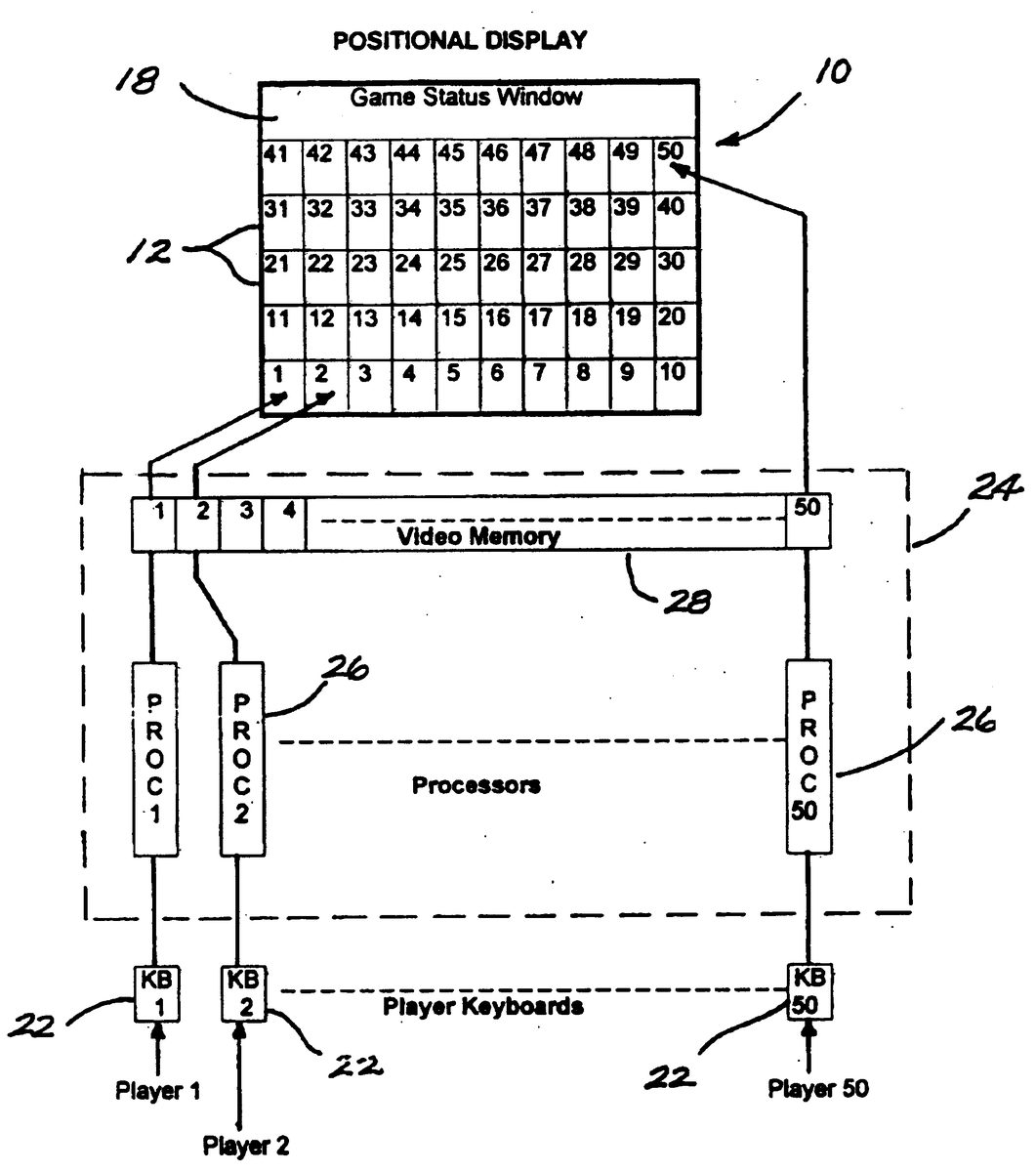
FIGS. 5 and 6a-6bshow alternative preferred hardware implementations of the common information display10wherein the individual participant windows12are associated respectively with the positions or locations of participants in a room at the game site (FIG.5), or with the relative ranking of participants according to their individual progress toward winning the game (FIGS. 6aand6b). In these examples, the display is implemented using simultaneous multiple processors or computer-like devices (defined as either general or special purpose computer processors or computer-like devices which process data) which may be either contained within the main game computer24as illustrated, or within separate devices suitably linked together to form a composite game processor system.
More particularly,FIG. 5shows a plurality of participant keyboards or input terminals22which are preferably arranged within a room at the game site in rows associated with numbered seats (as shown inFIG. 2) associated with the numbered participant windows12on the information display10. A corresponding number of processors26(“n” processors) are provided such that each participant game window12may be associated with one and only one processor26, and further that a pre-allocated portion of a video memory28(such as a very fast random access memory storage device from which the composite image information will be transferred to the display device) which corresponds to the portion of the display10for a particular participant game window12will be addressable or connected to a specific one of the multiple processors26. For example, in the participant position display arrangement shown inFIG. 5, participant #1's game window12is associated with a first one of the processors26, participant #2's game window12is associated with a second one of the processors26, and so forth for each of the 50 game windows shown on the illustrative display10.
FIG. 6ashows a hardware implementation for a ranking display. In this embodiment, the keyboards22associated with the participants are respectively coupled by a ranking processor30to a specific one the series of processors26according to real-time participant ranking or score as the game proceeds, wherein these processors26are each coupled in turn via the video memory28with a respective one of the participant game windows12. Thus, the game window12associated with the participant having the highest ranking or real-time score may be fixed in position on the information display10, such as the game window12appearing in the upper left corner of the display. In the example shown, the keyboard22associated with participant #1is coupled by the appropriate processor26and portion of the video memory28to a participant game window12associated with the fifth-ranked participant, thereby indicating that participant #1is in fifth position. Similarly,FIG. 6ashows the keyboard22associated with participant #2linked via the appropriate processor26and portion of the video memory28to a participant game window12associated with the tenth-ranked participant, thereby indicating that participant #2is in tenth position. Thus, each participant may, by observing the information display10, view status information for each of the ranked participants and thereby compare his or her own real-time status against the displayed ranked participants to assess his or her chances of winning the game.
FIG. 6billustrates an alternative hardware implementation of the invention for a ranking display. In this embodiment, the participant keyboards22are respectively associated with a corresponding one of the processors26. The ranking processor30in interposed between the bank of individual processors26and the video memory28. The ranking processor ranks the individual participants in real-time as the game progresses, and links each participant to the appropriate portion of the video memory28according to participant ranking. The video memory in turn assigns the information applicable to each participant to the appropriate game window12according to participant ranking. In the example shown, participant #1is coupled to a game window12associated with the fifth-ranked participant, and participant #2is coupled to a game window12associated with the tenth-ranked participant.
Each of the display positions (representing a particular rank) in the memory may be defined according to the needs of a particular game or implementation. For example, inFIGS. 6aand6b, the fifth-ranked participant is shown in the fifth position on the top row of the display windows12. However, other window ranking arrangements can be used, such as arranging the ranked windows in vertical rows.
In the example of speed bingo, the computer24would thus re-analyze and re-arrange the participant windows12after each number is called to update the display by participant rank. In other words, as viewed in the ranked displays ofFIGS. 6aand6b, the particular location of status information for a given participant would float within the display according to the real-time ranking of that participant as the game proceeds. This ranking approach is particularly useful wherein the number of game participants exceeds the number of participant boxes12on the information display10. Persons skilled in the art will appreciate that alternative hardware and/or software configurations may be employed for formulating the display10by participant location (FIG. 5) or by participant ranking (FIGS. 6a-6b). It will be recognized and understood by persons skilled in the art that the referenced video memory28may be located within the system of game controlling processors, or may be located externally of the system such as in a projection device or in a large screen display monitor or the like.
FIGS. 8a-8ecomprise a more detailed flow chart representing computer-based composition of the common information display10as the exemplary speed bingo game proceeds. More specifically,FIG. 8ashows programming of game parameters and/or other suitable configuration of the computer system for initially composing the display10, including determination of the number and size of each participant window12, and the participant status data to be displayed therein. The computer then constructs the array of participant windows12constituting the information display10. The computer is then programmed for suitably interfacing with each participant as by number, account number, seat location, or other relevant participant data. At this juncture, a determination is made regarding the composition of the display10in terms of displaying participant status for all participants according to location in the room at the game site (as viewed inFIGS. 1-2and5), or alternately displaying participant status according to individual participant ranking as the game proceeds (as viewed inFIG. 6aor6b). Thereafter, the participant information is aggregated and displayed by location or rank as shown inFIG. 8b. In this regard, when the display is set to organize the participants by ranking, the initial pre-game display may be blank particularly in the event that the number of participants exceeds the number of participant windows12on the display.
FIG. 8cis a continuation of the flow chart to illustrate operation of the game in coordination with participant input via the keyboards22. As shown, following pre-game set-up of the display as shown inFIGS. 8a-b, the computer receives data and related game preparation requests inputted by each participant and processes that data compose and visually present the common information display10. At the conclusion of the pre-game mode, the game starts (preferably automatically) by computer-generated random selection of the bingo numbers, or by other number selection means such as a conventional ball blower device. In response to this game action (i.e., calling of numbers in a bingo game), the computer reviews the participant cards and updates the display window12applicable to each participant. This process continues repeatedly as the game proceeds to a conclusion.FIG. 8dis a flow chart illustrating computer operation to compile and display participant status information based on participant position or location in a room or the like where the game is played. By contrast,FIG. 8eis a flow chart illustrating computer operation to compile and display participant status information based on real-time ranking of participant scores as the game proceeds.
The display system and method of the present invention beneficially accommodates participation by a large and virtually infinite number of “virtual” participants who do not need to be present at the game site. In this regard, the number of “active” participants who can participate in the game at the game site is inherently subject to physical resource limitations such as room size, the number of accessible participant keyboards22in the room, etc. However, in a computer controlled game environment, other participants may desire to participate without attendance, by permitting computer-generated selection of one or more bingo cards16or the like, and by instructing the computer in advance regarding participation parameters such as the number of games to play, the number of cards16to play in each game, and the wager amounts, etc. Such participation by “virtual” participants beneficially increases the wager pool and thereby increases the prize paid to the winner. Real-time display of game status information for “virtual” participants can be included on the common information display10when the total number of “active” and “virtual” participants does not exceed the number of participants windows12on the display. However, when the total number of participants exceeds the number of participant windows12, the display system may be set to display participant status by ranking as previously described.
In one alternative, the display10can be adapted to show game status information for “active” participants in the array of participant windows12, and to present relevant individual or summary information regarding the participation of “virtual” participants in a special game status window. Examples of such “virtual” participant information could include a listing of the number of participating “virtual” participants, the percentage of total cards in play attributable to “virtual” participants, and/or the percentage of the wager pool attributable to “virtual” participants. Such listing of information regarding “virtual” participants can be incorporated into the status window18(FIG. 1) at the top of the display10, or at any other suitable and convenient location on or in association with the display (such as in the window allocated to participant #50as shown inFIGS. 1-2and5, or as represented by the summary game status window32inFIG. 9d). In the event that a “virtual” participant holds a winning card, such winning card would be displayed within such special status window at the conclusion of a game.
More particularly, and with reference to the flow chart ofFIGS. 9a-9e, a “virtual” participant would be afforded an opportunity to purchase a selected stake in the game from a cashier or computer-operated kiosk terminal or the like (FIG. 9a) positioned an any convenient location at the game site or elsewhere. At the time of purchase, the “virtual” participant would specify his or her game participation by a variety of optional parameters, such as the number of cards to be played, the identification number or sequence of identification numbers for a succession of games to be played, the amount or amounts to be wagered, etc. Game participation could be based upon an account from which wagers would be debited and to which winnings would be credited, with instructions to halt play when the account is depleted, or when a specified amount of winnings are accumulated, or at the conclusion of a prestated time interval. Such participation by each “virtual” participant would be inputted into the game computer24, with the “virtual” participant receiving appropriate documentation or tickets or the like to verify his or her game “stake”.
The computer-based game would then proceed as described previously herein, with numbers randomly selected until each game is concluded by one or more cards16achieving the winning pattern (FIG. 9b). Participant windows12on the common information display10are updated as the game proceeds. At any time during a game or subsequent thereto, a “virtual” participant may access the information display10at the game site or through the use of a remotely positioned display device to monitor his or her status and progress. In this regard, participant terminals may be located at convenient remote positions for access by “virtual” participants who, upon entering an appropriate identification code, could view a display summarizing his or her status inclusive of account debits and credits attributable to concluded game activity (FIG. 9e). When a winner is declared, the computer24identifies the winner (FIG. 9b) on the display10, and then analyzes inputted information for each participant (both “active” and “virtual”) to credit and debit participant accounts. Alternately, it will be appreciated that participant accounts may be credited or debited during the game as each number is called. As viewed inFIG. 9c, in accordance with participant accounts and other limiting parameters inputted by participants, the computer may proceed to cash out and terminate participation by some participants while permitting other participants to participate in the next game in succession.
The game display system and method of the present invention thus provides participants with important and highly relevant information regarding their real-time status in the game, as the game proceeds from beginning to end. The displayed information remains on display in equal detail throughout the entire period of play. The display communicates to all “active” participants their relative game status, or, in the case of a ranking display for large numbers of participants, the game status of a sizable group or subset of participants identified as real-time leaders in game score, so that individual participants can continuously update and assess their chances of winning. Moreover, by displaying this information throughout the game, followed by openly displaying and identifying the game winner or winners, participant confidence in the integrity of the game is enhanced. The game system and method is beneficially adapted for operation by a minimum personnel staff, thereby reducing operator costs.
While the invention has been shown and described in connection with a single large-size common information display10viewable simultaneously by all game participants at the game site, it will be recognized that variations on this display concept may be employed. For example, the display10may alternately or in addition be provided on individual display terminals viewable by the individual participants, or on shared display terminals adapted for viewing by a small number of participants located in the immediate vicinity thereof. Moreover, such additional display terminals for participant viewing can be positioned remote from the game site to accommodate, for example, remote participant participation via internet or other suitable remote connection to the main game computer24. In each case, the display10contains information regarding the real-time game status of each participant by location or position, or a selected relatively large number of leading participants by participant ranking or score. For example, a remote participant could log-on to the game and participate via the internet, viewing his or her status relative to others by means of a remote-participant game status window12. The position of the remote-participant game status window may change during the course of the game with changes in ranking of the remote participant or others.
The invention can be adapted for use in a range of different games of skill or chance and the like, particularly such as alternative bingo games using cards having numbers or the like arranged in different arrays, such as numbers arranged in a predetermined configuration of rows and columns. The invention may also be adapted for other types of games, such as slot machine tournaments wherein multiple participants enter for a fee (“ante”) and compete for a high score which can be measured in terms of monetary winnings. The common information display10of the present invention would be configured to show the real-time status of each participant, or a group of top-ranked participants, as the tournament proceeds. As a result, individual participants could monitor their relative position in the field of participants, and develop game strategies aimed at improving their scores and associated chances of winning.
A variety of further modifications and improvements in and to the invention will be apparent to persons skilled in the art. Accordingly, no limitation on the invention is intended by way of the foregoing description and accompanying drawings, except as set forth in the appended claims.
Claims
- In a computer-based game, a method of compiling and displaying participant game events and status information, said method comprising the steps of: composing a single common information display image to include a plurality of participant windows for visually displaying game events and status information for a respective plurality of participants;updating each of said participant windows in real-time as the game proceeds so that said participant windows show each event of each participant's game in real time, and current status information for each of said plurality of participants;and presenting said single common information display image to said plurality of participants throughout the course of the game on one or more display devices, so that each participant can view all participant's games and monitor individual progress toward winning the game in relation to the progress of other participants;wherein said presenting step comprises presenting said single common information display image for viewing by said participants at a game site;and wherein the game site includes a plurality of participant seats arranged in a predetermined array, and further wherein said composing step comprises arranging said participant windows of said single common information display image in accordance with said predetermined array of participant seats, so that each participant can identify the location and identity of other participants at the game site by viewing said common single information display image.
- The method of claim 1 wherein said updating step further includes the step of indicating a winning participant at the conclusion of the game.
- The method of claim 2 wherein said step of indicating the winning participant comprises visually indicating the winning participant.
- The method of claim 3 wherein said step of indicating the winning participant additionally comprises audibly indicating the winning participant.
- The method of claim 2 wherein said step of indicating the winning participant comprises audibly indicating the winning participant.
- The method of claim 1 wherein said composing step further comprises composing the single common information display image to include a game status window for visually displaying general game status information.
- The method of claim 1 wherein said composing step comprises determining the number and size of participant windows to be included on the single common information display image, and determining the information to be included within each of said participant windows.
- The method of claim 1 further including the step of inputting participant information regarding each participant's participation and stake in the game.
- The method of claim 8 wherein said participant information inputting step comprises entering said participant information via one of a plurality of participant terminals.
- In a computer-based game, a system of compiling and displaying participant status information, said system comprising: computer means for composing a common information display image to include a plurality of participant windows for visually displaying status information for a respective plurality of participants;said computer means including processor means for updating each of said participant windows in real-time as the game proceeds so that said participant windows include current status information for each of said plurality of participants;and display means for presenting said common information display image to said plurality of participants throughout the course of the game, so that each participant can monitor individual progress toward winning the game in relation to the progress of other participants;wherein said display means presents said common information display image for viewing by said participants at a game site, wherein the game site includes a plurality of participant seats arranged in a predetermined array, and further wherein said computer means includes means for arranging said participant windows of said common information display image in accordance with said predetermined array of participant seats, so that each participant can identify the location and identity of other participants at the game site by viewing said common information display image.
- The system of claim 10 wherein said processor means includes means for identifying the winning participant at the conclusion of the game, and further wherein said display means includes means for visually indicating the winning participant at the conclusion of the game.
- The system of claim 10 further including means for audibly indicating the winning participant at the conclusion of the game.
- The system of claim 10 wherein said computer means further composes the common information display image to include a game status window for visually displaying general game status information.
- The system of claim 10 wherein said computer means includes means for composing the common information display image to include a summary status window including information regarding participation in the game by “virtual” participants, and further wherein said display means includes the summary status window on the common information display.
- The system of claim 10 further including participant terminals for inputting to said computer means participant information regarding each participant's participation and stake in the game.
- The system of claim 15 wherein said processor means comprises a plurality of processor units associated individually with each of said participant terminals, and video memory means for coupling said processor units to said display means.
- A computer-based game system, comprising: computer means including means responsive to inputted participant information to open accounts for a plurality of “active” participants and for a plurality of “virtual” participants;a plurality of “active” participant terminals associated respectively with said plurality of “active” participants and each including means for inputting to said computer means participant information regarding the participation and stake in the game for each of said “active” participants;and at least one “virtual” participant terminal including means for inputting to said computer means participant information regarding the participation and stake in the game for each of said plurality of “virtual” participants;said computer means including means for initiating and controlling play of the game in steps and including at least one visual display image on one or more display devices for presenting current status information regarding the progress of the game;said computer means further including means for identifying the winning participant at the conclusion of the game and for visually indicating said winning participant on said at least one visual display at the conclusion of the game;wherein a game site includes a plurality of “active” participant seats arranged in a predetermined array, and further wherein said computer means includes means for composing said display image to include a plurality of “active” participant windows arranged in accordance with said predetermined array of “active” participant seats, so that each “active” participant can identify the location and identity of other “active” participants at the game site by viewing said display image.
- The system of claim 17 wherein said display image includes summary status information for said plurality of “virtual” participants.
Disclaimer: Data collected from the USPTO and may be malformed, incomplete, and/or otherwise inaccurate.