U.S. Pat. No. 6,923,722
GAME SYSTEM AND GAME PROGRAM FOR PROVIDING MULTI-PLAYER GAMEPLAY ON INDIVIDUAL DISPLAYS AND A COMMON DISPLAY
AssigneeNintendo Co., Ltd.
Issue DateSeptember 4, 2003
U.S. Patent No. 6,923,722: Game system and game program for providing multi-player gameplay on individual displays and a common display

Summary:
The ‘722 patent will appeal to all those who love playing multi-player games. It involves a game system that provides individualized maps for each of the different players of a game. For example, if player number one is on the first floor, his map will reflect that while player two on the second floor will have the second floor map. The two maps contain at least one connection point whereby players can switch floors and maps. Whenever one of the players is located in the area of the other player, they will appear on a sub-map. This allows players to find each other or enemies with greater ease.
Abstract:
A game system with a high entertainment value, in which a plurality of player character are played by a plurality of players, and a game program for such a game system are provided. A plurality of individual displays provided to players and a common display commonly provided to all players are provided. Each player character is moved between a first game map and a second game map upon satisfaction of a predetermined condition. A player character located on the first game map and at least a part of the first game map are displayed on the common display. A player character located on the second game map and at least a part of the second game map are displayed on an individual display provided to a player operating that player character.
Illustrative Claim:
1. A game system to be played by a plurality of players, the game system including a plurality of operating mechanisms provided to the players, a plurality of individual displays provided to the players, and a common display commonly provided to the players, wherein a plurality of player characters appearing on game maps are controlled by each corresponding player operating each corresponding operating mechanism, the game system comprising: first game map data storage locations which store data for displaying a first game map; second game map data storage locations which store data for displaying at least one second game map; an inter-game-map movement control processing mechanism which moves the player characters individually between the first game map and the second game map upon satisfaction of a predetermined condition; common display control processing mechanism which displays player characters located on the first game map and at least a part of the first game map on the common display; and individual display control processing mechanism which displays a player character located on the second game map and at least a part of the second game map on an individual display provided to a player operating the player character located on the second game map.
Illustrative Figure
Abstract
A game system with a high entertainment value, in which a plurality of player character are played by a plurality of players, and a game program for such a game system are provided. A plurality of individual displays provided to players and a common display commonly provided to all players are provided. Each player character is moved between a first game map and a second game map upon satisfaction of a predetermined condition. A player character located on the first game map and at least a part of the first game map are displayed on the common display. A player character located on the second game map and at least a part of the second game map are displayed on an individual display provided to a player operating that player character.
Description
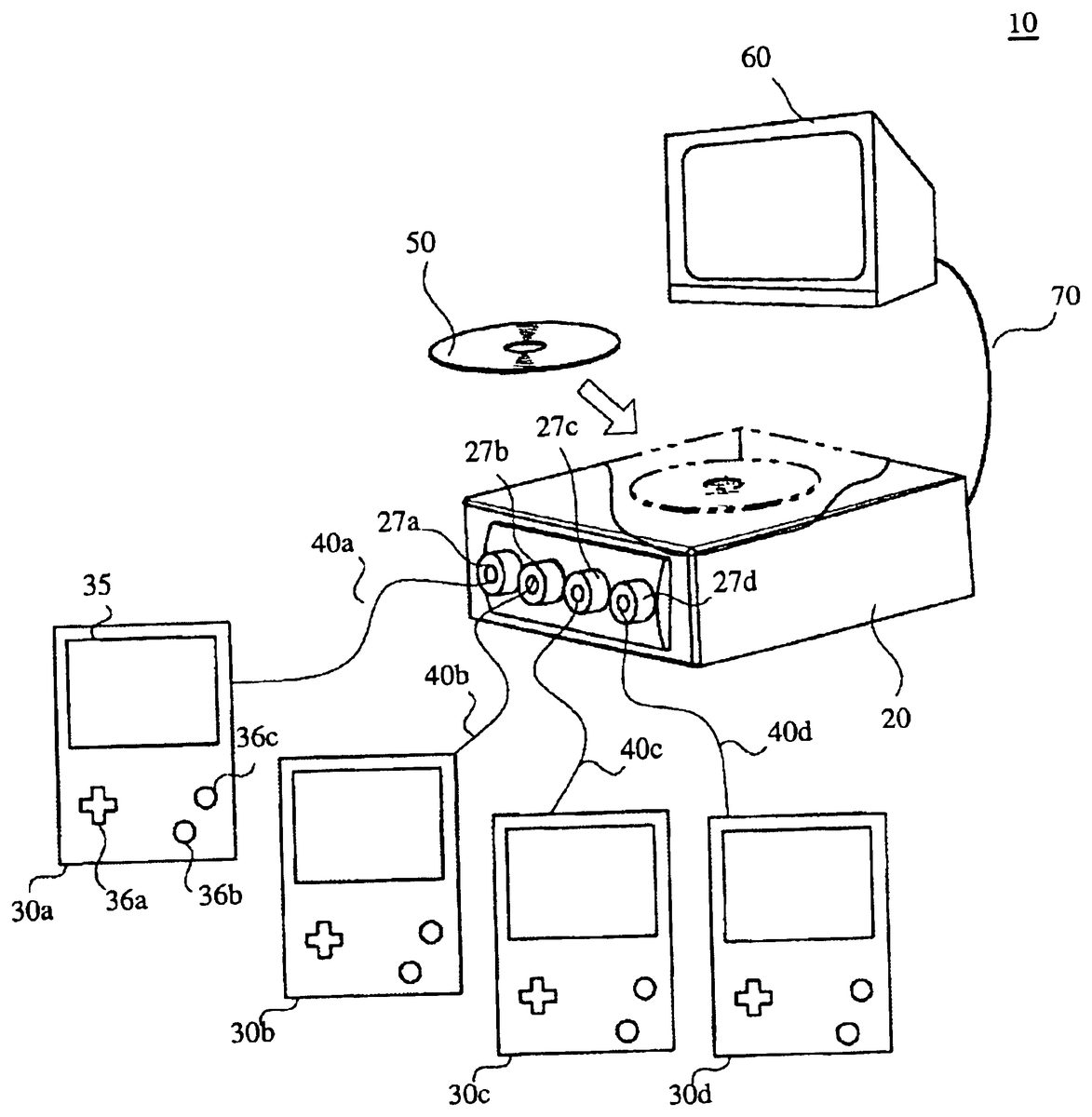
DESCRIPTION OF EXEMPLARY NON-LIMITING EMBODIMENTS FIG. 1is an external view of a game system10according to one present exemplary non-limiting embodiment. The game system10includes a first game machine20, second game machines30athrough30d, cables40athrough40dconnecting the first game machine20and each of the second game machines30(30athrough30d), a DVD50, a television monitor60, and a cable70for connecting the first game machine20and the television monitor60to each other. The first game machine20is a fixed-type game machine. The second game machines30athrough30dare portable-type game machines. The first game machine20has four connectors27(27athrough27d) each connectable to a game controller not shown. The game machines30athrough30dare connected via the cables40athrough40dto these connectors27athrough27d, respectively. The first game machine20has exchangeably inserted therein the DVD50. Video and audio outputs from the first game machine20are produced via the cable70to the television monitor60. The second game machines30athrough30deach include an LCD35and operation switches36athrough36c. FIG. 2is a block diagram illustrating the game system10. The first game machine20includes a CPU21, RAM22, an image processing unit23, a DVD drive25, and a communication interface26, which are connected to each other via a bus. Furthermore, the image processing unit23has connected thereto an encoder24, from which a video signal is output via the cable70to the television monitor60. Still further, the communications interface26includes an operation data buffer261connected via connectors27athrough27dand the cables40athrough40dto the second game machines30athrough30d. Note that the image processing unit23is not necessarily required, and its function can be achieved by the CPU21. The DVD50has stored therein a game program and game data for the first game machine20band a game program and game data for the second game machines30. The game program and game data are read by the DVD drive25when appropriate, and are then stored in the RAM22. The CPU21executes a game process based on the data stored in an area of the RAM22. Game data resulting from the execution of the game process by the CPU21is ...
DESCRIPTION OF EXEMPLARY NON-LIMITING EMBODIMENTS
FIG. 1is an external view of a game system10according to one present exemplary non-limiting embodiment. The game system10includes a first game machine20, second game machines30athrough30d, cables40athrough40dconnecting the first game machine20and each of the second game machines30(30athrough30d), a DVD50, a television monitor60, and a cable70for connecting the first game machine20and the television monitor60to each other. The first game machine20is a fixed-type game machine. The second game machines30athrough30dare portable-type game machines. The first game machine20has four connectors27(27athrough27d) each connectable to a game controller not shown. The game machines30athrough30dare connected via the cables40athrough40dto these connectors27athrough27d, respectively. The first game machine20has exchangeably inserted therein the DVD50. Video and audio outputs from the first game machine20are produced via the cable70to the television monitor60. The second game machines30athrough30deach include an LCD35and operation switches36athrough36c.
FIG. 2is a block diagram illustrating the game system10. The first game machine20includes a CPU21, RAM22, an image processing unit23, a DVD drive25, and a communication interface26, which are connected to each other via a bus. Furthermore, the image processing unit23has connected thereto an encoder24, from which a video signal is output via the cable70to the television monitor60. Still further, the communications interface26includes an operation data buffer261connected via connectors27athrough27dand the cables40athrough40dto the second game machines30athrough30d. Note that the image processing unit23is not necessarily required, and its function can be achieved by the CPU21.
The DVD50has stored therein a game program and game data for the first game machine20band a game program and game data for the second game machines30. The game program and game data are read by the DVD drive25when appropriate, and are then stored in the RAM22. The CPU21executes a game process based on the data stored in an area of the RAM22. Game data resulting from the execution of the game process by the CPU21is stored in another area of the RAM22. The image processing unit23generates display data based on the data generated by the CPU21and then stored in the RAM22, and then outputs the generated display data to the encoder24. The encoder24outputs a video signal via the cable70to the television monitor60.
Data to be transmitted from the first game machine20and the second game machines30athrough30dis output from the CPU21via the communications interface26, the connectors27athrough27d, and the cables40athrough40d. Data to be transmitted from the second game machines30athrough30dto the first game machine20is output to the CPU21via the cables40athrough40d, the connectors27athrough27d, and the communications interface26. Operation data of the operation switches36of each of the second game machines30athrough30dis transmitted via the cables40athrough40dand the connectors27athrough27d, respectively, for storage in the operation data buffer261.
Each of the second game machines30includes a CPU31, RAM32, an image processing unit33, the operation switches36, and a communications interface37, which are connected to each other via a bus. Furthermore, the image processing unit33has connected thereto an LCD driver34, to which the LCD35is connected. Still further, the communications interface37is connected via the connector38and the cable40to the first game machine20.
Of the data stored in the DVD50, the game program and game data for the second game machines30is read by the first game machine20, transferred to the second game machines30, and is then stored in an area of the RAM32. The CPU31reads the game program and game data stored in the RAM32for execution of a game process. At this time, game data newly generated by the CPU31is stored in another area of the RAM32. The image processing unit33generates display data based on the data generated by the CPU31and then stored in the RAM32, and then outputs the generated display data to the LCD driver34. The LCD driver34drives the LCD35for image display. Data to be transmitted to the first game machine20is transmitted from the CPU31via the communications interface27, the connector38, and the cable40. Also, data to be transmitted from the first game machine20is received by the CPU31via the connector38and the communications interface37. Note that the image processing unit33is not necessarily required, and its function can be achieved by the CPU31.
Furthermore, the second game machines30athrough30dhave the same structure.
An outline of a game executed in the above-described game system is illustrated inFIGS. 3 through 6, andFIGS. 7A and 7B. This game proceeds with the use of a ground map as a main map, and a dungeon map, a house map, and a castle map as sub-maps, in a manner such that an operation of the control switches36by each players controls the movement of each player character so that the player character is appropriately moved among the main map and the sub maps to beat an enemy character or get an item.
Each player is given a second game machine30. Since the second game machine30is provided with the LCD35, each player has his or her own screen (LCD35). In the present embodiment, it is assumed that there are four players (players a through d) and four player characters110athrough110d. The player a operating the player character110ais given the second game machine30a. The player b operating the player character110bis given the second game machine30b. The player c operating the player character110cis given the second game machine30c. The player d operating the player character110dis given the second game machine30d. Each player operates the operation switches36of his or her second game machine30to control his or her own player character. The state of the main map is displayed on the television monitor60. The state of a sub map is displayed on the LCD35of each second game machine30.
While the player character is located on a sub map, the screen (LCD35) dedicated to the player operating the player character has displayed thereon the sub map including the player character. While the player character is located on the main map, the screen (LCD35) dedicated to the player operating the player character may be blank, or may have displayed thereon a sentence such as “the character is on the ground map” or “the character is being displayed on the television monitor”.
To view the state of the main map (while the player character is located on the main map, for example), each player plays the game as viewing the television monitor60. While the player character is located on a sub-map when the player desires to view the state of the sub-map, the player plays the game as viewing a display on the LCD of his or her own second game machine30.
Each player character is displayed on the television monitor60while it is located on the main map. When the player character moves from the main map to a sub-map, the player character disappears from the television monitor60, and appears instead on the screen (LCD35) dedicated to the player operating that player character. When the player character moves from the sub-map to the main map, the player character disappears from the LCD35, and appears instead on the display monitor60.
FIG. 3is an illustration showing the ground map100, which is an example of a first game map. The ground map is a map mainly used for playing the game. Therefore, in the following description, the ground map is also referred to as a main map. The ground map100is extended as shown inFIG. 3, having placed thereon the player characters110athrough110d(inFIG. 3, all player characters are on the ground map), an enemy character120, dungeon-map entrances130aand130bto a dungeon map, which is one example of connecting points, a house-map entrance130cto a house map, which is another example of connecting points, a castle-map entrance130dto a castle map which is still another example of connecting points, a house object140a, and a castle object140b. The player characters110athrough110dand the enemy character120are objects moving on the ground map. The connecting points130athrough130d, the house object140a, and the castle object140bare unmoving objects fixed to each predetermined point on the ground map.
This ground map is displayed on the television monitor60, but not entirely. That is, a partial area is set as a display area150, and a part of the ground map within the display area150and various objects including player characters placed on that part of the ground map are displayed on the television monitor60.
Taking a predetermined point on the ground map as an origin, ground map coordinates are set. In the example ofFIG. 3, the ground map coordinates are two-dimensional coordinates. When the ground map is a three-dimensional map, the ground map coordinates are three-dimensional coordinates.
The television monitor60displays an area surrounding the player characters110. Therefore, the display area150can move as the player characters110move, which is illustrated in FIG.4. As the player characters110athrough110dmove in a lower-right direction on the ground map, the display area150moves in the lower-right direction accordingly.
Furthermore, the television monitor60displays all player characters110located on the ground map. Therefore, when the player characters110move in different directions to become distanced far apart from each other, the display area150becomes enlarged as illustrated in FIG.5. With such enlargement of the display area150, all player characters110located on the ground map are displayed on the television monitor60. Conversely, when the player characters110become less distanced apart from each other, the display area150is reduced. Note that the ground map and various objects thereon are displayed so as to become smaller when the display area150is enlarged, while they are displayed so as to become larger when the display area150is reduced.
FIG. 6is an illustration showing a dungeon map200, which is one example of a second game map.FIG. 6illustrates a state of the dungeon map200changed from the state illustrated inFIG. 3after the player characters110athrough110chave moved thereto. In this state, the dungeon map200has placed thereon the player characters110aand110c, the enemy character120, and a ground-map entrance230ato the ground map. The player characters110and the enemy character120are moving objects, while the ground-map entrance230ais an unmoving object fixed to a predetermined point on the dungeon map.
The dungeon map is displayed on screens (LCDs35) dedicated to the players operating the player characters located on that dungeon map. Here, what is displayed on each LCD35is not the entire dungeon map, but only a part thereof. In the state illustrated inFIG. 6, an area240acovering a certain area surrounding the player character110ais displayed on the screen (LCD35of the second game machine30a) dedicated to the player a operating the player character110a. Also, an area240ccovering a certain area surrounding the player character110cis displayed on the LCD35of the second game machine30cdedicated to the player c operating the player character110c. The display area240moves as the corresponding player characters move. However, the size of the display area does not have to be changed.
Taking a predetermined point on the dungeon map as an origin, dungeon map coordinates are set. In the example ofFIG. 6, the dungeon map coordinates are two-dimensional coordinates. When the dungeon map is a three-dimensional map, the dungeon map coordinates are three-dimensional coordinates. The origin of the dungeon map corresponds to a predetermined point on the ground map. For example, the origin of the dungeon map corresponds to a point (20, 10) on the ground map (that is, X=20, Y=10). With this correspondence, it is possible to relate points on the dungeon map to points on the ground map. That is, in this example, a point (Xd, Yd) on the dungeon map corresponds to a point (Xd+20, Yd+10).
The structures of the house map and the castle map are similar to that of the dungeon map, and therefore are not described herein.
When the player character110on the ground map comes to the dungeon-map entrance130aor130b, the player character110moves to the dungeon map illustrated in FIG.6. Also, when the player character110on the dungeon map comes to the ground-map entrance230a, the player character110moves to the ground map illustrated in FIG.3.
Specifically, a process of moving upon coming to a connecting point is performed with reference to tables ofFIGS. 7A and 7B.FIG. 7Ais a table which defines points on the sub-maps to which the player character110moves upon coming to connecting points on the ground map. That is, the player character110moves from the ground map to any one of the sub-maps in accordance with this table. Specifically, upon coming to the point130aon the ground map, the player-character110moves to the point230aon the dungeon map. Upon coming to the point130b, the player character110moves to a point represented by coordinates (X1, Y1) on the dungeon map. Furthermore, this table is referred to when the player character110comes to the house-map entrance130cor the castle-map entrance130dfor moving to the corresponding point on the house map or the castle map.
FIG. 7Bis a table that defines points on the ground map to which the player character moves upon coming to connecting points on sub-maps. That is, the player character110moves from a sub-map to the ground map in accordance with this table. Specifically, upon coming to the point230aon the dungeon map, the player character110moves to the point130a. Furthermore, this table is referred to when the player character110comes to a connecting point on the house map or the castle map for moving to the corresponding point on the ground map. Note that the player character can move from the point130bto the dungeon map, but cannot return to the point130bafter moving from the point130bto the dungeon map.
FIG. 8is an illustration showing examples of game images displayed on a television monitor60and LCDs35of the second game machines30athrough30d. The television monitor60displays a partial area of the ground map100(an area surrounding player characters located on the ground map) as a display area. Specifically, all player characters located on the ground map (inFIG. 8, the player characters110band110d) are displayed. Furthermore, of the enemy characters120located on the ground map, an enemy character120located within the display area is displayed. Still further, of other objects (objects other than player characters and enemy characters) located on the ground map, an object located within the display area (inFIG. 8, the dungeon-map entrance130a) is displayed. Still further, a part of the ground map within the display area is displayed.
Also, the television monitor60may display marks150aand150cat locations on the ground map that correspond to the locations of player characters on a sub-map (inFIG. 8, the player characters110aand110c, respectively). These marks150make it possible to achieve image representations such that the player characters located on the sub-map can be transparently viewed from the ground map (or such that the player characters located on the sub-map cast their shadows on the ground map). As described above, the locations on the ground map that correspond to those on the sub-map are calculated based on the correspondence of map coordinates. The mark150ais a mark indicative of a location on the ground map corresponding to the location of the player character110alocated on the dungeon map. Similarly, the mark150cis a mark indicative of a location on the ground map corresponding to the location of the player character110clocated on the dungeon map.
Regarding the player characters110located on the sub-map (inFIG. 8, the player characters110aand110c), the screens dedicated to the players operating these player characters (inFIG. 8, the LCDs35of the second game machines30aand30c) each display the corresponding player character, a part of the dungeon map within an area surrounding the player character, and, any enemy character, any other player characters, and any other objects within that area.
The screens dedicated to the players operating the player characters on the ground map (inFIG. 8, the player characters110band110d), that is, the LCDs of the second game machines30band30dinFIG. 8, do not display anything.
InFIG. 8, the player characters110aand110care located on the same sub-map (dungeon map). Alternatively, the player characters can be located on different sub-maps. For example, the player character110acan be located on the dungeon map, while the player character110ccan be located on the castle map. In this case, the LCD35of the second game machine30adisplays the dungeon map, while the LCD35of the second game machine30cdisplays the castle map.
Furthermore, inFIG. 8, when the player characters110aand110care coming close to each other within a predetermined distance on the dungeon map, the LCD35of the second game machine30amay display the player character110c, while the LCD35of the second game machine30cmay display the player character110a.
Still further, inFIG. 8, when the player character110bmoves to the dungeon-map entrance130a, the player character110bdisappears from the television monitor60, and then appears on the LCD35of the second game machine30btogether with the dungeon map.
Still further, inFIG. 8, when the player character110amoves to the ground-map entrance230aillustrated inFIG. 6, the player character110adisappears from the LCD3of the second game machine30a, and then appears on the television monitor60.
FIG. 9shows flowcharts for processes of programs executed on the first game machine20and each of the second game machines30. A flowchart shown on left inFIG. 9shows a process of a program executed by the CPU21of the first game machine20, while a flowchart shown on right therein shows a process of a program executed by the CPU31of each of the second game machines30.
InFIG. 9, when the first game machine20is powered on, an initializing process is performed. Then, in step S1, the game program and game data for the second game machines (for example, sub-map data) is read from the DVD50, and is then transmitted to the second game machines30. Subsequent to step S1, in step S3, the type of the player character is determined for each second game machine30. Then, in step S5, the determined type of the player character is transmitted to the respective second game machines30. Subsequent to step S5, it is determined in step S7whether all of the second game machines30athrough30dhave been processed in steps S1to S5. If they have not yet been processed, the procedure returns to step S1for processing a second game machine30not yet processed. That is, by repeating a series of steps S1to S7, the game program and game data for all of the second game machines30athrough30dare transmitted, and the type of the player character of each of the second game machines30athrough30dare determined and then transmitted. Then, the procedure goes to step S9.
In step S9, the game program and game data (for example, ground map data) for the first game machine is read from the DVD50, and is then stored in the RAM22. Subsequent to step S9, in step S11, a game process is executed, which will be described further below with reference toFIGS. 10 and 11.
InFIG. 9, when the second game machine30is powered on, an initializing process is performed. Then, in step S21, a process of receiving the game program and game data for the second game machines transmitted in the above-described step S1from the first game machine20, and storing the received program and data in the RAM32is performed. Subsequent to step S21, in step S23, a process of receiving the type of the player character transmitted in the above-described step S5from the first game machine20is performed. Subsequent to step S23, in step S25, each of the second game machines30athrough30dcauses its own LCD to perform a displaying process for presenting the type of the player character received in step S23to the player. Specifically, a name of the type of the player character, an image of the player character, and colors representing the player character are displayed to present, to the player, the type of the character which the player is going to operate. Subsequent to step S25, in step S27, a game process is performed, which will be described further below with reference to FIG.12.
FIGS. 10 and 11is a flowchart showing the game process preformed in the above-described step511ofFIG. 9by the CPU21of the first game machine20. In this game process, first in step S101, the CPU21reads operation data of a second game machine30x(first, a process is performed for a case where x=a, that is, operation data of the second game machine30ais read, then x=b, x=c, and x=d. Hereinafter, descriptions are made for an example where x=a). Subsequent to step S101, it is determined in step S103whether the operation data read in step S101is operation data of the cross key (the operation switch36ain FIG.1). If the read operation data is the operation data of the cross key, the procedure goes to step S105, wherein a control of the movement of the player character a is performed based on the operation data. Specifically, a process of moving the player character upward, downward, rightward, or leftward on the game map, in accordance with an upward, downward, rightward, or leftward operation of the cross key. If the read operation data is not the operation data of the cross key, the procedure goes to step S119.
Subsequent to step S105, it is determined in step S107whether the player character a has come to a connecting point on the ground map (for example, the dungeon-map entrance130ain FIG.3). If the player character a has come to a connecting point, the procedure goes to step S109, wherein a sub-map to which the player character is to move is determined with reference to the tables ofFIG. 7Ato move the player character a to the corresponding point on the sub-map. Subsequent to step S109, in step S111, a process of instructing the second game machine30ato start processing and transmitting the type of the destination sub-map determined in step S109to the second game machine30ais performed. If the player character a has not come to a connecting point or Subsequent to step S11, the procedure goes to step S113.
In step S113, it is determined whether the player character a has come to a connecting point on the sub-map (for example, the ground-map entrance230ain FIG.6). If the player character a has come to a connecting point, the procedure goes to step S115, wherein the corresponding point on the ground map to which the player character is to move is determined with reference to the tables ofFIG. 7Bto move the player character a to the corresponding point is performed. Subsequent to step S115, in step S117, a process of instructing the second game machine30ato end processing is performed. If the player character a has not come to a connecting point or Subsequent to step S117, the procedure goes to step S119.
In step S119, it is determined whether the operation data read in step S101is the operation data of the A button (the operation switch36bin FIG.1). If the read operation data is the operation data of the A button, the procedure goes to step S121, wherein it is determined whether the player character a is located on the ground map. If the player character a is located on the ground map, the procedure goes to step S123, wherein it is determined whether any other character (any other player character or any enemy character) is located at the corresponding point on any sub-map. If it is determined that any other character is located at the corresponding point, the procedure goes to step S125, wherein a process of damaging that character (impairing its life, which is one of its attributes) is performed. If it is determined in step S119that the operation data is not the operation data of the A button, if it is determined in step S121that the player character a is not located on the ground map, if it is determined in step S123that no other character is located, or Subsequent to step S125, the procedure goes to step S127.
If the player character a is located on the sub-map when the A button is operated, a process of damaging the other character located at the corresponding point on the ground map may be performed.
In step S127, it is determined whether the process of step S101to S125has been performed on all of the second game machines30athrough30d. If any one of the second game machines has not yet been processed, the procedure returns to step S101for processing that unprocessed second game machine (the process is performed with x=a, then x=b, x=c, and x=d).
If it is determined in step S127that all of the second game machines30athrough30dhave been processed, the procedure goes to step S129ofFIG. 11, wherein a process of controlling the movement of the enemy character is performed. The movement of the enemy character is automatically controlled based on a predetermined algorithm defined in the game program. Subsequent to step S129, it is determined in step S131whether a player character x (first, a process is performed for a case where x=a, then x=b, x=c, and x=d. Hereinafter, descriptions are made for an example where x=a) is located on any sub-map. If it is determined that the player character a is located on any sub-map, the procedure goes to step S133, wherein a process of transmitting the location (X and Y coordinates) of the player character a on the sub-map, a location of any other player character on the same sub-map, and a location of any enemy character on the same sub-map to the second game machine30ais performed.
Subsequent to step S133, it is determined in step S135whether the process of steps S131and S133has been performed on all of the player characters a through d. If any of the player characters a through d has not yet been processed, the procedure returns to step S131for processing unprocessed player character (the process is performed with x=b, then x=c and x=d).
If it is determined in step S135that all player characters have been processed, the procedure goes to step S137, wherein a process of setting the location and size of an area of the ground map to be displayed on the television monitor60(the display area150inFIG. 3) is performed. Specifically, the display area is set so as to satisfy both of the following conditions: (1) all player characters located on the ground map are displayed on the television monitor60, and (2) all marks corresponding to the player characters located on any sub-map (the marks150inFIG. 8) are displayed on the television monitor60. Furthermore, specifically, four corners of the display area150are determined based on maximum and minimum values of the X and Y coordinates of the location of the player character on the ground map and the locations on the ground map that correspond to the locations of the player characters on the sub-map.
Subsequent to step S137, in step S139, a process of displaying the player character(s) on the ground map on the television monitor60is performed. Subsequent to step S139, in step S141, a process of transforming the location of the player character located on the sub-map to the corresponding point on the ground map and then displaying the mark150as illustrated inFIG. 8on the television monitor60is performed.
Subsequent to step S141, in step S143, an enemy character located on the ground map within the display area set in step S137is displayed on the television monitor60. Subsequent to step S143, in step S145, other objects located on the ground map within the display area set in step S137are displayed on the television monitor60. Subsequent to step S145, in step S147, the ground map within the display area set in step S137is displayed on the television monitor60. Subsequent to step S147, it is determined in step S149whether or not the game has been cleared or over. If the game has been cleared or over, the game process ends. Otherwise, the procedure returns to step S101ofFIG. 10for repeating the process.
FIG. 12is a flowchart showing the details of the game process performed in the above-described step S27ofFIG. 9by the CPU31of the second game machine30. In this game process, the CPU31first determines in step S201whether a process start instruction to be transmitted in step S111ofFIG. 10from the first game machine20has been received. If such an instruction has not yet been received, the procedure goes to step S203, wherein a process of transmitting the operation data (data of the operation switches36athrough36c) to the first game machine20is performed. That is, until receiving a process start instruction from the first game machine20, the second game machine30merely performs the process of transmitting the operation data to the first game machine30.
If a process start instruction has been received, on the other hand, the procedure goes to step S205, wherein a process of receiving the type of the sub-map transmitted in the above-described step S111ofFIG. 10from the first game machine20and then selecting that sub-map from a plurality of sub-maps (the dungeon map, the house map, and the castle map) is performed. Subsequent to step S205, it is determined in step S207whether a process end instruction to be transmitted in the above-described step S117ofFIG. 10from the first game machine20has been received. If a process end instruction has been received, the procedure goes to step S209, wherein a process of clearing the screen is performed. If a process end instruction has not yet been received, the procedure goes to step S211, wherein a process of transmitting the operation data to the first game machine30is performed. Subsequent to step S211, in step S213, the second game machine30receives the data transmitted in above-described step S133ofFIG. 11, that is, the location of the relevant player character, a location of any other player character on the same sub-map, and a location of an enemy character on the same sub-map.
Subsequent to step S213, in step S215, a certain area centering on the location of the player character on the sub-map is set as a display area (the display area240of FIG.6). Subsequent to step S215, in step S217, the relevant player character is displayed on the LCD35. Subsequent to step S217, in step S219, any other player character, any enemy character, and other objects located on the sub-map within the display area set in step S215are displayed. Further, in step S221, the sub-map within the display area set in step S215is displayed. Subsequent to step S221, it is determined in step S223whether or not the game has been cleared or over. If the game has been cleared or over, the game process ends. Otherwise, the procedure returns to step S201ofFIG. 12for repeating the process.
As has been described above, in the present embodiment, the program for the second game machine as well as the program for the first game machine is stored in the DVD50. Then, prior to start a game process, the program for the second game machine is transferred to the second game machine. Alternatively, the program for the second game machine can be stored in a game cartridge removably inserted in the second game machine.
In the above embodiment, the movement of every player character is controlled by the first game machine20. Alternatively, each second game machine30can control the movement of every player character, and then transmit the control results to the first game machine.
Still further, in the above embodiment, the game system is configured by the first game machine20and the second game machine30. Alternatively, as illustrated inFIG. 13, a controller80having an LCD81is used instead of the second game machine30for configuring the game system. In this case, the image displayed on the LCD35in the above embodiment is displayed on the LCD81. The image data for display on the LCD81is generated by the CPU21of the first game machine20executing a game program (having a function of both the program for the first game machine and the program for the second game machine in the present embodiment). The generated image data is transferred through a cable to the controller80.
While the exemplary embodiments have been described in detail, the foregoing description is in all aspects illustrative and not restrictive. It is understood that numerous other modifications and variations can be devised without departing from the scope of the invention.
Claims
- A game system to be played by a plurality of players, the game system including a plurality of operating mechanisms provided to the players, a plurality of individual displays provided to the players, and a common display commonly provided to the players, wherein a plurality of player characters appearing on game maps are controlled by each corresponding player operating each corresponding operating mechanism, the game system comprising: first game map data storage locations which store data for displaying a first game map;second game map data storage locations which store data for displaying at least one second game map;an inter-game-map movement control processing mechanism which moves the player characters individually between the first game map and the second game map upon satisfaction of a predetermined condition;common display control processing mechanism which displays player characters located on the first game map and at least a part of the first game map on the common display;and individual display control processing mechanism which displays a player character located on the second game map and at least a part of the second game map on an individual display provided to a player operating the player character located on the second game map.
- The game system according to claim 1 , wherein the first game map and the second game map each include at least one connecting point, the connecting point of the first game map corresponding to a predetermined point on the second game map and the connecting point of the second game map corresponding to a predetermined point on the first game map, and the inter-game-map movement control processing mechanism moves, upon arrival of the player character at the connecting point on the first game map, the player character to the predetermined point on the second game map corresponding to the connecting point, and moves, upon arrival of the player character at the connecting point on the second game map, the player character to the predetermined point on the first game map corresponding to the connecting point.
- The game system according to claim 2 , wherein the second game map data storage locations store a plurality of said second game maps, and the connecting point on the first game map corresponds to a predetermined point on any one of the plurality of said second game maps.
- The game system according to claim 1 , wherein the second game map data storage locations store a plurality of said second game maps, and based on a second game map on which a player character is located, the individual display control processing mechanisms select, from the plurality of said second game maps, the second game map on which the player character is located, and causes the selected second game map to be displayed on the individual display provided to a player who operates the player character located on the second game map.
- The game system according to claim 1 , wherein the common display control processing mechanism determines a display range of the first game map so that all player characters located on the first game map can be displayed on the common display.
- The game system according to claim 1 , wherein each point on the first game map corresponds to any one point on the second game map, and the common display control processing mechanism generates a predetermined display of a player character located on the second game map, at a point on the first game map corresponding to a point on the second game map at which the player character is located.
- The game system according to claim 1 , wherein in addition to the player characters, an enemy character appears on at least one of the first and second game maps, each point on the first game map corresponds to any one point on the second game map, and a player character located on the first game map can have an influence on any other player character and an enemy character located on the second game map, and a player character located on the second game map can have an influence on any other player character and an enemy character located on the first game map.
- The game system according to claim 1 , wherein a plurality of portable game machines provided to the players, each portable game machine having an operating mechanism and a display.
- A computer-readable recording medium for recording a game program for a game system to be played by a plurality of players, the game system including a plurality of operating mechanisms provided to the players, a plurality of individual displays provided to the players, and a common display commonly provided to the players, wherein a plurality of player characters appearing on game maps are controlled by each corresponding player operating each corresponding operating mechanism, the game program causing the game system to function as: first game map data storage locations which store data for displaying a first game map;second game map data storage locations which store data for displaying at least one second game map;inter-game-map movement control processing mechanism which moves the player characters individually between the first game map and the second game map upon satisfaction of a predetermined condition;a common display control processing mechanism which displays player characters located on the first game map and at least a part of the first game map on the common display;and individual display control processing mechanism which displays a player character located on the second game map and at least a part of the second game map on individual displays provided to a player corresponding to the player character located on the second game map.
- In a multi-player game system including a plurality of controllers respectively provided to players, a plurality of individual displays respectively provided to the players, and a common display commonly provided to the players, wherein a plurality of player characters appearing on game maps are controlled by each corresponding player operating each corresponding controller, a method of providing game play comprising: displaying any of the player characters located on a first game map and at least a part of the first game map on the common display;displaying a player character located on a second game map and at least a part of the second game map on an individual display provided to a player controlling the player character located on the second game map;and moving the player characters individually between the first game map and the second game map upon that individual player character's satisfaction of a predetermined condition.
- The method as in claim 10 , wherein the first game map includes at least one connecting point corresponding to a predetermined point on the second game map;and the method further comprises moving the player character to the predetermined point on the second game map corresponding to the connecting point of the first game map upon the arrival of the player character at the connecting point of the first game map.
- The method as in claim 11 , wherein the second game map includes at least one connecting point corresponding to a predetermined point on the first game map;and the method further comprises moving the player character to the predetermined point on the first game map corresponding to the connecting point of the second game map upon the arrival of the player character at the connecting point of the second game map.
- The method as in claim 11 , further comprising: storing a plurality of said second game maps, wherein the connecting point on the first game map corresponds to a predetermined point on any one of the plurality of said second game maps.
- The method as in claim 10 , further comprising: storing a plurality of said second game maps;and based on a second game map on which a player character is located, selecting, from the plurality of said second game maps, the second game map on which the player character is located, and displaying the selected second game map on the individual display provided to a player who controls the player character located on the second game map.
- The method as in claim 10 , further comprising determining a display range of the first game map so that all player characters located on the first game map can be displayed on the common display.
- The method as in claim 10 , wherein each point on the first game map corresponds to any one point on the second game map, and the method further comprises generating a predetermined display of a player character located on the second game map at a point on the first game map corresponding to a point on the second game map at which the player character is located.
- In a multi-player video game system including a first controller operable by a first player to control a first player character and having a first individual display, a second controller operable by a second player to control a second player character and having a second individual display, and a common display provided for both the first and second players, a method comprising: displaying on the common display at least a part of a game map and any player character located on the game map;displaying on the first individual display at least a part of a sub-map and the first player character when the first player character is located on the at least part of the sub-map;and controlling inter-game-map movement by moving the first player character between the game map and the sub-map upon satisfaction of a predetermined condition.
- The method as in claim 17 , wherein upon arrival of the first player character at a connecting point on the game map, the first player character is moved from the game map to a corresponding point in the sub-map.
- The method as in claim 17 , wherein upon arrival of the first player character at a connecting point on the sub-map, the first player character is moved from the sub-map to a corresponding point on the game map.
- The method as in claim 17 , further comprising: displaying on the second individual display at least another part of the sub-map when the second player character is located on the at least another part of the sub-map;and controlling inter-game-map movement by moving the second player character between the game map and the sub-map upon satisfaction of a predetermined condition.
- The method as in claim 17 , further comprising: displaying on the second individual display at least part of another sub-map when the second player character is located on the least part of another sub-map;and controlling inter-game-map movement by moving the second player character between the game map and the another sub-map upon satisfaction of a predetermined condition.
- A game system comprising: a plurality of controllers each having an individual display for displaying at least a portion of a sub-map to a player operating that controller;and a game console which is connectable to a common display for displaying a game map to all players, the game console having a processor which executes a videogame program to control inter-game-map movement so that player characters controlled by player operation on respective controllers move from the game map displayed on the common display to a point on the sub-map upon that player character's arrival at a connecting point on the game map and move from the sub-map to a point on the game map displayed on the common display upon that player character's arrival at a connecting point on the sub-map.
- A game system comprising: a first controller having a first individual display for displaying at least a portion of a first sub-map to a player operating the first controller;a second controller having a second individual display for displaying at least a portion of a second sub-map to a player operating the second controller;and a game console which is connectable to a common display for displaying a game map to all of the players, the game console having a processor which executes a videogame program to control inter-game-map movement so that a first player character controlled by player operation on the first controller moves from the game map to the first sub-map upon the first player character's arrival at a connecting point on the game map and moves from the first sub-map to the game map upon the first player character's arrival at a connecting point on the first sub-map, and controls inter-game-map-movement so that the second player character controlled by player operation on the second controller moves from the game map to the second sub-map upon that player character's arrival at another connecting point on the game map and moves from the second sub-map to the game map upon the second player character's arrival at a connecting point on the second sub-map.
Disclaimer: Data collected from the USPTO and may be malformed, incomplete, and/or otherwise inaccurate.