U.S. Pat. No. 6,923,717
ADRENALINE FEATURE FOR SPORTS VIDEO GAMES
AssigneeNintendo of America Inc.
Issue DateSeptember 24, 2001
U.S. Patent No. 6,923,717: Adrenaline Feature for Sports Video Games
Welcome to the first post of our VIDEO GAME PATENTS feature. May we present:
U.S. Pat. No. 6,923,717: Adrenaline Feature for Sports Video Games
Issued August 2, 2005 to Nintendo of America, Inc.
Summary:
The ‘717 patent describes describes various methods of controlling a video game. In addition to all the regular buttons, joysticks, d-pads, thumbsticks, triggers, vibration motors, and other widgets and cogs found on video game controllers, Nintendo now allows the to control a level of virtual “adrenaline” of a player in a video game. A user can control the adrenaline level, e.g., with an analog trigger. When the adrenaline level is high, players in the video game act more aggressively. However, the players’ chance of overreacting also increases when the adrenaline increases. For example, a basketball player is more likely to block a shot if his adrenaline level is high, but the player is also more likely to commit a foul. Nintendo’s adrenaline feature adds more control and realism to sports video games. What’s next? The “steroid” trigger?
Illustrative Claim:
1. A method of controlling game play in a sports video game, wherein a user interactively controls a sports game character in a virtual sports game environment using a game controller, the method comprising:
defining initial character parameters for the sports game character and an opposing sports game character for use during game play, wherein the initial character parameters define play characteristics for the game character and the opposing game character;
detecting user input from at least one control element on the game controller requesting an animated action by the game character;
reading an adrenaline value from an analog control element on the controller indicating a level of aggression desired by the user for the animated action, wherein the analog control element is different from said at least one control element;
adjusting at least one of the initial character parameters for the game character based on the adrenaline value;
performing the animated action by the game character using the at least one adjusted character parameter, wherein the at least one adjusted character parameter is related to the animated action and influences the success or failure of the action depicted by the animated action; and
adjusting at least one of the initial character parameters for the opposing character based on the adrenaline value and performing an animated action by the opposing character at the same time as the same character’s animated action using the adjusted character parameter for the opposing character.
Illustrative Figure
Abstract
A method for controlling game play for use in a video game, wherein a plurality of possible animated actions can be taken by a game character in response to an input from a user provided through a game controller. The method includes: detecting user input from the game controller requesting an animated action by the player; reading an adrenaline value from a control element on the controller indicating a level of aggression desired by the user for the animated action; selecting an animated action from the plurality of possible animated actions based at least in part on the adrenaline value; and performing the selected animated action.
Description
DETAILED DESCRIPTION OF THE PREFERRED EMBODIMENTS The preferred embodiments of the instant invention will now be described with reference to the drawings.FIG. 1shows a videogame console10that can be used to run videogames implementing the adrenaline control feature of the instant invention. While the NINTENDO GAMECUBE video game console is shown inFIG. 1, the invention can be implemented on any suitable game platform capable of running sports games, including PC based games incorporating a game controller. In the videogame console10ofFIG. 1, a memory medium, such as a CD or DVD, is used to store videogame software. The software containing disk or other storage medium is placed in the console for controlling the operation thereof and enabling a desired game to be played on the console. The console preferably includes a graphics co-processor in addition to the central processing unit (CPU) in order to enable fast action games to be played and displayed in a very realistic and exciting manner. The console is typically connected to a display device, such as a television. The game console is also provided with a game controller20for use by the user in controlling the game by providing input to the console10through selective operation of the buttons and other control elements on the controller20. The controller20is preferably connected by wire22to the console via the connection port24, although a wireless connection or any other operable connection may be used. The controller20includes several different buttons that provide various corresponding signals to the game console for use by the game software to control the game in accordance therewith. More particularly, the exemplary controller20ofFIG. 1includes a cluster of four digital buttons26a-26d, two analog buttons28aand28b, a joypad30, a first analog joystick32and a second analog joystick34, as well as other control elements, such as a start/stop button. One of the two analog buttons28aand28bare ...
DETAILED DESCRIPTION OF THE PREFERRED EMBODIMENTS
The preferred embodiments of the instant invention will now be described with reference to the drawings.FIG. 1shows a videogame console10that can be used to run videogames implementing the adrenaline control feature of the instant invention. While the NINTENDO GAMECUBE video game console is shown inFIG. 1, the invention can be implemented on any suitable game platform capable of running sports games, including PC based games incorporating a game controller. In the videogame console10ofFIG. 1, a memory medium, such as a CD or DVD, is used to store videogame software. The software containing disk or other storage medium is placed in the console for controlling the operation thereof and enabling a desired game to be played on the console. The console preferably includes a graphics co-processor in addition to the central processing unit (CPU) in order to enable fast action games to be played and displayed in a very realistic and exciting manner. The console is typically connected to a display device, such as a television.
The game console is also provided with a game controller20for use by the user in controlling the game by providing input to the console10through selective operation of the buttons and other control elements on the controller20. The controller20is preferably connected by wire22to the console via the connection port24, although a wireless connection or any other operable connection may be used. The controller20includes several different buttons that provide various corresponding signals to the game console for use by the game software to control the game in accordance therewith. More particularly, the exemplary controller20ofFIG. 1includes a cluster of four digital buttons26a-26d, two analog buttons28aand28b, a joypad30, a first analog joystick32and a second analog joystick34, as well as other control elements, such as a start/stop button. One of the two analog buttons28aand28bare preferably used to implement the adrenaline feature of the instant invention, as will be explained in detail below.
The instant invention has particular applicability to sports videogames in which a several (or at least two) different actions can be taken in a given situation each having a defined level of adrenaline or aggression. Such games include but are not limited to basketball, baseball, soccer, football and hockey. In accordance with the instant invention, the game software is programmed to respond to signals from the controller20, such that operation of the analog button (e.g., button28a) dictates the amount of aggression that the player's action will have on a play-by-play basis. The remaining buttons preferably operate in a conventional manner to control game play as one skilled in the art will readily understand.
In accordance with the invention, all of the possible actions that a player can take are assigned an aggression or adrenaline level. When the player is ready to take an action, the system looks at the adrenaline button28ato determine how aggressive the user wants to be at that time (from no adrenaline to maximum adrenaline, as well as various levels therebetween). Based on the adrenaline level indicated by the user, a particular action is selected from all of the available actions for the player in that particular situation. Thus, only actions corresponding to the aggression level indicated by the user through operation of the analog button are selected by the system for possible use by the player. If more than one action is available at the indicated aggression level, the software may randomly or otherwise select the particular action from the list of possible actions having the indicated aggression level. In this way, the player can select an action for the player that corresponds to a desired adrenaline or aggression level. As a result, the player can strategically and prudently use the aggression button to balance the advantages of performing very aggressive actions or moves against the potential disadvantages of acting aggressively in the game. As a result, use of the adrenaline button becomes a strategic part of the game and adds a further level of excitement and realism to game play.
The game is preferably programmed so that the more aggressive moves correspond to more exciting animations and, if successful, increase the momentum for the team. In addition, the game preferably provides built-in penalties for using the adrenaline button. For example, use of the adrenaline button when blocking preferably increases the chance of a foul, while also increasing the change of a steal or block. Using the adrenaline button in a baseball game when at bat may, for example, cause a more powerful swing with less accuracy. Using the adrenaline button in a football game may, for example, cause a better block but with an increased chance of causing a penalty flag to be thrown. The adrenaline button may be used for any game where varying degrees of action are defined by the game and a selection between one of the possible actions is made. The adrenaline button is used in the selection of the particular action by the game software.
In accordance with a preferred embodiment of the invention, several different actions are defined for each situation that a player may be in at any given time. For example, in basketball, various dunks may be defined in the game (e.g. 200 different dunks and associated animations) and depending on a variety of parameters, such as how close the player is to the basket, the direction that the player is facing, how fast the player is moving and/or any other suitable parameters, a certain subset of the total possible dunks are determined as being possible for the circumstance that the player is currently in. Unlike conventional games, wherein the software automatically select one of the actions from the list, the instant invention uses output from the adrenaline button to select (or aid in the selection) of the particular action to be performed. Thus, the player can be made to act more or less aggressively depending on the desire of the user by operation of the adrenaline button. More aggressive actions are rewarded with increased momentum and/or exciting animations, while also being more susceptible to negative consequences.
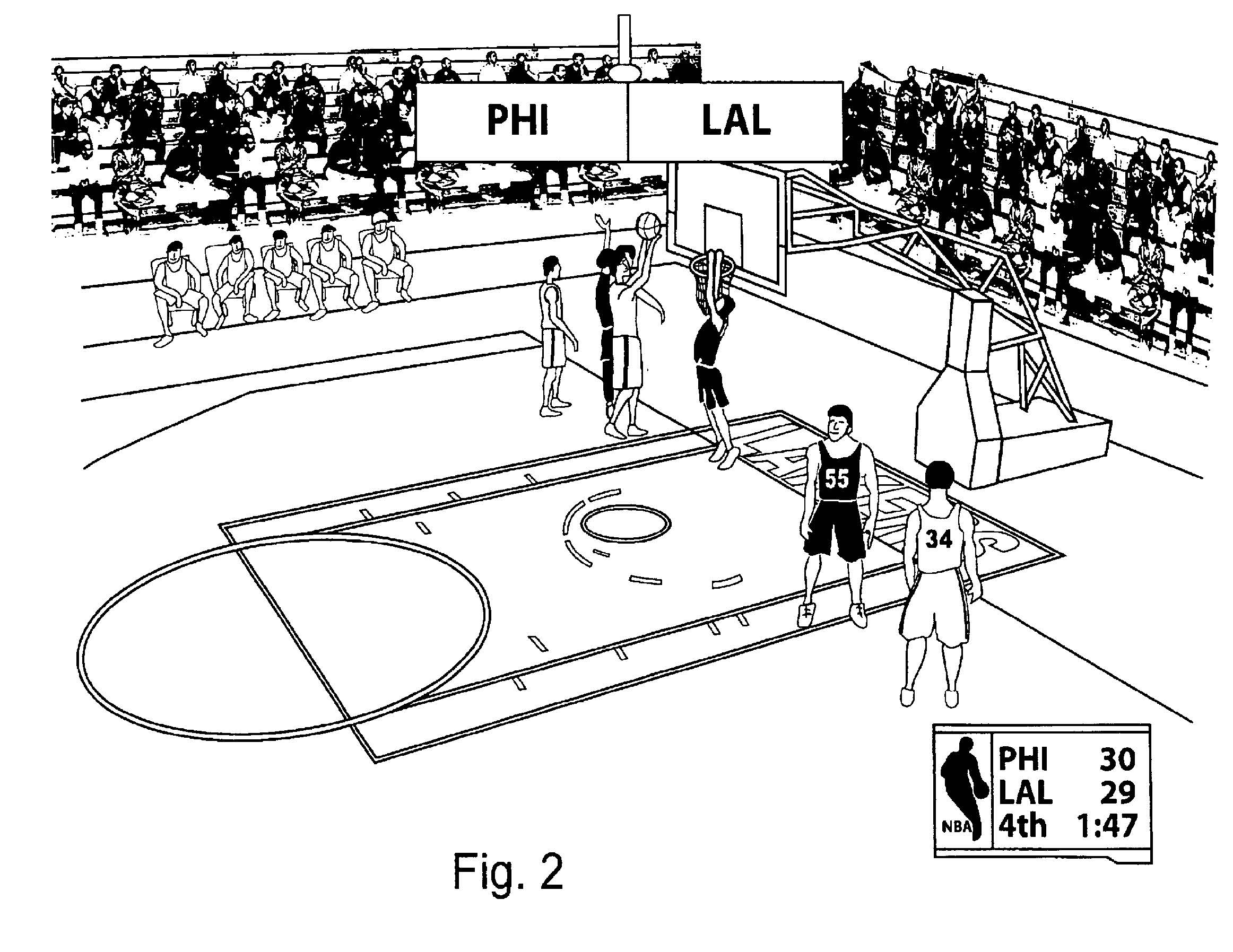
FIG. 2shows an exemplary basketball video game that implements the teachings of the instant invention. InFIG. 2, the defensive player is shown performing a low adrenaline attempted block of the shot by the offensive player. In other words, the defensive player used little or no adrenaline button when blocking. In this situation, the defender may not have wanted to take a chance of causing a foul, thereby acting conservatively.FIG. 3shows the defender making a much more aggressive block attempt, resulting from strong operation of the adrenaline button (i.e. pressing the button down completely or close to completely). With this aggressive block move, there is a higher chance that the defender will block the shot, but also a higher chance for a foul.FIG. 4shows an offensive player making a simple or low adrenaline dunk, as a result of little or no use of the adrenaline button. In contrast,FIG. 5shows a high adrenaline dunk being performed as a result of strong use of the adrenaline button. This dunk has a greater chance of being blocked but also results in exciting animation and increased momentum for the team.FIG. 6shows another low adrenaline dunk being performed as a result of the player deciding not to be aggressive at the time of the dunk (i.e., little or no use of the adrenaline button). In contrast,FIG. 7shows another high adrenaline dunk which, if successful, will increase the teams momentum and/or provide increased excitement for the user. While only basketball shooting and blocking are shown in the drawings, the instant invention can be implemented for any game action that has varying degrees of aggression or the like and is not limited to any particular application. The adrenaline feature provided by the instant invention greatly improves sports games by giving the user greater control over actions of the players and by adding another strategic level to the games, thereby improving the entire game as compared to prior games.
The invention is not limited to any specific types of sports games and can be implemented in any game where varying levels or degrees of action are possible during the game. The invention is particularly advantageous for use in connection with sports videogames with fast action, such as football, baseball, basketball, hockey, soccer and the like, and with a momentum feature that can swing in a teams favor when exciting and aggressive plays are made.
The instant invention is not difficult to implement in a videogame. To implement the invention, the game software can simply be programmed to look at the analog button28a(adrenaline button) for an adrenaline signal when a decision is made as to what action the player will take at a particular time during the game (instead of using a random selection as in prior games). More exciting animations are preferably associated with higher adrenaline plays, so that the game gives an incentive to the user to use the adrenaline button.
While the preferred embodiment of the instant invention uses an analog button (e.g., buttons28aand/or28b), other embodiments are also possible. For example, a digital button (e.g.,26a,26b,26cor26d) could be used to implement the adrenaline feature of the instant invention. The digital button could indicate high or low adrenaline depending on whether or not the digital button is pressed at the time of the play. Of course, this embodiment only allows two levels of aggression or adrenaline. Alternatively, adrenaline button could be implemented such that depending on how long the digital button is pressed determines the particular amount of adrenaline that is used for a particular play, thereby enabling a digital button to be used to indicate numerous different levels of adrenaline (like the analog adrenaline button discussed above). In another alternative embodiment, an analog joystick, such as the secondary analog joystick34ofFIG. 1, can be used as an adrenaline control element. In particular, the amount of inclination of the stick in any direction from its neutral position could be used to set an adrenaline amount for the play by the user. Thus, the invention can be implemented on game controllers that do not have analog buttons (i.e. by using a digital button or an analog joystick).
As can be seen from the foregoing description, the invention greatly enhances sports games by enabling the user to be involved in the decision as to what level of action will be used for a particular play in the game. The invention does not necessarily enable the player to pick the exact move, but instead enables then player to pick what range of move (from low intensity to high intensity) will be used on a play-by-play basis. The invention enables the user to be much more a part of the game, rather than being a bystander during the selection of the player's action (as in prior games).
Below is an example of how the adrenaline button of the instant invention can be implemented in a basketball embodiment. The example below shows how use of the adrenaline button will affect different aspects of game play. The example includes references to ratings percentages and defaults. These numbers are only exemplary and can vary depending on the particular application or desires of the game developers. The “TBD” reference indicates that the particular boost that will be used can vary from one game to another and can be set as desired by the game developers.
EXAMPLE BASKETBALL IMPLEMENTATION
Dunking
Adrenaline Button Not Held:Dunk boost (TBD) added to Momentum Meter on successful dunk.Dunk/lay-up rating drops by 50%.Chance of being called for charge is left at default if collision occurs.Chance of defender being called for a block increases by 30% if collision occurs.Shot block rating of opponent is left at default.
Adrenaline button Held All the way down:Dunk boost (TBD) *3 added to Momentum Meter on successful dunk.Dunk/lay-up rating left at default.Chance of being called for charge increases by 30% if collision occurs.Chance of defender being called for a block is left at default if collision occurs.Increases shot block rating of opponent by 30%.
Special Dribbles
Adrenaline Button Not Held:Special dribble boost (TBD) added to Momentum Meter on successful dribble move.Chance of being called for charge is left at default if collision occurs.Chance of defender being called for a block increases by 30% if collision occurs.Steal rating of opponent is left at default.
Adrenaline Button Held All the way down:Special dribble boost (TBD) *3 added to Momentum Meter on successful dribble move.Chance of being called for charge increases by 30% if collision occurs.Chance of defender being called for a block is left at default if collision occurs.Increases steal rating of opponent by 30%.
Blocking
Adrenaline Button Not Held:Special block boost (TBD) added to Momentum Meter successful block.Chance of being called for foul is left at default.Block rating on opponent is left at default.
Adrenaline Button Held All the way down:Special block boost (TBD) *3 added to Momentum Meter successful block.Chance of being called for foul increases by 30%.Block rating increased by 30%.
Steal
Adrenaline Button Not Held:Steal boost (TBD) added to Momentum Meter on successful steal.Steal rating left at default.Chance of a foul being called left at default.
Adrenaline Button Held All the way down:Special steal boost (TBD) *3 added to Momentum Meter on successful steal.Chance of being called for foul increases by 30% (inversely proportional to steal rating).If foul chance percentage exceeds 80%, call technical foul and play push animation.Chance of stealing the ball from opponent increases by 30%
Shooting
Adrenaline Button Not Held:Shot boost (TBD) added to Momentum Meter on successful shot.Shot rating left at default.Chance of defender being called for a foul left at default.Shot block rating of opponent is left at default.
Adrenaline Button Held All the way down:Shot Boost (TBD) *3 added to Momentum Meter on successful shot.Shot rating increased by 15%.Chance of shot being blocked increases by 30%Chance of defender being called for a foul decreases by 30%.
Rebounding
Adrenaline Button Not Held:Rebound boost (TBD) *3 added to Momentum Meter on successful rebound.Rebound rating is left at default.Chance for loose ball foul is at default.
Adrenaline Button Held All the way down:Rebound boost (TBD) *3 added to Momentum Meter on successful rebound.Rebound rating increases by 30%.Chance of loose ball foul being called increases by 30%.
In the above example, it can been seen that the user will get three times (*3) the dunk boost on the momentum meter when the adrenaline button is pressed all the way as compared to not being pressed at all. The player's dunk/lay-up rating is also decreased by 50% if the adrenaline button is not used. In other words, the player cannot perform to his maximum ability without using the adrenaline button. For example, dunks that require a certain dunk rating for a player may not be possible to perform by the player unless the adrenaline button is used. This rating feature is explained in greater detail below. The chance of being called for a charge also increases when the adrenaline button is used when dunking. The chance of the defender being called for a block (foul) also increases by 30% when the adrenaline button is not used during dunking (if a collision occurs). Similarly, the shot block rating of the opponent is increased by 30% if the adrenaline button is used while dunking. Similar exemplary changes in the parameters of the game can be seen for special dribbles, blocking, steals and shooting in the example above.
In accordance with the invention, the adrenaline feature is preferably implemented to make it not so advantageous offensively or defensively so that the user either never holds it down or always has it pressed all the way down. Instead, the game should be programmed to make it so the user uses this button with discretion and prudently in, for example, a close game, or when the situation is appropriate in the competition that is presented to the user at that time. An example of this would be a player that is dunking on an open breakaway. It makes sense for this user to press the adrenaline button all the way down in this case, because he has an opportunity to substantially boost his momentum and to make a spectacular play with little or no chance of being called for a charge or having his dunk blocked. Conversely, if he holds the button down all the time or uses it to dunk in traffic, it's very likely that he'll be called for a charge and/or have his dunk blocked.
It is also noted that, depending on the action, the particular animation would be different depending on if the button were held down or not, taking into account other factors that will affect the animation, such as which animations are available to which players, where the player is in relation to other players, etc.
It is important to note the adrenaline button is preferably not digital—it is analog, which means there are many more states than “Not Held” and “Held All the Way Down.” So, for each of these actions, for any button position that is in the in between state, the parameters set forth will be scaled accordingly, thereby providing a full range of adrenaline functionality and corresponding affect on the game. For example, if no adrenaline causes a dunk boost of “1” to be added to the momentum meter, and full adrenaline causes a dunk boost of “10” to be added to the momentum meter, the other positions for the adrenaline button can be scaled accordingly (e.g., half way would result in a boost of “5”, three-quarters would give a boost of “7.5”, etc.). Any number of variations in the particular adrenaline result can be used depending on the desires of the game developers.
Below is an example of a dunk/lay-up records used in an exemplary game incorporating the adrenaline button of the instant invention. Within this record is a qualifier labeled “DQ_SHOWTIME(2)”. This is the qualifier used to determine what rating a player will need to have to perform this particular dunk. In this embodiment, the range is from 0 to 5 with 5 being the best. The amount that the user holds the aggression button down will affect the players dunk rating. Thus, the greater the user holds down the button, the greater the aggression indicated, and therefore the greater the players rating will be which allows the player to do better or more spectacular dunks. A similar type of record is provided for all of the other types of moves that are available in the game.
Example Dunk Record−−−−−−−−−−−−−−−−−−−−−−−−−−−−−−−−−−−−−−−−−−−−−−−−−−−−−−−−−−−−−−−−−−−−−−−−−−−−−−−−−−−−−−−−−{DQ_BODY(ANIMBODY_hStandDunk1h180_A18),// iBodyCodefrom AnimBody.hDQ_RATE(DQ_DRM*1.0f),// fBodyRate(float)false,// bBodyFlippedtrue,falsetrue,// bBodyCanFliptrue,falsefalse,// bBouncesBalltrue,falsefalse,// bShootWithLefttrue,falsefalse,// bSpinClockwisetrue,falsefalse,// bBodyEndsInRuntrue,falsefalse,// bExcludeHoopArctrue,falsefalse,// bExcludeFaceArctrue,falseDUNK_SLAM,// iDunkTypeDUNK_HANG,DUNK_SLAM,DUNK_FINGER,DUNK_LAYUPDQ_HEIGHT(0,0),// iArcHeight(feet,inches) or zeroto leave originalDQ_SCALE(0.0f),// iArcScale0 for fixed time to 1for fixed speedDQ_ANGLE(−135),// iMinPlyrToHoopAng(degrees)DQ_ANGLE(−80),// iMaxPlyrToHoopAng(degrees)DQ_RANGE(0,1),// iMinPlyrToHoopDst(feet,inches)DQ_RANGE(4,0),// iMaxPlyrToHoopDst(feet,inches)DQ_ANGLE(DQ_MIN_FACE_HOOP),// iMinPlyrFaceAng(degrees)DQ_ANGLE(DQ_MAX_FACE_HOOP),// iMaxPlyrFaceAng(degrees)DQ_SPEED(DQ_MIN_SD_SPEED,0),// iMinPlyrFaceSpd(feet,inches) per secondDQ_SPEED(DQ_MAX_SD_SPEED,0),// iMaxPlyrFaceSpd(feet,inches) per secondDQ_SKILL(4),// iMinPlyrSkill(0..100)DQ_SIZE(9,0),// iMaxPlyrScale(feet,inches)DQ_PLYR(PID_NOBODY),// iPlyrCodefrom PlayerIDs.hDQ_SHOWTIME(2)// iShowTimeRating0-5},−−−−−−−−−−−−−−−−−−−−−−−−−−−−−−−−−−−−−−−−−−−−−−−−−−−−−−−−−−−−−−−−−−−−−−−−−−−−−−−−−−−−−−−−−
In the example above, the “Showtime” qualifier is set at “2”, which means the player must have a rating of at least “2” to perform this dunk. Thus, depending on the players maximum dunk rating, the player may need to use the adrenaline button to perform this dunk. For example, if the player has a dunk rating of “2”, the player must, in this example, use full adrenaline to perform this dunk. On the other hand, a player with a dunk rating of “5”, he can perform the dunk without any adrenaline being used (assuming that, for example, no adrenaline decreases the players dunk rating by 50%). Thus, in accordance with the preferred embodiment of the instant invention, the adrenaline button determines the types of plays or moves that each player can make, in combination with the players particular ratings for the various possible moves. This features makes the game much more realistic, because to perform at the player's highest level requires high adrenaline to be used. In this way, the user becomes intimately involved in each move the player makes during game play.
FIG. 8ashows a relatively high-level flow chart of the main steps that are performed by one aspect of the preferred embodiment of the instant invention. As seen inFIG. 8a, after the game is started (step180), the system monitors the controller for user input (step182) indicating a desire by the user to cause the player (e.g., basketball player) to respond in some manner within the game environment. If no player action is requested, the system continues to monitor for future user input. When it is detected that the user desires the player to take an action (step184)(e.g., such as shooting the ball), the system reads the current adrenaline value (step186) from the adrenaline button on the controller indicating the desired level of adrenaline requested by the user for that action. The particular action that the player takes is then selected from a plurality of possible actions based at least in part on the adrenaline value detected (step188). The selected action is then performed by the player (step190). If the momentum feature described above is used (step192) in the particular implementation of the invention, then the momentum value for the team (or player) may be adjusted (step194) based at least in part on the adrenaline value used and, possibly, on the outcome or success of the action that was performed. The game play is then continued (step196) and the controller is again monitored for user input (step182). The process then repeats as described above until the game is finished.
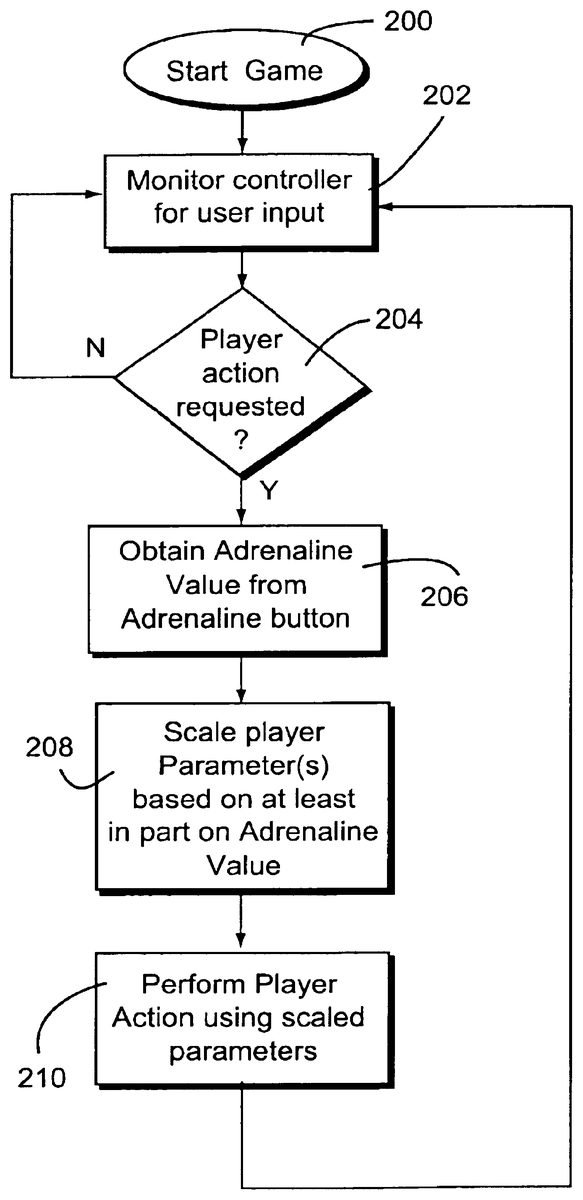
FIG. 8bshows another flow chart illustrating another aspect of the preferred embodiment of the instant invention. As shown isFIG. 8b, after the game is started (step200), the controller is monitored for user input (step202) indicating a desire by the user to have the player take action in the game. When a player action is requested (step204), the system reads the current output of the adrenaline button (step206) on the controller to determine the amount of adrenaline desired by the player for the current action. The adrenaline value is then used to modify or scale player parameters (step208) used in connection with the game to correspond to the particular adrenaline indicated thereby. For example, as indicated above, the players shooting percentage may be increased or decreased accordingly. Any other desired parameters, such as indicated in the example above, may also be adjusted accordingly based on the adrenaline value detected at the time the action is requested. The player then performs the requested action (step210) using the modified parameters and game play continues.
FIGS. 9aand9bshow an exemplary analog button28bon the controller20used as the adrenaline button in accordance with a preferred embodiment of the instant invention.FIG. 9ashows the adrenaline button28bin its low or no adrenaline position, wherein the user is not pressing the button to increased the adrenaline at that time. When the adrenaline button is in this low adrenaline position and an action is requested by the user, the player will act with low adrenaline and the players parameters will be scaled accordingly.FIG. 9bshows the adrenaline button28bon controller20in its high adrenaline position indicating a desire by the user to have the player act aggressively and with an appropriate adjustment in the player's game parameters. Positions of the button28bbetween the low and high levels, as shown inFIGS. 9aand9b, result in a scaled adrenaline value being used based on the relative position of the button28b, thereby giving a wide range of possible adrenaline values for use by the user during game play.
Example Illustrative Implementation
FIG. 10Ashows an example interactive 3D computer graphics system50. System50can be used to play interactive 3D video games with interesting animation provided by a preferred embodiment of this invention. System50can also be used for a variety of other applications.
In this example, system50is capable of processing, interactively in real time, a digital representation or model of a three-dimensional world. System50can display some or the entire world from any arbitrary viewpoint. For example, system50can interactively change the viewpoint in response to real time inputs from handheld controllers52a,52bor other input devices. This allows the game player to see the world through the eyes of someone within or outside of the world. System50can be used for applications that do not require real time 3D interactive display (e.g., 2D display generation and/or non-interactive display), but the capability of displaying quality 3D images very quickly can be used to create very realistic and exciting game play or other graphical interactions.
To play a video game or other application using system50, the user first connects a main unit54to his or her color television set56or other display device by connecting a cable58between the two. Main unit54produces both video signals and audio signals for controlling color television set56. The video signals are what controls the images displayed on the television screen59, and the audio signals are played back as sound through television stereo loudspeakers61L,61R.
The user also needs to connect main unit54to a power source. This power source may be a conventional AC adapter (not shown) that plugs into a standard home electrical wall socket and converts the house current into a lower DC voltage signal suitable for powering the main unit54. Batteries could be used in other implementations.
The user may use hand controllers52a,52bto control main unit54. Controls60can be used, for example, to specify the direction (up or down, left or right, closer or further away) that a character displayed on television56should move within a 3D world. Controls60also provide input for other applications (e.g., menu selection, pointer/cursor control, etc.). Controllers52can take a variety of forms. In this example, controllers52shown each include controls60such as joysticks, push buttons and/or directional switches. Controllers52may be connected to main unit54by cables or wirelessly via electromagnetic (e.g., radio or infrared) waves.
To play an application such as a game, the user selects an appropriate storage medium62storing the video game or other application he or she wants to play, and inserts that storage medium into a slot64in main unit54. Storage medium62may, for example, be a specially encoded and/or encrypted optical and/or magnetic disk. The user may operate a power switch66to turn on main unit54and cause the main unit to begin running the video game or other application based on the software stored in the storage medium62. The user may operate controllers52to provide inputs to main unit54. For example, operating a control60may cause the game or other application to start. Moving other controls60can cause animated characters to move in different directions or change the user's point of view in a 3D world. Depending upon the particular software stored within the storage medium62, the various controls60on the controller52can perform different functions at different times.
As also shown inFIG. 10A, mass storage device62stores, among other things, a sports video game program E that enables an interactive game to be played using the system50and incorporates the adrenaline feature of the instant invention. The details of the preferred embodiment program E will be described shortly. The program E in the preferred embodiment makes use of various components of system50shown inFIG. 10Bincluding:a main processor (CPU)110,a main memory112, anda graphics and audio processor114.
In this example, main processor110(e.g., an enhanced IBM Power PC 750) receives inputs from handheld controllers52(and/or other input devices) via graphics and audio processor114. Main processor110interactively responds to user inputs, and executes a video game or other program supplied, for example, by external storage media62via a mass storage access device106such as an optical disk drive. As one example, in the context of video game play, main processor110can perform collision detection and animation processing in addition to a variety of interactive and control functions.
In this example, main processor110generates 3D graphics and audio commands and sends them to graphics and audio processor114. The graphics and audio processor114processes these commands to generate interesting visual images on display59and interesting stereo sound on stereo loudspeakers61R,61L or other suitable sound-generating devices. Main processor110and graphics and audio processor114also perform functions to support and implement the preferred embodiment program E based on instructions and data E′ relating to the program that is stored in DRAM main memory112and mass storage device62.
As further shown inFIG. 10B, example system50includes a video encoder120that receives image signals from graphics and audio processor114and converts the image signals into analog and/or digital video signals suitable for display on a standard display device such as a computer monitor or home color television set56. System50also includes an audio codec (compressor/decompressor)122that compresses and decompresses digitized audio signals and may also convert between digital and analog audio signaling formats as needed. Audio codec122can receive audio inputs via a buffer124and provide them to graphics and audio processor114for processing (e.g., mixing with other audio signals the processor generates and/or receives via a streaming audio output of mass storage access device106). Graphics and audio processor114in this example can store audio related information in an audio memory126that is available for audio tasks. Graphics and audio processor114provides the resulting audio output signals to audio codec122for decompression and conversion to analog signals (e.g., via buffer amplifiers128L,128R) so they can be reproduced by loudspeakers61L,61R.
Graphics and audio processor114has the ability to communicate with various additional devices that may be present within system50. For example, a parallel digital bus130may be used to communicate with mass storage access device106and/or other components. A serial peripheral bus132may communicate with a variety of peripheral or other devices including, for example:a programmable read-only memory and/or real time clock134,a modem136or other networking interface (which may in turn connect system50to a telecommunications network138such as the Internet or other digital network from/to which program instructions and/or data can be downloaded or uploaded), andflash memory140.
A further external serial bus142may be used to communicate with additional expansion memory144(e.g., a memory card) or other devices. Connectors may be used to connect various devices to busses130,132,142. For further details relating to system50, see for example U.S. patent application Ser. No. 09/723,335 filed Nov. 28, 2000 entitled “EXTERNAL INTERFACES FOR A 3D GRAPHICS SYSTEM” incorporated by reference herein.
As can be seen from the above-description, the invention greatly improves sports video games by enabling the user to determine the level of intensity that a player will have when making a play or move. As a result, the user can use the adrenaline button strategically during the game as the circumstances may dictate. The player is given the ability to weigh the advantages of acting with high aggression with the disadvantages of acting with high aggression, and decide, based on his own reasoning, whether to use or not use the adrenaline button, as well as how much to use the button when the user decides to us it. In this way, sports games are made much more realistic and enjoyable for the users.
While the preferred forms and embodiment of the invention have been described herein, various modifications may be made without deviating from the scope of the instant invention, as one skilled in the art will understand from the description herein. The invention is not limited to the particular controller configuration shown in FIG.1and may be used with any suitable controller, game console and game software.
Claims
- A method of controlling game play in a sports video game, wherein a user interactively controls a sports game character in a virtual sports game environment using a game controller, the method comprising: defining initial character parameters for the sports game character and an opposing sports game character for use during game play, wherein the initial character parameters define play characteristics for the game character and the opposing game character;detecting user input from at least one control element on the game controller requesting an animated action by the game character;reading an adrenaline value from an analog control element on the controller indicating a level of aggression desired by the user for the animated action, wherein the analog control element is different from said at least one control element;adjusting at least one of the initial character parameters for the game character based on the adrenaline value;performing the animated action by the game character using the at least one adjusted character parameter, wherein the at least one adjusted character parameter is related to the animated action and influences the success or failure of the action depicted by the animated action;and adjusting at least one of the initial character parameters for the opposing character based on the adrenaline value and performing an animated action by the opposing character at the same time as the same character's animated action using the adjusted character parameter for the opposing character.
- The method of claim 1 , wherein the sports video game includes a momentum feature that can affect game play, said method further including adjusting a momentum value based at least in part on the adrenaline value that is used for an animated action.
- The method of claim 1 , wherein the sports video game is a basketball game.
- The method of claim 1 , further including adjusting a plurality of character parameters based on the adrenaline value.
- The method of claim 3 , wherein the at least one character parameter includes a shooting percentage for the character.
- The method of claim 3 , wherein the at least one character parameter includes a foul percentage for the character.
- The method of claim 3 , wherein the at least one character parameter includes a blocking percentage for the character.
- The method of claim 1 , wherein the control element is an analog button and adjusting at least one initial character parameter includes scaling the at least one parameter based on a relative position of the analog button at the time the animated action is requested by the player.
Disclaimer: Data collected from the USPTO and may be malformed, incomplete, and/or otherwise inaccurate.