U.S. Pat. No. 6,913,537
RECORDING MEDIUM AND ENTERTAINMENT SYSTEM
AssigneeSony
Issue DateNovember 5, 2002
U.S. Patent No. 6,913,537: Recording medium and entertainment system

Summary:
The ‘537 patent allows a player to advance a game by controlling his character through a key input according to the player’s intentions. Whenever the player selects at least one command, the character acts within its designed permissible range. The permissible range of actions expands as the character increases. The patent also provides for the implication of two or more commands combined into a special command, when the combination of the tow commands meets a predefined requirement.
Abstract:
An entertainment system includes an application program recording system which record an application program which can input at least one command of operation an which the player sets the action of the character on a display screen. The command is stored in an action set frame in the unit of one operation to action set frame used to create the movements of the player character. The system further has an input, operation system where the player inputs instructions and a control system which controls the operation of the player character on the display screen based on the command from the application program recorded by the application program record system and the input operation system.
Illustrative Claim:
1. A recording medium containing a program that allows a player to advance a game by manipulating a selected character displayed on a display screen through a key input according to the player’s intention, wherein said program recorded in the recording medium enables input of at least one command related to an action of said selected character so as to set up the actions of said selected character as a single operation, and wherein said recorded program enables inputs of a plurality of said commands if action points are within the permissible range of action points after said action points corresponding to said action command types are determined.
Illustrative Figure
Abstract
An entertainment system includes an application program recording system which record an application program which can input at least one command of operation an which the player sets the action of the character on a display screen. The command is stored in an action set frame in the unit of one operation to action set frame used to create the movements of the player character. The system further has an input, operation system where the player inputs instructions and a control system which controls the operation of the player character on the display screen based on the command from the application program recorded by the application program record system and the input operation system.
Description
DETAILED DESCRIPTION OF THE PREFERRED EMBODIMENTS Embodiments of the recording medium and entertainment system according to the present invention are explained as follows, referring to the accompanying drawings. This exemplifies a role-playing game device based on the application program recorded in the recording medium according to the present invention, where the player advances in the game by manipulating a character in the virtual world (player character) according to the instructions given. As shown inFIG. 1, the role-playing device10connects a graphic generation system40, a sound generation system50, an application program recorded system60and an input operation system70to a control system30through a system bus (BUS)20. Control system30consists at least of a Central Processing Unit (CPU)31, and RAM33which becomes the main memory. The main memory can at least execute the application program therein. Graphic generation system40has at least an Graphic Processing Unit (GPU)42which draws according to the drawing command from CPU31and a frame buffer43where the image drawn by GPU42is stored. An image generated by the graphic generation system40is displayed on a monitor45. Sound generation system50consists of a Sound Processing Unit (SPU)51, which generates the tone, sound effect, etc., based on the command from CPU31, a sound buffer52, which stores the tone, sound effects, etc., generated by the SPU51, and a speaker53which outputs (pronounce) the tone, sound effects, etc., generated by SPU51. Application program record system60is an example of the recording medium of the present invention, where an application program for manipulating the behaviour of the player character in the virtual world according to the intentions of the player is recorded. Specifically, the recorded application program advances the game while changing the story and the action by making the player create a skill for the player character through key input operation for a situation, for instance, in an ensuing fighting with the enemy character encountered ...
DETAILED DESCRIPTION OF THE PREFERRED EMBODIMENTS
Embodiments of the recording medium and entertainment system according to the present invention are explained as follows, referring to the accompanying drawings.
This exemplifies a role-playing game device based on the application program recorded in the recording medium according to the present invention, where the player advances in the game by manipulating a character in the virtual world (player character) according to the instructions given.
As shown inFIG. 1, the role-playing device10connects a graphic generation system40, a sound generation system50, an application program recorded system60and an input operation system70to a control system30through a system bus (BUS)20.
Control system30consists at least of a Central Processing Unit (CPU)31, and RAM33which becomes the main memory. The main memory can at least execute the application program therein.
Graphic generation system40has at least an Graphic Processing Unit (GPU)42which draws according to the drawing command from CPU31and a frame buffer43where the image drawn by GPU42is stored. An image generated by the graphic generation system40is displayed on a monitor45.
Sound generation system50consists of a Sound Processing Unit (SPU)51, which generates the tone, sound effect, etc., based on the command from CPU31, a sound buffer52, which stores the tone, sound effects, etc., generated by the SPU51, and a speaker53which outputs (pronounce) the tone, sound effects, etc., generated by SPU51.
Application program record system60is an example of the recording medium of the present invention, where an application program for manipulating the behaviour of the player character in the virtual world according to the intentions of the player is recorded. Specifically, the recorded application program advances the game while changing the story and the action by making the player create a skill for the player character through key input operation for a situation, for instance, in an ensuing fighting with the enemy character encountered while the character is walking, for instance, in a forest, a plain, or a town.
Input operating system70is an input device through which the player inputs instructions, and it consists of a control lever and a group of push buttons. In general, it is called the controller in the field of game devices.
When the role-playing game device10is started by the player through the controller, CPU31of control system30reads the application program from the application program record system60through system bus20, stores it in RAM33, and begins execution.
When the execution of the application program is commenced, graphic generation system40generates video signals of the background of this game, the player character, the enemy character, etc. This video signal is output to the monitor45, and the images of the background and the player character, etc., are displayed on the display screen of the monitor45.
Moreover, by the start of the execution of the application program, sound generation system50generates the tone and the sound effects, etc., and the sound is made from speaker53.
When the player operates the control lever and the group of push- buttons of input operation system70, the corresponding commands are input to CPU31through system bus20CPU31controls graphic generation system40as the player character moves on the display screen of monitor device45according to the manipulation of the player. In addition, CPU31controls sound generation system50and various sound effects, tones, etc., are made from speaker53.
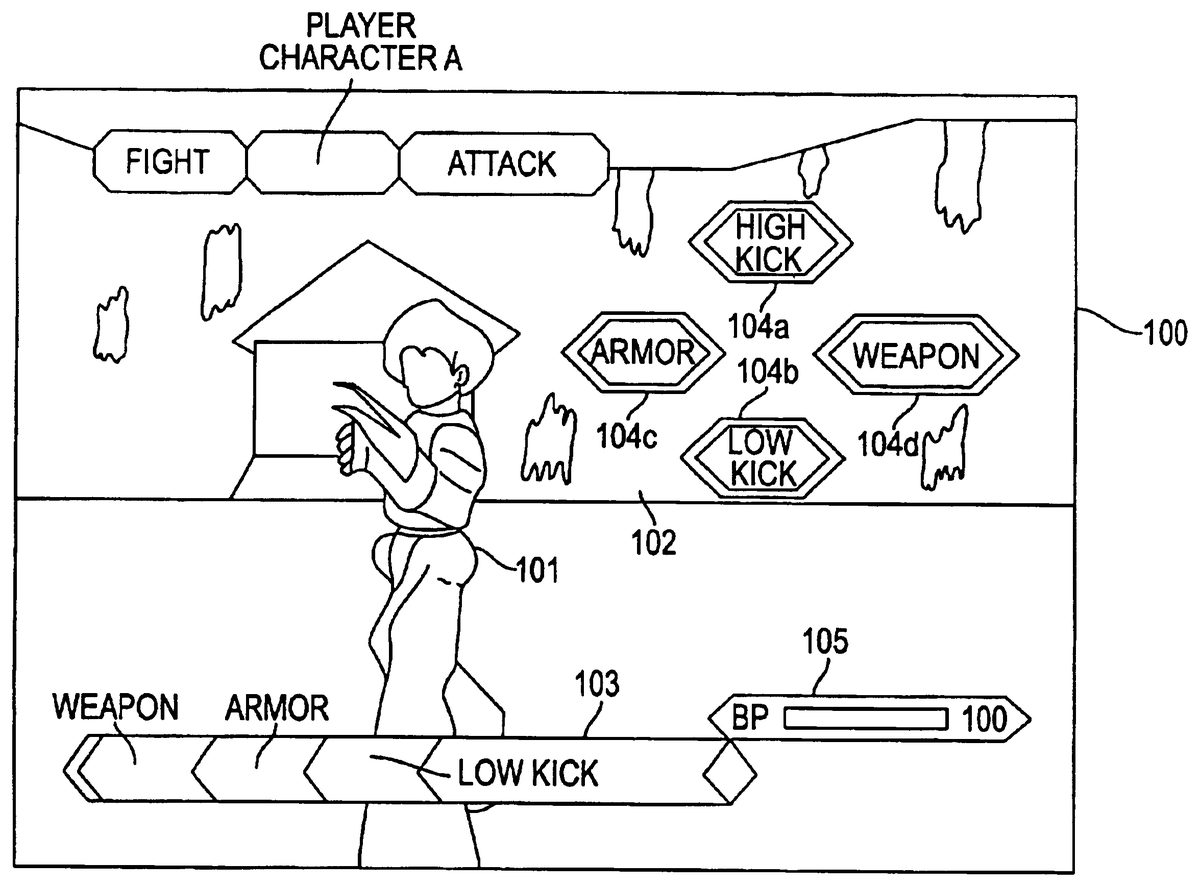
A concrete example of a display screen on monitor device45is shown inFIG. 2. Acommand selection screen is shown in FIG.2. In a display screen100which becomes the command selection screen, a player character101which becomes the simulation character that moves when the player manipulates the input operation system70, a background image102, an action gauge103which becomes the action set frame used to set up the actions of player character101, command selection parts104a,104b,104cand104dwhich are indicating various attack commands selected by the player, are displayed. Furthermore, on display screen100, an judgement gauge105, for kill without fail technique which becomes the judgement criterion on whether the application of the kill without fail technique to be described later is permitted or not, is also displayed.
In the role-playing game device10, the attack action of player character101against the enemy character cannot be defined with the player merely inputting only “Attack” command from the input operation system70. Through input operation system70, display screen100which becomes the command selection screen with command selection parts104a,104b,104cand104ddisplayed is selected, and by combining various commands and setting them up on action gauge103the attack action can be defined.
Here, various commands selected by command selection parts104a,104b,104cand104dhave their own corresponding action points. Moreover, in action gauge103, the total allowable action power allotted to player character101is decided and input of two or more various commands is acceptable if the total of the action points does not exceed the allowed total action power.
The length of action gauge103corresponds to the action power of player character101. For instance, when “100” is given to player character101(hero 1) as an initial value, the length of action gauge103is represented by 100 dots. Moreover, when “120” is given as the initial value to the player character hero 2, although not shown in the figure, the length of action gauge103is made to be 120 dots. Furthermore, when “80” is given to the player character hero 3, also not shown in the figure, as the initial value, the length of action gauge103is set to 80 dots.
The action power which corresponds to the length of this action gauge103keep on rising as shown in the following Table 1 as the level of the player character advances with the progress of the game until it is made to stop when maximum value is reached, for instance at “288”.
TABLE 1LevelHero 1Hero 2Hero 3110012080210612885311213690482742882804928828828550288288288
Parameter, other than the above-mentioned action power can be assigned to the player character, for instance, three ascending type of parameters, namely; “Precocious type”, “Immature type”, and “Ordinary Type”, and random error values, etc.
Moreover, the above-mentioned action power can be raised temporarily by using the “Yell” command during combat and by using special items, for instance, temporarily raised “Action Power”=normal “Action power”×1.4+8. However, when the maximum value of 288 is exceeded, the values more than 288 are truncated.
FIG.3andFIG. 4show the process where the player sets up action power in this fashion on the action gauge103, by setting up above-mentioned various commands through input operation system70using command selection part104a,104b,104cand104d.
The player uses input operation system70and selects the already selected command selection parts104cand104dand after setting up the “Armor” command and “Weapon” command in action gauge103, selects further command selection part104aand sets up “High Kick” command. Its progress is shown in FIG.3. As shown inFIG. 4, finally the command “High Kick” is set up as well in action gauge103.
Here “Armor” is a kind of weapon, and wearing it limits the techniques that can be used. As the action value, for example 25 is decided. For “High Kick” and “Low Kick” actions, each has an action point of 30, whereas 40, for example, is the action point for “Weapon”.
As the total action point of this player character101is 95, which is below the initial value “100” of action gauge103, setting up these commands is recognized. These commands are set up in the action pattern in RAM33list and the command input is terminated.
CPU31reads the said action pattern list in RAM33, and makes the graphic generation system40to generate images corresponding to each of the said commands on action gauge103. On the reproduction screen of monitor device45which becomes the display screen100, the continuous techniques against enemy character A are shown as inFIG. 5,FIG. 6, and FIG.7.
Moreover, in the role-playing game device10, when a predefined condition is met by the arrangement of two or more of above-mentioned commands on action gauge103on display screen100which becomes a command selection screen shown inFIG. 2, an action different from a continuous action by each original command is carried out.
For instance, in the scene in which player character101fights against the enemy character, when the combination of the input commands forms a specific combination, the command changes into the kill without fail technique. The two kinds of this kill without fail technique are the “Combo technique” where only the last combination changes into a different technique and the “Special technique” command where all the combinations are changed.
FIG. 8shows a concrete example of the combination which becomes “Combo technique” in the kill without fail technique. As the player selects commands from selection part104a,104b,104cand104don display screen100which becomes a command selection, it is assumed that the commands “Weapon”, “High Kick”, “Low Kick”, “Low Kick”, “Low Kick”, “High Kick” are set in action gauge103. The action power of action gauge103of player character101at this time is assumed to be increasing along with the rise of the level as shown in Table 1. Here, the combination of commands required to transform to “Combo Technique”, which is decided beforehand, is when commands are arranged according to “Low Kick”, “Low Kick” “Low Kick” and “High Kick”.
If the total action value of the above mentioned combination of commands should meet the condition of being less than the action power of action gauge103then setting of the command is accepted and these commands are set in the above-mentioned action pattern list and the command input is terminated.
Here, when CPU31ofFIG. 1judges that the arrangement of the commands input by the player is the same as in the above-mentioned combination decided beforehand, as shown inFIG. 9, by displaying “NEW ARTS!!” at the periphery of player character101on display screen100which becomes the reproduction screen of monitor device45, finding a new technique is notified to the player. Next, on display screen100, the actions of player character101are the following: after “Low Kick”, “Low Kick”, “Low Kick” follows “High Kick”. However, instead of “High Kick” other techniques can be used, for instance as shown inFIG. 10, a back kick called “Van Hurricane” may be added then followed by “Combo technique”.
Next, a concrete example of the combination which becomes “Special technique” in the kill without fail technique is shown in FIG.11. It is assumed that “Weapon” command, “Armor” command, and “Low Kick” command were set in action gauge103as the player selects commands by selection parts104a,104b,104cand104don display screen100which becomes a command selection screen. In addition, at this time, the action power of action gauge103of player character101as shown in Table 1, increases with the rise of the level. Here, the combination of commands which becomes advance “Special technique” is decided at the time when the order of the commands are as follows: “Weapons”, “Armor” and “Low Kick”.
If setting the total of action values of the above mentioned combination of commands is admitted subjected to being less than the action power of action gauge103, these commands are set in the above-mentioned action pattern list and the command input is terminated.
Here, when CPU31inFIG. 1judged that the order of the command input by the player is the same as the above mentioned combination which is decided beforehand, finding a new technique is notified to the player by displaying “HYPER ARTS!!” near player character101on display screen100which becomes the reproduction screen of monitor device45as shown in FIG.12. Then, the action of player character101on display screen100is changed to a quite new technique “Tornado Flame” as shown in FIG.13and FIG.14.
Here, a specific combination is set individually for each character. However, even if a combination is included, it sometimes does not become a kill without fail technique depending on equipped arms and other conditions. Moreover, in the case where a combination of actions meet two or more conditions, priority is given to the combination which starts earlier. Moreover, if the starting commands are the same, then priority is given to the longer combination.
When the action power of player character101is raised, for instance, the elongation of action gauge103is shown in FIG.15. As mentioned above, this is temporarily possible by the use of combating command “Yell”, for example, and by the use of a special item. Moreover, as shown in above-mentioned Table 1, this is also possible when the level of the player character rises with the progress of the game.
Here, the game has been advanced by using player character101alone, but it is also possible to advance the game by using other player characters. Other than Player character101(player character1) as “Hero 1”, as shown in Table 2 using “Hero 2” as Player2and “Hero 3” as Player3to advance the game is also possible.
TABLE 2CommandHero 1Hero 2Hero 3Long Sword305442Hammer425430Knife423054
The action point of each command is made according to the compatibility of each player character with the type of equipment and arms as shown in Table 2. For instance, the character of a large boorish man can easily brandish the hammer, however it is difficult for him to brandish a small knife. On the other hand, the character of a diminutive girl has difficulty in brandishing the hammer, but she is able to attack by brandishing a small knife quickly.
Next the application program recording system70as shown inFIG. 1, can be used with the possibility of installing optical disks such as CD-ROM and DVD into it. The composition of the video game device1which works as a role-playing game device with an optical disk installed is shown in FIG.16.
Through system bus (BUS)20, the video game device1is connected to control system30, graphic generation system40, sound generation system50, optical disk control component80and input operation system70. If the role-playing game software is not installed in an optical disk in the video game device it becomes a game device for other game software, the following points may become different.
As control system30, besides CPU31and RAM33shown inFIG. 1peripheral equipment control part32where the interruption control and direct memory access (DMA) forwarding are controlled, and a so-called operating system program where read-only memory (ROM)34is stored to control main memory33, graphic generation system40, and sound generation system50, etc., are provided.
This CPU31, for instance, consisting of 32 bit-RISC-CPU, controls this whole video game device1by executing the operating system stored in ROM34. The detailed composition and operation of this CPU31are described later.
For this video game device1, as the power supply is turned on, the CPU31of control system30can execute the operation system stored in ROM34and CPU31can have the control of graphic generation system40and sound generation system50, etc. Moreover, when the operation system is executed, CPU31controls optical disk control part80after initialization of the entire video game device1for operation readiness confirmation, etc., and executes the application program of the game, etc., which is recorded in the optical disk. By executing the program of this game, CPU31controls graphic generation system40and sound generation system50, etc., in accordance to the input from the user, and through this, the generation of the display of the image, the sound effect, and the tone are controlled.
Moreover, other than GPU42which is similar to the one shown in FIG.1and frame buffer43, graphic generation system40is provided with a Geometry Transfer Engine41where coordinates conversion is processed, and image decoder44which decodes image data compressed by orthogonal transformations such as discrete cosine conversion.
Above-mentioned GTE41provides the parallel operation mechanism which executes the multiple operations in parallel, and can carryout the operations of the coordinates conversion, the light source calculation, matrix or vector computations, etc., at high speed according to the operation demand from above-mentioned CPU31. Concretely, this GTE41for instance, when carrying out flat shading for drawing a triangular polygon with the same color, come to being able to perform a maximum of about 1,500,000 coordinate operations of a polygon in one second. As a result, the load of CPU31is decreased, and high-speed coordinate operations can be carried out in this video game device.
Moreover, the above-mentioned GPU42draws polygons on frame buffer43according to the drawing instruction from CPU31. This GPU42can draw a maximum of about 360,000 polygons in one second.
In addition, above-mentioned frame buffer43consists of so-called dual port RAM, reading for display simultaneously with drawing from GPU42or transmission from the main memory.
For instance, this frame buffer43has the capacity of 1 MB, and is treated as a matrix consisting of 1024 pixels horizontally and 512 pixels vertically, each with a capacity of 16 bits. Moreover, as a video output, besides the display area, this frame buffer43is provided with CLUT area where Color Look Up Table which GPU42refers to when drawing polygons, is stored and texture area, where at the time of drawing coordinates are converted and the texture of materials to be inserted (mapping) into the drawing by means of GPU42is stored. According to the change in the display area, etc., these CLUT area and texture area are dynamically altered.
In addition, besides said flat shading, said GPU42can also perform Gouraud shading, in which the color in the polygon is interpolated from the color of the vertices of the polygon, and texture mapping, in which the texture stored in said texture area is pasted onto the polygon. When this Gouraud shading or texture mapping is performed, said GTE41can perform up to about 500,000 coordinate operations of a polygon per second.
Also, from the control said CPU31, image decoder44decodes still pictures stored in main memory33or image data of moving pictures and then stores them in main memory33.
Moreover, these reproduced image data can be stored in frame buffer43through GPU42and then can be used as a background of the image drawn by the above-mentioned GPU42.
The above-mentioned sound generation system50consists of SPU51similar to the one shown inFIG. 1, sound buffer52, and speaker53.
Here, SPU51is provided with ADPCM decoding function to reproduce the voice data subjected to adaptive forecast encoding (ADPCM: Adaptive Differential PCM) which convert voice data in 16 bits to differential signals in 4 bits, reproduction function to generate the sound effect, etc., by reproducing the data in wave form stored in sound buffer52, and modulation function, etc., to reproduce the modulated data in wave form stored in sound buffer52.
With functions mentioned above provided, this sound generation system50can use the so called sampling sound source to generate the tone and the sound effect, etc., based on the wave data recorded in sound buffer52by the instruction from CPU31.
Moreover, the above-mentioned optical disk control part80is provided with an optical disk device81to reproduce data, programs, etc., stored in the optical disk, a decoder82to decode data, programs, etc., added and stored for instance by error correction code (ECC: Error Correction Code), and a buffer83to speed up the reading of data from the optical disk by temporarily storing data from optical disk device81. CPU84is connected to the above-mentioned decoder82.
Moreover, as for the sound data being recorded in the optical disk and readable with optical disk device81, besides the above-mentioned ADPCM there is so-called PCM data which are the analog/digital converted of sound signal.
The differential digital data of 16 bits shown, for instance, by four bits as ADPCM data and the recorded voice data are supplied to the said SPU51after they were decoded with decoder82and after carrying out the processing of digital/analog changes, etc., at SPU51they are used in order to operate speaker53.
Moreover, the voice data recorded for instance as digital data in 16 bits are used as PCM data to operate speaker53after they are decoded with decoder82.
Moreover, input operation system70is provided with communication control machine71which controls the communication with CPU31by bus BUS20, and with controller connection part72where the input controller73which inputs the instruction from the user is connected to.
Controller73connected to the said controller connection part72possesses 16 instruction keys, for example, to input the instruction from the user, and transmits the state of this instruction key to communication control machine71about 60 times per second by synchronous communication according to the instruction from the communication control machine71. Then the state of the instruction key of input controller73is transmitted to CPU31through communication control machine71.
As a result, the instruction from the user is input to CPU31, and based on the executed game program, etc., CPU31processes the instruction from user.
The function block chart of CPU31when it serves as an application program for the role-playing game as explained through the saidFIGS. 2-15wherein CD-ROM is installed in optical disk device81in optical disk control part80of this video game machine1, is shown in FIG.17. This function block chart also applies to CPU31shown in FIG.1.
CPU31judges the key input of the player in key input judgement part91using input controller73. Moreover, the action power of action gauge103and the total action value of each command are calculated by calculation part92while the command input by the player using command selection part104a,104b,104cand104dis controlled in command control part93. In addition, whether a combination of commands set in action gauge103is a special pattern decided beforehand or not is decided in special pattern search part94. Moreover, the reproduction image generation with graphic generation part40is controlled in graphic control part95. In addition, player characters1,2,3, and the enemy character are controlled in character control part96. Finally, the control and management which uses each of the said part91-96are judged in judgement part97.
FIGS. 18-20show the flow chart of the role-playing game and based on each control and management, the CPU31is started.FIG. 18shows the flow of the command at the input process,FIG. 19shows the flow of the special pattern search processing, andFIG. 20shows the flow of actual action processing.
At first, the input process is explained in FIG.18. Operation part92sets the length of action gauge103shown in above-mentionedFIG. 2in step S1as LENGTHa. Next, whether there is a key input which uses input controller73in step S2or not is judged in key input judgement part91.
When it is judged by step S2judgement that there was a key input, proceed to step S3, key input judgement part91judges whether the operated key is a decision key like enter key for instance. Here, if it is a decision key, proceed to step S4, and it is judged whether if even one command is set in the action pattern list installed in RAM33in control system30. On the other hand, when key input judgement part91judges that the input in step S3is not a decision key, proceed to step S5.
In step S5, operation part92reads the length value of the action value of the input command by using the command selection part104a,104b,104cand104dof FIG.2. And, operation part92sets the length value corresponding to the input command as LENGTHb in step S6, LENGTHa-LENGTHb is calculated in step S7, and set to LENGTHc.
In step S8, judgement part97judges whether LENGTHc is smaller than 0 or not. Here, if it is smaller than 0, return to step S2, and if it is equal or more than 0, proceed to step S9.
In step S9, operation part92obtains the remainder of the length of the action gauge103, and command control part93sets the input command in the action pattern list in step S10.
Next, proceed to step S12when judgement part97judges that the length of the remainder of action gauge103is less than the length value of all the commands in step S11, and command control part93completes the command input. Return to step S2when judgement part97judges that the length of the remainder of action gauge103can still set commands in step S11.
In said step S4, proceed to step S12even if it is judged that at least one command is set in the action pattern list.
Proceed to the special pattern search flow in step S20when the command input in step S12is completed.
Special pattern search flow is explained in FIG.19. In step S21, special pattern search part94of CPU31searches whether there is a special pattern shown in FIG.8andFIG. 11, for example, in the action pattern list installed in RAM33. Next, proceed to step S23when it is judged that a special pattern was found by judgement part97, graphic control part overwrites the kill without fail technique which corresponds to a special pattern95using the graphic generation system40, and then return to step S21. On the other hand, advance to the action flow in step S30when judgement part97judges that the special pattern search part94is not able to find a special pattern in step S22.
With regards to this action flow, explanation is presented while using FIG.20. When the action pattern list is read in step S31, graphic control part95reproduces the action motion by using GPU42, etc., of graphic generation system40in step S32.
If the attack of the enemy character hits the player character by this action motion reproduction, hit point (HP) is decreased by using operation part92in step S33.
Moreover, if the kill without fail technique notified the player by “NEW ARTS!!” as shown in FIG.9andFIG. 10, for example, hits enemy character B, hit point (HP) of the enemy character is decreased in step S34.
And, if in step S35the command control part93judges that there is still a remaining action in the command order the said action pattern, return to step S31, and if it is decided that there is none, proceed to step S36.
And, if when calculation part92calculates hit point (HP) of the enemy character in step S36, and it becomes less than 0, the enemy character is eliminated in step S37, and the display of victory is displayed by graphic generation system40through graphic control part95in step S38.
On the other hand, return to flow of input command in step S0shown inFIG. 18if it is judged that hit point (HP) of the enemy character is 0 or more in step S36.
Here, about the sound generation system50, though the explanation was omitted, at the disappearance of the enemy character in step S37and displaying victory at the same time the sound effect is made, for example, in step S38. Moreover, at the time of action motion reproduction in step S32or at the time of command input, or at the time of special pattern search, it is possible to have sound effects.
The exterior of the role-playing game video game machine1, which performs as described fromFIGS. 2toFIG. 15by having the CPU31operating in the above manner, is shown in FIG.21and FIG.22. InFIG. 21, the front view of the connection of the main body2of video game machine1to the input controller73is shown, and the external perspective view of the main body2of video game machine1is shown in FIG.22.
Main body2of video game machine1is accommodated in a roughly square enclosure and is composed of; disk installation part3where the optical disk such as CD-ROM which are the record medium to supply the application program such as the said role-playing games to the center part is installed, reset switch4to reset the game arbitrarily, power supply switch5, and disk operation switch6to operate the installation of the said optical disk and two slot components7A and7B.
Two operation devices73may be connected to slot components7A and7B, and two users can also play a game together. Furthermore, a memory card device and a portable electronic equipment can be attached to these slot components7A and7B.FIG. 21illustrates a structure installed with two slot components7A and7B, however, the number does not have to be limited to two systems only.
Operation device73contains 1st and 2nd operation components121and122respectively, L button123L, R button123R, start button124, and selection button125, and in addition, it has operation components131and132where an analog operation is possible, mode selection switch133which selects the operation mode of these operation parts131and132and display part134to display the selected operation. Furthermore, a vibration generating mechanism not shown in the figure is installed in operation device73.
In the said execution mode, the said application program is recorded in the record medium such as optical disks, and through the installation of this record medium, the game can be played. On the other hand, it is also possible to play the above-mentioned game by taking the above-mentioned application program, for instance, through the network, and storing it in a storage medium like RAM. As for the hardware component in this case, the network for instance is connected in the role-playing game device ofFIG. 1instead of application program record system60.
Execution of consecutive movements of the character is made possible and the actions with presence can be simulated through this device.
Claims
- A recording medium containing a program that allows a player to advance a game by manipulating a selected character displayed on a display screen through a key input according to the player's intention, wherein said program recorded in the recording medium enables input of at least one command related to an action of said selected character so as to set up the actions of said selected character as a single operation, and wherein said recorded program enables inputs of a plurality of said commands if action points are within the permissible range of action points after said action points corresponding to said action command types are determined.
- The recording medium as described in claim 1 , wherein said permissible range of the action points increases as the level of the selected character increases.
- The recording medium as described in claim 1 , wherein a program, which converts two or more of said commands to a special command when the arrangement of said two or more of said commands meets the predefined requirement, is recorded.
- The recording medium as described in claim 1 , wherein for action points corresponding to each of said commands, parameters other than the said commands are assigned to the selected character to give a predefined characteristic to the selected character.
- An entertainment system where a player simulates movements of a player character in the virtual world through a manipulation of a key input, the entertainment system comprising an input device for a player command input operation, a storage medium which stores a program which enables input of at least one command, in one operation step, related to actions of said selected character which is used to set up the actions of said player character;and control means to control movement of said player character on a display screen based on a command input through said input device and said program stored in said storage medium, wherein said control means record a plurality of said action commands if action points are within the permissible range of action points after said action points corresponding to said action command types are determined.
- The entertainment system as described in claim 5 , wherein said storage device is able to read and store said program from said recording medium where said program is being recorded.
- The entertainment system as described in claim 5 , wherein said storage medium is capable of incorporating and storing said program through communication means.
- The entertainment system as described in claim 5 , wherein said permissible range of the action points increases as the level of the player character increases.
- The entertainment system as described in claim 5 , wherein said action points corresponding to each type of said action commands is assigned taking into account parameters other than said action command to give a predefined characteristic to the selected character.
- The entertainment system as described in claim 5 , which can convert two or more of said commands to a special command when said commands are arranged in a prescribed order.
- A method for allowing a player to advance a game by manipulating a selected character displayed on a display screen through a key input according to the player's intention, the method comprising the steps of: enabling at least one command related to an action of said selected character to be input so as to set up the actions of said selected character as a signal operation, and enabling a plurality of said commands to be input if action points are within a permissible range of action points after said action points corresponding to action command types are determined.
- The method as described in claim 11 , wherein said permissible range of action points increases as a level of said selected character increases.
- The method as described in claim 11 , further comprising the step of converting two or more of said commands to a special command when an arrangement of said two or more of said commands meets a predefined requirement, is recorded.
- The method as described in claim 11 , wherein for action points corresponding to each of said commands, parameters other than said commands are assigned to the selected character to give a predefined characteristic to said selected character.
- A method for allowing a player to advance a game by manipulating a selected character displayed on a display screen according to a predetermined key input by the player, the method comprising the steps of: enabling the key input to be so configured that a command related to an action of the character is a single operation;and enabling the key input to be so configured that a plurality of commands related to the action of the character is a single operation if action point are within a permissible range of action points after the action points correspond to action command types are determined.
Disclaimer: Data collected from the USPTO and may be malformed, incomplete, and/or otherwise inaccurate.