U.S. Pat. No. 6,884,175
VIDEO GAME WITH ADDITIVE TRANSLATION DICTIONARIES
AssigneeKabushiki Kaisha Square Enix
Issue DateOctober 10, 2001
Illustrative Figure
Abstract
When starting a new game, saved translation dictionary data is selected and compared with other translation dictionary data. Based on the comparison result, translation dictionary parts differing from the saved translation dictionary parts are determined as un-obtained parts. Data corresponding to the un-obtained parts are then retrieved from the other translation dictionary data and stored in a predetermined area of a RAM as new translation dictionary data. Further, at a game start, translation dictionary data of saved data loaded at the beginning of a game and each of translation dictionary data in a memory card are compared. Based on the comparison result, translation dictionary parts differing from the saved translation dictionary parts are determined to be un-obtained parts. Data corresponding to the un-obtained parts are obtained from each of the translation dictionary data in the memory card and stored in a predetermined area of the RAM as new translation dictionary data.
Description
DESCRIPTION OF THE PREFERRED EMBODIMENTS An embodiment of the present invention will be described below with reference to the attached drawings.FIG. 1is a block diagram showing an overall system of one embodiment of the present invention. First, a video game machine according to one embodiment of the present invention will be described. A game machine10includes a game machine body11and a keypad50connected to an input side of the game machine body11. Further, a television set100having a cathode ray tube (CRT), a speaker, and so on is connected to an output side of the game machine body11. The game machine body11includes a central processing unit (CPU)12, a read only memory (ROM)13, a random access memory (RAM)14, a hard disk drive15, a graphics processing portion16, a sound processing portion17, a disk drive18, a communications interface portion19, a memory card reader/writer20, an input interface portion21and a bus22for connecting the components to each other. Further, the game machine body11is connected to the keypad50to which a manipulation is input via the input interface potion21. A cross key51, a button group52, and so on are placed on the keypad50. The button group52includes a circle button52a, a cross button52b, a triangle button52c, and a square button52d. Further, a select button55is placed on a joint portion between a base portion on which the cross key51is placed and a base portion on which the button group52is placed. Notably, several buttons such as an R1 button56and an L1 button53are placed at the side of the keypad50. The keypad50includes switches for cooperating with the cross key51, the circle button52a, the cross button52b, the triangle button52c, the square button52d, the select button55, the R1 button56, the L1 button53, and so on, respectively. When pressure is applied to each button, a corresponding switch is turned ON. A detecting signal in response to ON or ...
DESCRIPTION OF THE PREFERRED EMBODIMENTS
An embodiment of the present invention will be described below with reference to the attached drawings.FIG. 1is a block diagram showing an overall system of one embodiment of the present invention.
First, a video game machine according to one embodiment of the present invention will be described. A game machine10includes a game machine body11and a keypad50connected to an input side of the game machine body11. Further, a television set100having a cathode ray tube (CRT), a speaker, and so on is connected to an output side of the game machine body11.
The game machine body11includes a central processing unit (CPU)12, a read only memory (ROM)13, a random access memory (RAM)14, a hard disk drive15, a graphics processing portion16, a sound processing portion17, a disk drive18, a communications interface portion19, a memory card reader/writer20, an input interface portion21and a bus22for connecting the components to each other. Further, the game machine body11is connected to the keypad50to which a manipulation is input via the input interface potion21.
A cross key51, a button group52, and so on are placed on the keypad50. The button group52includes a circle button52a, a cross button52b, a triangle button52c, and a square button52d. Further, a select button55is placed on a joint portion between a base portion on which the cross key51is placed and a base portion on which the button group52is placed. Notably, several buttons such as an R1 button56and an L1 button53are placed at the side of the keypad50.
The keypad50includes switches for cooperating with the cross key51, the circle button52a, the cross button52b, the triangle button52c, the square button52d, the select button55, the R1 button56, the L1 button53, and so on, respectively. When pressure is applied to each button, a corresponding switch is turned ON. A detecting signal in response to ON or OFF of the switch is created in the keypad50.
The detecting signal created in the keypad50is supplied to the input interface portion21, and by passing through the input interface21the detecting signal from the keypad50becomes detecting information indicating which button on the keypad50is turned ON. Accordingly, a manipulation instruction which a user gives through the keypad50is supplied to the game machine body11.
The CPU12executes an operating system stored in the ROM13in order to control the entire device extensively. Further, the CPU12executes a video game program stored in the program area of the RAM14. Furthermore, the CPU12monitors a manipulation state of the keypad50through the input interface21in order to execute the video game program stored in the program area of the RAM14as necessary and to store various data derived from the developing processing of the game in a predetermined area of the RAM14as necessary. The ROM13includes an electrically erasable and programmable read only memory (EEPROM). Predetermined data in the RAM14, which requires to be maintained during power OFF, is stored in the EEPROM before the power is shut down.
The RAM14mainly has a program area, an image data area, an audio data area, and an area for storing other data. Program data, image data, audio data, and other data read from the disk30such as a DVD and a CD-ROM by the disk drive18are stored in those areas, respectively.
Further, the RAM14is used as a working area, and various data derived from developing processes of the game are stored in the area for storing other data. Notably, the program data, the image data, the audio data and other data read from the disk30may be stored in the hard disk drive15. The program data, the image data, the audio data, and other data stored in the hard disk drive15may be transferred to the RAM14as necessary. Further, various data derived from the developing processes of the game, which is stored in the RAM14, may be transferred and stored in the hard disk drive15.
The graphics processing portion16includes a frame buffer as a buffer memory for storing image data in the VRAM23. The graphics processing portion16creates video signals based on image data stored in the frame buffer in accordance with control information from the CPU12involved in the program execution, and then outputs the video signals to the television set100. Thus, the image data stored in the frame buffer is displayed on the screen display portion101of the television set100.
The sound processing portion17has a function for creating audio signals such as background music, conversations between characters, and sound effects. The sound processing portion17outputs sound signals including audio signals from the speaker102of the television set100based on data stored in the RAM14in accordance with the control information from the CPU12involved in the program execution.
The television set100has the screen display portion101and the speaker102and performs video (image) display and audio output in accordance with contents of a video game based on video signals and/or sound signals from the game machine body11.
The disk drive18is arranged so as to allow the disk (DVD or CD-ROM)30that is a recording medium to be attached removably therein. The disk drive18reads program data, image data, audio data, and other data of a video game stored in the disk30.
The communications interface portion19is connected to the network110in order to obtain different kinds of data by communicating data between a data storage device such as a server located in another place and an information processing device. Notably, the program data, image data, audio data, and other data of the video game stored in the above-described RAM14may be obtained through the network110and the communications interface portion19.
The memory card reader/writer20is arranged to allow the memory card31to be attached removably. The memory card reader/writer20writes in the memory card31a smaller amount of data such as saved data on a video game in progress and environment-setting data for the video game.
A video game program in a video game processing device to which a memory card can be connected is recorded in a recording medium according to one embodiment of the present invention, namely, the disk30, and can be read out by a computer (the CPU12and peripheral devices thereof). The computer can write saved data including acquired information acquired as the game advances in the memory card31in response to player's manipulation. The computer can also compare each piece of acquired information of the saved data written in the memory card31with acquired information maintained in the RAM14, in response to player's manipulation. Based on the comparison result, the computer can obtain a not yet obtained or “new” part of the acquired information maintained in the RAM14from the acquired information of the saved data written in the memory card31. Further, the computer can write predetermined saved data from the memory card31into the RAM14.
Accordingly, the game machine body11includes functions required for implementing a conventional video game through software processing based on data stored in memories in the CPU12and in each part, and further includes, as distinctive functions, the functions of writing saved data including acquired information acquired as the game advances in the memory card31in response to player's manipulation, and comparing each piece of acquired information of the saved data written in the memory card31with acquired information maintained in the RAM14in response to player's manipulation. Based on a comparison result, a not yet obtained or “new” part of the acquired information maintained in the RAM14is obtained from the acquired information of the saved data written in the memory card31. Further, the game machine body11includes the function of writing predetermined saved data in the memory card31into the RAM14.
Thus, a video game is implemented which makes a memory card available for many purposes in order to advance a game efficiently and can prevent spoiling the fun. These functions may be implemented by using dedicated hardware rather than software processing.
Next, an operation according to one embodiment, which is arranged as described above, will be described.FIG. 2is an explanatory diagram conceptually showing a distinctive part of the operation according to the above-described embodiment. Further,FIG. 3is a schematic flowchart, which is one example showing processing steps of an overall operation according to the above-described embodiment. Notably, respective steps inFIG. 3are given reference numerals such as steps S1to S21.
The operation according to the above-described embodiment will be described with reference to FIG.2. Several game-in-progress saved data are stored in the memory card31as shown in FIG.2. In this description, each game-in-progress saved data (simply called “saved data” hereinafter) includes interrupted-game data, character data, and translation dictionary data obtained as the game advances.
The game data includes information indicating a point where the game takes place, a current position of a player character and so on. The character data includes information indicating a state of each character, such as each parameter and different kinds of setting information. The translation dictionary data is data for translating a virtual language used in the game advancing process.
On the other hand, data on a currently advancing game and translation dictionary data acquired as the game advances are stored in a predetermined data area in a main memory (RAM14) of the game machine body11. When a request for reading out the translation dictionary occurs in the game advancing process, corresponding parts of translation dictionary data of each saved data and the translation dictionary data in the main memory, respectively, are compared in order to obtain a not yet obtained or “new” part of the translation dictionary data in the main memory from the translation dictionary data in the memory card31based on the comparison result. Accordingly, only the not yet obtained or “new” part of required information can be easily obtained from the memory card without actually playing.
Next, an overall operation of one embodiment having such a feature will be described with reference to FIG.3. First of all, though omitted inFIG. 3, when the power is turned on, a boot program is read out. Then, each part is initialized and processing for starting a game is performed. In other words, program data, image data, audio data, and other data of a video game stored in the disk (DVD or CD-ROM)30is read by the disk drive18, and each data is stored in the RAM14. Further, if necessary, predetermined data stored in the EEPROM of the ROM13, the hard disk drive15, or a writable non-volatile memory such as the memory card31is read out and stored in the RAM14.
Then, each setting is performed before actually starting the game and the process goes to step S1. In step S1, it is determined whether or not a new game start is selected. If it is determined that the new game start is not selected, the process goes to step S2, where it is determined whether or not a load start is selected. If it is determined that the load start is not selected, the process returns to step S1again. Then, steps S1and S2are repeated and the process enters into a waiting state.
During the waiting state, if it is determined that the new game start is selected in step S1, the process goes to step S3, where a parameter “a” for control is set to 0. Then, the process goes to step S4, where predetermined data is created and written in the working area in the RAM14. Then, the process goes to S8, where the game is ready to start. Notably, here, translation dictionary data acquired as the game advances is, of course, not obtained.
Further, during the waiting state where steps S1and S2are repeated, if it is determined that the load start is selected in step S2, the process goes to S6, where the parameter “a” for control is set to 1 (one). Then, the process goes to step S7, where predetermined data selected among saved data stored in the memory card31is read and written in the working area of the RAM14. Then, the process goes to step S8, where the game is ready to start. Notably, here, the translation dictionary data acquired as the game advances is included in the read saved-data.
When the process goes to step S8and the game advances, one scene such as a moving scene, a battle scene or other scenes occurs, where each corresponding processing is performed. For example, in the moving scene, the process enters a state for receiving movement manipulation. In accordance with received movement manipulation, movement processing is performed. Movement information is created based on position information of a player character derived in response to the movement processing.
In the battle scene, the process enters a state for receiving a battle manipulation. In step S8, battle processing is performed in accordance with received battle manipulation. Then, various information is created in accordance with battle processing. Further, in another scene (such as conversation, shopping or finding), processing corresponding to each scene is performed, and other various information are created in accordance with the processing.
As described above, the various information created in accordance with each scene is stored in the RAM14, and action evaluation processing is performed based on the various information. Specifically, information requiring digitizing is digitized by using a prepared conversion table. If weighting is required, a predetermined coefficient is multiplied. Then, those values are added up so as to calculate a score. Then, the calculated score is added to an old score having been kept in a predetermined data area of the RAM14, which is then stored in the predetermined data area again. Thus, the score, that is evaluation information, is updated as necessary.
As the game advances in this way, and when the player character moves a predetermined setting zone and approaches a predetermined indicator placed within the screen, for example, the game is interrupted and the process goes to step S9. In step S9, it is determined whether or not a request for reading out translation dictionary data occurred. If it is determined that the request for reading out translation dictionary data did not occur, the process goes to step S10. In step S10, it is determined whether or not a save request occurred. If it is determined that the save request did not occur, the process goes to step S21without any processing. In step S21, it is determined whether or not the game is finished. If it is determined that the game is not finished, the process returns to step S8and the game continues to advance. Otherwise, the processing ends.
On the other hand, in step S9, if it is determined that the request for reading out translation dictionary data occurred, the process goes to step S11, where the process gets ready to receive a selection of slots for connecting to the memory card. Then, in step S12, it is determined whether or not a confirmation manipulation has completed. The process goes to step S13only if it is determined that the confirmation manipulation has completed. Otherwise, the processing returns to step S11.
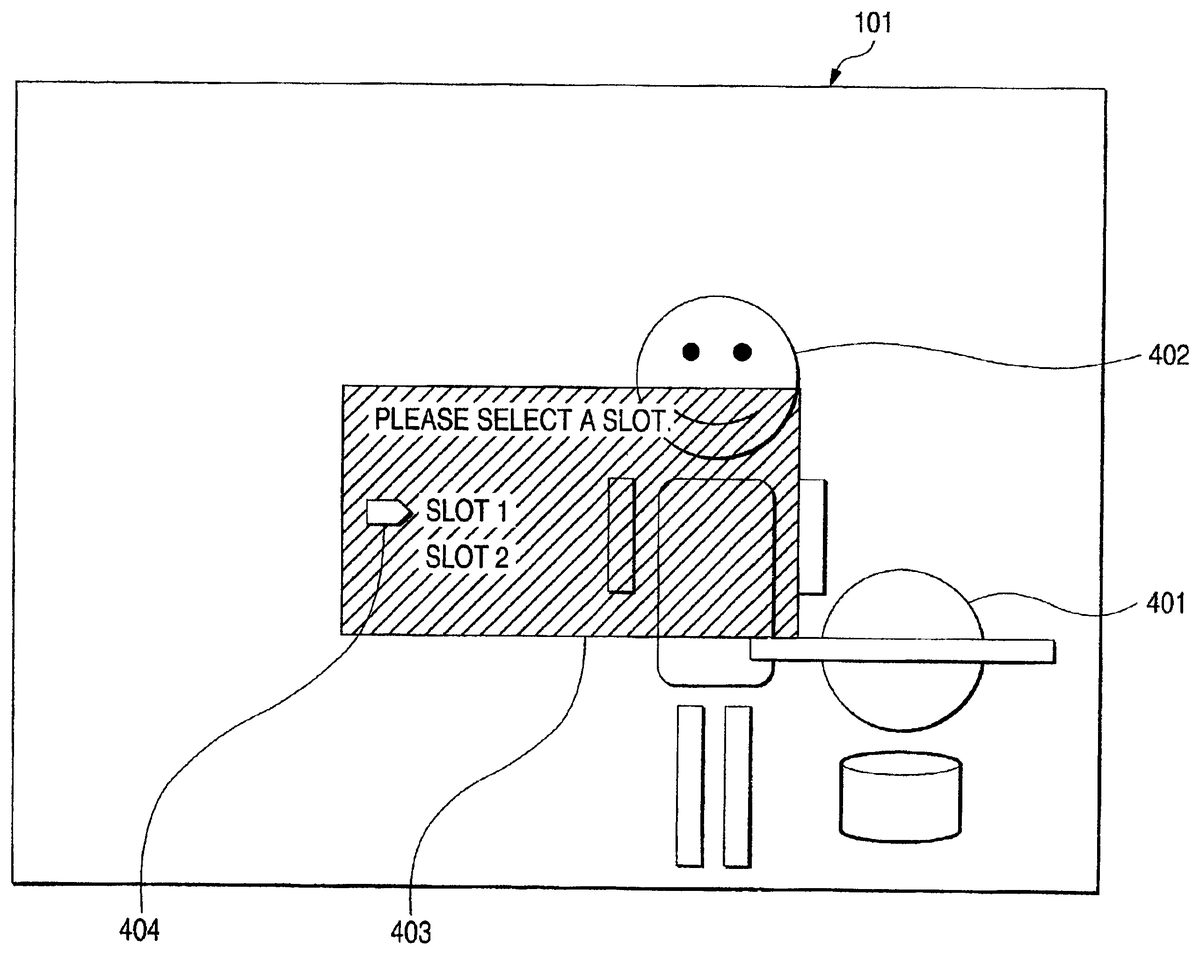
FIG. 4shows one example of a displayed screen at the time when the request for reading out translation dictionary data has occurred. An indicator having a function for interrupting the game and then moving to data-writing/reading processing is designated as401in FIG.4. Further, the player character is designated as402in FIG.4.
As shown inFIG. 4, when the player character402approaches to a predetermined distance to the indicator401, the game is interrupted temporally. If a request for reading out translation dictionary data occurs in response to player's manipulation, a game score, or the like, a window403is opened substantially at the center of the displayed screen as shown inFIG. 4, which displays a comment and slot selections. The slot selecting manipulation is performed by moving a cursor404through the cross key51and then pressing the circle button52aat a predetermined position near “slot 1” or “slot 2”. Then, it is determined from the action that the confirmation manipulation has been performed, and the process goes to step S13.
In step S13, each piece of translation dictionary data in the saved data stored in the memory card31is read out. Then, in step S14, it is determined whether or not the control parameter is (a=0). If (a=0), that is, if a new game start is instructed, each piece of translation dictionary data in the saved data is written in the RAM14once.
Then, one piece of translation dictionary data in the written saved data is selected and compared with the other translation dictionary data. If a different part is found and determined as a not yet or “new”, data corresponding to the part is obtained from the other translation dictionary data, and new translation dictionary data is created. The created translation dictionary data is stored in a predetermined area for storing translation dictionary data in the RAM14. Then, the process goes to step S21. There, it is determined whether or not the game is finished. If it is determined that the game is not finished, the process returns to step S8again. Then, the game continues to advance. Otherwise, the processing ends.
In step S14, if it is determined that the control parameter is not (a=0), that is, if a load start is instructed, the process goes to step S16. In step S16, translation dictionary data in saved data loaded at the time of starting the game and each of translation dictionary data in the memory card31are compared. There, a different part is determined as a not yet or “new”. In step S17, the not yet or “new” data in accordance with the determination result is obtained from each piece of translation dictionary data and then new translation dictionary data is created. Then, the created translation dictionary data is stored in a predetermined area for storing translation dictionary data in the RAM14. The process goes to step S21, where it is determined whether or not the game is finished. If the game is not finished, the process returns to step S8again. Then, the game continues to advance. Otherwise, the processing ends.
On the other hand, in step S10, if it is determined that a save request has occurred, the process goes to step S18, where the process gets ready to receive a selection of slots for connecting to the memory card. Then, in step S19, it is determined whether or not a confirmation manipulation has been completed. The process goes to step S20only if it is determined that the confirmation manipulation has been completed. Otherwise, the process returns to step S18.
In step S20, each piece of data (such as interrupted game data, character data, and translation dictionary data acquired as the game advances) at the current position of the player character is written in the memory card31as saved data such that the progress at that time can be reproduced. Once the data has been written in the memory card31, the process goes to step S21, where it is determined whether or not the game is finished. If it is determined that the game is not finished, the process returns to step S8again, and then, the game continues to advance. Otherwise, when it is determined that the game is finished, the processing terminates.
As described, the first embodiment of the invention provides several advantages. For example, a memory card can be utilized for multiple purposes while a game can be efficiently advanced and the user's pleasure can be maintained. In addition, the game can be re-started under the same conditions as before, and only a not yet or “new” necessary part of translation dictionary data can be easily acquired from the memory card without actually playing the game. This also helps prevent spoiling the fun.
Next, another embodiment will be described. In the above described embodiment, reading out data from the memory card and creating data in the internal memory are executed in order to obtain translation dictionary data. However, the processing may be also applied to obtain other various data acquired as a game advances.
Further, in the above-described embodiment, a request for reading out translation dictionary data occurs when the player character approaches the indicator having a function for performing data writing/reading processing in response to player's predetermined manipulation, or when the game score is equal to or higher than a predetermined value. However, a function may be given to a predetermined button such that reading out the translation dictionary data from the memory card and creating the translation dictionary data in the internal memory can be performed as required. Further, it may be arranged that a request for reading out translation dictionary data occurs in relation to different kinds of information caused as the game advances rather than game scores.
Further, in the above-described embodiment, requested data is transferred without any processing when a request for reading out data simply occurs in the game machine body. However, information indicating prohibition of data readout may be given to saved data stored in the memory card such that a request for data readout from the game machine body can be denied in order to manage written saved data.
Notably, the present invention is not limited to each of the above-described embodiments. It is apparent that each of the embodiments may be modified as necessary without departing from the technical idea of the present invention. For example, steps in the method according to the present invention may be changed in order without departing from the principal or the scope of the present invention. Furthermore, similar reference numerals are given to similar components in each of figures.
Claims
- A computer-readable recording medium on which a video game program is recorded in a video game processing device to which a memory card can be connected, said program causing a computer to execute: writing saved data, including acquired information acquired as the game advances, interrupted-game data, and character data, in said memory card in response to a player's manipulation, the acquired information being accessible separately from the interrupted-game data and character data;comparing only each piece of acquired information of said saved data written in said memory card, with acquired information maintained in an internal memory of said video game processing device in response to the player's manipulation;and obtaining a new piece of said acquired information from said acquired information written in said memory card, based on a comparison result.
- The computer readable recording medium according to claim 1 , wherein said acquired information included in said saved data is translation dictionary data.
- The computer readable recording medium according to claim 1 , said program further causing said computer to execute writing predetermined saved data in said memory card into said internal memory of said video game processing device.
- A video game program in a video game processing device to which a memory card can be connected, said program causing a computer to execute: writing saved data, including acquired information acquired as the game advances, and interrupted-game data, in said memory card in response to a player's manipulation, the acquired information being accessible separately from the interrupted-game;comparing only each piece of acquired information of said saved data written in said memory card with acquired information maintained in an internal memory of said video game processing device in response to the player's manipulation;and obtaining a new piece of said acquired information from said acquired information written in said memory card, based on a comparison result.
- The program according to claim 4 , wherein said acquired information included in said saved data is translation dictionary data.
- The program according to claim 4 , said program further causing said computer to execute writing predetermined saved data in said memory card into said internal memory of said video game processing device.
- A video game processing method to which a memory card can be connected, comprising: writing saved data, including acquired information acquired as the game advances, interrupted-game data, and character data, in said memory card in response to a player's manipulation, the acquired information being accessible separately from the interrupted-game data and character data;comparing only each piece of acquired information of said saved data written in said memory card with acquired information maintained in an internal memory of said video game processing device in response to the player's manipulation;and obtaining a new piece of said acquired information from said acquired information written in said memory card, based on a comparison result.
- The video game processing method according to claim 7 , wherein said acquired information included in said saved data is translation dictionary data.
- The video game processing method according to claim 7 , further comprising writing predetermined saved data in said memory card into said internal memory of said video game processing device.
- A video game processing device, comprising: a memory system that stores a video game program in said video game processing device to which a memory card can be connected;a computer that executes said program read out from said memory system;and a display device for screen display, which is provided as an output system of said computer, wherein said computer executes said program so as to write saved data, including acquired information acquired as the game advances and interrupted-game data, in said memory card in response to player's manipulation, the acquired information being accessible separately from the interrupted-game data, to only compare each piece of acquired information of said saved data written in said memory card with acquired information maintained in an internal memory of said video game processing device in response to a player's manipulation, and, based on a comparison result from said comparison, to obtain a new piece of said acquired information from said acquired information written in said memory card.
- The video game processing method according to claim 10 , wherein said acquired information included in said saved data is translation dictionary data.
- The video game processing device according to claim 10 , wherein said computer further writes predetermined saved data in said memory card into said internal memory of said video game processing device.
Disclaimer: Data collected from the USPTO and may be malformed, incomplete, and/or otherwise inaccurate.