U.S. Pat. No. 6,875,021
INTERACTIVE COMMUNICATION SYSTEM FOR COMMUNICATING VIDEO GAME AND KARAOKE SOFTWARE
Issue DateNovember 14, 2003
ADC Technology Inc. v. Microsoft Corporation et al
United States District Court for the Western District of Washington
Case No. 2:08-cv-01579-RSM, Filed October 27, 2008
Decided: May 2, 2016 against Nintendo; November 8, 2016 against Microsoft and Sony
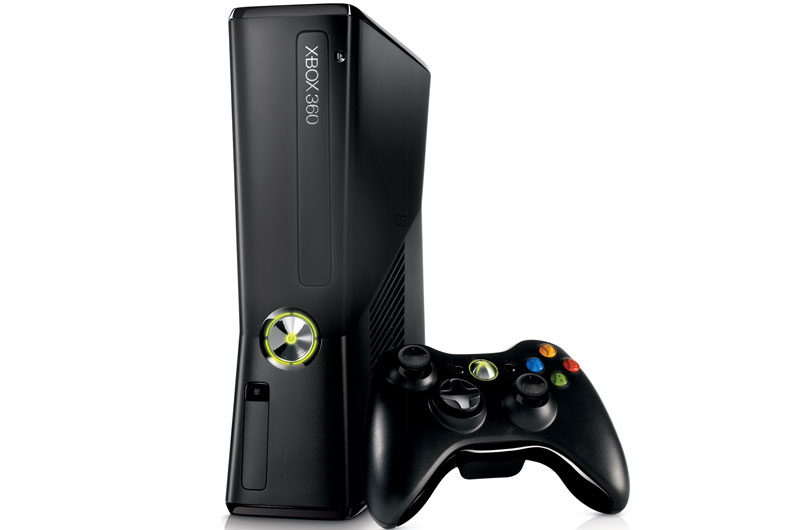
Nowadays, being able to download a game to a current generation console is a standard feature, but that was not always the case. Digital downloads for video games only became a viable option for most consumers during the Xbox 360, Wii, and PlayStation 3 generation. Back in 2008, ADC Technology filed a patent infringement lawsuit against Microsoft, Nintendo, and Sony, alleging their systems for digital downloads infringed ADC owned patents relating to pay-for-download software over a computer network.
ADC asserted five patents: U.S. Patent Nos. 5,775,995 (the ‘995 Patent), 6,193,520 (the ‘520 Patent), 6,488,508 (the ‘508 Patent), 6,702,585 (the ‘585 Patent), and 6,875,021 (the ‘021 Patent). The asserted patents related to the remote distribution of software to terminal devices. Claim 1 of the ‘021 patent reads:
1. A software distributing system for
transmitting at least one of the program, the data, and a combination of the program and data stored in a database provided in a distribution center to a requested communication terminal device via communication lines;storing the transmitted program, the data, and the combination of the program and data in a memory provided in the communication terminal device; and
enabling execution of the program or data processing according to the program, the data, and the combination of the program and data in the memory,
said distribution center comprising:
a transmitter device for transmitting the program, the data, or the combination of the program and data at the request of said communication terminal devices to said communication terminal device; and
a charging device for charging a fee for at least one use of the transmitted program, the data, or the combination of the program and data in said communication terminal device. (‘021 patent, col. 14, line 14-35).
In July 2009, the district court granted ADC’s motion for stay of proceedings pending the outcome of reexamination proceedings initiated for each of the patents-in-suit. This case before the Patent Trial and Appeal Board was filed in 2012 under the recently enacted America Invents Act. After initial examination by a USPTO Examiner, the PTAB eventually looked at the patents when it affirmed the Examiner’s decision in 2015. Both the PTAB and the Examiner found the ‘520, ‘508, ‘585, and ‘021 Patents to be unpatentable because of prior art. As a result, the PTAB affirmed the cancellation of those four patents. The only patent the PTAB did not cancel was the ‘995 Patent.
ADC dropped most of the allegations in the lawsuit after the PTAB canceled four out of five patents. Microsoft and Nintendo reached a settlement for claims related to the ‘995 Patent. Sony was able to get a victory regarding the ‘995 patent, however, the ‘995 Patent was not canceled as a result.
The five patents asserted by ADC related to software downloads where the user pays for the download. The patents were not limited to game console use, but could potentially apply to any pay-for-software downloads, such as PC downloads. The broadness of the patent claims may be due to the fact the invention claimed a 1993 priority date, a time when digital distribution was not as prevalent as it is today. Having broad patent claims is beneficial because you capture a wider scope of infringers, but can be a detriment because it is easier for potential defendants to invalidate the patent by referencing a larger body of prior art. Early priority dates can make it challenging for those (alleged) infringers to find prior art due to the novelty of the invention at the time. This case is a good illustration of all those points working together.
ADC Technology Inc. v. Microsoft Corp. illustrates the impact broad early patents can have on emerging technologies. Even though Microsoft, Sony, and Nintendo resolved their dispute with ADC regarding the asserted patents, there are other patents out there that could present problems in the future.
Additional Research By: Rachel Johns
Edited By: Andrew F. Thomas
Illustrative Figure
Abstract
A communication system is proposed for transmitting at least one of the data, the program, and a combination of them from a host facility to a communicator such as a communication terminal device. In this communication system, the data or the program becomes unable to be used when a predetermined time has elapsed after it is transmitted from the host facility to the communicator. This communication system is provided with the function of giving a warning before the use of the transmission becomes unable and the function of resuming the use in accordance with the user's instruction even after the use becomes unable.
Description
DETAILED DESCRIPTION OF THE PREFERRED EMBODIMENT In the embodiment of the invention, data, a program, or a combination of the two is transmitted from a host facility to a communicator as a communication terminal device. The data can be game data for playing games, karaoke data for playing karaoke music, image data for displaying static images like still pictures or dynamic images like movies, audio data for reproducing sound or playing music, character data for composing documents, and the like. The program includes a large-scale program, such as a program for word processing, a program for computing with a spread sheet, or a program for communication, and a plug-in-program to be incorporated in a main program. Transmitting a combination of the program and data means, for instance, transmitting a karaoke executing program and the data indicative of karaoke music to be played, or a set of a word processing program and the data indicative of document examples. In the embodiment of the invention, when a predetermined time has elapsed after the host facility sends out the transmission to the communicator, the data or the program becomes unusable, preferably after a warning has been given. It is also preferable to have a way to resume the use in accordance with the user's instruction, even after the data or program becomes unusable. As shown inFIG. 2, the communication system according to the present invention includes a host facility100, a personal communicator1as a communication terminal device, and transmission paths200as communication lines. The host facility100has game data base101, karaoke data base103and other data base105. The host facility100also has game data transmitter111, karaoke data transmitter113and other data transmitter116to retrieve data from corresponding data base and transmit them. The host facility100further has control unit120to control the transmitters111,113and115, and a headend130to output or input signals. When a ...
DETAILED DESCRIPTION OF THE PREFERRED EMBODIMENT
In the embodiment of the invention, data, a program, or a combination of the two is transmitted from a host facility to a communicator as a communication terminal device. The data can be game data for playing games, karaoke data for playing karaoke music, image data for displaying static images like still pictures or dynamic images like movies, audio data for reproducing sound or playing music, character data for composing documents, and the like. The program includes a large-scale program, such as a program for word processing, a program for computing with a spread sheet, or a program for communication, and a plug-in-program to be incorporated in a main program. Transmitting a combination of the program and data means, for instance, transmitting a karaoke executing program and the data indicative of karaoke music to be played, or a set of a word processing program and the data indicative of document examples.
In the embodiment of the invention, when a predetermined time has elapsed after the host facility sends out the transmission to the communicator, the data or the program becomes unusable, preferably after a warning has been given. It is also preferable to have a way to resume the use in accordance with the user's instruction, even after the data or program becomes unusable.
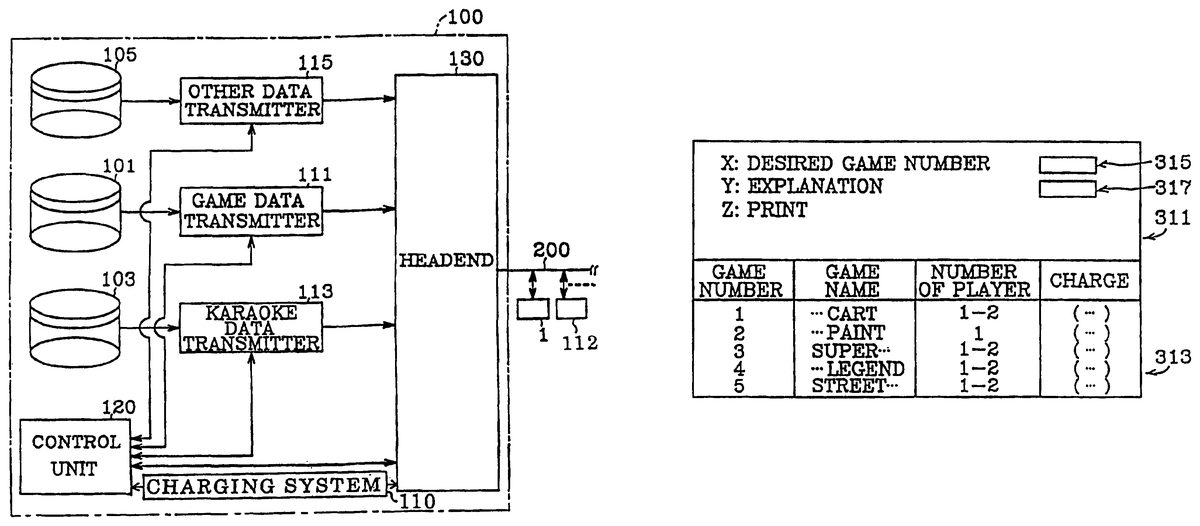
As shown inFIG. 2, the communication system according to the present invention includes a host facility100, a personal communicator1as a communication terminal device, and transmission paths200as communication lines.
The host facility100has game data base101, karaoke data base103and other data base105. The host facility100also has game data transmitter111, karaoke data transmitter113and other data transmitter116to retrieve data from corresponding data base and transmit them. The host facility100further has control unit120to control the transmitters111,113and115, and a headend130to output or input signals.
When a request data is sent out from the personal communicator1via the transmission paths200, the request data is received through the headend130and input by the control unit120. The control unit120then controls one of the transmitters111,113and115to retrieve data corresponding to the request, and the retrieved data is sent out via the headend130to the transmission paths200.
The transmission paths200is coaxial cables and connected to a plurality of personal communicators1.
As shown inFIG. 1, the personal communicator1includes a terminal modem3, timer4, CPU5, input device6, ROM7, memory8, video image circuit9, sound source10, audio amplifier11, speaker13, image composite circuit15, monitor16, controller connector21, microphone connector23, data input/output controller25and data input/output connector27.
The terminal modem3is connected to the transmission paths200and includes modulator/demodulator3aand video tuner3bwhich selects a channel of the image to be projected.
The input device6may be a keyboard or mouse, and is used for inputting a designation of a desired game or karaoke data or other instructions. When a controller31, which is exclusively used for playing video games, is connected to the controller connector21, the controller31can be operated only for playing games. The controller31is provided with joy sticks or other control buttons commonly provided on conventional video game machines.
By connecting a microphone33to the microphone connector23, the user can have his voice output to the speaker13.
The data input/output connector27is connected via data output cable37to a printer40, personal computer41, or other apparatus.
The operation effected on the CPU5will be now explained referring to the flowchart of FIG.3.
When power is supplied, a main menu is displayed, offering various selections, including “call host facility”, which is selected by a user.
First, category selection pages are displayed at step S1000. The display includes the instruction of “select a category” and a list of available categories such as game and karaoke. The selected category is next determined at step S1010. Subsequently, an operation selection page corresponding to the selected category is displayed at step S1020. The display of the operation selection page includes an instruction to the operator and the list of available operations in the selected category. When the operator inputs direction responsive to this instruction, the corresponding respective operation process is performed at step S1030. In preparation for the respective operation process, the personal communicator1is connected to the host facility100such that the interactive communication can be performed between the personal communicator1and the host facility100.
The above procedure is further explained in detail, only for exemplification purpose, hereinafter referring toFIGS. 4,5, and6.
When “game” category is selected at step S1000, operation selection page shown inFIG. 4is displayed, with an instruction301and operation list303shown on the screen. The operation list has three items of item A, item B and item C. Item A has a first game number box305, into which the operator can directly input a game number representative of a specific game the operator desires to receive. Item B is the operation to display the list of the game numbers now available from the game data base101of the host facility100. Item C is the operation to display charges, for example the accumulated cost for the month or the past month(s).
When the operator wishes to play a game, item A or B is selected. For example, if the operator knows the game number of the game he wishes to play, the operator moves the cursor on the screen to the first game number input box305, and inputs the desired game number therein. If the operator does not know the game number, he selects item B.
When item B is selected, data in the form of the list of game numbers is sent from the host facility100and displayed on the screen. As shown inFIG. 5, the list displayed by selecting item B has an input part311and display part313. The display of the game list313can be scrolled to display further the list of games. The display part313displays the number of players able to participate in the play and the charge, in addition to the game numbers and the game name. The operator, referring to these information on the screen, inputs his desired game number into a second game number input box315of the input part311.
When selecting a game for the first time, the operator may wish to know the feature or outline of the game. In this case, the operator inputs the selected game number into an explanation box317of item Y of the input part311. As a result, the outline of the game is explained on the display part313.
The game list can be printed out such that the operator can refer to the printed game list when he selects a game on other occasions. For printing, item Z of “print” in the input part311is selected. In response, the game list is printed, via the data input/output connector27and data output cable37shown inFIG. 1, at the printer40. The process which is effected when a game number is input in the first game number box305of item A shown inFIG. 4or in the second game number box315of item X shown inFIG. 5will be now explained referring to FIG.6.
First, game request data is generated at step S1100. The game request data includes the identification number of the calling personal communicator1and the desired game number. The generated game request data is then sent out to the host facility100at step S1110.
At the host facility100, the received request data is input by the control unit120through the headend130. Subsequently, game data corresponding to the request is retrieved from the game data base101by the game data transmitter111. The retrieved game data is sent out via the headend130to the transmission paths200and to the corresponding personal communicator1. First, second, and third predetermined time periods, which will be described later in detail, are also sent out to the personal communicator1.
Turning back toFIG. 6, the game data is received at the personal communicator1at step S1120and stored in the memory8at step S1130. When the storage of the game data into the memory8is completed, the completion is indicated on the monitor16at step S1140. Further, data indicative of the completion of the game data transmission is sent out to the host facility100at step S1150as the last step of the instant process step, and the personal communicator1awaits the next operation. When, for example, game play is instructed as the next operation, the game stored in the memory8is started.
The game data received by the process shown in FIG.6and the game data stored in the memory8is automatically deleted, as shown in the flowchart ofFIG. 7, in the following manner. First, the time when the data receipt is completed is read out at step S1200. The current time is also read out and the time period which has elapsed after the completion of the data receipt is calculated at step S1210. Next, it is determined, at step S1220, whether or not a first predetermined time period has elapsed. If “NO” is determined at the step S1220, the flow goes back to the step S1210. Thus, when the first predetermined time period has elapsed, a warning is given at step S1230. Further elapsing time period is calculated at step S1240. When it is determined, at step S1250, that a second predetermined time period has elapsed, the game data stored in the memory8is deleted at step S1260, and the instant process ends.
The warning given at step S1230may be a various form of warning, such as a message reading “Time Out in Five Minutes!” on the monitor16, or an alarming sound. Therefore, the total of the first predetermined time period of the step S1220and the second predetermined time period of the step S1250is the useful life period of the received game data. The warning may be provided a plurality of times, such as five minutes, two minutes and one minute before the deletion of the game data. Warned by this warning, the player can print the current status of the game progress, for example, which player corresponds to which character in the game or the top scorer at the time, at the printer40before quitting the game play. The printed data is useful when the player resumes the game play.
Furthermore, when the host facility100receives the data indicative of the transmission completion at the step S1150, the host facility100performs the charging process to accumulate the cost for its data transmission service. There are two known cost charging systems. One is the fixed amount system and the other, is the, pay-per-play system. In the fixed amount system, the fixed cost amount per-time period, for example monthly, is predetermined. In the pay-per-play system, the cost is charged per each play.
The charging system is dependent on the form or condition of the communication service to be rendered. In a practical charging system, the cost would be varied with respect to the complicatedness or scale of the game data provided. The cost would also vary depending on whether the game is new or old in the market. In the present embodiment, the pay-per-play system is adopted and the cost for the data service to each terminal communicator is charged every time the data indicative of the transmission completion is sent from the personal communicator1at step S150. The payment would be made, using the automatic transfer system, by debiting the amount to the bank account of the players.
However, the pay-per-play system has a problem: the player cannot know the total amount of the accumulated cost before actual payment. If the payment is made using the automatic transfer system, the player may not even notice his considerable expenditure on the game play. This problem is solved by the arrangement shown in FIG.4. If the player selects item C of the operation list303, the present accumulated cost and the previous cost, such as the payment made previously or the cost accumulated in the past half or whole year, are shown on the screen. Thus, parents can know the accumulated cost of their child's video game play.
By utilizing the communication system, the player need not purchase a game cassette or other software for playing video games, since the game data is provided by the host facility which received the game data request sent by the player from his personal communicator1. Further, the game data provided to the player is temporarily stored in the memory8serving as temporary storage means of the personal communicator1, thereby releasing the host facility to serve other personal communicators1requesting game data. The host facility is thus enabled to respond to a greater number of callers having personal communicators1.
Furthermore, the game data stored in the memory8is deleted in a predetermined time period after it was received at the personal communicator1. In other words, the useful life of the game data at the personal communicator1is limited. As a result of this arrangement, in order to continue the game play at the end of the predetermined time period, the player again needs to request the game data from the host facility100. This arrangement is therefore prerequisite so long as the game data transmission service is not free of charge. In contrast, if it were possible to keep the game data at the communication terminal device at the end of game play, the player could play the game permanently without calling the host facility100. Consequently, the service cost per each transmission would be higher than the normal price of the game cassettes. The above described arrangement solves this problem and meets the need of the software distributors.
The arrangement is also beneficial to the players since the service cost per each transmission can be considerably lower than the price of each game cassette. Therefore, the player who conventionally has to buy an expensive game cassette, even if he plays the game only once, can be satisfied with the reasonable cost of the transmission.
The arrangement is also superior with respect to child discipline. Video game players are in most cases younger children, who often become too absorbed in playing video games to quit in the middle thereof. The above arrangement according to the present invention leaves these children no other choice but to quit the play when a predetermined time period has elapsed. Thus, the arrangement meets the rising demand of parents.
The above embodiment is explained on the premise that the game is played by a single player using only a single personal communicator1. However, a plurality of players in remote places can play the same game together.
For example, the transmission paths200or telecommunication lines is utilized to connect a plurality of personal communicators1to one another such that the interactive communication can be performed therebetween. When the plurality of personal communicators1are supplied with the same game data, the players have the same game characters in common. Therefore, the data to be transmitted among the plurality of personal communicators1are only character number data and the position data. Thus, the players together participate, on a real time basis, in the same game on the monitor16of respective personal communicators1.
Map data of a role-playing game may be divided according to the progress degree of the story and the divided map data be sold separately. When the game progresses and the player wishes to play on a more advanced map data, the player purchases and downloads the advanced map data. In this case, arrangement is provided such that the player cannot purchase the advanced map data until the “capacity” or the progress degree of the characters in the game reaches a predetermined degree or level. Accordingly, using the interactive communication system, the player is to ask the host facility100for the proof of the capacity. In response, data proving the capacity or level of the characters may be transmitted from the host facility100. The capacity proof sent from the host facility100would be printed out by the printer40or transmitted to the player's facsimile machine, as a certificate.
It will be now explained how the communication system of the present invention is adopted to karaoke. The procedure to communicate the karaoke data is basically similar to the above described procedure to communicate the game data. Therefore, the explanation of the similar portion of the procedure are omitted for simplification. When using the system for karaoke, the microphone33is connected to the microphone connector23of the personal communicator1.
When “karaoke” is selected on the category selection page at step S1000, an operation selection page similar to that ofFIG. 4is displayed on the screen. Specifically, an item A of a desired karaoke number, item B of the karaoke number list, and item C of charge are displayed. If the operator wishes to start karaoke, the operator inputs the desired karaoke number in the corresponding box at item A or B.
Karaoke request data is then generated at the personal communicator1and sent out to the host facility100. The host facility100, receiving the request, controls the karaoke data transmitter113to retrieve corresponding karaoke data from the karaoke data base103, and sends out the retrieved karaoke data to the personal communicator1.
The karaoke data received at the personal communicator1is stored, as song data, in the memory8via the modulator/demodulator3a. At the same time, the CPU5sends song selection data, which is predetermined according to the type of each song, to the video tuner3bin order to select visual data suitable to the selected song. Further, the CPU5synchronously outputs to the video image circuit9and the sound source10, respectively, words data and accompaniment data included in the song data stored in the memory8. The video image circuit9converts the information concerning the words and other elements of the song into word/image data and outputs the word/image data to the monitor16.
The sound source10converts the accompaniment data into audio signals, and outputs the audio signals to the audio amplifier11. Subsequently, the audio amplifier11synthesizes the audio signals and the voice signals sent from the microphone12, amplifies these synthesized signals and outputs them to the speaker13as sound signals. The video tuner3breads out background visual data selected according to the song selection data, and outputs, to the image composite circuit15. Then, the image composite circuit15synthesizes the background visual data and, the words/image data and outputs the video signals to the monitor16.
The procedure for playing karaoke music will be further explained in detail.
The song data sent out from the host facility100via the co-axial cables as transmission paths200includes multiplied RF signals of video information and RF signals converted from the song data. The CPU5of the personal communicator1sends the song selection data to the video tuner3bof the terminal modem3in order to select the video channel according to the received song data. The song selection data is predetermined according to the genre of songs. Consequently, the song data is sent to the sound source10and the karaoke music is played.
When the karaoke music is ended, data indicative of the end of the play is sent to the host facility100. In response, the host facility100performs the charging process. In contrast to the pay-per-play system of the game data service, the cost for providing the karaoke music may be charged, for example per hour, since a single piece of karaoke music is only several minutes long.
In the case of karaoke data, as in the case of game data, a predetermined time is counted after the karaoke data is received from the host facility, and when the predetermined time has elapsed, the karaoke data is deleted.
By utilizing the communication system, the karaoke singer need not purchase a video disk or other karaoke software, since the karaoke data is provided by the host facility100, which received the karaoke data request sent by the karaoke singer from his personal communicator1. Further, the karaoke data provided to the karaoke singer is temporarily stored in the memory8serving as temporary storage means for the personal communicator1, thereby releasing the host facility100to serve other personal communicators1requesting karaoke data. The host facility100is thus able to respond to a greater number of callers having personal communicators1. This invention has been described above with reference to the preferred embodiment as shown in the drawings. Modifications and alterations may become apparent to one who skilled in the art upon reading and understanding the specification. Despite the use of the embodiment for illustration purposes, it is intended to include all such modifications and alterations within the scope and spirit of the appended claims.
In this spirit, it should also be noted that in the embodiment, the personal communicator1is integrally provided with the monitor16and the speaker13. However, any other external monitor or speaker may be connected to the personal communicator1and utilized. For example, a television receiver may be connected to the personal communicator1, thereby outputting the video information and the audio information on the television receiver. In this case, the personal communicator1may be provided with a small display, on which the selection pages as those shown inFIGS. 4 and 5would be displayed.
Furthermore, the transmission paths200may be existing co-axial cables for cable television system, thereby structuring the communication system of the present invention as a multimedia interactive communication system. In this way, the video and audio information of satellite television services, video disks, radio programs, and other various forms of available software are equated to the other data base shown in FIG.2. Such personal communicators1of the present invention can be provided in each individual's home or hotel room and in other various situations and places.
As mentioned, the stored data is deleted in a predetermined time period after it was received. This arrangement is beneficial to the data distributors since repeated game or karaoke play using the same game data or karaoke data is prevented.
In the above described embodiment, the game data stored in the memory8is deleted in order to interfere with the progress of game. Alternative arrangements to this are provided by the present invention, as shown inFIGS. 8A through 8D. In the arrangement ofFIG. 8A, the view on a screen161of the monitor16is blocked with patterns of stripes162displayed thereon. Instead, the view displayed on the screen may be partly deleted. In the arrangement shown inFIG. 8B, only an opponent of a boxing game, who is to be displayed on an area163of the screen161, is deleted. Still another alternative is provision of a switch131shown inFIG. 8Cfor a speaker circuit, which, when turned off, withholds the sound that would otherwise be issued from the speaker13during the game. Further alternative is provision of a switch61shown inFIG. 8Dwhich invalidates the operation on the input device6or the controller31. The switches131and61may be mechanical components or may be software operations. For instance, actuation of the sound source10may be halted by the CPU5, or the CPU5may reject signals from the input device6or the controller31. As still another alternative, the power of the personal communicator may be turned off when the CPU5determines that a predetermined time has elapsed after the game data was received.
In the described embodiment, when a predetermined time has passed after the game data was received from the host facility100, the game data stored in the memory8is deleted. However, it may be arranged so that the player can resume playing the game by paying a surcharge. Specifically, the process steps shown inFIG. 9may be taken. As will be noted, the process steps S1200through S1250inFIG. 9are identical to those inFIG. 7, whereas at step S1260′ the deletion of the game data is effected only after it is stored in a temporary storage device, different from the process at step S1260. At next step S1270, it is determined whether or not a surcharge has been paid. If the answer to the step S1270is negative, it is next determined, at step S1280, whether or not a predetermined time has elapsed after the game data in the memory8was deleted. If the answer to the step S1280is negative, the flow returns to step S1270. If the answer to the step S1280is affirmative, the process step ends.
If “YES” is determined at the step S1270, the game data stored in the temporary storage device is restored into the memory8to permit resumption of game play, at step S1290. The flow then goes back to step S1210. In the process after the resumption of game play, the elapsed time after the time of paying the surcharge is calculated at step1210.
The arrangement shown inFIG. 9allows a player to continue playing a game as long as the player pays a surcharge. An instruction to pay the surcharge can be given through the keys on the input device6. In response, the host facility100effects the charging process against the player.
In the embodiment shown inFIGS. 1 and 2, game data and karaoke data are transmitted via communication lines, which may be public telephone lines, dedicated communication lines, cables for community antenna television system. Instead of such communication lines, as shown inFIG. 10, the data may be sent via wireless transmission from a host facility100′ to a personal communicator1′. In this case, the host facility100′ is provided with a not-shown wireless transmission circuit including a transmitting/receiving antenna150, and the personal communicator1′ is provided with a not-shown transmitter/receiver circuit including a transmitting/receiving antenna2.
Turning toFIG. 11, a further modification is proposed in which the game data is sent from a ground broadcasting station100″ or a satellite broadcasting station. The game data, as it is received, is stored in the memory8of the personal communicator1″. In this case, the personal communicator1″ is connected with a tuner300so that the game is displayed on a screen of a home TV set400. Alternatively, the broadcasting may be performed preferably via two-way communication through cables, or via Internet. In the communication system disclosed in this specification, the data to be transmitted may be either analog or digital.
In both modifications shown inFIGS. 10 and 11, the game play is interrupted when a predetermined time has elapsed after the game data was received at the personal communicators1′,1″. Of course, the arrangement shown inFIG. 9may be incorporated into these arrangements ofFIGS. 10 and 11to allow the player to continue playing a game by paying a surcharge.
FIG. 12is a flowchart showing another embodiment. In this embodiment, a predetermined time period to prevent further use of the image data is counted from the starting time of use of the data, not from the receiving time of the data from the host facility.
This embodiment is explained in detail hereinafter referring to FIG.12. When the use of the image data sent from the host facility starts, the starting time is read out at step S1300. The current time is also read out, and the elapsed time after the starting time is calculated at step S1310. Then it is determined, at step S1320, whether or not a first predetermined time period has elapsed. If “NO” is determined at step S1320, the flow returns to step S1310. If “YES” is determined, a warning is given at step S1330, and the elapsed time continues to be calculated at step S1340until the end of a second predetermined time period. When it is determined, at step S1350, that the second predetermined time period has elapsed, a process to prevent further use of the above image data is performed at step S1360. There may be various means to prevent further use of the image data, such as deleting the image data stored in the memory8, blocking, as shown inFIG. 8Aor8B, the view on the screen of the monitor16in accordance with the progress of the image data processing, stopping, as shown inFIG. 8C, the sound generated in accordance with the progress of the image data processing and invalidating, as shown inFIG. 8D, any operation of the input device6or the controller31for instruction.
At next step S1370, it is determined whether or not a surcharge is paid. If the answer to step S1370is negative, it is next determined, at step S1380, whether or not a third predetermined time has elapsed after the process to prevent further use of the image data is performed. If the answer to step S1380is negative, the flow returns to step S1370. If the answer to step S1380is affirmative, the process step ends.
If “YES” is determined at step S1370, the image data is permitted to be continuously used at step S1390, then the flow returns to step S1310. In the process after the resumption of use, the elapsed time after the payment of the surcharge is calculated at step S1310. In the case where deletion of the image data stored in the memory is used as a means of preventing further use of the image data, it is preferable to preserve the image data in a not-shown temporary storage device before deleting it from the memory, and to restore it from the temporary storage device into the memory after the surcharge is paid.
As in the above embodiment, instructions to pay the surcharge can be given by operating the keyboard of the communicator1, and in response to the key operation, the host facility100performs the charging process.
FIG. 13is a flowchart of a further embodiment. In this embodiment, when the program sent from the host facility is continuously unused for a predetermined time period, a process to prevent further use of the program is performed.
The procedure of this embodiment is explained in detail, hereinafter referring to FIG.13. When the program sent from the host facility is used for some time and then the use ends, the ending time is read out at step S1400. Next, the current time is also read out and the elapsed time after the ending time is calculated at step S1410. Then it is determined, at step S1420, whether or not a first predetermined time period has elapsed. If “NO” is determined at step S1420, the flow returns to step S1410. If “YES” is determined, a warning is given at step S1430, and the elapsed time continues to be calculated at step S1440until the end of a second predetermined time period. When it is determined, at step S1450, that the second predetermined time period has elapsed, a process to prevent further use of the above program is performed at step S1460. There may be various means to prevent further use of the program, such as deleting the program stored in the memory8, blocking, as shown inFIG. 8Aor8B, the view on the screen of the monitor16in accordance with the progress of the program, stopping, as shown inFIG. 8C, the sound generated in accordance with the progress of the program, and invalidating, as shown inFIG. 8D, any operation of the input device6or the controller31for instructions.
At next step S1470, it is determined whether or not a surcharge is paid. If the answer to step S1470is negative, it is next determined, at step S1480, whether or not a third predetermined time has elapsed after the process to prevent further use of the program is performed. If the answer to step S1480is negative, the flow returns to step S1470. If the answer to step S1480is affirmative, the process step ends.
If “YES” is determined at step S1470, the program is permitted to be continuously used at step S1490, then the flow returns to step S1410. In the process after the resumption of use, the elapsed time after the payment of the surcharge is calculated at step S1410. In the case where deletion of the program stored in the memory is used as a means of preventing further use of the program, it is preferable to preserve the program in a not-shown temporary storage device before deleting it from the memory, and to restore it from the temporary storage device into the memory after the surcharge is paid.
As in the above embodiment, instructions to pay the surcharge can be given by operating the keyboard of the communicator1, and in response to the key operation, the host facility100performs the charging process.
If the program is used while a process shown inFIG. 13is in progress, the above process is ended by a not-shown interrupt handling, and at the next cycle time the process at step S1400starts again.
In the embodiments shown inFIG. 13, the elapsed time period, during which a program is continuously unused, is preferably counted in the background by a backup power source even when the power of the personal communicator1is off. The processes to give a warning and to prevent further use may be performed when the power switch of the personal communicator1is turned on next time.
In addition to the above described case, it may be considered that the elapsed time is calculated each time the power switch of the personal communicator1is turned on. Such an embodiment is shown in FIG.14. In this embodiment, concerning each program or data stored in the memory8, the ending time of use of the program or the data is stored in a specific storage region of the memory8. When the program or the data is used, the ending time data is renewed at the time of end of use. The procedure is explained hereinafter with respect to the case where a program is received by a personal communicator. In the case where image data, game data, or karaoke data is received, the same procedure is also taken.
InFIG. 14, when the power switch of the personal communicator1is turned on, the ending time data concerning every stored program is read out, at step S1500, from the above specific storage region of the memory8. Next, at step S1510, the elapsed time after the ending time is calculated. It is next determined, at step S1520, whether or not the elapsed time has exceeded a predetermined time period to prevent further use of the program, and at step S1530, whether or not the elapsed time has exceeded another predetermined time period to give a warning. If the elapsed time has exceeded the predetermined time period (a first time period) to give a warning (the answer to step S1530: “YES”), a warning is given at step S1540. If the elapsed time has exceeded the predetermined time period (a second time period) to prevent further use of the program (the answer to step S1520: YES), the process to prevent further use of the program is performed at step S1550. If the elapsed time has not exceeded either of the above predetermined time periods, the process step shown inFIG. 14ends.
When the process to prevent further use is performed, it is determined, at step S1560, whether or not a surcharge has been paid within a predetermined time period (a third time period). If the answer to step S1560is negative, the process step ends. If the answer to step S1560is affirmative, the process to allow resumption of use of the program is performed at step S1570. Next, the process to renew the ending time data with the current time concerning the program is performed at step S1580, and then the process step ends.
As in the above embodiment, instructions to pay the surcharge can be given by operating the keyboard of the communicator1, and in response to the key operation, the host facility100performs the charging process.
In order to enable the choice between two modes, one of which is to calculate the elapsed time when the power switch of the personal communicator1is turned on as shown inFIG. 14, and the other of which is to calculate the elapsed time in the background as shown inFIG. 13, the input device6or the controller25of the personal communicator1may be used by the user for choosing.
Claims
- A software distributing system for transmitting at least one of the program, the data, and a combination of the program and data stored in a database provided in a distribution center to a requested communication terminal device via communication lines;storing the transmitted program, the data, and the combination of the program and data in a memory provided in the communication terminal device;and enabling execution of the program or data processing according to the program, the data, and the combination of the program and data in the memory, said distribution center comprising: a transmitter device for transmitting the program, the data, or the combination of the program and data at the request of said communication terminal devices to said communication terminal device;and a charging device for charging a fee for at least one use of the transmitted program, the data, or the combination of the program and data in said communication terminal device.
- A software distributing system as in claim 1 , wherein the charging device charges a fee per each use of the transmitted program, the data, or the combination of the program and data in said communication terminal device.
- A software distributing system as in claim 1 , wherein the charging device automatically charges a fee per each use of the transmitted program, the data, or the combination of the program and data in said communication terminal device.
- A software distributing system as in claim 1 , further including a disabling device that disables said transmitted program, data, or combination of program and data, until said distribution center receives charge for use of said program, data, or combination of program and data.
- A software distributing system for transmitting at least one of the program, the data, and a combination of the program and data stored in a database provided in a distribution center to a requested communication terminal device via communication lines;storing the transmitted program, the data, and the combination of the program and data in a memory provided in the communication terminal device;and enabling execution of the program or data processing according to the program, the data, and the combination of the program and data in the memory, said distribution center comprising: a transmitter device for transmitting the program, the data, or the combination of the program and data at the request of said communication terminal devices to said communication terminal device;and a charging device for charging a fee for a specified time for use of at least one program, data, or combination of program and data in said communication terminal device.
- A software distributing system as in claim 5 , wherein the charging device automatically charges a fee for a specified time for use of the transmitted program, the data, or the combination of the program and data in said communication terminal device.
- A software distributing system as in claim 5 , further including a disabling device that disables said transmitted program, data, or combination of program and data, until said distribution center receives charge for use of said program, data, or combination of program and data.
- A software distributing system for transmitting at least one of the program, the data, and a combination of the program and data stored in a database provided in a distribution center to a requested communication terminal device via communication lines;storing the transmitted program, the data, and the combination of the program and data in a memory provided in the communication terminal device;and enabling execution of the program or data processing according to the program, the data, and the combination of the program and data in the memory, said distribution center comprising: a transmitter device for transmitting the program, the data, or the combination of the program and data at the request of said communication terminal devices to said communication terminal device;and a charging device for charging a fee for at least one transmitted program, data, or combination of program and data to said communication terminal device.
- A software distributing system as in claim 8 , wherein the charging device automatically charges a fee for the transmitted program, the data, or the combination of the program and data in said communication terminal device.
- A software distributing system as in claim 8 , further including a disabling device that disables said transmitted program, data, or combination of program and data, until said distribution center receives charge for said program, data, or combination of program and data.
- A software distributing system as in claim 8 , wherein the charging device charges a fee for unlimited use of programs, data, or the combination of programs and data to said communication terminal device within a specified time period.
Disclaimer: Data collected from the USPTO and may be malformed, incomplete, and/or otherwise inaccurate.