U.S. Pat. No. 6,860,812
VIDEO GAME HAVING SMOOTH CHARACTER CONTROL
AssigneeKabushiki Kaisha Square Enix
Issue DateOctober 10, 2001
Illustrative Figure
Abstract
A video game program enables smooth movement of a character while simplifying an operation. The video game program causes a computer to: always detect an angle θ formed by a line of sight of a camera and a direction of a player character. If a player operates a direction key, the computer corrects an input direction received by the operated direction key with the angle θ and generates the corrected direction, as a progress direction of the player character. The computer further stores this generated progress direction in a storage area and moves the player character in the direction. If operation of a key part of an identical direction is continued in the direction key, the computer moves the player character in the stored progress direction regardless of whether the line of sight moves. Therefore, the player character continues to move in the identical direction in the three-dimensional space even if a camera angle changes.
Description
DETAILED DESCRIPTION OF THE PREFERRED EMBODIMENTS Embodiments of the present invention will be hereinafter described with reference to the accompanying drawings. Further, in the following descriptions, the case in which the present invention is applied to a game machine for home use is explained. FIG. 1is a block diagram showing a configuration of a game apparatus in accordance with this embodiment of the present invention. As shown in the figure, this game apparatus1includes, for example, a game machine main body2, a keypad3, a memory card4, a TV set5and a CD-ROM6. The game machine main body2is composed of, for example, a CPU8(Central Processing Unit), an ROM (Read Only Memory)18, a RAM (Random Access Memory)9, an HDD (Hard Disk)10, an interface unit11, a sound processing unit12, a graphics processing unit13, a CD-ROM (Compact Disc Read Only Memory) drive14, a detachable CD-ROM6and a communications interface15, which are connected to each other via a bus7. The CPU8sequentially executes a program stored in the RAM9to perform processing for progressing a game based on a basic program such as a boot program and an OS (Operating System) stored in the ROM18. In addition, the CPU8controls operations of each of components9to15in the game machine main body2. The RAM9is used as a main memory of the game machine main body2and stores a program and data required for progress of a game, which are transferred from the CD-ROM6. In addition, the RAM9is also used as a work area in executing a program. That is, a program storage area91, a data storage area92, a work area93and the like are allocated to the RAM9. A program and data to be stored in the program storage area91and the data storage area92are read from the CD-ROM6by CD-ROM drive14in accordance with control of the CPU8and transferred to the RAM9. Various kinds of data required ...
DETAILED DESCRIPTION OF THE PREFERRED EMBODIMENTS
Embodiments of the present invention will be hereinafter described with reference to the accompanying drawings. Further, in the following descriptions, the case in which the present invention is applied to a game machine for home use is explained.
FIG. 1is a block diagram showing a configuration of a game apparatus in accordance with this embodiment of the present invention. As shown in the figure, this game apparatus1includes, for example, a game machine main body2, a keypad3, a memory card4, a TV set5and a CD-ROM6.
The game machine main body2is composed of, for example, a CPU8(Central Processing Unit), an ROM (Read Only Memory)18, a RAM (Random Access Memory)9, an HDD (Hard Disk)10, an interface unit11, a sound processing unit12, a graphics processing unit13, a CD-ROM (Compact Disc Read Only Memory) drive14, a detachable CD-ROM6and a communications interface15, which are connected to each other via a bus7.
The CPU8sequentially executes a program stored in the RAM9to perform processing for progressing a game based on a basic program such as a boot program and an OS (Operating System) stored in the ROM18. In addition, the CPU8controls operations of each of components9to15in the game machine main body2.
The RAM9is used as a main memory of the game machine main body2and stores a program and data required for progress of a game, which are transferred from the CD-ROM6. In addition, the RAM9is also used as a work area in executing a program. That is, a program storage area91, a data storage area92, a work area93and the like are allocated to the RAM9. A program and data to be stored in the program storage area91and the data storage area92are read from the CD-ROM6by CD-ROM drive14in accordance with control of the CPU8and transferred to the RAM9. Various kinds of data required during progress of a game are temporarily stored in the work area93.
A game program and data received from an external network17via the communications interface15and a communications line16are stored in the HDD10. The detachable keypad3and the memory card4are connected to the interface unit11. The interface unit11controls exchanges of data between the keypad3and the memory card4that are in the outside of the game machine main body2and the CPU8and the RAM9. Further, the keypad3is provided with direction keys and various buttons. A player operates these keys and buttons to execute inputs required for progress of a game, such as an instruction to move and an instruction to operate the player's own character. In addition, the memory card4saves data indicating a state of progress of a game.
The sound processing unit12performs processing for reproducing sound data such as BGM (Background Music) and sound effects corresponding to a state of progress of a game in accordance with an instruction from the CPU8and outputs the sound data to the TV set5.
The graphics processing unit13performs three-dimensional graphics processing in accordance with an instruction from the CPU8and generates image data corresponding to a state of progress of a game. The graphics processing unit13adds a predetermined synchronization signal to the generated image data to output the data to the TV set5as a video signal.
The CD-ROM drive14drives the CD-ROM6set in the game machine main body2in accordance with an instruction from the CPU8and transfers a program and data stored in the CD-ROM6to the RAM9via the bus7.
The communications interface15is connected to the external network17via the communications line16and performs processing for exchanging a program and data with the external network17in accordance with an instruction from the CPU8.
The CD-ROM6stores a program and data (game program6a) required for progress of a game. The CD-ROM6is driven by the CD-ROM drive14, whereby the stored program and data are read. The program and data read from the CD-ROM6are transferred to the RAM9from the CD-ROM drive14via the bus7.
The TV set5is provided with a display screen51consisting of a CRT (Cathode Ray Tube) or the like for displaying an image corresponding to a video signal from the graphics processing unit13and a speaker52for outputting sounds corresponding to a signal from the sound processing unit12. Usually, a television receiver is used as the TV set5.
FIG. 2Ais a plan view showing the keypad3andFIG. 2Bis a rear elevation showing the keypad3. The keypad3is provided with a direction key31, operation keys (a circular button32, a triangle button33, a square button34, a cross button35, a start button36and a select button42) for inputting various instructions to the CPU8and the like as operating tools. In addition, the keypad3is provided with joysticks37as an operating tool. A group of keys (an R1button38, an R2button39, an L1button40and an L2button41) are provided on the back of the keypad3as operating tools.
The direction key31is composed of an up key part KU and a down key part KD as well as a left key part KL and a right key part KR. Moreover, the keypad3incorporates a motor, which can start to operate by receiving a predetermined control signal from the CPU8, thereby casing the entire keypad3to vibrate.
In this embodiment in accordance with the above-mentioned configuration, the CPU8secures an area for storing information in the RAM9when a game is started, whereby a program storage area91, a data storage area92, a work area93and the like are secured in the RAM9. Then, upon receiving a game starting request, the CPU8reads information required for a game to be started from the CD-ROM6into the RAM9, whereby a game program is stored in the program storage area91.
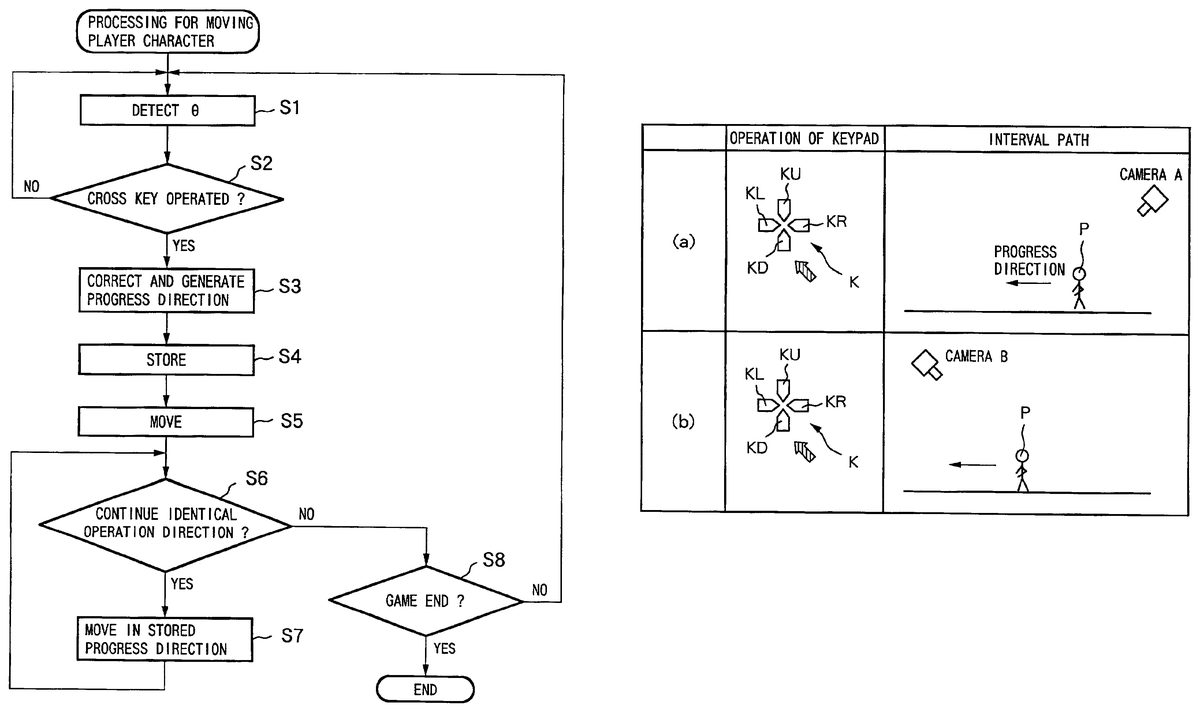
As described above with reference toFIGS. 3 and 5, the CPU8causes the display51to display a virtual three-dimensional space image viewed along a line of sight I from a virtual camera C based on the game program stored in this program storage area91. In this display state, the CPU8executes processing for moving a player character shown in the flow chart of FIG.3and always detects an angle θ formed by the line of sight I of the camera C and a direction line D that is an orientation of a player character P (step S1). Subsequently, the CPU8determines whether or not the direction key31is operated by a player (step S2). If the direction key31is operated, the CPU8corrects an input direction shown by the up key part KU, the down key part KD, the left key part KL and the right key part KR of the operated direction key31with the angle θ and generates the corrected input direction as a progress direction of the player character P (step S3). Moreover, the CPU8causes the data storage area92of the RAM9to store this generated progress direction of the player character P (step S4).
Subsequently, the CPU8causes the player character P to move in the above-mentioned progress direction (step S5). That is, since, when the line of sight I is changed by positional change of the virtual camera C, the angle θ changes following the camera change, and a direction from the direction key31is corrected by this angle θ. Thus, it is possible to automatically cause left and right directions corresponding to the left and right key parts KL and KR of the direction key31and left and right directions of the three-dimensional space as well as up and down corresponding to the up and down key parts KU and KD of the direction key31and direction of approaching and going away from the camera in the three-dimensional space to coincide with each other, respectively. Thus, if the right direction is input by the direction key, the player character P moves in the right direction in the virtual three-dimensional space and, if the left direction is input by the direction key, the player character P moves in the left direction in the virtual three-dimensional space.
In addition, the CPU8determines whether or not operation with respect to the key part of the identical direction is continued in the direction key31(step S6). Then, if the operation with respect to the key part of the identical direction is continued in the direction key31(step S6; YES), the CPU8causes the player character P to move in the progress direction stored in the data storage area92(by the processing of step S4) in a three-dimensional space regardless of whether the line of sight I moves (step S7). Therefore, if the operation with respect to the key part of the identical direction is continued in the direction key31, the player character P continues to move in the identical direction in the three-dimensional space, even if a display form of a three-dimensional space image changes following the movement of the line of sight I.
That is, for example, as shown inFIG. 4, it is assumed that there is a case in which an image displayed on a screen in a game progress process is switched from a three-dimensional space image (a) photographed by a virtual camera A from the back of the player character P to a three-dimensional space image (b) photographed by a virtual camera B from the front of the player character P. At this point, since the progress direction (←) of the character is a direction going away from the camera A in the three-dimensional space image (a), the player is operating the down key part KD in the direction key.
In this operation state, when the three-dimensional space image is switched to the three-dimensional space image from the camera B, the progress direction (←) of the player character P turns into a direction approaching the camera B in the three-dimensional space image. However, if the operation with respect to the down key part KD continues in the direction key31, the progress direction (←) of the player character P is continuously controlled in the identical direction in the three-dimensional space by the processing of step S7. Therefore, in order to move the player character P in the identical direction in the three-dimensional space before and after the camera is switched from A to B, it is sufficient that the operation with respect to the down key part KD simply continues.
Thus, it is not necessary to stop the operation of the down key part KD and operate the up key part KU in an attempt to move the player character P in a direction approaching the camera B as in the prior art, shown in FIG.6. As a result, even if a virtual three-dimensional space image to be displayed on the screen changes, a smooth movement of the character in the identical direction is possible without operating the direction key anew. Thus, the amusement value of the video game can be increased.
Then, if the operation with respect to the key part of the identical direction is stopped in the direction key31(step S6; NO), the CPU8determines whether or not a game is finished (step S8) and, if the game is continued, returns to step S1to detect the angle θ.
Further, although the case in which the present invention is realized with a game machine for home use as a platform is described in this embodiment, the present invention may be realized with a general-purpose computer such as a personal computer or an arcade game machine as a platform.
Moreover, a program and data for realizing the present invention are stored in a CD-ROM, which is used as a recording medium in this embodiment. However, a recording medium is not limited to a CD-ROM and may be a DVD (Digital Versatile Disc), other computer readable magnetic and optical recording media or a semiconductor memory. Furthermore, a program and data for realizing the present invention may be provided in the form of being preinstalled in a storage device of a game machine or a computer in advance.
In addition, a program and data for realizing the present invention may be downloaded from another apparatus on the network17connected by the communications interface15, shown inFIG. 1, via the communications line16to the HDD10and used. In addition, the program and the data may be recorded in a memory on another apparatus side on the communications line16and sequentially stored in the RAM9if necessary via the communications line16and used.
In addition, a form of providing a program and data for realizing the present invention may be such that the program and the data are provided as a computer data signal superimposed on a carrier wave from another apparatus on the network17. In this case, another apparatus on the network17is requested from the communications interface15via the communications line16to transmit the computer data, and the transmitted computer data signal is received and stored in the RAM9. It is also possible to realize the present invention in the game apparatus1using the program and the data stored in the RAM9in this way.
As described above, according to the present invention, if an identical direction is continuously input from a direction key, even if a display form of a three-dimensional space image changes following movement of a line of sight, it is possible to continue to cause a character to move in the identical direction in the three-dimensional space. Thus, even if a display form of a virtual three-dimensional space to be displayed on a screen changes, a smooth movement of a character in the identical direction is possible without operating the direction key anew. Consequently amusement provided by the video game can be increased.
The present invention is not limited to the above embodiments and various changes and modifications can be made within the spirit and scope of the present invention. Therefore, to apprise the public of the scope of the present invention the following claims are made.
Claims
- A recording medium having recorded thereon a video game program for causing a computer to execute a video game for displaying a virtual three-dimensional space while causing a line of sight to change and at the same time displaying a character on a screen and causing said character to move in said three-dimensional space based on a direction input by a direction key operated by a player, wherein the video game program causes a computer to execute: a generating procedure that, when said direction key is operated by the player, corrects said input direction by an angle to generate a corrected direction as a progress direction of said character in said three-dimensional space;a first character movement controlling procedure that moves said character in said progress direction in said three-dimensional space;a storing procedure that stores said progress direction;a determining procedure that determines whether an identical direction is input from said direction key continuously;and a second character movement controlling procedure that, when it is determined that an identical direction is input from said direction key continuously, moves said character in said stored progress direction in said three-dimensional space regardless of movement of said line of sight.
- A method of controlling movement of a character in a video game for displaying a virtual three-dimensional space while causing a line of sight to change and at the same time displaying a character on a screen and causing said character to move in said three-dimensional space based on a direction input by a direction key operated by a player, comprising: correcting, when said direction key is operated by the player, said input direction by an angle to obtain a corrected direction as a progress direction of said character in said three-dimensional space;moving said character in said progress direction in said three-dimensional space;storing said progress direction of said character;determining whether an identical direction is input from said direction key continuously;and moving, when it is determined that the identical direction is input from said direction key continuously, said character in said stored progress direction in said three-dimensional space regardless of movement of said line of sight.
- A game apparatus for displaying a virtual three-dimensional space while causing a line of sight to change and at the same time displaying a character on a screen and causing said character to move in said three-dimensional space based on a direction input by a direction key operated by a player, comprising: a generator that, when said direction key is operated by the player, corrects said input direction by an angle to generate a corrected direction as a progress direction of said character in said three-dimensional space;a first character movement controller that moves said character in said progress direction in said three-dimensional space;a storage that stores said progress direction of said character;a determining system that determines whether an identical direction is input from said direction key continuously;and a second character movement controller that, when it is determined that the identical direction is input from said direction key continuously, moves said character in said progress direction stored in said storage in said three-dimensional space regardless of movement of said line of sight.
Disclaimer: Data collected from the USPTO and may be malformed, incomplete, and/or otherwise inaccurate.