U.S. Pat. No. 6,743,099
VIDEO GAME MACHINE, PLAYER CHARACTER ACTION CONTROL METHOD, AND VIDEO GAME PROGRAM
Issue DateJanuary 29, 2002
Illustrative Figure
Abstract
No abstract is available for this record.
Description
DETAILED DESCRIPTION OF PREFERRED EMBODIMENTS (1) Constitution of Typical Video Game Machine A video game machine 100 suitable for running a video game program according to the present invention will be described. The video game machine 100 loads a program and data stored in a recording medium, such as an optical disk, and outputs images and sound to a player. The player can play a game by entering instructions by way of a controller. The configuration of the video game machine 100 will now be described with reference to FIG. 1 . The video game machine 100 comprises a control section 110 for controlling the operation of the overall game machine 100 ; an image processing section 120 for performing processing pertaining to image display; a sound processing section 130 for performing processing pertaining to sound output; an auxiliary storage control section 140 which loads a program and data from a recording medium; a communications control section 150 for controlling input and output of other data; and a main bus 160 for interconnecting the control section 110 , the image processing section 120 , the sound processing section 130 , the auxiliary storage control section 140 , and the communications control section 150 . The internal configuration of the video game machine 100 from the control section 110 to the communications control section 150 will now be described. The control section 110 comprises a CPU 111 ; a peripheral device controller 112 ; a primary storage device (main memory) 113 formed from RAM; and ROM 114 . The peripheral device controller 112 effects an interrupt control operation, a time control operation, a memory control operation, and transfer of direct memory access (DMA). The ROM 114 stores a program, such as an operating system (OS) for managing the main memory 113 ...
DETAILED DESCRIPTION OF PREFERRED EMBODIMENTS
(1) Constitution of Typical Video Game Machine
A video game machine 100 suitable for running a video game program according to the present invention will be described. The video game machine 100 loads a program and data stored in a recording medium, such as an optical disk, and outputs images and sound to a player. The player can play a game by entering instructions by way of a controller.
The configuration of the video game machine 100 will now be described with reference to FIG. 1 . The video game machine 100 comprises a control section 110 for controlling the operation of the overall game machine 100 ; an image processing section 120 for performing processing pertaining to image display; a sound processing section 130 for performing processing pertaining to sound output; an auxiliary storage control section 140 which loads a program and data from a recording medium; a communications control section 150 for controlling input and output of other data; and a main bus 160 for interconnecting the control section 110 , the image processing section 120 , the sound processing section 130 , the auxiliary storage control section 140 , and the communications control section 150 .
The internal configuration of the video game machine 100 from the control section 110 to the communications control section 150 will now be described.
The control section 110 comprises a CPU 111 ; a peripheral device controller 112 ; a primary storage device (main memory) 113 formed from RAM; and ROM 114 . The peripheral device controller 112 effects an interrupt control operation, a time control operation, a memory control operation, and transfer of direct memory access (DMA). The ROM 114 stores a program, such as an operating system (OS) for managing the main memory 113 , the image processing section 120 , and the sound processing section 130 . The CPU 111 controls the overall video game machine 100 by running the OS stored in the ROM 114 . The CPU 111 is equipped with an instruction cache and scratch pad memory and manages actual memory.
The image processing section 120 comprises a geometry transfer engine (GTE) 121 formed from a coordinate computation coprocessor for effecting processing, such as coordinate conversion processing; a graphics processing unit (GPU) 122 for effecting a rendering operation in accordance with a rendering instruction output from the CPU 111 ; a frame buffer 123 for storing an image rendered by the GPU 122 ; an image decoder (MDEC) 124 for decoding image data which have been encoded through orthogonal transformation, such as so-called discrete cosine transformation and compressed; and video output means 125 such as a display device.
The sound processing section 130 comprises a sound reproduction processor (SPU) 131 for emitting sound; a sound buffer 132 for storing sound read from a CD-ROM, musical data, or sound source data; and sound output means 133 , such as an amplifier and speaker for outputting sound produced by the SPU 131 .
The auxiliary storage device control section 140 comprises a CD-ROM drive unit 143 for reproducing a program or data recorded on a CD-ROM disk; a decoder 141 for decoding a program or data which are recorded along with, e.g., an error correction code (ECC); and a CD-ROM buffer 142 for temporarily storing reproduction data output from the CD-ROM drive unit 143 .
The communications control section 150 comprises a communications control device 151 for effecting communication control with the CPU 111 via the main bus 160 ; a controller 152 for entering an instruction from a user; a memory card 153 for storing settings of a game; a parallel I/O port 154 connected to a main bus 160 ; and an asynchronous serial I/O port 155 connected to the main bus 160 .
The outline of operation of the video game machine 100 will now be described.
When power of the video game machine 100 is turned on, the OS stored in the ROM 114 is run by the CPU 111 . The image processing section 120 and the sound processing section 130 are controlled under the OS. After performing initialization of the entire game machine 100 , such as operation check, the OS controls the auxiliary storage control section 140 and runs a program recorded on a CD-ROM, such as a game. Then, in accordance with the implemented program and input of an instruction byway of the controller 152 , the CPU 111 controls the image processing section 120 and the sound processing section 130 . The video output means 125 displays an image, and the sound output means 133 outputs sounds, such as sound effects or music. The video game program according to the present invention is run by the video game machine 100 as a program to be loaded from the CD-ROM drive 143 .
Input devices of the controller 152 will now be described with reference to FIG. 2 . The controller 152 has the following switches. Orientation levers 201 and 202 input orientation commands in accordance with a direction in which these levers 201 and 202 are tilted, and these levers are used primarily for inputting orientation. Switches 203 to 212 , a select switch 213 , a start switch 214 , and an analog/digital changeover switch 215 are press button switches. Of these switches, the start switch 214 is used primarily for activating a primary section of the video game from a menu appearing at the initiation of a video game program. The analog/digital changeover switch 215 switches to output a result of operation of the orientation levers 201 and 202 as an analog signal or a digital signal. A cable 216 connects the controller 152 to the video game machine 100 .
(2) Video Game
An action game of quarter view display is described as an embodiment of a video game program according to the present embodiment. One main character A (designated by A in the drawings) and one sub-character B (designated by B in the drawings) appear as player characters in the video game. The main character A requires player's manipulation at all times. If the player performs no manipulation, the main character A does nothing. A screen of the video game is always displayed at the center of the main character A. In contrast, the player can manipulate the sub-character B to a certain extent. However, even when the player does not perform manipulation at all, the sub-character B acts in accordance with a predetermined algorithm set previously in the video game program. In addition to the player characters, opponents (designated by C 1 , C 2 , C 3 , and C 4 in the drawings) of non-player characters appear in the game. Actions of the opponent characters are not susceptible to the player's manipulation and act in accordance with a predetermined algorithm.
Turning to FIG. 2 , the moving direction of the main character A is input by the orientation lever 201 , and the moving direction of the sub-character B is input by the orientation lever 202 . Switches 203 to 207 are assigned to manipulation of the main character A. Switches 208 to 212 are assigned to manipulation of the sub-character B.
As mentioned above, the sub-character B acts in accordance with the player's manipulation or a predetermined algorithm. In the following description, a state in which the sub-character B operates in accordance with the player's manipulation is called a manual operation mode of a video game program. On the other hand, a state in which the sub-character B operates in accordance with a predetermined algorithm is called an auto operation mode of the video game program. A process during which the video game program shifts from an auto operation mode to a manual operation mode will be described by reference to a flowchart shown in FIG. 4 .
In a period during which an input entered by way of any of the orientation lever 202 and the switches 206 and 207 is not detected, the sub-character B operates in an auto operation mode (step S 1 ). In the auto operation mode, the sub-character B attacks an opponent character located at the closest position. For instance, the sub-character B attacks an opponent character C 2 .
During the course of an auto operation mode, when any one of the switches assigned to the sub-character B; that is, the orientation lever 202 and the switches 206 and 207 , is subjected to an input action (step S 2 ), the video game program checks whether or not a shift to a manual operation is now available (step S 3 ) This check is for imposing a predetermined requirement on a shift from an auto operation mode to a manual operation mode. The check is made to represent in a video game a situation in which, for any reason, the sub-character B cannot follow an instruction entered by way of manual operation; for example, a frame in which the sub-character B is already engaging in battle with an opponent character and is performing attack and defense actions (e.g., is in the course of kicking the opponent with his feet), a frame in which the sub-character B cannot move because of severe injury, or a case where the action of the sub-character B is limited for reasons of a game system.
When it has been ascertained that a manual operation is acceptable, a positional relationship between the main character A and the sub-character B is verified (step S 3 ). In order for the player to instruct the action of the sub-character B directly, the player needs to see the sub-character B. However, depending on the situation of the game, the sub-character B may be outside the screen. Therefore, when the sub-character B is not present on the screen, the player causes the main character B to approach the sub-character A (step S 5 ). When the sub-character B is present in the screen, shift is made to the manual operation mode (step S 6 ).
When shift has been made to the manual operation mode, the sub-character B acts in accordance with key input performed by the player. Shift is made from the manual operation mode to the auto operation mode when none of the orientation lever 202 and the switches 206 and 207 is subjected to input operation for a predetermined period of time.
In the auto operation mode, the sub-character B attacks the closest opponent character. However, depending on the situation, the player may desire to change a target. For example, in the scenario shown in FIG. 5 , an opponent character C 3 is approaching the main character A, who is already engaging in battle with the opponent character C 1 . At this time, an object to be attacked by the sub-character B is originally an opponent character C 2 , and there maybe case where the player desires to prioritize elimination of the opponent character C 3 .
At this time, shift can made to a manual operation mode so that the player can guide the sub-character B to the opponent character C 3 . In this case, manipulation of the main character A is likely to be neglected. For this reason, in the video game according to the present invention, when an input operation is made to a certain extent in the manual operation mode, the sub-character B selects a desired opponent character as a target in a subsequent auto operation mode. With reference to FIG. 6 , there will now be described a process in which the sub-character B selects a character to be attacked from among the opponent characters C 1 , C 2 , and C 3 in the video game.
A numerical value which is incremented with lapse of time and is decremented when a character is attacked is set for the sub-character B. The sub-character B can perform attack when his energy has a positive value. When the energy of the sub-character B assumes a value of zero, the sub-character B can only attempt to evade attack from an opponent character. Therefore, a check is first made as to the magnitude of current energy of the sub-character B (step T 1 ). If the energy of the sub-character B assumes a value of zero, the sub-character B performs evasive action (step T 2 ).
Next, a distance between the main character A and the sub-character B is computed (step T 3 ). When the main character A and the sub-character B are spaced apart from each other by a distance greater than a predetermined value, the sub-character B is caused to approach the main character A (step T 4 ). On the other hand, when the main character A is present within a predetermined distance, an opponent in areas surrounding the sub-character B is searched (step T 5 ). When no opponent character is present, attack is not performed, and processing is terminated.
When an opponent character is present around the main character B, a determination is made as to whether or not input has been made through the orientation lever 202 within a predetermined frame in the past (step T 6 ). When input has been made, the opponent character, which is located in the entered direction at the time of input, is selected as a target (step T 7 ). If no input has been made, an opponent character located closest to the sub-character B is selected as a target (step T 8 ).
Selection of an opponent character is described by reference to a specific example. Assume that the main character A and the sub-character B are now in the situation shown in FIG. 5 ; namely, the main character A is engaging in battle with the opponent character C 1 , and the sub-character B is engaging in battle with the opponent character C 2 . Here, assume that the player attempts to cause the sub-character B to block the opponent character C 3 approaching the main character A from the back. Energy of the sub-character B is positive, and the sub-character B is in a status in which he can perform action. The sub-character B is sufficiently close to the main character A.
At the beginning, the sub-character B handles the closest opponent character as a target (step T 8 ). Here, the player momentarily tilts the orientation lever 202 toward the opponent character C 3 (step S 1 ). Shift is made to a manual operation mode after completion of an animation pertaining to attack/defense actions of the sub-character B (step S 2 ). The opponent character C 3 located in the direction in which the orientation lever 202 has been tilted is set as a target. Here, the sub-character B has positive energy (step T 1 ) and is located sufficiently close to the main character A (step T 3 ). Opponent characters C 1 , C 2 , and C 3 are present as opponent characters which the sub-character B can attack (step T 5 ). Therefore, determination is made that a manual operation was performed immediately before (step T 6 ) that is, the manual operation is available. The sub-character B changes a target and makes movement in the manner as shown in FIG. 7 , thus attacking the opponent character C 3 .
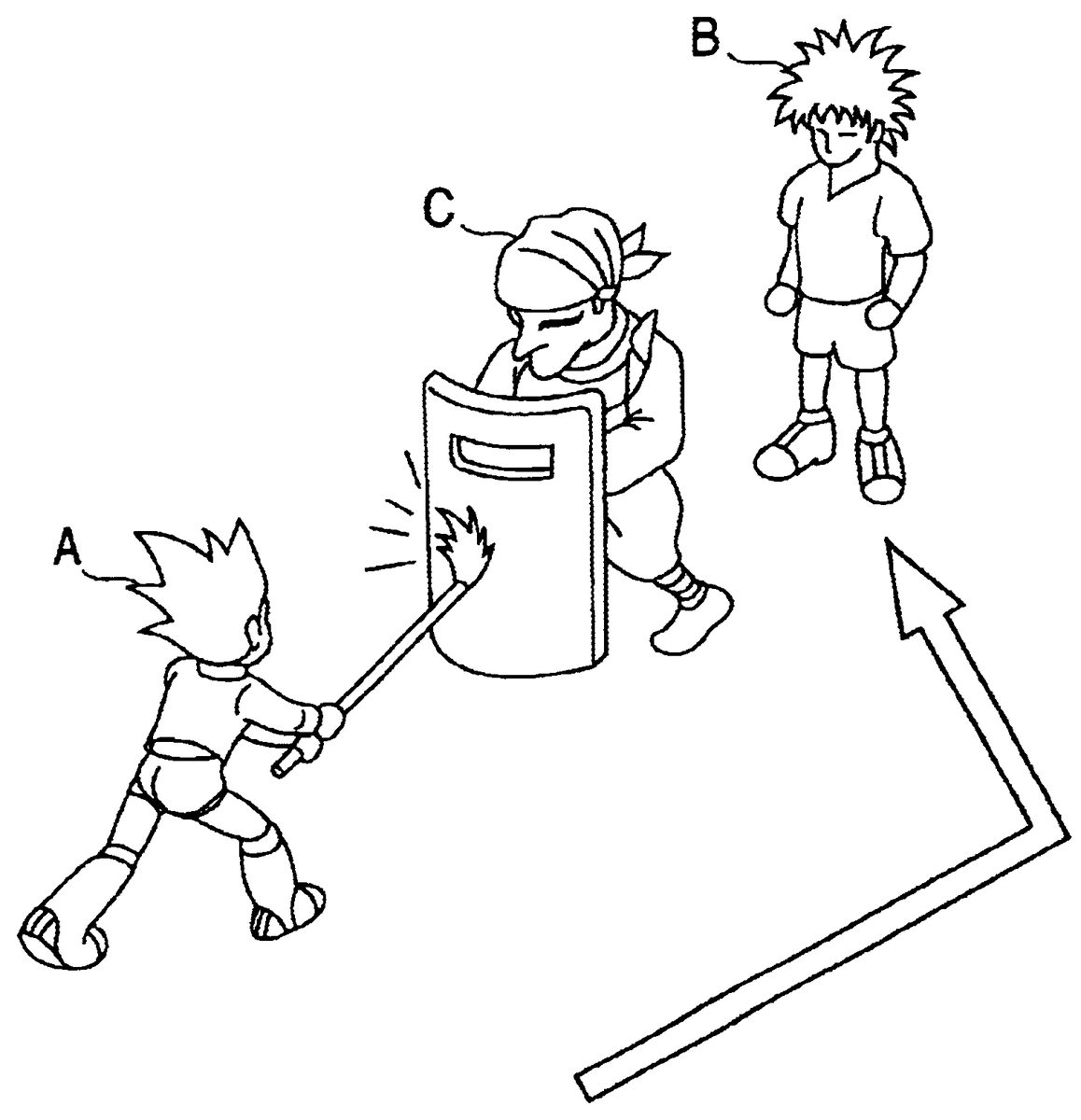
The above example has described a situation in which a video game according to the present invention can be represented, by taking as subject matter a battle between a plurality of player characters and a plurality of opponent characters. The next example pertains to a battle between a plurality of player characters and a single opponent character (FIG. 8 ). The opponent character C has a characteristic of completely preventing a frontal attack and being not susceptible to damage at all (FIG. 9 ). For this reason, the main character A cannot defeat the opponent character C. At this time, in order to defeat the opponent, the player move the sub-character B in the direction designated by the arrow B shown in FIG. 10 in a manual operation mode while causing the main character A to continually attack. By this action, the sub-character B can impart damage to the opponent character C (FIG. 11 ).
There is described an example of a challenge (problem) which can be solved by simultaneous operation of a plurality of player characters. Floors D 1 and D 2 shown in FIG. 12 act as switches. When a player character steps on the switch, the switch is turned on. When the player steps off the switch, the switch is turned off. The switches D 1 and D 2 are designed so as to operate in association with opening and closing actions of a door. The door is designed to open only when both switches D 1 and D 2 are turned on simultaneously.
In order to open the door in a state shown in FIG. 12 , the player tilts the orientation levers 201 and 202 forward, thus causing the main character A to step on the floor D 1 and the sub-character B to step on the floor D 2 .
Here, in addition to reference to turning on/off of the floors D 1 and D 2 , the switches D 1 and D 2 being turned on simultaneously may be added to requirements for opening the door. In this case, a difficulty level of operation required for playing a game can be increased.
The present invention has been described on the basis of the embodiment; however, the present invention is not limited thereto. As a matter of course, the present invention is susceptible to modification and improvement within the range of ordinary knowledge of those of ordinary skill in the art.
For instance, two or more sub-characters B maybe employed. In order to cause two sub-characters B to emerge, there is a conceivable method of entering a direction for the main character A by combination of four inputs entered by way of the switches 203 to 206 , as well as of assigning sub-characters B to the orientation levers 201 and 202 .
The present invention is described with reference to an example in which player characters battle with non-player characters. The present invention can be applied to a system by way of which a plurality of players cause player characters to battle with each other.
A video game program and a video game machine according to the present invention are provided with different orientation input means assigned to respective player characters. To switch operation modes of a player character having a plurality of operation modes, switches assigned to the player character are operated in their present forms. Therefore, there is no necessity for the player to perform special operation for only switching purpose. Hence, the player can manipulate the sub-character without consideration of switching between operation modes.
Since the video game program and the video game machine according to the present invention enable simultaneous manipulation of a plurality of player characters, a challenge which can be met only when a plurality of player characters are manipulated simultaneously can be set in a game.
According to the video game program and video game machine of the present invention, so long as a target is specified in a manual operation mode, a sub-character automatically takes a specified opponent character as a target. Hence, semi-automatic control of the sub-character can be effected.
Claims
- A video game machine comprising: a controller provided with a plurality of switches including a plurality of orientation input means;means for simultaneously displaying a plurality of player characters;and means of assigning switches including at least one of the orientation input means to the respective player characters, wherein at least one of the plurality of player characters has a first mode in which the player character operates in accordance with input made by the switches assigned to the player character, and a second mode in which the player character operates in accordance with a predetermined sub-program, and wherein switching between the first and second modes is effected when input operation, by any one of switches assigned to the player characters, is performed.
- The video game machine according to claim 1 , wherein the sub-program takes, as an object of action, a non-player character located at a position closest to the player character which is an object of control.
- The video game machine according to claim 1 , wherein in the first mode, a non-player character located in a direction which is entered by the orientation input means assigned to the player character is detected, and in the second mode, the detected non-player character is taken as an object of action for the player character.
- The video game machine according to claim 1 , wherein a non-player character takes one of the plurality of player characters located closest to the non-player character as an object of action.
- The video game machine according to claim 2 , wherein the action includes one of approaching action, battle action and conversation of the non-player character.
- The video game machine according to claim 1 , wherein at least one of the plurality of player characters acts in accordance with only an input entered by the assigned switches.
- The video game machine according to claim 1 , wherein a non-player character completely prevents attack in one direction.
- The video game machine according to claim 1 , wherein a plurality of switches which are to be actuated by the player character are provided, and when the plurality of player characters simultaneously actuates the plurality of switches, a predetermined response is performed.
- The video game machine according to claim 8 , wherein the plurality of switches includes a plurality of switches which are turned on when the player characters step on the switches.
- A method of controlling action of a player character which appears in a video game program to be executed by a video game machine which enables connection of a controller having a plurality of orientation input means, the method comprising the steps of: simultaneously displaying a plurality of player characters;and assigning switches including at least one of the orientation input means to the respective player characters, wherein at least one of the plurality of player characters has a first mode in which the player character operates in accordance with inputs made by the switches assigned to the player character, and a second mode in which the player character operates in accordance with a predetermined sub-program;and switching the first and second modes when input operation by way of any one of switches assigned to the player character is performed.
- A video game program product to be executed by a video game machine which enables connection of a controller having a plurality of orientation input means, the method comprising the steps of: simultaneously displaying a plurality of player characters;and assigning switches including at least one of the orientation input means to the respective player characters, wherein at least one of the plurality of player characters has a first mode in which the player character operates in accordance with inputs made by the switches assigned to the player character, and a second mode in which the player character operates in accordance with a predetermined sub-program;and switching between the first and second modes when input operation is performed by any one of switches assigned to the player characters.
- The video game program product according to claim 11 , wherein the sub-program takes, as an object of action, a non-player character located at a position closest to the player character which is an object of control.
- The video game program product according to claim 11 , wherein in the first mode, a non-player character located in a direction which is entered by the orientation input means assigned to the player character is detected, and in the second mode, the detected non-player character is taken as an object of action for the player character.
- The video game program product according to claim 11 , wherein a non-player character takes one of the player characters located closest to the non-player character as an object of action.
- The video game program product according to claim 12 , wherein the action includes one of approaching action, battle action and conversation of the non-player character.
- The video game program product according to claim 11 , wherein at least one of the plurality of player characters acts in accordance with only an input entered by the assigned switches.
- The video game program product according to claim 11 , wherein a non-player character completely prevents attack in one direction.
- The video game program product according to claim 11 , wherein a plurality of switches which are to be actuated by the player character are provided, and when the plurality of player characters simultaneously actuates the plurality of switches, a predetermined response is performed.
- The video game program product according to claim 18 , wherein the plurality of switches includes a plurality of switches which are turned on when the player characters step on the switches.
- A video game machine which operates in accordance with the video game program product as defined in any one of claims 11 through 19 .
- The video game machine according to claim 20 , further comprising a controller having a plurality of orientation input means.
Disclaimer: Data collected from the USPTO and may be malformed, incomplete, and/or otherwise inaccurate.