U.S. Pat. No. 6,672,964
VIDEO GAME WITH READILY DISTINGUISHABLE CHARACTERS DISPLAYING THE CHARACTER'S LINE OF SIGHT
Issue DateOctober 10, 2001
Illustrative Figure
Abstract
No abstract is available for this record.
Description
DETAILED DESCRIPTION OF THE PREFERRED EMBODIMENTS A preferred embodiment of the invention is described with reference to the accompanying drawings. FIG. 1 is a block diagram showing the overall construction of this preferred embodiment. First, a video game machine pertaining to this preferred embodiment of the invention is described. The game machine 10 is made up of a game unit proper 11 and a keypad 50 connected to an input side of the game unit proper 11 , and a television set 100 having a CRT (Cathode Ray Tube) as a display unit, speakers and so on is connected to an output side of the game unit proper 11 . The game unit proper 11 has a CPU (Central Processing Unit) 12 , a ROM (Read Only Memory) 13 , a RAM (Random Access Memory) 14 , a hard disc drive 15 , a graphics processing part 16 , an audio processing part 17 , a disk drive 18 , a communications interface 19 , a memory card reader/writer 20 , an input interface 21 , and a bus 22 connecting these components together. The game unit proper 11 is connected via the input interface 21 to the keypad 50 , which serves as a control input part. A -key 51 and a group of buttons 52 are provided on the top of the keypad 50 . The button group 52 includes a O-button 52 a , a -button 52 b , a -button 52 c and a -button 52 d . A select button 55 is provided on a connecting part linking a base part on which the -key 51 is provided to a base part on which the button group 52 is provided. Other buttons, such as an R1-button 56 and an L1-button 53 , are provided on ...
DETAILED DESCRIPTION OF THE PREFERRED EMBODIMENTS
A preferred embodiment of the invention is described with reference to the accompanying drawings. FIG. 1 is a block diagram showing the overall construction of this preferred embodiment.
First, a video game machine pertaining to this preferred embodiment of the invention is described. The game machine 10 is made up of a game unit proper 11 and a keypad 50 connected to an input side of the game unit proper 11 , and a television set 100 having a CRT (Cathode Ray Tube) as a display unit, speakers and so on is connected to an output side of the game unit proper 11 .
The game unit proper 11 has a CPU (Central Processing Unit) 12 , a ROM (Read Only Memory) 13 , a RAM (Random Access Memory) 14 , a hard disc drive 15 , a graphics processing part 16 , an audio processing part 17 , a disk drive 18 , a communications interface 19 , a memory card reader/writer 20 , an input interface 21 , and a bus 22 connecting these components together. The game unit proper 11 is connected via the input interface 21 to the keypad 50 , which serves as a control input part.
A -key 51 and a group of buttons 52 are provided on the top of the keypad 50 . The button group 52 includes a O-button 52 a , a -button 52 b , a -button 52 c and a -button 52 d . A select button 55 is provided on a connecting part linking a base part on which the -key 51 is provided to a base part on which the button group 52 is provided. Other buttons, such as an R1-button 56 and an L1-button 53 , are provided on the side of the keypad 50 .
The keypad 50 has switches linked respectively to the -key 51 , the O-button 52 a , the -button 52 b , the -button 52 c , the -button 52 d , the select button 55 , the R 1 -button 56 and the L 1 -button 53 . When a pushing force is applied to one of the buttons, the corresponding switch turns on. A detection signal corresponding to this on/off state of the switch is generated in the keypad 50 .
The detection signals generated in the keypad 50 are supplied to the input interface 21 , and by a detection signal from the keypad 50 being passed through the input interface 21 it becomes detection information indicating which button on the keypad 50 has been turned on. In this way, control operation commands keyed in to the keypad 50 by a user are supplied to the game unit proper 11 .
The CPU 12 centrally controls the apparatus as a whole by executing an operating system stored in the ROM 13 , and executes video game programs stored in a program area of the RAM 14 . Also, the CPU 12 monitors the state of the keypad 50 by way of the input interface 21 , executes video game programs stored in the program area of the RAM 14 as necessary, and as necessary stores in a predetermined area of the RAM 14 various data derived in the course of a game. The ROM 13 includes EEPROM (Electrically Erasable and Programmable Read Only Memory), and predetermined data in the RAM 14 which must be held even when the power supply is cut are stored in the EEPROM at a stage before power supply cut-off.
The RAM 14 essentially has a program area, a picture data area, and an audio data area, and also has an area for holding other data. Program data, picture data, audio data and other data read from a disc 30 such as a DVD or a CD-ROM by the disk drive 18 are respectively held in these areas.
The RAM 14 is also used as a work area, and various data derived in the course of the game are further held in the area for holding other data. Program data, picture data, audio data and other data read from the disc 30 can also be held in the hard disc drive 15 ; program data, picture data, audio data and other data held in the hard disc drive 15 may be transferred to the RAM 14 as necessary; and various data derived in the course of the game and held in the RAM 14 may be transferred to and held in the hard disc drive 15 .
The graphics processing part 16 includes in a VRAM 23 a frame buffer which constitutes a buffer memory for holding picture data. Using control information from the CPU 12 arising along with program execution it generates a video signal on the basis of picture data held in the frame buffer and outputs the video signal to the television set 100 . As a result, a picture based on picture data held in the frame buffer is displayed on the display screen 101 of the television set 100 .
The audio processing part 17 has the function of generating audio signals such as BGM (Background Music), conversations between characters, and sound effects. The audio processing part 17 outputs to a speaker 102 of the television set 100 a sound signal including audio signals on the basis of data stored in the RAM 14 using control information from the CPU 12 arising along with program execution.
The television set 100 has the display screen 101 and the speaker 102 and performs picture (image) and audio output according to the content of the video game on the basis of the video signal (picture signal) and sound signal from the game unit proper 11 .
The disk drive 18 is so constructed that the disc (DVD or CD-ROM) 30 , which is a recording medium, can be removably loaded into it, and reads video game program data, picture data, audio data and other data held on the disc 30 .
The communications interface 19 is connected to a network 110 , and acquires various kinds of data by performing data communications with data storage devices and information processing devices such as servers installed in other locations. The video game program data, picture data, audio data and other data held in the RAM 14 may alternatively be acquired by way of a network 110 and the communications interface 19 .
The memory card reader/writer 20 is so constructed that a memory card 31 can be removably loaded into it, and writes save data of a relatively low volume, such as mid-way progress data of video games and video game environment setting data, to a memory card.
On a recording medium pertaining to this preferred embodiment of the invention, that is, the disc 30 , is recorded a video game program capable of displaying multiple characters including player characters and enemy characters on a screen and controlling actions of the displayed characters in accordance with control operations of a player, and this can be read by a computer (the CPU 12 and its peripheral devices). The computer can accept the input of a candidate character intended to be the object of an action to be performed by a predetermined character in accordance with control operations of the player. The computer also can perform image-control so that the line of sight of the predetermined character points to the candidate character input-accepted when accepting input.
The computer can also accept a second input of a second action to be performed by a predetermined character in accordance with control operations of a player; distinguish the second action accepted as the second input; and execute the second action accepted as the second input in accordance with control operations of the player and performing image-control in accordance with a distinguishing result obtained when distinguishing the second action so that the line of sight of the predetermined character and the line of sight of the candidate character assume a predetermined relationship.
Accordingly, the game unit proper 11 has, besides the functions necessary for carrying out a related art video game by software processing based on data held in the CPU 12 and the various memories, as special functions, a first function of accepting the input of a candidate character intended to be the object of an action to be performed by a predetermined character in accordance with control operations of the player, and further a function of performing image-control so that the line of sight of the predetermined character points to this input-accepted candidate character.
The game unit proper 11 also has a second function of accepting the input of an action to be performed by a predetermined character in accordance with control operations of a player; a function of distinguishing the action input-accepted by the second function; and a function of executing the action input-accepted by the second function in accordance with control operations of a player and performing image-control in accordance with the result of distinguishing the action so that the line of sight of the predetermined character and the line of sight of the candidate character assume a predetermined relationship.
As a result a video game can be realized with which it is possible to exploit the particular characteristics of the video game to raise its sense of reality and with which it is possible to understand easily which character is to be the object of an action of a player character. Instead of being realized by software processing, these functions may alternatively be realized by the provision of appropriate dedicated hardware.
Next, the operation of this preferred embodiment will be explained. FIG. 2 is a flow chart showing an example of a processing routine of the overall operation of the preferred embodiment described above. The steps in FIG. 2 have been assigned the reference numerals S 1 through S 13 .
First, when a power supply (not shown) is turned on, a boot program is read out; the different parts are initialized; and processing for starting a game is carried out. That is, by the disk drive 18 , video game program data, picture data, audio data and other data held in the disc (DVD or CD-ROM) 30 are read out and stored in the RAM 14 , and as necessary, data held in nonvolatile memory such as the EEPROM of the ROM 13 , the hard disc drive 15 , or the memory card 31 are read out and stored in the RAM 14 . Before the start of an actual game, various settings are carried out to reach a state from which a game can proceed. Then, when a game is started from this state, a scene such as a movement scene, a battle scene or some other scene is set, and processing proceeds to step S 1 .
In step S 1 it is determined whether or not the present scene is a movement scene, and if it is not a movement scene processing proceeds to step S 2 and determines whether or not it is a battle scene. When in step S 2 it is determined that the scene is not a battle scene, processing moves on to step S 3 and it is determined whether or not the scene is another scene (conversation, shopping or picking up). When in step S 3 it is determined that the scene is not another scene, processing returns to step S 1 and the processing of steps S 1 through S 3 is repeated so that a standby state is assumed.
When in this state it is determined in step S 1 that the present scene is a movement scene, processing moves on to step S 4 and a movement control input-accepting state is assumed. And in step S 5 , movement processing corresponding to an accepted movement control input is carried out. When the movement processing ends, processing moves on to step S 6 and movement information is generated on the basis of player character position information derived successively along with the movement processing. The movement information includes information showing a set zone in a virtual space in which the present player character is positioned. When the movement information has been generated, processing moves on to step S 11 .
When in step S 2 it is determined that the present scene is a battle scene, processing moves on to step S 7 and a battle control input-accepting state is assumed. Then, in step S 8 , battle processing corresponding to input-accepted battle control operations is carried out; a battle is fought between multiple player characters and multiple enemy characters in a combination freely selected by the player; and processing proceeds to step S 9 . In step S 9 , battle information is generated which shows for example names of the player characters and enemy characters which fought; the progress of the battle; the result of the battle; and parameters stipulating the capabilities of the player characters. When the battle information has been generated, processing moves on to step S 11 .
When in step S 3 it is determined that the present scene is some other scene (conversation, shopping, picking up or the like), the routine proceeds to step S 10 and processing according to the scene is carried out; other information corresponding to that processing is generated; and the routine proceeds to step S 11 .
When processing reaches step S 11 , the present position of the player character is successively updated by movement information being stored in a predetermined data area of the RAM 14 . And, along with that, battle zone information for each set zone and other information is stored in a predetermined data area of the RAM 14 . That is, an action history of the player character is stored for each set zone.
Then, in step S 12 , action evaluation processing is carried out on the basis of the information showing the action history of the player character stored in the RAM 14 . Specifically, for information of which numbering is necessary, numbering is carried out using a pre-prepared conversion table. For information of which weighting is necessary, predetermined coefficients are applied. These figures are totalled to calculate a score. The calculated score is added to a previous score held in a predetermined data area of the RAM 14 , and by this being stored again in a predetermined data area of the RAM 14 a score constituting evaluation information is successively updated.
When action evaluation processing ends like this, processing moves on to step S 13 and determines whether the game is over, and when the game is not over, processing returns to step S 1 and the processing of step S 1 through step S 13 described above is repeated.
When in step S 13 it is determined that the game is over, although this is not shown in FIG. 2 , the information showing the action history of characters, the evaluation information, and the player character capability settings information held in a predetermined area of the RAM 14 are each read from the RAM 14 and transferred to and stored together with other data in rewritable nonvolatile memory such as the EEPROM of the ROM 13 , the hard disc drive 15 , or the memory card 31 . After other kinds of processing accompanying the ending of a game are carried out, the power supply is cut off and the game ends. When the power supply is switched on again, the various information and other data thus held in nonvolatile memory by data save processing before power supply cut-off are read out from the nonvolatile memory to which they were saved and stored again in the same data area of the RAM 14 in which they were held before the power supply was cut off.
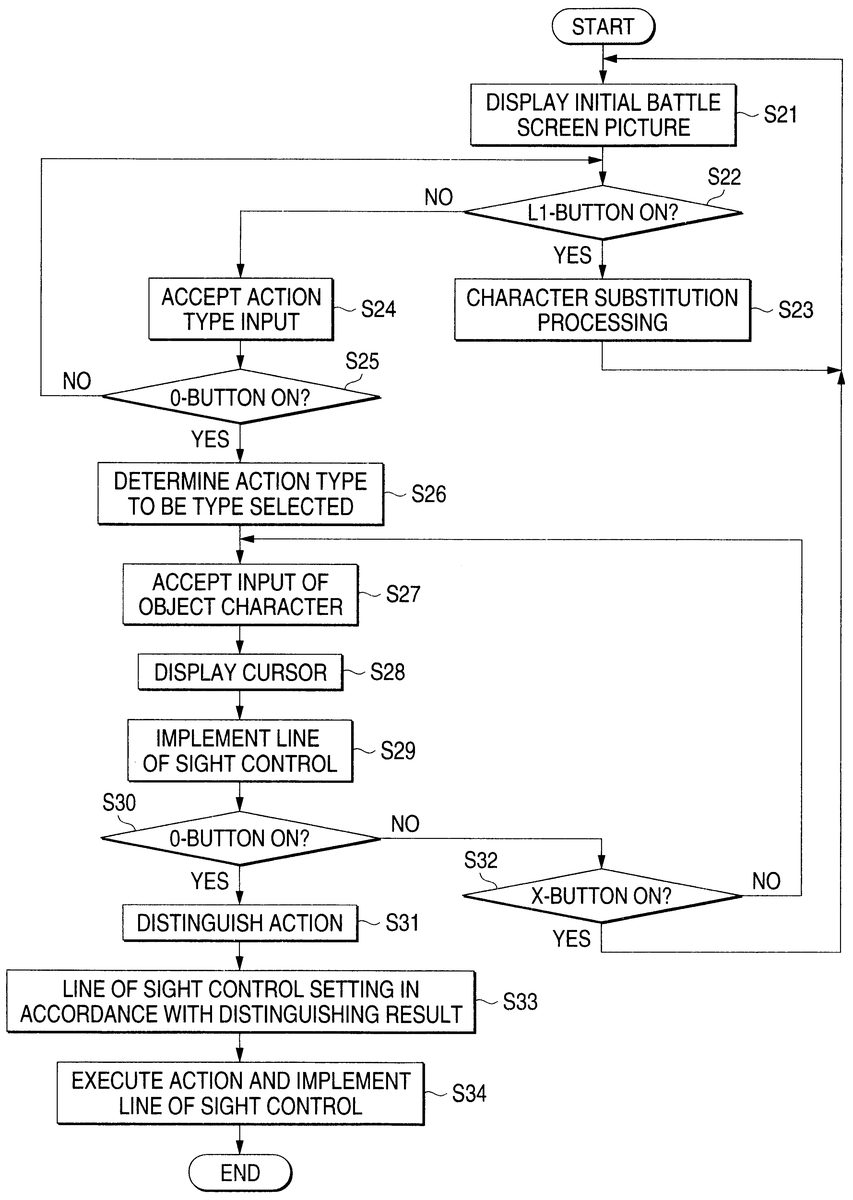
FIG. 3 is a flow chart showing an example of a processing procedure for the battle control operation input-acceptance processing (step S 7 ) of the preferred embodiment described above. FIG. 4A shows an example of a specific display picture pertaining to battle control operation input-acceptance processing, and FIGS. 4B and 4C show parts of the same display picture. With reference to FIG. 3 and FIGS. 4A , 4 B and 4 C, battle control operation input-acceptance processing in the preferred embodiment described above will now be explained. The steps in FIG. 3 have been assigned the reference numerals S 21 through S 34 .
In FIGS. 4A , 4 B and 4 C the reference number 401 denotes a player character taking part in a battle and the reference numbers 402 through 404 denote enemy characters, and it will be assumed that a battle can be fought with any combination of the player character 401 and the enemy characters 402 through 404 .
First, when the battle control operation input-acceptance processing is reached in the routine of FIG. 2 , in step S 21 , an initial battle picture is displayed, as shown in FIG. 4 A. In this initial battle picture, the player character 401 and the enemy characters 402 through 404 are displayed confronting each other. In FIG. 4A , the reference number 405 denotes a cursor for pointing to a candidate character intended to be the object of an action; however, this cursor is not displayed at this stage.
In step S 22 it is determined whether or not the L 1 -button 53 has been pressed, and when it is determined that the L 1 -button 53 has been pressed processing proceeds to step S 23 . When processing proceeds to step S 23 , a state is assumed wherein the player character 401 can be replaced with a substitute character. That is, a substitute character is selected by a control operation of the player, and character substitution processing is carried out as necessary between the selected substitute character and the player character 401 . When the character substitution processing ends, processing returns to step S 21 and the initial battle picture is displayed. And also when character substitution is canceled part-way through, processing returns to step S 21 and the initial battle picture is displayed.
And when in step S 22 it is determined that the L 1 -button 53 has not been pressed, processing moves on to step S 24 ; a state for accepting the input of an action (command input) to be executed by the player character 401 is assumed; and an action is selected in accordance with an operation of the -key 51 . In FIG. 4A , a display region for action selection is omitted. Then, in step S 25 , it is determined whether or not the O-button 52 a has been pressed, and when it is determined that the O-button 52 a has not been pressed processing returns to step S 22 and the processing of step S 22 , step S 24 and step S 25 is repeated so that a standby state is assumed until either the L 1 -button 53 is pressed or the O-button 52 a is pressed.
When in step S 25 it is determined that the O-button 52 a has been pressed, processing moves on to step S 26 ; selection of the action selected at that time is confirmed, various associated processing is carried out, and the displayed picture changes to a battle execution picture. At this time, the cursor 405 of FIG. 4A is displayed for the first time, and a candidate character intended to be the object of an action determined by internal processing is indicated. When the various processing associated with action determination ends and the displayed picture changes to a battle execution picture, processing moves on to step S 27 .
When processing reaches step S 27 , a state for accepting the input of a candidate character intended to be the object of the action of the player character 401 is assumed; a candidate character is selected in accordance with a number of times the -key 51 is pressed; and in step S 28 , the cursor 405 is controlled and displayed in accordance with the selection operation. In step S 29 , line of sight control of the player character 401 is implemented, and processing then proceeds to step S 30 .
In step S 30 , it is determined whether or not the O-button 52 a has been pressed. When it is determined that the O-button 52 a has not been pressed, processing proceeds to step S 32 and it is determined whether or not the -button 52 b has been pressed. When it is determined that the -button 52 b has not been pressed, processing returns to step S 27 and the processing of step S 28 through step S 33 is repeated so that a standby state, wherein candidate character selection input is accepted, is assumed until either the O-button 52 a is pressed or the -button 52 b is pressed.
That is, each time the -key 51 is pressed once, the cursor 405 moves from one displayed character to the next to indicate a selected candidate character, and the line of sight of the player character 401 is pointed at that candidate character.
For example, it is assumed that each time the -key 51 is pressed once the cursor 405 moves around from character to character in the order 404 403 402 404 . . . . When from the initial state wherein the battle execution picture has been reached but the -key has not been pressed the -key is pressed once, as shown in FIG. 4B the cursor 405 moves to the enemy character 403 and the line of sight of the player character 401 (shown with a dashed arrow in the figure) is pointed to the enemy character 403 . And when the -key is pressed again, as shown in FIG. 4C the cursor 405 moves to the enemy character 402 and the line of sight of the player character 401 (shown with a dashed arrow in the figure) is pointed at the enemy character 402 . Consequently, the player can easily make out the candidate character on the basis of the line of sight of the player character 401 .
When the selection of a candidate character is input-accepted like this and then in step S 32 it is determined that the O-button 52 a has been pressed, the candidate character is confirmed as the object of the action and processing proceeds to step S 31 . When processing reaches step S 31 , distinguishing of the action to be performed by the player character 401 is carried out, and in step S 33 control information for implementing predetermined line of sight control according to the distinguishing result is set.
When the setting of the control information is finished, processing proceeds to step S 34 and the confirmed action is executed, and line of sight control is implemented between the player character 401 and the selected character. Consequently, one sequence of battle control operation input-acceptance processing ends with the lines of sight of the two characters still controlled to a predetermined relationship. When in step S 32 it is determined that the -button 52 b has been pressed, processing returns to step S 21 and the initial battle picture is displayed again.
The control of the lines of sight of the characters is now explained. For each character, there are prepared multiple images of which the body of the character faces a different way, and there are also prepared multiple images which the body faces the same way, but the face of the character faces a different way. Then, in line of sight control on selection of a candidate character, a direction is detected on the basis of the position information for each of the player character 401 and the enemy characters 402 through 404 , and by a certain image of the player character 401 being displayed in accordance with that direction, its line of sight is controlled to the direction of the candidate character.
In line of sight control on action execution, a direction is detected successively on the basis of position information of the player character 401 arising from internal processing and position information of the character to be the object of the action. By the player character 401 and a certain image of the character to be the object of the action being displayed in accordance with the direction and the action, the directions of the lines of sight of the two are controlled to a predetermined relationship.
For example, when there are multiple player characters and a defense action such as magic (command name) is to be executed with respect to a supporting character, the lines of sight are controlled so that the side using the magic faces in the direction of the position of the opposing supporting character and then the supporting character on which the magic has been used faces in the direction of the position of the player character which used the magic . Conversely, when a character has magic used on it by an opposing supporting character, from when the magic is used, the line of sight of the character is controlled so as to point in the direction of the position of the opposing supporting character. And when a player character executes an attack action such as fight (command name) with respect to an enemy character, the lines of sight of the attacking side and the side being attacked are both held so that they point at each other. Consequently, players can, to some extent, understand the state of execution of an action from the lines of sight of the two characters involved. When magic is used on all of a number of enemies (or supporters), by the line of sight of the supporting (or enemy) character using the magic being made to face the front, the situation can be understood more easily.
Thus, the preferred embodiment described above provides the following effects. A first effect is that because the line of sight of a predetermined character about to execute an action is controlled so that it points at a candidate character, the player can easily understand which is the candidate character, and the enjoyability of the game can be maintained. A second effect is that because a predetermined input-accepted action is executed the line of sight of the predetermined character performing the action and the line of sight of the candidate character are controlled so that they assume a predetermined relationship. The relationship between the predetermined character and the candidate character can then, to some extent, be understood and the enjoyability of the game can be better maintained.
Next, other preferred embodiments will be described. In the preferred embodiment described above, in the battle control input-acceptance processing, a case wherein control commands relating to battle control operations are accepted using the L 1 -button 53 , the -key 51 , the O-button 52 a and the -button 52 b was described; however, other buttons may alternatively be used. And whereas a case was described in which only the timing at which a switch is turned on after its respective button is pressed is monitored in the input-accepting of operation commands, alternatively operation commands may be accepted using the timing at which the switch linked to the respective button is turned off, or both the on and the off timing of the switch linked to a respective button can be monitored and both combined to input-accept operation commands. Also, the time for which a switch linked to a respective button is on or off can be combined to input-accept operation commands.
In the preferred embodiment described above, a case is described wherein the line of sight of a predetermined character about to execute an action is controlled so as to point to a candidate character. Also, in the execution of a predetermined action, the line of sight of the predetermined character performing the action and the line of sight of the candidate character are controlled so as to assume a predetermined relationship, also, between the position of the character whose line of sight has been directed and the position of a character at which the line of sight is directed. A display which associates the relationship of the two may be carried out in the representation of the background of the characters. However, the effects of the invention can be obtained by controlling the line of sight of the predetermined character performing the action and the line of sight of the candidate character so that they assume a predetermined relationship.
The present invention is not limited to the preferred embodiments described above, and it will be clear that various changes and modifications are possible within the spirit and scope of the invention. For example, the order of the steps of a method according to the invention can be changed within the spirit and scope of the invention.
As described above, with the present invention it is possible to exploit the particular characteristics of the video game to raise its sense of reality and it is possible to understand easily which character is to be the object of an action of a player character and to maintain the enjoyability of the game.
Claims
- A computer-readable recording medium on which is recorded a video game program capable of displaying multiple display characters and controlling actions of the displayed characters in accordance with control operations of a player, which program executes: accepting an input to a computer to select a candidate character to be an object of an action to be performed by a predetermined character in accordance with a control operation of a player;and performing image-control so that a line of sight of the predetermined character points to the candidate character selected by the input.
- The computer-readable recording medium according to claim 1 , the program further executing: accepting input of an action to be performed by the predetermined character in accordance with a control operation of a player;distinguishing the action accepted as input when accepting the input;and executing the action accepted as input when accepting the input in accordance with a control operation of the player and performing image-control in accordance with a distinguishing result obtained when distinguishing the action so that the line of sight of the predetermined character and a line of sight of the candidate character assume a predetermined relationship.
- A computer-readable recording medium on which is recorded a video game program capable of displaying multiple display characters and controlling actions of the displayed characters in accordance with control operations of a player, which program executes: accepting an input to a computer of an action to be performed by a predetermined character in accordance with a control operation of a player;distinguishing the input as an action when accepting the input;and executing the action and performing image-control in accordance with a distinguishing result obtained when distinguishing the action so that a line of sight of the predetermined character and a line of sight of a character to be the object of the action assume a predetermined relationship.
- A video game program capable of displaying multiple display characters and controlling actions of the displayed characters in accordance with control operations of a player, which program executes: accepting a first input to a computer to select a candidate character to be an object of a first action to be performed by a predetermined character in accordance with a control operation of a player;and performing image-control so that a line of sight of the predetermined character points to the candidate character as selected by the first input.
- The video game program according to claim 4 , further executing: accepting a second input of a second action to be performed by the predetermined character in accordance with a control operation of a player;distinguishing the second action accepted as the second input when accepting the second input;and executing the second action accepted as the second input in accordance with a control operation of the player and performing image-control in accordance with a distinguishing result obtained when distinguishing the second action so that the line of sight of the predetermined character and a line of sight of the candidate character assume a predetermined relationship.
- A video game program capable of displaying multiple display characters and controlling actions of the displayed characters in accordance with control operations of a player, which program executes: accepting an input to a computer of an action to be performed by a predetermined character in accordance with a control operation of a player;distinguishing the input as an action when accepting the input;and executing the action and performing image-control in accordance with a distinguishing result obtained when distinguishing the action so that a line of sight of the predetermined character and a line of sight of a character to be the object of the action assume a predetermined relationship.
- A video game processing method of a video game capable of displaying multiple display characters and controlling actions of the displayed characters in accordance with control operations of a player, the method comprising: accepting a first input to a computer to select a candidate character be the object of a first action to be performed by a predetermined character in accordance with a control operation of a player;and performing image-control so that a line of sight of the predetermined character points to the candidate character selected by the first input.
- The video game processing method according to claim 7 , further comprising: accepting a second input of a second action to be performed by the predetermined character in accordance with a control operation of a player;distinguishing the second action accepted as the second input when accepting the second input;and executing the second action accepted as the second input when accepting the second action in accordance with a control operation of the player and performing image-control in accordance with a distinguishing result obtained when distinguishing the second action so that the line of sight of the predetermined character and a line of sight of the candidate character assume a predetermined relationship.
- A video game processing method of a video game capable of displaying multiple display characters and controlling actions of the displayed characters in accordance with control operations of a player, the method comprising: accepting an input to a computer of an action to be performed by a predetermined character in accordance with a control operation of a player;distinguishing the action input as an action when accepting the input;and executing the action and performing image-control in accordance with a distinguishing result obtained when distinguishing the action so that a line of sight of the predetermined character and a line of sight of a character to be the object of the action assume a predetermined relationship.
- A video game processing apparatus, comprising: a storage that stores a video game program capable of displaying multiple display characters and controlling actions of the displayed characters in accordance with control operations of a player;a computer that reads from the storage and executes a program;and a display that displays an image, wherein the computer, by executing the program, accepts a first input to select a candidate character to be the object of a first action to be performed by a predetermined character in accordance with a control operation of a player, and performs image-control so that a line of sight of the predetermined character points to the candidate character accepted as the first input.
- The video game processing apparatus according to claim 10 , wherein the computer also accepts a second input of a second action to be performed by the predetermined character in accordance with a control operation of a player and distinguishes the second action accepted as the second input and executes the second action accepted as the second input in accordance with a control operation of the player and performs image-control in accordance with a result of distinguishing the second action accepted as the second input so that the line of sight of the predetermined character and the-a line of sight of the candidate character assume a predetermined relationship.
- A video game processing apparatus, comprising: a storage that stores a video game program capable of displaying multiple display characters and controlling actions of the displayed characters in accordance with control operations of a player;a computer that reads from the storage and executes a program;and a display that displays an image, wherein the computer, by executing the program, accepts the input of an action to be performed by a predetermined character in accordance with a control operation of a player, distinguishes the accepted input as an action, executes the action in accordance with a control operation of the player and performs image-control in accordance with a result of distinguishing the action accepted as input so that a line of sight of the predetermined character and a line of sight of the character to be the object of the action assume a predetermined relationship.
Disclaimer: Data collected from the USPTO and may be malformed, incomplete, and/or otherwise inaccurate.