U.S. Pat. No. 6,612,925
COMPUTER GAME
Issue DateJune 20, 2001
Illustrative Figure
Abstract
No abstract is available for this record.
Description
For convenience the present invention will be described hereinafter in relation to its application to motor racing but other applications will be apparent to a skilled reader. FIG. 1 is intended to represent an actual motor racing circuit, for example any circuit at which a round of Formula 1 Grand Prix Racing is held. A typical Grand Prix race will have twenty racing cars competing but for convenience of illustration only four cars are shown at 10 in the illustration. An enlarged diagrammatic representation of one car is shown in FIG. 2 . The car is provided with a plurality of Motion Reference Units (MRU's), a Global Positioning System (GPS), and a Data Transmission Device (DTS). The GPS gathers actual position data in a world reference framework. Utilising this system, the position data can be gathered in real-time and without modification passed on as actual position data. The Motion Reference Units gather the vehicle dynamics data and in particular data relating to pitch, roll, heading, speed, 3-D G-forces and yaw angle. Using this systen the dynamics data can be gathered in real-time. The data collection rate is typically at 0.1-1000 Hz but may be at another more suitable rate. Preferably the MRU's are 6 axis devices but where coarser measurements are sufficient fewer axis devices may be utilised. The data may be transmitted to a local receiver such as that illustrated at 20 in FIG. 1 for onward transmission say as a satellite transmission. Alternatively the data may be transmitted directly from each vehicle (10) to a remote receiving unit. Preferably the receiving unit collects the data received from all the vehicles as they move around the circuit. Thus the vehicle dynamics are correlated to circuit position. Software is used to convert this data into a graphical form suitable for ...
For convenience the present invention will be described hereinafter in relation to its application to motor racing but other applications will be apparent to a skilled reader. FIG. 1 is intended to represent an actual motor racing circuit, for example any circuit at which a round of Formula 1 Grand Prix Racing is held. A typical Grand Prix race will have twenty racing cars competing but for convenience of illustration only four cars are shown at 10 in the illustration. An enlarged diagrammatic representation of one car is shown in FIG. 2 . The car is provided with a plurality of Motion Reference Units (MRU's), a Global Positioning System (GPS), and a Data Transmission Device (DTS). The GPS gathers actual position data in a world reference framework. Utilising this system, the position data can be gathered in real-time and without modification passed on as actual position data. The Motion Reference Units gather the vehicle dynamics data and in particular data relating to pitch, roll, heading, speed, 3-D G-forces and yaw angle. Using this systen the dynamics data can be gathered in real-time. The data collection rate is typically at 0.1-1000 Hz but may be at another more suitable rate. Preferably the MRU's are 6 axis devices but where coarser measurements are sufficient fewer axis devices may be utilised. The data may be transmitted to a local receiver such as that illustrated at 20 in FIG. 1 for onward transmission say as a satellite transmission. Alternatively the data may be transmitted directly from each vehicle (10) to a remote receiving unit. Preferably the receiving unit collects the data received from all the vehicles as they move around the circuit. Thus the vehicle dynamics are correlated to circuit position. Software is used to convert this data into a graphical form suitable for displaying on a television screen or other media display device. A camera on each car records the view from the vehicle. This data is also transmitted. The conversion may take place before transmission from the receiving unit or form part of game software.
The transmitted data is used by software programming to generate a simulated dynamics profile for each vehicle or for a simulated vehicle and thereby make possible a computer game in which one or more users may compete against other vehicles for which actual vehicle dynamics and position data have been provided. To allow such audience participation the software would have sufficient intelligence to allow the participants room to manoeuvre their vehicle in relation to the actual vehicles and other simulated vehicles preferably without unnecessary overrunning their displayed images.
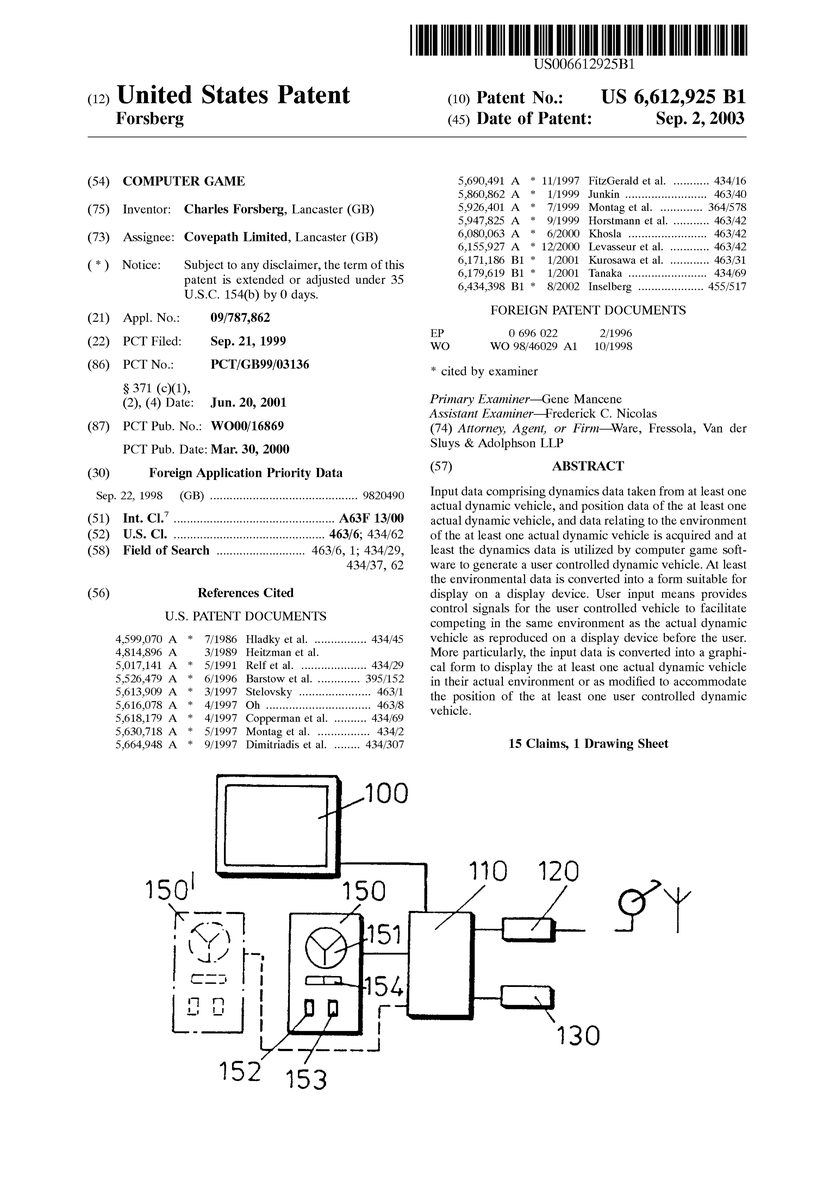
Referring now to FIG. 3 a television monitor is shown at 100 , a computer at 110 , a data decoder unit at 120 , a memory at 130 and user control module at 150 more than one user control module may be provided as indicated by dotted outline 150 . The transmitted data may be a digital or analogue signal end is received by the data decoder unit 120 . The data transmitted may be transmitted in real time or on a delayed broadcast basis. On the other hand the data may be stored on a CD Rom or other media storage device from which it can be read into computer memory. Software stored in memory 130 and run on CPU 110 facilitates reproduction of the dynamics data graphically on screen 100 if required, and to view on-screen the image from any vehicle taking part in the race for which data has been transmitted. The user may select to take the place of one of the actual vehicle's and to drive it up to its simulated performance characteristics or choose to compete in a simulated vehicle. The view from the simulated vehicle can be computed from the received data. The user is able to control steering inputs 151 , braking 152 , gear changing 154 and acceleration inputs 153 using the control input means. The provision of more than one control input means facilitates a number of users competing in the race. Other users may be located at a remote location.
From the foregoing it will be apparent that a competitor is able to receive data gathered from actual vehicles participating in an event and to take part in that event in a simulated fashion at a remote location. By controlling in the case of a motor racing game vehicle speed, and direction of movement, the remote competitor is able to position his car amongst the cars that actually competing in the race.
Claims
- A computer game comprising game software, at least one display device, at least one user input means, and an input data set comprising dynamics data taken from at least one actual dynamic object, position data of the at least one actual dynamic object, and data relating to an environment of the at least one actual dynamic object, at least the environment data being converted into a pictorial form suitable for display on the at least one display device, and wherein the game software operates to generate a simulated user controlled dynamic object utilizing at least the dynamics data of the input data set, the input data set of the at least one actual dynamic object is used to set performance limitations of the simulated user controlled dynamic object and wherein the at least one user input means provides control signals for the simulated user controlled dynamic object to facilitate competing with the at least one actual dynamic object in the pictorial form as portrayed on the at least one display device.
- A computer game as claimed in claim 1 , in which the game software utilizes both dynamics data and position data.
- A computer game as claimed in claim 1 , in which the input data set is converted into a graphical or pictorial form to display each at least one actual dynamic object in its actual environment.
- A computer game as claimed in claim 3 in which the position data of each at least one actual dynamic object is modified to accommodate display of the simulated user controlled dynamic object in the pictorial form as portrayed on the at least one display device.
- A computer game as claimed in claim 1 in which the dynamics data of the at least one actual dynamic object is acquired by apparatus installed on at least one actual dynamic object.
- A computer game as claimed in claim 5 in which the apparatus comprises sensors to measure at least one of speed, pitch, roll, heading, 3-D G forces, yaw angle and acceleration.
- A computer game as claimed in claim 1 in which the position data of the at least one actual dynamic object is acquired by apparatus installed on at least one actual dynamic object.
- A computer game as claimed in claim 7 in which the apparatus for acquiring position data comprises a global position system.
- A computer game as claimed in claim 1 in which the environment data is acquired by a television camera mounted on the at least one actual dynamic object which is at least one actual dynamic vehicle.
- A computer game as claimed in claim 1 in which the input data set is transmitted in real-time.
- A computer game as claimed in claim 1 in which the input data set is transmitted in delayed transmission form.
- A computer game as claimed in claim 1 in which the input data set is captured onto a data storage medium for later use.
- A computer game as claimed in claim 1 in which the position data is gathered in real-time and is passed on without modification.
- A computer game as claimed in claim 1 in which the dynamics data and the position data are gathered simultaneously in real-time.
- A computer game as claimed in claim 1 in which the at least one display device is a television screen.
Disclaimer: Data collected from the USPTO and may be malformed, incomplete, and/or otherwise inaccurate.