DESCRIPTION OF THE PREFERRED EMBODIMENTS
FIG. 1 shows a car racing game apparatus 10 (hereinafter referred to simply as a racing apparatus 10 ), which is related to an aspect of an embodiment of a game apparatus consistent with the present invention.
Racing apparatus 10 thereof is installed in an urban area game center or the like as a so-called arcade game. A monitor 14 is provided on the front surface of the racing apparatus 10 .
Further, a shift knob 20 is provided in FIG. 1 on the right side of a housing 18 , which supports the abovementioned monitor 14 and so forth. Furthermore, shift knob 20 is used only at manual operation, and becomes unnecessary when automatic operation is selected. On an inner side of seat 22 in which a player sits, in order from the left side, a clutch pedal 24 , brake pedal 26 , and accelerator pedal 28 are arranged on the bottom portion of housing 18 , and are constituted so as to correspond respectively to the tips of the right and left feet of a sitting player. Furthermore, steering wheel 30 is positioned in front of the monitor, and, by sitting in the seat 22 , a player can experience the ambiance of sitting in the cockpit of a race car.
When a player plays with racing apparatus 10 , racing apparatus 10 is constituted so that a game can be started by inserting a coin of a prescribed value into coin slot 32 provided on the wall portion 18 A of housing 18 .
FIG. 2 shows the hardware constitution for operating racing apparatus 10 . When a coin of a prescribed value is inserted, associated hardware is constituted so that an OK signal is inputted to controller 36 by way of I/O board 34 . Furthermore, I/O board 34 and the controller 36 are connected by USB cable 35 .
Controller 36 is composed of master board 38 for data operations, and three drawing boards 40 , 42 , 44 for controlling geometry, rendering and other such graphical operations. The master board 38 comprises a main CPU (symbol SH of FIG. 2 ) 46 , and a peripheral equipment control CPU (symbol Z 80 of FIG. 2 ) 48 . Further, in accordance with a serial cable (RS422) 50 from the master board 38 , a printer I/F board 52 , driving I/F board 54 , and monitor I/F board 56 are connected in series, and the final stage monitor I/F board 56 is connected to the master board 38 , and sends data from each board to the master board 38 .
A printer 58 is connected to the printer I/F board 52 by way of a parallel cable 60 so that a game score is printed out on a form 78 (refer to FIG. 4 ). A driving board 62 is connected to the driving I/F board 54 by way of a parallel cable 64 . This driving board 62 has a function for artificially transmitting to the housing 18 , steering wheel 30 , shift knob 20 , clutch pedal 24 , brake pedal 26 , and accelerator pedal 28 horizontal G and the reaction (vibration) from a road surface during game driving, and a function for detecting the manipulated variables of the steering wheel 30 , shift knob 20 , clutch pedal 24 , brake pedal 26 , and accelerator pedal 28 . Monitor driver 66 is connected to the monitor I/F board 56 by a parallel cable 68 . Monitor driver 66 performs display control of monitor 14 .
FIG. 3 shows a display state of game scores displayed on monitor 14 after playing with racing apparatus 10 with respect to an aspect of one embodiment consistent with the present invention. In the upper portion of monitor 14 , title display portion 70 is displayed, to the effect that it is a RANKING display. There is an item display field 72 for displaying the ranking order of players' names (a player can select a name from an alphabet, and symbols and numerals), integrated score (time) and a game date. Result display field 76 is constituted so as to link up with the item display field 72 .
Result display field 76 is larger than the monitor 14 , and is listed by being extended in a downward direction. This means that the area within the chain-line frame of FIG. 3 is displayed on monitor 14 by being sequentially scrolled. That means that during the initial phase of display, the top 10 ranks of the ranking are displayed, and thereafter, the 11th rank, 12th rank, . . . are displayed in order by scrolling, and when the 100th rank is displayed, then the initial 1st rank is displayed.
The displayed ranking goes up to the 100th rank, and the stored game scores are also limited in number to 100. In this case, when the score of the most recent player is worse than the 100th rank, in the past, this most recent game score would not have been stored. However, in this aspect of an embodiment consistent with the present invention, the score of the most recent player is always retained, and is displayed in place of a player, who hitherto had been ranked somewhere in the top 100.
The game score to be replaced is selected on the basis of its being temporally the oldest game score, regardless of the its rank. In accordance with the present invention, the score of the most recent player is always displayed on monitor 14 . Furthermore, the ranking is recomputed in accordance with the game score of this most recent player. Further, the constitution is such that the score of this most recent player, and the players ranked in the top 10 are printed out by printer 58 on form 78 (Refer to FIG. 4 ).
The operation of this aspect of the embodiment will be explained in connection with the flowchart of FIG. 5 . In step 100 , initialization is performed as soon as the power source is turned ON, and next, in step 102 , display and control of a demonstration screen are executed. It is desirable for this demonstration screen to show the traveling state of a typical race car, and to be a screen that is advantageous to playing the game.
In step 104 , a determination is made as to whether or not a coin of a prescribed denomination has been inserted, and when this determination is negative, the display of the demonstration screen continues. Here, when there is a positive determination in step 104 , that is, when it is determined that a coin of a prescribed denomination has been inserted, processing moves to step 106 , the initial screen is displayed, and game mode selection is carried out. In the initial screen, there is displayed a course selection guide, a mode selection guide, and a class selection guide, and a player selects the desired items, respectively.
For example, the selection thereof is done by steering wheel manipulation, and the selected contents are highlighted by concentration difference in accordance with the angle of operation of steering wheel 30 . In the case of course selection, when the Fuji Speedway is selected, a portion, in which a plan view of this course is displayed, is highlighted, and, in the highlighted state, selection is completed when accelerator pedal 28 is pressed down. Respective selections are made in this manner, and when all selections are complete, a positive determination is made in step 108 , and processing moves to step 110 . In step 110 , the above-mentioned selected game modes are stored. In the following step 112 , game operation control begins. At this point, it is possible to enjoy a game.
When a game-over determination is made, in step 114 , a game score is established. (step 116 ) Next, processing moves to step 120 , and a game score is displayed on monitor 14 . Next, processing moves to step 122 , and a printout is made on form 78 . Displayed results are displayed for a prescribed time (step 124 ), and thereafter, processing returns to step 102 , and the demonstration screen is displayed and controlled.
At this point, when a game score was established in step 116 , and the game score thereof was displayed on monitor 14 in step 120 , in the past, the display number thereof was limited, and if the most recent game score was worse than the limited number of game scores thereof, there were times when the name of this most recent player (to include game results, such as lap time) was not displayed. However, in this aspect of an embodiment consistent with the present invention, control is implemented so that the score of the most recent player is always displayed.
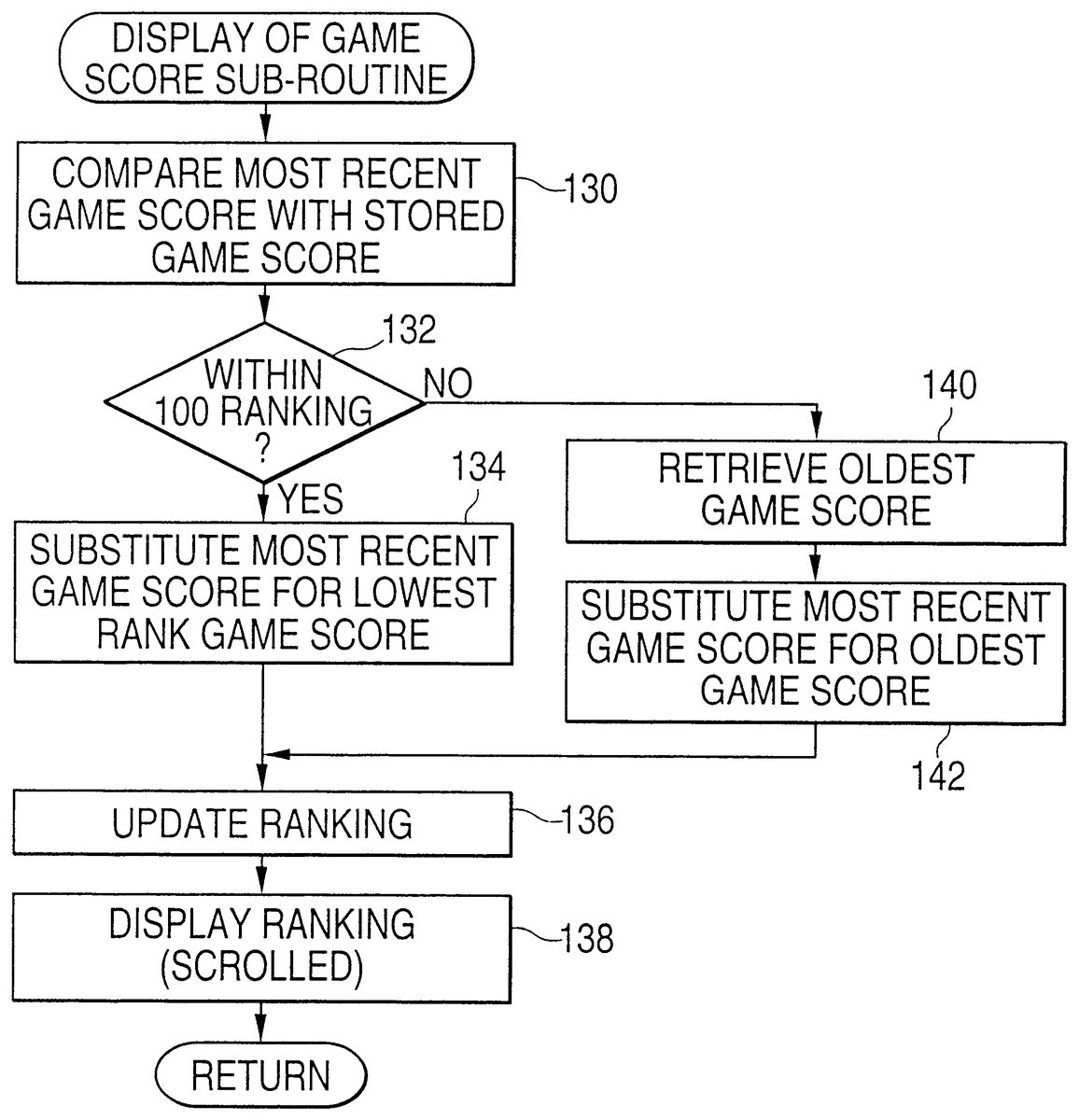
Game score display control of step 120 of FIG. 5 will be explained in detail in connection with the flowchart of FIG. 6 .
In step 130 , most recent game score data is compared with game score data that has been stored to date, and in step 132 , a determination is made as to whether or not this most recent game score data falls within the a ranking of the top 100 scores. When it is determined in step 132 that the most recent game score is within the top 100 (a positive determination), processing moves to step 134 , and the most recent game score data is substituted for game score data of the lowest rank (among the stored game score data ranked in the top 100)
Next, in step 136 , the ranking is updated, and subsequent thereto, in step 138 , display control is performed, that is, the ranking is displayed while being scrolled. Conversely, in step 132 , if it is determined that the most recent game score does not fall within the top 100 (a negative determination), processing jumps from step 132 to step 140 , and the oldest game score data is retrieved. Next, processing moves to step 142 , the most recent game score data is substituted for the retrieved oldest game score data, and processing moves to step 136 .
That is, regardless of whether the most recent game score falls within the 100 ranking or not, the most recent game score can always be placed in the ranking, and because even a novice player can confirm his score in the display contents, this player's desire to play another game can be enhanced. Meanwhile, since the deleted game score data is the oldest data, the player, who achieved this game score, can understand, and acquiesce in the deletion because the score was the oldest data.
Furthermore, in this aspect of the embodiment, game score data that was stored at the oldest time is deleted instead of the most recent player's game score, but if this oldest game score data is among the top rankings, interest in a game can be heightened by retaining the highly-ranked game score for the sake of prestige. Accordingly, when the oldest game score data has a high rank (for example, within the top 10 ranks), a game apparatus consistent with the present invention can be constituted such that the next oldest game score data is targeted for deletion. That is, as shown in FIG. 7 , steps 144 , 146 can be added after step 140 . Furthermore, because the other steps are the same as those of FIG. 6 , an explanation of the previously explained steps will be omitted.
In Step 144 , a determination is made as to whether or not a retrieved oldest game score data falls within the top 10 rankings, and when the determination is positive, a determination is made that this oldest game score should be retained, the next oldest game score data is retrieved in step 146 , and processing returns to Step 144 . This is repeated, and if the oldest game score outside of the top 10 rankings is retrieved, processing moves to step 142 , maintaining the prestige of the best scorers while still heightening the interest of a beginner. Further, as shown in FIG. 8 , a game apparatus consistent with the present invention can also be constituted to constantly replace the lowest ranked (100th rank) game score data (Step 134 A), update a ranking (Step 136 A), and display a ranking (Step 138 A).
As explained hereinabove, in this aspect of the embodiment, because the premise is that the game score of the most recent player is always retained, and the constitution is basically such that, so as to be fair to the beginner, skilled player, and regular player alike, consideration is given to whether it is desirable to replace one hitherto stored game score within a ranking of the top 100 scores, and the temporally oldest game score is deleted, the ranking display is not biased toward the skilled player, and can be enjoyed even by a beginner. As explained hereinabove, a game apparatus related to the present invention has the outstanding effect of being able to retain a player's game score, regardless of whether he is a skilled player or a beginner, and of being able to do a ranking under circumstances that are fair to the skilled player and the beginner.