U.S. Pat. No. 12,390,717
GAME CONTROLLER WITH ONBOARD CALIBRATION
AssigneePanda Hardware LLC
Issue DateOctober 14, 2022
Illustrative Figure
Abstract
A game controller with onboard calibration. The game controller includes lights that illuminate to prompt the user to interact with the game controller by pressing one or more triggers and/or by moving one or more joysticks in certain directions. The game controller uses the inputs it receives from the user to calibrate the trigger(s) and/or joystick(s). The software which performs this calibration is onboard the game controller. The game controller can be calibrated without having to rely on any game console. The game controller can be calibrated while being connected to a game console, such as an older game console, that does not provide any type of game controller calibration mode for that game controller.
Description
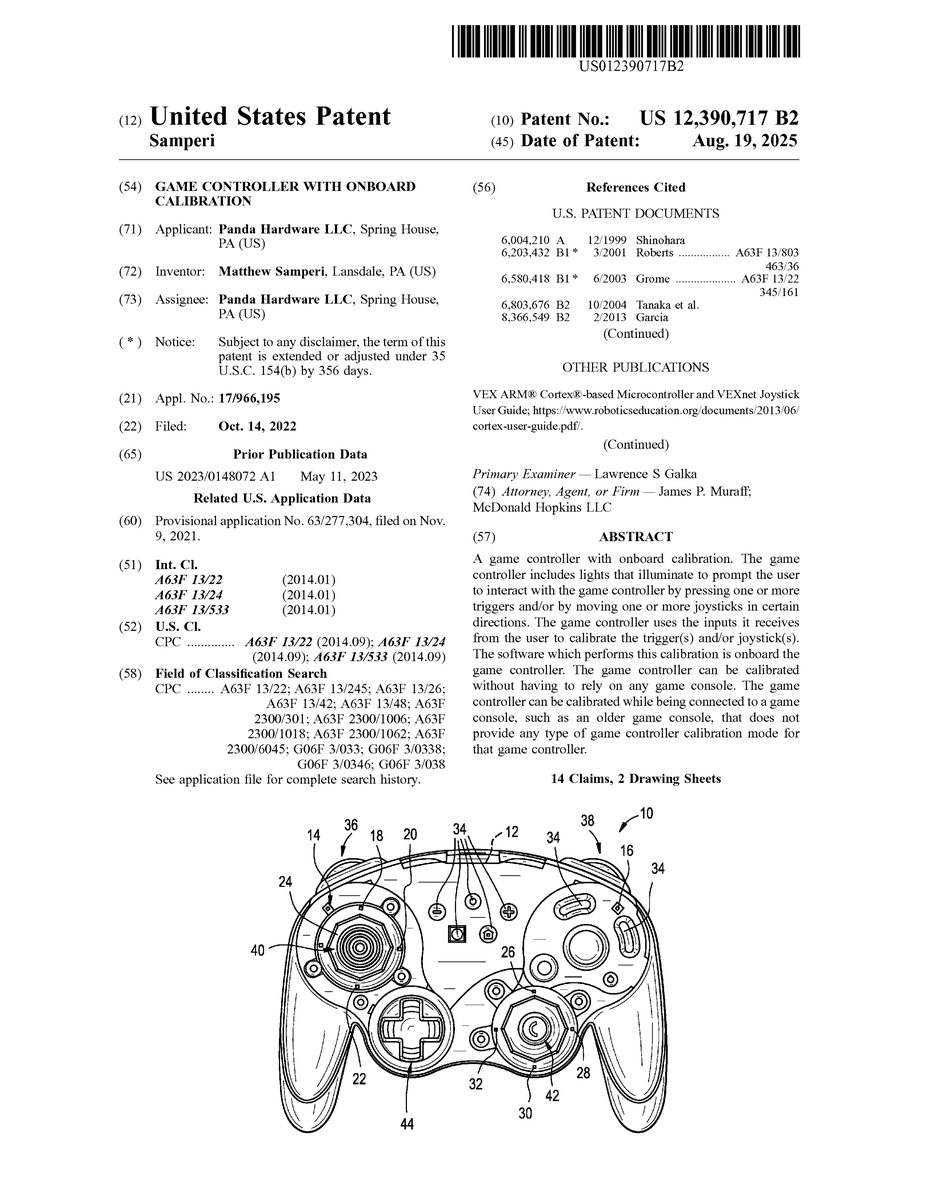
DESCRIPTION While this invention may be susceptible to embodiment in different forms, there is shown in the drawings and will be described herein in detail, a specific embodiment with the understanding that the present disclosure is to be considered an exemplification of the principles of the invention and is not intended to limit the invention to that as illustrated. FIG.1provides a top view of a game controller10that is in accordance with an embodiment of the present invention. The game controller10has onboard calibration and at least one user interactive control. Specifically, there is software12that runs inside the game controller10that illuminates lights14,16,18,20,22,24,26,28,30,32on the game controller10to effectively guide a user through a calibration mode by having the user press certain buttons34, triggers36,38, etc. and move certain joysticks40,42, etc. in certain directions. While the user performs these actions on the game controller10, the game controller10receives these user responses (i.e., inputs) and uses these inputs to calibrate the game controller10. FIG.1shows just one example of a game controller10that could employ this technology. As shown, the game controller10has two analog joysticks40,42and two analog triggers36,38, in addition to a plurality of digital push buttons34and a digital directional control44. Lights14,16,18,20,22,24,26,28,30,32are provided adjacent the analog controls, namely the two joysticks40,42and the two triggers36,38. The lights14,16associated with each of the triggers36,38illuminate to direct the user to press that particular trigger36or38. The lights18,20,22,24,26,28,30,32associated with each of the joysticks40,42illuminate to direct the user to move each of the joysticks40,42in certain directions. While the user performs these actions on the game controller10, the game controller10receives these user responses (i.e., inputs) and uses these inputs to calibrate the different analog inputs36,38,40,42on the game controller10. Preferably, the software12running inside the controller10is configured such that the game controller10starts this calibration mode upon the user intentionally pressing certain buttons and/or triggers, etc. in a certain order. Alternatively, ...
DESCRIPTION
While this invention may be susceptible to embodiment in different forms, there is shown in the drawings and will be described herein in detail, a specific embodiment with the understanding that the present disclosure is to be considered an exemplification of the principles of the invention and is not intended to limit the invention to that as illustrated.
FIG.1provides a top view of a game controller10that is in accordance with an embodiment of the present invention. The game controller10has onboard calibration and at least one user interactive control. Specifically, there is software12that runs inside the game controller10that illuminates lights14,16,18,20,22,24,26,28,30,32on the game controller10to effectively guide a user through a calibration mode by having the user press certain buttons34, triggers36,38, etc. and move certain joysticks40,42, etc. in certain directions. While the user performs these actions on the game controller10, the game controller10receives these user responses (i.e., inputs) and uses these inputs to calibrate the game controller10.
FIG.1shows just one example of a game controller10that could employ this technology. As shown, the game controller10has two analog joysticks40,42and two analog triggers36,38, in addition to a plurality of digital push buttons34and a digital directional control44. Lights14,16,18,20,22,24,26,28,30,32are provided adjacent the analog controls, namely the two joysticks40,42and the two triggers36,38. The lights14,16associated with each of the triggers36,38illuminate to direct the user to press that particular trigger36or38. The lights18,20,22,24,26,28,30,32associated with each of the joysticks40,42illuminate to direct the user to move each of the joysticks40,42in certain directions. While the user performs these actions on the game controller10, the game controller10receives these user responses (i.e., inputs) and uses these inputs to calibrate the different analog inputs36,38,40,42on the game controller10.
Preferably, the software12running inside the controller10is configured such that the game controller10starts this calibration mode upon the user intentionally pressing certain buttons and/or triggers, etc. in a certain order. Alternatively, a switch or button can be provided, such as on the bottom of the game controller10, with which the user can interact in order to have the game controller10initiate the calibration mode.
As a specific example with regard to the game controller10shown inFIG.1, the software12could be configured such that when the game controller10enters the calibration mode the light14associated with the left trigger36illuminates. After the user presses the left trigger36, the light14associated with the left trigger36goes out and the light16associated with the right trigger38illuminates. After the user presses the right trigger36, the light16associated with the right trigger38goes out and one of the lights18associated with the left joystick40illuminates. Specifically, preferably the top light18associated with the left joystick40illuminates. After the user presses the left joystick40up, the top light18goes out and the light20to the right of the left joystick40illuminates. After the user presses the left40joystick the right, the light20goes out and the light22to the bottom of the left joystick40illuminates. After the user presses the left joystick40down, the light22goes out and the light24to the left of the left joystick40illuminates. After the user presses the left joystick40to the left, the light24goes out and the light26to the top of the right joystick42illuminates. After the user presses the right joystick42up, the light26goes out and the light28to the right of the right joystick42illuminates. After the user presses the right joystick42the right, the light28goes out and the light30to the bottom of the right joystick42illuminates. After the user presses the right joystick42down, the light30goes out and the light32to the left of the right joystick42illuminates. After the user presses the left joystick42to the left, the light32goes out and the calibration mode is complete. At that point, all the lights14,16,18,20,22,24,26,28,30,32could blink a couple times to indicate to the user that the game controller10was successfully calibrated. This is just one example of how the software12could be programmed and just one example of the specific controls that could be provided on the game controller10. Of course, countless possibilities exist while still staying very much within the scope of the present invention. For example, different controls can be provided on the game controller10and/or the lights could illuminate in a different order. Furthermore,FIG.1shows lights being provided in four directions (up, down, right, left) for each of the joysticks40,42, lights can be provided for even more directions than that, such as diagonal. Regardless, the game controller10is configured to use the lights on the controller10to direct the user to perform certain actions on the game controller10and the game controller10receives these user responses (i.e., inputs) and uses them to calibrate the controls36,38,40,42on the game controller10.
Regarding what powers the game controller, the game controller10could be wireless and be configured to be powered by batteries. As such, the game controller10would not have to be connected to any game console to be calibrated. On the other hand, the game controller10could be configured to be hardwired to a game console and receive its power from the game console. Either way, the game controller10has software12onboard that is configured to perform the calibration and that calibration is not performed by the game console but rather by the game controller10itself.
FIG.2is a block diagram of the game controller10shown inFIG.1and is self-explanatory. The software12which runs the calibration is stored in memory50inside the game controller10and is run by a processor52. There is a console interface54configured to interface with a game console. The “other components”56indicated inFIG.2could be other components not specifically related to the invention, such as force feedback components, as well as other components that are conventional regarding game controllers.
The game controller10has onboard calibration. As such, the game controller10can be calibrated without having to rely on any game console or television screen. The game controller10can be calibrated while being connected to a game console, such as an older game console that does not provide any type of game controller calibration mode for that game controller.
While a specific embodiment of the invention has been shown and described, it is envisioned that those skilled in the art may devise various modifications without departing from the spirit and scope of the present invention.
Claims
- A game controller comprising: at least one light;at least one user interactive control;memory;software stored in the memory;and a processor, said processor configured to run the software to illuminate the at least one light to prompt the user to interact with the at least one user interactive control in order to calibrate the game controller, wherein the at least one user interactive control comprises at least one trigger, wherein the game controller is configured to illuminate the at least one light to facilitate calibration of the at least one trigger.
- The game controller as recited in claim 1, wherein the at least one user interactive control comprises at least one joystick, wherein the game controller is configured to illuminate the at least one light to facilitate calibration of the at least one joystick.
- The game controller as recited in claim 1, wherein the game controller is configured to use inputs the game controller receives from the user via the at least one user interactive control to calibrate the at least one user interactive control.
- The game controller as recited in claim 1, wherein the game controller is configured to be calibrated without having to rely on any game console or television screen.
- The game controller as recited in claim 1, wherein the game controller is configured to be calibrated while being connected to a game console that does not provide any type of game controller calibration mode for the game controller.
- The game controller as recited in claim 1, wherein the at least one user interactive control comprises a joystick, wherein the at least one light comprises a plurality of lights adjacent the joystick, wherein the game controller illuminates the plurality of lights adjacent the joystick to prompt a user to move the joystick in different directions in order to calibrate the joystick.
- The game controller as recited in claim 1, wherein the at least one light comprises a plurality of lights, wherein the at least one user interactive control comprises at least one button, the at least one trigger and at least one joystick, wherein the software runs inside the game controller to illuminate lights on the game controller to guide a user through a calibration mode by having the user press the at least one button, press the at least one trigger, and move the at least one joystick in certain directions, wherein while the user performs these actions on the game controller, and the game controller uses these actions to calibrate the game controller.
- The game controller as recited in claim 1, wherein the software is configured such that the game controller starts a calibration mode upon the user intentionally interacting with the at least one interactive control in a certain order.
- The game controller as recited in claim 1, wherein the at least one user interactive control comprises at least one joystick, wherein the at least one light comprises a plurality of lights adjacent the joystick, wherein the game controller illuminates the plurality of lights in an order to facilitate calibration of the at least one joystick.
- The game controller as recited in claim 1, further comprising a console interface that is configured to interface with a game console.
- The game controller as recited in claim 1, wherein the software stored in the memory is configured to provide that the game controller has onboard calibration.
- The game controller as recited in claim 1, wherein the at least one user interactive control comprises at least one analog control and at least digital control, wherein the at least one light is adjacent the at least one analog control.
- A game controller comprising: at least one light;at least one user interactive control;memory;software stored in the memory;and a processor, said processor configured to run the software to illuminate the at least one light to prompt the user to interact with the at least one user interactive control in order to calibrate the game controller, wherein the at least one user interactive control comprises two analog joysticks, two analog triggers, a plurality of digital push buttons and a digital directional control.
- A game controller comprising: at least one light;at least one user interactive control;memory;software stored in the memory;and a processor, said processor configured to run the software to illuminate the at least one light to prompt the user to interact with the at least one user interactive control in order to calibrate the game controller, wherein the at least one interactive control comprises at least two analog joysticks, wherein the at least one light is provided adjacent the at least two analog joysticks, the at least one light illuminates to direct the user to perform actions on the game controller, and the game controller receives these user inputs and uses these inputs to calibrate the at least two analog joysticks.
Disclaimer: Data collected from the USPTO and may be malformed, incomplete, and/or otherwise inaccurate.