U.S. Pat. No. 12,364,930
COMPUTER CONTROL METHOD FOR IMPLEMENTING A COMPUTER GAME TEMPLATE ARRANGEMENT
AssigneeGREE, INC.
Issue DateNovember 24, 2023
Illustrative Figure
Abstract
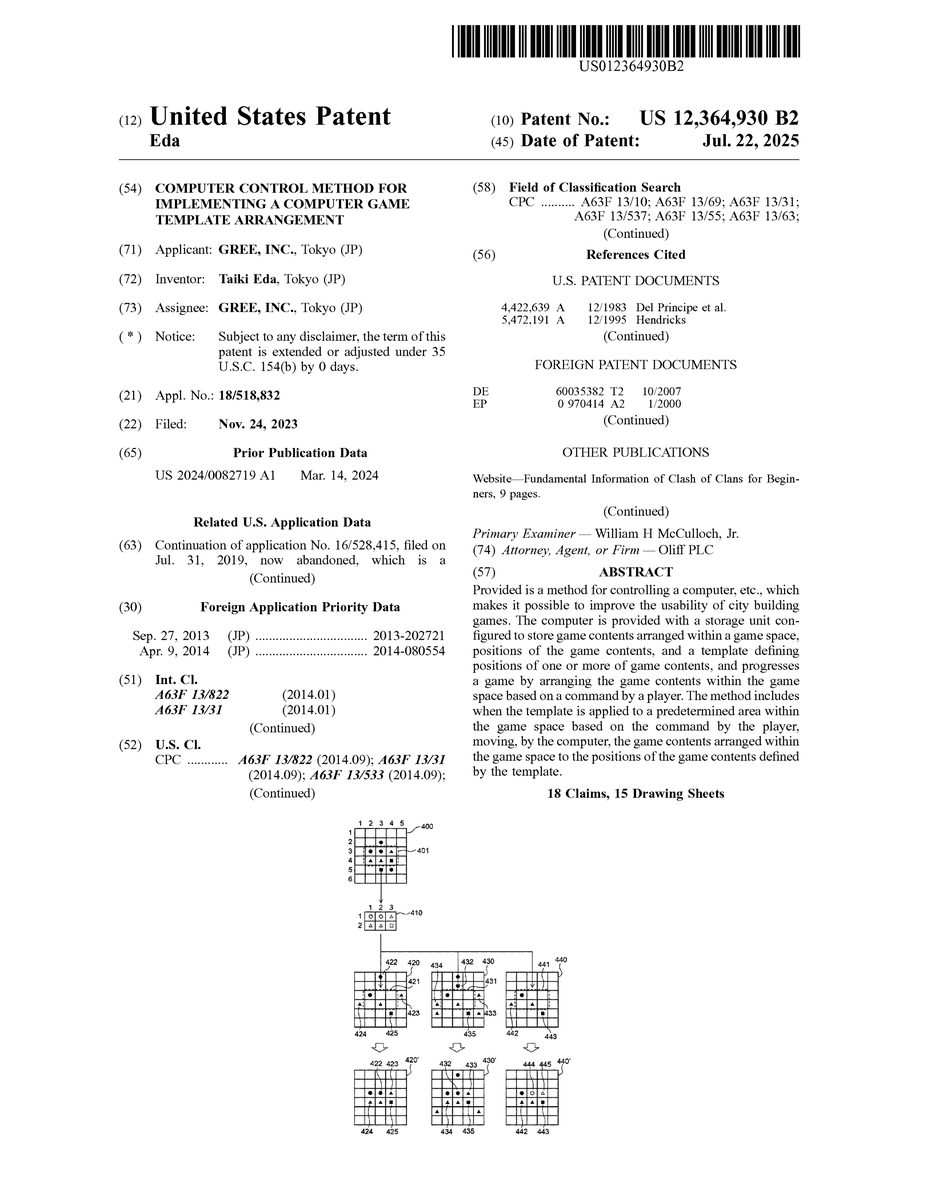
Provided is a method for controlling a computer, etc., which makes it possible to improve the usability of city building games. The computer is provided with a storage unit configured to store game contents arranged within a game space, positions of the game contents, and a template defining positions of one or more of game contents, and progresses a game by arranging the game contents within the game space based on a command by a player. The method includes when the template is applied to a predetermined area within the game space based on the command by the player, moving, by the computer, the game contents arranged within the game space to the positions of the game contents defined by the template.
Description
DESCRIPTION Hereinafter, with reference to the drawings, a method for controlling a computer, a recording medium, and a computer will be described. It should be noted that the technical scope of the present invention is not limited to the described embodiments, but covers the invention described in the claims and its equivalent. First Embodiment In the present embodiment, a player builds a city within a game space. The player can arrange various facilities which are one example of game contents, within the game space. Further, for a predetermined area within the game space, the player can also create a template stipulating types and positions of facilities based on the types and positions of facilities arranged within the area. Moreover, the player can also apply the created template to a given area within the game space. When a template is applied, facilities arranged within the game space are automatically changed to the facilities defined in the template, and they are automatically moved to the defined positions. Game contents refer to digital contents used in a game, and include, besides facilities, characters, soldiers, weapons, cards, figures, avatars, items, etc. FIG.1illustrates an example of a schematic configuration of a game system1. The game system1includes at least one portable device2and a server3. The portable device2and the server3are connected to each other via a communication network, and are connected to each other, for example, via a base station4, a mobile communication network5, a gateway6, and the Internet7. A program to be executed by the portable device2(e.g., a game program) and a program to be executed by the server3(e.g., a game control program) communicate with each other by using a communication protocol such as a Hypertext Transfer Protocol (HTTP). FIG.2Aillustrates an example of a schematic configuration of the portable device2. The portable device2progresses the game in ...
DESCRIPTION
Hereinafter, with reference to the drawings, a method for controlling a computer, a recording medium, and a computer will be described. It should be noted that the technical scope of the present invention is not limited to the described embodiments, but covers the invention described in the claims and its equivalent.
First Embodiment
In the present embodiment, a player builds a city within a game space. The player can arrange various facilities which are one example of game contents, within the game space. Further, for a predetermined area within the game space, the player can also create a template stipulating types and positions of facilities based on the types and positions of facilities arranged within the area. Moreover, the player can also apply the created template to a given area within the game space. When a template is applied, facilities arranged within the game space are automatically changed to the facilities defined in the template, and they are automatically moved to the defined positions.
Game contents refer to digital contents used in a game, and include, besides facilities, characters, soldiers, weapons, cards, figures, avatars, items, etc.
FIG.1illustrates an example of a schematic configuration of a game system1.
The game system1includes at least one portable device2and a server3. The portable device2and the server3are connected to each other via a communication network, and are connected to each other, for example, via a base station4, a mobile communication network5, a gateway6, and the Internet7. A program to be executed by the portable device2(e.g., a game program) and a program to be executed by the server3(e.g., a game control program) communicate with each other by using a communication protocol such as a Hypertext Transfer Protocol (HTTP).
FIG.2Aillustrates an example of a schematic configuration of the portable device2.
The portable device2progresses the game in response to an operation of an operation unit23by a player. When necessary, the portable device2is connected to the server3via the base station4, the mobile communication network5, the gateway6, and the Internet7, to communicate with the server3. In order to implement the foregoing functions, the portable device2includes a device communication unit21, a device storage unit22, the operation unit23, a display unit24, and a device processing unit25.
While a multifunctional mobile phone (a so-called “smartphone”) may be assumed as the portable device2, the present invention is not limited to this. The portable device2may be, for example, a mobile phone (a so-called “feature phone”), a personal digital assistant (PDA), a portable game machine, a portable music player, a tablet device, a tablet personal computer (PC), a notebook PC, etc., as long as the present invention is applicable thereto.
The device communication unit21includes a communication interface circuit including an antenna having a sensitivity band in a predetermined frequency band, and connects the portable device2to a wireless communication network. The device communication unit21establishes a wireless signal link with the base station4by a Code Division Multiple Access (CDMA) system or the like via a channel to be assigned by the base station4, and communicates with the base station4. The device communication unit21sends data supplied from the device processing unit25to the server3or the like. The device communication unit21supplies the data received from the server3or the like to the device processing unit25.
The device storage unit22includes a semiconductor memory, for example. The device storage unit22stores an operating system program, a driver program, an application program, data, etc., used for processing in the device processing unit25. For example, the device storage unit22stores an input device driver program for controlling the operation unit23and an output device driver program for controlling the display unit24, as the driver program. The device storage unit22stores a game program, etc., for progressing the game and displaying the result thereof, as the application program. The device storage unit22stores identification numbers (IDs) of the players, a facility table (FIG.2B) for managing facilities arranged within the game space, a facility-type table (FIG.2C) for managing types of the facilities, a template table (FIG.2D) for managing templates, and image data, video data, etc., relating to the facilities, templates, etc., as the data. Further, the device storage unit22may store temporary data relating to predetermined processing.
FIG.2Bdepicts a facility table. In the facility table, a facility ID, a type ID, a position within the game space, etc., are recorded for each facility.
In the present embodiment, the game space is configured in grid form, wherein one facility is arranged on one grid, and the position of the facility is represented with the help of grid coordinates that have their origin in a predetermined grid (e.g., upper left of the game space). However, the present invention is not limited to this configuration. Any configuration of the game space, etc., is possible as long as the present invention can be applied to the configuration.
FIG.2Cdepicts a facility-type table. In the facility-type table, a type ID, name, file name of image data, etc., are recorded for each type of facility.
FIG.2Ddepicts a template table. In the template table, for each template, a template ID, a file name of thumbnail image data, a type ID and a position within the template of each facility, etc., are recorded.
Similarly toFIG.2B, a position of a facility is represented with the help of the grid coordinates that have their origin in a predetermined grid (e.g., upper left of the template). However, the present invention is not limited to this configuration. Any representation of a position is possible as long as the present invention can be applied with the representation.
The operation unit23may be any device capable of operating the portable device2, for example, a touch panel, a key button or the like. The player can input letters, numbers, symbols, etc., by using the operation unit23. When operated by the player, the operation unit23generates a signal corresponding to the operation. The generated signal is supplied to the device processing unit25as a command from the player.
The display unit24may be any device capable of displaying a video, an image, etc., for example, a liquid crystal display, an organic electro-luminescence (EL) display, etc. The display unit24displays a video, an image, etc., corresponding to video data and image data supplied from the device processing unit25.
The device processing unit25includes one or more processors and their peripheral circuits. The device processing unit25is, for example, a central processing unit (CPU), and integrally controls an overall operation of the portable device2. The device processing unit25controls operations of the device communication unit21, the display unit24, etc., so that various types of processing of the portable device2are executed in an appropriate order in accordance with the programs stored in the device storage unit22, the operation of the operation unit23, etc. The device processing unit25executes processing based on the programs (the operating system program, the driver program, the application program, etc.) stored in the device storage unit22. The device processing unit25can execute multiple programs (application programs, etc.) in parallel.
FIGS.3A to3Eillustrate examples of a display screen of the portable device2.
FIG.3Adepicts a game progression screen300that is displayed when a command has been given to start the game.
The game progression screen300displays a game space301and various facilities302to306arranged within the game space.
Further, multiple buttons are displayed in the lower portion of the game progression screen300. By pushing buttons, commands are given: pushing a “Create” button307creates a template, pushing an “Apply” button308applies a template.
FIG.3Bdepicts an area selection screen310that is displayed when a command to create a template has been given on the game progression screen300depicted inFIG.3A.
The area selection screen310displays the game space301, in which, for example, by tapping on two arbitrary points, an area311with the two points as opposite apexes is selected.
Further, a “Confirm” button312is displayed in the lower portion of the area selection screen310, and by pushing this button, a command is given to create a template for the selected area311.
FIG.3Cdepicts a template selection screen320that is displayed when a command to apply a template has been given on the game progression screen300depicted inFIG.3A.
On the template selection screen320, a thumbnail image321and a “Select” button322are displayed for each template. By pushing the “Select” button322, the corresponding template is selected.
FIG.3Ddepicts a template display screen330that is displayed when a template has been selected on the template selection screen320depicted inFIG.3C.
A preview image3310for when the template is applied to a predetermined area (e.g., around the center) within the game space is displayed in the left portion of the template display screen330.
Further, names and quantities3320of facilities for which positions are defined by the template, are listed in the right portion of the template display screen330.
Further, a “Confirm” button333is displayed in the lower portion of the template display screen330, and by pushing this button, a template is confirmed.
FIG.3Edepicts an area selection screen340that is displayed when a template has been confirmed on the template display screen330depicted inFIG.3D.
The area selection screen340displays the game space301, in which, for example, by tapping on two arbitrary points, an area341with the two points as opposite apexes is selected.
Further, a “Confirm” button342is displayed in the lower portion of the area selection screen340, and by pushing this button, a command is given to apply the template to the selected area341.
FIG.4illustrates a concept of creating and applying a template.
400illustrates a game space. Nine facilities are arranged within the game space400. Specifically, four facilities illustrated as “black circle”, three facilities illustrated as “black triangle”, and two facilities illustrated as “black square” are arranged therein.
Assume that a template has been created for an area401within the game space400.410illustrates the created template. The template410defines that facilities illustrated as “black circle” of a type illustrated as “white circle” are arranged at (1,1) and (1,2), facilities illustrated as “black triangle” of a type illustrated as “white triangle” are arranged at (1,3), (2,1) and (2,2), and a facility illustrated as “black square” of a type illustrated as “white square” is arranged at (2,3).
420illustrates another game space. Six facilities are arranged within the game space420. Specifically, two facilities illustrated as “black circle”, three facilities illustrated as “black triangle”, and one facility illustrated as “black square” are arranged therein.
Assume that the template410has been applied to an area421within the game space420. The number of a types of facilities and the number of facilities in each type arranged within the game space420are equal to the number of types of facilities and the number of facilities in each type, respectively, positions of the facilities being defined by the template410. Thus, all facilities arranged within the game space420are moved to positions of facilities as defined by the template410. Actually, facilities422to425arranged outside of the area421are moved to positions of these facilities within the area421.420′ illustrates the game space420after the facilities422to425have been moved.
430illustrates yet another game space. Nine facilities are arranged within the game space430. Specifically, three facilities illustrated as “black circle”, five facilities illustrated as “black triangle”, and one facility illustrated as “black square” are arranged therein.
Assume that the template410has been applied to an area431within the game space430. The number of types of facilities and the number of facilities in each type arranged within the game space430is equal to or larger than the number of types of facilities and the number of facilities in each type, respectively, positions of the facilities being defined by the template410. Thus, of the facilities arranged within the game space420, those facilities with the smallest moving distance (e.g., Manhattan distance) to positions of facilities defined by the template410, are moved to the positions of facilities. Actually, facilities432to435arranged outside of the area431are moved to positions of these facilities within the area431.430′ illustrates the game space430after the facilities432to435have been moved.
The facilities to be moved are not limited to those with the smallest moving distance. The player may also designate facilities which are to be moved, or an area containing facilities which are to be moved. Further, the player may also in advance designate facilities which are not to be moved, or an area containing facilities which are not to be moved.
440illustrates still another game space. Four facilities are arranged within the game space440. Specifically, one facility illustrated as “black circle”, two facilities illustrated as “black triangle”, and one facility illustrated as “black square” are arranged therein.
Assume that the template410has been applied to an area441within the game space440. The number of types of facilities and the number of facilities in each type arranged within the game space440is equal to or smaller than the number of types of facilities and the number of facilities in each type, respectively, positions of the facilities being defined by the template410. Thus, all facilities arranged within the game space440are moved to positions of facilities defined by the template410, to which the moving distance is the smallest. Actually, facilities442and443arranged outside the area441are moved to positions of these facilities within the area441.440′ illustrates the game space440after the facilities442and443have been moved.
In the game space440′, positions on which no facilities are arranged among the positions of facilities defined by the template410, are illustrated in a condition where the facility type is discernible (e.g., “white circle”444and “white triangle”445).
Further, when no facility has been arranged, it is also possible to present the player with facilities of the same type or with facilities of a similar type as proposals.
Moreover, it is also possible for the player to purchase facilities for positions where no facility has been arranged, or to acquire the facilities, for example, by trading with a different player in a multi-player environment as described below. Moreover, when the player has not arranged a facility defined by a template within the game space but has stored the facility in storage, the player may arrange this facility based on the template, or conversely, the player may store a facility that is not defined by the template, in the storage. Although in the above description, a player creates templates himself/herself, templates may also be distributed from a service-side server3, or may be acquired from other players. In such cases, a player may not possess a facility defined by a template in some cases. However, whether the player possesses a facility defined by a template may be judged on a portable device2side or on a server3side, and a screen for purchasing the facility which has been judged not to be in the player's possession may be displayed on the portable device2, so that the player is automatically guided to a purchase screen.
Further, templates may also be automatically created based on an operation by the player. For example, the server3may automatically create templates based on facilities the player possesses, facilities selected by the player, an area and/or an objective of a template. The objective of a template is, for instance, to realize a city that offers strong protection against soldiers with bows and arrows, to realize a city that work effectively for protection against attacks by giants, to strengthen the protection against air attacks, etc. In doing so, it becomes easy for the player to create templates consistent with objectives.
In order to achieve the above-described functions, the device processing unit25includes a game progression unit251, a template creation unit252, and a template application unit253. All of these units are functional modules implemented by a program executed on a processor provided in the device processing unit25. Alternatively, these units may also be provided as firmware on the portable device2.
In the following, processing by the game progression unit251will be described.
The game progression unit251controls the start and progression of the game, and appropriately gives commands to execute processing to the template creation unit252, template application unit253, etc.
Specifically, when a command to start the game is given by the player via the operation unit23, the game progression unit251displays the game progression screen300.
In other words, the game progression unit251refers to the facility table stored in the device storage unit22, and extracts a type ID and a position of each facility. Further, the game progression unit251refers to the facility-type table stored in the device storage unit22by using the extracted type IDs as key, and extracts file names of image data for corresponding types. Further, the game progression unit251obtains image data corresponding to the extracted file names, from the device storage unit22. Then, the game progression unit251configures a game progression screen300that displays images arising from the obtained image data according to the extracted positions, and that simultaneously displays buttons for receiving commands such as template creation, template application, etc., in a predetermined layout; and outputs the game progression screen300to the display unit24.
When a command to create a template is given by the player via the operation unit23, the game progression unit251gives a command to execute processing to the template creation unit252.
When a command to apply a template is given by the player via the operation unit23, the game progression unit251gives a command to execute processing to the template application unit253.
When a command to execute different processing is given by the player via the operation unit23, the game progression unit251executes the different processing.
In the following, processing by the template creation unit252will be described.
The template creation unit252creates templates, stores the templates in the device storage unit22, and registers the created templates on the server3.
Specifically, the template creation unit252displays the area selection screen310.
When an area has been selected and a command to create a template is given by the player via the operation unit23, the template creation unit252creates a template.
In other words, the template creation unit252refers to the facility table stored in the device storage unit22by using the coordinates of the selected area as key, and extracts a type ID and a position within the game space of each facility arranged within the selected area. The template creation unit252further converts the extracted positions within the game space to positions within the template. Moreover, the template creation unit252creates thumbnail image data for the selected area, and stores the data in the device storage unit22. The template creation unit252then stores the file name of the stored thumbnail image data, the extracted type ID and position within the template of each facility, etc., in the template table stored in the device storage unit22under a newly assigned template ID.
Further, the template creation unit252registers the created template on the server3.
In other words, the template creation unit252sends a template registration request via the device communication unit21to the server3by using the player ID, the assigned template ID, the created thumbnail image data, and the extracted type ID and position within the template of each facility, as parameters.
Then, the template creation unit252terminates the processing.
In the following, processing by the template application unit253will be described.
The template application unit253obtains a template from the device storage unit22or the server3, and applies the obtained template.
Specifically, the template application unit253displays the template selection screen320.
In other words, the template application unit253refers to the template table stored in the device storage unit22, and extracts an ID and a file name of thumbnail image data of each template. Further, the template application unit253obtains thumbnail image data corresponding to the extracted file name, from the device storage unit22.
When necessary, the template application unit253sends a request for providing a template list via the device communication unit21to the server3by using the player ID as a parameter. Further, the template application unit253receives an ID and thumbnail image data of each template from the server3via the device communication unit21.
Then, the template application unit253configures the template selection screen320that displays thumbnail images arising from the obtained thumbnail image data, buttons for receiving commands such as template selection, etc., in a predetermined layout; and outputs the template selection screen320to the display unit24.
When a template is selected by the player via the operation unit23, the template application unit253displays the template display screen330.
In other words, when the selected template is a template provided by the server3, the template application unit253sends a request for providing the template via the device communication unit21to the server3by using the ID of the selected template as a parameter. Further, the template application unit253receives thumbnail image data of a corresponding template and the type ID and position of each facility from the server3via the device communication unit21. The template application unit253then stores the received thumbnail image data in the device storage unit22. Further, the template application unit253stores the ID of the selected template, the file name of the stored thumbnail image data, the received type ID and position of each facility, etc., in the template table stored in the device storage unit22.
The template application unit253refers to the template table stored in the device storage unit22by using the ID of the selected template as key, and extracts a type ID of each facility in the corresponding template. The template application unit253counts the number of extracted types of facilities. Further, the template application unit253refers to the facility-type table stored in the device storage unit22by using the extracted type IDs as key, and extracts corresponding names of the types. Moreover, the template application unit253creates a preview image for when the selected template is applied to a predetermined area within the game space. Then, the template application unit253configures the template display screen330that displays the extracted names and the number of facilities, the created preview image, buttons for receiving commands such as template confirmation, etc., in a predetermined layout; and outputs the template display screen330to the display unit24.
In the following, a process of applying a template will be described.
When a template is confirmed by the player via the operation unit23, the template application unit253displays the area selection screen340.
When an area has been selected and a command to apply a template has been given by the player via the operation unit23, the template application unit253applies the template.
In other words, the template application unit253refers to the facility table stored in the device storage unit22, and extracts an ID, a type ID and a position within the game space of each facility. The template application unit253counts the number of extracted types of facilities and the number of facilities in each type. The template application unit253further refers to the template table stored in the device storage unit22by using the ID of the selected template as key, and extracts a type ID and a position within the template of each facility in the corresponding template. The template application unit253counts the number of extracted types of facilities and the number of facilities in each type. Moreover, the template application unit253converts the extracted positions within the template to positions within the game space based on coordinates of the selected area. For each type of facility, the template application unit253compares the number of facilities of this type within the game space and the number of facilities of this type within the template.
When the former and the latter are equal, the template application unit253moves the facilities of this type within the game space to the positions of the facilities of this type within the template. In other words, the template application unit253refers to the facility table stored in the device storage unit22by using the IDs of the facilities of each type within the game space as key, and stores the positions of the facilities of this type within the template as positions of the corresponding facilities within the game space.
On the other hand, when the former is larger than the latter, the template application unit253moves the facilities of this type within the game space for which the moving distance to the positions of the facilities of this type within the template is the smallest, to the positions of these facilities. In other words, for each position of a facility of a type within the template, the template application unit253specifies a facility of this type within the game space for which the moving distance to the position is the smallest. The template application unit253then refers to the facility table stored in the device storage unit22by using the ID of the specified facility as key, and stores the position of the specified facility as position of the corresponding facility within the game space.
On the other hand, when the former is smaller than the latter, the template application unit253moves the facilities of a type within the game space to positions of the facilities of this type within the template to which the moving distance is the smallest. In other words, for each facility of a type within the game space, the template application unit253specifies a position of a facility of this type within the template to which the moving distance is the smallest. The template application unit253then refers to the facility table stored in the device storage unit22by using the ID of the facility as key, and stores the specified position as position of the corresponding facility within the game space.
Other than facilities for which the moving distance is the smallest, the player may also designate facilities which are to be moved, or an area containing facilities which are to be moved. Further, the player may also in advance designate facilities which are not to be moved, or an area containing facilities which are not to be moved.
Then, the template application unit253terminates the processing.
FIG.5Aillustrates one possible schematic configuration of the server3.
In response to requests from the portable device2, the server3registers and provides templates. In order to achieve such functions, the server3is provided with a server communication unit31, a server storage unit32, and a server processing unit33.
The server communication unit31includes a communication interface circuit for connecting the server3to the Internet7, and communicates with the Internet7. The server communication unit31supplies the data received from the portable device2or the like to the server processing unit33. The server communication unit31sends the data supplied from the server processing unit33to the portable device2or the like.
The server storage unit32includes at least one of a magnetic tape device, a magnetic disk device and an optical disk device, for example. The server storage unit32stores an operating system program, a driver program, an application program, data, etc., used for processing in the server processing unit33. The server storage unit32stores, for example, a game control program, etc., for registering and providing templates, as the application program. The server storage unit32stores a player table (FIG.5B) for managing players, a template table (FIG.5C) for managing templates, and image data, video data, etc., relating to the players, templates, etc., as the data. Further, the server storage unit32may store temporary data relating to certain processing.
FIG.5Bdepicts a player table. In the player table, a player ID, a name, a file name of image data, an ID of a created template, etc., are recorded for each player.
FIG.5Cdepicts a template table. Similarly toFIG.2D, in the template table, for each template, a template ID, a file name of thumbnail image data, a type ID and a position within the template of each facility, etc., are recorded.
The server processing unit33includes one or more processors and their peripheral circuits. The server processing unit33is, for example, a CPU, and integrally controls an overall operation of the server3. The server processing unit33controls an operation of the server communication unit31or the like so that various types of processing of the server3are executed in an appropriate order in accordance with the programs stored in the server storage unit32. The server processing unit33executes processing based on the programs stored in the server storage unit32(the operating system program, the driver program, the application program, etc.). The server processing unit33can execute the multiple programs (the application program, etc.) in parallel.
The server processing unit33includes a server control unit331, a template registration unit332, and a template provision unit333. Each of the units is a functional module implemented by a program to be executed by the processor included in the server processing unit33. Alternatively, each of the units may be provided as a firmware on the server3.
In the following, processing by the server control unit331will be described.
The server control unit331controls the performance of the server and appropriately gives commands to execute processing to the template registration unit332, template provision unit333, etc.
Specifically, when a template registration request is received from the portable device2via the server communication unit31, the server control unit331gives the template registration unit332a command to execute processing, by using the received template registration request as a parameter.
When a request for providing a template list or a template provision request is received from the portable device2via the server communication unit31, the server control unit331gives the template provision unit333a command to execute processing, by using the received request for providing a template list or the like as a parameter.
When a different request is received from the portable device2via the server communication unit31, the server control unit331executes different processing corresponding to the request.
In the following, processing by the template registration unit332will be described.
The template registration unit332stores templates in the server storage unit32.
In other words, the template registration unit332interprets the received template registration request, and specifies the ID of the player, the ID of the template, thumbnail image data, as well as the type ID and position of each facility. Then, the template registration unit332stores the specified thumbnail image data in the server storage unit32. The template registration unit332further refers to the player table stored in the server storage unit32by using the specified player ID as key, and stores the specified template ID as an ID of a template created by the corresponding player. Moreover, the template registration unit332stores the specified template ID, the file name of the stored thumbnail image data, the type ID and position of each specified facility, etc., in the template table stored in the server storage unit32.
Then, the template registration unit332terminates the processing.
In the following, processing by the template provision unit333will be described.
The template provision unit333obtains a template list or a template from the server storage unit32, and sends the obtained template list or the like to the portable device2.
Specifically, when a request for providing a template list has been received, the template provision unit333obtains a template list from the server storage unit32.
In other words, the template provision unit333interprets the received request for providing a template list, and specifies the ID of the player. The template provision unit333then refers to the player table stored in the server storage unit32by using the specified player ID as key, and extracts an ID of a template created by a player different from the corresponding player. Further, the template provision unit333refers to the template table stored in the server storage unit32by using the extracted template ID as key, and extracts a file name of thumbnail image data for the corresponding template. Moreover, the template provision unit333obtains the thumbnail image data corresponding to the extracted file name, from the server storage unit32.
On the other hand, when a template provision request is received, the template provision unit333obtains a template from the server storage unit32.
In other words, the template provision unit333interprets the received template provision request, and specifies the ID of the template. Then, the template provision unit333refers to the template table stored in the server storage unit32by using the specified template ID as key, and extracts a file name of thumbnail image data for the corresponding template, as well as the type ID and position of each facility. Further, the template provision unit333obtains thumbnail image data corresponding to the extracted file name, from the server storage unit32.
The template provision unit333sends the obtained template list or the like to the portable device2.
In other words, the template provision unit333sends the extracted ID of each template and the thumbnail image data, or the thumbnail image data of the template as well as the type ID and position of each facility that are obtained or the like, to the portable device2via the server communication unit31.
Then, the template provision unit333terminates the processing.
FIGS.6A to6Cillustrate examples of the operational flow of the portable device2.
The below-described operational flow is executed, based on a program that is stored in advance in the device storage unit22, mostly by the device processing unit25by working together with each component of the portable device2.
FIG.6Aillustrates an example of the operational flow of the game progression unit251.
The player gives the device processing unit25a command to start a game via the operation unit23. The device processing unit25starts processing based on the game program. In other words, the game progression unit251implemented by the game program displays the game progression screen300(Step S100).
When a command to create a template is given by the player via the operation unit23(Step S102—Yes), the game progression unit251gives the template creation unit252a command to execute processing (Step S104).
FIG.6Billustrates an example of the operational flow of the template creation unit252.
The template creation unit252displays the area selection screen310(Step S120).
When an area is selected by the player via the operation unit23(Step S122) and a command to create a template is given, the template creation unit252creates a template (Step S124).
The template creation unit252registers the created template on the server3(Step S126). Then, the template creation unit252terminates processing.
On the other hand, when a command to apply a template is given by the player via the operation unit23(Step S106—Yes), the game progression unit251gives the template application unit253a command to execute processing (Step S108).
FIG.6Cillustrates an example of the operational flow of the template application unit253.
The template application unit253displays the template selection screen320(Step S130).
When a template is selected by the player via the operation unit23(Step S132), the template application unit253displays the template display screen330.
When the template is confirmed by the player via the operation unit23(Step S134), the template application unit253displays the area selection screen340.
When an area is selected by the player via the operation unit23(Step S136) and a command to apply a template is given, the template application unit253applies the template (Step S138). Then, the template application unit253terminates processing.
On the other hand, when a command for different processing is given by the player via the operation unit23(Step S106—No), the game progression unit251executes the different processing (Step S110).
FIGS.7A to7Cillustrate examples of the operational flow of the server3.
The below-described operational flow is executed, based on a program that is stored in advance in the server storage unit32, mostly by the server processing unit33by working together with each component of the server3.
FIG.7Aillustrates an example of the operational flow of the server control unit331.
When a template registration request is received from the portable device2via the server communication unit31(Step S200—Yes), the server control unit331gives the template registration unit332a command to execute processing (Step S202), by using the received template registration request as a parameter.
FIG.7Billustrates an example of the operational flow of the template registration unit332.
The template registration unit332stores the template included in the received template registration request in the server storage unit32(Step S220). Then, the template registration unit332terminates processing.
On the other hand, when a request for providing a template list or a template provision request is received from the portable device2via the server communication unit31(Step S204—Yes), the server control unit331gives the template provision unit333a command to execute processing (Step S206), by using the received request for providing a template list or the like as a parameter.
FIG.7Cillustrates an example of the operational flow of the template provision unit333.
When the request for providing a template list is received (Step S230—Yes), the template provision unit333obtains a list of templates of players other than the player corresponding to the player ID included in the received request for providing a template list, from the server storage unit32(Step S232).
On the other hand, when the template provision request is received (Step S230—No), the template provision unit333obtains a template corresponding to the template ID included in the received template provision request, from the server storage unit32(Step S234).
The template provision unit333sends the obtained template list or the like to the portable device2(Step S236). Then, the template provision unit333terminates processing.
On the other hand, when a different request is received from the portable device2via the server communication unit31(Step S204—No), the server control unit331executes different processing corresponding to the request (Step S208).
As have been described above, by making the arrangement of facilities changeable by using templates, the usability of city building games is improved, and it becomes possible to continuously attract players to the game.
In the above-described embodiment, the case is described where upon application of a template, facilities are automatically arranged within the game space based on definition in the template. However, it is also possible that when a template is being applied, a mark is displayed on the game space, so that the player can use this mark as approximation and change the types and positions of facilities himself/herself.
Further, besides buildings, walls, fences and so forth, facilities may also include information on types and quantities of soldiers and weapons to fight back against an attack by a different player.
Further, multiple templates may be prepared corresponding to objectives, and the player may be able to select a template depending on the objective. To give specific examples; there are multiple types of soldiers with which a different player attacks, and there may be a template realizing a city that offers strong protection against soldiers with bows and arrows, a template realizing a city that work effectively for protection against attacks by giants, a template that strengthens the protection against air attacks, etc.
Moreover, a characteristic value of each template may be calculated based on the facilities included in the template and the records of battles fought using the template in the game. Further, the characteristic value of the template and characteristics of the template based on the characteristic value may be displayed and presented to the player. Specifically, a defense power may be displayed based on parameters of protective facilities and the number of the protective facilities included in the template; a winning percentage when using the template may be displayed; and characteristic that the template has good defense power and a good winning percentage is displayed based on the defense power and winning percentage included in the templates. Thus, the player can easily understand the characteristics of respective templates and compare the characteristics.
Second Embodiment
In the first embodiment, a single player environment is assumed, wherein a player progresses the game by himself/herself. However, the present invention can also be applied to a multi-player environment wherein multiple players progress the game together. In the present embodiment, multiple players build a city within a single game space, and each player applies templates to a predetermined area within the game space. When a template is applied by a player, the facilities that belong to the player among the facilities arranged within the game space are moved to positions of these facilities defined by the template.
Since the schematic configuration of the game system1is the same as illustrated inFIG.1, a description thereof is omitted.
FIG.8Aillustrates an example of a schematic configuration of the portable device2.
The portable device2progresses the game in response to an operation of an operation unit23by a player or a command from a different portable device2. When necessary, the portable device2is connected to the server3via the base station4, the mobile communication network5, the gateway6, and the Internet7, to communicate with the server3. In order to implement the foregoing functions, the portable device2includes a device communication unit21, a device storage unit22′, the operation unit23, a display unit24, and a device processing unit25.
Since the device communication unit21, the operation unit23, and the display unit24are the same as illustrated inFIG.2A, a description thereof is omitted.
The device storage unit22′ includes a semiconductor memory, for example. The device storage unit22′ stores an operating system program, a driver program, an application program, data, etc., used for processing in the device processing unit25. For example, the device storage unit22′ stores an input device driver program for controlling the operation unit23and an output device driver program for controlling the display unit24, as the driver program. The device storage unit22′ stores a game program, etc., for progressing the game and displaying the result thereof, as the application program. The device storage unit22′ stores player IDs, a facility table (FIG.8B) for managing facilities arranged within the game space, a facility-type table (FIG.2C) for managing types of the facilities, a template table (FIG.2D) for managing templates, and image data, video data, etc., relating to the facilities, templates, etc., as the data. Further, the device storage unit22′ may store temporary data relating to predetermined processing.
FIG.8Bdepicts a facility table. In the facility table, for each player, an ID of each facility arranged within the game space by the player, a type ID, a position within the game space, etc., are recorded. The device processing unit25includes one or more processors and their peripheral circuits. The device processing unit25is, for example, a CPU, and integrally controls an overall operation of the portable device2. The device processing unit25controls operations of the device communication unit21, the display unit24, etc., so that various types of processing of the portable device2are executed in an appropriate order in accordance with the programs stored in the device storage unit22′, the operation of the operation unit23, etc. The device processing unit25executes processing based on the programs (the operating system program, the driver program, the application program, etc.) stored in the device storage unit22′. The device processing unit25can execute multiple programs (application programs, etc.) in parallel.
FIG.9illustrates a concept of applying a template in a multi-player environment.
900illustrates a game space. Twelve facilities are arranged within the game space900. Specifically, four facilities illustrated as “black circle”, four facilities illustrated as “black triangle”, and four facilities illustrated as “black square” are arranged therein. Among these facilities, assume that the one facility illustrated as “black circle” and the two facilities illustrated as “black triangle” arranged in the upper-right three by three squares are those of a player1. Further, assume that the three facilities illustrated as “black square” arranged in the lower-right three by three squares are those of a player2, the two facilities illustrated as “black triangle” and the one facility illustrated as “black square” arranged in the lower-left three by three squares are those of a player3, and the three facilities illustrated as “black circle” arranged in the upper-left three by three squares are those of a player4.
Assume that a template910has been applied to an area901within the game space900by the player1. Similarly, assume that templates920to940have been applied to areas902to904by the player2to player4, respectively. In relation to the player1, the number of types of facilities and the number of facilities in each type arranged within the game space900are equal to the number of types of facilities and the number of facilities in each type, respectively, positions of the facilities being defined by the template910. Thus, all facilities of the player1are moved to positions of facilities as defined by the template910. Similarly, all facilities of the player2to player4are moved to positions of facilities as defined by the templates920to940, respectively.900′ illustrates the game space900after all the facilities have been moved.
In order to achieve the above-described functions, the device processing unit25includes a game progression unit251′, a template creation unit252, a template application unit253, and a second template application unit254. All of these units are functional modules implemented by a program executed on a processor provided in the device processing unit25. Alternatively, these units may also be provided as firmware on the portable device2.
Since the template creation unit252and the template application unit253are the same as illustrated inFIG.2A, a description thereof is omitted.
In the following, processing by the game progression unit251′ will be described.
The game progression unit251′ controls the start and progression of the game, and appropriately gives commands to execute processing to the template creation unit252, template application unit253, second template application unit254, etc.
Specifically, when a command to start the game is given by the player via the operation unit23, the game progression unit251′ displays the game progression screen300.
When a command to create a template is given by the player via the operation unit23, the game progression unit251′ gives a command to execute processing to the template creation unit252.
When a command to apply a template is given by the player via the operation unit23, the game progression unit251′ gives a command to execute processing to the template application unit253.
When a template application command is received from a different portable device2via the device communication unit21, the game progression unit251′ gives the second template application unit254a command to execute processing, by using the received template application command as a parameter.
When a command to execute different processing is given by the player via the operation unit23, the game progression unit251′ executes the different processing.
In the following, processing by the second template application unit254will be described.
The second template application unit254obtains a template from the server3, and applies the obtained template.
Specifically, the second template application unit254obtains a template from the server3.
In other words, the second template application unit254interprets the received template application command, and specifies the ID of the player, the ID of the template, and the coordinates of the area to which the template is to be applied. Further, the second template application unit254sends a template provision request via the device communication unit21to the server3by using the specified template ID as a parameter. Further, the second template application unit254receives thumbnail image data of a corresponding template, as well as the type ID and position of each facility from the server3via the device communication unit21. The second template application unit254then stores the received thumbnail image data in the device storage unit22′. Further, the second template application unit254stores the ID of the specified template, the file name of the stored thumbnail image data, the received type ID and position of each facility, etc., in the template table stored in the device storage unit22′.
The second template application unit254applies the obtained template.
In other words, the second template application unit254refers to the facility table stored in the device storage unit22′ by using the ID of the specified player as key, and extracts an ID, a type ID and a position within the game space of each facility of the corresponding player. The second template application unit254counts the number of extracted types of facilities and the number of facilities in each type. The second template application unit254further refers to the template table stored in the device storage unit22′ by using the ID of the specified template as key, and extracts a type ID and a position within the template of each facility in the corresponding template. The second template application unit254counts the number of extracted types of facilities and the number of facilities in each type. Moreover, the second template application unit254converts the extracted positions within the template to positions within the game space based on coordinates of the specified area. For each type of facility, the second template application unit254compares the number of facilities of this type within the game space and the number of facilities of this type within the template, and, according to the result, moves the facilities of this type within the game space to the positions of the facilities of this type within the template.
Then, the second template application unit254terminates the processing.
Since the schematic configuration of the server3is the same as illustrated inFIG.5A, a description thereof is omitted.
FIGS.10A and10Billustrate examples of the operational flow of the portable device2.
The below-described operational flow is executed, based on a program that is stored in advance in the device storage unit22′, mostly by the device processing unit25by working together with each component of the portable device2.
FIG.10Aillustrates an example of the operational flow of the game progression unit251′.
Since Steps S100to S108are the same as illustrated inFIG.6A, a description thereof is omitted.
When a template application command is received from a different portable device2via the device communication unit21(Step S300—Yes), the game progression unit251′ gives the second template application unit254a command to execute processing, by using the received template application command as a parameter (Step S302).
FIG.10Billustrates an example of the operational flow of the second template application unit254.
The second template application unit254obtains a template corresponding to the template ID included in the received template application command, from the server3(Step S310).
The second template application unit254applies the obtained template (Step S312). Then, the second template application unit254terminates the processing.
On the other hand, when a command for different processing is given by the player via the operation unit23(Step S300—No), the game progression unit251′ executes the different processing (Step S110).
As have been described above, by allowing each player to change the arrangement of facilities by using templates in a multi-player environment, the usability of city building games is improved, and it becomes possible to continuously attract players to the game.
It should be noted that the present invention is not limited to the above-described embodiment. For example, in the above-described embodiment, in order to combine multiple templates to create a single template, it is assumed that a player applies multiple templates to predetermined areas within the game space, or multiple players apply a template each to predetermined areas within the game space, and then a template for a predetermined area that encompasses all these areas is created. However, a player may designate multiple templates or multiple players may designate a template each, and then a template may be created by directly joining these templates.
FIG.11illustrates a concept of combining templates in a multi-player environment.
Assume that the player1has specified a template1110for an area1100. Further, assume that the player2to player4have specified templates1120to1140for areas1101to1103, respectively.1150illustrates a template obtained by combining the templates1110to1140.
In order to achieve the above-described functions, the portable device2may perform processing as described below.
When a command to create a template is given by the player via the operation unit23, the portable device2displays a predetermined screen and receives designations of template and area. In the same manner, the portable device2receives designations of template and area from a different portable device2. Then, the portable device2obtains the designated templates from the device storage unit22or the server3, and creates a new template by arranging the obtained templates on the designated areas.
In other words, the portable device2corrects the position of each facility defined by the obtained templates based on the coordinates specified by the designated areas. The portable device2then stores the type ID and corrected position, etc., of each facility defined by the obtained templates, in the template table stored in the device storage unit22under a newly assigned template ID.
Third Embodiment
In the above-described embodiment, it is assumed that templates are created by the player. However, preexisting templates may also be distributed by a server or the like. In the present embodiment, a preexisting template is distributed by a server depending on an event (e.g., protecting the city from an enemy character) happening in the city building game. The player applies the template distributed by the server, to a predetermined area within his/her own game space, moves and adds facilities as necessary, and thus prepares for the event. After a certain time has passed, the event happens, and the player is given various rewards (e.g., templates, facilities, etc.) depending on the outcome. Such a template can also be understood as a task given to the player in an event.
Since the schematic configuration of the game system1is the same as illustrated inFIG.1, a description thereof is omitted.
FIG.12illustrates an example of a schematic configuration of the portable device2.
The portable device2progresses the game in response to an operation of an operation unit23by a player. When necessary, the portable device2is connected to the server3via the base station4, the mobile communication network5, the gateway6, and the Internet7, to communicate with the server3. In order to implement the foregoing functions, the portable device2includes a device communication unit21, a device storage unit22, the operation unit23, a display unit24, and a device processing unit25.
Since the device communication unit21, the device storage unit22, the operation unit23, and the display unit24are the same as illustrated inFIG.2A, a description thereof is omitted.
The device processing unit25includes one or more processors and their peripheral circuits. The device processing unit25is, for example, a CPU, and integrally controls an overall operation of the portable device2. The device processing unit25controls operations of the device communication unit21, the display unit24, etc., so that various types of processing of the portable device2are executed in an appropriate order in accordance with the programs stored in the device storage unit22, the operation of the operation unit23, etc. The device processing unit25executes processing based on the programs (the operating system program, the driver program, the application program, etc.) stored in the device storage unit22. The device processing unit25can execute multiple programs (application programs, etc.) in parallel.
The device processing unit25includes a game progression unit251″, a template creation unit252, a template application unit253, and a third template application unit255. All of these units are functional modules implemented by a program executed on a processor provided in the device processing unit25. Alternatively, these units may also be provided as firmware on the portable device2.
Since the template creation unit252and the template application unit253are the same as illustrated inFIG.2A, a description thereof is omitted.
In the following, processing by the game progression unit251″ will be described.
The game progression unit251″ controls the start and progression of the game, and appropriately gives commands to execute processing to the template creation unit252, template application unit253, third template application unit255, etc.
Specifically, when a command to start the game is given by the player via the operation unit23, the game progression unit251″ displays the game progression screen300.
When a command to create a template is given by the player via the operation unit23, the game progression unit251″ gives a command to execute processing to the template creation unit252.
When a command to apply a template is given by the player via the operation unit23, the game progression unit251″ gives a command to execute processing to the template application unit253.
When an event start report is received from the server3via the device communication unit21, the game progression unit251″ gives the third template application unit255a command to execute processing, by using the received event start report as a parameter.
When a command to execute different processing is given by the player via the operation unit23, the game progression unit251″ executes the different processing.
In the following, processing by the third template application unit255will be described.
The third template application unit255obtains a template for an event from the server3, and applies the obtained template.
Specifically, the third template application unit255obtains a template for an event from the server3.
In other words, the third template application unit255interprets the received event start report, and specifies the ID of the event. Further, when a command to participate in an event is given by the player via the operation unit23, the third template application unit255sends an event participation request via the device communication unit21to the server3by using the player ID and the specified event ID as parameters. Further, the third template application unit255receives an ID and thumbnail image data of a template for the corresponding event, as well as the type ID and position of each facility from the server3via the device communication unit21. The third template application unit255then stores the received thumbnail image data in the device storage unit22. Further, the third template application unit255stores the ID of the received template, the file name of the stored thumbnail image data, the received type ID and position of each facility, etc., in the template table stored in the device storage unit22.
The third template application unit255applies the obtained template.
In other words, the third template application unit255refers to the facility table stored in the device storage unit22, and extracts an ID, a type ID and a position within the game space of each facility. The third template application unit255counts the number of extracted types of facilities and the number of facilities in each type. The third template application unit255further refers to the template table stored in the device storage unit22by using the ID of the received template as key, and extracts a type ID and a position within the template of each facility in the corresponding template. The third template application unit255counts the number of extracted types of facilities and the number of facilities in each type. Moreover, the third template application unit255converts the extracted positions within the template to positions within the game space based on coordinates of the area selected by the player via the operation unit23. For each type of facility, the third template application unit255compares the number of facilities of this type within the game space and the number of facilities of this type within the template, and, according to the result, moves the facilities of this type within the game space to the positions of the facilities of this type within the template.
Then, the third template application unit255terminates the processing.
FIG.13Aillustrates one possible schematic configuration of the server3.
In response to requests from the portable device2, the server3registers and provides templates. Further, the server3manages events and provides templates. In order to achieve such functions, the server3is provided with a server communication unit31, a server storage unit32′, and a server processing unit33.
Since the server communication unit31is the same as illustrated inFIG.5A, a description thereof is omitted.
The server storage unit32′ includes at least one of a magnetic tape device, a magnetic disk device and an optical disk device, for example. The server storage unit32′ stores an operating system program, a driver program, an application program, data, etc., used for processing in the server processing unit33. The server storage unit32′ stores, for example, a game control program, etc., for registering and providing templates and managing events, as the application program. The server storage unit32′ stores a player table (FIG.5B) for managing players, a template table (FIG.5C) for managing templates, an event table for managing events (FIG.13B), and image data, video data, etc., relating to the players, templates, etc., as the data. Further, the server storage unit32′ may store temporary data relating to certain processing.
FIG.13Bdepicts an event table. In the event table, an event ID, starting date and time, an ID of a template to be used, an ID of a participating player, etc., are recorded for each event.
The server processing unit33includes one or more processors and their peripheral circuits. The server processing unit33is, for example, a CPU, and integrally controls an overall operation of the server3. The server processing unit33controls an operation of the server communication unit31or the like so that various types of processing of the server3are executed in an appropriate order in accordance with the programs stored in the server storage unit32′. The server processing unit33executes processing based on the programs stored in the server storage unit32′ (the operating system program, the driver program, the application program, etc.). The server processing unit33can execute the multiple programs (the application program, etc.) in parallel.
The server processing unit33includes a server control unit331′, a template registration unit332, a template provision unit333, and an event management unit334. Each of the units is a functional module implemented by a program to be executed by the processor included in the server processing unit33. Alternatively, each of the units may be provided as a firmware on the server3.
Since the template registration unit332and the template provision unit333are the same as illustrated inFIG.5A, a description thereof is omitted.
In the following, processing by server control unit331′ will be described.
The server control unit331′ controls the performance of the server and appropriately gives commands to execute processing to the template registration unit332, template provision unit333, event management unit334, etc.
Specifically, when a template registration request is received from the portable device2via the server communication unit31, the server control unit331′ gives the template registration unit332a command to execute processing, by using the received template registration request as a parameter.
When a request for providing a template list or a template provision request is received from the portable device2via the server communication unit31, the server control unit331′ gives the template provision unit333a command to execute processing, by using the received request for providing a template list or the like as a parameter.
When there is an event whose starting date and time has passed, the server control unit331′ gives the event management unit334a command to execute processing, by using the event ID as a parameter.
In other words, the server control unit331′ refers to the event table stored in the server storage unit32′, and extracts an ID and starting date and time of each event. Further, the server control unit331′ obtains the current date and time from a clock (not illustrated). When there is an event whose starting date and time is before the obtained current date and time, the server control unit331′ gives the event management unit334a command to execute processing, by using the event ID as a parameter.
When an event participation request is received from the portable device2via the server communication unit31, the server control unit331′ gives the event management unit334a command to execute processing, by using the received event participation request as a parameter.
When a different request is received from the portable device2via the server communication unit31, the server control unit331′ executes different processing corresponding to the request.
In the following, processing by the event management unit334will be described.
The event management unit334sends an event start report to the portable device2. Further, the event management unit334obtains a template for an event from the server storage unit32′, and sends the obtained template to the portable device2.
Specifically, when an event ID has been received, the event management unit334sends an event start report to the portable device2.
In other words, the event management unit334refers to the player table stored in the server storage unit32′, and specifies players. Then, the event management unit334sends an event start report via the server communication unit31to the portable device2of each of the specified players, by using the received event ID as a parameter.
Then, the event management unit334terminates the processing.
On the other hand, when an event participation request has been received, the event management unit334makes the player participate in the corresponding event.
Specifically, the event management unit334interprets the received event participation request, and specifies the ID of the event and the ID of the player. The event management unit334then refers to the event table stored in the server storage unit32′ by using the specified event ID as key, and stores the specified player ID as an ID of a player participating in the corresponding event.
The event management unit334obtains a template for the corresponding event from the server storage unit32′.
Specifically, the event management unit334refers to the event table stored in the server storage unit32′ by using the specified event ID as key, and extracts an ID of a template for the corresponding event. Then, the event management unit334refers to the template table stored in the server storage unit32′ by using the extracted template ID as key, and extracts a file name of thumbnail image data for the corresponding template, as well as the type ID and position of each facility. Further, the event management unit334obtains thumbnail image data corresponding to the extracted file name, from the server storage unit32′.
The event management unit334sends the obtained template to the portable device2.
In other words, the event management unit334sends the thumbnail image data of the template as well as the type ID and position of each facility that are obtained or the like, to the portable device2via the server communication unit31.
Then, the event management unit334terminates the processing.
FIGS.14A and14Billustrate examples of the operational flow of the portable device2.
The below-described operational flow is executed, based on a program that is stored in advance in the device storage unit22, mostly by the device processing unit25by working together with each component of the portable device2.
FIG.14Aillustrates an example of the operational flow of the game progression unit251″.
Since Steps S100to S108are the same as illustrated inFIG.6A, a description thereof is omitted.
When an event start report is received from the server3via the device communication unit21(Step S400—Yes), the game progression unit251″ gives the third template application unit255a command to execute processing, by using the received event start report as a parameter (Step S402).
FIG.14Billustrates an example of the operational flow of the third template application unit255.
The third template application unit255obtains a template for an event from the server3, and applies the obtained template (Step S410).
The third template application unit255applies the obtained template (Step S412). Then, the third template application unit255terminates the processing.
On the other hand, when a command for different processing is given by the player via the operation unit23(Step S400—No), the game progression unit251″ executes the different processing (Step S110).
FIGS.15A to15Cillustrate examples of the operational flow of the server3.
The below-described operational flow is executed, based on a program that is stored in advance in the server storage unit32′, mostly by the server processing unit33by working together with each component of the server3.
FIG.15Aillustrates an example of the operational flow of the server control unit331′.
Since Steps S200to S206are the same as illustrated inFIG.7A, a description thereof is omitted.
When there is an event whose starting date and time has passed (Step S500—Yes), the server control unit331′ gives the event management unit334a command to execute processing, by using the event ID as a parameter (Step S502).
FIG.15Billustrates an example of the operational flow of the event management unit334.
When an event ID has been received, the event management unit334sends an event start report to the portable device2(Step S510). Then, the event management unit334terminates the processing.
On the other hand, when an event participation request is received from the portable device2via the server communication unit31(Step S504—Yes), the server control unit331′ gives the event management unit334a command to execute processing, by using the received event participation request as a parameter (Step S506).
FIG.15Cillustrates another example of the operational flow of the event management unit334.
When an event participation request has been received, the event management unit334makes the player participate in the corresponding event. (Step S520).
The event management unit334obtains a template for the corresponding event from the server storage unit32′ (Step S522).
The event management unit334sends the obtained template to the portable device2(Step S524). Then, the event management unit334terminates the processing.
On the other hand, when a different request is received from the portable device2via the server communication unit31(Step S504—No), the server control unit331′ executes different processing corresponding to the request (Step S208).
As have been described above, by making preexisting templates distributable, it becomes possible to make an event happen in accordance with the arrangement of facilities, which increases the attractiveness of city building games, and makes it possible to continuously attract players to the game.
It should be noted that the present invention is not limited to the above-described embodiment. For example, in the above-described embodiment, it is assumed that a preexisting template is distributed depending on occurrence of an event. But templates may not only be used when an event is happening. During a so-called tutorial that is meant to teach players how to play by arranging various facilities, templates with arrangements for different intended uses, such as balance type, resource protecting type, and so forth may be provided.
Further, in the above-described embodiment, the creation and application of a template are performed by the portable device2. However, the creation and application may also be performed by the server3. In this case, the server3may store facilities arranged within the game space for each player, and in response to commands by the player, create and/or apply a template to a predetermined area within the game space of the player.
Further, while the above-described embodiment is described by an example wherein positions of facilities are changed based on definition in the template, the types of facilities may be changed.
Further, types are not limited to buildings, walls, fences and so forth, and any other game items such as soldiers and weapons to fight back against an attack by a different player may be applicable.
A computer program for causing a computer to execute the respective functions of the device processing unit25and the server processing unit33may be provided in a form recorded on a non-transitory computer-readable recording medium such as a semiconductor recording medium, a magnetic recording medium and an optical recording medium, and may be installed on the device storage unit22and the server storage unit32from the recording medium by using a known set-up program, etc.
The preceding description has been presented only to illustrate and describe exemplary embodiments of the present invention. It is not intended to be exhaustive or to limit the invention to any precise form disclosed. It will be understood by those skilled in the art that various changes may be made and equivalents may be substituted for elements thereof without departing from the scope of the invention. In addition, many modifications may be made to adapt a particular situation or material to the teachings of the invention without departing from the essential scope. Therefore, it is intended that the invention not be limited to the particular embodiment disclosed as the best mode contemplated for carrying out this invention, but that the invention will include all embodiments falling within the scope of the claims. The invention may be practiced otherwise than is specifically explained and illustrated without departing from its spirit or scope.
Claims
- A terminal comprising: a processor programmed to: display a first screen in response to receiving a first signal, the first screen displaying a plurality of media at first positions in a first arrangement within a predetermined game space;subsequent to receiving a second signal, create a first template for arranging the plurality of media;subsequent to receiving a third signal while displaying the first screen, display a second screen displaying the first template created based on the second signal;in response to receiving a fourth signal while displaying the second screen, display a third screen displaying selection of the first template;and in response to receiving a fifth signal, display a fourth screen displaying the plurality of media at second positions in a second arrangement within the predetermined game space, the processor positioning the plurality of media into the second arrangement subsequent to selection of the first template, wherein when the number of media arranged within the predetermined game space is smaller or larger than the number of media for which the second positions are defined by the first template, the processor automatically moves the media arranged at the first positions within the predetermined game space to the second positions of the media defined by the first template to which the moving distance is the smallest.
- The terminal according to claim 1, wherein the first template is created according to predetermined parameters.
- The terminal according to claim 1, wherein the first, second, third, fourth and fifth signals are received via a touch panel device.
- The terminal according to claim 1, wherein each of the plurality of media is a digital content movable within the predetermined game space.
- The terminal according to claim 1, wherein on the second screen, the first template is displayed as an image smaller than an image of the first template displayed on the third screen.
- The terminal according to claim 1, wherein in response to receiving a sixth signal while displaying the third screen, the processor displays a fifth screen displaying the plurality of media in the first arrangement within the predetermined game space.
- A method comprising: displaying a first screen in response to receiving a first signal, the first screen displaying a plurality of media at first positions in a first arrangement within a predetermined game space;subsequent to receiving a second signal, creating a first template for arranging the plurality of media;subsequent to receiving a third signal while displaying the first screen, displaying a second screen displaying the first template created based on the second signal;in response to receiving a fourth signal while displaying the second screen, displaying a third screen displaying selection of the first template;and in response to receiving a fifth signal, displaying a fourth screen displaying the plurality of media at second positions in a second arrangement within the predetermined game space, the plurality of media being positioned into the second arrangement subsequent to selection of the first template, wherein when the number of media arranged within the predetermined game space is smaller or larger than the number of media for which the second positions are defined by the first template, the media arranged at the first positions within the predetermined game space are automatically moved to the second positions of the media defined by the first template to which the moving distance is the smallest.
- The method according to claim 7, wherein the first template is created according to predetermined parameters.
- The method according to claim 7, wherein the first, second, third, fourth and fifth signals are received via a touch panel device.
- The method according to claim 7, wherein each of the plurality of media is a digital content movable within the predetermined game space.
- The method according to claim 7, wherein on the second screen, the first template is displayed as an image smaller than an image of the first template displayed on the third screen.
- The method according to claim 7, further comprising in response to receiving a sixth signal while displaying the third screen, displaying a fifth screen displaying the plurality of media in the first arrangement within the predetermined game space.
- A non-transitory computer-readable medium storing thereon a program causing a computer to execute: displaying a first screen in response to receiving a first signal, the first screen displaying a plurality of media at first positions in a first arrangement within a predetermined game space;subsequent to receiving a second signal, creating a first template for arranging the plurality of media;subsequent to receiving a third signal while displaying the first screen, displaying a second screen displaying the first template created based on the second signal;in response to receiving a fourth signal while displaying the second screen, displaying a third screen displaying selection of the first template;and in response to receiving a fifth signal, displaying a fourth screen displaying the plurality of media at second positions in a second arrangement within the predetermined game space, the plurality of media being positioned into the second arrangement subsequent to selection of the first template, wherein when the number of media arranged within the predetermined game space is smaller or larger than the number of media for which the second positions are defined by the first template, the media arranged at the first positions within the predetermined game space are automatically moved to the second positions of the media defined by the first template to which the moving distance is the smallest.
- The non-transitory computer-readable medium according to claim 13, wherein the first template is created according to predetermined parameters.
- The non-transitory computer-readable medium according to claim 13, wherein the first, second, third, fourth and fifth sixth-signals are received via a touch panel device.
- The non-transitory computer-readable medium according to claim 13, wherein each of the plurality of media is a digital content movable within the predetermined game space.
- The non-transitory computer-readable medium according to claim 13, wherein on the second screen, the first template is displayed as an image smaller than an image of the first template displayed on the third screen.
- The non-transitory computer-readable medium according to claim 13, wherein the program further causes the computer to execute: in response to receiving a sixth signal while displaying the third screen, displaying a fifth screen displaying the plurality of media in the first arrangement within the predetermined game space.
Disclaimer: Data collected from the USPTO and may be malformed, incomplete, and/or otherwise inaccurate.