U.S. Pat. No. 12,357,915
ADVERTISING DISPLAY SYSTEM, METHOD FOR DISPLAYING ADVERTISING IN VIRTUAL SPACE, AND CALCULATING FEES FOR THE ADVERTISING
AssigneeDENTSU INC.
Issue DateDecember 7, 2022
Illustrative Figure
Abstract
An advertising display system includes: an advertising display unit which displays advertising on an avatar operated by a user in a virtual reality space; a contact information acquiring unit which acquires information on contact times of the avatar in the virtual reality space with other avatars operated by other users and the number of the other avatars; and an advertising fee calculating unit which calculates an advertising fee to be applied to each of the user and the other users based on the information on the contact times and the number of other avatars acquired by the contact information acquiring unit.
Description
DESCRIPTION OF EMBODIMENT An advertising display system according to a first aspect of an embodiment includes:an advertising display unit which displays advertising on an avatar operated by a user in a virtual reality space;a contact information acquiring unit which acquires information on contact times of the avatar in the virtual reality space with other avatars operated by other users and the number of the other avatars; andan advertising fee calculating unit which calculates an advertising fee to be applied to each of the user and the other users based on the information on the contact times and the number of other avatars acquired by the contact information acquiring unit. According to the aspect described above, an advertising fee can be calculated based on a contact time of an avatar on which advertising is displayed in a virtual reality space with other avatars and the number of the other avatars. In addition, an advertising fee is applied not only to a user operating the avatar on which advertising is displayed but also to other users operating other avatars which the avatar had come into contact according to calculations based on contact times. Accordingly, the user operating the avatar on which advertising is displayed is motivated to come into contact with other avatars, and since an advertising fee is also applied to other users operating other avatars which the avatar had come into contact, the users around the user operating the avatar on which advertising is displayed can favorably accept contact. Therefore, due to promotion of interchange with the avatar on which advertising is displayed in a virtual reality space, awareness of the advertising can be generated and the advertising can be disseminated in an effective manner through interchange among avatars. Furthermore, since actual recognition of the advertising by a user can ...
DESCRIPTION OF EMBODIMENT
An advertising display system according to a first aspect of an embodiment includes:an advertising display unit which displays advertising on an avatar operated by a user in a virtual reality space;a contact information acquiring unit which acquires information on contact times of the avatar in the virtual reality space with other avatars operated by other users and the number of the other avatars; andan advertising fee calculating unit which calculates an advertising fee to be applied to each of the user and the other users based on the information on the contact times and the number of other avatars acquired by the contact information acquiring unit.
According to the aspect described above, an advertising fee can be calculated based on a contact time of an avatar on which advertising is displayed in a virtual reality space with other avatars and the number of the other avatars. In addition, an advertising fee is applied not only to a user operating the avatar on which advertising is displayed but also to other users operating other avatars which the avatar had come into contact according to calculations based on contact times. Accordingly, the user operating the avatar on which advertising is displayed is motivated to come into contact with other avatars, and since an advertising fee is also applied to other users operating other avatars which the avatar had come into contact, the users around the user operating the avatar on which advertising is displayed can favorably accept contact. Therefore, due to promotion of interchange with the avatar on which advertising is displayed in a virtual reality space, awareness of the advertising can be generated and the advertising can be disseminated in an effective manner through interchange among avatars. Furthermore, since actual recognition of the advertising by a user can be confirmed by contact, advertising effectiveness can be measured and a structure of application of an advertising fee as compensation can be clarified even to advertisers.
An advertising display system according to a second aspect of the embodiment is the advertising display system according to the first aspect, whereinthe advertising fee calculating unit calculates the advertising fee by further taking into consideration at least one of the number of pieces of advertising displayed on the avatar, display sizes of the pieces of advertising, display positions of the pieces of advertising, and display times of the pieces of advertising.
An advertising display system according to a third aspect of the embodiment is the advertising display system according to the second aspect, whereinthe advertising display unit is capable of selecting and/or modifying, based on an operation by the user, at least one of the number of pieces of advertising displayed on the avatar, display sizes of the pieces of advertising, display positions of the pieces of advertising, and display times of the pieces of advertising.
According to the aspect described above, since a user can freely select and modify, at any time, the number of pieces, the display sizes, the display positions, and the display times of advertising displayed on an avatar, the user can construct an advertising display style to the user's liking, and since an advertising fee changes accordingly, a mechanism of displaying advertising on the avatar only after the user is convinced to do so can be constructed.
An advertising display system according to a fourth aspect of the embodiment is the advertising display system according to any one of the first to third aspects, whereinthe contact information acquiring unit acquires, as a contact time, any of a time during which the other avatar continuously gazes on advertising displayed on the avatar in the virtual reality space, a time during which the avatar and the other avatars are in a state of conversation, and a time during which the avatar and the other avatars have approached each other within a distance determined in advance.
An advertising display system according to a fifth aspect of the embodiment is the advertising display system according to any one of the first to fourth aspects, whereinthe advertising display unit is capable of copying, based on an operation by the other users, advertising displayed on the avatar onto the other avatars.
According to the aspect described above, since advertising displayed on an avatar can be readily copied onto another avatar, the number of displayed pieces of advertising itself in a virtual reality space increases and advertising effectiveness can be increased. In addition, a mechanism in which a user being a copy destination copies advertising onto an avatar only after being convinced to do so can be constructed. In other words, since copying is performed based on an operation by a user being a copy destination who wishes to copy advertising, convincingness perceived by the user being the copy destination is enhanced, advertising is no longer imposed from a user being a copy source or an advertiser, defamation risks to the advertising and the brand can be reduced, and a mechanism effective for both users and advertisers can be realized.
An advertising display method according to a sixth aspect of the embodiment includes the steps of:displaying advertising on an avatar operated by a user in a virtual reality space;acquiring information on contact times of the avatar in the virtual reality space with other avatars operated by other users and the number of the other avatars; andcalculating an advertising fee to be applied to each of the user and the other users based on the information on the contact times of the avatar in the virtual reality space with other avatars and the number of the other avatars.
Hereinafter, a specific example of an embodiment will be described in detail with reference to the accompanying drawings. Note that, in the following description and the drawings referred to in the description, portions which may be configured in the same manner will be denoted by same reference signs and overlapping descriptions will be omitted.
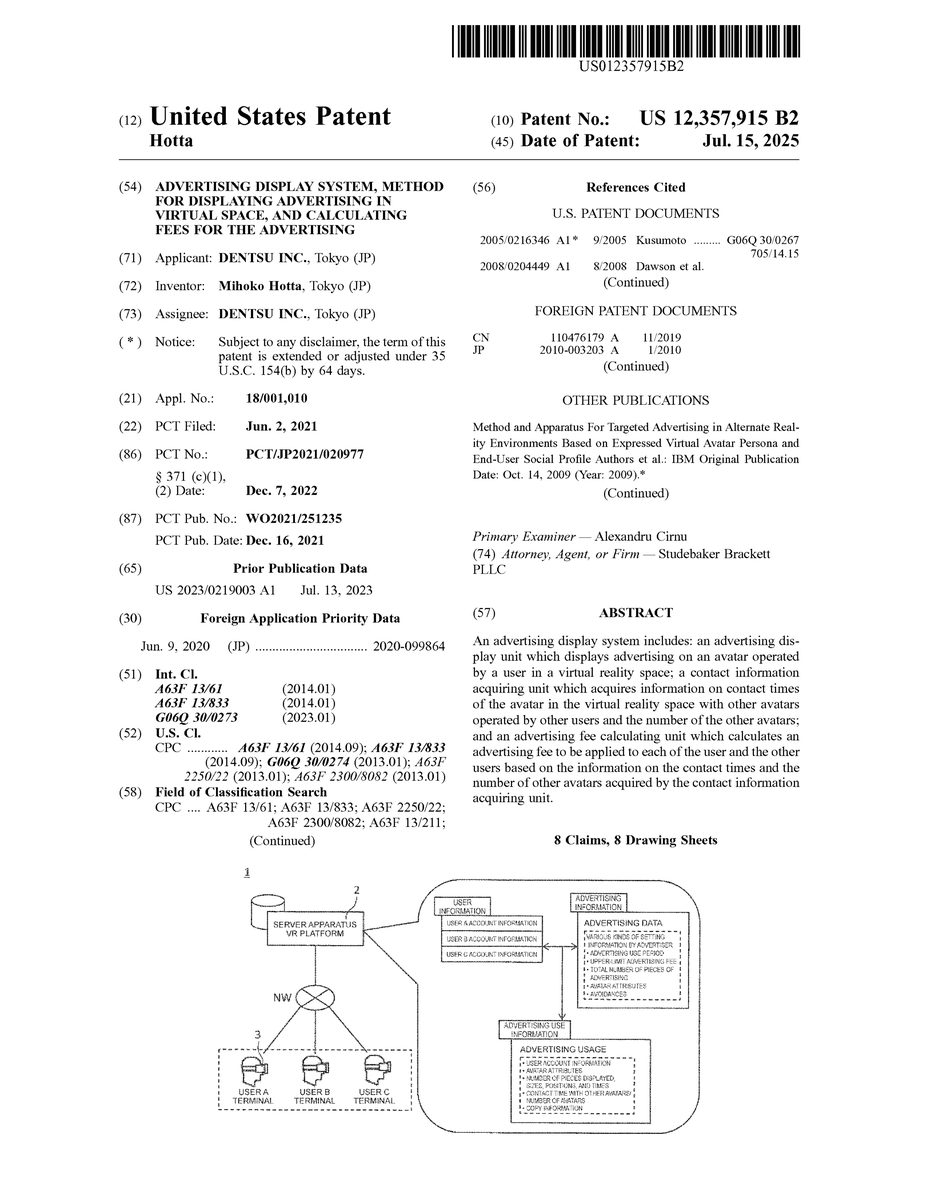
FIG.1is a diagram showing a schematic configuration of an advertising display system1according to an embodiment. The advertising display system1is a system which displays advertising to a user in a virtual reality space.
As shown inFIG.1, the advertising display system1includes a server apparatus2and a plurality of user terminals3. The server apparatus2and the plurality of user terminals3are connected to be capable of communicating with each other via a network NW such as the Internet. The network NW may be any of a wired communication line or a wireless communication line and a type or a form of the communication line is not restricted. At least a part of the server apparatus2and the user terminals3is realized by a computer.
Among the advertising display system1, the user terminal3is to be used by a user and is, for example, a head-mounted display (HMD), a personal computer (PC), a smartphone, or a tablet terminal.
FIG.3is a block diagram showing a configuration of the user terminal3. As shown inFIG.3, the user terminal3includes a terminal communicating unit31, a terminal control unit32, a terminal input unit33, and a terminal display unit34. Each of the units31to34are connected via a bus to be capable of communicating with each other.
The terminal communicating unit31is a communication interface between the user terminal3and the network NW. The terminal communicating unit31transmits and receives information between the user terminal3and the server apparatus2via the network NW.
The terminal control unit32is control means which performs various kinds of processing of the user terminal3. The terminal control unit32may be realized by a processor in the user terminal3by executing a predetermined program or may be implemented by hardware.
The terminal input unit33is an interface used by a user to input information to the user terminal3and is, for example, a hand-held controller in a head-mounted display, a touch panel or a microphone in a smartphone or a tablet terminal, or a touchpad, a keyboard or a mouse in a personal computer. In this case, the hand-held controller in the head-mounted display includes at least one operation button and may have various built-in sensors for detecting an orientation and a motion (acceleration, rotation, and the like) of the controller. Due to an operation input from the terminal input unit33, the user can move an avatar or cause the avatar to make an utterance in the virtual reality space.
The terminal display unit34is an interface for displaying various kinds of information to the user from the user terminal3and is, for example, video displaying means such as a liquid crystal display. When the user terminal3is a head-mounted display, the terminal display unit34is video display means which is mounted to the head of the user and which covers a field of view of both eyes of the user. The user wearing the head-mounted display can view video displayed on the terminal display unit34. The terminal display unit34displays objects (electronic files) of any other type including a still image, a moving image, a document, and a website. A display mode of the terminal display unit34is not particularly limited and a mode may be adopted in which an object is displayed at any position in a virtual space (virtual reality space) with depth or a mode may be adopted in which an object is displayed at any position on a virtual plane.
Next, the server apparatus2will be described. While the server apparatus2is made up of one computer in the illustrated example, the server apparatus2is not limited to this configuration and may be made up of a plurality of computers connected to be capable of communicating with each other via a network.
FIG.2is a block diagram showing a configuration of the server apparatus2. As shown inFIG.2, the server apparatus2includes a server communicating unit21, a server control unit22, and a server storage unit23. Each of the units21to23are connected via a bus or a network to be capable of communicating with each other.
Among the units, the server communicating unit21is a communication interface between the server apparatus2and the network NW. The server communicating unit21transmits and receives information between the server apparatus2and each user terminal3via the network NW.
The server storage unit23is, for example, a non-volatile data storage such as a flash memory. Various kinds of data handled by the server control unit22are stored in the server storage unit23. For example, the server storage unit22includes a user information database231, an advertising information database232, and an advertising use information database233.
Referring toFIG.1, for each user, the user information database231stores account information (for example, a user ID, a password, information on an avatar that can be operated by the user, and information on a bank account into which an advertising fee is to be deposited) of the user.
The advertising information database222stores advertising data provided by the advertiser. Advertising data is to be displayed (for example, pasted) on an avatar in the virtual reality space and may be either still image data or moving image data. In addition, display of advertising data may change over time or change depending on the environment. The advertising information database222may store, for each piece of advertising data, various kinds of setting information (for example, an advertising use period, an upper-limit advertising fee (per avatar/whole), total number of pieces of advertising, avatar attributes, and avoidances) designated by the advertiser.
The advertising use information database233stores information (advertising use information) related to advertising usage acquired from the user terminal3. As advertising use information, the advertising use information database233may store account information of a user operating an avatar on which advertising is displayed, avatar attributes of the avatar, the number of pieces, display sizes, display positions, and display times of advertising displayed on the avatar, contact times of the avatar with other avatars/number of avatars, and copy information indicating that advertising has been copied from the avatar to another avatar.
As shown inFIG.2, the server control unit22includes an advertising display unit221, a contact information acquiring unit222, and an advertising fee calculating unit223. Each of the units221to223may be realized by a processor in the server apparatus2by executing a predetermined program or may be implemented by hardware.
The advertising display unit221refers toFIGS.4A to4Cand displays advertising11corresponding to advertising data stored in the advertising information database222on an avatar10(a portion visible from the outside such as a surface of the body of the avatar10or a surface of clothing worn by the avatar10) operated by the user in the virtual reality space.
The advertising display unit221may be capable of selecting and/or modifying, based on an operation by the user, at least one of the number of pieces of advertising displayed on the avatar, display sizes of the pieces of advertising, display positions of the pieces of advertising, and display times of the pieces of advertising. Specifically, for example, the advertising11is given a patch shape, and by having the avatar10grasp edges of the advertising11with the patch shape and open or close the patch shape based on an operation by the user, the display size of the advertising11may be freely selectable or modifiable. In addition, by having the avatar10grasp the advertising11with the patch shape and paste the advertising11with the patch shape to or detach the patch shape from a portion visible from the outside such as a surface of the body of the avatar10or a surface of clothing worn by the avatar10based on an operation of the user, the number of pieces of the advertising11displayed, display positions of the pieces of advertising11, and display times of the pieces of advertising11may be freely selectable or modifiable. When the avatar10tries on (tentatively pastes) the advertising11with a patch shape based on an operation of the user, the advertising fee calculating unit223to be described later may present the user with an assumed advertising fee in accordance with a display size or a display position.
Since a user can freely select and modify, at any time, the number of pieces of the advertising11displayed on the avatar10, display sizes of pieces of the advertising11, display positions of pieces of the advertising11, and display times of pieces of the advertising11, the user can construct an advertising display style to the user's liking, and since an advertising fee changes accordingly as will be described later, a mechanism of displaying the advertising11on the avatar10only after the user is convinced to do so can be constructed.
The contact information acquiring unit222acquires information on contact times of the avatar10on which the advertising11is displayed in the virtual reality space with other avatars and the number of the other avatars. The information on contact times and the number of the other avatars acquired by the contact information acquiring unit222is stored in the advertising use information database233.
Specifically, for example, the contact information acquiring unit222may refer toFIG.5Ato determine whether or not an avatar10A on which the advertising11is displayed is in a state of conversation with other avatars10B and10C based on a presence or absence of an utterance by each of the avatars10A to10C in the virtual reality space and acquire, as a contact time, a time during which the avatar10A on which the advertising11is displayed is in a state of conversation with the other avatars10B and10C. In addition, the contact information acquiring unit222may refer toFIG.5Bto determine whether or not the other avatars10B and10C are continuously gazing on the advertising11displayed on the avatar10A based on position coordinates of an eye mark of each of the avatars10A to10C in the virtual reality space and acquire, as a contact time, a time during which the other avatars10B and10C continuously gaze on the advertising11displayed on the avatar10A. Furthermore, the contact information acquiring unit222may refer toFIG.5Cto determine whether or not the avatar10A on which the advertising11is displayed and the other avatars10B and10C are in a state where the avatars have approached each other within a distance determined in advance based on position coordinates of each of the avatars10A to10C in the virtual reality space and acquire, as a contact time, a time during which the avatar10A on which the advertising11is displayed and the other avatars10B and10C are in a state where the avatars have approached each other within a distance determined in advance.
Based on the information on contact times and the number of other avatars acquired by the contact information acquiring unit222, the advertising fee calculating unit223calculates advertising fees to be respectively applied to a user A who operates the avatar10A on which the advertising11is displayed and other users B and C who operate the other avatars10B and10C having come into contact with the avatar10A. In this case, an “advertising fee” may be a coupon or points, electronic money, cryptocurrency, or the like which can be used for payment in the virtual reality space or a coupon or points, electronic money, cryptocurrency, cash, or the like which can be used for payment in the real world.
Due to advertising fees being applied according to a calculation based on the contact times of the avatar10A on which the advertising11is displayed in the virtual reality space with the other avatars10B and10C, the user A operating the avatar10A on which the advertising11is displayed is motivated to come into contact with the other avatars10B and10C, and since advertising fees are also applied to the other users B and C operating the other avatars10B and10C which the avatar10A had come into contact, the users B and C around the user A can favorably accept contact. Therefore, due to promotion of interchange with the avatar10A on which the advertising11is displayed in the virtual reality space, awareness of the advertising can be generated and the advertising can be disseminated in an effective manner through interchange among the avatars. In addition, since actual recognition of the advertising by a user can be confirmed by contact, advertising effectiveness can be measured and a structure of application of an advertising fee as compensation can be clarified even to advertisers.
As a modification, based on the information on contact times and the number of other avatars acquired by the contact information acquiring unit222, the advertising fee calculating unit223may calculate advertising fees to be respectively applied to the user A who operates the avatar10A on which the advertising11is displayed and the other users B and C who operate the other avatars10B and10C having come into contact with the avatar10A and, at the same time, calculate an advertising fee to be applied to a world owner providing a field (world) in which the avatars10A to10C are staying in the virtual reality space.
The advertising fee calculating unit223may calculate the advertising fees by further taking into consideration at least one of: the number of pieces of advertising11displayed on the avatar10A; display sizes of the pieces of advertising11; display positions of the pieces of advertising11; and display times of the pieces of advertising11. Specifically, for example, since the larger the number of pieces of advertising11displayed on the avatar10A, the more easily the advertising11is recognized by the other avatars10B and10C, the advertising fee applied to each of the users A to C may be increased. In addition, since the larger the display size of the advertising11displayed on the avatar10A, the more easily the advertising11is recognized by the other avatars10B and10C, the advertising fee applied to each of the users A to C may be increased. Furthermore, since the closer the display position of the advertising11is to a face portion of the avatar10, the more easily the advertising11is recognized by the other avatars10B and10C, the advertising fee applied to each of the users A to C may be increased. In addition, since the longer the display time of the advertising11displayed on the avatar10A, the more easily the advertising11is recognized by the other avatars10B and10C, the advertising fee applied to each of the users A to C may be increased.
In other words, the advertising fee calculating unit223may calculate the advertising fee to be applied to each of the users A to C based on at least one element (=variable element that can be freely selected or modified by the user A) among the number of pieces of advertising11displayed on the avatar10A, display sizes of the pieces of advertising11, display positions of the pieces of advertising11, and display times of the pieces of advertising11as well as the contact times of the avatar10A on which the advertising11is displayed in the virtual reality space with the other avatars10B and10C and the number of avatars (=incidental eventual element).
The advertising display unit221may be capable of copying the advertising11displayed on the avatar10A onto the other avatars10B and10C based on input operations of the other users B and C operating the other avatars10B and10C. Specifically, for example, based on operations by the other users B and C, the advertising11displayed on the avatar10A can be copied onto the other avatars10B and10C in response to the other avatars10B and10C coming into contact with the advertising11for a few seconds determined in advance. The advertising display unit221may be capable of selecting and/or modifying, based on operations by the other users B and C, at least one of the display sizes of pieces of the advertising copied onto the other avatars10B and10C, display positions of pieces of the advertising, and display times of pieces of the advertising. By simply copying the advertising11displayed on the avatar10A onto the other avatars10B and10C, the number of displayed pieces of the advertising11itself in the virtual reality space increases and advertising effectiveness can be increased. In addition, since copying is performed based on operations by the users B and C being copy destinations, a mechanism in which the users B and C being copy destinations copy advertising onto the avatars10B and10C only after being convinced to do so can be constructed.
The advertising fee calculating unit223may acquire copy information indicating that the advertising11displayed on the avatar10A has been copied onto the other avatars10B and10C from the advertising use information database233and calculate, based on the copy information, advertising fees to be respectively applied to the user A who operates the avatar10A being a copy source and the users B and C who operate the avatars10B and10C being copy destinations.
Next, a basic operation of the advertising display system1configured as described above will be described with reference toFIG.6.FIG.6is a flow chart showing an example of a basic operation of the advertising display system1.
As shown inFIG.6, when using the advertising display system1according to the present embodiment, first, when login information is input on the user terminal3(step S10), the input login information is transmitted from the user terminal3to the server apparatus2(step S11), and processing of user authentication is performed by the server apparatus2(step S12). When the user authentication is successful, login permission is sent from the server apparatus2to the user terminal3(step S13).
Next, when a user given the login permission operates the user terminal3and generates the avatar10in the virtual reality space (step S14), avatar information (avatar attributes and the like) of the avatar10operated by the user is transmitted from the user terminal3to the server apparatus2(step S15), and confirmation of the avatar information (for example, confirmation that the avatar attributes are consistent with avatar attributes designated by an advertiser) is performed by the server apparatus2(step S16). Once the avatar information is confirmed, advertising data is sent from the server apparatus2to the user terminal3to be disclosed (step S17).
Next, when the user operates the user terminal3and selects one or a plurality of pieces of advertising11corresponding to the disclosed advertising data (step S18: YES), based on the operation by the user, the advertising display unit221performs display setting (for example, selection and/or modification of at least one of a display size, a display position, and a display time) of the selected advertising11(step S19).
Subsequently, the user terminal3queries the user as to whether or not the display setting of the selected advertising11has been completed (step S20). When the display setting of the advertising11has not been completed (step S20: NO), a return is made to step S18or step S19to perform display setting once again.
When the user operates the user terminal3and answers that the display setting of the advertising11has been completed in step S20(step S20: YES), advertising display setting information is transmitted from the user terminal3to the server apparatus2(step S21), and the advertising display unit221of the server apparatus2displays the advertising11in a mode in accordance with the advertising display setting information on the avatar10operated by the user in the virtual reality space. In addition, the server apparatus2starts monitoring advertising usage by the avatar10(step S23). The monitored advertising usage is stored in the advertising use information database233. The user operates the user terminal3and causes the avatar10on which the advertising11is displayed to stay in a world of the virtual reality space (step S24).
On the other hand, returning to step S18, when none of the pieces of advertising11corresponding to the disclosed advertising data are selected by the user (step S18: NO), the advertising11is not displayed on the avatar10operated by the user in the virtual reality space. The user operates the user terminal3and causes the avatar10on which the advertising11is not displayed to stay in the world of the virtual reality space (step S24).
Next, when the user operates the user terminal3and performs logout or an advertising cancellation operation (for example, an operation of removing, from the avatar10, the advertising11with a patch shape being pasted on the avatar10) (step S25), logout information or advertising cancellation information is transmitted from the user terminal3to the server apparatus2(step S26), the advertising fee calculating unit223of the server apparatus2calculates an advertising fee to be applied to a user based on the advertising usage stored in the advertising use information database233(step S27), and information on the advertising fee is sent from the server apparatus2to the user terminal3(step S28).
According to the present embodiment described above, since the user can freely select and modify, at any time, the number of pieces, display sizes, display positions, and display times of the advertising11displayed on the avatar10, the user can construct an advertising display style to the user's liking, and since an advertising fee changes accordingly, a mechanism of displaying the advertising11on the avatar10only after the user is convinced to do so can be constructed.
Next, an operation of the advertising display system1when the avatar10A on which the advertising11is displayed comes into contact with another avatar10B will be described with reference toFIG.7.FIG.7is a flow chart showing an example of an operation of the advertising display system1.
As shown inFIG.7, first, the user A operates his/her own user terminal3(hereinafter, may be referred to as “user A terminal”), performs login and generates the avatar10A in the virtual reality space (step S30), and performs display setting of the advertising11(step S31). In this case, steps S30to S31are similar to steps S10to S20in the flow chart shown inFIG.6and a detailed description will be omitted.
When advertising display setting has been completed at the user A terminal, advertising display setting information is transmitted from the user A terminal to the server apparatus2(step S21), and the advertising display unit221of the server apparatus2displays the advertising11in a mode in accordance with the advertising display setting information on the avatar10A operated by the user A in the virtual reality space. In addition, the server apparatus2starts monitoring advertising usage by the avatar10A (step S23). The monitored advertising usage is stored in the advertising use information database233. The user A operates the user A terminal and causes the avatar10A on which the advertising11is displayed to stay in a world of the virtual reality space (step S24).
In parallel with the operation by the user A, as shown inFIG.7, the user B operates his/her own user terminal3(hereinafter, may be referred to as “user B terminal”), performs login, and generates the avatar10B in the virtual reality space (step S130). In this case, step S130is similar to steps S10to S18: NO in the flow chart shown inFIG.6and a detailed description will be omitted. The user B operates the user B terminal and causes the avatar10B on which the advertising11is not displayed to stay in the world of the virtual reality space (step S124).
When the avatar10A on which the advertising11is displayed during its stay in the world comes into contact with the other avatar10B (steps S32and S132), contact information is sent from the user A terminal and the user B terminal to the server apparatus2(steps S33and S133). Based on the contact information received from the user A terminal and the user B terminal, the contact information acquiring unit222of the server apparatus2acquires information on a contact time of the avatar10A on which the advertising11is displayed in the virtual reality space with the other avatar10B and the number of the other avatars (step S34). The information on the contact time and the number of the other avatars acquired by the contact information acquiring unit222is stored in the advertising use information database233.
Subsequently, when the user A operates the user A terminal and performs logout or an advertising cancellation operation (for example, an operation of removing, from the avatar10A, the advertising11with a patch shape being pasted on the avatar10A) (step S25), logout information or advertising cancellation information is transmitted from the user A terminal to the server apparatus2(step S26). In addition, when the user B operates the user B terminal and performs logout (step S125), logout information is transmitted from the user B terminal to the server apparatus2(step S126).
In addition, based on the information on the contact time and the number of the other avatars acquired by the contact information acquiring unit222, the advertising fee calculating unit223of the server apparatus2calculates advertising fees to be respectively applied to the user A who operates the avatar10A on which the advertising11is displayed and the other user B who operates the other avatar10B having come into contact with the avatar10A (step S27), and information on the advertising fees is sent to the user A terminal and the user B terminal from the server apparatus2(steps S28and S128).
According to the present embodiment described above, an advertising fee can be calculated based on a contact time of the avatar10A on which the advertising11is displayed in the virtual reality space with the other avatar10B and the number of the other avatars. In addition, an advertising fee is applied not only to the user A operating the avatar10A on which advertising11is displayed but also to the other user B operating the other avatar10B which the avatar10A had come into contact according to a calculation based on the contact time. Accordingly, the user A operating the avatar10A on which advertising11is displayed is motivated to come into contact with the other avatar10B, and since an advertising fee is also applied to the other user B operating the other avatar10B which the avatar10A had come into contact, the other user B can also favorably accept contact. Therefore, due to promotion of interchange with the avatar10A on which the advertising11is displayed in the virtual reality space, awareness of the advertising can be generated and the advertising can be disseminated in an effective manner through interchange among the avatars. Furthermore, since actual recognition of the advertising by a user can be confirmed by contact, advertising effectiveness can be measured and a structure of application of an advertising fee as compensation can be clarified even to advertisers.
Next, an operation of the advertising display system1when the advertising11is copied from the avatar10A on which the advertising11is displayed to the other avatar10B will be described with reference toFIG.8.FIG.8is a flow chart showing an example of an operation of the advertising display system1.
As shown inFIG.8, first, the user A operates his/her own user terminal3(hereinafter, may be referred to as “user A terminal”), performs login and generates the avatar10A in the virtual reality space (step S30), and performs display setting of the advertising11(step S31). In this case, steps S30to S31are similar to steps S10to S20in the flow chart shown inFIG.6and a detailed description will be omitted.
When advertising display setting has been completed at the user A terminal, advertising display setting information is transmitted from the user A terminal to the server apparatus2(step S21), and the advertising display unit221of the server apparatus2displays the advertising11in a mode in accordance with the advertising display setting information on the avatar10A operated by the user A in the virtual reality space. In addition, the server apparatus2starts monitoring advertising usage by the avatar10A (step S23). The monitored advertising usage is stored in the advertising use information database233. The user A operates the user A terminal and causes the avatar10A on which the advertising11is displayed to stay in a world of the virtual reality space (step S24).
In parallel with the operation by the user A, as shown inFIG.7, the user B operates his/her own user terminal3(hereinafter, may be referred to as “user B terminal”), performs login, and generates the avatar10B in the virtual reality space (step S130). In this case, step S130is similar to steps S10to S18: NO in the flow chart shown inFIG.6and a detailed description will be omitted. The user B operates the user B terminal and causes the avatar10B on which the advertising11is not displayed to stay in the world of the virtual reality space (step S124).
After the avatar10A on which the advertising11is displayed comes into contact with the other avatar10B during a stay in the world (steps S32and step S132), when the user B operates the user B terminal and performs an advertising copy action for copying the advertising11(for example, an action by the avatar10B of coming into contact for a few seconds determined in advance with the advertising11displayed on the avatar10A) (step S141), an advertising copy request is sent from the user B terminal to the server apparatus2(step S142).
The advertising display unit221of the server apparatus2determines feasibility of copying (step S143) and, when copying is feasible, the advertising display unit221also displays the advertising11on the avatar10B operated by the user B in the virtual reality space (in other words, copies the advertising11displayed on the avatar10A to the avatar10B). Copy information indicating that the advertising11displayed on the avatar10A has been copied onto the avatar10B is stored in the advertising use information database233and an advertising copy completion notification is sent from the server apparatus2to the user A terminal (step S144). In addition, the server apparatus2starts monitoring advertising usage by the avatar10B being the copy destination (step S145). The monitored advertising usage is stored in the advertising use information database233.
Subsequently, when the user A operates the user A terminal and performs logout or an advertising cancellation operation (for example, an operation of removing, from the avatar10A, the advertising11with a patch shape being pasted on the avatar10A) (step S25), logout information or advertising cancellation information is transmitted from the user A terminal to the server apparatus2(step S26). In addition, when the user B operates the user B terminal and performs logout or an advertising cancellation operation (for example, an operation of removing, from the avatar10B, the advertising11with a patch shape being pasted on the avatar10B) (step S125), logout information or advertising cancellation information is transmitted from the user B terminal to the server apparatus2(step S126).
In addition, the advertising fee calculating unit223of the server apparatus2acquires copy information indicating that the advertising11displayed on the avatar10A has been copied onto the other avatar10B from the advertising use information database233and calculates, based on the copy information, advertising fees to be respectively applied to the user A who operates the avatar10A being a copy source and the user B who operates the avatar10B being a copy destination (step S27), and information on the advertising fees is sent from the server apparatus2to the user A terminal and the user B terminal (step S28and S128).
According to the present embodiment described above, since the advertising11displayed on the avatar10A can be readily copied onto the other avatar10B, the number of displayed pieces of advertising itself in the virtual reality space increases and advertising effectiveness can be increased. In addition, a mechanism in which the user B being a copy destination copies advertising onto the avatar10B only after being convinced to do so can be constructed. In addition, since copying is performed based on an operation (step S141inFIG.8) by the user B being the copy destination who desires to copy the advertising, convincingness perceived by the user B being the copy destination is enhanced, advertising is no longer imposed from the user A being a copy source or an advertiser, defamation risks to the advertising and the brand can be reduced, and a mechanism effective for both users and advertisers can be realized.
It is to be understood that the description of the embodiment presented above and the disclosure of the drawings merely represent an example for describing the invention as set forth in the scope of claims and that the invention set forth in the scope of claims is not limited by the description of the embodiment presented above and the disclosure of the drawings. Components of the embodiment described above may be combined in any way without departing from the true scope and spirit of the invention.
In addition, while at least a part of the advertising display system1according to the present embodiment may be constituted of a computer, a program for causing the computer to realize at least a part of the advertising display system1and a computer-readable recording medium which records the program in a non-transitory manner are also subject to protection in the present case.
Claims
- An advertising display system, comprising: at least one processor configured to: display advertising on an avatar operated by a user in a virtual reality space;acquire information on contact times of the avatar in the virtual reality space with other avatars operated by other users and the number of the other avatars;and send, to a terminal of the user and other terminals of the other users, information on an advertising fee according to the information on the contact times and the number of the other avatars, wherein the at least one processor is configured to: determine whether or not the other avatars are continuously gazing on the advertising displayed on the avatar based on position coordinates of an eye mark of each of the avatars in the virtual reality space and acquire, as a contact time, a time during which the other avatars continuously gaze on the advertising displayed on the avatar, or determine whether or not the avatar and the other avatars are in a state where the avatars have approached each other within a distance determined in advance based on position coordinates of each of the avatars in the virtual reality space and acquire, as a contact time, a time during which the avatar and the other avatars are in a state where the avatars have approached each other within the distance determined in advance.
- The advertising display system according to claim 1, wherein the at least one processor is configured to: calculate the advertising fee by further taking into consideration at least one of the number of pieces of advertising displayed on the avatar, display sizes of the pieces of advertising, display positions of the pieces of advertising, and display times of the pieces of advertising.
- The advertising display system according to claim 2, wherein the at least one processor is configured to: select and/or modify, based on an operation by the user, at least one of the number of pieces of advertising displayed on the avatar, display sizes of the pieces of advertising, display positions of the pieces of advertising, and display times of the pieces of advertising.
- The advertising display system according to claim 1, wherein the at least one processor is configured to: copy, based on an operation by the other users, advertising displayed on the avatar onto the other avatars.
- An advertising display method, comprising: displaying advertising on an avatar operated by a user in a virtual reality space;acquiring information on contact times of the avatar in the virtual reality space with other avatars operated by other users and the number of the other avatars;and sending, to a terminal of the user and other terminals of the other users, information on an advertising fee according to the information on the contact times of the avatar in the virtual reality space with other avatars and the number of the other avatars, wherein acquiring information on contact times of the avatar comprises: determining whether or not the other avatars are continuously gazing on the advertising displayed on the avatar based on position coordinates of an eye mark of each of the avatars in the virtual reality space and acquiring, as a contact time, a time during which the other avatars continuously gaze on the advertising displayed on the avatar, or determining whether or not the avatar and the other avatars are in a state where the avatars have approached each other within a distance determined in advance based on position coordinates of each of the avatars in the virtual reality space and acquiring, as a contact time, a time during which the avatar and the other avatars are in a state where the avatars have approached each other within the distance determined in advance.
- The advertising display method according to claim 5, wherein calculating an advertising fee comprises calculating the advertising fee by further taking into consideration at least one of the number of pieces of advertising displayed on the avatar, display sizes of the pieces of advertising, display positions of the pieces of advertising, and display times of the pieces of advertising.
- The advertising display method according to claim 6, the method further comprising: selecting and/or modifying, based on an operation by the user, at least one of the number of pieces of advertising displayed on the avatar, display sizes of the pieces of advertising, display positions of the pieces of advertising, and display times of the pieces of advertising.
- The advertising display method according to claim 5, the method further comprising: copying, based on an operation by the other users, advertising displayed on the avatar onto the other avatars.
Disclaimer: Data collected from the USPTO and may be malformed, incomplete, and/or otherwise inaccurate.