U.S. Pat. No. 12,357,911
TRACKING HAND GESTURES FOR INTERACTIVE GAME CONTROL IN AUGMENTED REALITY
AssigneeSnap Inc.
Issue DateJanuary 8, 2024
Illustrative Figure
Abstract
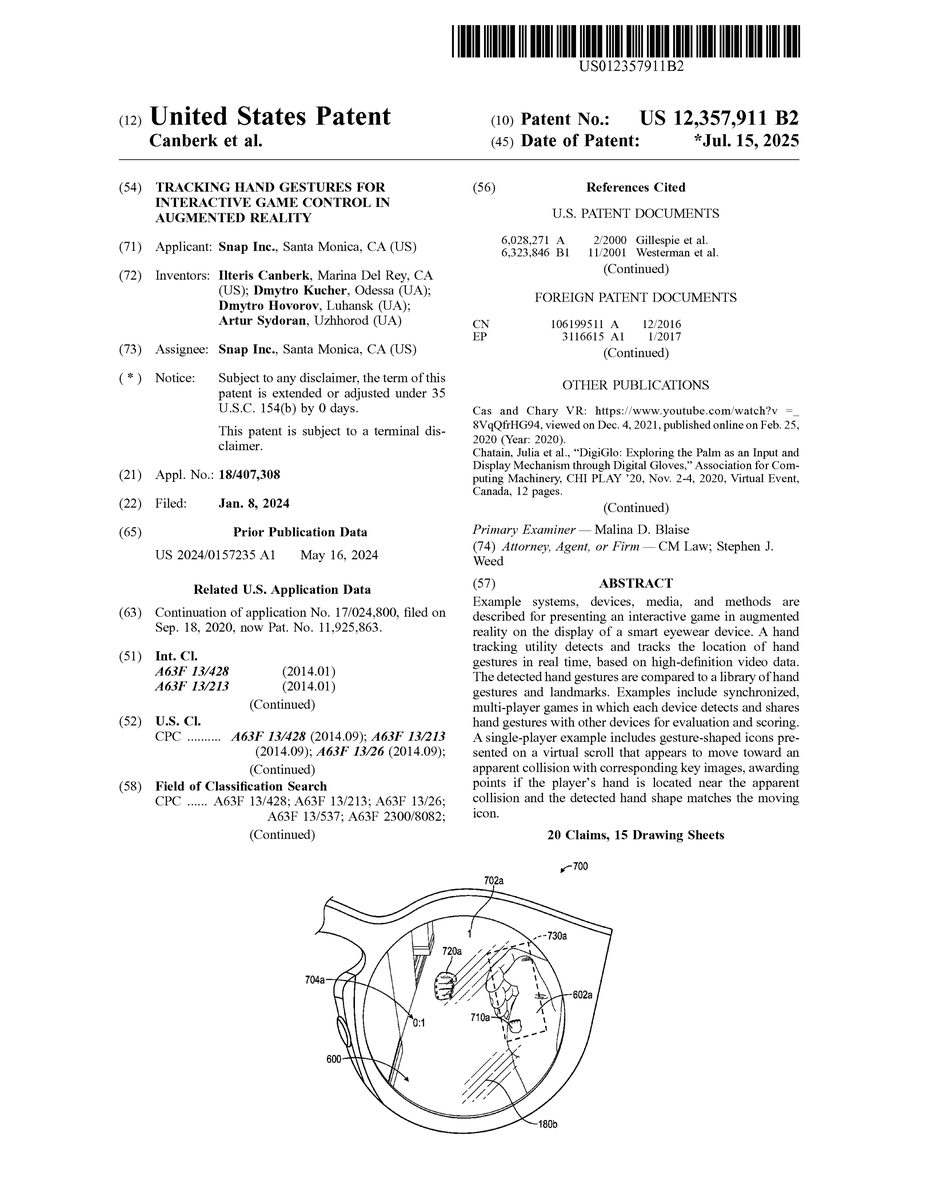
Example systems, devices, media, and methods are described for presenting an interactive game in augmented reality on the display of a smart eyewear device. A hand tracking utility detects and tracks the location of hand gestures in real time, based on high-definition video data. The detected hand gestures are compared to a library of hand gestures and landmarks. Examples include synchronized, multi-player games in which each device detects and shares hand gestures with other devices for evaluation and scoring. A single-player example includes gesture-shaped icons presented on a virtual scroll that appears to move toward an apparent collision with corresponding key images, awarding points if the player's hand is located near the apparent collision and the detected hand shape matches the moving icon.
Description
DETAILED DESCRIPTION Various implementations and details are described with reference to example interactive games presented in augmented reality on the display of an electronic eyewear device. The eyewear device includes a camera, a processor, a memory, a hand tracking utility, and a display. The camera is configured to capture frames of video data, wherein each frame of video data includes depth information for a plurality of pixels. A game application stored in memory on the eyewear, in one example, interactive game, is configured to present a game clock on said display at a location establishing a field of play. The field of play is persistently viewable as an overlay relative to the surrounding physical environment, independent of movement of the eyewear. The game clock is configured to increment from a start time to a final time. Using the hand tracking utility, the game application detects in the frames of video data a final hand shape associated with a final time on the game clock. The game application presents on the display a final virtual game piece based on the detected final hand shape. The final virtual game piece is broadcast wirelessly to nearby devices, including an opponent device. The game application detects an opposing final virtual game piece, which may or may not be presented on the user's display. The game application presents on the display a game score based on the final virtual game piece versus the opposing final virtual game piece. In a related example interactive game, the game application presents a key image at a scoring location on the display. The game application presents an icon that appears to move from a distal location toward the key image. Using the hand tracking utility, the game application detects in the frames of video data a final hand shape—and ...
DETAILED DESCRIPTION
Various implementations and details are described with reference to example interactive games presented in augmented reality on the display of an electronic eyewear device. The eyewear device includes a camera, a processor, a memory, a hand tracking utility, and a display. The camera is configured to capture frames of video data, wherein each frame of video data includes depth information for a plurality of pixels. A game application stored in memory on the eyewear, in one example, interactive game, is configured to present a game clock on said display at a location establishing a field of play. The field of play is persistently viewable as an overlay relative to the surrounding physical environment, independent of movement of the eyewear. The game clock is configured to increment from a start time to a final time. Using the hand tracking utility, the game application detects in the frames of video data a final hand shape associated with a final time on the game clock. The game application presents on the display a final virtual game piece based on the detected final hand shape. The final virtual game piece is broadcast wirelessly to nearby devices, including an opponent device. The game application detects an opposing final virtual game piece, which may or may not be presented on the user's display. The game application presents on the display a game score based on the final virtual game piece versus the opposing final virtual game piece.
In a related example interactive game, the game application presents a key image at a scoring location on the display. The game application presents an icon that appears to move from a distal location toward the key image. Using the hand tracking utility, the game application detects in the frames of video data a final hand shape—and a final hand location—associated with a final time on the game clock. The final time is associated with the apparent collision between the moving icon and the key image. At the final time when the apparent collision occurs, the game application determines (a) whether the detected final hand location is a location match relative to the apparent collision, and (b) whether the detected final hand shape is a shape match relative to the key image. If both conditions are satisfied, the game application increases the game score incrementally.
Although the various systems and methods are described herein with reference to presenting an interactive game, the technology described may be applied to guide the manipulation of other kinds of objects or instruments, such as handheld surgical devices, hand tools, parts to be assembled, input components like keyboards and keypads, and the like.
The following detailed description includes systems, methods, techniques, instruction sequences, and computing machine program products illustrative of examples set forth in the disclosure. Numerous details and examples are included for the purpose of providing a thorough understanding of the disclosed subject matter and its relevant teachings. Those skilled in the relevant art, however, may understand how to apply the relevant teachings without such details. Aspects of the disclosed subject matter are not limited to the specific devices, systems, and method described because the relevant teachings can be applied or practiced in a variety of ways. The terminology and nomenclature used herein is for the purpose of describing particular aspects only and is not intended to be limiting. In general, well-known instruction instances, protocols, structures, and techniques are not necessarily shown in detail.
The terms “coupled” or “connected” as used herein refer to any logical, optical, physical, or electrical connection, including a link or the like by which the electrical or magnetic signals produced or supplied by one system element are imparted to another coupled or connected system element. Unless described otherwise, coupled or connected elements or devices are not necessarily directly connected to one another and may be separated by intermediate components, elements, or communication media, one or more of which may modify, manipulate, or carry the electrical signals. The term “on” means directly supported by an element or indirectly supported by the element through another element that is integrated into or supported by the element.
The term “proximal” is used to describe an item or part of an item that is situated near, adjacent, or next to an object or person; or that is closer relative to other parts of the item, which may be described as “distal.” For example, the end of an item nearest an object may be referred to as the proximal end, whereas the generally opposing end may be referred to as the distal end.
The orientations of the eyewear device, other mobile devices, associated components and any other devices incorporating a camera, an inertial measurement unit, or both such as shown in any of the drawings, are given by way of example only, for illustration and discussion purposes. In operation, the eyewear device may be oriented in any other direction suitable to the particular application of the eyewear device; for example, up, down, sideways, or any other orientation. Also, to the extent used herein, any directional term, such as front, rear, inward, outward, toward, left, right, lateral, longitudinal, up, down, upper, lower, top, bottom, side, horizontal, vertical, and diagonal are used by way of example only, and are not limiting as to the direction or orientation of any camera or inertial measurement unit as constructed or as otherwise described herein.
Advanced AR technologies, such as computer vision and object tracking, may be used to generate a perceptually enriched and immersive experience. Computer vision algorithms extract three-dimensional data about the physical world from the data captured in digital images or video. Object recognition and tracking algorithms are used to detect an object in a digital image or video, estimate its orientation or pose, and track its movement over time. Hand and finger recognition and tracking in real time is one of the most challenging and processing-intensive tasks in the field of computer vision.
The term “pose” refers to the static position and orientation of an object at an instant in time. The term “gesture” refers to the active movement of an object, such as a hand, through a series of poses, sometimes in rapid succession (e.g., waving, pinching) to convey a signal or idea. The terms “pose” and “gesture” are sometimes used interchangeably in the field of computer vision and augmented reality. As used herein, the terms “pose” or “gesture” (or variations thereof) are intended to be inclusive of both poses and gestures; in other words, the use of one term does not exclude the other.
Additional objects, advantages and novel features of the examples will be set forth in part in the following description, and in part will become apparent to those skilled in the art upon examination of the following and the accompanying drawings or may be learned by production or operation of the examples. The objects and advantages of the present subject matter may be realized and attained by means of the methodologies, instrumentalities and combinations particularly pointed out in the appended claims.
Reference now is made in detail to the examples illustrated in the accompanying drawings and discussed below.
FIG.1Ais a side view (right) of an example hardware configuration of an eyewear device100which includes a touch-sensitive input device or touchpad181. As shown, the touchpad181may have a boundary that is subtle and not easily seen; alternatively, the boundary may be plainly visible or include a raised or otherwise tactile edge that provides feedback to the user about the location and boundary of the touchpad181. In other implementations, the eyewear device100may include a touchpad on the left side.
The surface of the touchpad181is configured to detect finger touches, taps, and gestures (e.g., moving touches) for use with a GUI displayed by the eyewear device, on an image display, to allow the user to navigate through and select menu options in an intuitive manner, which enhances and simplifies the user experience.
Detection of finger inputs on the touchpad181can enable several functions. For example, touching anywhere on the touchpad181may cause the GUI to display or highlight an item on the image display, which may be projected onto at least one of the optical assemblies180A,180B. Double tapping on the touchpad181may select an item or icon. Sliding or swiping a finger in a particular direction (e.g., from front to back, back to front, up to down, or down to) may cause the items or icons to slide or scroll in a particular direction; for example, to move to a next item, icon, video, image, page, or slide. Sliding the finger in another direction may slide or scroll in the opposite direction; for example, to move to a previous item, icon, video, image, page, or slide. The touchpad181can be virtually anywhere on the eyewear device100.
In one example, an identified finger gesture of a single tap on the touchpad181, initiates selection or pressing of a graphical user interface element in the image presented on the image display of the optical assembly180A,180B. An adjustment to the image presented on the image display of the optical assembly180A,180B based on the identified finger gesture can be a primary action which selects or submits the graphical user interface element on the image display of the optical assembly180A,180B for further display or execution.
As shown, the eyewear device100includes a right visible-light camera114B. As further described herein, two cameras114A,114B capture image information for a scene from two separate viewpoints. The two captured images may be used to project a three-dimensional display onto an image display for viewing with 3D glasses.
The eyewear device100includes a right optical assembly180B with an image display to present images, such as depth images. As shown inFIGS.1A and1, the eyewear device100includes the right visible-light camera114B. The eyewear device100can include multiple visible-light cameras114A,114B that form a passive type of three-dimensional camera, such as stereo camera, of which the right visible-light camera114B is located on a right corner110B. As shown inFIGS.1C-D, the eyewear device100also includes a left visible-light camera114A.
Left and right visible-light cameras114A,114B are sensitive to the visible-light range wavelength. Each of the visible-light cameras114A,114B have a different frontward facing field of view which are overlapping to enable generation of three-dimensional depth images, for example, right visible-light camera114B depicts a right field of view111B. Generally, a “field of view” is the part of the scene that is visible through the camera at a particular position and orientation in space. The fields of view111A and111B have an overlapping field of view304(FIG.3). Objects or object features outside the field of view111A,111B when the visible-light camera captures the image are not recorded in a raw image (e.g., photograph or picture). The field of view describes an angle range or extent, which the image sensor of the visible-light camera114A,114B picks up electromagnetic radiation of a given scene in a captured image of the given scene. Field of view can be expressed as the angular size of the view cone; i.e., an angle of view. The angle of view can be measured horizontally, vertically, or diagonally.
In an example configuration, one or both visible-light cameras114A,114B has a field of view of 100° and a resolution of 480×480 pixels. The “angle of coverage” describes the angle range that a lens of visible-light cameras114A,114B or infrared camera410(seeFIG.2A) can effectively image. Typically, the camera lens produces an image circle that is large enough to cover the film or sensor of the camera completely, possibly including some vignetting (e.g., a darkening of the image toward the edges when compared to the center). If the angle of coverage of the camera lens does not fill the sensor, the image circle will be visible, typically with strong vignetting toward the edge, and the effective angle of view will be limited to the angle of coverage.
Examples of such visible-light cameras114A,114B include a high-resolution complementary metal-oxide-semiconductor (CMOS) image sensor and a digital VGA camera (video graphics array) capable of resolutions of640p(e.g., 640×480 pixels for a total of 0.3 megapixels), 720p, or 1080p. Other examples of visible-light cameras114A,114B that can capture high-definition (HD) still images and store them at a resolution of 1642 by 1642 pixels (or greater); or record high-definition video at a high frame rate (e.g., thirty to sixty frames per second or more) and store the recording at a resolution of 1216 by 1216 pixels (or greater).
The eyewear device100may capture image sensor data from the visible-light cameras114A,114B along with geolocation data, digitized by an image processor, for storage in a memory. The visible-light cameras114A,114B capture respective left and right raw images in the two-dimensional space domain that comprise a matrix of pixels on a two-dimensional coordinate system that includes an X-axis for horizontal position and a Y-axis for vertical position. Each pixel includes a color attribute value (e.g., a red pixel light value, a green pixel light value, or a blue pixel light value); and a position attribute (e.g., an X-axis coordinate and a Y-axis coordinate).
In order to capture stereo images for later display as a three-dimensional projection, the image processor412(shown inFIG.4) may be coupled to the visible-light cameras114A,114B to receive and store the visual image information. The image processor412, or another processor, controls operation of the visible-light cameras114A,114B to act as a stereo camera simulating human binocular vision and may add a timestamp to each image. The timestamp on each pair of images allows display of the images together as part of a three-dimensional projection. Three-dimensional projections produce an immersive, life-like experience that is desirable in a variety of contexts, including virtual reality (VR) and video gaming.
FIG.1Bis a perspective, cross-sectional view of a right corner110B of the eyewear device100ofFIG.1Adepicting the right visible-light camera114B of the camera system, and a circuit board.FIG.1Cis a side view (left) of an example hardware configuration of an eyewear device100ofFIG.1A, which shows a left visible-light camera114A of the camera system.FIG.1Dis a perspective, cross-sectional view of a left corner110A of the eyewear device ofFIG.1Cdepicting the left visible-light camera114A of the three-dimensional camera, and a circuit board.
Construction and placement of the left visible-light camera114A is substantially similar to the right visible-light camera114B, except the connections and coupling are on the left lateral side170A. As shown in the example ofFIG.1B, the eyewear device100includes the right visible-light camera114B and a circuit board140B, which may be a flexible printed circuit board (PCB). A right hinge126B connects the right corner110B to a right temple125B of the eyewear device100. In some examples, components of the right visible-light camera114B, the flexible PCB140B, or other electrical connectors or contacts may be located on the right temple125B or the right hinge126B. A left hinge126A connects the left corner110A to a left temple125A of the eyewear device100. In some examples, components of the left visible-light camera114A, the flexible PCB140A, or other electrical connectors or contacts may be located on the left temple125A or the left hinge126A.
The right corner110B includes corner body190and a corner cap, with the corner cap omitted in the cross-section ofFIG.1B. Disposed inside the right corner110B are various interconnected circuit boards, such as PCBs or flexible PCBs, that include controller circuits for right visible-light camera114B, microphone(s), low-power wireless circuitry (e.g., for wireless short range network communication via Bluetooth™), high-speed wireless circuitry (e.g., for wireless local area network communication via Wi-Fi).
The right visible-light camera114B is coupled to or disposed on the flexible PCB140B and covered by a visible-light camera cover lens, which is aimed through opening(s) formed in the frame105. For example, the right rim107B of the frame105, shown inFIG.2A, is connected to the right corner110B and includes the opening(s) for the visible-light camera cover lens. The frame105includes a front side configured to face outward and away from the eye of the user. The opening for the visible-light camera cover lens is formed on and through the front or outward-facing side of the frame105. In the example, the right visible-light camera114B has an outward-facing field of view111B (shown inFIG.3) with a line of sight or perspective that is correlated with the right eye of the user of the eyewear device100. The visible-light camera cover lens can also be adhered to a front side or outward-facing surface of the right corner110B in which an opening is formed with an outward-facing angle of coverage, but in a different outwardly direction. The coupling can also be indirect via intervening components.
As shown inFIG.1B, flexible PCB140B is disposed inside the right corner110B and is coupled to one or more other components housed in the right corner110B. Although shown as being formed on the circuit boards of the right corner110B, the right visible-light camera114B can be formed on the circuit boards of the left corner110A, the temples125A,125B, or the frame105.
FIGS.2A and2Bare perspective views, from the rear, of example hardware configurations of the eyewear device100, including two different types of image displays. The eyewear device100is sized and shaped in a form configured for wearing by a user; the form of eyeglasses is shown in the example. The eyewear device100can take other forms and may incorporate other types of frameworks; for example, a headgear, a headset, or a helmet.
In the eyeglasses example, eyewear device100includes a frame105including a left rim107A connected to a right rim107B via a bridge106adapted to be supported by a nose of the user. The left and right rims107A,107B include respective apertures175A,175B, which hold a respective optical element180A,180B, such as a lens and a display device. As used herein, the term “lens” is meant to include transparent or translucent pieces of glass or plastic having curved or flat surfaces that cause light to converge/diverge or that cause little or no convergence or divergence.
Although shown as having two optical elements180A,180B, the eyewear device100can include other arrangements, such as a single optical element (or it may not include any optical element180A,180B), depending on the application or the intended user of the eyewear device100. As further shown, eyewear device100includes a left corner110A adjacent the left lateral side170A of the frame105and a right corner110B adjacent the right lateral side170B of the frame105. The corners110A,110B may be integrated into the frame105on the respective sides170A,170B (as illustrated) or implemented as separate components attached to the frame105on the respective sides170A,170B. Alternatively, the corners110A,110B may be integrated into temples (not shown) attached to the frame105.
In one example, the image display of optical assembly180A,180B includes an integrated image display. As shown inFIG.2A, each optical assembly180A,180B includes a suitable display matrix177, such as a liquid crystal display (LCD), an organic light-emitting diode (OLED) display, or any other such display. Each optical assembly180A,180B also includes an optical layer or layers176, which can include lenses, optical coatings, prisms, mirrors, waveguides, optical strips, and other optical components in any combination. The optical layers176A,176B, . . .176N (shown as176A-N inFIG.2Aand herein) can include a prism having a suitable size and configuration and including a first surface for receiving light from a display matrix and a second surface for emitting light to the eye of the user. The prism of the optical layers176A-N extends over all or at least a portion of the respective apertures175A,175B formed in the left and right rims107A,107B to permit the user to see the second surface of the prism when the eye of the user is viewing through the corresponding left and right rims107A,107B. The first surface of the prism of the optical layers176A-N faces upwardly from the frame105and the display matrix177overlies the prism so that photons and light emitted by the display matrix177impinge the first surface. The prism is sized and shaped so that the light is refracted within the prism and is directed toward the eye of the user by the second surface of the prism of the optical layers176A-N. In this regard, the second surface of the prism of the optical layers176A-N can be convex to direct the light toward the center of the eye. The prism can optionally be sized and shaped to magnify the image projected by the display matrix177, and the light travels through the prism so that the image viewed from the second surface is larger in one or more dimensions than the image emitted from the display matrix177.
In one example, the optical layers176A-N may include an LCD layer that is transparent (keeping the lens open) unless and until a voltage is applied which makes the layer opaque (closing or blocking the lens). The image processor412on the eyewear device100may execute programming to apply the voltage to the LCD layer in order to produce an active shutter system, making the eyewear device100suitable for viewing visual content when displayed as a three-dimensional projection. Technologies other than LCD may be used for the active shutter mode, including other types of reactive layers that are responsive to a voltage or another type of input.
In another example, the image display device of optical assembly180A,180B includes a projection image display as shown inFIG.2B. Each optical assembly180A,180B includes a laser projector150, which is a three-color laser projector using a scanning mirror or galvanometer. During operation, an optical source such as a laser projector150is disposed in or on one of the temples125A,125B of the eyewear device100. Optical assembly180B in this example includes one or more optical strips155A,155B, . . .155N (shown as155A-N inFIG.2B) which are spaced apart and across the width of the lens of each optical assembly180A,180B or across a depth of the lens between the front surface and the rear surface of the lens.
As the photons projected by the laser projector150travel across the lens of each optical assembly180A,180B, the photons encounter the optical strips155A-N. When a particular photon encounters a particular optical strip, the photon is either redirected toward the user's eye, or it passes to the next optical strip. A combination of modulation of laser projector150, and modulation of optical strips, may control specific photons or beams of light. In an example, a processor controls optical strips155A-N by initiating mechanical, acoustic, or electromagnetic signals. Although shown as having two optical assemblies180A,180B, the eyewear device100can include other arrangements, such as a single or three optical assemblies, or each optical assembly180A,180B may have arranged different arrangement depending on the application or intended user of the eyewear device100.
As further shown inFIGS.2A and2B, eyewear device100includes a left corner110A adjacent the left lateral side170A of the frame105and a right corner110B adjacent the right lateral side170B of the frame105. The corners110A,110B may be integrated into the frame105on the respective lateral sides170A,170B (as illustrated) or implemented as separate components attached to the frame105on the respective sides170A,170B. Alternatively, the corners110A,110B may be integrated into temples125A,125B attached to the frame105.
In another example, the eyewear device100shown inFIG.2Bmay include two projectors, a left projector150A (not shown) and a right projector150B (shown as projector150). The left optical assembly180A may include a left display matrix177A (not shown) or a left set of optical strips155′A,155′B, . . .155′N (155prime, A through N, not shown) which are configured to interact with light from the left projector150A. Similarly, the right optical assembly180B may include a right display matrix177B (not shown) or a right set of optical strips155″A,155″B, . . .155″N (155double prime, A through N, not shown) which are configured to interact with light from the right projector150B. In this example, the eyewear device100includes a left display and a right display.
FIG.3is a diagrammatic depiction of a three-dimensional scene306, a left raw image302A captured by a left visible-light camera114A, and a right raw image302B captured by a right visible-light camera114B. The left field of view111A may overlap, as shown, with the right field of view111B. The overlapping field of view304represents that portion of the image captured by both cameras114A,114B. The term ‘overlapping’ when referring to field of view means the matrix of pixels in the generated raw images overlap by thirty percent (30%) or more. ‘Substantially overlapping’ means the matrix of pixels in the generated raw images—or in the infrared image of scene—overlap by fifty percent (50%) or more. As described herein, the two raw images302A,302B may be processed to include a timestamp, which allows the images to be displayed together as part of a three-dimensional projection.
For the capture of stereo images, as illustrated inFIG.3, a pair of raw red, green, and blue (RGB) images are captured of a real scene306at a given moment in time—a left raw image302A captured by the left camera114A and right raw image302B captured by the right camera114B. When the pair of raw images302A,302B are processed (e.g., by the image processor412), depth images are generated. The generated depth images may be viewed on an optical assembly180A,180B of an eyewear device, on another display (e.g., the image display580on a mobile device401), or on a screen.
The generated depth images are in the three-dimensional space domain and can comprise a matrix of vertices on a three-dimensional location coordinate system that includes an X axis for horizontal position (e.g., length), a Y axis for vertical position (e.g., height), and a Z axis for depth (e.g., distance). Each vertex may include a color attribute (e.g., a red pixel light value, a green pixel light value, or a blue pixel light value); a position attribute (e.g., an X location coordinate, a Y location coordinate, and a Z location coordinate); a texture attribute; a reflectance attribute; or a combination thereof. The texture attribute quantifies the perceived texture of the depth image, such as the spatial arrangement of color or intensities in a region of vertices of the depth image.
In one example, the game control system400(FIG.4) includes the eyewear device100, which includes a frame105and a left temple125A extending from a left lateral side170A of the frame105and a right temple125B extending from a right lateral side170B of the frame105. The eyewear device100may further include at least two visible-light cameras114A,114B having overlapping fields of view. In one example, the eyewear device100includes a left visible-light camera114A with a left field of view111A, as illustrated inFIG.3. The left camera114A is connected to the frame105or the left temple125A to capture a left raw image302A from the left side of scene306. The eyewear device100further includes a right visible-light camera114B with a right field of view111B. The right camera114B is connected to the frame105or the right temple125B to capture a right raw image302B from the right side of scene306.
FIG.4is a functional block diagram of an example game control system400that includes a wearable device (e.g., an eyewear device100), a mobile device401, and a server system498connected via various networks495such as the Internet. The game control system400includes a low-power wireless connection425and a high-speed wireless connection437between the eyewear device100and the mobile device401.
As shown inFIG.4, the eyewear device100includes one or more visible-light cameras114A,114B that capture still images, video images, or both still and video images, as described herein. The cameras114A,114B may have a direct memory access (DMA) to high-speed circuitry430and function as a stereo camera. The cameras114A,114B may be used to capture initial-depth images that may be rendered into three-dimensional (3D) models that are texture-mapped images of a red, green, and blue (RGB) imaged scene. The device100may also include a depth sensor213, which uses infrared signals to estimate the position of objects relative to the device100. The depth sensor213in some examples includes one or more infrared emitter(s)215and infrared camera(s)410.
The eyewear device100further includes two image displays of each optical assembly180A,180B (one associated with the left side170A and one associated with the right side170B). The eyewear device100also includes an image display driver442, an image processor412, low-power circuitry420, and high-speed circuitry430. The image displays of each optical assembly180A,180B are for presenting images, including still images, video images, or still and video images. The image display driver442is coupled to the image displays of each optical assembly180A,180B in order to control the display of images.
The eyewear device100additionally includes one or more speakers440(e.g., one associated with the left side of the eyewear device and another associated with the right side of the eyewear device). The speakers440may be incorporated into the frame105, temples125, or corners110of the eyewear device100. The one or more speakers440are driven by audio processor443under control of low-power circuitry420, high-speed circuitry430, or both. The speakers440are for presenting audio signals including, for example, a beat track. The audio processor443is coupled to the speakers440in order to control the presentation of sound.
The components shown inFIG.4for the eyewear device100are located on one or more circuit boards, for example a printed circuit board (PCB) or flexible printed circuit (FPC), located in the rims or temples. Alternatively, or additionally, the depicted components can be located in the corners, frames, hinges, or bridge of the eyewear device100. Left and right visible-light cameras114A,114B can include digital camera elements such as a complementary metal-oxide-semiconductor (CMOS) image sensor, a charge-coupled device, a lens, or any other respective visible or light capturing elements that may be used to capture data, including still images or video of scenes with unknown objects.
As shown inFIG.4, high-speed circuitry430includes a high-speed processor432, a memory434, and high-speed wireless circuitry436. In the example, the image display driver442is coupled to the high-speed circuitry430and operated by the high-speed processor432in order to drive the left and right image displays of each optical assembly180A,180B. High-speed processor432may be any processor capable of managing high-speed communications and operation of any general computing system needed for eyewear device100. High-speed processor432includes processing resources needed for managing high-speed data transfers on high-speed wireless connection437to a wireless local area network (WLAN) using high-speed wireless circuitry436.
In some examples, the high-speed processor432executes an operating system such as a LINUX operating system or other such operating system of the eyewear device100and the operating system is stored in memory434for execution. In addition to any other responsibilities, the high-speed processor432executes a software architecture for the eyewear device100that is used to manage data transfers with high-speed wireless circuitry436. In some examples, high-speed wireless circuitry436is configured to implement Institute of Electrical and Electronic Engineers (IEEE) 802.11 communication standards, also referred to herein as Wi-Fi. In other examples, other high-speed communications standards may be implemented by high-speed wireless circuitry436.
The low-power circuitry420includes a low-power processor422and low-power wireless circuitry424. The low-power wireless circuitry424and the high-speed wireless circuitry436of the eyewear device100can include short-range transceivers (Bluetooth™ or Bluetooth Low-Energy (BLE)) and wireless wide, local, or wide-area network transceivers (e.g., cellular or Wi-Fi). Mobile device401, including the transceivers communicating via the low-power wireless connection425and the high-speed wireless connection437, may be implemented using details of the architecture of the eyewear device100, as can other elements of the network495.
Memory434includes any storage device capable of storing various data and applications, including, among other things, camera data generated by the left and right visible-light cameras114A,114B, the infrared camera(s)410, the image processor412, and images generated for display by the image display driver442on the image display of each optical assembly180A,180B. Although the memory434is shown as integrated with high-speed circuitry430, the memory434in other examples may be an independent, standalone element of the eyewear device100. In certain such examples, electrical routing lines may provide a connection through a chip that includes the high-speed processor432from the image processor412or low-power processor422to the memory434. In other examples, the high-speed processor432may manage addressing of memory434such that the low-power processor422will boot the high-speed processor432any time that a read or write operation involving memory434is needed.
As shown inFIG.4, the high-speed processor432of the eyewear device100can be coupled to the camera system (visible-light cameras114A,114B), the image display driver442, the user input device491, and the memory434. As shown inFIG.5, the CPU530of the mobile device401may be coupled to a camera system570, a mobile display driver582, a user input layer591, and a memory540A.
The server system498may be one or more computing devices as part of a service or network computing system, for example, that include a processor, a memory, and network communication interface to communicate over the network495with an eyewear device100and a mobile device401.
The output components of the eyewear device100include visual elements, such as the left and right image displays associated with each lens or optical assembly180A,180B as described inFIGS.2A and2B(e.g., a display such as a liquid crystal display (LCD), a plasma display panel (PDP), a light emitting diode (LED) display, a projector, or a waveguide). The eyewear device100may include a user-facing indicator (e.g., an LED, a loudspeaker, or a vibrating actuator), or an outward-facing signal (e.g., an LED, a loudspeaker). The image displays of each optical assembly180A,180B are driven by the image display driver442. In some example configurations, the output components of the eyewear device100further include additional indicators such as audible elements (e.g., loudspeakers), tactile components (e.g., an actuator such as a vibratory motor to generate haptic feedback), and other signal generators. For example, the device100may include a user-facing set of indicators, and an outward-facing set of signals. The user-facing set of indicators are configured to be seen or otherwise sensed by the user of the device100. For example, the device100may include an LED display positioned so the user can see it, a one or more speakers positioned to generate a sound the user can hear, or an actuator to provide haptic feedback the user can feel. The outward-facing set of signals are configured to be seen or otherwise sensed by an observer near the device100. Similarly, the device100may include an LED, a loudspeaker, or an actuator that is configured and positioned to be sensed by an observer.
The input components of the eyewear device100may include alphanumeric input components (e.g., a touch screen or touchpad configured to receive alphanumeric input, a photo-optical keyboard, or other alphanumeric-configured elements), pointer-based input components (e.g., a mouse, a touchpad, a trackball, a joystick, a motion sensor, or other pointing instruments), tactile input components (e.g., a button switch, a touch screen or touchpad that senses the location, force or location and force of touches or touch gestures, or other tactile-configured elements), and audio input components (e.g., a microphone), and the like. The mobile device401and the server system498may include alphanumeric, pointer-based, tactile, audio, and other input components.
In some examples, the eyewear device100includes a collection of motion-sensing components referred to as an inertial measurement unit472. The motion-sensing components may be micro-electro-mechanical systems (MEMS) with microscopic moving parts, often small enough to be part of a microchip. The inertial measurement unit (IMU)472in some example configurations includes an accelerometer, a gyroscope, and a magnetometer. The accelerometer senses the linear acceleration of the device100(including the acceleration due to gravity) relative to three orthogonal axes (x, y, z). The gyroscope senses the angular velocity of the device100about three axes of rotation (pitch, roll, yaw). Together, the accelerometer and gyroscope can provide position, orientation, and motion data about the device relative to six axes (x, y, z, pitch, roll, yaw). The magnetometer, if present, senses the heading of the device100relative to magnetic north. The position of the device100may be determined by location sensors, such as a GPS unit473, one or more transceivers to generate relative position coordinates, altitude sensors or barometers, and other orientation sensors. Such positioning system coordinates can also be received over the wireless connections425,437from the mobile device401via the low-power wireless circuitry424or the high-speed wireless circuitry436.
The IMU472may include or cooperate with a digital motion processor or programming that gathers the raw data from the components and computes a number of useful values about the position, orientation, and motion of the device100. For example, the acceleration data gathered from the accelerometer can be integrated to obtain the velocity relative to each axis (x, y, z); and integrated again to obtain the position of the device100(in linear coordinates, x, y, and z). The angular velocity data from the gyroscope can be integrated to obtain the position of the device100(in spherical coordinates). The programming for computing these useful values may be stored in memory434and executed by the high-speed processor432of the eyewear device100.
The eyewear device100may optionally include additional peripheral sensors, such as biometric sensors, specialty sensors, or display elements integrated with eyewear device100. For example, peripheral device elements may include any I/O components including output components, motion components, position components, or any other such elements described herein. For example, the biometric sensors may include components to detect expressions (e.g., hand expressions, facial expressions, vocal expressions, body gestures, or eye tracking), to measure bio signals (e.g., blood pressure, heart rate, body temperature, perspiration, or brain waves), or to identify a person (e.g., identification based on voice, retina, facial characteristics, fingerprints, or electrical bio signals such as electroencephalogram data), and the like.
The mobile device401may be a smartphone, tablet, laptop computer, access point, or any other such device capable of connecting with eyewear device100using both a low-power wireless connection425and a high-speed wireless connection437. Mobile device401is connected to server system498and network495. The network495may include any combination of wired and wireless connections.
The game control system400, as shown inFIG.4, includes a computing device, such as mobile device401, coupled to an eyewear device100over a network. The game control system400includes a memory for storing instructions and a processor for executing the instructions. Execution of the instructions of the game control system400by the processor432configures the eyewear device100to cooperate with the mobile device401. The game control system400may utilize the memory434of the eyewear device100or the memory elements540A,540B,540C of the mobile device401(FIG.5). Also, the game control system400may utilize the processor elements432,422of the eyewear device100or the central processing unit (CPU)530of the mobile device401(FIG.5). In addition, the game control system400may further utilize the memory and processor elements of the server system498. In this aspect, the memory and processing functions of the game control system400can be shared or distributed across the eyewear device100, the mobile device401, and the server system498.
The memory434, in some example implementations, includes or is coupled to game rules480, a set of virtual game pieces482, key images484, icons486, and a hand gesture library488. The game rules480include a series of rules for conducting a game, presenting game pieces, and scoring the results. The virtual game pieces482include one or more virtual objects selected from a virtual object library or database. The virtual game pieces482are designed to represent a three-dimensional game piece when rendered and presented on a display. The key images484, as described herein, may correspond to one of the virtual game pieces482. The icons486are correlated with the key images484and, as described herein, are sized and shaped to appear to move along a virtual scroll.
The library of hand gestures488includes a large number of poses and gestures, with the hand in various positions and orientations. The stored poses and gestures are suitable for ready comparison to a hand shape that is detected in an image. The library488includes three-dimensional coordinates for a large number of landmarks, from the wrist to the fingertips. For example, a hand gesture record stored in the library488may include a hand gesture identifier (e.g., closed fist, open palm, relaxed hand, grasping an object, pinching, spreading), a point of view or a directional reference (e.g., palmar side visible, dorsal, lateral), and other information about orientation, along with three-dimensional coordinates for the wrist, the fifteen interphalangeal joints, the five fingertips and other skeletal or soft-tissue landmarks. The process of selecting a candidate hand gesture from the library488involves comparing the detected hand shape to each hand gesture stored in the library488until a good match is found.
The memory434additionally includes, for execution by the processor432, a game application910, a hand tracking utility915, and a virtual object rendering utility920. The game application910, as described herein, includes instructions for conducting a game or task, for presenting elements on a display, for communicating with other devices, and for scoring the game or task. The hand tracking utility915configures the processor432to detect hand shapes in still images or frames of video footage and to track the motion of hand shapes in subsequent frames. The virtual object rendering utility920configures the processor432to render virtual objects, such as virtual game pieces482, for presenting on a display, such as one or both optical assemblies180A,180B under control of the image display driver442and the image processor412.
FIG.5is a high-level functional block diagram of an example mobile device401. Mobile device401includes a flash memory540A which stores programming to be executed by the CPU530to perform all or a subset of the functions described herein.
The mobile device401may include a camera570that comprises at least two visible-light cameras (first and second visible-light cameras with overlapping fields of view) or at least one visible-light camera and a depth sensor with substantially overlapping fields of view. Flash memory540A may further include multiple images or video, which are generated via the camera570.
As shown, the mobile device401includes an image display580, a mobile display driver582to control the image display580, and a display controller584. In the example ofFIG.5, the image display580includes a user input layer591(e.g., a touchscreen) that is layered on top of or otherwise integrated into the screen used by the image display580.
Examples of touchscreen-type mobile devices that may be used include (but are not limited to) a smart phone, a personal digital assistant (PDA), a tablet computer, a laptop computer, or other portable device. However, the structure and operation of the touchscreen-type devices is provided by way of example; the subject technology as described herein is not intended to be limited thereto. For purposes of this discussion,FIG.5therefore provides a block diagram illustration of the example mobile device401with a user interface that includes a touchscreen input layer591for receiving input (by touch, multi-touch, or gesture, and the like, by hand, stylus or other tool) and an image display580for displaying content.
As shown inFIG.5, the mobile device401includes at least one digital transceiver (XCVR)510, shown as WWAN XCVRs, for digital wireless communications via a wide-area wireless mobile communication network. The mobile device401also includes additional digital or analog transceivers, such as short-range transceivers (XCVRs)520for short-range network communication, such as via NFC, VLC, DECT, ZigBee, Bluetooth™, or Wi-Fi. For example, short range XCVRs520may take the form of any available two-way wireless local area network (WLAN) transceiver of a type that is compatible with one or more standard protocols of communication implemented in wireless local area networks, such as one of the Wi-Fi standards under IEEE 802.11.
To generate location coordinates for positioning of the mobile device401, the mobile device401can include a global positioning system (GPS) receiver. Alternatively, or additionally the mobile device401can utilize either or both the short range XCVRs520and WWAN XCVRs510for generating location coordinates for positioning. For example, cellular network, Wi-Fi, or Bluetooth™ based positioning systems can generate very accurate location coordinates, particularly when used in combination. Such location coordinates can be transmitted to the eyewear device over one or more network connections via XCVRs510,520.
The transceivers510,520(i.e., the network communication interface) conform to one or more of the various digital wireless communication standards utilized by modern mobile networks. Examples of WWAN transceivers510include (but are not limited to) transceivers configured to operate in accordance with Code Division Multiple Access (CDMA) and 3rd Generation Partnership Project (3GPP) network technologies including, for example and without limitation, 3GPP type 2 (or 3GPP2) and LTE, at times referred to as “4G.” For example, the transceivers510,520provide two-way wireless communication of information including digitized audio signals, still image and video signals, web page information for display as well as web-related inputs, and various types of mobile message communications to/from the mobile device401.
The mobile device401further includes a microprocessor that functions as a central processing unit (CPU); shown as CPU530inFIG.4. A processor is a circuit having elements structured and arranged to perform one or more processing functions, typically various data processing functions. Although discrete logic components could be used, the examples utilize components forming a programmable CPU. A microprocessor, for example, includes one or more integrated circuit (IC) chips incorporating the electronic elements to perform the functions of the CPU. The CPU530, for example, may be based on any known or available microprocessor architecture, such as a Reduced Instruction Set Computing (RISC) using an ARM architecture, as commonly used today in mobile devices and other portable electronic devices. Of course, other arrangements of processor circuitry may be used to form the CPU530or processor hardware in smartphone, laptop computer, and tablet.
The CPU530serves as a programmable host controller for the mobile device401by configuring the mobile device401to perform various operations, for example, in accordance with instructions or programming executable by CPU530. For example, such operations may include various general operations of the mobile device, as well as operations related to the programming for applications on the mobile device. Although a processor may be configured by use of hardwired logic, typical processors in mobile devices are general processing circuits configured by execution of programming.
The mobile device401includes a memory or storage system, for storing programming and data. In the example, the memory system may include a flash memory540A, a random-access memory (RAM)540B, and other memory components540C, as needed. The RAM540B serves as short-term storage for instructions and data being handled by the CPU530, e.g., as a working data processing memory. The flash memory540A typically provides longer-term storage.
Hence, in the example of mobile device401, the flash memory540A is used to store programming or instructions for execution by the CPU530. Depending on the type of device, the mobile device401stores and runs a mobile operating system through which specific applications are executed. Examples of mobile operating systems include Google Android, Apple iOS (for iPhone or iPad devices), Windows Mobile, Amazon Fire OS, RIM BlackBerry OS, or the like.
The processor432within the eyewear device100may construct a map of the environment surrounding the eyewear device100, determine a location of the eyewear device within the mapped environment, and determine a relative position of the eyewear device to one or more objects in the mapped environment. The processor432may construct the map and determine location and position information using a simultaneous localization and mapping (SLAM) algorithm applied to data received from one or more sensors. In the context of augmented reality, a SLAM algorithm is used to construct and update a map of an environment, while simultaneously tracking and updating the location of a device (or a user) within the mapped environment. The mathematical solution can be approximated using various statistical methods, such as particle filters, Kalman filters, extended Kalman filters, and covariance intersection.
Sensor data includes images received from one or both of the cameras114A,114B, distance(s) received from a laser range finder, position information received from a GPS unit473, or a combination of two or more of such sensor data, or from other sensors providing data useful in determining positional information.
FIG.6is a flow chart650listing the steps in an example method of presenting an interactive game in augmented reality. Although the steps are described with reference to the eyewear device100, as described herein, other implementations of the steps described, for other types of wearable mobile devices, will be understood by one of skill in the art from the description herein. Additionally, it is contemplated that one or more of the steps shown in the drawings, and described herein, may be omitted, repeated, performed simultaneously or in a series, performed in an order other than illustrated and described, or performed in conjunction with additional steps.
The steps are described with reference to an eyewear device100that includes a processor432, memory434, a hand tracking utility915, and a display180A,180B. Consistent with aspects of some example implementations, the eyewear device100initiates and runs a game application910, the hand tracking utility915, and a virtual object rendering utility920. The game application910includes programming directing the eyewear processor to execute the steps described in the flow chart650, accessing the hand tracking utility915and the virtual object rendering utility920as needed for particular tasks.
At block652, the processor432captures frames of video data with a camera114A,114B that is coupled to or part of an eyewear device100. The camera114A,114B, in some implementations, includes one or more high-resolution, digital cameras equipped with a CMOS image sensor capable of capturing high-definition still images and high-definition video. Each frame of digital video includes depth information for a plurality of pixels in the image. In this aspect, the camera114A,114B serves as a high-definition scanner by capturing a detailed input image of the environment. The camera114A,114B, in some implementations, includes a pair of high-resolution digital cameras114A,114B coupled to the eyewear device100and spaced apart to acquire a left-camera raw image and a right-camera raw image. When combined, the raw images form an input image that includes a matrix of three-dimensional pixel locations. The method, at step802, in some implementations, includes storing the captured sequences of frames of video data in memory434on the eyewear device100, at least temporarily, such that the frames are available for analysis; for example, to detect hand shapes and track their movement.
At block654, the processor432presents a game clock702on a display of the eyewear device100. The game clock702, in some implementations, is presented at a location on the display which establishes a field of play700for an interactive game. The image processor412and image display driver442are involved in presenting the game clock702on the display, which, in this example, is one or both of the optical assemblies180A,180B of the eyewear device100). In one example implementation, the right lens (right optical assembly180B) includes a right display matrix177B configured to interact with light from a right projector150B positioned to project images onto the interior surface of the lens180B.
As shown inFIG.7A, a game clock showing a preliminary time702ais presented at an upper, central location on the display180A,180B. The game clock702, the game score704, and the virtual game pieces710,720as described herein remain persistently viewable on the display as an overlay relative to the physical environment600. In other words, those elements of the field of play700do not move, relative to the display, regardless of movements of the eyewear100or the user's hand602. The game clock702is configured to increment from a start time702a, when play begins, to a final time702b, when the final virtual game pieces710b,720bare evaluated to determine a game score704.
At block656, the processor432, using a hand tracking utility915, analyzes the frames of video and detects a final hand shape602bassociated with the final time702bon the game clock702. The hand tracking utility915may detect one or more preliminary hand shapes, as described herein; however, the final hand shape602b, detected at or near the final time702b, is most useful in determining the game score704. The detection need not take place precisely at the final time702b. As shown inFIG.7B, the final time702bis zero and the final hand shape602bis a flat or open hand, as shown, with the fingers extended.
At block656, the processor432presents on the display a final virtual game piece710b, which is based on the detected final hand shape602b. Presenting the final virtual game piece710b, in some implementations, involves the virtual object rendering utility920described herein. As shown inFIG.7B, the final virtual game piece710bis an image of an open hand, which corresponds with or matches the detected final hand shape602b(an open hand). As described herein, the process of selecting a final virtual game piece710bthat matches the detected final hand shape602b, in some implementations, includes generating a bounding box730baround the hand shape, identifying hand landmarks, selecting a candidate hand gesture from a library of hand gestures, and selecting a virtual game piece based on the selected hand gesture.
At block660, the processor432detects an opposing final virtual game piece720bwhich, in this example interactive game, was detected by an opponent device and presented on an opponent display (which, from the opponent's perspective, is her final virtual game piece710b). In this aspect, the method contemplates a user eyewear device100and an opponent running the game application910on a similar eyewear device. For scoring purposes, however, the game application910need only detect the opposing final virtual game piece720b, which may be presented on the display in the field of play700, as shown inFIG.7B. In order to be detected, the opposing final virtual game piece720bmay be broadcast by the opponent device. In this aspect, the processor(s)432may be configured to broadcast wirelessly the final virtual game pieces730b,720bfrom their respective devices to nearby devices.
At block662, the processor432presents on the display a game score704that is based on the final virtual game piece710bversus the opposing final virtual game piece720b. Calculating the score includes comparing the values associated with each game piece710,720b.
Example implementations of the present disclosure are directed toward a game application910and method for presenting an interactive game modeled after the game known as Rock Paper Scissors. Presenting a game score704in this example includes applying the game rules480associated with Rock Paper Scissors; namely, Rock beats Scissors, Scissors beats Paper, Paper beats Rock, and throwing the same element (e.g., Rock versus Rock) results in a draw. The game rules480may include a value associated with a winning score, such as three. Because any turn may result in a tie or draw, it may take any number of turns before a player achieves the winning score.
FIG.7Ais a perspective illustration of an example interactive game of Rock Paper Scissors, at a preliminary time, presented in augmented reality. The field of play700is presented on the display180B as an overlay relative to the physical environment600. The field of play700includes a preliminary game score704aand a game clock showing a preliminary time702a. The preliminary time702arepresents any time before (or after) the final time, when a score is determined.
At this preliminary stage of the game, a camera coupled to the eyewear device is capturing frames of video data. The hand tracking utility915, as described herein, detects a preliminary hand shape602a(i.e., the user's own hand, in the shape of a fist, detected within the field of view of the camera and the eyewear). Based on the detected preliminary hand shape602a, the game application910retrieves and presents on the display a corresponding preliminary virtual game piece710a, which in this example is an icon in the shape of a fist, as shown. The bounding box730a, as described herein, is shown here for reference purposes, and may or may not be presented on the display to the user.
The opponent's hand, in this example, is not viewable within the field of view of the camera and the eyewear. In operation, when an opponent device is running the game application910, the opponent device will detect the opponent's preliminary hand shape, select a corresponding preliminary virtual game piece, and then broadcast the preliminary virtual game piece to nearby devices, such as the eyewear100worn by the user. Once received, the user's game application910presents on the display the opponent's preliminary virtual game piece720a, as shown, which in this example is also an icon in the shape of a fist. As shown, the opponent's preliminary virtual game piece720ais presented at a location that is spaced apart from the user's own preliminary virtual game piece710a.
Because the camera is continuously capturing frames of video data, the preliminary virtual game pieces710awill update in response to any change in the detected preliminary hand shape602a. Similarly, the opponent's device will update the opponent's preliminary virtual game piece720ain response to any change in the opponent's preliminary hand shape. In this aspect, the preliminary virtual game pieces710a,720amay be updated at any time.
The game clock may be configured, in accordance with the game rules480, to increment the time in seconds or other interval, and in either direction (increasing or decreasing), from a start time to a final time. For example, the final time702bshown inFIG.7Bis zero, displayed after a countdown from a start time, such as three. InFIG.7Athe preliminary time702ais one.
The game application100, in some implementations, is configured to synchronize the game clock on the user's device with the game clock on the opponent's device, such that the game clock is presented and incremented on the display simultaneously on both devices. To start the game, and to start a next turn in the game, the game application100, in some implementations, is configured to start the game clock at the start time on both displays in response to detecting a start signal in the captured frames of video data. The start signal, in one example, includes the detection and display of both preliminary virtual game pieces710a,720aon both displays, whether matching one another as shown inFIG.7Aor not. The start signal, in another example, includes the detection and display of a specific preliminary virtual game piece, such as a two-finger horns-like game piece (e.g., third icon843band third key image863b, shown inFIG.8B).
FIG.7Bis a perspective illustration of the example interactive game ofFIG.7A, at a final time, presented in augmented reality. The field of play700, as shown, includes an updated game score704band a game clock showing a final time702b. The final time702brepresents the instant when a game score is determined. The final hand shapes, however, need not be detected precisely at the instant of time represented by the final time702b; however, the game application910in accordance with the game rules480may proscribe a discrete window of time during which the final hand shapes are detected. In this aspect, the hand shape detected nearest in time to the final time702bwill be considered the final hand shape602band will be used when retrieving and presenting a corresponding final virtual game piece710b.
At the final time702b, the hand tracking utility915, as described herein, detects a final hand shape602b(i.e., the user's own hand, in the shape of an open hand). Based on the final hand shape602b, the game application910retrieves and presents on the display a corresponding final virtual game piece710b, which in this example is an icon in the shape of an open hand, as shown. The bounding box730baround the final hand shape602b, as described herein, is shown here for reference purposes, and may or may not be presented on the display to the user.
In operation, the opponent device will detect the opponent's preliminary hand shape, select a corresponding preliminary virtual game piece, and then broadcast the preliminary virtual game piece to nearby devices, such as the eyewear100worn by the user. Once received, the user's game application910presents on the display the opponent's final virtual game piece720b, as shown, which in this example is an icon in the shape of a two-fingered vee (also known as a peace sign or victory sign). As shown, the opponent's final virtual game piece720bis presented at a location that is spaced apart from the user's own final virtual game piece710b.
In the example shown inFIG.7B, at the final time702b, the user's final game piece710bis an open hand, as shown, representing Paper, and the opponent's final virtual game piece720bis a two-finger vee or peace sign, as shown, representing Scissors. The updated game score704billustrates an incremental increase by one, for the opponent, on the left side of the colon (indicating a win because Scissors beats Paper), along with a highlight770that, in some examples, appears near the winning score for a predetermined duration.
The next turn in the game may start after a pause lasting a predetermined duration or in response to a start signal. The game application910, in accordance with the game rules640, may include a setting for the pause duration that is adjustable through a user interface. Upon starting the next turn, the game clock will initiate, of course, at a new or subsequent start time on both displays. After one player achieves a winning score, such as three, the game application910may be configured to start a new game, either in response to detecting a start signal or automatically (after a pause or immediately).
FIGS.8A and8Bare perspective illustrations of a second example interactive game, presented in augmented reality.
Consistent with the example shown inFIG.8A, the field of play800includes a game clock showing a first time802a, a game score showing a first score804a, a group of three key images861a,862a,863a, and a group of three lanes831,832,833(labeled inFIG.8B) which appear to extend from a distal location848toward the key images. The field of play800is persistently viewable on the display as an overlay relative to the physical environment600. In other words, the elements presented on the field of play800do not move, relative to the display, regardless of movements of the eyewear100or the user's hand.
The three key images861a,862a,863ain this example are located along a scoring plane815and are presented on the front surfaces of three cube-shaped elements851,852,853(labeled inFIG.8B).
During play, one or more icons841a,842a,843ais presented on the display in a location corresponding to one of the lanes831,832,833and in variable sizes and positions, such that the icons841a,842a,843aappear to be in motion from the distal location848toward one of the three key images861a,862a,863a. The icons841a,842a,843aare correlated with, or match, the key images861a,862a,863a. For example, the fist-shaped first icon841ain the first lane831matches the first key image861athat is displayed on the first cube-shaped element851. The two-finger vee-shaped second icon842ain the second lane832matches the second key image862a. The open hand third icon843ain the third lane833matches the third key image863a. The moving icons and their corresponding key images, in some implementations, may change at any time before the moving icon reaches the scoring plane and apparently collides with its corresponding key image.
The first key image861aindicates the hand gesture to be made, the motion of the first icon841aindicates the approaching time when the user must make the correct hand gesture, and the position of the first lane831indicates where the user's hand must be located—at the final time—in order to score a point. The final time occurs at the instant of an apparent collision between the first icon841a(moving along the first lane831) and the first key image861a(located at the scoring plane815). In this aspect, a point is earned if three conditions are satisfied: time, position, and hand shape. During play, if the user's final hand shape616ais a location match (relative to the first key image861a) and a shape match (relative to the first icon841a)—both of which are evaluated at the final time, when the apparent collision occurs—then the user earns a point.
For example, inFIG.8A, the final hand shape616ais a location match because the hand is positioned near the first key image861a. The final hand shape616ais a shape match because the hand is making a fist, which matches the fist-shaped first icon841a. The time condition is met because the final hand shape616ais in the correct location and shape when the apparent collision occurs between the fist-shaped first icon841aand the first key image861a(at the scoring plane815). Because all three conditions are met, a success highlight871(e.g., rays of light) is displayed near the apparent collision and the game score804ais increased by one point.
FIG.8Billustrates a turn in which the fist-shaped final hand shape616bis not a shape match relative to the two-finger horn-shaped third icon843b, as it crosses the scoring plane815. Because all three conditions are not met, a failure highlight872(e.g., a letter X) is displayed near the apparent collision and the game score804bis not increased.
As shown inFIG.8B, there is no icon presented in the first lane831. In this aspect, the moving icons may appear, or not, at any time before the moving icon reaches the scoring plane and apparently collides with its corresponding key image. The first key image861bis fist-shaped; if and when a first icon appears in the first lane831, it would be fist-shaped. The pointing-finger second icon842bin the second lane832matches the pointing-finger second key image862b. The two-finger horn-shaped third icon843bin the third lane833matches the third key image863b. At the time of the apparent collision, as shown, the moving third icon843bis nearly coincident with the third key image863b.
The icons and key images illustrated inFIGS.8A and8B, together with the virtual game pieces for Rock Paper Scissors illustrated inFIGS.7A and7B, illustrate some of the variety of hand gestures that may be suitable for the interactive games described herein.
FIG.9is a flow chart950listing the steps in an example method of presenting the second example interactive game illustrated inFIGS.8A and8B.
Consistent with the interactive games described herein, any one of the moving icons841a,842a,843ais similar in several aspects to the opposing final virtual game piece720bdescribed with reference to opponent device for the Rock Paper Scissors game. In this aspect, the Moving Icons game, in some implementations, includes one or more steps as described for the example method650of presenting the Rock Paper Scissors game, including capturing frames of video data and detecting a final hand shape.
At block952, the processor432, in executing the game application910on the eyewear device100, presents on the display a first key image861aat a scoring location815. As shown inFIG.8A, the first key image861amay be presented on a surface, such as the face of a first cube-shaped element851.
At block954, the processor432presents on the display a first icon841ain a first lane831of a virtual scroll, as illustrated inFIGS.8A and8B. The first icon841aappears to move from a distal location848toward the first key image861a. The first icon841amatches the first key image861a.
The method, in some implementations, includes using the hand tracking utility915to analyze the frames of video, before the final time, to detect a preliminary hand shape at a current location relative to the display. In turn, the method also includes presenting on the display a preliminary virtual game piece, based on the detected preliminary hand shape. In this aspect, during play, the user can see the preliminary virtual game piece selected and presented by the game application910before the first icon841aapparently collides with the first key image861a. If the preliminary virtual game piece appears to be correct, the user can maintain her preliminary hand shape (at the proper location) until the apparent collision occurs. If the preliminary virtual game piece appears to be incorrect, the user can change her preliminary hand shape before the apparent collision occurs.
At block956, the processor432, using a hand tracking utility915, analyzes the frames of video and detects a final hand location816arelative to the location of the first lane831at a final time. The final time, as described herein, is associated with an apparent collision between the moving first icon841aand the first key image861a. The hand tracking utility915also detects the final hand shape, as described herein.
At block958, the processor432determines whether the final hand location816ais a location match relative to the location of the apparent collision between the moving first icon841aand the first key image861a.
At block960, the processor432determines whether the final hand shape616ais a shape match relative to the first key image861a.
At block962, the processor432determines whether the location match is satisfied and whether the shape match is satisfied; if both conditions are satisfied, the game score704is increased by one point.
Although the method950is described with reference to a single first icon841aand a single first key image861a, the game application910in accordance with the game rules480may accommodate any number of moving icons, lanes, and key images. For example, several key images may lie along a scoring plane, as defined at least partially by the scoring location for any one of the key images. The icons may appear or disappear in any lane at any time. The icons may move at any apparent speed, constant or variable, along the lanes.
In both the Moving Icons game, illustrated inFIGS.8A and8B, and the Rock Paper Scissors game, illustrated inFIGS.7A and7B, the processor432, in executing the game application910on the eyewear device100, performs the task of detecting a final hand shape in the captured frames of video data. The hand tracking utility915, in some implementations, generates a bounding box near the detected final hand shape. Example bounding boxes730a,730b,830a,830bare shown inFIGS.7A,7B,8A and8B; however, the bounding box may or may not be presented on the display for viewing by the user. The bounding box, in some implementations, represents a region for analysis which is smaller than the entire digital image, thus conserving computing resources. Generating the bounding box, in some implementations, involves detecting a palm of a hand, in any orientation, with all or part of the palm visible (e.g., palmar side, dorsal side, lateral edge, or combinations thereof). Within a bounding box, the hand tracking utility915, in some implementations, identifies a set of hand landmarks based on the pixel-level depth information contained in the frame of digital video data. The set of hand landmarks, for example, may include three-dimensional coordinates for as many as all fifteen of the interphalangeal joints, the five fingertips, and the wrist at its articulation points, as well as other skeletal and soft-tissue landmarks. The hand tracking utility915, in some implementations, selects a candidate hand gesture from a hand gesture library488by comparing the identified set of hand landmarks to the data about the variety of hand gestures stored in the library488. Based on the selected candidate hand gesture, the hand tracking utility915, in some implementations, selects a virtual game piece from the collection of virtual game pieces482.
Any of the functionality described herein for the eyewear device100, the mobile device401, and the server system498can be embodied in one or more computer software applications or sets of programming instructions, as described herein. According to some examples, “function,” “functions,” “application,” “applications,” “instruction,” “instructions,” or “programming” are program(s) that execute functions defined in the programs. Various programming languages can be employed to develop one or more of the applications, structured in a variety of manners, such as object-oriented programming languages (e.g., Objective-C, Java, or C++) or procedural programming languages (e.g., C or assembly language). In a specific example, a third-party application (e.g., an application developed using the ANDROID™ or IOS™ software development kit (SDK) by an entity other than the vendor of the particular platform) may include mobile software running on a mobile operating system such as IOS™ ANDROID™, WINDOWS® Phone, or another mobile operating systems. In this example, the third-party application can invoke API calls provided by the operating system to facilitate functionality described herein.
Hence, a machine-readable medium may take many forms of tangible storage medium. Non-volatile storage media include, for example, optical or magnetic disks, such as any of the storage devices in any computer devices or the like, such as may be used to implement the client device, media gateway, transcoder, etc. shown in the drawings. Volatile storage media include dynamic memory, such as main memory of such a computer platform. Tangible transmission media include coaxial cables; copper wire and fiber optics, including the wires that comprise a bus within a computer system. Carrier-wave transmission media may take the form of electric or electromagnetic signals, or acoustic or light waves such as those generated during radio frequency (RF) and infrared (IR) data communications. Common forms of computer-readable media therefore include for example: a floppy disk, a flexible disk, hard disk, magnetic tape, any other magnetic medium, a CD-ROM, DVD or DVD-ROM, any other optical medium, punch cards paper tape, any other physical storage medium with patterns of holes, a RAM, a PROM and EPROM, a FLASH-EPROM, any other memory chip or cartridge, a carrier wave transporting data or instructions, cables or links transporting such a carrier wave, or any other medium from which a computer may read programming code or data. Many of these forms of computer readable media may be involved in carrying one or more sequences of one or more instructions to a processor for execution.
Except as stated immediately above, nothing that has been stated or illustrated is intended or should be interpreted to cause a dedication of any component, step, feature, object, benefit, advantage, or equivalent to the public, regardless of whether it is or is not recited in the claims.
It will be understood that the terms and expressions used herein have the ordinary meaning as is accorded to such terms and expressions with respect to their corresponding respective areas of inquiry and study except where specific meanings have otherwise been set forth herein. Relational terms such as first and second and the like may be used solely to distinguish one entity or action from another without necessarily requiring or implying any actual such relationship or order between such entities or actions. The terms “comprises,” “comprising,” “includes,” “including,” or any other variation thereof, are intended to cover a non-exclusive inclusion, such that a process, method, article, or apparatus that comprises or includes a list of elements or steps does not include only those elements or steps but may include other elements or steps not expressly listed or inherent to such process, method, article, or apparatus. An element preceded by “a” or “an” does not, without further constraints, preclude the existence of additional identical elements in the process, method, article, or apparatus that comprises the element.
Unless otherwise stated, any and all measurements, values, ratings, positions, magnitudes, sizes, and other specifications that are set forth in this specification, including in the claims that follow, are approximate, not exact. Such amounts are intended to have a reasonable range that is consistent with the functions to which they relate and with what is customary in the art to which they pertain. For example, unless expressly stated otherwise, a parameter value or the like may vary by as much as plus or minus ten percent from the stated amount or range.
In addition, in the foregoing Detailed Description, it can be seen that various features are grouped together in various examples for the purpose of streamlining the disclosure. This method of disclosure is not to be interpreted as reflecting an intention that the claimed examples require more features than are expressly recited in each claim. Rather, as the following claims reflect, the subject matter to be protected lies in less than all features of any single disclosed example. Thus, the following claims are hereby incorporated into the Detailed Description, with each claim standing on its own as a separately claimed subject matter.
While the foregoing has described what are considered to be the best mode and other examples, it is understood that various modifications may be made therein and that the subject matter disclosed herein may be implemented in various forms and examples, and that they may be applied in numerous applications, only some of which have been described herein. It is intended by the following claims to claim any and all modifications and variations that fall within the true scope of the present concepts.
Claims
- A method of presenting an interactive game in augmented reality, the method comprising: capturing frames of video data with a camera coupled to an eyewear device comprising a processor, a memory, a hand tracking utility, and a display;presenting on the display a virtual field of play comprising a distal location and a scoring location, wherein the virtual field of play is persistently viewable as an overlay relative to a physical environment, independent of movement of the eyewear device relative to the physical environment, presenting on the display a first icon in apparent motion from the distal location toward the scoring location on the virtual field of play;detecting in the frames of video data, with the hand tracking utility, a final hand shape;selecting a final virtual game piece from a set of virtual game pieces based on the final hand shape;presenting on the display the final virtual game piece as an overlay relative to the final hand shape;detecting a final hand location associated with the final hand shape relative to the scoring location;and incrementing a game score on the display if the final virtual game piece matches the first icon and the final hand location matches the scoring location.
- The method of claim 1, wherein detecting the final hand location further comprises: presenting on the display a game clock configured to increment from a start time to a final time;detecting the final hand location associated with the final time;and incrementing the game score based on the final time, the final virtual game piece, and the final hand location.
- The method of claim 1, wherein incrementing the game score further comprises: detecting an opposing final virtual game piece, and incrementing the game score based on a comparison of the final virtual game piece to the opposing final virtual game piece.
- The method of claim 1, further comprising: presenting on the display a game clock configured to increment from a start time to a final time;detecting in the captured frames of video data, with the hand tracking utility and before the final time, a preliminary hand shape;presenting on the display a bounding box near the preliminary hand shape;and presenting on the display a preliminary virtual game piece based on the detected preliminary hand shape.
- The method of claim 1, further comprising: presenting on the display a game clock configured to increment from a start time to a final time;synchronizing the game clock with an opponent device comprising an opponent display, such that the game clock presents and increments simultaneously on the display and the opponent display;initiating the game clock at the start time on both the displays in response to detecting a start signal in the captured frames of video data;detecting an opposing final virtual game piece;and presenting on the display the opposing final virtual game piece within the virtual field of play and spaced apart from the final virtual game piece.
- The method of claim 1, further comprising: presenting on the display a game clock configured to increment from a start time to a final time;presenting on the display a first key image at the scoring location;presenting on the display the virtual field of play, wherein the virtual field of play comprises a first lane associated with a virtual scroll extending from the distal location toward the scoring location;presenting on the display the first icon in apparent motion along the near first lane from the distal location toward the first key image at the scoring location, wherein the first icon persistently matches the first key image;detecting a final hand location relative to the first lane, wherein the final time is further associated with an apparent collision between the first icon and the first key image;determining whether the detected final hand location is a location match relative to the apparent collision in the first lane;determining whether the detected final hand shape is a shape match relative to the first key image;and in response to detecting both the shape match and the location match, incrementing the game score by one.
- The method of claim 1, wherein selecting the final virtual game piece further comprises: presenting on the display a bounding box near the final hand location, wherein the bounding box comprises a subset of depth information associated with a plurality of pixels;identifying a set of hand landmarks associated with the final hand shape based on the subset of depth information;and selecting a candidate hand gesture from a library of hand gestures based on the set of hand landmarks.
- The method of claim 7, wherein the library of hand gestures and the set of virtual game pieces comprises: a first gesture associated with a virtual fist-like game piece, a fist-shaped key image, and a fist-shaped icon;an open-hand gesture associated with a virtual open-hand game piece, a hand-shaped key image, and a hand-shaped icon;a two-finger vee gesture associated with a virtual two-finger vee game piece, a vee-shaped key image, and a vee-shaped icon;a pointing gesture associated with a virtual pointing-finger game piece, a pointing key image, and a pointing key icon;and a two-finger horns gesture associated with a virtual two-finger horns game piece, a two-finger key image, and a two-finger key icon.
- An interactive game presentation system, comprising: an eyewear device comprising a processor, a memory, a camera, a hand tracking utility, and a display;programming in the memory, wherein execution of the programming by the processor configured the eyewear device to perform functions, including functions to: capture frames of video data with a camera coupled to an eyewear device comprising a processor, a memory, a hand tracking utility, and a display;presenting on the display a virtual field of play comprising a distal location and a scoring location, wherein the virtual field of play is persistently viewable as an overlay relative to a physical environment, independent of movement of the eyewear device relative to the physical environment;present on the display a first icon in apparent motion from the distal location toward the scoring location on the virtual field of play;detect in the frames of video data, with the hand tracking utility, a final hand shape;select a final virtual game piece from a set of virtual game pieces based on the final hand shape;present on the display the final virtual game piece as an overlay relative to the final hand shape;detect a final hand location associated with the final hand shape relative to the scoring location;and increment a game score on the display if the final virtual game piece matches the first icon and the final hand location matches the scoring location.
- The system of claim 9, wherein the execution of the programming further configures the eyewear device to: present on the display a game clock configured to increment from a start time to a final time;detect the final hand location associated with the final time;and increment the game score based on the final time, the final virtual game piece, and the final hand location.
- The system of claim 9, wherein the execution of the programming further configures the eyewear device to: present on the display a game clock configured to increment from a start time to a final time;detect in the captured frames of video data, with the hand tracking utility and before the final time, a preliminary hand shape;present on the display a bounding box near the preliminary hand shape;and present on the display a preliminary virtual game piece based on the detected preliminary hand shape.
- The system of claim 9, wherein the execution of the programming further configures the eyewear device to: present on the display a game clock configured to increment from a start time to a final time;synchronize the game clock with an opponent device comprising an opponent display, such that the game clock presents and increments simultaneously on the display and the opponent display;initiate the game clock at the start time on both the displays in response to detecting a start signal in the captured frames of video data;detect an opposing final virtual game piece;and present on the display the opposing final virtual game piece within the virtual field of play and spaced apart from the final virtual game piece.
- The system of claim 9, wherein the execution of the programming further configures the eyewear device to: present on the display a game clock configured to increment from a start time to a final time;present on the display a first key image at the scoring location;present on the display the virtual field of play, wherein the virtual field of play comprises a first lane associated with a virtual scroll extending from the distal location toward the scoring location;present on the display the first icon in apparent motion along the first lane from the distal location toward the first key image at the scoring location, wherein the first icon persistently matches the first key image;detect a final hand location relative to the first lane, wherein the final time is further associated with an apparent collision between the first icon and the first key image;determine whether the detected final hand location is a location match relative to the apparent collision in the first lane;determine whether the detected final hand shape is a shape match relative to the first key image;and in response to detecting both the shape match and the location match, increment the game score by one.
- The system of claim 9, wherein the execution of the programming further configures the eyewear device to: present on the display a bounding box near the final hand location, wherein the bounding box comprises a subset of depth information associated with a plurality of pixels;identify a set of hand landmarks associated with the final hand shape based on the subset of depth information;and select a candidate hand gesture from a library of hand gestures based on the set of hand landmarks, wherein the library of hand gestures and the set of virtual game pieces comprises: a first gesture associated with a virtual fist-like game piece, a fist-shaped key image, and a fist-shaped icon;an open-hand gesture associated with a virtual open-hand game piece, a hand-shaped key image, and a hand-shaped icon;a two-finger vee gesture associated with a virtual two-finger vee game piece, a vee-shaped key image, and a vee-shaped icon;a pointing gesture associated with a virtual pointing-finger game piece, a pointing key image, and a pointing key icon;and a two-finger horns gesture associated with a virtual two-finger horns game piece, a two-finger key image, and a two-finger key icon.
- A non-transitory computer-readable medium storing program code which, when executed, is operative to cause an electronic processor to perform the steps of: capturing frames of video data with a camera coupled to an eyewear device comprising a processor, a memory, a hand tracking utility, and a display;presenting on the display a virtual field of play comprising a distal location and a scoring location, wherein the virtual field of play is persistently viewable as an overlay relative to a physical environment, independent of movement of the eyewear device relative to the physical environment;presenting on the display a first icon in apparent motion from the distal location toward the scoring location on the virtual field of play;detecting in the frames of video data, with the hand tracking utility, a final hand shape;selecting a final virtual game piece from a set of virtual game pieces based on the final hand shape;presenting on the display the final virtual game piece as an overlay relative to the final hand shape;detecting a final hand location associated with the final hand shape relative to the scoring location;and incrementing a game score on the display if the final virtual game piece matches the first icon and the final hand location matches the scoring location.
- The non-transitory computer-readable medium storing program code of claim 15, wherein the program code, when executed, is operative to cause an electronic processor to perform the further steps of: presenting on the display a game clock configured to increment from a start time to a final time;detecting the final hand location associated with the final time;and incrementing the game score based on the final time, the final virtual game piece, and the final hand location.
- The non-transitory computer-readable medium storing program code of claim 15, wherein the program code, when executed, is operative to cause an electronic processor to perform the further steps of: presenting on the display a game clock configured to increment from a start time to a final time;detecting in the captured frames of video data, with the hand tracking utility and before the final time, a preliminary hand shape;presenting on the display a bounding box near the preliminary hand shape;and presenting on the display a preliminary virtual game piece based on the detected preliminary hand shape.
- The non-transitory computer-readable medium storing program code of claim 15, wherein the program code, when executed, is operative to cause an electronic processor to perform the further steps of: presenting on the display a game clock configured to increment from a start time to a final time;synchronizing the game clock with an opponent device comprising an opponent display, such that the game clock presents and increments simultaneously on the display and the opponent display;initiating the game clock at the start time on both the displays in response to detecting a start signal in the captured frames of video data;detecting an opposing final virtual game piece;and presenting on the display the opposing final virtual game piece within the virtual field of play and spaced apart from the final virtual game piece.
- The non-transitory computer-readable medium storing program code of claim 15, wherein the program code, when executed, is operative to cause an electronic processor to perform the further steps of: presenting on the display a game clock configured to increment from a start time to a final time;presenting on the display a first key image at the scoring location;presenting on the display the virtual field of play, wherein the virtual field of play comprises a first lane associated with a virtual scroll extending from the distal location toward the scoring location;presenting on the display the first icon in apparent motion along the first lane from the distal location toward the first key image at the scoring location, wherein the first icon persistently matches the first key image;detecting a final hand location relative to the first lane, wherein the final time is further associated with an apparent collision between the moving first icon and the first key image;determining whether the detected final hand location is a location match relative to the apparent collision in the first lane;determining whether the detected final hand shape is a shape match relative to the first key image;and in response to detecting both the shape match and the location match, incrementing the game score by one.
- The non-transitory computer-readable medium storing program code of claim 15, wherein the program code, when executed, is operative to cause an electronic processor to perform the further steps of: presenting on the display a bounding box near the final hand location, wherein the bounding box comprises a subset of depth information associated with a plurality of pixels;identifying a set of hand landmarks associated with the final hand shape based on the subset of depth information;and selecting a candidate hand gesture from a library of hand gestures based on the set of hand landmarks, wherein the library of hand gestures and the set of virtual game pieces comprises: a first gesture associated with a virtual fist-like game piece, a fist-shaped key image, and a fist-shaped icon;an open-hand gesture associated with a virtual open-hand game piece, a hand-shaped key image, and a hand-shaped icon;a two-finger vee gesture associated with a virtual two-finger vee game piece, a vee-shaped key image, and a vee-shaped icon;a pointing gesture associated with a virtual pointing-finger game piece, a pointing key image, and a pointing key icon;and a two-finger horns gesture associated with a virtual two-finger horns game piece, a two-finger key image, and a two-finger key icon.
Disclaimer: Data collected from the USPTO and may be malformed, incomplete, and/or otherwise inaccurate.