U.S. Pat. No. 12,343,638
SYSTEMS AND METHODS FOR PROVIDING RECOMMENDATIONS TO IMPROVE GAMEPLAY
AssigneeAdeia Guides Inc
Issue DateMay 16, 2022
Illustrative Figure
Abstract
Systems and methods are described for recommending a proposed hardware configuration to a first user in response to determining that a performance aspect of the first user having a first hardware configuration playing a multiplayer game is worse than a performance aspect of a second user having a second hardware configuration jointly playing the multiplayer game. The proposed hardware configuration is generated based on the first hardware configuration and the second hardware configuration and caused to be displayed on a device of the first user.
Description
DETAILED DESCRIPTION FIG.1shows an illustrative block diagram of a system100for recommending a hardware configuration to improve gameplay in a video game, in accordance with some embodiments of the disclosure. System100includes server102, gaming devices104, communication network106, content source108, metadata database110, and gaming logs/gaming device data database112. Server102is communicatively coupled to gaming devices104by way of communication network106and is communicatively coupled to content source108, metadata database110, and gaming logs/gaming device data database112by way of additional communication paths, which may be included in communication network106or may be separate from communication network106. Communication network106may be any type of communication network, such as the Internet, a mobile phone network, mobile voice or data network (e.g., a 4G or LTE network), cable network, public switched telephone network, or any combination of two or more of such communication networks. Communication network106includes one or more communication paths, such as a satellite path, a fiber-optic path, a cable path, a path that supports Internet communications (e.g., IPTV), free-space connections (e.g., for broadcast or other wireless signals), or any other suitable wired or wireless communication path or combination of such paths. Communication network106communicatively couples various components of system100to one another. Server102is configured to aggregate, from gaming devices104over communication network106, gaming logs118generated based on user performance in video games using gaming devices104while logged into user accounts. Gaming logs118may be pushed by gaming devices104to server102and/or pulled by server102from gaming devices104. Gaming logs118may include, for example, user data, game data, device data of gaming device104, and gameplay data. However, this is only one example, and certain data may be communicated separately from the gaming logs118. For example, user data may be retrieved from a database when a user logs into their account. Game data may include the details of the video game that a user is playing (e.g., name, version, etc.). The video game ...
DETAILED DESCRIPTION
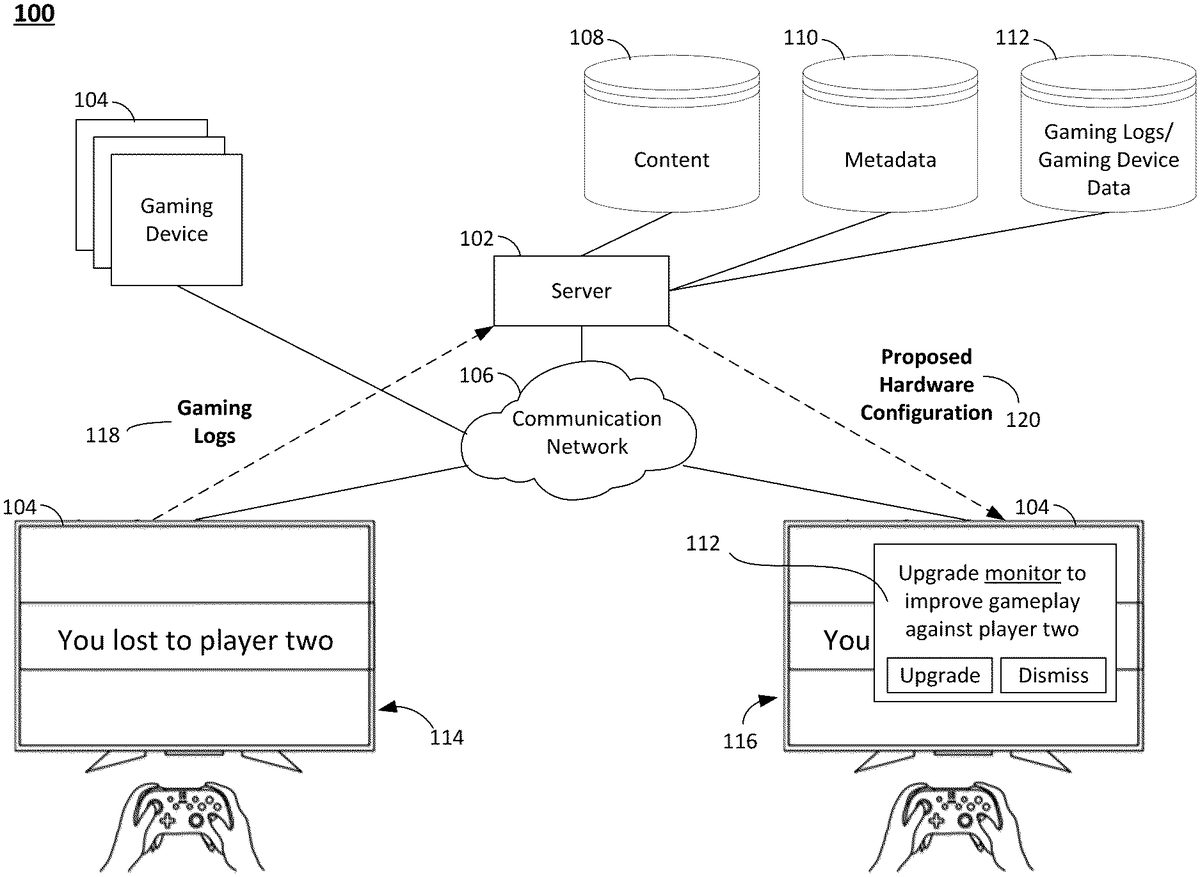
FIG.1shows an illustrative block diagram of a system100for recommending a hardware configuration to improve gameplay in a video game, in accordance with some embodiments of the disclosure. System100includes server102, gaming devices104, communication network106, content source108, metadata database110, and gaming logs/gaming device data database112. Server102is communicatively coupled to gaming devices104by way of communication network106and is communicatively coupled to content source108, metadata database110, and gaming logs/gaming device data database112by way of additional communication paths, which may be included in communication network106or may be separate from communication network106. Communication network106may be any type of communication network, such as the Internet, a mobile phone network, mobile voice or data network (e.g., a 4G or LTE network), cable network, public switched telephone network, or any combination of two or more of such communication networks. Communication network106includes one or more communication paths, such as a satellite path, a fiber-optic path, a cable path, a path that supports Internet communications (e.g., IPTV), free-space connections (e.g., for broadcast or other wireless signals), or any other suitable wired or wireless communication path or combination of such paths. Communication network106communicatively couples various components of system100to one another.
Server102is configured to aggregate, from gaming devices104over communication network106, gaming logs118generated based on user performance in video games using gaming devices104while logged into user accounts. Gaming logs118may be pushed by gaming devices104to server102and/or pulled by server102from gaming devices104. Gaming logs118may include, for example, user data, game data, device data of gaming device104, and gameplay data. However, this is only one example, and certain data may be communicated separately from the gaming logs118. For example, user data may be retrieved from a database when a user logs into their account. Game data may include the details of the video game that a user is playing (e.g., name, version, etc.). The video game may be any online multiplayer game such a massively multiplayer online role-playing game (MMORPG), a mobile online battle arena multiplayer (MOBA) video game, a massively multiplayer online game (MMOG), etc. Device data of gaming device104may include a hardware profile and a software profile of the gaming device, as well as a peripheral profile (e.g., of external peripheral devices currently connected to the gaming device). The hardware profile may include information about each of the hardware components that are installed in the gaming device104(e.g., CPU, GPU, Graphics card, RAM, ROM, etc.). In some embodiments, the information about the hardware components may include a model number or other identifier of the hardware components. In some embodiments, the information about the hardware components may include performance metrics of the hardware components when playing the video game. The software profile may include information about the operating system installed on gaming device104, as well as any other software installed on gaming device104. The peripheral profile may include information about peripherals (e.g., monitors, gaming controllers, input devices, speakers, etc.) that are currently connected to gaming device104. Gameplay data may include information about pre-game performance metrics (e.g., prior to the current or most recent gaming session) and in-game performance metrics (e.g., of the current gaming session). The pre-game and in-game performance metrics measure the performance of a player in a video game (e.g., data indicating particular video games played, levels of those video games, successes and failures at challenges in video games, as well as characters, scenes, sports, levels completed, kills, time to complete levels, health data, ammunition used, deaths, challenges completed, or any other game-specific performance metrics to measure player performance against other players).
Content source108may store data including video game content, which includes player data corresponding to the video game. In one example, the video game content includes player data such as aggregated pre-game and in-game metrics for each of the first and second user (e.g.,FIG.6). The pre-game and in-game metrics will be described in greater detail below with respect toFIG.6. In some embodiments, the video game content may be included in gaming logs118and stored in gaming logs/gaming device data database112.
Metadata database110may store metadata of a game map and parameters of the video gameplay. Some of the parameters include character positioning, the route followed, reaction time, objective captures, target elapsed in objective capturing and target destroyed, and any other game-specific parameters to analyze user performance. Gaming logs/gaming device data database112may store gaming logs118, which may include device data of gaming devices104(e.g., hardware profiles of gaming devices104).
Server102is configured to detect when a first user of their gaming device104has lost against a second user (e.g., “player two”) of another gaming device104during a session of a video game (e.g., an online video game), and would thus benefit from receiving a hardware recommendation to improve their gaming device104. For instance, in view114, upon the first user of their gaming device104losing against the second user of another gaming device104during the session of the video game, the server102determines if gaming device104of the second user has a hardware advantage with respect to gaming device104of the first user that affects gameplay of the video game. For example, server102may compare the device data of gaming devices104of the first and second users. If a difference is detected, the detected difference may be, e.g., compared to aggregate data for a large number of other gaming devices104and associated gameplay data to determine if the detected difference affects gameplay. In response to determining that gaming device104of the second user has a hardware advantage that affects gameplay of the video game, server102is configured to provide or recommend to the first user via their gaming device104(or any other device of the user), a recommendation proposal comprising a hardware configuration recommendation120to improve the gameplay of the first user using gaming device104. For example, server102may search content source108, metadata database110, gaming logs/gaming device data database112, and/or gaming logs118to determine the hardware configuration recommendation120and provide, to gaming device104of the first user over communication network106, a selectable recommendation, such as the pop-up window122in view116, that the first user may select to view the hardware configuration recommendation120. In some embodiments, the selectable recommendation may provide a link to a recommended hardware component (e.g., an upgraded monitor). In some embodiments, the recommendation may include a settings change for a hardware component (e.g., “increase the sensitivity of your Joystick”). Additional details regarding the features and functionality of system100are provided below.
FIG.2shows an illustrative block diagram showing additional details of system100(FIG.1), in accordance with some embodiments of the disclosure. In various embodiments, system200includes some components described above in connection with system100. AlthoughFIG.2shows certain numbers of components, in various examples, system200may include fewer than the illustrated components and/or multiples of one or more illustrated components. Server102includes control circuitry202and I/O path208, and control circuitry202includes storage204and processing circuitry206. Computing device104, which may correspond to gaming devices104ofFIG.1, may be a gaming device, such as a video game console, user television equipment such as a set-top box, user computer equipment, a wireless user communications device such as a smartphone device, or any device on which video games may be played. Computing device104includes control circuitry210, I/O path216, speaker218, display220, and user input interface222. Computing device104may optionally include external peripheral device224(e.g., gaming controller) connected by wired or wireless means (e.g., by I/O path216). Control circuitry210includes storage212and processing circuitry214. Control circuitry202and/or210may be based on any suitable processing circuitry such as processing circuitry206and/or214. As referred to herein, processing circuitry should be understood to mean circuitry based on one or more microprocessors, microcontrollers, digital signal processors, programmable logic devices, field-programmable gate arrays (FPGAs), application-specific integrated circuits (ASICs), etc., and may include a multi-core processor (e.g., dual-core, quad-core, hexa-core, or any suitable number of cores). In some embodiments, processing circuitry may be distributed across multiple separate processors, for example, multiple of the same type of processors (e.g., two Intel Core i9 processors) or multiple different processors (e.g., an Intel Core i7 processor and an Intel Core i9 processor).
Each of storage204, storage212, and/or storages of other components of system200(e.g., storages of content source108, metadata database110, gaming logs/gaming device data database112, and/or the like) may be an electronic storage device. As referred to herein, the phrase “electronic storage device” or “storage device” should be understood to mean any device for storing electronic data, computer software, or firmware, such as random-access memory, read-only memory, hard drives, optical drives, digital video recorders (DVRs, sometimes called personal video recorders, or PVRs), solid state devices, quantum storage devices, gaming consoles, gaming media, or any other suitable fixed or removable storage devices, and/or any combination of the same. Each of storage204, storage212, and/or storages of other components of system200may be used to store various types of content, metadata, gaming data, media guidance data, game device profile data, and or other types of data. Non-volatile memory may also be used (e.g., to launch a boot-up routine and other instructions). Cloud-based storage may be used to supplement storages204,212or instead of storages204,212. In some embodiments, control circuitry202and/or210executes instructions for an application stored in memory (e.g., storage204and/or212). Specifically, control circuitry202and/or210may be instructed by the application to perform the functions discussed herein. In some implementations, any action performed by control circuitry202and/or210may be based on instructions received from the application. For example, the application may be implemented as software or a set of executable instructions that may be stored in storage204and/or212and executed by control circuitry202and/or210. In some embodiments, the application may be a client/server application where only a client application resides on computing device104, and a server application resides on server102.
The application may be implemented using any suitable architecture. For example, it may be a stand-alone application wholly implemented on computing device104. In such an approach, instructions for the application are stored locally (e.g., in storage212), and data for use by the application is downloaded on a periodic basis (e.g., from an out-of-band feed, from an Internet resource, or using another suitable approach). Processing circuitry214may retrieve instructions for the application from storage212and process the instructions to perform the functionality described herein. Based on the processed instructions, processing circuitry214may determine what action to perform when input is received from user input interface222(or from external peripheral device224).
In client/server-based embodiments, control circuitry210may include communication circuitry suitable for communicating with an application server (e.g., server102) or other networks or servers. The instructions for carrying out the functionality described herein may be stored on the application server. Communication circuitry may include a cable modem, an integrated services digital network (ISDN) modem, a digital subscriber line (DSL) modem, a telephone modem, an Ethernet card, or a wireless modem for communication with other equipment, or any other suitable communication circuitry. Such communication may involve the Internet or any other suitable communication networks or paths (e.g., communication network106). In another example of a client/server-based application, control circuitry210runs a web browser that interprets web pages provided by a remote server (e.g., server102). For example, the remote server may store the instructions for the application in a storage device. The remote server may process the stored instructions using circuitry (e.g., control circuitry202) and generate the displays discussed above and below. Computing device104may receive the displays generated by the remote server and may display the content of the displays locally via display220. This way, the processing of the instructions is performed remotely (e.g., by server102) while the resulting displays, such as the display windows described elsewhere herein, are provided locally on computing device104. Computing device104may receive inputs from the user via input interface222and transmit those inputs to the remote server for processing and generating the corresponding displays.
A user may send instructions to control circuitry202and/or210using user input interface222(or external peripheral device224). User input interface222may be any suitable user interface, such as a gaming controller, a remote control, trackball, keypad, keyboard, touchscreen, touchpad, stylus input, joystick, voice recognition interface, or other user input interfaces (e.g., such as external peripheral device224). External peripheral device224may function as user input interface222as described herein, but is shown as an external peripheral device for understanding. User input interface322may be integrated with or combined with display220, which may be a monitor, a television, a liquid crystal display (LCD), an electronic ink display, or any other equipment suitable for displaying visual images.
Server102and computing device104may receive content and data via input/output (hereinafter “I/O”) paths208and216, respectively. For instance, I/O path216may include a communication port configured to receive a live content stream (e.g., video game stream) from server102and/or content source108via a communication network106. Storage212may be configured to buffer the received live content stream for playback, and display220may be configured to present the buffered content, navigation options, alerts, and/or the like via a primary display window and/or a secondary display window. I/O paths208,216may provide content (e.g., a live stream of content, video game content, broadcast programming, on-demand programming, Internet content, content available over a local area network (LAN) or wide area network (WAN), and/or other content) and data to control circuitry202,210. Control circuitry202,210may be used to send and receive commands, requests, and other suitable data using I/O paths208,216. I/O paths208,216may connect control circuitry202,210(and specifically processing circuitry206,214) to one or more communication paths (described below). I/O functions may be provided by one or more of these communication paths but are shown as single paths inFIG.2to avoid overcomplicating the drawing.
Content source108may include one or more types of content distribution equipment, including video game servers, television distribution facility, cable system headend, satellite distribution facility, programming sources, etc. Content and/or data delivered to computing device104may be over-the-top (OTT) content. OTT content delivery allows Internet-enabled user devices, such as computing device104, to receive content that is transferred over the Internet, including any content described above, in addition to content received over cable or satellite connections. OTT content is delivered via an Internet connection provided by an Internet service provider (ISP), but a third party distributes the content. The ISP may not be responsible for the viewing abilities, copyrights, or redistribution of the content, and may transfer only IP packets provided by the OTT content provider. OTT content providers may additionally or alternatively provide media guidance data described above. In addition to content and/or media guidance data, providers of OTT content can distribute applications (e.g., web-based applications or cloud-based applications), or the content can be displayed by applications stored on computing device104.
Having described system100, reference is now made toFIG.3, which depicts an illustrative flowchart of process300for recommending a hardware configuration to improve gameplay in a video game that may be implemented by using system200, in accordance with some embodiments of the disclosure. In various embodiments, individual steps of process300, or any process described herein, may be implemented by one or more components of system200. Although the present disclosure may describe certain steps of process300(and of other processes described herein) as being implemented by certain components of system200, this is for purposes of illustration only, and it should be understood that other components of system200may implement those steps instead.
At302, control circuitry202analyzes game performance of a first user having a first hardware configuration (e.g., the hardware configuration of the first user's gaming device104) and of a second user having a second hardware configuration (e.g., the hardware configuration of the first user's gaming device104) who are jointly playing a multiplayer game (e.g., an online multiplayer game). For example, control circuitry202may analyze game performance included in gaming logs118(e.g., received from the gaming device104). However, this is only one example, and control circuitry202may analyze game performance of the first user and of another user selected by the first user. For example, the first user may select another player in the multiplayer game (e.g., a friend or tournament competitor) who they have not yet jointly played the multiplayer game with. Additional details on how control circuitry202may analyze game performance at302are provided below in connection withFIG.4.
At304, control circuitry202determines if a performance aspect of the first user is worse than a performance aspect of the second user (in the multiplayer game). There may be various aspects to performance in a video game. For example, all, none, or only some performance aspects of the first user may be worse than of the second user. In some cases, different performance aspects may be assigned weights based on their relative importance in the multiplayer game to calculate a composite score for each of the first and second users. In some cases, the first and the second user may be playing against each other, and the performance aspect used in the determination may be based on the number of times each of the players was killed by the other player in the multiplayer game. In some cases, the first and the second user may be playing on the same team and their respective performance in the multiplayer game (e.g., number of kills, response time, points earned, levels reached, treasures found, gameplay duration, structures built, deaths, health data, ammunition used, deaths, challenges completed, or any other game-specific performance metrics to measure player performance against other players) may be used in the determination. If a performance aspect of the first user is not worse than a performance aspect of the second user (“NO” at304), then the procedure terminates. If a performance aspect of the first user is worse than a performance aspect of the second user (“YES” at304), then control is passed to306.
At306, control circuitry202generates a proposed hardware configuration for the first user (e.g., hardware configuration recommendation120), based on the first hardware configuration of the first user and the second hardware configuration of the second user. For example, control circuitry202may compare the first hardware configuration to the second hardware configuration, determine differences that affect gameplay in the multiplayer game, and generate the proposed hardware configuration for the first user based on these determined differences. The proposed hardware configuration may include a new peripheral (e.g., gaming controller) or a replacement peripheral for gaming device104of the first user, new or replacement hardware components of gaming device104of the first user, or an entirely new gaming device. Additional details on how control circuitry202may generate the proposed hardware configuration for the first user are provided below in connection withFIG.5.
At308, control circuity202causes to be displayed on a device of the first user (e.g., gaming device104) a recommendation proposal including the proposed hardware configuration. For example, control circuity202transmits the recommendation proposal to gaming device104of the first user (e.g., by communication network106) for presentation to the first user (e.g., via a pop-up window, such pop-up window122in view116inFIG.1). In some embodiments, the recommendation proposal may include the identity of the second user (e.g., “The second user is using a joystick that provides an advantage in the game. We recommend upgrading to a joystick”). In some embodiments, the identity of the second user may include the second user's screen name in the video game (e.g., “Steve007”). In some embodiments, if the second user is a friend of the first user, the identity of the second user may include the second user's actual name, along with a more general hardware recommendation (e.g., “Dennis beats you in this level 90% of the time. You would improve your chances if you upgraded to the same monitor as Dennis because the refresh rate of your monitor is not optimal for playing the game.”). The recommendation proposal may also include a link to the proposed hardware configuration. In some embodiments, sponsored products may be included in the proposed hardware configuration. In some embodiments, the proposed hardware configuration may include a recommendation for a setting change of a hardware component (e.g., “All of your teammates in the last level set the sensitivity of their handheld controller to six. Your current sensitivity might be too high”). In some embodiments, the recommendation proposal may be provided on a periodic basis (e.g., once a week). The periodic basis may be adjusted based on, e.g., an amount of user gameplay, user skill level, or other in-game characteristics. In some embodiments, control circuitry202may monitor environmental factors (e.g., time of day, location, duration of gameplay, etc.) to determine parameters for providing the recommendation proposal. In some embodiments, the recommendation proposal may be provided based on the time-sensitivity of the recommendation proposal. For example, urgent recommendation proposals (e.g., based on a poor internet connection) may be provided immediately, while other recommendation proposals (e.g., based on monitor differences) may be provided at a time that minimizes interruptions of user gameplay.
In will be understood that while process300was described in the content of a hardware configuration recommendation, process300(and the processes described below) may be used for providing any type of recommendation that affects gameplay (e.g., software configuration recommendations, settings recommendations, in-game character recommendations, etc.). For example, in some embodiments, software configurations of the gaming devices of the first and the second user may be compared to provide a software configuration recommendation to one of the first and the second user. In some embodiments, in-game characteristics (e.g., avatars) of the first and the second user may be compared to provide in-game configuration recommendations (e.g., avatar upgrades) to one of the first and the second user. For example, in-game configuration recommendations may include offers to buy avatar upgrades to improve gameplay (e.g., improved health, weapons, etc.). In some embodiments, a user may buy or borrow avatar upgrades from other users through a marketplace. For example, users may be provided with recommendations to either buy/sell avatar upgrades or other in-game attributes to/from other users. In some embodiments, it may be advantageous to automatically adjust in-game settings and gaming device setting to optimize gameplay. In some embodiments, it may be advantageous to automatically adjust in-game settings and/or gaming device settings to compensate for a hardware advantage of one of the gaming devices during a video game session. For example, in-game settings and/or gaming device settings of the gaming device determined to have a superior hardware configuration may be adjusted to remove any advantage provided by the superior hardware configuration. In some embodiments, the in-game settings and/or gaming device settings may be adjusted automatically (e.g., during a tournament) to compensate for hardware advantages of any gaming device. In some embodiments, users with gaming devices having similar hardware configurations may be paired in the same video game session or recommended to play against each other in the same video game session (e.g., “You keep losing to player two. You would have a better chance of beating player two if you upgraded to the same monitor as player two. Otherwise, we recommend that you play against player three who has the same monitor as you.”).
FIG.4depicts an illustrative flowchart of process400for analyzing game performance of the first user and the second user to determine if a performance aspect of the first user is worse than a performance aspect of the second user (in the multiplayer game), in accordance with some embodiments of the disclosure. Process400, in various embodiments, may correspond to step302ofFIG.3.
At402, control circuitry202retrieves gameplay data of the first user and the second user. For example, control circuitry202retrieves gaming logs (e.g., gaming logs118inFIG.1) from the gaming devices of the first user and the second user (e.g., gaming devices104inFIG.1) who are jointly playing a session in a multiplayer video game. In some embodiments, control circuitry202retrieves gameplay data stored in a memory (e.g., gaming logs/gaming device data database112ofFIG.1).
At404, control circuitry202determines if sufficient gameplay data has been retrieved. For example, in order to limit the recommendations that are provided to a user and improve the accuracy of the recommendations that are provided, control circuitry202may compare the retrieved gameplay data to a threshold value (e.g., a certain number of video game sessions, a certain number of hours played, etc.). In some embodiments, the threshold value is preset and may be changed by a user. If sufficient gameplay data has not been retrieved (“NO” at404), control may return to402to retrieved additional gameplay data. Otherwise, if sufficient gameplay data has been retrieved (“YES” at404), control is passed to406.
At406, control circuitry calculates a first performance aspect of the first user in the multiplayer game and a second performance aspect of the second user in the multiplayer game, based on the retrieved gameplay data. For example, control circuitry202may calculate an aggregated performance score for the first and the second user from the last (current) session of the first and the second user. For example, control circuitry202may calculate the aggregated performance score602shown inFIG.6. In some embodiments, the aggregated performance score may be calculated across multiple video game sessions. Although aggregated performance scores are discussed, the calculated first performance aspect and the second performance aspect may be based on any aspect of gameplay. For example, the calculated performance aspect may be based on a single metric (e.g., “kills”) or multiple metrics (e.g., “kills” and “accuracy”). In some embodiments, metrics used in the calculated performance aspects may be selected by a user. In some embodiments, the metrics are preset by the video game or the control circuitry202. In some embodiments, the metrics are changed based on user feedback.
FIG.5depicts an illustrative flowchart of process500for generating a proposed hardware configuration for the first user, in accordance with some embodiments of the disclosure. Process500, in various embodiments, may correspond to step304ofFIG.3.
At502, control circuitry202retrieves the first hardware configuration and the second hardware configuration. For example, control circuitry202retrieves gaming logs (e.g., gaming logs118inFIG.1) from the gaming devices of the first user and the second user (e.g., gaming devices104inFIG.1). In some embodiments, control circuitry202may simply retrieve the first hardware configuration and the second hardware configuration from the gaming logs retrieved at402. In some embodiments, control circuitry202may retrieve the first hardware configuration and the second hardware configuration from device data stored in a memory (e.g., gaming logs/gaming device data database112ofFIG.1).
At504, control circuitry202compares the first hardware configuration to the second hardware configuration. For example, control circuitry202may compare hardware components installed in the gaming devices, peripherals that are currently connected to the gaming devices, and settings associated with the hardware components and peripherals. For example, control circuitry202may compare device data discussed above with reference toFIG.1or the hardware discussed below with reference toFIG.7. However, these are only examples, and the control circuitry202may compare any aspect of the first hardware configuration and the second hardware configuration (e.g., aspects of the platform: CPU, GPU, operating system/kernel dependencies, RAM/memory, etc.; aspects of gameplay controls: mouse, keyboard, joystick, touch, gesture control, handheld control, etc.; aspect of connection: Internet speed, throughput, stability, etc.).
At506, control circuitry202determines if the first hardware configuration is identical to the second hardware configuration. If the first hardware configuration is identical to the second hardware configuration (“YES” at506), then the procedure terminates. If the first hardware configuration is not identical to the second hardware configuration (“NO” at304), then control is passed to508.
At508, control circuitry202identifies at least one difference between the first hardware configuration and the second hardware configuration, based on the comparison at504. For example, control circuitry202may determine that the first hardware configuration and the second hardware configuration have different monitors. For example, the first hardware configuration may include a monitor with a response time of 8 ms and the second hardware configuration with a response time of 2 ms.
At510, control circuitry202determines if the identified at least one difference affects gameplay. For example, the control circuitry202may compare the identified at least one difference data to performance data associated with hardware configurations of a large number of gaming devices (e.g., table700inFIG.7). In some embodiments, the identified at least one difference may be compared to data provided with the video game (e.g., stored in the metadata database110inFIG.1). If the identified at least one difference does not affect gameplay (“NO” at510), then the procedure terminates. However, this is only one example, and if multiple differences are identified, control circuitry202may determine if any of the multiple differences affect gameplay before the procedure terminates. If the identified at least one difference does affect gameplay (“YES” at510), then control is passed to512. For example, with reference to table700inFIG.7, control circuitry202may determine that the monitor of the second hardware configuration provides a “+4” gaming advantage compared to the monitor of the first hardware configuration. If, however, the identified at least one difference does not affect gameplay in the advantage of the second user, the procedure may terminate instead of proceeding to512to generate the proposed hardware configuration for the first user.
At512, control circuitry202generates the proposed hardware configuration for the first user, based on the identified at least one difference. For example, the proposed hardware configuration may include a recommendation for the monitor of the second hardware configuration (e.g., “You lost to player two. You would have a better chance of beating player two if you upgraded to the same monitor as player two. Would you like more information about the monitor of player two?”).
FIG.6depicts a graph600illustrating game analysis (e.g., pre-game analysis and/or in-game analysis) of the first and the second user from the same session of a video game, in accordance with some embodiments of the disclosure. As shown, the x-axis includes two users (players), the first user and the second user and the y-axis illustrates aggregated performance scores602of the first and the second users for the session of the video game. Although only two users are shown, this is only one example and any number of users greater than or equal to two may be included in graph600. As shown, aggregated performance score602may include game-specific performance metrics. For example, when the video game is a MOBA video game (e.g., LEAGUE OF LEGENDS), aggregated performance score602includes ability power (AP) defense (Def) score602a, attack damage (AD) Def score602b, attack damage (AD) score602c, crowd control (CC) Done score602d, CC Def score602e, aggregate power attack (APA) score602fand healing score602gof each of the first and the second users. However, this is only one example, and aggregated performance score602may include more or fewer performance metrics (e.g., game-specific metrics). As shown, aggregated performance score602for the first user may be approximately twenty, while aggregated performance score602for the second user may be approximately twenty-six (e.g., higher than the first user). In some embodiments, the game performance may correspond to multiple gaming sessions.
FIG.7depicts table700, which includes different possible hardware configurations and a corresponding gaming advantage in the multiplayer game, in accordance with some embodiments of the disclosure. In some embodiments, the server102may generate table700by analyzing gaming logs118from a large set of gaming devices104to identify how different hardware configurations affect in-game performance of the multiplayer video game. As shown, table700may have different score advantages representing the additional points that a user will typically add to their score if they upgrade/add/change a hardware component (e.g., with respect to aggregated performance score602shown inFIG.6). For example, as shown, if a user upgrades their current display having a response time above 7 m to a display having a response time between 3-7 ms, that user can expect to add two points to their score. As shown, some types of upgrades may have a greater or lesser impact than other upgrades. Also, some upgrades may not have any effect on a user's aggregated performance score. For example, while a “mouse” and a “joystick” share a plus-one point advantage over a “keyboard,” they do not have an advantage with respect to each other.
In some embodiments, server102may analyze the effect of changes in a hardware configuration of a gaming device104(e.g., scores before and after a component is upgraded). In some embodiments, server102may retrieve table700from a database (e.g., gaming logs/gaming device data database112). Periodically, when additional gaming logs are available, table700may be updated.
The processes discussed above are intended to be illustrative and not limiting such that steps of the processes discussed herein may be omitted, modified, combined and/or rearranged, and any additional steps may be performed without departing from the scope of the invention. More generally, the above disclosure is meant to be exemplary and not limiting. Only the claims that follow are meant to set bounds as to what the present invention includes. Furthermore, it should be noted that the features and limitations described in any one embodiment may be applied to any other embodiment herein, and flowcharts or examples relating to one embodiment may be combined with any other embodiment in a suitable manner, done in different orders, or done in parallel. In addition, the systems and methods described herein may be performed in real time. It should also be noted that the systems and/or methods described above may be applied to, or used in accordance with, other systems and/or methods.
Claims
- A method comprising: receiving first user performance data of a first user and second user performance data of a second user, wherein the first user performance data is based at least in part on the first user's performance within a multiplayer game using a first user device with a first software configuration and the second user performance data is based on the second user's performance within the multiplayer game using a second user device with a second software configuration;determining, by control circuitry, based at least in part on the first user performance data and the second user performance data, that a performance aspect of the first user in the multiplayer game is worse than the performance aspect of the second user in the multiplayer game, wherein the performance aspect of the first user comprises at least one game-specific metric by which player in-game performance is measured against the in-game player performance of another player;based at least in part on the determining that the performance aspect of the first user in the multiplayer game is worse than the performance aspect of the second user in the multiplayer game: identifying, by the control circuitry, a first software setting in the first software configuration of the first user device;identifying, by the control circuitry, a second software setting in the second software configuration of the second user device;accessing, by the control circuitry, in a previously stored configuration data structure comprising gaming advantage values for a plurality of software settings, a first gaming advantage value corresponding to the first software setting, wherein the first gaming advantage value indicates an effect on player gameplay of the first software setting;accessing, by the control circuitry, in the previously stored configuration data structure, a second gaming advantage value corresponding to the second software setting, wherein the second gaming advantage value indicates the effect on the player gameplay of the second software setting;determining, by the control circuitry, that the second gaming advantage value exceeds the first gaming advantage value;generating, by the control circuitry, for display, on a device associated with the first user, a recommendation comprising an indication of the second software setting based at least in part on the determining that the second gaming advantage value exceeds the first gaming advantage value;and causing a change of the second software setting based at least in part on the recommendation.
- The method of claim 1, wherein the recommendation further comprises an identity of the second user.
- The method of claim 1, wherein the recommendation comprises a proposed update of the first software setting.
- The method of claim 1, wherein the recommendation comprises identifying a software setting of the second software configuration as not being used by the first software configuration.
- The method of claim 1, wherein the recommendation comprises a weblink to a software component.
- The method of claim 1, wherein the first software setting is an in-game characteristic selectable in the multiplayer game, and the recommendation comprises a change in the in-game characteristic.
- The method of claim 1, wherein the first software setting and the second software setting control analogous components, respectively, in the first software configuration and the second software configuration.
- The method of claim 1, wherein the generating for the display on the device associated with the first user comprises causing the display for the first user device.
- The method of claim 1, wherein the performance aspect comprises a game win by a player, a game loss by the player, a success in an in-game challenge by the player, a player failure in the in-game challenge, a number of player challenges completed, one or more in-game kills by the player, one or more in-game player deaths, one or more player completions of a game level, a player obtaining one or more in-game characters, the player reaching one or more in-game scenes, a time to complete one or more game levels by the player, in-game player health data, ammunition used by the player, aggregate player performance score or a player damage score.
- The method of claim 1, further comprising: receiving user interface input requesting acceptance of the recommendation, wherein the causing the change of the second software setting is based at least in part on the receiving user interface input requesting acceptance of the recommendation.
- A system comprising: a memory storing a configuration data structure comprising gaming advantage values for a plurality of software settings;and control circuitry configured: to receive first user performance data of a first user and second user performance data of a second user, wherein the first user performance data is based at least in part on the first user's performance within a multiplayer game using a first user device with a first software configuration and the second user performance data is based on the second user's performance within the multiplayer game using a second user device with a second software configuration;to determine, based at least in part on the first user performance data and the second user performance data, that a performance aspect of the first user in the multiplayer game is worse than the performance aspect of the second user in the multiplayer game, wherein the performance aspect of the first user comprises at least one game-specific metric by which player in-game performance is measured against the in-game player performance of another player;based at least in part on the determining that the performance aspect of the first user in the multiplayer game is worse than the performance aspect of the second user in the multiplayer game: to identify a first software setting in the first software configuration of the first user device;to identify a second software setting in the second software configuration of the second user device;to access, in a previously stored configuration data structure comprising gaming advantage values for a plurality of software settings, a first gaming advantage value corresponding to the first software setting, wherein the first gaming advantage value indicates an effect on player gameplay of the first software setting;to access, in the previously stored configuration data structure, a second gaming advantage value corresponding to the second software setting wherein the second gaming advantage value indicates the effect on the player gameplay of the second software setting;to determine that the second gaming advantage value exceeds the first gaming advantage value;to generate for display, on a device associated with the first user, a recommendation comprising an indication of the second software setting based at least in part on the determining that the second gaming advantage value exceeds the first gaming advantage value;and to cause a change of the second software setting based at least in part on the recommendation.
- The system of claim 11, wherein the recommendation further comprises an identity of the second user.
- The system of claim 11, wherein the recommendation comprises a proposed update of the first software setting.
- The system of claim 11, wherein the recommendation comprises identifying a software setting of the second software configuration as not being used by the first software configuration.
- The system of claim 11, wherein the recommendation comprises a weblink to a software component.
- The system of claim 11, wherein the first software setting is an in-game characteristic selectable in the multiplayer game, and the recommendation comprises a change in the in-game characteristic.
- The system of claim 11, wherein the first software setting and the second software setting control analogous components, respectively, in the first software configuration and the second software configuration.
- The system of claim 11, wherein the generating for the display on the device associated with the first user comprises causing the display for the first user device.
- A non-transitory computer-readable medium comprising instruction that when executed by a processor cause the processor: to receive first user performance data of a first user and a second user performance data of a second user, wherein the first user performance data is based at least in part on the first user's performance within a multiplayer game using a first user device with a first software configuration and the second user performance data is based on the second user's performance within the multiplayer game using a second user device with a second software configuration;to determine, based at least in part on the first user game performance data and the second user performance data, that a performance aspect of the first user in the multiplayer game is worse than the performance aspect of the second user in the multiplayer game, wherein the performance aspect of the first user comprises at least one game-specific metric by which player in-game performance is measured against the in-game player performance of another player;based at least in part on the determining that the performance aspect of the first user in the multiplayer game is worse than the performance aspect of the second user in the multiplayer game: to identify a first software setting in the first software configuration of the first user device;to identify a second software setting in the second software configuration of the second user device;to access, in a previously stored configuration data structure comprising gaming advantage values for a plurality of software settings, a first gaming advantage value corresponding to the first software setting, wherein the first gaming advantage value indicates an effect on player gameplay of the first software setting;to access, in the previously stored configuration data structure, a second gaming advantage value corresponding to the second software setting, wherein the second gaming advantage value indicates the effect on the player gameplay of the second software setting;to determine that the second gaming advantage value exceeds the first gaming advantage value;to generate for display, on a device associated with the first user, a recommendation comprising an indication of the second software setting based at least in part on the determining that the second gaming advantage value exceeds the first gaming advantage value;and to cause a change of the second software setting based at least in part on the recommendation.
- The medium of claim 19, wherein the first software setting is an in-game characteristic selectable in the multiplayer game, and the recommendation comprises a change in the in-game characteristic.
Disclaimer: Data collected from the USPTO and may be malformed, incomplete, and/or otherwise inaccurate.