U.S. Pat. No. 12,343,635
COMPUTER-READABLE NON-TRANSITORY STORAGE MEDIUM HAVING GAME PROGRAM INCLUDING IN-GAME OBJECT WITH CHANGEABLE IN-GAME STATES, AND COUNTERPART SYSTEM, METHOD, AND APPARATUS
AssigneeNintendo Co., Ltd.
Issue DateMarch 17, 2022
Illustrative Figure
Abstract
An in-game object is changed from a first state to a second state on the basis of elapse of a first period. When the in-game object is in the second state, an in-game reward is given to a user. When a first condition is satisfied by the in-game reward being given, the in-game object is changed from the second state to a third state. The in-game object is changed from the third state to the first state in accordance with elapse of a second period. A remaining period of the second period is shortened in accordance with a parameter regarding an exercise amount of the user.
Description
DETAILED DESCRIPTION OF NON-LIMITING EXAMPLE EMBODIMENTS Hereinafter, one exemplary embodiment will be described. [Hardware Configuration of Information Processing Apparatus] First, the configuration of an information processing apparatus according to the exemplary embodiment will be described. In the exemplary embodiment, an information processing apparatus10is assumed to be a smart device such as a smartphone or a tablet, a hand-held game apparatus, a portable laptop computer, or the like, for example. In the following description, an information processing apparatus (e.g., smartphone) having a display screen and a touch panel integrated with each other will be described as an example. Therefore, an input operation is mainly an input to the touch panel. However, in another exemplary embodiment, an input operation may be performed using a physical controller connected to the information processing apparatus wirelessly or via wire, or using an input device formed integrally with the information processing apparatus, for example. FIG.1is a function block diagram of the information processing apparatus10according to the exemplary embodiment. InFIG.1, the information processing apparatus10includes a processor11, a memory12, an operation section14, a display section15, and a detection section16. The processor11executes information processing as described later and executes a system program (not shown) for controlling overall operation of the information processing apparatus10, thereby controlling operation of the information processing apparatus10. The processor11may be a single processor or may be formed from a plurality of processors. The memory12stores various programs to be executed by the processor11and various data to be used for the various programs. The memory12is a flash EEPROM or a hard disk device, for example. The operation section14is an input device for receiving an operation from a user, for example. The display section15is typically a liquid crystal display device. In the process according to the exemplary embodiment, a touch panel integrated with a liquid crystal screen is ...
DETAILED DESCRIPTION OF NON-LIMITING EXAMPLE EMBODIMENTS
Hereinafter, one exemplary embodiment will be described.
[Hardware Configuration of Information Processing Apparatus]
First, the configuration of an information processing apparatus according to the exemplary embodiment will be described. In the exemplary embodiment, an information processing apparatus10is assumed to be a smart device such as a smartphone or a tablet, a hand-held game apparatus, a portable laptop computer, or the like, for example. In the following description, an information processing apparatus (e.g., smartphone) having a display screen and a touch panel integrated with each other will be described as an example. Therefore, an input operation is mainly an input to the touch panel. However, in another exemplary embodiment, an input operation may be performed using a physical controller connected to the information processing apparatus wirelessly or via wire, or using an input device formed integrally with the information processing apparatus, for example.
FIG.1is a function block diagram of the information processing apparatus10according to the exemplary embodiment. InFIG.1, the information processing apparatus10includes a processor11, a memory12, an operation section14, a display section15, and a detection section16. The processor11executes information processing as described later and executes a system program (not shown) for controlling overall operation of the information processing apparatus10, thereby controlling operation of the information processing apparatus10. The processor11may be a single processor or may be formed from a plurality of processors. The memory12stores various programs to be executed by the processor11and various data to be used for the various programs. The memory12is a flash EEPROM or a hard disk device, for example. The operation section14is an input device for receiving an operation from a user, for example. The display section15is typically a liquid crystal display device. In the process according to the exemplary embodiment, a touch panel integrated with a liquid crystal screen is assumed as the operation section14and the display section15. In another exemplary embodiment, a predetermined pointing device other than a touch panel may be used as the operation section14. The detection section16is a device for detecting a walking (or running) action of the user carrying the information processing apparatus10(i.e., a device for detecting taken steps), and is, for example, an acceleration sensor.
[Outline of Game Process in Exemplary Embodiment]
Next, the outline of information processing executed in the exemplary embodiment will be described. In the exemplary embodiment, a game process for executing a game application (which may be referred to as “app”) will be described as an example of the information processing. First, the outline of the game application (which may be simply referred to as “game”) realized by the game process will be described. The game assumed in the exemplary embodiment is a game in which a game character (which may be referred to as “character” or “char”) is acquired and the number of game characters is increased, by the user walking or running (which may be simply referred to as “walking”).
More specifically, the game assumed in the exemplary embodiment is as follows. The user walks with the information processing apparatus10carried, to acquire a seedling or nectar. The user plants the acquired seedling in a planter, and then walks to grow the seedling. The user plucks the grown seedling as a character, and then walks, waits for time to pass, or feeds nectar to the character to grow the character and obtain (pick) a petal from the character. By using the acquired petal, the user can more readily acquire a seedling. Through repetition of such a cycle, the user enjoys walking (exercising) and increasing the number of characters. Hereinafter, with reference to the drawings, this game will be specifically described.
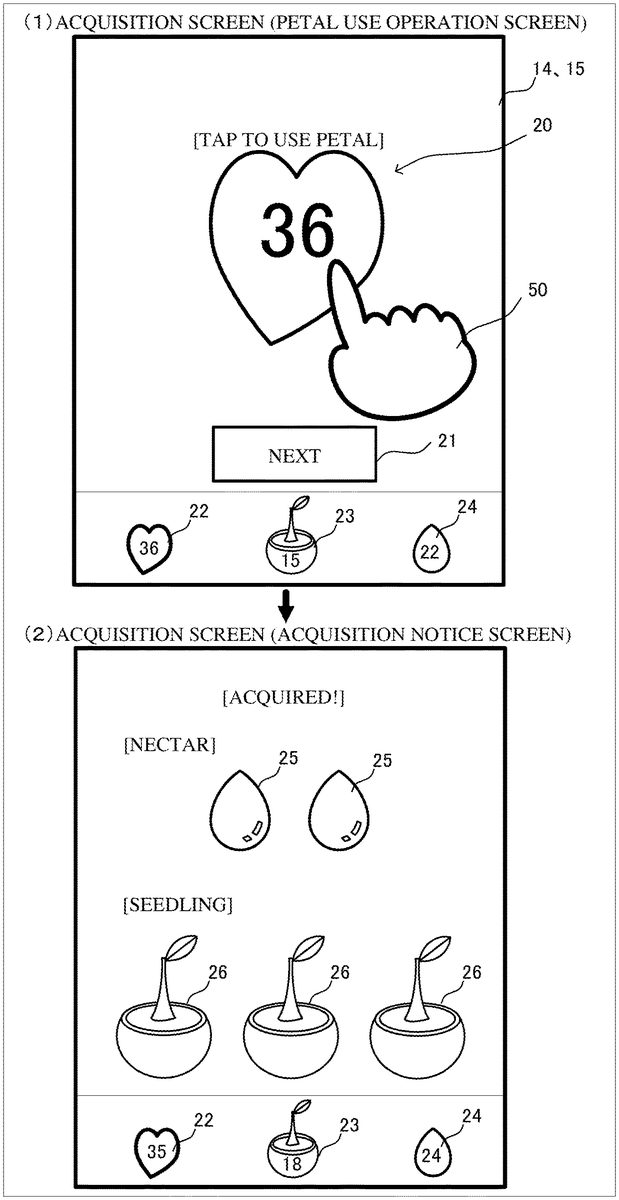
FIG.2shows an example of a menu screen displayed when this game is started. As shown inFIG.2, on the menu screen, a menu image17is displayed. The menu image17includes an acquisition menu image17a, a planter menu image17b, and a character menu image17cas operation menus. When the user touches the acquisition menu image17a, the screen shifts to an acquisition screen where the user can acquire a seedling or nectar as described later with reference toFIG.3. When the user touches the planter menu image17b, the screen shifts to a planter screen where the user can plant a seedling in a planter and grow the seedling into a character as described later with reference toFIG.4, etc. When the user touches the character menu image17c, the screen shifts to a character screen where the user can grow the character and obtain (pick) a petal from the character as described later with reference toFIG.8, etc. As shown inFIG.2, at the lower part of the menu screen, a petal count image22indicating the number of possessed petals, a seedling count image23indicating the number of possessed seedlings, and a nectar count image24indicating the number of possessed nectars, are displayed.
FIG.3shows an example of the acquisition screen. When the menu screen has shifted to the acquisition screen in accordance with a user's operation, as shown inFIG.3(1), first, a petal use operation screen is displayed. On the petal use operation screen, a petal use image20including a petal image representing a comparatively large petal is displayed. In addition, a word image21on which a word “NEXT” is written, is displayed. In addition, as in the menu screen described inFIG.2, at the lower part of the acquisition screen, the petal count image22, the seedling count image23, and the nectar count image24are displayed. On the petal use image20, the number of possessed petals are displayed as in the petal count image22.
As shown inFIG.3(1), when the user taps the petal use image20, in accordance with the number of times of the tap operation, the number of petals to be used is set and the displayed number of possessed petals is decremented. A hand50represents the user's hand operating the information processing apparatus10. For example, inFIG.3, when a tap operation is performed once, one (one petal) is set as the number of petals to be used, and the numbers of possessed petals displayed on the petal use image20and the petal count image22are decremented to 35. Then, when the word image21is tapped, the screen shifts to an acquisition notice screen shown inFIG.3(2).
As shown inFIG.3(2), on the acquisition notice screen, nectar images25and seedling images26are displayed, which are acquired by such a lottery that, the more the number of steps the user has walked with the information processing apparatus10carried is, the higher the winning probability is. In addition, in this lottery, the winning probability for a seedling increases as the number of used petals set by the user increases. In another exemplary embodiment, this lottery may be set such that the winning probabilities for both of a seedling and nectar increase as the number of used petals set by the user increases. In the example shown inFIG.3(2), the user is notified that, as a result of the lottery in accordance with the number of steps of the user, two nectars are acquired with two nectar images25displayed, and three seedlings are acquired with three seedling images26displayed. In addition, along with this, the number on the nectar count image24is incremented by 2 to be 24, and the number on the seedling count image23is incremented by 3 to be 18.
FIG.4shows an example of the planter screen. When the menu screen has shifted to the planter screen in accordance with a user's operation, as shown inFIG.4, the planter screen is displayed. On the planter screen, a planter image30(which may be simply referred to as “planter”) for growing seedlings, and a step tank image35(which may be simply referred to as “step tank”) in which steps the user has walked with the information processing apparatus10carried are accumulated, are displayed. As shown inFIG.4, in the planter image30, there are three seedling plantable parts (31a,31b,31c) which have been present originally (initially) and where seedlings can be planted, and three extensible parts (32a,32b,32c) which can be added as parts where seedlings can be planted. The user can increase the number of seedling plantable parts to six at maximum by performing an operation (which may be referred to as “planter extending operation”) of using in-game coins (in-game currency, which may be simply referred to as “coins”; not shown). The user can acquire coins in accordance with the elapsed period since this game was initially started, payment, or the like. In addition, as in the menu screen described inFIG.2, at the lower part of the planter screen, the petal count image22, the seedling count image23, and the nectar count image24are displayed.
The user can plant a possessed seedling in the planter image30. As shown inFIG.4, when the user taps the seedling count image23, in accordance with the number of times of the tap operation, seedlings are planted in the seedling plantable parts31of the planter image30, and the number of the planted seedlings are indicated in parentheses in the seedling count image23. In the example shown inFIG.4, in a state in which the seedling image34ahas been already planted in the seedling plantable part31aof the planter image30, the user performs operation (which may be referred to as “seedling planting operation”) of tapping the seedling count image23once, whereby the seedling image34b(which may be simply referred to as “seedling”) is planted in the seedling plantable part31band the number in the parentheses in the seedling count image23is incremented from 1 to 2. InFIG.4, the number of seedling plantable parts is three, and it is impossible to plant more than three seedlings.
As shown inFIG.4, at each seedling plantable part (31a,31b,31c), a seedling accumulated step count image (33a,33b,33c) is displayed. The seedling accumulated step count image (33a,33b,33c) indicates the number of steps having been accumulated for the corresponding seedling (the number of steps the user has walked with the information processing apparatus10carried) since the time when the seedling was planted, and the number of steps needed until the seedling grows to be a character. Thus, the seedling accumulated step count image33can also be said to be an image indicating the growth degree of the seedling. In the example shown inFIG.4, in the seedling accumulated step count image33a,500 is indicated as the number of steps having been accumulated for the seedling since the time when the seedling was planted, and 3000 is indicated as the number of steps needed until the seedling grows to be a character. In addition, in the seedling accumulated step count image33b,0 is indicated as the number of steps having been accumulated for the seedling since the time when the seedling was planted, and 1000 is indicated as the number of steps needed until the seedling grows to be a character. Thus, the number of steps needed until the seedling grows to be a character may differ depending on the seedling. In the seedling plantable part31c, no seedling is planted and therefore such numbers are not indicated in the seedling accumulated step count image33c.
As shown inFIG.4, the step tank image35is displayed in which steps the user has walked with the information processing apparatus10carried are accumulated. The step tank image35is composed of up to five unit step tank images (35a, etc., which may be simply referred to as “unit step tank”). In the unit step tank image, steps taken by the user can be accumulated by up to 1000. In addition, the user can perform operation (which may be referred to as “step tank increasing operation”) of increasing the number of unit step tank images to five at maximum by using coins. In the example shown inFIG.4, the step tank image35is composed of four unit step tank images (35a,35b,35c,35d). A number 1000 which indicates that 1000 steps are accumulated is indicated in the unit step tank images35aand35b, a number 283 which indicates that 283 steps are accumulated is indicated in the unit step tank image35c, and a number 0 which indicates that no steps are accumulated is indicated in the unit step tank image35d. Thus, it is indicated that 2283 steps are accumulated in total.
FIG.5shows an example of the planter screen. Hereinafter, with reference toFIG.5, a case where the user walks with the information processing apparatus10carried and steps are accumulated in the seedling accumulated step count images33and the step tank image35will be described. When the user walks with the information processing apparatus10carried, steps are accumulated in each seedling accumulated step count image33and the step tank image35simultaneously. In the example shown inFIG.5, the user has walked 700 steps with the information processing apparatus10carried from the state inFIG.4, so that 700 steps are accumulated in each of the seedling accumulated step count image33a, the seedling accumulated step count image33b, and the step tank image35. That is, in accordance with the number of steps the user has walked, each seedling grows and steps are accumulated in the step tank. In each seedling accumulated step count image33, steps exceeding the number of steps (e.g., 1000 in the seedling accumulated step count image33b) needed until the seedling grows to be a character, are not accumulated.
FIG.6shows an example of the planter screen. Hereinafter, with reference toFIG.6, a case where steps accumulated in the step tank image35are given to the seedling image34to grow the seedling, will be described. As shown inFIG.6, the user performs tap operation (which may be referred to as “step tank use operation”) on the unit step tank image (35a, etc.) in which 1000 steps are accumulated, in the step tank image35, whereby images40for giving the steps accumulated in the unit step tank image to the respective seedling images34are displayed and this unit step tank image is deleted, so that 1000 steps are accumulated in the respective seedling accumulated step count images33corresponding to the seedling images34. Here, an upper limit accumulated step count for each unit step tank image is 1000, and only the unit step tank image that has reached the upper limit accumulated step count 1000 can be used to give steps to the seedling images34in accordance with tap operation, only on a 1000-step basis. In the example shown inFIG.6, by the user performing tap operation on the unit step tank image35athat has reached the upper limit accumulated step count 1000, the unit step tank image35ais deleted (consumed), and as a result, 1000 steps are accumulated in the seedling accumulated step count image33aof the seedling image34aso that the number of the accumulated steps has increased from 1200 steps (seeFIG.5) to 2200 steps, and 1000 steps are accumulated in the seedling accumulated step count image33bof the seedling image34bso that the number of the accumulated steps has increased from 700 steps (seeFIG.5) to 1000 steps. Here, as previously described, in each seedling accumulated step count image33, steps exceeding the number of steps (upper limit step count) needed until the seedling grows to be a character are not accumulated. Therefore, in the seedling accumulated step count image33b, steps are accumulated to 1000 steps corresponding to the upper limit. In addition, as shown inFIG.6, the seedling image34bcorresponding to the seedling accumulated step count image33bin which 1000 steps corresponding to the upper limit are accumulated is changed into a double-leaf state showing that the seedling has fully grown (growth of the seedling is finished).
FIG.7shows an example of the planter screen. Hereinafter, with reference toFIG.7, a case where the seedling image34the growth of which is finished is plucked to be a character image will be described. As shown inFIG.7, the user performs swipe operation (operation of touching and sliding, which may be referred to as “plucking operation”) upward on the seedling image34the growth of which is finished, and accordingly, a scene in which the seedling image34is plucked is displayed, and the number of possessed seedlings indicated on the seedling count image23and the number written in parentheses and indicating the number of seedlings planted in the planter30, are decremented by 1. In addition, the numbers on the seedling accumulated step count image33corresponding to the plucked seedling image34are deleted. In the example shown inFIG.7, in accordance with the user's swipe operation, the seedling image34bthe growth of which is finished is plucked, the numbers indicated on the seedling count image23are decremented from 18(2) to 17(1), and the numbers on the seedling accumulated step count image33bare deleted. The plucked seedling image34is changed to a character image40adescribed later. In addition, inFIG.7, since the unit step tank image35ais used inFIG.6, the unit step tank image35ais deleted and the other unit step tanks are shifted downward. The seedling image34the growth of which has not been finished cannot be plucked (prohibited from being plucked).
FIG.8shows an example of the character screen. Hereinafter, with reference toFIG.8, the details of the character screen will be described. On the character screen, character images40(which may be simply referred to as “character” or “char) acquired by plucking the seedling image34the growth of which is finished (seeFIG.7), are displayed. As shown inFIG.8, the character images40include a character image40ain a double-leaf state, a character image40bin a bud state, a character image40cin a glowing flower state in which a glowing flower is bloomed, a character image40din a flower state in which a flower not glowing is bloomed, and a character image40ein a leafless state of having no leaves. In the example shown inFIG.8, character images (40a-1,40a-2) in a double-leaf state, character images (40b-1,40b-2,40b-3) in a bud state, character images (40c-1,40c-2) in a glowing flower state, a character image (40d-1) in a flower state, and a character image (40e-1) in a leafless state, are displayed. As shown inFIG.8, the character image (40a-1) in a double-leaf state, which is newly displayed by plucking the seedling image34the growth of which is finished, is displayed in a glowing manner so that this fact is understandable. In addition, as in the menu screen described inFIG.2, at the lower part of the character screen, the petal count image22, the seedling count image23, and the nectar count image24are displayed.
FIG.9shows an example of the character screen. Hereinafter, with reference toFIG.9, a case where possessed nectar is fed to a character displayed on the character screen will be described. Here, nectar can be fed to the character image40ain a double-leaf state, the character image40bin a bud state, and the character image40din a flower state, whereas nectar cannot be fed to the character image40cin a glowing flower state and the character image40ein a leafless state. In addition, as described later, when nectar is fed, the character image40ain a double-leaf state is immediately changed to the character image40bin a bud state, the character image40bin a bud state is immediately changed to the character image40cin a glowing flower state, and the character image40din a flower state is immediately changed to the character image40cin a glowing flower state.
As shown inFIG.9, when swipe operation (which may be referred to as “nectar feeding operation”) is performed from the nectar count image24toward the character image40that can be changed (a character that can be fed with nectar), an image of nectar moves toward the character image40, the number of possessed nectars on the nectar count image24is decremented, and the state of this character image40is changed. In the example shown inFIG.9, nectar feeding operation is performed to feed nectar to the character image40b-2in a bud state, so that the number of possessed nectars on the nectar count image24is decremented from 24 to 23, and the character image40b-2in a bud state is changed to a glowing flower state (not shown).
FIG.10shows an example of the character screen. Hereinafter, with reference toFIG.10, a case where a petal is obtained (picked) from the character image40cin a glowing flower state will be described. Here, a petal can be picked from the character image40cin a glowing flower state, but cannot be picked from the character image40din a flower state (and the character images in the other states). As shown inFIG.10, when the user performs tap operation (which may be referred to as “petal obtaining operation”) on the character image40cin a glowing flower state, an image of a petal moves toward the petal count image22, the number of possessed petals on the petal count image22is incremented, and the character image40cin the glowing flower state changes to a flower state (40d) or a leafless state (40e). In the example shown inFIG.10, petal obtaining operation is performed on the character image40c-2in a glowing flower state, so that the number of possessed petals on the petal count image22is incremented from 35 to 36, and the character image40c-2in a glowing flower state is changed to a flower state (not shown).
FIG.11schematically illustrates state change of the character40displayed on the character screen described inFIG.8, etc. Hereinafter, with reference toFIG.11, state change of the character40will be described.
When nectar is fed to the character image40ain a double-leaf state (seeFIG.9), the character image40aimmediately changes (grows) to the character image40bin a bud state. Besides, when eight hours have elapsed since the time when the character state came into a double-leaf state, the character image40ain a double-leaf state changes to the character image40bin a bud state. Here, the period (eight hours) needed for this change is shortened by 20 minutes per 100-count increase in the number of steps taken from the time when the character state came into a double-leaf state (the number of steps the user has walked with the information processing apparatus10carried). For example, in a case where the number of steps taken from the time when the character state came into a double-leaf state is 633, the period (eight hours) required for the above change is shortened by two hours, to be six hours.
When nectar is fed to the character image40bin a bud state (seeFIG.9), the character image40bimmediately changes (grows) to the character image40cin a glowing flower state. Besides, when eight hours have elapsed since the character state came into a bud state, the character image40bin a bud state changes to the character image40cin a glowing flower state. Here, the period (eight hours) needed for this change is shortened by 20 minutes per 100-count increase in the number of steps taken from the time when the character state came into a bud state (the number of steps the user has walked with the information processing apparatus10carried). For example, in a case where the number of steps taken from when the character state came into a bud state is 685, the period (eight hours) needed for the above change is shortened by two hours, to be six hours.
From the character image40cin a glowing flower state, the user can obtain (pick) a petal by petal obtaining operation (seeFIG.10). The character image40cin a glowing flower state after the user has obtained the petal changes to the character image40din a flower state in which the user cannot obtain a petal. If nectar feeding operation is performed on the character image40din a flower state (seeFIG.9), the character image40dreturns to the character image40cin a glowing flower state so that the user can obtain a petal. Besides, when two hours have elapsed since the time when the character image changed to the character image40din a flower state, the character image40dreturns to the character image40cin a glowing flower state so that the user can obtain a petal. After the bud state has changed to the glowing flower state, the user is allowed to perform petal obtaining operation four times. However, in a case where two hours have elapsed since the time when the character image changed to the character image40din a flower state and thus the character image40dreturns to the character image40cin a glowing flower state as described above, the number of times the petal obtaining operation has been performed is reset so that the user can perform petal obtaining operation four times again. In addition, in a case where the user performs petal obtaining operation for the first time since the bud state changed to the glowing flower state, the user obtains two petals, and after that, when the user performs petal obtaining operation three times (or four times if the number of times for petal obtaining operation is reset with elapse of two hours), the user obtains one petal for each time. Then, after petal obtaining operation has been performed four times, the character image40cin a glowing flower state changes to the character image40ein a leafless state.
Meanwhile, the character image40cthat has changed to a glowing flower state from a double-leaf state without being fed with nectar comes into a fever state with a predetermined probability (e.g., 10%). For the character image40cin a glowing flower state that has come into a fever state, the fever state is canceled after such a loop that the character state changes to a flower state by the user obtaining petals and then returns to a glowing flower state in three seconds is repeated three times.
In a time period from 4:00 to 24:00, when six hours have elapsed since the time when the character state came into a leafless state, the character image40ein a leafless state returns to the character image40ain a double-leaf state. On the other hand, in a time period from 0:00 (24:00) to 4:00, even if six hours have elapsed since the time when the character state came into a leafless state, the character image40ein a leafless state does not return to the character image40ain a double-leaf state. Here, the above period (six hours) to elapse is shortened by 20 minutes per 100-count increase in the number of steps that have been taken in the time period from 4:00 to 24:00 and that have been taken since the time when the character state came into a leafless state (the number of steps the user has walked with the information processing apparatus10carried). For example, in a case where the character state has come into a leafless state at 19:00 and then the user has walked 600 steps during a time period from 21:00 to 22:00, the period to elapse is shortened by two hours and thus the character state returns to the character image40ain a double-leaf state at23:00. In addition, the character image40bin a bud state, the character image40cin a glowing flower state, the character image40din a flower state, and the character image40ein a leafless state return to the character image40ain a double-leaf state at 4:00. In addition, for the character image40ain a double-leaf state, the elapsed period since the character state came into a double-leaf state is reset at 4:00.
[Details of Information Processing in Exemplary Embodiment]
Next, with reference toFIG.12toFIG.16, the information processing in the exemplary embodiment will be described in detail.
[Used Data]
Various data used in this game process will be described.FIG.12shows an example of a program and data stored in the memory12of the information processing apparatus10. The memory12stores a game program100, operation data101, character data102, time data121, petal count data122, seedling count data123, nectar count data124, planter data125, step tank data126, second taken step count data127, third taken step count data128, and the like.
The game program100is a game program for executing the game process according to the exemplary embodiment.
The operation data101is data indicating operation performed on the information processing apparatus10, which is input operation to a touch panel, for example.
The character data102is data regarding characters40and seedlings which will become characters40, as described with reference toFIG.3toFIG.11. The character data102includes first to nth (n is a natural number) character data (103-1to103-n). That is, the character data103is generated for each character40(or each seedling that will become the character40) in this game. Hereinafter, the first character data103-1will be described. For the second to nth character data103-2to103-n, the same kinds of data as the first character data103-1are stored.
The first character data103-1includes character state data104, seedling data105, last-time character condition data106, first taken step count data107, nectar growth data108, petal obtaining count data109, and fever data110.
The character state data104is data indicating the state of the character. Specifically, the character state data104is data indicating the state of the character40(double-leaf state, bud state, glowing flower state, flower state, or leafless state; seeFIG.11), and indicating the state of a seedling that will become the character40(including information about whether or not the seedling is planted in the planter30; seeFIG.4). In the exemplary embodiment, also a character in a seedling state may be referred to as “character”.
The seedling data105is data indicating the upper limit number of steps (number of steps with which growth of the seedling is finished) that can be accumulated for the seedling (character in a seedling state), and indicating the number of steps accumulated for the seedling. The upper limit number of steps that can be accumulated may differ among seedlings, and for example, fixed numbers of steps such as 1000 and 3000 are set (seeFIG.4).
The last-time character condition data106is data indicating the state of the character at the time when the character screen was displayed last time (i.e., the time at which the state of the character was determined when the character screen was displayed last time) (this state may be referred to as “character state at last-time display”), and if this state can change to the next state with elapse of a period, indicating a scheduled remaining period until change to the next state (which may be referred to as “next-change scheduled remaining period). That is, the last-time character condition data106indicates the condition of the character at the time when the character screen was displayed last time (which may be referred to as “character condition at last-time display”).
The first taken step count data107is data indicating the number of steps the user has walked (or run) with the information processing apparatus10carried. Specifically, the first taken step count data107is data indicating the number of steps (number of steps calculated on the basis of a detection result from the detection section16) taken from the time when the character screen was displayed last time (i.e., the time at which the state of the character was determined when the character screen was displayed last time), and the number of steps taken as described above (which may be referred to as “number of taken steps”) is accompanied with information about time (period) when the steps are taken. That is, the first taken step count data107indicates a time history of the number of taken steps. For example, in a case where 150 steps are taken during one minute (unit period) from 13:00 to 13:01 on Jan. 1, 2021, the number of taken steps, i.e., 150 steps, is associated with the period when the steps are taken (from 13:00 to 13:01 on Jan. 1, 2021). In the exemplary embodiment, the period when the steps are taken is described using one minute as a unit period, but in another exemplary embodiment, the unit period may be one second, for example.
The nectar growth data108is information indicating whether or not the character40has ever changed by being fed with nectar in a process of changing from a double-leaf state to a glowing flower state (seeFIG.11).
The petal obtaining count data109is information indicating the number of times a petal has been obtained from the character40cin a glowing flower state (this can be also said to be the number of times of petal obtaining operation, and may be referred to as “petal obtaining count”) (seeFIG.11).
The fever data110is data regarding the fever state described with reference toFIG.11. Specifically, the fever data110includes data (e.g., flag data) indicating whether or not the character40is in a fever state, data indicating how many times the character40has returned to a glowing flower state (in three seconds) after coming into a fever state, and data indicating the upper limit number of times, i.e., three times, for returning to a glowing flower state (in three seconds) in a fever state.
Thus, description of the character data102has been finished.
The time data121is information indicating the present time (present date and time).
The petal count data122is data indicating the number of possessed petals. On the basis of the petal count data122, the number of possessed petals is displayed on the petal count image22(seeFIG.3, etc.).
The seedling count data123is data indicating the number of possessed seedlings. On the basis of the seedling count data123, the number of possessed seedlings is displayed on the seedling count image23(seeFIG.3, etc.).
The nectar count data124is data indicating the number of possessed nectars. On the basis of the nectar count data124, the number of possessed nectars is displayed on the nectar count image24(seeFIG.3, etc.).
The planter data125is data regarding a planter described inFIG.4, etc. Specifically, the planter data125includes data indicating the number (initially, three) of seedling plantable parts where seedlings can be planted in the planter30, data indicating the number (three at maximum) of extensible parts that can be added as parts where seedlings can be planted, and data indicating the number of seedlings planted in the seedling plantable parts.
The step tank data126is data regarding a step tank (step tank image35) described inFIG.5,FIG.6, etc. Specifically, the step tank data126includes data indicating the number (five at maximum) of unit step tanks (unit step tank image35a, etc.) composing the step tank, and data indicating the number of steps accumulated in each unit step tank (which may be referred to as “number of accumulated steps”; the upper limit number thereof is 1000).
The second taken step count data127is data indicating the number of steps the user has walked (or run) with the information processing apparatus10carried. Specifically, the second taken step count data127is data indicating the number of steps (number of steps calculated on the basis of a detection result from the detection section16) taken from the time when the acquisition notice screen shown inFIG.3(2) was displayed last time.
The third taken step count data128is data indicating the number of steps the user has walked (or run) with the information processing apparatus10carried. Specifically, the third taken step count data123is data indicating the number of steps (number of steps calculated on the basis of a detection result from the detection section16) taken from the time when the planter screen shown inFIG.4, etc. was displayed last time.
Here, in the information processing apparatus10, a step counting application is installed, besides the application of this game. During a period in which the information processing apparatus10is operating, the step counting application works to always count the number of steps taken by the user walking (or running) on the basis of information from the detection section16, and store the number of steps in the memory in association with the time period in which the counted steps have been taken. That is, the step counting application is generating time history data (not shown) of the number of taken steps during the operating period of the information processing apparatus10. Then, in this game process, using the time history data of the number of taken steps as appropriate, the first taken step count data107, the second taken step count data127, and the third taken step count data128are generated (updated).
[Details of Game Process]
Next, with reference to flowcharts, the details of the game process according to the exemplary embodiment will be described.FIG.13toFIG.16are examples of flowcharts showing the details of the game process according to the exemplary embodiment.
[Process for Menu Screen]
First, when operation of starting the application of this game is performed, a process shown inFIG.13is started.
In step S101inFIG.13, the processor11receives saved data from a game server (not shown) by, for example, wireless communication via the Internet, and loads the saved data to the respective data stored in the memory12. Then, the process proceeds to step S102.
In step S102, the processor11displays the menu screen on the display section15(seeFIG.2). Then, the process proceeds to step S103.
In step S103, the processor11determines whether or not operation of selecting the acquisition menu has been performed. Specifically, the processor11determines whether or not the acquisition menu image17ais touched on the menu screen, on the basis of the operation data (seeFIG.12). In the case of YES in this determination, the process proceeds to step S104, and in the case of NO in this determination, the process proceeds to step S105.
In step S104, the processor11performs an acquisition menu process for acquiring a seedling or nectar described inFIG.3. The acquisition menu process will be described later with reference toFIG.14. Then, the process proceeds to step S105.
In step S105, the processor11determines whether or not operation of selecting the planter menu has been performed. Specifically, the processor11determines whether or not the planter menu image17bis touched on the menu screen, on the basis of the operation data. In the case of YES in this determination, the process proceeds to step S106, and in the case of NO in this determination, the process proceeds to step S107.
In step S106, the processor11performs a planter menu process for growing a seedling in the planter30described inFIG.4toFIG.7. The planter menu process will be described later with reference toFIG.15. Then, the process proceeds to step S107.
In step S107, the processor11determines whether or not operation of selecting the character menu has been performed. Specifically, the processor11determines whether or not the character menu image17cis touched on the menu screen, on the basis of the operation data. In the case of YES in this determination, the process proceeds to step S108, and in the case of NO in this determination, the process proceeds to step S109.
In step S108, the processor11performs a character menu process for growing the character40and obtaining a petal as described inFIG.8toFIG.11. The character menu process will be described later with reference toFIG.16. Then, the process proceeds to step S109.
In step S109, the processor11determines whether or not predetermined application ending operation has been performed. Specifically, the processor11determines whether or not the application ending operation has been performed on the basis of the operation data. In the case of YES in this determination, the process proceeds to step S110, and in the case of NO in this determination, the process returns to step S102to continue to display the menu screen.
In step S110, the processor11saves data regarding this game, and then ends the game process. Specifically, the processor11saves data stored in the memory12, into the game server, by, for example, wireless communication via the Internet, and then ends the application of this game.
[Acquisition Menu Process]
FIG.14is an example of a flowchart showing the details of the acquisition menu process in step S104inFIG.13.
In step S201inFIG.14, the processor11displays the petal use operation screen described inFIG.3(1), on the display section15. Then, the process proceeds to step S202.
In step S202, the processor11determines whether or not petal use operation has been performed on the basis of the operation data101(seeFIG.12). Specifically, the processor11determines whether or not the petal use image20is tapped as described inFIG.3(1). In the case of YES in this determination, the process proceeds to step S203, and in the case of NO in this determination, the process proceeds to step S204.
In step S203, the processor11sets the number of used petals corresponding to the number of times the user has performed petal use operation, on the basis of the operation data101, and performs display of decrementing the number of petals. Specifically, as described inFIG.3(1), in accordance with the number of times the petal use image20has been tapped, the processor11decrements the number of possessed petals indicated by the petal count data122, and decrements the numbers of possessed petals displayed on the petal use image20and the petal count image22. Then, the process proceeds to step S204.
In step S204, on the basis of the operation data101, the processor11waits (NO) until operation of ending display of the petal use operation screen (tap operation on the word image21written as “NEXT” described inFIG.3(1)) is performed, and if the display ending operation is performed (YES), the process proceeds to step S205.
In step S205, the processor11ends display of the petal use operation screen. Then, the process proceeds to step S206.
In step S206, the processor11performs a lottery in accordance with the number of taken steps and the number of used petals, to determine the number of seedlings to be acquired. Specifically, the processor11performs such a lottery that, the more the number of taken steps indicated by the second taken step count data127(the number of steps taken from the time when the acquisition notice screen shown inFIG.3(2) was displayed last time) is, the more likely the number of acquired seedlings increases, and the more the number of used petals set in step S203is, the more likely the number of acquired seedlings increases, thereby determining the number of seedlings to be acquired. The processor11adds the determined number of seedlings to the seedling count data123. Then, the process proceeds to step S207.
In step S207, the processor11performs a lottery in accordance with the number of taken steps, to determine the number of nectars to be acquired. Specifically, the processor11performs such a lottery that, the more the number of taken steps indicated by the second taken step count data127(the number of steps taken from the time when the acquisition notice screen shown inFIG.3(2) was displayed last time) is, the more likely the number of acquired nectars increases, thereby determining the number of nectars to be acquired. The processor11adds the determined number of nectars to the nectar count data124. Then, the process proceeds to step S208.
In step S208, the processor11displays, on the display section15, the acquisition notice screen for notifying the user about the numbers of seedlings and nectars acquired in step S206and S207as described inFIG.3(2). Along with this, the processor11updates indication of the number of possessed seedlings on the seedling count image23and indication of the number of nectars on the nectar count image24, on the basis of the seedling count data123and the nectar count data124. Then, the process proceeds to step S209.
In step S209, the processor11waits (NO) until menu ending operation is performed, and if menu ending operation is performed (YES), ends the acquisition menu process and shifts the process to step S105inFIG.13. It is noted that the menu ending operation is operation of tapping a part where words “END MENU” (not shown) are displayed on the acquisition notice screen shown inFIG.3(2), for example.
[Planter Menu Process]
FIG.15is an example of a flowchart showing the details of the planter menu process in step S106inFIG.13.
In step S301inFIG.15, the processor11displays the planter screen described inFIG.4toFIG.7, on the display section15. Specifically, the processor11adds the number of taken steps indicated by the third taken step count data128(seeFIG.12) (number of steps taken from the time when the planter screen was displayed last time), to the number of accumulated steps in the seedling data105for each seedling planted in the planter30(without exceeding the number of steps that can be accumulated), and also adds the same number of steps to the numbers of accumulated steps on the seedling accumulated step count images (33a, etc.) for the respective seedlings as described inFIG.5. In addition, the processor11adds the number of taken steps indicated by the third taken step count data128, to the number of accumulated steps in the step tank data126(without exceeding the number of steps that can be accumulated in accordance with the number of unit step tanks), and also adds the same number of steps to the number of accumulated steps in the step tank (step tank image35) as described inFIG.5. Then, the process proceeds to step S302.
In step S302, the processor11determines whether or not seedling planting operation has been performed, on the basis of the operation data101. Specifically, the processor11determines whether or not seedling planting operation of tapping the seedling count image23has been performed as described inFIG.4. In the case of YES in this determination, the process proceeds to step S303, and in the case of NO in this determination, the process proceeds to step S304.
In step S303, the processor11performs display of planting a seedling in the planter30. Specifically, as described inFIG.4, the processor11decrements the number of the seedling plantable parts31and increments the number of seedlings planted in the seedling plantable parts, which are indicated by the planter data125, and performs display of planting a seedling in the seedling plantable part31of the planter30. In addition, the processor11increments the number of seedlings planted in the planter30, displayed on the seedling count image23. Then, the process proceeds to step S304.
In step S304, the processor11determines whether or not planter extending operation described inFIG.4has been performed, on the basis of the operation data101. In the case of YES in this determination, the process proceeds to step S305, and in the case of NO in this determination, the process proceeds to step S306.
In step S305, the processor11performs display of increasing the seedling plantable parts31of the planter30. Specifically, as described inFIG.4, the processor11increases the number of seedling plantable parts31indicated by the planter data125(without exceeding the extendable number), and performs display of increasing the seedling plantable parts31of the planter30. In addition, the processor11updates the planter data125accordingly. Then, the process proceeds to step S306.
In step S306, the processor11determines whether or not step tank use operation has been performed for the unit step tank that has reached the upper limit accumulated step count 1000 as described inFIG.6, on the basis of the operation data101. In the case of YES in this determination, the process proceeds to step S307, and in the case of NO in this determination, the process proceeds to step S308.
In step S307, the processor11performs display of giving steps to each seedling from the step tank. Specifically, as described inFIG.6, the processor11decrements the number of accumulated steps indicated by the step tank data126, by1000, and decrements the number of unit step tanks by 1, and also deletes the display of the unit step tank for which the step tank use operation has been performed. In addition, as described inFIG.6, the processor11performs display of images40and increments, by1000, the number of accumulated steps displayed on the seedling accumulated step count image33corresponding to each seedling planted in the planter30(without exceeding the number of steps that can be accumulated). Then, the process proceeds to step S308.
In step S308, the processor11determines whether or not unit step tank increasing operation described inFIG.4has been performed, on the basis of the operation data101. It is noted that the unit step tank increasing operation cannot be performed if the number of unit step tanks has reached the upper limit number 5. In the case of YES in this determination, the process proceeds to step S309, and in the case of NO in this determination, the process proceeds to step S310.
In step S309, the processor11performs display of incrementing the number of unit step tanks. Specifically, as described inFIG.4, the processor11increments the number of unit step tanks indicated by the step tank data126, and performs display of adding a unit step tank on which 0 is indicated as the number of accumulated steps. Then, the process proceeds to step S310.
In step S310, the processor11determines whether or not plucking operation for a seedling the growth of which is finished has been performed as described inFIG.7, on the basis of the operation data101. In the case of YES in this determination, the process proceeds to step S311, and in the case of NO in this determination, the process proceeds to step S312.
In step S311, the processor11performs display of plucking the grown seedling. Specifically, the processor11changes the state indicated by the character state data104corresponding to the seedling to be plucked, from the state of the seedling planted in the planter30to a double-leaf state, and resets the number of accumulated steps, etc. indicated by the seedling data105to0. Also, the processor11decrements the number of possessed seedlings indicated by the seedling count data123by 1, increments the number of seedling plantable parts31indicated by the planter data125by 1, and decrements the number of seedlings planted in the seedling plantable parts31by 1. In addition, as described inFIG.7, the processor11performs display of plucking the grown seedling, and decrements the number of possessed seedlings, etc. displayed on the seedling count image23. Then, the process proceeds to step S312.
In step S312, the processor11determines whether or not menu ending operation has been performed. In the case of YES in this determination, the planter menu process is ended and the process proceeds to step S107inFIG.13, and in the case of NO in this determination, the process returns to step S301, to continue displaying the planter screen. It is noted that the menu ending operation is operation of tapping a part where words “END MENU” (not shown) are displayed on the planter screen shown inFIG.4, etc., for example.
[Character Menu Process]
FIG.16is an example of a flowchart showing the details of the character menu process in step S108inFIG.13.
In step S401inFIG.16, the processor11displays, on the display section15, a character screen on which the characters40in states based on the elapsed periods, the number of taken steps, etc., are displayed as described inFIG.8toFIG.11. Specifically, the processor11calculates the state of each character40on the basis of the condition of the character displayed last time, indicated by the last-time character condition data106, and the time history of the number of taken steps indicated by the first taken step count data107(seeFIG.12), and performs display of the respective characters40in the calculated states. In addition, in a case where the present time is past 4:00 at which the character40should be reset to a double-leaf state, the processor11calculates the state of each character40, considering the elapsed period since 4:00, and performs display of each character40in the calculated state. In addition, the processor11prohibits the character40ein a leafless state from changing to a double-leaf state during a time period from 0:00 to 4:00, and considering this, calculates the states of the characters40and performs display of the respective characters40in the calculated states. Then, in accordance with the changed states, the processor11updates the character state data104. The character screen is displayed as described above, whereby the characters40are displayed in states changed in accordance with the elapsed period, the number of taken steps, etc., as described inFIG.11. Then, the process proceeds to step S402.
In step S402, the processor11determines whether or not nectar feeding operation described inFIG.9has been performed, on the basis of the operation data101. Here, as described inFIG.9, nectar feeding operation can be performed for only a specific character40. In the case of YES in this determination, the process proceeds to step S403, and in the case of NO in this determination, the process proceeds to step S404.
In step S403, the processor11performs display of feeding nectar to the character40and changing the state thereof. Specifically, as described inFIG.9, the processor11decrements the number of possessed nectars indicated by the nectar count data124, and performs display of changing the state of the character40fed with nectar. In addition, the processor11updates the nectar growth data108and decrements the number of nectars displayed on the nectar count image24. Then, in accordance with the changed state, the processor11updates the character state data104. Then, the process proceeds to step S404.
In step S404, the processor11determines whether or not there is a character40that has changed to a glowing flower state without being fed with nectar, on the basis of the nectar growth data108for each character40. In the case of YES in this determination, the process proceeds to step S405, and in the case of NO in this determination, the process proceeds to step S406.
In step S405, for the character40that has changed to a glowing flower state without being fed with nectar, the processor11performs a lottery having a predetermined winning probability (e.g., 10%). In a case of winning in the lottery, the processor11sets a fever state as described inFIG.11. In this case, on the basis of the fever data110, for the character40cin the glowing flower state set in the fever state, the processor11performs processing of repeating, up to three times, such a loop that a petal is obtained and the character state changes to a flower state and returns to a glowing flower state in three seconds after that. Then, the process proceeds to step S406.
In step S406, for the character40cin the glowing flower state, the processor11determines whether or not petal obtaining operation described inFIG.10has been performed, on the basis of the operation data101. In the case of YES in this determination, the process proceeds to step S407, and in the case of NO in this determination, the process proceeds to step S408.
In step S407, the processor11changes the state of the character40cin a glowing flower state for which petal obtaining operation has been performed, and increments the number of possessed petals. Specifically, the processor11increments the petal obtaining count (the number of times of petal obtaining operation) indicated by the petal obtaining count data109, by 1. Then, if the incremented petal obtaining count is 1 to 3, the processor11performs display of changing the character40cin a glowing flower state to a flower state, and if the incremented petal obtaining count is 4, the processor11performs display of changing the character40cin a glowing flower state to a leafless state. Here, on the basis of the petal obtaining count data109, in a case of obtaining a petal for the first time after the character40has come into a glowing flower state, the processor11increments the number of possessed petals indicated by the petal count data122, by 2, and increments the number of possessed petals displayed on the petal count image22, by 2. In a case of obtaining a petal for the second or subsequent time after the character40has come into a glowing flower state, the processor11increments the number of possessed petals indicated by the petal count data122, by 1, and increments the number of possessed petals displayed on the petal count image35, by 1. Then, in accordance with the changed state, the processor11updates the character state data104. Then, the process proceeds to step S408.
In step S408, the processor11determines whether or not there is a character40dfor which two hours have elapsed since the character has changed to a flower state, on the basis of the time data121. In the case of YES in this determination, the process proceeds to step S409, and in the case of NO in this determination, the process proceeds to step S410.
In step S409, the processor11changes the character40din a flower state determined in step S408, to a glowing flower state. In addition, the processor11resets the petal obtaining count indicated by the petal obtaining count data109, to0. Then, in accordance with the changed state, the processor11updates the character state data104. Then, the process proceeds to step S410.
In step S410, the processor11determines whether or not menu ending operation has been performed. In the case of YES in this determination, the character menu process is ended and the process proceeds to step S109inFIG.13, and in the case of NO in this determination, the process returns to step S401, to continue displaying the character screen. It is noted that the menu ending operation is operation of tapping a part where words “END MENU” (not shown) are displayed on the character screen shown inFIG.8, etc., for example.
It is noted that seedlings, characters, etc., displayed on the display screens described with reference toFIG.2toFIG.11, etc., may be referred to as “in-game objects”. In addition, a seedling planted in the planter30may be referred to as “active object”. In addition, a petal that can be obtained in this game may be referred to as “in-game reward”. In addition, the number of steps taken through the user walking (or running) and the numbers of steps accumulated for seedlings and the step tank may be referred to as “parameters” regarding the exercise amount. In addition, nectar may be referred to as “state change item”.
As described above, in the exemplary embodiment, the user takes steps through walking (or running), thereby raising the probability of acquiring seedlings, accumulates steps for seedlings and the step tank, grows the seedlings, and increasingly acquires the characters40, thus enjoying the game. In addition, by taking steps through walking (or running), the user changes (grows) the character40to increase the number of petals to be obtained, and uses the petals to raise the probability of acquiring seedlings, and as a result, the number of acquired characters40is further increased and thus the user can enjoy the game. With such features, the exemplary embodiment can provide the user with a motivation to walk (or run), i.e., exercise.
In the exemplary embodiment, by taking steps, it is possible to acquire seedlings and nectars, grow the seedlings, and change (grow) the characters40simultaneously (in parallel). Thus, the exemplary embodiment can provide the user with a motivation to exercise.
In the exemplary embodiment, even after the character40has grown into a glowing flower state in which a petal can be obtained, the character40returns to a leafless state or a double-leaf state if a petal is obtained a predetermined number of times or a specific time (4:00) has arrived (seeFIG.11). Thus, the exemplary embodiment enables the user to keep motivated to continue exercise.
In the exemplary embodiment, steps are accumulated for both of seedlings planted in the planter30and the step tank, and even if the number of accumulated steps for the planted seedling has reached the upper limit and thus steps are not accumulated for that seedling any longer, steps are accumulated in the step tank from which the steps can be given to seedlings. Thus, in the exemplary embodiment, even if the number of accumulated steps for the planted seedling has reached the upper limit, the user can keep motivated to continue exercise.
[Modifications]
The above exemplary embodiment has shown the example in which the character40can change from a double-leaf state to a bud state in accordance with the elapsed period or taken steps (seeFIG.11). However, control may be performed such that the character40can change from a double-leaf state to a bud state only by being fed with nectar.
The above exemplary embodiment has shown the example in which the character40can change from a bud state to a glowing flower state in accordance with the elapsed period or taken steps (seeFIG.11). However, control may be performed such that the character40can change from a bud state to a glowing flower state only by being fed with nectar.
The above exemplary embodiment has shown the example in which the character40can change from a flower state to a glowing flower state in accordance with the elapsed period (seeFIG.11). However, control may be performed such that the character40can change from a flower state to a glowing flower state only by being fed with nectar.
The above exemplary embodiment has shown the example in which the character40immediately changes from a double-leaf state to a bud state by being fed with nectar and immediately changes from a bud state to a glowing flower state by being fed with nectar (seeFIG.11). However, control may be performed such that the character40immediately changes from a double-leaf state to a glowing flower state by being fed with special nectar (special nectar different from normal nectar described inFIG.3(2),FIG.9,FIG.11, etc.). That is, control may be performed so as to provide special nectar that allows the character40in a double-leaf state to change to a glowing flower state without experiencing a bud state. In the case of performing such control, if the special nectar is fed to the character40in a bud state, the character40may immediately change from a bud state to a glowing flower state (as in the case of feeding normal nectar). For the special nectar, a display manner such as color may be set to be different from that for normal nectar, and for example, control may be performed such that the special nectar is acquired through a lottery as in the case of normal nectar (see S207inFIG.14) and then is displayed on the acquisition screen described inFIG.3(2), etc.
The above exemplary embodiment has shown the example in which the character40that has changed from a double-leaf state to a glowing flower state without being fed with nectar is set to a fever state with a predetermined probability (see S404, S405inFIG.16). However, for example, control may be performed such that the character40that has grown by being fed with special nectar (special nectar different from normal nectar described inFIG.3(2),FIG.9,FIG.11, etc.) at least once in a process of changing from a double-leaf state to a glowing flower state is necessarily set to a fever state when changing to a glowing flower state, irrespective of whether or not normal nectar has been fed. That is, control may be performed so as to provide special nectar with which the character40necessarily comes into a fever state when changing to a glowing flower state. Alternatively, for example, control may be performed such that the character40that has grown by being fed with special nectar at least once in a process of changing from a double-leaf state to a glowing flower state is necessarily set to a fever state when changing to a glowing flower state, on the condition that normal nectar has not been fed. For the special nectar, a display manner such as color may be set to be different from that for normal nectar, and for example, control may be performed such that the special nectar is acquired through a lottery as in the case of normal nectar (see S207inFIG.14) and then is displayed on the acquisition screen described inFIG.3(2), etc.
The above exemplary embodiment has shown the example in which the number of kinds of a flower to bloom on the character40in a glowing flower state (or flower state) is one (seeFIG.10andFIG.11). However, for example, control may be performed such that a special kind of flower blooms on the character40that has grown by being fed with special nectar (special nectar different from normal nectar described inFIG.3(2),FIG.9,FIG.11, etc.) at least once in a process of changing from a double-leaf state to a glowing flower state. That is, control may be performed so as to provide special nectar that allows a special kind of flower to bloom. For the special nectar, a display manner such as color may be set to be different from that for normal nectar, and for example, control may be performed such that the special nectar is acquired through a lottery as in the case of normal nectar (see S207inFIG.14) and then is displayed on the acquisition screen described inFIG.3(2), etc.
The above exemplary embodiment has shown the example in which the character40changes from a double-leaf state to a bud state when a fixed period (eight hours) has elapsed (in a case where there are no steps taken) (seeFIG.11). However, control may be performed such that the character40can change from a double-leaf state to a bud state when a period (e.g., random period) determined in a predetermined range (e.g., range of 8 to 16 hours) in accordance with a lottery or the like has elapsed (in a case where there are no steps taken).
The above exemplary embodiment has shown the example in which the character40changes from a bud state to a glowing flower state when a fixed period (eight hours) has elapsed (in a case where there are no steps taken) (seeFIG.11). However, control may be performed such that the character40can change from a bud state to a glowing flower state when a period (e.g., random period) determined in a predetermined range (e.g., range of 8 to 16 hours) in accordance with a lottery or the like has elapsed (in a case where there are no steps taken).
The above exemplary embodiment has shown the example in which the character40changes from a flower state to a glowing flower state when a fixed period (two hours) has elapsed (seeFIG.11). However, control may be performed such that the character40can change from a flower state to a glowing flower state when a period (e.g., random period) determined in a predetermined range (e.g., range of 1 to 3 hours) in accordance with a lottery or the like has elapsed.
The above exemplary embodiment has shown the example in which the character40changes from a leafless state to a double-leaf state when a fixed period (six hours) has elapsed (in a case other than a time period in which the character state cannot change and where there are no steps taken) (seeFIG.11). However, control may be performed such that the character40can change from a leafless state to a double-leaf state with a required number of (taken) steps (e.g., a random number of steps) determined in a predetermined range (e.g., range of 500 to 1000 steps) in accordance with a lottery or the like (in a case other than a time period in which the character state cannot change and where there are no steps taken).
In the above exemplary embodiment (seeFIG.11), control may be performed such that, in a case where the character40is grown by being fed with nectar and comes into a glowing flower state, the number of times a petal can be obtained after the character40has come into a glowing flower state becomes smaller (e.g., by two) than in a case where the character40is grown without being fed with nectar and comes into a glowing flower state.
In the above exemplary embodiment (seeFIG.11), control may be performed such that, in some cases, the character40returns to a seedling state (seeFIG.3(2)). In this case, control may be performed such that the probability for the character40to return to a seedling state increases as the number of times the character40has come into a leafless state by a petal being obtained (picked) therefrom increases. For example, control may be performed such that the probability for the character40to return to a seedling state increases by 10% per one-count increase in the number of times the character40has come into a leafless state. In this case, control may be performed such that, if the number of times the character40has come into a leafless state by a petal being obtained therefrom has reached a predetermined number of times (e.g., five times), the character40returns to a seedling state (at a next timing of coming into a leafless state, for example). Further, control may be performed such that the seedling (character in a seedling state) to which the character40has returned can be returned to the character40ain a double-leaf state, using steps (e.g., 100 steps) taken through walking or the like of the user or using the steps (e.g., 100 steps) accumulated in the step tank. In addition, control may be performed such that the seedling (character in a seedling state) to which the character40has returned returns to the character40ain a double-leaf state (automatically without user's operation or in accordance with user's operation) on the basis of a specific time having arrived (e.g.,4:00). Alternatively, control may be performed such that the character40does not change to a double-leaf state (is prohibited from changing to a double-leaf state) even in a case of a specific time (e.g.,4:00) having arrived.
The above exemplary embodiment has shown the example in which steps taken by the user walking (or running) are accumulated for both of seedlings and the step tank simultaneously (in parallel), and steps can be accumulated in the step tank even after the seedling has reached the upper limit number of accumulated steps (e.g., 1000 steps). However, for example, control may be performed such that, firstly, steps taken by the user walking (or running) are preferentially accumulated for seedlings, and only after all the seedlings planted in the planter have reached the upper limit number of accumulated steps (e.g., 1000 steps or 3000 steps; seeFIG.5), steps can be accumulated in the step tank.
The above exemplary embodiment has shown the example in which the accumulated steps in the step tank35are used on a 1000-step basis (seeFIG.6). However, for example, control may be performed such that steps are given to the seedling by an amount corresponding to a period during which the user is touching the step tank35(unit step tank35a, etc.). For example, 100 steps may be given to the seedling when the user has touched for one second.
The above exemplary embodiment has shown the example in which a petal can be obtained by performing petal obtaining operation on the character40(seeFIG.10,FIGS.11, S406and S407inFIG.16). However, for example, a parameter indicating a friendship level may be set for each character40, and control may be performed such that, by performing petal obtaining operation on the character40, a petal can be obtained and the parameter indicating the friendship level of the character40is increased. That is, control may be performed such that, as petals are more obtained, the friendship level of the character40from which the petals have been obtained increases, so that the user can become friendly with the character40.
The above exemplary embodiment has shown the example in which, for the character image40cin a glowing flower state that has come into a fever state, the fever state is canceled after three-time repetition of such a loop that a petal is obtained and the character state changes to a flower state and returns to a glowing flower state in three seconds after that (seeFIG.11). However, for example, control may be performed such that, for the character image40cin a glowing flower state that has come into a fever state, the fever state is canceled after petals are obtained in accordance with the number of times the user has performed tap operation during a predetermined period (e.g., five seconds) from the first tap operation by the user. For example, in response to the user first tapping the character image40cin a glowing flower state that has come into a fever state, two petals (or, for example, one petal) are obtained and also a period of five seconds during which petals can be obtained is started. Then, petals are obtained one by one in accordance with the number of times of tap operation performed during the five seconds, and thus the fever state is canceled. Alternatively, for example, in response to the user first tapping the character image40cin a glowing flower state that has come into a fever state, a period of five seconds during which petals can be obtained is started (i.e., no petals are obtained with this first tap operation). Then, petals are obtained one by one in accordance with the number of times of tap operation performed during the five seconds, and thus the fever state is canceled.
The above exemplary embodiment has shown the example in which change of the character40is hastened (the period until change is shortened) by steps taken by the user (seeFIG.11). However, control may be performed such that change of the character40is hastened through exercise without using steps. In this case, the detection section16is a device for measuring an exercise amount of the user, and is, for example, a device for measuring the number of heartbeats (number of pulses), the number of breaths, the respiratory volume, etc. per unit period, of the user. In addition, for example, control may be performed such that the period (six hours) needed for change from a leafless state to a double-leaf state is shortened using steps, and the period (eight hours) needed for change from a double-leaf state to a bud state, or the like, is shortened using the number of heartbeats, etc., as described above.
The above exemplary embodiment has shown the example in which, while the planter screen is displayed or the character screen is displayed, calculation is performed for reflecting the number of taken steps, the elapsed period, and the like in the states of objects (seedlings, step tank, characters), and the resultant screen is displayed (see S301inFIG.15, S401inFIG.16, etc.). However, for example, control may be performed such that, even when the application of this game is not being activated, a part of the application function of this game is exerted to constantly (in real time) calculate the states of objects (seedlings, step tank, characters) on the basis of the number of taken steps, the elapsed period, and the like, and then, when the planter screen is displayed or the character screen is displayed, the objects are displayed in the calculated states.
The above exemplary embodiment has shown the example in which a series of processing steps in the game process is executed by a single apparatus. However, the above series of processing steps may be executed by an information processing system including a plurality of information processing apparatuses. For example, in an information processing system including a terminal-side apparatus and a server-side apparatus capable of communicating with the terminal-side apparatus via a network, a part of the above series of processing steps may be executed by the server-side apparatus. Further, in an information processing system including a terminal-side apparatus and a server-side apparatus capable of communicating with the terminal-side apparatus via a network, major processing of the above series of processing steps may be executed by the server-side apparatus, and a part of the above series of processing steps may be executed by the terminal-side apparatus. In addition, in the above information processing system, a server-side system may be composed of a plurality of information processing apparatuses and processing to be executed on the server side may be executed by the plurality of information processing apparatuses in a shared manner.
While the exemplary embodiments have been described herein, it is to be understood that the above description is, in all aspects, merely an illustrative example, and is not intended to limit the scope thereof. It is to be understood that various modifications and variations can be made without deviating from the scope of the exemplary embodiments.
Claims
- A non-transitory computer-readable storage medium having stored therein instructions that, when executed by a processor of an information processing apparatus, cause the information processing apparatus to perform operations comprising: in a game being played in connection with the information processing apparatus, changing a visual appearance of an in-game object so as to reflect a change from a first lifecycle state to a second lifecycle state, once a first time period has elapsed;assigning an in-game reward to a user when the in-game object is in the second lifecycle state;determining whether the assignment of the in-game reward to the user satisfies one of a first condition and a second condition;changing the visual appearance of the in-game object so as to reflect a change from the second lifecycle state to a third lifecycle state in response to a determination that the assignment of the in-game reward to the user satisfies the first condition;changing the visual appearance of the in-game object so as to reflect a change from the second lifecycle state to a fourth lifecycle state in response to a determination that the assignment of the in-game reward to the user satisfies the second condition;changing the visual appearance of the in-game object so as to reflect a change from the third lifecycle state to the first lifecycle state, once a second time period has elapsed;changing the visual appearance of the in-game object so as to reflect a change from the fourth lifecycle state to the second lifecycle state in response to the user using a state change item in the game;tracking an amount of real-world exercise performed by the user, via a sensor of the information processing apparatus;and shortening a remaining amount of the first time period and/or second time period in accordance with a parameter calculated based on the tracked amount of real-world exercise performed by the user, wherein the first, second, third, and fourth lifecycle states are indicative of different respective lifecycle levels of the in-game object, the first lifecycle level being more advanced than the third lifecycle level but less advanced than the second lifecycle level, the fourth lifecycle level being more advanced than the first lifecycle level but less advanced than the second lifecycle level, and wherein an effect in which the in-game object can have in the game is variable based on the lifecycle level of the in-game object and is perceivable based on the visual appearance of the in-game object.
- The non-transitory computer-readable storage medium according to claim 1, wherein the remaining amount of the first time period is shortened based on the parameter.
- The non-transitory computer-readable storage medium according to claim 1, wherein the remaining amount of the second time period is shortened in accordance with an elapse of time only during a specific time period.
- The non-transitory computer-readable storage medium according to claim 1, wherein further operations comprise enabling the user to shorten the remaining amount of the first time period based on the user using the state change item.
- The non-transitory computer-readable storage medium according to claim 4, wherein in a case where the in-game object is changed from the first lifecycle state to the second lifecycle state based on the user using the state change item, the in-game reward is reduced as compared to a case where the in-game object is changed from the first lifecycle state to the second lifecycle state without the user using the state change item.
- The non-transitory computer-readable storage medium according to claim 1, wherein based on the parameter, the visual appearance of the in-game object is changed so as to reflect a change from the fourth lifecycle state to the first lifecycle state.
- The non-transitory computer-readable storage medium according to claim 6, wherein the in-game object is changed from the fourth lifecycle state to the first lifecycle state based on a specific time having arrived.
- The non-transitory computer-readable storage medium according to claim 7, wherein the in-game object is not changed from the third lifecycle state to the first lifecycle state even if the specific time has arrived.
- The non-transitory computer-readable storage medium according to claim 7, wherein the in-game object is changed from the second lifecycle state to the first lifecycle state based on the specific time having arrived.
- The non-transitory computer-readable storage medium according to claim 6, wherein a probability that the second condition is satisfied changes in accordance with a number of times the first condition has been satisfied, or the second condition is satisfied when a number of times the first condition has been satisfied has reached a predetermined number of times.
- The non-transitory computer-readable storage medium according to claim 1, wherein the in-game object is changeable from the second lifecycle state to a fifth lifecycle state based on the in-game reward having been given to the user when the in-game object is in the second lifecycle state.
- The non-transitory computer-readable storage medium according to claim 11, wherein the in-game object is changed from the fifth lifecycle state to the second lifecycle state based on the user using the state change item.
- The non-transitory computer-readable storage medium according to claim 11, wherein the in-game object is changed from the fifth lifecycle state to the second lifecycle state based on an elapse of a third time period.
- The non-transitory computer-readable storage medium according to claim 1, wherein the exercise is walking and the parameter is based on a number of steps.
- The non-transitory computer-readable storage medium according to claim 1, wherein the in-game object is changeable from the first lifecycle state to the second lifecycle state via an intermediate lifecycle state.
- The non-transitory computer-readable storage medium according to claim 15, wherein the in-game object is changeable from the first lifecycle state to the second lifecycle state via the intermediate lifecycle state based on the user using the state change object.
- The non-transitory computer-readable storage medium according to claim 15, wherein the in-game object is changeable from the first lifecycle state to the second lifecycle state via the intermediate lifecycle state based on the user using the state change object twice, once before transitioning to the intermediate state from the first lifecycle state and once after transitioning to the intermediate state.
- A game processing system, comprising: a processor and a memory coupled thereto, the processor being configured to control the game processing system to at least: in a game being played in connection with the information processing apparatus, change a visual appearance of an in-game object so as to reflect a change from a first lifecycle state to a second lifecycle state, once a first time period has elapsed;assign an in-game reward to a user when the in-game object is in the second lifecycle state;determine whether the assignment of the in-game reward to the user satisfies one of a first condition and a second condition;change the visual appearance of the in-game object so as to reflect a change from the second lifecycle state to a third lifecycle state in response to a determination that the assignment of the in-game reward to the user satisfies the first condition;change the visual appearance of the in-game object so as to reflect a change from the second lifecycle state to a fourth lifecycle state in response to a determination that the assignment of the in-game reward to the user satisfies the second condition;change the visual appearance of the in-game object so as to reflect a change from the third lifecycle state to the first lifecycle state, once a second time period has elapsed;change the visual appearance of the in-game object so as to reflect a change from the fourth lifecycle state to the second lifecycle state in response to the user using a state change item in the game;track an amount of real-world exercise performed by the user, via a sensor of the information processing apparatus;and shorten a remaining amount of the first time period and/or second time period in accordance with a parameter calculated based on the tracked amount of real-world exercise performed by the user, wherein the first, second, third, and fourth lifecycle states are indicative of different respective lifecycle levels of the in-game object, the first lifecycle level being more advanced than the third lifecycle level but less advanced than the second lifecycle level, the fourth lifecycle level being more advanced than the first lifecycle level but less advanced than the second lifecycle level, and wherein an effect in which the in-game object can have in the game is variable based on the lifecycle level of the in-game object and is perceivable based on the visual appearance of the in-game object.
- A game processing method performed using a game processing system comprising a processor, the game processing method comprising: in a game being played in connection with the information processing apparatus, changing a visual appearance of an in-game object so as to reflect a change from a first lifecycle state to a second lifecycle state, once a first time period has elapsed;assigning an in-game reward to a user when the in-game object is in the second lifecycle state;determining whether the assignment of the in-game reward to the user satisfies one of a first condition and a second condition;changing the visual appearance of the in-game object so as to reflect a change from the second lifecycle state to a third lifecycle state in response to a determination that the assignment of the in-game reward to the user satisfies the first condition;changing the visual appearance of the in-game object so as to reflect a change from the second lifecycle state to a fourth lifecycle state in response to a determination that the assignment of the in-game reward to the user satisfies the second condition;changing the visual appearance of the in-game object so as to reflect a change from the third lifecycle state to the first lifecycle state, once a second time period has elapsed;changing the visual appearance of the in-game object so as to reflect a change from the fourth lifecycle state to the second lifecycle state in response to the user using a state change item in the game;tracking an amount of real-world exercise performed by the user, via a sensor of the information processing apparatus;and shortening a remaining amount of the first time period and/or second time period in accordance with a parameter calculated based on the tracked amount of real-world exercise performed by the user, wherein the first, second, third, and fourth lifecycle states are indicative of different respective lifecycle levels of the in-game object, the first lifecycle level being more advanced than the third lifecycle level but less advanced than the second lifecycle level, the fourth lifecycle level being more advanced than the first lifecycle level but less advanced than the second lifecycle level, and wherein an effect in which the in-game object can have in the game is variable based on the lifecycle level of the in-game object and is perceivable based on the visual appearance of the in-game object.
- A game processing apparatus, comprising: a processor and a memory coupled thereto, the processor being configured to control the game processing apparatus to at least: in a game being played in connection with the information processing apparatus, change a visual appearance of an in-game object so as to reflect a change from a first lifecycle state to a second lifecycle state, once a first time period has elapsed;assign an in-game reward to a user when the in-game object is in the second lifecycle state;determine whether the assignment of the in-game reward to the user satisfies one of a first condition and a second condition;change the visual appearance of the in-game object so as to reflect a change from the second lifecycle state to a third lifecycle state in response to a determination that the assignment of the in-game reward to the user satisfies the first condition;change the visual appearance of the in-game object so as to reflect a change from the second lifecycle state to a fourth lifecycle state in response to a determination that the assignment of the in-game reward to the user satisfies the second condition;change the visual appearance of the in-game object so as to reflect a change from the third lifecycle state to the first lifecycle state, once a second time period has elapsed;change the visual appearance of the in-game object so as to reflect a change from the fourth lifecycle state to the second lifecycle state in response to the user using a state change item in the game;track an amount of real-world exercise performed by the user, via a sensor of the information processing apparatus;and shorten a remaining amount of the first time period and/or second time period in accordance with a parameter calculated based on the tracked amount of real-world exercise performed by the user, wherein the first, second, third, and fourth lifecycle states are indicative of different respective lifecycle levels of the in-game object, the first lifecycle level being more advanced than the third lifecycle level but less advanced than the second lifecycle level, the fourth lifecycle level being more advanced than the first lifecycle level but less advanced than the second lifecycle level, and wherein an effect in which the in-game object can have in the game is variable based on the lifecycle level of the in-game object and is perceivable based on the visual appearance of the in-game object.
Disclaimer: Data collected from the USPTO and may be malformed, incomplete, and/or otherwise inaccurate.