U.S. Pat. No. 12,327,112
COMPLIANCE ADAPTION PLANS AND SOFTWARE COMPONENT MATCHMAKING
AssigneeInternational Business Machines Corp
Issue DateNovember 23, 2021
Illustrative Figure
Abstract
Aspects of the invention include correlating a context of a written data privacy requirement with a first code segment of a source code of a target computer system. A selection of a first candidate code segment is received to replace the first code segment. The selected first candidate code segment is determined to have replaced the first code segment and is integrated into the source code. A stimulation signal is transmitted to the target computer system, wherein the stimulation signal is directed toward the first candidate code segment integrated into the source code.
Description
The diagrams depicted herein are illustrative. There can be many variations to the diagram or the operations described therein without departing from the spirit of the invention. For instance, the actions can be performed in a differing order or actions can be added, deleted or modified. Also, the term “coupled” and variations thereof describes having a communications path between two elements and does not imply a direct connection between the elements with no intervening elements/connections between them. All of these variations are considered a part of the specification. DETAILED DESCRIPTION One or more embodiments of the present invention provide computer-implemented methods, computer systems, and computer program products that use a dependency graph to match the language of a written data privacy requirement with code segments that effectuate the requirement. This enables system administrators to identify non-compliant code and update a target computer system to comply with the written data privacy requirement. Furthermore, a geographic monitoring of the target computer system enables a system administrator to determine whether the target computer system is updated based on geographic requirements of the written data privacy requirement. System administrators receive written data privacy requirements to implement and are tasked with updating their computer systems to comply with the requirements. These requirements can be in the form of an email from an executive, a company-wide memo, or a legal regulation (e.g., Europe's General Data Protection Regulations). In many instances, the written directive is not drafted by anyone with computer science expertise, or include any technical instructions. As a result, the system administrators adopt their own methodology for implementation of the required computer system updates. It is difficult for system administrators to discern an intended meaning of the directives as they are not written by a person who understands what updated a computer system entails. It ...
The diagrams depicted herein are illustrative. There can be many variations to the diagram or the operations described therein without departing from the spirit of the invention. For instance, the actions can be performed in a differing order or actions can be added, deleted or modified. Also, the term “coupled” and variations thereof describes having a communications path between two elements and does not imply a direct connection between the elements with no intervening elements/connections between them. All of these variations are considered a part of the specification.
DETAILED DESCRIPTION
One or more embodiments of the present invention provide computer-implemented methods, computer systems, and computer program products that use a dependency graph to match the language of a written data privacy requirement with code segments that effectuate the requirement. This enables system administrators to identify non-compliant code and update a target computer system to comply with the written data privacy requirement. Furthermore, a geographic monitoring of the target computer system enables a system administrator to determine whether the target computer system is updated based on geographic requirements of the written data privacy requirement.
System administrators receive written data privacy requirements to implement and are tasked with updating their computer systems to comply with the requirements. These requirements can be in the form of an email from an executive, a company-wide memo, or a legal regulation (e.g., Europe's General Data Protection Regulations). In many instances, the written directive is not drafted by anyone with computer science expertise, or include any technical instructions. As a result, the system administrators adopt their own methodology for implementation of the required computer system updates. It is difficult for system administrators to discern an intended meaning of the directives as they are not written by a person who understands what updated a computer system entails. It is further difficult for system administrators to ascertain which systems need to be updated. For example, does a company's encryption processes for a database server in West Virginia need to be updated in response to a memo on data privacy written for retail operations in Brazil?
One or more embodiments of the present invention address one or more of the above-described shortcomings by providing computer-implemented methods, computer systems, and computer program products that receive the written data privacy requirement and use natural language processing techniques to discern the meaning of the requirement. The meaning of written data privacy requirement is used to match the requirement with the source code that needs to be updated. In addition to the source code directly affected by the requirement, code that is dependent from the affected source code is also identified. A proposed amended source code that places the computer system in compliance with the written data privacy requirement is retrieved and presented to the system administrator. If the source code is accepted, the source code and the dependent code are updated to comply with the written data privacy requirement.
Referring toFIG.1, a system100for compliance adaptation and software component matchmaking is shown in accordance with one or more embodiments of the present invention. The system100includes a cross-code component analyzer102for correlating written data privacy requirement with affected computer system components. The system100further includes a code and requirement analyzer104for correlating written data privacy requirement with affected code related to the affected computer system components. The system100further includes a requirement information visualization controller106for presenting proposed updated code blocks to a software engineer. The system100further includes a geolocation unit108for determining whether the code for introducing code to comply with different requirements based on a geographic requirements of a written data privacy requirement. The system100further includes a code adaptation planner110for provisioning resources to effectuate the amendment of the code to comply with the written data privacy requirement. It should be appreciated that all or a portion of the functionality described herein can be performed on a cloud computing environment, such as the cloud computing environment50described inFIG.4; or on a computer system, such as the computer system600described inFIG.6.
The cross-code component analyzer102receives the text of a written data privacy requirement and associates the requirement with a component of a target computing system. In some embodiments of the present invention, the cross-code component analyzer102applies natural language processing (NLP) techniques to discern the meaning of the written data privacy requirement. The cross-code component analyzer102first preprocesses the text through a process of tokenization (sometimes referred to as text segmentation or lexical analysis) of the written data privacy requirement to separate the text into a list of tokens. The individual tokens can include, for example, individual words, phrases, sections, and sentences. The cross-code component analyzer102then uses the tokenized written data privacy requirement to derive a semantic meaning of the requirement. The cross-code component analyzer102applies NLP techniques, for example, a word-embedding model, to semantically analyze the written data privacy requirement. The cross-code component analyzer102maps the tokens to respective words vectors in a low-dimensional space. Various techniques can then be applied to derive a context of the written data privacy requirement. For example, the cross-code component analyzer102can take a target word for the embedding being learned and attempt to predict the surrounding context words from it. In another embodiment of the present invention, the cross-code component analyzer102analyzes the context of the words surrounding a masked target word and seeks to predict the target word based on the surrounding words. The cross-code component analyzer102is trained to semantically analyze text from the privacy domain. In an exemplary embodiment, the cross-code component analyzer102employs a trained artificial neural network, for example, a support vector machine (SVM), or other neural network appropriate for text analysis of the written data privacy requirement.
The cross-code component analyzer102applies the semantic meaning of the written data privacy requirement to determine which components of a computer system are affected by the requirement. For example, if an email from a chief operating officer states, “when we process data based on consent, our system needs be able to demonstrate that the consumer has agreed to process his or her personal data”, the cross-code component analyzer102is trained to associate the meaning with at least a user interface of the system that receives a consent, and a data storage of the system that stores the consent. In some embodiments of the present invention, the cross-code component analyzer102accesses a text description of each component of a target computer system. For example, a target computer system includes a database, a terminal, and a communication network. In this instance, each of the components includes a description for the cross-code component analyzer102to review and compare with the written data privacy requirement. In some embodiments of the present invention, the cross-code component analyzer102is trained to associate keywords in the text of the written data privacy requirement with particular target computer system components. The cross-code component analyzer102can also use a dictionary to associate words generated to describe a context of a written data privacy requirement with particular target computer system components. For example, if a memo uses the phrase “when a customer enters their information”, the cross-code component analyzer102contextually associates the phrase with a user interface. The cross-code component analyzer102then associates “user interface” with “display unit”, “peripheral devices”, and “communication protocol”.
The code and requirement relationship analyzer104receives an identity of each affected component of a target computing system and identifies target source code that is related to those components. The code and requirement analyzer104further identifies code that is dependent from the related source code. In some embodiments of the present invention, the code and requirement analyzer104, generates a directed dependency graph that describes dependencies of code segments for a target computer system. Each node of the directed dependency graph describes a code segment of the source code. Each edge of the dependency graph describes a code dependency between two connected nodes. The code and requirement analyzer104further identifies the classes, functions, and methods in the source code and associates them with the nodes in the directed dependency graph. The code and requirement analyzer104receives keywords and context of the written data privacy requirement from the cross-code component analyzer102. The code and requirement analyzer104then uses the dependency graph to associate the keywords and context with the source code. For example, if the written data privacy requirement includes the phrase “user data”, the code and requirement analyzer104can use the dependency graph to associate the phrase with the class “userData” found in source code located at a node of the directed dependency graph. By identifying the class “userData” in a segment of the source code, the code and requirement analyzer104determines that the code segment is affected by the requirement. The code and requirement analyzer104further uses the dependency graph to determine whether the code segment is dependent from another code segment, or is another code segment dependent from it.
The requirement information visualization controller106receives the identified segments of code affected by the written data privacy requirement. The requirement information visualization controller106accesses a code database and retrieves updated code to replace the affected code. The database is comprised of code that has been updated to comply with the written data privacy requirement. In some embodiments of the present invention, the requirement information visualization controller106compares the affected code with candidate code to retrieve code that is functionally compliant with the written data privacy requirement. This is different than retrieving functionally similar code, as the functionally similar code would have the same non-compliance issues as the affected code. For example, if the affected code relates to a database management system, the requirement information visualization controller106first retrieves candidate code segments for a database management system. The requirement information visualization controller106then analyzes the candidate code segments for code that matches the context of the written data privacy requirement.
For example, a new company privacy initiative requires that browsing history data must be deleted after thirty days. The cross-code component analyzer102uses the determined context of the written data privacy requirement to determine that the requirements affect server storage located in South America. The requirement information visualization controller106analyzes the current source code regulating the server storage and determines that the current source code does not require that the browser histories be deleted after thirty days. The requirement information visualization controller106retrieves candidate code segments relating to database management from a code database. The requirement information visualization controller106then analyzes the candidate code segments to find code that matches the context of the written data privacy requirement, for example, source code and dependent code that deletes a browser history from stored memory. Candidate code segments that do not include functional code for deleting a browser history from stored memory are eliminated as candidate code segments.
The system100further includes a geolocation unit108for determining a geospatial requirements of the written data privacy requirement. For example, a multi-national company may have issued a written data privacy requirement in Africa that a certain data class can only be accessed through a multi-factor authentication. However, upon analyzing the requirement and another requirement from an Asian division of the company, the cross-code component analyzer102determines that the requirement is necessary in Africa, but not in Asia. Therefore, the geolocation unit108introduces a conditional code to the set of candidate code segments. The introduced conditional code sets a condition for when the execution of a selected candidate code segment. The introduced conditional code segment includes, for example, an if/else statement, and permits a target computer system to bypass a written data privacy requirement based on geographics. For example, assume the above-referenced multi-national company has its data storage servers in Africa. The target computer system receives a first request for information from Africa. The conditional code causes the target computer system to request the IP address of the requestor. Based on the IP request, the target computer system determines that the requestor is in Africa and causes the data server to receive an acknowledgement of a multi-factor authorization prior to releasing the data. The target computer system also receives a request for the same data, but from Europe. This time the requested IP address confirms that the requestor is in Europe. Upon execution of the conditional code, the data server does not require acknowledgement of a multi-factor authorization and transmits the requested data.
The code adaptation planner110estimates a cost for replacing each segment of affected source code. For example, the code adaptation planner110identifies the lines of the original source code affected by the written data privacy requirement. The code adaptation planner110then determines a number of lines of candidate code needed to replace the affected source code. The code adaptation planner110then estimates a cost for replacing the affected source code with the candidate code. For example, the code adaptation planner110uses a k-nearest neighbor (K-NN) to find a number of candidate code segments based on keywords in the candidate code segments that match the context of a written data privacy requirement. The code adaptation planner110then retrieves a cost for updating a system with each candidate code segment. The code adaptation planner110retrieves a candidate code segment previously used to update another database management system. The code adaptation planner110retrieves a time taken to update the other database management system. Based on the time taken to update the other database management system, the code adaptation planner110estimates a time required to update the current database management system software.
The code adaptation planner110further presents the candidate code segments, including dependent code segments, and costs to a system administrator. The system administrator can select a candidate code segment, including dependent code segments, from the candidate code segments. The code adaptation planner110receives a selection and then prepares the computer system for the software update. For example, the code adaptation planner110provisions computing resources, such as processors and memory, to prepare for the code replacement. The code adaptation planner110copies and back up any data that is manipulated by the replaced code. The code adaptation planner110then generates a virtual machine(s) to execute a trial run of the affected component of the target computer system using the selected candidate code segments. The virtual machine includes copies of any applications, memory, instructions necessary to execute the updated code. Based on the results of the trial run, code adaptation planner110determines whether the selected candidate code segment places the computer system in compliance with the written data privacy requirement. The trial run is isolated from the operations of the actual target computer system via the virtual machine(s). Therefore, the code adaptation planner110is able to perform the trial run using the virtual machine(s) without affecting the functioning of the target computer system. For example, if a written data privacy requirement determines that certain personal information has to be encrypted, the code adaptation planner110creates a virtual machine and imports a portion of the data to be encrypted. The code adaptation planner110then executes the selected candidate code segment to determine if the code does cause the data to be encrypted. If the data does become encrypted, the code adaptation planner110replaces the affected code segment with the selected candidate code segment. If the data does not become encrypted, the code adaptation planner110presents the candidate code segment to the system administrator without the previously selected candidate code segment.
The code adaption planner110further determines that the selected candidate code segment is integrated with the target computer system. The code adaption planner110verifies the impact of the code replacement to the original source code in order to meet the written privacy policy requirement. In some embodiments of the present invention, the code adaption planner110relies on existing sets of unit tests to determine the replaced source code still performs the same sets of functionalities of the original target computer system (i.e., based on the input of a unit test, the expected output is returned). The code adaption planner110initiates one or more stimulation signals designed to stimulate the replacement source code. The code adaption planner110then compares output signals to expected output signals to identify if the unit test touches code that was modified to meet the written privacy policy requirement. For example, the code adaptation planner110verifies whether a data that includes personally identifiable information was encrypted pursuant to the replacement code. In other embodiments of the present invention, the code adaption planner110further identifies if the unit test touches any code dependent from the source code that was modified to meet the written privacy policy requirement. The code adaptation planner110references the directed dependency graph to determine each dependent code segment. The code adaptation planner110monitors runtime data to determine whether the dependent code was invoked by the stimulation signal. The code adaption planner110reports in the unit test output plus highlights of the code that were modified and code that by the written privacy policy requirement in the unit test report. In the instance that dependent code identified by the directed dependency graph was not touched by execution of the replacement source, the code adaption planner110also identifies these segments in the report. To accomplish this, each unit test needs to be executed with original and modified code for comparison purpose.
The code adaptation planner110engages a neural network to determines whether the output corresponds to the written data privacy requirement. The cross code component analyzer102is trained to associate the written data privacy requirement with the affected computer system components. The code adaptation planner110engages a neural network trained to predict whether the output matches the written data privacy requirement. For example, a written data privacy requirement email reads, “we must institute greater protection of our consumer data”. The system100has determined that the options for executing this requirement are data encryption and adding a new firewall. The system administrator selects a candidate code segment that adds an additional firewall to protect the data. Upon determining that the candidate code segment has been integrated into the target computer system, the code adaptation planner110transmits a stimulation signal to determine whether the candidate code segment has created an additional firewall. The code adaptation planner110collects the output signal and uses the neural network, for example a neural network executing a word embedding model, to correlate the context of the written privacy directive with the output.
The phrases “neural network” and “machine learning” broadly describe a function of electronic systems that learn from data. A machine learning system, engine, or module can include a machine learning algorithm that can be trained, such as in an external cloud environment (e.g., the cloud computing environment50), to learn functional relations between inputs and outputs that are currently unknown. In one or more embodiments, machine learning functionality can be implemented using system100, having the capability to be trained to perform a currently unknown function. In machine learning and cognitive science, neural networks are a family of statistical learning models inspired by the biological neural networks of animals, and in particular, the brain. Neural networks can be used to estimate or approximate systems and functions that depend on a large number of inputs.
The system100can be embodied as so-called “neuromorphic” systems of interconnected processor elements that act as simulated “neurons” and exchange “messages” between each other in the form of electronic signals. Similar to the so-called “plasticity” of synaptic neurotransmitter connections that carry messages between biological neurons, the connections in the system100that carry electronic messages between simulated neurons are provided with numeric weights that correspond to the strength or weakness of a given connection. During training, The weights can be adjusted and tuned based on experience, making the system100adaptive to inputs and capable of learning. After being weighted and transformed by a function determined by the network's designer, the activation of these input neurons are then passed to other downstream neurons, which are often referred to as “hidden” neurons. This process is repeated until an output neuron is activated. The activated output neuron determines which character was read.
Referring toFIG.2, a portion of a directed dependency graph200of code segments, according to one or more embodiments of the present invention, is shown. The code and requirement analyzer104identifies a first code segment of a source code. The code and requirement analyzer104then creates a first node202to describe the first code segment. The code and requirement analyzer104then identifies a second code segment that is dependent from the first code segment. The code and requirement analyzer104then creates a second node206to describe the first code segment. The code and requirement analyzer104then creates a first edge204connecting the first node202and the second node206. Each time a new dependent code is identified, a subsequent new edge and node are generated. As a code segment affected by a written data privacy requirement is identified, the code and requirement analyzer104uses the directed dependency graph200and identifies each code segment that is dependent from the affected code segment.
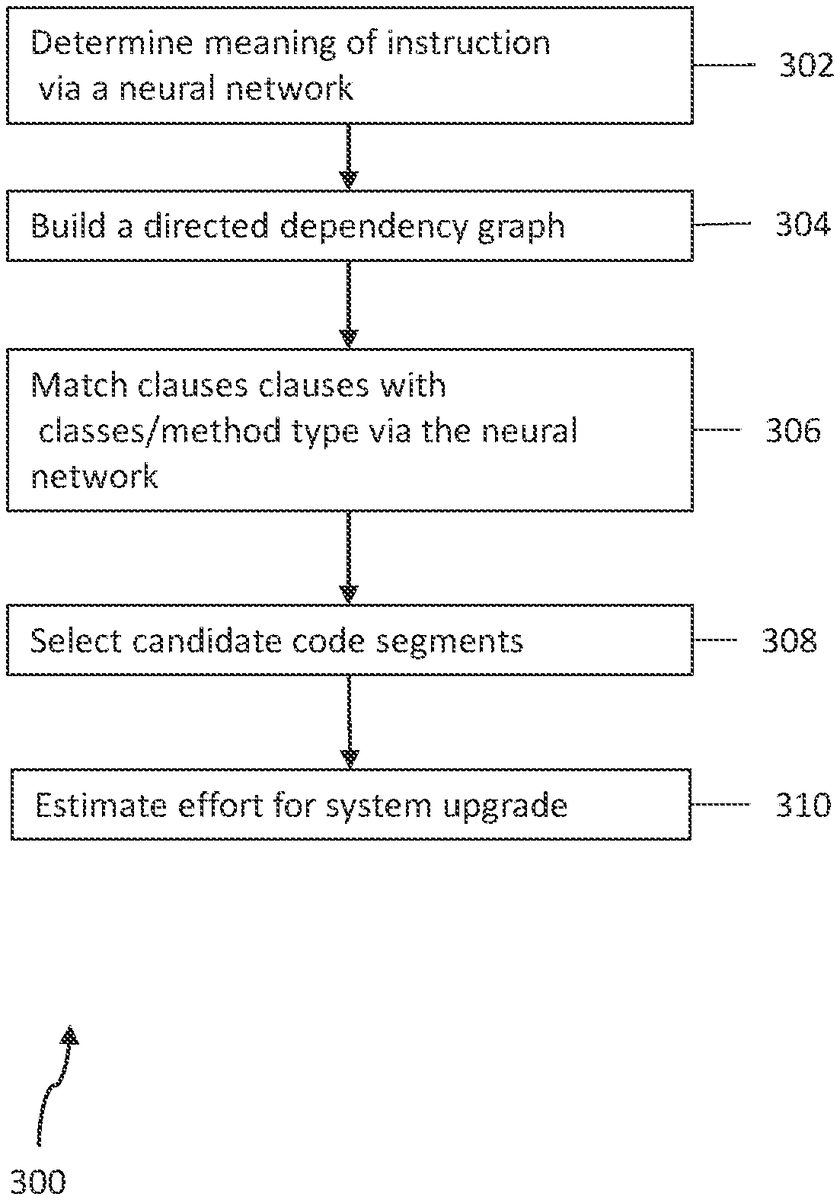
Referring toFIG.3, a process300for compliance adaptation and software component matchmaking is shown in accordance with one or more embodiments of the present invention. It should be appreciated that some or all of the steps described byFIG.3can be performed by a computer system, for example, the computer system600ofFIG.6. At block302, a cross-code component analyzer102analyzes a written data privacy requirement to determine a context of the requirement. In some embodiments of the present invention, the cross-code component analyzer102is implemented as a neural network and applies a word-embedding model to discern a meaning of the written data privacy requirement. Based on the context of the written data privacy requirement, the cross-code component analyzer102determines which components of a target computer system are affected by the requirement.
At block304, a code and requirement analyzer104retrieves a source code directed towards the affected components of the target computer system. The code and requirement analyzer104generates a directed dependency graph describing segments of an affected source code and source code that is dependent from the affected source code. Each node of the directed dependency graph describes a segment of the source code. Each edge of the directed dependency graph describes a dependency between two connected nodes. As part of the analysis, the code and requirement analyzer104further identifies the classes, functions, and methods described in the source code.
At block306, the code and requirement analyzer104matches a determined context of the written data privacy requirement with the code. In some embodiments of the present invention, the code and requirement analyzer104is implemented as a neural network and applies natural language processing techniques to correlate the context of a written data privacy requirement with the code segments. In other embodiments of the present invention, the code and requirement analyzer104accesses a dictionary, that cross-references context with code language found in the classes, functions, and methods described in the source code. With this step, the language of the source code is matched with the context of the written data privacy requirement. The code and requirement analyzer104can now identify which components of a computer system are affected by a written data privacy requirement and which segments of the source code, including dependent code are affected by the written data privacy requirement.
At block308, the requirement information visualization controller106presents candidate code segment(s) to replace the affected code segment(s). In some embodiments of the present invention, the requirement information visualization controller106accesses a database of code segments and retrieves candidate code segments related to the computer system components affected by the written data privacy requirement. The requirement information visualization controller106then accesses a dictionary that correlates the context of the written data privacy requirement with the code language of the retrieved code segments. The requirement information visualization controller106then selects codes segments that include language correlated to the written data privacy requirement context.
At block310, a code adaptation planner110estimates a respective cost for replacing affected source code with a candidate code segment. The costs can include an estimated time and resources used to replace the affected source code. To determine the cost, the code adaptation planner110can access historical data of other computer systems that have replaced similar code for written data privacy requirement compliance.
It is to be understood that although this disclosure includes a detailed description on cloud computing, implementation of the teachings recited herein are not limited to a cloud computing environment. Rather, embodiments of the present invention are capable of being implemented in conjunction with any other type of computing environment now known or later developed.
Cloud computing is a model of service delivery for enabling convenient, on-demand network access to a shared pool of configurable computing resources (e.g., networks, network bandwidth, servers, processing, memory, storage, applications, virtual machines, and services) that can be rapidly provisioned and released with minimal management effort or interaction with a provider of the service. This cloud model may include at least five characteristics, at least three service models, and at least four deployment models.
Characteristics are as follows:
On-demand self-service: a cloud consumer can unilaterally provision computing capabilities, such as server time and network storage, as needed automatically without requiring human interaction with the service's provider.
Broad network access: capabilities are available over a network and accessed through standard mechanisms that promote use by heterogeneous thin or thick client platforms (e.g., mobile phones, laptops, and PDAs).
Resource pooling: the provider's computing resources are pooled to serve multiple consumers using a multi-tenant model, with different physical and virtual resources dynamically assigned and reassigned according to demand. There is a sense of location independence in that the consumer generally has no control or knowledge over the exact location of the provided resources but may be able to specify location at a higher level of abstraction (e.g., country, state, or datacenter).
Rapid elasticity: capabilities can be rapidly and elastically provisioned, in some cases automatically, to quickly scale out and rapidly released to quickly scale in. To the consumer, the capabilities available for provisioning often appear to be unlimited and can be purchased in any quantity at any time.
Measured service: cloud systems automatically control and optimize resource use by leveraging a metering capability at some level of abstraction appropriate to the type of service (e.g., storage, processing, bandwidth, and active user accounts). Resource usage can be monitored, controlled, and reported, providing transparency for both the provider and consumer of the utilized service.
Service Models are as follows:
Software as a Service (SaaS): the capability provided to the consumer is to use the provider's applications running on a cloud infrastructure. The applications are accessible from various client devices through a thin client interface such as a web browser (e.g., web-based email). The consumer does not manage or control the underlying cloud infrastructure including network, servers, operating systems, storage, or even individual application capabilities, with the possible exception of limited user-specific application configuration settings.
Platform as a Service (PaaS): the capability provided to the consumer is to deploy onto the cloud infrastructure consumer-created or acquired applications created using programming languages and tools supported by the provider. The consumer does not manage or control the underlying cloud infrastructure including networks, servers, operating systems, or storage, but has control over the deployed applications and possibly application hosting environment configurations.
Infrastructure as a Service (IaaS): the capability provided to the consumer is to provision processing, storage, networks, and other fundamental computing resources where the consumer is able to deploy and run arbitrary software, which can include operating systems and applications. The consumer does not manage or control the underlying cloud infrastructure but has control over operating systems, storage, deployed applications, and possibly limited control of select networking components (e.g., host firewalls).
Deployment Models are as follows:
Private cloud: the cloud infrastructure is operated solely for an organization. It may be managed by the organization or a third party and may exist on-premises or off-premises.
Community cloud: the cloud infrastructure is shared by several organizations and supports a specific community that has shared concerns (e.g., mission, security requirements, policy, and compliance considerations). It may be managed by the organizations or a third party and may exist on-premises or off-premises.
Public cloud: the cloud infrastructure is made available to the general public or a large industry group and is owned by an organization selling cloud services.
Hybrid cloud: the cloud infrastructure is a composition of two or more clouds (private, community, or public) that remain unique entities but are bound together by standardized or proprietary technology that enables data and application portability (e.g., cloud bursting for load-balancing between clouds).
A cloud computing environment is service oriented with a focus on statelessness, low coupling, modularity, and semantic interoperability. At the heart of cloud computing is an infrastructure that includes a network of interconnected nodes.
Referring now toFIG.4, illustrative cloud computing environment50is depicted. As shown, cloud computing environment50includes one or more cloud computing nodes10with which local computing devices used by cloud consumers, such as, for example, personal digital assistant (PDA) or cellular telephone54A, desktop computer54B, laptop computer54C, and/or automobile computer system54N may communicate. Nodes10may communicate with one another. They may be grouped (not shown) physically or virtually, in one or more networks, such as Private, Community, Public, or Hybrid clouds as described hereinabove, or a combination thereof. This allows cloud computing environment50to offer infrastructure, platforms and/or software as services for which a cloud consumer does not need to maintain resources on a local computing device. It is understood that the types of computing devices54A-N shown inFIG.4are intended to be illustrative only and that computing nodes10and cloud computing environment50can communicate with any type of computerized device over any type of network and/or network addressable connection (e.g., using a web browser).
Referring now toFIG.5, a set of functional abstraction layers provided by cloud computing environment50(FIG.4) is shown. It should be understood in advance that the components, layers, and functions shown inFIG.5are intended to be illustrative only and embodiments of the invention are not limited thereto. As depicted, the following layers and corresponding functions are provided:
Hardware and software layer60includes hardware and software components. Examples of hardware components include: mainframes61; RISC (Reduced Instruction Set Computer) architecture based servers62; servers63; blade servers64; storage devices65; and networks and networking components66. In some embodiments, software components include network application server software67and database software68.
Virtualization layer70provides an abstraction layer from which the following examples of virtual entities may be provided: virtual servers71; virtual storage72; virtual networks73, including virtual private networks; virtual applications and operating systems74; and virtual clients75.
In one example, management layer80may provide the functions described below. Resource provisioning81provides dynamic procurement of computing resources and other resources that are utilized to perform tasks within the cloud computing environment. Metering and Pricing82provide cost tracking as resources are utilized within the cloud computing environment, and billing or invoicing for consumption of these resources. In one example, these resources may include application software licenses. Security provides identity verification for cloud consumers and tasks, as well as protection for data and other resources. User portal83provides access to the cloud computing environment for consumers and system administrators. Service level management84provides cloud computing resource allocation and management such that required service levels are met. Service Level Agreement (SLA) planning and fulfillment85provide pre-arrangement for, and procurement of, cloud computing resources for which a future requirement is anticipated in accordance with an SLA.
Workloads layer90provides examples of functionality for which the cloud computing environment may be utilized. Examples of workloads and functions which may be provided from this layer include: mapping and navigation91; software development and lifecycle management92; virtualization93; data analytics processing94; transaction processing95; and written data privacy requirement compliance adaptation and software component matchmaking96.
In one or more embodiments of the present invention, the hardware/software modules in the system100fromFIG.1can be implemented on the computer system600found inFIG.6. Turning now toFIG.6, a computer system600is generally shown in accordance with an embodiment. The computer system600can be an electronic, computer framework comprising and/or employing any number and combination of computing devices and networks utilizing various communication technologies, as described herein. The computer system600can be easily scalable, extensible, and modular, with the ability to change to different services or reconfigure some features independently of others. The computer system600may be, for example, a server, desktop computer, laptop computer, tablet computer, or smartphone. In some examples, computer system600may be a cloud computing node, such as a node10ofFIG.4. Computer system600may be described in the general context of computer system executable instructions, such as program modules, being executed by a computer system. Generally, program modules may include routines, programs, objects, components, logic, data structures, and so on that perform particular tasks or implement particular abstract data types. Computer system600may be practiced in distributed cloud computing environments where tasks are performed by remote processing devices that are linked through a communications network. In a distributed cloud computing environment, program modules may be located in both local and remote computer system storage media including memory storage devices.
As shown inFIG.6, the computer system600has one or more central processing units (CPU(s))601a,601b,601c, etc. (collectively or generically referred to as processor(s)601). The processors601can be a single-core processor, multi-core processor, computing cluster, or any number of other configurations. The processors601, also referred to as processing circuits, are coupled via a system bus602to a system memory603and various other components. The system memory603can include a read only memory (ROM)604and a random access memory (RAM)605. The ROM604is coupled to the system bus602and may include a basic input/output system (BIOS), which controls certain basic functions of the computer system600. The RAM is read-write memory coupled to the system bus602for use by the processors601. The system memory603provides temporary memory space for operations of said instructions during operation. The system memory603can include random access memory (RAM), read only memory, flash memory, or any other suitable memory systems.
The computer system600comprises an input/output (I/O) adapter606and a communications adapter607coupled to the system bus602. The I/O adapter606may be a small computer system interface (SCSI) adapter that communicates with a hard disk608and/or any other similar component. The I/O adapter606and the hard disk608are collectively referred to herein as a mass storage610.
Software611for execution on the computer system600may be stored in the mass storage610. The mass storage610is an example of a tangible storage medium readable by the processors601, where the software611is stored as instructions for execution by the processors601to cause the computer system600to operate, such as is described herein below with respect to the various Figures. Examples of computer program product and the execution of such instruction is discussed herein in more detail. The communications adapter607interconnects the system bus602with a network612, which may be an outside network, enabling the computer system600to communicate with other such systems. In one embodiment, a portion of the system memory603and the mass storage610collectively store an operating system, which may be any appropriate operating system, such as the z/OS or AIX operating system from IBM Corporation, to coordinate the functions of the various components shown inFIG.6.
Additional input/output devices are shown as connected to the system bus602via a display adapter615and an interface adapter616and. In one embodiment, the adapters606,607,615, and616may be connected to one or more I/O buses that are connected to the system bus602via an intermediate bus bridge (not shown). A display619(e.g., a screen or a display monitor) is connected to the system bus602by a display adapter615, which may include a graphics controller to improve the performance of graphics intensive applications and a video controller. A keyboard621, a mouse622, a speaker623, etc. can be interconnected to the system bus602via the interface adapter616, which may include, for example, a Super I/O chip integrating multiple device adapters into a single integrated circuit. Suitable I/O buses for connecting peripheral devices such as hard disk controllers, network adapters, and graphics adapters typically include common protocols, such as the Peripheral Component Interconnect (PCI). Thus, as configured inFIG.6, the computer system600includes processing capability in the form of the processors601, and, storage capability including the system memory603and the mass storage610, input means such as the keyboard621and the mouse622, and output capability including the speaker623and the display619.
In some embodiments, the communications adapter607can transmit data using any suitable interface or protocol, such as the internet small computer system interface, among others. The network612may be a cellular network, a radio network, a wide area network (WAN), a local area network (LAN), or the Internet, among others. An external computing device may connect to the computer system600through the network612. In some examples, an external computing device may be an external webserver or a cloud computing node.
It is to be understood that the block diagram ofFIG.6is not intended to indicate that the computer system600is to include all of the components shown inFIG.6. Rather, the computer system600can include any appropriate fewer or additional components not illustrated inFIG.6(e.g., additional memory components, embedded controllers, modules, additional network interfaces, etc.). Further, the embodiments described herein with respect to computer system600may be implemented with any appropriate logic, wherein the logic, as referred to herein, can include any suitable hardware (e.g., a processor, an embedded controller, or an application specific integrated circuit, among others), software (e.g., an application, among others), firmware, or any suitable combination of hardware, software, and firmware, in various embodiments.
Various embodiments of the invention are described herein with reference to the related drawings. Alternative embodiments of the invention can be devised without departing from the scope of this invention. Various connections and positional relationships (e.g., over, below, adjacent, etc.) are set forth between elements in the following description and in the drawings. These connections and/or positional relationships, unless specified otherwise, can be direct or indirect, and the present invention is not intended to be limiting in this respect. Accordingly, a coupling of entities can refer to either a direct or an indirect coupling, and a positional relationship between entities can be a direct or indirect positional relationship. Moreover, the various tasks and process steps described herein can be incorporated into a more comprehensive procedure or process having additional steps or functionality not described in detail herein.
One or more of the methods described herein can be implemented with any or a combination of the following technologies, which are each well known in the art: a discrete logic circuit(s) having logic gates for implementing logic functions upon data signals, an application specific integrated circuit (ASIC) having appropriate combinational logic gates, a programmable gate array(s) (PGA), a field programmable gate array (FPGA), etc.
For the sake of brevity, conventional techniques related to making and using aspects of the invention may or may not be described in detail herein. In particular, various aspects of computing systems and specific computer programs to implement the various technical features described herein are well known. Accordingly, in the interest of brevity, many conventional implementation details are only mentioned briefly herein or are omitted entirely without providing the well-known system and/or process details.
In some embodiments, various functions or acts can take place at a given location and/or in connection with the operation of one or more apparatuses or systems. In some embodiments, a portion of a given function or act can be performed at a first device or location, and the remainder of the function or act can be performed at one or more additional devices or locations.
The terminology used herein is for the purpose of describing particular embodiments only and is not intended to be limiting. As used herein, the singular forms “a”, “an” and “the” are intended to include the plural forms as well, unless the context clearly indicates otherwise. It will be further understood that the terms “comprises” and/or “comprising,” when used in this specification, specify the presence of stated features, integers, steps, operations, elements, and/or components, but do not preclude the presence or addition of one or more other features, integers, steps, operations, element components, and/or groups thereof.
The corresponding structures, materials, acts, and equivalents of all means or step plus function elements in the claims below are intended to include any structure, material, or act for performing the function in combination with other claimed elements as specifically claimed. The present disclosure has been presented for purposes of illustration and description, but is not intended to be exhaustive or limited to the form disclosed. Many modifications and variations will be apparent to those of ordinary skill in the art without departing from the scope and spirit of the disclosure. The embodiments were chosen and described in order to best explain the principles of the disclosure and the practical application, and to enable others of ordinary skill in the art to understand the disclosure for various embodiments with various modifications as are suited to the particular use contemplated.
The diagrams depicted herein are illustrative. There can be many variations to the diagram or the steps (or operations) described therein without departing from the spirit of the disclosure. For instance, the actions can be performed in a differing order or actions can be added, deleted or modified. Also, the term “coupled” describes having a signal path between two elements and does not imply a direct connection between the elements with no intervening elements/connections therebetween. All of these variations are considered a part of the present disclosure.
The following definitions and abbreviations are to be used for the interpretation of the claims and the specification. As used herein, the terms “comprises,” “comprising,” “includes,” “including,” “has,” “having,” “contains” or “containing,” or any other variation thereof, are intended to cover a non-exclusive inclusion. For example, a composition, a mixture, process, method, article, or apparatus that comprises a list of elements is not necessarily limited to only those elements but can include other elements not expressly listed or inherent to such composition, mixture, process, method, article, or apparatus.
Additionally, the term “exemplary” is used herein to mean “serving as an example, instance or illustration.” Any embodiment or design described herein as “exemplary” is not necessarily to be construed as preferred or advantageous over other embodiments or designs. The terms “at least one” and “one or more” are understood to include any integer number greater than or equal to one, i.e. one, two, three, four, etc. The terms “a plurality” are understood to include any integer number greater than or equal to two, i.e. two, three, four, five, etc. The term “connection” can include both an indirect “connection” and a direct “connection.”
The terms “about,” “substantially,” “approximately,” and variations thereof, are intended to include the degree of error associated with measurement of the particular quantity based upon the equipment available at the time of filing the application. For example, “about” can include a range of #8% or 5%, or 2% of a given value.
The present invention may be a system, a method, and/or a computer program product at any possible technical detail level of integration. The computer program product may include a computer readable storage medium (or media) having computer readable program instructions thereon for causing a processor to carry out aspects of the present invention.
The computer readable storage medium can be a tangible device that can retain and store instructions for use by an instruction execution device. The computer readable storage medium may be, for example, but is not limited to, an electronic storage device, a magnetic storage device, an optical storage device, an electromagnetic storage device, a semiconductor storage device, or any suitable combination of the foregoing. A non-exhaustive list of more specific examples of the computer readable storage medium includes the following: a portable computer diskette, a hard disk, a random access memory (RAM), a read-only memory (ROM), an erasable programmable read-only memory (EPROM or Flash memory), a static random access memory (SRAM), a portable compact disc read-only memory (CD-ROM), a digital versatile disk (DVD), a memory stick, a floppy disk, a mechanically encoded device such as punch-cards or raised structures in a groove having instructions recorded thereon, and any suitable combination of the foregoing. A computer readable storage medium, as used herein, is not to be construed as being transitory signals per se, such as radio waves or other freely propagating electromagnetic waves, electromagnetic waves propagating through a waveguide or other transmission media (e.g., light pulses passing through a fiber-optic cable), or electrical signals transmitted through a wire.
Computer readable program instructions described herein can be downloaded to respective computing/processing devices from a computer readable storage medium or to an external computer or external storage device via a network, for example, the Internet, a local area network, a wide area network and/or a wireless network. The network may comprise copper transmission cables, optical transmission fibers, wireless transmission, routers, firewalls, switches, gateway computers and/or edge servers. A network adapter card or network interface in each computing/processing device receives computer readable program instructions from the network and forwards the computer readable program instructions for storage in a computer readable storage medium within the respective computing/processing device.
Computer readable program instructions for carrying out operations of the present invention may be assembler instructions, instruction-set-architecture (ISA) instructions, machine instructions, machine dependent instructions, microcode, firmware instructions, state-setting data, configuration data for integrated circuitry, or either source code or object code written in any combination of one or more programming languages, including an object oriented programming language such as Smalltalk, C++, or the like, and procedural programming languages, such as the “C” programming language or similar programming languages. The computer readable program instructions may execute entirely on the user's computer, partly on the user's computer, as a stand-alone software package, partly on the user's computer and partly on a remote computer or entirely on the remote computer or server. In the latter scenario, the remote computer may be connected to the user's computer through any type of network, including a local area network (LAN) or a wide area network (WAN), or the connection may be made to an external computer (for example, through the Internet using an Internet Service Provider). In some embodiments, electronic circuitry including, for example, programmable logic circuitry, field-programmable gate arrays (FPGA), or programmable logic arrays (PLA) may execute the computer readable program instruction by utilizing state information of the computer readable program instructions to personalize the electronic circuitry, in order to perform aspects of the present invention.
Aspects of the present invention are described herein with reference to flowchart illustrations and/or block diagrams of methods, apparatus (systems), and computer program products according to embodiments of the invention. It will be understood that each block of the flowchart illustrations and/or block diagrams, and combinations of blocks in the flowchart illustrations and/or block diagrams, can be implemented by computer readable program instructions.
These computer readable program instructions may be provided to a processor of a general purpose computer, special purpose computer, or other programmable data processing apparatus to produce a machine, such that the instructions, which execute via the processor of the computer or other programmable data processing apparatus, create means for implementing the functions/acts specified in the flowchart and/or block diagram block or blocks. These computer readable program instructions may also be stored in a computer readable storage medium that can direct a computer, a programmable data processing apparatus, and/or other devices to function in a particular manner, such that the computer readable storage medium having instructions stored therein comprises an article of manufacture including instructions which implement aspects of the function/act specified in the flowchart and/or block diagram block or blocks.
The computer readable program instructions may also be loaded onto a computer, other programmable data processing apparatus, or other device to cause a series of operational steps to be performed on the computer, other programmable apparatus or other device to produce a computer implemented process, such that the instructions which execute on the computer, other programmable apparatus, or other device implement the functions/acts specified in the flowchart and/or block diagram block or blocks.
The flowchart and block diagrams in the Figures illustrate the architecture, functionality, and operation of possible implementations of systems, methods, and computer program products according to various embodiments of the present invention. In this regard, each block in the flowchart or block diagrams may represent a module, segment, or portion of instructions, which comprises one or more executable instructions for implementing the specified logical function(s). In some alternative implementations, the functions noted in the blocks may occur out of the order noted in the Figures. For example, two blocks shown in succession may, in fact, be executed substantially concurrently, or the blocks may sometimes be executed in the reverse order, depending upon the functionality involved. It will also be noted that each block of the block diagrams and/or flowchart illustration, and combinations of blocks in the block diagrams and/or flowchart illustration, can be implemented by special purpose hardware-based systems that perform the specified functions or acts or carry out combinations of special purpose hardware and computer instructions.
The descriptions of the various embodiments of the present invention have been presented for purposes of illustration, but are not intended to be exhaustive or limited to the embodiments disclosed. Many modifications and variations will be apparent to those of ordinary skill in the art without departing from the scope and spirit of the described embodiments. The terminology used herein was chosen to best explain the principles of the embodiments, the practical application or technical improvement over technologies found in the marketplace, or to enable others of ordinary skill in the art to understand the embodiments described herein.
Claims
- A computer-implemented method comprising: correlating, by a processor, a context of a written data privacy requirement with a first code segment of a source code of a target computer system;receiving, by the processor, a selection of a first candidate code segment to replace the first code segment;determining, by the processor, that the selected first candidate code segment has replaced the first code segment and is integrated into the source code;transmitting, by the processor, a stimulation signal to the target computer system, wherein the stimulation signal is directed toward the first candidate code segment integrated into the source code;and determining, by the processor, whether the source code with the first candidate code segment replacing the first code segment is in compliance with the written data privacy requirement based on an output to the stimulation signal.
- The computer-implemented method of claim 1, wherein the method further comprises generating a virtual machine to execute the source code with the candidate code segment replacing the first code segment.
- The computer-implemented method of claim 1, wherein the method further comprises: analyzing, via natural language techniques, the written data privacy requirement to determine the context of the written data privacy requirement;accessing a dictionary to correlate the context of the written data privacy requirement with a component of the target computer system;and selecting the first candidate code segment based on the correlated component of the target computer system.
- The computer-implemented method of claim 3, wherein the method further comprises: selecting a plurality of candidate code segments that are related to the correlated component of the target computer system;accessing a dictionary to determine a correlation between the context of the written data privacy requirement with the plurality of candidate code segments;and selecting the first candidate code segment based on the correlation.
- The computer-implemented method of claim 1, wherein the method further comprises: generating a directed dependency graph comprising a plurality of nodes and edges, wherein each node of the plurality of nodes describes a code segment of the source code, and wherein each edge of the plurality of edges describes a dependency between two code segments of the source code;and identifying a second code segment that is dependent from the first code segment based on the directed dependency graph.
- The computer-implemented method of claim 1, wherein the method further comprises: receiving a selection of the first candidate code segment;and provisioning computing resources of the target computer system, such as processors and memory to prepare for replacing the first code segment.
- The computer-implemented method of claim 1, wherein the method further comprises estimating a cost for replacing the first code segment with the first candidate code segment.
- A system comprising: a memory having computer readable instructions;and one or more processors for executing the computer readable instructions, the computer readable instructions controlling the one or more processors to perform operations comprising: correlating a context of a written data privacy requirement with a first code segment of a source code of a target computer system;receiving a selection of a first candidate code segment to replace the first code segment;determining that the selected first candidate code segment has replaced the first code segment and is integrated into the source code;transmitting a stimulation signal to the target computer system, wherein the stimulation signal is directed toward the first candidate code segment integrated into the source code;and determining whether the source code with the first candidate code segment replacing the first code segment is in compliance with the written data privacy requirement based on an output to the stimulation signal.
- The system of claim 8, wherein the operations further comprise generating a virtual machine to execute the source code with the first candidate code segment replacing the first code segment.
- The system of claim 8, wherein the operations further comprise: analyzing, via natural language techniques, the written data privacy requirement to determine the context of the written data privacy requirement;accessing a dictionary to correlate the context of the written data privacy requirement with a component of the target computer system;and selecting the first candidate code segment based on the correlated component of the target computer system.
- The system of claim 10, wherein the operations further comprise: selecting a plurality of candidate code segments that are related to the correlated component of the target computer system;accessing a dictionary to determine a correlation between the context of the written data privacy requirement with the plurality of candidate code segments;and selecting the first candidate code segment based on the correlation.
- The system of claim 8, wherein the operation further comprise: generating a directed dependency graph comprising a plurality of nodes and edges, wherein each node of the plurality of nodes describes a first code segment of the source code, and wherein each edge of the plurality of edges describes a dependency between two code segments of the source code;and identifying a second code segment that is dependent from the first code segment based on the directed dependency graph.
- The system of claim 8, wherein the operations further comprise: receiving a selection of the first candidate code segment;and provisioning computing resources of the target computer system, such as processors and memory to prepare for replacing the first code segment.
- The system of claim 8, wherein the operations further comprise estimating a cost for replacing the first code segment with the first candidate code segment.
- A computer program product comprising a computer readable storage medium having program instructions embodied therewith, the program instructions executable by a processor to cause the processor to perform operations comprising: correlating a context of a written data privacy requirement with a first code segment of a source code of a target computer system;receiving a selection of a first candidate code segment to replace the first code segment;determining that the selected first candidate code segment has replaced the first code segment and is integrated into the source code;transmitting a stimulation signal to the target computer system, wherein the stimulation signal is directed toward the first candidate code segment integrated into the source code;and determining whether the source code with the first candidate code segment replacing the first code segment is in compliance with the written data privacy requirement based on an output to the stimulation signal.
- The computer program product of claim 15, wherein the operations further comprise generating a virtual machine to execute the source code with the first candidate code segment replacing the first code segment.
- The computer program product of claim 15, wherein the operations further comprise: analyzing, via natural language techniques, the written data privacy requirement to determine the context of the written data privacy requirement;accessing a dictionary to correlate the context of the written data privacy requirement with a component of the target computer system;and selecting the first candidate code segment based on the correlated component of the target computer system.
- The computer program product of claim 17, wherein the operations further comprise: selecting a plurality of candidate code segments that are related to the correlated component of the target computer system;accessing a dictionary to determine a correlation between the context of the written data privacy requirement with the plurality of candidate code segments;and selecting the first candidate code segment based on the correlation.
- The computer program product of claim 15, wherein the operations further comprise: generating a directed dependency graph comprising a plurality of nodes and edges, wherein each node of the plurality of nodes describes a first code segment of the source code, and wherein each edge of the plurality of edges describes a dependency between two code segments of the source code;and identifying a second code segment that is dependent from the first code segment based on the directed dependency graph.
- The computer program product of claim 15, wherein the operations further comprise: receiving a selection of the first candidate code segment;and provisioning computing resources of the target computer system, such as processors and memory to prepare for replacing the first code segment.
Disclaimer: Data collected from the USPTO and may be malformed, incomplete, and/or otherwise inaccurate.