U.S. Pat. No. 12,318,686
CONTROLLER FOR VIDEO GAME CONSOLE
AssigneeIronburg Inventions Limited
Issue DateOctober 9, 2023
Illustrative Figure
Abstract
An improved controller for a game console that is intended to be held by a user in both hands in the same manner as a conventional controller, which has controls on the front operable by the thumbs, and has two additional controls located on the back in positions to be operated by the middle finger of a user.
Description
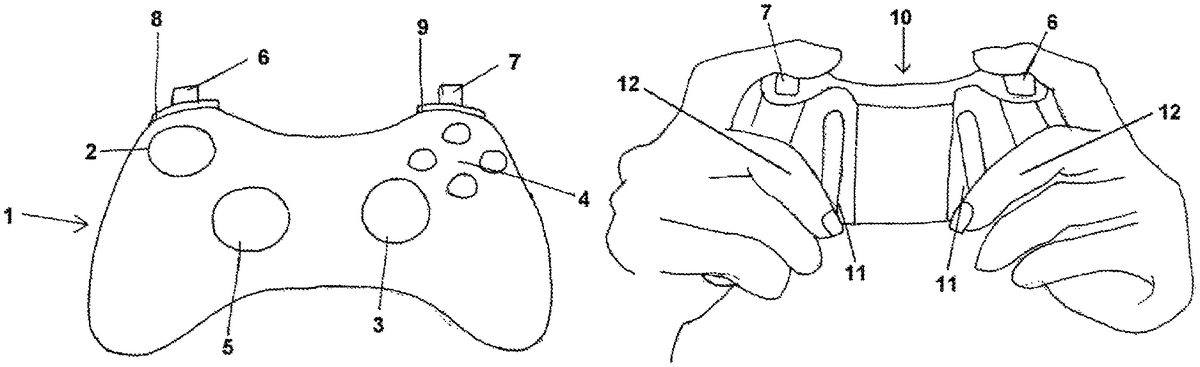
DETAILED DESCRIPTION OF THE INVENTION The particular embodiment described below and illustrated byFIGS.2and3serves to further illustrate the invention, to provide those of ordinary skill in the art with a complete disclosure and description of the devices claimed herein, and is not intended to knit the scope of the invention. For example, the additional controls are described below as two paddle levers but the term “control” as used in the claims, unless otherwise made clear in the claim, refers to paddle levers as well as other controls such as buttons, analogue control sticks, bumpers, and triggers. The game controller10according to the present invention illustrated inFIGS.2and3. The front of the game controller10ofFIGS.2and3is the same as a conventional controller1, as illustrated inFIG.1and as discussed above. Therefore, where appropriate the same reference numerals have been used to indicate the features of the controller according to the present invention10that are identical to the features of a conventional controller1. Game controller10differs from the conventional controller1in that it additionally comprises two paddle levers11located on the back of the controller. The paddle levers11are vertically orientated with respect to the controller10and are positioned to be operated by the middle fingers of a user12, as shown inFIG.3. In one embodiment the paddles11are formed from a thin flexible material such as a plastics material for example polyethylene. Preferably, the paddles11are less than 10 mm thick, but may be less than 5 mm thick, and more preferably are 3 mm thick or less. The paddles11are inherently resilient, which means that they return to an unbiased position when not under load. A user may displace or depress either of the paddles11by engaging an outer surface thereof; such displacement causes the paddle11to activate a switch mechanism mounted within the body of the controller10. The paddles11are mounted within recesses located on the case of the ...
DETAILED DESCRIPTION OF THE INVENTION
The particular embodiment described below and illustrated byFIGS.2and3serves to further illustrate the invention, to provide those of ordinary skill in the art with a complete disclosure and description of the devices claimed herein, and is not intended to knit the scope of the invention. For example, the additional controls are described below as two paddle levers but the term “control” as used in the claims, unless otherwise made clear in the claim, refers to paddle levers as well as other controls such as buttons, analogue control sticks, bumpers, and triggers.
The game controller10according to the present invention illustrated inFIGS.2and3. The front of the game controller10ofFIGS.2and3is the same as a conventional controller1, as illustrated inFIG.1and as discussed above. Therefore, where appropriate the same reference numerals have been used to indicate the features of the controller according to the present invention10that are identical to the features of a conventional controller1.
Game controller10differs from the conventional controller1in that it additionally comprises two paddle levers11located on the back of the controller. The paddle levers11are vertically orientated with respect to the controller10and are positioned to be operated by the middle fingers of a user12, as shown inFIG.3.
In one embodiment the paddles11are formed from a thin flexible material such as a plastics material for example polyethylene. Preferably, the paddles11are less than 10 mm thick, but may be less than 5 mm thick, and more preferably are 3 mm thick or less.
The paddles11are inherently resilient, which means that they return to an unbiased position when not under load. A user may displace or depress either of the paddles11by engaging an outer surface thereof; such displacement causes the paddle11to activate a switch mechanism mounted within the body of the controller10. The paddles11are mounted within recesses located on the case of the controller10; and are disposed in close proximity to the outer surface of the controller body. In this way a user may engage the paddles11with the tips of the fingers, preferably the middle fingers, without compromising the user's grip on the controller10. While the example shows the paddles11engaged by the middle fingers, they could also be engaged by the index, ring, or little fingers. The index fingers may also engage trigger style controls mounted on the top edge of the controller10while the thumbs may be used to activate controls on the front of the controller10.
The paddles11are elongate in shape and substantially extend in a direction from the top edge to bottom edge of the controller10. In one embodiment the paddles are orientated parallel with each other. In an alternative embodiment the paddles are orientated such that they converge towards the top edge with respect to each other. This elongate shape allows a user to engage the paddles with any of the middle, ring, or little finger; it also provides that different users having different size hands can engage with the paddles in a comfortable position thereby reducing the effects of prolonged or repeated use such as repetitive strain injury.
In one embodiment, the paddle levers11replicate the functions of two of the four buttons4located on the front of the controller10and thereby allow a user to operate the functions of the relevant buttons using his or her middle fingers12, without the need to remove either of his or her thumbs from the left or right thumb stick2,3. In alternative embodiments a paddle lever11may activate a new function not activated by a control on the front or top edge of the controller10.
It is envisaged that the paddles11could be fitted to an existing controller10. In such embodiment the paddle would be mounted on the outer surface of the controller body by means of a mechanical fixing such as a screw or bolt or alternatively bonded or welded to the controller body by adhesive or other suitable means. A switch mechanism would be mounted within the controller in vertical registry with a portion of each paddle. A portion of the switch mechanism may extend through the controller body and be disposed in close proximity or in contact with an innermost surface of the paddle11.
In alternative embodiments it is envisaged that the paddles11would be integrally formed with the controller body, the paddles11being configured to be resilient and flexible such that they can be depressed by a user to activate a switch mechanism. This could be achieved by moulding the controller body to have a U-shaped slot extending through the controller body; alternatively a U-shaped slot could be cut into the controller body after the moulding process. Preferably, the paddles11would comprise a raised outermost surface with respect to the surrounding area such that a user may locate the paddles11. This may be achieved by moulding the paddle such that is thicker than the surrounding area. It will be recognised that as used herein, directional references such as “top”, “bottom”, “front”, “back”, “end”, “side”, “inner”, “outer”, “upper”, and “lower” do not limit the respective features to such orientation, but merely serve to distinguish these features from one another.
Modifications and variations of the present invention will be apparent to those skilled in the art from the forgoing detailed description. All modifications and variations are intended to be encompassed by the following claims. All publications, patents, and patent applications cited herein are hereby incorporated by reference in their entirety.
Claims
- A hand held apparatus for providing user inputs to a computer program for controlling the computer program, the apparatus comprising: a case configured to be supported only by a user's hands during operation of the apparatus, the case comprising: a front face, a back face opposite the front face, a top face and a bottom opposite the top face;a pair of handles, a first handle of the pair of handles being adjacent a first edge of the back face and a second handle of the pair of handles being adjacent a second edge of the back face opposite the first edge, wherein at least a portion of the back face forms a recess between the first handle and the second handle configured to receive the user's fingers when the apparatus is grasped by the user;a plurality of front controls disposed at the front face, each front control configured to be activated by the user's thumbs during operation of the apparatus and each front control in communication with one of a plurality of first sensors;a plurality of top controls disposed at the top face, each top control configured to be activated by the user's index fingers during operation of the apparatus and each top control in communication with one of a plurality of second sensors;and a first back control located at the back face in a position to allow activation by the user's middle, ring, or pinkie finger during operation of the apparatus, the first back control in communication with a third sensor of the apparatus, the first back control having a vertical dimension measured from a top edge of the back face adjacent to the top face of the case to a bottom edge of the back face adjacent to the bottom of the case, the vertical dimension being different than a horizontal dimension of the first back control perpendicular to the vertical dimension, wherein the third sensor is configured to replicate a first user input from one of the plurality of first sensors or a second user input from one of the plurality of second sensors, wherein at least part of the first back control is located in the recess and is configured to bend when activated by the user and is configured to unbend with released.
- The apparatus of claim 1, further comprising: a second back control located at the back face in a position to allow activation by the user's middle, ring, or pinkie finger during operation of the apparatus, the second back control in communication with a fourth sensor of the apparatus, the second back control having a vertical dimension measured from a top edge of the back face adjacent to the top face of the case to a bottom edge of the back face adjacent to the bottom of the case, the vertical dimension being different than a horizontal dimension of the second back control perpendicular to the vertical dimension, wherein the fourth sensor is configured to replicate a first user input from one of the plurality of first sensors or a second user input from one of the plurality of second sensors, wherein at least part of the second back control is located in the recess.
- The apparatus of claim 2, wherein the second back control comprises a first end activated by the user and a second end opposite the first end and wherein at least the second end of the second back control is located in the recess.
- The apparatus of claim 2, wherein the first back control and second back control comprise flexible portions of the back face.
- The apparatus of claim 2, wherein the first back control and the second back control comprise paddle levers configured to move towards an outer surface of the back face when activated by the user and configured to return to an unactivated position when released.
- The apparatus of claim 5, wherein the first back control and the second back control comprise flexible paddle levers configured to bend towards the outer surface of the back face when activated by the user, and configured to unbend when released.
- The apparatus of claim 2, wherein: the vertical dimension of the first back control is greater than the horizontal dimension of the first back control, and the vertical dimension of the second back control is greater than the horizontal dimension of the second back control.
- The apparatus of claim 1, wherein the first back control comprises a first end activated by the user and a second end opposite the first end and wherein at least the second end of the first back control is located in the recess.
- The apparatus of claim 1, wherein a surface of the first back control activated by a user is substantially flush with an outer surface of the back face.
- The apparatus of claim 1, wherein a surface of the first back control activated by a user is raised with respect to an outer surface of the back face.
- The apparatus of claim 1, wherein the apparatus comprises a game controller configured to operate with a computing device.
- A hand-held input device for providing user inputs to a computer program for controlling the computer program, the hand-held input device comprising: an outer case configured to be supported only by a user's hands during operation of the hand-held input device, the outer case comprising: a front face, a back face opposite the front face, a top face and a bottom opposite the top face;a pair of handles including a first handle of the pair of handles adjacent a first side of the back face and a second handle of the pair of handles adjacent a second side of the back face opposite the first side, wherein at least a portion of the back face forms a recess between the first handle and the second handle configured to receive the user's fingers when the hand-held input device is grasped by the user;a front control disposed at the front face in a position to be activated by a thumb of the user, the front control in communication with a first sensor of the apparatus configured to provide a first user input to the computer program;a top control disposed at the top face in a position to be activated by an index finger of the user, the top control in communication with a second sensor of the apparatus configured to provide a second user input to the computer program;a first back control located at the back face in a position to be activated by the user's middle, ring, or pinkie finger, the first back control in communication with a third sensor configured to provide a third user input to the computer program, the third user input of the third sensor from activation of the first back control capable of replicating one of the first user input from the first sensor or the second user input from the second sensor;and a second back control located at the back face in a position to be activated by the user's middle, ring, or pinkie finger, the second back control in communication with a fourth sensor configured to provide a fourth user input to the computer program, the fourth user input of the fourth sensor from activation of the second back control capable of replicating one of the first user input from the first sensor or the second user input from the second sensor, wherein at least part of the first back control and at least part of the second back control are located in the recess, and wherein the first back control and the second back control are configured to bend when activated by the user and configured to return to an unbent position when released.
- The hand-held input device of claim 12, wherein: the first back control comprises an engagement portion configured to be activated by the user and an attachment portion configured to attach the first back control to the input device, the attachment portion opposite the engagement portion and the attachment portion of the first back control located in the recess;and the second back control comprises an engagement portion configured to be activated by the user and an attachment portion configured to attach the second back control to the input device, the attachment portion opposite the engagement portion and the attachment portion of the second back control located in the recess.
- The hand-held input device of claim 12, wherein: the first back control has a first horizontal dimension perpendicular to a first vertical dimension of the first back control and wherein the first horizontal dimension is different from the first vertical dimension;and the second back control has a second horizontal dimension perpendicular to a second vertical dimension of the second back control and wherein the second horizontal dimension is different from the second vertical dimension.
- The hand-held input device of claim 14, wherein the first back control and second back control comprise paddle levers.
- The hand-held input device of claim 15, wherein the first back control and second back control comprise plastic paddle levers.
- The hand-held input device of claim 14, wherein: the first vertical dimension of the first back control comprises at least one fourth of the distance from a top edge of the back face to a bottom edge of the back face, and the second vertical dimension of the second back comprises at least one fourth of the distance from the top edge of the back face to the bottom edge of the back face.
- The hand-held input device of claim 12, wherein the third and fourth sensors are located inside the apparatus.
- The hand-held input device of claim 12, wherein the third and fourth sensors comprise switches.
- The hand-held input device of claim 12, wherein the input device comprises a games controller.
Disclaimer: Data collected from the USPTO and may be malformed, incomplete, and/or otherwise inaccurate.