U.S. Pat. No. 12,257,500
AUTOMATED FRAME PACING BASED ON GAMEPLAY STATE
AssigneeGoogle LLC
Issue DateNovember 9, 2021
Illustrative Figure
Abstract
A computing device may determine one or more characteristics of a gaming application executing at one or more processors of the computing device. The computing device may determine a gameplay state of the gaming application executing at the one or more processors based at least in part on the one or more characteristics. The computing device may adjust, based at least in part on the state of the gaming application, a target frame rate of image data outputted by the gaming application for display at a display device. The computing device may output, based at least in part on the adjusted target frame rate, the image data for display at the display device.
Description
DETAILED DESCRIPTION In general, techniques of this disclosure are directed to determining the gameplay state of a gaming application executing at a computing device and adjusting a target frame rate of image data outputted by the gaming application based on the gameplay state. The computing device may determine the gameplay state of the gaming application without receiving explicit indications of the gameplay state of the gaming application. Instead, the computing device may determine, based on one or more characteristics associated with the gaming application during execution, the gameplay state of the gaming application. A gaming application may, during execution, transition between a gaming state and a non-gaming state. A gaming application may be in a gaming state when the gaming application is providing an interactive gameplay environment for active gameplay by the user of the computing device. Conversely, the gaming application may be in a non-gaming state when the gaming application is not providing such an interactive gameplay environment, such as when the gaming application is outputting a menu screen, is outputting a loading screen, outputting a lobby screen, etc. When a gaming application is in a gaming state, the frame rate of image data outputted by the gaming application may affect the gameplay experience for the user of the computing device, such as the perceived smoothness of the gaming application's graphics, the amount of graphical artifacts in the image data outputted by the gaming application, the amount of input lag experienced by the user, and the like. As such, a gaming application may attempt to always output image data at as high of a frame rate as possible that is able to be rendered and outputted by the computing device while the gaining application is in the gaming state. When a gaming application is in a non-gaming state, such ...
DETAILED DESCRIPTION
In general, techniques of this disclosure are directed to determining the gameplay state of a gaming application executing at a computing device and adjusting a target frame rate of image data outputted by the gaming application based on the gameplay state. The computing device may determine the gameplay state of the gaming application without receiving explicit indications of the gameplay state of the gaming application. Instead, the computing device may determine, based on one or more characteristics associated with the gaming application during execution, the gameplay state of the gaming application.
A gaming application may, during execution, transition between a gaming state and a non-gaming state. A gaming application may be in a gaming state when the gaming application is providing an interactive gameplay environment for active gameplay by the user of the computing device. Conversely, the gaming application may be in a non-gaming state when the gaming application is not providing such an interactive gameplay environment, such as when the gaming application is outputting a menu screen, is outputting a loading screen, outputting a lobby screen, etc.
When a gaming application is in a gaming state, the frame rate of image data outputted by the gaming application may affect the gameplay experience for the user of the computing device, such as the perceived smoothness of the gaming application's graphics, the amount of graphical artifacts in the image data outputted by the gaming application, the amount of input lag experienced by the user, and the like. As such, a gaming application may attempt to always output image data at as high of a frame rate as possible that is able to be rendered and outputted by the computing device while the gaining application is in the gaming state.
When a gaming application is in a non-gaming state, such as when a gaming application is outputting menus and/or loading screens, the frame rate of image data outputted by the gaming application may have little to no impact on the user experience of the user interacting with menus and/or load screens. As such, when the gaming application continues to output image data at as high of a frame rate as possible while the gaming application is in the non-gaming state, the processing resources required for sustaining such high frame rates, such as the one or more processors of the gaming application operating at high clock rates, may cause excessive battery drain and may prevent the computing device from reducing the amount of heat generated by the one or more processors.
In accordance with aspects of the present disclosure, a computing device may, during execution, determine the gameplay state of the gaming application and may, in response to determining the gameplay state of the gaming application, adjust the target frame rate of the gaming application based on the gameplay state of the gaming application. The computing device may be able to determine the gameplay state of the gaming application without receiving, from the gaming application, explicit indications of the gameplay state of the application. Instead, the computing device may be able to determine the gameplay state of the gaming application based on one or more characteristics associated with the gaming application during execution, such as the pattern of user inputs received during execution of the gaming application, the patterns of usage of the one or more processors of the computing device, the graphical commands issued by the gaming application during execution, the image data being outputted by the gaming application during execution, and the like.
When the computing device determines that the gaming application is in the gaming state, the computing device may set the target frame rate to a relatively high target frame rate, thereby enabling the gaming application to provide a high quality gameplay experience for the user. When the computing device determines that the gaming application is in the non-gaming state, the computing device may set the target frame rate to a relatively low target frame rate, thereby enabling the computing device to reduce the amount of heat generated by the one or more processors and reducing the battery drain caused by the one or more processors.
The techniques of this disclosure provides one or more technical advantages. By determining the gameplay state of a gaming application, the techniques of this disclosure may enable a computing device to adaptively decrease the frame rate of image data being outputted the gaming application to output image data while the gaming application is in the non-gaming state, thereby enabling the computing device to reduce battery drain and reduce the amount of heat dissipated by one or more processors of the computing device during execution of the gaming application by decreasing the operating clock speeds of the one or more processors of the computing device.
Reducing the battery drain of the computing device may, in cases where the computing device is a mobile computing device, increase the battery life of the computing device. Furthermore, reducing the amount of heat dissipated by one or more processors of the computing device while the gaming application is in the non-gaming state increases the available thermal headroom of the computing device for later increasing the operating clock speeds of the one or more processors to support increasing the target frame rate of image data outputted by the computing device when the computing device transitions to the gaming state.
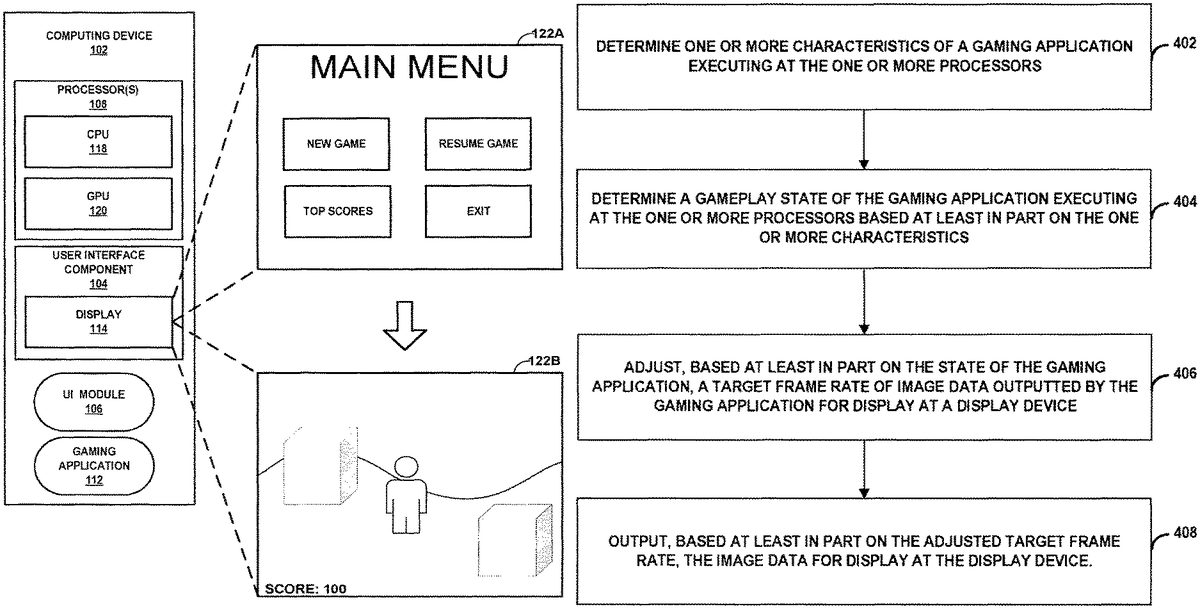
FIG.1is a conceptual diagram illustrating an example computing device that is configured to determine the gameplay state of a gaming application and to adjust the target frame rate of the gaming application based on the gameplay state, in accordance with one or more aspects of the present disclosure. In the example ofFIG.1, computing device102may include, but is not limited to, portable or mobile devices such as mobile phones (including smart phones), laptop computers, tablet computers, wearable computing devices such as smart watches or computerized eyewear, smart television platforms, cameras, personal digital assistants (PDAs), etc. In some examples, computing device102may include stationary computing devices such as desktop computers, servers, mainframes, etc.
As shown inFIG.1, computing device102includes user interface component104(“UIC104”) user interface module106(“UI module106”), and gaming application112. UI module106and gaming application112may perform operations described herein using software, hardware, firmware, or a mixture of both hardware, software, and firmware residing in and executing on computing device102or at one or more other remote computing devices. In some examples, UI module106and gaming application112may be implemented as hardware, software, and/or a combination of hardware and software. Computing device102may execute module106and gaming application112with one or more processors108. Computing device102may execute any of module106and gaming application112as or within a virtual machine executing on underlying hardware. UI module106and gaming application112may be implemented in various ways. For example, any of module106and/or gaming application112may be implemented as a downloadable or pre-installed application or “app.” In another example, any of module106and gaming application112may be implemented as part of an operating system of computing device102. Other examples of computing device102that implement techniques of this disclosure may include additional components not shown inFIG.1.
One or more processors108may implement functionality and/or execute instructions within computing device102. For example, one or more processors108may receive and execute instructions that provide the functionality of UI module106and gaming application112to perform one or more operations. That is, UI module106and gaming application112may be operable by processors40to perform various functions described herein. In the example ofFIG.1, one or more processors include central processing unit (CPU)118and graphics processing unit (GPU)120. GPU120may be a processing unit configured to configured to perform graphics related functions, such as to generate and output graphics data for presentation on a display, as well as to perform non-graphics related functions that exploit the massive processing parallelism provided by GPU120. Examples of CPU118and GPU12.0include, but are not limited to, a digital signal processor (DSP), a general purpose microprocessor, application specific integrated circuit (ASIC), field programmable logic array (FPGA), or other equivalent integrated or discrete logic circuitry.
UIC104of computing device102may function as an input device for computing device102and as an output device. For instance, UIC104may function as an input device using a resistive touchscreen, a surface acoustic wave touchscreen, a capacitive touchscreen, a projective capacitance touchscreen, a pressure sensitive screen, an acoustic pulse recognition touchscreen, or another presence-sensitive screen technology. UIC104may function as an output device using any one or more of a liquid crystal display (LCD), dot matrix display, light emitting diode (LED) display, microLED, organic light-emitting diode (OLED) display, e-ink, or similar monochrome or color display capable of outputting visible information to the user of computing device102. For example, UIC104includes display114.
In some examples, display114may be a presence-sensitive screen that may receive tactile user input from a user of computing device102, MC104may receive the tactile user input by detecting one or more taps and/or gestures from a user of computing device102(e.g., the user touching or pointing to one or more locations of UIC104with a finger or a stylus pen). The presence-sensitive screen of UIC104may present output to a user. UIC104may present the output as a user interface, which may be related to functionality provided by computing device102. For example, UIC104may present various functions and applications executing on computing device102such as an electronic message application, a messaging application, a map application, etc.
UI module106may be implemented in various ways. For example, UI module106may be implemented as a downloadable or pre-installed application or “app.” In another example, UI module106may be implemented as part of a hardware unit of computing device102. In another example, UI module106may be implemented as part of an operating system of computing device102. In some instances, portions of the functionality of UI module106or any other module described in this disclosure may be implemented across any combination of an application, hardware unit, and operating system.
UI module106may interpret inputs detected at UIC104(e.g., as a user provides one or more gestures at a location of UIC104at which user interface14A or another example user interface is displayed). UI module106may relay information about the inputs detected at UIC104to one or more associated platforms, operating systems, applications, and/or services executing at computing device102to cause computing device102to perform a function. UI module106may also receive information and instructions from one or more associated platforms, operating systems, applications, and/or services executing at computing device102(e.g., gaming application112) for generating a graphical user interface (GUI). In addition, module106may act as an intermediary between the one or more associated platforms, operating systems, applications, and/or services executing at computing device102and various output devices of computing device102(e.g., speakers, LED indicators, vibrators, etc.) to produce output (e.g., graphical, audible, tactile, etc.) with computing device102.
In the example ofFIG.1, computing device102includes gaming application112that executes at one or more processors108to perform the functionality of a video game. Although shown as operable by computing device102, gaming application112may, in some examples, be operable by a remote computing device that is communicatively coupled to computing device102. In such examples, a gaming application executing at a remote computing device may cause the remote computing device to send the content and intent information using any suitable form of data communication (e.g., wired or wireless network, short-range wireless communication such as Near Field Communication or Bluetooth, etc.). In some examples, a remote computing device may be a computing device that is separate from computing device102.
In some examples, gaming application112may be an action game that may emphasize hand-eye coordination and reaction time, such as a first-person shooter game, a battle royale game, etc. In some examples, gaming application112may be a simulation game, such as a motorsports simulation game, an airplane simulation game, a trucking simulation game, and the like. In other examples, gaming application112may be a role playing game (e.g., a massive multiplayer role playing game), a networked multi-player game, a single player game, and the like.
As gaming application112executes at one or more processors108, gaming application112may output image data for display at display114. Image data, in some examples, may be frames of graphics that gaming application112outputs for display at display114during execution of gaming application112. For example, the image data may include frames of graphics of the interactive gameplay environment, frames of graphics of loading screens, frames of graphics of menu screens, and the like.
Gaming application112may output image data at a specified frame rate, such as a specified frames per second (fps). The frame rate of the image data outputted by gaming application112may be the rate at which gaming application112outputs frames of graphics. Examples of the frame rate at which gaming application112outputs image data may include 5 fps, 10 fps, 30 fps, 60 fps, 120 fps, 144 fps, and the like.
Computing device102may specify a target frame rate for the image data outputted by gaming application112. That is, computing device102may indicate a target frame rate, such as 60 fps, to gaming application112, and gaming application112may attempt to output image data at the specified target frame rate for display at display114. Computing device102may adjust the frame rate of the image data being outputted by gaming application112by adjusting the target frame rate for the image data being outputted by gaming application112. Gaming application112may, in response to the target frame rate being adjusted, attempt to output image data at the adjusted target frame rate. For example, computing device102may increase the target frame rate for the image data being outputted by gaming application to increase the frame rate at which gaming application112outputs image data, or computing device102may decrease the target frame rate for the image data being outputted by gaming application to decrease the frame rate at which gaming application112outputs image data.
As gaming application112executes at one or more processors108, gaming application112may be in one of a plurality of states, and gaming application112may transition between the plurality of gameplay states during execution at one or more processors108. Specifically, gaming application112may be in one of: a gaming state or a non-gaming state, and may transition between the gaming state and the non-gaming state during execution at one or more processors108.
Gaming application112may be in a gaming state when gaming application112is providing an interactive gameplay environment for active gameplay by the user of computing device102. That is, when gaming application112is in the gaming state, gaming application112enables the user of computing device102to actively provide user input at UIC104to play a game in the interactive gameplay environment, such as by providing user input at UIC104in an attempt to complete a level of the game, to achieve a high score, to beat a final boss, to beat an opponent at the game, to cooperate with other players to complete a goal (e.g., a quest), to simulate operating a motor vehicle, and the like.
Gaming application112may be in a non-gaming state when gaming application112is not providing an interactive gameplay environment for active gameplay by the user of the computing device. For example, gaming application112may be in the non-gaming state when gaming application112is outputting a menu screen of gaming application112, when gaming application112is outputting a loading screen, such as a loading screen during loading of a next level of the game, when gaming application112is outputting a lobby screen or a waiting room screen during matchmaking of players, and the like. A menu screen may be a GUT outputted by gaming application112, such as the GUI for a main menu of gaming application112, that includes one or more UI controls such as buttons, menus, and the like, that enables the user to, in some examples, quit the game, resume a currently saved game, start a new game, view the high scores for the game, adjust settings for the game, and the like. A loading screen may be a GUI outputted by gaming application112while gaming application112is loading a next level of the game, while gaming application is saving the current state of the game, while gaming application112is loading the menu screen, and the like. A lobby screen or a waiting room screen may be a GUI outputted by gaming application112while gaming application112is performing matchmaking of players across a network. In some examples, gaming application112may be in the non-gaming state when gaming application112outputting any other image data besides image data of an interactive gameplay environment for active gameplay by the user of computing device102.
Gaming application112may not explicitly indicate the current gameplay state of gaming application112to the operating system of computing device102. That is, when gaming application112is in a non-gaming state, gaming application112may not provide an explicit indication that gaming application112is in the non-gaming state to the operating system of computing device102. Similarly, when gaming application112is in a gaming state, gaming application112may not provide an explicit indication that gaming application112is in the gaming state to the operating system of computing device102.
As such, in accordance with aspects of the present disclosure, computing device102may determine the gameplay state of gaming application112without receiving, from gaming application112, explicit indications of the gameplay state of gaming application112. Instead, as gaming application112executes at one or more processors108, computing device102may determine one or more characteristics associated with gaming application112and may determine the gameplay state of gaming application112based at least in part on the one or more characteristics.
The one or more characteristics associated with gaming application112executing at one or more processors108may include any characteristics and/or behaviors of computing device102that is as a result of gaming application112executing at one or more processors108besides explicit indications of the gameplay state of gaming application112received from gaming application112. Specifically, the one or more characteristics may include characteristics of components of computing device102that are indicative of differences in behavior of gaming application112and/or computing device102while gaming application112is in different gameplay states.
In some examples, the one or more characteristics may include one or more of: patterns of usage of one or more processors108by gaming application112during execution, the graphical rendering commands invoked by gaming application112during execution, the pattern of inputs received at UIC104during execution of gaming application112, the characteristics of the image data outputted for display at display114by gaming application112during execution, information generated by profiling gaming application112during execution of gaming application112, and/or patterns of network traffic sent and received by computing device102during execution of gaming application112. Computing device102may determine, based at least in part on the one or more characteristics associated with gaming application112, the gameplay state of gaming application112. As discussed above, computing device102may determine the gameplay state of gaming application112without the operating system of computing device102receiving, from gaming application112, explicit indications of the gameplay state of gaming application112.
In some examples, computing device102may implement and use one or more neural networks trained via machine learning to determine, based on the one or more characteristics associated with gaming application112the gameplay state of gaming application112. In general, one or more neural networks implemented by computing device102may include multiple interconnected nodes, and each node may apply one or more functions to a set of input values that correspond to one or more features, and provide one or more corresponding output values. The one or more features may be the one or more characteristics associated with gaming application112, and the one or more corresponding output values of one or more neural networks may be an indication of the gameplay state of gaining application112.
The one or more corresponding output values may, in some examples, include probabilities of the gameplay state of gaming application112. Accordingly, computing device102may use one or more neural networks to determine probabilities of gaming application112being in each of the plurality of gameplay states. Computing device102may therefore determine the gameplay state of gaming application112having the highest probability of being the gameplay state of gaming application112as the gameplay state of gaming application.
In some examples, the one or more corresponding output values may include a confidence score associated with each of the gameplay states of gaming applications112. Accordingly, computing device102may use one or more neural networks to determine a respective confidence score of gaming application112being in each of a plurality of gameplay states based on the one or more characteristics. Computing device102may therefore determine the gameplay state of gaming application112having the highest confidence score of being the gameplay state of gaming application112as the gameplay state of gaming application.
Computing device102may adjust a targeted frame rate of image data being outputted by gaming application112for display at display114based at least in part on the determined gameplay state of gaming application112. Computing device102may associate different target frame rates with different gameplay states of gaming application112. That is, computing device may associate a non-gaming target frame rate with the non-gaming state of gaming application112and may associate a gaming target frame rate with the gaming state of gaming application112. In general, a gaming target frame rate may be greater than a non-gaming target frame rate, as a lower target frame rate during the non-gaming state may not negatively affect the user experience of interacting with gaming application112during the non-gaming state compared with the user experience of interacting with gaming application112during the gaming state.
Computing device102may adjust the frame rate of image data being outputted by gaming application112for display at display114based at least in part on the determined gameplay state of gaming application112so that the frame rate of image data being outputted by gaming application112for display at display114matches the target frame rate associated with the determined gameplay state of gaining application112. If the frame rate of image data being outputted by gaming application112is below the targeted frame rate, computing device102may enable gaming application112to increase the frame rate of image data being outputted by gaming application112to match the target frame rate. If the frame rate of image data being outputted by gaming application112is above the targeted frame rate, computing device102may enable gaming application112to decrease the frame rate of image data being outputted by gaming application112to match the target frame rate.
If computing device102determines that gaming application112is in the gaming state, computing device102may adjust the frame rate of image data being outputted by gaming application112to match the gaming target frame rate associated with the gaming state of gaming application112. Similarly, if computing device102determines that gaming application112is in the non-gaming state, computing device102may adjust the frame rate of image data being outputted by gaming application112to match the non-gaming target frame rate associated with the non-gaming state of gaming application112.
To adjust the frame rate of image data being outputted by gaming application112, computing device102may send an indication of the target frame rate to gaming application112to enable gaming application112to increase or decrease the frame rate of image data being outputted by gaming application112to match the target frame rate. Computing device102may also adjust the respective clock speeds of CPU118and/or GPU120to enable adjusting the frame rate of image data being outputted by gaming application112to match the target frame rate. For example, to increase the frame rate of image data being outputted by gaming application112to match the target frame rate, computing device102may increase the respective clock speeds of CPU118and/or GPU120. Similarly, to decrease the frame rate of image data being outputted by gaming application112to match the target frame rate, computing device102may decrease the respective clock speeds of CPU118and/or GPU120.
In some examples, to adjust the frame rate of image data being outputted by gaming application112, computing device102may also adjust the panel refresh rate of display114. For example, to adjust the frame rate of image data being outputted by gaming application112to match a target frame rate, computing device102may set the panel refresh rate of display114to match the target frame rate.
Computing device102may, while gaming application112executes at one or more processors108, periodically determine one or more characteristics associated with gaming application112and adjust the frame rate of image data being outputted by gaming application112based on the one or more characteristics. Computing device102may not necessarily perform such determination and adjustment at the same rate as the frame rate of image data being outputted by gaming application112. Instead, computing device102may perform such determination of the gameplay state of gaming application112and adjustment of the target frame rate of gaming application112multiple times a second, such as ten times a second, fifteen times a second, twenty times a second, and the like.
In the example ofFIG.1, when gaming application112is outputting GUI122A of a menu screen, gaming application112may be in a non-gaming state. Computing device102, as gaming application112executes at one or more processors108to output GUI122A of a menu screen, may determine one or more characteristics associated with gaming application112executing at one or more processors108, and may determine, based on the one or more characteristics associated with gaming application112executing at one or more processors108, that gaming application112is in a non-gaming state. Computing device102may therefore adjust the target frame rate of image data being outputted by gaming application112based on the gameplay state of gaming application112being in a non-gaming state, such as by setting the target frame rate to a relatively low frame rate, such as 5 fps.
Gaming application112may transition from the non-gaming state to the non-gaming state by executing at one or more processors108to output GUI122B of an interactive gameplay environment for active gameplay by the user of computing device102. Computing device102, as gaming application112executes at one or more processors108to output GUI122B, may determine one or more characteristics associated with gaming application112executing at one or more processors108, and may determine, based on the one or more characteristics associated with gaming application112executing at one or more processors108, that gaming application112has transitioned from the non-gaming state to a gaming state. Computing device102may therefore adjust the target frame rate of image data being outputted by gaming application112based on the gameplay state of gaming application112being in a gaming state, such as by increasing the target frame rate from the previously adjusted target frame rate of 5 fps to a relatively high frame rate, such as 144 fps.
FIG.2is a block diagram illustrating an example computing device, in accordance with one or more aspects of the present disclosure.FIG.2illustrates only one particular example of computing device102, and many other examples of computing device102may be used in other instances and may include a subset of the components included in example computing device102or may include additional components not shown inFIG.2.
As shown in the example ofFIG.2, computing device202includes one or more processors240, one or more input devices242, one or more communication units244, one or more output devices246, one or more storage devices248, and one or more sensors256. One or more processors240may be an example of one or more processors108ofFIG.1. One or more input devices242and one or more output device246may be examples of UIC104ofFIG.1. Storage devices248of computing device202also include UT module222, gaming application212, operating system226, gameplay state module252, and frame rate module254. Communication channels250may interconnect each of the components240,242,244,246,248, and256for inter-component communications (physically, communicatively, and/or operatively). In some examples, communication channels250may include a system bus, a network connection, one or more inter-process communication data structures, or any other components for communicating data between hardware and/or software.
One or more processors240may implement functionality and/or execute instructions within computing device202. For example, processors240on computing device102may receive and execute instructions stored by storage devices248that provide the functionality of UI module222, gaming application212, operating system226, gameplay state module252, and frame rate module254. These instructions executed by processors240may cause computing device202to store and/or modify information, within storage devices48during program execution. Processors240may execute instructions of UI module222, gaming application212, operating system226, gameplay state module252, and frame rate module254. That is, UT module222, gaming application212, operating system226, gameplay state module252, and frame rate module254may be operable by processors240to perform various functions described herein.
One or more processors240may include CPU218and GPU220. GPU220may be a processing unit configured to configured to perform graphics related functions, such as to generate and output graphics data for presentation on a display, as well as to perform non-graphics related functions that exploit the massive processing parallelism provided by CPU220. Examples of CPU218and CPU220include, but are not limited to, a digital signal processor (DSP), a general purpose microprocessor, application specific integrated circuit (ASIC), field programmable logic array (FPGA), or other equivalent integrated or discrete logic circuitry.
One or more input devices242of computing device202may receive input. Examples of input are tactile, audio, kinetic, and optical input, to name only a few examples. Input devices242of computing device202, in one example, include a mouse, keyboard, voice responsive system, video camera, buttons, control pad, microphone or any other type of device for detecting input from a human or machine. In some examples, input device242may be a presence-sensitive input device, which may include a presence-sensitive screen, touch-sensitive screen, etc.
One or more output devices246of computing device102may generate output. Examples of output are tactile, audio, and video output. Output devices46of computing device202, in one example, include a presence-sensitive screen, such as display214, sound card, video graphics adapter card, speaker, cathode ray tube (CRT) monitor, liquid crystal display (LCD), or any other type of device for generating output to a human or machine. Output devices246may include display214, such as cathode ray tube (CRT) monitor, liquid crystal display (LCD), Light-Emitting Diode (LED) or any other type of device for generating tactile, audio, and/or visual output.
One or more communication units244of computing device202may communicate with external devices by transmitting and/or receiving data. For example, computing device202may use communication units244to transmit and/or receive radio signals on a radio network such as a cellular radio network. In some examples, communication units244may transmit and/or receive satellite signals on a satellite network such as a Global Positioning System (GPS) network. Examples of communication units244include a network interface card (e.g. such as an Ethernet card), an optical transceiver, a radio frequency transceiver, a GPS receiver, or any other type of device that can send and/or receive information. Other examples of communication units44may include Bluetooth®, GPS, 3G, 4G, and Wi-Fi® radios found in mobile devices as well as Universal Serial Bus (USB) controllers and the like.
One or more storage devices248within computing device202may store information for processing during operation of computing device202. In some examples, storage device248is a temporary memory, meaning that a primary purpose of storage device248is not long-term storage. Storage devices248on computing device202may be configured for short-term storage of information as volatile memory and therefore not retain stored contents if deactivated. Examples of volatile memories include random access memories (RAM), dynamic random access memories (DRAM), static random access memories (SRAM), and other forms of volatile memories known in the art.
Storage devices248, in some examples, also include one or more computer-readable storage media. Storage devices248may be configured to store larger amounts of information than volatile memory. Storage devices248may further be configured for long-term storage of information as non-volatile memory space and retain information after activate/off cycles. Examples of non-volatile memories include magnetic hard discs, optical discs, floppy discs, flash memories, or forms of electrically programmable memories (EPROM) or electrically erasable and programmable (EEPROM) memories. Storage devices248may store program instructions and/or data associated with UI module222, which may be an example of UI module106ofFIG.1, gaming application212, which may be an example of gaming application112ofFIG.1, operating system226, gameplay state module252, and frame rate module254.
As shown inFIG.2, computing device102may include one or more sensors256. Sensors256may include an accelerometer that generates accelerometer data. Accelerometer data may indicate an acceleration and/or a change in acceleration of computing device202. Sensors256may include a gyroscope that generates gyroscope data. Gyroscope data may indicate a physical orientation and/or change in physical orientation of computing device102. In some examples, the orientation may be relative to one or more reference points. Sensors256may include a magnetometer that generates magnetometer data. Magnetometer data may indicate the magnetization of an object that is touching or in proximity to computing device202. Magnetometer data may indicate the Earth's magnetic field, and in some examples, provide directional functionality of a compass. Sensors256may include an ambient light sensor that generates ambient light data. The ambient light data may indicate an intensity of light to which computing device202is exposed. Sensors256may include a proximity sensor that generates proximity data. Proximity data may indicate whether an object is within proximity to computing device202. In some examples, proximity data may indicate how close an object is to computing device202. In some examples, sensors256may include a clock that generates a date and time. The date and time may be a current date and time.
As shown inFIG.2, computing device102may include a power source257. In some examples, power source257may be a battery. Power source257may provide power to one or more components of computing device202. Examples of power source257may include, but are not necessarily limited to, batteries having zinc-carbon, lead-acid, nickel cadmium (NiCd), nickel metal hydride (NAM), lithium ion (Li-ion), and/or lithium ion polymer (Li-ion polymer) chemistries. In some examples, power source257may have a limited capacity (e.g., 1000-4000 mAh).
In accordance with techniques of the disclosure, one or more processors240of computing device202are configured to execute gameplay state module252to determine the gameplay state of gaming application212as gaming application212executes at one or more processors240. Gameplay state module252may be able to determine the gameplay state of gaming application212without receiving, from gaming application212, an explicit indication of the gameplay state of gaming application212. Instead, gameplay state module252may determine the gameplay state of gaming application212as gaming application212executes at one or more processors240based on one or more characteristics associated with gaming application212executing at one or more processors240. One or more processors240may periodically execute gameplay state module252to determine the current gameplay state of gaming application212as gaming application212executes at one or more processors240. For example, one or more processors240may execute gameplay state module252to determine the current gameplay state of gaming application212five times a second, ten times a second, and the like.
Gaming application212executes at one or more processors240to perform the functionality of a video game. In some examples, gaming application212may be an action game that may emphasize hand-eye coordination and reaction time, such as a first-person shooter game, a battle royale game, etc. In some examples, gaming application212may be a simulation game, such as a motorsports simulation game, an airplane simulation game, a trucking simulation game, and the like. In other examples, gaming application212may be a role playing game (e.g., a massive multiplayer role playing game), a networked multi-player game, a single player game, and the like.
As gaming application212executes at one or more processors240, gaming application212may output image data for display at display214. Image data, in some examples, may be frames of graphics that gaming application212outputs for display at display214during execution of gaming application212. For example, the image data may include frames of graphics of the interactive gameplay environment, frames of graphics of loading screens, frames of graphics of menu screens, and the like.
As gaming application212executes at one or more processors240, gaming application212may be in one of a plurality of states, and gaming application212may transition between the plurality of gameplay states during execution at one or more processors240. Specifically, gaming application212may be in one of: a gaming state or a non-gaming state, and may transition between the gaming state and the non-gaming state during execution at one or more processors240.
Gaming application212may be in a gaming state when gaming application212is providing an interactive gameplay environment for active gameplay by the user of computing device202. That is, when gaming application212is in the gaming state, gaming application212enables the user of computing device202to actively provide user input at one or more input devices242to play a game in the interactive gameplay environment, such as by providing user input at one or more input devices242in an attempt to complete a level of the game, to achieve a high score, to beat a final boss, to beat an opponent at the game, to cooperate with other players to complete a goal (e.g., a quest), to simulate operating a motor vehicle, and the like.
Gaming application212may be in a non-gaming state when gaming application212is not providing an interactive gameplay environment for active gameplay by the user of the computing device. For example, gaming application212may be in the non-gaming state when gaming application212is outputting a menu screen of gaming application212or when gaming application212is outputting a loading screen, such as a loading screen during loading of a next level of the game. A menu screen may be a GUI outputted by gaming application212, such as the GUI for a main menu of gaming application212, that includes one or more UI controls such as buttons, menus, and the like, that enables the user to, in some examples, quit the game, resume a currently saved game, start a new game, view the high scores for the game, adjust settings for the game, and the like. A loading scree may be a GUI outputted by gaming application212while gaming application212is loading a next level of the game, while gaming application is saving the current state of the game, while gaming application212is loading the menu screen, and the like. In some examples, gaming application212may be in the non-gaming state when gaming application212outputting any other image data besides image data of an interactive gameplay environment for active gameplay by the user of computing device202.
The one or more characteristics associated with gaming application212executing at one or more processors240may include any characteristics and/or behaviors of the components of computing device202that may be indicative of differences in the behavior of gaming application212and/or components of computing device202while gaming application212is in different gameplay states. In some examples, the one or more characteristics may include patterns of usage of one or more processors240by gaming application212during execution, such as patterns of usage of CPU218and GPU220by gaming application212. In some examples, the usage of CPU218and GPU220may be relatively higher when a gaming application, such as gaming application212, is in the gaming state and may be relatively lower when the gaming application is in the non-gaming state. As such, the pattern of usage of one or more processors240by gaming application212during execution may be indicative of the gameplay state of gaming application212, and the patterns of usage of one or more processors240included as the one or more characteristics may include the amount of usage of CPU218and/or the amount of usage of GPU220during execution of gaming application212.
In some examples, the one or more characteristics may include the patterns of one or more graphical rendering commands invoked by gaming application212during execution. Examples of such graphical rendering commands may include OpenGL commands, DirectX commands, Metal commands, commands sent through a cross-platform graphics engine abstraction layer such as Almost Native Graphics Layer Engine (ANGLE), and the like. In some instances, a gaming application, such as gaming application212, may invoke a relatively greater variety of different graphical rendering commands and use a relatively greater number of different shaders while the gaming application is in the gaming state compared with the gaming application in the non-gaming state. In some instances, a gaming application may also invoke a relatively greater amount of three-dimensional graphical rendering commands while in the gaming state compared with the gaming application in the non-gaming state, and the graphical application may invoke a greater amount of two-dimensional graphical rendering commands while in the non-gaming state compared with the gaming application in the gaming state. Thus, the pattern of one or more graphical rendering commands invoked by gaming application212included in the one or more characteristics may include the variety of different graphical rendering commands invoked by gaming application212, the types of graphical rendering commands invoked by gaming application212, the number and type of different shaders used during execution of gaming application212, and the like.
In some examples, the one or more characteristics may include pattern of inputs received at one or more input devices242during execution of gaming application212. Typically, a user using a gaming application may provide user input at a greater frequency during gameplay (i.e., when the gaming application is in the gaming state) compared with while the gaming application is displaying a menu or a loading screen (i.e., when the gaming application is in the non-gaming state). Further, if computing device202is a mobile computing device comprising a presence-sensitive display, the user may provide user input in the form of touch and hold gestures (e.g., long press gestures) at a greater frequency while the gaming application is in the gaming state compared with while the gaming application in the non-gaming state.
As such, computing device202may, during execution of gaming application212, more frequently receive user input at one or more input devices242while gaming application212is in the gaming state compared with the frequency of user input received while gaming application212is in the non-gaming state. Similarly, computing device202may, during execution of gaming application212, more frequently receive user input in the form of touch and hold gestures while gaming application212is in the gaming state compared with the frequency of user input in the form of touch and hold gestures received by computing device202while gaming application212is in the non-gaming state. As such, the one or more characteristics may include indications of the frequency of user inputs received by computing device202during execution of gaming application212and indications of the frequency of touch and hold gestures received by computing device202during execution of gaming application212.
In some examples, the one or more characteristics may include image data outputted for display at display214by gaming application212during execution. Image data outputted by, gaming application212for display at display214that is relatively stable may be indicative of gaming application212outputting a menu screen and thus gaming application212being in the non-gaming state, while image data outputted by gaming application212for display at display214that frequently changes from one frame to another may be indicative of gaming application212being in the gaming state.
As such, the one or more characteristics may include indications of the amount of change between frames of image data outputted by gaming application212. For example, gameplay state module252may determine, based on frames of image data outputted by gaming application212, a histogram of image data, such as a histogram that counts the amount of times consecutive frames of image data outputted by gaming application212are unchanged and the amount of times consecutive frames of image data outputted by gaming application212are different.
In some examples, the one or more characteristics may include information generated by profiling gaming application212during execution of gaming application212gameplay state module252may perform profiling of gaming application212may analyzing the call stack of gaming application212, GPU counters. The information generated by profiling gaming application212may include patterns between reasonably consistent work by gaming application212, which may be indicative of gaming application212being in the gaming state, and inconsistent work by gaming application212, which may be indicative of gaming application212in the non-gaming state.
In some examples, the one or more characteristics may include patterns of network traffic sent and received by computing device202during execution of gaming application212. If a gaming application is a network-based multiplayer game, gameplay state module252may analyze the patterns of the network traffic and/or inspect the network packets sent and received by computing device102to determine whether gaming application212is in a gaming state or a non-gaming state.
For example, gameplay state module252may perform stateful packet inspection to determine whether the network packets sent and received by computing device202during execution of gaming application212include matchmaking information, active gameplay information, and the like. If gameplay state module252determines that the network packets include matchmaking information, gameplay state module252may determine that gaming application212is in the non-gaming state. If gameplay state module252determines that the network packets include active gameplay information, such as the locations of different players within the map of the game, the health levels of different players, the amount of loot collected by each of the players, and the like, gameplay state module252may determine that gaming application212is in the non-gaming state.
In some examples, the consistency of the network traffic sent and received by computing device202during execution of gaming application212may be indicative of the gameplay state of gaining application212. Specifically, sudden but consistent network traffic may be indicative of gaming application212entering the gaming state, while sporadic and/or inconsistent network traffic may be indicative of gaming application212being in the non-gaming state. As such, the consistency of the network traffic sent and received by computing device202during execution of gaming application212may be included in the one or more characteristics that are indicate of whether gaming application212is in the gaming state or in the non-gaming state.
Gameplay state module252may execute at one or more processors240to determine, based at least in part on the one or more characteristics associated with gaming application212, the gameplay state of gaming application212. As discussed above, gameplay state module252may determine the gameplay state of gaming application212without receiving, such as from gaming application212, explicit indications of the gameplay state of gaming application212.
In some examples, gameplay state module252may implement and use one or more neural networks trained via machine learning to determine, based on the one or more characteristics associated with gaming application212the gameplay state of gaming application212. In general, one or more neural networks implemented by gameplay state module252may include multiple interconnected nodes, and each node may apply one or more functions to a set of input values that correspond to one or more features, and provide one or more corresponding output values. The one or more features may be the one or more characteristics associated with gaming application212, and the one or more corresponding output values of one or more neural networks may be an indication of the gameplay state of gaming application212.
In some examples, the one or more neural networks of gameplay state module252are trained to determine, based on one or more characteristics associated with a gaming application, the gameplay state of the gaming application. The one or more neural networks may perform such machine learning using training data that includes sets of characteristics associated with a gameplay state to learn connections between characteristics and gameplay states. In some examples, the one or more networks may be trained off-device (e.g., at an external computing system) and then installed and/or downloaded at computing device202. In some examples, the one or more neural networks may be trained on-device at computing device202.
The one or more corresponding output values may, in some examples, include probabilities of the gaming application212being in each of the plurality of gameplay states. Accordingly, gameplay state module252may implement one or more neural networks to determine probabilities of the gameplay state of gaming application212based on the one or more characteristics, and may determine and output an indication of the gameplay state of gaming application212having the highest probability of being the gameplay state of gaming application212based on the corresponding probabilities.
In some examples, the one or more corresponding output values of the one or more neural networks may include a respective confidence score for each of the plurality of gameplay states. Accordingly, gameplay state module252may implement one or more neural networks to determine a confidence score for gaming application212being in a gaming state and a confidence score for gaming application212being in a non-gaming state. As such, in some examples, gameplay state module252may determine the gameplay state of gaming application212to be the gaming state associated with the highest confidence score.
In some examples, gameplay state module252may use a combination of two or more models to determine, based on the one or more characteristics of gaming application212executing at one or more processors240, the gameplay state of gaming application212. For example, gameplay state module252may use a first model to determine, using a single characteristic, such as the patterns of user input received during execution of gaming applications212, the probability of gaming application212being in the gaming state. In some examples, the first model may include one or more neural networks trained via machine learning, as described above, to take, as input, the patterns of user input received during execution of gaming application212to determine the probability of gaming application212being in the gaming state.
In some examples, the first model may utilize a user input frequency threshold. In these examples, gameplay state module252may compare the frequency of user input received during execution of gaming applications212against the user input frequency threshold to determine whether gaming application212is likely to be in the gaming state. For example, if gameplay state module252determines that the frequency of user input received during execution of gaming application212exceeds the input frequency threshold, gameplay state module252may determine that gaming application212is likely to be in the gaming state.
If gameplay state module252determines, based on the first model, that the gaming application is not likely to be in the gaming state, such as if the probability of gaming application212being in the gaming state as determined using the first model does not exceed a threshold likelihood percentage (e.g., 50%), gameplay state module252may determine that gaming application212is in the non-gaming state. Similarly, if gameplay state module252determines, based on the first model, that the gaming application is likely to be in the gaming state, such as if the probability of gaming application212being in the gaming state as determined using the first model exceed a threshold likelihood percentage (e.g., 50%), gameplay state module252may use a second model that takes the additional one or more characteristics associated with gaming application212as input to output the probability and/or confidence of gaming application212being in the gaming state. Gameplay state module252may therefore determine, based on the output of the second model, the gameplay state of gaming application212.
One or more processors240of computing device202are configured to execute frame rate module254to adjust, based at least in part on the gameplay state of gaming application212, the target frame rate for the image data outputted by gaming application212. A target frame rate for gaming application212may be a frame rate that gaming application212attempts to match when outputting image data. For example, if the target frame rate for the image data outputted by gaming application212is 30 fps, gaming application212may attempt to output image data at 30 fps. If frame rate module254adjusts the target frame rate for the image data outputted by gaming application212from 30 fps to 45 fps, gaming application212may attempt to increase the frame rate at which it outputs image data from 30 fps to 45 fps.
Different gameplay states of gaming application212may be associated with different target frame rates. For example, a gaming target frame rate associated with the gaming state of gaming application212may typically be higher than a non-gaming target frame rate associated with the non-gaming state of gaming application212Examples of the gaming target frame rate may include 60 fps, 120 fps, 144 fps, and the like, while examples of non-gaming target frame rate may include 5 fps, 10 fps, 20 fps, 30 fps, and the like. In some examples, the gaming target frame rate may depend on the panel refresh rate of display214. For example, the gaming target frame rate may not exceed the panel refresh rate of display214. Thus, if the panel refresh rate of display214is 144 Hertz, the gaming target frame rate may not exceed 144 fps.
In some examples, frame rate module254may adjust the target frame rate for the image data outputted by gaming application212by setting the target frame rate for the image data outputted by gaming application212to the target frame rate associated with the gameplay state of gaming application212determined by gameplay state module252. That is, if gameplay state module252determines that the gameplay state of gaming application212is the gaming state, frame rate module254may set the target frame rate for the image data outputted by gaming application212to the gaming target frame rate associated with the gameplay state of gaming application212. Similarly, if gameplay state module252determines that the gameplay state of gaming application212is the non-gaming state, frame rate module254may set the target frame rate for the image data outputted by gaming application212to the non-gaming target frame rate associated with the non-gaming state of gaming application212.
The target frame rate for the image data outputted by gaming application212may be specific to gaming application212. That is, the target frame rate for the image data outputted by gaming application212may be different from the target frame rate for image data outputted by other applications. Similarly, the gaming target frame rate and the non-gaming target frame rate for the image data outputted by gaming application212may be specific to gaming application212and may be different from the gaming target frame rate and the non-gaming target frame rate for image data outputted by other applications.
In some examples, the target frame rate for the image data outputted by gaming application212may also be specific to computing device202and/or one or more processors240at which gaming application212executes. That is, the gaming target frame rate and the non-gaming target frame rate for the image data outputted by gaming application212may be specific to computing device202and/or the one or more processors240, and may be different from the gaming target frame rate and the non-gaming target frame rate for the image data outputted by the same gaming application that executes at a different computing device. For example, when gaming application212transitions from a non-gaming state to a gaming state, frame rate module254may determine a gaming target frame rate associated with the gameplay state of gaming application212that is specific to computing device202, and may set the target frame rate of the image data being outputted by gaming application212to the gaming target frame rate.
In some examples, frame rate module254may adjust the target frame rate for the image data outputted by gaming application212by profiling gaming application212during execution at one or more processors240. For example, frame rate module254may determine the frame rate at which gaming application212outputs image data during execution, such as when gaming application212is in the gaming state, and may determine the target frame rate associated based on the frame rate at which gaming application212outputs image data during previous execution.
In some examples, frame rate module254may determine, based on profiling gaming application212during execution at one or more processors240, determine the proportion of time spent by gaming application212in the non-gaming state and the proportion of time spent by gaming application212in the gaming state. Frame rate module254may also determine, based on the profiling of gaming application212, the frequency in which gaming application212is in the non-gaming state versus the frequency in which gaming application212is in the gaming state (e.g., the ratio of time between the gaming application212being in the non-gaming state and in the gaming state).
One or more processors240may typically operate at a much lower clock speed while gaming application212is in a non-gaming state versus being in the gaming state because the non-gaming target frame rate for gaming application212may be relatively much lower than the gaming target frame rate for gaming application212. As such, being in the non-gaming state enables computing device202allows computing device202to recover from the high internal temperature caused by one or more processors240operating at a high clock speed during the gaming state. Thus, the ratio of time between the gaming application212being in the non-gaming state and in the gaming state may correspond to the dock speed at which one or more processors240may operate while gaming application212is in the gaming state.
For example, if gaming application212frequently spends relatively long periods of time in non-gaming state versus being in gaming state, the frequent and long periods of time in non-gaming state enables one or more processors240to operate at a low clock speed for a relatively long period of time, thereby enabling long recover periods from high internal temperature caused by one or more processors240operating at a high clock speed during the gaming state. As such, the internal temperature of the enclosure of computing device202may be relatively low when gaming application212transitions from non-gaming state to gaming state, thereby enabling frame rate module254to increase the clock speeds of one or more processors240to a relatively higher operating frequency compared with a gaming application having relatively less frequent and shorter periods of time in non-gaming state versus being in gaming state.
For example, if frame rate module254determines that gaming application212, while in the gaming state, outputs image data at a certain frame rate without causing computing device202to exceed computing device202's thermal requirements (e.g., the internal temperature within computing device202's enclosure is below a specified threshold temperature), frame rate module254may determine the gameplay target frame rate associated with the gaming state based on the certain frame rate at which gaming application212outputs image data in the gaming state during previous execution of gaming application212. For example, frame rate module254may set the gameplay target frame rate associated with the gaming state to the certain frame rate at which gaming application212outputs image data in the gaming state during previous execution of gaming application212.
In some examples, frame rate module254may determine the target frame rate for the image data outputted by gaming application212based at least in part on the fidelity settings associated with the image data outputted by gaming application212. The fidelity settings associated with the image data may be associated the level of detail of the graphics in the image data outputted by gaming application212, the resolution of the image data outputted by gaming application212, and the like.
Gaming application212may require higher processing resources to output, at a specified frame rate, image data at a relatively higher fidelity setting compared with outputting, at the same specified frame rate, image data at a relatively lower fidelity setting. Due to factors such as the thermal requirements of computing device202, the processing power of one or more processors240, the amount of power available in power source257, gaming application212may sometimes be unable to output image data at a relatively higher fidelity at the same frame rate as image data at a relatively lower fidelity. As such, in some examples, frame rate module254may, when gaming application212transitions from a non-gaming state to a gaming state, adjust the target frame rate to a gaming target frame rate that is associated with the fidelity settings associated with gaming application212, where the gaming target frame rate associated with a relatively higher fidelity setting may be of a lower frame rate than the gaming target frame rate associated with a relatively lower fidelity setting.
Frame rate module254may, in response to determining the adjusted target frame rate, send an indication of the adjusted target frame rate to gaming application212. Gaming application212may therefore output image data based at least in part on the adjusted target frame. In some examples, gaming application212may output image data based on the adjusted target frame rate by setting the frame rate of image data outputted by gaming application212to the target frame rate. That is, gaming application212may attempt to output image data at a frame rate that matches the adjusted target frame rate, such as by increasing or decreasing the rate at which gaming application212outputs image data to output image data at a frame rate that matches the adjusted target frame rate.
In some examples, to enable gaming application212to output image data at a frame rate that matches the adjusted target frame rate, frame rate module254may adjust, based at least in part on the gameplay state of gaming application212, a respective clock speed of at least one of: CPU218or GPU220of the one or more processors240. For example, if frame rate module254adjusts the target frame rate by increasing the target frame rate, frame rate module254may increase the respective clock speed of at least one of: CPU218or GPU220of the one or more processors240. As such, if gameplay state module252determines that gaming application212is transitioning from a non-gaming state to a gaming state, frame rate module254may increase the target frame rate of image data outputted by gaming application212and increase the respective clock speed of at least one of: CPU218or GPU220of the one or more processors240.
Similarly, if frame rate module254adjusts the target frame rate by decreasing the target frame rate, frame rate module254may decrease the respective clock speed of at least one of: CPU218or GPU220of the one or more processors240. As such, if gameplay state module252determines that gaming application212is transitioning from a gaming state to a non-gaming state, frame rate module254may decrease the target frame rate of image data outputted by gaming application212and decrease the respective clock speed of at least one of: CPU218or GPU220of the one or more processors240.
In some examples, in addition to adjusting the respective clock speed of at least one of: CPU218or GPU220of the one or more processors240, frame rate module254may also adjust the refresh rate of display214to enable gaming application212to output image data based on the adjusted target frame rate. For example, frame rate module254may set the panel refresh rate of display214to the adjusted target frame rate for the image data outputted by gaming application212.
In some examples, frame rate module254may determine, in response to adjusting the target frame rate of the image data outputted by gaming application212, whether gaming application212is able to output image data at a frame rate that matches the adjusted target frame rate (e.g., whether the frame rate is the same as the adjusted target frame rate). Frame rate module254may determine that gaming application212is not able to output image data at a frame rate that matches the adjusted target frame rate if the maximum frame rate of image data being outputted by gaming application212never reaches the target frame rate and/or if gaming application212is unable to consistently output image data at the targeted frame rate. For example, frame rate module254may determine that gaming application212is unable to consistently output image data at the targeted frame rate if gaming application212is unable to output image data at the targeted frame rate for more than a threshold percentage of time, such as more than 5% of the time, more than 10% of the time, and the like. If frame rate module254determines that gaming application212is not able to output image data at a frame rate that matches the adjusted target frame rate, frame rate module254may take one or more actions to better enable gaming application212to output image data at a frame rate that matches the adjusted target frame rate.
In some examples, frame rate module254may, in response to determining that gaming application212is not able to output image data at a frame rate that matches the adjusted target frame rate, increase the respective dock speed of at least one of: CPU218or GPU220of the one or more processors240. For example, if the adjusted target frame rate is 60 fps, and if gaming application212is only able to output image data at a frame rate of 55 fps, frame rate module254may increase the respective dock speed of at least one of: CPU218or GPU220of the one or more processors240in an attempt to enable gaming application212to output image data at a frame rate (e.g., 60 fps) that matches the adjusted target frame rate.
In some examples, frame rate module254may, in response to determining that gaming application212is not able to output image data at a frame rate that matches the adjusted target frame rate of image data outputted by gaming application212, further adjust the target frame rate of image data outputted by gaming application212to a target frame rate at which gaming application212is able to output image data without an increase in the clock speed of one or more processors240. That is, frame rate module254may, in response to increasing the target frame rate of image data outputted by gaming application212based on the gameplay state of gaming application212, determine whether gaming application212is able to, without increasing the clock speed of one or more processors240, output image data at a frame rate that matches the adjusted target frame rate. Frame rate module254may, in some instances, in response to determining that gaming application212is unable to output image data at a frame rate that matches the adjusted target frame rate, refrain from increasing the respective clock speeds of at least one of: CPU218or GPU220of one or more processors240. Instead, frame rate module254may further adjust the target frame rate of image data outputted by gaming application212by decreasing the adjusted target frame rate to result in a target frame rate at which gaming application212is able to output image data at the current clock speeds of one or more processors240.
For example, frame rate module254may determine if the thermal requirements of computing device202(e.g., internal temperature within the enclosure of computing device202) would be exceeded by increasing the clock speed of one or more processors240. If frame rate module254determines that increasing the clock speed of one or more processors240to a rate that enables gaming application212is able to output image data at a target frame rate may cause computing device202to exceed its thermal requirements, frame rate module254may decrease the target frame rate to enable gaming application212to output image data at the target frame rate without increasing the clock speed of one or more processors240.
In some examples, frame rate module254may, in response to determining that gaming application212is not able to output image data at a frame rate that matches the adjusted target frame rate of image data outputted by gaming application212, determine whether to increase the respective clock speeds of at least one of: CPU218or GPU220of one or more processors240based at least in part on the difference between the adjusted target frame rate and the frame rate (e.g., maximum frame rate) at which gaming application212is able to output image data at the current clock speeds of CPU218and GPU220. In some examples, if frame rate module254determines that the difference between the adjusted target frame rate and the frame rate at which gaming application212is able to output image data at the current clock speeds of CPU218and GPU220is greater than a specified frame rate threshold, which may be a specified percentage of the adjusted target frame rate (e.g., 10% of the adjusted target frame rate, 20% of the adjusted target frame rate), frame rate module254may refrain from increase the respective clock speeds of at least one of: CPU218or GPU220of one or more processors240. Instead, frame rate module254may decrease the target frame rate to correspond to the frame rate at which gaming application212is able to output image data at the current clock speeds of CPU218and GPU220.
In some examples, frame rate module254may, in response to determining that gaming application212is not able to output image data at a frame rate that matches the adjusted target frame rate of image data outputted by gaming application212, determine whether to increase the respective clock speeds of at least one of: CPU218or GPU220of one or more processors240based at least in part on the amount of power available in power source257, such as the amount of battery power remaining in power source257. For example, if frame rate module254determines that the amount of battery power remaining in power source257is less than a specified threshold, such as less than 20% battery power, less than 10% battery power, and the like, frame rate module254may refrain from increase the respective clock speeds of at least one of: CPU218or GPU220of one or more processors240. Instead, frame rate module254may decrease the target frame rate to correspond to the frame rate at which gaming application212is able to output image data at the current clock speeds of CPU218and GPU220.
FIG.3is a block diagram illustrating an example computing device that outputs graphical content for display at a remote device, in accordance with one or more techniques of the present disclosure. Graphical content, generally, may include any visual information that may be output for display, such as text, images, a group of moving images, to name only a few examples. The example shown inFIG.3includes a computing device360, a presence-sensitive display364, communication unit370, projector380, projector screen382, mobile device386, and visual display device390. In some examples, presence-sensitive display364may be an example of display114shown inFIG.1and display214shown inFIG.2. Although shown for purposes of example inFIGS.1and2as a stand-alone computing device102and stand-alone computing device202, a computing device such as computing device360may, generally, be any component or system that includes a processor or other suitable computing environment for executing software instructions and, for example, need not include a presence-sensitive display.
As shown in the example ofFIG.3, computing device360may be an example of computing device102ofFIG.1or computing device202ofFIG.2, and may include a processor that includes functionality as described with respect to one or more processors108ofFIG.1or one or more processors240ofFIG.2. In such examples, computing device360may be operatively coupled to presence-sensitive display364by a communication channel362A, which may be a system bus or other suitable connection. Computing device360may also be operatively coupled to communication unit370, further described below, by a communication channel362B, which may also be a system bus or other suitable connection. Although shown separately as an example inFIG.3, computing device360may be operatively coupled to presence-sensitive display364and communication unit370by any number of one or more communication channels.
In other examples, such as illustrated previously by computing device102ofFIG.1and computing device202ofFIG.2, a computing device may refer to a portable or mobile device such as mobile phones (including smart phones), laptop computers, etc. In some examples, a computing device may be a desktop computer, tablet computer, smart television platform, camera, personal digital assistant (PDA), server, or mainframes.
Presence-sensitive display364may include display device366and presence-sensitive input device368. Display device366may, for example, receive data from computing device360and display the graphical content. In some examples, presence-sensitive input device368may determine one or more user inputs (e.g., continuous gestures, multi-touch gestures, single-touch gestures) at presence-sensitive display364using capacitive, inductive, and/or optical recognition techniques and send indications of such user input to computing device360using communication channel362A. In some examples, presence-sensitive input device368may be physically positioned on top of display device366such that, when a user positions an input unit over a graphical element displayed by display device366, the location at which presence-sensitive input device368corresponds to the location of display device366at which the graphical element is displayed.
As shown inFIG.3, computing device360may also include and/or be operatively coupled with communication unit370. Communication unit370may include functionality of communication unit244as described inFIG.2. Examples of communication unit370may include a network interface card, an Ethernet card, an optical transceiver, a radio frequency transceiver, or any other type of device that can send and receive information. Other examples of such communication units may include Bluetooth, 3G, and WiFi radios. Universal Serial Bus (USB) interfaces, etc. Computing device360may also include and/or be operatively coupled with one or more other devices (e.g., input devices, output devices, memory, storage devices) that are not shown inFIG.3for purposes of brevity and illustration.
FIG.3also illustrates a projector380and projector screen382. Other such examples of projection devices may include electronic whiteboards, holographic display devices, and any other suitable devices for displaying graphical content. Projector380and projector screen382may include one or more communication units that enable the respective devices to communicate with computing device360. In some examples, the one or more communication units may enable communication between projector380and projector screen382. Projector380may receive data from computing device360that includes graphical content. Projector380, in response to receiving the data, may project the graphical content onto projector screen382. In some examples, projector380may determine one or more user inputs (e.g., continuous gestures, multi-touch gestures, single-touch gestures) at projector screen using optical recognition or other suitable techniques and send indications of such user input using one or more communication units to computing device360. In such examples, projector screen382may be unnecessary, and projector380may project graphical content on any suitable medium and detect one or more user inputs using optical recognition or other such suitable techniques.
Projector screen382, in some examples, may include a presence-sensitive display384. Presence-sensitive display384may include a subset of functionality or all of the functionality of presence-sensitive display384and/or364as described in this disclosure. In some examples, presence-sensitive display384may include additional functionality. Projector screen382(e.g., an electronic whiteboard), may receive data from computing device360and display the graphical content. In some examples, presence-sensitive display384may determine one or more user inputs (e.g., continuous gestures, multi-touch gestures, single-touch gestures) at projector screen382using capacitive, inductive, and/or optical recognition techniques and send indications of such user input using one or more communication units to computing device360.
FIG.3also illustrates mobile device386and visual display device390. Mobile device386and visual display device390may each include computing and connectivity capabilities. Examples of mobile device386may include e-reader devices, convertible notebook devices, hybrid slate devices, etc. Examples of visual display device390may include other semi-stationary devices such as televisions, computer monitors, etc. As shown inFIG.3, mobile device386may include a presence-sensitive display388. Visual display device390may include a presence-sensitive display392. Presence-sensitive displays388and392may include a subset of functionality or all of the functionality of presence-sensitive display384and/or364as described in this disclosure. In some examples, presence-sensitive displays388and392may include additional functionality. In any case, presence-sensitive display392, for example, may receive data from computing device360and display the graphical content. In some examples, presence-sensitive display392may determine one or more user inputs (e.g., continuous gestures, multi-touch gestures, single-touch gestures) at projector screen using capacitive, inductive, and/or optical recognition techniques and send indications of such user input using one or more communication units to computing device360.
As described above, in some examples, computing device360may output graphical content for display at presence-sensitive display364that is coupled to computing device360by a system bus or other suitable communication channel. Computing device360may also output graphical content for display at one or more remote devices, such as projector380, projector screen382, mobile device386, and visual display device390. For instance, computing device360may execute one or more instructions to generate and/or modify graphical content in accordance with techniques of the present disclosure. Computing device360may output the data that includes the graphical content to a communication unit of computing device360, such as communication unit370. Communication unit370may send the data to one or more of the remote devices, such as projector380, projector screen382, mobile device386, and/or visual display device390. In this way, computing device360may output the graphical content for display at one or more of the remote devices. In some examples, one or more of the remote devices may output the graphical content at a presence-sensitive display that is included in and/or operatively coupled to the respective remote devices.
In some examples, computing device360may not output graphical content at presence-sensitive display364that is operatively coupled to computing device360. In other examples, computing device360may output graphical content for display at both a presence-sensitive display364that is coupled to computing device360by communication channel362A, and at one or more remote devices. In such examples, the graphical content may be displayed substantially contemporaneously at each respective device. For instance, some delay may be introduced by the communication latency to send the data that includes the graphical content to the remote device. In some examples, graphical content generated by computing device360and output for display at presence-sensitive display364may be different than graphical content display output for display at one or more remote devices.
Computing device360may send and receive data using any suitable communication techniques. For example, computing device360may be operatively coupled to external network374using network link372A. Each of the remote devices illustrated inFIG.3may be operatively coupled to external network374by one of respective network links372B,372C, or372D. External network374may include network hubs, network switches, network routers, etc., that are operatively inter-coupled thereby providing for the exchange of information between computing device360and the remote devices illustrated inFIG.3. In some examples, network links372A-372D may be Ethernet, ATM or other network connections. Such connections may be wireless and/or wired connections.
In some examples, computing device360may be operatively coupled to one or more of the remote devices included inFIG.3using direct device communication378. Direct device communication378may include communications through which computing device360sends and receives data directly with a remote device, using wired or wireless communication. That is, in some examples of direct device communication378, data sent by computing device360may not be forwarded by one or more additional devices before being received at the remote device, and vice-versa. Examples of direct device communication378may include Bluetooth, Near-Field Communication, Universal Serial Bus, WiFi, infrared, etc. One or more of the remote devices illustrated inFIG.3may be operatively coupled with computing device360by communication links376A-376D. In some examples, communication links376A-376D may be connections using Bluetooth, Near-Field Communication, Universal Serial Bus, infrared, etc. Such connections may be wireless and/or wired connections.
In accordance with techniques of the disclosure, a gaming application may execute at computing device360and may output image data for display at presence-sensitive display364, presence-sensitive display384, presence-sensitive display388, or presence-sensitive display392. Computing device360may determine, based at least in part on one or more characteristics associated with the gaming application executing at computing device360, a gameplay state of the gaming application and may adjust a target frame rate of the image data being outputted by the gaming application. The gaming application may therefore output image data for display at presence-sensitive display364, presence-sensitive display384, presence-sensitive display388, or presence-sensitive display392based at least in part on the adjusted target frame rate.
FIG.4is a flowchart illustrating an example mode of operation for a computing device to determine the gameplay state of a gaming application and to adjust the target frame rate of the gaming application based on the gameplay state, in accordance with one or more techniques of the present disclosure.FIG.4is described below in the context of computing device202ofFIG.2. As shown inFIG.4, computing device202may determine one or more characteristics of a gaming application212executing at one or more processors240of the computing device202(402). The computing device202may determine a gameplay state of the gaming application212executing at the one or more processors240based at least in part on the one or more characteristics (404). The computing device202may adjust, based at least in part on the state of the gaming application212, a target frame rate of image data outputted by the gaming application212for display at a display device214(406). The computing device202may output, based at least in part on the adjusted target frame rate, the image data for display at the display device (408).
This disclosure includes the following examples.
Example 1: A method includes determining, by one or more processors of a computing device, one or more characteristics of a gaming application executing at the one or more processors, determining, by the one or more processors, a gameplay state of the gaming application executing at the one or more processors based at least in part on the one or more characteristics; adjusting, by the one or more processors and based at least in part on the state of the gaming application, a target frame rate of image data outputted by the gaming application for display at a display device; and outputting, by the one or more processors and based at least in part on the adjusted target frame rate, the image data for display at the display device.
Example 2: The method of example 1, wherein the one or more characteristics comprise patterns of usage of the one or more processors by the gaming application during execution at the one or more processors, wherein determining the gameplay state of the gaming application further comprises: determining, by the one or more processors and based at least in part on the patterns of usage of the one or more processors by the gaming application, the gameplay state of the gaming application.
Example 3: The method of any one of examples 1 and 2, wherein the one or more characteristics comprise graphical rendering commands invoked by the gaming application during execution at the one or more processors, and wherein determining the gameplay state of the gaming application further comprises: determining, by the one or more processors and based at least in part on the graphical rendering commands invoked by the gaming application, the gameplay state of the gaming application.
Example 4: The method of any one of examples 1-4, wherein the one or more characteristics comprise a pattern of inputs received at an input device during execution of the gaming application at the one or more processors, and wherein determining the gameplay state of the gaming application further comprises: determining, by the one or more processors and based at least in part on the pattern of inputs received at an input device, the gameplay state of the gaming application.
Example 5: The method of any one of examples 1-4, wherein the one or more characteristics comprise the image data outputted for display at the display device by the gaming application, and wherein determining the gameplay state of the gaming application further comprises: determining, by the one or more processors and based at least in part on the image data outputted for display at the display device, the gameplay state of the gaming application.
Example 6: The method of any one of examples 1-5, wherein determining the gameplay state of the gaming application further comprises: determining, by the one or more processors and based at least in part on profiling the gaming application during execution of the gaming application at the one or more processors, the gameplay state of the gaming application.
Example 7: The method of any one of examples 1-6, wherein determining the gameplay state of the gaming application further comprises: determining, by the one or more processors, that the gameplay state of the gaming application is in one of: a gaming state or a non-gaming state, wherein the gaming application, in the gaming state, provides an interactive gameplay environment for active gameplay.
Example 8: The method of example 7, wherein adjusting the target frame rate of the image data further comprises: in response to determining that the gameplay state of the gaming application is in the gaming state, increasing, by the one or more processors, the target frame rate of the image data being outputted by the gaming application.
Example 9: The method of any one of examples 7 and 8, wherein adjusting the target frame rate of the image data further comprises: in response to determining that the gameplay state of the gaming application is in the non-gaming state, decreasing, by the one or more processors the target frame rate of the image data being outputted by the gaming application.
Example 10: The method of any one of examples 1-9, wherein outputting, based at least in part on the adjusted target frame rate, the image data for display at the display device further comprises: adjusting, by the one or more processors and based at least in part on the gameplay state of the gaming application, a respective clock speed of at least one of: a central processing unit (CPU) or a graphics processing unit (GPU) of the one or more processors.
Example 11: A computing device includes memory; and one or more processors operably coupled to the memory and configured to: determine one or more characteristics of a gaming application executing at the one or more processors; determine a gameplay state of the gaming application executing at the one or more processors based at least in part on the one or more characteristics; adjust, based at least in part on the state of the gaming application, a target frame rate of image data outputted by the gaming application for display at a display device; and output, based at least in part on the adjusted target frame rate, the image data for display at the display device.
Example 12: The computing device of example 11, wherein the one or more characteristics comprise patterns of usage of the one or more processors by the gaming application during execution at the one or more processors, and wherein to determine the gameplay state of the gaming application, the one or more processors are further configured to: determine, and based at least in part on the patterns of usage of the one or more processors by the gaming application, the gameplay state of the gaming application.
Example 13: The computing device of any one of examples 11 and 12, wherein the one or more characteristics comprise graphical rendering commands invoked by the gaming application during execution at the one or more processors, and wherein to determine the gameplay state of the gaming application, the one or more processors are further configured to: determine, based at least in part on the graphical rendering commands invoked by the gaming application, the gameplay state of the gaming application.
Example 14: The computing device of any one of examples 11-14, wherein the one or more characteristics comprise a pattern of inputs received at an input device during execution of the gaming application at the one or more processors, and wherein to determine the gameplay state of the gaming application, the one or more processors are further configured to: determine, based at least in part on the pattern of inputs received at an input device, the gameplay state of the gaming application.
Example 15: The computing device of any one of examples 11-14, wherein the one or more characteristics comprise the image data outputted for display at the display device by the gaming application, and wherein to determine the gameplay state of the gaming application, the one or more processors are further configured to: determine, based at least in part on the image data outputted for display at the display device, the gameplay state of the gaming application.
Example 16: The computing device of any one of examples 11-15, wherein to determine the gameplay state of the gaming application, the one or more processors are further configured to: determine, based at least in part on profiling the gaming application during execution of the gaming application at the one or more processors, the gameplay state of the gaming application.
Example 17: The computing device of any one of examples 11-16, wherein to determine the gameplay state of the gaming application, the one or more processors are further configured to: determine that the gameplay state of the gaming application is in one of: a gaming state or a non-gaming state, wherein the gaming application, in the gaming state, provides an interactive gameplay environment for active gameplay.
Example 18: The computing device of example 17, wherein to adjust the target frame rate of the image data, the one or more processors are further configured to: in response to determining that the gameplay state of the gaming application is in the gaming state, increase the target frame rate of the image data being outputted by the gaming application.
Example 19: The computing device of any one of examples 17 and 18, wherein to adjust the target frame rate of the image data, the one or more processors are further configured to: in response to determining that the gameplay state of the gaming application is in the non-gaming state, decrease the target frame rate of the image data being outputted by the gaming application.
Example 20: A computer-readable storage medium storing instructions that, when executed, cause one or more processors of a computing device to: determine one or more characteristics of a gaming application executing at the one or more processors; determine a gameplay state of the gaming application executing at the one or more processors based at least in part on the one or more characteristics; adjust, based at least in part on the state of the gaming application, a target frame rate of image data outputted by the gaming application for display at a display device; and output, based at least in part on the adjusted target frame rate, the image data for display at the display device.
Example 21: A computing device comprising means for performing the methods of any one of examples 1-10.
Example 22. A computer-readable storage medium encoded with instructions that cause one or more processors of a computing device to perform the methods of any one of examples 1-10.
By way of example, and not limitation, such computer-readable storage media can comprise RAM, ROM, EEPROM, CD-ROM or other optical disk storage, magnetic disk storage, or other magnetic storage devices, flash memory, or any other storage medium that can be used to store desired program code in the form of instructions or data structures and that can be accessed by a computer. Also, any connection is properly termed a computer-readable medium. For example, if instructions are transmitted from a website, server, or other remote source using a coaxial cable, fiber optic cable, twisted pair, digital subscriber line (DSL), or wireless technologies such as infrared, radio, and microwave, then the coaxial cable, fiber optic cable, twisted pair, DSL, or wireless technologies such as infrared, radio, and microwave are included in the definition of medium. It should be understood, however, that computer-readable storage mediums and media and data storage media do not include connections, carrier waves, signals, or other transient media, but are instead directed to non-transient, tangible storage media. Disk and disc, as used herein, includes compact disc (CD), laser disc, optical disc, digital versatile disc (DVD), floppy disk and Blu-ray disc, where disks usually reproduce data magnetically, while discs reproduce data optically with lasers. Combinations of the above should also be included within the scope of computer-readable medium.
Instructions may be executed by one or more processors, such as one or more digital signal processors (DSPs), general purpose microprocessors, application specific integrated circuits (ASICs), field programmable logic arrays (FPGAs), or other equivalent integrated or discrete logic circuitry. Accordingly, the term “processor,” as used herein may refer to any of the foregoing structure or any other structure suitable for implementation of the techniques described herein. In addition, in some aspects, the functionality described herein may be provided within dedicated hardware and/or software modules. Also, the techniques could be fully implemented in one or more circuits or logic elements.
The techniques of this disclosure may be implemented in a wide variety of devices or apparatuses, including a wireless handset, an integrated circuit (IC) or a set of ICs (e.g., a chip set). Various components, modules, or units are described in this disclosure to emphasize functional aspects of devices configured to perform the disclosed techniques, but do not necessarily require realization by different hardware units. Rather, as described above, various units may be combined in a hardware unit or provided by a collection of interoperative hardware units, including one or more processors as described above, in conjunction with suitable software and/or firmware.
Various embodiments have been described. These and other embodiments are within the scope of the following claims.
Claims
- A method comprising: determining, by one or more processors of a computing device, one or more characteristics of the computing device during execution of a gaming application at the one or more processors;determining, by the one or more processors, a gameplay state of the gaming application executing at the one or more processors based at least in part on the one or more characteristics, the gameplay state comprising a gaming state or a non-gaming state;determining, by the one or more processors, that, during previous execution of the gaming application, the gaming application outputted image data at a certain frame rate without an internal temperature within an enclosure of the computing device exceeding a specified threshold temperature;adjusting, by the one or more processors and based at least in part on the gameplay state of the gaming application and on the internal temperature within the enclosure of the computing device, a target frame rate of the image data outputted by the gaming application for display at a display device, including setting, by the one or more processors, the target frame rate to the certain frame rate;and outputting, by the one or more processors and based at least in part on the adjusted target frame rate, the image data for display at the display device.
- The method of claim 1, wherein the one or more characteristics comprise an amount of usage of the one or more processors by the gaming application during execution at the one or more processors, wherein determining the gameplay state of the gaming application further comprises: determining, by the one or more processors and based at least in part on the amount of usage of the one or more processors by the gaming application, the gameplay state of the gaming application.
- The method of claim 1, wherein the one or more characteristics comprise graphical rendering commands invoked by the gaming application during execution at the one or more processors, and wherein determining the gameplay state of the gaming application further comprises: determining, by the one or more processors and based at least in part on the graphical rendering commands invoked by the gaming application, the gameplay state of the gaming application.
- The method of claim 1, wherein the one or more characteristics comprise a pattern of inputs received at an input device during execution of the gaming application at the one or more processors, and wherein determining the gameplay state of the gaming application further comprises: determining, by the one or more processors and based at least in part on the pattern of inputs received at an input device, the gameplay state of the gaming application.
- The method of claim 1, wherein the one or more characteristics comprise the image data outputted for display at the display device by the gaming application, and wherein determining the gameplay state of the gaming application further comprises: determining, by the one or more processors and based at least in part on the image data outputted for display at the display device, the gameplay state of the gaming application.
- The method of claim 1, wherein determining the gameplay state of the gaming application further comprises: determining, by the one or more processors, that the gameplay state of the gaming application is in one of: a gaming state or a non-gaming state, wherein the gaming application, in the gaming state, provides an interactive gameplay environment for active gameplay.
- The method of claim 6, wherein adjusting the target frame rate of the image data further comprises: in response to determining that the gameplay state of the gaming application is in the gaming state, increasing, by the one or more processors, the target frame rate of the image data being outputted by the gaming application.
- The method of claim 6, wherein adjusting the target frame rate of the image data further comprises: in response to determining that the gameplay state of the gaming application is in the non-gaming state, decreasing, by the one or more processors the target frame rate of the image data being outputted by the gaming application.
- The method of claim 1, wherein outputting, based at least in part on the adjusted target frame rate, the image data for display at the display device further comprises: adjusting, by the one or more processors and based at least in part on the gameplay state of the gaming application, a respective clock speed of at least one of: a central processing unit (CPU) or a graphics processing unit (GPU) of the one or more processors.
- The method of claim 9, further comprising: determining that the gaming application is not able to output image data at the adjusted target frame rate and, in response, determining to increase the respective clock speed;determining that, by increasing the respective clock speed, the internal temperature would exceed a specified threshold temperature;and in response to determining that the internal temperature would exceed the specified threshold temperature by increasing the respective clock speed, decreasing, by the one or more processors, the adjusted target frame rate without increasing the respective clock speed.
- A computing device comprising: memory;and one or more processors operably coupled to the memory and configured to: determine one or more characteristics of the computing device during execution of a gaming application at the one or more processors;determine a gameplay state of the gaming application executing at the one or more processors based at least in part on the one or more characteristics, the gameplay state comprising a gaming state or a non-gaming state;determine that, during previous execution of the gaming application, the gaming application outputted image data at a certain frame rate without an internal temperature within an enclosure of the computing device exceeding a specified threshold temperature;adjust, based at least in part on the gameplay state of the gaming application and on the internal temperature within the enclosure of the computing device, a target frame rate of image data outputted by the gaming application for display at a display device, including setting the target frame rate to the certain frame rate;and output, based at least in part on the adjusted target frame rate, the image data for display at the display device.
- The computing device of claim 11, wherein the one or more characteristics comprise an amount of usage of the one or more processors by the gaming application during execution at the one or more processors, and wherein to determine the gameplay state of the gaming application, the one or more processors are further configured to: determine, and based at least in part on the amount of usage of the one or more processors by the gaming application, the gameplay state of the gaming application.
- The computing device of claim 11, wherein the one or more characteristics comprise graphical rendering commands invoked by the gaming application during execution at the one or more processors, and wherein to determine the gameplay state of the gaming application, the one or more processors are further configured to: determine, based at least in part on the graphical rendering commands invoked by the gaming application, the gameplay state of the gaming application.
- The computing device of claim 11, wherein the one or more characteristics comprise a pattern of inputs received at an input device during execution of the gaming application at the one or more processors, and wherein to determine the gameplay state of the gaming application, the one or more processors are further configured to: determine, based at least in part on the pattern of inputs received at an input device, the gameplay state of the gaming application.
- The computing device of claim 11, wherein the one or more characteristics comprise the image data outputted for display at the display device by the gaming application, and wherein to determine the gameplay state of the gaming application, the one or more processors are further configured to: determine, based at least in part on the image data outputted for display at the display device, the gameplay state of the gaming application.
- The computing device of claim 11, wherein to determine the gameplay state of the gaming application, the one or more processors are further configured to: determine that the gameplay state of the gaming application is in one of: a gaming state or a non-gaming state, wherein the gaming application, in the gaming state, provides an interactive gameplay environment for active gameplay.
- The computing device of claim 16, wherein to adjust the target frame rate of the image data, the one or more processors are further configured to: in response to determining that the gameplay state of the gaming application is in the gaming state, increase the target frame rate of the image data being outputted by the gaming application.
- The computing device of claim 16, wherein to adjust the target frame rate of the image data, the one or more processors are further configured to: in response to determining that the gameplay state of the gaming application is in the non-gaming state, decrease the target frame rate of the image data being outputted by the gaming application.
- A computer-readable storage medium storing instructions that, when executed, cause one or more processors of a computing device to: determine one or more characteristics of the computing device during execution of a gaming application at the one or more processors;determine a gameplay state of the gaming application executing at the one or more processors based at least in part on the one or more characteristics, the gameplay state comprising a gaming state or a non-gaming state;determine that, during previous execution of the gaming application, the gaming application outputted image data at a certain frame rate without an internal temperature within an enclosure of the computing device exceeding a specified threshold temperature;adjust, based at least in part on the gameplay state of the gaming application and on the internal temperature within the enclosure of the computing device, a target frame rate of image data outputted by the gaming application for display at a display device, including setting the target frame rate to the certain frame rate;and output, based at least in part on the adjusted target frame rate, the image data for display at the display device.
Disclaimer: Data collected from the USPTO and may be malformed, incomplete, and/or otherwise inaccurate.