U.S. Pat. No. 12,246,231
Reactive Game Play
AssigneeTopgolf International Inc
Issue DateNovember 1, 2024
Illustrative Figure
Abstract
A method and system for playing a player reactive game at a golf entertainment venue are disclosed herein. The system includes golf ball tracking sensors, hitting bays and a server. The golf ball tracking sensors are positioned at a golf driving range. The hitting bays are also at the golf driving range, and each hitting bay has a video display. The server is configured to modify gameplay based on the shot types detected.
Description
DETAILED DESCRIPTION OF THE INVENTION At a golf entertainment venue, a player or group of players are assigned a hitting bay. The hitting bay has various screens and graphical user interfaces for inputting player information and selecting a game to play. The hitting bay also has a golf ball dispenser with a screen such as disclosed in Burdette et al., U.S. Patent Publication Number 20220203178 (U.S. patent application Ser. No. 17/699,020 filed on Mar. 18, 2022) for a Golf Ball Dispenser With Embedded Display Device, Separate Front Waterfall Panel And/Or Blower Assembly, which is hereby incorporated by reference in its entirety. When a game with a reactive function is selected by a player, the game begins to track the players performance for each shot. This involves obtaining golf ball tracking data and utilizing a game engine with a virtual game. The golf ball tracking data is combined with the virtual game data to generate an output displayed on the various screens in the hitting bay and on devices. When a ball is hit, a camera system tracks the ball flights and produces a trace data for the struck golf ball. Such a system is disclosed in Hugmark et al., U.S. Pat. No. 12,121,771 for a Trajectory Extrapolation And Origin Determination For Objects Tracked in Flight, which is hereby incorporated by reference in its entirety. The virtual environment for a game is provided for combining the data with the golf ball tracking data. One such mechanism for providing data to generate a virtual environment for a driving range of a golf entertainment venue is disclosed in Medcalf, U.S. patent application Ser. No. 18/751,522, filed on Jun. 24, 2024, for Data Generated Outfields, is hereby incorporated by reference in its entirety. Generating a virtual image of a driving range of golf entertainment ...
DETAILED DESCRIPTION OF THE INVENTION
At a golf entertainment venue, a player or group of players are assigned a hitting bay. The hitting bay has various screens and graphical user interfaces for inputting player information and selecting a game to play. The hitting bay also has a golf ball dispenser with a screen such as disclosed in Burdette et al., U.S. Patent Publication Number 20220203178 (U.S. patent application Ser. No. 17/699,020 filed on Mar. 18, 2022) for a Golf Ball Dispenser With Embedded Display Device, Separate Front Waterfall Panel And/Or Blower Assembly, which is hereby incorporated by reference in its entirety. When a game with a reactive function is selected by a player, the game begins to track the players performance for each shot. This involves obtaining golf ball tracking data and utilizing a game engine with a virtual game. The golf ball tracking data is combined with the virtual game data to generate an output displayed on the various screens in the hitting bay and on devices. When a ball is hit, a camera system tracks the ball flights and produces a trace data for the struck golf ball. Such a system is disclosed in Hugmark et al., U.S. Pat. No. 12,121,771 for a Trajectory Extrapolation And Origin Determination For Objects Tracked in Flight, which is hereby incorporated by reference in its entirety. The virtual environment for a game is provided for combining the data with the golf ball tracking data. One such mechanism for providing data to generate a virtual environment for a driving range of a golf entertainment venue is disclosed in Medcalf, U.S. patent application Ser. No. 18/751,522, filed on Jun. 24, 2024, for Data Generated Outfields, is hereby incorporated by reference in its entirety. Generating a virtual image of a driving range of golf entertainment venue is also disclosed in Cheng et al., U.S. Pat. No. 7,847,808 for Photographic Mapping In A Simulation, which is hereby incorporated by reference in its entirety. Thus the playing field for a game is constructed in in a virtual environment creating a virtual driving range that matches the X-Y coordinates of the physical driving range. Further, use of virtual golf equipment is disclosed in Cheng, U.S. Pat. No. 7,806,777 for Automatically Adapting Virtual Equipment Model, which is hereby incorporated by reference in its entirety. Further, the bounce and the roll of a golf ball in a virtual environment is disclosed in Medcalf, U.S. patent application Ser. No. 18/750,251, filed on Jun. 21, 2024, for a Bounce & Roll Engine, is hereby incorporated by reference in its entirety.
The shot type are detected by the camera system at a venue. Detecting shot types has four separate factors: determining what shot types should be detected; gathering the shot characteristics (launch vector, curve amount, ball speed, etc.) that make up the shot types determined; developing a system that compares the determined shot types with the player's shot and informing the game; and reacting to the detected shot type in-game.
In a preferred embodiment of a reactive game, tiles are created in the virtual driving range with each tile matching a location of the physical driving range. The trace data from the camera sensors direct the flight of a golf ball in the virtual environment of the reactive game. The bounce and roll engine assist with the bounce and roll in the virtual environment. Based on the trace data (matching the actual flight of the struck golf ball from the hitting bay to the driving range), tiles are “hit” in the virtual environment. As play progresses, bonus tiles25, shown inFIGS.6-8, appear in the outfield10, glowing and highlighted so that the player knows something great will happen if the player hits one.
Hitting a bonus tile25activates surrounding tiles and awards the player with extra points.
The placement of bonus tiles25adjusts to how the player has been hitting their shots. To achieve this, the player's shot history during the game is used to determine the placement of bonus tiles25. This means that the more skilled golfers who are hitting the ball further down the outfield10will have more difficult bonus tiles25to hit. Players hitting the ball closer to the hitting bays118will get much easier bonus tiles to hit, making it easier for them to score points.FIG.7shows a short shot player's bonus tile25a-25cplacement versus a long shot player's bonus tile25x-25zplacement inFIG.6.
The bespoke software component (BSC) determines where the golf ball has impacted the outfield and awards points, whether the ball hits a target or not.
This will allow for the following benefits to the game: allows scoring for a wider range of skill levels; variety—not always having to aim for the regular targets; different golf strategies-players have more opportunities to either play it safe or take bigger risks, utilizing the entire outfield for scoring.
Covering the outfield in hexagonal tiles allows for giving the player points based on where the ball lands and rolls with the need to hit a target. However, each tile can alternatively be a square, circle, diamond, triangle, rectangle or polygon.
Each tile is preferably the same size. Each tile has a representative width ranging from 0.1 meter to 10 meters in the virtual outfield.
On game load, the data for the current venue in which the game is being played is pulled into the game and the regular outfield10is generated from it.
The BSC then creates a grid of hexagonal tiles15, overlaying them on the generated outfield. A tile-covered outfield10can be seen inFIGS.1-3. InFIGS.4-5andFIG.8the outfield have the same tile layout, however, only a patch of tiles is shown as an example.
Preferably, the number of tiles the grid is comprised of is between 1,000 to 50,000 tiles. More preferably, the number of tiles the grid is comprised of is between 10,000 to 20,000 tiles.
A player's golf ball5is tracked by sensors and when the player's golf ball5impacts with the outfield10, the BSC checks the impact position and finds the nearest tile in the grid created. Then that tile is activated and points are awarded to the player for virtually hitting that tile.
The BSC allows for custom point values to be assigned to a tile to award more/less points depending on where the ball lands.
FIG.9is an illustration of the different player interfaces and venue screens. The play experience screens show the same content in the hitting bay. The player view screen41is front of the player as the player addresses the golf ball. The game panel45allows the player to make adjusts to the player order and to input additional information. The bay view screen42displays the same content as the player view screen. A bayboard TV44provides additional content to the players in the hitting bay, and bayboard ads43displays various advertising content to the players in the hitting bay. The game can be also viewed through a mobile app46or through a website47of the venue.
FIG.10is a table100of shot types and their details relating to the game. The shot types are: drive, stinger, chip, pitch, putt, and bunker. The top table data is mainly used for determining the shot type. The Effect, Scoring and Superlatives are reactions to the shot type and used in-game to award and celebrate the shots and to make game playing more positive.
An example of a shot type and the resulting details is shown inFIG.1. A player hit a ball5onto a bonus tile25. From the shot characteristics gathered by the system, it was determined that it was a pitch shot. For the pitch shot, in the bottom table100, the Effect is an impact explosion and the Scoring is a radius++ of rings activated on outfield impact26.
FIG.11Ais a continuation of the table100of shot types and their details. The shot types here are draw, fade, power fade, hook, slice, hole-in-one, target-in-one, roll/bounce into target, wormburner, shank and near miss.FIG.11Bis a continuation of the details of the shot types inFIG.11A. For the roll/bounce shot the skipping stone and rays from below 27 are shown inFIG.2. The extra tiles were 5 points each, thereby awarding a bonus of 25 total points.
FIGS.12-13show a table200of formal shots describing their characteristics and their detectability. The formal shots are: drive; approach; tee shot (all shots are considered tee shots); chip; pitch; putt; bunker (sand) shot; flop shot; and punch (knockdown) shot; draw; fade; hook; slice; layup shot; recovery/escape shot; pitch-and-run; and a hole-in-one.
FIGS.14-15show a table300of informal shots describing their characteristics and their detectability. The un-formal shots are wormburner; skull; shank; duff; chunk; thin/bladed shot; fat shot; pop shot; flush; snap hook; pull; push; and blocked shot.
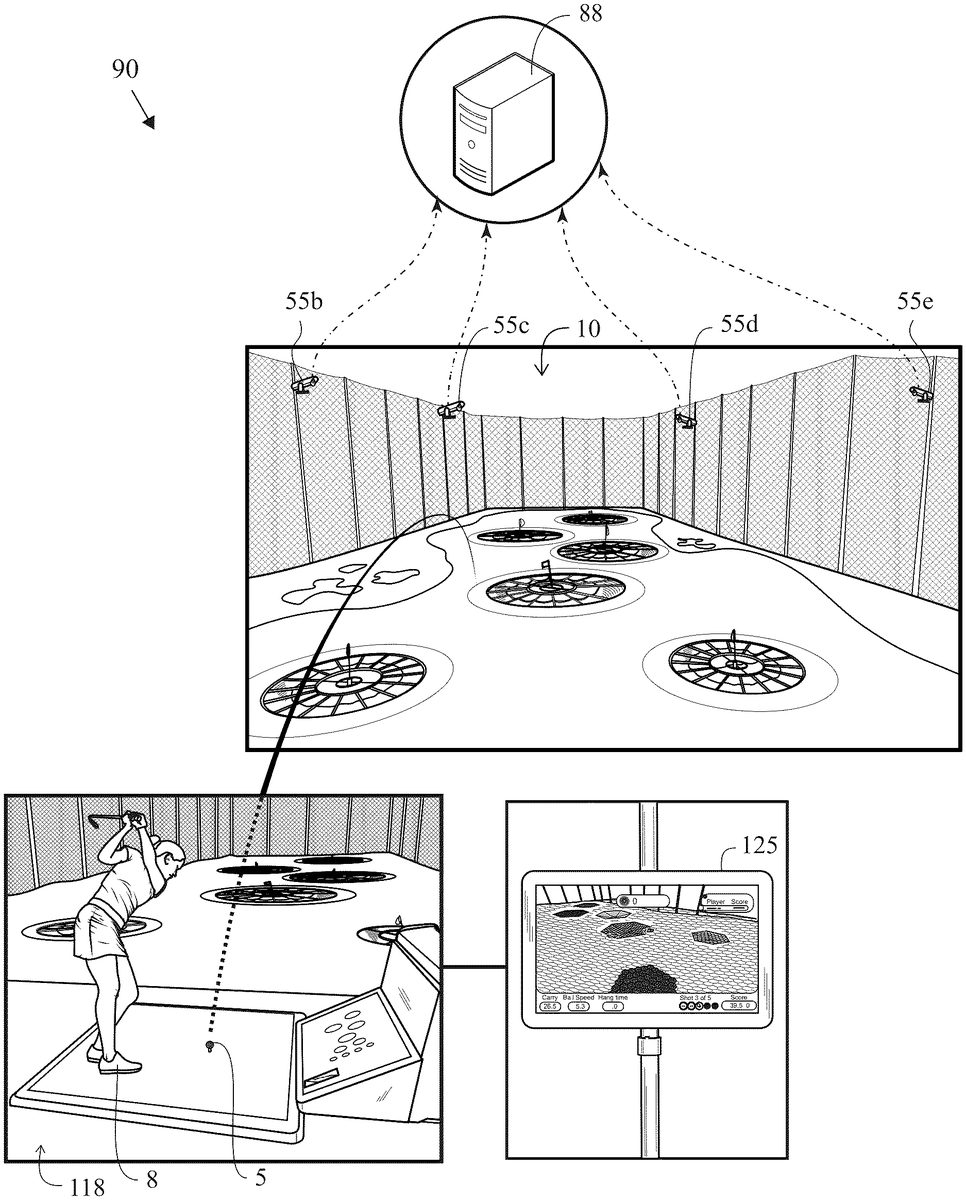
A system400for playing a player reactive game at a golf entertainment venue90is shown inFIG.16. The system includes golf ball tracking sensors55a-55fpositioned at the driving range, hitting bays118with a video display125in each bay118, and a server88. The server88communicates with each of the golf ball tracking sensors55a-55fand with each video display125a-125eof the hitting bays118a-118f. The server88detects the type of golf shot the player hit and tracks the progress of different shot types. The server88modifies the gameplay based on the shot types detected, and then celebrates the shot types in different ways.
The server88transmits feedback, such as effects of the shot type, to the player in a way that creates an overall more positive experience. The server88also generates bonus tiles corresponding to the tile previously virtually hit, and awards points if a bonus tile is hit.
The golf ball tracking sensors55are preferably camera sensors. Alternatively, they can be radar sensors.
A golf entertainment venue90is shown inFIG.17. In reference toFIG.16, the hitting bays118are in the building115portion of the venue90, facing the outfield10. Within each hitting bay118, there is a video display125from which a player plays the game. A ball5hit by a player8while playing the game is tracked by golf ball tracking sensors55. Preferably, at least two or more sensors. The player8is awarded with points for hitting virtual tiles, shown on the display125.
A flow chart500for a method for playing a player reactive game at a golf entertainment venue is shown inFIG.18. In step501, a game, created by tiles covering an entire virtual outfield of the golf driving range, is generated on a video display in a hitting bay. A player, from the hitting bay, hits shots of golf balls toward the outfield of the driving range in step502. The flight of each golf ball shot is tracked by the tracking sensors in step503. The type of golf shot hit by the player is detected in step504. In step505, feedback is transmitted to the player in a way that creates an overall more positive experience. In step506, player progress of different shot types is tracked. In step507, the gameplay is modified based on the shot types detected. Step508is celebrating the shot types in different ways.Thirkettle et al., U.S. Pat. No. 7,056,221 for a Ball Collection Arrangement, is hereby incorporated by reference in its entirety.Golliffe et al., U.S. Pat. No. 7,059,974 for Golf Balls With Impact Resistant Identification Device, is hereby incorporated by reference in its entirety.Thirkettle et al., U.S. Pat. No. 7,160,196 for an Identification Device, is hereby incorporated by reference in its entirety.Thirkettle et al., U.S. Pat. No. 7,337,965 for a Ball Identifying Device, is hereby incorporated by reference in its entirety.Savarese et al., U.S. Pat. No. 7,691,009 for Apparatus And Methods Relating To Findable Balls, is hereby incorporated by reference in its entirety.Savarese et al., U.S. Pat. No. 7,766,766 for Methods And Apparatus Relating To Findable Balls, is hereby incorporated by reference in its entirety.Cheng, U.S. Pat. No. 7,806,777 for Automatically Adapting Virtual Equipment Model, is hereby incorporated by reference in its entirety.Cheng, U.S. Pat. No. 7,847,808 for Photographic Mapping In A Simulation, is hereby incorporated by reference in its entirety.Savarese et al., U.S. Pat. No. 8,002,645 for Apparatus, Methods And Systems Relating To Findable Balls, is hereby incorporated by reference in its entirety.Cheng, U.S. Pat. No. 8,029,359 for Providing Offers To Computer Game Players, is hereby incorporated by reference in its entirety.Forsgren, U.S. Pat. No. 8,077,917 for Systems And Methods For Enhancing Images in A Video Recording of A Sports Event, is hereby incorporated by reference in its entirety.Caster et al., U.S. Pat. No. 9,132,326 for a System For Providing Loaner Clubs To Novice Golfers, is hereby incorporated by reference in its entirety.Forsgren, U.S. Pat. No. 10,596,416 for a System And Method For Three Dimensional Object Tracking Using Combination of Radar And Image Data, is hereby incorporated by reference in its entirety.Semsak et al., U.S. Pat. No. 10,799,770 for a RFID Golf Ball Testing Apparatus, is hereby incorporated by reference in its entirety.Johanssson et al., U.S. Pat. No. 10,898,757 for Three Dimensional Object Tracking Using Combination of Radar Speed Data And Two Dimensional Image Data, is hereby incorporated by reference in its entirety.Forsgren et al., U.S. Pat. No. 11,335,013 for Three Motion Based Pre-Processing Of Two-Dimensional Image Data Prior To Three-Dimensional Object Tracking With Virtual Time Synchronization, is hereby incorporated by reference in its entirety.Levin, U.S. Pat. No. 11,409,411 for a Single Finger User Interface Camera Control, is hereby incorporated by reference in its entirety.Johansson et al., U.S. Pat. No. 11,504,582 for Three Dimensional Object Tracking Using Combination of Radar Speed Data And Two Dimensional Image Data, is hereby incorporated by reference in its entirety.Stroud, U.S. Pat. No. 11,779,809, for a Method And System Utilizing A Golf Shot API Proxy, is hereby incorporated by reference in its entirety.Burdette, U.S. patent application Ser. No. 18/202,178, filed on May 25, 2023, for a Golf Ball Identification Apparatus And System, is hereby incorporated by reference in its entirety.Burdette et al., U.S. Patent Publication Number 20220203178, for a Golf Ball Dispenser With Embedded Display Device, Separate Front waterfall And/Or Blower Assembly, is hereby incorporated by reference in its entirety.Ekstrom et al., U.S. Pat. No. 11,786,783 for Identifying A Location For A Striker Of An Object, is hereby incorporated by reference in its entirety.Eriksson et al., U.S. Pat. No. 11,815,618 for Doppler Radar Coexistence, is hereby incorporated by reference in its entirety.Wase, U.S. Pat. No. 11,934,085 for a Camera Mounting Post, is hereby incorporated by reference in its entirety.Burdette et al., U.S. Pat. No. 11,944,883, for a Galton Configuration In Golf Ball Receiving Apparatus And Systems, is hereby incorporated by reference in its entirety.Forsgren et al, U.S. Pat. No. 11,995,846 for Three Dimensional Object Tracking Using Unverified Detections Registered By One Or More Sensors, is hereby incorporated by reference in its entirety.Medcalf, U.S. patent application Ser. No. 18/750,683, filed on Jun. 21, 2024, for a RFID And Trace Pairing, is hereby incorporated by reference in its entirety.Medcalf, U.S. patent application Ser. No. 18/751,522, filed on Jun. 24, 2024, for Data Generated Outfields, is hereby incorporated by reference in its entirety.Medcalf, U.S. patent application Ser. No. 18/750,251, filed on Jun. 21, 2024, for a Bounce & Roll Engine, is hereby incorporated by reference in its entirety.
From the foregoing it is believed that those skilled in the pertinent art will recognize the meritorious advancement of this invention and will readily understand that while the present invention has been described in association with a preferred embodiment thereof, and other embodiments illustrated in the accompanying drawings, numerous changes, modifications and substitutions of equivalents may be made therein without departing from the spirit and scope of this invention which is intended to be unlimited by the foregoing except as may appear in the following appended claims. Therefore, the embodiments of the invention in which an exclusive property or privilege is claimed are defined in the following appended claims.
Claims
- A system for playing a player reactive game at a golf entertainment venue, the system comprising: a plurality of golf ball tracking sensors positioned at a golf driving range;a plurality of hitting bays at the golf driving range, each of the plurality of hitting bays having a video display;and a server in communication with each of the plurality of golf ball tracking sensors and each video display of the plurality of hitting bays;wherein the server is configured to detect a type of golf shot the player has hit by performing the following steps, determining what shot types should be detected, gathering the shot characteristics that make up the shot types determined, developing a procedure that compares the determined shot types with the player's shot and informing the game, and reacting to the detected shot type in-game;wherein the server is configured to transmit positive feedback to the player;wherein the server is configured to track a progress of different shot types;wherein the server is configured to modify gameplay based on the shot types detected;and wherein the server is configured to celebrate shot types in different ways;wherein the game comprises a plurality of tiles covering an entire virtual outfield of the golf driving range, wherein a golf ball hit by a player at a hitting bay while playing the game is tracked by at least a pair of the plurality of golf ball tracking sensors and the player is awarded with points for virtually hitting tiles of the plurality of tiles.
- The system according to claim 1 wherein the server is configured to generate a plurality of bonus tiles corresponding to tile previously virtually hit by the player.
- The system according to claim 2 wherein the serve is configured to award the player with extra points if a bonus tile is hit in the virtual game.
- The system according to claim 1 wherein the plurality of tiles comprises from 10,000 to 20,000 tiles.
- The system according to claim 1 wherein each of the plurality of golf ball tracking sensors is a camera sensor.
- The system according to claim 1 wherein each of the plurality of golf ball tracking sensors is a radar sensor.
- The system according to claim 1 wherein each tile is a hexagon, square, circle, diamond, triangle, rectangle or polygon.
- The system according to claim 1 wherein each of the tiles is the same size.
- The system according to claim 1 wherein each tile has a representative width ranging from 0.1 meter to 10 meters in the virtual outfield.
- A method playing a player reactive game at a golf entertainment venue, the method comprising: generating a game on a video display in a hitting bay of a plurality of hitting bays of a golf driving range, wherein the game comprises a plurality of tiles covering an entire virtual outfield of the golf driving range hitting, by a player, a plurality of shots of golf balls toward the outfield of the golf driving range from the hitting bay of the plurality of hitting bays of the golf driving range;tracking a flight of each shot of golf balls using a plurality of golf ball tracking sensors positioned at a golf driving range;detecting a type of golf shot the player has hit by determining what shot types should be detected, gathering the shot characteristics that make up the shot types determined, developing a procedure that compares the determined shot types with the player's shot and informing the game, and reacting to the detected shot type in-game;transmitting positive feedback to the player;tracking a player progress of different shot types;modifying gameplay based on the shot types detected;and celebrating shot types in different ways;wherein the game comprises a plurality of tiles covering an entire virtual outfield of the golf driving range, wherein a golf ball hit by a player at a hitting bay while playing the game is tracked by at least a pair of the plurality of golf ball tracking sensors and the player is awarded with points for virtually hitting tiles of the plurality of tiles, and the method further comprises generating a bounce and roll prediction at the server for the tracked golf ball;and combining, at the server, a trace of the flight of the golf ball and the bounce and roll of the golf ball to generate a complete shot of the golf ball in the game.
- The method according to claim 10 wherein the plurality of tiles comprises from 1000 to 50,000 tiles.
- The method according to claim 10 wherein the plurality of tiles comprises from 10,000 to 20,000 tiles.
- The method according to claim 10 wherein each tile is each tile is a hexagon.
- The method according to claim 10 wherein each of the plurality of golf ball tracking sensors is a camera sensor.
- The method according to claim 10 wherein each of the plurality of golf ball tracking sensors is a radar sensor.
- The method according to claim 10 wherein each tile is a square, circle, diamond, triangle, rectangle or polygon.
- The method according to claim 10 wherein each of the tiles is the same size.
- The method according to claim 10 wherein each tile has a representative width ranging from 0.1 meter to 10 meters in the virtual outfield.
Disclaimer: Data collected from the USPTO and may be malformed, incomplete, and/or otherwise inaccurate.