U.S. Pat. No. 12,226,700
VIDEO GAME FOR ENABLING REVERSAL OF POTENTIALLY-REVERSIBLE REAL-WORLD HEALTH CONDITIONS OF PLAYERS
AssigneeJennifer Kraly
Issue DateNovember 30, 2018
Illustrative Figure
Abstract
A system and method may include generating, by a computing system, a list of selectable challenge factors for a player to select one or more challenge factors when playing a video game. The player may be provided with the ability to set a plan for each of the challenge factors. A protocol inclusive of the planned challenge factors may be established to be achieved over a time period. A player interface may be displayed for the player of the video game, where the player interface may show the protocol inclusive of at least a portion of the planned challenge factor(s) along with corresponding input elements associated with each planned challenge factor for the player to account for the planned challenge factors by submitting whether or not the player achieved each of the respective planned challenge factors. Achieving the planned challenge factor(s) causes a health condition to be reversed.
Description
DETAILED DESCRIPTION OF THE DRAWINGS Overview of Video Game System Definition of a Video Game According to the Wikipedia page titled, “Video Game,” “[a] video game is an electronic game that involves human interaction with a user interface to generate visual feedback on a video device. The word ‘video’ in ‘video game’ traditionally referred to a raster display device, but it now implies any type of display device that can produce two- or three-dimensional images. The electronic systems used to play video games are known as platforms; an example of a platform is a personal computer.” Definitions of “video game” in other treatises are similar in scope. The PRHC Video Game within the Universal Set of Video Games In short, the PRHC reversal system enables people with PRHCs to not only reverse and/or prevent their targeted PRHCs, but also have fun in the process. As understood, people in general enjoy playing video games. As a video game, the innovation fits within the definition of a video game and falls within multiple video game categories. Video games appeal to a wide range of individuals, and, therefore, serve as a potentially powerful medium by which to capture the interest of large numbers of people. In addition to serving as a source of entertainment, video games provide an extensive range of player experiences delivered and/or supported by digital technology. Player experiences supported by digital technology may include player experiences performed in the real world as a part of the game. By contrast, player experiences delivered by digital technology typically refer to player experiences performed in a fictional world. Regarding the subject PRHC reversal platform, digital technology to both support and deliver player experiences for the purpose of enabling the player to achieve and maintain good health is used. That is, the PRHC reversal ...
DETAILED DESCRIPTION OF THE DRAWINGS
Overview of Video Game System
Definition of a Video Game
According to the Wikipedia page titled, “Video Game,” “[a] video game is an electronic game that involves human interaction with a user interface to generate visual feedback on a video device. The word ‘video’ in ‘video game’ traditionally referred to a raster display device, but it now implies any type of display device that can produce two- or three-dimensional images. The electronic systems used to play video games are known as platforms; an example of a platform is a personal computer.” Definitions of “video game” in other treatises are similar in scope.
The PRHC Video Game within the Universal Set of Video Games
In short, the PRHC reversal system enables people with PRHCs to not only reverse and/or prevent their targeted PRHCs, but also have fun in the process. As understood, people in general enjoy playing video games.
As a video game, the innovation fits within the definition of a video game and falls within multiple video game categories.
Video games appeal to a wide range of individuals, and, therefore, serve as a potentially powerful medium by which to capture the interest of large numbers of people. In addition to serving as a source of entertainment, video games provide an extensive range of player experiences delivered and/or supported by digital technology. Player experiences supported by digital technology may include player experiences performed in the real world as a part of the game. By contrast, player experiences delivered by digital technology typically refer to player experiences performed in a fictional world. Regarding the subject PRHC reversal platform, digital technology to both support and deliver player experiences for the purpose of enabling the player to achieve and maintain good health is used. That is, the PRHC reversal platform uses digital technology to support player experiences by, for example, helping the player organize, commit to, and manage various player experiences performed in the real world as a part of a video game; such experiences include creating, developing, and adhering to a reversal protocol—i.e., a protocol designed to enable the player to reverse one or more of his or her potentially-reversible health conditions. The platform uses of digital technology to deliver player experiences by, for example, applying algorithms and presenting high-quality graphics to help the player suspend disbelief and, in essence, “pretend” that various game-specific concepts (e.g., “challenge factors,” “missions,” “sub-missions”), elements (e.g., points, praise), and characters (e.g., player and non-player characters), are real.
In terms of its placement within the universal set of video games, the PRHC reversal platform falls into the video game subcategory of “serious video games,” and, within the serious video games category, it falls into the category of “healthcare” and the subcategory of serious video games for health, otherwise referred to as “health games.” As understood in the art, a serious video game is a type of video game that attempts to entertain and change the player; such changes may include changes in the player's attitudes, beliefs, perception of risk, knowledge, skills, and/or behavior. Thus, serious video games have dual and seemingly disparate goals: 1) to be fun, and 2) to produce important or “serious” outcomes. The serious video games described as health games are those designed to entertain the player and, at the same time, change his or her health behavior(s). Changing health behaviors typically refers to changing behaviors associated with eating, lifestyle, and/or stress-related activities; such changes often boil down to breaking sets of bad habits and developing sets of good ones. The innovation focuses not only on entertaining the player and changing his or her health behaviors, but also on motivating and training the player to want to engage in various health behaviors, including, for example, systematic health behavior-related planning, and the systematic reporting of the extent to which behavior-related plans were carried out or “matched.”
A subset of games within the health games category focuses on the management of chronic diseases such as type 2 diabetes. That said, no subset of games within the health games category focuses on the reversal of chronic diseases, despite the fact that many such conditions, including type 2 diabetes, are potentially reversible. Furthermore, the existing chronic disease-related health games that include player experiences performed in the real world as a part of the game do not incorporate the expert knowledge, player autonomy, motivational elements, and organization used to make reversal and/or prevention of the (re)occurrence of one or more PRHCs the goal of a game.
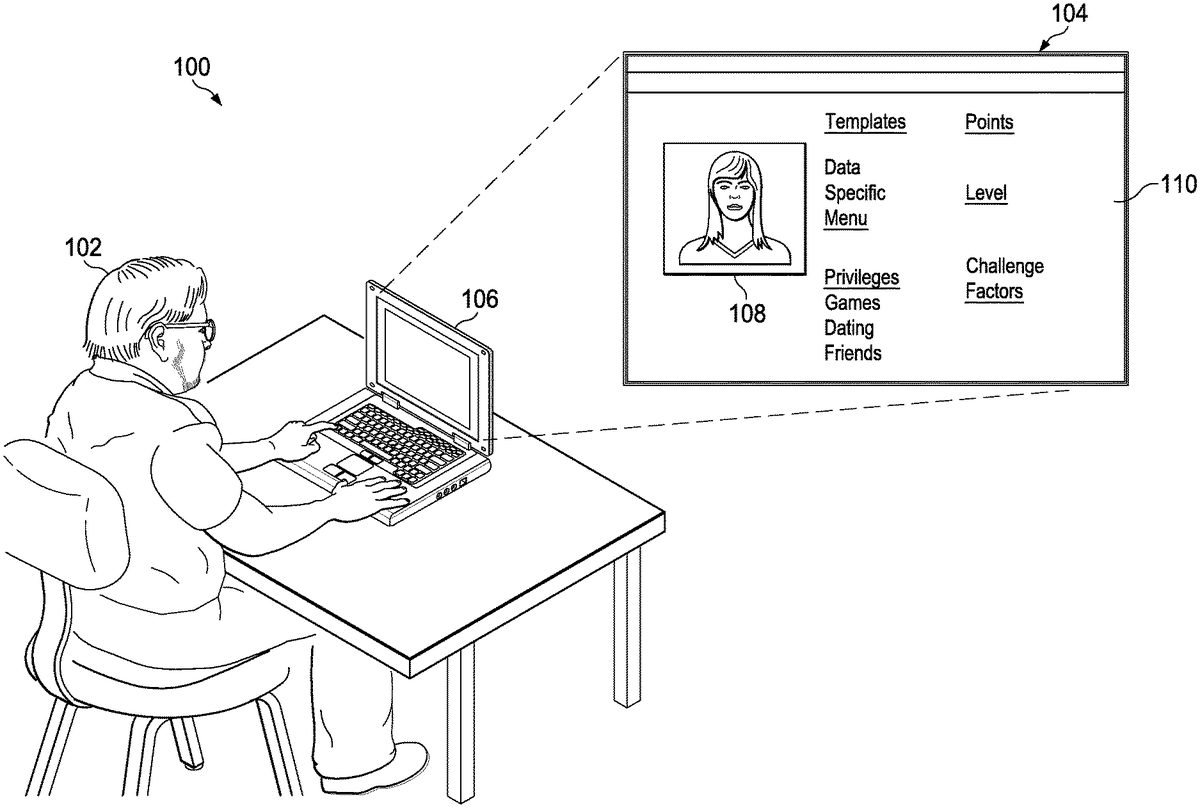
As depicted inFIG.1, an illustration of a video game environment100includes a user102playing a video game104on an electronic device, in this case a computer106. The video game104may be designed to enable a player to reverse or prevent one or more potentially-reversible, non-communicable, lifestyle-related health conditions (PRHCs), such as type 2 diabetes, is shown.
Plan Builder
As shown onFIG.2, a standard reversal protocol200may be comprised of various standard protocols that define rules or processes by which the player is to adhere when playing the video game. The standard reversal protocol200may include a standard eating protocol202, a standard lifestyle protocol204, and a standard medical oversight protocol206. One or more respective sets of challenge factors CF1-CFNmay be associated with each of the protocols202,204, and206and used by the video game104ofFIG.1for gaming purposes.
In operation, the player creates each protocol by interacting with the video game104and entering plan information. In the video game104, the player may engage in missions that include planning and enacting various reversal-related behaviors in real life. More specifically, the player may (1) choose individual system-provided, selectable behavior-related challenges or “challenge factors” on which to focus (e.g., adhering to a bedtime and rise time schedule), (2) personalize each challenge factor with a specific plan (e.g., going to bed every day by 10:00 pm, and getting up every day at 6:00 am) using a system provided plan builder, and (3) enact those challenge factor plans in real life (i.e., the player is to perform the challenge factors). Such plans combine to form what is referred to herein as the player's standard reversal protocol200and may be identified by the system. Each protocol may be defined by a period of time, such as days and/or dates specified. It should be understood that the challenge factors described above for each of the protocols are illustrative, and that other challenge factors may be utilized.
To reverse a player's PRHC, the player develops and follows his or her standard reversal protocol200over time. To develop the standard reversal protocol200, the game provides the player with an array of challenge factors CF1-CFNthat the player may consider including as part of the protocol, and tools designed to help the player create, carry out, and further develop the protocol over time. More specifically and as a part of the game, the player has the power to make the protocol more or less challenging based on the speed at which s/he wants to reverse. The player also has the power to revise the protocol from time to time (e.g., weekly). In the end, success depends on the player's ability to balance his or her ambition (the speed at which he or she wants to reverse his or her PRHC) against his or her developing ability to carry out the protocol provided for in the game. The more ambitious the protocol and the closer the player follows the protocol, the more game rewards and privileges the player earns, which results in more opportunities the player has to further develop the protocol (e.g., add new challenge factors), which results in the greater the likelihood that the player will reverse his or her PRHCs sooner rather than later or at all. The video game may serve as an augmented reality for the player, thereby causing the player to reverse his or her PRHC though success in the video game, which reduces or eliminates typical mental stress that often comes with an individual trying to reverse his or her PRHC.
To motivate the player102to continually perform challenge factor plans in real life, the video game104provides the player with opportunities to earn points, receive virtual awards, and enjoy various privileges as a result of the player being successful in real life achievements. As an example, a player who follows a meal plan as set forth in the video game may cause the player to account for achieving or not achieving challenge factor plans, etc., which, in turn, may cause a representation of the player to achieve improved health or a certain performance level or skill, or to achieve rewards of its own.
As noted above, a player representation108(e.g., virtual character) in the video game104may benefit as a result of the player's successful achievement of game-related real world actions. The representation108may be set forth in non-graphical terms, as well. In an embodiment, functional of the representation of the player may be altered, where the functionality may include changing operation of a virtual character, altering the ability for the representation of the player to access additional challenge factors, changing player feedback data being presented to the player, providing the representation of the player the ability to access additional and/or alternative areas within the video game104, and so forth. The video game104benefits to the player may include earning points110, receiving virtual awards, achieving higher levels, and receiving privileges (e.g., access to new areas of the video game or video game affiliates). Specifically, earned points110provide feedback to the player, enabling him or her to determine how to proceed. Additionally and under certain conditions, earned points in the form of credits may be redeemed for actual products and services. Such credits may also be used by the player to enable friends and family to join in and play the reversal game for themselves for free or at a discounted rate. And, in addition to points, virtual awards, such as trophies and badges, may be awarded to the player; such awards may be received based upon the achievement of various behavior-related milestones.
Video Game System Architecture
FIG.3is a diagram of an illustrative video game network environment300inclusive of medical professional devices302a-302b, reversal specialist devices302c-302d, and user or player devices302e-302f(collectively302) that may access a video game system server304via a communications network306. The video game system server has a processing unit308that executes software310to provide for the features and functions (e.g., modules) described herein. The processing unit308may be in communication with a memory312, input/output unit314, and a storage unit316that store one or more data repositories318. It should be understood that the processing unit308, memory312,110unit314, and storage unit316may be particularly configured when executing software to perform the video game and other functionality, as described herein. The devices in communication with the video game system server may be desktop computers, laptop computers, mobile devices, such as tablets and smart phones, or any other networked electronic device. The server304may host a website, gaming interface or otherwise for users of the devices to access via the network.
FIG.4is a diagram illustrative of an illustrative video game architecture400depicting user or player devices302e-302faccessing player interface or player interface engine402and associates (e.g., reversal specialists) devices302c-302daccessing an associates interface404over the communications network306. Interfaces402and404may access system services406to perform data transformations, provide gaming functionality, store data, and retrieve data using server data repositories318, which may be in the form of a database, such as a relational database. This architecture400may support any number of interfaces with interfaces402and404being illustrative. In this way, the flexible, scalable architecture allows the system to serve the needs of a large player population.
The video game system may be set up to support up to millions of players to play simultaneously. The video game system may operate within the context of an individualistic structure, a competitive structure, and/or a cooperative structure, as further described herein.
FIG.5is an illustration depicting modules500used by the video game. The modules500may include video game set-up modules502, user interface execution modules504, generator modules506, and adaptive learning modules508that may interact with the system database modules510. The modules500are utilized by players and support the video game to assist the player in reversing his or her PRHC.
The setup modules502may include a collector module512configured to collect player information, including demographic information, likes/dislikes related to eating and lifestyle, and medical history information. The collector module512may be configured to display one or more graphical user interfaces that provide for listings of selectable information for the player to provide for his or her demographic information, likes and dislikes related to eating and lifestyle, and medical history. The information collected by the collector module512may be stored in a data repository in association with the player, and used during gaming operations, including establishing challenge factors.
The data collected by the setup modules502may be communicated to the platform database modules510. The platform database modules510may be used to store recipes, menus, favorites, likes/dislikes, lifestyles/activities, protocols (current/archive), results, and family/friends. The platform database modules510may be configured to store and access the data stored in data repositories associated with each of the users. As an example, a recipe module may be configured to access recipes stored in the data repository. The video game may thereafter access the recipes that are consistent with or match a player's food likes to be included in a menu for a meal on a particular day. The platform database modules510may manage data associated with the player, and update the data while the player is playing the video game. As an example, as a result of the player's achieving certain challenge factors, the results platform database module of the platform database modules510may update the database with the player's achievement.
The challenge factor selector module514may enable the user to establish challenge factors. The challenge factors may include eating challenge factors, lifestyle challenge factors, and medical oversight challenge factors. The challenge factor selector module514, in response to receiving the desired challenge factors for the player, may select challenge factors to be set and stored in a data repository in association with the player. In an alternative embodiment, the challenge factor selector module514may be configured to enable the user to allow for the video game to automatically select the challenge factors for the player. In selecting the challenge factors for the player, the challenge factor selector module may utilize the demographic information, likes/dislikes related to eating and lifestyle, and medical history in making the selections that are appropriate for the player. If the player is to select his or her challenge factors, then the video game may present available challenge factors for the player to select may be based on the player's demographic information, likes and dislikes, and medical history.
The generator modules506may be configured to generate a profile and calendar for the player. In generating the profile and calendar, the generator modules506may receive data collected by the collector module512and challenge factor selector module514so that the generator modules506may generate the player profile and calendar. The player profile may be inclusive of the player's demographic information, likes and dislikes related to eating and lifestyle, and medical history. The calendar may include meals, challenge factors, medical appointments, exercise, specialist visits, family member participation, and any other information related to the video game in which the player is to engage while playing the video game.
The user interface/execution module504may include a profile module516that enables the user to create and/or edit his or her profile through a user interface that the profile module516may be configured to create. A plan module518may be configured to enable the user to generate his or her plan by which the video game is to use for establishing and monitoring player standard reversal protocols200. The plan module518may store the player's standard reversal protocol200in the server database318. A plan module518may be used in establishing an eating plan, calendar, and/or other plan, for example, and be used to establish challenge factors. An earn points module520may be configured to enable the player to earn points while playing the video game. The earn points module520may receive and respond to the player when he or she submits that a challenge factor has been completed or has not been completed. In an embodiment, the player may be able to earn points as recorded by the earn points module520by successfully completing actions, tests (e.g., quizzes about reversal activities, ingredients, meals, exercise, blood glucose levels, etc.), virtual video game activities (e.g., preparing and cooking virtual meals), or otherwise. In an embodiment, if an electronic device, such as a wearable electronic device, measures a player's exercise, sleep patterns, or otherwise, then the earned points module520may use measurement data collected by the electronic device to automatically determine whether or not the player earn points in the video game (e.g., if the player took 10,000 steps, the player achieves a challenge factor; if the player went to sleep before 10 pm, the player achieves a challenge factor).
Test results input modules522may enable a medical professional, the player, they reversal specialists, or otherwise to submit test results. The test results may include a variety of different tests, including blood tests, fitness tests, weight tests, or any other test that is able to show improvement as a result of playing the video game and completing challenge factors.
A use points module524may enable the player102and the video game system to use points in a variety of ways. The video game system may provide for a number of different point types.
Effort points: Effort points may represent effort that the player invests in order to achieve reversal. Total effort points provide a crude measure of the players' effort over a period of time and compared to other players. Effort points may include challenge factor points.
Challenge Factor Points: Challenge factor points may represent protocol-related effort. Challenge factor points may include accounting points and achievement points. In an embodiment, the player may earn an accounting point each time he or she reports whether or not he or she successfully achieved a particular challenge factor action. The player may earn an achievement point each time he or she reports having successfully achieved a particular challenge factor action.
Achievement points: Achievement points may represent challenge factor actions the player achieved or “matched.” The game may use the terms “achieve” and “match” interchangeably for the reason that to achieve a challenge factor action is to meet or “match” a challenge factor plan that defines that action. In the game, some matches may be determined by the system, and other matches may be determined by the player. For example, one challenge factor action may be for a player to enter a daily to-do list no later than 6:00 pm the night before into the video game system; in this example, the game determines if a match occurs based on whether or not a daily to-do list was entered by the deadline as defined by the rules of the game.
Automatic analyses performed by the system analyzing the player's planned or “potential” challenge factor points versus the player's achieved or “actual” challenge factor points may produce statistics describing the player's level of adherence in terms of percentages. The video game may use these statistics to enforce the rules of the game. The video game may also use the statistics of the player as feedback to enable the player to assess his or her current status as he or she works toward winning each of the game's missions. As defined by the rules of the game, adherence to a reversal protocol, or to one or more protocol elements, may involve (i) acknowledging or “accounting for” one's action and inaction via physical reporting (e.g., paper reporting) or electronic reporting (e.g., a web-based reporting system), and (ii) acting in accordance with a reversal protocol or to one or more protocol elements to a measurable extent.
The player may use total accounting points, total achievement points, and/or total effort points to compare his or her level of effort from period to period (e.g., from day to day, week to week, year to year) or to compare his or her own level of effort with the levels of effort of other players. The game may also use players' challenge factor points in order to calculate players' handicaps which, in turn, enable players of various levels of experience to compete against one another. The competition may range from a general comparison of relative achievement points (e.g., friends or social group comparing their weekly challenge factor efforts) to serious competition between players that may be used to earn additional points and/or prizes.
A community module526may be used to establish a player's community. The community modules526may include a household module528that may establish and maintain interaction with household members of the player, social network module530that may be used to maintain communication with a players social networks, and competition module532that may enable the player to engage in competition, including games, tournaments, or other gaming interactions via the video game. Each of these community modules526may be used to encourage the user to succeed in playing the video game. In one embodiment, household members that are able to interact with the video game via the household module528may help the player achieves challenge factors. As an example, the household members may perform an activity, such as participating in a challenge factor (e.g., walking a mile in each day of the week with the player), and that participation may be recorded as a successful challenge factor, which helps the player in the video game. Friends of the player who interact with the video game via the social network module530may also help the player achieves challenge factors by the friends participating in certain activities and recording those activities via the social network module530user interface of the video game.
Adaptive learning modules508may be configured to access data being generated by each of the players using the video game to determine which players are reversing their PRHC when achieving their challenge factors and which are not reversing their PRHC despite achieving their challenge factors. The adaptive learning modules508may, in response to learning that certain players are reversing and other are not reversing their PRHC, learn to determine how players who have similar characteristics can reverse their PRHC. As an example, the learning algorithms may identify players with similar lifestyles, physical characteristics (e.g., blood types), work lives, and so forth and establish challenge factors that have worked for other players in reversing their PRHC, thereby optimizing the ability and speed of reversal of PRHC for the players. The use of K-nearest neighbor and other learning algorithms may be used as part of the video game and adaptive learning modules508.
Relational databases on the server database318may store the data used by the video game. The server database318may store transactional data that the system functionality uses to present information to and save information from the player. The data may include charts, reports, statistics, analyses, and machine learning. A regularly-occurring process may transform the transactional data in the server database318into the data formats in the data warehouse. TABLE I below describes data that may be stored in the server database318, and be used by the video game that, in part, aids in reversal of PRHC of the players thereof.
TABLE IRelational Databases Used by Video Game1. Data Warehousea. Reversal Chartsb. Other Results Chartsc. KNNd. ERT2. Operational Data Store Tables and Fields (all tables have a notshown ID field)a. Playersi.First nameii.Fast nameiii.Email addressiv.Accounting point totalv.Completion point totalvi.Bonus point totalvii.Start dateviii.Subscription levelix.Last active dateb. Players-to-players relationships (Players' community)c. Point Transactionsi.Dateii.Timeiii.Player IDiv.Point amountv.Point typevi.Before balancevii.After balanceviii.Challenge factor IDd. Challenge Factorsi.Nameii.Domainiii.Categoryiv.Time component typev.List component typevi.Is leveledvii.Is householde. Player Challenge Factorsi.Player IDii.Challenge factor IDiii.Active dateiv.Active weekv.Ambition levelvi.Planf. Player Representationi.Player IDii.Nameiii.Facial expressioniv.Health statusg. Trophiesi.Player IDii.Typeiii.Dateh. Eligibilitiesi.Player IDii.Active dateiii.Eligibility type (dating site)i. Player Goalsi.Player IDii.Goal type (prevention, reversal)iii.Condition IDiv.Start date
Detailed Descriptions of Certain Tool and Module Functionality
Game Engine
FIG.6is a diagram of an illustrative game engine600. The game engine600may include a set of background processes in the system that may enforce rules of the game and make automatic updates to the game state. The following sets of components may define the game engine: meter calculation components602, engine component604, and automatic update components606. Additional and/or alternative components may be utilized, as well, such as player interface engine components that enable the user to interface with the system.
Each of the meter components602has a different algorithm for calculating a numeric value (0 to 100, for example) for the player102. Numeric values may be rounded to the nearest whole number before each meter's numeric value is stored in the server database318. The meters provided by the video game system may include a planning consistency meter608, an accounting consistency meter610, a matching meter612, an ambition meter614, a non-wildcard meals meter616, a non-wildcard days meter618, an intentionality meter620, and a flow meter622.
Planning Consistency Meter
The Planning Consistency Meter component608may calculate the amount of planning consistency of the player102. Consistency in planning is used by the player102to establish a working standard reversal protocol200. A numeric value for the Planning Consistency Meter may be calculated by comparing the player's eating, lifestyle, and medical oversight plans for a current week against a previous week's plans. In one embodiment, plans that are totally consistent may result in a numeric value of 100. The algorithm may consider each planned item for the current week and identify the exact same planned item in the previous week's plans, disregarding the date property of the two items. To calculate the numeric value of the Planning Consistency Meter, the algorithm may count the found planned items, divide that number by either the number of the current week's total planned items or the number of the previous week's total planned items, whichever is higher, and multiply the quotient by 100. For example, if a player102has ten items planned the previous week, and nine of these items appeared on the current week's schedule, the numeric value stored is 90. Alternative algorithms may be utilized, as well.
Accounting Consistency Meter
The Accounting Consistency Meter component610may calculate the player's amount of behavioral accounting over the past seven or other number of days. Accounting for behaviors helps the player102make adjustments to eating and lifestyle behaviors since the player102is to recognize his or her behaviors in order to change those behaviors. The numeric value for the Accounting Consistency Meter610is calculated by comparing the player's challenge factor CF1-CFNamount and the amount of accounting points earned and be averaged for the past seven days, for example. For the past seven days, the algorithm divides the number of accounting points earned for the day by the player's number of challenge factors CF1-CFN. To calculate the Accounting Consistency Meter numeric value, the algorithm may multiply the average of the quotients by 100. For example, if the player102earned these accounting points for the last seven days: 6, 16, 10, 15, 8, 20, 15; and if the player102had these challenge factor amounts for the last seven days: 12, 32, 10, 15, 16, 20, 15; on three days, the player102accounted for half of his or her challenge factors CF1-CFN, and accounted for all of them on the other four. Therefore, the numeric value stored would be the rounded average of 0.5, 0.5, 1, 1, 0.5, 1, and 1 times 100 for a result of 79.
Matching Meter
The Matching Meter component612may calculate the player's completion amount of planned behaviors. To properly reverse PRHCs, the player102may complete planned behaviors. The numeric value for the Matching Meter may be calculated by comparing the player's potential point amount and the amount of points earned, averaged for the past seven days. For the past seven days, the algorithm divides the amount of points earned for the day by the player's amount of potential points. To calculate the Matching Meter numeric value, the algorithm may multiply the average of the quotients by 100. For example, if the player102matched this many behaviors for the last seven days: 12, 24, 7, 15, 8, 20, 15; and if the player102had these challenge factor amounts for the last seven days: 12, 32, 10, 15, 16, 20, 15; the numeric value stored is 85 or the rounded average of 1, 0.75, 0.7, 1, 0.5, 1, and 1 times 100.
Ambition Meter
The Ambition Meter component614may calculate the player's self-reported level of ambition regarding his or her current set of challenge factors. The ambition meter614allows the player102to correctly interpret his or her behavioral outcomes. For example, a highly ambitious player102may be able to see that although they only matched 50% of their behaviors, he or she can see his or her actions in the context of being highly ambitious. The numeric value for the Ambition Meter may be calculated by comparing the player's highest possible ambition level and the player's actual ambition level. The highest possible ambition level may be three multiplied by the amount of ambition-rating responses gathered from the player102for challenge factors where a corresponding event is on the player's schedule for the current week. The actual ambition level may be a total of the player's scored ambition-rating responses for challenge factors where a corresponding event is on the player's schedule for the current week. Ambition-rating responses may be scored as one for low ambition, two for medium ambition, and three for high ambition. The algorithm may divide the player's actual ambition level by the player's highest possible ambition level. To calculate a numeric value of the Ambition Meter, the algorithm may multiply the quotient by 100. For example, if the player102had supplied these ambition-rating responses for challenge factors, where a corresponding event is on the player's schedule for the current week: low, medium, high, low, medium, high, and medium; these would be scored as 1, 2, 3, 1, 2, 3, and 2; and the stored numeric value would be 67 or 0.666 (14 divided by 21) times 100, rounded. Each month, or other time period, the system may ask the player102to rerate the ambition level associated with each active challenge factor.
Non-Wildcard Meals Meter
The Non-Wildcard Meals Meter component616calculates how many of the player's recent meals did not include wildcards. Reducing the consumption of wildcards per meal may improve reversal of PRHCs. The numeric value for the Non-Wildcard Meals Meter616is calculated by comparing the player's number of meals that included wildcard foods and the amount of meals that did not, and be averaged for the past seven days. For the past seven days, the algorithm may divide the number of meals that did not include wildcard foods for the day by the player's number of meals. To calculate the Non-Wildcard Meals Meter numeric value, the algorithm may multiply the average of the quotients by 100. For example, if the player102had 20 meals in the last seven days, and 15 of them did not include wildcard foods, the stored numeric value is 75.
Non-Wildcard Days Meter
The Non-Wildcard Days Meter component618calculates how many of the player's recent days did not include wildcards. Reducing the consumption of wildcards overall may improve reversal of PRHCs. A numeric value for the Non-Wildcard Days Meter may be calculated by comparing the player's number of days that included wildcard foods and the number of days that did not, and be averaged for the past seven days. For the past seven days, the algorithm may divide the amount of days that did not include wildcard foods by seven. To calculate the Non-Wildcard Days Meter numeric value, the algorithm may multiply the quotient by 100. For example, if the player102did not have wildcards on five of the past seven days, the stored numeric value is 71.
Intentionality Meter
The Intentionality Meter component620may calculate the percentage of the amount of time in a given week that the player102has scheduled items for (potential versus actual planning amount). For the current week, the algorithm may divide the number of minutes in all of the schedule items by 10,080. To calculate a numeric value for the Intentionality Meter, the algorithm may multiply the quotient by 100. For example, if the player's current week's schedule had schedule items totaling 5,040 minutes, the stored numeric value is 50.
Flow Meter
The Flow Meter component622may be used to calculate and generate a flow meter, and may calculate the player's quality of his or her current experience playing the video game. A high value of the Flow Meter may mean that the player102is doing the best he or she can to reverse his or her PRHCs. A low value of the Flow Meter may mean that the player102should make adjustments to his or her standard reversal protocol200or behavior to get on track towards reversal and to improve the state of the representation of the player102(e.g., a player's character). The numeric value for the Flow Meter may be calculated using the player's matching level and the amount of challenge factors CF1-CFN recently added, until the player102begins to reverse his or her PRHCs. After which, a value of the Flow Meter may be calculated by the same method as the numeric value of the Matching Meter. Before the player102reverses his or her PRHCs, two values may be added together to calculate the numeric value of the Flow Meter. In one embodiment, the first value is the Matching Meter numeric value divided by two. For the second value, a number of new challenge factors the player102added for the current week divided by the amount of new challenge factors the player102could have potentially added for the current week. The second value may be this quotient multiplied by 100. Adding these two values results in the Flow Meter numeric value. For example, if a player102had the opportunity to add four challenge factors but only added two, and the player's Matching Meter numeric value is 80, the stored Flow Meter numeric value is 65.
Character Profile Engine
Another component of the game engine600is a Player Representation Profile Engine624, which are part of the engine components604. The Player Representation Profile Engine624may automatically update data about the game-controlled player character, which may be displayed on the player's profile.
When the Accounting Consistency Meter numeric value is lower than a threshold level, such as 50 percent, the Player Representation Profile Engine624may store, in the server database316, a frowning game-controlled player character image and a corresponding negative character message (for example, “I'm depressed. I had a lot of things to get done that I didn't get done.”). When the numeric value of the Accounting Consistency Meter is at or above a threshold level, such as 50 percent or greater, the Player Representation Profile Engine624may store, in the server database316, a smiling game-controlled player character image and a corresponding positive character message (for example, “I got a lot accomplished.”). It should be understood that additional and/or alternative character images, static or dynamic, may be utilized.
When the Matching Meter numeric value is lower than a threshold value, such as 50 percent, the Player Representation Profile Engine624may store in the server database316the game-controlled player character health status that represents a negative outcome (for example, “I cannot feel my feet”, “I cannot see”, “I have chest pains when walking”, and “I have to go to dialysis”). When the Matching Meter numeric value is at or greater than a threshold level, such as 50 percent), the Player Representation Profile Engine624stores in the server database318a game-controlled player character health status that represents a positive outcome (for example, “I can feel my feet”, “I can see”, “I have no chest pains when walking”, and “I don't have to go to dialysis”). These elements of the game-controlled player character's message may serve an educational purpose for the player102detailing the potential health ramifications surrounding PRHC s.
When the Non-Wildcard Meals Meter numeric value is lower than a threshold level, such as 50 percent, the Player Representation Profile Engine624may store in the server database318a “sluggish” energy level in the database318, and the platform adds text to a game-controlled player character's message (e.g., a message from the game-controlled player character) to the effect that the player102is to eat fewer wildcards. When the Non-Wildcard Meals Meter numeric value is at or above a threshold level, such as 50 percent or greater, the Player Representation Profile Engine624may store in the server database318an “energetic” energy level in the database318, and the platform may remove any wildcard-related text from a game-controlled player character's message.
Rules Engine
The Rules Engine626may be configured to apply and enforce rules of the video game. As an example, the Rules Engine626may be configured to prevent the player102from altering the player's set of challenge factor CF1-CFNplans for the current week and enforce other rules described herein.
When the player102does not earn accounting points within a certain timeframe or the player102is not matching to a certain level, the rules engine626may automatically create a remedial protocol that has fewer challenge factors than the player's current standard reversal protocol200. The rules engine626may then send a textual message to the player102asking the player102to either 1) contact the reversal specialist to revise the player's protocol or 2) log into the video game system to adopt the automatically-generated remedial protocol. If the player102does not take either of these actions within a certain time period, as evidenced by the reversal specialist, for example, the rules engine626may send another textual message to the player102stating that the game is over.
Challenge Factor Update Component
If the player102purchases a challenge factor CF1-CFNusing real money, virtual money, points, and/or otherwise earns the upgrade allowing for the addition of a new challenge factor CF1-CFN, the challenge factor update components628within the Automatic Update Components606make the challenge factors CF1-CFNavailable for activation by the player102.
If the player102is not achieving on a given challenge factor category within a certain timeframe, the challenge factor update component628may send a textual message to the player102suggesting that he or she apply leveling to the challenge factor category. If the player102is not leveling up for a given challenge factor category within a certain timeframe, the challenge factor update component628may send a textual message to the player102encouraging him or her. If the player102is not leveling up, the challenge factor update component628may send a textual message asking the player102about the ambition level of the challenge factor plan target (e.g., 30 minutes of walking).
In one embodiment, the video game system allows the player102to have the video game system automatically add challenge factors CF1-CFNto the standard reversal protocol200. For example, as the player's skill level increases, the system may respond by automatically adding one or more challenge factors CF1-CFNto the player's standard reversal protocol200.
Points Update Component
As the player102plays the video game and performs actions that earn points, the points update component630records the number of points the player102earns in a points transaction log on the server database316.
Privilege Update Component
Once the player102earns a certain number of points, which may correspond to specific privileges (for example, tournaments, dating site), the privilege update component632may flag these privileges on the server database316as being available for the player102. Also, points may be used to add or modify inspirational content posted on the player's profile.
Trophy Update Component
When the player102earns points, the trophy update component634analyzes the achievements of the player102to determine if the player102is now eligible for any trophies. If the player102is eligible, the trophy update component634stores appropriate trophy records in the server database316. Examples of trophy eligible achievements may include the player102fully maximizing the numeric value of the Non-Wildcard Days Meter as computed by the Non-Wildcard Meals Meter616and/or Non-Wildcard Days Meter618and fully maximizing the Matching Meter numeric value.
As described earlier, gameplay may begin when the player decides to make the standard reversal protocol200more challenging and, potentially, more effective. To earn periodic opportunities to make the reversal protocols more challenging—i.e., to earn upgrades—the player may successfully carry out the current protocol to a certain minimum extent, as defined by the game engine600. For example, the player may be commissioned to successfully carry out seven consecutive, day-specific reversal protocols at an average adherence rate of 70% each week; each such challenge is what the game refers to as a “mission.” To help the player succeed, the game may provide various in-game tools and motivational elements, including a supportive computer-controlled player character, helpful non-player characters, and a wide variety of rewards and other forms of feedback. If the player fails at a given mission (e.g., fails to carry out the week's reversal protocols to the minimum extent required), the game may set the player up to try the mission again the following week. However, if the player succeeds at a given mission, he or she earns the opportunity to develop his or her standard reversal protocol200to an extent allowed by the rules of the game. The more missions the player wins, the more the skill level of the player improves, which enables more opportunities for the player to develop the reversal protocol. And, the more developed the protocol becomes, the more effective it becomes, and the faster reversal occurs.
Mission rewards and reward requirements are structured by mission week. One embodiment of such rewards and requirements is presented in TABLE II. In TABLE II, the mission requirement labeled “minimum adherence level” refers to the requirement that the player adhere to a particular set of reversal protocols (e.g., a week's worth of reversal protocols, or, more specifically, a set of up to seven consecutive day-specific reversal protocols) to a certain extent. As shown in TABLE II, the minimum adherence level for mission week 3 is 70%, meaning that the player is to adhere to or “match” at least 70% of the actions presented in the protocol set contained in mission week 3. In the case of this requirement, the computer controls the player's ability to receive mission-related rewards—e.g., a predetermined number of earned upgrades—by making sure that the player's adherence level of the mission period meets a minimum adherence level, as defined by the game, prior to allowing the player to receive those rewards. In other words, the computer reconciles the player's accounting of his or her adherence against the rules of the game. The matching meter component612makes this calculation.
As shown in TABLE II, the reward labeled “protocol upgrades” refers to the earned opportunity to upgrade the standard reversal protocol200with one or more upgrades in accordance with the rules of the game. An upgrade may be defined in at least three ways. One way to upgrade may be to add to the player's standard reversal protocol200a new challenge factor, and a corresponding challenge factor plan. For example, one upgrade may involve adding the challenge factor, “Rise time,” and then assigning three rise time actions (e.g., 7:00 am Monday, 7:00 am Wednesday, and 7:00 am Friday), for instance, to a player's protocol. A second way to upgrade may be to “level up” one existing challenge factor plan. In this game, leveling up may refer to raising the difficulty level of one or more challenge factor action(s) associated with one particular challenge factor. For example, an upgrade may involve leveling up the challenge factor plan assigned to the challenge factor labeled, “Walking.” In this example, the player may elect to level up one or more challenge factor actions in that plan from 30 minutes per walk to 45 minutes per walk, for example. A third way to upgrade may be to add challenge factor actions to an existing challenge factor plan. For example, one upgrade may involve adding one or more challenge factor actions to an existing challenge factor plan. In this example, a player may elect to modify his or her current challenge factor plan associated with the challenge factor labeled, “Break time,” changing the plan from having one break per weekday from 10:00 am to 11:00 am, to two breaks per weekday, one from 10:00 am to 10:30 am and another from 3:00 pm to 3:30 pm. The computer controls the player's ability to upgrade his or her reversal protocol and the number of upgrades allowed based on the rules of the game. For example, if the player satisfies the reward requirements for Week 3, the game allows the player to make one and only one protocol upgrade. In all cases, the number of upgrades allowable to the player over a given period is determined by the rules of the game and enforced by the game engine600.
TABLE IIMission Rewards and Reward RequirementsMission Reward:MissionMission Reward Requirement:Maximum Number ofWeekMinimum Adherence LevelEarned Protocol Upgrades150%1260%1370%1480%1590%2690%2790%2890%2
In the embodiment, presented in TABLE II, the game limits the player to one protocol upgrade per mission win per week for the first 4 weeks, and two upgrades for each of the next four weeks. This embodiment, described TABLE II, presents an example whereby the game engine600determines the player's number of earned upgrades based solely on the player's Match Meter numeric value. This example is important as it reflects the possibility that a player may elect to not assign an ambition rating to each of challenge factors contained in his or her reversal protocol.
By contrast and as described in TABLE III, the game engine may determine the player's number of earned upgrades (e.g., number of challenge factors that the player is allowed to add) based on not only the player's Match Meter numeric value for that particular mission week, but also on the player's Ambition Meter numeric value for that week. In other words, TABLE III presents the maximum allowable upgrades, or as defined in this embodiment, maximum allowable challenge factor addition amount by match meter numeric value and ambition meter numeric value. For example, as illustrated in TABLE III, if the player has a match meter numeric value of 95 and an ambition meter numeric value of 50, the game engine may limit the player to adding at most 2 additional challenge factors for the upcoming week. This limits the number of challenge factors that the player may take on depending on how much the game currently challenges the player. Conversely, the game engine may determine that the player can or should increase the number of challenge factors, and notify the player to do so.
In summary, to help the player102maintain a state of flow and stay motivated while playing the game, the game engine600may limit the number of available upgrades (e.g., number of challenge factors that the player may add during a given week). The data presented in TABLE II and TABLE III illustrate two ways in which the game may calculate the number of upgrades that a player may earn based on his or her mission protocol adherence.
TABLE IIIMAXIMUM ALLOWABLE CHALLENGE FACTOR ADDITIONAMOUNT BY MATCH METER NUMERIC VALUE ANDAMBITION METER NUMERIC VALUEAmbition Meter Numeric Value0-3334-6667-100Match MeterMaximum Allowable ChallengeNumeric ValueFactor Addition Amount10024690-9912480-8901270-79001<70000
Upgrade Calculator
FIG.7is a sequence diagram illustrative of a process by which the player may use the video game system server to calculate the number of upgrades available to the player. The game engine600may calculate the number of upgrades earned by the player (for example, the amount of challenge factors earned by the player that the player may add to his or her protocol) using the following process. The player102may create and enter plans into the player interface404at step702. At step704, the player interface404may store the plan data in the database308via the game engine600. The player102may enter challenge factor ambition data into the player interface404at step706, and at step708, the player interface404may store the ambition data in the database308via the game engine600. At step710, the game engine600may then use the ambition meter component614to calculate the ambition meter numeric value for the player102. At step712, the player102may earn points using the player interface404, where the player may earn points by achieving challenge factors, performing virtual activities, family member performing an action, and so forth. The player interface404may store the points data in the database308via the game engine600at step714. The game engine600may get plan, points, and ambition data from the database308at steps716,718, and720. Using the plans and points data, the game engine600may use the matching meter component612at step722to calculate the matching meter numeric value for the player102. At step724, using the matching meter numeric value and the ambition meter numeric value, the game engine600may calculate the number of upgrades earned by the player102(e.g., the amount of challenge factors that the player that the player may add to his or her protocol200, whereby each earned challenge factor represents an earned upgrade).
Analytics Viewer
FIG.8is an illustrative video game user interface or analytics viewer800displayed on an electronic device (not shown) that presents an analytics viewer800that is generated by a video game system. The analytics viewer800may be displayed on a computer (e.g., desktop or laptop computer) or mobile device (e.g., mobile telephone, tablet computer). The analytics viewer is a display that provides feedback to the player and serves as a representation of the player. This screen features two sets of feedback data, 1) the player's effort points total 818, and 2) the player's reversal protocol adherence820. The player's effort points total describes the total amount of effort that the player has expended, to date, to reverse his or her PRHC. The screen indicates that the player's current earned points total 816 is 315. Other ways to illustrate the player's progress toward reversal may include, for example, a graphic representation of the player getting skinnier.
The screen also features the player's reversal protocol adherence820, i.e., the extent to which the player has performed or “matched” his or her reversal protocol over a period of time (e.g., over the course of a week, a set of weeks, or year to date). Reversal protocol adherence820reflects the skill level of the player and is communicated as a percentage. In this embodiment, the player's degree of skill—his or her reversal protocol adherence percentage—may be based on the player's actual challenge factor points earned over a set period of time, divided by the player's potential points over the same period of time. The game engine's matching meter component makes this calculation.
The screen featured inFIG.8reflects the computer-controlled rules that apply to the game's missions. These rules are associated with the missions' reward requirements and the missions' rewards. TABLE III presents one embodiment of such requirements and rewards. Not unlike other games that include missions, the player meets or exceeds the mission reward requirements in order to receive the mission rewards.
As mentioned,FIG.8is an exemplary screen presenting an analytics viewer which is a display that provides feedback to the player and serves as a representation of the player. This screen shows the player's reversal protocol adherence, or skill level, in percentage terms, over a period of time.
The screen illustrated inFIG.8shows that the most recent mission week completed by the player was mission week 3 as shown by the mission week start date and end date indicator802, the mission week numeric display804, and the percentage of adherence chart812. Also shown for that week is the player's reversal protocol adherence percentage806, or skill level, which is shown as being 70%. The screen may also show a box that contains reversal adherence percentage806highlighted in color (e.g., green), indicating that the player has earned at least one upgrade. The message to the player810, also generated by the game engine, informs the player, “Congratulations! You may add 1 new challenge factor.” This message corresponds to the information presented in TABLE II. For example, in TABLE II, column2shows that the target adherence percentage, or skill level, as determined by the game engine; this is the target that the player may meet or exceed on mission week 3 in order to earn an upgrade to be applied to a future mission, e.g., the following mission, mission4. In TABLE III, column3shows that if the protocol adherence level for mission3is at least 70%, then the player may add a maximum of 1 upgrade. In the embodiment illustrated inFIG.8, the 1 upgrade earned by the player is defined as a new challenge factor that the player may add. At the bottom ofFIG.8, the player's skill level over time is displayed in the percentage of adherence chart812. As shown, the player's skill level has increased each week, over the 3 weeks since he or she started playing the game. In the middle ofFIG.8, the player's year-to-date skill level of 43% is displayed; this represents the player's average skill level across the 3 weeks of play. As shown at the bottom ofFIG.8, each week's skill level is displayed in the percentage of adherence chart812, reflecting adherence levels of 25%, 50%, and 70%, respectively.
In one embodiment, the video game system may allow the player102to view his or her skill level as ranked against one or more other players102.
FIG.9is an illustration of a player interface900allowing the selection of one or more protocol-specific challenge factors that are utilized in the video game provided herein.
To enable the player to create an initial standard reversal protocol200, the game has the player go through its set up. This involves selecting challenge factors and creating a plan for each one. A challenge factor is a reversal-related challenge; an example of a challenge factor is “bed time” and an example of a corresponding challenge factor plan is “bed time at 10:00 pm Sunday through Thursday, and 12:00 am Friday and Saturday.” Each challenge factor plan contains at least one challenge factor action. Each planned enactment of a challenge factor plan is referred to as a challenge factor action. In this example of a challenge factor plan for bedtime, seven challenge factor actions are included, one for each day of the week. In other words, in this example, the challenge factor plan includes seven challenge factor actions per week.
The game provides the player with a list of challenge factors902from which to select the one(s) that he or she would like to include in his or her standard reversal protocol200. Each of the challenge factors available for selection by the game are considered actions associated with the reversal of PRHCs in general, or associated with the reversal of the player's targeted PRHC in particular.
For reversal protocols to be effective, the reversal protocols may satisfy two criteria:
1. Contain health habits and routines known to reverse the targeted PRHC(s), and, of equal importance.
2. Be suited to the person, meaning, the reversal protocols are to contain health habits and routines that the person wants to do, is able to do, and is allowed to do.
The first criterion is upheld by the computer as the game may be configured to present to the player for selection those challenge factors that satisfy this criterion. The second criterion may be upheld by the player as he or she creates his or her individual challenge factor plans. Specifically, he or she is to do his or her best to set plans that he or she wants to do, is able to do, and is allowed to do.
In accordance with the rules of the game, the player may be instructed to include certain game-required challenge factor in his or her protocols. The game enforces this rule by prohibiting the player to continue through the set up part until he or she sets a plan for each required challenge factor(s). In addition, the player may be allowed to add one or more optional challenge factors in accordance with the rules of the game.
FIG.10is a flow diagram of an illustrative process1000for performing a video game. The process1000may start at step1002, where a player may be enabled to affect a representation of the player in response to the player accounting for and achieving challenge factors of the video game. At step1004, rules of the video game may be applied and enforced. At step1006, points of the player may be updated by one or more update components, and (ii) challenge factors available for the player to achieve to advance in playing the video game may be updated at step1008. In an embodiment, a player interface engine may be configured to affect functionality of a representation of the player in response to the player accounting for and achieving or failing to account for or to achieve the real-world challenge factors. At step1010, the player may be directed to establish a set of real-world challenge factors to achieve. At step1012, the process1000may account for achieving or not achieving the real-world challenge factors. A communication may be performed at step1014to adjust the score of the player as represented by the representation of the player. At step1016, in response to the score of the representation of the player being adjusted, the player representation profile engine may alter functionality of the representation of the player to represent that the player's achieving at least a portion of the planned challenge factors causes the health condition to be reversed.
FIG.11is a flow diagram of an illustrative process1100for performing a video game. At step1102, the method1100may include generating a list of selectable challenge factors for a player to select one or more challenge factors when playing a video game. At step1104, the player may be provided with the ability to set a plan for each of the challenge factors. The selected challenge factors and the planned challenge factors may be stored in a data repository at step1106. At step1108, a protocol inclusive of the planned challenge factors may be established to achieve over a time period. A player interface may be displayed at step1110for the player of the video game, where the player interface may show the protocol inclusive of at least a portion of the one or more planned challenge factors along with corresponding input elements associated with each planned challenge factor for the player to account for the planned challenge factors by submitting whether or not the player achieved each of the respective planned challenge factors, such that achieving at least a portion of the planned challenge factors causes the health condition to be reversed.
The foregoing method descriptions and the process flow diagrams are provided merely as illustrative examples and are not intended to require or imply that the steps of the various embodiments must be performed in the order presented. As will be appreciated by one of skill in the art, the steps in the foregoing embodiments may be performed in any order. Words such as “then,” “next,” etc. are not intended to limit the order of the steps; these words are simply used to guide the reader through the description of the methods. Although process flow diagrams may describe the operations as a sequential process, many of the operations may be performed in parallel or concurrently. In addition, the order of the operations may be re-arranged. A process may correspond to a method, a function, a procedure, a subroutine, a subprogram, etc. When a process corresponds to a function, its termination may correspond to a return of the function to the calling function or the main function.
The various illustrative logical blocks, modules, circuits, and algorithm steps described in connection with the embodiments disclosed here may be implemented as electronic hardware, computer software, or combinations of both. To clearly illustrate this interchangeability of hardware and software, various illustrative components, blocks, modules, circuits, and steps have been described above generally in terms of their functionality. Whether such functionality is implemented as hardware or software depends upon the particular application and design constraints imposed on the overall system. Skilled artisans may implement the described functionality in varying ways for each particular application, but such implementation decisions should not be interpreted as causing a departure from the scope of the present invention.
Embodiments implemented in computer software may be implemented in software, firmware, middleware, microcode, hardware description languages, or any combination thereof. A code segment or machine-executable instructions may represent a procedure, a function, a subprogram, a program, a routine, a subroutine, a module, a software package, a class, or any combination of instructions, data structures, or program statements. A code segment may be coupled to and/or in communication with another code segment or a hardware circuit by passing and/or receiving information, data, arguments, parameters, or memory contents. Information, arguments, parameters, data, etc. may be passed, forwarded, or transmitted via any suitable means including memory sharing, message passing, token passing, network transmission, etc.
The actual software code or specialized control hardware used to implement these systems and methods is not limiting of the invention. Thus, the operation and behavior of the systems and methods were described without reference to the specific software code being understood that software and control hardware can be designed to implement the systems and methods based on the description here.
When implemented in software, the functions may be stored as one or more instructions or code on a non-transitory computer-readable or processor-readable storage medium. The steps of a method or algorithm disclosed here may be embodied in a processor-executable software module which may reside on a computer-readable or processor-readable storage medium. A non-transitory computer-readable or processor-readable media includes both computer storage media and tangible storage media that facilitate transfer of a computer program from one place to another. A non-transitory processor-readable storage media may be any available media that may be accessed by a computer. By way of example, and not limitation, such non-transitory processor-readable media may comprise RAM, ROM, EEPROM, CD-ROM or other optical disk storage, magnetic disk storage or other magnetic storage devices, or any other tangible storage medium that may be used to store desired program code in the form of instructions or data structures and that may be accessed by a computer or processor. Disk and disc, as used here, include compact disc (CD), laser disc, optical disc, digital versatile disc (DVD), floppy disk, and Blu-ray disc where disks usually reproduce data magnetically, while discs reproduce data optically with lasers. Combinations of the above should also be included within the scope of computer-readable media. Additionally, the operations of a method or algorithm may reside as one or any combination or set of codes and/or instructions on a non-transitory processor-readable medium and/or computer-readable medium, which may be incorporated into a computer program product.
The previous description is of a preferred embodiment for implementing the invention, and the scope of the invention should not necessarily be limited by this description. The scope of the present invention is instead defined by the following claims.
Claims
- A method, comprising: generating, by a computing system, a list of selectable challenge factors for a player to select one or more challenge factors when playing a video game, the selectable one or more challenge factors being real-world challenge factors being associated with at least one of an eating protocol, lifestyle protocol, and medical oversight protocol;providing, by the computing system, the player with the ability to set a plan for each of the selected one or more challenge factors to establish one or more planned challenge factors to be used to form an unalterable protocol to be performed over a time period;storing, by the computing system in a data repository, the selected one or more challenge factors and the one or more planned challenge factors;establishing, by the computing system, the unalterable protocol inclusive of the one or more planned challenge factors to achieve over the time period;enabling the player to affect a representation of the player based on the player (i) accounting for or failing to account for, and (ii) achieving or failing to achieve the one or more planned challenge factors;displaying, by the computing system, a player interface of the video game for the player, the player interface including: (A) the protocol inclusive of at least a portion of the one or more planned challenge factors along with corresponding input elements associated with each planned challenge factor for the player to account for the at least a portion of the one or more planned challenge factors by submitting that the player: (i) achieved, or (ii) failed to achieve each of the at least a portion of the one or more respective planned challenge factors;and (B) the representation of the player;altering functionality of and/or the representation of the representation of the player in response to the player: (i) failing to account for, (ii) accounting for and achieving, or (iii) accounting for and failing to achieve the at least a portion of the one or more planned challenge factors, such that: (a) accounting for and not achieving the at least a portion of the one or more planned challenge factors leads to reversal of a potentially-reversible chronic disease, (b) accounting for and achieving the at least a portion of the one or more planned challenge factors leads to reversal of the potentially-reversible chronic disease, and (c) failing to account for the at least a portion of the one or more planned challenge factors leads to non-reversal of the potentially-reversible chronic disease;calculating, by the computing system, points for the player by accumulating: (a) a first number of points based on the player accounting for and not achieving the at least a portion of the one or more planned challenge factors, and/or (b) a second number of points based on the player accounting for and achieving the at least a portion of the one or more planned challenge factors, and calculating a numeric value based on the points earned by the player over the time period, wherein the points at the end of the time period lead to reversal or non-reversal of the potentially-reversible chronic disease.
- The method according to claim 1, further comprising: comparing the numeric value of the player earned over the time period to a threshold level to determine whether the potentially-reversible chronic disease of the player is reversing or not reversing based on that comparison;and presenting an indication to the player that the potentially-reversible chronic disease is reversing or not reversing based that comparison.
- The method according to claim 1, further comprising establishing, by the computing system, an ambition level and/or a difficulty level of the one or more planned challenge factors, as determined by the player.
- The method according to claim 3, further comprising enabling the player to change or adjust the ambition level and/or the difficulty level of the one or more planned challenge factors as determined by the player after being established.
- The method according to claim 1, further comprising establishing a skill level for the player.
- The method according to claim 5, further comprising, after completion of the time period and before the start of a new time period for a new unalterable protocol to be performed: enabling the player to: modify the protocol;add a challenge factor from the list of selectable challenge factors;increase a difficulty level of at least one of the one or more planned challenge factors;decrease a difficulty level of at least one of the one or more planned challenge factors;and remove a challenge factor from the protocol to establish a new unalterable protocol to be performed over the new time period.
- The method according to claim 1, further comprising modifying the protocol as a skill level of the player increases or decreases based on the player (i) accounting for and not achieving, or (ii) accounting for and achieving any of the at least a portion of the one or more planned challenge factors, or (iii) failing to account for any of the at least a portion of the one or more planned challenge factors.
- The method according to claim 7, wherein the selectable challenge factors are real-world challenge factors including action to be performed by the player.
- The method according to claim 8, wherein the player completing any of the one or more planned challenge factors while playing the video game increases the number of points associated with the player to cause the representation of the player to be altered to indicate that the player is reversing the potentially-reversible chronic disease.
- The method according to claim 1, further comprising allowing the player to compare the player's skill level to skill levels of other players.
- The method according to claim 1, further comprising allowing the player to compare the points of the player to points of other players.
- The method according to claim 1, further comprising: establishing the points of the player;adjusting the points of the player in response to the player: (i) accounting for and achieving, and/or (ii) accounting for and failing to achieve the at least a portion of the one or more planned challenge factors;and altering functionality of and/or the representation of the representation of the player in response to the points of the player being adjusted.
- The method according to claim 1, wherein providing the player with the ability to set a plan for each of the selected one or more challenge factors includes enabling the player with the ability to establish an eating plan and/or calendar.
- The method according to claim 1, further comprising awarding accounting points and achievement points to the player in response to the player submitting that he or she successfully achieved or failed to achieve a particular challenge factor action, wherein the accounting points and achievement points are distinct from one another, and wherein the first number of points is the accounting points, and wherein the second number of points is the sum of the accounting points and the achievement points.
- The method according to claim 14, wherein (i) if the player fails to account for achieving or not achieving the at least a portion of the one or more planned challenge factors, then neither accounting points nor achievement points are awarded to the player;(ii) if the player accounts for and achieves the at least a portion of the one or more planned challenge factors, then points are awarded for both accounting for and achieving;and (iii) if the player accounts for and fails to achieve the at least a portion of the one or more planned challenge factors, then points are awarded for accounting for, but not achieving the at least a portion of the one or more planned challenge factors.
- The method according to claim 1, wherein the first number of points is lower than the second number of points.
- The method according to claim 16, wherein the first number of points per a given challenge factor action equals 1;and the second number of points per a given challenge factor action equals 2.
Disclaimer: Data collected from the USPTO and may be malformed, incomplete, and/or otherwise inaccurate.