U.S. Pat. No. 12,226,688
ERGONOMICALLY CORRECT GAME CONTROLLER
AssigneeHit Box, L.L.C.
Issue DateOctober 20, 2023
Illustrative Figure
Abstract
A hand operated game controller for controlling a game console. Multiple push buttons are arranged on the surface of the game controller. The push buttons are placed in an arrangement that approximately matches the natural position of the fingers of the user's hands. As the user presses the buttons, control signals are sent from the buttons to the game console via wiring.
Description
DETAILED DESCRIPTION OF THE EMBODIMENTS The present invention is an alternative to traditional gaming controllers to provide greater speed and accuracy in the fighting game genre. The present invention recognizes that eliminating the joystick method and utilizing an all-push-button design operated by the fingertips yields greater game efficiency in an ergonomic fashion. Hence, a significant distinction of the present invention from “arcade joysticks” is the removal of the joystick entirely and replacing it with four arcade-quality directional pushbuttons. In doing so travel time and accidental inputs are near-eliminated. Game users enjoy superior control and ease of complex movements. FIG.1shows a prior art Sony Playstation® Controller80. The control buttons are labeled in the figure as shown. The button placement, however, is arbitrary and does not logically conform to the natural contours of a human hand.FIG.2shows a box shaped controller101. The buttons have been placed on backing20as shown. In the embodiment shown, buttons1-4correspond to movement buttons40(FIG.1) and buttons5-14correspond to function buttons50,60and70(FIG.1) Button placement has been carefully considered so that it matches the natural contour and shape of the human hand. In this manner, a user can more precisely control the game action. This is very important for competitive garners who are striving to achieve the highest possible score. It is much more natural to play a computer game if the button placement matches the position of the user's fingers. FIGS.3and4give a very good illustration of the user's hands and fingers appropriately positioned over the buttons of the embodiment shown inFIG.2. Specifically, inFIG.3, the left hand is positioned to control the left, right, up and down motion of a character in the game. InFIG.4, the right hand is appropriately positioned to control fighting movements and other special motions and actions. It should be noted that the right or left thumb can equally reach ...
DETAILED DESCRIPTION OF THE EMBODIMENTS
The present invention is an alternative to traditional gaming controllers to provide greater speed and accuracy in the fighting game genre. The present invention recognizes that eliminating the joystick method and utilizing an all-push-button design operated by the fingertips yields greater game efficiency in an ergonomic fashion. Hence, a significant distinction of the present invention from “arcade joysticks” is the removal of the joystick entirely and replacing it with four arcade-quality directional pushbuttons. In doing so travel time and accidental inputs are near-eliminated. Game users enjoy superior control and ease of complex movements.
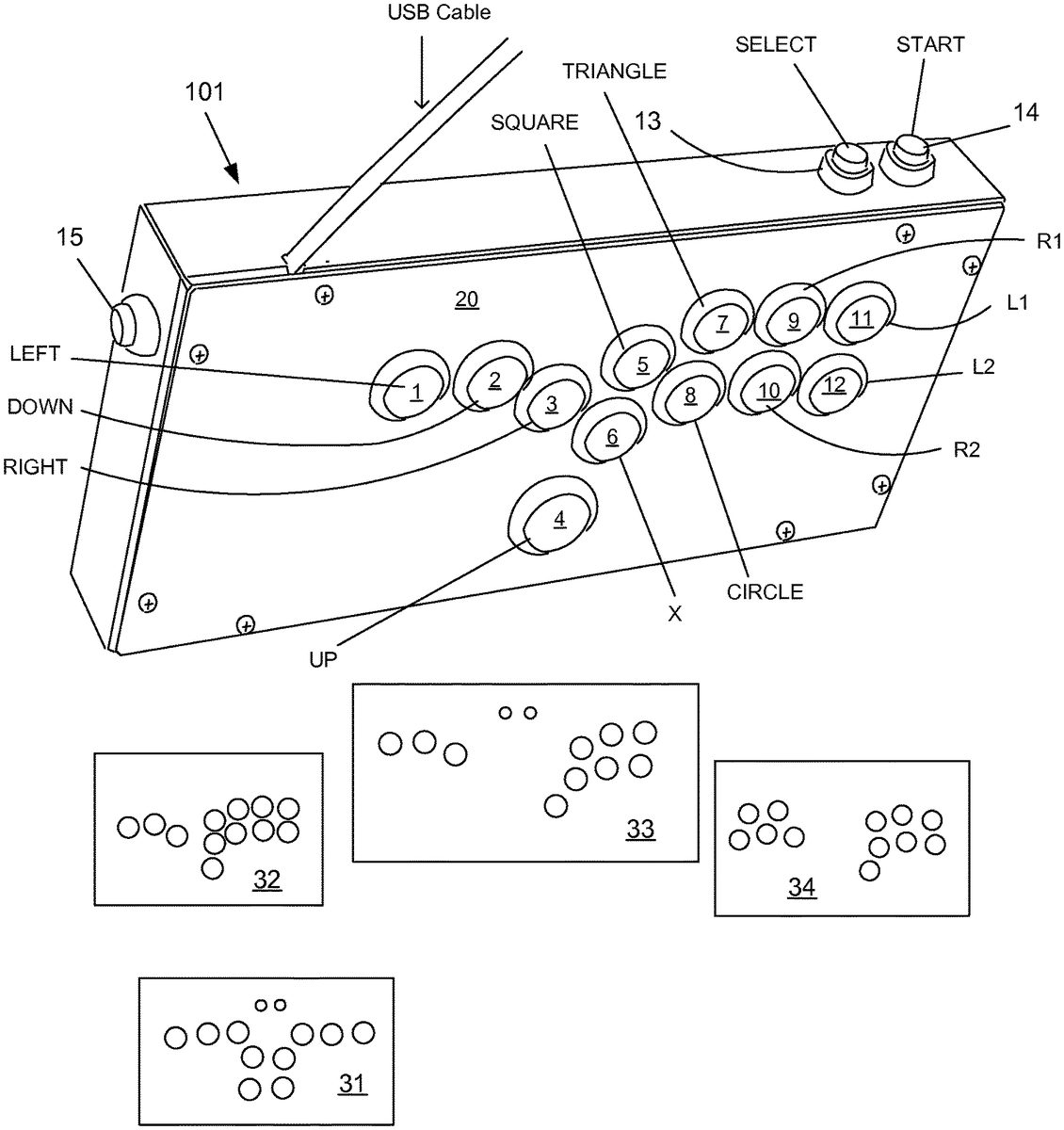
FIG.1shows a prior art Sony Playstation® Controller80. The control buttons are labeled in the figure as shown. The button placement, however, is arbitrary and does not logically conform to the natural contours of a human hand.FIG.2shows a box shaped controller101. The buttons have been placed on backing20as shown. In the embodiment shown, buttons1-4correspond to movement buttons40(FIG.1) and buttons5-14correspond to function buttons50,60and70(FIG.1) Button placement has been carefully considered so that it matches the natural contour and shape of the human hand. In this manner, a user can more precisely control the game action. This is very important for competitive garners who are striving to achieve the highest possible score. It is much more natural to play a computer game if the button placement matches the position of the user's fingers.
FIGS.3and4give a very good illustration of the user's hands and fingers appropriately positioned over the buttons of the embodiment shown inFIG.2. Specifically, inFIG.3, the left hand is positioned to control the left, right, up and down motion of a character in the game. InFIG.4, the right hand is appropriately positioned to control fighting movements and other special motions and actions. It should be noted that the right or left thumb can equally reach “up” button4.
It should be understood that the specific placement of buttons can be modified as desired. The important consideration is that the buttons are placed so that the fingers of the hand can naturally reach the buttons with minimum effort, as shown in the figures.FIGS.2-4show one positioning of buttons1-15. It should be noted that the exact positioning, size and amount of buttons can be modified. It is preferable, however, that the position of the buttons are such that they conform to the natural contour and shape of the user's hand. For example,FIG.5shows controller21with buttons placed as shown.FIG.6shows controller22with buttons placed in an alternative style.FIG.7shows controllers31-34with buttons positioned as shown.FIG.8shows controller35with buttons positioned as shown.
FIG.9shows a front view of controller20shown inFIG.2.FIG.10shows a front see-through view of the embodiment ofFIG.9. InFIGS.10and11, the wiring details are displayed.FIGS.10and11show the printed circuit board (PCB)51. In an embodiment, PCB51is printed circuit board model no. PS360 manufactured by Akishop Corp. The PS360 PCB is an aftermarket printed circuit board which allows a user to interface with a Sony Playstation® console and an XBOX 360® console. XBOX 360® is a registered trademark of the Microsoft Corporation and refers in general to interactive game consoles. Wiring runs from the appropriate pin connections of PCB51to the buttons1-15as shown.
FIGS.12-18show several alternate embodiments where the position of the buttons has been modified relative to each other. However, in each embodiment, the position of the buttons is arranged so that the position of the buttons matches the position of the user's fingers in a fashion similar to that shown above in reference toFIGS.3and4.
FIGS.19and20show alternate embodiments where the buttons for one hand are configured to match the natural arrangement of the user's fingers. InFIG.19the left hand controls buttons configured similar to the up, down, left and right arrows of a keyboard. InFIG.20the right hand controls buttons configured similar to the up, down, left and right arrows of a keyboard.FIGS.19and20show controllers that are preferable for gamers who are used to the up, down, left and right arrows of a keyboard.
The embodiments of the present invention use smaller buttons than a traditional common joystick. These buttons create a more ergonomic layout for the human hand. The embodiments are modeled after the curvature of the human hand so as to greatly reduce stress over time to reduce repetitive strain injuries (RSI's). They also eliminate the need to hover the hand around searching for buttons in game, and have all buttons instantly accessible to the hands.
As shown above, there are several embodiments. All are closely related in design, but have differences in button placement and button quantity.
One feature shown inFIG.2is the directional button inputs. “Left,” “Right,” and “Down” are controlled by the left hand, while the final direction “Up” is controlled by the right thumb. This unique placement of “Up” allows greater ease in performing advanced techniques in fighting games. It also eliminates the common mistake of accidental “Up” inputs.
Other embodiments of the present invention place the important “Up” button on the left thumb in an ergonomic curvature of the human hand.
Some of the embodiments use larger standard-sized 30 mm arcade pushbuttons.
As shown above, electrical wire connects the arcade pushbuttons to the controller's circuit board. Specifically, the directional input pushbuttons are linked to the corresponding directions on the circuit board.
The present invention is an instrument designed preferably for fighting video games. Its advantages can be appreciated by the beginning player through the champion tournament player. It is designed for gamers all across the globe.
It should be noted that although the figures show a modification of a Sony Playstation® game controller, it should be understood that a PCB of any existing game controller can be substituted for PCB51. Some of the existing game controller PCBs that can be utilized include (but are not limited to): the Xbox® controller, the Xbox 360®, Sony Playstation® 2, Sony Playstation® 3, the Nintendo Gamecube®, controller boards and kits such as the Toodles Cthulhu for Multi-Console, any existing joystick or alternative brand controller, and many more. To modify controller101, the printed circuit board of the prior art controller of interest is inserted into controller101in place of PCB51. For example to create a controller for Nintendo Gamecube® the PCB from the Nintendo Gamecube® is removed and placed in controller101in place of PCB51.
There are several sub categories in models of game controllers as well. For example, Sony Playstation® game controller Playstation 1 Digital H is different in structure than Playstation 1 Dual Shock A (Late Version), but follow the same principles. Also, it should be understood that the present invention can be fabricated as a stand alone item. For example, a new controller (not tied to an existing game unit) can be built using the principles disclosed above. It is only important that both hands are able to comfortably reach and control the push buttons in a fashion similar to that described above and that the directional buttons are controlled by the fingers.
It should be noted that it is possible for controller101to be connected to console via a wire connection (such as a USB cable shown inFIG.21) or via a wireless connection (FIG.22).
Although the above-disclosed embodiments have been described with specificity, persons skilled in this art will recognize that many changes to the specific embodiments disclosed above could be made without departing from the spirit of the invention. For example, althoughFIG.2shows button15on the left side of controller20, it can be easily moved so that it is adjacent buttons13and14. It should be noted that in the embodiments the buttons of ergonomic relevance are buttons1-12, and buttons13-15are merely utility buttons. Therefore, the attached claims and their legal equivalents should determine the scope of the invention.
Claims
- A hand-operated game controller for controlling a game comprising: a game controller surface extending horizontally between a left edge and a right edge and vertically between a top edge and a bottom edge;a first assemblage of buttons arranged along a first arcuate shape extending from a right most point to a left most point, wherein the left most point of the first arcuate shape is closer to the bottom edge of the game controller surface than the right most point of the first arcuate shape is to the bottom edge;a second assemblage of buttons arranged along a second arcuate shape, wherein a left most point of the second arcuate shape is closer to the bottom edge than the left most point of the first arcuate shape is to the bottom edge;and a third assemblage of buttons of at least four adjacently positioned buttons having a center button located closer to the left edge than the right edge of the game controller surface, a left button closer to the left edge than the center button, a right button closer to the right edge than the center button, and a top button closer to the top edge than the center button.
- The hand-operated game controller of claim 1, wherein the third assemblage of buttons are associated with directional functions when controlling the game.
- The hand-operated game controller of claim 1, wherein the center button of the third assemblage of buttons, the top button of the third assemblage of buttons, the left button of the third assemblage of buttons, and the right button of the third assemblage of buttons are rectangular shaped with rounded edges.
- The hand-operated game controller of claim 1, wherein a right most edge of the first arcuate shape and a left most edge of the first arcuate shape is closer to the bottom edge than an apex of the first arcuate shape.
- The hand-operated game controller of claim 1, wherein the first assemblage of buttons and the second assemblage of buttons provide functional inputs when controlling the game.
- The hand-operated game controller of claim 1, further comprising a fourth assemblage of at least two buttons arranged along a horizontal straight line, wherein the fourth assemblage of buttons is closer to the top edge than the first assemblage of buttons and the third assemblage of buttons.
- The hand-operated game controller of claim 6, wherein the fourth assemblage of buttons provides access to, and navigation within, menus when controlling the game.
- The hand-operated game controller of claim 1, wherein the buttons of the first assemblage of buttons and the second assemblage of buttons are round.
- The hand-operated game controller of claim 1, wherein the first assemblage of buttons and the third assemblage of buttons do not intersect with a central line extending vertically halfway between the right edge and left edge of the game controller surface.
- The hand-operated game controller of claim 2, wherein the top button of the third assemblage of buttons is associated with an up direction, the center button of the third assemblage of buttons is associated with a down direction, the left button of the third assemblage of buttons is associated with a left direction, and the right button of the third assemblage of buttons is associated with a right direction.
- A hand-operated game controller for controlling a game comprising: a game controller surface extending horizontally between a left edge and a right edge and vertically between a top edge and a bottom edge;a first assemblage of buttons arranged along a first arcuate shape extending from a right most point to a left most point, wherein the left most point of the first arcuate shape is closer to the bottom edge and left edge of the game controller surface than the right most point of the first arcuate shape is to the bottom edge;a second assemblage of buttons arranged along a second arcuate shape, wherein a left most point of the second arcuate shape is closer to the bottom edge than the left most point of the first arcuate shape and the right most point of the first arcuate shape;a third assemblage of buttons of at least four adjacently positioned buttons having a center button located closer to the left edge than the right edge of the game controller surface, a left button closer to the left edge than the center button, a right button closer to the right edge than the center button, and a top button closer to the top edge than the center button;and a fourth assemblage of at least two buttons arranged linearly, wherein the fourth assemblage of buttons is closer to the top edge than the first assemblage of buttons.
- The hand-operated game controller of claim 11, wherein the fourth assemblage of buttons provide access to, and navigation within, menus when controlling the game.
- The hand-operated game controller of claim 11, wherein the top button of the third assemblage of buttons is associated with an up direction, the center button of the third assemblage of buttons is associated with a down direction, the left button of the third assemblage of buttons is associated with a left direction, and the right button of the third assemblage of buttons is associated with a right direction.
- The hand-operated game controller of claim 11, wherein the center button of the third assemblage of buttons, the top button of the third assemblage of buttons, the left button of the third assemblage of buttons, and the right button of the third assemblage of buttons are rectangular shaped with rounded edges.
- A hand-operated game controller for controlling a game comprising: a game controller surface extending horizontally between a left edge and a right edge and vertically between a top edge and a bottom edge;a first assemblage of buttons including a row of at least three buttons arranged along a first arcuate shape extending from a right most point to a left most point, wherein the right most point of the first arcuate shape is closer to the right edge of the game controller surface than the left edge of the game controller surface and wherein the left most point of the first arcuate shape is closer to the bottom edge and left edge of the game controller surface than the right most point of the first arcuate shape is to the bottom edge and the left edge;a second assemblage of at least three buttons arranged along a second arcuate shape, wherein a left most point of the second arcuate shape and a right most point of the second arcuate shape are closer to the bottom edge than the left most point of the first arcuate shape and the right most point of the first arcuate shape;and a third assemblage of buttons of at least four adjacently positioned buttons having a center button located closer to the left edge than the right edge, a left button closer to the left edge than the center button, a right button closer to the right edge than the center button, and a top button closer to the top edge than the center button, wherein the third assemblage of buttons are associated with directional functions when controlling the game.
- The hand-operated game controller of claim 15, wherein the center button of the third assemblage of buttons, the top button of the third assemblage of buttons, the left button of the third assemblage of buttons, and the right button of the third assemblage of buttons are rectangular shaped with rounded corners.
- The hand-operated game controller of claim 16, further comprising a fourth assemblage of at least two buttons arranged along a horizontal straight line, wherein the fourth assemblage of buttons is closer to the top edge than the first assemblage of buttons and the third assemblage of buttons.
- The hand-operated game controller of claim 17, wherein the buttons of the first assemblage of buttons and the second assemblage of buttons are round.
- The hand-operated game controller of claim 18, wherein the first assemblage of buttons and the third assemblage of buttons do not intersect with a central line extending vertically halfway between the right edge and left edge of the game controller surface.
- The hand-operated game controller of claim 19, wherein a right most edge of the first arcuate shape and a left most edge of the first arcuate shape is closer to the bottom edge than an apex of the first arcuate shape.
Disclaimer: Data collected from the USPTO and may be malformed, incomplete, and/or otherwise inaccurate.