U.S. Pat. No. 12,177,413
MULTI-PLAYER AUDIO-VIDEO INTEGRATED WITH INTERACTIVE GAME BOARD
AssigneeIndividual
Issue DateJanuary 16, 2024
Illustrative Figure
Abstract
System and methods for providing simultaneous public and private audio-video integrated with an interactive board game, where a private viewer looking through an eye filter perceives the private video while a public viewer not looking through an eye filter perceives the public video all responsive to playing the interactive board game. Means for providing private audio simultaneous with the private video are also shown. The audio-video is selectively provided during game play based at least upon the tracked game state of the interactive board game. The video output component of the system can be implemented as either a display or a projector.
Description
In the following description, numerous specific details are set forth, such as examples of specific components, types of usage scenarios, etc. to provide a thorough understanding of the present disclosure. It will be apparent, however, to one skilled in the art that the present disclosure may be practiced without these specific details and with alternative implementations, some of which are also described herein. In other instances, well-known components or methods have not been described in detail to avoid unnecessarily obscuring the present disclosure. Thus, the specific details set forth are merely exemplary. The specific details may be varied from and still be contemplated to be within the spirit and scope of the present disclosure. DETAILED DESCRIPTION OF THE INVENTION In the following description, a number of specific details are presented in order to provide a thorough understanding of the embodiments of the present invention. It will be apparent, however, to a person skilled in the art that these specific details need not be employed to practice the present invention. Conversely, specific details known to the person skilled in the art are omitted for the purposes of clarity where appropriate. Referring toFIG.1athere is shown the three key components of system100including a content controller18for determining and providing two or more viewing sub-channels such as1A,1B,2A,2B,3A,3B as video content to a video output device23, where device23outputs the provided video content as single channel video23-outto be received by channel filtering eye glasses14-5, and where controller18further determines and provides synchronized control signals representing a selected viewing sub-channel to eye glasses14-5, such that glasses14-5using at least in part the control signals controllably filter single channel video23-outto transmit the selected one of viewing sub-channels1A,1B,2A,2B,3A,3B as14-outto a viewer2. System100preferably further comprises a content selector19for determining or accepting indications from the viewer2, where selector19provides any of the indications as viewer ...
In the following description, numerous specific details are set forth, such as examples of specific components, types of usage scenarios, etc. to provide a thorough understanding of the present disclosure. It will be apparent, however, to one skilled in the art that the present disclosure may be practiced without these specific details and with alternative implementations, some of which are also described herein. In other instances, well-known components or methods have not been described in detail to avoid unnecessarily obscuring the present disclosure. Thus, the specific details set forth are merely exemplary. The specific details may be varied from and still be contemplated to be within the spirit and scope of the present disclosure.
DETAILED DESCRIPTION OF THE INVENTION
In the following description, a number of specific details are presented in order to provide a thorough understanding of the embodiments of the present invention. It will be apparent, however, to a person skilled in the art that these specific details need not be employed to practice the present invention. Conversely, specific details known to the person skilled in the art are omitted for the purposes of clarity where appropriate.
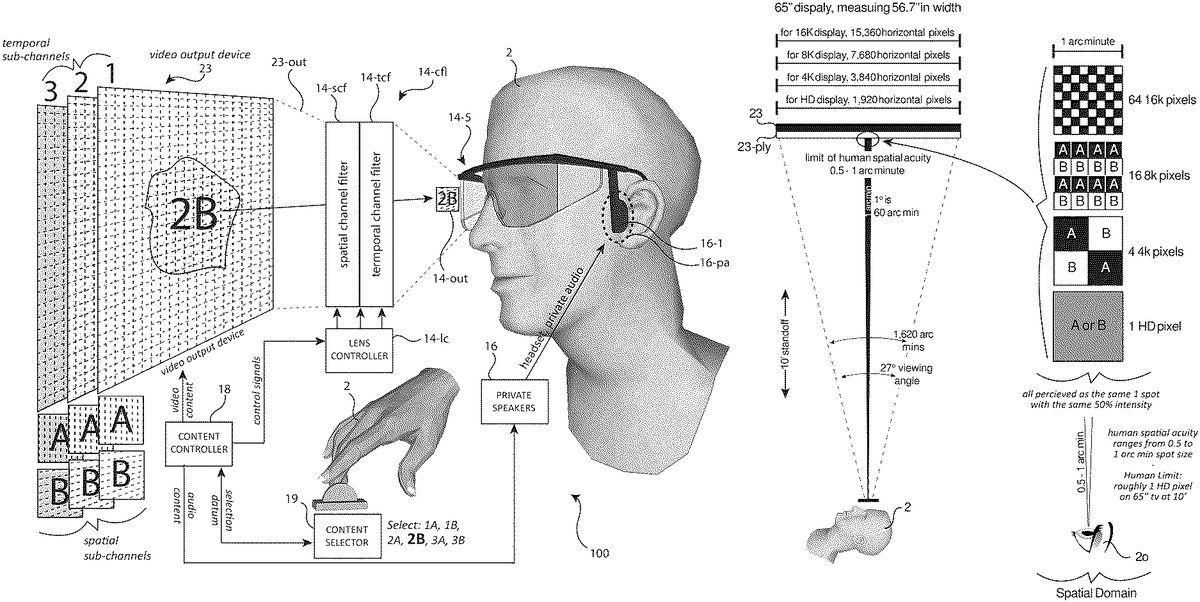
Referring toFIG.1athere is shown the three key components of system100including a content controller18for determining and providing two or more viewing sub-channels such as1A,1B,2A,2B,3A,3B as video content to a video output device23, where device23outputs the provided video content as single channel video23-outto be received by channel filtering eye glasses14-5, and where controller18further determines and provides synchronized control signals representing a selected viewing sub-channel to eye glasses14-5, such that glasses14-5using at least in part the control signals controllably filter single channel video23-outto transmit the selected one of viewing sub-channels1A,1B,2A,2B,3A,3B as14-outto a viewer2. System100preferably further comprises a content selector19for determining or accepting indications from the viewer2, where selector19provides any of the indications as viewer selection datum to content controller18, where controller18at least in part uses the viewer selection datum to determine the selected viewing sub-channel and corresponding synchronized control signals for providing to eye glasses14-5. System100preferably further comprises one or more private speakers16for providing to the viewer2private audio16-pacorresponding to14-out, where content controller18provides audio to private speakers16corresponding to the selected viewing sub-channel.
Controller18comprises a cell processor with XDRAM for executing its included functions preferably further comprises a video co-processor with VRAM, all as will be well-known to those skilled in the art of computing systems, especially those handling video graphics. In one operational mode of the present invention100, content controller18first queries video device23to determine extended display identification data (EDID) using technology well-known to those skilled in the art of video devices, where the EDID at least indicates if the video device23is 2D, active 3D or passive 3D and preferably also indicates the display resolution and screen size. Using any of the EDID, controller18then determines and provides multi sub-channel content appropriate to the video device23, where all of 2D, active 3D and passive 3D video devices23support multiple temporal sub-channels such as1,2and3depicted, and where passive 3D video devices23additionally support 2 spatial sub-channels A and B depicted. Therefore, content controller18can determine and provide at least 2 to 3 temporal sub-channels1,2or3for any existing video device23, and where the video device23further supports passive 3D, content controller18is further capable of providing 2 spatial sub-channels A and B and a combination of temporal-spatial sub-channels such as1A,1B,2A,2B,3A,3B.
As will be discussed in relation to upcomingFIGS.4a,5and10b, content controller18is further capable of receiving video from two or more content sources such as a settop box, gaming console or personal computing device, where controller18transforms each of the received video into a distinct viewing sub-channel and provides the mix of distinct viewing sub-channels to the single video device23for output as23-outsuch that multiple viewers2each wearing distinct eye glasses14-5may select and receive a distinct sub-channel from within23-out, thus allowing multiple viewers2to share a single video device23-out, each receiving substantially different video. Controller18is capable of querying each of connected input content sources to at least determine a device type or name, where controller18preferably provides a list of currently connected content sources including at least type or name as selection datum to content selector19, where selector19interfaces with the viewer2to provide at least in part the selection datum to assist the viewer2in the sub-channel selection process.
Anticipated uses include providing four gamers the ability to share a single large screen display by plugging for example each of their gaming consoles or PCs into four video input ports on the content controller18and then wearing eye glasses14-5set to receive their desired sub-channel. Another expected use is for first member of a family to select a traditional channel from a settop box plugged into a first video input port on controller18, where for example the traditional channel is showing a sporting event that is then transformed by the controller18for output through spatial sub-channel A, while a second member of the family wirelessly connects their personal computing device to a second video input port on controller18, where for example the personal computing device then streams a movie that is then transformed by the controller18for output through spatial sub-channel B.
As is well-known in the art of 3D movies and active 3D displays, a 3D movie created for viewing with what is known as active shutter glasses typically comprises two temporal sub-channels1and2each comprising alternating left-eye/right-eye images, where the active shutter glasses controllably transmit only left-eye images (e.g. temporal sub-channel1) to a viewer2's left eye and right eye images (e.g. temporal sub-channel2) to the viewer2's right eye. In the present system100, there are no restrictions as to the number of temporal sub-channels, nor are there any restrictions regarding which of the multiplicity of video images comprising video23-outare to be included in any given temporal sub-channel, where for reasons that will be well understood to those familiar with the human vision system and acceptable video quality, the number of temporal sub-channels is anticipated to be, but not limited to, four.
As is well-known in the art of 3D movies and passive 3D displays, a 3D movie created for viewing with what is known as passive polarizer glasses typically comprises two spatial sub-channels A and B each comprising alternating left-eye/right-eye images, where the passive polarizer glasses controllably transmit only left-eye images (e.g. spatial sub-channel A) to a viewer2's left eye and right eye images (e.g. spatial sub-channel B) to the viewer2's right eye. As is also well-known, when using typical display technology for example as opposed to projector technology, each of the two spatial sub-channels A and B are present in a single video image within23-outand comprise a fixed and substantially equal number of left-eye pixels (e.g. A) and right-eye pixels (e.g. B,) for example each of spatial sub-channels A and B represent alternating rows of pixels within the video device23. In at least one embodiment of the present invention as to be discussed later in the specification, there are no restrictions as the which pixels within a given video image belong to the first spatial sub-channel A versus B. As is also well-known, each of spatial sub-channels A and B emit distinguishably polarized light that is responsive to a passive polarizer lens, where the response is either to substantially transmit in full or be blocked in full, and where the distinguishable polarization is either based upon circularly polarized light or linearly polarized light. While some embodiments of the present invention employ passive polarizers and as such either transmit A and block B, or transmit B and block A, other embodiments employ active polarizers that can be controllably operated to transmit either of A or B, and therefor block either of A or B.
Still referring toFIG.1a, the preferred embodiment eye glasses14-5comprise an independently controlled channel filter lens14-cflfor each of the left eye lens and right eye lens, where each channel filter lens14-cflcomprises both an active spatial channel filter14-scfand an active temporal channel filter14-tcf, such that there is no restriction as to which of the multiplicity of provided viewing sub-channels such as1A,1B,2A,2B,3A,3B are filterable for either the left or right eye of viewer2with respect to any given video frame comprising video out23-out. Eye glasses14-5also comprises a lens controller14-lcthat is in wireless communication with content controller18, where wireless communication is like that used by existing active shutter glasses technology and typically includes either Bluetooth or infrared, but may also operate in wi-fi, all as will be well understood by those familiar with active shutter glasses and active 3D televisions. Lens controller14-lccommunicates with content controller18to perform the well-known function of device pairing, after which content controller18provides control signals to lens controller14-lcfor controllably operating each of the left and right eye channel filter lens14-cflin synchronization with the output23-outof device23. Content selector19is any implementation of a user interface and can be either a separate device such as the viewer's cell phone running an app that is in wireless communications with the content controller18, or an embedded devices such as programmable buttons on a universal remote control or scroll wheel selector (such as depicted) built into a chair, where the any implementation is in communication with the content controller18and includes any of well-known computing elements for executing its functions.
Still referring toFIG.1a, video output devices23are well-known in the art and include any of display devices such as OLED, LED, LCD or projection devices such as DLP or LCD. State-of-the-art displays and projection systems support outputting a stream of image frames such as23-out, for example at a rate of 240 to 480 images per second. The preferred single channel video23-outthat comprises at least 240 images per second may then, for example, be controllably divided into 3 temporal sub-channels (shown as1,2and3,) each comprising 80 images per second. It is important to understand that: 1) for a traditional output channel23-out, all images in the output stream represent a continuous on-going set of visible information that is perceived by the naked eye of a viewer2as coherent content, 2) creating flick-free video typically requires a minimum of 60 images per second, 3) evenly dividing single channel23-outcomprising 240 images into three temporal sub-channels (1,2and3) of 80 images per second provides greater than 60 images per second per each temporal sub-channel, but assuming distinct visual content for each of the three temporal sub-channels, the naked eye of a viewer2will experience the interleaved combination of the three temporal channels as incoherent content, and 4) if the images received by a viewer2are limited by eye glasses14-5to a single temporal sub-channel (e.g.1,2or3,) then the viewer2will perceive coherent video at the frame rate of the single temporal channel, e.g. at 80 images per second. The temporal channel filter14-tcfof lens14-cflcomprises any implementation of an active shutter that is capable of controllably switching between either of a transmissive or non-transmissive state (see upcomingFIGS.2b,2c,2d,2eand2gfor more detail,) where each of the transmissive or non-transmissive states correspond to select images in the temporal sequence of images comprising video23-out, all as will be well understood by those skilled in the art.
Still referring toFIG.1a, as is also well-known in the art of display systems such as OLED and LCD and as described in the copending applications, a single output image frame may be spatially divided into two distinct sub-frames using polarization elements such as left and right circular polarizers or vertical and horizontal linear polarizers. Those familiar with 3D imaging displays will recognize that these distinct sub-frames are the left and right images necessary for creating the 3D visual effect for a viewer2. Display manufacturer LG Electronics has sold displays including a film-type patterned retarder for causing alternating rows of an output image to be either left or right circular polarized, where the output polarized rows are then either transmitted or blocked by a left or right circular polarizer layer affixed to each lens of eye glasses worn by a viewer2, all as will be well understood by those familiar with 3D display systems. Also well-known are optical devices and films for causing alternating rows of an image to be either vertically linear polarized or horizontally linear polarized, where the output polarized rows are then either transmitted or blocked by a vertical or horizontal linear polarizer affixed to each lens of eye glasses worn by a viewer2, all as will be well understood by those familiar with 3D display systems. The spatial channel filter14-scfof lens14-cflcomprises any implementation of actively switchable circular or linear polarizers that is capable of controllably switching between either of two polarization states A or B, for example where A is right circularly polarized and B is left circularly polarized (see upcomingFIGS.2b,2c,2d,2eand2gfor more detail,) where each of the two polarization states A and B correspond to the alternating image rows of the output display, all as will be well understood by those skilled in the art.
A careful understanding of the present teachings will recognize that the preferred output channel23-outcomprising at least 240 image frames per second is for example filtered using temporal channel filter14-tcfinto three temporal sub-channels (1,2and3) each comprising a stream of 80 image frames per second, where each image frame per second is further filtered using spatial channel filter14-scfinto two spatial sub-channels (A and B) each comprising some amount of pixels, such that the entire preferred single channel video23-outsupports a total of six separate viewing sub-channels, where a viewing sub-channel is a combination of a temporal and spatial sub-channel.
Still referring toFIG.1a, as will be well understood by those familiar with displays, projectors, video streams, human visual perception and 3D systems, there is a lower temporal limit for the visual information sufficient for creating the perception of full-motion video without the effects of flickering, where flickering is the perception of black image frames sequenced in between the images making up the full-motion video. As prior mentioned, this limit is generally understood to be 60 images per second. In addition to the total images per second, it is also important to understand the length of time that each image of the 60 remains viewable to the naked eye, for example ranging from 1/60 of a second for an output channel23-outcomprising 60 images per second, to 1/240 of a second for an output channel comprising 240 images per second, where the assumption is that the underlying display technology is capable of outputting a single image frame with minimal delay in the switching time of the pixel electronics, which varies based upon the technology and for example is at least one order of magnitude faster for OLED versus LCD, all as will be well understood by those familiar with the various display technologies. As will also be well understood, there is a lower spatial limit for the visual information sufficient for creating pleasing visual images where the edges of objects are smooth as opposed to jaggy. In today's market, HD images with a minimum resolution of 1280 (horizontal)×720 (vertical) are generally considered as pleasing, where for 3D HD displays these same HD images are spatially sub-divided using polarization as prior discussed, such that each of the left/right eye images are presented at a lower minimal resolution of 1280×360 (where 360 is 50% of the 720 vertical image rows.) For 3D viewing, it is well-known that human visual perception combines the 50% resolution of the left and right images into a single 3D image that is generally perceived as comprising the full 1280×720 resolution and is therefore still pleasing.
In the present teachings, splitting a single HD image into two spatial sub-channels A and B will result in image resolutions that are anticipated to be minimally acceptable by a viewer2, and therefor what is preferred when implementing spatial sub-channels as herein taught is to at least use what are generally referred to as 4k displays that output a single image frame at a minimum resolution of 3840×2160, such that a single spatial sub-channel image A or B would have a resolution of 3840×1080 that exceeds the acceptable HD spatial quality. As is also well-known in the art, 3D projector systems can work differently than 3D displays, in that two projectors may be simultaneously outputting full resolution left and right images, each with a distinguishable polarization states, where the full resolution images reflect off a screen back to the viewer2who wearing 3D glasses perceives each left and right image to be full resolution, rather than the half-resolution of a 3D display. What is most important to understand with respect to the present invention is that a single channel video23-outpresents an on-going stream of individual images, where the total number of images as well as the total spatial resolution of each single image may be controllably sub-divided into any combination of herein defined temporal and spatial sub-channels, where a combination of temporal and spatial sub-channels forms a unique viewing sub-channel, and where distinct video content may be presented to a viewer2through a distinct viewing sub-channel such that the viewer2wearing eye glasses14-5is limited to perceiving only the temporal-spatial visual information presented within the distinct viewing sub-channel.
Given the state-of-the-art in video output displays and projectors, this provides the opportunity of creating a single channel output23-outthat is divisible into for example into two to six viewing sub-channels, where each viewing sub-channel creates sufficiently smooth spatial quality and flicker-free temporal quality. One anticipated use for the present invention100is to adapt a traditional closed story movie to further comprise alternative scenes embedded within any of the available viewing sub-channels, where for example multiple viewers2pre-select prior to a movie a role type, such as hero or villain, and then receive 80% of the same image frames while the remaining 20% of received image frames are different for at least two of the viewers2based at least in part upon the pre-selected role type. There are many other anticipated uses for the present teachings as will be well understood to a careful reader of the present invention, including interactively constructing and streaming video23-outto a group of two or more viewers2who are playing a game, were the stream23-outis dynamically constructed based at least in part upon on-going inputs from each of the two or more viewers2, where the stream23-outis dynamically adjusted to form a varying number of viewing sub-channels at any given time ranging from a single sub-channel viewed by all two or more viewers, to for example six sub-channels selectively viewably by any of the two or more viewers, all as will be described in greater detail forthwith. It is also possible that the output video23-outis divided into a set number of viewing sub-channels, e.g. two to six, for the entire duration of output, but that at any given time frame during the output of video23-outsome or all of the viewing sub-channels include copies of the same or different image frames, such that viewers2of different viewing sub-channels sometimes are viewing the same image information as other viewers2watching a different viewing sub-channel, and sometimes viewing distinct images only provided on the select sub-channel. As the careful reader will see, many variations are possible with respect to the technology used for implementing the present system, and for the static or dynamic determination of viewing sub-channels based upon combinations of temporal and spatial sub-channels, and therefore the preferred apparatus and methods should be considered as exemplary, rather than as limitations of the present invention.
Still referring toFIG.1a, as those familiar with hardware and software systems will understand, the apparatus and methods herein described are functional, where the functions may be deployed in various hardware and software configurations without departing from the scope and intention of the present invention, therefore again, the preferred and depicted embodiments should be considered as exemplary rather than as a limitation of the present invention. For example, using the present teachings, any traditional video device23can be used with the content controller18and eye glasses14-5to provide single channel video23that comprises at least two viewing sub-channels that are two temporal sub-channels, such that a single traditional close story movie is further adaptable to be output as an adjustable story comprising the two sub-channels, where for example one sub-channel emphasizes the hero's journey while the other sub-channel emphasizes the villain's journey. Furthermore, content controller18might be a separate computing device within an enclosure separate from the video device23, or controller18might be included within the enclosure of the video device23such as an OLED 3D TV sharing none or some of any computing elements comprising the video device23. Alternately, controller18or its functions might be included within a popular gaming controller such as PlayStation 4 or XBOX, or some equivalent. The video output device23can be any of display or projection systems, for example an LCD display for use in a home living room or a 3D projection system for use in a movie theater. Again, what is important to see is that the single channel video23-outis controllably divided into two or more viewing sub-channels, where the viewing sub-channels are then made selectable to the viewer2.
Referring next toFIG.1b, there is show an approximate scale depiction of a viewer2looking at a 65″ display at a distance of 10′, where the display width measures 56.7″ in width and takes up approximately 27 degrees of the viewer's2field-of-view. As those familiar with human vision will understand, the study of spatial visual acuity attempts to define the smallest visual angle within which a person can see clearly. There are many considerations, but in general it is useful to know that the definition of a “standard observer” with 20/20 vision means that they can read letters with a stroke width of 1 arc minute, and that the “normal best-corrected” adult visual acuity is roughly 0.8 arc minutes. As is also well-known, there are 60 arc minutes per degree, such that the 27-degree view as depicted includes 1,620 arc minutes. The number of pixels per arc minute depends upon the distance to the display, the display width, and the pixels resolution of the display, where for example an HD display includes 1,920 horizontal pixels, versus 3,840 for a 4k display, 7,680 for an 8k display and 15,360 for a 16k display. Using well-known trigonometric functions, it is possible to calculate the number of pixels per 1 arc minute for a 65″ display being view at 10′, where a 1 arc minute surface area of display would include approximately: 1 HD pixel, 4 4k pixels, 16 8k pixels and 64 16k pixels (see the right side of the present Figure.) As the careful reader will observe, given the depicted constraints, at 4k resolution the pixel size is roughly 0.5 arc min and is reaching the typical human limit of spatial acuity.
As the present Figure depicts, at HD resolution a single pixel roughly becomes a single spot of light within a spatial area that is 1 arc min wide and 1 arc min high. At 4k resolution, 1 pixel reaches about 0.5 arc minutes that is below the 0.8 are minute normal best-corrected vision. As is also well-known, the human eye sums light intensity over area, where as spatial detail increases, human vision blurs image detail created by varying intensities into a larger feature. For example, a 1 HD pixel with a display intensity of 50% will be perceived as a spot of average brightness in an image. Likewise, a matrix of 4 4k pixels, where 2 are displayed at 100% intensity and 2 are 0% intensity (thus providing the same total light intensity over the 1 arc min×1 arc min spatial area as the 1 HD pixel,) will tend to be blurred and summed by the human eye as roughly equivalent to the 1 HD pixel, as depicted. In another blurring arrangement, 4 rows of 4 pixels of 8k resolution are arranged in an alternating horizontal pattern, similar to how the left-eye and right-eye images are arranged on a passive 3D display, where again the total light emitted across the matrix of 16 pixels is equivalent to the 1 HD pixel such that the human eye will tend to blur the matrix perceiving the equivalent of the 1 HD pixel. What is important to see is that at 4k resolutions and above, dividing pixels within a 1×1 arc min area between the two spatial sub-channels of A and B will provide two spatial images with an equivalent 1 HD resolution that reaches the standard visual acuity of a standard observer, such that greater resolution detail has marginal effect on image quality. At 8k resolution, pixel detail well exceeds that of normal best-correct adult vision. What is also important to see is that as display manufactures compete to bring out displays with higher and higher spatial resolution, like the spatial resolution competition in digital cameras or digital audio, the technology has reached and will exceed a practical human limit where the present invention then seeks to find alternative advantageous uses for the additional spatial resolution beyond increase image detail.
Referring next toFIG.1c, there is depicted the naked eye2oreceiving a stream of images from a 65″ 4k tv with a refresh rate of 120 Hz, being viewed at 10′. As discussed in relation toFIG.1b, given this exemplary arrangement, human spatial visual acuity begins to reach the average person's limits at HD resolutions. As is also well-known to those familiar with human vision, there is also a concept of temporal visual acuity, which attempts to define the critical rate at which changes in the luminance levels of a given spot, e.g. 1 HD pixel, are perceived as continuous as opposed to intermittent, where this critical rate is referred to as the critical flicker fusion rate (CFF.) As with spatial visual acuity, there are many factors effecting temporal visual acuity. For example, increasing the total luminance of the 1 HD pixel shortens the critical duration necessary for the eye to detect the luminance that conversely increases the CFF such that a pixel going from black to 100% intensity will tend to flicker more than a pixel going from black to 25% intensity. In general, in order to detect a successive flashing of light an appropriate integration time is required between flashes that ranges in normal human vision between 10 ms to 15 ms, which translates to refresh rates of 100 Hz and 65 Hz. The commonly accepted norm for what the display industry calls “flicker free,” is to display images at a minimal rater of 60 Hz, where each pixel within the image is updated once every 16 ms.
However, understanding flicker also requires understanding what is actually happening inside of the display with respect to the difference between what is known as frames-per-second and the refresh rate. Frames per second relates to the number of distinct images a computing element such as a graphics card can form within internal memory, a task that typically includes decoding if the images are providing from a streaming source or graphics calculations if a virtual image is being generated such as in a video game. In today's marketplace, 60 fps is a typical rate, where many graphics cards can reach 120 distinct images per second and beyond. As each image is formed within internal memory, another process transfers this digital representation as typically analog signals to the display elements such as OLED of LCD pixel elements, where this transfer rate is the refresh rate. It is also well-known and important to understand that when flashing a series of individual images that includes the motion of an object, at roughly 24 images per second, the human eye will start to perceive continuous motion of the object, were below 24 images the object's motion appears uneven or jumpy. Given this consideration, in practice cinematic movies have display at least 24 distinct images per second and computer systems have rounded this up to 30 images per second, or 30 fps, where 1/30thof a second is equal to 33 ms. The next question becomes the duration of time that a single image is display, e.g. is the image display for the full 33 ms or only a portion of this time such as 16 ms? Many modern televisions implement what is known as display-and-hold, where each distinct image is displayed for the entire amount of time until the next distinct image is available. In this case, the refresh rate is the same as the frames-per-second, e.g. 30. In some displays, a single frame presented every 1/30thof a second is flashed onto the screen twice, in which case the fps is 30 and refresh rate is 60 Hz.
Still referring toFIG.1c, while 30 fps is considered full-motion/smooth motion, in practice when a series of images includes a fast-moving object, and each of 30 images per second is displayed for the full 30thof a second, with each successive image frame the fast-moving object can still appear to jump to the human eye. There are two general techniques for reducing this jumpiness, the first is to display a minimum of 60 fps or more requiring a more powerful graphics card, where this motion is then twice as smooth but also perceived as the “soap opera effect” for movie watchers, basically too smooth compared to a normal 24 fps of a cinema movie. In the second technique, each of the 30 images is displayed for only 16 ms, or 1/60thof a second. In between the 30 images the screen is left substantially black for the remaining 16 ms, a technique known as black frame insertion (BFI.) This technique works to trick the eye that than integrates the motion of the objects in the successive frames within the brain to make them appear smooth. The difficulty with black frame insertion is that the human eye is able to detect flashing lights down to 15 ms and even 10 ms. As the careful reader will see, a temporal sub-channel is formed by filtering only a sub-set of the total refresh rate to be received by a first viewer2watching a first temporal sub-channel1verses a second viewer2watching a second temporal sub-channel2. In order to stay above the generally accepted CFF of 60 Hz while also providing 2 temporal sub-channels, it is necessary to have a display that at least supports a refresh rate of 120 Hz.
In one embodiment, a first graphics card that is capable of decoding, generating or otherwise providing 120 fps that are used to provide 60 fps to the first temporal sub-channel1and the remaining interleaved 60 fps to the second temporal sub-channel2, where for example sub-channel1is receiving 60 fps related to a movie while sub-channel2is receiving 60 fps related to a sporting event or video game. As the careful reader will see, at 60 distinct images per second each sub-channel is receiving over twice the rate of images generally excepted as necessary for providing cinematic smooth motion (i.e. 24 fps,) where in between each image the sub-channel is essentially off, or receiving a black frame inserted by the action of the temporal channel filter14-tcf(to be discussed in greater detail with respect to upcoming Figures.) In another embodiment, two graphics cards or computing processes are used simultaneously, where for example the first process receives and decodes a movie at a rate of 60 fps, while a second process generates virtual world gaming images at a rate of 60 fps, and where a third process alternately provides one of each of the first process and second process images to the display for a combined 120 fps. As the careful reader will see, the visual effect for a viewer2of sub-channels1and2is substantially equivalent for the first and second embodiments, where the total frames per second is still more than twice the cinema rate of 24 fps.
In a third embodiment that is like the second embodiment, the two computing processes for providing video to temporal sub-channels1and2each operate at 30 fps, staggered by 25%, such that the two processes combine to provide a substantially continuous rate of 60 fps to the 120 Hz display. In this case, the 120 Hz display is preferably refreshed as follows: image1, image2, image1repeated, image2repeated, where each refresh last 8 ms (i.e. 120thof a second.) As the careful reader will see, image1appears on sub-channel1every 60that substantially 50% intensity caused by the temporal blurring of the inserted black image, where 1) the reduction in intensity and temporal blurring acts to further reduce flicker, and 2) it is then possible to increase the luminance output (referred to as NITs which is a measure of candela per square meter) of the television such to compensate for each dimmed sub-channel, where for example the increase is roughly 2×.
What is important to see is that at 120 Hz, or 8 ms per image refresh, the refresh rate well exceeds that of the normal adult vision for detecting flicker. Furthermore, even when dividing the 120 Hz refreshes between two temporal sub-channels, each sub-channel with an effective 60 Hz refresh rates provides the typically accepted flicker-free rate. As will be shown in relation toFIG.1d, at even higher image fps and refresh rates, it is possible to provide additional flicker-free full-motion temporal sub-channels with the important understanding that the luminance (Nits) must then also be increased to avoid dimming of the sub-channels. What is also important to see is that as display manufactures compete to bring out displays with higher and higher temporal resolution, like the fps/samples-per-second temporal competition in digital cameras or digital audio, the technology has reached and will exceed a practical human limit where the present invention then seeks to find alternative advantageous uses for the additional temporal resolution beyond increasing video smoothness. Given the understandings related toFIG.1cas exemplified, when using a 4k 65″ 120 Hz (refresh rate) tv viewed at 10′, the average person is receiving roughly 4× more spatial resolution and 2× more temporal resolution than is necessary for a pleasing image.
Referring next toFIG.1d, there is shown four exemplary cases of various combinations of image frame rates (as provided by a graphics display card or otherwise a computing process) and refresh rates (as provided by a video display or projector.) In each exemplary case, there is a sequence of boxes left-to-right where each vertically aligned box represents a single image being output by a video device, and where some vertically aligned boxes are divided horizontally to represent the output of two spatial sub-channels, e.g. when providing left-eye/right-eye images on a passive 3d display device. Going from left-to-right, the first example depicts a 2D television that provides a refresh rate of 60 Hz being provided distinct images at a rate of 30 fps from a graphics card or otherwise image processing. As depicted, each provided image (1,2, . . . ) is repeated once by the display, where for example “1” followed b “1r” combine as the first image displayed for 1/30thof a second. As the careful reader will see, in this example as well as the remaining three examples, there are no black inserted frames, which is a practice that is not typically implemented in a modern video device. As the careful reader will also see, a display-and-hold video device could simply output the image1for 32 ms rather than displaying image1twice for 16 ms each display. This arrangement will provide what is referred to as flicker-free, full-motion video.
In the second example, both the refresh rate and the fps are doubled, with the net effect of providing even smoother video at 60 fps. In the third example, the display is a passive 3d display where each output image is spatially divided into left-eye versus right-eye pixels being output at distinguishable polarization states such as left or right circular, typically comprising alternating image display rows of pixels. In this case, each image refresh, such as 1 or 1r, provides 50% luminance of the left-eye and 50% luminance of the right-eye image, and thus on a per-eye basis the perceived brightness of passive 3D is reduced (with a further slight attenuation as the images transmit through the passive polarizer glasses,) all as will be well understood by those familiar with 3d display systems. In the fourth example, an active 3d television outputs a refresh rate of 120 Hz and is provided 120 fps from a video source. In this case, each next image alternates between a left-eye image and a right-eye image, such that the left-eye and right-eye are each receiving 60 refreshes per second (flicker free) fps at 60 fps (exceeding full-motion video,) however once again the total luminance per left and right eye is reduced by 50%.
What is important to see is the interplay between the three factors of: refresh rate (in Hz,) image rate (in fps) and luminance (Nits). With respect to luminance, it is well-known that the average tv outputs images at around 100 to 200 Nits, while newer high-dynamic-range (HDR) tvs output images with 400 to 2,000 Nits. Using the increased luminance allows for a broader (i.e. higher) range of colors going from black to white, all as is well-known in the art. While the followingFIG.1edescribes exemplary cases preferably providing HDR images per each sub-channel, as will be well understood by those familiar with video devices, this is not necessary in order to provide pleasing images assumed to be at least HD in resolution, 30 fps of new images providing full-motion, a refresh rate of 60 Hz to provide flicker-free, and 200 Nits in luminance to match a typical tv. A similar discussion applies to projectors versus displays, where luminance for a projector is measured in terms of ANSI lumens versus Nits, where generally 1 Nit=3.426 ANSI lumens. The present invention prefers and anticipates dynamically adjusting the output Nits or ANSI lumens of a video output device based upon the number of sub-channels being provided, where for example a display capable of 2,000 Nits might display a traditional single channel at 600 Nits, and then when switched into 2 viewing sub-channels increase the luminance output to 800-1200 Nits netting an effective 400-600 Nits per sub-channel. If the same video device is then switched to 4 sub-channels, it is preferred to further increase the luminance output, for example to 1600-2000 Nits, thus providing sub-channels with effective Nits of 400 to 500 each.
Referring next toFIG.1e, there are show 6 exemplary implementations of temporal, spatial and temporal-spatial sub-channels, where each case 1 through 6 is based upon a different combination of image frame rates, refresh rates, spatial resolution and luminance (Nits). In case 1, 2 temporal sub-channels are formed using a graphics card or computing process that provides 120 fps of images representing 2 different video streams, e.g. a sporting event and a news broadcast, or player 1's point-of-view (POV) in a video game and player 2's POV in the same game. Each 1 image of the 120 fps is output by the video device at least 1 time, where the video device has a 120 Hz or higher refresh rate, thus providing substantially flicker-free, full-motion video for each sub-channel1and2. The resolution is preferably HD quality or higher output at 800 Nits, where the effective Nits of each temporal sub-channel1and2is 400.
In case 2, 2 spatial sub-channels are formed using a passive polarization 3d display providing substantially 50% of the resolution from each HD or higher image to a first sub-channel A with the remaining resolution provided to sub-channel B. Images are provided at 60 fps and displayed at least once by a video device capable of providing a minimum refresh rate of 60 Hz. As those familiar with passive polarization 3d displays will understand, each single image output by a video device carries both the left-eye and right-eye image data, where for example the left-eye image is represented by all even row pixels while the right-eye image is represented by all odd row pixels. Because todays systems are limited to passive polarization glasses that cannot dynamically change the polarization state transmitted through each lens, it is then necessary that each next single image output provided to and output by the video device continue to provide left-eye images on all even rows and right-eye images on all odd rows. A drawback of this limitation is that each left-eye and right-eye stream of images (and therefore each spatial sub-channel A and B) is therefore limited to 50% spatial resolution. As will be discussed in greater detail with respect to the upcoming Figures, the present invention100will work with either passive polarization glasses or active polarization glasses such as14-5, where each lens of glasses14-5comprises a separately controllable spatial channel filter14-scfthat can alternate between transmitting a first distinguishable polarization state such as right-circularly polarized light versus a second distinguishable polarization state such as left-circularly polarized light.
As the careful reader will see, using the present invention it is possible that a first image frame1comprise even rows of pixels for representing a first spatial sub-channel A and odd rows of pixels for representing a second spatial sub-channel B, where when the first image frame1is output on a passive polarization display, the pixels of sub-channel A are for example right-circularly polarized and the pixels of sub-channel B are left-circularly polarized. Content controller18then provides control signals to active polarization glasses14-5to allow each lens to be set for transmission of either right or left circularly polarized light, thereby causing a viewer to receive an image from either sub-channel A or B. If then the second image frame2oppositely comprises odd rows of pixels for representing a first spatial sub-channel A and even rows of pixels for representing a second spatial sub-channel B, then when the second image frame2is output on a passive polarization display, the pixels of sub-channel A are for example left-circularly polarized and the pixels of sub-channel B are right-circularly polarized. For this second oppositely polarized image frame2, content controller18then provides control signals to active polarization glasses14-5to allow each lens to be oppositely set for transmission of either left or right circularly polarized light, thereby causing a viewer to receive the next image from the same either sub-channel A or B. As those familiar with display systems will understand, this allows sub-channel A to provide a full-resolution HD image using the combination of alternating image frames1and2, where each sub-channel is then also flicker free and full motion. Similar to case 1, each spatial sub-channel A and B will be output at an effective Nits of 400.
Still referring toFIG.1e, example case 2, especially as taught in reference to upcomingFIGS.2athrough2e, the present invention100also provides for active polarization video devices, where a given first or second spatial sub-channel A or B, based upon a given first or second distinguishable polarization state, can be formed using any combination of individual pixels. Regarding example 2, it is also possible that during the output of the first image frame1, comprising even rows of pixels for representing a first spatial sub-channel A and odd rows of pixels for representing a second spatial sub-channel B, the active polarization video devices as herein specified outputs sub-channel A pixels using a first distinguishable polarization state such as right circularly polarized light and outputs sub-channel B pixels using a second distinguishable polarization state such as left circularly polarized light. In this case a viewer2may be wearing any of system eye glasses providing a passive polarization filter as opposed to the active polarization filter prior discussed, such that the viewer2is only able to receive for example light emitted from the video device at the first distinguishable polarization state such as right circularly polarized light. Within this understanding, when then outputting the second image frame2, comprising odd rows of pixels for representing a first spatial sub-channel A and even rows of pixels for representing a second spatial sub-channel B, the active polarization video devices continue to output sub-channel A pixels using the first distinguishable polarization state of right circularly polarized light while also outputting sub-channel B pixels using the second distinguishable polarization state of left circularly polarized light. As the careful reader will see, accomplishing this requires that any given pixel can be controllably set to either of the two distinguishable polarization states for any given output frame such as image1or image2. Like a passive polarization video device using active polarization eye glasses, this arrangement of an active polarization video device using passive polarization glasses teaches a novel opportunity for providing full-resolution images from a single spatial sub-channel, where the full-resolution comprises two interleaved half-resolution images alternately output, all as will be well understood by those familiar with 3d video devices.
Referring still toFIG.1e, in exemplary case 3, 2 temporal sub-channels and 2 spatial sub-channels are combined to create 4 viewing sub-channels. In this case 3, a video stream is provided at preferably 120 fps, where each single video image comprises for example 50% pixels dedicated to a first spatial sub-channel A, with the remaining 50% pixels dedicated to a second spatial sub-channels B. Each single video image is displayed at least once using a video device capable of a 120 Hz refresh rate, where alternating images1versus2are dedicated to two different temporal sub-channels1and2. As the careful reader will see, using this arrangement the input video stream of images can be mixed to comprise up to four different and distinct streams of video, such as a sporting event, a news broadcast, a gamer1's POV and a gamer2's POV. Each of the four temporal-spatial sub-channels1A,1B,2A and2B will be provided at 50% resolution, 25% of full luminance and flicker-free 60 refreshes per second. For this arrangement, it is preferred that the display is 4k resolution or higher such that each 50% spatial sub-channel is effectively HD quality resolution. It is also preferred that the output Nits of the video device are increased to for example 1600 or the ANSI lumens equivalent, such that each temporal-spatial sub-channel is output at a net of at least 400 Nits. As those familiar with video processing will also understand, every two successive images within the preferred stream of 120 fps will comprise 150% resolution image representative of one of the four viewing sub-channels1A,1B,2A and2B. As will also be understood, at 120 fps, this means that each of the four viewing sub-channels could potentially receive new video information every 60thof a second, which is more than full-motion video at 30 fps, where some video streams do not comprise more than 30 fps. Given a single video steam of only 30 fps to be mixed into a four sub-channel combination of four video streams such as shown in exemplary case 3, it is possible to simply repeat each of the given 30 fps video stream images twice, where for example on a first display image comprising temporal-spatial sub-channel1A there is displayed a first image from a source 30 fps video stream, where then also on a second subsequent display image comprising temporal-spatial sub-channel1A there is displayed the same first image from a source 30 fps video stream. In such an arrangement, the net frame rate of sub-channel A is then the full-motion 30 fps, again provided at the flicker-free rate of 60 Hz.
Still referring toFIG.1e, case 4 is like case 1 where the provided fps, refresh rate and Nits are all doubled in order to form four temporal sub-channels rather than two. The higher 240 Hz displays are currently becoming available in the marketplace from companies such as ASUS, where graphics cards also capable of providing 240 fps at high resolutions are not yet available. For the purposes of the present invention, it is important to note that generating 240 fps in relation to a single coherent scene is generally only desired by video gamers where near continuous, very fast object motion is typical. With respect to a cinematic movie captured at 24 fps, generating 240 fps is neither relevant nor supported by the cameras and image workflows currently used in the movie, and show production studios, even including the faster moving sporting events, still mostly captured at 30 fps or at most 60 fps. The other important understanding is that especially at higher resolution such as 4k, the cost/benefit tradeoffs of capturing and streaming 240 fps let alone 120 fps of a single movie, show, sporting event, news broadcast, etc. is problematic. However, as depicted in case 4, multiple content sources each provided at a lower 60 fps are either mixed into or otherwise made available for a combined output rate of 240 fps, where it is even possible to repeat frames provided from a content source at 30 fps in order to generate 60 fps content for a single temporal sub-channel1,2,3or4.
As will be clear to those familiar with image processing, what it is important is that an image is prepared in computer memory for transferring to the video output device at the frame rate set for the device, e.g. 120 Hz or 240 Hz. The particular visual content of the individual images in computer memory are irrelevant, including whether they are updated images or repeated images. As will be discussed in relation to upcomingFIGS.4bthrough4h, the content controller18is capable of concurrently receiving input from multiple content sources, where one graphic image is formed in computer memory for each temporal sub-channel, and where the coherent images per each of the multiple input sources provide an incoherent combined output stream to the video display device that is then controllably filtered (i.e. sorted) by the system eye glasses such as14-5back into individual coherent image streams. There is no limitation requiring that each temporal sub-channel provides the same fps or refresh rate, where for example in case 4, what is shown as sub-channel1(SC1) and sub-channel3(SC3) could be fed from a single 120 fps content source such as a video game (thus becoming single temporal sub-channel such as SC1,) where on the remaining sub-channel SC2there might be provided a sporting event and on sub-channel SC4there might be provided a news broadcast. A large multiplicity of combinations is possible.
Furthermore, there is no limitation requiring that any given content source providing a stream of images at a given fps be correspondingly represented by the images output by a temporal sub-channel. For example, the input content source may be at 30 fps while the sub-channel may display 60 images per second, where each of the 30 fps is displayed twice (i.e. refreshed) or equivalent (e.g. by using the well-known “display and hold” method.) It is also possible that the input content source provides images at 120 fps, where the system drops every other image to provide only 60 fps to the output temporal sub-channel. There is also no limitation that the frames per second provided from a single content source to a temporal (or spatial) sub-channel be consistent throughout the duration of the providing of the single content source, where for example a sporting contest captured at 60 fps is output at 60 fps during start and stop times indicative of individual plays, and otherwise output at 30 fps for example including commercials. The content controller18is able to dynamically reset the provided fps to any given temporal sub-channel based upon any given input fps from a content source.
Still referring toFIG.1eand case 4, by doubling the Nits from 800 (case 1) to 1600, each of the four images represented as SC1, SC2, SC3and SC4are output at 400 Nits, similar to the luminance of the two images SC1and SC2of case 1. It is also preferred that the video output device such as a display or projector receives indications from the content controller18specifying the desired current luminance per temporal sub-channel, where for example controller18provides datum indicating that sub-channel SC1is to be provided at 300 Nits whereas sub-channel SC4is to be provided at 500 Nits. The minimum preferred resolution in case 4 is HD, where also each represented sub-channel is then flicker free at 60 Hz, full-motion at 30 to 60 fps, while a sufficient luminance of 400 Nits to achieve high-dynamic range (HDR) quality. As shown in case 5, each of the 4 temporal sub-channels discussed in relation to case 4 are divided into two spatial sub-channels A and B, forming the eight viewing sub-channels of:1A,1B,2A,2B,3A,3B,4A and4B, where it is understood that the video output device is providing each of two distinguishable polarization states for each of the sub-channels A and B, such as accomplished using a passive 3D polarization layer included with a 3D tv as is well-known in the art. It is then further preferred to use a 4k video device, such that each of the two spatial sub-channels A and B are provided at HD quality. It is also preferred that the luminance is increased to 3200 Nits, where it is understood that each temporal sub-channel (comprising the two spatial sub-channels of A and B) has twice the luminance as for example in case 4, and that this luminance is then halved for the viewers2receiving a single spatial sub-channel A or B within the temporal sub-channel.
As prior discussed and as will be well understood by those familiar with the human vision system, there is a critical duration of time during which the eye processes incoming light before signaling a detection pulse to the brain, where the critical duration varies based at least upon the total luminance received. In general, as a light source is decreased in luminance it is necessary to integrate the light source for a proportionally increased duration of time to achieve the same threshold, where there is a limit to the max integration time before providing a signal. As a light source flickers on and off, the difference between the luminance of the on state versus off state is generally referred to as the temporal contrast, where increased contrast also shortens the critical duration. For example, as the duration of time that a given temporal sub-channel is displayed decreases, such as from 16 ms (60 Hz) down to 4 ms (240 Hz,) if the corresponding output Nits per image is not changed (as depicted in cases 1 through 6,) than the contrast will be decreasing per sub-channel along with the increasing of the critical duration of the human eye, thus also reducing the ability of the human eye to detect flicker. However, while the present exemplary cases 1 through 6 prefer that the output Nits per image remain at least equal as the refresh rates increase, this is not a limitation as increasing the output per image as the duration per image decreases will improve the perceived image brightness, all as will be well understood by those familiar with display systems and human vision. For example, as the maximum Nits increases for a video output device, it is possible to provide each temporal-spatial sub-channel of case 5 at 800 Nits rather than 400 Nits by doubling the maximum from 3200 to 6400 Nits. As those familiar with the human vision system will understand, according to the Talbot-Plateau Law, the perceived brightness of an intermittent light source (such as a temporal sub-channel) emitting at a frequency that is above the critical flicker fusion (CFF) rate will be the same sensation as if the emitted light had been uniformly distributed over the whole time (and thus any extension of the duration of the black insertion frame that does not then cause the perception of flicker will simply act to dim the corresponding emitted light.)
As discussed, the tradeoff includes the increase in contrast as a given temporal-spatial sub-channel flashes on (at 400 or 800 Nits) for 4 ms and then remains essentially black for 12.5 ms, where the human visual system may begin to detect the flicker as the luminance threshold is reached by the increased flash on. As prior stated, the typical minimal duration of temporal light integration ranges between 10 ms to 15 ms, thus straddling the 12.5 ms black insertion frame. While reducing the output of luminance such as from 800 Nits to 600 Nits or even 400 Nits will have the effect of increasing the integration time of the human eye, e.g. from 10 ms to 15 ms and thus masking the black insertion frame, using the present system it is also possible to use a given temporal or temporal-spatial sub-channel to flash an additional amount of for example white light thus helping to further reduce contrast and trigger the human vision system to continue visual integration thus avoiding the detection of flicker. For example, temporal sub-channel3comprising both of temporal-spatial sub-channels3A and3B could be reserved as a flashing sub-channel that outputs white light to be received by all viewers of the remaining temporal-spatial sub-channels1A,1B,2A,2B,4A and4B, where the additional light level is set to reduce contrast sufficient to reduce any perception of image flicker. As will also be well understood by those familiar with human vision, the extra inserted white light of any given flashing sub-channel will have the effect of reducing contrast of all sub-channels, where the reduction in contrast does not change the perception of color but does change the perception of color saturation which is often referred to as “washing out” and image. As the careful reader will see, there are many tradeoffs to consider and what is important to also see is that the content controller18can provide dynamically adjusted mixes of content from 1 or more content sources to any two or more viewing channels, where signals are also provided to adjust luminance levels for maintaining substantial flicker free, full motion quality.
Still referring toFIG.1e, example case 6 is like case 5 wherein content is provided at 240 fps to a video output device capable of refreshing images at 240 Hz, were case 6 illustrates the flexibility of the present system100. Specifically, while temporal sub-channels1and3are further sub-divided into spatial sub-channels A and B, temporal sub-channels2and4are not. In this regard, when using a passive polarization layer combined with a video display device, every image emitted by the device necessarily comprises two sets of pixels A and B, each polarized to a different state such as right circular and left circular. If the polarization layer is for a traditional passive 3D display, then there is even a further restriction in that not only does every image comprise two sets A and B of distinctly polarized pixels, each of these sets comprise substantially 50% of the total pixels of the display and the sets are spatially interleaved, for example ever odd row of pixels is in set A and every even row of pixels is in set B. Given this traditional passive polarization layer, if a viewer2is wearing traditional passive polarization glasses than the viewer will always receive all of either the A or B pixels for each temporal image frame. However, the present system teaches a new combination of active shutter with passive polarizer glasses (seeFIGS.2b,2c,2dand2g,) wherein the active shutter is operable to either transmit or block any given temporal sub-channel, thereby enabling cases 3, 5 and 6 that each contain spatial sub-channels that do not appear in at least 1 temporal sub-channel. (As discussed in relation to case 3, there are no temporal sub-channels as every image frame comprises both sub-channels A and B, where the unique abilities of the system allow sub-channels A and B to alternate between the sets of display pixels, such as even and odd rows, for every next image frame.)
Still referring to case 6 ofFIG.1e, there is taught the use of an active polarization layer included with a display where the assignment of any given pixel to a spatial sub-channels A or B is dynamic, and therefore can change from output image to output image (seeFIGS.2a-2e.) In this embodiment, for any given temporal sub-channel all the pixels can be set to a single spatial sub-channel A or B and then also all pixels would be transmitted to a viewer wearing passive polarizer glasses matched to receive A or B, respectively. Using this embodiment, as shown in case 6, it is also possible to include a higher total number of pixels in a first sub-channel such as3A versus a second sub-channel such as3B.
Also, in case 6, there is shown an entire temporal sub-channel being set aside for outputting what is referred to herein as a complimentary image (seeFIG.4d,) where the pixels of the complimentary image are dynamically determined by the content controller18based at least in part upon the temporally surrounding sub-channels such as1A,1B,2,3A and3B with respect to case 6. The purpose of the complimentary image is to temporally combine in the visual perception of the naked eye to cause the combination of output sub-channels to appear more coherent, e.g. appearing to be a half-intensity white light. As will be well understood by those familiar with content sources, image displays, as well as passive and active polarization, and as the careful reader will see, the present system100is capable of creating multiple combinations of temporal and spatial sub-channels comprising a multiplicity of video data (seeFIGS.4b-4hfor more detail) output at a variety of frames per second (fps,) for display at a variety of refresh rates (Hz,) at a variety of luminance (Nits,) with various combinations of pixels included in any given spatial sub-channel A or B, and therefore the preferred and alternate embodiments described herein, including various cases, should be considered as exemplary rather than as limitation to the present invention.
Referring next toFIG.2a, there is shown video output device23comprising traditional apparatus for producing images for output, further adapted to include active circular polarization layer23-ply, where a stream of polarized images emitted by the combination of video device23and active polarization layer23-plyform single channel output23-out. As those familiar with 3D monitors and projection systems will understand, there are many existing video devices23that are either displays (as depicted) or projection systems. All of these existing video devices23produces a temporal sequence of image frames sufficient for output23-outto present eye glasses14-5with two or more temporal sub-channels for temporal filtering. Some of these existing video devices23are further adapted with a passive polarization layer23-plyat least sufficient for polarizing substantially 50% of the pixels comprising of each output image frame in a first distinguishable polarization state (e.g. 45 degrees linear or right circular) while also polarizing the remaining pixels of each output image frame in a second distinguishable polarization state (e.g. 135 degrees linear or left circular, respectively.) As is also well-known, there currently exit polarization overlays, such as the Z-Screen sold by VRLOGIC of Germany and used in the RealD 3D system for showing 3D movies in theaters that can be placed in front of a projector lens or display23screen to alternately polarize the light from each successive and entire video frame, whereas the presently described polarization layer23-plyis capable of setting each individual pixel of the video device23to either of the two distinguishable polarization states within any individual video frame. (It is noted here, and as will be well understood by those familiar with optical systems and polarization, the assigning of a particular number, such as 45 degrees or 135 degrees to a particular linear orientation is somewhat subjective, as there are no hard-and-fast rules. What is important is that within a given set of explanations, the assignments remain consistent, which is the case herein.)
Still referring toFIG.2a, there is depicted a left-to-right flow of light as first emitted by device23, and then as transformed by active circular polarization layer23-plyto become multi sub-channel video-audio output23-outthat is spatially polarized. Light input into active polarization layer23-plyis any of: 1) un-polarized light, for example as is typically output by an OLED
display, or 2) linearly polarized light at a known angle such as 45 degrees or 135 degrees, as for example as is typically output by an LCD display. If the light input into active polarization layer23-plyis un-polarized, then the first preferred optical element is a linear polarizer as is well-known in the art, where for example the linear polarizer is oriented to filter the un-polarized light causing the light to become polarized at an angle of 45 degrees. If the light input into active polarization layer23-plyis already polarized, e.g. to an angle of 45 degrees or 135 degrees (as is typical with the output of an LCD display,) then the first preferred optical element is omitted as being unnecessary and only serving to further attenuate the input light, all as will be well understood by those familiar with 3D display systems. Again, it should be understood that the given arrangement of optical and electro-optical elements comprising23-plyare meant to be operable on a per-pixel level, and not at the sub-pixel level similar to a light valve in an LCD display, and not at the entire screen level for example like the ZScreen.
Within layer23-ply, linearly polarized light is then preferably transmitted through a light valve, where light valves are well-known in the art and for example include twisted nematic, in-plane switching or a push-pull modulator technology, and where what is most important is that the included light valve be electronically controllable for rotating the linear angle of polarization of the light input to the light valve, e.g. incoming at a polarization angle of 45 degrees, to be either un-rotated and therefore output from the light valve at the same 45 degrees, or to be 90 degrees rotated and therefore output from the light valve at the same 135 degrees, all as will be well understood by those familiar with light valve technology. While the examples of 45 degrees and 135 degrees are given without a reference point, as will be will understood by those familiar with 3D systems these angles are typically as shown, which is diagonal to the horizontal plane of the display device23(and thus causing minimum attenuation for a viewer that might be wearing polarized sun-glasses, for example comprising a linear polarizer oriented to 0 degrees (vertical) or 90 degrees (horizontal.) However, these example angles should not be construed as limitations to the present invention, as other angle can be chosen while still achieving the goals of dynamically providing on a pixel-by-pixel basis at least two spatial sub-channels A and B of distinguishable polarized light that is then filterable by eye glasses14-5.
Still referring toFIG.2a, the light valve within active polarization layer23-plyis optional and serves to provide additional useful functionality for outputting dynamically re-arrangeable pixel configurations of spatial sub-channels A and B. As prior described in relation toFIG.1a, a typical 3D display outputs a fixed and unchanging configuration of spatial sub-channels A and B, for example comprising alternating rows of an output image to be either left or right circular polarized. As is well-known, this fixed and unchanging configuration of alternating circular polarizations is preferable for supporting the left-right images to be output for creating the perception of 3D by the viewer. However, the present system anticipates use cases where for example spatial sub-channel A might comprise one or more areas comprising one or more spatially contiguous pixels, where each area may be located anywhere within the total display23image area, such that channel A can be made to represent for example only a single object in an image (e.g. a car,) where the remainder of the image is orthogonally polarized as channel B, thus channel B revels an image with a car-shaped hole when being viewed through channel filtering glasses14-5set for transmitting channel B and (therefore blocking channel A.) Furthermore, the example single object in an image could be multiple objects, or portions of objects, where the presentation of these objects or portions correspond to a game being played by one or more viewers2. As the careful reader will see, with the ability to dynamically adjust for each output image frame which one or more pixels within the entire output image frame are polarized for inclusion in spatial sub-channel A versus B, it is both possible to create traditional compositions of channel A and B, for example including alternating rows for representing left and right images for forming a perceived 3D view, or any possible combination of one or more areas comprising one or more pixels for either channel A and B, where one possible composition is that all pixels are of type A and none are of type B, or vice versa, thus providing for full spatial resolution on either of the given spatial sub-channels A or B.
Still referring toFIG.2a, the per-pixel light waves output by the light valve are then passed through a quarter wave plate, where the function of a quarter wave plate is well-known for converting linearly polarized light into either right or left circularly polarized light, depending upon the input rotation angle of the linearly polarized light as well as the orientation of what is known as the fast and slow axis of the quarter wave plate with respect to the input rotation angle. What is important to understand is that preferably the active circular polarization layer23-plyfurther comprises a quarter wave plate such that output channels A and B of images23-outare circularly (rather than linearly) polarized, although using an active polarization layer23-plythat omits the quarter wave plate still provides actively linearly polarized pixels A and B, where it is considered sufficient for the present teachings to operate with either circularly polarized spatial channels of pixels A and B, or linearly polarized spatial channels of pixels A and B, and therefore an active polarization layer23-plywith or without the quarter wave plate are both considered within the scope of the present invention.
Still referring toFIG.2a, the active polarization layer23-plyminimally comprises sufficient optical and electro-optical elements for controllably outputting two polarization-state distinct sub-sets of pixels A and B, where each pixel in the sub-set of A is at least linearly polarized at a first rotation angle, such as 45 degrees, and where each pixel in the sub-set B is at least linearly polarized at a second rotation angle that is preferably orthogonal to the first rotation angle, such as 135 degrees, where A and B pixels are preferably then also transformed from linearly polarized to circularly polarized for example by using a quarter wave plate, and where any zero or more pixels of a given display can be of type A or B for any given output video frame.
Referring next toFIG.2b, as is well-known in the art, it is possible to provide what are known as active shutter glasses for actively filtering what is herein referred to as temporal sub-channels. The well-known LCD active shutter comprises a combination of linear polarizer, liquid crystal solution (a light valve) and second linear polarizer, also referred to as an analyzer. For many of the purposes of the present invention, the well-known active shutter glasses are considered to fall within the scope of the present system, as they are sufficient for working in combination with other novel apparatus and methods described herein to provide at least two viewing sub-channels based upon at least two temporal sub-channels. The present inventor also notes a technology in production referred to as an “active domain LCD shutter.” Manufactured and sold by Liquid Crystal Technologies of Cleveland, OH, the novel shutter differs from a traditional active shutter that is a combination of a light valve placed between two linear polarizers. As is well-known, a linear polarizer in theory reduces incident unpolarized light by 50%, whereas the active domain LCD shutter does not include a linear polarizer but instead uses a “novel liquid crystal device that can act as an optical diffraction or phase grating.” Liquid Crystal Technologies claims to have achieved roughly 95% transmission of incident unpolarized light, which is roughly double the 45% that is provided by today's actual (and not theoretical) linear polarizer based active shutters. Any implementation of the active shutter lens is sufficient for accomplishing the needs of the temporal channel filter14-tcfof the present teachings. Regardless of the technology used for implementing the active shutter, what is important is that in response to control signals for example as provided by the lens controller14-lc, the temporal channel filter14-tcfof lens14-cflis capable of either transmitting or blocking any given video frame comprising output23-out.
Still referring toFIG.2b, as is also well-known in the art, it is possible to provide what are known as polarization glasses, herein referred to as passive polarizer glasses, for passively filtering what is herein referred to as a spatial sub-channel. The well-known 3D passive polarizer glasses typically filter a first lens (e.g. left eye) for a first distinguishable polarization state and the second lens (e.g. right eye) for a second distinguishable polarization state, where the distinguishable polarization states are typically either right and left circular polarization or two orthogonal states of linear polarization. For many of the purposes of the present invention, the well-known passive polarizer glasses are considered to fall within the scope of the present system, as they are sufficient for working in combination with other novel apparatus and methods described herein to provide at least 1 viewing sub-channel based upon at least 2 spatial sub-channels (i.e. A for the left eye and B for the right eye.) In the copending application entitled INTERACTIVE OBJECT TRACKING MIRROR-DISPLAY AND ENTERTAINMENT SYSTEM and INTERACTIVE GAME THEATER WITH SECRET MESSAGE IMAGING SYSTEM, the present inventor described eye glasses for receiving secret messages (see for example eye glasses14of copendingFIG.5c,) where these glasses combined the use of an active shutter and passive polarizers, wherein further for the passive polarizers, both the left and right eye lenses were specified to use the same distinguishable polarizer, e.g. both eyes either received right circular or left circular polarized light.
In the copending application entitled INTERACTIVE GAME THEATER WITH SECRET MESSAGE IMAGING SYSTEM, the present inventor described a magnifying glass lens15for filtering images to receive a secret message, where the lens comprised a passive polarizer, active shutter and active light valve, where the light valve was at least used for dynamically adjusting the linear polarization angle of any received light prior to the passing of this adjusted light through the active shutter and passive linear polarizer. The present application builds upon the teachings of the copending applications to provide active shutter, active polarization glasses14-5as herein specified, where the glasses14-5are controllably operable to dynamically transmit 4 or more temporal-spatial viewing sub-channels (such as1A,1B,2A,2B and3A,3B, ofFIG.1a,) independently for either of the left lens or right lens of glasses14-5, such that a viewer2(not depicted) wearing glasses14-5may dynamically receive filtered14-outcomprising any of spatial channels A or B or No Signal for any video frame of the output23-out. It is further here noted once, that any of the teachings herein applicable to any of the system eye glasses, such as14-5, are also applicable as further adaptations to any of the copending glasses (copending element14) or copending magnifying glass (copending element15,) where it is also noted that the apparatus and methods taught regarding the copending glasses and magnifying glass are likewise applicable as further adaptations to the presently taught eye glasses such as14-5.
Still referring toFIG.2b, the preferred channel filter lens14-cflcomprises a series of optical (passive) and electro-optical (active) elements depicted in a left-to-right flow along the optical path where output images23-outenters glasses14-5to be filtered into output14-outfor receiving by a viewer2. As prior stated, output images23-outcomprise a stream of temporally distinct image frames, where each temporal image frame comprises zero to many pixels of a first distinguishable polarization state (e.g. A, right circular,) and possibly also zero to many pixels of a second distinguishable polarization state (e.g. B, left circular.) When inputting circularly polarized light, as will be well understood by those familiar with optical elements and polarization, filter lens14-cflpreferably first includes a quarter wave plate with the well-known function of transforming circularly polarized light (such as A and B) into linearly polarized light (such as A′ and B′,) where both light A and A′ as well as B and B′ carry the same information to a viewer2as will be well understood by those familiar with human vision that is unable to distinguish between states of polarization such as circularly polarized versus linearly polarized light. If the first and second distinguishable polarization states where linearly polarized A′ and B′ as opposed to circularly polarized A and B, for example as would be caused by removing the quarter wave plate of polarization layer23-ply, then filter lens14-cflalternatively omits the first quarter wave plate as necessary, as will be clear to those familiar with polarization optics and from a careful reading of the present invention.
As will also be well understood by those skilled in the art, the rotational alignment between the quarter wave plate included within polarization layer23-plyand the quarter wave plate included within the filter lens14-cflis important for determining the expected rotational angle of the linearly polarized light output by the filter lens quarter wave plate. As prior stated, quarter wave plates are well-known to include both a fast and slow axis, where incoming light, e.g. linearly polarized at a 45-degree rotation, is converted into right circularly polarized light if the fast axis of the quarter wave plate is aligned along the 90-degree vertical orientation with respect to the incoming light. If the outgoing right circularly polarized light is then passed through a second quarter wave plate (such as that included in filter lens14-cfl,) where the second plate also orients the fast axis along the 90-degree vertical orientation, then the linearly polarized light output from the second wave plate will be 90 degrees rotated to the linearly polarized light input to the first wave plate, all as is well-known in the art. Hence, in the depiction of the present Figure, if light that has been linearly polarized at 45 degrees enters the first wave plate of polarization layer23-ply, this same light will be polarized at 135 degrees as it exits the second wave plate of filter lens14-cfl.
Still referring toFIG.2b, what is most important to understand with respect to the quarter wave plates of both polarization layer23-plyand channel filter14-cflis that: 1) linearly polarized light entering the first quarter wave plate within polarization layer23-plywill be transformed into circularly polarized light; 2) circularly polarized light exiting the first quarter wave plate and entering the second quarter wave plate within channel filter14-cflwill be transformed back into linearly polarized light; 3) by pre-arranging the orientations of the fast and slow axis of both the first and second quarter wave plates, it is possible to accurately known the substantial angle of linear polarization of the light exiting the second quarter wave plate based upon pre-knowledge of the rotational angle of linear polarization of light entering the first quarter wave plate as well as the rotational angles of the fast and slow axis of each of the first and second quarter wave plates, and 4) many arrangements are possible with respect to any of: a) the rotational angle of the linear polarized light entering the first quarter wave plate, and b) the rotational angles of the fast and slow axis of each of the first and second quarter wave plates with respect to each other and the light input into the first quarter wave plate. Therefore, as will be well understood by those skilled in the art of polarization optics, the preferred embodiments herein disclosed describing the orientation of optical elements such as linear polarizers and quarter wave plates are exemplary as many variations are possible while remaining within the scope of the present invention, and as such the preferred embodiments should not be considered as limitation of the present invention, but rather exemplifications thereof.
Still referring toFIG.2b, linearly polarized light A′ and B′ exiting the quarter wave plate included within the channel filter14-cflthen preferably passes through a first light valve included within channel filter14-cfl, where the light valve is of any sufficient technology for controllably rotating the linear polarization of the incoming light based upon electrical controls signals provided by a lens controller14-lc(seeFIGS.1aand3.) As prior mentioned, many technologies are well-known and sufficient for the functions of the present invention for providing a light valve at least including twisted nematic, in-plane switching or a push-pull modulator technology. Furthermore, there is no requirement for implementing any of the three light valves depicted in the present Figure using the same technology, as many embodiments are possible and sufficient. Those familiar with the different light valve technologies will understand that each technology offers trade-offs in performance, where these trade-offs are important for determining for example the thickness and weight of the channel filter lens14-cfl, the power consumed by the channel filter lens14-cfl, the switching speed (and therefore synchronization) of the light valve with respect to the output frame rate of the images being emitted by video device23, the quality of the image frames14-outfiltered and output by channel filter lens14-cfl, the cost of the polarization layer23-ply, and many other considerations. For the purposes of the present invention, the novel teachings herein disclosed are independent of the individual optical elements chosen, and even their orientations with respect to each other, what is important is that some technology is chosen and that the final orientations are known, such that light flows and is substantially transformed as herein taught in both the preferred and all alternate embodiments, where some alternate embodiments are disclosed, and many others are anticipated.
Still referring toFIG.2b, as those familiar with light valve technology will understand, the first light valve of channel filter14-cflserves to controllably rotate the angle of linear polarization of the A′ and B′ light output by the quarter wave plate included within the channel filter14-cfl, for example rotating A′ light output by the quarter wave plate at 135 degrees rotation to 45 degrees rotation A′, or rotating B′ light output by the quarter wave plate at 45 degrees rotation to 135 degrees rotation B′. Light output from the first light valve included within channel filter14-cflis then input into a first linear polarizer included within channel filter14-cfl, where the function of the first linear polarizer is to filter the input A′ and B′ light to either pass the light or block the light, all as will be well understood by those familiar with polarization optics. Therefore, given a careful consideration of the present teachings thus far, a single spatial sub-channel A or B (as shown inFIG.1a) is controllably output by the first linear polarizer included within channel filter14-cfl, where the determination of sub-channel A or B for output is controllable at least in part by electronically switching the first light valve included within channel filter14-cfl, and as such the portion of the channel filter lens14-cflincluding the quarter wave plate, first light valve and first linear polarizer is herein referred to as a spatial channel filter14-scf. For example, incoming right circular light A is transformed by the quarter wave plate into 135 degrees linearly polarized A′ light, while incoming left circular light B is transformed by the quarter wave plate into 45 degrees linearly polarized B′ light. Since the first linear polarizer is chosen to transmit along the 45-degree linear axis, if the first light valve is set to the 0-degree rotation state, then B′ light will be transmitted through the first linear polarizer while A′ light will be blocked. However, if the first light valve is set is the 90-degree rotation state, then B′ light will be substantially rotated to 135 degrees linear and will be blocked by the first linear polarizer while A′ light will be substantially rotated to 45 degrees linear and transmitted.
Still referring toFIG.2b, light output by the spatial channel filter14-scfwithin channel filter lens14-cflis then preferably input into a temporal channel filter14-tcfcomprising a second light valve and second linear polarizer. The second light valve controllably rotates the input light by either 0 or 90 degrees as well-known in the art. The controllably rotated light output from the second light valve is then input into the second linear polarizer, where the second linear polarizer then either transmits or blocks the input light based upon the combination of the rotational angle of the input light and the transmission axis of second linear polarizer, all as will be well understood by those familiar with polarization optics, and for which many technology and orientation choices are possible. For example, all light exiting the first linear polarizer will be, in the present example, oriented at 45 degrees linear rotation, but may be either one of A′ or B′ light. To controllably transmit the either A′ or B′ through the second linear polarizer with a likewise transmission axis of 45 degrees linear rotation, the light valve is set to 0 degrees rotation. In order to controllably block the either A′ or B′ from passing through the second linear polarizer with a likewise transmission axis of 45 degrees linear rotation, the light valve is set to 90 degrees rotation. What is important to see is that the light input to the second light valve included within channel filter14-cflis controllably selectable as either spatial sub-channel A or B, and that the light output by the second linear polarizer included within channel filter14-cflis controllably selectable as either spatial sub-channel A or B, or No Signal, where No Signal means that all light is substantially blocked and therefore any light information passing through channel filter lens14-cflto be received by a viewer2wearing eye glasses14-5is substantially not perceivable by a viewer2.
As the careful reader will understand, the combination of the second light valve and the second linear polarizer included within channel filter14-cflare therefore acting as what is herein referred to as a temporal channel filter14-tcf, either passing some information (i.e. such as spatial sub-channel A or B) corresponding to a given temporal image frame as included within the stream of images comprising video output23-out, or passing no light information, and therefore effectively blocking a given image frame. As those familiar with polarization optics and especially 3D video systems will understand, the combination of the first linear polarizer, the second light valve and the second linear polarizer all included within the channel filter14-cflare commonly referred to as an active shutter. As will be clear to those familiar with polarization systems, it is possible to for example select other orientations (such as 135 degrees transmissive rather than the portrayed 45 degrees transmissive) for the first and second linear polarizers, or even to select different orientations (for example where the first linear polarizer is at one orientation such as 45 degrees linear while the second linear polarizer is at a second, and preferably orthogonal orientation such as 135 degrees linear.) Based upon the selection of the orientations of the transmission axis of the first and second polarizers, the settings of for example 0 rotation or 90-degree rotation of the first and second light valves are then altered accordingly to accomplish the transmission of either A′ or B′ or No Signal as herein taught. Therefore, the present depiction of the optical and electro-optical elements comprising glasses14-5should be considered as exemplary rather than as a limitation of the present invention, what is important is that some optical and electro-optical elements are provided for accomplishing the selective transmission, per individual eye glass14-5left and right lens, of either A′, B′ or No Signal.
And finally, with respect to bothFIGS.2aand2b, the present invention anticipates many alternative embodiments at least including:1) the active circular polarization layer23-plythat is further adapted to omit the light valve thus becoming a passive circular polarization layer23-ply, comprising any of well-known combinations of passive linear polarizers and quarter wave plates for causing preferably and substantially 50% of the pixels to be right circularly polarized and the remaining pixels to be left circularly polarized, for example following the well-known arrangements of a 3D display that includes what is known as a film pattern retarder, for example causing every other row to be alternatively polarized right or left circular;2) the active circular polarization layer23-plythat is further adapted to omit the quarter wave plate thus becoming an active linear polarization layer23-ply, where pixels A or B are linearly polarized, preferably at orthogonal rotational angles for example of 45 degrees linearly polarized A′ and 135 degrees linearly polarized B′, and where channel filter lens14-cflis also further adapted to omit the quarter wave plate;3) the active linear polarization layer23-plyof (2) above that is further adapted to omit the light valve thus becoming a passive linear polarization layer23-ply, comprising any of well-known combinations of passive linear polarizers for causing preferably and substantially 50% of the pixels to be linearly polarized at a first linear rotation (such as 45 degrees) and the remaining pixels to be linearly polarized at a second, and preferably orthogonal rotation with respect to the first linear rotation (such as 135 degrees,) for example causing every other row to be alternatively polarized right or left circular;4) any of the preferred or alternate embodiments (1), (2) or (3) above where eye glasses14-5are further adapted to omit the temporal channel filter14-tcfincluded within channel filter lens14-cflby omitting the second light valve and second linear polarizer, where the alternate embodiment of eye glasses14-5omitting the temporal channel filter14-tcfreceives and selectively transmits any of spatial sub-channels at least including A and B;5) any of the preferred or alternate embodiments (1), (2) or (3) above where eye glasses14-5are further adapted to implement the temporal channel filter14-tcfincluded within channel filter lens14-cflusing an active domain LCD shutter rather than the depicted second light valve and second linear polarizer;6) the embodiment (5) above where the optical path location of the active domain LCD shutter providing temporal channel filter14-cflis changed, for example the active domain LCD shutter is included within channel filter lens14-cflas the first element (and therefore left-most in the present drawing,) prior to the quarter wave plate, and7) an imaging device23that is not further adapted to include a polarization layer23-ply, where output23-outcomprises a multiplicity of ongoing image frames that are selectable into temporal sub-channels but are not selectable into spatial sub-channels, and where channel filter lens14-cflis further adapted to omit the functions of a spatial channel filter14-scfby omitting the quarter wave plate and first light valve, where the remaining first linear polarizer, second light valve and second linear polarizer included within channel filter14-cflform a controllable active shutter for selectively transmitting or blocking ongoing image frames.
Still referring toFIGS.2aand2b, regarding the preferred and alternate embodiments, what is important to understand is: 1) multiple sufficient technologies exist for all optical and electro-optical elements of both the polarizing layer23-plyand the channel filter14-cfl, where optical elements include at least linear polarizers and quarter wave plates and electro-optical elements include at least light valves and active domain LCD shutters, where sufficient technologies have trade-offs well-known in the art such that some combinations are more desirable than others, where regardless of the desirable and sufficient technologies selected for implementing any particular embodiment, what is implemented is any of: a) a temporal channel filter for selecting between two or more temporal sub-channels; b) a spatial channel filter for selecting between two or more spatial sub-channels, and c) a temporal-spatial channel filter for selecting between four or more temporal-spatial sub-channels; 2) a viewer may be provided with a sub-channel selecting apparatus or method, where the selecting apparatus or method enables viewer2or the system (such as further comprising an interactive gaming component to be discussed in relation to upcoming Figures) to dynamically select between two or more viewing sub-channels within single channel output23-out, where viewing sub-channels are any of temporal only, spatial only, or temporal-spatial, and 3) where the viewer2or system using any implementation of the selecting apparatus or method selects between viewing sub-channels either once (statically) prior to the emission of the stream of images23-out, or one or more times (dynamically) prior to and during the emission of the stream of images23-out.
As the careful reader will see, the present invention broadly provides novel apparatus and methods for sub-dividing an on-going stream of light including visual information emitted by a display, projection or otherwise light emitting system into one or more temporal or spatial divisions of the on-going light stream, where the divisions are then available to a viewer2or the system for selection and therefore present novel opportunities to control the flow of visual information represented in the on-going stream of light thereby creating a customizable stream of visual information, where the present invention further provides for a combination of public and private audible information corresponding to the on-going stream of visual information, and where any of the public and private audible information is adjusted by the apparatus and methods based at least in part on the viewer2or system's selection of temporal or spatial divisions of the on-going stream of light including visual information. Many variations of the present teachings are possible and will be evident to those skilled in the necessary arts and from a careful reading of the present invention, therefore the preferred and alternate embodiments described herein should be considered as exemplary rather than as limitations of the present invention.
Referring next toFIG.2c, there is shownFIG.4from the copending application INTERACTIVE GAME THEATER WITH SECRET MESSAGE IMAGING SYSTEM. This copending application built upon other prior teachings regarding the copending application entitled INTERACTIVE OBJECT TRACKING MIRROR-DISPLAY AND ENTERTAINMENT SYSTEM. In the OBJECT TRACKING MIRROR-DISPLAY application, the present inventor taught apparatus and methods for providing secret message images in combination with a mirror for use in a destination-wide gaming system, where for example the display-mirror was a Harry Potter Mirror of Erised and a gamer wore various combinations of passive polarization glasses, active shutter glasses and active shutter/passive polarization glasses. The present application expands upon these copending applications to further teach amongst other things the use of active shutter/active polarization glasses. In the copending application for an INTERACTIVE GAME THEATER WITH SECRET MESSAGE IMAGING SYSTEM, there was shown as can be seen in the copendingFIG.4and the presentFIG.2c, a magnifying glass15with a single lens15-lp-ascomprising the combination of a linear polarizer and an active shutter for filtering the output of two distinct polarization states from one or more projectors21-p. The polarization states are depicted as linear (herein referred to as A′ and B′,) but were also discussed and anticipated as being circularly polarized, such as the presently taught A and B. Each of the two copending applications also addressed the implementation of either display or projection technology for creating the necessary two-state polarization, again, either linear or circular.
The presentFIG.2cis repeated from the copending application for three primary reasons. First, the teachings related to the magnifying glass15are applicable to all the present system eye glasses14-5,14-7,14-8,14-9,14-10and14-11and are considered as incorporated herein. For example, the channel filtering lenses of the present invention including14-cfl,14-cfl-3,14-cfl-4,14-cfl-5as well as all discussed, anticipated and obvious variations are implementable as either a single lens magnifying glass15or as a dual-lens eye glass such as any14. Indeed, there is no restriction to the number and size of any lens as herein taught or as taught in the copending applications. For example, the copending application for the MIRROR-DISPLAY described the value of creating a large lens-window that was essentially any of the taught lens combinations, and where for example the window was used as a prop in a ride line at a theme park, such that certain guests standing in one portion of the ride line perceived one image from a system display, while other guests looking through the lens-window at the same system display, perceived the images output by the system display differently.
Second, the copendingFIG.4and presentFIG.2cdescribes how a projector based system can output two simultaneous spatial channels, A and B, either using linearly polarized light as shown or using circular polarized light as discussed both in the copending and present application and as will be well understood by those familiar with polarization systems, where A is for example a private image (e.g. a secret message in a gaming system,) and B is a complimentary image. As will be appreciated by those familiar with projector-based systems, one interesting advantage is that it is possible to display two full resolution images simultaneously through a single projector21-pby using a prism to essentially divide the image intensity between A and B. It is furthermore possible to display two full resolution, full intensity images using two projectors21-p, one for displaying A and the other for displaying B. As was discussed and is well-known to those familiar with 3D projection systems, if the reflective surface is based upon metallic paints then the projected images A and B substantially retain their polarization states. The projected light from for example a two projector21-psystem is additive, which simply means that the naked eye combines the colors and intensities. As the copending application discussed, using this principle it is possible for the present and copending apparatus and methods to: 1) start with a given private video comprising a sequence of private images A as well as a desired final public image or public video A+B, and 2) then dynamically determine the color and intensity differences between a given private image A and a desired public image A+B in order to craft a best fitting additive complimentary image B. The main restriction with this understanding is that for any given pixel, the luminance of private image A should not be substantially greater than the desired public image A+B, as will be evident from a careful consideration. However, as those familiar with destinations such as theme parks and museums will understand, there are significant fun and exciting public images that can be used to essentially hide fun and exciting private (secret) images, like the opportunities provided by the present teachings especially related toFIG.2d.
Still referring toFIG.2c, the third reason the copendingFIG.4is repeated as presentFIG.2cis to show that the teachings of the present invention are applicable for use in what the copending application referred to as a game access point, where a game access point automatically identified a gamer and any of their gamer equipment and clothing, and where the game access point engaged the gamer in an on-going physical-virtual experience including the provision of secret messages and clues using any of secret message output devices22. These game access points are preferably spread throughout a destination such as a theme park, resort or museum and work to more deeply engage the guest. A preferred alternate embodiment of a secret message display22will be discussed in relation to the upcomingFIGS.6a,6band7.
Referring still toFIG.2cand with respect to game access points, it is ideal that a secret message can be provided to a single targeted viewer2s, even if other viewers2sare also looking at the same reflective surface21-rsfat the same time, with either their own magnifying glass15or similar system glasses14. To provide a secret message, it is important that some component of the glass15or14have at least one active component that is controllable by the system, and that the system differentiates between each unique magnifying glass15or similar system glasses14providing at least different control signals to a viewer2sfor whom a secret message is intended. In the present depiction, the active element is the active shutter layer, where it is also possible that the magnifying glass15or system glasses14can use an active polarizer, or a combination of active shutter and active polarizer, all as will be discussed further throughout the upcoming Figures and summarized with respect toFIG.2g. It is also possible that the magnifying glass15or system glasses14combine with the use of a color filter for separating RGB1versus RGB2triplets in combination with an active shutter and/or an active polarizer (see upcomingFIGS.2h,2i,2ksummarized inFIG.2m.) UpcomingFIG.2odiscusses the use of at least an active shutter (preferably an Active Domain Shutter as prior described in relation toFIG.2b,) in combination with a color filter for use with non-metallic surfaces that do not maintain the polarization state, such as artwork in an art museum.
Still referring toFIG.2c, when providing a secret message to a viewer such as2susing only one active component that is an active shutter, the present system preferably provides a sequence of secret images that is not periodic such that without receiving the proper sequence of temporal channel filter14-tcflight valve rotations (i.e. shutter open/close control signals,) a viewer2sfor which a signal is not intended (i.e. encoded,) is substantially unable to activate their glasses15or14properly to transmit the secret image at the synchronized times. If the one active component is an active polarizer, it is preferred that the projector21-phas been further adapted with a polarization layer such as23-plyfor controllably emitting at least two different states of polarization A or B (including A′ or B′) for any or all of the pixels of an image, where a secret message is provided to a single viewer2oby controllably transmitting a sequence of A/B rotations for controlling the spatial channel filter14-scfof the glasses15or14in coordination with the emission of secret message pixels in either of polarization sates A or B. For example, projector21-pfurther adapted with polarization layer23-plyemits a secret image at a first polarization state A or B while concurrently (in the case of spatial sub-channels) or sequentially (in the case of temporal sub-channels) emitting a complimentary image at a second polarization state B or A, where a synchronized control signal is emitted exclusively to the glasses15or14for which the secret message is intended causing the entrance light valve of the spatial channel filter14-scfto rotate accordingly for the transmission of the polarization state A or B comprising the secret message. A viewer2sfor which the synchronized signals are not intended (i.e. encoded,) is substantially unable to activate their glasses15or14properly to transmit the secret image at the synchronized times.
If two active components are used such as the preferred combination of an active polarizer and an active shutter, a number of combinations are possible for controllably emitting a secret message on any of a spatial, temporal, or spatial-temporal sub-channel all as herein described, where other spatial, temporal, or spatial-temporal sub-channels are then reserved for emitting a complimentary image or disguising image (seeFIG.4dfor further teachings.) As will become apparent from the teachings of upcoming Figures of the present invention, the use of a privacy mode (primarilyFIGS.2d,2e,2f,4gand5b-5m) is also possible for providing secret messages. And as prior mentioned, upcomingFIG.2odiscusses an alternative embodiment using a combination of an active shutter and a color filter for providing secret messages that does not require polarization and is still controllably secure/private.
However, as will be appreciated by those familiar with certain fun-oriented destinations such as theme parks or museums, there is essentially little concern or motivation for a given viewer2sto try and “steal” a secret message. Given this understanding, using an active shutter or any active component such as an active polarizer, what is most important is that the glass15o414being worn by the viewer2sfor which the secret message is intended receives control signals causing the secret message to be substantially transmitted, whereas any other glass15or14being worn by any other viewer2sfor which the secret message is not intended receives control signals causing the secret message to be substantially blocked. As the careful reader of the present invention will see, this understanding removes the system requirement of needing to create a unique, non-periodic sequence of secret image versus complimentary image emissions, since a periodic emission is sufficient.
For example, using a single projector21-pfurther adapted with an active polarization layer such as23-plythat can emit an image of a first detectable polarization state such as A and an image of a second detectable polarization state such as B, where one desirable sequence of emitted A and B images along with concurrent control signals includes:1) emitting a public image in a first polarization state such as A that is pre-known to align for best transmission with a passive linear polarizer included within a lens such as15-lp-as, whether configured as a magnifying glass15or eye glasses14, where if the magnifying glass15or system eye glasses14are further adapted to include an active polarizer rather than a passive polarizer, then a control signal is provided to all glasses15and14so as to cause the rotation of the active polarizer to substantially transmit the emitted public image, where all of glasses15and14with either passive or active polarizers also include an active shutter, where a control signal is provided to only the glasses15and14being worn by a select viewer2sso as to cause the active shutter to substantially block the emitted public image, where a control signal is provided to only the glasses15and14being worn by all non-select viewers2sso as to cause the active shutter to substantially transmit the emitted public image, and where it is further understood that the naked eye2owill also receive the public image;2) emitting a secret image in a first polarization state such as A that is pre-known to align for best transmission with a passive linear polarizer included within a lens such as15-lp-as, whether configured as a magnifying glass15or eye glasses14, where if the magnifying glass15or system eye glasses14are further adapted to include an active polarizer rather than a passive polarizer, then a control signal is provided to all glasses15and14so as to cause the rotation of the active polarizer to substantially transmit the emitted secret image, where all of glasses15and14with either passive or active polarizers also include an active shutter, where a control signal is provided to only the glasses15and14being worn by a select viewer2sso as to cause the active shutter to substantially transmit the emitted secret image, where a control signal is provided to only the glasses15and14being worn by all non-select viewers2sso as to cause the active shutter to substantially block the emitted secret image, and where it is further understood that the naked eye2owill also receive the secret image, and3) emitting a complimentary image in a second polarization state such as B that is pre-known to align for least transmission with a passive linear polarizer included within a lens such as15-lp-as, whether configured as a magnifying glass15or eye glasses14, where if the magnifying glass15or system eye glasses14are further adapted to include an active polarizer rather than a passive polarizer, then a control signal is provided to all glasses15and14so as to cause the rotation of the active polarizer to substantially block the emitted complimentary image, where all of glasses15and14with either passive or active polarizers also include an active shutter, where a control signal is provided to all of glasses15and14so as to cause the active shutter to substantially block the emitted complimentary image, and where it is further understood that the naked eye2owill also receive the complimentary image and that the naked eye2owill substantially perceive the temporal combination of the secret image and the complimentary image as the public image.
Still referring toFIG.2c, as the careful reader will note from the above preferred operation, the naked eye2owill perceive a sequence of images including: 1—pubic image, 2—secret image and 3—complimentary image, where the secret image and complementary image temporally combine to be substantially the same as the public image (1). A select viewer2swill perceive: 1—no image, 2—secret image and 3—no image, while a non-select viewer2swill perceive: 1—public image, 2—no image and 3—no image.
Given a single projector21-pfurther adapted with a polarization layer23-plycapable of selectively causing some pixels in an image to emit at a first detectable polarization state such as A while other pixels in the same image are emitted at a second detectable polarization state such as B, it is possible to support two spatial sub-channels concurrently emitting images A and B. Given a single projector21-pthat is further adapted to include a prism for substantially dividing the first projected white light into two separate light-paths, where the first light-path comprising substantially 50% of the white light is modulated into a first image emitted at a first detectable polarization state such as A and on the second light-path comprising substantially 50% of the white light is modulated into a second image emitted at a second detectable polarization state such as B, it is possible to support two spatial sub-channels concurrently emitting images A and B. Given two projectors21-p, it is also possible to support two spatial sub-channels concurrently emitting images A and B. Given a system capable of projecting two spatial sub-channels concurrently emitting images A and B, one desirable sequence of emitted A and B images along with concurrent control signals includes:1) concurrently emitting a secret image on a first spatial sub-channel with a first polarization state such as A along with a complimentary image on a second spatial sub-channel with a second polarization state such as B, where the first polarization state such as A is pre-known to align for best transmission with a passive linear polarizer included within a lens such as15-lp-as, whether configured as a magnifying glass15or eye glasses14, where if the magnifying glass15or system eye glasses14are further adapted to include an active polarizer rather than a passive polarizer, then a control signal is provided to all glasses15and14so as to cause the rotation of the active polarizer to substantially transmit the emitted secret image, where all of glasses15and14with either passive or active polarizers also include an active shutter, where a control signal is provided to only the glasses15and14being worn by a select viewer2sso as to cause the active shutter to substantially transmit the emitted secret image, where a control signal is provided to only the glasses15and14being worn by all non-select viewers2sso as to cause the active shutter to substantially block the emitted secret image, and where it is further understood that the naked eye2owill also receive both the concurrent secret image and complimentary image and that the naked eye2owill substantially perceive the spatial combination of the secret image and the complimentary image as the public image, and2) concurrently emitting a public image on a first spatial sub-channel with a first polarization state such as A along with a public image on a second spatial sub-channel with a second polarization state such as B, where the first polarization state such as A is pre-known to align for best transmission with a passive linear polarizer included within a lens such as15-lp-as, whether configured as a magnifying glass15or eye glasses14, where if the magnifying glass15or system eye glasses14are further adapted to include an active polarizer rather than a passive polarizer, then a control signal is provided to all glasses15and14so as to cause the rotation of the active polarizer to substantially transmit the emitted public image, where all of glasses15and14with either passive or active polarizers also include an active shutter, where a control signal is provided to only the glasses15and14being worn by a select viewer2sso as to cause the active shutter to substantially block the emitted public image, where a control signal is provided to only the glasses15and14being worn by all non-select viewers2sso as to cause the active shutter to substantially transmit the emitted public image, and where it is further understood that the naked eye2owill also receive the public image as emitted on both the first and second spatial sub-channels and that the naked eye2owill substantially perceive the spatial combination as the public image.
Still referring toFIG.2c, as the careful reader will note from the above preferred operation, the naked eye2owill perceive a sequence of images including: 1—secrete image+complimentary image and 2—public image+public image, where the secret image and complementary image spatially combine to be substantially the same as the public image (2). A select viewer2swill perceive: 1—secret image and 2—no image, while a non-select viewer2swill perceive: 1—no image and 2—public image.
As will be clear to the careful reader, using the various combinations of a passive polarizer or an active polarizer combined with an active shutter comprised within magnifying glass15or eye glasses14, there are multiple possible sequences for emitting secret images, complimentary images and public images to accomplish the desired goal of exclusively transmitting a secret image to only a select viewer2s. As will also be clear to the careful reader, there are other possible emission sequences comprising any of spatial, temporal or spatial temporal sub-channels for accomplishing the same goal. In yet another example, if the magnifying glass15or eye glasses14comprises only active polarizer without an active shutter (see glasses14-apinFIG.2g,) it is possible to provide 2 spatial sub-channels for accomplishing the desired goal of exclusively transmitting a secret image to only a select viewer2s, where one desirable sequence of emitted A and B images along with concurrent control signals includes:1) concurrently emitting a secret image on a first spatial sub-channel with a first polarization state such as A along with a complimentary image on a second spatial sub-channel with a second polarization state such as B, where a control signal is provided to all glasses15and14being worn by any of a select viewer2sor non-select viewer2sso as to cause the rotation of the active polarizer to substantially transmit the emitted secret image (and therefore substantially block the complimentary image,) where it is further understood that the naked eye2owill also receive both the concurrent secret image and complimentary image and that the naked eye2owill substantially perceive the spatial combination of the secret image and the complimentary image as the public image, and2) concurrently emitting a secret image on a first spatial sub-channel with a first polarization state such as A along with a complimentary image on a second spatial sub-channel with a second polarization state such as B, where a control signal is provided only to the glasses15and14being worn by a select viewer2sso as to cause the rotation of the active polarizer to substantially transmit the emitted secret image (and therefore substantially block the complimentary image,) where a control signal is provided only to the glasses15and14being worn by any non-select viewer2sso as to cause the rotation of the active polarizer to substantially transmit the emitted complimentary image (and therefore substantially block the secret image,) where it is further understood that the naked eye2owill also receive both the concurrent secret image and complimentary image and that the naked eye2owill substantially perceive the spatial combination of the secret image and the complimentary image as the public image.
Still referring toFIG.2c, as the careful reader will note from the above preferred operation, the naked eye2owill perceive a sequence of images including: 1—secret image+complimentary image and 2—secret image+complimentary image, where the secret image and complementary image spatially combine to be a public image. A select viewer2swill perceive: 1—secret image and 2—secret image, while a non-select viewer2swill perceive: 1—secret image and 2—complimentary image, where the secret image and complementary image temporally combine to be a public image. As the careful reader will note, the following sequence of images is also possible for accomplishing the desired goal of exclusively transmitting a secret image to only a select viewer2s, namely: 1—secret image (spatial sub-channel A)+complimentary image (spatial sub-channel B) followed by 2—complimentary image (spatial sub-channel A)+secret image (spatial sub-channel B.) Like the prior example, the naked eye also receives a secret image concurrent with a complimentary image, the spatial combination of which is the public image. By controllably operating the active polarizer comprised within the glass15or14associated with a select viewer2s, it is possible to always substantially transmit the secret image and always substantially block the complimentary image. Likewise, using inverse control signals, a non-select viewer2salways substantially receives the complimentary image and always substantially is blocked from receiving the secret image. One advantage of this second mode of operation is that the select viewer2sreceives the secret image in substantially twice the resolution comprising the combination of the spatial sub-channels A and B as a careful consideration will show. Therefore, with respect to the various configurations of apparatus and methods of operation, the present teachings are to be considered as exemplary, rather than as limitations to the present invention. What is most important is that a public image is perceived by at least the naked eye2oand preferably also a non-select viewer2s, while a viewer2ssubstantially perceives only a secret message.
Referring next toFIG.2d, unlike polarization layer23-ply-1where the configuration of optical and electro-optical components works to effect the output polarization state of each pixel and therefore equally effecting all of the pixel's sub-pixels (where each pixel is known to comprise of for example three sub-pixels for separately outputting (R)ed, (G)reen and (B)lue light,) there is shown alternate embodiment polarization layer23-ply-2where the configuration of optical and electro-optical components works to individually effect the output polarization state of each sub-pixel R, G and B, as will be well understood by those skilled in the art of display technology. As will also be well understood, using certain display technologies such as OLED, AMOLED, LED, Micro LED, or Quantum Dots that are typically non-polarizing, a non-polarizing display23-npwill require linear polarizers23-ipcovering each sub-pixel as shown, whereas using certain technologies such as LCD where the emitted sub-pixel light is already linearly polarized, it is possible to take advantage of the existing LCD linear polarizers and thus omit linear polarizers23-ipfrom polarization layer23-ply-2. For the present Figure, as will be well understood, what is important is that each of the sub-pixels R, G and B in a display23-npor23-pis emitting light that transmits through a linear polarizer, for example setting the angle of linear polarization to 135 degrees, referred to as A′ (prime) light.
Still referring toFIG.2d, the significant transformation of each sub-pixel's emitted light, starting with the light's emission from either display23-npor23-p, is portrayed left-to-right in three cases 1, 2 and 3, as it is modulated by light valves23-mand then output as modulated public image23-out-m, where image23-out-mis then received into glasses14-7and then filtered and demodulated for output as private image14-out-dmto a viewer2. Prior to discussing the transformations associated with cases 1, 2 and 3, as the careful reader will see, in case 1 the light valve of layer23-mis set for 90 degrees rotation, while in case 2 the light valve is set for 45 degrees rotation and in case 3 the light valve is set for 0 degrees rotation. As those familiar with human vision will understand, this differing modulation of the emitted light forming public image23-out-mis not perceivable to the naked eye2o. However, as is also well-known, the modulated public image23-out-mcan then be analyzed (or demodulated) by the use of a linear polarizer to reveal what is herein referred to as a private image14-out-dm. In case 1, there is no modulation and therefore the emitted light C is received by the viewer2at full intensity, whereas in case 2 light C is modulated to half intensity and in case 3 light C is modulated to zero intensity, all as will be explained shortly in more detail and as will be well understood by those skilled in the art of light valves and from a careful consideration of the present Figure. Lastly, by modulating each of the underlying sub-pixels R, G and B, as will also be understood by those familiar with at least LCD displays, it is possible to emit a modulated public image23-out-mthat is perceived to the naked eye2owith certain colors and intensities (for example a picture of a bright sky with birds flying) that is then demodulated into a substantially different private image14-out-dm(for example dark skies with dragons flying and breathing fire.)
More specifically, it is well-known that the pixel comprises what are referred to as sub-pixels, for example emitting red (R), green (G) and blue (B) light, where the relative emitted intensities of each R, G and B pixel with respect to each other cause a perception of color as the human eye integrates the emitted light. For example, on the well-known intensity scale of 0 (no emission) to 256 (full emission,) sub-pixels with values of R=256, G=256 and B=256 would be perceived in23-out-mas a white pixel. The present and upcomingFIG.2fwill teach that this same perceived white pixel is then further modulated by light valves23-ply-msuch that by the time the pixel in image C is filtered and analyzed (demodulated) by lens14-cfl-3, the same example sub-pixels may be seen by a viewer2as the color of R=128, G=200 and B=57, where it is well-known that the steps of modulation and demodulation of light can only lower any given intensity (e.g. reducing 256 to any value as low as 0,) but cannot increase the given intensity (e.g. increasing 128 to 129.) Still referring toFIG.2d, with respect to a non-polarizing display23-np, case 1 starts with the transformation of unpolarized light into for example 135 degrees linearly polarized light A′ using any of well-known linear polarizers. In case 1, the linearly polarized light A′ then passes through a light valve in layer23-m, where the light valve is controlled for 90 degrees rotation such that the light A′ exiting the valve is substantially 45 degrees linearly polarized. The 45 degrees linearly polarized light A′ of case 1 is then emitted becoming23-out-mthat is viewable to the naked eye2o, where the naked eye perceives the frequency (color) and intensity (amplitude,) but not the linear 45-degree angle of polarization. The emitted light A′ then enters channel filtering lens14-cfl-3to be operated upon by a first linear polarizer (the analyzer,) a light valve and then a second linear polarizer (altogether forming an active shutter,) where the careful reader will note that this arrangement of components is similar to the channel filter14-cflwith the quarter wave plate and first light valve omitted (seeFIG.2b,) and where the present inventor notes that the operation of the final three optical elements of lens14-cfl-3(i.e. the first linear polarizer, second light valve and second linear polarizer) is exactly like the operation of the corresponding elements of lens14-cfland that it is instructive to recognize light A′ as the linearly polarized version of circularly polarized light A.
As the 45-degree light A′ enters the first linear polarizer of lens14-cfl-3, where the axis of transmission of the first linear polarizer is set to, for example, 45 degrees, light A′ than transmits without further substantial attenuation to enter the first light valve of lens14-cfl-3at a 45 degrees rotation. Like the function of the second light valve of lens14-cfl(primarilyFIG.2b,) the first light valve of lens14-cfl-3is controllably operated to 0 degrees rotation to transmit light A′ remaining at substantially at 45 degrees rotation before entering the second linear polarizer of lens14-cfl-3. If the first light valve of14-cfl-3is alternatively operated to 90 degrees rotation, then light A′ will be substantially rotated to a 135 degrees rotation before entering the second linear polarizer, as is well-known in the art. As is also well-known, 45 degrees light A′ will substantially transmit through a second linear polarizer with an axis of transmission aligned at 45 degrees, whereas 135 degrees light A′ will be substantially blocked. As will also be well understood by the those skilled in the art, if the second linear polarizer of lens14-cfl-3was alternatively implemented to include a 135 degree axis of transmission, than the operation of the first light valve of lens14-cfl-3to be 0 degrees rotation would cause light A′ to be blocked, while operation of the first light valve to be 90 degrees rotation would cause light A′ to transmits and become14-out-dm, and therefore the preferred and alternate embodiments should be considered as exemplary rather than as limitations to the present invention, as what is important is that a function is provided to either substantially transmit or substantially block light A′ from being received by a viewer2as14-out-dm.
Still referring toFIG.2d, and now referring to case 2, 135 degrees polarized light A′ enters the light valve of layer23-mset to rotate this incoming light by 45 degrees rather than the 90 degrees rotation shown in case 1, thus emitting 90 degrees light A′, as opposed to the 45 degrees light A′ of case 1. The now 90 degrees linearly polarized light A′ comprised within23-out-mis still perceived by the naked eye2oas 100% or full intensity because the light has not yet passed through an analyzer, such that the naked eye2operceives the light emitted in23-out-mof case 1 the same as case 2. As 90 degrees light A′ of case 2 enters the first 45-degree axis of transmission linear polarizer of lens14-cfl-3, light A′ is then considered to be what is referred to as off-axis with respect to the linear polarizer, and as such will experience some attenuation. As is well-known in the art of polarization optics as the Law of Malus, if light enters a linear polarizer off-axis to the transmission axis of the polarizer, it will be reduced in its intensity according to the following calculation: Output Intensity=Input Intensity*COS2(theta), where theta is the angle of rotation of the input light with respect to the axis of transmission. In the present case 2 example, theta is 45 degrees and therefore the Output Intensity=Input Intensity*0.5, where the COS2(45 degrees) is 0.5. Thus, and for example, if the incoming light was a red sub-pixel of 200 intensity, after passing through the analyzer it would become a red sub-pixel of substantially 100% intensity.
As is also well-known in the art, after passing through the analyzer, any transmitted light will then take on the rotational angle of the analyzer, such that in the present case 2, the transmitted A′ light is now 45 degrees linearly polarized like case 1, except at a 50% intensity in comparison to case 1. Now rotated to 45 degrees, the 50% reduced intensity A′ light of case 2 passes through the light valve of lens14-cfl-3without further rotation and then also passes through the second linear polarizer without further substantial attenuation to be received by a viewer2as 50% of the intensity as was perceived by the naked eye2owhen viewing the same light within23-out-m. As prior mentioned, the 50% reduced intensity light A′ could be blocked from transmission to a viewer2as14-out-dmby setting the rotation angle of the light valve to 90 degrees thus rotating the incoming 50% intensity 45 degrees rotated light A′ to exit at 50% intensity 135 degrees rotated light A′ that would be orthogonal to the transmission axis of the second polarizer and therefore substantially blocked.
Referring still toFIG.2dand now to case 3, the same light path is followed with the only difference being that the light valve of layer23-mis set to a 0-degree rotation, such that the incoming light A′ is not rotated and remains 135 degrees light A′. The 135-degree A′ light will then enter the first linear polarizer of lens14-cfl-3off-axis by 90 degrees, and therefore as will well-known in the art will be substantially blocked, or from the modulation/demodulation perspective, attenuated to 0% intensity. Similar to case 1 and 2, in case 3 the naked eye2odoes not recognize any change in polarization and will perceive the 135 degree rotated A′ light of case 3 to be the same as the 45 degree A′ light of case 1 and the 90 degree A′ light of case 2, and therefore the public image23-out-mis perceived to be the colors (based upon the various intensities of R, G and B sub-pixels) as input to, and output from the modulation layer23-ply-m, where therefore the modulation layer23-mhas no effect on the visible perception of image A′23-out-mto the naked eye2o. As the careful reader will see, while the private image encoded within public image23-out-memitted by the modulation layer23-mwill be undetectable by any viewer2not wearing system glasses such as14-7, channel filtering glasses14-7not only operate to filter (i.e. transmit or not transmit) the selected image A′ to viewer2, they also perform the function of an analyzer, thus attenuating the emitted light of23-out-mbased upon the rotations of modulation layer23-ply-m, where the attenuated23-out-mis demodulated private image14-out-dm, and where private image14-out-dmmay then appear substantially different to viewer2wearing glasses14-7as compared to the naked eye2oseeing public image23-out-m.
Still referring toFIG.2d, as will also be well understood, the arrangement of a first linear polarizer, first light valve and second linear polarizer as described for lens14-cfl-3is well-known in the art as an LCD active shutter. What is different about this traditional LCD active shutter versus the prior mentioned active domain shutter (that does not include a polarizer,) is that in the present usage the first polarizer of lens14-cfl-3is also acting as the second polarizer in combination with the first polarizer of layer23-ipand first light valve of layer23-m, where acting as the second polarizer it also serves the well-known function of an analyzer. Hence, the present teachings are showing the advantage of interleaving two traditional LCDs, where the first LCD is partially implemented as polarization layer23-ply-2covering a non-polarizing display23-npand includes the traditional first linear polarizer and light valve, but where the second linear polarizer (that is also the analyzer) that is traditionally affixed directly to an LCD is alternatively used as the first optical element in a lens such as14-cfl-3. The second of the interleaved LCDs is then contained entirely within channel filter lens14-cfl-3, where it now serves both as an analyzer and as an active shutter. It is further noted that traditionally an active shutter is not used as an analyzer but simply as a “transmit/no-transmit” filter, where light is passed or blocked, but in passing there is not the additional considered combination and planned usage of analyzing the light such as A′. As an example of this traditional thinking, the alternative active domain shutter prior described and sold by Liquid Crystal Technologies, either transmits or blocks light without the use of a linear polarizer, and as such cannot even act as an analyzer because it specifically excludes the use of any linear polarizers. As an alternative embodiment, the present invention anticipates placing a linear polarizer in combination with an active domain shutter to be functionally equivalent to lens14-cfl-3, that is specifically providing both the functions of analyzing the incoming light such as A′ and then controllably transmitting or not-transmitting this analyzed light A′, all as the careful reader and those familiar with optical polarization elements will understand.
As those familiar with LCDs will also understand, it is well-known to create what is herein referred to as a split-LCD, whereby removing the second linear polarizer of a traditional LCD display, the naked eye then perceives all white light at full intensity (i.e. as the public image23-out-m.) If the viewer then uses a traditional linear polarizer (analyzer) as a revealing lens on an eye glass, they will then see the image fully-formed (analyzed) as intended for output by the operation of the traditional LCD monitor. In this example, the herein specified further combination of an active shutter following the revealing lens is considered to be within the scope of the present invention, providing novel and useful teachings. However, as those familiar with various possible uses will understand, a split-LCD has limited applications since the public image is limited to full-intensity white light, although it would be possible to set or change this intensity of the emitted white light by for example regulating the LCD backlighting, all as will be well understood by those familiar with the operations of an LCD monitor.
Still referring toFIG.2d, what is desirable is to have a display that is both capable of emitting traditional public images (where traditional means substantially like any existing market display using any technology such as LCD or OLED,) and further capable of modulating this emitted traditional public image forming23-out-mto further include a polarization encoded private image14-out-mthat is controllably transmitted or not-transmitted to a viewer2wearing system glasses such as14-7. The present Figure teaches this desirable display, for example by: 1) placing layer23-ply-2comprising linear polarizer layer23-ipand light valve layer23-mover a non-polarizing display23-npsuch as an OLED display, or by 2) placing layer23-ply-2comprising only light valve layer23-mover a sufficiently polarizing display23-psuch as an LCD display, where in both cases (1) and (2) the displays23-npand23-p, respectively, serve to emit the traditional fully-formed public image while the included polarization layer23-ply-2provides for modulation of the public image into modulated public image23-out-mand the matched glasses14-7serve to both demodulate23-out-minto14-out-dmand to controllably transmits or not-transmit14-out-dmto a viewer2. As the careful reader will appreciate, providing the additional novel ability to encode a private image14-out-dmwithin a full-formed public image12-out-mis useful and considered to be herein novel, even if the necessary additional optical elements for controllably transmitting or not-transmitting are omitted from glasses14-7, specifically the first light valve and second linear polarizer as depicted, in which case any appropriately oriented linear polarizing lens will act to always reveal the private image14-out-m. As will also be well understood, it is possible to further include an emitting quarter wave plate with polarization layer23-ply-2after the light valve layer23-mand then also include a receiving quarter wave plate in front of the first linear polarizer (analyzer) of lens14-cfl-3, like the arrangements of polarization layer23-plyofFIG.2aand lens14-cflofFIG.2b, where the result is to transmit public image23-out-mto glasses14-7as circularly polarized light such as A, rather than linearly polarized light A′.
As will be discussed further within the present application, such a display can at times be operated as a traditional display, with or without further modulation of a private image14-out-mthus satisfying the traditional needs of a display, while also being capable of entering novel operations such as described herein, where for example the display enters a privacy mode (seeFIG.4g) that emits non-descript white or colored light, or even still or moving images, that are further modulated such that the viewer is then capable of receiving a traditional single channel as a private image14-out-dm, where in combination with the private speakers16-1such as bone speakers attached to glasses14-7, a viewer2can now watch a traditional single channel in complete video and audio privacy. As will be appreciated by those familiar with sun glasses employing polarization, it is typical that the linear angle of polarization of the polarizing layer included on the sun glasses is oriented vertically, thus designed to maximally block any horizontally oriented polarized light as is typically found in road or water surface glare. To maximize the images output by a display such as23-pincluding some polarization layer such as23-plyor23-ply-2, manufactures often orient the exit linear polarizer (such as23-lp) at 45 degrees or 135 degrees linear polarization so as to not be fully blocked by traditional sunglasses. The present inventor notes that the modulated public image23-out-mwill necessarily be comprised of a range of linear rotations that are encoding the private image14-out-dm, and that a person using passive polarizing glasses (such as used in movie theaters or 3D televisions,) or sun glasses, will also be able to perceive the modulated private image14-out-dm. For the goals of privacy, this is not desirable. In up-comingFIG.2f, by adding an additional entrance light valve to channel filter lens14-cfl-3, thus becoming lens14-cfl-4, it will be shown that alternating temporal frames comprising public image23-out-mmay be rotated by 90 degrees (thus forming a type of compliment image,) where the alternating complimentary public images23-out-mcombine into neutral gray when perceived by any of passive polarizer glasses such as sun glasses. However, synchronized channel filter lenses14-cfl-4will act to rotate every other frame of emitted public image out23-out-m, thus doubling the refresh of private image14-out-dmto the viewer2while at the same time obscuring the private image to: passive polarized lenses, as well as active polarized lenses that are not synchronized.
Referring next toFIG.2e, there is depicted further adapted apparatus and methods for providing private image14-out-dmto a viewer2as described in relation toFIG.2dwith the additional goal of causing private image14-out-dmto be disguised to any viewer using passive polarizer glasses such as sun glasses, where it is well-known that sun glasses or other passive polarizers will reveal image4-out-dmas public image23-out-mpasses through an analyzer layer. Apparatus adaptations comprise further adapting channel filter lens14-cfl-3to include an entrance light valve, thus becoming channel filter lens14-cfl-4, where lens14-cfl-4is like lens14-cfl(seeFIG.2b) with the quarter wave plate omitted. As will be appreciated by those skilled in the art, lens14-cfl, although described with a quarter wave plate, is useable for the purposes taught in relation toFIG.2ewith the added condition that polarization layer23-ply-2is also further adapted to include an exit quarter wave plate following modulator23-m, all as will be well understood by those skilled in the art and from a careful reading of the present invention. Method adaptations include: 1) emitting a first video frame including modulated public image23-out-msuch as described in relation toFIG.2d, see especially cases 1, 2 and 3; 2) emitting a second, preferably alternating video frame where the exit light valve23-mof polarization layer23-ply-2rotates each sub-pixel of the second video frame to be a complimentary rotation that is a 90 degree rotation with respect to the corresponding sub-pixels of the first image frame, and 3) providing control signals to channel filter lens14-cfl-4such that for each second 90 degree rotated second image frame, the added entrance light valve further rotates the incoming second image light an additional 90 degrees, where the net result of two 90 degree rotations is to create a 180 degree rotation, turning the second image frame into a modulated replica of the first image frame.
Still referring toFIG.2e, upcomingFIG.4dwill describe a disguising mode operation of the present invention that uses color complimenting for causing spatially or temporally corresponding pixels to be perceived in combination as neutral gray, a function that is well-known in the art and herein improved upon. UpcomingFIG.2gwill describe the use of modulation and demodulation as taught in relation toFIGS.2dand2efor providing an alternative means for causing private images, which is also known in the art and herein further improved upon. In general, the complementation being referred to in the disguising mode ofFIG.4dis based upon image processing, where for any given set of red, green and blue sub-pixel valves, a complimentary pixel is generally described as the inverse valve based upon the intensity scale. For example, and to be explained in more detail in relation toFIG.4d, if a given pixel has a maximum intensity of 255 with a red intensity of 100, green intensity of 200 and blue intensity of 255, then the complimentary pixel would have a red intensity of 155=255−100, a green intensity of 55=255−200 and a blue intensity of 0=255−255, all as is well-known in the art. With respect to the complimenting referred to in the present Figure, if a given sub-pixel is modulated (rotated) by 0 degrees (case 1 ofFIG.2d,) 45 degrees (case 2) or 90 degrees (case 3,) then the modulation compliments are: 90 degrees for case 1, where 90=90−0, 45 degrees for case 2, where 45=90−45, and 0 degrees for case 3, where 0=90−90. Further examples include a first image sub-pixel rotated to 10 degrees, with a compliment of 80 degrees=90−10, or a first sub-pixel rotated to 70 degrees, with a compliment of 20 degrees=90−70. As will be appreciated by those familiar with the workings of LCD displays and the effect of rotating the angle of linear polarization as a means of regulating the amount of light from for example 0 (=no light) to 255 (=full light) that passes through an exit analyzer, any first sub-pixel and complimentary second sub-pixel will have complimentary intensities, where the perception of complimentary intensities as seen through a passive polarizer will net into the average intensity that is 50%, thus disguising the analyzed first and second images.
Still referring toFIG.2e, when a complimentary second image is emitted by polarization layer23-ply-2, a synchronized control signal is also emitted (preferably by a controller18,) to be received by channel filter lens14-cfl-4. In response to the received control signal, lens14-cfl-4then sets the entrance light valve to rotate all incoming light by 90 degrees (where for the first image the light valve is set for 0 degrees rotation.) As a careful consideration will show, the effect of this second 90-degree rotation is to return all complimentary second sub-pixels back to a rotation matching the corresponding first sub-pixels, thus causing the second image to be further analyzed by channel lens14-cfl-4identically to the first image, where viewer2then perceives back-to-back presentation of the first image causing a doubling of the intensity of the first image. As those familiar with the color-based complimenting will appreciate, color complimenting is useful for images that are perceptible to the naked eye, where the compliments cause the naked eye to perceive neutral gray. As will be taught in more detail going forward especially in relation to upcomingFIGS.5bthrough5m, while the public image ofFIGS.2dand2emay also be recognizable to the naked eye, the further modulation of the private image14-out-dmis only visible if seen through an analyzer (i.e. linear polarizer.) By using polarization angle complementation as discussed in the present Figure, the naked eye cannot perceive either the first or complimented second private image14-out-dm, while viewers wearing polarized sun glasses will perceive neutral gray as the first and second images are analyzed into complimentary sub-pixel intensities, and the viewer2wearing glasses14-8comprising channel filter lenses14-cfl-4will perceive the first image followed by another first image (that is the 90 degrees rotated second image.)
As will also be appreciated by those skilled in the art of color-based image complementation as a means of disguising, it is possible to cause the first image as described inFIG.2dto be output as normal while the second image of the present Figure is a color-based compliment that is then not additionally rotated by 90 degrees, and where channel filter lens14-cflalso does not additionally rotate the incoming second image light by 90 degrees. In this case, while both the first and second images are modulated (and therefore not visible to the naked eye,) when analyzed by normal sun glasses the first and second images will still be perceived as neutral gray, in the same manner that is well-known in the art. However, in this alternate use, while the first and second private images are effectively disguised from a non-authorized viewer, the authorized viewer2wearing glasses such as14-8will also perceive neutral gray unless the glasses14-8are controllably operated to block the viewer2from receiving the color-complimented second image.
Referring still toFIG.2e, the present invention teaches several novel combinations of glasses including14-8that combine active polarization (known in the art) with active shutter (known in the art) to provide for novel active polarization/active shutter glasses, wherein various combinations of spatial, temporal and spatial-temporal filtering are possible, especially in combination with displays using either pixel level exit polarization such as with layer23-ply, or sub-pixel level exit polarization such as with layer23-ply-2. Using the teachings of the present Figure and generally those provided herein, it is possible to create modulated first and rotationally complimented second images23-out-mthat are: 1) disguised from the naked eye; 2) disguised from non-authorized viewers for example wearing polarized sun glasses, and 3) perceived as double intensity first images. This doubling of intensity is favorable with respect to the color-based complimenting of the prior art that effectively loses the additional output light of the complimented pixels, all as will be well understood by those familiar with using color complementation to create disguised images.
Referring next toFIG.2f, there is shown identical configuration of polarization layer23-ply-2now matched with eye glasses14-8comprising channel filtering lens14-cfl-4, where channel filtering lens14-cfl-3ofFIG.2dhas been further adapted to include a first light valve proceeding the first linear polarizer thus becoming lens14-cfl-4, and like lens14-cflofFIG.2bwith the quarter wave plate omitted.FIG.2fdiscusses two cases 1 and 2, wherein case 1 operates the light valve of layer23-mto controllably rotate 0 degrees, wherein case 2 operates the light valve of layer23-mto controllably rotate 90 degrees. In case 1, light A′ remains unchanged and is emitted as light A′ from the polarization layer23-ply-2. In case 2, light A′ is rotated by 90 degrees becoming as prior discussed 45 degrees light A′, that can also be seen as light B′. As the careful reader will see, by controllably rotating any of the light valves of layer23-ply-2to be either and only 0 degrees rotated, or 90 degrees rotated, without for example allowing any rotations in between 0 and 90 such as 30 degrees, 45 degrees or 72 degrees, it is possible to selectively transmit any sub-pixel and therefore also any pixel comprising e.g. three sub-pixels, as either A′ light or B′ light to be received by system glasses14-8. Using such an arrangement, unlike a traditional passive 3D screen that uses fixed linear polarizers or fixed retarders for example to always transmit every other row as either a first polarization state or a second polarization state, such as 45 degrees and 135 degrees linear or right and left circular respectively, the described embodiment allows any zero or more pixels to be assigned a first distinguishable polarization state while the remaining zero or more pixels are assigned to a second distinguishable polarization state. (Again, it is noted by that adding an emitting quarter wave plate to polarization layer23-ply-2, thus becoming like polarization layer23-plyofFIG.2a, and by adding a receiving quarter wave plate to lens14-cfl-4thus becoming like lens14-cflofFIG.2b, the embodiment ofFIG.2fwill operate with the two distinguishable polarization states being right and left circular, rather than the depicted 45 degrees and 135 degrees linear.)
Still referring toFIG.2f, it is important to understand that a traditional passive 3D display has a fixed and interleaved arrangement of the 2-state pixels, such that 50% of the pixel as represented by the first polarization state can for example be directed to the left eye while the remaining 50% are directed to the right eye. As prior stated, present teachings anticipate the use of a display to provide for multiple viewing sub-channels within a single traditional channel. As to be further discussed in more detail, as display technologies continue to advance from 4k, to 8k, to 16k and even 32k, it is well-known that the spatial resolution will exceed the limits of human vision to resolve a single pixel when for example viewing at reasonable in-home distances, and even when not exceeding human vision still provide more resolution than is necessary for a pleasing image that is assumed to be what is now referred to as at least HD quality. For example, a 4k display with resolution of 3840×2160, can be divided equally into two spatial sub-channels each providing 1,920×1,080, such that each of the two spatial sub-channels both exceed HD quality by 50%, all as will be understood by those familiar with display resolutions. Using an 8k display with resolution of 7,680×4,320, with an equal distribution of pixels across two spatial sub-channels, each sub-channel will effectively be 4k having the resolution of 3,840×4,320. Using the present invention, it is possible to reassign this total resolution to the two spatial sub-channels in proportions different from the 50%-50% arrangement of a traditional passive 3D tv. For example, in an 8k display 33% of the total resolution could be assigned to a first spatial sub-channel (such as A inFIG.1a,) while the remaining 67% of the total resolution is assigned to the second spatial sub-channel. As will be well understood by those familiar with broadcasting, some shows such as a sporting event benefit more from the additional spatial resolution than other shows such as a game show with limited motion. Hence, the present invention allows for the dynamic allocation of pixels to spatial sub-channels to be based at least in part upon the best needs and requirements of the show to be watched on the display.
As will likewise be understood with respect to temporal sub-channels, a traditional active 3D system automatically splits the temporal resolution of the output (i.e. the frame rate) equally between the left and right eye. Using the present active shutter/active polarization glasses in combination with the at least per-pixel 2-state polarization layers23-ply,23-ply-2herein described, it is now possible to provide a dynamic allocation of both spatial and temporal resolution to one or more given viewing sub-channels. For example, when considering an 8k display with a 480 Hz frame rate, the presently described system is capable of outputting at least four viewing sub-channels based upon two spatial sub-channels A and B and two temporal sub-channels1and2, where for example viewing sub-channel:1A has a spatial resolution of 2,557×1439 that is 33.3% of the available total and 50% more pixels than provided by an HD tv, and has a temporal resolution of 160 Hz that exceeds flicker free;1B has a spatial resolution of 5,123×2,881 that is 66.7% of the available total and 5 times more pixels than provided by an HD tv, and has a temporal resolution of 33.3%, while both2A and2B have equal spatial resolution of 3,840×2,160 (4k) and equal temporal resolution of the balance 320 Hz. Furthermore, the present invention has no restriction regarding the allocation of either spatial or temporal resolution to a given sub-channel, such that any allocation can change dynamically during the on-going output of a sub-channel. For example, the resolution of sub-channel1A could be increased automatically by taking spatial pixels away from sub-channel1B, or by taking away temporal resolution from sub-channels2A and/or2B. As a careful consideration will show, there are virtually limitless possibilities for sub-channel spatial and temporal resolution allocation, where the assignment of this dynamic resolution is an alternate feature of content controller18.
What is also important to see is that as display technologies continue to advance in their total resolution, e.g. from HD to now 4k and soon 8k and beyond, broadcasters will be challenged to create content at these higher resolutions and furthermore internet providers will be challenged to then also provide sufficient bandwidth. There is also significant content already created and desirable to the marketplace that is only available at lower resolutions. One adaptation for the market place to these forces has been the increasing of what is commonly referred to as “video up-scaling,” where for example content created and provided at a lower resolution is transmitted to the final delivery devices, such as a television in a home living room, wherein a local hardware component such as the settop box or a DVD player transforms the lower resolution images into a higher resolution that takes better advantage of the increased resolution of the output display device.
The present system offers many new opportunities to television manufactures that support selling increased resolution displays with useful new and exciting features that are not fully dependent upon the content and internet providers to supply full-resolution (e.g. 4k or 8k) content. Many of these new and exciting uses will be discussed further within the present application. It is important to see that in one respect, displays and projectors based upon the teachings herein will offer a reconfigurable number of sub-channels, where one sub-channel is therefore equivalent to the state-of-the-art as provided through a single tv receiver, and two to eight sub-channels provides new features and content opportunities still provided through a single receiver, and where any of the two or more viewing sub-channels can be dynamically allocated for output as necessary and upscaled across any desired spatial resolution, where for example the preferred pixel resolution of a sub-channel is at least dependent upon any of: 1) specifications included with the content for example in meta-data associated with the video; 2) the total pixels available for allocation based upon the determined capacity of the output display, and 3) the total number of desired sub-channels requested by an end user. It is then also important to understand that what has traditionally been considered a single video-audio experience device that occupies a central location can now be a shared video-audio experience where the video and audio are private to each of the sharing parties, providing significant opportunities for convenience, socialization and new types of gaming.
Referring next toFIG.2g, there is shown various species of any system glasses14, where it is also understood that magnifying glasses15is like a single lens of any system glasses14. Any system glasses14comprise: 1) any of passive polarizer glasses14-ppfor transmitting a single distinguishable polarization state through preferably both left and right lenses, such as either right circular A, left circular B, 135 degree linear A′ or 45 degree linear B′; 2) any of active shutter glasses14-asfor controllably transmitting through either left or right lens independently, a first video image1and blocking a second video image2, where active shutter glasses14-asinclude active domain LCD shutter glasses; 3) any of active shutter/passive polarizer glasses14-as-ppfor controllably transmitting through either left or right lens independently, a first video image1and blocking a second video image2wherein for each transmitted image1or2there is transmitted preferably a single distinguishable polarization state such as A, B, A′ or B′; 4) any of active polarizer glasses14-apfor controllably transmitting through either left or right lens independently, either of two distinguishable polarization states such as right or left circular (i.e. A or B) or 135 degree or 45 degree linear (i.e. A′ or B′), and 5) any of active shutter/active polarizer glasses14-as-apfor controllably transmitting through either left or right lens independently, a first video image1and blocking a second video image2wherein for each transmitted image1or2there is controllably transmitted through either left or right lens independently, either of two distinguishable polarization states such as right or left circular (i.e. A or B) or 135 degree or 45 degree linear (i.e. A′ or B′.)
Still referring toFIG.2g, the careful reader will note that: 1) eye glasses14-5ofFIG.2bare an implementation of active shutter/active polarization glasses14-as-apdesigned for working with circularly polarized light; 2) eye glasses14-7ofFIG.2dare an implementation of active shutter/active polarization glasses14-as-apdesigned for working with further modulated linearly polarized light, and 3) eye glasses14-8ofFIG.2fare an implementation of active shutter/active polarization glasses14-as-apdesigned for working with linearly polarized light. As the careful reader will see, each of the preferred and alternate embodiments of any system glasses14such as14-5,14-7and14-8as well as magnifying glass15are exemplary and used to best illustrate possible variations and as such should be considered as exemplary rather than as limitations of the present invention. Those familiar with active shutter technology as well as passive and active polarization technology we realize that they are many possible variations of any system glasses14beyond those specifically described herein, where the many possible variations are not mentioned for both clarity and because the variations will be obvious to those skilled in the necessary arts.
And finally, with respect toFIG.2g, as well as the copending application entitled INTERACTIVE GAME THEATER WITH SECRET MESSAGE IMAGING SYSTEM, the following additional features of the herein and copending described eye glasses and magnifying lenses are recapped. First, as will be well understood by those familiar with LCD and light valve technology, any of active glasses14-as,14-apor14-as-apthat include light valves such as used in LCD technology are cable of adjusting the light received at individually small locations across the surface of either left or right lens of the respective any glasses, such that as depicted in copendingFIG.8cit is possible to display any of information such as symbols, text or even images by controllably altering the individual light valves, where the copending application discussed one example of outputting text in relation to a game. Second, as will be well understood by those familiar with various types of augmented reality glasses, any of system glasses14can be further modified to include various implementations of AR technology such as depicted in copendingFIG.6where a lens is further adapted to include an internal projector for projecting an additional image C onto the lens for combination with any of A, B or No Signal, such that the viewer2receives additional information beyond that output from the provider of light A or B.
In summary reference toFIGS.2a,2b,2c,2d,2e,2fand2g, as those familiar with polarization optics will understand, there are many possible selections of linear polarizers, quarter wave plates, and light valves as well as many possible orientation states of the optical elements such that the embodiments and alternate embodiments herein taught should be considered as exemplary rather than as limitations to the present invention. In fact, there are also additional well-known optical and electro optical components such as half wave plates, switchable halfwave plates, switchable quarter wave plates and variable retarders that can be used to implement the novel system herein taught, and therefore are also considered to fall within the scope of the present invention.
Referring next toFIG.2h, there is depicted a stereoscopic projector system21-sscomprising two “3P” projectors21-p-1and21-p-2, where each projector21-p-1and21-p-2emits a unique RGB triplet of colors R1,G1,B1and R2,G2,B2respectively that are reflected off a non-metallic screen to be filtered and selectively received by passive color-filter glasses14-9-1and14-9-2respectively, and where “3P” is an industry term that refers to the “3 Primary” colors of red, green and blue. As is well known, the human vision system is sensitive to the visible frequencies of the electromagnetic spectrum, where these frequencies range from roughly 380 nm to 760 nm. Within this limited visible spectrum, the human vision system is capable of distinctly detecting three overlapping ranges, including 500 nm-760 nm (generally red light,) 430 nm to 670 nm (generally green light,) and 380 nm-550 nm (generally blue light.) Within these ranges, the human vision system has peak receptivity centered at 600 nm (generally red,) 550 nm (generally green,) and 450 nm (generally blue.) As will be discussed in greater detail with respect to upcomingFIGS.2jand2k, it is possible for a projector or display to emit two narrow, non-overlapping frequency bands (e.g. “red1” vs. “red2”) for each of the colors red, green and blue, where these two bands for each of the three primary colors form distinct triplets known as R1,G1,B1and R2,G2,B2. Based upon the choice of these frequency bands, the human vision system is largely unable to detect any difference between R1vs. R2, G1vs. G2and B1vs. B2, such that an image formed using triplet R1,G1,B1is perceived as identical to an image formed using triplet R2,G2,B2. As is also well-known, it is possible to create glasses such as14-9-1using color filters such as a multiple layer dielectric to substantially pass the narrow frequency bands of R1,G1,B1while substantially blocking all other visible light including R2,G2,B2. Likewise, it is possible to create glasses14-9-2that substantially transmit R2,G2,B2and block all other visible light including R1,G1,B1. Thus as a system, color images may be emitted by a R1,G1,B1projector such as21-p-1that are only received by glasses such as14-9-1and color images may be emitted by a R2,G2,B2projector such as21-p-2that are only received by glasses such as14-9-2. Color filter glasses are often referred to in the art as dichroic filter glasses, and the stereoscopic projection system is referred to as wavelength multiplex visualization.
Still referring toFIG.2h, as those familiar with 3D movie projection systems such as used in IMAX theaters will understand, what is typical is that a viewer2wears glasses with a left lens for example filtered to transmit R1,G1,B1and block R2,G2,B2and a right lens alternately filtered to transmit R2,G2,B2and block R1,G1,B1such that a viewer simultaneously receives a left 2D image and right 2D image to be interpreted as a combined 3D image. This type of system is generally referred to in the art as “color-separation-based 3D.” As depicted, for the novel purposes of the present invention, glasses14-9-1exclusively transmit R1,G1,B1through both the left and right lenses and glasses14-9-2exclusively transmit R2,G2,B2, thus providing the ability to simultaneously project two concurrent closed scenes (e.g. two distinct entire movies) that are exclusively seen by a viewer2depending upon the glasses14-9-1or14-9-2that the viewer2is wearing. In the terminology of the present invention, the combination of projectors21-p-1and21-p-2simultaneously emit a single traditional channel23-out-2that comprises two spatial sub-channels (herein referred to as “0.1”=R1,G1,B1and “0.2”=R2,G2,B2,) where each spatial sub-channel is filtered into14-outby passive color-filter glasses such as14-9-1and14-9-2respectively, where glasses14-9-1and14-9-2are not then further capable of temporal sub-channel filtering. In one example use of the present configuration, a theater such as IMAX provides traditional 3D glasses that for example filter R1,G1,B1for the left eye and R2,G2,B2for the right eye when showing a 3D movie. When showing a single 2D movie, the viewer2does not wear glasses. What is new is that a theater such as IMAX using a stereoscopic projector system21-ssmay then also show two 2D movies simultaneously, where a first movie is output throughout its entire duration as R1,G1,B1colors whereas a second movie is output throughout its entire duration as R2,G2,B2colors, where it is also assumed that the theater is equipped with private audio16-paas herein taught for simultaneously providing on a viewer-by-viewer basis unique audio corresponding to both the first and second movies. One advantage of such as system is that a movie theater may then for instance provide two movie options for a given time slot, for example during normally slower mid-week moving going times to maximize attendance and revenues.
Referring still toFIG.2h, one well-known advantage of the color-filter systems for separating left-eye/right-eye images for displaying 3D video as opposed to polarization based systems is that at least some color filtering systems are able to preserve a greater percentage of the original luminance as emitted by the light sources, where in general greater luminance produces a higher, more pleasing dynamic range of colors and where it is well known that a polarizer reduces the emitted light by over 50%. A second well-known advantage is that a color-filtering system can use a non-metallic screen21-rsf-2that is capable of a more even dispersion of light, also forming a more pleasing image compared to the metallic screens used for polarization-based systems. The present inventor prefers using active shutter/passive color-filter glasses14-9acomprising both an active domain shutter (i.e. temporal filter) in combination with the color (spatial) filters such as R1,G1,B1of glasses14-9-1or R2,G2,B2of glasses14-9-2, where the combination glasses14-9aprovide at least two temporal sub-channels along with the two spatial sub-channels, thus allowing for at least four viewing sub-channels as herein defined. As previously mentioned, the active domain shutter as provided by Liquid Crystal Technologies of Cleveland, OH, does not employ polarization and claims as little as 5% light loss in the transmissive state. To be discussed in more detail with respect to upcomingFIG.2j, color-separation based projection systems such as manufactured by Christie are now emerging that use what are known as RGB lasers, where the RGB lasers are in a scalable configuration and capable of providing at least 2× the luminance of a typical Xenon lamp-based projection system. Using the increased luminance, it is possible to sub-divide the total stream23-out-2into two to four sub-channels, where each sub-channel forms a pleasing video with a minimum 2k resolution, 24-30 fps of video at an industry standard luminance of 14 fl (foot-Lambert.) Using such as system, a movie theater could then offer 4 simultaneous movies during off-peak days and times, thus increasing potential revenues. Furthermore, using active viewing sub-channels as provided by glasses14-9a, it is possible to provide viewers2with adjustable scenes and therefore movies that are adjustable stories, all as will be described in greater detail especially with respect to upcomingFIGS.9a,9b,9c,10band10c.
Hence, using a stereoscopic projector system21-ssa theater chooses different modes of operation including:1) exhibiting a single 2D movie during a given time slot using projectors21-p-1and21-p-2, where viewers2do not wear glasses, all as is a normal practice;2) exhibiting a single 3D movie during a given time slot using projectors21-p-1and21-p-2, where viewers2wear traditional color filter 3D glasses for filtering the left lens to transmit a first color triplet such as R1G1B1and filtering the right lens to transmit a second color triplet such as R2G2B2, all as is a normal practice;3) exhibiting two 2D movies during a given time slot using projectors21-p-1and21-p-2to output a first 2D movie comprising temporal sub-channel1image frames and using projectors21-p-1and21-p-2to output a second 2D movie comprising temporal sub-channel2image frames that requires at least: a) each viewer2to wear traditional color filter 3D glasses that are further adapted to include an active shutter such as an active domain shutter for selectively filtering the first temporal sub-channel comprising the first 2D movie from the second temporal sub-channel comprising the second 2D movie; b) the herein taught private audio16-paapparatus and methods (seeFIGS.3a,3b,3c,3d,3e, and3f) for providing separate audio to each viewer2corresponding to each of the two 2D movies; c) the herein taught content controller18apparatus and methods (seeFIGS.1,4a,4b,5and10b) for temporally mixing each of the image streams comprising each of the 2D movies into a single image stream23-out-2, and d) the herein taught content controller18apparatus and methods for emitting control signals to be received by each of the traditional color filter 3D glasses further adapted to include active shutters for synchronizing with the output of temporal sub-channels1and2;4) exhibiting two 2D movies during a given time slot using projector21-p-1to output a first 2D movie and projector21-p-2to output a second 2D movie, where viewers2wear passive color-filter glasses14-9-1or14-9-2for filtering both lenses to receive only the R1G1B1triplet or only the R2G2B2triplet respectively, and that requires at least the herein taught private audio16-pa;5) exhibiting two 3D movies during a given time slot using projectors21-p-1and21-p-2to output a first 3D movie comprising temporal sub-channel1image frames and using projectors21-p-1and21-p-2to output a second 3D movie comprising temporal sub-channel2image frames that requires at least: a) each viewer2to wear traditional color filter 3D glasses that are further adapted to include an active shutter such as an active domain shutter for selectively filtering the first temporal sub-channel comprising the first 3D movie from the second temporal sub-channel comprising the second 3D movie; b) the herein taught private audio16-paapparatus and methods for providing separate audio to each viewer2corresponding to each of the two 3D movies; c) the herein taught content controller18apparatus and methods for temporally mixing each of the image streams comprising each of the 3D movies into a single image stream23-out-2, and d) the herein taught content controller18apparatus and methods for emitting control signals to be received by each of the traditional color filter 3D glasses further adapted to include active shutters for synchronizing with the output of temporal sub-channels1and2, and6) exhibiting four 2D movies during a given time slot using mode (3) further limited wherein projector21-p-1outputs a first and second movie on a first and second temporal sub-channel and projector21-p-2outputs a third and fourth movie on a first and second temporal sub-channel, where viewers2wear active shutter/passive color-filter glasses14-9afor controllably receiving either of two temporal sub-channels limited to a single color triplet such as R1G1B1or R2G2B2, where each projector21-p-1and21-p-2can be controlled by a single content controller18or both projectors21-p-1and21-p-2can be controlled by the same content controller18, and where controlling includes the temporal mixing of two movies into a combined stream23-outfor provision to a projector21-p-1or21-p-2.
Other combinations of modes as will be apparent through a careful consideration of the teachings herein. As will also be apparent from a careful reading of the present invention, two or more “single movies” can be the same movie presented in two or more versions or perspectives, for example an “R” version vs. a “PG-13” version, or a “hero's version” vs. a “villain's version,” etc.
Referring next toFIG.2i, the stereoscopic projector system21-ssofFIG.2his further adapted with a polarization layer21-plyto emit color-separated polarized light23-out-3providing a combination of four spatially separable images and is herein referred to as a polarizing stereoscopic projector system21-pss. Polarization apparatus are well known in the art and are also herein further taught for causing images to be emitted as any of: 1) single-state-polarized to a first distinguishable polarization state, such that all pixels of an emitted image are polarized to the same first distinguishable polarization state, for example right or left circular, or 2) dual-state-polarized to both a first and second distinguishable polarization state, such that at least a first number of pixels of an emitted image are polarized to the same first distinguishable polarization state, for example right circular, where the remaining pixels of the image are polarized to the second distinguishable polarization state, for example left circular.
For example, it is well-known that the “RealD 3D” system sold by RealD is a single projector that alternately emits right and left circularly polarized images at a rate of 144 images per second, such that 72 of the images are right circularly polarized and the other 72 are left circularly polarized. The 72 images represent 24 unique images, where each unique image is repeated three times. Viewers2wearing passive polarization glasses then receive for example the right circularly polarized images into their right eye and the left circularly polarized images into their left eye, all as is well-known in the art. Using the terminology of the present invention, polarization is being used to filter two alternating temporal sub-channels1and2. In one embodiment of the present invention, two RealD 3D projectors (or any marketplace equivalent) are used in an arrangement like that depicted as21-p-1aand21-p-2a, where the projectors are not yet further adapted to emit different RGB triplets as prior described in relation toFIG.2h. Using the two RealD 3D projector configuration, each of the projectors are synchronized by a content controller18to emit alternately polarized images in synchronization. For example, while projector21-p-1aemits an image A with for example right circular polarization, projector21-p-2aemits an image B with for example left circular polarization. Subsequently, when projector21-p-1anext emits an image B with left circular polarization, projector21-p-2anext emits an image A with right circular polarization. In a first use of this two RealD 3D projector arrangement, the A and B images represent left and right eye images for creating a 3D effect and as such a viewer2receives 3D content at twice the refresh rate and therefore also twice the total luminance, all as will be well-understood by those skilled in the art and from a careful reading of the present teachings. In this first use, viewers2wear traditional polarization 3D glasses, where for example the right lens filters for the first distinguishable polarization A such as right circular and the left lens filters for the second distinguishable polarizations B such as left circular.
Still referring toFIG.2i, in another embodiment of the present invention, each of projectors21-p-1aand21-p-2aare further adapted as depicted to emit unique RGB triplets, namely R1G1B1and R2G2B2respectively, where glasses such as14-10-1or14-10-2include both passive color filters for exclusively receiving R1G1B1and R2G2B2, respectively, as well as passive polarization filters for exclusively receiving through both the left and right lens a first distinguishable polarization A such as right circular versus a second distinguishably polarization B such as left circular. In this embodiment, each further adapted RealD 3D projector21-p-1aand21-p-2acan be operated separately to output two 2D movies, thus simultaneously providing four 2D movies for sharing during a single time slot, the benefits of which were prior discussed and help to increase theater revenues. For example, a first and second 2D movie are controllably interleaved and output on projector21-p-1aby a content controller18(not depicted,) where the first and second 2D movies are limited to the R1G1B1colors, and where the first 2D movie is limited to a first distinguishable polarization A, such as right circular, and the second 2D movie is limited to a second distinguishable polarization B, such as left circular. Likewise, controller18mixes a third and fourth 2D movie for output on projector21-p-2a. What is also important to see is that in such a configuration, each of the further adapted RealD 3D (or marketplace equivalent) projectors can still be operated one-at-a-time to provide either 2D or 3D movies using passive polarization glasses all as is currently practiced, and that the inclusion of filtered colored light such as R1G1B1or R2G2B2, at least using some apparatus and methods such as RGB lasers provided by Christie does not further limit luminance but rather increases luminance over the existing broadband light sources such as a Xenon bulb.
Hence, using a polarizing stereoscopic projector system21-pssa theater chooses different modes of operation including:1) exhibiting a single 2D movie during a given time slot using a single projector21-p-1aor21-p-2a, where viewers2do not wear glasses, all as is a normal practice;2) exhibiting a single 3D movie during a given time slot using a single projector21-p-1or21-p-2, where viewers2wear traditional polarization 3D glasses for filtering the right lens to transmit a first distinguishable polarization A such as right circular and filtering the left lens to transmit a second distinguishable polarization B such as left circular, all as is a normal practice;3) exhibiting two 2D movies during a given time slot using a first projector21-p-1ato output a first 2D movie where all image frames are polarized to a first distinguishable polarization A such as right circular and using a second projector21-p-2ato output a second 2D movie where all image frames are polarized to a second distinguishable polarization B such as left circular, that requires at least: a) each viewer2to wear traditional polarization 3D glasses that are further adapted such that both the left and right lens transmit either the first distinguishable polarization A or the second distinguishable polarization B, and b) the herein taught private audio16-paapparatus and methods (seeFIGS.3a,3b,3c,3d,3e, and3f) for providing separate audio to each viewer2corresponding to each of the two 2D movies;4) exhibiting two 2D movies during a given time slot using a first projector21-p-1ato output a first 2D movie where all image frames are output in a first color triplet R1G1B1and using a second projector21-p-2ato output a second 2D movie where all image frames are output in a second color triplet R2G2B2, that requires at least: a) each viewer2to wear traditional color filter 3D glasses that are further adapted such that both the left and right lens transmit either the first color triplet R1G1B1or the second color triplet R2G2B2, and b) the herein taught private audio16-paapparatus and methods for providing separate audio to each viewer2corresponding to each of the two 2D movies;5) exhibiting two 3D movies during a given time slot using a first projector21-p-1ato output a first 3D movie where all image frames are output in a first color triplet R1G1B1and all right eye image frames are polarized to a first distinguishable polarization A such as right circular and all left eye image frames are polarized to a second distinguishable polarization B such as left circular and using a second projector21-p-2ato output a second 3D movie where all image frames are output in a second color triplet R2G2B2and all right eye image frames are polarized to a first distinguishable polarization A such as right circular and all left eye image frames are polarized to a second distinguishable polarization B such as left circular, that requires at least: a) each viewer2to wear traditional polarized 3D glasses that are further adapted such that both the left and right lens transmit either the first color triplet R1G1B1or the second color triplet R2G2B2, and b) the herein taught private audio16-paapparatus and methods for providing separate audio to each viewer2corresponding to each of the two 3D movies;6) exhibiting four 2D movies during a given time slot using a first projector21-p-1ato output a first and second 2D movie where all image frames are output in a first color triplet R1G1B1and all first 2D movie image frames are polarized to a first distinguishable polarization A such as right circular and all second 2D movie image frames are polarized to a second distinguishable polarization B such as left circular and using a second projector21-p-2ato output a third and fourth 2D movie where all image frames are output in a second color triplet R2G2B2and all third 2D movie image frames are polarized to a first distinguishable polarization A such as right circular and all fourth 2D movie image frames are polarized to a second distinguishable polarization B such as left circular, that requires at least: a) each viewer2to wear passive polarizer/passive color-filtered glasses such as14-10-1and14-10-2such that a first pair of glasses for watching the first movie filters for colors R1G1B1polarized to A, a second pair of glasses for watching the second movie filters for colors R1G1B1polarized to B, a third pair of glasses for watching the third movie filters for colors R2G2B2polarized to A, and a fourth pair of glasses for watching the fourth movie filters for colors R2G2B2polarized to B; b) the herein taught private audio16-paapparatus and methods for providing separate audio to each viewer2corresponding to each of the four 2D movies, and c) the herein taught content controller18apparatus and methods (seeFIGS.1,4a,4b,5and10b) for temporally mixing the image stream for projecting through projector21-p-1acomprising each of the first and second 2D movies into a single image stream23-out-2and for temporally mixing the image stream for projecting through projector21-p-2acomprising each of the third and fourth 2D movies into a single image stream23-out-2.
Other combinations of modes as will be apparent through a careful consideration of the teachings herein. As will also be apparent from a careful reading of the present invention, two or more “single movies” can be the same movie presented in two or more versions or perspectives, for example an “R” version vs. a “PG-13” version, or a “hero's version” vs. a “villain's version,” etc.
Referring next toFIG.2j, there is shown a preferred multi-mode adaptable stereoscopic projector system21-apsfor implementing each of stereoscopic projector system21-ssand polarizing stereoscopic system21-pssas described inFIGS.2hand2irespectively, comprising a content controller18, a light source21-ls, a light modulator21-lmand a polarization layer21-ply. As will be discussed in more detail with respect to upcomingFIGS.4,4b,4c,4e,5and10b, content controller18is capable of receiving a multiplicity of content such as one or more movies as streams of images and mixing the multiplicity of individual content streams into a single stream for output23-out-2or23-out-3, where23-out-2,23-out-3comprises a multiplicity of viewing sub-channels including any combination of temporal and spatial sub-channels, where a viewer2wearing system glasses14(see especiallyFIGS.2gand2m) is limited to a receiving single viewing sub-channel14-outthrough each left and right lens at any given time. As will be well understood by those familiar with the state-of-the-art in movie projection systems, light source21-lspreferably comprises either of: 1) a broad-band light source such as a Xenon lamp, where the emitted white light of the Xenon lamp is filtered into either R1G1B1or R2G2B2using any of well-known color filters such as substrates coated with multiple layers of dielectric compounds, and where the color filters are preferably attached to apparatus for causing the color filter to be either inserted or removed from the path of the white light through the projector such that the projector operates in either a colored filtered mode or a non-color filtered mode, or 2) RGB lasers as are well-known in the marketplace that are manufactured to emit R1G1B1or R2G2B2colored light.
As will also be well understood by those familiar with the state-of-the-art in movie projection systems, light modulator21-lmcan be implemented by at least using either a LCD (liquid crystal display) modulator or a DMD (digital micro-mirror) modulator, where a well-known variation of an LCD is known as a LCOS (liquid crystal on silicon) modulator is often used in projectors as a light modulator. And finally, as is also well-known, there are several manufacturers of polarization layers for at least alternately polarizing a first image with a first distinguishable polarization such as right-circular and polarizing a second image with a second distinguishable polarization such as left-circular, where one such example is the ZScreen sold by RealD that uses what is known as a push-pull electro-optical liquid crystal modulator. As is well known, LCD light modulators include at least one linear polarizer, where the linear polarizer decreases the transmission of light by at least 50%, thus being one of the disadvantages of using a polarization layer such as21-ply. For the purposes of creating a multi-mode projector system21-aspsuch as depicted inFIG.2jthat is capable of outputting polarized light such as in23-out-3or outputting non-polarized light such as in23-out-2, it is further preferred that polarization layer21-plyis attached to apparatus for causing the polarization layer21-plyto be either inserted or removed from the path of the white or colored light through the projector such that the projector21-aspoperates in either a polarizing or a non-polarizing mode. As depicted, at least in one mode of operation adjustable projector system21-aspis capable of emitting two or more temporal sub-channels (such as1,2and3,) where each temporal sub-channel comprises one to four spatial sub-channels such as: A or B, A and B, “0.1” or “0.2”, “0.1“and”0.2”, or combinations of A.1, B.1, A.2or B.2.
Referring next toFIG.2k, there is depicted a preferred passive color/active polarizer display23-pc-apthat comprises a multiplicity of P1pixels23-pc-ap-P1and P2pixels23-pc-ap-P2, where each pixel P1and P2comprises three sub-pixels R1,G1,B1and R2,G2,B2respectively, and where each sub-pixel comprises a preferred stack of optical and electro-optical elements23-pc-ap-s. Passive color/active polarizer display23-pc-apemits a stream of images23-out-4comprising one or more temporal sub-channels such as1,2and3, where each temporal sub-channel comprises: 1) a multiplicity of pixels P1emitting a first distinguishable color triplet R1G1B1referred to as “0.1” and a multiplicity of pixels P2emitting a second distinguishable color triplet R2G2B2referred to as “0.2,” where the ratio of multiplicities of P1to P2pixels is preferred to be substantially 50%-50%, where a distinguishable color triplet is a set of three narrow band frequencies representative of the colors red, green and blue, and where the narrow band frequencies comprising the first distinguishable color triplet R1G1B1do not substantially overlap any of the narrow band frequencies comprising the second distinguishable color triplet R2G2B2, and 2) zero or more P1or P2pixels that have been polarized to a first distinguishable polarization A such as right circular, and zero or more P1or P2pixels that have been polarized to a second distinguishable polarization B such as left circular. The combination of emitted temporal and/or spatial sub-channels23-out-4are received by either of active shutter/active polarizer/passive color filter glasses14-11or magnifying glass15that comprise channel filter lenses14-cfl-5, where a channel filter lens14-cfl-5comprises preferred stack of optical and electro-optical elements and is capable of controllably filtering input23-out-4into output14-outfor receiving by a viewer2, where output14-outis any combination of A, B, “0.1”, “0.2” or No Signal.
As those familiar with LCD technology will recognize, the preferred sub-pixel stack23-pc-ap-sis like a traditional LCD stack that has been further adapted to include an exit light value and quarter wave plate as taught in relation toFIGS.2d,2eand2fwith respect to polarization layer23-ply-2for modulating the public image emitted by a display such as23-pc-apat the sub-pixel level. While it is preferred that the modulation control of the exit light value is applied at the sub-pixel level, as will be understood by those familiar with display technology and from a careful reading of the present invention, in an alternative embodiment the exit light value is applied at the pixel level, rather than the sub-pixel level, as described inFIG.2ain relation to polarization layer23-ply, such that entire pixels P1or P2are controllably set to either of two distinguishable polarization states A or B such as right circular or left circular. As will also be as will be understood by those familiar with display technology and from a careful reading of the present invention especially in relation toFIGS.2dand2e, it is possible that either of the polarization layers23-ply-2or23-plyare combined with non-LCD display/projector technology, for example OLED, AMOLED, LED, Micro LED, or Quantum Dot display technology or DLP. What is important to see regarding the underlying display technology such as LCD or OLED that produces the light energy to be input into the exit light valve is that produced light is filtered to form a distinguishable color triplet such as R1G1B1or R2G2B2comprising three distinct narrow bands of red frequencies, green frequencies and blue frequencies, where filtering white light into a narrow band of red, green or blue frequencies is well-known in the art and for which many technical solutions are available such as using a multiple layer dielectric.
Most displays and2A projectors include some form of a color filtering element covering each sub-pixel for at least limiting the colors emitted by a sub-pixel to a frequency band of red, green or blue, all as is well known. For example, filtering the broad band white light emitted by a Xenon lamp into narrow-band RGB triplets is a well-known practice associated with some types of projectors, where two identical images created from light comprising two different narrow-band RGB triplets such as R1G1B1and R2G2B2are: 1) substantially indistinguishable to the human vision system, and 2) substantially distinguishable to color filter glasses including what are generally known as band-pass filters for substantially transmitting only the select narrow bands of one of the RGB triplets such as R1G1B1or R2G2B2and substantially non-transmitting all other visible light. In the present Figure, these narrow-band color filters are depicted as “Color Filter(RBG.1)” for pixels P1and “Color Filter(RBG.2)” for pixels P2. Again, it is important to see that if a non-LCD technology is used, for example an OLED technology, then each OLED pixel must be likewise color filtered to be a distinguishable color triplet such as R1G1B1or R2G2B2prior to being input into the polarization layer23-ply-2or23-ply. As those familiar with projector technology and the human vision system will understand, a display23-pc-apcomprising a mix of P1to P2pixels can emit a single image using all of P1and P2pixels and therefore the full resolution of the display where a human observer looking with the naked eye will perceive a single image at full resolution without any perception that some of the pixels are of type P1verses P2. As will also be understood, if for example the mix of P1to P2pixels is interspersed evenly such as every other row/col as depicted, and the display emits a first distinct image using all P1pixels and a second distinct image using all P2pixels, than: 1) a human observer looking with the naked eye will perceive a spatial mix of the first and second distinct images as an incoherent image; 2) first glasses with a color filter for exclusively transmitting the R1G1B1narrow frequency bands will only substantially transmit the first distinct image whereas second glasses with a color filter for exclusively transmitting the R2G2B2narrow frequency bands will only substantially transmit the second distinct image, and 3) an observer wearing first glasses will therefore only substantially perceive the first distinct image while an observer wearing second glasses will therefore only substantially perceive the second distinct image.
Still referring toFIG.2k, and specifically to the preferred pixel stack of channel filter14-cfl-5, filter14-cfl-5is like channel filter14-cflthat has been further adapted to include either a “Color Filter(RGB.1)” or a “Color Filter(RGB.2),” where the preferred channel filter14-cfl-5comprises a substantially equal interspersed mix of pixels filtering with “Color Filter(RGB.1)” versus “Color Filter(RGB.2).” As will be clear from a careful consideration of this arrangement, each lens14-cfl-5comprises a multiplicity of active pixels such as typically found in any active shutter glasses, where each active pixel includes additional elements for actively filtering based upon the polarization states of A and B, such that each pixel can be operated to controllably transmit or not transmit any light polarized as A or B, all as taught in relation toFIG.2bwith respect to filter14-cfl, and then where any transmitted A or B light is subject to either of the color filters RGB.1or RGB.2. Using the combination of a passive color/active polarization output device such as display23-pc-apalong with active shutter/active polarizer/passive color filter glasses14-11, it is possible for a single image emitted by the display23-pc-apon a single temporal sub-channel to be further sub-divided into as many as four spatial sub-channels, specifically A.1, B.1, A.2and B.2.
For example, if the display23-pc-apis an 8k display with a resolution of 7,680×4,320, where every other row/col pixel is of type P1verses P2as depicted, then all of the P1pixels (“0.1”) can be used to emit a first distinct image while all of the P2pixels (“0.2”) can be used to emit a second distinct image. In this case, each of the two distinct images will have a resolution of 3,840×4,320, which is 2.25× greater than 4k resolution.
If then further, substantially half of the P1pixels are polarized to A (forming “A.1” pixels) and half are polarized to B (forming “B.1” pixels,) and likewise substantially half of the P2pixels are polarized to A (forming “A.2” pixels) and half are polarized to B (forming “B.2” pixels,) than it is possible to form four distinct images using four distinguishable pixels including: A.1, B.2, A.2and B.2, where each of the four distinct images will have a resolution of 3,840×2,160, which is 1.125× greater than 4k resolution. Thus, a single temporal sub-channel can support up to four spatial sub-channels, or four simultaneous images. Using displays with frame rates between 120 to 240 images per second, it is possible to support up to four temporal sub-channels, where each of the four temporal sub-channels supports four spatial sub-channels, all together supporting up to 16 viewing sub-channels, where active shutter/active polarizer/passive color filter glasses14-11are useable by the system to dynamically switch a viewer2between any of the viewing sub-channels, for example in response to a viewer indication, a game indication or a combination of a viewer and game indication, all as to be discussed in greater detail with respect to upcomingFIGS.4a,4b,4c,4e,4f,4h,5,6a,6b,7,8,9a,9b,9c,10band10c.
Still referring toFIG.2k, there are many alternative embodiments of system glasses14as described herein, especially including those described in relation toFIG.2gthat comprise combinations of passive polarizers, active polarizers and active shutters. Each of these combinations of glasses14as described inFIG.2gare combinable with color filters as will be discussed in greater detail in relation to upcomingFIG.2m. Therefore, each of the system glasses14as described herein should be considered as exemplary, where the glasses14must be correctly matched to the type of display or projector output such as23-out,23-out-m,23-out-2,23-out-3and23-out-4, all as will be clear from a careful reading of the present invention. As will also be clear, outputs23-out-2or23-out-3as provided by projector system21-asptaught in relation toFIG.2jis identical to output23-out-4as provided by display23-pc-apof the present Figure, and therefore glasses14-11are matched to and may be additionally used with at least projector system21-asp.
As will also be clear to those familiar with display technology, passive polarizers, and from a careful understanding of the purposes of the present invention, in an alternate embodiment display23-pc-apis further adapted to omit the exit polarizing light value and to implement a pattern of quarter wave plates for causing a fixed and preferably interspersed multiplicity of A versus B polarized pixels, where for example all of the light entering the quarter wave plate associated with any given sub-pixel or pixel is of the same linear polarization and the rotation of the individual A versus B quarter wave plates is chosen such that the A light for example becomes right circularly polarized while the B light for example becomes left circularly polarized, where multiple interspersion patterns of A and B type pixels are possible as to be discussed in relation to upcomingFIG.2l. Furthermore, it is also possible that the orientation of all quarter wave plates is fixed and that the optical elements including linear polarizers preceding the quarter wave plate are chosen such that the A light enters the quarter wave plate at a first linear polarization rotation and the B light enters the quarter wave plate at a second linear polarization rotation that is substantially orthogonal to the first linear rotation, where the arrangement then causes the A light to be for example right circularly polarized and the B light to be left circularly polarized, all as will be understood by those familiar with the polarization of light. As will also be clear, omitting the exit light value reduces the complexity and cost of the display while also limiting the display's features. For example, the exit light valve is necessary for causing alternating full-resolution A polarized images versus B polarized images, where then passive polarization glasses filtering by A or B polarization are effectively filtering for temporal sub-channels1and2.
And finally with respect to color separated displays and projectors such as23-pc-ap,21-asp,21-p-1,21-p-2,21-p-1aand21-p-2a, it is well known that the state-of-the-art of optical color filtering is advancing such that the minimum FWHM (full width half maximum) for a given filtered red, green or blue color of a triplet such as R1G1B1or R2G2B2is narrowing, thus providing for the opportunity of at least third triplet R3G3B3supported by a projector or display and matched glasses, where the third triplet provides the opportunity for adding a third spatial sub-channel based upon color filtering, where then the 3 color-based spatial sub-channels are combinable with the two polarization-based spatial sub-channels to form 6 spatial sub-channels for combining with any one or more temporal sub-channels.
Referring next toFIG.2l, there is shown a passive color/passive polarization video output device such as display23-pc-ppthat is capable of simultaneously emitting four spatial sub-channels. Passive color/passive polarization display23-pc-ppcomprises a multiplicity of pixels A.1, A.2, B.1and B.2in any of multiple arrangements such as23-ply-3,23-ply-4or23-ply-5. As taught in the priorFIG.2k, “A” pixels emit light polarized at a first distinguishable polarization such as right circular while “B” pixels emit light polarized at a second distinguishable polarization such as left circular. As was also taught, “0.1” pixels emit red, green, blue light in a first distinguishable color triplet R1G1B1while “0.2” pixels emit red, green, blue light in a second distinguishable color triplet R2G2B2. As will be well understood by those familiar with the human vision system, since the naked eye cannot perceive states of polarization such as A and B, and further cannot substantially distinguish between color triplets such as R1G1B1versus R2G2B2, it is possible to emit images of full resolution using all of pixels A.1, A.2, B.1and B.2that will appear to the observer as identical to another display of equivalent specifications that does not include polarization or color filtering to provide pixels A.1, A.2, B.1and B.2. Hence, display23-pc-ppcan be used in any “normal” mode of operation that is typical for a state-of-the-art 2D display. Furthermore, since display23-pc-ppincludes substantially 50%-50% arrangements of A and B pixels, it is possible to emit half resolution right-eye images (e.g. using A polarization) and left-eye images (e.g. using B polarization) for providing polarization-based 3D video. It is also possible to provide color separation 3D video alternatively based upon half resolution right-eye images (e.g. using 0.1 colors) and left-eye images (e.g. using 0.2 colors.)
Still referring toFIG.2l, using the teachings provided herein, it is also possible to controllably emit one to four spatial sub-channels23-out-4comprising various combinations of A, B, 0.1 and 0.2 for combination with any one or more temporal sub-channels, thus forming the herein taught viewing sub-channels, where the present system using a controller18for providing control signals to active shutter/active polarization/passive color glasses14-11being worn by a viewer2can cause the viewer2, or allow the viewer2to cause the transmitted sub-channel14-outto be any of the viewing sub-channels comprised within23-out-4. As the careful reader will understand, any display23-pc-ppor similarly constructed projector can be used with a number of the herein defined system glasses (see especiallyFIGS.2gand2m,) where it is not mandatory that a viewer2wear system glasses14-11that are capable of filtering and transmitting every type of viewing sub-channel a display such as23-pc-ppor similarly constructed projector can emit, i.e. based upon any combination of A.1, A.2, B.1and B.2, but rather it is only necessary for a system based upon the present teachings to cause viewing sub-channels to be emitted that are appropriately matched to the particular species of glasses14being worn by a viewer2, where it is understood that a display such as23-pc-ppor similarly constructed projector has a maximum flexibility to emit every type of viewing sub-channel thus supporting every type of system glasses14. It should be further understood that it is not mandatory that a viewer2wear a form of active glasses14to receive benefit from the teachings herein provided, since there are many novel benefits provided herein where viewers2are only wearing passive glasses14. For example, a movie theater or display showing two to four simultaneous movies or shows allows a viewer to select a desired movie or show and to watch the video output using the lesser expensive passive glasses14. As will also be clear from a careful reading of the present invention, active glasses allow the system to dynamically switch a viewer2from seeing a first viewing sub-channel to seeing a second viewing sub-channel, where the dynamic switching provides for new types of adjustable scenes, open-restricted scenes and open-free scenes, as well as branching narratives, all to be discussed in more detail going forward.
Referring next toFIG.2m, there is shown additional various species of any system glasses14now further adapted to include color filtering, where it is also understood that magnifying glasses15is like a single lens of any system glasses14. Like the teachings related toFIG.2g, there are various possible species of system glasses14that are benefited by the further adaptation of color separation, where color separation provides for at least two additional spatial channels. Passive color filter glasses14-pcare like those used in 3D movie theaters, except that both the right and left lenses are adapted to likewise filter either “0.1”=R1G1B1or “0.2”=R2G2B2, whereas in the traditional color filter glasses the left lens filters for a first distinguishable color triplet such as R1G1B1while the right lens filters for a second distinguishable color triplet such as R2G2B2. Passive polarizer glasses14-pphave been prior described in relation toFIG.2g, and similarly comprises lenses that filter for the same first A or second B polarization state, unlike traditional polarization glasses used for 3D movies that filter for different states. As is well-known, one benefit of color filtering is that less light is lost as compared to polarization filtering.
Passive polarizer/passive color filter glasses14-pp-pccombine polarization filtering of A or B with color filtering of at least R1G1B1or R2G2B2, where preferably but not necessarily each right and left lens filter for the same combination. By having both lenses filter for the same color triplets or polarization states, the present invention has shown that the glasses14-pcor14-pprespectively, can be used to filter between two simultaneously displayed viewing sub-channels, such as two movies being displayed at the same time in a movie theater, where the two movies could also be the same movie with different MPAA rated content or different perspectives such as hero and villain. The novel combination of color filtering and passive polarization filtering provides for glasses14-pp-pcthat can be used for example to filter between four simultaneously displayed viewing sub-channels, such as four movies being displayed at the same time in a movie theater, all as discussed herein. As is also well known, passive glasses such as14-pc,14-ppand14-pp-pcare less expensive than active glasses that require power and control signals to operate.
Still referring toFIG.2m, active shutter glasses14-ashave been prior described in relation toFIG.2g, where attention was drawn to a new type of active domain shutter that is not based upon polarization and claims a 95% transmission of light when the shutter is in the open state. Active shutter/passive color filter glasses14-as-pccombine the well-known active shutter for filtering temporal sub-channels with the well-known passive color filters for filtering spatial (or temporal) sub-channels, where again the present invention uses the same color filters for both the left and right lens. Hence, using novel active shutter/passive color filter glasses14-as-pc, it is possible to filter two or more temporal sub-channels such as1or2, each with two spatial sub-channels 0.1 or 0.2, where preferably the active shutter is implemented using an active domain shutter as sold by Liquid Crystal Technologies of Cleveland, OH, thus providing for a minimum of light loss.
Active polarizer glasses14-apwere also prior described in relation toFIG.2gand allow for the dynamic filtering of polarization states A or B through either the right or left lens, with many benefits as herein described. The teachings of the present Figure further adapt active polarizer glasses14-apto include passive color filters becoming active polarizer/passive color filter glasses14-ap-pc, where the color filtering is any of: 1) the same RGB triplet across the entire right and left lenses, e.g. where the glasses14-ap-pctransmit either A or B polarized light, but only R1G1B1light, or 2) a first RGB triplet across the right lens and a second RGB triplet across the left lens, e.g. where the glasses14-ap-pctransmit either A or B polarized light through both right and left lenses, but only R1G1B1light through the right lens and only R2G2B2light through the left lens.
Still referring toFIG.2m, active shutter/active polarization glasses14-as-apwere also described in relation toFIG.2gand are herein shown as glasses14-as-ap-pcthat have been further adapted to also comprise color filters 0.1 and 0.2. It is important to understand that the color filters 0.1 and 0.2 can be implemented in 3 important variations as follows: 1) both the right and left lenses can include the same color filter 0.1 filtering for example R1G1B1or 0.2 filtering for R2G2B2; 2) the right lens can include a first color filter such as 0.1 while the left lens includes a second color filter such as 0.2, and 3) each pixel of the active shutter/active polarization stack can include either of a first, second or more color filters, such as described in relation to glasses14-11taught inFIG.2kthat comprise channel filter lens14-cfl-5. As a careful consideration of variation (3) will show, if both the right and left lenses of glasses14-as-ap-pccomprise substantially evenly interspersed pixels with color filter 0.1 verses 0.2 (like the arrangements23-ply-3,23-ply-4and23-ply-5inFIG.2l,) it is possible to independently and dynamically control each right and left lens of glasses14-as-ap-pcto act as: 1) a passive color filter for 0.1=R1G1B1, thus providing substantially 50% spatial resolution of a given first viewing sub-channel; 2) a passive color filter for 0.2=R2G2B2, thus providing substantially 50% spatial resolution of a given second viewing sub-channel, or 3) a passive color filter for both 0.1 and 0.2 thus providing 100% spatial resolution for a third viewing sub-channel that does not differentiate based upon color, where channel filter lens14-cfl-5therefore operates as an active color filter. As depicted, when combined with polarization A/B filtering, glasses14-as-ap-pcprovide dynamic selection of any available spatial sub-channels based upon combinations of A/B and 0.1/0.2 including A.1, A.2, B.1and B.2. As prior mentioned, using a third color filter 0.3 for filtering a triplet R3G3B3, it is then possible to further adapt glasses such as14-as-ap-pcto dynamically filter between six simultaneous spatial sub-channels. The present inventor notes that the same advancements in display and projector resolutions are applicable to the resolutions available for implementing active shutter, active polarization or active shutter/active polarization glasses, such that any filtering of the actively controlled and transmitted viewing sub-channel14-outis granularized to a finer detail that is expected to be less noticeable to the naked eye, all as will be well understood by those familiar with active glasses technology and the human vision system.
Referring generally to the teachings related to color filters as described inFIGS.2h,2i,2j,2k,2land2m, it has been shown that it is possible to provide at least 2 spatial sub-channels based upon color filtering and at least four spatial sub-channels based upon the combination of color filtering and polarization filtering, where four spatial sub-channels combined with two to four temporal sub-channels provides four to sixteen viewing sub-channels, providing significant new opportunities as described herein. The remaining Figures and discussion going forward in the present application generally discuss examples related to temporal and spatial sub-channels that do not implement color filtering, and for the sake of clarity generally limit the viewing sub-channels to two or four. It should be understood that the teachings going forward are exemplary, and that for example two spatial sub-channels described based upon polarization emission and filtering of A and B could also be implemented based upon the color triplet emission and filtering of 0.1 and 0.2, and as such these exemplary teachings should not be considered as limitations to the present invention. Those skilled in the necessary arts, as well as those conducting a careful reading of the present invention, will understand that many preferred and alternate embodiments of the present invention and all of its physical components including displays, projectors, content controllers, glasses, private and public speakers have been described, while other variations are possible, and that it is important to match the features of each component as taught herein to provide the novel functionality of multiple sub-channels within a single traditional sub-channels.
Referring next toFIG.2n, in the upper right-hand corner there is shown an existing camera sensor manufactured by Sony and sold as the IMX250MZXR “polarized sensor.” The sensor is currently being incorporated by manufacturers such as Lucid Vision Labs to provide cameras for imaging the reflected polarized light of a scene. The Sony sensor uses a well-known wire-grid array that is typically fit over the micro-lenses of a camera sensor, or in Sony's case attached directly to the surface of the sensor over which the micro-lenses are then placed, all as will be understood by those familiar with machine vision systems and polarization cameras. The fundamental part of any wire-grid array is a set of 4 polarizers, where each of the four polarizers is oriented to transmit a different angle of linearly polarized light. Sony refers to this as a “calculation unit” where the four polarization filters transmit at 90°, 45°, 0° and 135° as can be seen by a careful review of the diagram labeled “Sony IMX250MZR polarized sensor.” What is most important to see is that the Sony sensor, like all other polarization sensors in the marketplace, covers all the pixels in the sensor with these or similar “calculation units.” While this is helpful for creating the maximum polarization information regarding a scene, it is also problematic in that the polarized dataset is monochrome and as such the sensor and any camera using the sensor is unable to then also capture and determine the traditional color and intensity values for each pixel. What is needed for the purposes to be discussed herein, is a sensor83with a set of traditional pixels filtering for color in combination with at least a set of pixels filtering for linear polarization angles, where one means for filtering for polarization angles is to use wire-grid polarizers. It is also desirable for certain applications such as facial recognition and providing secret data to further include a set of pixels filtering for non-visible portions of the spectrum such as UVA or preferably near-IR.
Still referring toFIG.2n, using a preferred sensor83that comprises a combination of color filtering pixels and linear polarization filtering pixels, it is possible to provide preferably 2 cameras83-1and83-2with any of system glasses including an active polarizer14-apand preferably also including an active shutter14-as-ap. Examples of preferred system glasses include:14-5(primarilyFIG.2b,)14-7(primarilyFIG.2d,2e,)14-8(primarilyFIG.2f,) and14-11(primarilyFIG.2k,2l.) By using 2 cameras83-1and83-2, the captured color-polarization images are usable to provide 3d data registered to the system glasses, all as will be well understood by those familiar with 3d vision systems and related calibration techniques. What is most important see is that unlike traditional cameras fitted onto glasses for capturing color images, cameras83-1and83-2also provide important information about any emitted and/or reflected linearly polarized light within the FOV of the glasses14-as-ap,14-apand therefor the wearer of the glasses. As depicted, there are well known sources of reflected polarized light63-lp, such as sun62glare reflecting off of a road or water surface63. Existing polarized sunglasses are limited to: 1) anticipating a single and typically horizontal linear polarization for sun glare and therefore, 2) using a fixed vertical polarizing film across the entire lenses of the sunglasses, such that only horizontally polarized light is substantially blocked, and this blockage is across the entire surface of the both lenses. However, there are situations where it is preferable to have an option to block or transmit at least this horizontally reflected sun glare63-lp, for example when fishing on the water it is useful to block the glare allowing better vision into the water, but it is also desirable at times to allow the glare effect as it provides more information about the surface turbulence of the water.
It is also well-known that LCD based displays such as used in many computer laptops, tablets19-2and cell phones19-1, as well as computer displays in airplane cockpits as well as other vehicles, emit linearly polarized light19-2-lpthat is typically not oriented at the horizontal angle to lessen the filtering by traditional sun glasses with vertical polarizers. It is also well-known that as these LCD displays are physically rotated with respect to the viewer, the linear rotation of the emitted light such as19-2-lpis therefore also rotated. Given these understanding regarding both reflected linear polarized light63-lpand emitted linear polarized light19-2-lp, what is desirable are polarized sunglasses that can: 1) detect the various angles of linear polarized light throughout the entire FOV of the glasses14-as-ap,14-ap;2) determine pixels within the glasses14-as-ap,14-apthrough which the detected linearly polarized light is expected to transmit; 3) determine known objects such as road or water surfaces as well as laptops, tablets and displays that are in the FOV of the glasses14-as-ap,14-ap;4) associate the detect linear polarized light with the detected objects; and 5) adjust the entrance light valve of individual pixels within glasses14-as-ap,14-apaccording to the expected transmission locations of the linearly polarized light so as to effect the transmission, such as by increasing or decreasing the transmission. Using the present teachings, it is now possible to provide these desirable features in glasses such as14-as-ap,14-ap.
It is further desirable to provide system glasses14-as-ap,14-apwith a user interface such as an app accessible on a paired mobile device such as a cell phone19-1, such that the wearer of the sun glasses can do any one of, or any combination of: 1) set a mode for manually or automatically determining sun glass polarization features as described herein; 2) set at least one threshold for controlling the transmitted intensity level of the detected linearly polarized light such63-lp,19-2-lp, where the entrance light valves of individual pixels are adjusted at least in part based upon the at least one threshold, thereby effecting the transmittance through glasses14-as-ap,14-apof the reflected or emitted linearly polarized light such as63-lpor19-2-lprespectively, and where the threshold can be set according to an object type (such as a road or water surface63versus a cell phone19-1or tablet19-2); 3) see images from their glasses14-as-ap,14-apwith overlaid polarization information, and 4) see located objects with within the images and select these objects for setting a transmission threshold. Using the present teachings, it is now possible to provide these desirable features in glasses such as14-as-ap,14-apwith an associated app such as running on a cell phone19-1.
Still referring toFIG.2n, as shown in the upper left with respect to a step “A,” system glasses such as14-as-apor14-apthat are further adapted to include at least one color-polarization camera such as83-1or83-2along with respective computer processing as is well-known in the field for controlling cameras and processing images, use cameras83-1and83-2to capture color images within which some portion of pixels comprise calculation units or similar means for determining the linear angle of polarization of the light received throughout the camera's FOV. As shown with respect to a step “B,” using image processing such as edge detection and shape template recognition, glasses14-as-ap,14-appreferably identify one or more objects that are associable with any of the linearly polarized light, where for example objects include road or water surfaces63or LCD display devices such as cell phones19-1or tablets19-2. If no objects or object types are identified, step “B” at least identifies incoming linearly polarized light preferably with associated intensity values for comparison to an intensity threshold. In step “C,” glasses14-as-ap,14-apuse at least one threshold such as an intensity threshold, preferably associated with a detected object or object type, for at least in part determining a change to the rotation of an entrance light valve included within at least one pixel of glasses14-as-ap,14-ap, where the change in rotation angle is communicated to the active spatial filter14-scf(seeFIG.2b) such that the spatial filter causes the entrance light valve to rotate the linear polarization angle of the incoming light with respect to the first linear polarizer that follows the first light valve on the incoming optical path, where the rotating of the incoming linearly polarized light effects the resulting light transmission through the first linear polarizer substantially achieving the desired threshold.
Referring still toFIG.2n, the preferred steps A, B and C are performed at some interval such that as objects in the glass's FOV are rotated (e.g. tablet19-2,) or change their position (e.g. a road surface63as the wearer of the glasses is driving,) or change either than linear angle of rotation or intensity (e.g. when the light source such as the sun62changes its position or intensity,) the glasses14-as-ap,14-apadjust accordingly to best maintain the at least one desired threshold. In one example, a wearer of the further adapted sunglasses14-as-ap,14-apis outside looking at a LCD based tablet19-2that emits linearly polarized light19-2-lpwhile at the same time there is sun-glare63-lpbeing reflected off both a local surface and off the tablet19-2. In response to the detected linear polarization angles across the FOV of the glasses, and by performing steps A, B and C, the light valves associated with the pixels determined to be located in the FOV for transmitting the emitted polarized light19-2-lpare set to maximally transmit the light19-2-lp, whereas other different pixels determined to be located in the FOV for transmitting at least some of the reflected sun-glare63-lpare set to minimally transmit the glare63-lp. It is further noted that to the extent that the sun glare63-lpis of a substantially different rotational angle from the emitted LCD light19-2-lp, any glare63-lpreflected off the tablet19-2is also minimized as the light valves are rotated to favor the transmission of the emitted light19-2-lp.
Referring still toFIG.2n, further adapted glasses14-as-ap,14-apare also capable of setting an overall desired lighting level, such that any one or more of the pixels of the glasses can be operated to lower or raise the transmitted lighting level, where rotating either or both the entrance light valve associated with the spatial channel filter14-scfor the second light valve associated with the temporal channel filter14-tcf(seeFIG.2b) will cause a change in the transmission levels of any light, as will be understood by those familiar with polarization and from a careful reading of the present invention. And finally, it is also desirable that the app for controlling the glasses14-as-p,14-ap, regardless of whether or not the glasses14-as-ap,14-apare further adapted to include at least one polarization camera such as82or83, allow the wearer of the glasses to set and/or control the other modes of operation as described herein, including any one of, or any combination of: active shutter based 2d, 3d modes, active polarizer based 2d, 3d modes, active shutter/active polarizer based modes including spatial or temporal sub-channel selection, determination of a sub-channel for viewing synchronization, or the setting of disguising or privacy mode. It is further understood that in the exemplary case where the controlling app is running on a mobile device such as a cell phone19-1, the cell phone19-1is acting as the herein defined selector19and is in communication with both the glasses14-as-ap,14-apand at least a local controller18-l. In determining a mode or setting, selector19-1communicates this information to a controller18, all as herein described, such that the appropriate mode or setting is activated in coordination with the function of at least the controller18and any of displays23, projectors21-p, polarization layers23-plyor23-ply-2, or private speakers16-pa. As those familiar with the marketplace will understand, by providing glasses such14-as-ap,14-apthat are capable of operating in the many useful modes as herein described, where the glasses are then further adapted to include at least one polarization sensing camera such as82or83, it is possible to broaden the market appeal of the glasses14-as-ap,14-apfor operation with viewing sub-channels, disguising mode, privacy mode, gaming mode as well as adjustable sun-glasses.
Still referring toFIG.2n, as will be understood by those familiar with image processing and in particular the processing of both color image and polarization image data, the ratio of color detecting pixels to linear polarization detecting pixels can be altered based upon the needs of the application, such that the depiction herein of a ratio should be considered as exemplary, rather than as a limitation. It should also be understood that while capturing the four rotation angles of 90°, 45°, 0° and 135° provides a typically accepted polarization data set, it is possible to capture only two substantially orthogonal angles such as 90° and 0° for sufficiently estimating the presence of sun glare63-lp(that will primarily be horizontally oriented and therefore 0° as depicted,) and the presence of emitted LCD polarized light19-2-lp(that will primarily be oriented at a 45° rotation,) where detecting a substantially equal intensity of 90° and 0° is interpretable as indicating a 45° rotation, as will be understood by those familiar with linear polarization. It is also noted that as an LCD device is rotated, the change in intensities detected between the at least two orthogonal rotational angles will change in proportion to the rotation, thus indicating a corresponding change in the entrance light valves determined to be substantially coincident with the detected LCD emittance rays19-2-lp.
And finally, while comprising two cameras such as83-1and83-2is advantageous for glasses14-as-ap,14-apwhen determining 3d information, a single camera is sufficient for performing at least simple edge and shape detection sufficient for determining the location of a rectangular shaped computing device (with LCD screen) such as a cell phone19-1or tablet19-2and even the form of a hand holding the device, where this information is sufficient for estimating the relative location of the device with respect to the glasses14-as-ap,14-ap, and where the estimated location of the device along with the corresponding detected polarization angles is then sufficient for estimating a subset of pixels within glasses14-as-ap,14-apwhose entrance light valves should then be rotated accordingly. Therefore, the depiction and description of the preferred sun glasses14-as-apor14-apthat are further adapted to comprise at least one camera for capturing at least one pixel of linear polarization data for use in determining the rotation angle of the entrance light valve for at least one pixel of the glasses should be considered as exemplary, rather than as a limitation of the present teachings. Still within the spirit of these teachings, many variations are possible.
Referring next toFIG.2o, there is shown a secret message display22like shown inFIG.2cfor concurrently or successively emitting both a secret message image A and a complimentary image B, where the naked eye perceives either or both the spatial and temporal combination of A and B to be a public image, and where a viewer2susing a system magnifying glass15or glasses14perceives only the secret message A. InFIG.2c, the secret message A and complimentary image B were emitted by either the same projector21-por by two separate projectors21-p, where the image A comprised polarized light of a first polarization state such as A and image B comprising polarized light of a second polarization state such as B. Because images A and B were emitted and differentiated using two different polarization states A/B, it was necessary to use a metallic based reflective surface21-rsf.FIG.2also discussed the use of secrete message display22in a game access point as first taught in the prior copending patent INTERACTIVE GAME THEATER WITH SECRET MESSAGE IMAGING SYSTEM, and as to be taught in further detail with respect to upcomingFIGS.6a,6b,6c,7aand7b. One of the intended uses of a game access point is to conduct a game within a destination such as a museum, where it is further anticipated that secret messages A can be overlaid directly onto artwork surfaces such as paintings and statues, where these artwork surfaces are expected to be non-metallic, and therefore emitting secret message A and complimentary image B using two different polarization states is problematic.
Still referring toFIG.2o, one or more projectors21-p-1concurrently or successively emit both a secret message image A and a complimentary image B, where the naked eye perceives either or both the spatial and temporal combination of A and B to be a public image, and where a viewer2susing a system magnifying glass15or glasses14such as14-9-1perceives only the secret message A, where magnifying glass15preferably comprises active color filter lens15-cf-ascombining both an active shutter and a passive dichroic (color) filter. Using projectors21-p-1, a secret message image A is emitted using a first RGB triplet such as R1G1B1while the complimentary image B is emitted using a second RGB triplet such as R2G2B2(seeFIG.2h.) With respect to the public image that is the combination of the images A and B and emitted onto an artwork in a museum, it is noted that preferably this public image is white light that in all other respects is substantially unnoticeable to the naked eye2o, except that perhaps it is further illuminating the artwork. As taught in relation toFIG.2h, by adding an active shutter that is preferably an Active Domain Shutter, it is possible to controllably provide secret messages to a select viewer2susing either of the system magnifying glass15comprising lens15-cf-asor glasses14such as14-9-1, even while other viewers2sare also concurrently attempting to view the reflective surface21-rsf-2, wherein it was taught that only the appropriate glasses15or14being worn by the intended select viewer2sreceive the encoded control signals sufficient for enabling the operation of the active shutter and therefore for transmitting synchronized secret message A.
Referring still toFIG.2oin comparison to the teachings related toFIG.2c, the careful reader will note that a passive element such as a passive linear polarizer is useful when the reflective surface21-rsfis metallic and that a passive element such as a color filter is useful when the reflective surface21-rsf-2is non-metallic (i.e. diffuse.) From an operations view, both the passive elements types of linear polarization versus color filter can be treated similarly when combined with an active element such as an active shutter and as such the detailed description of various emission sequences of images for accomplishing the desired goal of exclusively transmitting a secret image to only a select viewer2sare equally applicable to the combination of an active shutter and a passive polarizer as well as the combination of an active shutter and a passive color filter. It is again noted that when using a passive polarizer, the active shutter is preferably also based upon linear polarizers, whereas when using a color filter, the active shutter is preferably and Active Domain Shutter that is not based upon linear polarizers.
Referring next to the combination ofFIGS.3a,3b,3cand3d, there are shown four basic types of apparatus and methods for providing private audio16-pato a viewer2corresponding to a selected viewing sub-channel.
FIG.3arepeats the information taught regardingFIG.1a, now showing any system glasses14being worn by viewer2. As withFIG.1a, where eye glasses14-5are a species of any glasses14, inFIG.3athe any glasses14are shown in combination with integrated speakers16-1, where the preferred integrated speakers are what is commonly referred to as bone speakers. Bone speakers are well-known in the art and are meant to be worn near, but not covering the ear of viewer2(thus providing for better reception of ambient sounds that are not private audio16-pa.) As those familiar with bone speakers will understand, sound is conducted to the inner ear through the bones of the skull, rather than through the ear's auditory canal. As those familiar with audio information especially in relation to a movie, it is typical that at least the conversation of the movie characters is separated as audio information to be output through specially positioned center speakers, whereas other ambient sounds such as outdoor noises are output as different audio information on different left, right, front and back speakers. The anticipated use of the present invention is that at least the separated conversation audio of a movie or show, along with none, some or all the non-conversation audio will be output as private audio16-pathrough integrated eye glasses speakers16-1, whereas all, some or none of the non-conversation audio will be output on public speakers as shared ambient sounds. However, any integrated speakers16-1, whether bone speakers or more traditional ear covering speakers necessarily ad cost, power requirements, size, weight, manufacturing complexity and other considerations with respect to any system eye glasses14.
Referring now toFIG.3b, rather than integrating bone speakers or earphones into the any glasses14, it is also possible to use any of well-known wired (depicted) or wireless (not depicted) not-integrated bone speakers or earphones16-2, where the audio source for example is the viewer's2cell phone in communication with the present system100and therefore receiving at least audio content from content controller18and then acting in combination with earphones or similar as the private speakers16. Another example audio source is a seat in a movie theater auditorium that is in communication with content controller18for receiving audio content and includes an audio jack and provides the appropriate sub-channel of audio based upon the viewer2's selections, where the private speakers16are preferably built into a seat (see upcomingFIGS.3cand3d.) Non-integrated private speakers16-2are advantageous since they reduce the cost and simplify manufacturing of the any eye glasses14. For example, by removing the requirement of power for providing a custom audio sub-channel, the any eye glasses14have the option of being very low cost for example by implementing any of passive polarization lenses14-ppas described inFIG.2g. However, regardingFIG.3b, ear speakers16-2that are ear buds do interfere with the viewer2's hearing of shared audio16-saand may be uncomfortable to some viewers over an extended period.
Referring toFIG.3c, there is shown a viewer2sitting in a preferred chair50including one or more directional speakers such as16-3. In this case, the viewer2is still receiving a private audio16-pasub-channel while wearing any species of any system glasses14. Chairs with embedded speakers are well-known in the market, where in general their designs are not concerned with restricting the audio to only be substantially heard by the occupant of the chair. The market also currently offers for sale what are referred to as directional speakers16-3, where directional speakers are designed to limit the hearing of the audio output to a confined volumetric space, such as surrounding the head of a viewer2sitting in a chair, and where the present inventor prefers using directional speakers16-3positioned within a high-back chair, where the high-back of the chair forms a curved surface partially enclosing viewer2as depicted in the present Figure.
Referring still toFIG.3c, chair50is further adapted to comprise one or more eye glasses RFID sensors50-rf, where the one or more sensors50-rfare preferably embedded (and therefore not seen, whereas for clarity the present Figure depicts the sensors as seen) in the back of the chair50near where the head of viewer2is anticipated to be located during the movie. As those familiar with passive RFID technology will understand, it is possible and inexpensive to include a passive RFID chip within for example the frame of any system glasses14, where the RFID chip is then automatically detected by chair sensor50-rf. An example use case is a movie being shown that is a two perspective adjustable story, and where viewer's preselect either of two passive glasses14-ppsuch as discussed in relation toFIG.2gfor filtering 2-state polarization distinguishable images such as A or B, where the glasses14-ppare further adapted to include two different passive RFID chips uniquely identifying A or B and where sensor50-rfautomatically detects and classifies the A or B type of a viewer's glasses14-ppand sets the corresponding audio sub-channel accordingly such that the viewer then sees and hears substantially only sub-channel A or B using inexpensive passive eye glasses14-pp. One preferred solution for embedding a sub-channel code such as A or B into any of system eye glasses14is to use what is referred to as a micro-RFID, such as sold by Hitachi as a “ultra small package tag” USPT. The Hitachi tag has dimensions of only 2.5 mm square and therefore is a small size for fitting into frames of any system glasses14and also has a short-read range thus helping to ensure that only the specific glasses such as14-pp(e.g. type A or B) being worn by a specific viewer2occupying a specific chair50are detected by sensors such as50-rf. Other passive short and medium range RFID devices are also usable and are well-known in the art. When using any of active system glasses14-as,14-as-pp,14-apor14-as-apit is also anticipated that the passive RFID chip further includes a unique identifier for assisting with the pairing of the active system glasses14, thus in combination with the lens controller14-lcincluded with any active system glasses14, system100associates a single pair of any active system glasses14with a unique seat such as50. The present inventor notes that the preferred chair50may also be created to seat two or more viewers2, where all viewers2sitting in chair50hear the same audio sub-channel and therefore are assumed to be watching the same corresponding viewing sub-channel wearing the same type of any system glasses14, except in the case where the viewers2are wearing any active version of any system glasses14and for example are participating in an adjustable story that includes a game, such as an open-restricted scene as described especially in relation to upcomingFIGS.9cand10c.
Referring next toFIG.3d, there is shown alternate chair51in which a viewer2sits and is wearing any of system glasses14. In this arrangement, directional sound16-4-dsis being projected by any of directional speakers16-4into the sitting space occupied by the viewer2, where only the occupant2of the seat is able to substantially hear sound16-4-ds. The present inventor prefers directional speakers16-4that emit what is technically referred to as modulated ultrasound, where the modulated ultrasound is demodulated by the volume of air through which the ultrasonic waves travel on the way to the viewer2, and thus the volume of air is technically the speaker. The present inventor is aware of at least two commercially available speaker systems based upon modulated ultrasound including the “Audio Spotlight” manufactured by Holosonics, with headquarters in Watertown, MA and the HyperSound HSS300 manufactured by HyperSound of San Diego, CA. Like the speakers16-3ofFIG.3c, directional speakers16-4provide a means of supplying a corresponding audio sub-channel without requiring an integrated speaker (such as bone speakers16-1, seeFIG.1a) on any of system glasses14, thus allowing for lower cost glasses14including the lowest cost passive polarizer glasses14-pp. Also like preferred chair50, alternative chair51may have many designs, including high backs that help to further limit the unwanted hearing of directional sound16-4-dsby other viewers2not currently occupying chair51, as well as designs for seating two or more viewers, where it is well-known and possible to alter the shape of the directional sound16-4-ds's audio field, where the audio field is herein defined as the volumetric space within which a viewer2may substantially hear the sound16-4-ds(as depicted in grey) such that the audio field may include multiple viewers2.
While chair51is further capable of implementing RFID sensors50-rffor automatically detecting eye glasses14, chair51is shown as alternatively comprising a manually operated content selector19-2, such as a combination barcode scanner and touch-sensitive screen that are both well-known in the art. The present invention anticipates that rather than including an embedded RFID element, such as a passive micro-RFID, any of system glasses14are further adapted to include a barcode somewhere on their outer surface and/or on any packaging within which the eye glasses14are enclosed prior to providing to a viewer2or even as provided on the viewer2's theater ticket, where the viewer2uses the barcode scanner of selector19-2to scan the included barcode and thus classify or identify the viewer's glasses14. As the careful reader will see, by having the viewer2first scan a bar code associated with their active glasses such as14-as-ap, it is possible to determine a unique identifier for use in the well-known pairing operation between content controller18and lens controller14-lc.
In the example of a 4-perspective adjustable movie using four viewing sub-channels1A,1B,2A,2B for filtering using active shutter/active polarization glasses14-as-ap, the preferred selector19-2presents a list of four movie characters representative of each sub-channel, such as: “Thor,” “Jane,” “Hulk” or “Odin,” where the viewer2selects their sub-channel choice by touching the appropriate screen location on selector19-2. Once the viewer2's choice is determined by content selector19-2, the indication is provided to the content controller18that is capable of then transmitting the appropriate control signals to paired lens controller14-lc. In the example of a 2-perspective adjustable movie using two viewing sub-channels A or B for filtering using any of passive polarizing glasses14-pp, the preferred selector19-2presents a list of two movie characters representative of each sub-channel, such as: “Thor” or “Loki,” where the viewer2selects their sub-channel choice by touching the appropriate screen location on selector19-2. As the careful reader will see, by having the viewer2select a viewing sub-channel from a list of 2 choices such as through a touch screen, it is possible to deduce which of the two types of passive glass14-ppa viewer2is wearing, such as A or B, and therefore it is not necessary or preferred that selector19-2includes a barcode scanner for classifying the type of glasses14-pp.
Referring still toFIG.3d, as those familiar with at least technology for wirelessly identifying mobile electronic devices will understand, it is possible to replace the barcode reader component of selector19-2with some other technology for determining the classification or identity of the viewer2's any system glasses14. For example, in another embodiment of the present invention, any system glasses14include a near field RFID and selector19-2includes a near-field scanner, such that the viewer2simply holds their glasses14near the selector19-2during which glasses14are automatically scanned using near-field communication (NFC) and sufficiently classified or identified. It is also possible that the viewer2simply enter a unique code through the touch LCD screen for classifying or identifying their glasses14. As will be well understood by those familiar with user input devices especially including screens with touch interfaces, many solutions are sufficient for the requirements of the present invention and therefore the herein disclosed versions of channel selectors such as19-2should be considered as exemplary, rather than as limitations of the present invention. What is important is that a sub-channel is determined in regard to the any viewer2occupying a unique seat such as50or51, where determination can be fully automatic such as with chair50or semi-automatic or manual assisted such as with chair51. As will be clear to those familiar with information systems, all that is necessary is that the apparatus and methods associated with chair50or51determines or otherwise receives information indicative of: 1) a classification of passive glasses14-ppas type A or B, therefore also identifying a viewing sub-channel and associated private audio16-pato be provided by the content controller18to the private chair speakers16, or 2) the unique identity of a viewer2's active glasses14-as,14-as-pp,14-apor14-as-apfor use in the pairing operation between the content controller18and the lens controller14-lcincluded with the viewer2's active glasses, as well as the viewer2's desired viewing sub-channel for use by the controller18in determining proper control signals for transmission to the paired lens controller14-lcand for use by the controller18in providing associated private audio16-pato the private chair speakers16.
Referring next toFIG.3e, there is shown alternative chair52, where chair52includes both overhead speakers16-4for outputting directional sound16-4-dsas described with chair51as well as seat speakers16-5for outputting additional directional sound16-5-ds. As with speaker16-4, the preferred technology for seat speaker16-5is modulated ultrasound that can maintain a tight audio field while also extending over significant distances, all as is well-known in the art. As will also be understood by those familiar with modulated ultrasound, speakers16-4and16-5emit modulated ultrasound that is well above the hearing range for a viewer/listener2, and as such is not a speaker per se, where the unique pattern of ultrasound frequencies emitted over the entire surface of speaker16-4and16-5conduct through the air volume as longitudinal waves forming a combined multiplicity of compressions and rarefactions within the air that ultimately provide a demodulation of the original emitted ultrasound into frequencies that are within the hearing range of the viewer2, such that technically the air volume of the audio field is the speaker. Audio systems such as provided by Holosonics emit ultrasound at a frequency range of roughly 60 kHz to 70 kHz, where it is generally understood that human hearing extends between 20 Hz to 20 kHz, such that demodulation of the 60-70 kHz ultrasound into the audible hearing range requires an extended air volume acting as the speaker for demodulating the ultrasound. In general, the demodulation process creates the higher frequencies such as 20 kHz first and requires more time and distance to create the lower frequencies, all as will be well understood by those familiar with modulated ultrasound technology.
Still referring toFIG.3e, with respect to the private audio16-pathat is provided by the system100to a first viewer2sitting in a movie theater auditorium seat such as52, what is most desirable and herein taught is that: 1) private audio16-pasuch as16-4-dsis provided to each of a first viewer2sitting in a movie theater auditorium seat such as51or52that is substantially not heard by any other second viewer2sitting in a different auditorium seat, where audio16-4-dsis emitted remote to the seat such as51or52; 2) additional private audio16-pasuch as16-5-dsis provided to each first viewer2and is also substantially not heard by any of second viewers2, where audio16-5-dsis emitted at the seat such as52; 3) seat speaker16-5is mounted using any of well-known adjustable mounting16-5-mso as to allow the orientation of directional sound16-5-dsto be manually adjusted by the first viewer2occupying a seat52; 4) adjustable mounting16-5-mis further adapted to include electro-mechanical apparatus for controllably adjusting the orientation of directional sound16-5-dsin response to provided control signals, where electro-mechanical apparatus includes any of well-known motorized pan/tilt mechanisms, and 5) seat speaker16-5is further adapted to include computer processing (not depicted) in communications with the motorized pan/tilt adjustable mounting16-5-mas well as any of well-known cameras16-5-camfor capturing images of the first viewer2while sitting in seat52, where the captured images are analyzed during computer processing using for example any of well-known face tracking algorithms in order to determine the relative position of the first viewer2's head or torso, where the relative position information is used at least in part by the computer processing to determine and provide electronic control signals to the motorized pan/tilt adjustable mounting16-5for automatically adjusting the orientation of the directional sound16-5-dsduring at least some portion of time for which first viewer2is seated in seat52.
Referring still toFIG.3e, chair52preferably includes any of registration apparatus and methods for registering any of system glasses14as associated with a given chair52, where any of registration apparatus and methods include eye glasses RFID sensors50-rf(see chair50,FIG.3c) or content selector19-2(see chair51,FIG.3d,) where registration at least determines either the classification of any system eye glasses14such as a type of movie perspective (e.g. “Thor” vs. “Loki”,) or a unique ID of the any system eye glasses14, and where the unique ID associated with the any system glasses14is usable for determining a movie perspective and for establishing a unique pairing between any of active system glasses14's included lens controller14-lcand the content controller18. As the careful reader will see, using a chair52including any of registration apparatus and methods, it is possible to provide a viewer2with the experience of simply occupying their assigned theater seat52after which: (a) the viewer2's any system glasses14are automatically detected such that the viewer2's visual experience is then fully determined and controllable, and (b) their head location is tracked such that the directional sound16-5-dsbecomes and remains automatically oriented towards their head throughout the duration of the provided movie; where the combination of features provides for minimal input from a given viewer2.
Still referring toFIG.3e, it is well-known that the wavelength (lambda) for a given longitudinal sound wave can be calculated as the speed of sound traveling through a medium such as air (approximately 330 [ms−1],) divided by the frequency of the sound (e.g. in the case of typical modulated ultrasound 65 kHz,) such that a typical wave length of modulated ultrasound is on the order of 50 mm (or 2 inches.) It is further well-known that the absorption rate of sound propagating through a given material is directly affected by the thickness of the material with respect to the wavelength, such that materials with a thickness that is substantially less than the wavelength of a given soundwave will cause lesser or limited absorption of the transmitting sound. It is also well-known that flexible displays such as AMOLED panels produced by Royale of China, have a thickness on the order of 0.01 mm, and therefore substantially less that the wavelength of 65 kHz ultrasound. Furthermore, it is also well-known that flexible displays are based upon plastic substrates and tend to be more porous than for example rigid displays that include glass, where the rigid displays also tend to be thicker. And finally, it is also well-known that “due to the limited thickness of the porous medium, the attenuation caused by the wave front expansion is negligible and the main attenuation is the wave amplitude from the reflection and refraction,” (see top of page, in the chapter on Porous Materials, in the book Porous Materials: Processing and Applications, by Peisheng Lui, Gui-Feng Chen.)
Given that attenuation of the wave front expansion is akin to sound distortion whereas the attenuation of wave front amplitude is akin to reducing volume (and can therefore be somewhat counteracted by increasing the power output of the modulated ultrasound,) it is possible to at least place a AMOLED display (such as manufactured by Royal of China) over the surface area of the directional speaker (such as the AS-168i manufactured by Holosonics of Watertown, Mass,) without substantially affecting the sound quality of directional sound16-5-dsbeing provided to the viewer2. The resulting AMOLED touch screen selector19-3therefore repurposes the area of seating dedicated to the seat speaker16-5and its mounting16-5-mto also provide a content selector19, preferably with at least the features described with respect to either selector19-2of chair51(where seat speaker camera15-5-camalso serves as a barcode reader) and/or the current teachings for selector19-3. However, it is also noted that OLED displays are also available with a thickness on the order of 0.5 mm, which is still substantially less than the expected wave length of the modulated ultrasound and therefore is also usable for the present purposes of covering chair speaker16-5and providing a touch screen19-3for interacting with a viewer2.
Still referring toFIG.3e, Turtle Beach of San Diego, CA, selling under the name of Hypersound, has demonstrated a product they call HyperSound Clear 500p, that is a transparent modulated ultrasound speaker that is meant to be placed over a display, such that the combination of any of well-known displays located directly underneath the clear modulated ultrasound speaker, and any of well-known touch sensors placed over the clear modulated speaker, is considered an alternative embodiment of seat speakers16-5and selector19-3for the purposes of the presently described chair52, where a viewer2receives both directional sound16-5-dsand a user interface19-3from the same speaker-apparatus surface area. Regarding the use of overlaid touch sensor technology, it is preferred that what is known as an infrared touchscreen is implemented, since unlike all other touch technologies, there is no overlay and thus no potential for distorting or otherwise attenuating the emitted modulated ultrasound, all as will be well understood by those familiar with touch screen technologies and from a careful consideration of the teachings herein provided. It is also noted that chair52has significant novel value and benefits that are dependent upon the provision of the seat speaker16-5and the provision of interface19-3and that are not dependent upon the combination of the two components into a single surface area, such that the preferred and alternate embodiments as herein discussed should be considered as exemplary, and many other combinations of well-known technology can be used to provide a user interface19-3separate from the seat speakers16-5.
Still referring toFIG.3e, the user interface provided by any implementation of touch screen19-3preferably: 1) allows a first viewer2to register their any system eye glasses14and/or provide additional viewing and listening parameters; 2) allows a first viewer2to likewise set any parameters for any other of second viewers2sitting in other seats52, and 3) provides a user interface for accepting viewer2input during the presentation of the movie, where for example the accepted input is in relation to an adjustable or open-restricted scene within an movie that is an adjustable story, all as to be discussed in relation toFIGS.9cand10c. With respect to the preferred parameters accepted via touch screen19-3, one preferred operation is for a first viewer2to scan a barcode provided for example on their theater ticket using either a further included barcode scanner (such as described in relation to selector19-2in chair51,) or using the camera16-5-camto capture images for any of well-known image processing analysis by the associated computer processing thereby confirming their ticket number. After scanning their ticket, viewer2then uses interface19-3to set viewing and listening parameters such as: 1) a desired movie perspective, such as the prior examples of a 4-perspective Marvel Comic movie including the perspectives of Thor, Jane, Hulk and Odin; 2) a desired well-known MPAA moving rating such as PG, PG-13 or R; 3) a designed spoken language such as English, Spanish or Chinese. As the careful reader will see, a 4-perspective movie, where each perspective has a PG, PG-13 and R rated version, represents a total of twelve combinations of movie content. However, using two spatial sub-channels and two temporal sub-channels, the producers and storytellers are limited to four viewing sub-channels. As those familiar with movies and production will understand, there are often only a few scenes that determine if a given MPAA rating is PG versus PG-13 versus R, such that it is possible to work within a limit of four viewing sub-channels to still provide four perspectives at three rating levels, where the only requirement is that at any given overlap of time, only four of the possible twelve combinations are being displayed.
Referring still toFIG.3e, it is also possible that interface19-3allows a given first viewer2to additionally provide parameter choices for any one or more second viewers2, where for example the first viewer2is a parent and a second viewer2is their child. In this situation, the first viewer2, using the first viewer's seat51, scans the ticket of the second viewer2using any of the herein described apparatus and methods, after which the first viewer2makes parameter selections for the second viewer2, for example including a seat number for the second viewer2and the preferred movie perspective and MPAA rating. In this situation, it is possible that the bar code or similar printed for example on the theater ticket includes an indication that a given ticket is a master seat and thus allowed to operate the seat user interface such as19-3, whereas tickets that are not for a master seat will not be able to be scanned and therefore select parameters.
Regarding audio parameters, it is well-known that movie sound systems often separate the conversation audio of the actors for output on a separate traditional audio channel, such as center speakers, whereas other sound (herein collectively referred to as background sound,) is output on other traditional channels that are not the center speakers. In one implementation of the present invention, overhead speakers16-4are used for outputting background sound while seat speakers16-5are uses for outputting actor conversation, and user interface19-3accepts at least one parameter regarding the output of audio, for example: 1) the volume level of the actor conversation, as preferably output exclusively by seat speakers16-5; 2) the volume level of the background sound, as preferably output exclusively by overhead speakers16-4; 3) other audio characteristics such as treble or bass as will be well-known to those familiar with audio systems, or 4) the balance of sound as directed to the left or right ear as will be well-known to those familiar with stereo sound systems, where it is further noted that many individuals experience tinnitus, hearing loss or other hearing deficiencies that adversely affect the enjoyment of a movie, and that can be benefited by the herein taught system including the ability to set personal conversation and background volumes as well as setting the treble and bass volumes or balancing the sound between ears. It is also preferred that the viewer2is provided with an option to flip between their personalized sound settings and the sound settings as recommended to the director, as an easy means for comparison. In this regard, the present system preferably provides a test sound track that is available prior to the start of the movie for use by a viewer2to determine their preferred parameters, where the test audio is output to the viewer as both overhead directional sound16-4-dsand seat directional sound16-5-dsfor personal adjustment. And finally, it is further anticipated that a master seat first viewer2may indicate through their user interface19-3that a second seat viewer2may or may not use the user interface19-3associated with the second viewer2's second seat to adjust their second seat audio, where the indication is portrayed in the present screen example as “unlock sound?”
Still referring toFIG.3e, the present teachings in relation to upcomingFIGS.9cand10cdiscuss the concept and implementation of adjustable and open-restricted scenes, where especially in an open-restricted scene, but also at any time throughout the adjustable story, it may be desirable to gather input from a viewer2, where the input is interpreted as a part of a game. For accepting input, it is anticipated that the system100will automatically change the user interface (such as displayed as19-3) to become some game interface, where the game interface can dynamically reflect the state of the game all as will be well understood by those familiar with gaming and video systems. What is important to see is that: 1) a provided user interface such as19-3is usable as a gaming interface during the presentation of a movie, and in this regard can be further adapted to include an of well-known gaming input controllers such as a joystick and buttons, and 2) the present invention also anticipates that ability for a master seat such as for a parent viewer2, to turn on or off the gaming system interface for any associated viewer2(such as a child) seat, where turning on or off is portrayed as “unlock gaming?”
As will be well understood by those familiar with concepts of business metrics and data science, the parameter choices made by any given first viewer2, or by a given first viewer2for a second viewer2, any by any given second viewer2as allowed by a first viewer2, comprise valuable information, where the present system further provides any of traditional and well-known computing and network means to capture and maintain the input parameters and all indications made by any first or second viewer2through any of the provided user interfaces such as19-3with the anticipated use of selling or otherwise providing the information to interested third parties including the movie theater owners, the movie producers and storytellers, the movie distributors, movie critics and movie rating systems such as the well-known Rotten Tomatoes. As the careful reader will see, and as those familiar with business metrics and data collection will understand, any and all of the datum gathered by the system in the performance of its operations is considered as usable for business intelligence and therefore also stored in database100-dbor similar, where examples include the time at which any of system glasses14was registered thus indicating the time of occupancy as well as the occupied seat ID, the amount and timing of any movement of a viewer2as detected by seat camera16-5-camthat is comparable via the timing information to content being portrayed during the movie, any of well-known facial recognition parameters such as detected emotions also correlated to timing as well as the detected sex or age of the viewer2, where it is further possible to adapt camera16-5-camto provide an infrared (IR) illumination of the viewer2, such as with a ring light, and to detect IR in addition to or replacement of visible light, thus allowing for tracking and facial recognition in lower visible lighting conditions, all as will be well-known to those familiar with imaging systems.
And finally, still with respect toFIG.3e, the present inventor anticipates many uses for chairs such as50,51and especially52, where for example chair52is provided in a conference room setting and includes only seat speakers16-5, mounted to the chair as herein described, or alternatively to a desk or conference room table, where the directional sound16-5-dsoutput by the chair is limited to a spatial area substantially contained by the space of the chair, such that using the preferred high frequency absorbers the viewer/listener is provided both control over the provided audio and best insured that the private audio is not substantially heard by others.
It is further anticipated that a home theater embodiment of the present invention100comprises a content controller18for providing multi sub-channel private video to a video output device23along with corresponding private audio to one or more private audio speakers16that are directional speakers such as16-5mounted on adjustable mounting16-5-m. In the copending application INTERACTIVE OBJECT TRACKING MIRROR-DISPLAY AND ENTERTAINMENT SYSTEM, the present inventor described various tracking apparatus and methods with respect to copending taught system glasses14considered to be usable with the herein further taught adaptations of copending system glasses14, where the tracking apparatus and methods are usable to determine and provide to content controller18the current 3D location of any system eye glasses14being worn by a viewer2, such that it is at least possible to estimate the 3D location of a viewer2's head. Using at least in part the current 3D locations determined and provided by any tracking apparatus and method for tracking system glasses14, content controller18determines control signals for providing to adjustable mounting16-5-m, where in response to the control signals mounting16-5-madjusts the direction of the directional sound16-5-dsto substantially follow the head location of the viewer2wearing the tracked system glasses14, such that tracked viewer2continues to receive private audio16-pathat is the directional sound16-5-dseven as the tracked viewer2moves about within an area that provides an unobstructed air volume between the speakers16-5and the viewer2, where unobstructed means that the modulated ultrasound comprising directional sound16-5-dsis transmitted to the tracked viewer2without substantial absorption or distortion. For example, the home theater embodiment of the present invention100as described is in a living room where two or more viewers2are sharing a video output device23to each receive a private viewing sub-channel14-out, where each of viewers2can move freely about the living room while still receiving both the private video14-outand private audio16-pasuch as16-5-ds.
Referring next toFIG.3f, there is shown an example arrangement of three alternative seats52as representative of three rows in an exemplary movie theater auditorium. The chairs52as portrayed are roughly drawn to scale to match typical dimensions for auditorium chairs and their offsets. As prior discussed, the present invention prefers the novel use of directional sound such as16-4-dsand16-5-dsin a movie setting for providing private audio16-pacorresponding to private video14-out. While the use of modulated ultrasound provides significant opportunity for limiting the audio to a single seat such as52and therefore a single viewer2, as is well-known, sound striking a surface will reflect, where the reflections of the modulated ultrasound are considered as unwanted reflections to preferably be minimized. As depicted, the initial reflecting surfaces of the overhead directional sound16-4-dsare the viewers2, the seats52and the floor area surrounding the seats52. The initial reflecting surfaces of the seat directional sound16-5-dsare the viewer2and the seat52. What is desired and considered to be novel is the use of special materials within seats52for the substantial absorbing of ultrasonic waves, especially those in the frequency range of 20 kHz to 70 kHz, where the ultrasound is initially emitted at frequencies between 60 kHz and 70 kHz, but then demodulates down to 20 kHz and lower as it propagates through the air space. Once the demodulation produces frequencies below 20 kHz, the audio has reached the range of human hearing and as such many theaters already include sound proofing for controlling these audible frequencies as emitted by public speakers17. What is needed is to combine special materials designed specifically to absorb these higher ultrasonic frequencies into the chair, floor and walls, thus minimizing the unwanted reflections of ultrasound prior to further demodulation.
Still referring toFIG.3f, it is well-known that ultrasound is used for medical applications, where controlling unwanted reflections is critical. For these purposes, one company Acoustic Polymers Ltd. of Churcham, England, produces a special polyurethane rubber material specifically designed to absorb ultrasonic sound frequencies ranging from 20 kHz to 10 MHz, with reductions measured in the significant range of 30 dB to 40 dB, that is 1,000 to 10,000 times reduced. This material has a minimal thickness of 14 mm (roughly 0.5 inches) and can be cut into various geometries. In their paper entitled Sound-Absorbing and Insulating Enclosures for Ultrasonic Range, authors Andrzej Dobrucki, et. al. describe their research and findings that include a comparison between polyurethane based materials versus well-known Ecophon™ and specially produced boards of ceramic fibers. Their test results showed that for frequencies in excess 30 kHz, the polyurethane material provide the best absorption while both the polyurethane and ceramic tiles where roughly equivalent as best absorbers between roughly 6 kHz to 30 kHz, and the ceramic tiles were the best absorbers below 6 kHz. It is herein noted that the polyurethane layer tested by Dobrucki had a thickness of 1 cm (roughly 0.4 inches and similar to the Acoustic Polymers product.) It is preferred that first absorbers such as seats52and the floor area surrounding seats52are further adapted to include an ultrasonic absorbent material such as AptFlex F28 as sold by Acoustic Polymers or a similarly constructed polyurethane material, where serving as first absorbers they are positioned to absorb the highest of the emitted ultrasound frequencies above 30 kHz. It is further anticipated that using either or both of the polyurethane materials or ceramic tiles as described by Dobrucki as absorbers for any of the auditorium walls70, it is possible to significantly absorb all remaining unwanted ultrasonic frequencies as well as unwanted audible frequencies. As the careful reader will see, with a well-known estimated average movie theater seating of 200-300 viewers, by adding the preferred modulated ultrasound, it is very desirable to then also provide for the prevention and/or absorption of all unwanted reflections, where frequencies of particular concern are the higher more energetic frequencies above the audible range that are known pass through more traditional audible frequency absorbers such as fabrics or EcoPhon.
Referring next toFIG.4a, there is shown a device and information flow diagram depicting a preferred embodiment of the present invention100, including a content controller18, 4 content sources26including26-1,26-2,26-3and26-4, a video output device23, any of system eye glasses14, any of system private speakers16, any of system public speakers17, any of system content selectors/game interface19, an internet connection/wi-fi router24connecting to a content delivery network28and a physical/virtual game board11, where game board11was the subject of the copending application entitled PHYSICAL-VIRTUAL GAME BOARD AND CONTENT DELIVERY SYSTEM. As to be discussed in relation to upcomingFIGS.4b,4c,4d,4e,4f,4gand4f, there are many possible implementations of a system content controller18, just as there are various implementations for each of the depicted devices especially including video device23, eye glasses14, private speakers16and content selector/game interface19. In all implementations, any system controller18provides at least one of well-known and sufficient input port connections such as HDMI for accepting video-audio. As is also well-known, the content source may connect to the any controller18using various wireless means such as well-known wireless dongles or what is known as wi-fi direct, where both the content source and the content controller18are connected to a shared network using for example a wi-fi router24over which they exchange data. As those familiar with computing devices will understand, controller18in any configuration includes computing elements sufficient for detecting the presence of content source26input on any of the provided input ports. One of the key functions of any controller18is act as what is generally known as a multiplexer by: 1) identifying to the content source26that the controller18is able to receive any of: a) a conventional 2D tv signal, b) a conventional 3D tv signal, or c) a multi sub-channel tv signal as herein defined; 2) providing a user interface for identifying which of any and all input ports are connected to a content source26, preferably including any available identification such as “Dish,” “Kris IPAD,” “David PC,” “PlayStation4,” etc., and 3) allowing the user to select any of the available input ports/content sources26to be directly connected in a well-known pass through mode to the video device23.
Another key function of any system controller18is to pair with or otherwise allow the registration of a multiplicity of active eye glasses14such as14-as,14-as-pp,14-apor14-as-ap, where the controller18preferably includes some form of persistent storage such as a solid state drive or non-volatile memory for at least saving information regarding all paired devices such as eye glasses14or any of private speakers16, all as will be well understood to those familiar with the art. Preferably, for each paired eye glasses14, any controller18also accepts and maintains a name, such as “Kris” or “David,” for association with the active glasses14. As will also be well understood, using the communications means and path available for pairing such as Bluetooth, glasses14are also able to provide an indication to any controller18if glasses14include integrated private speakers16-1. Any controller18is also able to pair with wireless connected private speakers16, where each of connect private speakers such as included in or projecting onto a chair50,51or52, are also preferably associated with a name, such as “Dad's Chair,” or “Mom's Chair.” It is also possible that any controller18provides output to an audio system, where the audio system maintains and controls the connections to the various private speakers16, and where any controller18is capable of providing audio signals sufficiently encoded for the audio system to thereby control which of audio sources input to any controller18are then also output to a given private speaker(s)16by the audio system, all as will be well understood by those familiar with audio systems.
All content controllers18are capable of connecting with and providing video-audio to at least one video device23, where any controller18further acts as a mixer by: 1) presenting the user with a list of available video devices23, including at least one indication of either a 2d or 3d tv/display/projector, where for example an indication is: “TV1—2d,” or “TV1—3d,” or “TV1—3d; TV2—2d”; 2) either automatically selecting or allowing the user to select an video device23output source and available sub-channel, e.g. “TV1—2d/sub-channel1” or “TV1—3d/sub-channel4,” where the sub-channels are any of the herein defined temporal, spatial or temporal-spatial sub-channels; 3) providing a list of sub-channels for a selected video device23output source, showing any content source26already assigned to the video device23sub-channel, or otherwise allowing the user to add, delete or change the content source26assigned to any given video device23sub-channel, e.g. “TV1—2d/sub-channel1/Settop Box” or “TV1—3d/sub-channel4/Kris IPAD”; 4) providing a list of all paired eye glasses14, where for a selected paired eye glasses14, showing any content source26already assigned to the paired glasses14, or otherwise allowing the user to add, delete or change the content source26assigned to the paired glasses14, e.g. “David/David PC”, and 5) providing a list of all connected private speakers16, where for a selected private speaker16, showing any content source26already assigned to the private speaker16, or otherwise allowing the user to add, delete or change the content source assigned to the private speaker16, e.g. “Dad's Chair/Dish,” where after any controller18then: a) provides to the selected video device23output sub-channel the assigned content source video as provided by the content source26preferably sufficiently up-scaled or down scaled by the any controller18processing to fit the resolution of the assigned output sub-channel; b) provides control signals sufficient for operating either or both of the temporal channel filter14-tcfand/or spatial channel filter14-scfincluded within the any and all assigned active glasses14, such that the any and all assigned active glasses14controllably filter only the assigned content source26, and c) provides to the selected any private speakers16the assigned content source audio as provided by the content source26.
Still referring toFIG.4a, a system content selector19is preferably provided with content controller18as a remote control, using any of well-known apparatus and methods. As to be further discussed with respect to upcoming Figures, it is also desirable that the system100provides an option for a user to download a selector app for a computing device such as a smart phone or tablet, all of which will be well-known to those skilled in the art, where the software app selector19preferably communicates wirelessly over the wi-fi router24with the content controller18. As will also be discussed further in relation toFIGS.4h,8and9c, in other gaming embodiments of the present invention the software app selector19further includes a game interface that is a part of an interactive gaming system. In one of these gaming embodiments, system100includes the use of the copending physical/virtual game board11that for example allows viewers to play a board game where the movement of the pieces is tracked and provided to the interactive gaming system for at least in part determining video content to be provided on a given video device23output sub-channel (seeFIG.8.)
And finally, with respect to the list of any video devices23, it is preferred that any content controller18determine (for example by requesting EDID from the video device23) or otherwise receive (for example from the user through the selector19interface) device type datum regarding the specifications of the video device23including any of: 2d, 3d active, 3d passive, screen size, resolution and distance to viewer, where the any content controller18uses at least in part any of the device type datum for determining the translation of video input from a content source26to be output to a selected video device23sub-channel. It is further preferred that any content controller18allows the user to specify temporal-spatial details regarding any given video device23sub-channel, where temporal-spatial details includes information regarding output pixel resolutions and frame rates, such that it is possible that a user can configure a first video device23sub-channel to be of a different spatial or temporal resolution than a second sub-channel, all as will be well understood by those familiar with video output devices and video translation software.
Referring next in general toFIGS.4b,4c,4d,4e,4f,4g,4fand4hthere is shown a number of exemplary use cases of the present any video device23, polarization layer23-ply,23-ply-2, any content controller18and any active eye glasses14providing features such as dual-view mode, quad-view mode, disguising mode, 2D or 3D content, pre-mixed sub-channels, privacy mode as well as an example gaming mode. In these Figures, any video device23is shown as either: 1) any traditional display or projector23-2dthat provides a temporal sequence of images without any spatial polarization and is therefore capable of at least dual-view mode using 2 temporal sub-channels such as1and2, or 2) any passive 3d display23-3dthat provides both a temporal sequence of images for dividing into at least temporal sub-channels1and2as well as further providing two spatial sub-channels (such as right circular A and left circular B,) and is therefore capable of at least quad-view mode using 4 temporal-spatial sub-channels such as1A,2B,2A and2B. While for clarity, all controllers18-2and18-4are shown to connect to a single video device23-2dor23-3d, it is possible and useful that for example two or more any video devices23are supported. Content controller18is presented as either18-2that supports dual-view mode using two temporal sub-channels on any display23-2d, or18-4that supports quad-view mode using two temporal sub-channels and two spatial sub-channels on any display23-3d. All content controllers18-2and18-4are capable of supporting one to four or more input ports for connection various content sources26, where content sources26provide either traditional single-channel content (such as a sporting event, news broadcast or a movie,) provide 3D content with intermixed left-eye, right-eye images (seeFIG.4e,) provide what is known as dual-view content such as from a gaming console (seeFIG.4c,) or provide mixed sub-channel content as herein defined (seeFIGS.4fand4h.) Various system eye glasses14are shown as exemplary and preferred, while it will be obvious to those skilled in the art which eye glasses14best match with a given use case.
Referring now toFIG.4b, there is shown dual-view content controller18-2receiving input from two content sources26for allocation and mixing into two temporal sub-channels14-out-1and14-out-2, where each input is a traditional single channel. For example, input source one is a settop box connected to controller18-2using an HDMI cable and input source two is a pc connected to controller18-2using a wireless dongle (or a wifi direct connect link,) all as is well-known in the art. Video device23-2dis any traditional display or projector. In a dual-view mode of operation, controller18-2receives and decodes the full frame rate (e.g. approximately 24-30 fps) from both sources1and2, where based upon determined allocation of video sources1and2to the video device23sub-channels, controller18-2for example substantially divides the available refresh rate of the video display23to presenting a sampling of the input video frames from both source1and2, where the sampling is14-out-1and14-out-2respectively.
Those familiar with video systems will understand that there is a well-known difference between what is referred to as the frame rate of the any video source26and the refresh rate of the any display23. In general, the frame rate refers to the number of distinct images per second that are contained within the stream of images comprising video source26, where the number typically ranges from 24-30 distinct images per second but can also reach as high as 60 images per second. These images are typically decoded or otherwise determined from the input stream of source video images and then transformed into an image representation in graphics memory, where the graphics memory representation is matched to the resolution of the output device23, such that it is the graphics memory that is updated at roughly the frame rate, for example 30 fps. As is also well-known, the graphics controller can transmit the image formed in graphics memory to the video output device23at a given refresh rate as supported by the display23, e.g. 60, 120, 240 or even 480 refreshes per second. The preferred content controller18comprises sufficient computing capacity to decode all input sources forming a separate graphic memory image for each next video frame provided by each input source26. When providing a temporal sub-channel, the preferred content controller18equally divides the video refresh rate between displaying images from source1versus source2. For example, if the video device23has a refresh rate of 120 Hz, then the controller18-2allocates substantially 60 Hz to the refreshing of source1images and 60 Hz to the refreshing of source2images. It is further preferred that controller18-2sample each single image from each of the video sources at least once and preferably at an equal rate per image frame. For example, with120refreshes per second divided across the sampling of 30 source1images per second as well as 30 source2images per second, it is most desirable that the controller18-2allocates 2 refreshes per each distinct image frame from each of sources1and2, where 2 refreshes=120 total refreshes/(30 images from source1+30 images from source2). There are significant protocols already established and well-known for the allocation of frame rates to refresh rates, where again, what is most desirable is that each distinct image provided by an input source1is decoded and sampled (i.e. provided to the viewer2as a refreshed image) at least once, but in general at a substantially equal amount refreshes to all other image frames from all sources26.
Still referring toFIG.4b, controller18-2additionally provides control signals to paired eye glasses such as active shutters14-asbeing worn by a viewer2-1that correspond to the timing of the source1image refreshes to display23-2d, thus allowing glasses14-asto controllably limit viewer2-1to only receiving the source1image refreshes. Likewise, controller18-2additionally provides control signals to paired eye glasses such as14-asbeing worn by a viewer2-2that correspond to the timing of the source2image refreshes to display23-2d, thus allowing glasses14-asto controllably limit viewer2-2to only receiving these source2image refreshes. As will be well understood those familiar with polarization optics, while any of active system glasses14-as-ppor14-as-apare capable of temporal filtering, they require that light emitted by display23-2dpass through at least 1 linear polarizer, where if the emitted light is for example un-polarized, it will be attenuated by at least 50% by the linear polarizer, all as is well-known in the art. While the present Figure depicts viewer's2-1and2-2as wearing eye glasses14-as, it should be understood that any system eye glasses14capable of temporal channel filtering14-tcfare sufficient.
Referring next toFIG.4c, there is shown quad-view content controller18-4receiving input from 3 content sources26for allocation and mixing into 4 temporal-spatial sub-channels14-out-1A,14-out-1B,14-out-2A and14-out-2B, where inputs1and2are receiving traditional single channel source video while input4is receiving what is known as dual-view video, for example as output by a gaming device such as a PlayStation. For example, input source1is a settop box connected to controller18-2using an HDMI cable, input source2is a pc connected to controller18-2using a wireless dongle (or a wi-fi direct connect link,) and input source4is game system connected to controller18-2using an HDMI cable, all as is well-known in the art. Video device23-3dis any traditional passive 3d display, where a passive 3d display is typically constructed to output ever other row of pixels as right circularly polarized light versus left circularly polarized light, all as is well-known in the art, and any existing passive 3d construction is sufficient. What is important is that controller18-4can discover from display23-3dits construction regarding the pixel arrangements associated with a first distinguishable polarization (such as all even rows) versus the pixel associated with the second distinguishable polarization (such as all odd rows.) In a quad-view mode of operation, controller18-2receives and decodes the full frame rate (e.g. approximately 24-30 fps) from all sources1,2and3, where based upon determined allocation of video sources1,2and3to the video device23sub-channels, controller18-2for example substantially divides the available refresh rate and the available pixel resolution of the video display23to presenting a sampling of the input video frames from sources1,2and3, where the sampling is14-out-1A,14-out-2A, and the combination of14-out-1B and14-out-2B respectively.
As is also well-known in the art, dual-view video such as provided by a gaming device comprises two monoscopic images representing each of two gamer's visual experiences. As is also well-known, it is possible to provide each of these two monoscopic images in for example half-resolution for each dual-view video frame, or full-resolution for half of the frame rate. Regardless, it is possible for any controller18, such as18-2or18-4, to decode the dual-view content and form two separate images in the controller18's graphic memory, as if the single dual-view source was in fact actually two separate single view sources. What is important to see is that any controller18first receives each of input sources and creates single view images in graphics memory representative of the single view intended to be output as14-outto a viewer2. If the input sources are providing only a single view, then the any controller18preferably creates a single corresponding graphic memory image, where the image may be up-scaled or down-scaled by the controller18to best fit the display resolution provided by the video device23and as allocated to a sub-channel by the controller18or the system user. If the input sources provide dual views, than the any controller18preferably creates two single corresponding graphic memory images, and if the input source is a quad-view (as defined at least herein,) then the controller18preferably creates four single corresponding graphic memory images, where upon and in any case, after all input sources images are decoded, up-scaled or down-scaled and then transferred to graphics memory, the any controller18then proceeds to refresh the video device23as herein taught.
As will be appreciated by those familiar with display resolutions and refresh rates, as well as human visual perception, what is desirable is that video device23-3dis a 4k or higher resolution television with a refresh rate of 240 Hz or more, which are commonly available in today's marketplace. As prior explained in detail with respect toFIG.4b, controller18receives the stream of video images from each of sources1,2and3for decoding into graphics memory. As was applicable to the priorFIG.4bbut not discussed, it is possible that the source video such as from the settop box is provided in HD, therefore at a resolution of 1,920×1,080, whereas the output resolution of the video device23is at a different resolution, such as 4k or 3,840×2,160. With respect to the priorFIG.4b, it would be additionally necessary for controller18-2to upscale the HD input image of a 1,920×1,080 resolution to match the 4k resolution of 3,840×2,160, all as is well-known in the art. With respect to the presentFIG.4c, this example 4k total resolution would be equally divided between the two output polarization states, thus providing 2 spatially interleaved sub-images within each single image frame, where each sub-image includes a resolution of 1,920×1,080 matching the HD input source resolution, and where it is desirable that each sub-image represents a single viewing sub-channel as provided input sources1,2or4to be received by a viewer as14-out-1A,14-out-2A,14-out-1B or14-out-2B.
Still referring toFIG.4c, in this example, controller18-4preferably creates both a first and a second 4k merged graphic image, where each 4k image comprises 2 spatially interleaved sub-images each representative of a spatial viewing sub-channel A and B, where the first 4k merged graphic image is to be output as the spatial combination of viewing sub-channels14-out-1A and14-out-1B, and the second 4k merged graphic image is to be output as the spatial combination of viewing sub-channels14-out-2A and14-out-2B. The pixels of each HD video image received from input source1are preferably evenly distributed to occupy 50% of the first 4k merged graphic image, for example occupying every even row. Similarly, the pixels of each HD video image received from input source2are preferably evenly distributed to occupy 50% of the second 4k merged graphic image, for example also occupying every even row.
As the careful reader will see, if the dual-view input source4is providing temporally interleaved HD monoscopic images, then a first decoded dual-view image will fully comprise a first monoscopic image with a HD resolution of 1,920×1,080, and as such the first monoscopic image is preferably evenly distributed to occupy the remaining 50% of the first 4k merged graphic image, for example occupying every odd row.
Likewise, a second decoded dual-view image will fully comprise a second monoscopic image with a HD resolution of 1,920×1,080, and as such the second monoscopic image is preferably evenly distributed to occupy the remaining 50% of the second 4k merged graphic image, for example occupying every odd row. However, if the dual-view input source4is providing spatially interleaved HD monoscopic images, then a first decoded dual-view image will 50% comprise a first monoscopic image and 50% comprise a second monoscopic image, where it is then preferable to first upscale the 50% HD resolution first monoscopic image to be full HD resolution, after which the upscaled first monoscopic image is then preferably evenly distributed to occupy the remaining 50% of the first 4k merge graphic image, for example occupying every odd row. Likewise, it is also preferable to first upscale the 50% HD resolution second monoscopic image to be full HD resolution, after which the upscaled second monoscopic image is then preferably evenly distributed to occupy the remaining 50% of the second 4k merge graphic image, for example occupying every odd row.
Still referring toFIG.4c, as any controller18such as18-4decodes, scales and mixes the pixels from a given input video source26into graphics memory representative of a given viewing sub-channel for output by the target video device23such as23-p3d, any controller18also determines timing signals associated with the temporal, spatial or temporal-spatial given viewing sub-channel for providing to any of active system eye glasses14such as14-as-pp,14-as-ap,14-as-pc,14-as-ap-pcthat are pre-associated by the controller18to receive the given input video source26, and therefore to substantially transmit and not block the given viewing sub-channel, where the timing signals are transmitted to the associated eye glasses14in sufficient time for the lens controller14-lcto operate any of the spatial channel filter14-scfor temporal channel filter14-tcfsubstantially simultaneous with the output of the given viewing sub-channel image by the video device23.
As those skilled in the art of video processing will understand, and as the careful reader will see, there are many possible video sources26with many possible resolutions for providing 1, 2 or more temporally and/or spatially interleaved monoscopic or even stereoscopic views. There are also many possible video devices23with many possible image resolutions and refresh rates. There are also many possible computing elements such as graphics co-processors for use within any controller18with many possible supported frame rates. What is preferred is that each viewing sub-channel comprise a total resolution and frame rate sufficient for creating pleasing visual images, where for example HD resolution at 60 refresh samplings of 30 image frames per second is considered to be minimally pleasing such that a preferred video device23-2dfor outputting only temporal sub-channels provides at least HD resolution at a 120 kHz refresh rate and a preferred video device23-p3dfor outputting only spatial or temporal-spatial viewing sub-channels provides at least 4k resolution at a 120 kHz refresh rate. As will also be appreciated, there are many possible algorithmic approaches for decoding, scaling and mixing the input source video to best comprise the in-memory graphic image pixels to be output as any given video frame on a video device23. As such, the preferred and alternative embodiments herein disclosed should be considered as exemplary, rather than as limitations of the present invention, as for example many hardware and software processing arrangements are possible for implementing the any controller18.
Referring next toFIG.4d, there is shown any controller such as18-2(supporting dual-view based upon temporal sub-channels) or18-4(supporting quad-view based upon temporal-spatial sub-channels) including at least one input port for inputting traditional single channel content from a content source26such as a settop box. Using temporal sub-channels, both controller18-2and18-4can provide what is herein referred to as a disguising mode, which controller18-4is also capable of providing using either spatial or temporal-spatial sub-channels. The purpose of disguising mode is to allow a viewer2-1to watch at least a single channel of source26video in privacy, where any other viewer2onot looking through paired glasses14simply sees at least a white screen, but otherwise some default or target imagery that is not indicative of the single channel26. In disguising mode, using either controller18-2or18-4, a viewer2-1first selects an input such as source1, settop box, to be directed for output to a display23-2dor23-p3d, respectively. When selecting the input source1through the controller18-2,18-4, the viewer2-1is presented with an option for disguising mode, with an advanced option of temporal, spatial, or temporal-spatial disguising. In temporal disguising, controller18-2,18-4assigns the selected input source1to a first temporal sub-channel1for providing the viewing image14-out-1, while then also assigning the complimentary image14-out-2to a second temporal sub-channel2. As controller18-2,18-4receives, decodes and appropriately scales each next video frame from the input source to be disguised, the next video frame is stored as a first graphic image in computer memory, where a disguising process computes at least a complimentary image that is stored as a second graphic image. In operation, for preferably each pixel of the first graphic image, the disguising algorithm computes a corresponding complimentary pixel for each pixel of the second graphic image, where corresponding means the same row number and column number in the video frame, and where complimentary means having sub-pixels whose intensity values are set to the maximum possible intensity value less the intensity value of the corresponding sub-pixel.
For example, if the maximum intensity value any given sub-pixel can have is 255, and a given first image pixel has a red sub-pixel of value 127, a green sub-pixel of value 0 and a blue sub-pixel of value 255, then the complimentary pixel has a red sub-pixel of value 128, a green sub-pixel of value 255 and a blue sub-pixel of value 0, all as will be well understood by those familiar with image processing. As will also be understood by those familiar with human vision, by alternating the first graphic image output as viewing image14-out-1with the second graphic image output as complimentary image14-out-2, the temporal combination will appear to a viewer2onot wearing glasses as a half-intensity-white disguising image23-out-d(depicted as light gray in the present Figure.) As the careful reader will see, if the first graphic image output as14-out-1representing the input source1is all black (i.e. all sub-pixels of all pixels are set to an intensity of 0,) then the complimentary image14-out-2will necessarily be all white (i.e. all sub-pixels of all pixels are set to an intensity of 255,) thus forming the half-intensity-white disguising image23-out-d. Conversely, if14-out-1is all white, then14-out-2must be all black. Hence, there is no assurance that for any given next video frame from an input source1, that any given combination of corresponding pixels in images14-out-1and14-out-2can be set to a particular combined RGB intensity value in order to create a pre-known and recognizable image for the disguising image23-out-d, where for example disguising image23-out-dis a clock or text providing the current weather rather than always a half-intensity-white image.
However, most viewing images14-out-1created from an on-going input source such as1will have contrast between pixels, meaning that the majority of viewer image14-out-1 pixels will not be either black or white. Using this understanding, in at least one embodiment of the present disguising mode, controller18-2,18-4includes a target disguising image for use in determining each next complimentary image14-out-2such that the perceived temporal combination23-out-dof the viewing image14-out-1and the complementary image14-out-2is substantially the target disguising image rather than, for example, a half-intensity-white image. In this embodiment of the controller's18-2,18-4disguising mode, there are two methods for setting for each corresponding complimentary sub-pixel, where a first method is used if a given sub-pixel of the viewing image14-out-1has an intensity value that is equal to or greater than the intensity value of corresponding sub-pixel from the target disguising image. In this first method, the corresponding sub-pixel value C of the complementary image14-out-2is set to be equal to the sub-pixel value of the corresponding target disguising image (T) less the difference between the intensity value of the corresponding viewing image sub-pixel (V) and the value of (T), written as a calculation to be: IF V>=T, then C=T−(V−T), where it is also understood that if C=T, C=120−(180−120)=60, such that the temporal combination of V=180 and C=60 results in a corresponding disguising image D=(180+60)/2=120, which is the target T.
For the preferred second method, where Vthe max intensity such as 255, C=the max intensity. For example, if V=0 and T=55, then since V<T, C=55+(55−0)=110, such that the such that the temporal combination of V=0 and C=110 results in a corresponding disguising image D=(0+110)/2=55, which is the target T. In another example where V=50 and T=220, since V<T, C=220+(220−50)=390, and therefore C=255, such that the temporal combination of V=50 and C=255 results in a corresponding disguising image sub-pixel D=(50+255)/2=152.5, which is as close to the target of T=220 as the blended V and C can achieve. As those familiar with image processing will understand, the taught first and second methods for alternatively determining the value of any given sub-pixel in the complimentary image14-out-2has many possible and useful variations. For example, the perception of a given pixel/sub-pixel comprising disguising image23-out-dis affected by more than the temporal combination of the corresponding pixels/sub-pixels of viewing image14-out-1and complimentary image14-out-2. Human visual perception will also tend to blend any given pixel within the temporally formed disguising image23-out-dwith neighboring spatial pixels of disguising image23-out-d.
For example, given a pixel within the interior rows and columns of disguising image23-out-d, it is well-known that each interior pixel has 8 nearest neighbors, where a nearest neighbor is any pixel with a column number that is 1 less, equal to, or 1 greater than the interior pixel, and a row value that is 1 less, equal to, or 1 greater than the interior pixel. For example, if the interior pixel is located at Row=10, Col=20, i.e. (10, 20), its nearest neighbors are: (1) (9,19); (2) (9,20); (3) (9,21); (4) (10,19); (5) (10,21); (6) (11,19); (7) (11,20) and (8) (11,21). The nearest neighbor determination is flexible, and can be decreased to only those pixels sharing a border with the given pixel (which from the last example would be the 4 pixels of: (1) (9,20); (2) (10,19); (3) (10,21), and (4) (11,20)), or increased to any pixel with a column number that is within 2 less to 2 greater than the interior pixel, and a row value that is within 2 less to 2 greater than the interior pixel. What is important to see is that when setting a given complimentary pixel it is determined that C either is less than 0 or greater than the maximum intensity such as 255, then the corresponding D pixel/sub-pixel will be more intense or less intense, respectively, than the desired intensity of the target T. As those familiar with image processing will understand, it is at least possible to then alter the first and second methods for the neighboring pixels to essentially further decrease intensity or increase intensity, respectively, where the altered methods cause neighboring pixels that work to adjust the perceived color and intensity of the entire group of neighbors to best match that same group in the target image T.
Still referring toFIG.4d, the use of spatial sub-channels is possible for a controller18-4providing output to any passive 3D display, all as previously discussed. Given spatial sub-channels, is it possible for the disguising algorithm to provide a viewing image such as14-out-1to a first spatial sub-channel, such as A, while then also providing the complimentary image to a second spatial sub-channel B, where both A and B are for the same temporal frame, all as will be well understood from a careful reading of the description of the presentFIG.4dconsidering the priorFIG.4c. For example, in reference toFIG.4c, the viewing sub-channel14-out-1A could be assigned to the viewing image V to be seen by a viewer2, while the viewing sub-channel14-out-1B could be assigned to the complimentary image C, where the simultaneous spatial combination of14-out-1A (V) and14-out-1B (C) form the combined disguising image23-out-d(D). Given a 4k passive 3d display23-p3d, and an HD input1source26such as a settop box, each next video frame received from source26is decoded, scaled and fit into the appropriate pixels representative of the spatial channel A as supported by device23-p3d, where for example the appropriate pixels are all even rows that are output with a right circular polarization. In the case of spatial images A and B within the same temporal image frame, the function of the disguising algorithm is like that prior described for temporal sub-channels, except that the definition of corresponding pixels is altered.
As will be apparent to those skilled in the art of image processing as well as human visual perception, if a viewing image V, such as provided on a spatial sub-channel14-out-A (not depicted) or temporal-spatial sub-channel such as14-out-1A (seeFIG.4c,) comprises for example all the pixels in even rows of the output image, it is possible to create corresponding pixels from within all of the odd rows. Considering a viewing image V pixel from an interior row and column, such as row=12, column=10, it is preferable to consider the pixels directly above and below the V pixel as corresponding, e.g. either row=11, col=10 or row=12, col=10. Therefore, in a first spatial disguising embodiment, assuming that the first row of pixels in an image frame is for row=0, which is even, then a corresponding pixel is defined as the pixel in the same column but the next higher number row, i.e. in this case row=1. In a second spatial disguising embodiment, the corresponding pixel is defined as two pixels, where both the first and second corresponding pixels are in the same column as the V pixel (such as column=10,) but where the first corresponding pixel is in the next lower number row, such as row=11, and the second corresponding pixel is in the next higher number row, such as row=13: hence, if the V pixel=(R12, C10) then the first corresponding pixel is (R11, C10) and the second corresponding pixel is (R13, C10).
As will be clear from this example, for spatial disguising it is possible to have a complimentary image C pixel that corresponds to 2 viewing image V pixels, e.g. complimentary image C pixel located at (R13, C10) corresponds to both a first image V pixel (R12, C10) and a second image V pixel (R14, C10). In summary, for the first spatial disguising embodiment there is only 1 V pixel for consideration when determining the R, G, B sub-pixel intensity values of a corresponding C pixel, while in the second spatial disguising embodiment there are potentially 2 V pixels for consideration when determining the R, G, B sub-pixel intensity values of a corresponding C pixel, where potentially means that in the special cases where either the first row or the last row of an image is considered to be a complimentary row (e.g. an odd row,) than any pixel in these special cases will have only 1 corresponding V pixel, whereas in all other complimentary rows each complementary row pixel will have 2 corresponding V pixels.
Still referring toFIG.4d, at least for use in the second spatial disguising embodiment, whenever there are 2 V pixels corresponding to a given C pixel, it is preferred to first average the R, G, B sub-pixel intensities of the 2 V pixels prior to executing any method for determining the R, G, B sub-pixel intensity values of the 1 corresponding C pixel. For example, if a first V pixel located at (R12, C10) has a red sub-pixel with an intensity of 200 while a second V pixel located at (R14, C10) has a red sub-pixel with an intensity of 220, then it is preferred that the average of 210=(200+220)/2 is used as the red sub-pixel V intensity when determining the red sub-pixel value of the corresponding C (R13, C10) pixel. Furthermore, as will be evident to those skilled in the art of image processing, when using a quad view embodiment of the present invention, it is possible to combine the benefits of both temporal and spatial disguising, where for example in reference toFIG.4c, a viewing image V could be chosen as14-out-1A, with complimentary images C being both spatial, i.e.14-out-1B and temporal14-out-2A, where it is then also further possible to include the remaining sub-channel of14-out-2B as a complimentary image as well. As those who are both skilled in the art of image processing and aware of the limitation of human visual perception will understand, there are many possible methods for determining any one or more complimentary images C for display on either temporal, spatial, or spatial temporal sub-channels that will combine with one or more viewing images V for display on either temporal, spatial, or spatial temporal sub-channels to form a disguised image D23-out-d, where the disguised image D23-out-dcan be further influenced by a target image T, and where the target image T can be a single image that does not change from video frame to video frame, or can be a continuous set of images such that the target image T is itself a video sequence perceptible to the naked eye2o.
As those familiar with display and projection technology will understand, advancements in pixel resolution, frame rates and refresh rates are expected to continue to advance, for example reaching and exceeding 16k displays with 480 Hz refresh rates and video graphics display processors capable of providing 240 or more frames per second. As the careful reader will see, using a herein taught active polarization layer such as23-plyofFIG.2a, it is possible to limit the total number of pixels in a given spatial sub-channel such as A, e.g. right circularly polarized pixels, to some sub-set of the total pixels being output by a given video display23, where the sub-set does not have to be the 50%-50% ratio output by a traditional passive polarization 3D display or projector. Given these advancements and the advantages of the present invention, it is possible to increase the disguising of a viewing image V inside of a public seen image23-out-d. For example, in any given square area of a display, as the display resolution doubles, the square pixels per that area increase by a factor of 4. This means that in the same square area, such as 1.35 mm×1.35 mm of a display, that contains a single HD resolution pixel, it is possible to fit 4 pixels of 4k resolution, 16 pixels of 8k resolution and 64 pixels of 16k resolution. Given the present teachings of an active polarization layer such as23-plyor any of its alternatives, it is also possible that any number or combination of the increased pixels fitting in the same square area of a single HD pixel can be set for an A versus B spatial sub-channel, and hence set for comprising a first spatial sub-channel image such as14-out-1A versus a second spatial sub-channel image such as14-out-1B (seeFIG.4c,) where the first image is for example a V viewing image to be transmitted to a viewer2and the second image is a complimentary image to be combined with the first image for creating a disguising image D for the naked eye2o(as depicted in the presentFIG.4d.)
As is well-known to those familiar with human visual acuity, there is a “detection” limit to the smallest spot or thinnest line that can be seen against a bright or dark background as well as a “resolution” limit to the smallest gap between spots or lines that can be seen, where these limits begin to be reached on the order of 1 arc minute, where an arc minute is 1/360thof a degree. As a matter of comparison, for a 65″ display measuring 56.7″ in width being viewed at a distance of 10 feet, a single arc minute on the surface of the display would include an area of approximately 1.35 mm×1.35 mm that would include roughly 1 HD pixels, 4 4k pixels, 16 8k pixels or 64 16k pixels. As is also well-known, human visual acuity is adversely affected by blurring, where blurring can be caused by reducing the contrast between any two neighboring pixels. Hence, as the number of pixels per square area of a display are increased, using an active polarization layer such as23-plyany combination of these increased pixels can be assigned to either spatial sub-channel A or B, such that it is possible to dynamically affect and maximize the amount of blurring of any given A pixel that is interspersed between B pixels as perceived by the naked eye2o, where blurring is a reduction in contrast between any to contiguous pixels.
For example, with 4 4k pixels, assume 1 4k pixel is dedicated to sub-channel A comprising the viewing image V, while the remaining 3 pixels are dedicated to sub-channel B comprising complimentary image C. Also assume that the total R, G, B sub-pixel luminous intensity being emitted by the 1 4k pixel A is equal to red=200, green=100 and blue=150 and that the luminous intensity per pixel on any display is substantially proportional to the output surface area of the pixel, where for example 1 4k pixel is 4 times the surface area of 1 8k pixel and therefore roughly emits 4 times the luminous intensity. Given these assumptions, and switching from an 4k display to an 8k display, it will be necessary to choose roughly ¼thof the 16 8k pixels to output red=200, green=100 and blue=150 in order to substantially match the luminous intensity of the 1 4k pixel dedicated to outputting image V. As a careful consideration will show, these 4 8k pixels dedicated to sub-channel A for outputting the same red=200, green=100 and blue=150 as the 14k pixel, may then be more thoroughly dispersed amongst the remaining 12 8k pixels comprising sub-channel B, as compared to dispersing 1 4k pixel between only 3 other 4k pixels. Furthermore, while it is desirable that all the 4 8k pixels assigned to sub-channel A output the same red=200, green=100 and blue=150, it is possible to vary the R, G, B intensity values of the surrounding 12 8k pixels assigned to sub-channel B, thus creating smoother color gradients further increasing the blurring of the A sub-channel to the naked eye2o, all as will be well understood by those familiar with image processing and human visual perception.
Still referring toFIGS.4cand4d, in an alternate embodiment using quad-views, the viewing image V is assigned to a first temporal-spatial sub-channel such as14-out-1A while the complimentary image C is assigned to a second temporal-spatial sub-channel, where the second sub-channel is of the same spatial channel (i.e. A) but of a different temporal sub-channel, e.g.2, such that in this example the second sub-channel is14-out-2A. In this alternate embodiment, the corresponding pixels between the image V and image C are those of the same row and column address, where any of the prior methods for assigning R, G, B sub-pixel intensities to each corresponding image C pixel are acceptable. What is different is that the pixels of the remaining two temporal-spatial sub-channels, i.e.14-out-1B and14-out-2B, are set to their corresponding pixels in the target image T, where corresponding also means of the same row and column address. As the careful reader will see, using a passive 3D display23-p3dthat essentially limits each spatial sub-channel A and B to 50% of the total resolution, the disguising image23-out-dwill comprise 50% of the exact same pixels as the target image T, while the remaining 50% of pixels will at the very least be half intensity white with the effect of slightly brightening or darkening the perception of the target image T based upon the comparative difference between any given portion of image T and half intensity white. Using a display23with for example a 4k, 8k or higher resolution that is modified with a polarization layer such as23-ply, as previously discussed, it is then also possible to change the spatial ratio of A to B pixels within a given temporal sub-channel from something other than the fixed 50%-50% ratio of a well-known passive 3d display, such that by changing the ratios in favor of the complimentary sub-channel B, it is possible to further disguise the viewing image V output on spatial sub-channel A.
As those skilled in the various arts and the careful reader will see, the present teachings provide significant opportunities for outputting a viewing image V on any of a first temporal, spatial, or temporal-spatial sub-channel to be transmitted to a viewer2wearing appropriately matching eye glasses, where at least one of any remaining temporal, spatial or temporal spatial sub-channels are then dedicated to a complimentary image, such that the naked eye2oseeing the combination of output sub-channels23-out-dperceives an disguising image D that is substantially different from the viewing image V, where it is also then possible that the complimentary image(s) C are set to further cause the perception of disguising image D by the naked eye2oto appear substantially like a target image T. Therefore, the present embodiments and alternative embodiments of the present invention should be considered as exemplary rather than as a limitation to the present invention, as many variations and alterations are possible and anticipated without departing from the teaching herein.
Referring next toFIG.4e, there is depicted any controller18such as18-2or18-4for use in outputting dual-view or quad-view sub-channels, respectively.FIG.4eis similar toFIG.4cas follows. The present figure depicts three input sources1,2and4providing sufficient content to controller18-4for determining and providing four temporal-spatial sub-channels, where input source4comprises 2-view mixed content that is decoded, separated and provided to two distinct sub-channels. Also, input source1is depicted as a settop box providing sporting event content that is output by controller18-4as14-out-1A.FIG.4eis different fromFIG.4cas follows: (1) input source2that is a PC providing a streaming movie is being routed by controller18-4to sub-channel14-out-1B, rather than sub-channel14-out-2A; (2) the 2-view mixed content is being provided from a DVD player rather than a gaming system such as PlayStation; (3) the 2-view mixed content represents two stereoscopic (left-eye/right-eye) views rather than two monoscopic views (such as for 2 gamers each seeing their own scene in the 1stperson), and (4) controller18-4provides the 2-views determined from the stereoscopic content on two different spatial sub-channels (A and B) for the same temporal sub-channel (2), hence14-out-2A and14-out-2B, rather than on the same spatial sub-channel (B) for two different temporal sub-channels (1and2), hence14-out-1B and14-out-2B.
Still referring toFIG.4e, as will be appreciated by those familiar with 3d movie apparatus and methods, the two left-eye and right-eye stereoscopic images could be provided by any controller18to a viewer such as2-3on any combination of temporal, spatial, or temporal-spatial sub-channels based upon the type of display23-2dor23-p3d. As will also be appreciated, it is possible for any controller18to provide any first video content received from a first video source26to any left or right eye lens of any active system glasses14on any first assigned temporal, spatial or temporal-spatial sub-channel. Furthermore, it is possible for any controller18to switch from the first video content to a second video content being received from the same first video source26while still being provided on the first assigned sub-channel, where for example the first video content is a first monoscopic or stereoscopic view, and the second video content is a second monoscopic or stereoscopic view. It is possible for any controller18to switch from the first video content being received from the first video source26to a second video content being received from a second video source26while still being provided on the first assigned sub-channel, where for example the first video content is a sporting event being provided by a settop box and the second video content is a movie being provided by or through a PC. It is also possible for any controller18to switch from the first assigned sub-channel to a second assigned sub-channel at any time prior to or during the output of the given first video content, for example switching from14-out-2B to14-out-1B or14-out-1A, such the viewer2receives the same first video content but now on a different second sub-channel with substantially no perception of the switch. It should also be well understood from a careful reading of the present invention that switching a sub-channel means to cause the current first video content to stop being provided on the first assigned sub-channel and to substantially simultaneously start being provided on the second assigned sub-channel, where switching includes determining and providing different control signals to any active system eye glasses14assigned to the first current sub-channel such that the glasses14then properly filter and transmit to the viewer2the second different sub-channel.
Referring next toFIG.4f, there is depicted any controller18such as18-2or18-4for use in outputting dual-view or quad-view sub-channels, respectively.FIG.4fis similar toFIG.4eas follows. The present Figure depicts a controller18-4providing 4 sub-channels comprising14-out-1A,14-out-2A,14-out-1B and14-out-2B.FIG.4fis different fromFIG.4eas follows: the video content for providing each of the 4 sub-channels is being received from a single input1source26, such as a settop box inputting pre-mixed 4 sub-channel content, rather than 2 input sources26each providing video content sufficient for a single sub-channel and 1 input source26providing video content sufficient for 2 sub-channels. One anticipated example of pre-mixed 4 sub-channel content is for a live sporting event, where multiple perspectives are provided such as: 1) a home team perspective, 2) an away team perspective, 3) a coaching/training perspective, and 4) a key play with analysis perspective.
As will be well understood by those skilled in the art of video content providers, the vast majority of video content as well as the means and apparatus for capturing the video content is at the HD quality level, with some content available for the 4k quality level. As will also be appreciated, the entire content delivery system is focused on what is herein referred to as a “single traditional channel” paradigm, for which a viewer2is responsible for selecting the single traditional channel after which the many necessary system apparatus and methods are responsible for providing the single traditional channel. Given this entrenchment in the single traditional channel paradigm, allowing a viewer to move between multiple perspectives of a single on-going event is problematic. For example, currently all viewers2set to select a single traditional channel receive and view the exact same video, video frame by video frame, precluding the idea of allowing any individual viewer to switch to a different perspective while remaining in the same single traditional channel. Given the increased transmission capacities of fiber optics and satellite and cellular systems as well as the increased display capacity of 4k and greater displays, it is possible to provide two to four pleasing video sub-channels by for example pre-mixing two to four different HD video-audio content to be delivered to any system controller18, where the any system controller18first identifies the provided content as pre-mixed content, second decodes the pre-mixed content back into the two to four different HD video-audio content, and then third provides any of the two to four different HD video-audio content to a viewer2via a selected viewing sub-channel.
Still referring toFIG.4f, it is anticipated that a single viewer2of a video device such as23-2dor23-p3dwill have a system controller such as18-2and18-4, respectively, for which a single content source26such as a settop box will be inputting pre-mixed two or four sub-channel content. Controller18is capable of:1) receiving and operating upon any pre-mix of sub-channel content, for example a four sub-channel mix, regardless of the connected display type, i.e. dual-view capable display23-2dor quad-view capable display23-p3d;2) decoding any of the multiple sub-channels and preferably using information provided by the content source26or otherwise determining and automatically selecting one of the multiple sub-channels as the default sub-channel, where the controller18then outputs the decoded default sub-channel to an output port18-o, and where if a display such as23-2dor23-p3dis connected to the output port18-othen the default sub-channel is displayed to the viewer2-1in full spatial and temporal capacity as if the default sub-channel was a traditional single channel where the viewer2-1is not required to wear any of system eye glasses14;3) scaling any of the decoded sub-channels such as the default sub-channel prior to providing the sub-channel video to the output port18-o;4) switching the current default sub-channel to a new default sub-channel at any point during the on-going receiving and display of video from the pre-mixed video content source26, where controller18preferably receives or determines a new default sub-channel selection from viewer2-1and then stops outputting the current default sub-channel to the output port18-oand starts outputting the new default sub-channel to the output port18-o;5) disguising the current default sub-channel according to the teachings provided especially in relation to priorFIG.4d, where upon disguising the default sub-channel the viewer2-1is then required to wear any of system glasses14matched to the type of display23-2d,23-p3dto receive the disguised sub-channel V, and where controller18then optionally also provides private audio16-pato the viewer through any of the herein defined private speakers16;6) entering either dual-view mode or quad-view mode based upon the type of display23-2dor23-p3d, respectively, that is attached to the output port18-o, where upon a second viewer that is not viewer2-1may select any of the available sub-channels for receiving through any of system glasses14matched to the type of display23-2d,23-p3dincluding the same sub-channel as being currently transmitted to viewer2-1, and7) entering 3D mode if the pre-mixed video content input from source26includes any of a known 3D content formats and if a second output sub-channel is available or made available at the request of the viewer such as2-1.
Still referring toFIG.4f, what is also different with respect toFIG.4eis that viewer2-1is depicted as providing indications to any controller18through a content selector19, where the selector19can be any of external selection devices such as a mobile device running an app (depicted as a cell phone,) or a remote control. As will be apparent to those skilled in the art of content, there are virtually limitless possibilities for transforming traditional single channel video-audio content into pre-mixed video-audio content as herein described such that the present examples including a 4-perspective sporting event should be considered as exemplary, rather than as limitations to the present invention. As also described herein, the present invention provides novel apparatus and methods for supporting new types of adjustable stories, where the adjustable stories are anticipated to include multiple concurrent sub-channels during at least some portion of their content duration (seeFIGS.9a,9b,9cand10c.) The present inventor will also shortly describe new gaming opportunities that also involve multiple pre-mixed sub-channels provided by a remoted content source26. As the careful reader will see, the any controller18is capable of receiving and operating upon two or more single traditional channels to determine two or more displayable sub-channels, wherein the controller18is further adapted to include a mixing function for combining any of two or more displayable sub-channels into pre-mixed content for storing and/or output, and wherein as least some functions of controller18are implemented in a remote capacity such as a cloud server for use by any of traditional single channel content sources26for first creating the pre-mixed sub-channel content that is then input by the content source26to a controller18for receiving and operating upon to provide multiple sub-channels to any viewer2.
Still referring toFIG.4f, as those familiar with sporting events will understand, there are often key plays where it is desirable for the viewer2to see these plays repeated or replayed. These replays are not the entire duration of the sporting event, but rather a segment of time within the event, captured from any one or more camera angles, where it is understood that this generalization of a segment of a show being of unique interest for selection and replay by a viewer extends beyond the present example of sports, as will be well understood by those familiar with tv, shows and movies. With respect to sports broadcasters, they are already creating multi-viewpoint replay clips for use by what is known as the production truck or room that is responsible for determining and outputting the single traditional channel, where the operators of the production room can select any of the replay segments for insertion into the single traditional channel video-audio content.
What is anticipated is that this same production room (and by generalization any production system for use by a creator of single channel content) will be further adapted to have access to a content controller18in some form, where the controller18is either remote from, or local to the production room, where any local controller18is either implemented on a separate computing device or as one or more programs executed on a computing device already present in the production room apparatus, and where the function of the controller18is to convert the traditional single channel into preferably the default sub-channel for mixing along with at least one additional sub-channel such as a segment replay sub-channel, where the two or more mixed sub-channels are then provided as a single traditional channel for inputting pre-mixed sub-channel content to a controller18available for use by a viewer2according to the teachings herein. It is furthermore anticipated that the content source26(for example a sports broadcaster) will additionally provide describing datum encoded with the video and audio of at least the replay segment sub-channel using any protocol for mixing non-video-audio data with video-audio data, where the describing datum along with the replay segment sub-channel is then further received by any system controller18that is inputting the pre-mixed sub-channel content from the content source26, where the any system controller18is then further adapted to:1) record any of received sub-channels onto any of internal or external associated memory devices such as a solid-state disk drive;2) decode and store in association with any recorded sub-channel any describing datum as provided by the content source26, where describing datum includes naming or other datum sufficient for identifying and assisting a viewer2in selecting any of one or more segments of the recorded sub-channel as well as indexing datum sufficient for allowing the controller18to retrieve a selected segment of the recorded sub-channel, for example from the controller18's associated memory device, for providing as output on a selected sub-channel to a video display23, where a segment is any duration of the recorded sub-channel including the full duration or some lesser duration, and where a segment can for example represent a replay in a sporting event, a chapter or scene in a movie, a person speaking such as giving a speech or a portion of a speech, a commercial, or any number of other possible sub-portions of the recoded sub-channel;3) present a list to a viewer2of one or more selectable segments associated with a recorded sub-channel based upon the describing datum, where the list is preferably presented on any of content selectors19, and4) retrieve and provide a viewer2selected segment as video on a sub-channel, including either the default sub-channel that is viewable without any system eye glasses14or a sub-channel that is only viewable by wearing any system eye glasses14, where the controller18determines or accepts viewer2indications from a selector19for use at least in part to determine which segment of video to retrieve, and where the controller directs any private audio16-paassociated with the selected and provided video to the private speakers16assigned to the viewer2.
Still referring toFIG.4f, as the careful reader will see, in the most general sense, the present invention100teaches apparatus and means for concurrently transmitting additional content mixed into the bandwidth of a single traditional channel for receiving by a device or system being used by a viewer2to watch the single traditional channel, where the device or system is adapted to differentiate between the additional content and the content representative of the single traditional channel, where the additional content including video-audio datum and non-video-audio datum such as describing datum is then storable on the device or system for providing access to a viewer2through the use of a content selector19. In the most general sense, the present invention100further allows the concurrently transmitted additional content to be visualized by a first viewer2watching a video device23, while a second viewer2alternatively watches the single traditional channel, or some other additional transmitted content output, where both viewers2are wearing system eye glasses14in communication with the controller18for appropriately filtering the mixed content.
Regarding controller18's ability to store multi sub-channel content as it is being received, in a further embodiment controller18both automatically determines or selectively allows a given sub-channel being received and recorded to have its output to a device23paused and then also restarted. For example, if a viewer2is receiving pre-mixed multi sub-channel content from a source26comprising 2 sub-channels A and B, such as a sporting event being received through a settop box where sub-channel A is the traditional single channel content of the event and sub-channel B is additional content such as replays with describing datum, if a viewer2that is first watching sub-channel A then uses a content selector19to select content from sub-channel B, the controller18then automatically pauses the content being viewed on sub-channel A to display to the viewer2the selected content on sub-channel B, where after if the viewer2is desirous of returning to sub-channel A, the content controller18then automatically resumes the content of sub-channel A for display to the viewer2. In the copending application for INTERACTIVE OBJECT TRACKING MIRROR-DISPLAY AND ENTERTAINMENT SYSTEM, the eye glasses14(see copendingFIG.5d) where described as having apparatus and methods for determining if the glasses14where currently being worn by a guest2(herein a viewer2,) where the apparatus for example included “pads14-pthat are capable of sensing whether 14-frame is resting on guest2nose or not resting on nose,” where it should be understood that any of the system eye glasses14as herein disclosed can be further adapted to include any of the features as described in the copending applications. Given any system glasses14including apparatus and methods for determining if the glasses14are currently being worn by a viewer2for example watching current content being providing by controller18through a video device23, the present system100is further adapted such that glasses14communicate wearing datum indicative of the state of being worn or not worn by a viewer2, where controller18at least in part uses the wearing datum to at least automatically pause the current content or restart the current content.
Still referring toFIG.4f, in addition to automatically pausing and resuming the display of content to a viewer2, the controller18is capable of receiving any of the well-known media control indications including pause, play, stop, fast forward, slow forward, slow backward, fast backward, skip forward, skip backward, etc. from a viewer2through a content selector19, where the controller18that is storing the received content from a source26is enabled to execute the requested indication. Where is it restated that the presently described controller18is capable of receiving any type of content including any of traditional single channel content, in any of 2d or 3d formats, any of dual-view gaming content, or any of mixed sub-channel content as herein specified, from any one or more content sources26, where by storing the received any content the controller18provides the traditional media control functions without the requirement of interfacing with any of the content sources26, for example to request that that the content source26execute the media control function, such as pause or resume. It is also restated that the presently described controller18provides apparatus and methods for use by any content source26to provide any type of content comprising additional content descriptive datum, where the descriptive datum is used at least in part by the controller18to provide a list of selectable segments of content, where upon selection by a viewer2using a content selector19the controller18is capable of switching the any type of content currently being displayed to a viewer2in favor of the selected segment.
As will be well understood by those familiar with settop boxes, without further adaptation a settop box will display any pre-mixed sub-channel content as if it were a single traditional channel thus creating incoherent visual information for a viewer2as output directly on a video device23. However, by causing the output of the non-adapted settop box to be first input to any system controller18for transformation prior to being output to the video device23, it is possible to transform the incoherent visual information into coherent visual information as herein described. In another embodiment of the present system100, a settop box is further adapted to detect at least pre-mixed content, for example including two or more mixed sub-channels where at least one of the pre-mixed sub-channels is designated as a default channel, and where the further adapted settop box decodes the pre-mix of sub-channels, selects the default channel, and provides the default channel as coherent visual information to a viewer2as output directly on a video device23, comprising the full temporal and spatial capacity of the output display23. In yet another embodiment of the present system100, a settop box is further adapted to include any of the functions of the herein specified any controller18, for example including the ability to support simultaneous viewing of two or more distinct sub-channels by two or more viewers2each wearing any of system glasses.
In still another embodiment of system100, a traditional settop box is further adapted to receive any of descriptive datum provided with a single traditional channel, whereby the settop box at least in part uses the descriptive datum to present the viewer2with a list of segments of the single traditional channel currently being received, such that in addition to the normal media control indications, a viewer2is able to select a distinct segment of the already received single traditional channel for replay, where the settop box is further adapted to automatically store the currently received single traditional channel as a data source of the selected distinct segment to be replayed, and otherwise the settop box is further adapted to provide the replay functionality as herein described but applicable only to a single traditional channel.
Referring next toFIG.4g, there is shown any system controller18being used with any polarizing display23-por non-polarizing display23-npthat has been further modified to include an active polarization layer23-ply-2, where active polarization layer23-plywas taught to provide pixel-level control over the distinguishable polarization state of any given pixel (and therefore equally controlling all of the given pixel's sub-pixels,) and where active polarization layer23-ply-2was taught to provide sub-pixel level control over the distinguishable polarization state of any given pixel, especially as described in relation to priorFIGS.2dand2e. The combination of a video device23-por23-npand active polarization layer23-ply-2was shown to provide for both a public image23-out-mperceivable to the naked eye2oas some coherent image or video, as well as a coherent demodulated private image14-out-dmas seen by a viewer2wearing eye glasses such as14-7and14-8. As those skilled in art of at least LCD displays will understand, the total range of colors achievable in the demodulated private image14-out-mis limited to any color with a per sub-pixel intensity that is equal to or less than the per sub-pixel intensity of the modulated public image. For instance, if the public image is full intensity white, and therefore all sub-pixels are emitting R, G, B light at for example an intensity of 256, then the private image14-out-dmcan take on any possible color in the full range of emitted light. Conversely, if the public image is zero intensity black, then the private image14-out-mis limited to zero intensity black.
Still referring toFIG.4g, the system100is operated to provide a privacy mode that is like the purposes of the disguising mode as taught in relation toFIG.4d, where the privacy mode is only available using temporal sub-channels, whereas the disguising mode was shown to be available in using temporal or spatial sub-channels. In operation any content controller such as18-2or18-4that is inputting any type of content such as a traditional single channel from a content source26through a settop box is capable of providing this traditional single channel in the full temporal spatial capacity of the video device23, including any modified video device23-por23-npfurther adapted to comprise active polarization layer23-ply-2, whereby any viewer2is capable of perceiving the traditional single channel as coherent information without wearing any of system glasses14. Similar to disguising mode, any controller such as18-2or18-4provides a selection via content selector19whereby a viewer2can indicate the desire to enter privacy mode such that any of the currently display content, such as the traditional single channel or otherwise any default sub-channel, is then hidden from the perception of the naked eye2owhile simultaneously any associated audio is transformed to become private audio16-paand provided by the any controller18-2,18-4to the viewer via the assigned private speakers16, all as prior taught.
As those familiar with especially LCD technology will understand, when not in privacy mode, the any controller18-2,18-4receives and decodes the video content as input from the video source26, providing the decoded video directly to the any display23-p,23-np, where the video content is either a traditional single channel or a default channel in a pre-mix of sub-channels, where display23-p,23-npthen uses the video content in a normal and well-known fashion at least in part to adjust the R, G, B or similar sub-pixel intensity levels for each pixel of the display23-p,23-npsuch that the resulting non-modulated output image23-outis perceived as a coherent image of the video content, and where also the active polarization layer23-ply-2preferably remains in a non-operative state and thus applying no additional modulation of output image23-out, although any additional modulation would not be noticeable to the naked eye2oas is well-known. In one embodiment, when the controller18-2,18-4is switched into privacy mode, controller18-2,18-4provides a default all white image to the display23-p,23-npto be displayed as23-out-m, where also controller18-2,18-4provides the video content to the active polarization layer23-ply-2, where the active polarization layer23-ply-2then uses the video content at least in part to adjust the R, G, B or similar sub-pixel intensity levels for each pixel of the polarization layer23-ply-2wherein such modulation of the default all white image23-out-mis not perceivable to the naked eye2while also the resulting modulated23-out-mis demodulated/analyzed by any of appropriately matched system eye glasses such as14-7and14-8to become a coherent image14-out-dmof the video content. As the careful reader will note, one difference between privacy mode and disguising mode is that in privacy mode the demodulated image14-out-dmcan be output at the full temporal-spatial capacity of the display23-p,23-npcapacity, whereas in disguising mode it is necessary to use at least one temporal, spatial or temporal-spatial sub-channel to provide a complimentary image C, however, privacy mode requires the further adaptation of a display23-p,23-npto include an active polarization layer23-ply-2, whereas disguising mode can be implemented using any display23-2d,23-p3d.
Still referring toFIG.4g, as will be understood by a careful reading of the present invention, in order to modulate video content for demodulation as a private image14-out-dm, it is necessary to variably control the polarization state of each sub-pixel, where the variable control is for example accomplished by the use of a light value and represents any twist of linear polarization from 0 to 90 degrees, therefore 90-state-rotation, all as previously discussed and as will be well understood by those familiar with LCD technology. In embodiments of the present invention100supporting two simultaneous spatial sub-channels A and B, it is necessary for each entire pixel (and therefore all of the pixel's sub-pixels such as R, G and B) to take on either one of two possible distinguishable polarization states, for example 0 degrees linear rotation or 90 degrees linear rotation being 2-state-rotation, regardless of whether or not the linearly rotated light was then also passed through a quarter wave plate to produce circularly polarized light. Given the 2-state-rotational limitation required for supporting two simultaneous spatial sub-channels A and B, privacy mode must be implemented for all sub-pixels of a display23-p,23-npand as such in privacy mode the controller such as18-2and18-4does not also provide the option for two spatial sub-channels. However, controller18-2or18-4is still capable of providing two or more temporal sub-channels, such that privacy mode can be offered in at least either single or dual view, all as will be well understood from a careful reading of the present invention. As will also be clear, using temporal sub-channels, privacy mode can therefore be provided for a corresponding at least either one or two traditional single channels or default sub-channels, as for example input from two different content sources26, or privacy mode can be implemented for any dual monoscopic video content provided by a content source26such as a gaming console (see especiallyFIG.4c,) or any of two pre-mixed sub-channels as provided by a content source26such as a settop box (see especiallyFIG.4f.)
Referring next toFIG.4h, there is depicted a local controller18-1such as18-2or18-4for use in outputting dual-view or quad-view sub-channels, respectively.FIG.4his similar toFIG.4fas follows. There is a content source26providing content to the local controller18-1such as18-4, where the example controller18-4is receiving a mix of four sub-channel content that is being controllably output to four sub-channels14-out-1A,14-out-2A,14-out-1B and14-out-2B. Each viewer2such as2-1,2-2,2-3and2-4is using a content selector19such as a mobile device running an app to provide at least one viewer indication datum.FIG.4his different fromFIG.4fas follows: the video content being received is a dynamic mix of four sub-channels rather than a static mix, where dynamic means that the on-going mix of content is alterable based at least in part upon indications from any of each viewers2, whereas inFIG.4fthe pre-mix of four sub-channel content was static and not alterable by any viewer2, although once received and processed by the any controller18-2,18-4, any viewer2such as2-1was able to switch between any of the provided four sub-channels based at least in part upon indications from the viewer2-1. In the present Figure, the dynamic mix of four sub-channels is being provided via a wireless connection, but more importantly a 2-way internet connection verses inFIG.4fthe 1-way cable connection provided by a settop box, all as will be understood by those familiar with a multiple service operator (MSO) (such as Comcast) versus and over-the-top (OTT) internet operator (such as Netflix.)
Still referring toFIG.4h, as previously discussed in relation toFIG.4f, any content source26providing a pre-mix (static or dynamic) of two or more sub-channels uses key components of a content controller18to create the pre-mix. In this regard, the present Figure depicts a first remote content controller18-rthat is capable of: 1) receiving indications from a viewer2such as2-1,2-2,2-3or2-4as provided directly by a content selector19or as provided by and through a second local controller18-1such as18-2,18-4in communication with content selector19; 2) causing at least one next content26-ncto be included in at least one provided sub-channel based at least in part upon the received indications of a viewer2, and 3) providing mixed sub-channel content to the second local controller18-1at least including the selected next content26-nc. In the present Figure, remote content controller18-ris depicted as further adapted to comprise: 1) manage and allocate sub-channels part18-mng;2) interactive gaming system part48; 3) mix and scale sub-channels/create content datum part18-mix, and 4) image blender and video-audio compression part18-comp.
Manage and allocate sub-channels part18-mngeither receives or determines allocation datum regarding the number of sub-channels that can be supported by a local controller18-1based upon any video output device23connected to the local controller18-1, where allocation datum includes any one of, or any combination of: video device232d or 3d functions, video device refresh rate and resolution, video device display size and preferred viewing distance, maximum frames per second input to the video device, number of desired viewing sub-channels, number of currently in use viewing sub-channels, recommended or preferred output resolutions, frame rates and refresh rates, as well as any other datum herein mentioned regarding any of the provided modes of operation. Manage and allocate part18-mngat least determines spatial and temporal composition datum for providing as sub-channel allocations datum to mix and scale sub-channels/create content datum part18-mix, where spatial composition datum includes a target graphic image resolution as well as specification of a sub-set of pixels within the target graphic image that comprise either of spatial sub-channel A or B, and where temporal composition includes a target graphic image frame rate and sequence with respect to any and all other target graphic images. Manage and allocate sub-channels part18-mngmaintains an allocation table comprising the assignments of: 1) content sources to sub-channels that includes the spatial and temporal composition datum, and 2) sub-channels to viewers that includes identification and communication datum for each viewer2's paired eye glasses14and private speakers16, where the allocation table is then made available to both the mix and scale sub-channels/create content datum part18-mixand the image blender and ideo-audio compression part18-comp.
Mix and scale sub-channels/create content datum part18-mixreceives sub-channel allocations datum including spatial and temporal composition datum for use at least in part to manage one or more target graphic images in computer memory, where a target graphic image is representative of a temporal sub-channel and where a target graphic image can be sub-divided into two sub-sets of pixels forming spatial sub-channels A and B. Mix and scale sub-channels part18-mixalso receives next content26-ncfrom a content repository, where for example next content26-ncis determined, selected and provided by an interactive gaming system48, where gaming system48either comprises or is in communication with a content repository. After receiving content26-nc, mix and scale sub-channels part18-mixat least in part uses any of sub-channel allocations datum to direct the mapping of any video portion of next content26-ncinto a target graphic image, where mapping includes determining pixel locations within the target graphic image to store either pixels or scaled pixels comprising next content26-nc, where scaled pixels are either an extrapolation or interpolation of any one or more pixels comprising next content26-nc, all as will be well understood by those familiar with image processing and scaling. Mix and scale sub-channels part18-mixalso at least in part uses any of sub-channel allocations datum to determine and provide an stream of output images to image blender and video-audio compression part18-comp, where each output image is at least in part a target graphic image, and where preferably mix and scale sub-channels part18-mixalso provides any of audio content corresponding to any of video content represented in the determined target graphic images as well as content related datum for sufficiently describing all video and audio sub-channel content such that a receiving content controller18-1is capable of decoding the mix of video-audio sub-channels for provision as video on separate viewing sub-channels and audio as private audio16-paon private speakers16or shared audio on public speakers17. Image blender and video-audio compression part18-compreceives mixing datum comprising the stream of output images from mix and scale sub-channels part18-mixalong with any corresponding audio content and content related datum, where compression part18-compat least in part uses any of mixing datum to create any of well-known video-audio-data compression streams such as MPEG2, MPEG4, H.264, H.265, etc.
Still referring toFIG.4h, as will be discussed in relation to upcomingFIGS.9a,9band9c, it is possible to remove interactive gaming system48from remote controller18-rfor execution on a separate computing device, where removed gaming system48provides selection datum usable at least in part to retrieve next content26-ncfrom a content repository, where the selection datum is either provided to the remote controller18-rfor interacting with a content repository in order to receive next content26-ncor selection datum is provided directly to the content repository in order to cause the repository to provide next content26-ncto the remote controller18-r. As will be discussed in relation toFIGS.9a,9band9c, the removed gaming system48can be implemented for example on a gaming device such as a Sony PlayStation or Microsoft Xbox that is local to a viewer2and in communications with the local content controller18-l, where the gaming device including an interactive gaming system48interacts with one of more viewers2using any of viewing sub-channels as provided by local controller18-l, and where interactions include providing video games including virtual environments, herein referred to as open-free scenes as determined or generated using computer processing available on the gaming device, and providing selection datum to either remote content controller18-ror an associated content repository such that next content26-ncis then provided to any of viewers2on a viewing sub-channel via local content controller18-l.
As those familiar with computing systems will understand, interactive gaming system48in the most generalized sense is a next content26-ncselector, where a next content26-cselector is key component of a remote content controller18-rfor providing dynamically mixed sub-channels, where the next content26-ncselector does not necessarily need to be implementing a game such as depicted, and where the minimal requirements of next content26-cselector are: 1) receiving at least one indication from a viewer2, and 2) selecting and optionally providing next content26-cfor inclusion by the remote controller18-rin dynamically mixed sub-channel content based at least in part on the at least one indication. As will also be understood, next content26-ncmay be any form of content including video, audio, video-audio, content datum including content descriptive datum, a website or page, a link to a website or page, gaming indications for use with a local gaming system, etc. Each of the copending applications INTERACTIVE OBJECT TRACKING MIRROR-DISPLAY AND ENTERTAINMENT SYSTEM, PHYSICAL-VIRTUAL GAME BOARD AND CONTENT DELIVERY SYSTEM and INTERACTIVE GAME THEATER WITH SECRET MESSAGE IMAGING SYSTEM refer to and provide description for an interactive gaming system48.
Still referring toFIG.4h, in one embodiment, interactive gaming system48comprises gaming logic48-log, game state48-gsdatum, a game map48-gm, source content26-alland next content26-nc(see alsoFIG.10b.) Interactive gaming system48preferably communicates with any of local viewers such as2-1,2-2,2-3or2-4through a single two-way communication path provided between the remote content controller18-rand the local content controller18-l, where the communication path: 1) provides viewer indications from local viewers2to both the remote content controller18-rand the interactive gaming system48, and 2) provides gaming indications from the gaming system48to the local content controller18-1, the content selector19and therefore any local viewers2. However, as will be well understood by those skilled in system communications, other communication paths are possible, such as a multiplicity of paths directly between the gaming system48and any individual content selector19being used by a given viewer2, and what is important is that viewer indications and gamer indications are exchanged. A gaming indication includes any datum useable by local content controller18-1or content selector19at least in part for providing or updating a user interface, where a viewer indication is any datum determined or accepted by content selector19at least in part from the user interface, where a user interface includes any apparatus and method by which a viewer2may cause or provide a distinct datum including a touch screen interface, a keyboard, a mouse, a joystick, a game controller as well as motion sensors of any kind including cameras, accelerometers, gyros and magnetometers.
Gaming indications may be usable directly such as for visible output to a viewer2including a question, answer, clue, message, picture, a video, etc., or may be used indirectly, such as for causing a gaming app running on the content selector19to execute any of the gaming app's available operations, including starting and stopping the gaming app or any of its internal functions. Viewer indications also include any game output datum from a gaming app running on the content selector19with or without the gaming app having determined or accepted any viewer indication, for example where a function of the gaming app includes a countdown clock that is being displayed to the viewer2and where upon expiration of the countdown a game output datum is transmitted to the interactive gaming system48. Other examples of game output datum for inclusion as viewer indications are any of current or on-going game states including scores and other measurements of game progress and results. As will be well understood by those familiar with gaming apps, while it is preferred that any gaming app is implemented on the content selector19such as a cell phone or tablet computer, any computing apparatus in communications with local content controller18-1is sufficient, including executing some or all of the gaming app on the content controller18-1.
Still referring toFIG.4h, content26-allis associated and available to interactive gaming system48as a repository at least including any of static content such as: 1) closed scenes that are video-audio to be provided to all viewer's2such as2-1,2-2,2-3and2-4; 2) adjustable scenes that are a combination of 2 or more concurrent video-audio to be provided on distinct viewing sub-channels by the local content controller18-1to 2 or more distinct viewers2such as2-1,2-2,2-3and2-4, and 3) open-restricted scenes that are a combination of 2 or more concurrent video-audio to be provided on distinct viewing sub-channels by the local content controller18-1to any viewers2such as2-1,2-2,2-3and2-4, whereupon the local content controller18-1determines which sub-channel to provide at any given time throughout the duration of the open-restricted scene to each of viewers2based at least in part upon any of gaming indications or viewer indications. All of video-audio comprising any of closed scenes, adjustable scenes or open-restricted scenes are pre-determined prior to being selected as next content26-nc, where pre-determined means that the video and audio content is pre-known and does not change after being selected. Content26-allalso comprises any of dynamic content such as: 4) open-free scenes that comprise video-audio that is not pre-determined prior to being selected as next content26-nc, where the open-free scenes are at least in part determined after being selected based at least in part any of on-going gaming indications or viewer indications, and where the open-free scenes are provided to any one or more viewer's2such as2-1,2-2,2-3and2-4, and 5) advertisements that comprise either pre-determined or not pre-determined video-audio, where the not pre-determined advertisements are at least in part determined after being selected based at least in part any of on-going gaming indications or viewer indications, and where the advertisements are provided to any one or more viewer's2such as2-1,2-2,2-3and2-4.
Still referring toFIG.4h, any of static or dynamic video-audio26-allcan be any one of, or any combination of, real or virtual visuals and sounds, as will be well understood by those familiar with movies with real actors including graphic animations or familiar with video games.
In one use of the present invention100, a viewer2is being provided a movie or show comprising a static pre-mix of at least closed and adjustable scenes based at least in part upon a single viewer2indication made prior to the commencement of the movie or show, where for example the viewer2pre-selects to see the movie or show from any of two to four perspectives as prior described, where each perspective includes at least one scene that is distinct from at least one other perspective.
In another use of the present invention100, a viewer2is being provided a movie or show comprising a dynamic mix of at least closed and adjustable scenes based at least in part upon a single viewer2branching indication made after the commencement of the movie or show, where for example the viewer2selects during the movie or show to receive any one of a multiplicity of possible scenes, where the selected scene is then incorporated into the movie or show for the single viewer2and provided on that viewer2's assigned viewing sub-channel, where allowing a viewer to dynamically select a next scene is often referred to in the art as a branching narrative.
In another use of the present invention100, multiple viewers2are receiving a dynamic mix of at least closed and adjustable scenes that are a branching narrative, where at least one of the branching indications is determined as a part of an open-free scene that is a video game in which two or more viewers2compete, whereupon conclusion of the competition any of gaming indications or viewer indications are then used at least in part by the interactive gaming system48to select a next content26-nc, where for example a gaming indication is datum indicative of a winning or losing team or individual and a viewing indication is a selection made by a winning or losing team or individual, and where for example the selected next content26-ncis different for a viewer2on a winning team than a viewer2on a losing team.
In another use of the present invention100, a movie theater provides two or more distinct movies inside a single auditorium over the same duration of moving show time such that movies goers choose any of the two or more movies, and not a movie perspective, to watch and hear. In this use case, the two or more movies each represent a closed story and are provided throughout the entire duration of the moving showing time on a single sub-channel, where viewer's2are assigned a sub-channel based upon there movie selection indication. The two or more movies can be pre-mixed, for example by use of a content controller181or18r, prior to be input into a traditional movie projection system, where two movies can be separately viewed using passive polarizer glasses14-pp, and where three or more movies can be viewed using any of system active glasses such as14-as-ppor14-as-ap. When using system active glasses, control signals are provided by an implementation of the necessary components of a local controller181.
As is well-known in the art, some 3d movie projection systems provide alternating left-eye/right-eye images, each at full resolution and full intensity and polarized to a distinct state such as left circular or right circular, where the present system100outputs to this type of 3d projector as video device23in order to present two on-going spatial sub-channels, where each sub-channel can be a separate movie (or a separate perspective in a single movie.) Using a content controller18(or its software equivalents,) two such 3d movie projection systems can be operated in a synchronized fashion such that the first projector simultaneously emits a temporal sub-channel1image on a first spatial sub-channel A while the second projector emits a temporal sub-channel1image on a second spatial sub-channel B, after which the first projector simultaneously emits a temporal sub-channel2image on the second spatial sub-channel B while the second projector emits a temporal sub-channel2image on the first spatial sub-channel A. In this two 3d projector arrangement, content controller18provides control signals to active system glasses such as14-as-ppor14-as-apto cause any single pair of glasses to operate its active shutter synchronized to a single temporal sub-channel1or2, after which a passive polarizer or a controller18activated polarizer transmits either of spatial sub-channels A or B, all as will be well understood from a careful reading of the present invention.
In another variation, two 2d movie projectors are used, where the reflective movie screen is then changed from the traditional 2d movie screen that has a non-metallic (dielectric) surface that does not substantially maintain polarization states upon reflection to the traditional 3d surface for example comprising metallic paint that does substantially maintain polarization states upon reflection. In this two 2d movie projector with 3d movie screen variation, each of the 2d movie projectors are further adapted with a passive polarization layer for polarizing the emission of their projected light, for example where the first projector emits right circularly polarized light and the second projector emits left circularly polarized light, and where the viewers2are wearing either of left or right circular polarizing glasses14-pp. In this arrangement, each of a viewer2watches a full temporal and spatial resolution projection of a single movie. In another variation, two 2d movie projectors are used with traditional 2d screen, where each of the 2d movie projectors are further adapted with an active shutter layer for blocking or transmitting their projected light, where controller181controls the active shutter layer for each 2d projector so as to cause alternating images from each projector on the 2d movie screen thus mixing each 2d projector's emitted light into two temporal sub-channels, where the control of the active shutters is timed with the emission of images from each of the 2d projectors, and where the controller181further provides control signals to active shutter glasses14-asbeing worn by viewers2, such that a single viewer2is limited to viewing the output of either one but not both of the 2d projectors.
As the careful reader will see, there are many variations possible some portions of which already exist in the marketplace, where the present system100uses a content controller18to control any one or more of existing 2d or 3d projectors, using any of 2d or 3d movie screens, for causing the output of the one or more projectors to be assignable to a single temporal, spatial or temporal-spatial sub-channel, and where the controller18then provides control signals for appropriately operating any active system glasses such as14-as,14-as-pp,14-apor14-as-apas required by the arrangement. As will also be understood by a careful reading of the present invention, corresponding with a distinct viewing sub-channel, private audio16-pais then also provided to each viewer2, such as by using any of the private speakers16as herein taught or similar. Where it is further understood than any of these example variations of 2d and 3d projectors, 2d and 3d screens, polarization layers, active shutter layers or even active shutter/polarization layers placed over the projectors for providing 2 or more temporal, spatial, or temporal-spatial sub-channels outputting video that is coordinated with control signals provided to active system glasses for receiving a single viewing channel, and coordinated with private audio corresponding to the single viewing sub-channel is useable for any of the many possible variations of content from a content source26.
In another use of the present invention100, a remote content controller18-rcomprising an interactive gaming system48is used to dynamically provide next content26-ncaccording to game logic48-logand game state48-gsto one or more first viewer's2viewing a first sub-channel that are in a competition with any 1 or more second viewer's2viewing a second sub-channel, wherein the interactive gaming system48is providing for example the same branching narrative content26-allto each of the first and second viewers2, where the competition is for each of the first or second viewers to explore the same game map48-gmconnecting various content26-allto answer a question or solve a puzzle. For example, the branching narrative could comprise three hours of any types of scenes, including any one or any combination of closed, adjustable, open-restricted, open-free and advertisements, where the three hours of scenes relate to a mystery or crime show, and where the first and second viewers are presented with next scenes26-ncbased at least in part upon any of gaming indications or viewer indications. In a variation of this use of invention100, gaming or viewer indications related to either of the first or second viewers2are used by the interactive gaming system48to alter the game map48-gm, such that a first viewer2directly or indirectly causes a change it any branching narrative represented at least in part by the game map48-gmavailable to a second viewer. In yet another variation, game logic48-logaccepts, requests and receives, or otherwise determines viewer indications from a first viewer2for directing which of any overriding next content26-ncis to be provided for a second viewer2, where for example a first viewer2indicates a given closed, adjustable or open scene to be provided to a second viewer2overriding game map48-gm, such as in a competition where each of the first and second viewers attempt to thwart or slow down their opponents by selecting a specific next content26-nc. In another variation, one or more third viewers2are an audience that is viewing a third sub-channel, where any viewer indications from the audience such as a vote are used at least in part by the gaming logic48-logfor selecting any next content26-ncfor any of contestant viewers2such as the first viewer2or second viewer2.
As will also be understood, and as depicted in theFIG.4h, any remote content controller18-rcan be connected to any one or more local content controllers18-1, where then each of local content controllers18-1provide content to any number of viewer's2viewing any one of multiple viewing sub-channels, wherein any remote controller18-rfurther comprising an interactive gaming system48conducts an interactive game across a multiplicity of local content controllers18-1and therefore a multiplicity of viewers2distributed over the network of local controllers18-1. In another embodiment of the present invention100, two or more remote content controllers18-rare in communications such that a multiplicity of remote controllers18-rare providing next content26-ncto different one or more local content controllers18-1, wherein the multiplicity of remote controller18-rfurther comprise an interactive gaming system48such that the multiplicity of controllers18-rprovide the same game to the multiplicity of local controller18-1and any associated viewers2.
Still referring toFIG.4h, open-free scenes include live scenes, for example scenes being recorded live during a live event such as a sporting event, music concert or stage play, or scenes being recorded live from a location, such as a well-known city or architectural structure, where if the one or more remote content controllers18-rinclude an interactive gaming system48, then the live scenes are usable in a game, where for example the various viewers2receiving content from the system make guesses about or answer questions regarding the live scenes. For a live scene, at least one recording device such as a camera is placed for example at the desired event or location and is in communication with any one of the remote content controllers18-rfor providing the live scene content. In one embodiment, the camera is an adjustable view camera that is mounted on any of well-known electro-mechanical apparatus for controllably changing the current pan, tilt or zoom view of the camera in response to provided control signals or datum, where any of the remote content controllers18-rprovide the control signals or datum based upon any one of, or any combination of: game logic48-log, game map48-gm, game state48-gs, gaming indications with respect to any one or more viewers2, or viewing indications with respect to any one or more viewers2. For example, in one game being played live across a multiplicity of viewers2distributed over a multiplicity of local content controllers181, an adjustable camera is placed in a well-known location with a limited view, where at least one viewer2provides any of control signals for controllably changing the current pan, tilt or zoom view of the camera so as to alter the live content being received in the open-free scene, where viewers2compete to be the first to recognize any of the scene, objects in the scene, disguised objects, etc.
In another variation of a live scene, one or more contestant cameras are videoing one or more live contestants, where if the contestants are gamers playing a video game, the video-audio content provided by the video game to the gamer's display is useable as the contestant camera output content. In another variation, coaches are either watching the contestants locally or remotely (such as through a contestant camera,) where at least one coach camera captures a live scene of the coach providing instructions to one or more contestants, where any other viewers such as an audience receiving a sub-channel, are controllably provided open-free scenes of the contestants and coaches as next content26-nc.
In another use of the present invention, a content source26that provides a tv game show as traditional single channel content23-out, further provides the single channel23-outto at least one remote content controller18-r, where the single channel23-outis either provided as pre-recorded content and therefore closed scenes, or live content and therefore open-free scenes, and where any of game show datum is also provided by the tv game show in association with the closed or open-free scenes. Game show datum includes any information used by the show to conduct the game for its contestants, where the game show datum includes for example questions asked on the show Jeopardy or Wheel of Fortune, including a verbal reading or visual of a text question, a picture of the question such as multiple boxes representing letters in various unknown words, or a picture of a game device such as a wheel spinning to select a next dollar amount, and where the game show datum includes timing datum sufficient for correlating the pre-recorded or live video with any of the contestants experiences including: being presented the question, indicating they have an answer, and providing their answer. In the tv game show use of the present invention, the content source26then uses a content controller18to provided pre-mixed sub-channel content where one or more viewer's2receive the mixed sub-channel content via a local controller18-l, where for example one of the sub-channels is the traditional single channel and the viewer2uses their content selector19to compete with the game show contestants to provide correct answers, where a game app running on the content selector19receives both game show datum and viewer indications, for example allowing a viewer2to press a button on the selector19which then pauses the sub-channel providing the show while the viewer2provides their guess, and where after the guess is provided the paused sub-channel is resumed and the viewer2waits to see if any one or more contestants provide an answer and then also the viewer2's answer is compared to the correct answer that is game show datum.
In the Wheel of Fortune example game show use, a second sub-channel that is not the traditional channel is provided wherein the viewer2is able to compete with one or more other viewer2using the same game show datum as provided to the show contestants. In this example, the competing viewers2see the same phrase with hidden letters but otherwise do not see the show contestants letter guesses or wheel spins. Instead, each viewer2contestant is provided the opportunity to guess a letter or spin the wheel timed with the pace of the show contestants. If the viewer2contestant losses their turn following the normal game rules, then play is transferred to the next viewer2contestant, where preferably the number of viewer2contestants matches the number of show contestants, where a viewer2's turn is either limited to a selected show contestant's turns, or is only limited by the pace of all show contestants turns. The goal of the competing viewer2contestants is to solve the question, puzzle or play out the “board” (such as in Jeopardy) prior to the show contestants, where the viewer2contestants' game is automatically stopped as soon as the show contestants game ends. The video-audio content provided on this second viewer2contestant sub-channel is preferably a computer animation based at least in part upon both the game show datum and the contestant viewer2's indications, where the animation is preferably created by a scene animator process running within the local controller18-1.
Still referring toFIG.4h, as the careful reader will see, the present invention offers many exciting and novel opportunities for movies, shows and games, some of which have been discussed as example uses herein, therefore any of the preferred and alternate embodiments of the present invention, or example uses, should be considered as exemplary, rather than as limitations of the present invention or its uses.
In another alternate embodiment and use of the present invention, there is provided a game-branching narrative comprising a multiplicity of sequential scenes26-allwherein at least one of the sequential scenes26-allis connected to two or more other sequential scenes, where the connection is a branch and the determination of which of the two or more other sequential scenes is to be used as next content26-ncis based at least in part upon any of gaming indications or viewer indications. One anticipated use of the game-branching narrative is in a gaming café comprising a local content controller18-1in communication with a remote content controller18-rcomprising an interactive gaming system48for exchanging gaming and viewer indications and for determining next content26-ncfor providing to the local controller18-1, where local controller18-1provides the next content26-ncto at least one video output device such as23-2dor23-p3d, all as depicted in the presentFIG.4h.
What is different regarding the game-branching narrative alternate embodiment is that viewer-gamers such as2-1,2-2,2-3and2-4are divided into two separate groups of viewers2verses gamers2, where viewers2optionally interact with a viewer content selector19for providing viewer indications and gamers2interact with a gamer content selector19for competing in video games that are open-free scenes as determined by the interactive gaming system48. The purpose of the game-branching narrative at the gaming café is to provide a combination of a branching narrative movie where the branching is affected at least in part by the results of one or more competitive video games. For example, if the branching narrative is a Star Wars movie comprising multiple possible scenes representing multiple possible storylines and also alternative endings (seeFIGS.9a,9b,9cand10c,) it is possible to use a game-branching narrative to allow viewers2that are the audience to passively watch the Star Wars movie where the outcome is uncertain but at least in part determined by the results of one or more competitive video games conducted by active gamers2, where for example in one outcome Darth Vader and the Empire prevails and Luke dies, all as will be well understood by those familiar with the Star Wars movies.
Still referring toFIG.4h, the preferred gaming café further includes a local area network (LAN) for connecting a multiplicity of gamer content selectors19to the local content controller18-1and/or to the internet for connecting directly to the remote content controller18-ror an associated cloud gaming service, where a gamer content selector19is any computing device such as a PC or gaming console such as a PlayStation or Xbox and allows a gamer2to interact with a video game that is initiated as next content26-ncbased at least in part upon gaming indications provided by the interactive gaming system48. Hence, in one variation the video game is executed on each gamer selector19. In another variation, the video game is executed on a local or remote game server in communications with the LAN or at least the game content selectors19, where a preferred remote game server implements what is known as cloud gaming or gaming on demand and where the game content selectors19provide a visual interface for the gamer, as will be well understood by those familiar with multiplayer games.
Gaming selectors19are preferably also used to register each of gamers2with the interactive gaming system48, where register means to identify a gamer such as2-1with a specific gamer content selector19and any of zero or more gaming teams, where registration information are gaming indications usable by the interactive gaming system48for determining which gamers such as2-1are to compete in any of next content26-ncthat are open-free scenes, such as a video game, or limited video game. To initiate game play amongst any number of selected registered gamers2, interactive gaming system48provides gaming indications for communication to each game content selector19registered to a selected gamer2, where the provided gaming indications are used at least in part by the selected gaming selector19to start, stop, or limit a specified video game, where limiting a video game includes providing parameters to the video game initiating a specific instance, indicating specific non-player characters (NPCs) to be used in the game, or otherwise limiting the video game's normal operation, as will be well understood by those familiar with video games.
What is important to see is that: 1) the interactive gaming system48determines or provides next scenes26-ncsuch as closed scenes that are passive for both the viewers2and the gamers2and are perceived as a traditional movie or show, where the next scenes26-ncare output to the video output device such as23-2dor23-3pd;2) based at least in part upon the timing of the expiration of any given next scene26-nc, gaming system48then optionally and in accordance with any one of, or any combination of gaming logic48-log, game state48-gsor game map48-gm, selects a next content26-ncthat is an open-free scene such as a video game or a limited video game that is executed directly on any one or more game content selectors19or executed on a game server such as a cloud gaming service being interfaced from a game content selector19; 3) a video-audio representation of the on-going game is provided to the local controller18-1for output to the video output device such as23-npor23-p3dsuch that at least passive viewers2watch the on-going video game, where the video-audio representation is preferably provided by the game server or cloud gaming service; 4) either the gaming content selector19determines or receives from the video game or limited video game any of gaming indications including scores and results for providing to the interactive gaming system48, or the game server directly provides any of gaming indications to the interactive gaming system48, and 5) based at least in part upon the provided gaming indications, gaming system48selects a next content26-ncsuch as one or multiple possible next content26-ncthat are closed scenes.
Still referring toFIG.4hand the game-branching narrative, in another variation passive viewers2are semi-active viewers2, where semi-active viewers2use their associated viewer content selector19to provided viewer indications for use at least in part by the interactive gaming system48along with gaming indications to select next content26-nc. Viewer indications include any of: a) datum for determining which open-free scene and therefore which video game is to be played next as next content26-nc; b) datum for determining which of registered gamers2or gamer teams is to compete in a video game; c) datum that are parameters for limiting a video game, for example choosing a preferred instance or NPCs, and d) datum for associating a given viewer2with a given gamer2or a gamer team.
As the careful reader will see, a game-branching narrative is useful without comprising any adjustable scenes or open-restricted scenes, and therefore without also requiring the local content controller18-1to implement two or more viewing sub-channels and without requiring any of system glasses14or private speakers16. A game branching narrative supports a passive viewing experience for a multiplicity of viewers2, where the outcome of the movie or show is undetermined prior to the commencement of the movie or show and where one or more active gamers2compete to provide gaming indications for at least in part determining the final presentation of next content26-ncthat is the movie or show. A game branching narrative further supports accepting indications from one or more viewers for at least in part selecting which video games will be played, how the video game will be limited, and which gamers2will compete.
Still referring toFIG.4h, a game-branching narrative may further comprise an adjustable scene or an open-restricted scene, where therefore the local content controller18-1implements two or more viewing sub-channels and at least viewers2are required to wear system glasses14and preferably receive private audio16-pathrough private speakers16(seeFIGS.9a,9b,9cand10c.) In a game-branching narrative that further comprises an adjustable scene or an open-restricted scene, gamers2optionally wear system glasses14that are preferably operated to: 1) disable viewing channel filters such as14-cflwhen a gamer2is interacting with a video game on their game content selector19, such that the gamer2receives maximum temporal-spatial luminance as emitted by their selector19, and 2) enable the viewing channel filters such as14-cflto filter output23-outwhen a gamer2is not interacting with a video game on their game content selector19and therefore is watching output23-outas emitted by the video output device such as23-2dor23-p3d. Each of viewers2or gamers2receive a viewing sub-channel with private video and audio based at least in part upon any of viewer or gaming indications, where for example as each team is assigned a viewing sub-channel or viewing sub-channels are assigned based upon movie or gaming character names or roles.
And finally, still with respect toFIG.4hand a game-branching narrative, the preference for a gaming café is exemplary, where it is also possible to provide the same game-branching narrative in a home for example with fewer viewers2and gamers2, or in a movie theater with more viewers2or gamers2. It is also anticipated that an image blender and video-audio compression part18-comp(seeFIG.5a) operating preferably within either the remote content controller18-ror the local content controller18-1creates a video-audio recording of the game-branching narrative for provision either live or on-demand to a larger audience such as through an on-line streaming service such as Netflix, Amazon or Twitch, all as will be well understood by those familiar with video gaming streaming services and competitive leagues.
Referring now to allFIGS.4a,4b,4c,4d,4e,4f,4gand4h, the presented embodiments are meant to show a range of capabilities and should therefore be considered as exemplary rather than as limitations. For example, input sources26can be from any device capable of providing video-audio content as are well-known in the art. Input sources26can be coupled to any available controller18input using any of well-known or future marketplace connector technologies, ranging from wired connections such as an HDMI cable to wireless connection such as a wireless dongle or wi-fi direct, all as will be well understood by those skilled in the art of systems and communications. Any controller18must have at least one connection to an input source26for receiving any of traditional single channel content, dual-view monoscopic content as provided for example by a gaming system such as Sony's PlayStation, dual-view stereoscopic content as provided for a 3D passive or active movie, quad-view content as taught herein, or any other mixed view content created by the future marketplace with available decoders for use by the any controller to segment the mixed views into individual views for output onto any of the available viewing sub-channels. Any controller18can provide dual-view content to any traditional display or projector23-2dand quad-view content to any passive 3D display23-p3dor any polarized display23-por non-polarized display23-npthat has been further adapted to include an active polarizing layer such as23-plyor23-ply-2. Any single view of multi-view content, including dual view monoscopic or stereoscopic content, can be output by any controller18on any combination of temporal, spatial or temporal-spatial sub-channels dependent upon the type of video device such as23-2d(allowing temporal sub-channels only) or23-p3d(allowing any of temporal, spatial or temporal-spatial sub-channels.)
Referring next toFIG.5athere is shown a block diagram portraying the interconnections between the parts of a controller18including the manage and allocate sub-channels part18-mng, mix and scale sub-channels/create content datum part18-mixand image blender and video-audio compression part18-comp. Manage and allocate sub-channels part18-mngis responsible for interfacing with one or more content sources26such as CS1, CS2, CS3and CS4, where content source interfacing responsibilities include: 1) determining or receiving datum descriptive of the content source26such as a settop box, gaming console, PC, internet streaming service, DVD player, etc., and 2) determining or receiving datum descriptive of any video-audio content currently being input from a content source26such as encoding format, mix type including single traditional channel, 3D, gaming dual-view or multi sub-channel mix as herein described, native and preferred resolution, frames per second and refresh rate.
Manage and allocate sub-channels part18-mngis also responsible for interfacing with one or more supported devices including content selectors19, system eye glasses14, private speakers16and shared speakers17, where supported devices interfacing responsibilities include: 1) establishing or confirming a communications path to the supported device including any of supported device identifiers; 2) determining supported device types including: the type of a content controller19and therefore the controller's supported functions, the type of system eye glasses14and therefore the glass's supported functions, the type of private speakers16and therefore the private speaker's supported functions, and the type of public speakers17and therefore the public speaker's supported functions; 3) determining or receiving allocation assignments including: content source26to sub-channel assignments, viewer2to sub-channel assignments, system eye glasses14to viewer2assignments and private speakers16to viewer2assignments, and 4) receiving desired sub-channel video specifications including preferences for frames per second, refresh rates and resolutions.
Manage and allocate sub-channels part18-mngis also responsible for interfacing with at least one video output device23such as23-p3d, where video output device interfacing includes: 1) determining the type of video output device23such as a display versus a projector, and 2) determining device23features such as support for active 3D output, support for passive 3D output, support for active polarization such as provided by a layer23-ply, support for active polarization and modulation such as provided by a layer23-ply-2, support for two or more color separations such as triplets R1G1B1and R2G2B2, maximum input image frame rate, maximum refresh rate, display size and resolution, maximum pixel luminance, and support for variable pixel luminance.
Still referring toFIG.5a, manage and allocate sub-channels part18-mngmaintains an allocation table18-atcomprising any of content source interfacing datum, supported devices interfacing datum and video output device interfacing datum, where the allocation datum comprising the allocation table18-atis available for use by both the mix and scale sub-channels/create content datum part18-mixand the image blender and video-audio compression part18-comp. For each connected content source26, manager part18-mngpreferably instantiates one buffer-decoder process18-bd, where some content sources26provide decoded video-audio content and therefore the decoder function of18-bdis disabled, and where other content sources26provide encoded video-audio content and therefore the decoder function18-bdserves to translate the encoded content into a decoded format, all of which will be well understood by those familiar with video audio computer processing. Each of any instantiated buffer-decoder processes18-bdprovides content in a decoded format to mix and scale sub-channels/create content datum part18-mix.
Still referring toFIG.5a, mix and scale sub-channels/create content datum part18-mixreceives allocation datum from manager part18-mngor accesses the allocation table18-atto determine allocation datum and receives any on-going decoded content from each instantiated buffer-decoder processes18-bd. Using at least in part any of allocation datum, mix part18-mixdetermines and creates any one of, or any combination of: 1) a graphic image18-gicomprising content source26video datum; 2) content source26audio datum18-adcorresponding to a graphic image18-gi, and 3) eye glasses14control signals datum18-cscorresponding to a graphic image18-gi. Mix part18-mixpreferably creates 1 graphic image such as1,2,3or4for each allocated temporal sub-channel such as1,2,3or4, where each graphic image1,2,3or4optionally includes two to four sub-sets of pixels forming two to four spatial sub-channels, where two sub-channels are shown as A and B based upon polarization, and where 4 sub-channels are possible such as A.1, B.1, A.2and B.2based upon a combination of polarization and color separation preferably using RGB triplets1and2(see especiallyFIG.2j,2k,2l.) Mix part18-mixscales the on-going decoded content received from each instantiated buffer-decoder18-bdto be mapped into the pixels of a graphic image18-giaccording to the assigned temporal, spatial or temporal-spatial sub-channel as received from the manager part18-mngor retrieved from allocation table18-at, where mapping includes determining pixel locations within the target graphic image18-gito store either pixels or scaled pixels comprising the decoded video content, where scaled pixels are either an extrapolation or interpolation of any one or more pixels comprising the decoded video content, all as will be well understood by those familiar with image processing. Mix part18-mixpreferably shares content controller memory18-gifor forming one or more graphic images with image blender and video-audio compression part18-comp, where mix image part18-mixis synchronized with image blender part18-compusing any of well-known methods such that as graphics images18-giare prepared image blender18-compaccesses each of the graphic images18-gifor blending into a video stream23-infor input into video display23such as23-p3d.
As will be well understood by those skilled in the art of real-time video processing, mix image part18-mixalternately maintains two graphic images for each of any temporal sub-channels, where for example “graphics image1” is implemented as a buffer of two images such as “graphics image1a” and “graphics image1b.” During this alternate operation, mix part18-mixhas exclusive access to image1afor mapping content source video datum, where upon completion of mapping, mix part18-mix: a) releases exclusive access of image1ato be exclusively accessed by image blending part18-comp, and then b) takes exclusive access of image1bfor mapping the next content source video datum. As a careful consideration will show, in this alternate operation, mix part18-mixcycles between mapping every-other image frame received from a buffer-decoder18-bdinto graphics images1aand1band likewise image blending part18-compcycles between blending every other graphics images1band1ainto the video stream23-in. As will be well understood by those skilled in the art of real-time video processing, in yet another embodiment, mix image part18-mixmaintains and shares with image blender18-compa larger buffer of three or more graphic images for each temporal sub-channel, such as what is known as a first-in-first-out buffer.
Still referring toFIG.5a, image blender part18-compeither receives or retrieves graphics image datum18-gisuch as graphic images1,2,3or4, and sequences the graphic images18-giinto stream of video image23-inin any of well-known formats such as HDMI signals or Display Port signals for outputting to a video output device23. Image blender part18-compeither receives allocation datum from manager part18-mngor accesses the allocation table18-atto determine blending datum indicative of the preferred blend of temporal, spatial or temporal-spatial sub-channels, where blending datum includes the rate of graphic images such as1,2,3or4that are to be output per second within the possible full-frame rate supported by the video output device23. For example, the preferred video device23as portrayed in Case 5 of the present Figure is capable of receiving240image frames per second, such that one possible blend as depicted is to output each of graphics images1,2,3and4in repeating sequence until there is a change in the allocation of the temporal, spatial or temporal-spatial sub-channels. As prior discussed, it is also possible that a given graphics image such as1is to be output at a frame-rate that is twice that of a graphics image2and3, thus creating a sequence of 1, 2, 1, 3. Image blender18-compincludes any of shared audio datum intended for the video output device23as additional audio signals such as in the HDMI or Display Port format, where video device23or its attached devices are performing the function of a public speaker17.
Referring still toFIG.5a, for any private audio16-pacorresponding to a graphics image such as1,2,3or4, image blending part18-compfurther comprises an audio synch process18-asfor outputting synchronized private audio16-pato assigned private speakers such as16-1as indicated in the allocation datum, such that a viewer2receives private audio16-pasubstantially synchronized with received private video such as14-out-2A. The audio synch process18-asalso outputs any shared audio to any of assigned public speakers17that are not included with or attached to the video output device23as indicated in the allocation datum. Image blending part18-compfurther comprises a lens sync process18-lsfor providing synchronized control signals to assigned eye glasses such as14-as-ap(based upon two spatial sub-channels,) or eye glasses such as14-as-ap-pc(based upon four spatial sub-channels) as indicated in the allocation datum, where the control signals correspond to and are synchronized with graphics image such as1,2,3or4. Eye glasses such as14-as-apor14-as-ap-pcat least in part use the provided synchronized control signals to filter the output23-outof a video device such as23-p3d, where output23-outcomprises a multiplicity of graphics images1,2,3and4, such that viewer2substantially perceives the intended viewing sub-channel such as14-out-2A.
Image blending part18-compalong with included processes for audio synch18-asand lens sync18-lsoptionally output their respective datum to content storage18-csas recorded content datum. As discussed herein, by storing content datum related to any of the provided viewing sub-channels, a content controller18provides any of the well-known media control indications including pause, play, stop, fast forward, slow forward, slow backward, fast backward, skip forward, skip backward, etc. using at least in part the recorded content datum. Using the taught apparatus and methods, controller18provides the well-known functions of a digital-video-recorder (DVR.) As will be understood by those skilled in the art of media playback system, image blending part18-compalong with included processes for audio synch18-asand lens sync18-lsoptionally retrieves recorded content datum from storage18-csfor output rather than outputting newly generated content such as18-gi,18-ador18-cs, respectively, where the newly generated content such as18-gi,18-ador18-csis concurrently output to content storage18-csas recorded content datum. Using the well-known settop box feature referred to as a “return path,” content controller18also provides any of the well-known media control indications including pause, play, stop, fast forward, slow forward, slow backward, fast backward, skip forward, skip backward, etc. using functionality provided by a connected content source26, such as a cable tv settop box or a DVD player. And finally, video-audio compression part18-compincludes an optional video-audio compression process that compresses any of generated content such as18-gi,18-ador18-cscorresponding to any of the on-going viewing sub-channels using any of well-known compression methods, where for example the resulting compressed viewing sub-channel content forms either static pre-mixed four sub-channel content such as a sporting event provided in 4 perspectives (seeFIG.4f,) or dynamically mixed 4 sub-channel content such as an interactive game with distinct content for a gamer1,2,3and4(seeFIG.4h.)
Still referring toFIG.5a, as those familiar with computing systems and devices will understand, the preferred embodiment of content controller18as described inFIG.5aspecifies key processes and datum, where the execution of these process and the storage of the datum is deployable across several variations of computing elements including what are generally referred to as CPUs and GPUs. It is also possible that some key processes can be further broken into sub-processes or combined to form new key processes and therefore the preferred embodiment should be considered as exemplary, rather than as a limitation of the present invention.
FIG.5ain general discussed the parts of controller18for receiving, decoding, mixing and outputting 2 or more sub-channels for accomplishing any of a multiplicity of modes including multi-view modes such as dual (primarilyFIG.4b) or quad view (primarilyFIG.4c,) disguising mode (primarilyFIG.4d,) and 2D or 3D content modes (primarilyFIG.4e) using any of pre-mixed content (primarilyFIG.4f) or dynamically mixed content (primarilyFIG.4g,) where the preferred best mode includes a display23(primarilyFIG.2a) or projector21-p(primarilyFIG.2c) further adapted with a polarization layer23-ply(primarilyFIG.2a) operating at the pixel level as well as matched system glasses comprising at least an active shutter combined with an active polarizer glasses14-5(primarilyFIG.2b,) that are also classified as glasses' specie14-as-ap(primarilyFIG.2g.) A preferred alternate best mode of operation further adapted the display23(primarilyFIGS.2kand2l) and projector21-p(primarilyFIG.2h,FIG.2iandFIG.2j) for outputting a pattern of RGB1(“0.1”) and RGB2(“0.2”) triplets combinable with “A”/“B” 2-state polarization for forming any of four simultaneous spatial sub-channels within each given temporal sub-channel, including spatial sub-channels “A.1”, “B.1”, “A.2” and “B.2”, where this alternate best mode also further adapts active shutter/active polarizer glasses14-5to comprise a color filter pattern of RGB1and RGB2triplets forming glasses14-9,14-10,14-11(primarilyFIG.2h,FIG.2iandFIG.2k, respectively,) that are also classified as glasses' specie14-as-ap-pc(primarilyFIG.2m.) The upcomingFIGS.5b,5c,5d,5e,5f,5g,5h,5i,5j,5k,5land5maddress further understandings and adaptations to controller18for supporting privacy mode (primarilyFIG.4g,) where the best mode for accomplishing privacy includes the use of sub-pixel polarization layer23-ply-2(primarilyFIG.2d,FIG.2eandFIG.2f,) as well as the use of active shutter/active polarizer glasses14-5(primarilyFIG.2b) or their variants14-7(primarilyFIGS.2d) and14-8(primarilyFIG.2f.) Privacy mode can also be further adapted to take advantage of the 4 simultaneous spatial sub-channels of A.1, B.1, A.2and B.2as output by display23-pc-ap(primarilyFIG.2k) with the use of glasses14-10,14-11(primarilyFIG.2iandFIG.2k.) These upcoming Figures address the following key understandings for best implementing privacy mode:1)FIG.5b—Just as pixels can be controlled to form spatial sub-channels and image frames can be controlled to form temporal sub-channels, the luminous intensity range of every pixel can be divided between public image luminance (e.g. ranging from 27 to 255 on the 8-bit intensity scale) and private image luminance (e.g. ranging from 0 to 26 on the same scale,) where the private image luminance is underneath a Black Floor1and represents the darkest tones in a color space;2)FIG.5c—In accordance with the Weber-Fechner Law of Contrast and the theory of just noticeable differences (JND,) the darkest tones of a color space (being removed from the public image) will otherwise become less and less perceivable to the naked eye2oas the average ambient light surrounding the display is increased, where these same darkest tone (being reserved to encode the private image) will also be less perceivable to a viewer2wearing system glasses unless the ambient lighting can be reduced proportionately;3)FIG.5d—The spectral output of a typical tri-stimulus RGB display covers roughly 30% of the total range of visible light frequencies, such that adding a matched color filter to system glasses provides for near 100% transmission of the spectral output of a display23while simultaneously blocking 70% of other unwanted ambient frequencies, where the transmitted 30% of unwanted frequencies are then further reduced 50% by the glasses' linear polarizers, resulting in a net blockage of 85% of ambient light with respect to the private image, where the blockage is proportional to the reduced luminance of the private image thus supporting perceived brightness of the private image on par with the public image;4)FIG.5e—A same public image U is output in two successive image frames1and2, where frame1using a Function1restricts all public image U sub-pixels to individual RGB values equal to or exceeding a Black Floor2calculated as 2× Black Floor1, and where frame2counterbalances frame1providing RGB values below Black Floor1such that the naked eye2operceives the temporal combination of frames1and2(with all concurrent ambient light) to be a single public image without detail in the darkest tones below Black Floor1while at the same time a viewer2wearing system glasses is: 1) blocked by the active shutter from seeing frame2and 100% of any concurrent ambient light, and 2) allowed to see frame1wherein all public image pixels have been set to exceed the Black Floor2in illumination and as to be discussed in upcoming Figures, this reserved illumination is then reapportioned spatially such that for example 25% of all public image pixels transformed to be 80%-100% white (referred to as “U(V)” pixels,) where these 25% U(V) white pixels are then second modulated to encode private image pixels V for transmission through the system glasses to the viewer, where the remaining 75% non-U(V) pixels are second modulated to zero illumination, and where 85% of the concurrent frame1ambient light is also blocked by the system glasses;5)FIG.5f—A Function2is depicted for upshifting (tinting) the intensity of at least any frame1public image pixels (U) where at least one of the R, G or B sub-pixels is less than the Black Floor2and a Function3for additionally upshifting other public image pixels in frame1(or2) whose R, G or B sub-pixels are all already equal to or exceed Black Floor2, where it is shown that upshifting can result in R, G or B intensity clipping leading to distortion in either or both hue and saturation;6)FIG.5g—A shifting Function2a(and by implication3a) is depicted where, in the event of clipping, the relative proportionality of R to G to B is maintained thereby eliminating any distortion of hue and minimizing distortion in saturation;7)FIG.5h—Using the described Functions2aand3awith the preferred proportional upshifting, all pixels U of frame1can be ensured to comprise R, G and B sub-pixel intensities equal to or greater than the Black Floor2. By remapping a single public image source pixel into a Color Redistribution Group for example comprising 4 pixels, the total RGB luminance of 4× the original public pixel U is maintained, while the luminance is shifted such that at least 1 pixel U(V) in the Color Redistribution Group is at least 80% white, where this resulting pixel contributes to the correct perception of the public image pixel U while also providing a white window for second modulating a private image pixel V, and where the second modulation is therefore limited to 80% of the full dynamic range;8)FIG.5i—Using a Color Redistribution Group of 5 pixels (based upon a Black Floor1of 10% and Black Floor2of 20%,) it is possible to create a single pixel U(V) with a 100% white window providing for the second modulation of private pixel V without any loss of dynamic range. A Color Redistribution Group of 16 pixels alternately provides 3 U(V) pixels and 1 normal U pixels (that has not been redistributed,) where the combination of these 4 pixels can be second modulated into a single V pixel with near-full dynamic range and a spatially-temporally averaged illumination proportional to the Black Floor1. Thus, for example using a 4k display outputting 2000 NITs, an HD public image can be output with a minimal loss of 10% in the darkest tones, where each of the HD public image pixels U are redistributed into groups of four 4k pixels each then providing a single U(V) pixel with at least 80% of full intensity, the combination of U(V) pixels of which are usable to second modulate a HD private image V output at 200 NITs and viewed through system glasses that reduce the ambient lighting by a similar 90% thus creating a pleasing private image V that is undetectable to the naked eye2oand is illuminated to normal TV lighting;9)FIG.5j—In preparation for the second modulation of the white-window pixel U(V) for the encoding of a private image pixel V, especially if the white window is less than 100% of the full dynamic range, than Functions11,12,12a,13and13aare provided for converting the less than 100% white-window illumination into a best representation of the private pixel V (that may require the full dynamic range, such as when the minimum value of at least one V sub-pixel is =0% and while the maximum value of at least one other V sub-pixel is 100%,) where Functions11,12,12a,13and13aare similar to Functions1,2,2a,3and3a;10)FIG.5k—Function4is shown as applied to an original U pixel that has been first upshifted using Function2(which resulted in clipping and distortion,) where the RGB luminance of upshifted pixel U is then multiplied by 4× and redistributed into a color group of 4 pixels within a frame1, thus resulting in 1 white-window pixel U(V) along with 3 remaining pixels for best representing the color and saturation of the original U pixel. There is also the same color distribution group of 4 pixels now within frame2(that does not represent the private image V) being set according to the teachings of a Function5such that the spatial-temporal perception of the color redistribution group within frames1and2averages both spatially (within a frame) and temporally (across frames) to best represent the original U pixel;11)FIG.5l-Based upon the present inventor's experimentation, it is possible to set a Black Floor1of 20% while still maintaining a pleasing public image U, such that the BF2is 40% formed by temporal shifting illumination from frame2into frame1(Function1,) where the BF2can then be further spatially aggregated within frame1using a color redistribution group comprising only 2 pixels (Function4).FIG.5lis likeFIG.5kwhere it is shown that with the increased BF1and the decreased color redistribution group size (i.e. from 4 pixels to 2 pixels,) it is possible to double the perceived luminance of the private image V from 10% to 20%, and12)FIG.5m—A Function4dis shown using a depiction likeFIG.5hdescribing Function4, where Function4duses a 3× enlargement (rather than 4×) of a Function2tinted U pixel still redistributed into a color redistribution group of 4 pixels. The BF1is set to 16.5% (that is under the acceptable level determined by experimentation) such that the BF2is set to 33%, where the 3× enlargement then creates a 100% white-window for the second modulation of the V pixel providing full dynamic range. The maximum possible distortion from the Function2tinting creates a 33% exceeding of the maximum intensity value (e.g. 255) (see the original U Blue sub-pixel as depicted,) where this 33% exceeding enlarged by 3× is then fully recaptured within the 4-pixel color redistribution group such that there is no distortion in hue. These settings of a BF1to 16.5%, a color redistribution group size to 4, and an enlargement factor of 3× not only create a 100% white-window pixel U(V) for the full dynamic range second modulation of a private image pixel V, but also serve to reduce by 25% the maximum illumination of the public image U while also ensuring a maximum illumination of the private image V of 12.5%, where in the example of a 2,000 NITs display, the public image is reduced in luminance to 1,500 NITs max while the private image is increased from prior examples to 250 NITs max such that the difference between the public and private image luminance is reduced from 90% to 83% easing requirements for the filtering of ambient light by any of system glasses.
Referring next toFIG.5b, there is shown the well-known projection of the cube-shaped RGB color space model50onto the cylindrical-shaped HSL color space model51. What is of primary interest for the present invention is the vertical axis53running up the center of both the HSL cylinder and the RGB cube (that has been tilted onto its RGB=0 corner,) where this tinting scale53is also called the tonal range that describes the shades of gray or tints of white that can be added to any hue (H) and saturation (S) to change what is referred to as the lightness (L). It is well-known that the human visual system detects a greater range of colors HS (defining each color wheel51-w) than lightness L (defining tones/shades/tints) of these same colors HS, where the changes in lightness essentially move the color wheel51-walong the tinting axis. It is generally accepted that the human vision system can see millions of colors versus hundreds of tones, also called shades of gray, or grayscale/monochromatic vision. Several studies indicate that on average human vision can detect from 50 to 100 shades of gray. As a practical matter, the RGB color system used by tri-stimulus displays and projectors, typically provides at least 256 steps of tinting, where each step is defined as an equal intensity of red, green and blue.
Still referring toFIG.5b, to provide a private image14-out-dm(now referred to as “V”) hidden with a public image23-out-m(now referred to as “U”) all as herein defined, there are several key system aspects to be understood as follows:1) LCDs create public images U by reducing the respective intensities of individual R, G and B sub-pixels using a light valve to step (modulate) the maximum (e.g. 255) intensity down to a desired intensity (with a minimum of 0);2) A pleasing public image U is generally accepted to require 1,920×1,080 points of light, where each point of light is created using at least one pixel that spatially fits within the limit of human spatial acuity, hence between 0.5 to 1.0 arc minutes;3) Given a LCD light valve's ability to step between 0-255 intensities of R, G and B, there are over 16.7 M=2563 possible colors, and 256 possible tints (such as R=G=B=127, which defines the mid-tone depicted as color wheel51-win the present Figure,) and4) The extent of possible colors and tints within an image define the images dynamic range (DNR).
In privacy mode, controller18determines a Black Floor1(BF1)52-1representing a reserved minimum R, G or B value for each sub-pixel in a public image U23-out-m, where at least some of the reserved illumination (i.e. potential U pixel output) associated with the public image U23-out-mis second modulated to encode a private image V14-out-dm, where second modulation is understood to be provided by a polarization layer23-ply-2(primarilyFIG.2d,FIG.2eandFIG.2f,) comprised within a display23or projector21-p. In the present Figure, the BF152-1is set to 26, where a value of 26 represents 10% of 255 possible intensity value based upon an 8-bit modulating system. Using a BF152-1value of 26 and assuming normal human vision detects 50 to 100 shades of gray, substantially 5 to 10 of the darkest tones will effectively be removed from the public image U and therefore reserved for encoding the private image V. (The present inventor notes that 10% of 255 is 25.5 which is being rounded up to 26 for clarity and conformance to image processing data formats. This choice of rounding that will impact further equations and calculations based upon the BF1, or similar system variables, should be understood as not substantially impacting any of the intended performance of the present invention, where different rounding choices can be made with respect to BF1and other system variables while staying within the spirit of the present teachings. The reader is instructed that many of the percentage depictions, e.g. 10%, 50%, etc. in the Figures now being discussed are also rounded for clarity, where the rounding differences have no substantial effect on the performance of the taught apparatus and methods.)
Referring next toFIG.5c, there is depicted a visualization of the concepts of a just noticeable difference (JND,) where when applied to the human vision system is associated with the Weber-Fechner Law of Contrast. What is important to understand is the general observation that a perceived change in the luminous output of a display (e.g. two to four steps on the RGB intensity on the tinting scale53ofFIG.2b) is proportional to the initial stimulus, where for the purposes of understanding the present invention, the initial stimulus includes both the light emitted by a display and all other ambient light being concurrently received by the observer. As a practical matter, if the initial stimulus is a low intensity gray of for example R=G=B of 8, than a change of four steps represents a highly detectable 50%=4/8 of the initial stimulus, whereas for an initial stimulus of R=G=B of 200, a change of four steps represents 2% of the stimulus, where studies of human vision have shown that a 2% change is substantially the just noticeable difference with respect to the average person.
However, as prior stated, the initial stimulus is a combination of both the display's output luminance and any concurrent ambient lighting also being received by the human vision system. Thus, it is instructive to consider the JND in terms of the total combined luminance that forms the initial stimulus for the human eye. For example, if a display outputs a maximum of 200 NITs in a dark room, where the display comprises roughly 25% of the viewers field-of-view, then the initial stimulus is on the order of 50 NITs=200 NITs*25%. In this case, a change of 2% of 50 NITs equals 1 NIT and would be a just noticeable difference. Assuming the same 200 NIT display is in a typical house room contributing an equal luminance to the display (and therefore not a dark room,) then the initial stimulus is on the order of 200 NITs, where a JND of 2% equals 4 NITs. If the same 200 NITs display is in a bright office building contributing a comparative 1,000 NITs of surrounding illumination, then the initial stimulus is 800 NITs=1000 NITs*75% of the FOV and 200 NITs*25% of the FOV. In this brighter office example, a JND of 2% equals 16 NITs.
Still referring toFIG.5c, if the Black Floor1is set to 10% of a 2,000 NIT display's potential illumination, then the 200 NITs reserved for encoding the private image V is expected to remove the darkest black tonal information from the public image U (seeFIG.5b,) information that otherwise is noticeable to the average human eye. In practice, the present inventor has found through experimentation that when an image is manipulated to effectively limit the lowest R, G or B values to 26 (i.e. 10% of a maximum 255 intensity,) the typical observer does not then realize any significant difference in image quality. Essentially, full-black becomes R=G=B=26 and while for example a change of 13 steps darker, to R=G=B=13, would be a noticeable change in tone, since the change is restricted from the public image it is rather to be considered as “not being missed” rather than “not being noticed.” Compare this to a public image where the Black Floor1is set to R=G=B=128, thus removing 50% of the tonal scale. In such a case, even though no “changes” exist in the image below the 128 BF1, a human observer using their memory of typical image dynamic range would clearly recognize the public image as washed-out, or otherwise would only consider the image to be an acceptable quality if the image is of a bright scene, such as sky on a sunny day with doves flying in the air.
Referring still toFIG.5c, if the same 2,000 NIT display comprises 25% of an observer's FOV and is taken into a bright room or outdoor setting that provides a surrounding reflectivity on the order of 4,000 NITs, then the initial stimulus would be 3,500 NITs=4,000 NITs*75% of the FOV and 2,000 NITs*25% of the FOV. In this case, the 200 NITs of reserved illumination for the private image V represents just under 6% of the initial stimulus. If the same 2,000 NITs display was in a typical house setting with 200 NITs of surrounding reflectivity, then the initial stimulus would be 650 NITs=200 NITs*75% of the FOV and 2000 NITs*25% of the FOV and therefore the 200 NITs of reserved illumination for the private image V represents a much more significant 34% of the initial stimulus. It is therefore to be understood that when using the division of illumination as output by a display23or projector21-pto provide a private image V using second modulation, it is preferable that the ambient lighting match or exceed the maximum luminance level of the display23or projector21-p, and it is further desirable that the initial stimulus in consideration of the factors of at least the display/projector luminance and % FOV as well as concurrent ambient lighting maintains an effective luminance 20× the BF1, such that the BF1/(initial stimulus) is on the order of 5% of the darkest noticeable illumination. The present inventor notes that at least in the desired use cases of a public display setting including museums, theme parks, airports, office buildings, etc. and especially any outdoor setting, achieving this desirable BF1to (initial stimulus) ratio is easily achievable.
And finally, still referring toFIG.5c, it should also be understood that while a display is rated for a maximum illuminance, the average luminance of the output images will be substantially less, e.g. 1,000 NITs or 50% of the 2,000 NIT maximum. Thus, in the prior example of a bright setting contributing effectively 4,000 NITs of reflected luminance concurrent with 1,000 NITs of display average luminance occupying 25% of the observer's FOV, the initial stimulus would drop from 3,500 NITs to 3,250 NITs=4000 NITs*75% of the FOV and 1000 NITs*25% of the FOV. However, this causes only a minor change to the ratio of private V illumination (e.g. 200 NITs) to initial stimulus (e.g. 3,250 NITs,) where the ratio is still on the order of 6%, an amount considered by the present inventor to be well within the range of “not being missed” with respect to the typical human observer. It is also important to understand that with respect to the viewer2receiving the private image V comprising a maximum of 200 NITs, and on average only 100 NITs, the tonal range of the private image V will otherwise be difficult to perceive in ambient lighting on the order of the desirable lighting discussed above, e.g. contributing a concurrent 4,000 NITs of stimulus over 75% of the FOV. Therefore, it is highly desirable to limit the ambient lighting transmitted by any system glasses being worn by the intended viewer2of a private image V.
Referring next toFIG.5dthere is shown the juxtaposition of the four spectral graphs aligned to the visible spectrum ranging from 400 nm to 700 nm. The uppermost graph64-soshows the spectral output of the sun64that produces consistent illumination across the entire visible spectrum, thus providing what is referred to as white light and best illumination. The second graph62-soshows the spectral output of an exemplary LED lighting62preferred for use in a museum setting, where the output spans all visible frequencies but intentionally limits the blue frequencies in the frame from roughly 400 nm to 500 nm. The third graph23-soshows the spectral output of a typical tri-stimulus display, where the peak emissions are designed to output blue in the range of 460 nm, green in the range of 540 nm and red in the range of 640 nm. The fourth graph depicts the band-pass filters B1G1R1and B2G2R2proposed by Jorke and Fritz in their paper entitled INFITEC—A NEW STEREOSCOPIC VISUALISATION TOOL BY WAVELENGTH MULTIPLEX IMAGING, where these filters are intended for use in a stereographic projection system that for example emits left-eye images using light filtered into bands B1G1R1and right-eye images using light filtered into bands B2G2R2. What is important to recognize is that the R, G and B sub-pixels of a traditional display23or projector21-pare color filtered such that the emitted light comprises some fraction of the visible spectrum, where this fraction is substantially less than 50% of the visible spectrum, and the with respect to the present graphs is estimated to be on the order of only 30% of the visible spectrum. It is also important to recognize that by further adapting any of the system glasses herein taught to comprise color filters substantially aligned with the tri-stimulus output of the display23or projector21-p, it is possible to both transmit roughly 100% of the signal (i.e. the emission of the display23or projector21-p,) while then also blocking substantially 70% of the noise (i.e. all other visible light frequencies being emitted by ambient light sources such as the sun64and LED lighting62.)
Still referring toFIG.5d, the ambient white-light as output by the sun64and the exemplary lighting62is well-known to be unpolarized, whereas the tri-stimulus RGB light output by a preferred display23or projector21-pis linearly polarized, all as taught herein (especially when using the preferred sub-pixel polarization layer23-ply-2.) As also taught herein, system glasses such as active shutter/active polarizers of the specie14-as-apinclude linear polarizers substantially aligned to, or align able with, the emitted linearly polarized light. As those familiar with linear polarization will understand, the unpolarized ambient light passing through a tri-stimulus color filter such as14-cfwill then be further attenuated by substantially 50% as it also passes through the linear polarizers included within the system glasses. Thus it can be seen that approximately 100% of the linearly polarized tri-stimulus light that is the output of the display23will be transmitted by system glasses such as14-5that are further adapted to include a color filter14-cf, where the color filter14-cfis substantially aligned with the RGB emission peaks of the display23's spectral output such as23-so. It can also be seen that approximately 70% of the unpolarized ambient light will be blocked by the same color filter14-cf, and that of the remaining 30% of unpolarized ambient light that is not blocked by the filter14-cf, less than 50% will be transmitted to the viewer due to the effect of passing through the glass's14-5's linear polarizers. The net result is a drop in ambient light noise on the order of 85%, which compares favorably with the associated 90% reduction in illumination provided for the private image V as described in the priorFIGS.5band5c.
Referring next toFIG.5e, there is depicted a side view of a display23emitting frames1and2(23-out-f1and23-out-f2, respectively) that are temporally averaged and perceived as a single public image U23-outby the naked eye2o. (For ease of readability, frame123-out-f1and frame223-out-f2will simply be referred to as frame1and frame2with respect toFIG.5eand other upcoming Figures.) In a traditional movie, distinct image frames are typically updated at a rate of 24 fps while each distinct image is output three times in succession, providing an overall display rate of 72 frames per second. Using a computer and monitor, a distinct image frame (e.g. from a video game) is typically updated at least 30 times per second (30 fps,) where each distinct image is then refreshed once, yielding a 60 Hz flicker-free rate, where refreshing is simply redisplaying the exact same image comprising the exact same pixels.
In one embodiment of the present teachings, in each frame pair1and2representing the same distinct public image U, the pixels comprising the public image U are not all identical from frame1to frame2, where the differences in the frame1versus frame2U pixel encoding best support the second modulation of a private image V comprised exclusively within frame1, all as to be explained in detail. As those familiar with temporal integration performed by the human eye will understand, it does not matter which frame1or2comprises the private image V, where the present depiction will include V hidden within frame1. The same functions described herein are applicable if frame2comprises the private image V rather than frame1, or even if the private image V alternates between frame1and2within successive frame pairs. Furthermore, as will be clear from a careful reading, the functions taught herein are applicable and have other advantages if the frame pair1and2is a triplet of frames1,2and3, where again any one of these frames carries the private image V. It is also possible to use four frames,1,2,3and4, and that when using more than 2 frames, multiple frames may carry the private image V. Thus, the present teachings should be considered as exemplary rather than as limitations of the present invention.
Still referring toFIG.5e, the exemplary display23(or projector21-p) performs 8-bit modulation thus providing sub-pixel intensity values ranging from 0 (no intensity) to 255 (full intensity) and is further adapted to include sub-pixel-based polarization layer23-ply-2(seeFIGS.2d,2eand2f.) Exemplary display23outputs 2,000 NITs, where in today's market a typical HDR display is 1,000 NITs. A 1,000 to 2,000 NITs display is preferable for bright indoor settings such as museums, office building and air ports, or outdoor settings such as theme parks. As will also be clear, the present teachings can be applied using any type of display23or projector21-pregardless of features such as the type of technology including OLED, LCD, Quantum Dot, etc., the output luminance in NITs, the modulation bit depth, the display resolution, input frames per second or the refresh rate, and as such the depictions and teachings should be considered as exemplary, rather than as a limitation of the present invention. What is most important with respect to the novel functions of privacy mode is:1) further adaptation of a display23or projector21-pto comprise a sub-pixel polarization layer23-ply-2for performing a further modulation on the visible public image comprising U pixels, where the further modulation is not detectable to the naked eye2oand encodes a private image V (seeFIGS.2d,2e,2f,2kand4g,) and where the further modulation is herein referred to as a “second modulation;”2) further adaptation of controller18to reserve a minimum luminance within every public image U by setting a minimum intensity level for every sub-pixel within preferably every U pixel, where this minimum intensity level is herein referred to as the “Black Floor1” (seeFIGS.5e,5f,5g,5h,5i,5j,5k,5l, and5m;)3) further adaptation of controller18to spatially and/or temporally redistribute and therefore aggregate the reserved minimum luminance comprised within the set of all U pixels thereby forming a sub-set of U(V) pixels and a sub-set of non-U(V) pixels, where the U(V) pixels comprise preferably equal amounts of red, green and blue sub-pixel intensities (such as R=G=B=204 that is 80% of a maximum of 255) and the non-U(V) pixels comprise a balance of R, G and B intensities such as that the visual perception by the naked eye of the combination of U(V) and non-U(V) pixels is substantially the same as the perception of the original set of all U pixels (seeFIGS.5h,5i,5k,5land5m,) where the U(V) pixels are herein referred to as “white-window” pixels, and where the ratio of U(V) to non-U(V) pixels range for example from 1:1 to 1:4;4) further adaptation of controller18to calculate both a first graphic image in memory for output of the public image U comprising the U(V) and non-U(V) pixels using the traditional apparatus of the display23or projector21-pand a second graphic image in memory for the second modulation of the output public image U by the polarization layer23-ply-2into a private image V, where all U(V) “white-window” pixels are second modulated to best represent a private image V pixel while all non-U(V) pixels are second modulated to be substantially black (seeFIGS.5h,5k,5land5m;)5) further adaptation of a controller18to calculate for each distinct public image U a first frame1comprising both the first graphic image representing public image U and the second graphic image representing the private image V followed by a second frame2comprising a first graphic image representing the public image U, where the frame1first graphic image comprises different U pixel settings than the frame2first graphic image, and where the naked eye2operceives the combination of the frame1first graphic image and frame2first graphic image to be substantially like the distinct public image U (with the limitation of the Black Floor setting,) (seeFIGS.5e,5kand5l;)6) further adaptation of controller18to alternately encode the second graphic image representative of the private image V to form alternating and inverted representations of V described as V and R(V) (seeFIGS.2d,2e,2fand6c) such that an observer using a passive polarizer (including polarized sun-glasses) sees a substantially neutral image as the combination of V (a first private image) and R(V) (a second inverted private image);7) further adaptation of controller18to communicate an inversion control signal to system glasses comprising a spatial channel filter14-scfsuch that inverted private images R(V) are then re-inverted to thereby return to the original private image V for receiving by a viewer2wearing system glasses (seeFIG.6c;) and8) limiting the ambient light being transmitted through system glasses such as14-5comprising both a spatial channel filter14-scfand a temporal channel filter14-tcfwith respect to the received private images V and R(V), where limiting includes the controller18communicating a temporal channel close signal for blocking public images U that do not further comprise the second modulated private image V and/or further adapting the system glasses such as14-5to comprise a color filter14-cfaligned for maximumly transmitting the narrow red, green and blue emissions of a display23or projector21-pand maximally blocking all other visible frequencies (seeFIG.5d.)
As has also been discussed herein, using the present method of the division of luminance (rather than the division of whole spatial or temporal pixels,) it is useful to model and control the level of ambient light62,64perceived both by the naked eye2olooking at the public image23-outas well as the viewer2looking at the private image14-outthrough system glasses.
In a preferred embodiment, black floor1(BF1)52-1is set to at least 10% such that all public images U are formed using pixels that are perceived in the temporally combined output23-outby the naked eye to lack image detail in the darkest tones made possible using sub-pixel intensity values ranging from 0 to 26 (using 8-bit modulation.) As mentioned, in the brighter ambient light settings, these darkest tones are also more difficult for the naked eye2oto perceive. It is further anticipated based upon the present inventor's own testing, that BF152-1is easily set to 12.5% without any substantial awareness of the casual observer looking at the public image23-outwith the naked eye2o. Experimentation has further determined that a BF1of 20% represents a reasonable maximum, after which any further raising of the Black Floor1is preferably accomplished within a controlled setting wherein the public image U is intentionally created to be lighter in tones such that the darker tones are not substantially “missed” by the observer using the naked eye2o. As will be explained using the present Figure as well as upcomingFIGS.5f,5g,5h,5i,5j,5k,5land5m, it is desirable to spatially and/or temporally aggregate this private image V illumination reserved by the setting of the BF152-1, where the aggregation functions to be discussed ultimately create a sub-set of U(V) pixels (such as one in every two to four pixels comprising the public image U) that have R, G and B sub-pixel intensity values equal to or greater than 80%, where these U(V) white-window pixels can then be modulated with full or near full dynamic range for creating a pleasing V image.
In the first step of this aggregation, a number of frames (F) is chosen for repeating the same distinct public image U, where in the present example F=2, and where a first frame1is intended to carry the aggregated white-window U(V) pixels for second modulation into the private image V while a second frame2is intended to carry U pixels with sub-pixel intensities set to blend with the frame1U(V) and non-U(V) pixels so as to cause the perception of the original distinct public image U to the naked eye2o. Using this BF1=26 and F=2 example, within frame2substantially all sub-pixels with an intensity value<BF1are reset to have an intensity value=BF1=26 (thus losing the information encoded between 0 and 26.) Using F=2, a Black Floor2(BF2)52-2is set equal to the F*BF1, or in this example BF2=52. Like frame2with respect to the BF1, within frame1substantially all sub-pixels with an intensity value52, G>52 and B>52 can always provide the color white ranging from R=G=B=1 to R=G=B=52. In the exemplary case of a 2,000 NIT display, this means that the private image V can be modulated from 200 NITs of illumination, which is generally understood to be the equivalent of a traditional (i.e. non-HDR) tv or display.
As those familiar with image processing will also understand, this resetting of frame1and2sub-pixels may cause shifts in the hue (H) and saturation (S) of the given public image U pixel, where the lightness (L) will also shift but that is the desired result. In the upcomingFIGS.5f,5g,5h, and5i, functions for reducing the distortion of saturation S, as well as eliminating the distortion of hue H will be taught in relation to the U pixels in frame1, where it is to be understood that these same functions are then also similarly applicable in relation to resetting the U pixels in frame2. In relation to U pixels of frame1, and without concern for any distortions, an exemplary sub-pixel resetting Function1is taught as follows. If any R, G or B sub-pixel has the intensity value X=40, where BF1<XBF1but <BF2can be reset in frame1to BF2while then still also being perceived by the naked eye2oin the temporal combination output23-outas having the original intensity value X, such that the present teachings serve to limit the loss of tones to those established between sub-pixels of values 0 to BF1. Providing the same example X=40 subpixel value, where F=3 frames rather than 2, then BF2then =78=3*26, and Y=21=3*(40−26)/(3−1), such that the successive frame1,2and3intensities of 78, 21 and 21, respectively, yield an average of 40.
Still referring to FIG. Se, a viewer2wearing system glasses such as active shutter/active polarizer14-5further adapted with color filter14-cf(seeFIG.5d) will perceive the following: 1) only the second modulated V image14-outas comprised within frame1along with 15% of any frame1concurrent ambient lighting62,64, and 2) none of the frame2output luminance23-outor any frame2concurrent ambient lighting62,64due to the closing of glasses15-4's active shutter. As the careful reader will see, the perceived visual experience of the viewer2will be 200 NITs of illumination of a private image V14-outalong with substantially 7.5% of the ambient light62,64concurrent with frame1and frame2, where the 200 NITs is a 90% reduction in the luminance available for the presentation of the public image U23-outto the naked eye2oand the 7.5% of ambient light is a proportional 92.5% reduction in ambient lighting with respect to the experience of the naked eye2o. Thus, the perceived brightness of the private image V14-outto the viewer2will be like the perceived brightness of the public image U23-outto the naked eye2o, where it is understood that perceived brightness is significantly affected by any ambient lighting.
Referring next toFIG.5f, within any given frame such as frame1or frame2, there are a multiplicity of U pixels that collectively comprise the public image U, where these pixels operate under all traditional understandings, e.g. including three sub-pixels for each of the colors red, green and blue. When considering the present teachings that require a BF2to be set across all pixels for the image frame that is to be used to second modulate the private image V (in this example frame1,) the U pixels can be categorized into four groups including: 1) type “U1,” where all sub-pixels such as R, G and B have intensity values X that lie within the range BF2<=X=BF2, and at least one sub-pixel has an intensity value X>Max−BF2; 3) type “U3,” where all sub-pixels such as R, G and B have intensity values X that are <=Max−BF2, and at least one sub-pixel has an intensity value X that is <BF2, and 4) type “U4,” where and at least one sub-pixel has an intensity value X that is Max−BF2. As the careful reader will see, for type U1and U2pixels, there is no requirement that any given sub-pixel be reset to equal BF2, since all sub-pixels for U1and U2pixels already satisfy the requirement that X>=BF2. It is also clear that for type U3and U4pixels, at least 1 sub-pixel must be reset such that X=BF2, where this resetting function serves to both increase lightness L as desired, and to cause distortion in either or both the hue H and saturation S of the altered U3or U4pixel, where this distortion is addressed further in upcomingFIGS.5g,5hand5l.
Still referring toFIG.5f, there are taught two functions, Function2and Function3, that are different from Function1described inFIG.5e, for the transformation of any given frame1(again, where frame1is meant to ultimately comprise illumination intended for the second modulation of the private image V.) In Function2, only the U3and U4pixels are transformed, since all U1and U2pixels already comprise sub-pixels at or above the BF2floor, so these U1and U2pixels remain unchanged. The present inventor has noted that it is reasonable to anticipate that a majority of U pixels in any average frame1will be of type U1and U2, since the average intensities of pixels (and therefore their sub-pixels) will generally be a distribution centered around 50% of Max, e.g. centered around an intensity of 128=50%*255. In Function2, each sub-pixel comprising a U3and U4type, will have its intensity X increased by an amount Y=BF2−min(RGB), where the min(RGB) is the minimum X in consideration of R(X), G(X) and B(X). For example, if a U3pixel has R, G, and B sub-pixels values of R=12, G=13 and B=150, then the min(RGB)=12, i.e. the value of the R sub-pixel. As depicted in the present Figure, the exemplary U3pixel has RGB sub-pixel values of: R=0 (0% of 255,) G=128 (50% of 255) and B=204 (80% of 255,) where min(RGB)=0, where this is meant specifically to represent the boundary case, as those familiar with mathematics and logic will understand.
Thus, in this example, Y=52=52-0, and the sub-pixels of the original U3pixel are reset to be: R=52, G=180 and B=255. Note that the hue H of the original pixel is 202, the saturation is 100% and the lightness L is 40% (using traditional RGB to HSL conversion,) whereas the reset pixel has a hue H of 202, saturation of 100% and lightness L of 60%. It is also important to see that the increase in lightness L from the original U3pixel to the reset U3pixel is 20%, which is the full amount of the BF2due to the fact that min(RGB)=0, and therefore all sub-pixels were increased by essentially 20% of the possible 255 scale. It is also important to see, that using the per sub-pixel reset Function1as described inFIG.5e, the reset U3pixel would have sub-pixels of: R=52, G=128 and B=204, where this pixel would have a hue H of 210, a saturation S of 60%, and a lightness L of 50%, where the lightness L of 50% is less of an increase than with Function2where the lightness increased to 60%, which is due to the fact that the G and B sub-pixels were not likewise increased in Function1vs.2. It is also noted that in this exemplary case, both Functions1and2accomplish the desired goal ensuring that all sub-pixels R, G and B to have intensities X>=BF2, and that Function2causes no distortion of either hue or saturation, whereas Function1distorts both hue and saturation.
In another instructive example, if a U3pixel has R, G, and B sub-pixels values of R=12, G=13 and B=150, then the min(RGB)=12, i.e. the value of the R sub-pixel. Thus, in this example, Y=40=52-12, and the sub-pixels of the original U3pixel are reset to be: R=52, G=53 and B=190. Note that the hue H of the original pixel is 240, the saturation is 85% and the lightness L is 32%, whereas the reset pixel has a hue H of 240, saturation of 57% and lightness L of 47%. It is also important to see that with a min(RGB)=12, the lightness L of the original R=12, G=13 and B=150, which when scaled based upon 0 to 255 (rather than 0% to 100%) is equal to 5%=12/255. Since the desired BF2is 20% on the 0 to 255 intensity scale, it is then necessary to add lightness L=15%, which is the reset lightness of 47% less the original lightness of 32%. It is also important to see, that using the single sub-pixel reset Function1as described inFIG.5e, the reset pixel would have sub-pixels of: R=52, G=52 and B=150, where this pixel would have a hue H of 240, a saturation S of 49%, and a lightness L of 40%, where the lightness L of 40% is less of an increase than with Function2where the lightness increased to 47%, which is due to the fact that the B sub-pixel was not likewise increased in Function1vs.2. It is also noted that in this exemplary case, both Functions1and2accomplish the desired goal ensuring that all sub-pixels R, G and B to have intensities X>=BF2, both Functions1and2do not alter the hue H=240 of the original pixel, and that Function2causes less distortion of the original saturation.
Still referring toFIG.5f, and now to an example of the transformation by Function2of a U4frame1pixel, the exemplary U4pixel has RGB sub-pixel values of: R=0 (0% of 255,) G=128 (50% of 255) and B=255 (100% of 255,) where min(RGB)=0, and where this is example is meant specifically to represent another of the boundary cases. Thus, in this example, Y=52=52-0, and the sub-pixels of the original U4pixel are reset to be: R=52, G=180 and B=307, where B=307 is then clipped based upon the maximum possible value of 255 such that B=255. Note that the hue H of the original pixel is 210, the saturation is 100% and the lightness L is 50%, whereas the reset pixel has a hue H of 202, saturation of 100% and lightness L of 60%. It is also important to see that the increase in lightness L from the original U4pixel to the reset U4pixel is only 10%, which is due to the clipped sub-pixel B value, even though the desired goal has been accomplished that all sub-pixels have an intensity value X>=BF2. It is also important to see, that using the per sub-pixel reset Function1as described inFIG.5e, the reset U4pixel would have sub-pixels of: R=52, G=128 and B=255, where this pixel would have a hue H of 218, a saturation S of 100%, and a lightness L of 60%. It is also noted that in this exemplary case, both Functions1and2accomplish the desired goal ensuring that all sub-pixels R, G and B to have intensities X>=BF2, and both Functions1and Function2distort the hue H and not the saturation S. (As stated previously, upcomingFIG.5gwill address changes to Function2providing a Function2athat reduces any substantial distortion of hue H even in the event of clipping.)
Referring still toFIG.5f, in Function2only the U3and U4pixels of frame1are altered. In Function3, at least some of the U1and U2are also altered using the same mathematical approach as just described for Function2. Thus, the main difference between Functions2and3is that in an average to brighter public image U, comprising a majority of U1and U2pixels, with Function2there is less overall “lightening” of the public image U. However, Function3offers a more uniform change by lightening the entire public image U, avoiding a case where some of the darker portions of the public image are lightened while the average and brighter parts of the image are not, thus decreasing the contrast between the dark and light regions, as will be well understood by those familiar with image processing. In Function3, like the U4pixels with respect to Function2, U2pixels will also undergo some clipping and therefore potential hue distortion. As mentioned, upcomingFIG.2gdescribes at least on alteration of Function2, referred to as Function2a, for minimizing the distortion of hue H caused by clipping. It is here noted that upcoming Function2athen has a similar Function3athat addresses the changing of all U1, U2, U3and U4pixels.
What is most important to see is that Functions1,2and3are possible for ensuring that an image frame1comprises U pixels with sufficient lightness to ensure RGB sub-pixels values greater than the BF2. It will be clear to those familiar with image processing that functions other than Function1,2and3are possible while still conforming to the basic requirement that substantially all sub-pixels in frame1have intensity values equal to or greater than a determined BF2. Thus, the present Functions1,2and3beyond the BF2minimum RGB requirement should be considered as exemplary rather than as limitations to the present invention. As will also be understood and as prior mentioned, any frame such as2that is not intended for comprising U pixels to be second modulated into V pixels must conform to the BF1minimum RGB requirement, and as such any of Functions1,2or3are likewise adaptable to these “type 2” frames2, wherein the adapted Function1,2or3BF1replaces the variable BF2.
Referring next toFIG.5g, there is shown a U4pixel with original RGB values of 0, 128 and 255 as also described in an example with relation toFIG.5f. As in the prior examples, BF1=26, F=2 and therefore BF2=F*BF1=52. Thus, the desired tinting shift (T) (that effectively changes the lightness L of a pixel) is denoted as T=52=(BF2−R)=(52−0). The original U4pixel with values R=0 (0% of 255,) G=128 (50% of 255) and B=255 is transformed by Function2to become pixel U4.2with R′=52, G′=180 and B′=307, that is clipped to 255 so as to not exceed the maximum value of 255, all as prior discussed in relation toFIG.5f. It is noted that in Function2, the middle G′ sub-pixel value is determined to be G′=T+G. What is different about Function2athat transforms pixel U4into pixel U4.2ais that G′=(G−R)/(B−R)*(B′−R′)+R′, where it is understood that in the generalized version of the Function2aformula for G′, R=min(RGB), G=mid(RGB) and B=max(RGB). Those familiar with mathematics will see that the revised formula for calculating G′ in Function2ais derived to best maintain the proportionality between the new R′G′B′ sub-pixels to be substantially equal to the proportionality between the original RGB sub-pixels. This new Function2aformula results in a pixel U4.2awith R′=52, G′=154 and B′=255. By way of comparison, the original U4pixel has a hue H of 210, saturation S of 100% and lightness L of 50%. The Function2calculated U4.2pixel distorts the hue H to be 202, whereas the Function2acalculated U4.2apixel substantially maintains the original hue H of 210, thus improving upon Function2.
The present inventor also notes that a change in tint T is meant to be an equal increase in all sub-pixels R, G and B, to the extent that these sub-pixels do not then exceed the maximum intensity value and therefore need to be clipped. Hence, adding a 20%=52/255 means adding 52 to the sub-pixels values of R, G and B (again, assuming no clipping.) By tinting, or shifting all sub-pixels by the same tint value such as 52, it is shown in a comparison of Function2vs. Function1, that distortions can be minimized. It is possible to increase the lightness L of a pixel without equally tinting all sub-pixels, such that while the increase in lightness L is proportional to tinting T, it is not identical in mathematical derivation. What is most important to see is that a BF1is ensured in all U pixels of a type “frame2” that is not meant to second modulate a private V image, and that a BF2is ensured in all U pixels for a type “frame1” that is meant to second modulate a private V image, and that functions such as Function1ensure the minimum respective Black Floor by increasing only sub-pixels beneath the floor, thus increasing lightness L but not adding a tint per se, whereas Functions2,2a,3(and the implied Function3a) all increase each sub-pixel of a U pixel by equal intensity amounts and thereby are considered to be adding tints.
Referring next toFIG.5h, there is described a Function4that is preferably applied to all U1, U2, U3and U4pixels comprised within any type “frame1,” and it not necessary to be applied to any of type “frame2” U pixels. This Function4is to be performed on all U1, U2, U3and U4pixels, such as U4.2a, after the application of any of Functions1,2,2a,3or3a, or any other similar functions that meet the minimum requirement of ensuring that each U pixel has R, G and B sub-pixel intensity values X>=BF2, all as prior discussed. Preferably, to best accomplish Function4, an original public image U is received in a resolution that is 25% of the available resolution for providing a scaled public image on any given spatial, temporal or spatial-temporal sub-channel as described herein. For example, if the original public image U is a frame from an HD video source26being input by into controller18, it is preferable that the sub-channel assigned to the HD source by controller18comprises a resolution of at least 4k, where this HD to 4K relationship ensures that for each 1 U pixel of the original HD frame, there are 4 4k pixels into which 1 HD pixel can be enlarged and redistributed. It is possible that the 4k sub-channel represents the entire spatial resolution of a display, or that the 4k sub-channel is for example one of two or even four spatial sub-channels on at least an 8k display, all as herein taught. It is also possible that four different neighboring HD pixels from a public image U are remapped using Function4into the same spatial neighborhood of four pixels, hence there is a redistribution of U sub-pixel intensities without an enlargement of these same intensities. However, to best illustrate the purpose of Function4for aggregating all type “frame1” ensured U pixel illumination underneath the BF2into a single U(V) pixel23-out-f1-pxl-V capable of being second modulated into a full, or near-full dynamic range V pixel14-out-f1-pxl, the present Figure assumes a 1 to 4 ratio between any Function1,2,2a,3or3areset original U pixel23-out-f1-pxl, such as U1, U2, U3or U4, and the mapped color redistribution group23-out-f1-crgas depicted.
Still referring toFIG.5h, the exemplary U pixel23-out-f1-pxlto be mapped into a corresponding pixel color group23-out-f1-crgcomprising a neighborhood of preferably at least 4 pixels, is depicted as the same U4.2apixel described in relation to priorFIG.5g, namely R′=52 (20%), G′=154 (60%) and B′=255 (100%.) For clarity, the pixel color group23-out-f1-crgis shown to comprise 4 pixels, but other group sizes are possible varying for example from 2 to 8 pixels, where the spirit of the teachings of all Functions1,2,2a,3,3aand4are thus still maintained, all as will be understood by a careful reading of the present teachings and by those having skill in the art of image processing and human visual perception. What is shown in the present Figure is that conceptually the exemplary reset pixel U4.2a23-out-f1-pxlis multiplied by 4 with respect to the sub-pixel intensities which are then stacked allowing the resulting 4× sub-pixel intensities to aggregate into the lowest displayed color group pixel U(V)23-out-f1-pxl-V. Using this visualization, it is made clear that 4× the R sub-pixel value of 20% provides a total of 80% illumination within the entire color redistribution group23-out-f1-crg, and that all of this 80% of intensity can be included within the U(V) pixel23-out-f1-pxl-V, such the other 3 non-U(V) pixels in group23-out-f1-crghave R sub-pixel values of 0%. Using this same reasoning, 4× the G sub-pixel in U4.2ayields a total of 240% that provides 80% of G that may be assigned to the U(V) pixel23-out-f1-pxl-V, where the remaining 160% can be distributed in any way across the remaining 3 non-U(V) pixels in the color group, such as evenly providing each non-U(V) pixel with 53% green. And finally, 4× the B sub-pixel in U4.2ayields 400% thus requiring the setting of B=100% in all pixels of the color redistribution group23-out-f1-crg. Thus, Function4results in the creation of a new U(V) pixel23-out-f1-pxl-V with R=80%, G=80% and B=100%. Given that the U(V) pixel is to be best modulated into a V pixel23-out-f1-pxl-V, it is further desirable to first clip the B=100% sub-pixel value in U(V) to be B=80% such that the U(V) pixel is “full-white” and there is no loss of dynamic range due to the need to use the second modulation to first clip the B sub-pixel. Given this desirable full-white 80% U(V) pixel and depicted non-U(V) pixels, it can be seen that the average U values of the group23-out-f1-crgare: R′=52 (20%), G′=154 (60%) and B′=242 (95%,) where this combination results in a hue H=208, saturation S=88% and lightness L=58%, which compares favorably with the original H, S and L values of the enlarged and redistributed U4.2apixel23-out-f1-pxl. The present inventor also notes that by raising the BF1to 12.5%, the BF2would then rise to 25% given F=2, and then the new U(V) pixel23-out-f1-pxl-V would have R=100%, G=100% and B=100%. However, this increase of the BF1to 12.5% would also cause the B sub-pixel to undergo further clipping and distortion as discusses in relation to Functions2and2a. In upcomingFIG.5l, there is shown another Function4afor achieving a similar R=100%, G=100% and B=100% U(V) pixel without further distortion of the B=100% U4.2asub-pixel, where Function4aincreases the size of the color redistribution group from 4 to 5, and them compacts three groups of five into a larger group of 16 along with one original U4.2apixel. UpcomingFIG.5mprovides a preferred alternative approach for minimizing distortion by enlarging any original U pixel by 3× (without any sub-pixel clipping) and then redistributing the total sub-pixel intensities into a group of four.
Referring still toFIG.5hand then also to the prior teachings herein, the greater resolution of the color redistribution group23-out-f1-crgshould be understood to preferably occupy a similar 0.5-1.0 arc minutes as occupied by the original enlarged and redistributed U pixel. Thus it will be understood by those familiar with the human vision system, that the 4 pixels comprising the color redistribution group23-out-f1-crgwill be perceived as a single spatially blended pixel wherein the total 4× intensities of R, G and B are perceived substantially the same whether the 4 neighboring pixels are exactly the same as U4.2a, thus comprising 4 of [R′=52 (20%), G′=154 (60%) and B′=255 (100%)], or as depicted comprising 1 of [R=80%, G=80% and B=80%] and 3 of [R=0%, G=53% and B=100%]. Function4then accomplishes the goal of aggregating into the U(V) pixel a maximum white-window of R, G and B intensities, where as those familiar with the operations of an LCD light valve will understand that this maximum intensity white light can then be modulated across the full bit-depth, such as 256 steps assuming an 8-bit depth system. Without such aggregation into the U(V) pixel, while each frame1U pixel is ensured to comprise at least 20% of white light, this 20% can only be modulated across a reduced 20% of the full dynamic range. This is most evident by considering an original U pixel with R=G=0 and B=255 that is transformed by all of the Functions1,2,2a,3and3ainto R=G=52 and B=255, where then a second modulation must first operate the second light valve to trim B=255 down to B=52 thus achieving an R=G=B first state for then modulating the V pixel14-out-f1-pxl, where the second light valves controlling the second modulations of R, G and B will only have sufficient rotation remaining for modulating 52 additional steps (0 to 52) rather than the entire 8-bit dynamic range of 0 to 255. A thoughtful consideration will realize that it is possible that for instance the intended V pixel14-out-f1-pxlhas the sub-pixels values of R=G=0 and B=255 or similar, and thus further modulation is not necessary an in this sense this example pixel can be considered to have the full dynamic range. However, while more sophisticated functions are envisioned, the present Functions1,2,2a,3,3aand4described a universally applicable approach that always ensures 1 in 4 pixels of every color redistribution group has at least an 80% full-white-window for the modulation of V to 80% of the full dynamic range, with also the possibility of achieving 100% white window by a number of means including raising the BF1to 12.5%, applying a Function4aas to be described in relation toFIG.5i, or relying upon at least a majority of brighter original U pixels that do already comprise all R, G and B sub-pixels greater than 25% such that while there is no requirement for the application of Functions1,2,2a,3and3a, using Function4is useful for aggregating the minimal 25% light into a full 100% white window, as the careful reader will understand.
Still referring toFIG.5h, as those familiar with the human vision system will understand, the naked eye2owill perceive the color redistribution group23-out-f1-crgas equivalent to 4× the luminance of the original U pixel such as U4.2a, hence there is no further distortion in hue or saturation caused by Function4(accept in consideration of the clipping of the exemplary Blue sub-pixel in U(V) from 100% down to 80%.) As will also be understood, if each of the 3 non-U(V) pixels are second modulated to 0% while the white widow U(V) pixel23-out-f1-pxl-V is modulated to best represent an intended private image V pixel14-out-f1-pxl, then a viewer2wearing system glasses such as14-5will perceive the V pixel surrounded by three black pixels. Given that this redistribution group23-out-f1-crgis preferably within the 0.5-1.0 arc min spatial acuity limit of the average human vision system, the net perception is a “100% V illumination pixel” reduced in intensity to 20%-25% by the three surrounding black pixels, based upon a white window of 80%-100% respectively. As the careful reader will also note, in the present example of F=2, this V pixel14-out-f1-pxlwill then be reduced in perceived intensity by 4 corresponding black pixels in frame2, thus being perceived by viewer2with a corresponding intensity of 10%-12.5%, that is the chosen black floor1. As prior discussed, the 87.5% to 90% reduction in the luminance of the private image V with respect to the luminance of the public image U is problematic unless the ambient lighting is proportionately reduced, where the present teachings provide apparatus and methods for this proportionate reduction as described herein. As taught with respect toFIG.5e, using a 2,000 NITs display in a bright indoor room or outdoors provides a pleasing public image U while then also providing a second modulated private image V reduced to 200 NITs with less than 90% concurrent ambient lighting, such that the private image V is perceived with a similar resolution and brightness to the public image U. Using these and other functions described in up-coming Figures, the present inventor believes that a reasonable maximum illumination of the private image is ranges between 12.5% and 20% of the total illuminance of a display23or projector21-p, such that in the best case a 2,000 NITs display can substantially provide a private image with 400 NITs of illumination that remains undetectable to the naked eye2owhile at the same time providing a pleasing public image U.
Referring next toFIG.5i, there is shown Function4atransforming the U4.2apixel based upon a BF1of 10% into a set of five mapped color redistribution group pixels23-out-f1-crg-2. Also shown is Function4btransforming the U4.2apixel into three groups of 5 (23-out-f1-crg-2) combined with a single U4.2apixel to form a color redistribution group of 16 pixels23-out-f1-crg-3. As will be clear from a careful comparison of the four mapped pixels of23-out-f1-crginFIG.5h, with the present five pixel group23-out-f1-crg-2, using the extra 5th pixel it is possible to multiply the 20% BF2min(RGB) sub-pixel (in this example Red) by 5× to become 100% along with the remaining sub-pixels (i.e. in this example Green and Blue) forming 100% white-window pixel U(V)23-out-f1-pxl-V-2. As will also be clear to those familiar with LCD light valves, by rearranging the RGB light within a given U pixel such as U4.2a, it is possible to form a full-white and therefore R=100%, G=100% and B=100% U pixel from which a V pixel such as14-out-f1-pxlcan be second modulated using a polarization layer such as23-ply-2without any loss in dynamic range. As prior described, as long as all of the pixels within the color redistribution group such as23-out-f1-crg-2and23-out-f1-crg-3remain substantially within an area of 0.5 to 1.0 arc mins with respect to an observer, the human eye will tend to blur the light from all of these pixels together into a perceived single hue, saturation and lightness, such that in the present depiction a cluster of five remapped pixels within color redistribution group23-out-f1-crg-2will be perceived to have a combined H=210, S=100% and L=60% with five times the total luminance of the original U pixel such as U4.2a, even though none of the five pixels in the group has the same individual RGB sub-pixel intensities as the original U4.2apixel.
Still referring toFIG.5l, as will be well understood by those familiar with image processing, a group of five mapped pixels representing a single source pixel is problematic to maintain as a repetitive pattern. Assuming for example that the source pixel is from an HD resolution image and that the mapped pixels are from an 8k display, then the 1 HD pixel can be mapped into a color redistribution group23-out-f1-crg-3comprising 16 8k pixels as depicted. As will also be clear from a careful consideration of the present Figure, these 16 8k pixels form 3 groups of 5 pixels plus 1 additional pixel, where each of the 3 groups of 5 can be treated as a color redistribution group23-out-f1-crg-2while the remaining 1 additional pixel can be set equal to the original pixel U4.2a. In such a configuration, where all the 16 group23-out-f1-crg-3 pixels lie within a 0.5-1.0 arc min area with respect to the average observer, each of the 16 pixels can be placed within any of the 16 possible locations. However, for the sake of clarity, the present depiction shows each of the three white-window pixels U(V)23-out-f1-pxl-V2from each of the three groups23-out-f1-crg-2of five pixels, as being placed within the interior of the 16-pixel group23-out-f1-crg-3along with the one additional original pixel U4.2a. It is then also clear by a careful consideration of the mathematics presented herein, that the combined luminance of the 3 U(V) pixels and the 1 U4.2apixel is equivalent to 20% of the total possible illumination from the 16 pixel group23-out-f1-crg-3, where for example if the 8k display outputs 2,000 NITs, then on a proportional basis the 16 pixel group has reserved a full 20% of possible illumination being 400 NITs for the second modulation of the private image V. In further consideration of temporal averaging with a corresponding 16-pixel group comprised within a second frame2, this 400 NITs is then averaged into 200 NITs, which is the exemplary setting of the BF1, namely 10%=200 NITs/2,000 NITs. As will also be clear from a careful consideration of the present teachings, the use of functions such as Function1,2,2a,3,3a,4,4aand4bnot only reserves a selectable percentage (such as BF1=10%) of the total display illuminance (such as 2,000 NITs) for the second modulation of a private image V, this reserved illumination can be shifted into a sub-set of full-white-window U(V) pixels including 100% RGB intensities such that the second modulation of the private image V has substantially the full dynamic range, all as will be well understood by those familiar with at least LCD technology.
Given this teaching of the reservation and aggregation of illumination, the present examples provided herein especially with respect toFIG.5bthrough upcomingFIG.5mshould be considered as exemplary rather than as limitations of the present invention. What is most important in this regard is that a consistent illumination is reserved and therefore always available across the entire display/projector image area intended for the output of a private image V, and that this illumination is available as substantially a sub-set of full-white pixels U(V) for a second modulation of V pixels with substantially full dynamic range, where these full-white pixels U(V) can be assured through a function of light aggregation as described herein. It is also important that care be taken to minimize any distortions of hue and saturation within the public image U as output over the same image area, as can be assured through functions of proportional sub-pixel shifting as described herein.
Referring in general to the prior teachings related toFIG.5bthroughFIG.5l, the examples where given with respect to a display23further comprising a sub-pixel polarization layer23-ply-2, where this layer23-ply-2was prior described as being applied to any technology such as OLED or LCD, and even to those technologies within projector21-psystems. As will also be understood by those familiar with 3D movies provided using projection systems, since the reflective surface of the screen is metallic, the polarization characteristics of the projected light are maintained. Thus, the privacy mode teachings that are provided herein are applicable to the movie theater setting, where a movie then comprises both a public image U that is viewable by the naked eye2oalong with at least one private image V that is only viewable with glasses such as the specie14-as-ap, where this private image V is second modulated from projector21-pillumination that is reserved and aggregated to form a sub-set of substantially full-white public image pixels U(V) from which the private image V can be encoded, all as prior described.
Referring next toFIG.5j, there is shown an exemplary 80% white-window U(V) pixel23-out-f1-pxl-V being second modulated using any of Functions11,12,12a,13and13ato be encoded as a best representation such as V4.m1, V4.m2or V4.m2aof an original V pixel V414-out-f1-pxl. Key to these teachings is the concept of a white ceiling WC54shown with respect to the original V414-out-f1-pxl. The WC54is similar in concept to the BF152-1, in that it serves as a dynamic range limit on the original image pixel (such as V in the case of WC and U in the case of BF1) within which modulation is to take place, i.e. second modulation with respect to V limited by the WC and first modulation with respect to U limited by the BF1. It is noted that the BF1serves to acceptably limit the darkest tones of the public image U in order to reserve illumination for the second modulation of the private image V, and that the WC serves to acceptably limit the brightest tones of the public image V in order to minimize the loss of darkest tones in the public image U (i.e. by requiring for example the aggregation of a white-window U(V) pixel to reach only 80% white rather than 100% white.) Similar to the understanding that the public image U is preferably output within greater ambient lighting such that the initial stimulus is increased and therefore the just noticeable difference JND with respect to the darkest tones is also increased thereby minimizing the perceptibility of the darkest tones to the benefit of the public image U, since the private image V is preferably received through system glasses such as14-5with a color filter such as14-cftogether significantly limiting any ambient lighting it will be then clear that the JND of the brightest tones is decreased thereby maximizing perceptibility of the brightest tones to the benefit of the private image V.
Still referring toFIG.5j, Function11is like Function1where any V4sub-pixel>WC is reset equal to the WC, thus potentially also introducing distortion of H and S. Like Function2, Function12is only applied to original V pixels comprising at least one sub-pixel with an intensity value X>WC, where by analogy these would be referred to as V3and V4pixels (see the U3and U4pixels ofFIG.5f.) Analogous to Function2, Function12reduces the tint of all sub-pixels by an amount equal to the max(RGB) intensity (in the present Figure being B=255) less the WC54setting (in the present Figure being204,) where in the present Figure this change in tint=51=255-204. During this reduction, it is possible that that a given sub-pixel with an intensity value XWC, where by analogy these would be referred to as V1and V2pixels. Function12aand13aare like Functions2aand3aand introduce proportional scaling of all sub-pixels based upon the necessary decrease of the maximum valued sub-pixel (in this example B=225 (100%) must be scaled to B′=204 (80%),) to substantially remove any distortion of H and minimize distortion of S.
Referring next toFIG.5k, there is shown on the lower half of the drawing the exemplary color redistribution group23-out-f1-crgas first depicted in relation toFIG.5h, where the 4-pixel group held the enlarged color redistribution of an exemplary U4.2apixel21-out-f1-pxlas contained with frame1and in accordance with the teachings of Function4. Based upon these teachings, it was shown to be possible to create 1 80% white-window pixel U(V) along with 3 non-U(V) pixels for example carrying an even redistribution of the balance of the enlarged R, G, and B intensities comprising [R=0%, G=53% and B=100%.] The average H, S and L values of the group23-out-f1-crgare shown as H=208, S=88% and L=58% that compare to the U4.2apixel with H=210, S=100% and L=60%, where it is also understood that the original U4pixel prior to the processing by Function2ahad the values of H=210, S=100% and L=50% (see alsoFIG.5g.) Further depicted inFIG.5kare the same 4 pixels of group23-out-f1-crgreset according to a Function5within frame2group23-out-f2-crgto the new R, G and B intensity values of [R=0%, G=40% and B=100%.]
The purpose of Function5is to determine appropriate sub-pixel intensity values for a frame (such as2) that is not constructed to carry illumination such as U(V) for the second modulation of a private image V, all as prior discussed, such that it is also understood that Function5is operable on a single frame2where F=2 but then also operable for example on frames2and3where F=3, etc. The appropriate sub-pixel intensity values are those that when temporally combined with other corresponding groups such as23-out-f1-crg(carrying U(V)) or a frame3(if F>2,) etc., cause the average hue and saturation to best represent the original U pixel. In the present Figure, the original U pixel has average sub-pixel intensities of [R=0%, G=50% and B=100%] that are equivalent to values of H=210, S=100% and L=50% while the temporally average U.f1+U.f2has average sub-pixel intensities of [R″=10%, G″=50% and B″=97.5%] that are equivalent to values of H=213, S=95% and L=54%, where these U.f1+U.f2values compare favorably with the original U values. It is also noted that B″=97.5% due to the clipping of B′ from 100% to 80% within the U(V) pixel23-out-f1-pxl-V as prior discussed in relation toFIG.5h. (The present inventor notes that choosing not to clip B′ leads to either: 1) some loss in the dynamic range of the V pixel14-out-f1-pxl, or 2) a proportional 20% increase in the Blue coloration of the V pixel, but then otherwise allows for the temporally averaged U.f1+U.f2to have sub-pixel intensities of [R″=10%, G″=50% and B″=100%] that are equivalent to values of H=213, S=100% and L=55% that are even closer to the original values while still providing sufficient illumination for the provision of the private image V.
Still referring toFIG.5k, it is noted that the perceived V illumination based upon frame1is 20%, and that the perceived illumination after temporally averaging with frame2is 10%, also equal to the BF1. As a useful adaptation of Function5, it is possible to use a frame2pixel with sub-pixel intensities of [R=0%, G=20% and B=100%] to better corresponding to the frame1U(V) pixel with intensities of [R=80%, G=80% and B=80%,] such that the average of the two corresponding pixels is then [R=40%, G=50% and B=90%] which the careful reader will see is closer to the original U pixel with values of [R=0%, G=50% and B=100%.] Using further adapted Function5that first determines a corresponding frame2pixel to best offset a U(V) frame1pixel, the further adapted Function5second determines the best average R, G and B intensities of the frame2pixels corresponding to non-U(V) pixels, such that the average of all frame1and frame2intensities best matches the original U intensities. Using the present example, the frame2pixels corresponding to non-U(V) frame1pixels would be set to [R=0%, G=47% and B=100%.] The present inventor notes that the four equally set frame2pixels in the present Figure have a total illumination of: 4× [R=0%, G=40% and B=100%], where the further adapted Function5pixels would have substantially the same total illumination comprising a different combination of 1×[R=0%, G=20% and B=100%]+3×[R=0%, G=47% and B=100%.]
Referring next toFIG.5l, during experimentation by the present inventor it was determined that even when adjusting the BF1to introduce as much as 20% loss in the darkest tones of the public image U, the observer still finds the tinted public image U to be pleasing and to that extent the darkest tones were substantially “not missed.” Given F=2 and BF1=20% then BF2=40%=2*20%. With BF2=40%, it is then possible to proportionally tint the original U pixel comprising [R=0%, G=50% and B=100%] by 40% resulting in [R=0%, G=70% and B=100%] (after clipping B from 140% back to 100% and then proportionally scaling G from 90% back to 70%, all as discussed in relation to Function2ainFIG.5g.) The proportionally tinted U4.2apixel is then enlarged using Function4into the 2-pixel group23-out-f1-crg-4to become the U(V) pixel [R1=80%, G=80% and B=80%] and the non-U(V) pixel [R=0%, G=60% and B=100%.] These two pixels create the average pixel U.f1comprising [R′=40%, G′=70% and B′=90%] sub-pixel values corresponding to H=204, S=72% and L=65%. Using Function5, the 2-corresponding frame2pixels23-out-f2-crg-4for example could be given equal [R′=0%, G′=30% and B′=100%] sub-pixel values, with a resulting H=222, S=100% and L=50%. As depicted, the average of the frame1and frame2pixels yields sub-pixel values of [R″=20%, G″=50% and B″=95%] with a resulting H=216, S=88% and L=58% which the present inventor has determined to appear substantially similar to the original U pixel. What is then important to see is that using the two U(V) pixels now provided within frame1as compared to 1 U(V) pixel as shown inFIG.5k, the maximum modulated V illumination has doubled from 20% to 40%, where after frame2averaging remains 20%=BF1. Using the exemplary 2,000 NITs display, 20% illumination reserved for the private image V amounts to 400 NITs, which is equivalent to an HDR display.
Again, the public image U will appear brightened but to an acceptable level that still provides for pleasing darker tones, especially when considering that the display is preferably situated within ambient lighting substantially equal to or greater than the luminance of the display, or that even the public image U is specially crafted to be on average a brighter image (for example the controlled use case of a museum or theme park.) All the light reserved for the output of the private image V is second modulated and therefore the naked eye will not perceive the private image V in any way. As will be apparent from a careful consideration, using the arrangement as depicted in the present Figure as compared toFIG.5k, the effective output resolution of the both the public image U and the private image V has been doubled, since only two (rather than four) pixels are required to represent each of any U and V pixels. The present inventor also notes that an exemplary worst case original U pixel given the present arrangement ofFIG.5lwould have sub-pixels values of [R=0%, G=0% and B=100%] which when tinted become [R=40%, G=40% and B=100%] such that the Blue intensity is maximally impacted by the increase in Red and Green intensities. However, this exemplary worst-case original U pixel has a H=240, S=100% and L=50% whereas the combined frame1and2pixels would average to [R=20%, G=20% and B=100%] with H=240, S=100% and L=60%, which will be perceived as substantially the same to the observer.
Referring next toFIG.5m, there is shown another embodiment of the present teachings with respect to best implementing privacy mode where the BF1is set to 16.5% that is below the experimental maximum of 20% (without using controlled use case content) and 100% white-window U(V) pixels are created by enlarging the tinted U pixels by 3× for color redistribution into a group of four pixels. As depicted in the present Figure, exemplary original U4pixel23-out-f1-pxlwith sub-pixels values of [R=0%, G=50% and B=100%] (seeFIG.5g) when tinted by the BF2=2*BF1=33% becomes U4.2aas shown with sub-pixels values of [R=33%, G=83% and B=133%.] Rather than clipping the excess 33% of illumination associated with the Blue pixel during Function2a, Function4enlarges the U4.2aby a factor of 3× and then redistributes the resulting R, G and B illumination across four pixels in the color redistribution group23-out-f1-crg. As depicted, this allows for the formation of a 100% white-window U(V) pixel21-out-f1-pxl-V, along with three non-U(V) balancing pixels, in this case shown with an equal balance of the remaining R, G and B illumination such that each non-U(V) pixel has sub-pixels values of [R=0%, G=50% and B=100%.] Also as depicted, the resulting aveU pixel has sub-pixels values of [R=25%, G=63% and B=100%] resulting in H=210, S=100% and L=63% as compared to the original U pixel with H=210, S=100% and L=50%, where there is no distortion of H or S and L changes by the desired 25%.
Still referring toFIG.5m, although not depicted, a corresponding frame2color group23-out-f2-crgas determined by Function5generates a set of RGB values to best combine with the aveU hue, saturation and lightness to restore the original U hue, saturation and lightness. An evenly balanced set of four pixels in such a group23-23-out-f2-crgwould comprise pixels with sub-pixels values of [R=0%, G=37% and B=100%,] which then temporally averages with the frame1aveU pixel to create a combined and perceived pixel with sub-pixels values of [R=12.5%, G=50% and B=100%.] The perception of this spatially and temporally combined four frame-1and four frame-2pixels would then have H=214, S=100% and L=56% that is substantially identical in perception to the original U pixel H=210, S=100% and L=50%.
Another important distinction of the 3-into-4 enlargement ratio is that this results in a decrease of the maximum luminance of the U public image by 25%, where for example if the display's maximum luminance is 2,000 NITs, then the public image U is limited to a maximum of 1,500 NITs. This decrease has advantages where the ambient light is not as bright. However, the private image V will still have maximum luminance equal to the BF1which is this example is 16.5% of 2,000 NITs, or 330 NITs, which exceeds the typical luminance of a non-HDR tv. Hence, the ratio of luminance is further balanced between the public and private images, where the reduction in luminance from public to private is now on the order of 78% rather than 90% (using a BF1=10% as shown inFIG.5e.) As prior mentioned in relation toFIG.5e, it is desirable to reduce the ambient lighting transmitted through the system glasses such as14-5along with the private image V luminance such that the relative ratio of the private image V luminance to the transmitted ambient lighting62,64is substantially the same as the ratio of the public image U luminance to the ambient lighting62,64as perceived by the naked eye2o. For this reason, when the BF1is set to 10% and there is a 90% reduction in image U-into-V luminance, it is desirable to cut the ambient lighting associated with V also by 90%. It was shown that by adding a color filter14-cfto system glasses14-5a reduction of roughly 92.5% is anticipated (seeFIGS.5dand5e.)
As discussed, using a BF1of 16.5% and a 3:4 enlargement ratio, the maximum U luminance drops to 75% (i.e. 1,500 NITs) while the net perceived luminance of the private image V increases to 16.5% (i.e. 330 NITs,) resulting in a net decrease in the ratio of U to V illumination from 90% down to 78%=(1,500−330)/(1,500). Using system glasses14-5without a color filter14-cf,100% of the ambient lighting associated with frame2is dropped by closing the active shutter, while at least 50% of the unpolarized ambient lighting62,64associated with frame1is cut during transmission of frame1by the linear polarizers included in the system glasses14-5, resulting in a reduction of at least 75%, which is substantially similar to 78%, especially when considering that linear polarizers typically block 55% rather than 50% of unpolarized light. Using system glasses such as14-5further adapted to include a color filter14-cfthat effectively block 92.5% of the ambient lighting62,64, the ratio of U to V illumination remains 78% while the corresponding drop in ambient lighting is 92.5%. Thus, with or without the adaptation of a color filter14-cf, system glasses14-5can provide a private image V with a perceived brightness on par with the public image U as seen by the naked eye2o.
Referring next toFIG.6a, there is depicted an alternate embodiment of the present invention combining components of the present system100with components described for a game access point such as30-1in the copending application INTERACTIVE GAME THEATER WITH SECRET MESSAGE IMAGING SYSTEM. A game access point such as30-1is meant for use at a destination such as a theme park or museum where viewers2become gamers2under the direction of an interactive gaming system48. A preferred destination includes several game access points such as30-1where gamers2receive secret messages through a video display23using teachings from both the copending and present application. The video display23is shown combined with a gamer/device detector30-det, where the purpose of the detector30-detis to automatically detect, identify and locate a gamer2as the gamer2approaches the video device23, where gamer tracking datum is provided by detector30-detto a remote content controller18-r2comprising an interactive gaming system48. Gaming system48uses the gamer tracking datum at least in part to determine next content26-ncfor the gamer2, such as a secret message related to an on-going game. Remote controller18-r2provides next content26-ncto local controller18-1along with gaming indications including any of gamer tracking datum indicative of the gamer2's spatial location with respect to the video device23. Local controller18-1then provides the next content26-ncto video device23for output on a select viewing sub-channel and a select sub-set of pixels, where the sub-set of pixels has been determined to be substantially in front of the gamer2with respect to the video display23such that multiple gamers such as2-1,2-2,2-3,2-4and2-5are able to each receive next content26-ncsubstantially at the same time using combinations of viewing sub-channels and sub-sets of pixels. For the purposes of the present Figure, a gamer2is exactly like a viewer2with the additional understanding that the gamer2is currently engaged with interactive gaming system48to play a game such as those described in the copending applications INTERACTIVE OBJECT TRACKING MIRROR-DISPLAY AND ENTERTAINMENT SYSTEM, THEME PARK GAMIFICATION, GUEST TRACKING AND ACCESS CONTROL SYSTEM and INTERACTIVE GAME THEATER WITH SECRET MESSAGE IMAGING SYSTEM.
Gamer/device detector30-detautomatically detects any one or more gamers such as2-xwithin the zone of detection76anear video device23, for potentially summoning a gamer2-xto approach video device23. As gamer2-xapproaches video device23, whether summoned or self-motivated, game access point30-1is capable of automatically engaging a specific gamer such as2-1,2-2,2-3,2-4or2-5within a zone of engagement76bto provide content via a combination of: 1) a unique viewing sub-channel such as temporal channels1,2and3or spatial sub-channels A or B, and b) a sub-set of video device23pixels. It is important to see that the entire video device23is outputting situational, individualized, private, on-demand content to one or more concurrent gamers2, where a first gamer2is receiving first distinct next content26-nc, where the first distinct next content26-ncis limited to any combination of temporal, spatial and temporal-spatial sub-channels as well as a distinct sub-sets of the total pixels comprising device23, where the sub-set covers a display area that is less than the total display area of the video device23, and where a second gamer2is substantially unable to perceive the first distinct next content26-nc, where these capabilities are significantly different than a traditional display system that outputs the same content to all on-lookers across at least the total display area if not also all of the total pixels. It is also important to understand that the entire display23is concurrently providing one or more public images or video while providing private next content23-ncto one or more gamer's2, where an observer using the naked eye2operceives the public image preferably displayed across the entire display23and does not substantially perceive any of the private next content23-nc.
Still referring toFIG.6a, private next content26-ncis selected by interactive gaming system48for the engaged gamer2based at least in part upon any one of, or any combination of: 1) gamer tracking datum, where gamer tracking datum is as described in the copending applications INTERACTIVE OBJECT TRACKING MIRROR-DISPLAY AND ENTERTAINMENT SYSTEM, THEME PARK GAMIFICATION, GUEST TRACKING AND ACCESS CONTROL SYSTEM and INTERACTIVE GAME THEATER WITH SECRET MESSAGE IMAGING SYSTEM, and where gamer tracking datum includes any datum determined about or relating to a gamer2for example using any of detectors that are cameras, RFID sensors or pressure sensors such as pressure sensing flooring materials such as carpets or tiles; 2) gaming indications, where gaming indications are as described in relation toFIG.4h, or 3) gamer indications, where gamer indications are like viewer indications as described in relation toFIG.4hand include any of inputs made by a gamer2using any interfaces provided by the game access point30-1or provided by a mobile gaming device being used by the gamer2including system eye glasses14, magnifying glass15, or gaming devices especially as described in the copending application INTERACTIVE GAME THEATER WITH SECRET MESSAGE IMAGING SYSTEM.
In the copending patent THEME PARK GAMIFICATION, GUEST TRACKING AND ACCESS CONTROL SYSTEM the present inventor taught in detail the use any one of, or any combination of: 1) RFID smart tickets (see especiallyFIG.1aof copending app, elements2,2b,2c) that preferably implement passive RFID technology detectable within a medium range such as 3-35 feet by RFID transponders (such as RFID reader6also in copendingFIG.1a), where a guest (e.g. gamer2-x) carrying a smart ticket2is automatically detected within a proximity76aallowing pre-known or associated information about the guest to be recalled including e.g. biometric data such as facial images or facial meta-data; 2) cameras for detecting gamer2-xpresence at a specified fixed physical location (such as a ride car seat, see e.g. copendingFIGS.8aand8b) further capable of determining or confirming gamer2-xidentity, where especially the determined identity is based upon a smaller list of potential facial images or facial meta-data predetermined as a consequence of RFID smart ticket detection, and 3) either a combined pressure sensor and (RFID) exciter (see element20of copendingFIG.5b) or some implementation of a pressure sensor mat (see element14of copendingFIG.5b) for further determining the physical location and movement of a gamer2-xby detecting the pressure of the gamer2-xapplied to the sensor such as by walking on the mat or sitting in a pressure sensing seat. These elements (1), (2) and (3) in any combination are herein referred to as gamer/device detection30-det, where specifically element30-detwas taught in the copending application entitled INTERACTIVE GAME THEATER WITH SECRET MESSAGE IMAGING SYSTEM (see e.g. copendingFIG.7a.) Element30-detwas introduced along with a game access point (see element30e.g. in copendingFIG.10c) such as30-1, where any gamer such as2-1is preferably but not necessarily playing a game that at least in part is managed by an interactive gaming system48, for example, game access point30-1could alternatively be a self-contained system where the functions included within remote content controller18-r2are included within local content controller18-l, where rather than playing a game, visitors2at a convention center or airport are wearing or carrying RFID detectable badges or tickets and are being provided customized private information (i.e. next content26-nc) at a shared video output device23.
Still referring toFIG.6a, the preferred remote content controller18-r2is like the remote gaming platform described in the copending applications INTERACTIVE OBJECT TRACKING MIRROR-DISPLAY AND ENTERTAINMENT SYSTEM and INTERACTIVE GAME THEATER WITH SECRET MESSAGE IMAGING SYSTEM, wherein controller18-r2receives gamer tracking datum from game access points30-1including gamer proximity, identity and location such as determined by gamer/device detection30-det. Once identified, interactive gaming system48(as originally taught with respect to the remote gaming platform of the copending applications) provides the gamer2with questions, clues, pictures, answers as well as any other digital content associated with an on-going game. The specific teachings for a remote gaming platform10and gamer/device detection30-detremain as described in the copending application where other descriptions included video devices referred to as a secret message output device (see element22in copending appFIG.7a,) where the present video display device23is a further adaptation of the teachings regarding the secret message output devices, and where the secret message output device was itself a further adaptation upon teachings related to a mirror/display (see element20inFIGS.1,2aof copending app entitled INTERACTIVE OBJECT TRACKING MIRROR-DISPLAY AND ENTERTAINMENT SYSTEM.) Also taught along with the secret message output device was secret message magnifying glass (see element15especially inFIGS.3,4,5and6of copending application INTERACTIVE GAME THEATER WITH SECRET MESSAGE IMAGING SYSTEM,) where the magnifying glass was itself a further adaptation of secret message eye glasses (see element14in especiallyFIGS.5a,5b,5cand5dof copending application INTERACTIVE OBJECT TRACKING MIRROR-DISPLAY AND ENTERTAINMENT SYSTEM,) and where the present eye glasses14-5are a further adaptation of both the secret message eye glasses (14) and magnifying glass (15.) What is important to see is that present application is a continuation in part of a chain of applications detailed as the related copending applications, where core teachings have been introduced and are hereby incorporated.
Still referring toFIG.6a, as a gamer2-xenters a zone of detection76a, for example within 35 feet of the video device23, gamer/device detection30-detuses any combination of RF, cameras and pressure sensors to detect, identify and locate the gamer2-xall as taught in the copending applications, where locating is at least with respect to the video device23such that it is possible to determine that a particular gamer such as2-1or2-4is currently standing within an engagement zone76b, for example 6 feet of the video device23and with an un-obstructed view of device23. One preferable detection sequence of gamer2-xis as follows:1) a gamer2-xis wearing or carrying a mobile gaming device (see element60ofFIG.2in copending application INTERACTIVE GAME THEATER WITH SECRET MESSAGE IMAGING SYSTEM) such as eye glasses14-5,14-7,14-8,14-9,14-10or14-11(or copending magnifying glass15further adapted as necessary by the teachings herein);2) the mobile gaming device implements preferably a wi-fi network connection or Bluetooth communications such that it is automatically detectable by communication devices comprised within the gamer/device detection30-detof the game access point30-1;3) each mobile gaming device has a unique ID that has been pre-associated with a gamer ID such that once connected to detector30-det, detector30-detreceives and transmits the mobile device ID to the interactive gaming system48as gamer tracking datum along with a unique ID associated with the game access point30-1, where the interactive gaming system48then at least in part uses the mobile device ID to retrieve the gamer ID for example from a database of gamers2as maintained in association with the interactive gaming system48and otherwise available to gaming system48;4) the interactive gaming system48uses the gamer ID and the current game state48-gsto retrieve or determine related gaming indications associated with the gamer ID;5) the interactive gaming system48at least in part uses gaming indications to determine whether or not to summon the gamer2to the video display device23in order to receive next content26-nc, and if so determined communicates with a mobile gaming device associated with gamer2including any of a cell phone, any of system eye glasses14, or any of other wearable or carried devices that for example causes output detectable by the gamer2including any of flashing lights, vibration and sounds such that the gamer2is alerted and then proceeds towards an unobstructed opening in front of video device23, where for example the gamer2might walk into any unoccupied engagement location76csuch as ground markings including colored circles located for example 6 feet in front of the video device23;6) where the flooring or ground area preferably including all of engagement locations76cin front of the video device23is further covered with pressure sensing materials that at least determines the pressure and therefore presence of a gamer2's feet, even if the exact gamer2ID is not detected by the materials, and more specifically detects that some gamer2is standing or has just entered for example a previously unoccupied engagement location76c;7) one or more cameras included within gamer/device detector30-detprovide images of any gamers2occupying any of locations76c, where the provided images are usable at least in part by computing elements such as included within detector30-detto determine or confirm the identity of a gamer2occupying a specific location76c, where the determination or confirmation is made using any of facial recognition or body recognition, and where the timing of the determination or confirmation is preferably triggered by the detections that some gamer2is standing or has just entered for example a previously unoccupied engagement location76c;8) one or more RFID transponders included within gamer/device detector30-detprovide identification signals of any gamers2occupying any of locations76c, where the provided identification signals are usable at least in part by computing elements such as included within detector30-detto determine or confirm the identity of a gamer2occupying a specific location76c, where the identification signals are respective of a RFID being carried by a gamer2, where a carried RFID is located upon, within or otherwise physically associated with any of a ticket or mobile gaming device, and where the timing of the determination or confirmation is preferably triggered by the detections that some gamer2is standing or has just entered for example a previously unoccupied engagement location76c;9) using at least in part the determined or confirmed gamer ID of a gamer such as2-1occupying a location such as76c, interactive gaming system48determines and provides any of game next content26-ncincluding video or audio to local content controller18-1along with gaming indications including any of gamer tracking datum received from detector30-detsuch as the specific engagement location76cbeing occupied by the gamer such as2-1, where content controller18-1at least in part uses the specific engagement location76cto determine a sub-set of pixels within video device23for outputting the provided game content26-nc, where the selected sub-set of pixels are located substantially in front of the determined physical location76cand therefore in front of the gamer such as2-1, and10) where the content controller18-1then further selects a viewing sub-channel comprising any of temporal or spatial sub-channels for outputting as private images/video the provided game video content26-ncto the gamer such as2-1occupying location such as76c, where the selected viewing sub-channel is preferably different from any other viewing sub-channel currently being used to output any different next content26-ncto another adjacent gamer such as2-2or otherwise preferably any gamer sufficiently in view of the sub-set of pixels selected for output to gamer2-1, where content controller18also provides control signals to system eye glasses such as14-5,14-7,14-8,14-9,14-10,14-11or magnifying glass15associated with the gamer such as2-1sufficient of filtering the selected viewing sub-channel and therefore selected next content26-ncintended for gamer2-1, and where content controller18-1preferably also provides game audio content associated with the game video content26-ncas any of private audio16-pausing any of private speakers16or shared audio using any of public speakers17.
Still referring toFIG.6a, it is important to understand that the present teachings of a video device23further adapted to include a polarization layer such as23-plyor23-ply-2allow controller18-1to limit the display of any next content26-ncto only a sub-set of pixels, thereby providing a significant advantage for spatially dividing the display area of a given video output device23across one or more engagement locations76c. Furthermore, it is important to see that while concurrently outputting private next video content26-ncas viewing images V to one or more gamers such as2-1,2-2,2-3,2-4and2-5using any combination of viewing sub-channels and sub-sets of pixels, controller18-1is cable of dynamically determining a complimentary image C for display across all pixels of video device23such that the naked eye2osubstantially perceives either of a disguising image D or target image T (seeFIG.4d.) It is also important to see that using a video output device23further adapted to include active polarizing and modulating layer23-ply-2, controller18-1is capable of causing any of next video content26-ncto be output as private modulated images23-out-mthat are only perceivable to a gamer such as2-1as private demodulated images14-out-dmusing any of system glasses such as14-7or14-8, where the naked eye2osubstantially perceives only the public image23-out(seeFIG.4g.)
And finally, still with respect toFIG.6a, as taught in the copending applications, game access point30-1may be further equipped with an object tracking component (see element30-otinFIG.7aof copending application INTERACTIVE GAME THEATER WITH SECRET MESSAGE IMAGING SYSTEM,) where the object tracking component uses cameras to track articles such as a wizard's wand (see element12inFIG.1aof copending application INTERACTIVE OBJECT TRACKING MIRROR-DISPLAY AND ENTERTAINMENT SYSTEM,) where the tracked trajectory of the article is then interpreted by a computing process preferably being executed within detector30-detto be gamer2indications such as commands, where either or both the tracked trajectory of the article is communicated to gaming system48as gamer tracking datum or the gamer2indications are communicated to gaming system48as gamer indications, where gaming system48then provides gaming indications to controller18-1based at least in part upon any of gamer tracking datum or gamer indications, where controller18-1at least in part uses gaming indications for adjusting the next content26-nc, where adjusting means changing the output color or intensity of any one or more pixels in the next content26-nc.
Referring next toFIG.6b, there is depicted an alternative embodiment30-2of game access point30-1taught in relation toFIG.6a, where game access point30-1has been further adapted to omit gamer/device detector30-detand comprise gamer stations30-stasuch as stations1,2,3,4and5. Like access point30-1, multiple gamers2-xapproach video display device23in a random queue with random spacing. Unlike access point30-1, access point30-2does not provide for automatic gamer engagement where a gamer such as2-xis first detected within a zone of detection76a, second summoned to approach the video device23and then third detected as occupying an engagement location such as76cwithin an engagement zone76b. Alternatively, access point30-2provides gamer controlled engagement where a gamer such as2-1self-determines to approach a gamer station30-stasuch as station1, where the engagement location such as76cof each of gamer stations30-stais pre-known and calibrated with respect to video device23, where each station30-staprovides at least one identification interface for identifying a gamer2, where the gamer such as2-1uses the identification interface to identify themselves by providing gamer indications, where stations30-staprovide gamer indications and gamer tracking datum including the engagement location76cto interactive gaming system48, and where gaming system48then provides next content26-ncas prior described in the preferable detection sequence steps (9) and (10).
With respect to the identification interface provided by each gamer station30-sta, each station30-stacomprises technology for uniquely identifying a respective gamer2, where preferably the technology includes any of a near field communication (NFC) or RFID reader capable for detecting encoded gamer2identification information contained within or related to other information contained within any electronic encoding means embedded within any of the gamer's smart ticket (see element2inFIG.1of copending application THEME PARK GAMIFICATION, GUEST TRACKING AND ACCESS CONTROL SYSTEM) or mobile gaming devices (see element60inFIG.2of copending application INTERACTIVE GAME THEATER WITH SECRET MESSAGE IMAGING SYSTEM,) where mobile gaming devices include for example any of herein described eye glasses14-5,14-7,14-8,14-9,14-10,14-11or copending eye glasses (see element14inFIGS.5a,5b,5cand5dof copending application INTERACTIVE OBJECT TRACKING MIRROR-DISPLAY AND ENTERTAINMENT SYSTEM,) copending described magnifying glass (see element15inFIG.3of copending application INTERACTIVE GAME THEATER WITH SECRET MESSAGE,) or for any of mobile gaming devices such as a wand article (see element12inFIG.10Ddof copending application INTERACTIVE GAME THEATER WITH SECRET MESSAGE) or a game toy sword article (see element62-swdinFIG.11of copending application INTERACTIVE GAME THEATER WITH SECRET MESSAGE.) Alternately, the identification interface also includes any of manual identification apparatus and methods such as a screen interface for entering gamer ID related codes, a bar code interface for scanning a gamer ID related bar code, or a card swipe interface for scanning a magnetically encoded gamer ID related code. It is anticipated that a gamer2using an identification interface provided by a given station30-stapresents any of materials such as their smart ticket or a mobile gaming device to the given station30-stathat detects the contained encoded datum such as a gamer ID or mobile device ID for transmitting to the interactive gaming system48as gamer indications, where the contained encoded datum either already uniquely identifies the gamer2or where the interactive gaming system48then at least in part uses the mobile device ID to retrieve the gamer ID for example from a database of gamers2as maintained in association with the interactive gaming system48and otherwise available to gaming system48.
Still referring toFIG.6b, each station30-stapreferably includes a station ID that is transmitted to interactive gaming system48as gamer tracking datum along with the gamer ID as gamer indications, where the station ID is used at least in part by gaming system48to associate with the pre-known and calibrated engagement locations76cof each station30-stato determine a first sub-set of pixels spatially aligned with the station30-stafrom within the total pixels comprising video device23, where the first sub-set of pixels are then used for displaying a secret/private image to the respective gamer2.
Still referring toFIG.6b, as the careful reader will see, game access point30-1(ofFIG.6a) has advantages in that it automatically detects and engages gamers2based largely upon gamer tracking datum acquired by gamer/device detector30-detwhereas the present game access point30-2has advantages in that gamers2self-control their own access thus obviating the need for device detector30-det. Both access points30-1and30-2allow a gamer2to interact with the gaming system48and receive at least secret message/private images or video as next content26-ncand optionally also private audio16-pausing any of private speakers16. As those familiar with these technologies will understand, and based upon a careful reading of the present and copending inventions, it is possible to combine the functionalities of game access points30-1and30-2. For example, access point30-2could be further adapted to include a game/device detector30-detcomprising for example sufficient technology such as RFID transponders for automatically detecting the presence of gamers2-xwithin the zone of detection. Furthermore, access point30-2could also further include wi-fi or Bluetooth communications for communicating with gamer glasses such as14-5,14-7,14-8,14-9,14-10,14-11or15, so as to provide indications to the gamer2for summoning the gamer to a specific station such as1,2,3,4or5, where for example the indications are any of flashing lights, vibrations, or audible sounds. Therefore, the preferred and alternate embodiments described herein should be considered as exemplary rather than as a limitation of the present invention, as many variations are possible and beneficial without departing from the present teachings or the teachings of the copending applications.
Referring next to bothFIGS.6aand6b, as those familiar with computing systems and communication will understand, it is possible that the functions of the remote content controller18-r2are provided locally for example at a destination such as a theme park comprising a multiplicity of game access points such as30-1and30-2, where locally means on a local area network verses at wide area network that includes a cloud-based implementation of remote controller18-r2as depicted. It is also possible for the functions of18-r2are incorporated into local controller18-l. What is important to see is the specified functionality for allowing one or more gamers2to simultaneously engage a video output device23for receiving next content26-ncvia a sub-set of pixels restricted to a physical portion of the video device23determined to be substantially in front of an engaging gamer2, where the apparatus and methods for gamer2engagement with the game access point range from automatic to manual, where automatic means that the access point such as30-1determines the gamer2identity by detecting datum being carried or worn by the gamer2such as an RFID embedded in a ticket, and where manual means that the access point such as30-2determines gamer2identity by detecting datum being physically presented (such as placing a ticket near a reader) or otherwise physically input (such as entering a code through a screen) by the gamer2.
As will be well understood by those familiar with crowd interface systems such as a game access point as described both herein and in the copending applications, the ability to divide the total display area of a video device23into sub-sets of pixels for outputting secret messages or otherwise private information to a select viewer2has many uses and possibilities within and beyond entertainment. For example, the present invention anticipates multiple gamers2standing together in a crowd and all watching the same first viewing sub-channel being display across the entire display area of the video device23, where the game access point such as30-1is determining general locations of the multiplicity of gamers2with respect to the video device23, and where the remote controller18-r2uses at least in part the determined general location of an identified gamer2to deliver an individualized private next content26-ncto the gamer2using a second viewing sub-channel and a selected sub-set of pixels such that the gamer2either does not realize that they are receiving individualized content26-ncor is surprised by the content26-ncand therefor is motivated to take some action that is different from the remaining gamers2forming the crowd. Therefore, game access points30-1and30-2should be considered as exemplary rather than as limitations of the present invention as many variations are possible without departing from the teachings of the present and copending applications.
Referring next toFIG.6c, there is shown a preferred display23with sub-pixel polarization layer23-ply-2being used at either of automatically detecting game access point30-1(primarilyFIG.6a) or gamer self-engaged game access point30-2(primarilyFIG.6b.) What is most important to see with respect to the current Figure is that the display23and layer23-ply-2are operated to provide a multiplicity of physically separated streams such as Stream1,2,3,4,5,6,7,8, and9comprising private video of Types V1, V2and V3that are: 1) not substantially perceivable to the naked eye2o;2) not substantially perceivable to an observer wearing sunglasses or passive polarizer glasses, and 3) only perceivable to viewers such as2-v2wearing system glasses of specie14-ap(seeFIG.2g) or a similar specie such as14-as-apcomprising at least an active polarizer that are receiving control signals indicative of the rotational state of an entrance light valve (seeFIG.2a,) where each of the Streams1through9are associated with a distinct station76cfor receiving a secret/private message as next content26-nc. Each Type V1, V2and V3of a private video V stream comprises a temporal secession frames including reserved V illumination based upon F=1, where preferably BF1>=20% and each pixel of the public image U is being enlarged by a factor of 3× or 4× and redistributed over a color group of size four such that 25% of the U pixels are transformed into U(V) pixels with a white window of at least 80% for the second modulation of private V pixels, all as will be understood by a careful reading ofFIGS.5bthrough5m.
Still referring toFIG.6c, there are shown three tables across the top of the Figure describing the relationship of rotation states of the first light valve of active polarizer glasses such as14-apwith respect to the rotation state of the second polarizer layer23-ply-2during the encoding of the private image V within the public image23-out-m(seeFIGS.2dand2e.) In priorFIGS.2dand2e, it was shown that with respect to each sub-pixel, the rotational state of the second modulation layer23-mcan be alternately set based upon a 0 or complementary 90 degree starting rotation for encoding each sub-pixel, where for example starting with a 0 degree rotation provides what is shown in the tables as “V” and starting with a complimentary 90 degree rotation provides what is shown in the tables as “R(V),” where also as prior taught any of system glasses such as14-apincluding a first light valve of an active polarizer receive coordinated control signals such that all V encoded public images23-out-mare not further rotated as they transmit through the first light valve thus remaining “V,” whereas all R(V) encoded public images23-out-mare further rotated by 90 degrees as they transmit through the first light valve transforming into “V” encoding. Based upon the teachings in relation to priorFIGS.2dand2e, an observer wearing polarized sunglasses or otherwise passive polarizer glasses that are incapable of having their axis of linear polarization rotated in coordination with the output of Streams of Type V1, V2and V3, will substantially perceive neutral gray light as the non-rotated private image V combines with its complimentary 90 degree rotated R(V).
The leftmost table at the top of the present Figure indicates three Streams V1, V2and V3being output side-by-side via a display23and polarization layer23-ply-2such as at stations76cproviding Private Streams1,2and3, Private Streams4,5and6, or Private Streams7,8and9. In a Stream of Type V1, starting from the bottom of the table going to the top, the private image V (14-out-dmofFIGS.2dand2e) is encoded within public image U (23-out-mofFIGS.2dand2e) using an on-going pattern of rotations V1, R(V1), V1, R(V1), whereas a Stream of Type V2is encoded using a pattern of rotations V2, V2, R(V2), R(V2) and the Stream of Type V3is encoded using a pattern of rotations R(V3), V3, V3, R(V3). Referring to the centermost tables at the top of the present Figure, there is shown from top to bottom three successive tables, one for each of three viewers2-v1,2-v2and2-v3. As shown in the top of the three centermost tables, the entrance light valve of system glasses such as14-apare controllably rotated in coordination with the output of the Streams V1, V2and V3(as shown in the leftmost table,) where starting from the bottom of the table going to the top, the entrance light valve is “Rotated?” in the pattern of No, Yes, No, Yes. As the careful reader will see, when this pattern of No, Yes, No, Yes rotations to the entrance light valve is applied to Stream V1, the result is a stream of final private images V1, V1, V1and V1, such that viewer2-v1substantially perceives the private images encoded as V1. As the careful reader will also see, when this pattern of No, Yes, No, Yes rotations to the entrance light valve is applied to Stream V2, the result is a stream of final private images V2, R(V2), R(V2) and V2, where, as prior discussed in relation toFIGS.2dand2e, complimentary rotations V2and R(V2) temporally combine to form neutral gray light such that viewer2-v1substantially does not perceives the private images encoded as V2. Similar to Stream of Type 2, based upon the pattern of No, Yes, No, Yes light valve rotations with respect to Stream of Type 3, viewer2-v1receives R(V3), R(V3), V3, V3and thus also does not substantially perceive any of private stream V3.
Still referring toFIG.6c, the middle of the centermost tables indicates the preferred light valve rotation pattern of No, No, Yes and Yes for a viewer2-v2while the bottom of the centermost tables indicates the preferred light valve rotation of Yes, No, No, Yes for viewer2-v3. As the careful reader will see based upon a similar comparison of the centermost tables to the leftmost table, after the indicated light valve rotations, viewer2-v2will substantially perceive streams of Type V2and substantially not perceive streams of Type V1or V3, whereas viewer2-v3will substantially perceive streams of Type V3and substantially not perceive streams of Type V1or V2. Referring next to the rightmost table shown at the top of the present Figure, the binary numbers from 0 to 16 are shown, where each of bit3, bit2, bit1and bit0represent the possible rotation states of the light valve of any system glasses such as14-agwith respect to the output of private image frames V as depicted in the leftmost table. What is clear from a consideration of the possible combinations of the light valve setting to 0 or 90 degrees rotation, only combinations corresponding to the decimal numbers of 3, 5, 6, 9, 10 and 12 provide both 2 states of 0 degree rotation and 2 states of 90 degree rotation, where an even combination of 0 and 90 degree rotation is most effective for causing a private image V to be neutralized by its complimentary image R(V). As a careful observer will see, the combination of “0101” associated with decimal number 5 corresponds with the rotation of the light valve in the system glasses14-apbeing worn by a viewer2-v1, hence “0101” indicates rotations “No, Yes, No, Yes.” Similarly, combination 3 corresponds to viewer2-v2while combination 9 corresponds to viewer2-v3.
A careful consideration will also show that the combinations “1010” corresponding to decimal number10are simply the inverse of the combination “0101” that is decimal number 5, such that if a viewer2-v1had their system glasses14-aprotated in the pattern of “1010”=Yes, No, Yes, No, the viewer2-v1would receive R(V1), R(V1), R(V1), R(V1), which is substantially identical to the a demodulated V1, V1, V1, V1, thus the combination corresponding to number10provides no additional value over the combination 5. In a similar consideration, combination12is the inverse of 3 while combination 6 is the inverse of 9. Thus, when considering the Streams of Combinations Table in the preset Figure, it is clear that three streams V1, V2and V3can be modulated side-by-side using a display23with polarization layer23-ply-2such that three side-by-side viewers2-v1,2-v2and2-v3will each only perceive the private video1,2or3output on the display23's pixels spatially corresponding to an assigned station76csuch as station4,5or6, respectively. By strategically arranging each station such as Station5, to have each of the next two neighboring Stations (such as Stations6and7to the right of Station5, or Stations4and3to the left of Station5) be of a different rotation type (such as V1or V3,) there is a maximum distance created between the center-of-view of a viewer such as2-v2standing at a Station5and the pixels of another Type V2stream, such as being displayed at either Stations2or8, where the maximum distance helps ensure that the viewer2-v2does not substantially perceive any secret message being output at Stations2or8.
Still referring toFIG.6c, the purpose of the present Figure is to show that various combinations of rotational states coordinated between regions of a display23corresponding to access-point stations76cand the entrance light valves comprised within system glasses such as14-apbeing worn by a viewer standing at the access-point station76ccan be used to enable privacy between viewers such as2-v1,2-v2and2-v3. As will be also understood by a careful reading of the present invention, it is possible to create various patterns of successive streams comprising any of Types V1, V2and/or V3, such that the present depiction should be considered as exemplary, rather than as a limitation of the present invention. It is also possible to combine the use of an active shutter using glasses such as14-as-apwhere for example half of the image frames (such as the first combination of V1and R(V1)) in any given stream (such as Stream5corresponding to Station5) are restricted to a first viewer of a Type such as V2, such that this restricted first half of frames are then blocked from any viewer of another Type V2stream at a next adjacent Type V2station (such as Stream2at Station2or Stream8at Station8,) whereas these next adjacent viewers of Type V2streams receive for example the second half of V2stream frames that are then blocked from the viewer2-v2standing in the middle station5. As a careful consideration will show, this active shutter/active polarizer (rotation) method further limits a given viewer such as2-v2standing a particular station such as5from being able to see any other private images of the same Type (in this case V2,) while simultaneously having the effect of cutting the refresh rate for the viewer2-v2by 50% along with the associated illumination.
Referring next toFIG.7a, there is shown game access point30-1ofFIG.6afrom two separate viewpoints, view1and view2. As will be well understood by those familiar with video display technology, flexible displays are now possible using technologies such as AMOLED developed by the Chinese manufacturer Royole. Using any technology supporting flexible or curved displays, game access point30-1alternately includes video output device23in a pillar style form30-1-piras depicted in views1and2. Combined into the pillar30-1-pirto which video device23is attached, there is also shown gamer/device detector RF technology30-det-rfand camera technology30-det-camin exemplary locations. Pressure sensing mat30-det-pspreferably surrounds pillar30-1-pirfor engaging the footsteps of one or more gamers such as2-1,2-2,2-3and2-4. As the careful reader will see, the curved video device23of pillar30-1-pirperforms and behaves exactly like the non-curved traditional/rectangular video device23, thus further allowing gamers2-1,2-2,2-3and2-4to approach from all directions. As prior taught, gamers2-x(not depicted) can be first detected at a greater distance from pillar30-1-pirwithin some zone of detection76a(not shown,) where after any of gamers2-xmay be summoned or self-directed to approach pillar30-1-pir. Also as explained, using the various combinations of RF, camera and pressure sensing, it is possible to determine when and where a particular gamer such as2-1is standing for example within 4 feet of pillar30-1-pirwith an unobstructed view of the pillar, where the engagement location of where the gamer is standing is then used at least in part to select a sub-set from within the total pixels comprising video device23as being substantially located in front of gamer2-1, all as prior described in relation toFIG.6a. The selected sub-set of pixels are then used to display first next content26-ncas provided by interactive gaming system48and as determined to be relevant to the gamer such as2-1, where for example the first next content26-ncis provided over a spatial sub-channel such as A, all as prior described.
Also depicted is example adjacent gamer2-2viewing pillar30-1-pirand simultaneously receiving second next content26-ncas provided by interactive gaming system48and as determined to be relevant to the gamer such as2-2, where for example the second next content26-ncis provided over a spatial sub-channel such as B. In this depicted example, the selected sub-set of total pixels for displaying video content to gamer2-1at least partially overlaps the sub-set of total pixels for displaying video content to gamer2-2, where each gamer perceives only their selected sub-channel A or B, respectively. In view1, gamer2-1is depicted as receiving a riddle that is a next question in a game being played by the gamer2-1as managed by the interactive gaming system48, where the present inventor discussed this type of gaming in copending application INTERACTIVE GAME THEATER WITH SECRET MESSAGE IMAGING SYSTEM (e.g. seeFIG.8c,) and where gamer2-1might then either enter an answer for example using a game app running on their cell phone, or might take a picture with any of the game app running on the cell phone, a camera embedded in their eye glasses such as14-5,14-7,14-8,14-9,14-10,14-11or a magnifying glass (see element15inFIG.8cof copending app INTERACTIVE GAME THEATER WITH SECRET MESSAGE IMAGING SYSTEM,) where the picture is then analyzed using well-known software tools such as Google Photos that interprets the picture providing for example object classification or identification of all objects recognized by the software, and where the provided object classification or identification is usable by the interactive gaming system48as an actionable response from the gamer, all as prior described in the copending application.
Also in view1, gamer2-2is depicted as receiving a secret message from an avatar, where for example gamer2-2simultaneously sees the avatar as output by video display device23while also hearing a message from the avatar as output by any of private speakers16or public speakers17. The present inventor notes the special effect that can be caused by outputting shared audio over public speakers17that might be musically associated to the avatar or in some way a sound effect that nearby gamers and/or on-lookers hear, while a private audio16-pamessage is provided from the avatar exclusive to the gamer2-2.
Still referring toFIG.7a, now view2, there is shown the same moment in time where two other gamers2-3and2-4are simultaneously receiving third and fourth video content as output on other select sub-sets of pixels within video display device23. For example, gamer2-3is viewing a secret lock symbol (see48-sym-lockinFIG.14of copending application INTERACTIVE GAME THEATER WITH SECRET MESSAGE IMAGING SYSTEM,) where gamer2-3may then use for example a camera included in their eye glasses14or magnifying glass15, such that the camera captures an image of the lock symbol (48-sym-lock.) As discussed in the copending application, the gamer2-3has already been given a key symbol (see48-sym-keyalso inFIG.14) for which the combination of key and lock fit together to form the clue symbol (see48-symalso inFIG.14.) The present inventor anticipates that a special cell phone case similar to that taught in relation toFIG.7cof copending application INTERACTIVE OBJECT TRACKING MIRROR-DISPLAY AND ENTERTAINMENT SYSTEM can be provided for a gamer such as2-3to use with their cell phone and game app, such that the game app using the originally equipped cell phone camera receiving images through a channel filtering lens such as14-cfl,14-cfl-3,14-cfl-4,14-cfl-5can capture images substantially similar to what the gamer2-3would also perceive using for example eye glasses such as14-5,14-7,14-8or14-11, respectively, as well as glasses14-9and14-10. And finally, gamer2-4is shown as simultaneously receiving a map for obtaining directions to for example a next game access point to which gamer2-4is being directed by the interactive gaming system48. The mapping functions are principally described in relation toFIGS.9a,9b,9c,9dand9eof copending application INTERACTIVE GAME THEATER WITH SECRET MESSAGE IMAGING SYSTEM.
Referring next toFIG.7b, there is shown a preferred alternate pillar30-1-pir-2for use with a game access point such as30-1that automatically detects the presence and identities of gamers such as2-1and2-3. What is different about pillar30-1-pir-2as compared to pillar30-1-pir(as depicted inFIG.7a) is that: 1) pillar30-1-pir-2comprises an arrangement of a multiplicity of adjacent flat displays23with polarization layers23-ply-2, e.g. in a hexagon arrangement, that substantially form a pillar shape without requiring curved displays23; 2) each of the flat displays such as30-1-pir-d1,30-1-pir-d2and30-1-pir-d3are operated to output a private stream of either Type V1, V2or V3as taught in relation toFIG.6c, where for example the three Types of private streams V1, V2and V3are ideally separated by a hexagonal column arrangement where any given viewer such as2-1of a private stream Type such as V1is opposite from any other viewer such as2-4of the same stream Type V1and therefore physically restricted to viewing only a single stream of Type V1, and 3) the pillar30-1-pir-2includes structures for preferably holding directional private speakers such as16-4(seeFIG.3d) thereby allowing the substantially overhead projection of a modulated ultrasound such as16-4-ds-1and16-4-ds-3for providing private audio16-acorresponding to private video V of types V1, V2and V3.
As prior described, the combination of flat displays such30-1-pir-d1,30-1-pir-d2and30-1-pir-d3each also provide a public image U viewable to the naked eye2o, where it is also possible that the public image U can be continuous across all flat displays of the pillar30-1-pir-2even though the private images V are restricted to single flat panels. Also as prior described, viewers such as2-1,2-3and2-4are preferably automatically detected as they enter a detection zone76a(seeFIG.6a) surrounding pillar30-1-ply-2(for example by detecting the viewer's system glasses comprising a communications link such as Bluetooth,) where after the viewers are optionally summoned according the state of an on-going game to approach and engage the pillar30-1-ply-2by occupying an available station such as76c-1,76c-2and76c-3. In one embodiment of the pillar30-1-pir-2, pressure sensing mats automatically detect the presence of a gamer such as2-1standing at a station76c-1, after which the game access point30-1determines the identity of the gamer2-1using any one of, or any combination of: 1) RF detectors such as30-det-rffor detecting preferably a passive RFID embedded on either a ticket or device being worn or held by the viewer2-1, where the RFID is usable to uniquely identify the gamer, or 2) cameras30-det-camfor capturing images of the gamer2-1for comparison with a list of possible pre-known gamer images, where the comparison is usable to uniquely identify the gamer. Identified gamers are then provided with next content26-ncaccording to the on-going state of an interactive gaming system48, where the next content26-ncpreferably comprises private video V output as a stream Type V1, V2or V3with corresponding private audio16-apreferably output as modulated ultrasound column16-4-ds-3.
Still referring toFIG.7b, as will be clear from a careful consideration of the present teachings, both pillars30-1-plrand30-1-pir-2can also be adapted for use with a game access point30-2that allows gamers to self-engage rather than being automatically detected, such that the present Figure should be considered as exemplary rather than as a limitation of the present invention, where other modifications are also possible without departing from the scope and spirit of the present teachings.
Referring now toFIGS.6a,6b,6c,7aand7b, as the careful reader will see it is also possible to implement video display device23using projectors rather than displays and it is also possible to implement video device23as a multiplicity of smaller video devices23collectively acting a single video output device23as is commonly referred to as a video wall. Therefore, the preferred embodiments and alternatives should be considered as exemplary rather than as limitations to the present invention. Those familiar with the underlying technologies and the environments for using video device23will understand that some implementations are best served using a display technology configured as a single display or a video wall while others are best served using projector technology.
Referring next toFIG.8there is shown an alternate embodiment of the present invention combining components of the present system100with components described for a physical/virtual game board10in the copending application PHYSICAL-VIRTUAL GAME BOARD AND CONTENT DELIVERY SYSTEM, where the combination forms game access point30-3. A game access point such as30-3is meant for use in a home or small group setting such as a café where viewers2are playing a physical board game as represented by the interchangeable board game overlay11, where the overlay is in the format of a game such as Monopoly or Clue. Overlay11rests upon a game base10gbcapable of detecting and tracking the locations of multiple game pieces8, where game base10gbis in communication with a computing device such as a mobile tablet including a gaming app19and provides the piece locations as gamer tracking datum to a device19. Computing device19is also serving as a content selector19and is in communication with a local content controller18-1for exchanging any of gamer tracking datum, gaming indications or gamer indications, where local controller18-1is in communications with and provides the same datum and indications to remote controller18-r2. Remote controller18-r2includes an interactive gaming system48that at least in part uses any of the provided datum and indications to select next content26-ncfor transmission to local controller18-1, where local controller18-1then selects a viewing sub-channel such A or B to provide the next content26-ncto a gamer using any of video output devices such as23-2dor23-p3d, where for example the next content26-ncis provided in response to a gamer such as2-10moving their game piece8onto a new game board location.
Still referring toFIG.8, along with a video display device such as23-2d,23-p3dthere is shown example private speakers16-1that are bone speakers attached to eye glasses14being worn by each of example gamers2-10and2-11for receiving private audio16-pacorresponding to next content26-ncthat includes private video such as14-out-1and14-out-2.
As taught in the copending application, physical-virtual game10differs from a traditional game board such as Monopoly in many ways including: 1) game board10comprises piece tracking game board10gbthat uses electronics to determine and communicate the on-going locations and unique ID of all game pieces8with respect to board10gband therefore also registered overlay11; 2) game base10gbalso comprises a communications path10csuch as a wireless Bluetooth technology for transmitting game piece tracking datum as gamer tracking datum to a computing device19such as a PC, smart phone or tablet, where the computing device19also serves as a content selector19as defined herein and is therefore also capable of transmitting game piece tracking datum to at least the local content controller18-1, exchanging gamer questions and answers and receiving game content, ads, and device commands as both gaming indications and gamer indications, all as taught in the copending application; 3) game board10uses any of a multiplicity of game board overlays11to represent the actual game layout and game piece paths, where for example one overlay11could be made to look like a Monopoly game while another overlay11could be made to look like the game of CLUE, where the overlay11is registered to the game base10gbby the gaming app running on computing device19such that device19is capable of translating generic game base10gbdetected piece locations into specific game overlay11locations; and 4) many other features not presently depicted such as automatically communicating with gamer wearables such as eye glasses14-5,14-7,14-8,14-9,14-10,14-11,15or necklaces, where the wearables are made to present output to any of the gamer(s)2-10and2-11in response to the game state, where output is for example flashing lights, sounds, vibrations, etc.
Still referring toFIG.8, in the copending patent the physical-virtual board game10was described as automatically providing virtual content26-ncto any of gamers2-10and2-11including secret messages via connected computing devices including cell phones or tablets such as a content selector19, where the virtual content26-ncwas relevant to the game state48-gsand preferably provided by the interactive gaming system48as included within a gaming platform such as remote content controller18-r2. The present invention extends these copending teachings to additionally incorporate the use of herein taught video display device23and any of private speakers16such as16-1along with all other necessary components as also herein taught such as a content controller18and channel filtering eye glasses such as14-5,14-7,14-8,14-9,14-10and14-11. In one example where gamers2-10and2-11are playing the board game Clue, based upon a gamer2-10landing their game piece8upon a certain location of game board10gb, interactive gaming system48determines and provides next content26-ncto gamer2-10that is a first scene being provided on a first viewable sub-channel14-out-1. Similarly, based upon a gamer2-11landing their game piece8upon a certain location of game board10gb, interactive gaming system48determines and provides next content26-ncto gamer2-10that is a second scene being provided on a second viewable sub-channel14-out-2. As the careful reader of the present and copending applications will see, there are many possibilities and benefits for novel gaming interactions using the unique combination of the present application and copending physical/virtual board game11.
Referring next toFIG.9athere is shown an alternative embodiment of the present invention, where like the embodiment described inFIG.4hthere is a remote content controller18-racting as a content source providing multi sub-channel content to a local content controller18-1, where local controller18-1then provides video content to a video output device such as23-p3d, audio content to audio output devices such as public speakers17, and where viewers2-10and2-11provide viewer indications using content selectors19for use at least in part for determining next content such as a closed scene26-nc-cs. Unlike the embodiment described inFIG.4h, in the alternate embodiment of the present Figure the interactive gaming system48-1is local with respect to the local content controller18-1, where local means that the communications path between the gaming system48-1and the controller18-1is not over a wide area network. For example, the local interactive gaming system48-1could be implemented on a gaming console such as a Sony PlayStation or a Microsoft Xbox. Gaming system48-1could also be implemented on the local content controller18-1. It is further possible that either or both of the local content controller18-1and the local interactive gaming system48-1could be implemented on either a settop box or in a smart tv, all as will be well understood by those familiar with computing and network systems. Also unlike the embodiment described inFIG.4h, the local controller18-1determines and provides both private audio content16-paand control signals for eye glasses14to interactive gaming system48-1, where interactive gaming system48-1provides both private audio content16-paand control signals for eye glasses14to the content selectors19, and where content selectors19then provide the private audio content16-pato private speakers such as16-1and control signals to eye glasses14.
Still referring toFIG.9aand also in reference toFIG.4h, a main function of the interactive gaming system such as48and48-1is to select next content such as26-ncand26-nc-csbased at least in part upon viewer indications. Once selected, a content repository in communication with gaming system48-1provides next content such as26-ncand26-nc-cs, where the repository is either included within or external to the interactive gaming system such as48-1, where an example external repository is a content database located on a local or wide area network that is in communications with the gaming system48-1. In one example, the content database is on a local area network and is queried by a process running on the gaming system48-1, where the query is based at least in part upon the selection datum determined by system48-1and where in response to the query the repository provides next content such as26-ncand26-nc-csto either system48-1or a local controller18-1for providing to a viewer2. In another example, the content database is on a wide area network in a cloud based configuration, where the gaming system48-1provides selection datum to a remote content controller18-r, and where remote controller18-ris in communications with and queries the content repository and the receives the next content such as26-ncand26-nc-csfor providing to either of the gaming system48-1or a local controller18-1. As those familiar with computing systems will understand, many arrangements are possible and therefore the preferred and alternate embodiments described herein should be considered as exemplary rather than as limitations to the present invention. What is important is that a process such as the interactive gaming system48-1receives and at least in part uses viewer indications to select next content such as26-ncand26-nc-cs, after which selected next content is provided to controller18for outputting on a viewing sub-channel assigned to a viewer2along with control signals being output to eye glasses14being worn by the assigned viewer2.
Still referring toFIG.9a, in the portrayed alternative embodiment, interactive gaming system48-1is in communications with remote controller18-r, local controller18-1and any of eye glasses14or content selectors19being used by viewers such as2-10and2-11. Gaming system48-1provides gaming datum to selectors19sufficient for providing and updating a user interface. Viewers2-10,2-11interact with the user interface as provided by selector19, where the interactions are at least in part used to determine viewer indications. A selector19provides viewer indications to gaming system48-1, where in a first use the gaming system48-1then further updates the user interface implemented on a selector19based at least in part upon the viewer indications. In a second use, gaming system48-1determines and otherwise selects a next content such as closed scene26-nc-cs, where the selection is provided to remote controller18-ras mixing indications. Remote controller18-rreceives mixing indications and provides next content such as26-nc-csto local content controller18-1based at least in part upon the mixing indications, where controller18-rprovides an on-going mix of multiple sub-channels of next content26-nc, where multiple sub-channels are sequentially or concurrently provided, and where sub-channels are optionally compressed prior to providing.
Still referring toFIG.9a, local content controller18-1receives and decodes the on-going mix of multiple sub-channels, where the decoded mix is provided as video content on one or more viewing sub-channels to a video output device23such as a passive 3d tv23-p3dand audio content on either a public speaker17or a private speaker16such as ear buds16-aconnected to a content selector19that is a cell phone. Based at least in part upon datum provided in the decoded on-going mix, local controller18-1also determines and provides control signals to interactive gaming system48-1, where interactive gaming system48-1is paired with any of system glasses14being used by any of viewers such as2-10and2-11, and where gaming system48-1further provides the control signals to the paired glasses14such that glasses14properly filter output23-outprovided by the video device such as23-3dpto cause a viewer such as2-10or2-11to receive a selected or otherwise determined sub-channel such as1A,1B,2A or2B. It is noted that audio content comprised within the on-going mix is decoded and provided by local controller18-1to gaming system48-1for further communication to private speakers such as ear buds16-2via content selector19.
As the careful reader will see, in this alternate embodiment, all communications with viewer2devices such as content selector19, private speakers16-aand eye glasses14are performed by gaming system48-1, thus providing efficiencies that will be well-known to those skilled in the art of network device communications. However, it is also possible that local controller18-1pairs with eye glasses14and directly provides control signals to the eye glasses14. It is also possible that eye glasses14include bone speaks such as taught in relation to private speakers16-1ofFIG.3aand that either controller18-1or gaming system48-1further provides private audio to eye glasses14for output on bone speakers16-1. It is also possible that a viewer2is receiving directed audio for example from any of private speakers16-3,16-4or16-5ofFIGS.3c,3dand3e, respectively, and that either controller18-1or gaming system48-1further provides private audio to private speakers16-3,16-4or16-5. As those familiar with computing and networking systems will understand, many communication paths are possible and therefore the preferred and alternate embodiments should be considered as exemplary, rather than as limitations of the present invention. What is important is that an on-going mix of sub-channel content comprising video-audio content and related content datum is received by a computing element such as a content controller18capable of decoding the content, where then the decoded video is provided along some communication path to a video output device23, the audio content is provided along some communication path to either or both of private speakers16and public speakers17, and related content datum including control signals are provided along some communication path to eye glasses14.
Still referring toFIG.9a, as the careful reader will see, gaming system48-1also provides viewer indications to local controller19-1. As prior discussed in relation toFIG.4f, a content source26can input a static on-going pre-mix of 4 sub-channel content to a local controller such as18-1. Examples were provided, and will be further discussed in relation to upcomingFIG.10c, of a static pre-mixed multi perspective movie, where after the static on-going pre-mix is initiated, each of any multiple perspectives are provided directly to the local controller18-1without any use in part of a viewer2selection indication by the remote controller18-rto determine a next content26-nc. Local controller18-1receives the on-going mix from the content source remote controller18-rand uses any of viewer2selection indications to either: 1) alter video content allocated to a viewing sub-channel assigned to the viewer2, or 2) switch the viewer2assignment from a first viewing sub-channel to a second viewing sub-channel, where in either case controller18-1then provides corresponding control signals along some communications path to the eye glasses14being worn by the viewer2such that the video and private audio content received by a viewer2is altered. For example, remote content controller18-ras portrayed inFIGS.9a,9band9ccan be a digital movie projection system that provides the static on-going mix of multi sub-channel content to a local content controller18-1, where controller18-ris not responsive to any mixing indications provided by gaming system48-1, and where local controller18-rreceives mixing indications from gaming system48-1and then alters the assignment from a first viewing sub-channel to a second viewing sub-channel for any given viewer such as2-10or2-11based at least in part upon the viewer indications or mixing indications.
Still referring toFIG.9a, closed scene26-nc-cscomprises video-audio that can be of any composition with respect to the division of sub-channels. For instance, closed scene26-nc-csmight be included on four sub-channels, where two are temporal and for each temporal sub-channel there are provided two spatial sub-channels, all as prior discussed. Alternately, a single sub-channel can be provided where all temporal images comprising closed scene26-nc-csare for example right circularly polarized into a sub-channel A, where all eye glasses such as14-5,14-7,14-8,14-10and14-11are operated to receive sub-channel A. In this regard, zero sub-channels can be considered identical to one sub-channel that includes 100% of the frame rate and 100% of the spatial resolution, all as will be well understood by those familiar with 3D displays and projection systems as well as a careful reading of the present invention. What is most important is that for a closed scene, all of any viewers such as2-10and2-11wearing channel filtering glasses14receive the same video14-outand the same private audio16-pa, irrespective of any particular sub-channel such as temporal sub-channels1,2or3and spatial sub-channels A or B that are selected by any of the viewers2.
As there are many ways of accomplishing this requirement in terms of combinations of sub-channels, it is important to see that the breakdown of video-audio content during the duration of any of a closed, open or adjustable story is controllably alterable, such that at any given time, either for an entire scene or within a given scene, it is possible that the total number of sub-channels are altered, for example from one to six sub-channels, where all that is necessary is that sufficient control signals and private audio content is determined and provided to glasses14and private speakers16, respectively, or their implemented equivalents, such that a viewer2is limited to receiving only14-outand16-pabased upon their selected or assigned sub-channel.
Referring next toFIG.9b, the alternate embodiment of the present invention as depicted inFIG.9ais further shown to additionally providing an adjustable scene26-nc-asof video-audio. The exemplary adjustable scene26-nc-ascomprises four sub-channels such as1A,1B,2A and2B. Each of sub-channels1A and1B are shown as transmitting identical video-audio content, e.g. a third person scene that might be preferred by a given viewer that is not associated with any of the characters in the scene, where association, whether assigned by any component in the system or specifically chosen by the viewer is a viewer indication as earlier discussed. Also depicted, for example, is a different viewpoint of the same scene as transmitted by sub-channel2A, where a viewer such as2-11has selected a male-lead character perspective and therefore sees the scene through the male-lead's viewpoint. There is also shown, for example, a sub-channel2B selected by viewer2-10comprising a scene viewpoint as might be appropriate for a female-lead character. As the careful reader of the present invention will see, there are many possible opportunities for using adjustable scenes, where an adjustable scene can be considered as including two or more simultaneously provided sub-channels of closed video-audio. Furthermore, there is no requirement that any of the video-audio provided at any given time on a given sub-channel within a multiplicity of sub-channels be contextually related to the video-audio on any other simultaneously output sub-channel. For example, in the presentFIG.9bthe sub-channels are contextually related in that they are two distinct viewpoints of the same story scene. It is also possible that these could be entirely different scenes, for example a first simultaneously provided sub-channel might show a scene related to the protagonist while a second simultaneously provided sub-channel might show a scene related to the antagonist, while a third simultaneously provided sub-channel might show an advertisement.
What is also important to understand is that under certain preferred operations the system is both determining the number of sub-channels to provide and selecting which viewers are assigned to and therefore will receive which sub-channels, while under other preferred circumstances the viewer is selecting which of the multiplicity of provided sub-channels they wish to view, where the selection can be made in any manner that is ultimately interpretable as a distinct sub-channel, where any manner includes: a) directly indicating a sub-channel; b) selecting information that is directly relatable to a sub-channel, and c) providing any other input, such as for instance operating a game app interface on a content selector19that is a mobile device such as a cell phone, where the provided input is usable at least in part to uniquely determine a sub-channel. It is also important to understand that there is no requirement that during any given adjustable scene, the viewer is then locked into a single sub-channel and as such prohibited from switching sub-channels or being automatically switched, the benefits of which will be made more apparent in upcomingFIG.9c.
For the purposes of allowing producers and storytellers to control the emotional experience of a viewer, in combination with allowing a viewer some volition and therefore perceiving some autonomy in an otherwise closed story, it is preferred (but not required) that for the duration of an adjustable scene the viewer will remain fixed to the selected sub-channel. As a careful reading of the present invention will also make clear, any story such as a movie or show that includes at least one adjustable scene is therefore an adjustable story, even if the entire remainder of the scenes in the adjustable story are closed. As will also be clear, an open-restricted scene is another form of an adjustable scene, and therefore any otherwise closed story comprising an open-restricted scene is considered an adjustable story. There are no system restrictions on the total number of scenes or the total duration of the adjustable story. Likewise, there are no restrictions on the total number of sub-channels used to provide any of an adjustable of open scene, except that the total number of sub-channels is limited by the desired quality resulting from the temporal and spatial sub-division of the single channel output23-out.
As the as those familiar with video games will understand and based upon a careful reading of the background of the present invention, what is important to see is that the viewer of a traditional closed story can now experience some autonomy and relatedness, where the autonomy is for example provided by picking a character roll or even advising the protagonist via for example an user interface provided on or by the content selector19to proceed down one path versus another, where the paths are represented by one or more upcoming adjustable scenes, all of which will be discussed in greater detail with respect to upcomingFIG.10c. The increased relatedness is expected as a viewer selects the story/character viewpoint that they prefer, where the viewer presumably selects the story/character viewpoint to which they most personally relate or identify.
Referring next toFIG.9c, the alternate embodiment of the present invention as depicted inFIG.9ais further shown to additionally provide an open-restricted scene26-nc-osof video-audio. The exemplary open-restricted scene26-nc-oscomprises four sub-channels such as1A,1B,2A and2B, where each sub-channel is related to the same scene and provides slightly different video and or audio information, and where the scene is a space fight between opposing forces. Depicted in sub-channel1A is a current moment in time when there are substantially two enemy space craft (see the white circles added for clarity to the surface of video display device23,) each space craft of which is shown to be fully in tack. Depicted in sub-channel1B is the identical scene where the first enemy fighter that is positioned above and to the left of the second enemy fighter is shown as exploding. In sub-channel2A, the first enemy fighter is still intact whereas the second fighter positioned below and to the right is exploding, and in sub-channel2B both the first and second enemy fighters are shown to be exploding. Given these example sub-channels, the present Figure teaches a game where for some amount of time such as 1-2 seconds, a number X of targets (in this case space ships) are displayed on all N sub-channels, where N=2xand as such serves to limit the number of simultaneous targets, where for example two targets requires four sub-channels and three targets requires eight sub-channels, both considered to be supportable by the present invention. As the careful reader will see, by ensuring that the total number of targets is log2N or less, it is possible to simultaneously represent each of the targets exploding in and out of combination with all other targets. The present example depicts two targets displayed on four sub-channels, such that it is possible to display all combinations of the targets either being missed by a gamer such as2-10or2-11, or hit by a gamer2-10or2-11. The present inventor notes the subtle distinction between a viewer that is generally passive while receiving closed or adjustable scenes that becomes a gamer that is generally active while receiving an open scene such as open-restricted scene26-nc-os.
Still referring toFIG.9c, content selectors19as controlled by each of gamers2-10and2-11, include a gaming app or gaming app interface and are in communications with interactive gaming system48-l. The preferred content selector19comprises a touch input screen as well as the ability to provide any of audible or tactile feedback, where audible feedback can be provided by the speakers included within the selector19such that the sounds are public and shared amongst gamers, but is preferably provided as output mixed into the audio channel that provides private audio16-pato a single gamer such as2-10or2-11, and where the tactile feedback at least includes haptic vibrations. It is preferred that content selector19automatically senses orientation and therefor automatically flips screen UI orientation between what is known as portrait or landscape mode, which is a commonly available function in a typical mobile computing device. It is further preferred that the gaming app or gaming app interface has a calibrated correlation between the spatial area of the video output device such as23-p3dand the spatial area of the respective UI screens on selectors19, such that for example the lower right portion of a UI screen is generally representative of the lower right portion of the video being output by video device23-p3d.
Still referring toFIG.9c, during the anticipated and exemplary adjustable story there is some combination of closed and adjustable scenes that lead up to the open-restricted scene26-nc-ossuch as presently depicted, where for example the audio track for providing private audio16-pato all viewers such as2-10and2-11includes a tone indicating that an open scene is either being displayed or about to be displayed, where the viewer now gamer such as2-10and2-11is then already aware of how to play the game. Once receiving the audible tone, all of gamers such as2-10and2-11will start off open-restricted scene26-nc-osassigned to and therefore watching for example sub-channel1A and seeing all of two enemy fighters, neither of which has been hit yet. It is anticipated that the enemy fighters are flying through the video scene for example staying visible for only a brief duration of 1 to 2 seconds. Each of gamers such as2-10or2-11then independently notice the enemy fighters and attempt to touch the screen surfaces of their controllers19before the fighters exit the scene, while still looking up at the video device23-p3d. If for example gamer2-11decides to “fire” at the enemy fighter in the upper left portion of the video output23-out, then gamer2-11would press the screen of their selector19in substantially that same area, where for example the more on target the gamer2-11is in terms of matching the press-point to the actual spatial location of the enemy fighter, the more points they may be awarded. It is also preferred that the gamer2-11receive any of audible and tactile feedback for each pressing of the screen, for example hearing a sound representative of a “miss,” “partial hit,” or “direct hit.” If for example the gaming app has determined that gamer2-11has made a partial or direct hit in sufficient time, then the gaming app transmits indicative gaming datum to gaming system48, where system48at least in part uses the indicative gaming datum to determine a new sub-channel assignment for gamer2-11, such as sub-channel1B, and where gaming system48then also provides altered control signals to the eye glasses14being worn by gamer2-11such that gamer2-11then stops receiving sub-channel1A and begins receiving sub-channel1B and as a result perceives that they have partially or directly hit an enemy fighter.
Still referring toFIG.9c, likewise the gamer2-10may have chosen to “fire” at the enemy ship in the lower right portion of the video output23-out, and similarly, if a partial or direct hit is determined by the gaming app, then the gaming app transmits indicative gaming datum to gaming system48, where system48at least in part uses the indicative gaming datum to determine a new sub-channel assignment for gamer2-10, such as sub-channel2A, and where gaming system48then also provides altered control signals to the eye glasses14being worn by gamer2-10such that gamer2-10then stops receiving sub-channel1A and begins receiving sub-channel2A and as a result perceives that they have partially or directly hit an enemy fighter. It is also possible that a gamer such as2-10or2-11presses their screen twice in succession or in the case of a multi-touch screen twice at once sufficiently to hit both enemy fighters, in which case that gamer is then switched to sub-channel2B where both enemy fighters are shown as exploding.
The presently described activity by the gamers2-10and2-11with respect to the open-restricted scene26-nc-oscould continue for some extended time, where for example every 2 to 3 seconds additional enemy fighters fly through the scene, such that for example over 20 seconds of an open-restricted scene such as26-nc-osa gamer might have the opportunity to hit 40 to 60 targets, each with partial or direct points awarded. As a careful consideration of the present teachings will show, what is necessary for creating a pleasurable experience is that the gamer such as2-10or2-11is afforded some time to make a choice and press the screen of their content selector19as soon as they notice the enemy ship but before the enemy ship leaves the screen. For a most convincing effect, it is preferred that for example the enemy ship shown in sub-channel1B is depicted as progressively exploding such that a gamer that is automatically switched to the1B sub-channel immediately perceives that the enemy ship is exploding starting from the time of switching, where it is also possible that the exploding of the enemy ship even oscillates for the duration of the time that it passes through the1B sub-channel and that the gamer is switched at a point in time where the oscillation is at a low explosion point.
Still referring toFIG.9c, as those familiar with video games will understand and based upon a careful reading of the background of the present invention, what is important to see is that the viewer of a traditional closed story can now become a gamer, and therefore potentially more deeply engaged with the content through the intrinsic motivations of competency, autonomy and relatedness, where for relatedness it is anticipated that: 1) gamers may form teams and compete with other gamers or even a story character, and 2) gamers may be coached by a story character, where for example the audible sounds letting the gamer know the results of their hit attempts are not tones but rather words spoken by the story character. Regarding (1,) during the example 1-2 seconds a given fighter is displayed on the video out23-out, it is possible that the fighter always explodes, where the assumption is that if the gamer such as2-10or2-11does not hit the fighter (and therefore also receive some feedback,) then as the ship explodes the gamer understands that the ship was hit by the story character, where for example the character might then provide some different audio output to the gamer such as “I got 'em for you!”
Still referring toFIG.9c, as the careful reader will see there are many possibilities for implementing an open-restricted scene using the herein described apparatus and methods such that the example as provided in relation to the present Figure should be considered as exemplary rather than as a limitation of the present invention.
What is important to see is that: 1) a multiplicity of sub-channels may be provided within an open-restricted scene26-nc-ossuch that any one or more gamers2are automatically switched between sub-channels as a part of a game, thus changing their private filtered video-audio content14-outand16-paand therefore also their perception of the scene; 2) the sub-channel assigned to a gamer2can be automatically switched based at least in part upon any viewer (i.e. gamer2) indications determined about or accepted from the gamer2, such as information determinable by content selector19using any of built-in sensors and/or viewer indications input by the gamer2such as through UI provided by selector19; 3) the sub-channel assigned to a gamer2can be automatically switched based at least in part upon the combination of gaming datum and viewer (i.e. gamer2) indications, where gaming datum includes any of: a) timing information relatable to the start and stop times of a scene, or a multiplicity of frames within a scene; b) timing information relatable to the start and stop times of an object appearing or disappearing in a scene; c) scene or object related information including descriptions especially indicative of the visual aspects of the scene or object such as size, shape, color, object type or even object identity, where objects are animate or inanimate; and d) any other information usable for relating a scene to a gamer2's perception of the scene, including visual or audible perception.
Referring next toFIG.10a, there is provided an abstraction using block symbols to represent various well-known relationships between a content source26providing content such as a static closed scene or dynamic open-free scene to a video output device23. Six abstractions are provided left-to-right, top-to-bottom, where the abstractions approximate an evolution of video-audio content in relation to a content source26and video output device23. In each of the abstractions, there is a 1-to-1 relationship between a content source26and a video output device23, where the content provided by the source26is portrayed below the horizontal line and then again within the video device23above the horizontal line. What is important to see is the general types of scenes including closed scenes and open-free scenes and how they have developed to impact the final display of content to a viewer through a video device23. Starting in the top left, there is represented a closed scene such as a scene in a movie or the entire move (comprising multiple closed scenes) that is pre-determined by a producer or storyteller and does not change its video-audio content in response to choices or inputs from a viewer, where therefore a closed scene is referred to as static and is displayed in white.
Still referring toFIG.10a, in the top middle, there is represented an open-free scene such as an ongoing battle scene in a video game where the entire duration of the video game is not pre-determined by the producer or storyteller and does change its video-audio content in response to choices or inputs from a gamer, where therefore an open-free scene is referred to as dynamic and is displayed in gray. As represented on the top right, some video games include closed scenes mixed with open-free scenes, where the closed scene is often referred to as a “cut scene” in a video game and typically introduces the video game to provide the gamers with background and motivation. Represented in the bottom left are closed scenes that are provided with associated left-eye/right-eye video for implementing traditional 3D closed scenes, where traditional 3D closed scenes are separated to the left and right eye of viewer using either of active shutter glasses or passive polarizer glasses, all as is well-known in the art.
Represented in the bottom middle, video games such as provided by Sony PlayStation implement what is referred to as a dual-view video game where each of left-eye and right-eye stereoscopic images become gamer1and gamer2monoscopic perspectives that are on-going and related to the same virtual environment game. As mentioned in the background of the present invention, in U.S. Pat. No. 9,516,292 Bickerstaff et al. describes an IMAGE TRANSFER APPARATUS AND METHOD where “the left and right images of a stereoscopic output are replaced with first and second viewpoints of first and second players of a game, and each player has a pair of active shutter glasses where, instead of the left and right lens alternately becoming opaque, both lenses blink in synchrony with display of the respective player's viewpoint. As a result, both players can see a full-screen monoscopic image of the game from their own viewpoint on the same 3D TV.”
And finally, still with respect toFIG.10a, on the bottom left there is represented a succession of closed scenes that are interactively provided to a viewer based at least in part on the viewers choices and inputs in a technique called a branching narrative. One example of branching narrative technology is a app known as Mosaic produced by PodOp in combination with HBO and the director Steven Soderbergh. The app provides access to a “7-plus-hour miniseries about a mysterious death,” where “viewers have some agency over what order they watch it in and which characters' stories they follow.”
Referring next toFIG.10b, there are depicted key components and functional differences between the present invention100and the existing marketplace content apparatus and methods depicted inFIG.10a, where the components and differences are shown using the same and additional block symbols as shown in the prior Figure. In one difference, video output device23in combination with eye glasses14is capable of providing any of 2 or more temporal, spatial or temporal-spatial sub-channels to either left or right lenses of glasses14at any time during the presentation of video content. As is well-known in the art, current apparatus and methods support either 2 temporal sub-channels using active shutter glasses or 2 spatial sub-channels using passive polarizer glasses but do not support either active polarization glasses or a combination of either active shutter and passive polarization or active shutter and active polarization glasses, all as herein described. Unlike prior marketplace solutions that support only 2 viewing sub-channels that are statically set to a single sub-channel for the duration of the provided video content, the present invention provides for 2 or more viewing sub-channels, where each of the left and right eye lenses of the present system eye glasses14can be operated independently to receive or block any given temporal, spatial or temporal-spatial sub-channel and where each lens can be operated dynamically during the presentation of any video content such that the lens switches from a first viewing sub-channel to a second viewing sub-channel in timed synchronization with changes in the provided video content, all as prior described herein.
Still referring toFIG.10b, this novel capability of the present system100provides for two new types of scenes beyond the well-known closed scenes (C) and open-free scenes (F), including static adjustable scenes (A) and static open-restricted scenes (R), where the combination of all 4 types of scenes C, F, A and R is usable to form a content repository26-allthat is a content source26. As defined herein, adjustable scenes A are a static composition of two or more otherwise closed scenes meant to be concurrently provided on two or more viewing sub-channels for a fixed and pre-known duration, where for example the two scenes are for different MPAA ratings in an ongoing movie or represent two different movie characters such as the protagonist and the antagonist. An adjustable scene A is shown with four segments that are concurrent scenes represented by four different geometric shapes including a square, triangle, circle and rhombus, indicative of different content, different viewing sub-channels and/or different viewers, where it is also understood that the present invention100provides sufficient support for two or more concurrent viewing sub-channels given sufficient graphics card and video output device features. It is taught herein that an adjustable scene is presented on a number of sub-channels matching the number of segments in the adjustable scene A, and that any given viewer2assigned to a given sub-channel and therefore segment of scene A remains assigned to that given sub-channel for the pre-known duration, see for example priorFIG.9b. The video-audio of any segment of an adjustable scene A can be related to the same primary scene, such as different perspectives or even a left-eye versus right-eye view or can be distinct video-audio with no contextual relationship.
Open-restricted scenes R are like adjustable scenes A accept that the segments of an open-restricted scene R are meant to be variations or perspectives of a same primary on-gong closed scene, and therefore include a very tight contextual relationship, such as described in relation toFIG.9c. The purpose of an open-restricted scene R is to provide a means for a producer or story teller to achieve a feeling of agency within a viewer like an open-free scene F, while allowing the R scene to be restricted to static content with a pre-known time duration while the F scene is free to be dynamically constructed without necessary time constraints based at least in part upon gamer indications. An open free F scene requires significant computer processing at the concurrent time of generation and display whereas an R scene moves the requirement for any computer processing to a time prior to the display of the content, hence generation and display are not concurrent. Therefore, the segments of an open-restricted scenes are depicted with the same geometric symbol of a square, where a horizontal line joins all of the segments indicating that any given viewer2can be dynamically switched from any first assigned sub-channel outputting a first restricted scene R segment to any second sub-channel outputting a second restricted scene R segment within the pre-known duration of the open-restricted scene, where the switching is at least in part based upon viewer and/or gaming indications such that a viewer-gamer perceives some sense of agency, all as prior described especially in relation toFIG.9c. With respect to open-free scenes F, the present system supports open-free scenes F comprising two or more segments, such as four portrayed, whereas the state-of-the art supports only dual-view and therefore two segments. In one advantage, using the present system four gamers can be viewing a single open-free scene F in a 3rdperson view and then be automatically switched to each of the four gamers viewing the same scene F in the 1stperson on each of four viewing sub-channels.
Still referring toFIG.10b, a content source26comprising any one of, or any combination of scenes C, F, A or R that are collectively26-all, may further comprise a branching process for allowing the selection of a next content26-ncfrom amongst the available scenes26-all. Like the current marketplace implementations of a branching process for selecting between any two or more next content26-nc, the present invention provides that in at least one embodiment the branching process determines the next scene based at least in part upon any of viewer indications. Unlike current marketplace implementations, in another embodiment the branching process determines the next scene based at least in part upon any of gaming indications as provided by an interactive gaming system48, where gaming system48can determine or select a next scene based upon any one of, or any combination of a gaming logic, game state, game map or viewer indications. In yet another embodiment, the branching process associated with the content source determines or selects next content26-ncbased at least in part upon any one of, or any combination of viewer indications provided by a viewer2or gamer2or gaming indications provided by a gaming system such as48. In current marketplace implementations of a branching narrative, the selected next scenes26-ncare limited to closed scenes C, whereas the present invention allows for a selected next scene26-ncto be any of type C, F, A or R. The branching process can alternatively be implemented on either the content controller18or the interactive gaming system48, such that the content source26does not actively determine next content26-ncbut rather retrieves and provides next content26-ncbased upon external requests, all as will be well understood by those familiar with software systems and databases. The present implementations of the branching process support unique combinations of a traditional branching narrative and a traditional gaming system.
Referring still toFIG.10b, in another difference between the state-of-the-art and the present invention100, the present invention provides for a many-to-1 relationship between content sources26and the video output device23, whereas prior systems provide only a 1-to-1 relationship. The many-to-1 relationship between content sources26and a video output device23are implemented and managed by the herein taught content controller18, where controller18receives indications (depicted as “choices” for convenience) from viewer2for use at least in part in determining which of content26-allfrom which of multiple content sources26such as CS1, CS2, CS3or CS4is provided on which of the two or more viewing sub-channels. In the many-to-1 relationship, any given content26-allfrom any given content source26such as CS1, CS2, CS3or CS4can be provided on any given viewing sub-channel mixed with any other any given content26-alleither from the same content source26or any other content source26. The content-to-sub-channel-to-viewer assignments can be dynamically adjusted by the controller18based at least in part upon any of viewer2indications, where adjustments include setting a variable spatial sub-channel resolution (in terms of the video output device23total available pixels) and/or a variable temporal sub-channel resolution (in terms of either the fps or refresh rate supported by the video output device23.) Controller18also provides apparatus and methods for dynamically determining the novel complimentary image C, that when combined with a given viewing sub-channel image V causes the perception of the naked eye to be a disguising image D (seeFIG.4d.) Using a video output device23further adapted to include an active polarization and modulation layer23-ply-2, controller18is also able to provide at least two temporal sub-channels in a privacy mode such that a private image is displayed at full spatial resolution while at the same time the naked eye cannot perceive the private image (seeFIG.4g.)
And finally, still referring toFIG.10b, in yet another difference, controller18provides private audio16-pato a viewer2using any of private speakers16, where private audio corresponds to the private video provided to the viewer2on a viewing sub-channel (seeFIGS.3a,3b,3c,3dand3e.)
Referring next toFIG.10c, there is shown a block diagram depicting an exemplary adjustable story27, where an adjustable story27is any combination of scenes26-allthat includes at least one of an adjustable scenes A or one of an open-restricted scenes R. Exemplary adjustable story27is representative of a movie with alternate scenes and endings as well as open scenes in which viewers have the opportunity to participate in games. The adjustable story27is represented as a series of blocks, starting at the bottom of the present Figure and working up to the top, starting at scene1and ending with scene12. There are shown three closed scenes including1,3and10, where closed scenes are discussed especially in relation toFIG.9a. There are shown7adjustable scenes including2,4,5,7,8,9and12, such as discussed inFIG.9b. And there are shown two open scenes6and11, such as discussed inFIG.9c. The purposes of the present Figure include visualizing how an adjustable story27might be composed, emphasizing a mix of closed C, adjustable A and open scenes (R or F) ordered in some sequence. The individual blocks should be considered as placeholders for content including any of video, audio, content timing information and otherwise any information directly discussed herein or anticipated, such as information relating to a gaming system including scores, status, instructions, responses such as clues, questions, any other information addressed in the copending application for an INTERACTIVE GAME THEATER WITH SECRET MESSAGE IMAGING SYSTEM.
Still referring toFIG.10c, as those familiar with software and hardware systems will understand, the content is digital and therefore must be translated into a physical form before it can be perceived by any of viewers or gamers, where translation includes converting into and of the sensory modes of sight, hearing, touch, scent and taste, where the converted physical output is any of video, audio, tactile sensations, smells and flavors. What is important to understand is that an adjustable story27can contain and provide information intended to fully and deeply engage the viewer with experiences and is not merely the video-audio as is found in the traditional movie or show, although adjustable stories have significant value even when they are so limited. In the copending applications especially including THEME PARK GAMIFICATION, GUEST TRACKING AND ACCESS CONTROL SYSTEM as well as an INTERACTIVE GAME THEATER WITH SECRET MESSAGE IMAGING SYSTEM, the present inventor described physical-virtual games where guests at destinations such as theme parks and resorts play out games over longer periods of time and across physical space, i.e. rather than sitting in a movie auditorium for 2 hours. It should be understood that the concept of an adjustable story27is not limited to the traditional paradigms including sitting in a seat and viewing or even gaming for some fixed or indefinite period of time, although adjustable stories27provide significant value even when they are so limited.
Referring still toFIG.10c, closed scene1might be the traditional introductory scene to a show or movie, for example introducing the storyline and conflicts in a broad scope that encompass all character perspectives. Adjustable scene2might then comprise four distinct scenes, one for each of four main characters such as the hero, the hero's supporting friend, the villain, or the villain's supporting friend, where each of these scenes represent entirely different settings, including different images and sounds. In such a use case, the anticipated audio content of the present invention will emphasize private audio16-patransmitted to each viewer through any of private speakers16. There is no requirement or limit to the number of distinct scenes represented on different sub-channels of an adjustable scene, other than the support of the system for providing pleasing video, all as prior described. As prior mentioned, given the state-of-the-art in video and projection systems with video output at 4k to 8k and frames rates of 240 Hz to 480 Hz, it is anticipated that two to four temporal and two spatial channels will be combinable for providing four to eight electronically selectable, pleasing video experiences for a viewer-gamer. Adjustable scene2is shown as being provided on sub-channels1,2,3and4, labeled as SC1, SC2, SC3and SC4. Adjustable scene2might alternatively comprise video and audio from the same basic scene as provided from four different character viewpoints, like the three distinct viewpoints depicted in relation to adjustable scene26-nc-asdepicted inFIG.9b. In such a use case, it is anticipated that for example background sounds will be transmitted through public speakers17providing shared audio for all viewers to hear and that conversation will be transmitted as private audio16-pathrough any of private speakers16, although in such a shared scene with only different viewing perspectives, it is also anticipated that all audio including conversations are presented as shared audio through public speakers17.
Still referring toFIG.10c, closed scene3might then depict multiple of the characters in some joint action sequence. Adjustable scenes4and5are depicted as overlapping as an example of what is possible and anticipated. Adjustable scene4is provided on sub-channel1and is followed on SC1by adjustable scene5. Sub-channel SC2provides a longer duration scene4-5overlapping the time for separate scenes4and5being provided on SC1. The difference in content presented on SC1versus SC2is for example that SC1changes at least the background settings if not then also the characters between scenes4and5, whereas SC2keeps the same background settings and characters such that it would be considered as a single traditional scene4(and then not also scene5,) where the numbering depicted of as “scene4-5” is simply provided to help visualize the possibilities for overlapping and adjustable scene times. Also shown is an adjustable scene5on SC3corresponding to scene5on SC1and the later portion of scene4-5on SC2. As will be understood by a careful reading of the present invention, there are many possibilities for adjustable scene arrangements for which the current Figure should be understood as exemplary, rather than as any limitation on the present invention.
Referring still toFIG.10c, open-restricted scene6is provided on four sub-channels SC1, SC2, SC3and SC4, where an additional symbol of lines connecting circles across the four sub-channels is meant to represent that the game being played in the open-restricted scene dynamically switches a viewer-turned-gamer from any one given sub-channel to another given sub-channel at any given point in time based at least in part upon the game rules and state as well as viewer-gamer input of any kind. This example representation is meant to correspond to the depictions as provided for an open-restricted scene inFIG.9c. Open-restricted scene6is depicted has having two exit paths1and2, where in path1a given viewer-gamer is determined to have lost the game, and as such the next scene they are shown is for example adjustable scene7on SC1that might be a subdued scene where the characters' moods are representative of the loss. Path2is depicted as the winning path, where a gamer is then for example taken to an adjustable scene7-8where the characters are in an upbeat mood and celebrating. Like the discussion related to adjustable scenes4and5, adjustable scenes7,8and9are shown as not necessarily equal in time duration across any particular sub-channel. The present example block diagram shows that the losing path goes from a common adjustable scene7into a two-perspective adjustable scene8being shown on sub-channels SC1and SC3, where for example two of the characters might be having their own private scene as they deal with the loss. It is further anticipated, that in any scene, an individual character might be looking directly at the viewer as if they are speaking directly to them, perhaps even in this example giving them a pep-talk or otherwise encouraging the viewer. The present invention anticipates that for example when a viewer chooses a role at the beginning of the adjustable story, they might then also be given the option of choosing from several different names, where the viewers chosen name is then used by a character in an adjustable scene increasing the sense of viewer relatedness, and where for example the producers and storytellers have captured the same adjustable scene with different audio tracts using the different character names to provide the desired effect.
Still referring toFIG.10c, in adjustable scene9on SC1, for example the characters rally themselves and prepare to finish their quest as they perhaps receive information that some of their friends or compatriots ended up defeating the opponent that they lost to in the open scene6, such that now both the losing and winning paths are essentially back on equal track in the storyline. In adjustable scene8-9on SC2, for example the happy characters learn that the opponents just won a significant battle and all is not as good as it seemed, again working to put both the losing and winning paths back to a balanced emotional perspective in order to continue the storyline with a joined closed scene10that works both for the loser and winners of open scene6. After this joint closed scene10, there is shown a final open-free scene11, where the game is now for example individualized per each of the character rolls. There are many possibilities including that the interactive gaming system48communicates and directs the gaming app running on the personal computing device such19to present a different challenge for each character, where in this case the viewers-turned-gamers switch their primary attention to the gaming app on their personal computing device19and play a short game. This distinction of an open-free game that does not dynamically switch sub-channels is depicted by not including the additional symbols of lines connecting circles across the 4 sub-channels. The present invention anticipates that the gaming experience of an open-free scene is conductible at least on either or both the video display device23and any of another computing device19that provides an interface such as a personal computing device including a tablet as displayed inFIG.8as19, or as a smart phone as displayed inFIGS.9a,9band9cas19.
Still referring toFIG.10c, after individually playing the game provided with open-free scene11, each viewer-gamer is then shown one of the possible alternative endings to the adjustable story based for example upon whether they individually lost (e.g. path1,) or won (e.g. path2.) Or, the adjustable story might simply end with different adjustable scenes12on SC1and SC2for any other reasons, where the more the reason for the different ending is based upon choices and gaming activities of a viewer-gamer, the greater the anticipated emotional experience and sense of personal agency for the viewer-gamer, all as will be understood by those familiar with motivational theory especially as it relates to video games. The combination of closed, adjustable and open scenes is collectively referred to as an adjustable story27, where a closed story includes only closed scenes and an open-free story (i.e. a video game) includes any of open-free scenes and closed (“cut”) scenes.
The present Figure is meant as an example to portray some of the numerous creative opportunities provided to producers and storytellers for both maintaining substantial control over the storyline and the personal emotional experience of the viewer, while also gaining deeper viewer engagement by providing the viewer-gamer with personal volition and agency for effecting the storyline, and using the intrinsic motivational tools of competency, autonomy and relatedness well-known within the video game world. Therefore, as will be well understood by those familiar with the art of storytelling in combination with a careful reading of the present and copending applications, the preferred and alternative embodiments presented herein, along with the exemplary use cases, should be considered as exemplary rather than as limitations of the present invention.
CONCLUSION AND RAMIFICATIONS
Thus, based upon a careful reading of the present Figures and specification, the reader will see that the present invention teaches new apparatus and methods for providing multiple electronically selectable spatial, temporal and spatial-temporal sub-channels comprising private video and audio delivered within a single traditional channel. New apparatus and methods have been shown to provide a pleasing private image using the second modulation of light concurrently contributing to a pleasing public image, where there is no loss of signal due to color complementation often used to hide the private image from the naked eye. Universal sun glasses are taught to provide all the herein described modes including privacy mode such that a broader market is addressable. As the reader will also see, using the electronically selectable sub-channels, the present invention teaches an adjustable story and delivery platform, where adjustable stories comprise at least one adjustable scene and any of closed, open-free, and open-restricted scenes, and where selection is based upon any one of, or any combination of viewer/gamer indications or gaming system indications. The present invention teaches movie theater projector systems for providing two or more concurrent movies or movie perspectives, where it was also shown that 4 concurrent spatial sub-channels are possible allowing for four concurrent movies without temporal sub-division. The present invention also teaches enhanced video gaming systems that go beyond dual-views without private audio that are locked to a single sub-channel without consideration of gamer selections. The present invention teaches enhanced game access points used with an interactive gaming system at a destination that provides private video/secret messages on determined sub-sets of pixels allowing for multiple concurrent gamer access. The present system also teaches new types of hybrid gaming systems that combine adjustable stories that include branching narratives, which are then further combinable with physical-virtual game boards.
Those familiar with open story gaming systems as well as closed story movies and shows will appreciate the many possible opportunities for the composition of a new type of adjustable story that more deeply engages the viewer. For example, when providing an adjustable story such as discussed in relation toFIGS.9a,9b,9cand10cto be played at a movie theater, it is anticipated that the viewer-gamer will bring their own personal computing device such as a cell phone or tablet that already comprises a downloaded gaming app for automatically paring with the viewer-gamer's eye glasses as well as the content controller and interactive gaming system as necessary. Alternatively, it was shown that special movie theater seats further provide touch screen user interfaces that are likewise usable for providing a viewer-gamer with their own personal computing device for interacting with the system. The viewer-gamers are anticipated to either provide their own eye-glasses or pick up returnable eye glasses at the theater.
Using the gaming app on their personal computing device, or the theater provided seat computing device with included camera, viewers are anticipated to capture self-images as a part of selecting a preferred character, where at least their face is adapted into a character avatar or image that can be reviewed and adjusted prior to the start of the movie. One anticipated use for this character picture using at least the viewer's face is to include the viewer in on or more pictures that are automatically generated by the interactive gaming system in combination with the content repository, for example from an exciting scene in the movie, thus inserting the viewer into a movie image or scene. Another anticipated use is that as the viewer is exiting the movie, the system automatically sends a snapshot to the viewer's email or text number, where the snapshot is of the viewer in character costume with their favorite chosen role/character, the lead character or the entire cast, and where special signature messages are overlaid onto the image with congratulatory or otherwise personal notes that may be different for each movie goer, where for instance using an algorithm that at least in part accounts for the various inputs made by the movie goer during the movie as a means for best selecting the image and personal message they receive.
The present inventor further anticipates that during the adjustable story, for an open-free scene, the viewer-turned-gamer is switched to viewing and operating a traditional video game on their personal or provided computing device, or otherwise the video output device is switched to providing a traditional video game where all viewers-turned-gamers are now competing using any input apparatus such as a personal or provided computing device and the video content is a third person view of the action. Hence, during any adjustable story, it is possible to turn the video content provider, such as a large screen display or a movie theater screen, back into a traditional single channel output device wherein all gamers are now competing at least for some duration as they would using a shared video device for example at a gamer competition, and where at the end of the open-free scene that is a traditional video game the results are useable at least in part by the system for then selecting the next adjustable or closed scene to be provided to the gamers-now-turned-viewers.
Regarding the new opportunities for movie going experience now including open-restricted as well as open-free gaming, it is possible to determine in real-time the game state of multiple viewer-gamers with respect to an “in-movie game,” where the present system also knows the individual seats occupied by each of the gamers, were it is anticipated that winners are selected during a single open gaming scene, and while the movie is still being displayed, the theater has an employee come an provide food thus surprising and rewarding any winning gamer.
The present inventor anticipates that producers and storytellers will be able to offer commercial free movies and shows for example in home or public settings, where the traditional single channel comprises two sub-channels, one non-paid sub-channel provides video-audio that includes commercials while a second paid sub-channel provides video-audio without commercials. These paid and non-paid sub-channels can be selected by a viewer based upon a security code linked with for example verification of subscription or payment, where the sub-channel is not provided as private video but rather decoded by the controller and provided as the default channel that is viewable without system glasses. The present invention also anticipates that advertisers will be able to provide commercials as adjustable scenes, where the commercial includes for example 4 sub-channels each comprising a different variation of the commercial, where the variation is dynamically chosen for the viewer based at least in part upon any information provided by or determined about the viewer.
Another possible use of the present invention is to provide for real-time graphic overlays during sporting events, where for example it is well-known that the NHL attempted to provide a graphic line showing the path of the puck and where some viewers appreciated the graphic while others did not. Using two viewing sub-channels, it is possible for a viewer of a sporting event to select if they would like the enhanced graphics, thus being switched to the appropriate sub-channel. Again, these provided sub-channels can be selected as a default channel such that they are viewable without system glasses.
Regarding the potential of adjustable stories and varied content, it is well-known that for example, at least Disney Productions offers multi-level comedy in their family-oriented movies. Many of the jokes spoken by the animated characters are perceived as funny to both parents and children, and to this extent are enjoyable to both. Using the presently taught apparatus and methods, it is now possible for content producers such as Disney to provide movies with short portions of varied video-audio content, therein providing content to adults without concern that a child will be watching or hearing and with simultaneous content for children without concern of boring the adults, thus relieving the need for what is commonly referred to as double entendre. It is further anticipated that a private sub-channel visual and/or audible cue is provided to alert the parent that they are receiving different content from the children. It is anticipated that the present system and teachings for an adjustable story provide significant opportunities and benefits to the producers, directors, writers and actors, where various script dialogue problems can be avoided using a less costly approach of providing two or more simultaneous content variations, as opposed to for example paying larger budgets for more experienced writers capable of better crafting subtle meaning and double entendre.
In yet another example of the benefits of providing an adjustable story, it is well-known (or at least believed) that in general men for example prefer a slant of action whereas women prefer a slant of romance with respect to their movie going experience, where it is often discussed that some movies are expected to appeal to one audience versus another, where the demographics include any of sex, age, race, religion, nationality, etc., and where now a producer or storyteller may include variation scenes even selectable as the “Action Cut” versus the “Romance Cut,” thus offering a new experience of appealing to multiple demographics with a single movie release. Regarding the notion of believing versus having hard data that one particular demographic such as men or women, or young or old, prefer one given movie slant versus another, the present invention has also shown that it is now possible to capture valuable demographic information including the viewer sex and approximate age (e.g. using facial recognition,) as well as their conscious choices regarding any offered content slants, e.g. if offered in an adjustable story, will in fact more men choose the “Action Cut” while more women choose the “Romance Cut” ? The present invention went further to provide means for capturing on-going images of the viewer during the movie for determination for example of the viewer's emotional state using any of well-known facial analysis algorithms, where the determined changes in emotional state are time-correlated to the specific video-audio content provided, where the specific video-audio content is known based at least in part upon the information regarding the viewer selected sub-channel. For example, it is now possible to gather critical data concerning at which points during a movie are viewers emotionally affected, e.g. at what points are they laughing, crying, appearing unemotional, or appearing scared?
It is further anticipated that any of the now available or forthcoming advancements for providing augmented reality (AR) through eye glasses are combinable with the present teachings, such that the anticipated channel filtering/AR eye glasses are capable of both filtering multi sub-channel output and augmenting the final received sub-channel.
Using the present as well as copending teachings, the present inventor anticipates displays in public settings that for example have a still image, or moving image of colors and shapes, or a looping video advertisement, wherein if a shopper or observer stops and views the advertisement using special eye glasses, or a lens based upon any of the teachings herein, they will see a new image that is fun or exciting and for example continues the advertisement, even to the extent of including the viewers captured image in the advertisement in some arrangement. It is also anticipated that the present teachings will provide for pleasing white or colored lighting sources for public spaces where an individual viewer may approach and receive a private messages including video and audio that is not shared with any of the surrounding individuals, even if the surrounding individuals are also wearing special eye glasses, where for example the private message might be in response to a question provided by the individual viewer such as through their cell phone via a text message to the system. This same type of display is anticipated to be useful in corporate settings where there are different clearance levels for the types of information to be received, such that a corporate or military presentation using the present system outputs information across multiple sub-channels, where each sub-channel is restricted to a different clearance level and providing different private video-audio.
From the many descriptions provided including those of the copending applications, the careful reader familiar with the necessary technologies will understand that many embodiments are possible for implementing the functional teachings of the present invention. As such, it will be well understood that the preferred and alternate embodiments of the presently taught apparatus and methods, as well as the many taught use cases, should be considered as exemplary, rather than as limitations to the present invention. Indeed, the present inventor anticipates many other useful variations of the present teachings as well as many additional use cases.
While only certain features of the invention have been illustrated and described herein, many modifications and changes will occur to those skilled in the art. It is, therefore, to be understood that the appended claims are intended to cover all such modifications and changes as fall within the true spirit of the invention.
Claims
- A system for selectively providing game content as private video to one or more players in conjunction with interactive game play using a shared viewing device, comprising: one or more shared viewing devices for simultaneously emitting either a public video and a private video or multiple private videos, where each of the shared viewing devices comprises a display or a projector;one or more electronically controllable filtering glasses for use by one or more players, where each of the one or more glasses comprises at least one electronically controllable component and receives control signals for at least in part operating the at least one electronic component, where operation of the glasses is switchable between substantially transmitting an emitted private video through the glasses to be seen by a player or substantially blocking an emitted private video from passing through the glasses so as to not be seen by a player;one or more game objects, where each one or more game objects comprises an electronically readable unique identifier;one or more game object tracking apparatus, where the tracking apparatus determines the unique identifier for any of the one or more game objects placed or otherwise located by a player within a sufficient proximity to the tracking apparatus;an interactive gaming system comprising: communication means for either directly or indirectly communicating with any one of or any combination of the one or more shared viewing devices, the one or more electronically controllable filtering glasses, the one or more game objects, and the object tracking apparatus;computer memory and database means or remote database access means for use in determining or otherwise maintaining any of game logic or rules, a current game state, or game content, and computing means for (a) determining a relationship between a given player and any one or more game objects, and (b) executing game play logic or rules and for providing game content as any of shared or private content to the one or more players based at least in part upon the game state and at least in part upon the relationship between a given player and any one or more game objects associated with the player.
Disclaimer: Data collected from the USPTO and may be malformed, incomplete, and/or otherwise inaccurate.