U.S. Pat. No. 12,172,080
STORAGE MEDIUM, INFORMATION PROCESSING SYSTEM, INFORMATION PROCESSING APPARATUS, AND GAME PROCESSING METHOD
AssigneeNintendo Co Ltd
Issue DateAugust 17, 2021
Illustrative Figure
Abstract
An example of an information processing system determines a usage character to be operated by a player from among a plurality of characters whose operation methods are different from each other. The information processing system executes a game by controlling a motion of the usage character in a virtual space, based on an operation by the player. The information processing system, during execution of the game, changes the usage character to a different character among the plurality of characters. Thus, the game operation during the game can be varied, thereby increasing the variations of game operations.
Description
DETAILED DESCRIPTION OF NON-LIMITING EXAMPLE EMBODIMENTS [1. Configuration of Game System] A game system according to an example of an exemplary embodiment is described below. An example of a game system1according to the exemplary embodiment includes a main body apparatus (an information processing apparatus; which functions as a game apparatus main body in the exemplary embodiment)2, a left controller3, and a right controller4. Each of the left controller3and the right controller4is attachable to and detachable from the main body apparatus2. That is, the game system1can be used as a unified apparatus obtained by attaching each of the left controller3and the right controller4to the main body apparatus2. Further, in the game system1, the main body apparatus2, the left controller3, and the right controller4can also be used as separate bodies (seeFIG.2). Hereinafter, first, the hardware configuration of the game system1according to the exemplary embodiment is described, and then, the control of the game system1according to the exemplary embodiment is described. FIG.1is a diagram showing an example of the state where the left controller3and the right controller4are attached to the main body apparatus2. As shown inFIG.1, each of the left controller3and the right controller4is attached to and unified with the main body apparatus2. The main body apparatus2is an apparatus for performing various processes (e.g., game processing) in the game system1. The main body apparatus2includes a display12. Each of the left controller3and the right controller4is an apparatus including operation sections with which a user provides inputs. FIG.2is a diagram showing an example of the state where each of the left controller3and the right controller4is detached from the main body apparatus2. As shown inFIGS.1and2, the left controller3and the right controller4are attachable to and detachable from the main body apparatus2. It should be noted that hereinafter, the left controller3and the right controller4will occasionally be referred to ...
DETAILED DESCRIPTION OF NON-LIMITING EXAMPLE EMBODIMENTS
[1. Configuration of Game System]
A game system according to an example of an exemplary embodiment is described below. An example of a game system1according to the exemplary embodiment includes a main body apparatus (an information processing apparatus; which functions as a game apparatus main body in the exemplary embodiment)2, a left controller3, and a right controller4. Each of the left controller3and the right controller4is attachable to and detachable from the main body apparatus2. That is, the game system1can be used as a unified apparatus obtained by attaching each of the left controller3and the right controller4to the main body apparatus2. Further, in the game system1, the main body apparatus2, the left controller3, and the right controller4can also be used as separate bodies (seeFIG.2). Hereinafter, first, the hardware configuration of the game system1according to the exemplary embodiment is described, and then, the control of the game system1according to the exemplary embodiment is described.
FIG.1is a diagram showing an example of the state where the left controller3and the right controller4are attached to the main body apparatus2. As shown inFIG.1, each of the left controller3and the right controller4is attached to and unified with the main body apparatus2. The main body apparatus2is an apparatus for performing various processes (e.g., game processing) in the game system1. The main body apparatus2includes a display12. Each of the left controller3and the right controller4is an apparatus including operation sections with which a user provides inputs.
FIG.2is a diagram showing an example of the state where each of the left controller3and the right controller4is detached from the main body apparatus2. As shown inFIGS.1and2, the left controller3and the right controller4are attachable to and detachable from the main body apparatus2. It should be noted that hereinafter, the left controller3and the right controller4will occasionally be referred to collectively as a “controller”.
FIG.3is six orthogonal views showing an example of the main body apparatus2. As shown inFIG.3, the main body apparatus2includes an approximately plate-shaped housing11. In the exemplary embodiment, a main surface (in other words, a surface on a front side, i.e., a surface on which the display12is provided) of the housing11has a generally rectangular shape.
It should be noted that the shape and the size of the housing11are optional. As an example, the housing11may be of a portable size. Further, the main body apparatus2alone or the unified apparatus obtained by attaching the left controller3and the right controller4to the main body apparatus2may function as a mobile apparatus. The main body apparatus2or the unified apparatus may function as a handheld apparatus or a portable apparatus.
As shown inFIG.3, the main body apparatus2includes the display12, which is provided on the main surface of the housing11. The display12displays an image generated by the main body apparatus2. In the exemplary embodiment, the display12is a liquid crystal display device (LCD). The display12, however, may be a display device of any type.
Further, the main body apparatus2includes a touch panel13on a screen of the display12. In the exemplary embodiment, the touch panel13is of a type that allows a multi-touch input (e.g., a capacitive type). The touch panel13, however, may be of any type. For example, the touch panel13may be of a type that allows a single-touch input (e.g., a resistive type).
The main body apparatus2includes speakers (i.e., speakers88shown inFIG.6) within the housing11. As shown inFIG.3, speaker holes11aand11bare formed on the main surface of the housing11. Then, sounds output from the speakers88are output through the speaker holes11aand11b.
Further, the main body apparatus2includes a left terminal17, which is a terminal for the main body apparatus2to perform wired communication with the left controller3, and a right terminal21, which is a terminal for the main body apparatus2to perform wired communication with the right controller4.
As shown inFIG.3, the main body apparatus2includes a slot23. The slot23is provided on an upper side surface of the housing11. The slot23is so shaped as to allow a predetermined type of storage medium to be attached to the slot23. The predetermined type of storage medium is, for example, a dedicated storage medium (e.g., a dedicated memory card) for the game system1and an information processing apparatus of the same type as the game system1. The predetermined type of storage medium is used to store, for example, data (e.g., saved data of an application or the like) used by the main body apparatus2and/or a program (e.g., a program for an application or the like) executed by the main body apparatus2. Further, the main body apparatus2includes a power button28.
The main body apparatus2includes a lower terminal27. The lower terminal27is a terminal for the main body apparatus2to communicate with a cradle. In the exemplary embodiment, the lower terminal27is a USB connector (more specifically, a female connector). Further, when the unified apparatus or the main body apparatus2alone is mounted on the cradle, the game system1can display on a stationary monitor an image generated by and output from the main body apparatus2. Further, in the exemplary embodiment, the cradle has the function of charging the unified apparatus or the main body apparatus2alone mounted on the cradle. Further, the cradle has the function of a hub device (specifically, a USB hub).
FIG.4is six orthogonal views showing an example of the left controller3. As shown inFIG.4, the left controller3includes a housing31. In the exemplary embodiment, the housing31has a vertically long shape, i.e., is shaped to be long in an up-down direction (i.e., a y-axis direction shown inFIGS.1and4). In the state where the left controller3is detached from the main body apparatus2, the left controller3can also be held in the orientation in which the left controller3is vertically long. The housing31has such a shape and a size that when held in the orientation in which the housing31is vertically long, the housing31can be held with one hand, particularly the left hand. Further, the left controller3can also be held in the orientation in which the left controller3is horizontally long. When held in the orientation in which the left controller3is horizontally long, the left controller3may be held with both hands.
The left controller3includes an analog stick32. As shown inFIG.4, the analog stick32is provided on a main surface of the housing31. The analog stick32can be used as a direction input section with which a direction can be input. The user tilts the analog stick32and thereby can input a direction corresponding to the direction of the tilt (and input a magnitude corresponding to the angle of the tilt). It should be noted that the left controller3may include a directional pad, a slide stick that allows a slide input, or the like as the direction input section, instead of the analog stick. Further, in the exemplary embodiment, it is possible to provide an input by pressing the analog stick32.
The left controller3includes various operation buttons. The left controller3includes four operation buttons33to36(specifically, a right direction button33, a down direction button34, an up direction button35, and a left direction button36) on the main surface of the housing31. Further, the left controller3includes a record button37and a “−” (minus) button47. The left controller3includes a first L-button38and a ZL-button39in an upper left portion of a side surface of the housing31. Further, the left controller3includes a second L-button43and a second R-button44, on the side surface of the housing31on which the left controller3is attached to the main body apparatus2. These operation buttons are used to give instructions depending on various programs (e.g., an OS program and an application program) executed by the main body apparatus2.
Further, the left controller3includes a terminal42for the left controller3to perform wired communication with the main body apparatus2.
FIG.5is six orthogonal views showing an example of the right controller4. As shown inFIG.5, the right controller4includes a housing51. In the exemplary embodiment, the housing51has a vertically long shape, i.e., is shaped to be long in the up-down direction. In the state where the right controller4is detached from the main body apparatus2, the right controller4can also be held in the orientation in which the right controller4is vertically long. The housing51has such a shape and a size that when held in the orientation in which the housing51is vertically long, the housing51can be held with one hand, particularly the right hand. Further, the right controller4can also be held in the orientation in which the right controller4is horizontally long. When held in the orientation in which the right controller4is horizontally long, the right controller4may be held with both hands.
Similarly to the left controller3, the right controller4includes an analog stick52as a direction input section. In the exemplary embodiment, the analog stick52has the same configuration as that of the analog stick32of the left controller3. Further, the right controller4may include a directional pad, a slide stick that allows a slide input, or the like, instead of the analog stick. Further, similarly to the left controller3, the right controller4includes four operation buttons53to56(specifically, an A-button53, a B-button54, an X-button55, and a Y-button56) on a main surface of the housing51. Further, the right controller4includes a “+” (plus) button57and a home button58. Further, the right controller4includes a first R-button60and a ZR-button61in an upper right portion of a side surface of the housing51. Further, similarly to the left controller3, the right controller4includes a second L-button65and a second R-button66.
Further, the right controller4includes a terminal64for the right controller4to perform wired communication with the main body apparatus2.
FIG.6is a block diagram showing an example of the internal configuration of the main body apparatus2. The main body apparatus2includes components81to91,97, and98shown inFIG.6in addition to the components shown inFIG.3. Some of the components81to91,97, and98may be mounted as electronic components on an electronic circuit board and accommodated in the housing11.
The main body apparatus2includes a processor81. The processor81is an information processing section for executing various types of information processing to be executed by the main body apparatus2. For example, the processor81may be composed only of a CPU (Central Processing Unit), or may be composed of a SoC (System-on-a-chip) having a plurality of functions such as a CPU function and a GPU (Graphics Processing Unit) function. The processor81executes an information processing program (e.g., a game program) stored in a storage section (specifically, an internal storage medium such as a flash memory84, an external storage medium attached to the slot23, or the like), thereby performing the various types of information processing.
The main body apparatus2includes a flash memory84and a DRAM (Dynamic Random Access Memory)85as examples of internal storage media built into the main body apparatus2. The flash memory84and the DRAM85are connected to the processor81. The flash memory84is a memory mainly used to store various data (or programs) to be saved in the main body apparatus2. The DRAM85is a memory used to temporarily store various data used for information processing.
The main body apparatus2includes a slot interface (hereinafter abbreviated as “I/F”)91. The slot I/F91is connected to the processor81. The slot I/F91is connected to the slot23, and in accordance with an instruction from the processor81, reads and writes data from and to the predetermined type of storage medium (e.g., a dedicated memory card) attached to the slot23.
The processor81appropriately reads and writes data from and to the flash memory84, the DRAM85, and each of the above storage media, thereby performing the above information processing.
The main body apparatus2includes a network communication section82. The network communication section82is connected to the processor81. The network communication section82communicates (specifically, through wireless communication) with an external apparatus via a network. In the exemplary embodiment, as a first communication form, the network communication section82connects to a wireless LAN and communicates with an external apparatus, using a method compliant with the Wi-Fi standard. Further, as a second communication form, the network communication section82wirelessly communicates with another main body apparatus2of the same type, using a predetermined communication method (e.g., communication based on a unique protocol or infrared light communication). It should be noted that the wireless communication in the above second communication form achieves the function of enabling so-called “local communication” in which the main body apparatus2can wirelessly communicate with another main body apparatus2placed in a closed local network area, and the plurality of main body apparatuses2directly communicate with each other to transmit and receive data.
The main body apparatus2includes a controller communication section83. The controller communication section83is connected to the processor81. The controller communication section83wirelessly communicates with the left controller3and/or the right controller4. The communication method between the main body apparatus2and the left controller3and the right controller4is optional. In the exemplary embodiment, the controller communication section83performs communication compliant with the Bluetooth (registered trademark) standard with the left controller3and with the right controller4.
The processor81is connected to the left terminal17, the right terminal21, and the lower terminal27. When performing wired communication with the left controller3, the processor81transmits data to the left controller3via the left terminal17and also receives operation data from the left controller3via the left terminal17. Further, when performing wired communication with the right controller4, the processor81transmits data to the right controller4via the right terminal21and also receives operation data from the right controller4via the right terminal21. Further, when communicating with the cradle, the processor81transmits data to the cradle via the lower terminal27. As described above, in the exemplary embodiment, the main body apparatus2can perform both wired communication and wireless communication with each of the left controller3and the right controller4. Further, when the unified apparatus obtained by attaching the left controller3and the right controller4to the main body apparatus2or the main body apparatus2alone is attached to the cradle, the main body apparatus2can output data (e.g., image data or sound data) to the stationary monitor or the like via the cradle.
Here, the main body apparatus2can communicate with a plurality of left controllers3simultaneously (in other words, in parallel). Further, the main body apparatus2can communicate with a plurality of right controllers4simultaneously (in other words, in parallel). Thus, a plurality of users can simultaneously provide inputs to the main body apparatus2, each using a set of the left controller3and the right controller4. As an example, a first user can provide an input to the main body apparatus2using a first set of the left controller3and the right controller4, and simultaneously, a second user can provide an input to the main body apparatus2using a second set of the left controller3and the right controller4.
Further, the display12is connected to the processor81. The processor81displays a generated image (e.g., an image generated by executing the above information processing) and/or an externally acquired image on the display12.
The main body apparatus2includes a codec circuit87and speakers (specifically, a left speaker and a right speaker)88. The codec circuit87is connected to the speakers88and a sound input/output terminal25and also connected to the processor81. The codec circuit87is a circuit for controlling the input and output of sound data to and from the speakers88and the sound input/output terminal25.
The main body apparatus2includes a power control section97and a battery98. The power control section97is connected to the battery98and the processor81. Further, although not shown inFIG.6, the power control section97is connected to components of the main body apparatus2(specifically, components that receive power supplied from the battery98, the left terminal17, and the right terminal21). Based on a command from the processor81, the power control section97controls the supply of power from the battery98to the above components.
Further, the battery98is connected to the lower terminal27. When an external charging device (e.g., the cradle) is connected to the lower terminal27, and power is supplied to the main body apparatus2via the lower terminal27, the battery98is charged with the supplied power.
FIG.7is a block diagram showing examples of the internal configurations of the main body apparatus2, the left controller3, and the right controller4. It should be noted that the details of the internal configuration of the main body apparatus2are shown inFIG.6and therefore are omitted inFIG.7.
The left controller3includes a communication control section101, which communicates with the main body apparatus2. As shown inFIG.7, the communication control section101is connected to components including the terminal42. In the exemplary embodiment, the communication control section101can communicate with the main body apparatus2through both wired communication via the terminal42and wireless communication not via the terminal42. The communication control section101controls the method for communication performed by the left controller3with the main body apparatus2. That is, when the left controller3is attached to the main body apparatus2, the communication control section101communicates with the main body apparatus2via the terminal42. Further, when the left controller3is detached from the main body apparatus2, the communication control section101wirelessly communicates with the main body apparatus2(specifically, the controller communication section83). The wireless communication between the communication control section101and the controller communication section83is performed in accordance with the Bluetooth (registered trademark) standard, for example.
Further, the left controller3includes a memory102such as a flash memory. The communication control section101includes, for example, a microcomputer (or a microprocessor) and executes firmware stored in the memory102, thereby performing various processes.
The left controller3includes buttons103(specifically, the buttons33to39,43,44, and47). Further, the left controller3includes the analog stick (“stick” inFIG.7)32. Each of the buttons103and the analog stick32outputs information regarding an operation performed on itself to the communication control section101repeatedly at appropriate timing.
The communication control section101acquires information regarding an input (specifically, information regarding an operation or the detection result of the sensor) from each of input sections (specifically, the buttons103, and, the analog stick32). The communication control section101transmits operation data including the acquired information (or information obtained by performing predetermined processing on the acquired information) to the main body apparatus2. It should be noted that the operation data is transmitted repeatedly, once every predetermined time. It should be noted that the interval at which the information regarding an input is transmitted from each of the input sections to the main body apparatus2may or may not be the same.
The above operation data is transmitted to the main body apparatus2, whereby the main body apparatus2can obtain inputs provided to the left controller3. That is, the main body apparatus2can determine operations on the buttons103and the analog stick32based on the operation data.
The left controller3includes a power supply section108. In the exemplary embodiment, the power supply section108includes a battery and a power control circuit. Although not shown inFIG.7, the power control circuit is connected to the battery and also connected to components of the left controller3(specifically, components that receive power supplied from the battery).
As shown inFIG.7, the right controller4includes a communication control section111, which communicates with the main body apparatus2. Further, the right controller4includes a memory112, which is connected to the communication control section111. The communication control section111is connected to components including the terminal64. The communication control section111and the memory112have functions similar to those of the communication control section101and the memory102, respectively, of the left controller3. Thus, the communication control section111can communicate with the main body apparatus2through both wired communication via the terminal64and wireless communication not via the terminal64(specifically, communication compliant with the Bluetooth (registered trademark) standard). The communication control section111controls the method for communication performed by the right controller4with the main body apparatus2.
The right controller4includes input sections similar to the input sections of the left controller3. Specifically, the right controller4includes buttons113, and, the analog stick52. These input sections have functions similar to those of the input sections of the left controller3and operate similarly to the input sections of the left controller3.
The right controller4includes a power supply section118. The power supply section118has a function similar to that of the power supply section108of the left controller3and operates similarly to the power supply section108.
[2. Outline of Processing in Game System]
Next, an outline of game processing executed in a game system1will be described with reference toFIGS.8to17. A plurality of types of characters are prepared in a game program as usage character (also referred to as player characters) to be used by a player (i.e., a user of the game system1) in a game. Moreover, in the exemplary embodiment, a plurality of types of games are prepared in the game program. In each game, the player plays the game by using a plurality of types of characters as usage characters.
[2-1. Character]
Firstly, the plurality of types of characters are described. In the exemplary embodiment, the respective characters are different in the operation method. For example, character's movement (e.g., the direction or method of movement) according to a direction input made by the player differs among the characters, or character's motion according to a predetermined motion instruction input made by the player differs among the characters. In the exemplary embodiment, 18 types of characters are prepared. The number of characters to be prepared is arbitrary, and may be any number not less than 2.
As described above, the operation methods of the respective characters are different from each other. In the exemplary embodiment, motions of the 18 types of characters A to R are controlled according to an input to an analog stick (i.e., the analog stick32or52of the controller3or4) for inputting a direction, and an input to a predetermined button (e.g., the left direction button36of the left controller3or the A-button53of the right controller4, which is referred to as “motion instruction button” hereinafter) for performing the motion instruction input. Specifically, the motions of the 18 types of characters A to R are controlled according to the following operation methods.
(Character A)
This character:Moves while changing the direction, according to an input to the analog stick. This movement may be limited in the left-right direction.Rushes in the direction that it faces, according to an input to the motion instruction button.Is not influenced by gravity (i.e., does not fall even when it is in mid-air).
(Character B)
This character:Moves while changing the direction, according to left and right inputs to the analog stick.Jumps according to an input to the motion instruction button.Is influenced by gravity (i.e., falls when it is in mid-air).
(Character C)
This character:Faces a direction in which an input is made to the analog stick. When there is no input, the character C faces the front.Shoots a bullet in the direction that it faces, according to an input to the motion instruction button.Is influenced by gravity.
(Character D)
This character:Moves while changing the direction, according to an input to the analog stick.Throws a boomerang, according to an input to the motion instruction button (after the boomerang is thrown, the boomerang returns).Cannot move while the boomerang is thrown, and the boomerang moves according to an input to the analog stick.Is not influenced by gravity.
(Character E)
This character:Moves according to an input to the analog stick (this character always faces to the right).Shoots a bullet rightward, according to an input to the motion instruction button.Is not influenced by gravity.
(Character F)
This character:Changes the direction according to an input to the analog stick.Moves in the direction that it faces, according to an input to the motion instruction button, while the input is performed.Is influenced by gravity.
(Character G)
This character:Automatically moves in the horizontal direction regardless of an input to the analog stick (but stops while it takes out a yo-yo).Moves in the opposite direction when it hits a wall or the like.Shoots a yo-yo upward, according to an input to the motion instruction button.Is influenced by gravity.
(Character H)
This character:Moves according to an input to the analog stick.Shoots a bullet upward, according to an input to the motion instruction button.Is not influenced by gravity.
(Character I)
This character:Moves according to left and right inputs to the analog stick, while constantly repeating jumping (this character always faces to the right).Shoots a bullet rightward, according to an input to the motion instruction button.Is influenced by gravity.
(Character J)
This character:Changes the direction according to an input to the analog stick.Rushes in the direction that it faces, according to an input to the motion instruction button.Is influenced by gravity.
(Character K)
This character:Moves while changing the direction, according to an input to the analog stick.Shoots a bullet in the direction that it faces, according to an input to a predetermined button.Is not influenced by gravity.
(Character L)
This character:Moves according to an input to the analog stick.Emits a light beam downward, according to an input to the motion instruction button, while the input is performed (an object hit by the light beam is drawn upward).Is not influenced by gravity.
(Character M)
This character:Moves an aim according to an input to the analog stick.Moves to the position of the aim, according to an input to the motion instruction button.Is influenced by gravity.
(Character N)
This character:Moves while changing the direction, according to an input to the analog stick.Drops a bomb according to an input to the motion instruction button.Is not influenced by gravity.
(Character O)
This character:Moves while changing the direction, according to left and right inputs to the analog stick.Jumps according to an input to the motion instruction button.Is influenced by gravity.Can stick to a ceiling when it jumps, and the direction of gravity with respect to this character is inverted while it sticks to the ceiling.
(Character P)
This character:Moves while changing the direction, according to left and right inputs to the analog stick. This character steeply falls according to a downward input while it is in mid-air.Moves upward according to an input to the motion instruction button.Is influenced by gravity.
(Character Q)
This character:Discharges a stream of water according to an input to the analog stick, and moves in a direction opposite to the water discharge direction.Switches between discharge and stop of the stream of water, according to an input to the motion instruction button.Is influenced by gravity.Stops without being influenced by gravity when the scream of water is stopped.
(Character R)
This character:Moves while changing the direction, according to left and right inputs to the analog stick.Thrusts its tongue out obliquely upward with respect to the advancing direction, according to an input to the motion instruction button, while the input is performed.Is influenced by gravity.
As described above, the respective characters are different in the operation method. The phrase “different in the operation method” means: (a) different in a motion (including movement) that each character performs in response to an input by the player; (b) different in a motion that each character can take; and (c) different in a rule regarding a motion that each character performs (e.g., whether or not the motion of the character is caused by an influence of gravity). In the exemplary embodiment, some characters (e.g., the character A) move according to an input to the analog stick so as to move in the input direction while others (e.g., the character C) just face the input direction. In addition, a motion that each character performs according to an input to the motion instruction button also varies. Therefore, depending on which character is used, the strategic method and the fun factor of a game significantly varies, thereby increasing the variations of games.
In the exemplary embodiment, the respective characters can be operated according to inputs to the analog sticks and the motion instruction button on the controllers although the operation methods thereof are different from each other. That is, the game system1controls the motions of the characters according to inputs to the analog sticks and the motion instruction button, and does not control them according to other inputs. Therefore, the player, who does not grasp the operations for the characters, can try to perform input operations to the analog sticks and the motion instruction button for any character, and thus can grasp the operation methods for the characters. Thus, even when multiple characters to be operated by various operation methods are prepared, the player can easily grasp the operations for the respective characters.
In the exemplary embodiment, the 18 types of characters are prepared on assumption that the game is played by a single player. In another embodiment, the game may be played by a plurality of players, and a usage character may be automatically determined for each player, thereby further increasing the variations. In the case of two players, as for a certain character (specifically, the character E or the character I always facing to the right), if this character is selected for the second player, this character may be changed to another character that faces to the left. In the case of two players, the initial position of a character operated by the first player is on the left side while the initial position of a character operated by the second player is on the right side. That is, the character that can easily shoot a bullet from its initial position is selected for each player, thereby avoiding a situation that only one of the two players is disadvantaged. In another embodiment, even in the case of a single player, a character facing to the right may be changed to a character facing to the left if the initial position of the character in the game is on the right side.
In the exemplary embodiment, a character as a usage character is changed to another character in response to that a change condition is satisfied during the game. Therefore, the player uses a plurality of types of characters in one game. Moreover, the player uses a different combination of characters each time he/she plays a game. In the exemplary embodiment, the respective characters are different in the operation method. Therefore, in one type of game, the usage characters used in the game vary, whereby the strategic method and the fun factor of the game also vary. Thus, in the exemplary embodiment, since the usage character changes, the strategic method and the fun factor change even in one game, thereby providing many variations of games. Moreover, since the usage character changes, even in one type of game, the strategic method and the fun factor change each time the player plays the game, thereby preventing the player from getting tired of the game.
As described above, in the exemplary embodiment, the plurality of characters prepared in advance are different from each other in the movement method according to a direction input and a predetermined instruction input (e.g., an input to the motion instruction button). The game system1, during execution of a game, performs a movement control for a usage character in the virtual space according to the movement method corresponding to the usage character, based on the direction input and the instruction input. Thus, in the exemplary embodiment, since the fundamental motion, “movement”, differs among characters, the fun factor of the game greatly differs depending on which usage character is used in the game. Therefore, the variations of games can be increased due to the plurality of types of usage characters as described above.
In the exemplary embodiment, the direction input is an input to an analog stick, and the instruction input is an input to a button of a controller. However, any input device may be used for performing a direction input and an instruction input. For example, in another embodiment, a direction input and an instruction input may be inputs to a touch panel.
The methods for controlling movements of individual characters are arbitrary. In the exemplary embodiment, as movement control for at least any of a plurality of characters, the game system1performs movement control by using at least any of the following methods: (a) a method of moving a usage character in a direction according to a direction input (e.g., a movement control method for the character A); (b) a method of moving a usage character in a predetermined direction according to combination of a direction input and an instruction input (e.g., a movement control method for the character C, the character J, or the character Q); and (c) a method of automatically moving a usage character (e.g., a movement control method for the character G). In another embodiment, as movement control methods for the plurality of characters, not all the three methods described above need to be used, and at least one method out of the three methods may be used. Moreover, the movement control methods for the characters are not limited to the above three methods, and a character to be controlled by another method may be included in the plurality of characters.
In the exemplary embodiment, the plurality of characters include: characters of a first type (e.g., the character B) that are influenced by gravity in the virtual space; and characters of a second type (e.g., the character A) that are not influenced by gravity in the virtual space. When a usage character is a character of the first type, the game system1, during execution of a game, performs movement control for the usage character with the influence of gravity being reflected. For example, the character of the first type is controlled to fall downward when it is in mid-air, or controlled to firstly move upward and then fall downward when an instruction of jumping is made. Meanwhile, when the usage character is a character of the second type, the game system1, during execution of the game, performs movement control for the usage character without the influence of gravity being reflected. For example, a control of fall movement as described above is not performed to the character of the second type. Here, the operation feeling of the player to the character greatly differs depending on whether or not the movement control is performed with the influence of gravity being reflected, and therefore, the fun factor of the play target game greatly differs depending on which character is used, the first type or the second type. Thus, in the exemplary embodiment, since the two types of characters are included in the plurality of characters, the variations of games can be increased by the two types of characters.
In the exemplary embodiment, the game system1controls an attack motion of shooting an attack object (e.g., a bullet or a boomerang) according to an instruction input (e.g., an input to the motion instruction button), as a control of an attack motion of at least any of a plurality of characters. The game system1may control an attack motion of automatically shooting an attack object, as the control of the attack motion. For example, the character may be controlled to continue shooting bullets, regardless of the input to the motion instruction button. Thus, preparing the character capable of performing the attack object shooting motion results in an increase in variations of motions of the characters, thereby increasing the variations of games using the plurality of types of characters.
Hereinafter, an example of a game executed in the exemplary embodiment will be described. In the exemplary embodiment, it is assumed that first to fourth games described below are executed according to the game program. However, the number of games to be executed according to the game program is arbitrary, and any number of games not less than one may be executed. For example, in another embodiment, games different from the first to fourth games may be executed, and the first to fourth games may not necessarily be executed.
[2-2. First Game]
Hereinafter, a first game will be described with reference toFIGS.8to10.FIG.8shows an example of a game image of the first game. As shown inFIG.8, in the first game, the game system1displays two usage characters201and202on the display device. In the exemplary embodiment, the display device on which various images are displayed may be the display12or a stationary monitor.
FIG.8shows a case where two players (hereinafter referred to as “first player” and “second player”) play the first game by using the respective usage characters. However, the number of players playing the first game is arbitrary. Three or more players may play the first game, or a single player may play the first game.
In the first game, the game system1displays marks205and206indicating the players operating the usage characters, in association with the usage characters. Specifically, the usage character201operated by the first player is associated with the mark indicating the first player (inFIG.8, a mark indicating “1P”)205, and the usage character202operated by the second player is associated with the mark indicating the second player (inFIG.8, a mark indicating “2P”)206.
The first game is a fighting game in which the usage characters fight against each other. In the exemplary embodiment, a usage character attacks another usage character to reduce the physical strength of the other usage character. In the first game, a player, who has reduced the physical strength of another usage character to zero, wins. As shown inFIG.8, the game image includes gauge images203and204indicating the physical strengths of the respective usage characters. The content of the first game is arbitrary. The first game is not limited to the fighting game, and may be a game of any genre.
FIG.9shows an example of a game image immediately before the usage characters are changed in the first game. In the exemplary embodiment, each usage character is changed to another character at a predetermined change timing in the first game. That is, the change condition in the first game is that the change timing has come. The change timing is, for example, a timing at which a predetermined time has elapsed from when the current usage character appears. That is, in the first game of the exemplary embodiment, the usage character is changed at intervals of the predetermined time. The change timing is arbitrary, and, for example, may be determined at random or may be a timing at which a predetermined condition has been satisfied (e.g., when the physical strength of any usage character has become equal to or lower than a predetermined value).
In the exemplary embodiment, the game system1displays a preannouncement image207announcing, before the change timing (e.g., a predetermined time before the change timing), that the usage character will be changed. InFIG.8, the preannouncement image207is an image indicating a message “Get ready for change!”. In another embodiment, the preannouncement image207may indicate a remaining time until the change timing. The preannouncement image207allows the player to know that the change timing will come soon.
When the change timing has come, the game system1performs change of the usage character. That is, the game system1determines, for each player, a usage character after the change (hereinafter also referred to as “post-change usage character”) from among the prepared 18 types of characters. In the exemplary embodiment, the game system1automatically determines the usage character. The phrase “automatically determine” means that the game system1performs the determination independently of selection by the player. The phrase “automatically determine” means that the game system1performs the determination without considering selection by the player at the present time, and may mean that the game system1may perform the determination while considering selection by the player in the past, for example. That is, for example, if a game mode in which a player selects a desired character and plays the game is prepared in the game program, the game system1may determine the user character while considering the history of selection made in the game mode.
A specific method for automatically determining a usage character is arbitrary. In the exemplary embodiment, the game system1determines a usage character by selecting the same at random from among the prepared 18 types of characters. The phrase “selecting at random” means not only that the selection result becomes random in a strict sense, but also that, as for multiple times of trials (selections), the selection results are not the same.
In the case of determining a usage character at random, the game system1may determine a post-change usage character so that the current usage character is not selected. Moreover, for example, the game system1may determine a post-change usage character such that a player who is in a disadvantageous game situation at the time of the change (e.g., a player whose usage character has less remaining physical strength) can take advantage in progressing the game. Specifically, the game system1may cause a character, which is set to be compatible with the terrain in the game being played, to be easily selected as a post-change usage character for the player in the disadvantageous game situation.
In another embodiment, the game system1may determine a usage character by selecting the same from among the plurality of characters prepared, according to a predetermined rule. For example, the game system1may determine, as a usage character, a character that has been less frequently determined as a usage character.
As described above, the game system1determines a usage character by a method in which a usage character is not uniquely determined for one game (a specific method may be either the random selection method or the method according to the predetermined rule). Thus, the variations of game operations for one game can be increased, thereby preventing the player from getting tired of the game.
In the exemplary embodiment, the usage character at the start of the first game is determined at random from among the 18 types of characters prepared in the game program, like the usage character to be determined during the first game. However, the usage character at the start of the first game may be determined to a character that is selected by the player from among the 18 types of characters.
FIG.10shows an example of a game image after the usage characters have been changed in the first game. InFIG.10, the usage character of the first player has been changed from the character201shown inFIG.8to a different character211, and the usage character of the second player has been changed from the character202shown inFIG.8to a character212different therefrom. In the exemplary embodiment, each post-change usage character is disposed at the position where the pre-change usage character has been disposed. This reduces the possibility that the player loses sight of the post-change usage character.
In the exemplary embodiment, when the usage character has been changed, the game system1displays a notification image213notifying that the change has been made (inFIG.10, an image indicating a message “Change!”). The notification image213notifies the player that the usage character has been changed. The notification image213is erased after a predetermined time (e.g., 5 seconds) has elapsed from the change.
As described above, in the exemplary embodiment, the game system1changes the usage character according to the lapse of time in the game while the game is being executed. In this case, since the character operation method is changed according to the lapse of time in the game, the player confirms the operation method and thinks of a strategic method each time the usage character is changed during the game. Thus, a highly entertaining game can be provided. In the first game, the usage character is changed regardless of the state (e.g., the physical strength) of the pre-change usage character. This makes it difficult for the player to predict a timing at which the usage character is changed, whereby the entertainment characteristics of the game can be further enhanced.
As described above, in the exemplary embodiment, the game system1, during execution of the game, displays an image (e.g., the preannouncement image207or the notification image213) indicating the timing at which the usage character is changed according to the lapse of time in the game. This can notify the player of the change of the usage character. Specifically, this display may preannounce, before the change, that the change will be performed (e.g., the preannouncement image207) or may notify, on and/or after the change, that the change has been performed (e.g., the notification image213).
In the exemplary embodiment, the timing at which the usage character is changed is the same among the respective players. This can ensure the fairness among the players. However, in another embodiment, the timing at which the usage character is changed may differ among the players. At this time, the game system1may change the usage character such that, for example, the number of times of change per predetermined time period (e.g., the number of times of change per game) is the same among the players. Also in this case, the fairness among the players can be ensured as in the exemplary embodiment. In the other embodiment, for example, in order to give a handicap to some of the plurality of players, the game system1may make the number of times of change per predetermined time period different among the players. For example, the game system1may make the number of times of change larger for a player in an advantageous game situation than for a player in a disadvantageous game situation, to increase the play difficulty level for the player in the advantageous game situation.
As shown inFIGS.8to10, in the exemplary embodiment, even when the usage characters have been changed, display of the marks205and206is continued to indicate the players corresponding to the usage characters. As described above, since each post-change usage character is determined at random in the first game, there is a possibility that, when the usage character has been changed, each player no longer knows which usage character he/she is operating or loses sight of the usage character. In this regard, in the exemplary embodiment, display of the marks205and206is continued even after the usage characters have been changed, so that each player can easily know the post-change usage character to be operated by the player.
In the exemplary embodiment, as for the physical strength of the post-change usage character, the physical strength of the pre-change usage character is taken over. For example, if the physical strength value, immediately before the change, of the pre-change usage character is 80, the physical strength value, immediately after the change, of the post-change usage character is set to 80. Thus, in the exemplary embodiment, among parameters associated with the post-change usage character, the game system1uses, as the value of a parameter used for determining the game result (the value of physical strength used for determining a winner and a loser in the game), the value of the parameter regarding the pre-change usage character. The reason is as follows. If the physical strength of each post-change usage character is recovered (i.e., maximized), a player who has advantageously progressed the game before the change may have a feeling of unfairness, and moreover, a winner and a loser in the game may be less likely to be determined.
In the example shown inFIG.10, objects for movement214to217are disposed in a game field. Each object for movement is an object that allows a character of a predetermined type (i.e., a special movement character described later) to move in the game field, and it is a ring-like object in the exemplary embodiment.
In the exemplary embodiment, the 18 types of characters include a character of a type that cannot be moved by only a direction input to the analog stick. In the exemplary embodiment, the character of this type is referred to as “special movement character”. For example, the character C is a special movement character that performs a motion of changing its direction according to an input to the analog stick and a motion of shooting a bullet in the direction that it faces, but cannot move with these inputs. The objects for movement are disposed for the purpose of allowing such a special movement character to move in the game field.
In the example shown inFIG.10, the character211is a special movement character (inFIG.10, the character211is displayed in its sitting state as a display mode indicating that the character211is a special movement character). When a bullet219shot by the character211hits an object for movement, the game system1moves the character211to the position of the object for movement (see an arrow shown inFIG.10). The character211at the position of the object for movement performs a motion of hanging on the object for movement. Thus, in the exemplary embodiment, the special movement character can move by hitting an object for movement with an attack object such as a bullet. Therefore, in the first game, the operation to a usage character and the fun factor differ between the case where the usage character is a special movement character and the case where the usage character is not a special movement character (but a character that moves in a direction according to a direction input, for example).
Although the objects for movement are omitted and not shown in the examples shown inFIGS.8and9, the objects for movement are displayed in actuality. That is, in the exemplary embodiment, in the first game, the game system1disposes the objects for movement regardless of whether or not the current usage character is a special movement character. This prevents the objects for movement from being erased and disposed each time the usage character is changed. In another embodiment, the game system1may dispose the objects for movement while the special movement character appears in the game field, and may dispose no objects for movement while the special movement character does not appear in the game field.
In the example shown inFIG.10, four objects for movement214to217are disposed in the game field. However, the number and positions of objects for movement in the game field are arbitrary. The number and positions of objects for movement may be appropriately set based on the game field, the clear condition, and/or the like of each game.
Moreover, the objects for movement may be movable in the game field, or may be fixedly disposed in the game field. In the example shown inFIG.10, the object for movement214moves along a line218in the game field, while the objects for movement215to217are fixedly disposed in the game field. Each object for movement may start to move in response to that a character has moved to the position of the object for movement.
As described above, in the exemplary embodiment, if the post-change usage character is a predetermined character (e.g., a special movement character) that shoots an attack object (e.g., a bullet), the game system1, during execution of the game, disposes an object for movement in the virtual space, and performs a movement control for moving the predetermined character toward the object for movement when the attack object comes into contact with the object for movement. Thus, in the exemplary embodiment, since the character, which moves in a movement method different from a movement method in which a character moves according to a simple direction input, is provided, it is possible to increase the variations of games using the plurality of types of characters.
[2-3. Second Game]
Hereinafter, a second game will be described with reference toFIGS.11to13.FIG.11shows an example of a game image of the second game. As shown inFIG.11, in the second game, the game system1displays one usage character221on the display device. Hereinafter, a case where the second game is played by one player will be described. The number of players playing the second game is arbitrary. A plurality of usage characters may be disposed in a game field so that a plurality of players can simultaneously play the second game. In the second game, the game field is scrolled rightward, and the usage character moves rightward to reach a goal.
In the exemplary embodiment, as in the first game, the usage character at the start of the second game is determined at random from among the 18 types of characters prepared in the game program. However, the usage character at the start of the second game may be determined to a character that is selected by the player from among the 18 types of characters. Alternatively, the usage character at the start of the second game may be fixed to a predetermined character.
As shown inFIG.11, in the second game, a block222is disposed in the game field. Although described later in detail, the block222is an object that causes an item for changing the usage character to appear. Although one block is disposed in the game field shown inFIG.11, the number and positions of blocks to be disposed are arbitrary.
FIG.12shows an example of a game image in which the item appears in the second game. In the exemplary embodiment, when the usage character itself or an attack object shot by the user character has come into contact with the block, the game system1causes the item to appear from the block, and changes the display mode of the block to a mode indicating that the item has already appeared. InFIG.12, the block222disappears and an item223appears in response to that the usage character221has come into contact with the block222. The appearing item223may be fixedly disposed in the game field, or may be movable in the game field. In another embodiment, the item may not necessarily appear in response to disappearance of the block, and may be disposed in advance in the game field.
As described above, in the second game, the game system1performs, for each of a plurality of characters, a control of causing a predetermined object (e.g., a block) in a virtual space to generate a predetermined effect (e.g., appearance of an item) when the character has come into contact with the predetermined object. Moreover, the game system1performs, for a character that shoots an attack object among the plurality of characters, a control of causing the predetermined object to generate the same effect as that generated by the character coming into contact with the object, when the attack object has come into contact with the predetermined object. As described above, in the exemplary embodiment, even the character incapable of shooting an attack object can cause the predetermined object to generate the same effect as that generated by the character capable of shooting an attack object. Therefore, it is possible to avoid an inconvenient situation that a game cannot be cleared with a character incapable of shooting an attack object.
The specific content of the predetermined effect is arbitrary, and is not limited to appearance of an item as described above. As for the predetermined effect, various effects may be set according to objects. For example, when an object is an item that the usage character can acquire, the game system1may generate, as the above effect, an effect that the usage character acquires the item in response to the above contact.
FIG.13shows an example of a game image after the usage character has been changed in the second game. In the exemplary embodiment, when the usage character (or the attack object shot by the usage character) has come into contact with the item, the user character acquires the item. The game system1changes the usage character in response to that the usage character has acquired the item. In the example shown inFIG.13, the usage character221is changed to a usage character224in response to that the usage character221has acquired the item223. That is, the change condition in the second game is that the usage character acquires the item. Thus, in the second game, the player can select whether or not to change the usage character, according to his/her game operation.
In the second game, the item indicates the post-change character caused by acquisition of the item. For example, in the example shown inFIGS.12and13, the item223indicates the face of a character that will be the usage character224after the change. Specifically, when the game system1causes an item to appear, the game system1determines a post-change usage character, and causes an item indicating the determined post-change usage character to appear. The method of determining a post-change usage character in the second game may be the same as the determination method of the first game.
As described above, in the second game, the appearing item allows the player to check the post-change usage character that will appear when the item is acquired. Thus, the player can select whether or not to acquire the item after checking the character indicated by the item. In another embodiment, the item may be displayed in a mode in which the item does not indicate the post-change usage character. In this case, the player should select whether or not to acquire the item (i.e., whether or not to change the usage character) while he/she does not know what is the post-change usage character.
In the second game, if the usage character is the above special movement character, an object for movement is disposed in the game field. That is, the game system1disposes the object for movement when the special movement character appears in the game field, and does not dispose the object for movement when no special movement character appears in the game field. Therefore, when the state where no special movement character appears in the game field has transitioned to the state where the special movement character appears in the game field according to the change of the usage character, the object for movement is disposed in the game field.
As described above, in the exemplary embodiment, when the usage character has acquired the predetermined item in the virtual space during execution of the game, the game system1changes the usage character to a character associated with the acquired item (i.e., a character indicated by the item) among the plurality of characters. This allows the player to easily select whether or not to change the usage character, and moreover, allows the player to easily determine a timing to change the usage character.
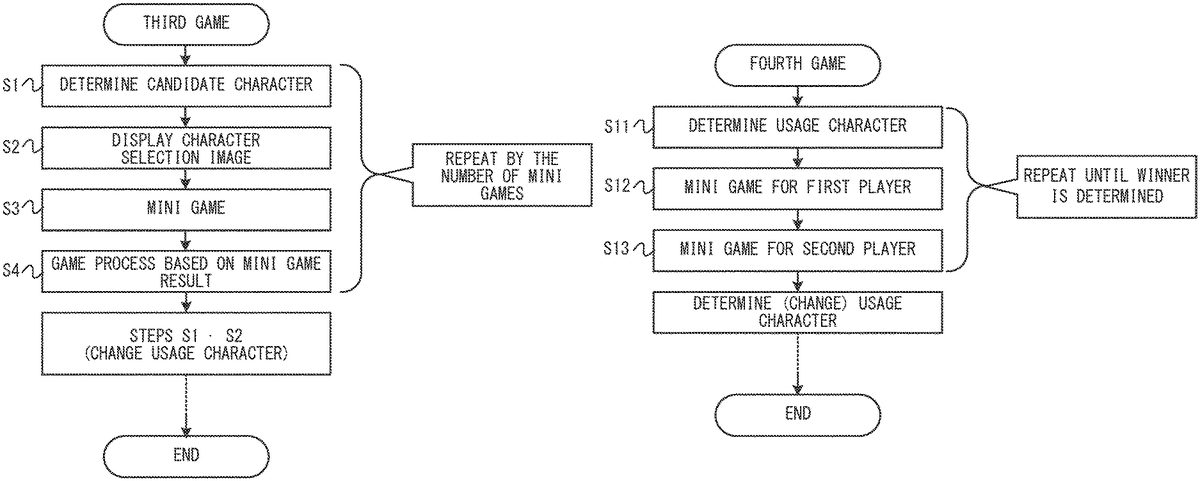
[2-4. Third Game]
Hereinafter, a third game will be described with reference toFIGS.14to16.FIG.14shows an example of a game flow in the third game. The third game includes a plurality of mini games. That is, a plurality of mini games are performed in one third game, and the game result (e.g., winner/loser) of the third game is determined based on the results of the respective mini game. Hereinafter, a case where the third game is played by two players (hereinafter referred to as “first player” and “second player”) will be described. However, the number of players playing the third game is arbitrary. Three or more players may play the third game, or a single player may play the third game.
As shown inFIG.14, in the third game, a series of processes in steps S1to S4is executed for each mini game. In the exemplary embodiment, the series of processes in steps S1to S4per mini game is repeated by the number of the mini games, thereby progressing the third game.
When a mini game is performed in the third game, the game system1firstly determines candidate characters from among the prepared 18 types of characters (step S1). The candidate characters are candidates for usage characters to be used by players in the mini game. In the exemplary embodiment, characters as many as the number of players (i.e., two) are determined as the candidate characters. However, in another embodiment, the number of candidate characters may be larger than the number of players.
The method of selecting/determining candidate characters is arbitrary. In the exemplary embodiment, the game system1determines candidate characters such that a character whose preset compatibility with a mini game to be played next is good and a character whose preset compatibility with the mini game is poor, are equally selected. Moreover, the balance in selecting candidate characters (i.e., selection probability of each character) varies depending on the progress state of the third game and/or the winner/loser in each mini game in the third game. The method of determining (in other words, selecting) candidate characters from among the plurality of characters may be performed at random, or may be the same as the usage character determination method in the first game or the second game.
After the candidate characters have been determined, the game system1displays a character selection image on the display device (step S2). The character selection image is a game image for each player to select a usage character that he/she wants to use, from among the candidate characters.
FIGS.15and16show an example of the character selection image in the third game. As shown inFIGS.15and16, the character selection image includes candidate characters231and232determined in step S1. In the exemplary embodiment, the candidate characters231and232in the character selection image move to rotate along a circle (see dotted line arrows inFIGS.15and16).
The character selection image further includes arms233and234. The arms are objects for catching the candidate characters, and are operated by the respective players. In the character selection image, arms as many as the number of the players are disposed. InFIGS.15and16, the arm233is operated by the first player, and the arm234is operated by the second player.FIG.15shows the state where the arm233is contracted, andFIG.16shows the state where the arm233is expanded. The game system1controls each arm such that the arm is expanded from its contracted state, according to a predetermined instruction input performed by the player. If a candidate character is located at a distal end of an arm when the arm is expanded (seeFIG.16), the player corresponding to this arm acquires the candidate character. That is, in the above case, the candidate character becomes the usage character of the player. In the example shown inFIG.16, since the arm233operated by the first player catches the candidate character231, the candidate character231is the usage character of the first player.
In the third game, a time period during which each player can operate the arm is set such that the time period becomes shorter for an advantaged player (e.g., a player having a larger number of wins in the mini games in the third game being played) although the time period is the same among the players at the beginning of the game. During the time period, each player can get a desired candidate character as his/her usage character by catching the character earlier than the other player by operating the arm. In the exemplary embodiment, the moving speed of each candidate character is relatively high at the time when display of the character selection image is started, and then is gradually decreased. Therefore, in the exemplary embodiment, catching a desired candidate character is difficult immediately after the start of the time period, but gradually becomes easy with the lapse of time.
As described above, in the third game, a usage character is assigned to each player from among the candidate characters selected at random. Therefore, also in the third game, as in the first and second games, each player cannot always designate a desired character as a usage character.
As shown inFIGS.15and16, the character selection image includes a round number image235, and a game content image236. The round number image235indicates the current round number (i.e., what number the current mini game is) in this third game. The game content image236indicates the content of a mini game to be performed next. In the example shown inFIGS.15and16, the game content image236indicates a thumbnail image of the mini game and the name of the mini game (balloon popping). In the exemplary embodiment, the game content image236being displayed allows the player to select a usage character while checking the content of the mini game.
In the exemplary embodiment, when usage characters have been determined for the respective players, the game system1ends the display of the character selection image. When there is only one player whose usage character is not yet determined and only one candidate character is left, the game system1may end the display of the character selection image and determine the left candidate character as a usage character for this player.
After the display of the character selection image has ended, the game system1executes the mini game using the respective usage characters (step S3). That is, in the mini game, each player plays the mini game by using the usage character determined in step S2. The content of the mini game is arbitrary. For example, the same games as the first game and/or the second game may be executed in the third game as the mini games in the third game. In the exemplary embodiment, the mini games in the third game have different contents. However, in another embodiment, the same mini game may be performed a plurality of number of times. Even in this case, since the usage characters differ among the mini games, the variations of games can be increased. Moreover, a plurality of mini games to be performed in the third game may be determined in advance, or may be selected by a predetermined method (e.g., at random) from among a plurality of mini games prepared in advance.
When the mini game has ended, the game system1executes a game process based on the result of the mini game (step S4). This game process is a process for determining the game result of the third game (e.g., a winner and a loser in the third game), based on the result of the mini game. For example, in the exemplary embodiment, as the game process, a process for a game for determining a winner and a loser in the third game (referred to as “winner/loser determination game) is executed. The content of the winner/loser determination game is arbitrary. In the exemplary embodiment, a game in which each player puts up a flag in the game field is performed as the winner/loser determination game. Specifically, a player who wins the mini game can put up a flag in the game field, and can gain, as his/her acquisition area, an area surrounded by his/her flags. In the third game, a player having the largest acquisition area is a winner of the game. Thus, in the exemplary embodiment, a player who wins more mini games in the third game and therefore puts up more flags is more likely to be a winner of the third game. The specific content of the game process is arbitrary. For example, in another embodiment, the game process may be a process of giving a score to each player, based on the result of the mini game. In this case, the game system1may determine the result of the third game, based on the scores that each player has earned through the mini games.
In the third game, a series of processes in steps S1to S4is repeated by the number of the mini games included in the third game. That is, after the processes in steps S1to S4have been executed for one mini game, the game system1executes the processes in steps S1to S4again for the next mini game. At this time, by the processes in steps S1and S2, a usage character different from that in the previous mini game is assigned to each player (note that there are cases where the usage character in the previous mini game and the usage character in this mini game happen to be the same). Therefore, by the processes in the second or subsequent steps S1and S2in the third game, the usage characters of the players are changed in the third game. That is, the change condition in the third game is execution of the next mini game.
In the exemplary embodiment, a predetermined number of mini games, determined in the game program in advance, are executed in one third game. However, the number of mini games to be executed in one third game is arbitrary. For example, in another embodiment, the number of mini games may be designated by the player. Moreover, for example, the game system1may end the third game even if not all the predetermined number of mini games have been done at a time when a winner and a loser of the third game are determined.
As described above, in the third game of the exemplary embodiment, the game system1, during execution of the game, automatically determines a plurality of candidate characters as candidates for usage characters from among a plurality of characters. Moreover, the game system1, during execution of the game, displays the plurality of candidate characters (FIGS.15and16), and determines post-change usage characters for a plurality of players from among the plurality of candidate characters, according to instructions of the players (e.g., instructions of expanding arms). Since the candidate characters as the candidates for usage characters are presented to the players, it is possible to give each player an opportunity to think of a strategic method for the game, before the usage character is changed. Thus, the strategic characteristics of the game can be enhanced.
The phrase “determine a usage character according to an instruction of a player” means determining the user character with the instruction of the player as a trigger, and may mean determining the user character by a method in which the player is allowed, to some extent, to select a desired character, or may mean determining the user character by a method in which it is impossible (or difficult) for the player to select a desired character. For example, in another embodiment, the game system1may determine a usage character by using a roulette. At this time, the game system1may receive, from the player, an instruction to stop the roulette rotating at a high speed, and may stop the roulette according to the instruction. In this case, it is difficult for the player to select a desired character from among the candidate characters.
[2-5. Fourth Game]
Hereinafter, a fourth game will be described with reference toFIG.17.FIG.17shows an example of a game flow in the fourth game. Like the third game, the fourth game includes a plurality of mini games. The fourth game is played by a plurality of players. Hereinafter, a case where the fourth game is played by two players (hereinafter referred to as “first player” and “second player”) will be described.
As shown inFIG.17, in the fourth game, a series of processes in steps S11to S13is executed for one mini game. In the exemplary embodiment, the series of processes in steps S11to S13is executed for each mini game, thereby progressing the fourth game.
When a mini game is performed in the fourth game, the game system1firstly determines a usage character for a player (step S11). In the fourth game, as in the first game, the game system1determines the usage character at random from among the prepared 18 types of characters. A specific method for determining the usage character in the fourth game may be the same as the usage character determination method in the first game or the second game.
After the usage character has been determined, the game system1starts a mini game to be played by the first player (step S12). In the fourth game, the respective players do not simultaneously play one mini game, but play the mini game one by one. That is, in the mini game in step S12, the first player plays the game by using the usage character determined in step S11.
The contents of the mini games in the fourth game are arbitrary, that is, the mini games may have any contents. For example, the same games as the first game and/or the second game may be executed in the fourth game as the mini games in the fourth game. A plurality of mini games to be executed in the fourth game may be determined in advance, or may be selected by a predetermined method (e.g., at random) from among a plurality of mini games prepared in advance.
When the mini game by the first player has ended, the game system1starts a mini game to be played by the second player (step S13). In the exemplary embodiment, the mini game to be played varies from player to player. In another embodiment, the first player and the second player may play the same mini game. The usage character in the mini game in step S13is the same as the usage character determined in step S11, i.e., the usage character used by the first player. Thus, in the fourth game, each player plays the mini game by using the same usage character.
In the fourth game, while one of the players is playing the mini game, the game system1causes the other player to play another game (referred to as “auxiliary game”) different from the mini game. At this time, both the game image of the mini game and the game image of the auxiliary game are displayed on the display device. In the exemplary embodiment, the game system1executes, as the auxiliary game, a game of inflating a balloon, according to an input by the other player. The other player can continue the above input until the one player clears the mini game. That is, by quickly clearing the mini game, the one player can inhibit the other player from inflating the balloon too much.
In the exemplary embodiment, a player who bursts the balloon first is a winner of the fourth game. That is, in the fourth game, one player tries to clear the mini game as quickly as possible to inhibit the other player from inflating a balloon, and performs an input so as to quickly burst a balloon while the other player is playing the mini game. This prevents the other player from getting tired of the game while the one player is playing the mini game. Moreover, in the exemplary embodiment, the game result of the fourth game is determined based on not only the results of the mini games but also the results of the auxiliary games. Therefore, the entertainment characteristics of the game can be enhanced as compared to the case where the game result of the fourth game is determined by simply comparing the results of the mini games by the respective players.
In another embodiment, the game system1may cause the other player to wait without performing any game while the one player is playing the mini game. Moreover, in the other embodiment, the game system1may determine a winner and a loser of each mini game based on the result of the mini game, and may determine a winner and a loser of the fourth game based on the results of the respective mini games, as in the third game.
In the fourth game, the respective players play the mini game one by one. However, in another embodiment, in the fourth game, a plurality of players may simultaneously play the mini game. At this time, as in the exemplary embodiment, the game system1may change the usage characters of the respective players to be a common usage character.
When the mini game by the second player has ended, the game system1newly determines a usage character to be used in the next mini game (seeFIG.17). At this time, by the process of newly determining a usage character, a usage character different from that in the previous mini game is assigned to each player (note that there are cases where the usage character in the previous mini game and the usage character in this mini game happen to be the same). Therefore, by the process in the second or subsequent step S11in the fourth game, the usage characters of the players are changed in the fourth game. That is, the change condition in the fourth game is execution of the next mini game.
As described above, in the fourth game of the exemplary embodiment, the game system1, during execution of the game, changes each of the usage characters respectively used by the plurality of players to a common character selected from the plurality of characters. This makes the condition for the game fair among the respective players. For example, even when the usage characters are determined at random as in the exemplary embodiment, it is possible to reduce occurrence of advantages and disadvantages among the players. Moreover, when the respective players individually perform the same mini game, it is possible to eliminate advantages and disadvantages among the players by making the usage characters of the players common.
[3. Specific Example of Processing in Game System]
Next, a specific example of information processing in the game system1will be described with reference toFIGS.18to22.
FIG.18shows an example of various data used for the information processing in the game system1. The various data shown inFIG.18are stored in a storage medium (e.g., the flash memory84, the DRAM85, and/or a memory card attached to the slot23) that is accessible by the main body apparatus2.
As shown inFIG.18, the game system1stores therein a game program. The game program is a game program for executing game processes (specifically, game processes shown inFIGS.19to22) according to the exemplary embodiment. The game system1stores therein character data, the operation data, candidate character data, usage character data, and mini game result data.
The character data indicates a plurality of characters prepared in the game program. For example, the character data includes: data indicating the appearances of the characters; and data indicating control methods for the characters (i.e., what motions the characters take according to an input by the player).
The operation data is data indicating an operation performed by the player. As described above, the operation data is transmitted from the controllers3and4to the main body apparatus2and is stored in the main body apparatus2. In the exemplary embodiment, the operation data includes input data indicating inputs to the respective input sections described above.
The usage character data is data indicating a character determined as a usage character among the plurality of characters indicated by the character data. The usage character data is, for example, data of identification information that allows identification of each character.
The candidate character data is data indicating characters determined as candidate characters in the above third game, among the plurality of characters indicated by the character data. For example, the candidate character data is data of identification information that allows identification of each character.
The mini game result data is data indicating the game results of the mini games included in the above third game. Specifically, in the exemplary embodiment, the mini game result data indicates the game situation in the above winner/loser determination game.
FIG.19is a flowchart showing an example of a flow of a first game process executed by the game system1. The first game process is a game process for performing the above first game. The first game process is started in response to that an instruction of starting the first game is performed by the player while, for example, a menu image is displayed, during execution of the game program.
In the exemplary embodiment, the processor81of the main body apparatus2executes the game program stored in the game system1, thereby executing processes in steps shown inFIGS.19to22. However, in another embodiment, a part of the processes in the steps may be executed by a processor (e.g., a dedicated circuit or the like) other than the processor81. If the game system1is communicable with another information processing apparatus (e.g., a server), a part of the processes in the steps shown inFIGS.19to22may be executed by the other information processing apparatus. The processes in the steps shown inFIGS.19to22are merely examples, and the processing order of the steps may be changed or another process may be executed in addition to (or instead of) the process in each step, so long as similar results can be obtained.
The processor81executes the processes in the steps shown inFIGS.19to22by using a memory (e.g., the DRAM85). That is, the processor81stores, in the memory, information (in other words, data) obtained in each process step, and reads out the information from the memory when using the information in the subsequent process steps.
In step S20shown inFIG.19, the processor81determines a usage character to be used in the first game. The usage character is determined according to the method described in the above “[2-2. First game]”. The usage character determined in step S20is a usage character to be used by each player at the start of the first game. At this time, the processor81updates the usage character data stored in the storage medium so as to indicate the determined usage character. Next to step S20, the process in step S21is executed.
In step S21, the processor81controls the motion of the usage character in the first game, according to an input for operating the usage character by the player. That is, based on the operation data stored in the storage medium, the processor81determines inputs to the analog stick and the motion instruction button and controls the motion of the usage character according to the inputs. If there are a plurality of usage characters (i.e., a plurality of players) in the first game, the processor81, according to an input by each player, controls the motion of the usage character corresponding to the player. If an enemy character or a moving object appears in the game field, the processor81performs a control of causing the enemy character to take a motion or a control of causing the object to move. Next to step S21, the process in step S22is executed.
In step S22, the processor81determines whether or not a timing, which is a little before a change timing to change the usage character, has come. That is, the processor81determines whether or not a timing a predetermined time (e.g., 3 seconds) before the change timing has come. When the determination result in step S22is positive, the process in step S23is executed. When the determination result in step S22is negative, the process in step S24is executed.
In step S23, the processor81performs a process of preannouncing the change of the usage character to the player. Specifically, the processor81performs setting so as to display the preannouncement image (seeFIG.9) preannouncing that the usage character will be changed. That is, an object indicating the preannouncement image is disposed in the game field. At this time, in a display process in step S28described later, a game image including the preannouncement image is displayed based on the setting. The setting regarding the display of the preannouncement image is maintained until the change timing comes. Next to step S23, the process in step S24is executed.
In step S24, the processor81determines where or not the change timing to change the usage character has come. When the determination result in step S24is positive, the process in step S25is executed. When the determination result in step S24is negative, the process in step S28is executed.
In step S25, the processor81determines a post-change usage character. The post-change usage character is determined according to the method described in the above “[2-2. First game]”. At this time, the processor81updates the usage character data stored in the storage medium so as to indicate the determined post-change usage character. Next to step S25, the process in step S26is executed.
In step S26, the processor81executes a usage character change process for changing the usage character. Specifically, the processor81changes the usage character disposed in the game field to the character determined in step S25. Thus, a game field in which the post-change usage character is disposed is generated. Next to step S26, the process in step S27is executed.
In step S27, the processor81performs a process of notifying the player of the change of the usage character. Specifically, the processor81performs setting so as to display the notification image (seeFIG.10) notifying the change of the usage character. That is, the processor81disposes an object indicating the notification image in the game field. In the display process in step S28described later, a game image including the notification image is displayed based on the setting. The setting regarding the display of the notification image is maintained until a predetermined time (e.g., 5 seconds) elapses from the change timing. Next to step S27, the process in step S28is executed.
In step S28, the processor81generates the game image of the first game, and causes the display device to display the same. That is, the processor81generates the game image including the game field, the usage character representing the motion controlled in step S21, other objects, and the like. When the setting has been performed in step S23or S27, the processor81generates the game image further including the preannouncement image or the notification image. The game image thus generated is displayed on the display device. The game image generating process in step S28is repeatedly executed once every predetermined time (e.g., 1 frame time). Next to step S28, the process in step S29is executed.
In step S29, the processor81determines whether or not to end the first game. For example, when the condition for ending the first game has been satisfied (e.g., when a winner player of the first game has been determined or when the first game has been cleared), or when an instruction of ending the first game has been made by the player, the processor81determines to end the first game. Meanwhile, when the condition for ending the first game is not yet satisfied and an instruction of ending the first game is not made by the player, the processor81determines not to end the first game. When the determination result in step S29is negative, the process in step S21is executed again. Thereafter, a series of processes in steps S21to S29is repeatedly executed until it is determined in step S29to end the first game. When the determination result in step S29is positive, the processor81ends the first game process shown inFIG.19.
FIG.20is a flowchart showing an example of a flow of a second game process executed by the game system1. The second game process is a game process for performing the above second game. The second game process is started in response to that an instruction of starting the second game is performed by the player while, for example, the menu image is displayed, during execution of the game program.
In step S31shown inFIG.20, the processor81determines a usage character to be used in the second game. The usage character is determined according to the method described in the above “[2-3. Second game]”. The usage character determined in step S31is a usage character to be used by each player at the start of the second game. At this time, the processor81updates the usage character data stored in the storage medium so as to indicate the determined usage character. Next to step S31, the process in step S32is executed.
In step S32, the processor81determines whether or not the determined usage character is the above special movement character. The processor81performed the above determination, based on the character data and the usage character data stored in the storage medium. When the determination result in step S32is positive, the process in step S33is executed. When the determination result in step S32is negative, the process in step S34is executed.
In step S33, the processor81generates, as a game field of the second game, a game field in which an object for movement is disposed, and causes the display device to display a game image indicating the game field in which the object for movement is disposed. Next to step S33, the process in step S35is executed.
In step S34, the processor81generates, as a game field of the second game, a game field in which an object for movement is not disposed, and causes the display device to display a game image indicating the game field in which the object for movement is not disposed. Next to step S34, the process in step S35is executed.
In step S35, the processor81controls the motion of the usage character in the second game, according to an input for operating the usage character by the player. The process in step S35may be the same as the process in step S21in the first game. Next to step S35, the process in step S36is executed.
In step S36, the processor81determines whether or not the usage character or an attack object shot by the usage character has come into contact with a block in the game field. When the determination result in step S36is positive, the process in step S37is executed. When the determination result in step S36is negative, the processes in steps S37and S38are skipped and the process in step S39is executed.
In step S37, the processor81determines a post-change usage character. The post-change usage character is determined according to the method described in the above “[2-3. Second game]”. At this time, the processor81updates the usage character data stored in the storage medium so as to indicate the determined post-change usage character. Next to step S37, the process in step S38is executed. The determination of the post-change usage character may not necessarily be performed at this timing, and may be performed at the start of the second game.
In step S38, the processor81disposes an item indicating the post-change usage character, in the game field (seeFIG.12). Moreover, the processor81changes the display mode of the block. Next to step S38, the process in step S39is executed.
In step S39, the processor81determines whether or not the usage character or an attack object shot by the usage character comes into contact with the item in the game field. When the determination result in step S39is positive, the process in step S40is executed. When the determination result in step S39is negative, the process in step S40is skipped and the process in step S41is executed.
In step S40, the processor81executes a usage character change process for changing the usage character. Specifically, the processor81changes the usage character disposed in the game field to the character determined in the step S37, and switches the game field such that the object for movement is disposed when the usage character is the special movement character while the object for movement is not disposed when the usage character is not the special movement character. Thus, the post-change usage character is disposed in the game field, and the object for movement is disposed in the game field when the usage character is the special movement character. Next to step S40, the process in step S41is executed.
In step S41, the processor81generates a game image of the second game, and causes the display device to display the game image. That is, the processor81generates the game image including: the game field according to whether or not the object for movement is disposed; the usage character representing the motion controlled in step S35; items in the game field; and the like. The game image thus generated is displayed on the display device. The game image generating/displaying process in step S41is repeatedly executed once every predetermined time (e.g., 1 frame time). Next to step S41, the process in step S42is executed.
In step S42, the processor81determines whether or not to end the second game. For example, when the condition for ending the second game has been satisfied (e.g., when the second game has been cleared), or when an instruction of ending the second game has been made by the player, the processor81determines to end the second game. Meanwhile, when the condition for ending the second game is not yet satisfied and an instruction of ending the second game is not made by the player, the processor81determines not to end the second game. When the determination result in step S42is negative, the process in step S35is executed again. Thereafter, a series of processes in steps S35to S42is repeatedly executed until it is determined in step S42to end the second game. When the determination result in step S42is positive, the processor81ends the second game process shown inFIG.20.
FIG.21is a flowchart showing an example of a flow of a third game process executed by the game system1. The third game process is a game process for performing the third game. The third game process is started in response to that an instruction of starting the third game is performed by the player while, for example, the menu image is displayed, during execution of the game program.
In step S51shown inFIG.21, the processor81determines candidate characters. The candidate characters are determined according to the method described in the above “[2-4. Third game]”. Next to step S51, the process in step S52is executed.
In step S52, the processor81generates the above character selection image (seeFIG.15), and causes the display device to display the same. The game image generating/displaying process in step S52is repeatedly executed once every predetermined time (e.g., 1 frame time). Next to step S52, the process in step S53is executed.
In step S53, the processor81controls the motion of an arm in the character selection image, according to an input by the player. That is, based on the operation data stored in the storage medium, the processor81determines an instruction input for expanding the arm, and performs a control to expand the arm according to the instruction input. Next to step S53, the process in step S54is executed.
In step S54, the processor81determines whether or not the arm has caught a candidate character. When the determination result in step S54is positive, the process in step S55is executed. When the determination result in step S54is negative, the process in step S52is executed again.
In step S55, the processor81determines a usage character of the player who has caught the candidate character with the arm. That is, the candidate character caught by the arm is determined to be the usage character of this player. At this time, the processor81updates the usage character data stored in the storage medium so as to indicate the determined usage character. Next to step S55, the process in step S56is executed.
In step S56, the processor81determines whether or not usage characters have been set for all the players in the third game. When the determination result in step S56is negative, the process in step S52is executed again. Thereafter, a series of processes in steps S52to S56is repeatedly executed until it is determined in step S56that usage characters have been set for all the players. When the determination result in step S56is positive, the process in step S57is executed.
In step S57, the processor81executes one mini game included in the third game. That is, the processor81executes a game process of progressing the mini game by controlling the motion of each usage character determined in step S55, based on an operation by the player. The processor81ends the process in step S57when the mini game has ended, and executes the process in step S58.
In step S58, the processor81executes a game process based on the result of the mini game executed in step S57. In the exemplary embodiment, the processor81executes a game process for the above winner/loser determination game. When all the mini games in the third game have been executed, a winner and a loser of the third game are determined based on the results of the winner/loser determination games, and causes the display device to display the winner/loser result. Next to step S58, the process in step S59is executed.
In step S59, the processor81determines whether or not to end the third game. For example, when the condition for ending the third game has been satisfied (e.g., when all the mini games in the third game have been executed), or when an instruction of ending the third game has been made by the player, the processor81determines to end the third game. Meanwhile, when the condition for ending the third game is not yet satisfied and an instruction of ending the third game is not made by the player, the processor81determines not to end the third game. When the determination result in step S59is negative, the process in step S51is executed again. Thereafter, a series of processes in steps S51to S59is repeatedly executed until it is determined in step S59to end the third game. When the determination result in step S59is positive, the processor81ends the third game process shown inFIG.21.
FIG.22is a flowchart showing an example of a flow of a fourth game process executed by the game system1. The fourth game process is a game process for performing the above fourth game. The fourth game process is started in response to that an instruction of starting the fourth game is performed by the player while, for example, the menu image is displayed, during execution of the game program.
In step S61shown inFIG.22, the processor81determines a usage character to be used in a mini game in the fourth game. The usage character is determined according to the method described in the above “[2-5. Fourth game]”. Next to step S61, the process in step S62is executed.
In step S62, the processor81executes one mini game included in the fourth game. That is, the processor81executes a game process of progressing the mini game by controlling the motion of the usage character determined in step S61, based on an operation of the player. In the exemplary embodiment, the above auxiliary game is executed together with the mini game. In step S62, the mini game is played by one player, and when the mini game played by this player has ended, the processor81ends the process in step S62. Next to step S62, the process in step S63is executed.
In step S63, the processor81determines whether or not to end the fourth game. For example, when the condition for ending the fourth game has been satisfied (e.g., when a winner and a loser have been determined through the mini game and the auxiliary game executed in step S62), or when an instruction of ending the fourth game has been made by the player, the processor81determines to end the fourth game. Meanwhile, when the condition for ending the fourth game is not yet satisfied and an instruction of ending the fourth game is not made by the player, the processor81determines not to end the fourth game. When the determination result in step S63is negative, the process in step S64is executed again. When the determination result in step S63is positive, the processor81ends the fourth game process shown inFIG.22.
In step S64, the processor81determines whether or not each of the players of the fourth game has played the mini game executed in step S62. When the determination result in step S64is negative, the process in step S62is executed again. That is, the processes in steps S62to S64are repeatedly executed until each of the players has played the one mini game. When the determination result in step S64is positive, the process in step S61is executed again. That is, a usage character is determined again through the process in step S61, and a mini game using the usage character is executed through the process in step S62. Thereafter, the processes in steps S61to S64are repeatedly executed until it is determined in step S63to end the fourth game.
[4. Function and Effect of Exemplary Embodiment, and Modifications]
As described above, in the exemplary embodiment, the information processing system (e.g., the game system1) performs operations as follows:Determining a usage character to be played by a player from among a plurality of characters whose operation methods are different from each other (steps S21, S31, S55, S61).Executing a game by controlling a motion of the usage character in a virtual space, based on an operation by the player (steps S21, S35, S57, S62).During execution of the game, changing the usage character to a different character among the plurality of characters (step S26, S40, S55, S61).
According to the above configuration, during execution of the game, the character being used by the player is changed to another character having a different operation method. Thus, the game operation can be varied, thereby increasing the variations of game operations.
In the first, third, and fourth games according to the exemplary embodiment, the game system1, during execution of the game, automatically determines a post-change usage character from among the plurality of characters. Thus, it is possible to provide a new and highly entertaining game during which the usage character is changed to a character that is not intended by the player.
In the first to fourth games according to the exemplary embodiment, the game system1determines a usage character at random from among the plurality of characters. Thus, it becomes difficult for the player to predict a usage character that he/she will use next, whereby the entertainment characteristics of the game during which the usage character is changed can be further enhanced.
In the first and third games according to the exemplary embodiment, the game system1executes the game by controlling, based on operations of a plurality of players, the motions of usage characters corresponding to the respective players in the virtual space. Moreover, the game system1, during execution of the game, changes each of the usage characters to a character, among the plurality of characters, which is different from the current usage character. Since the usage characters of the plurality of players are changed during the game, the entertainment characteristics of the game can be enhanced, and the fairness among the players can be ensured.
In the exemplary embodiment, the characters are, for example, persons that appear in the game. However, the characters are not limited to persons, as long as the characters have individualities in game settings.
In another embodiment, the information processing system may not necessarily include a part of the components included in the exemplary embodiment, and may not necessarily perform a part of the processes performed in the exemplary embodiment. For example, in order to achieve a certain specific effect of the exemplary embodiment, the information processing system may include a component for producing the effect and perform a process for producing the effect, in other words, the information processing system may not necessarily include components other than the component and may not necessarily perform processes other than the process.
The exemplary embodiment is usable as, for example, a game system, a game program, and the like for the purpose of increasing the variations of game operations.
While certain example systems, methods, devices and apparatuses have been described herein, it is to be understood that the appended claims are not to be limited to the systems, methods, devices and apparatuses disclosed, but on the contrary, are intended to cover various modifications and equivalent arrangements included within the spirit and scope of the appended claims.
Claims
- A non-transitory computer-readable storage medium having stored therein a game program, the game program causing a processor of an information processing apparatus to execute: determining a usage character to be operated by a player from among a plurality of characters whose operation methods are different from each other;and executing a game by controlling a motion of the usage character in a virtual space, based on an operation by the player on a user interface, where the user interface has a plurality of operating elements, during execution of the game, monitoring a spatial position of the usage character in the virtual space;changing the usage character to a different character among the plurality of characters while the virtual space having the moving usage character is displayed on a display;and causing the post-changed usage character to be displayed in the virtual space on the display at the monitored spatial position in the virtual space which the usage character had at a time of the change.
- The storage medium according to claim 1, wherein the game program causes the processor to execute, during execution of the game, automatically determining a post-change usage character from among the plurality of characters.
- The storage medium according to claim 1, wherein the game program causes the processor to execute determining the usage character at random from among the plurality of characters.
- The storage medium according to claim 2, wherein the game program causes the processor to execute, during execution of the game, changing the usage character according to a lapse of time in the game as determined by a timer.
- The storage medium according to claim 4, wherein the game program causes the processor to further execute, during execution of the game, displaying, on the display, an image indicating a timing at which the usage character is changed according to the lapse of time in the game as determined by the timer.
- The storage medium according to claim 1, wherein the game program causes the processor to execute: executing the game by controlling, based on operations of a plurality of players, motions of usage characters corresponding to the respective players in the virtual space;and during execution of the game, changing each of the usage characters to a character, among the plurality of characters, which is different from the usage character that is currently used.
- The storage medium according to claim 6, wherein the game program causes the processor to further execute: during execution of the game, automatically determining a plurality of candidate characters to be candidates of the usage characters from among the plurality of characters;during execution of the game, displaying the plurality of candidate characters;and during execution of the game, determining post-change usage characters of the respective players from among the plurality of candidate characters, according to instructions of the plurality of players.
- The storage medium according to claim 1, wherein the game program causes the processor to execute, when the usage character has acquired a predetermined item in the virtual space during execution of the game, changing the usage character to a character associated with the acquired item among the plurality of characters.
- The storage medium according to claim 6, wherein the game program causes the processor to execute, during execution of the game, changing each of the usage characters respectively used by the plurality of players to a common character selected from the plurality of characters.
- The storage medium according to claim 1, wherein the plurality of characters are different from each other in a movement method according a direction input and a predetermined instruction input different from the direction input, and the game program causes the processor to further execute, during execution of the game, performing a movement control for the usage character in the virtual space, according to a movement method corresponding to the usage character, based on the direction input and the predetermined instruction input.
- The storage medium according to claim 10, wherein the game program causes the processor to execute performing, as a movement control for at least any of the plurality of characters, a movement control by using at least any of: a method of moving the usage character in a direction according to the direction input;a method of moving the usage character in a predetermined direction according to a combination of the direction input and the predetermined instruction input;and a method of automatically moving the usage character.
- The storage medium according to claim 10, wherein the game program causes the processor to further execute performing, as a control for an attack motion of at least any of the plurality of characters, a control for an attack motion of shooting an attack object automatically or according to the predetermined instruction input.
- The storage medium according to claim 12, wherein the game program causes the processor to further execute: performing, for each of the plurality of characters, a control of causing a predetermined object in the virtual space to generate a predetermined effect when the character has come into contact with the predetermined object;and performing, for a character that shoots the attack object among the plurality of characters, a control of causing the predetermined object to generate an effect when the attack object has come into contact with the predetermined object, the effect being the same as the effect generated when the character has come into contact with the predetermined object.
- The storage medium according to claim 12, wherein the game program causes the processor to execute, during execution of the game, if a post-change usage character is a predetermined character that shoots the attack object, disposing an object for movement in the virtual space, and performing a movement control for moving the predetermined character toward the object for movement when the attack object has come into contact with the object for movement.
- The storage medium according to claim 10, wherein the plurality of characters include a character of a first type that is influenced by gravity in the virtual space, and a character of a second type that is not influenced by gravity in the virtual space, and the game program causes the processor to execute, when the usage character is the character of the first type, performing a movement control for the usage character with an influence of gravity being reflected during execution of the game.
- The storage medium according to claim 1, wherein the game program causes the processor to execute, determining whether a change condition is satisfied to change the usage character and in response to determining that the change condition is satisfied, changing the usage character to a different character among the plurality of characters.
- The storage medium according to claim 16, wherein the determining is made during the execution of the game.
- An information processing system comprising: a display;a user interface having a plurality of operating elements;and one or more processors, the one or more processors cause the information processing system to: determine a usage character to be operated by a player from among a plurality of characters whose operation methods are different from each other;and execute a game by controlling a motion of the usage character in a virtual space, based on an operation by the player on the user interface, during execution of the game, monitor a spatial position of the usage character in the virtual space;change the usage character to a different character among the plurality of characters while the virtual space having the moving usage character is displayed on the display;and cause the post-changed usage character to be displayed in the virtual space on the display at the monitored spatial position in the virtual space which the usage character had at a time of the change.
- The information processing system according to claim 18, wherein the one or more processors, during execution of the game, cause the information processing system to automatically determine a post-change usage character from among the plurality of characters.
- The information processing system according to claim 18, wherein the one or more processors, cause the information processing system to determine the usage character at random from among the plurality of characters.
- The information processing system according to claim 19, further comprising a timer, wherein the one or more processors, during execution of the game, cause the information processing system to change the usage character according to a lapse of time in the game as determined by the timer.
- The information processing system according to claim 21, wherein the one or more processors, during execution of the game, cause the information processing system to display an image indicating a timing at which the usage character is changed according to the lapse of time in the game on the display as determined by the timer.
- The information processing system according to claim 18, wherein the one or more processors cause the information processing system to execute the game by controlling, based on operations of a plurality of players, motions of usage characters corresponding to the respective players in the virtual space, and during execution of the game, change each of the usage characters to a character, among the plurality of characters, which is different from the usage character that is currently used.
- The information processing system according to claim 23, wherein the one or more processors cause the information processing system to during execution of the game, automatically determine a plurality of candidate characters to be candidates of the usage characters from among the plurality of characters, during execution of the game, display the plurality of candidate characters, and during execution of the game, determine post-change usage characters of the respective players from among the plurality of candidate characters, according to instructions of the plurality of players.
- The information processing system according to claim 18, wherein the one or more processors cause the information processing system to, when the usage character has acquired a predetermined item in the virtual space during execution of the game, change the usage character to a character associated with the acquired item among the plurality of characters.
- The information processing system according to claim 23, wherein the one or more processors, during execution of the game, cause the information processing system to change each of the usage characters respectively used by the plurality of players to a common character selected from the plurality of characters.
- The information processing system according to claim 18, wherein the one or more processors cause the information processing system to determine whether a change condition is satisfied to change the usage character and in response to the information processing system determining that the change condition is satisfied, the information processing system changes the usage character to a different character among the plurality of characters.
- The information processing system according to claim 27, wherein the one or more processors cause the information processing system to determine whether a change condition is satisfied during the execution of the game.
- An information processing apparatus including one or more processors, the one or more processors cause the information processing apparatus to: determine a usage character to be operated by a player from among a plurality of characters whose operation methods are different from each other;and execute a game by controlling a motion of the usage character in a virtual space, based on an operation by the player on a user interface, where the user interface has a plurality of operating elements, during execution of the game, monitor a spatial position of the usage character in the virtual space;change the usage character to a different character among the plurality of characters while the virtual space having the moving usage character is displayed on a display;and cause the post-changed usage character to be displayed in the virtual space on the display at the monitored spatial position in the virtual space which the usage character had at a time of the change.
- The information processing apparatus according to claim 29, wherein the one or more processors, during execution of the game, cause the information processing apparatus to automatically determine a post-change usage character from among the plurality of characters.
- The information processing apparatus according to claim 29, wherein the one or more processors cause the information processing apparatus to determine the usage character at random from among the plurality of characters.
- The information processing apparatus according to claim 30, further comprising a timer, wherein the one or more processors, during execution of the game, cause the information processing apparatus to change the usage character according to a lapse of time in the game as determined by the timer.
- The information processing apparatus according to claim 29, wherein the one or more processors cause the information processing apparatus to, when the usage character has acquired a predetermined item in the virtual space during execution of the game, change the usage character to a character associated with the acquired item among the plurality of characters.
- The information processing apparatus according to claim 29, wherein the one or more processors cause the information processing apparatus to determine whether a change condition is satisfied to change the usage character and in response to the information processing apparatus determining that the change condition is satisfied, the information processing apparatus changes the usage character to a different character among the plurality of characters.
- The information processing apparatus according to claim 34, wherein the one or more processors cause the information processing apparatus to determine whether a change condition is satisfied during the execution of the game.
- A game processing method executed by an information processing system, comprising: determining a usage character to be operated by a player from among a plurality of characters whose operation methods are different from each other;and executing a game by controlling a motion of the usage character in a virtual space, based on an operation by the player on a user interface, where the user interface has a plurality of operating elements, during execution of the game, monitoring a spatial position of the usage character in the virtual space;changing the usage character to a different character among the plurality of characters while the virtual space having the moving usage character is displayed on a display;and causing the post-changed usage character to be displayed in the virtual space on the display at the monitored spatial position in the virtual space which the usage character had at a time of the change.
- The game processing method according to claim 36, wherein, during execution of the game, a post-change usage character is automatically determined from among the plurality of characters.
- The game processing method according to claim 36, wherein the usage character is determined at random from among the plurality of characters.
- The game processing method according to claim 37, wherein, during execution of the game, the usage character is changed according to a lapse of time in the game as determined by a timer.
- The game processing method according to claim 36, wherein, when the usage character has acquired a predetermined item in the virtual space during execution of the game, the usage character is changed to a character associated with the acquired item among the plurality of characters.
- The game processing method according to claim 36, further comprising determining whether a change condition is satisfied to change the usage character and in response to determining that the change condition is satisfied, changing the usage character to a different character among the plurality of characters.
- The game processing method according to claim 41, wherein the determining is made during the execution of the game.
- A non-transitory computer-readable storage medium having stored therein a game program, the game program causing a processor of an information processing apparatus to execute: determining a usage character to be operated by a player from among a plurality of characters whose operation methods are different from each other;executing a game by controlling a motion of the usage character in a virtual space, based on an operation by the player on a user interface, where the user interface has a plurality of operating elements;during execution of the game, monitoring the game to determine whether a change condition is satisfied;and in response to determining that the change condition is satisfied, changing the usage character to a different character among the plurality of characters while the virtual space having the moving usage character is displayed on a display.
- An information processing system comprising: a display;a user interface having a plurality of operating elements: and one or more processors, wherein the one or more processors cause the information processing system to: determine a usage character to be operated by a player from among a plurality of characters whose operation methods are different from each other;execute a game by controlling a motion of the usage character in a virtual space, based on an operation by the player on the user interface;during execution of the game, monitor the game to determine whether a change condition is satisfied;and in response to determining that the change condition is satisfied, change the usage character to a different character among the plurality of characters while the virtual space having the moving usage character is displayed on the display.
- An information processing apparatus including one or more processors, the one or more processors causing the information processing apparatus to: determine a usage character to be operated by a player from among a plurality of characters whose operation methods are different from each other;execute a game by controlling a motion of the usage character in a virtual space, based on an operation by the player on a user interface, where the user interface has a plurality of operating elements;during execution of the game, monitor the game to determine whether a change condition is satisfied;and in response to determining that the change condition is satisfied, change the usage character to a different character among the plurality of characters while the virtual space having the moving usage character is displayed on the display.
- A game processing method executed by an information processing system, comprising: determining a usage character to be operated by a player from among a plurality of characters whose operation methods are different from each other;executing a game by controlling a motion of the usage character in a virtual space, based on an operation by the player on a user interface, where the user interface has a plurality of operating elements;during execution of the game, monitoring the game to determine whether a change condition is satisfied;and in response to determining that the change condition is satisfied, change the usage character to a different character among the plurality of characters while the virtual space having the moving usage character is displayed on the display.
Disclaimer: Data collected from the USPTO and may be malformed, incomplete, and/or otherwise inaccurate.