U.S. Pat. No. 12,168,174
DATA DISPLAY OVERLAYS FOR ESPORT STREAMS
AssigneeSony Interactive Entertainment Inc.
Issue DateDecember 23, 2021
Illustrative Figure
Abstract
Methods and systems are provided for selecting a viewport into a video game for a spectator viewing a video game played by a player. The method includes identifying a plurality of virtual cameras for providing a plurality of viewports into scenes of the video game. The method includes accessing a spectator playbook, the spectator playbook is stored in association with a profile of the spectator. The spectator playbook identifies viewing history of the spectator for types of video games viewed by the spectator. The method includes accessing a player playbook, the player playbook is stored in association with a profile of the player. The player playbook identifies performance of the player for types of video games played by the player. The method includes accessing gameplay data for the video game played by the player. The method includes selecting a viewport from the plurality of viewports into the video game. The selected viewport is dynamically updated based on processing the spectator playbook, the player playbook, and changes in the gameplay data. The method includes streaming a spectator video stream for the spectator. The spectator video stream automatically changes based on the dynamic updating of the viewport while the spectator views the video game. In this way, viewports into a video game are selected and dynamically updated to provide the spectator with a customized viewing experience.
Description
DETAILED DESCRIPTION The following implementations of the present disclosure provide methods, systems, and devices for selecting a viewport into a video game for a spectator viewing the video game played by a player or group of players. In particular, while viewing the gameplay of a plurality of players playing a video game, each spectator viewing the video game may be provided with a customized spectator video stream that includes viewports into the scenes of the video game that are preferred by each of the spectators. As used herein, a viewport may include the virtual camera angle presented to the user for viewing into the game scene. In some cases, the virtual camera angle is dynamically generated for the user in substantial real-time. In other cases, the viewport is selected from among one or more executing virtual camera angles. Accordingly, the dynamic selection of viewports during the spectating facilitates an enhanced viewing experience for each spectator since the viewports are selected based on the predicted viewing preferences of the respective spectator. By way of example, while watching an E-sports event that involves a basketball game, each spectator may have a preference for a particular viewpoint, viewing angle, event, game action, player, in-game character, etc. that are most interested in observing. Since the video game may include a plurality of virtual cameras that provide a plurality of viewports into the scenes of video game, a viewport is selected and dynamically updated based on processing of a spectator playbook, a player playbook, and changes occurring throughout the gameplay. Accordingly, throughout portions of the progression of the gameplay, a spectator may be provided with a spectator video stream that includes viewports into the scenes of the video game that are selected based on the preferences of the spectator. In some embodiments, dynamic data (e.g., ...
DETAILED DESCRIPTION
The following implementations of the present disclosure provide methods, systems, and devices for selecting a viewport into a video game for a spectator viewing the video game played by a player or group of players. In particular, while viewing the gameplay of a plurality of players playing a video game, each spectator viewing the video game may be provided with a customized spectator video stream that includes viewports into the scenes of the video game that are preferred by each of the spectators. As used herein, a viewport may include the virtual camera angle presented to the user for viewing into the game scene. In some cases, the virtual camera angle is dynamically generated for the user in substantial real-time. In other cases, the viewport is selected from among one or more executing virtual camera angles. Accordingly, the dynamic selection of viewports during the spectating facilitates an enhanced viewing experience for each spectator since the viewports are selected based on the predicted viewing preferences of the respective spectator.
By way of example, while watching an E-sports event that involves a basketball game, each spectator may have a preference for a particular viewpoint, viewing angle, event, game action, player, in-game character, etc. that are most interested in observing. Since the video game may include a plurality of virtual cameras that provide a plurality of viewports into the scenes of video game, a viewport is selected and dynamically updated based on processing of a spectator playbook, a player playbook, and changes occurring throughout the gameplay. Accordingly, throughout portions of the progression of the gameplay, a spectator may be provided with a spectator video stream that includes viewports into the scenes of the video game that are selected based on the preferences of the spectator.
In some embodiments, dynamic data (e.g., player information, player biography, player statistics, player specialized skills, etc.) regarding the player playing the video game may be generated and presented in the spectator video stream. Generally, the methods described herein provides a seamless and efficient way for a spectator to view a video game played by a plurality of player without having to manually select the viewports and having to look up specific information regarding a player or players playing the video game.
As used herein, the term “viewports” should be broadly understood to refer to different camera views into a specific video game. Generally, some video games are played by multiple players and in different locations of the game world. The game world has different actions occurring at the same time, such as actions by one or more players playing and taking actions in the game to score points, achieve goals, and/or interact with the game environment and/or other users. In this context, a game scene in the game world can include one or more camera views into the actions, and those camera views can provide spectators with different virtual camera view perspectives into the game scene or scenes. The camera views, therefore, provide viewports into one or more of the game scenes.
As used herein, the term
By way of example, in one embodiment, a method is disclosed that enables selecting a viewport into a video game for a spectator viewing the video game played by a player. The method includes identifying a plurality of virtual cameras for providing a plurality of viewports into scenes in the video game. In one embodiment, the method may further include accessing a spectator playbook. In one example, the spectator playbook is stored in association with a profile of the spectator and the spectator playbook identifies viewing history of the spectator for types of video games viewed by the spectator. In another embodiment, the method may include accessing a player playbook. In one example, the player playbook is stored in association with a profile of the player and the player playbook identifies performance of the player for types of video games played by the player. In some embodiments, the method includes accessing gameplay data for the video game played by the player. In another embodiment, the method includes selecting a viewport from the plurality of viewports into the video game. In one example, the selected viewport is dynamically updated based on processing the spectator playbook, the player playbook, and changes in the gameplay data. In another embodiment, the method includes streaming a spectator video stream for the spectator. In one example, the spectator video stream automatically changes based on the dynamic updating of the viewport while the spectator views the video game. It will be obvious, however, to one skilled in the art that the present disclosure may be practiced without some or all of the specific details presently described. In other instances, well known process operations have not been described in detail in order not to unnecessarily obscure the present disclosure.
In accordance with one embodiment, a system is disclosed for selecting a viewport into a video game for spectators viewing the video game such as an online multiplayer video game. For example, a plurality of spectators may be connected to view a plurality of players competing in a live gaming event such as an E-sports event. In one embodiment, the system includes a connection to a network. In some embodiments, a plurality of spectators can be connected over a network to view the players competing against one another in the live gaming event. In some embodiments, one or more data centers and game servers can execute the game and enable connections to a plurality of spectators and players when hosting the video game. The one or more game servers of the one or more data centers may be configured to receive, process, and execute data from a plurality of devices controlled by spectators and players.
In some embodiments, a customized spectator video stream can be created for each spectator viewing the video game. The customized spectator video stream includes a unique viewport that is selected for each spectator and is based on processing a spectator playbook associated with each spectator, a player playbook, and changes in occurring in the basketball game. The selected viewport may differ for each spectator viewing the basketball game. For example, a spectator watching a video game that involves a basketball game may be a fan of a particular player competing in the basketball game and only be interested the game actions of the particular player. Accordingly, the system may select viewports that captures the game actions of the particular player regardless of what the particular player is doing in the basketball game, e.g., shooting, passing, blocking, playing defense, sitting on the bench, etc.
In some embodiments, the system is configured to generate dynamic data regarding a player for presenting in the spectator video stream while the spectator views the video game. In one example, during the gameplay of a player, the system can generate dynamic data that includes various information associated with the player such as player biographical information, player statistics, player specialized skills, etc. In some embodiments, dynamic data is generated based on the profile of the spectator viewing the video game and the gameplay data. In this way, each spectator is provided with customized dynamic data that is preferred by the spectator.
With the above overview in mind, the following provides several example figures to facilitate understanding of the example embodiments.
FIG.1illustrates an embodiment of a system that is configured to execute a gameplay for a plurality of players104and to stream a customized spectator video stream to each of the plurality of spectators102viewing the gameplay of the plurality of players104. In one embodiment,FIG.1illustrates spectators102a-102n, players104a-104n, a data center114, a game server116, and a network108. The system ofFIG.1may be referred to as a cloud gaming system, where multiple data centers114game servers116can work together to provide wide access to spectators102and players104in a distributed and seamless fashion.
In some embodiments, the players104can be playing a multiplayer online game where they are teammates or on opposing teams competing against one another. Players104can be configured to send game commands to the data center114and the game server116and through the network108. In one embodiment, the players104can be configured to receive encoded video streams and decode the video streams received by the data center114and the game server116. In some embodiments, the video streams may be presented to the players104on a display and/or a separate device such as a monitor or television. In some embodiments, the devices of the players104can be any connected device having a screen and internet connection.
In some embodiments, the spectators102can be coupled to and can communicate with the data center114and the game server116through the network108. The spectators102are configured to receive encoded video streams and decode the video streams received from the data center114and the game server116. The encoded video streams, for example, are provided by the cloud gaming system, while player and spectator devices provide inputs for interacting with the game. In one embodiment, each of the spectators102can receive a customized spectator video stream such as a video stream from a multiplayer online game that is being executed by players104. In some embodiments, the customized spectator video stream of each of the spectators102may include viewports into scenes of the video game that are selected and dynamically updated based on a corresponding playbook of the spectator102, a playbook of the player, and changes in the gameplay data.
As used herein, a playbook is a model that defines preferences of a player or spectator. The preferences can be generated directly as input from the player or spectator, or can be automatically generated based on how a player or spectator reacts, plays, takes action, selects options, completes tasks, historical actions, historical selections, historical communications, social interactions, actions not taken, preferences not selected, responses to challenges, trophies obtained, points scored, levels achieved, comments made, etc. The factors that define a playbook can be multi-dimensional, and can change over time based on the player or spectator's actions or non-actions. The playbook in some embodiments is itself defined by a model that is learned using artificial intelligence.
In some embodiments, the video streams may be presented to the spectators102on a display of the spectator or on a separate device such as a monitor, or television or head mounted display, or portable device. In some embodiments, the spectators102may be configured to send feedback to the data center114and the game server116through the network108.
In other embodiments, while watching the video stream of the gameplay, a camera may be located in the physical environment of the spectator102and be configured to capture the reaction sand movements the spectator. In some embodiments, the camera may include gaze tracking to enable tracking of the gaze of the spectator. The camera can capture images of the eyes of the spectator, which are analyzed to determine the gaze direction of the spectator and any dilation associated with the pupils of the eyes of the spectator. In some embodiments, the gaze direction and the dilation of the pupils of a spectator can be used to determine whether the spectator is interested in a particular game scene that they are viewing. In some embodiments, the camera may be configured to track and capture a facial expression of the spectator during the gameplay which is analyzed to determine an emotion associated with the facial expression of the spectator.
In one example, according to the embodiment shown inFIG.1, the spectators102are shown connected and viewing the gameplay of players104on a display106. As shown on the display106, the gameplay of the players104illustrates a game scene of the players104competing in a basketball game. As shown in the game scene, player characters104a′-104n′ representing players104a-104nare shown on the basketball court competing against each other in the basketball game. During the progression of the gameplay, the players104a-104ncan control the various actions and movements of their corresponding player characters104a′-104n′, and the spectators102can view the various game actions occurring throughout the video game.
As further illustrated in the game environment shown on the display106, in some embodiments, the video game may include a plurality of virtual cameras110a-110nthat are dispersed throughout the game environment and configured to record the gameplay. Each of the virtual cameras110a-110nmay have an associated camera point of view (POV)112that is configured to record and capture the game activity occurring within its periphery. Accordingly, the plurality of virtual cameras110a-110ncan capture and provide one or more unique viewports into the game scenes of the video game. In one embodiment, the virtual cameras110a-110nmay be fixed or can dynamically move with a corresponding game scene within the video game. As a result, since the plurality of virtual cameras110a-110ncan move in the game environment, the viewports associated with the virtual cameras may include various viewing angles into the scene of the video game. For example, as shown on the display106inFIG.1, virtual cameras110a-110nmay be adjusted so that its corresponding camera POV112a-112ncan capture various viewpoint angles of the basketball court such as a bird's-eye view, a side-view, an upper-tier view, a lower-tier view, an end-view, or a zoomed-in view. In this way, various game actions in the basketball game can be captured and provided to the spectator, e.g., slam dunk, free throw, foul, fight between players characters, facial expression of player characters, crowd reaction, etc.
FIG.2illustrates an embodiment of multiple game regions202a-202dwithin a game environment of a video game. As shown inFIG.2, the game scene in the video game can include a plurality of game actions occurring simultaneously at a given time. For example, the game scene inFIG.2shows a gameplay of a 3-on-3 basketball game. As shown, player character104a′,104b′, and104c′ are on the same team and are competing against opposing player characters104d′,104e′ and104n′. Player character104a′ is shown dribbling a basketball and moving toward one end of the basketball court while being guarded by opposing player character104n′. Player character104b′ is shown walking toward one end of the basketball court while being guarded by opposing player character104d′. Player character104c′ is shown attempting to get into a desired position to receive a pass from player104a′ while opposing player character104e′ guards player character104c′.
As noted above, virtual cameras110a-110ncan be positioned anywhere within the game environment and be configured to capture different perspectives of the game actions occurring in the game environment of the video game. Throughout the progression of the gameplay, the virtual cameras110a-110nmay be dynamically adjusted to provide the spectator with viewing angles that are preferred by the spectator. For example, in one embodiment, the position of a virtual camera110can be adjusted so that the camera POV112includes a bird's-eye view of a player character104′ dunking a basketball. Accordingly, each of the virtual cameras110can be configured to dynamically move and its corresponding POV112can capture a unique perspective of the game scene and provide a unique viewport into the video game.
FIGS.3A-3Dillustrate various embodiments of a spectator interface302with a corresponding viewport that is selected by the system based on processing a spectator playbook, a player playbook, and gameplay data. As noted above, a viewport corresponds to a virtual camera110and its corresponding camera POV112in the game environment of the video game which provides a view into the game scenes in the video game. In one embodiment, as shown inFIG.3A, the figure illustrates a spectator interface302awith a corresponding viewport (e.g., V8) that is selected for a particular spectator102viewing the video game. As shown, the viewport (e.g., V8) corresponds to game region202bin the game environment which includes a game scene of player character104a′ attempting to perform a slam dunk while an opposing player character104n′ attempts to deflect the slam dunk attempt.
In one embodiment, the selection of the viewport for inclusion into the spectator interface302is based on processing a playbook of a spectator102, a playbook of a player104, and gameplay data for the video game played by the player104. In one embodiment, each spectator102may have a corresponding playbook. The playbook of a spectator102may include various attributes and information associated with the spectator102such as viewing preferences, favorite players, gender, age, gaming experience, game play history, viewing history, gaming skill level, interests, disinterests, etc. In some embodiments, the playbook of the spectator102may include the above-noted features, and additionally other features that have been processed using artificial intelligence to define a model for the playbook. In some embodiments, each player104may have a corresponding playbook. The playbook associated with a player104may include various attributes and information associated with the player104such as gameplay tendencies, specialized gaming skills, gaming skill level, player experience, signature game moves, biography information, statistics associated gameplay of the player, preferences, interests, disinterests, etc. Similar to the playbook of the spectator102, the playbook of the player104may include the above-noted features, and additionally other features that have been processed using artificial intelligence to define a model for the playbook. Furthermore, the gameplay data may be produced by the plurality of players104during their gameplay and include gameplay metadata such as state data that identifies all of the actions, inputs, and moves made by each of the plurality of players104during the gameplay. In other embodiments, the gameplay data may include a variety of information associated with the video game that is played by the players104such as the scenes in the video game, progression in the video game, points scored, position and total number of virtual cameras, available viewports, contextual data regarding scenes in the video game, etc.
In some embodiments, the selection of the viewport for inclusion into the spectator interface302is based on processing the playbook of a spectator102, the playbook of a player104, and the gameplay data through a viewport recommendation model. The viewport recommendation model is configured to identify features from the playbook of a spectator102, the playbook of a player104, and the gameplay data to classify the features using one or more classifiers. The classified features are then used by the viewport recommendation model to predict and select a viewport that may align with the interest of the spectator102or be preferred by the spectator102. For example, a playbook of a spectator102may reveal that the spectator102is a 25-year-old female who enjoys watching defensive plays in a basketball video game. Further, the playbook of a player104may indicate which of the players104playing the video game has strong attributes for having strong defensive skills (e.g., guarding a player, stealing a ball, blocking shots, etc.). Accordingly, based on the gameplay data and the playbook of a player104, the system can predict the type of game actions the player characters104′ will perform and select viewports for the spectator102that includes game actions that relate to defensive plays. Accordingly, by using the viewport recommendation model that implements machine learning, the selection of the viewports is based on a prediction of what game actions that a spectator may prefer which can be configured to improve over time.
In another embodiment,FIG.3Billustrates a spectator interface302bwith a corresponding viewport (e.g., V10) that is selected for a particular spectator102viewing the video game. As shown, the viewport (e.g., V10) corresponds to game region202din the game environment which includes a game scene of player character104b′ jumping in the air in an attempt to make a lay-up shot while opposing player character104d′ guards the player character104b′. As noted above, the selection of the viewport for inclusion into the spectator interface302bis based on processing the playbook of a spectator102, the playbook of a player104, and the gameplay data through a viewport recommendation model. The selected viewport can be dynamically updated throughout the progression of the gameplay where the selected viewport is predicted to include game actions of the players104that are likely to occur and would be preferred by the spectator102.
In another embodiment,FIG.3Cillustrates a spectator interface302cwith a corresponding viewport (e.g., V7) that is selected for a particular spectator102viewing the video game. As shown, the viewport (e.g., V7) corresponds to game region202cin the game environment which includes a game scene of player character104c′ jumping in the air to dunk a basketball. As noted above, the selection of the viewport for inclusion into the spectator interface302cis based on processing the playbook of a spectator102, the playbook of a player104, and the gameplay data through a viewport recommendation model. In this example, the viewport (e.g., V7) was selected for inclusion into the spectator interface302cbecause the spectator102has a preference for game actions that involve slam-dunk attempts by player104c.
In another embodiment,FIG.3Dillustrates a spectator interface302dwith a corresponding viewport (e.g., V4) that is selected for a particular spectator102viewing the video game. As shown, the viewport (e.g., V4) corresponds to game region202ain the game environment which includes a game scene of player character104b′ and opposing player character104d′ matched up against one another in the basketball game. In this example, viewport (e.g., V4) was selected for inclusion into the spectator interface302dbecause the spectator102has a preference for game actions that involves defensive actions of player character104d′. Accordingly, throughout the progression of the gameplay, the system can dynamically update the viewport to include game actions where opposing player character104d′ is predicted to make a defensive action against a player character in the video game.
FIGS.4A-4Dillustrate various embodiments of the spectator interface302a-302dshown inFIGS.3A-3Dillustrating dynamic data402regarding the players104playing the video game. In one embodiment, the dynamic data402is customized for each spectator102and presented in a spectator video stream for display on the spectator302interface. In some embodiments, dynamic data402includes information regarding a player104playing the video game and the information regarding the player104is customized based on the profile of the spectator102and preferences of the spectator102. For example, each spectator102viewing the video game may have various preferences and interests in the gameplay of the one or more players104competing in the video game. A spectator102may have an interest learning about the personal life of a player104playing the video game. Other spectators may have an interest in learning more about the accolades and achievements of the player104playing the video game.
In other embodiments, dynamic data402may include information regarding the one or more spectators102viewing the video game. For example, a spectator102viewing the video game may be a celebrity spectator with a large fan base. One or more of the spectators viewing the video game may be interested in the in the game scenes that the celebrity spectator is viewing and also the dynamic data that is generated for the celebrity spectator. Accordingly, in some embodiments, the system may generate dynamic data402or a viewport for a spectator based on the dynamic data and viewport that is generated for other spectators viewing the video game.
In one example, a profile of a spectator may indicate that the spectator viewing the gameplay has a strong interest in player data and analytics. Accordingly, when the dynamic data402is generated for the spectator, the dynamic data402may include information regarding the player such as game statistics, seasons statistics, predicted statistics, etc. In another example, a profile of a spectator viewing the video game may indicate that the spectator has an interest in the personal life of a particular player playing the video game. Accordingly, when the dynamic data402is generated for the spectator, the dynamic data402may include personal information regarding the player such as where the player grew up, number of years of experience, what the player does for fun, relationship status, etc.
To illustrate an example of the dynamic data402, referring toFIG.4A, the figure illustrates the spectator interface302awith a corresponding viewport (e.g., V8) that shows player character104a′ attempting to perform a slam dunk over player character104n′. As shown, dynamic data402ais generated and presented in the spectator video stream for a particular spectator102viewing the spectator interface302a. The dynamic data402aincludes various information regarding the player that is controlling the player character104a′ such as the name of the player, position, team, hometown, experience, and favorite hobby. As noted above, the information included in the dynamic data402ais generated based on the profile of the spectator viewing the spectator interface302aand is predicted to be aligned with the interests and preferences of the spectator. As further illustrated inFIG.4A, dynamic data402nis generated and includes information regarding the player controlling the player character104n′. As shown, dynamic data402nincludes information regarding various awards achieved by the player.
In another embodiment, as shown inFIG.4B, the figure illustrates the spectator interface302bwith a corresponding viewport (e.g., V10) that shows player character104b′ jumping in the air in an attempt to make a lay-up shot. As shown, dynamic data402bis generated and presented in the spectator video stream for a particular spectator102viewing the spectator interface302b. The dynamic data402bincludes various information regarding the player that is controlling the player character104b′ such as the game summary of the player, e.g., points, rebounds, assists, turnovers, etc. In some embodiments, background information about the player may be provided, including examples of past wins, history against types of players, likelihood of performing types of plays, etc. The information included in the dynamic data402bis generated based on the profile of the spectator viewing the spectator interface302band is predicted to be aligned with the interests and preferences of the spectator.
In another embodiment, as shown inFIG.4C, the figure illustrates the spectator interface302cwith a corresponding viewport (e.g., V7) that shows player character104c′ attempting to dunk a basketball. As shown, dynamic data402cis generated and presented in the spectator video stream for a particular spectator102viewing the spectator interface302c. The dynamic data402cincludes various information regarding the player that is controlling the player character104c′ such as the career highlights of the player, e.g., signature move, field goal percentage, three point percentage, free throw percentage, etc. As noted above, the information included in the dynamic data402cis generated based on the profile of the spectator viewing the spectator interface302cand is predicted to be aligned with the interests and preferences of the spectator.
In another embodiment, as shown inFIG.4D, the figure illustrates the spectator interface302dwith a corresponding viewport (e.g., V4) showing player character104d′ guarding player character104b′. As shown, dynamic data402dis generated and presented in the spectator video stream for a particular spectator102viewing the spectator interface302d. The dynamic data402dincludes various information regarding the player that is controlling the player character104d′ such as the seasons statistics of the player, e.g., rebounds per game, steals per game, blocks per game, etc. As noted above, the information included in the dynamic data402dis generated based on the profile of the spectator viewing the spectator interface302dand is predicted to be aligned with the interests and preferences of the spectator.
FIG.5illustrates an embodiment of a player profile table502illustrating player gaming metrics and various information associated with a plurality of players playing a video game. As shown, the player profile table502includes a player identification504and various information associated with each player. In one embodiment, the player profile table502may include information such as player information506, player biography508, player signature moves510, and various player season statistics512. In one embodiment, the player season statistics512may include various statistical categories such as ranking, games played (GP), minutes per game (MPG), field goal percentage (FGP), free throw percentage (FTP), rebounds per game (REB), assists per game (AST), steals per game (STL), blocks per game (BLK), turnovers per game (TO), and points per game (PTG).
To provide an illustration of the player profile table502inFIG.5, in one example, the system may determine that in a basketball game, player 2 plays shooting-guard and attempts a three-point shot from the corner region of the basketball court 74% of the time. Using the profile information of player 2 and the gameplay data of the video game, the system can determine player 2 will likely attempt a three-point shot when the player has possession of the ball along the corner region of the basketball court. Accordingly, viewports that are predicted to capture the three-point shot attempt by player 2 can be selected for spectators102who may have a preference for game actions that involve three-point shot attempts.
In some embodiments, the player profile table502can be used to generate the dynamic data402regarding the player104for presenting in the spectator video stream of a spectator102. For example, a spectator102may have an interest in the personal life of a player rather than the statistics associated with the gameplay of a player. Accordingly, the system would generate dynamic data402for the spectator102that includes information from the player information506and the player biography508section of the table rather than the player season statistics512section of the table.
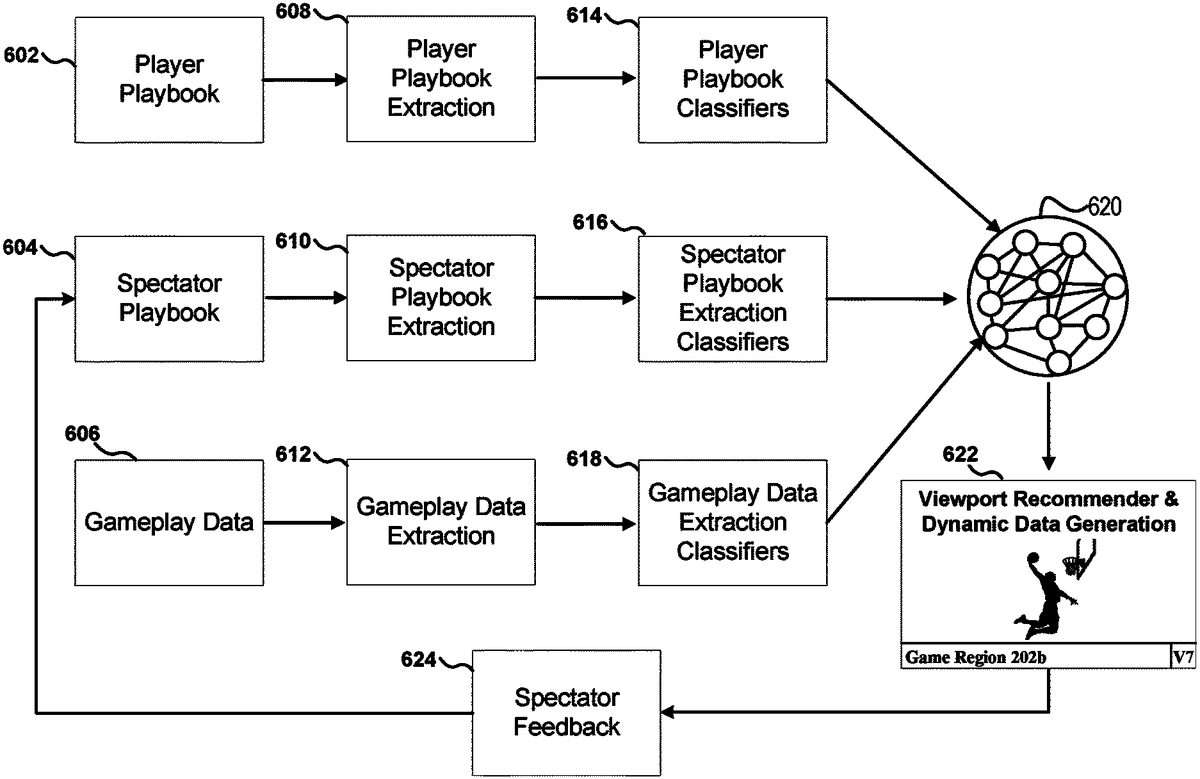
FIG.6illustrates an embodiment of a method for using a viewport recommendation model620to dynamically select and update viewports for a spectator102using a player playbook602, a spectator playbook604, and gameplay data606as inputs. As noted above, the selected viewports may be unique for each spectator102viewing the video game and included in a spectator video stream of the spectator102to provide the spectator102with a customized viewing experience of the video game.
As shown inFIG.6, in one embodiment, the system may include feature extraction operations (e.g.,608,610,612) that are configured to identify various features in the player playbook602, the spectator playbook604, and the gameplay data606. After the feature extraction operations identifies the features associated with the inputs, classifier operations (e.g.,614,616,618) may be configured to classify the features using one or more classifiers. In some embodiments, the system includes a viewport recommendation model620that is configured to receive the classified features from the classifier operations. Using the classified features, the viewport recommendation model620can be used to recommend and select a viewport for the spectator102. In some embodiments, operation622can use the viewport recommendation model620to determine which viewports to select for a particular spectator102. In other embodiments, operation622can use the viewport recommendation model620to determine the type of information used for generating the dynamic data for the spectator102. After the viewport and the dynamic data are selected and generated for the spectator102, a spectator feedback624operation can be configured to capture the feedback of the spectator which can be incorporated into the spectator playbook604.
In one embodiment, the system can process the player playbook602. As noted above, the player playbook602may include various attributes and information associated with the player104such as gameplay tendencies, specialized gaming skills, gaming skill level, player experience, signature game moves, biography information, statistics associated gameplay of the player, preferences, interests, disinterests, etc. In some embodiments, the player playbook extraction608operation is configured to process the player playbook602to identify and extract features associated with the profile of the player. After the player playbook extraction608operation processes and identifies the features from the player playbook602, the player playbook classifiers614operation is configured to classify the features using one or more classifiers. In one embodiment, the features are labeled using a classification algorithm for further refining by the viewport recommendation model620.
In another embodiment, the system can process the spectator playbook604. As noted above, the spectator playbook604may include various attributes and information associated with the spectator102such as viewport preferences, viewing angle preferences, favorite players, gender, age, gaming experience, game play history, viewing history, gaming skill level, interests, disinterests, etc. In some embodiments, the spectator playbook extraction610operation is configured to process the spectator playbook604to identify and extract features associated with the profile of the spectator. After the playbook extraction610operation processes and identifies the features from the spectator playbook604, the playbook extraction610operation is configured to classify the features using one or more classifiers. In one embodiment, the features are labeled using a classification algorithm for further refining by the viewport recommendation model620.
In another embodiment, the system can process the gameplay data606. As noted above, the gameplay data606may include a variety of information associated with the video game that is being played by the players104such as the scenes in the video game, progression in the video game, points scored, position of the virtual cameras, total number of virtual cameras, available viewports, contextual data regarding the scenes in the video game, metadata, etc. In some embodiments, the gameplay data extraction612operation is configured to process the gameplay data606to identify and extract features associated with the gameplay of the players. After the gameplay data extraction612processes and identifies the features from the gameplay data606, the gameplay data extraction classifiers618operation is configured to classify the features using one or more classifiers. In some embodiments, the features are labeled using a classification algorithm for further refining by the viewport recommendation model620.
In some embodiments, the viewport recommendation model620is configured to receive as inputs the classified features (e.g., player playbook classified features, spectator playbook classified features, gameplay data classified features). In another embodiment, other inputs that are not direct inputs or lack of input/feedback, may also be taken as inputs to the viewport recommendation model620. The viewport recommendation model620may use a machine learning model to predict viewports into scenes of the video game and dynamic data for a spectator102. For example, a spectator playbook604associated with a spectator102viewing the video game indicates that the spectator enjoys watching the reaction of the crowd who are attending the video game event. Using the player playbook602associated with the players playing the video game and the gameplay data, the viewport recommendation model620may predict when the players104will make will make specific game moves that will yield a loud reaction from the crowd, e.g., slam dunk, game winning shot, blocked shot, etc. Accordingly, viewport recommendation model620may predict viewports that include the best reactions (e.g., facial reactions, loudest cheers, high-fives, etc.) from individuals reacting to the game moves.
In some embodiments, operation622can use the viewport recommendation model620to determine which viewport to select for a particular spectator102viewing the video game. In other embodiments, operation622can use the viewport recommendation model620to determine the type of dynamic data to generate for a particular spectator102. Once the viewport and the dynamic data is determined, the viewport and the dynamic data may be included in a spectator video stream for the spectator. In some embodiments, while spectator views the video game, the viewport and the dynamic data can be dynamically updated by the system based the continuous processing of the player playbook, spectator playbook, and the gameplay data.
In some embodiments, the spectator feedback624operation can be configured to assess the spectator's response to the selected viewport and the dynamic data. In some embodiments, the feedback of the spectator may be explicit or implied by the spectator. For example, if the spectator does not look at or focus their attention on a viewport that is provided to the spectator, it may be implied that the spectator is not interested in the content. In another example, if the spectator manually zooms-in or clicks on a specific content in the viewport, it may be implied that the spectator is interested in the content. Accordingly, these inferences can be captured by the spectator feedback624operation and incorporated into the spectator playbook604.
FIG.7illustrates a method for selecting a viewport into a video game for a spectator102viewing the video game played by a player104. In one embodiment, the method described inFIG.7provides a spectator102with a customized viewing experience that includes viewports that are selected based on the preferences of the spectator102. In one embodiment, the method includes an operation702that is configured to identify a plurality of virtual cameras110for providing a plurality of viewports into scenes of the video game. For example, a video game may include a plurality of virtual cameras110that are dispersed throughout the game environment and configured to record the gameplay of the players104. Each virtual camera110may have a corresponding camera POV112that provides a viewport into the video game. In some embodiments, the virtual cameras110can zoom-in on specific game regions, dynamically move to capture specific viewing angles into the game scenes, and float to provide a birds-eye-view of the game environment.
The method shown inFIG.7then flows to operation704where the operation is configured to access a spectator playbook604. The spectator playbook604is stored in association with a profile of the spectator and identifies viewing history of the spectator for types of video games viewed by the spectator. In some embodiments, the spectator playbook604includes information such as viewport preferences, viewing angle preferences, favorite players, gender, age, gaming experience, game play history, viewing history, gaming skill level, interests, disinterests, etc. In some embodiments, the spectator playbook604may be stored in association with a profile of the spectator102and include a model that may be initially trained using global features of users similar to the spectator102. Over time, the model, based on the inputs and actions of the spectator102, e.g., selections and views, will be trained more specifically to the spectator's preferences and dislikes which can be used to predict what the spectator may wish to view with more accuracy.
The method flows to operation706where the operation is configured to access a player playbook602. The player playbook602is stored in association with a profile of the player104and identifies the performance of the player for types of video games played by the player. In one embodiment, since there can be a plurality of players104playing the video game, operation706is configured to access a playbook of a particular player based on the player being more active than other players, or based on the player being identified for following by a spectator102, or based on the player being a main character in a scene or action sequence of the game, or based on the player having a social relationship with a spectator102.
In some embodiments, the player playbook602includes information such as gameplay tendencies, specialized gaming skills, gaming skill level, player experience, signature game moves, biography information, statistics associated gameplay of the player, preferences, interests, disinterests, etc. In other embodiments, the player playbook602may include commentator type trivia information associated with the player or players, e.g., player N won her first E-sports event in 2019, player N started playing video games professionally when she was 16-years-old, player N holds the record for most assists in a game, etc. In some embodiments, the player playbook602may be stored in association with a profile of the player104and include a model that may be initially trained using global features of users similar to the player104. Over time, the model, based on the inputs and actions of the player104, will be trained more specifically to the player's gameplay tendencies and actions which can be used to predict with more accuracy what game actions the player104may perform.
The method shown inFIG.7then flows to operation708where the operation is configured to access gameplay data606for the video game played by the player. As noted above, the gameplay data606may be information associated with the game scenes in the video game, progression in the video game, points scored, position of the virtual cameras, total number of virtual cameras, contextual data regarding the scenes in the video game, metadata, game actions performed by the players, etc.
The method flows to operation710where the operation is configured to select a viewport from the plurality of viewports into the video game. In some embodiments, the viewport is selected and dynamically updated based on processing the spectator playbook604, the player playbook602, and changes in the gameplay data606. As discussed above, the selected viewport is predicted to include game actions of the player104that are preferred by the spectator102. In some embodiments, the selected viewport is predicted to include viewing angles into the scene of the video game that is preferred by the spectator102. For example, based on a spectator playbook604, the system may determine that the spectator enjoys watching a player perform a slam-dunk from a bird's-eye view rather than a side-view. Accordingly, when a player in the video game performs a slam-dunk, the viewport will provide an angle from a bird's-eye view for the spectator. In other embodiments, operation710is configured to generate dynamic data regarding the player104for presenting in a spectator video stream while the spectator102views the video game. In one embodiment, the dynamic data regarding the player104is customized based on the spectator playbook604.
The method shown inFIG.7then flows to operation710where the operation is configured to stream a spectator video stream for the spectator102. The spectator video stream may include the selected viewport and the generated dynamic data. Since the viewport and the dynamic data are selected and generated based on the preferences of the spectator, the spectator video stream is custom for each spectator102and allows the spectator to watch the video game in a seamless and efficient manner.
FIG.8illustrates components of an example device800that can be used to perform aspects of the various embodiments of the present disclosure. This block diagram illustrates a device800that can incorporate or can be a personal computer, video game console, personal digital assistant, a server or other digital device, suitable for practicing an embodiment of the disclosure. Device800includes a central processing unit (CPU)802for running software applications and optionally an operating system. CPU802may be comprised of one or more homogeneous or heterogeneous processing cores. For example, CPU802is one or more general-purpose microprocessors having one or more processing cores. Further embodiments can be implemented using one or more CPUs with microprocessor architectures specifically adapted for highly parallel and computationally intensive applications, such as processing operations of interpreting a query, identifying contextually relevant resources, and implementing and rendering the contextually relevant resources in a video game immediately. Device800may be a localized to a player playing a game segment (e.g., game console), or remote from the player (e.g., back-end server processor), or one of many servers using virtualization in a game cloud system for remote streaming of gameplay to clients.
Memory804stores applications and data for use by the CPU802. Storage806provides non-volatile storage and other computer readable media for applications and data and may include fixed disk drives, removable disk drives, flash memory devices, and CD-ROM, DVD-ROM, Blu-ray, HD-DVD, or other optical storage devices, as well as signal transmission and storage media. User input devices808communicate user inputs from one or more users to device800, examples of which may include keyboards, mice, joysticks, touch pads, touch screens, still or video recorders/cameras, tracking devices for recognizing gestures, and/or microphones. Network interface814allows device800to communicate with other computer systems via an electronic communications network, and may include wired or wireless communication over local area networks and wide area networks such as the internet. An audio processor812is adapted to generate analog or digital audio output from instructions and/or data provided by the CPU802, memory804, and/or storage806. The components of device800, including CPU802, memory804, data storage806, user input devices808, network interface810, and audio processor812are connected via one or more data buses822.
A graphics subsystem820is further connected with data bus822and the components of the device800. The graphics subsystem820includes a graphics processing unit (GPU)816and graphics memory818. Graphics memory818includes a display memory (e.g., a frame buffer) used for storing pixel data for each pixel of an output image. Graphics memory818can be integrated in the same device as GPU808, connected as a separate device with GPU816, and/or implemented within memory804. Pixel data can be provided to graphics memory818directly from the CPU802. Alternatively, CPU802provides the GPU816with data and/or instructions defining the desired output images, from which the GPU816generates the pixel data of one or more output images. The data and/or instructions defining the desired output images can be stored in memory804and/or graphics memory818. In an embodiment, the GPU816includes 3D rendering capabilities for generating pixel data for output images from instructions and data defining the geometry, lighting, shading, texturing, motion, and/or camera parameters for a scene. The GPU816can further include one or more programmable execution units capable of executing shader programs.
The graphics subsystem814periodically outputs pixel data for an image from graphics memory818to be displayed on display device810. Display device810can be any device capable of displaying visual information in response to a signal from the device800, including CRT, LCD, plasma, and OLED displays. Device800can provide the display device810with an analog or digital signal, for example.
It should be noted, that access services, such as providing access to games of the current embodiments, delivered over a wide geographical area often use cloud computing. Cloud computing is a style of computing in which dynamically scalable and often virtualized resources are provided as a service over the Internet. Users do not need to be an expert in the technology infrastructure in the “cloud” that supports them. Cloud computing can be divided into different services, such as Infrastructure as a Service (IaaS), Platform as a Service (PaaS), and Software as a Service (SaaS). Cloud computing services often provide common applications, such as video games, online that are accessed from a web browser, while the software and data are stored on the servers in the cloud. The term cloud is used as a metaphor for the Internet, based on how the Internet is depicted in computer network diagrams and is an abstraction for the complex infrastructure it conceals.
A game server may be used to perform the operations of the durational information platform for video game players, in some embodiments. Most video games played over the Internet operate via a connection to the game server. Typically, games use a dedicated server application that collects data from players and distributes it to other players. In other embodiments, the video game may be executed by a distributed game engine. In these embodiments, the distributed game engine may be executed on a plurality of processing entities (PEs) such that each PE executes a functional segment of a given game engine that the video game runs on. Each processing entity is seen by the game engine as simply a compute node. Game engines typically perform an array of functionally diverse operations to execute a video game application along with additional services that a user experiences. For example, game engines implement game logic, perform game calculations, physics, geometry transformations, rendering, lighting, shading, audio, as well as additional in-game or game-related services. Additional services may include, for example, messaging, social utilities, audio communication, game play replay functions, help function, etc. While game engines may sometimes be executed on an operating system virtualized by a hypervisor of a particular server, in other embodiments, the game engine itself is distributed among a plurality of processing entities, each of which may reside on different server units of a data center.
According to this embodiment, the respective processing entities for performing the may be a server unit, a virtual machine, or a container, depending on the needs of each game engine segment. For example, if a game engine segment is responsible for camera transformations, that particular game engine segment may be provisioned with a virtual machine associated with a graphics processing unit (GPU) since it will be doing a large number of relatively simple mathematical operations (e.g., matrix transformations). Other game engine segments that require fewer but more complex operations may be provisioned with a processing entity associated with one or more higher power central processing units (CPUs).
By distributing the game engine, the game engine is provided with elastic computing properties that are not bound by the capabilities of a physical server unit. Instead, the game engine, when needed, is provisioned with more or fewer compute nodes to meet the demands of the video game. From the perspective of the video game and a video game player, the game engine being distributed across multiple compute nodes is indistinguishable from a non-distributed game engine executed on a single processing entity, because a game engine manager or supervisor distributes the workload and integrates the results seamlessly to provide video game output components for the end user.
Users access the remote services with client devices, which include at least a CPU, a display and I/O. The client device can be a PC, a mobile phone, a netbook, a PDA, etc. In one embodiment, the network executing on the game server recognizes the type of device used by the client and adjusts the communication method employed. In other cases, client devices use a standard communications method, such as html, to access the application on the game server over the internet.
It should be appreciated that a given video game or gaming application may be developed for a specific platform and a specific associated controller device. However, when such a game is made available via a game cloud system as presented herein, the user may be accessing the video game with a different controller device. For example, a game might have been developed for a game console and its associated controller, whereas the user might be accessing a cloud-based version of the game from a personal computer utilizing a keyboard and mouse. In such a scenario, the input parameter configuration can define a mapping from inputs which can be generated by the user's available controller device (in this case, a keyboard and mouse) to inputs which are acceptable for the execution of the video game.
In another example, a user may access the cloud gaming system via a tablet computing device, a touchscreen smartphone, or other touchscreen driven device. In this case, the client device and the controller device are integrated together in the same device, with inputs being provided by way of detected touchscreen inputs/gestures. For such a device, the input parameter configuration may define particular touchscreen inputs corresponding to game inputs for the video game. For example, buttons, a directional pad, or other types of input elements might be displayed or overlaid during running of the video game to indicate locations on the touchscreen that the user can touch to generate a game input. Gestures such as swipes in particular directions or specific touch motions may also be detected as game inputs. In one embodiment, a tutorial can be provided to the user indicating how to provide input via the touchscreen for gameplay, e.g., prior to beginning gameplay of the video game, so as to acclimate the user to the operation of the controls on the touchscreen.
In some embodiments, the client device serves as the connection point for a controller device. That is, the controller device communicates via a wireless or wired connection with the client device to transmit inputs from the controller device to the client device. The client device may in turn process these inputs and then transmit input data to the cloud game server via a network (e.g., accessed via a local networking device such as a router). However, in other embodiments, the controller can itself be a networked device, with the ability to communicate inputs directly via the network to the cloud game server, without being required to communicate such inputs through the client device first. For example, the controller might connect to a local networking device (such as the aforementioned router) to send to and receive data from the cloud game server. Thus, while the client device may still be required to receive video output from the cloud-based video game and render it on a local display, input latency can be reduced by allowing the controller to send inputs directly over the network to the cloud game server, bypassing the client device.
In one embodiment, a networked controller and client device can be configured to send certain types of inputs directly from the controller to the cloud game server, and other types of inputs via the client device. For example, inputs whose detection does not depend on any additional hardware or processing apart from the controller itself can be sent directly from the controller to the cloud game server via the network, bypassing the client device. Such inputs may include button inputs, joystick inputs, embedded motion detection inputs (e.g., accelerometer, magnetometer, gyroscope), etc. However, inputs that utilize additional hardware or require processing by the client device can be sent by the client device to the cloud game server. These might include captured video or audio from the game environment that may be processed by the client device before sending to the cloud game server. Additionally, inputs from motion detection hardware of the controller might be processed by the client device in conjunction with captured video to detect the position and motion of the controller, which would subsequently be communicated by the client device to the cloud game server. It should be appreciated that the controller device in accordance with various embodiments may also receive data (e.g., feedback data) from the client device or directly from the cloud gaming server.
It should be understood that the various embodiments defined herein may be combined or assembled into specific implementations using the various features disclosed herein. Thus, the examples provided are just some possible examples, without limitation to the various implementations that are possible by combining the various elements to define many more implementations. In some examples, some implementations may include fewer elements, without departing from the spirit of the disclosed or equivalent implementations.
Embodiments of the present disclosure may be practiced with various computer system configurations including hand-held devices, microprocessor systems, microprocessor-based or programmable consumer electronics, minicomputers, mainframe computers and the like. Embodiments of the present disclosure can also be practiced in distributed computing environments where tasks are performed by remote processing devices that are linked through a wire-based or wireless network.
Although the method operations were described in a specific order, it should be understood that other housekeeping operations may be performed in between operations, or operations may be adjusted so that they occur at slightly different times or may be distributed in a system which allows the occurrence of the processing operations at various intervals associated with the processing, as long as the processing of the telemetry and game state data for generating modified game states and are performed in the desired way.
One or more embodiments can also be fabricated as computer readable code on a computer readable medium. The computer readable medium is any data storage device that can store data, which can be thereafter be read by a computer system. Examples of the computer readable medium include hard drives, network attached storage (NAS), read-only memory, random-access memory, CD-ROMs, CD-Rs, CD-RWs, magnetic tapes and other optical and non-optical data storage devices. The computer readable medium can include computer readable tangible medium distributed over a network-coupled computer system so that the computer readable code is stored and executed in a distributed fashion.
In one embodiment, the video game is executed either locally on a gaming machine, a personal computer, or on a server. In some cases, the video game is executed by one or more servers of a data center. When the video game is executed, some instances of the video game may be a simulation of the video game. For example, the video game may be executed by an environment or server that generates a simulation of the video game. The simulation, on some embodiments, is an instance of the video game. In other embodiments, the simulation maybe produced by an emulator. In either case, if the video game is represented as a simulation, that simulation is capable of being executed to render interactive content that can be interactively streamed, executed, and/or controlled by user input.
Although the foregoing embodiments have been described in some detail for purposes of clarity of understanding, it will be apparent that certain changes and modifications can be practiced within the scope of the appended claims. Accordingly, the present embodiments are to be considered as illustrative and not restrictive, and the embodiments are not to be limited to the details given herein, but may be modified within the scope and equivalents of the appended claims.
Claims
- A method for selecting a viewport into a video game for a spectator viewing the video game played by a player, comprising: identifying a plurality of virtual cameras for providing a plurality of viewports into scenes of the video game;accessing a spectator playbook, the spectator playbook is stored in association with a profile of the spectator, the spectator playbook identifying viewing history of the spectator for types of video games viewed by the spectator;accessing a player playbook, the player playbook is stored in association with a profile of the player, the player playbook identifying performance of the player for types of video games played by the player;accessing gameplay data for the video game played by the player during a session;selecting, during the session, a viewport from the plurality of viewports into the video game, the selected viewport is dynamically updated using a machine learning model that is configured to identify features from the spectator playbook, the player playbook, and the gameplay data to classify attributes of the spectator;wherein feedback received from the spectator related to at least one selected viewport that was dynamically updated is incorporated into the spectator playbook, such that said feedback is processed to extract features that are classified to update the machine learning model;and streaming a spectator video stream for the spectator, the spectator video stream presents a plurality of viewports that automatically changes based on the dynamic updating of the viewport while the spectator views the session of the video game played by the player.
- The method of claim 1, wherein the viewport selected is predicted to include game actions of the player that are preferred by the spectator.
- The method of claim 1, wherein the viewport selected is predicted to include viewing angles into the scenes of the video game preferred by the spectator.
- The method of claim 1, wherein the player is one player of a plurality of players, and each of the plurality of players has a corresponding player playbook.
- The method of claim 1, wherein the player is one player producing at least part of said gameplay data for the video game.
- The method of claim 1, wherein the player is one player of a plurality of players, and said player is selected among the plurality of players for accessing said player playbook based on said player being more active than other players, or said player being identified for following by said spectator, or said player being a main character in a scene or action sequence of the video game, or said player having a social relationship with said spectator.
- The method of claim 1, wherein the selected viewport is dynamically updated based on calls to the machine learning model to obtain predictions as to types of viewports that may be preferred by the spectator while the spectator is viewing the video game.
- The method of claim 1, further comprising, generating dynamic data regarding the player for presenting in the spectator video stream while the spectator views the video game, wherein the dynamic data regarding the player is customized based on the profile of the spectator.
- The method of claim 8, wherein the dynamic data include data that provide statistics associated with the video game played by the player, player gaming metrics of the player, biographical information of the player, information related to other spectators viewing the video game, or a combination of two or more thereof.
- The method of claim 1, wherein the plurality of virtual cameras are fixed or dynamically moves with a corresponding game action occurring within the video game.
- The method of claim 1, wherein the selected viewport is further based on processing a gaze direction of the spectator or facial expression of the spectator in response to game actions occurring within the video game.
- A method for selecting a viewport into a video game for a spectator viewing the video game played by a player, comprising: identifying, by a server, a plurality of virtual cameras for providing a plurality of viewports into scenes of the video game;accessing, by the server, a spectator playbook, the spectator playbook is stored in association with a profile of the spectator, the spectator playbook identifying viewing history of the spectator for types of video games viewed by the spectator;accessing, by the server, a player playbook, the player playbook is stored in association with a profile of the player, the player playbook identifying performance of the player for types of video games played by the player;accessing, by the server, gameplay data for the video game played by the player during a session;selecting, by the server, a viewport from the plurality of viewports into the video game, the selected viewport is dynamically updated based on processing the spectator playbook, the player playbook, and changes in the gameplay data through a machine learning model, the machine learning model is configured to identify features from the spectator playbook, the player playbook, and the gameplay data to classify attributes of the spectator, the attributes of the spectator being used to select the viewport, and wherein the dynamic updating of the selected viewport accounts for feedback received from the spectator that relates to at least one selected viewport that was dynamically updated, the feedback is incorporated into the spectator playbook and processed to extract features that are classified to update the machine learning model;and streaming, by the server, a spectator video stream for the spectator, the spectator video stream presents a plurality of viewports that automatically changes based on the dynamic updating of the viewport while the spectator views the session of the video game played by the player.
- The method of claim 12, wherein the viewport selected is predicted to include game actions of the player that are preferred by the spectator.
- The method of claim 12, wherein the viewport selected is predicted to include viewing angles into the scenes of the video game preferred by the spectator.
- The method of claim 12, wherein the selected viewport is dynamically updated based on calls to the machine learning model to obtain predictions as to types of viewports that may be preferred by the spectator while the spectator is viewing the video game.
- The method of claim 12, further comprising, generating by the server, dynamic data regarding the player for presenting in the spectator video stream while the spectator views the video game, wherein the dynamic data regarding the player is customized based on the profile of the spectator.
- The method of claim 16, wherein the dynamic data include data that provide statistics associated with the video game played by the player, player gaming metrics of the player, biographical information of the player, information related to other spectators viewing the video game, or a combination of two or more thereof.
- The method of claim 12, wherein the selected viewport is further based on processing a gaze direction of the spectator or facial expression of the spectator in response to game actions occurring within the video game.
Disclaimer: Data collected from the USPTO and may be malformed, incomplete, and/or otherwise inaccurate.