U.S. Pat. No. 12,145,051
A MULTI, SINGLE-AXIS GAME CONTROLLER
AssigneeBox Dark Industries Pty. Ltd.
Issue DateFebruary 23, 2021
Illustrative Figure
Abstract
A multi, single-axis game controller including a pair of hand units in a spaced apart configuration, each hand unit configured to be held in one hand by the user and at least one of the pair of hand units having at least one button control pad and at least one thumb stick; and a switching actuator to at least temporarily reassign at least some input functionality from the at least one thumb stick to another control element provided on at least one of the hand units.
Description
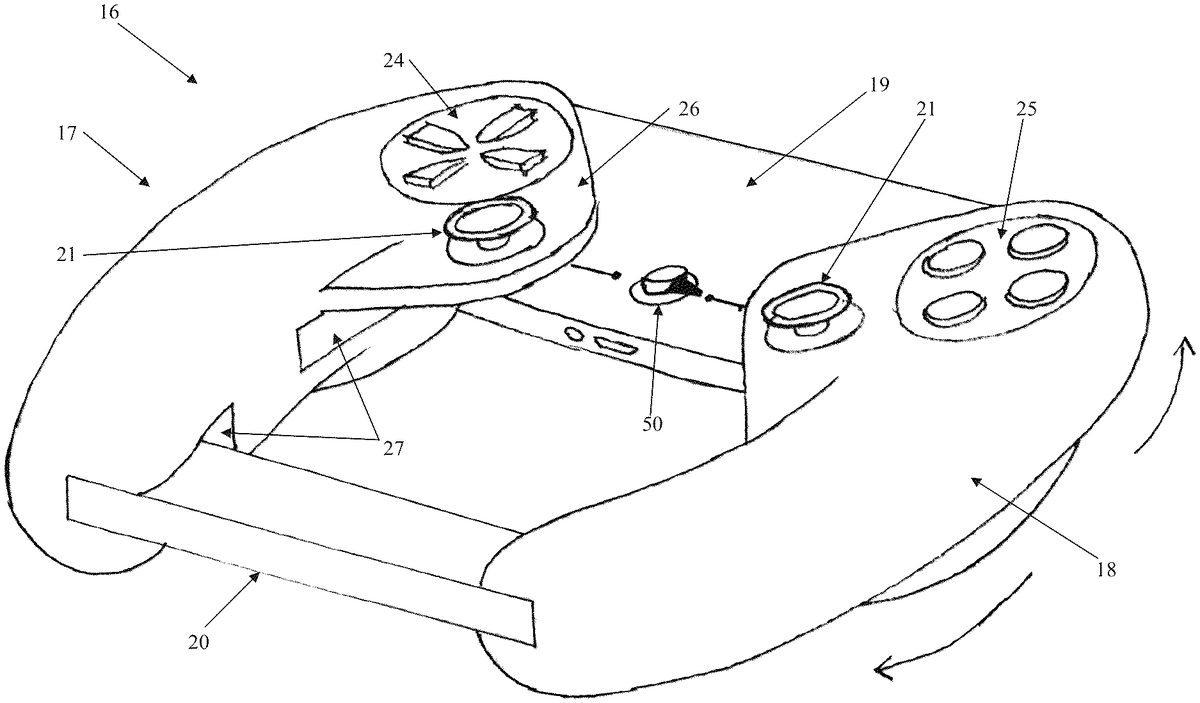
DESCRIPTION OF EMBODIMENTS According to a particularly preferred embodiment of the present invention, an articulated multi, single-axis game controller16is provided. In the detailed embodiment illustrated in the Figures, the articulated game controller16includes a pair of hand units in a spaced apart configuration, a left hand unit17and a right hand unit18. Each hand unit is configured to be held in one hand by the user. Each of the hand units have a button control pad and a thumb stick21. As shown inFIG.4, the pair of hand units are separated from one another by a pair of elongate links, an upper link19and a lower link20. The upper link19and a lower link20mount the left hand unit17and a right hand unit18via an upper and a lower articulable joint to enable the user to maintain a grip on each respective hand unit without interference from the articulable joint. User input is provided to the controller through movement of the left hand unit17and a right hand unit18relative to one another about the articulable joints. A switching actuator50is provided on the upper link19to at least temporarily reassign at least some input functionality from the at least one of the thumb sticks21to another control element provided on at least one of the hand units17,18. The control elements available on the controller16illustrated inFIG.4include:A pair of thumb sticks21;A pair of trigger actuators22(relocated in the embodiment illustrated inFIG.4to the underside of the left hand unit17and a right hand unit18);A pair of bumper actuators23(relocated in the embodiment illustrated inFIG.4to the underside of the left hand unit17and a right hand unit18);A joypad24with direction buttons on the left hand unit17;a button pad25including one or more function buttons substantially opposite to the joypad24, on the right hand unit18; andan upper and lower articulable joint and sensor configuration (obscured) on each of the left hand unit17and ...
DESCRIPTION OF EMBODIMENTS
According to a particularly preferred embodiment of the present invention, an articulated multi, single-axis game controller16is provided.
In the detailed embodiment illustrated in the Figures, the articulated game controller16includes a pair of hand units in a spaced apart configuration, a left hand unit17and a right hand unit18. Each hand unit is configured to be held in one hand by the user. Each of the hand units have a button control pad and a thumb stick21. As shown inFIG.4, the pair of hand units are separated from one another by a pair of elongate links, an upper link19and a lower link20. The upper link19and a lower link20mount the left hand unit17and a right hand unit18via an upper and a lower articulable joint to enable the user to maintain a grip on each respective hand unit without interference from the articulable joint. User input is provided to the controller through movement of the left hand unit17and a right hand unit18relative to one another about the articulable joints. A switching actuator50is provided on the upper link19to at least temporarily reassign at least some input functionality from the at least one of the thumb sticks21to another control element provided on at least one of the hand units17,18.
The control elements available on the controller16illustrated inFIG.4include:A pair of thumb sticks21;A pair of trigger actuators22(relocated in the embodiment illustrated inFIG.4to the underside of the left hand unit17and a right hand unit18);A pair of bumper actuators23(relocated in the embodiment illustrated inFIG.4to the underside of the left hand unit17and a right hand unit18);A joypad24with direction buttons on the left hand unit17;a button pad25including one or more function buttons substantially opposite to the joypad24, on the right hand unit18; andan upper and lower articulable joint and sensor configuration (obscured) on each of the left hand unit17and a right hand unit18,
with at least some of the functionality from at least one of the thumbsticks21being temporarily reassignable to at least one of the other control elements using the switching actuator50.
As illustrated, each articulable joint is at least partly enclosed by the hand units17,18to enable the user to maintain a grip on the respective hand unit17,18without interference from the articulable joint. User input is provided to the controller16through the control elements and/or movement of the hand units17,18relative to one another about the articulable joints.
As shown, each of the links19,20is elongate and articulated with the first hand unit at one end of the link, and articulated with the second hand unit at an opposing end of the link. The hand units17,18are pivotally attached to both of the links19,20.
The first and second hand units17,18are configured to pivot around an axis at the point at which the first hand unit is pivotally attached to the link, and an axis at the point at which the second hand unit is pivotally attached to the link to mimic a twisting or rotational motion (similar to a steering wheel) where the first and second hand units17,18are rotated in opposite directions around the pivotal attachments to the respective links19,20.
The axes about which the first and second hand units17,18are configured to pivot are perpendicular to a front surface (the surface relative to which the thumb stocks and the control buttons are provided) of the controller16.
Suitably, the first and second hand units17,18are configured to mimic an up-down motion, where the first and second hand units17,18are raised or lowered relative to each other, such that an angle is varied between the first hand unit and the link, and between the second hand unit and the link.
As shown, the first and second hand units17,18each include an extension portion for receiving respective ends of each of the links19,20with the upper extension portion26mounting the thumb stick21.
In the illustrated form, each of the first and second hand units17,18include a channel27for receiving respective ends of the links, best illustrated inFIG.4. The channels27are located on inside faces of each the first and second hand units17,18, that is the faces of the respective first and second hand units17,18that face each other.
Preferably, the controller includes an interface, for communicating signals of the controller to a system to be controlled. The system to be controlled may comprise a personal computer or a video game console, for example. Preferably, the interface is a wireless interface.
The controller16includes at least one sensor, coupled to the interface, the at least one sensor configured to sense relative movement of the first and second hand units17,18relative to one another. The at least one sensor may be configured to sense relative movement of the first and second hand units by sensing a movement of the first hand unit and/or the second hand unit with reference to the link(s).
As shown, the links19,20are configured to maintain the first and second hand units17,18in a parallel arrangement. The controller will generally include one or more resilient arrangements such as springs for example, configured to bias the articulable joints into a normal or home state or position.
The controller16includes at least one joypad24on an upper portion of a front thereof, which enables the user to input left, right up and down motions. Normally the joypad24is provided on a front or forward side of one of the left hand unit17.
The controller also includes a function pad25with one or more buttons on an upper portion of a front thereof, which enables the user to input selections. Normally the function pad25is on a front or forward side of one of the right hand unit18.
Preferably, the controller is substantially symmetrical. Preferably, the links are symmetrical. Preferably, the controller is entirely handheld.
The thumbsticks21on an upper portion of a front of each of the hand units17,18, enables the user to input left, right up and down motions. In a preferred form, a pair of thumbsticks21are provided as shown, one on each of the first hand unit and second hand unit. In providing input for certain games, one of the pair of thumbsticks21is used to input information that is used by the game for movement direction and the other of the pair of thumbsticks21is used to input information that is used by the game for viewing direction.
Each of the thumbsticks21are provided on the respective hand units to be located relative to one of the user's thumbs for manipulation. Each of the thumbsticks21will typically function as a conventional joystick or thumbstick, including using depression of the joystick or thumbstick as an input until the switching actuator50is used to at least temporarily reassign at least some input functionality to another control element provided on the controller16.
As shown the controller16includes a pair of trigger actuators22provided which enables a user to input a signal to fire or take another action. Preferably, each of trigger actuators22is provided on an underside of at least one and typically each of the hand units to be located relative to a user's forefinger when holding the controller16.
The controller also includes a pair of bumper actuator23provided which enables a user to input a signal to fire or take another action. Preferably, each of bumper actuators23is provided, provided on an underside of each of the hand units17,18to be located relative to a user's forefinger when holding the controller16.
In the preferred embodiment illustrated, the bumper actuators23are located away from the trigger area and remapped to paddles or buttons located on an underside of each of the hand units17,18accessible by the middle or ring fingers on both the left and right side when the user grips the controller16with both hands.
In the illustrated embodiment, a single switching actuator50is provided on the upper link19, typically substantially centrally.
The switching actuator preferably has the ability to switch at least some of the functionality in relation to at least one and preferably both of the thumbsticks21(independently) to one or more of the other control elements of the controller16. As mentioned above, the functionality from at least one and preferably both of the thumbsticks21may be switched to at least one additional control element provided on the controller or to a conventional control element instead such as a trigger22, bumper23or articulation.
The switching actuator50illustrated is a turn knob provided with a number of physical positions giving the user the ability to select the desired position and the attendant switched functionality. Two such positions are shown on the link19inFIG.4. The positions are normally delineated on the link19and tactile and/or audible feedback will normally be provided to the user when the position is changed.
In the illustrated embodiment, the switching actuator50cycles or toggle through the positions at each delineation as follows:1. Left thumb stick L/R into articulation;2. Right thumb stick L/R into articulation;3. Left thumb stick up/down into lever;4. Right thumb stick up/down into lever;5. Left thumb stick L/R into wheel;6. Right thumb stick L/R into wheel;7. Left thumb stick up/down into trigger; and8. Right thumb stick up/down into trigger.
The advantages of this are pure single axis control with no chance of interference from other inputs. Up/down control has no interference from left/right and left/right control has no interference from up/down. Each axis has been switched to its own unique control input, be it a thumb stick that now only handles one axis or another interface that also handles only one axis of control. As both axes can be manipulated independently, this can enable greater control that is swifter than dual axis control.
In certain cases, a single position may accomplish the switching of one or more than one thumbstick to one or more other control elements although this is more complex and will be more difficult for the user to become used to.
The switching actuator may be associated with a locking function as well which may lock the articulation of the controller when the switching actuator is not in a position which switches thumbstick function to articulation of the controller. In other words, when the controller is being used conventionally wit, the controller may be locked against articulation and when the switching actuator is used to reassign function from at least one of the thumbsticks to articulation of the controller, the switching actuator may also actuate unlocking of the actuation function of the controller.
In the present specification and claims (if any), the word ‘comprising’ and its derivatives including ‘comprises’ and ‘comprise’ include each of the stated integers but does not exclude the inclusion of one or more further integers.
Reference throughout this specification to ‘one embodiment’ or ‘an embodiment’ means that a particular feature, structure, or characteristic described in connection with the embodiment is included in at least one embodiment of the present invention. Thus, the appearance of the phrases ‘in one embodiment’ or ‘in an embodiment’ in various places throughout this specification are not necessarily all referring to the same embodiment. Furthermore, the particular features, structures, or characteristics may be combined in any suitable manner in one or more combinations.
In compliance with the statute, the invention has been described in language more or less specific to structural or methodical features. It is to be understood that the invention is not limited to specific features shown or described since the means herein described comprises preferred forms of putting the invention into effect. The invention is, therefore, claimed in any of its forms or modifications within the proper scope of the appended claims (if any) appropriately interpreted by those skilled in the art.
Claims
- A multi, single-axis game controller comprising: a pair of hand units in a spaced apart configuration, each hand unit configured to be held in one hand by the user and at least one of the pair of hand units having at least one button control pad and at least one thumb stick;and a switching actuator comprising a physical button or switch, the physical button or switch configured to cycle or toggle between a number of positions, each position with different functionality to at least temporarily reassign at least some input functionality from the at least one thumb stick to another control element provided on at least one of the hand units, the other control element for receiving user input in place of the at least one thumb stick.
- The multi, single-axis game controller as claimed in claim 1, wherein the pair of hand units include a first hand unit and a second hand unit, and the controller further includes an articulable joint for coupling the first hand unit and the second hand unit.
- The multi, single-axis game controller as claimed in claim 2, wherein the articulable joint is at least partly enclosed by the first hand unit to enable the user to maintain a grip on the first hand unit without interference from the articulable joint.
- The multi, single-axis game controller as claimed in claim 2, wherein the articulable joint comprises a link, articulated with the at least one of the hand units.
- The multi, single-axis game controller as claimed in claim 4, wherein the link is articulated with the first hand unit at one end of the link, and articulated with the second hand unit at an opposing end of the link.
- The multi, single-axis game controller as claimed in claim 4, wherein the first hand unit is pivotally attached to the link, and the second hand unit is pivotally attached to the link.
- The multi, single-axis game controller as claimed in claim 4, wherein the first and second hand units are configured to pivot around a first axis, and at least one of the first and second hand units is configured to pivot around a second axis.
- The multi, single-axis game controller as claimed in claim 4, wherein the first and second hand units are configured to pivot around an axis at the point at which the first hand unit is pivotally attached to the link, and an axis at the point at which the second hand unit is pivotally attached to the link, wherein the first and second hand units are configured to mimic a twisting or rotational motion where the first and second hand units are rotated in opposite directions around the axis of the link.
- The multi, single-axis game controller as claimed in claim 4, wherein the first and second hand units are configured to pivot around ends of the link.
- The multi, single-axis game controller as claimed in claim 4, wherein the first and second hand units are configured to mimic an up-down motion, where the first and second hand units are raised or lowered relative to each other, such that an angle is varied between the first hand unit and the link, and between the second hand unit and the link.
- The multi, single-axis game controller as claimed in claim 4, wherein each of the first and second hand units include a pair of spaced apart extension portions defining a channel for receiving respective ends of the link, and wherein the channels are located on inside faces of each the first and second hand unit.
- The multi, single-axis game controller as claimed in claim 4, wherein the controller further includes an interface for communicating signals of the controller to a system to be controlled.
- The multi, single-axis game controller as claimed in claim 12, wherein the interface is a wireless interface.
- The multi, single-axis game controller as claimed in claim 12, wherein the controller further includes at least one sensor, coupled to the interface, the at least one sensor configured to sense relative movement of the pair of hand units, and wherein the at least one sensor may be configured to sense relative movement of the pair of hand units by sensing a movement of the one or both of the pair of hand units with reference to the link.
- The multi, single-axis game controller as claimed in claim 4, wherein the link is configured to maintain the first and second hand units in a parallel arrangement.
- The multi, single-axis game controller as claimed in claim 4, wherein the link comprises first and second arms, pivotally coupled to the each of the left and right hand units.
- The multi, single-axis game controller as claimed in claim 2, wherein controller further includes one or more resilient arrangements configured to bias the articulable joint into a normal or home state or position.
- The multi, single-axis game controller as claimed in claim 1, wherein the controller further includes at least one additional control element on at least one of the hand units located relative to one or more of a user's fingers, wherein an additional control element is provided for each of the user's fingers, on each of the hand units, and wherein each of the additional control elements is provided in a nonfunctioning configuration and are only actuated to function as a control element once the switching actuator is operated to temporarily reassign at least some of the input functionality from the at least one thumb stick to one or more of the additional control elements provided on at least one of the hand units.
- The multi, single-axis game controller as claimed in claim 1, wherein the switching actuator is associated with a locking function.
- An articulated game controller comprising: a pair of hand units in a spaced apart configuration, each hand unit configured to be held in one hand by the user and at least one of the pair of hand units having at least one button control pad and at least one thumb stick;the pair of hand units associated with each other via at least one articulable joint to enable the user to maintain a grip on each respective hand unit without interference from the articulable joint, and wherein user input is provided to the controller through movement of the articulable joint;and a switching actuator comprising a physical button or switch, the physical button or switch configured to cycle or toggle between a number of positions, each position with different functionality to at least temporarily reassign at least some input functionality from the at least one thumb stick to another control element provided on at least one of the hand units, the other control element for receiving user input in place of the at least one thumb stick.
Disclaimer: Data collected from the USPTO and may be malformed, incomplete, and/or otherwise inaccurate.