U.S. Pat. No. 12,128,304
ALTERING COMPUTER GAME TILES HAVING MULTIPLE MATCHABLE ENDS
AssigneeSuperplay Ltd
Issue DateJune 29, 2022
Illustrative Figure
Abstract
Disclosed herein are systems and methods for altering display of selectable objects having multiple matchable ends in a computer game, comprising displaying a plurality of selectable objects of a computer game displayed by a client device, each of the plurality of selectable objects initially has a plurality of separable ends, each of the plurality of separable ends of each of the plurality of selectable objects is marked with one of a plurality of patterns, receiving user input comprising a match indication of one or more matches between separable ends of at least two of the selectable objects marked with a common pattern, and altering the display of one or more of the at least two selectable objects by breaking away and removing the matched separable end in case the match(s) indicated by the match indication is correct.
Description
DESCRIPTION OF SPECIFIC EMBODIMENTS OF THE INVENTION The present invention, in some embodiments thereof, relates to altering a display of a computer game and, more specifically, but not exclusively, to altering a display of a computer game to remove matching separable ends of selectable objects in response to user input indicating of correct matches. According to some embodiments of the present invention, there are provided methods, systems and computer program products for altering a display of a computer game, in particular a matching computer game. A plurality of selectable objects, items and/or assets (collectively designated objects) of the computer game, for example, a tile (e.g., domino tile), a card, and/or the like may each have a plurality of separable ends which may be detached and removed from the respective selectable object. Each of the separable ends may be marked with one of a plurality of patterns. Users playing (players) the matching game using client devices (e.g. computers, tablets, Smartphones, etc.) are challenged to match between separable ends having similar and/or identical patterns. When the player indicates a correct match between similar patterns marked on the separable ends of two or more selectable objects, the display of the computer game may be altered to separate the matched separable ends, break them away from their (parent) selectable objects and remove them. Moreover, the selectable objects of the computer game may be stacked in a plurality of stacks each comprising multiple selectable objects stacked one on top the other such that only the patterns marked on the separable ends of a top most selectable object in each stack may be visible while the top most selectable object conceals the patterns marked on the separable ends of lower layer selectable objects of the stack such that these patterns are invisible to the player. As ...
DESCRIPTION OF SPECIFIC EMBODIMENTS OF THE INVENTION
The present invention, in some embodiments thereof, relates to altering a display of a computer game and, more specifically, but not exclusively, to altering a display of a computer game to remove matching separable ends of selectable objects in response to user input indicating of correct matches.
According to some embodiments of the present invention, there are provided methods, systems and computer program products for altering a display of a computer game, in particular a matching computer game.
A plurality of selectable objects, items and/or assets (collectively designated objects) of the computer game, for example, a tile (e.g., domino tile), a card, and/or the like may each have a plurality of separable ends which may be detached and removed from the respective selectable object. Each of the separable ends may be marked with one of a plurality of patterns.
Users playing (players) the matching game using client devices (e.g. computers, tablets, Smartphones, etc.) are challenged to match between separable ends having similar and/or identical patterns. When the player indicates a correct match between similar patterns marked on the separable ends of two or more selectable objects, the display of the computer game may be altered to separate the matched separable ends, break them away from their (parent) selectable objects and remove them.
Moreover, the selectable objects of the computer game may be stacked in a plurality of stacks each comprising multiple selectable objects stacked one on top the other such that only the patterns marked on the separable ends of a top most selectable object in each stack may be visible while the top most selectable object conceals the patterns marked on the separable ends of lower layer selectable objects of the stack such that these patterns are invisible to the player.
As such, the player may match between visible patterns which are marked on the separable ends of the top most selectable objects in the stacks. However, when the display is altered to remove correctly matched separable ends which are obviously those of the top most selectable objects, the next lower layer selectable objects become the top most selectable objects and the pattern marked on their separable ends be revealed and visible to the player who may now select the newly revealed separate ends for matching.
Altering the display of the computer game to remove correctly matched separable ends may present significant benefits and advantages.
Even computer games which are initially highly attractive to players as they offer substantial fun and/or challenge, the appeal of a computer game may gradually diminish as players become familiar with its features, elements, details and/or the like which may eventually lead to loss of interest of the players in the computer game.
Therefore, altering the display of the computer game to remove correctly matched separable ends may significantly improve the technology of computer games by providing a dynamic game scene which may add challenge to the computer game thus increasing interest, attraction, and/or enthusiasm of the player in the computer game which may also increase player retention.
Furthermore, altering the display of the computer game to remove the correctly matched separable ends may further improve the technology of computer games since the display may be altered to remove the matched separable ends in a very graceful and appealing manner which may significantly improve user experience of the player.
Arranging the selectable objects in stacks such that removal of correctly matched separable ends of the top most selectable objects in each stack reveals the patterns marked on the next lower layer selectable objects of the stack may make the computer game even more dynamic and challenging which in turn may further increase interest, attraction, and/or enthusiasm of the player in the computer game.
According to some embodiments of the present invention the display of the computer game may be altered to lock one or more of the separable ends of one or more of the selectable objects thus prohibiting the locked separable ends for matching and limiting the matching options for the player.
To this end, the display may be altered to associate one or more selected separable ends of one or more selected selectable objects of the computer game with a lock mark which prevents the user from selecting these separable ends for matching with separable ends of other selectable objects marked with similar and/or identical patterns.
Moreover, the display may be periodically altered, for example, every time period, every number of moves (turns) of the player and/or the like, to reselect separable ends of the same and/or other selectable objects that are associated with lock marks and thus prohibited for matching.
The lock marks associated with the locked separable ends may be transparent such that the pattern of the locked separable ends may be visible to the player. However, the lock marks may be configured to conceal the pattern of the locked separable ends such that they are not visible to the player.
Altering the display of the computer game to lock one or more of the separable ends and thus prevent the user from matching them may significantly improve the technology of computer games by providing a dynamic lock feature which may significantly increase the challenge offered by the computer game thus increasing interest, attraction, and/or enthusiasm of the player in the computer game which may also increase player retention.
Before explaining at least one embodiment of the invention in detail, it is to be understood that the invention is not necessarily limited in its application to the details of construction and the arrangement of the components and/or methods set forth in the following description and/or illustrated in the drawings and/or the Examples. The invention is capable of other embodiments or of being practiced or carried out in various ways.
As will be appreciated by one skilled in the art, aspects of the present invention may be embodied as a system, method or computer program product. Accordingly, aspects of the present invention may take the form of an entirely hardware embodiment, an entirely software embodiment (including firmware, resident software, micro-code, etc.) or an embodiment combining software and hardware aspects that may all generally be referred to herein as a “circuit,” “module” or “system.” Furthermore, aspects of the present invention may take the form of a computer program product embodied in one or more computer readable medium(s) having computer readable program code embodied thereon.
Any combination of one or more computer readable medium(s) may be utilized. The computer readable storage medium can be a tangible device that can retain and store instructions for use by an instruction execution device. The computer readable storage medium may be, for example, but is not limited to, an electronic storage device, a magnetic storage device, an optical storage device, an electromagnetic storage device, a semiconductor storage device, or any suitable combination of the foregoing. A non-exhaustive list of more specific examples of the computer readable storage medium includes the following: a portable computer diskette, a hard disk, a random access memory (RAM), a read-only memory (ROM), an erasable programmable read-only memory (EPROM or Flash memory), a static random access memory (SRAM), a portable compact disc read-only memory (CD-ROM), a digital versatile disk (DVD), a memory stick, a floppy disk, a mechanically encoded device such as punch-cards or raised structures in a groove having instructions recorded thereon, and any suitable combination of the foregoing. A computer readable storage medium, as used herein, is not to be construed as being transitory signals per se, such as radio waves or other freely propagating electromagnetic waves, electromagnetic waves propagating through a waveguide or other transmission media (e.g., light pulses passing through a fiber-optic cable), or electrical signals transmitted through a wire.
Computer program code comprising computer readable program instructions embodied on a computer readable medium may be transmitted using any appropriate medium, including but not limited to wireless, wire line, optical fiber cable, RF, etc., or any suitable combination of the foregoing.
The computer readable program instructions described herein can be downloaded to respective computing/processing devices from a computer readable storage medium or to an external computer or external storage device via a network, for example, the Internet, a local area network, a wide area network and/or a wireless network. The network may comprise copper transmission cables, optical transmission fibers, wireless transmission, routers, firewalls, switches, gateway computers and/or edge servers. A network adapter card or network interface in each computing/processing device receives computer readable program instructions from the network and forwards the computer readable program instructions for storage in a computer readable storage medium within the respective computing/processing device.
The computer readable program instructions for carrying out operations of the present invention may be written in any combination of one or more programming languages, such as, for example, assembler instructions, instruction-set-architecture (ISA) instructions, machine instructions, machine dependent instructions, microcode, firmware instructions, state-setting data, or either source code or object code written in any combination of one or more programming languages, including an object oriented programming language such as Smalltalk, C++ or the like, and conventional procedural programming languages, such as the “C” programming language or similar programming languages.
The computer readable program instructions may execute entirely on the user's computer, partly on the user's computer, as a stand-alone software package, partly on the user's computer and partly on a remote computer or entirely on the remote computer or server. In the latter scenario, the remote computer may be connected to the user's computer through any type of network, including a local area network (LAN) or a wide area network (WAN), or the connection may be made to an external computer (for example, through the Internet using an Internet Service Provider). In some embodiments, electronic circuitry including, for example, programmable logic circuitry, field-programmable gate arrays (FPGA), or programmable logic arrays (PLA) may execute the computer readable program instructions by utilizing state information of the computer readable program instructions to personalize the electronic circuitry, in order to perform aspects of the present invention.
Aspects of the present invention are described herein with reference to flowchart illustrations and/or block diagrams of methods, apparatus (systems), and computer program products according to embodiments of the invention. It will be understood that each block of the flowchart illustrations and/or block diagrams, and combinations of blocks in the flowchart illustrations and/or block diagrams, can be implemented by computer readable program instructions.
The flowchart and block diagrams in the Figures illustrate the architecture, functionality, and operation of possible implementations of systems, methods, and computer program products according to various embodiments of the present invention. In this regard, each block in the flowchart or block diagrams may represent a module, segment, or portion of instructions, which comprises one or more executable instructions for implementing the specified logical function(s). In some alternative implementations, the functions noted in the block may occur out of the order noted in the figures. For example, two blocks shown in succession may, in fact, be executed substantially concurrently, or the blocks may sometimes be executed in the reverse order, depending upon the functionality involved. It will also be noted that each block of the block diagrams and/or flowchart illustration, and combinations of blocks in the block diagrams and/or flowchart illustration, can be implemented by special purpose hardware-based systems that perform the specified functions or acts or carry out combinations of special purpose hardware and computer instructions.
Referring now to the drawings,FIG.1is a flowchart of an exemplary process of altering a display of a computer game to remove matching separable ends of selectable objects, according to some embodiments of the present invention.
An exemplary process100may be executed to alter a display of a computer game displayed by a client device which displays, to a user associated with the client device, a plurality of selectable objects (items), for example, a tile (e.g., domino tile), a card, and/or the like each having a plurality of separable ends which may be detached and removed from the respective selectable object.
Each of the separable ends of each of the selectable objects may be marked with one of a plurality of patterns such that the user may interact with the client device to indicate matches between separable ends of different selectable objects having similar patterns.
In response to user input indicating one or more such matches, the display may be altered to remove the matched separable ends in case the match is correct. In particular, the display may be altered to break away the matched separable ends from their respective selectable objects.
Reference is also made toFIG.2, which is a schematic illustration of an exemplary client device configured for altering a display of a computer game, according to some embodiments of the present invention.
One or more exemplary client devices200, for example, a server, a desktop computer, a laptop computer, a Smartphone, a tablet, a proprietary client device and/or the like may be used by one or more associated users202to play one or more computer games.
Each client device200may comprise a user interface210for interacting with the associated user202, a processor(s)212, and a storage214for storing data and/or code (program store).
The user interface210may include one or more Human-Machine Interfaces (HMI) for interacting with the user202, for example, a keyboard, a pointing device (e.g., a mouse, a touchpad, a trackball, etc.), a screen, a touchscreen, a digital pen, a speaker, an earphone, a microphone and/or the like. The user may therefore operate one or more of the HMI interface of the user interface210to interact with the client device200, for example, play one or more of the computer games.
The processor(s)212, homogenous or heterogeneous, may include one or more processing nodes and/or cores arranged for parallel processing, as clusters and/or as one or more multi core processor(s). The storage214may include one or more non-transitory persistent storage devices, for example, a Read Only Memory (ROM), a Flash array, a Solid State Drive (SSD), a hard drive (HDD) and/or the like. The storage214may also include one or more volatile devices, for example, a Random Access Memory (RAM) component, a cache and/or the like.
The processor(s)212may execute one or more software modules such as, for example, a process, a script, an application, an agent, a utility, a tool and/or the like each comprising a plurality of program instructions stored in a non-transitory medium (program store) such as the storage232and executed by one or more processors such as the processor(s)230. Optionally, the processor(s)230may include one or more hardware elements integrated in the client device200to support one or more of the software modules executed by the client device200, for example, a circuit, a component, an Integrated Circuit (IC), an Application Specific Integrated Circuit (ASIC), a Field Programmable Gate Array (FPGA), a Digital Signals Processor (DSP), a Graphic Processing Unit (GPU) and/or the like.
The processor(s)212may execute one or more software modules, for example, a process, a script, an application, an agent, a utility, a tool, an Operating System (OS), a service, a plug-in, an add-on and/or the like each comprising a plurality of program instructions stored in a non-transitory medium (program store) such as the storage214and executed by one or more processors such as the processor(s)212.
Optionally, the processor(s)212includes, utilizes and/or applies one or more hardware elements available in the client device200, for example, a circuit, a component, an Integrated Circuit (IC), a Field Programmable Gate Array (FPGA), an Application Specific Integrated Circuit (ASIC), a Digital Signals Processor (DSP), a Graphic Processing Unit (GPU), and/or the like.
The processor(s)212may therefore execute one or more functional modules utilized by one or more software modules, one or more of the hardware elements and/or a combination thereof. For example, the processor(s)212may execute a game engine220configured to execute the process100and/or part thereof for altering a display of a computer game to remove separable ends of selectable objects in response to correct match indications received from the user202.
Optionally, one or more of the client devices200may further include a network interface216comprising one or more network adapters for connecting to a network204comprising one or more wired and/or wireless networks, for example, a Local Area Network (LAN), a Wireless LAN (WLAN, e.g. Wi-Fi), a Wide Area Network (WAN), a Metropolitan Area Network (MAN), a cellular network, the internet and/or the like.
Via the network interface202, the client device200may connect to the network204and communicate with one or more remote network resources, such as, for example, one or more game servers, computing nodes, clusters of computing nodes, platforms, systems, services, and/or the like collectively designated game server206that is configured to provide gaming services to one or more of the client devices202.
Optionally, the game server206may be utilized by one or more cloud computing services, platforms and/or infrastructures such as, for example, Infrastructure as a Service (IaaS), Platform as a Service (PaaS), Software as a Service (SaaS) and/or the like provided by one or more vendors, for example, Google Cloud, Microsoft Azure, Amazon Web Service (AWS) and Elastic Compute Cloud (EC2), IBM Cloud, and/or the like.
The game engine220executed by each of the client devices200may be therefore configured to execute the process100and/or part thereof depending on the deployment, architecture and/or implementations of the games played by the users202using their client devices200, specifically in terms of execution of the game at the client device200and/or at the remote game server206.
For example, the game engine220locally executed by the client device200may execute one or more stand-alone games such that the game logic, engine, and/or the like as well as the graphical and/or user interfaces are all controlled by the local game engine220. The local game engine220may optionally communicate with one or more remote network resources, for example, the game server206to receive, retrieve, collect and/or otherwise obtain supplemental data relating to the game(s) which may be used to enrich the game but is not essential to the execution of the game.
In another example, the client device200may communicate with the game server206which may execute the core, logic, engine, and/or the like of one or more games, for example, a web game, and/or the like. While the game engine itself may be executed remotely by the game server206, the game server206may instruct the client device200to control its graphical and/or user interfaces accordingly. In such implementations, the game engine220executed locally by the client device200, for example, a web browser, a mobile application, and/or the like may serve only as a local agent adapted to support interaction with the user202playing the game(s) (e.g., display, play sound, receive input, etc.) while the game itself is remotely executed by the game server206.
In another example, execution of one or more games may be distributed between the client device200and the remote game server206such that each may execute part of the of the game(s). The graphical and/or user interfaces of the client device200however, may be naturally controlled by the local game engine220.
For brevity, regardless of the exact deployment, architecture and/or implementation of the games, the game engine220is described herein after to control the entire game including its engine, logic, plot as well as the graphical and/or user interfaces. This however, should not be construed as limiting since as may become apparent to a person skilled in the art, the previously described deployment embodiments as well as other deployments may be applied to serve the game to the users202.
Moreover, while the process100is described for a single game played by a single user202using a respective client device, it should not be construed as limiting since the same process may be expanded and scaled for a plurality of user202using a plurality of client devices200to play a plurality of games.
As shown at102, the process100starts with the game engine220presenting a game to a user202via the user interface210of the client device200. In particular, the game engine220may display objects, items and/or assets of the game by instructing, operating, altering and/or otherwise controlling one or more screens of the client device200.
Moreover, the user202may play the game by interacting with the game engine220via one or more input interfaces supported by the user interface210of the client device200. For example, the user202may operate a pointing device, a keyboard and/or the like of the client device200to select, for example, click, point, choose, adjust, write, and/or the like one or more of the game's objects, items and/or assets which are thus collectively designated selectable objects.
The game may be a matching game, for example, a domino game, a memory game, and/or the like in which each of the plurality of selectable objects has a plurality of ends, for example, 2 ends, 3 ends, 4, ends, and/or the like each marked with one of a plurality of patterns where the user202has to match between object ends marked with similar and/or identical patterns.
In particular, each of the plurality of selectable objects may initially have a plurality of separable ends, i.e., sections, segments and/or parts of the object which may be separated, broken away and removed from the object.
Reference is now made toFIG.3AandFIG.3B, which are schematic illustrations of exemplary selectable objects of a computer game having multiple separable ends, according to some embodiments of the present invention.
As seen inFIG.3A, a plurality of exemplary selectable objects300of a game may comprise a plurality of separable ends302each marked with one of a plurality of patterns. The number of separable ends302and the number, type and/or style of the patterns marked on the separable ends302may be defined, selected and/or set according to one or more goals, objectives, parameters, levels and/or the like of the game. The patterns may be marked on the selectable objects using one or more methods, techniques and/or technologies, for example, painted, printed, imprinted, engraved, embossed, debossed and/or the like.
Moreover, the patterns may also include blank spaces, i.e., no marking on one or more of the separable ends302of one or more of the selectable objects300.
For example, an exemplary selectable object300A may be configured as a tile, for example, a domino tile having two separable ends each marked with one of a plurality of patterns, for example, 6 patterns illustrating one dot, two dots, three dots, four dots, five dots, and six dots. For example, a first separable end302A1of the selectable object300A may be marked with a three dots pattern and a second separable end302A2of the selectable object300A may be marked with a five dots pattern.
In another example, an exemplary selectable object300B may be configured as a cross having four separable ends each marked with one of a plurality of patterns, for example, geometric shapes. For example, a first separable end302B1of the selectable object300B may be marked with a hexagon shape, a second separable end302B2of the selectable object300B may be marked with a circle shape, a third separable end302B3of the selectable object300B may be marked with a triangle shape, and a fourth separable end302B4of the selectable object300B may be marked with a square shape.
In another example, an exemplary selectable object300C may be configured to have three separable ends each marked with one of a plurality of patterns, for example, numbers. For example, a first separable end302C1of the selectable object300C may be marked with the number3, a second separable end302C2of the selectable object300C may be marked with the number11, and a third separable end302C3of the selectable object300C may be marked with the number8.
In another example, an exemplary selectable object300D may be configured to have six separable ends each marked with one of a plurality of patterns, for example, combinations of one or more geometric shapes. For example, a first separable end302D1of the selectable object300D may be marked with two circles, a second separable end302D2of the selectable object300D may be marked with four peripheral squares and a circle in the middle, a third separable end302D3of the selectable object300D may be marked with the two triangles and an ellipse, a fourth separable end302D4of the selectable object300D may be marked with a pentagon, a fifth separable end302D5of the selectable object300D may be marked with three hexagons, and a sixth separable end302D6of the selectable object300D may be marked with a circle and a triangle.
As seen inFIG.3B, a display of the game, specifically a display (image) of the selectable objects300may be altered such that each of the separable ends302of each of the exemplary selectable objects300may be separated, i.e., broken away and removed from its selectable object300. For example, the separable end302A2may be separated from the selectable object300A. In another example, the separable end302B1may be separated from the selectable object300B. In another example, the separable end302C2may be separated from the selectable object300C. In another example, the separable end302D6may be separated from the selectable object300D.
Moreover, the display (image) of the selectable objects300may be altered to display a separation line, a break line, and/or the like marking the separation of one or more of the separated and removed separable ends302. For example, as seen in FIG.3B for selectable objects300A,300B and300D, a zigzag line, a crooked line, a jagged line, and/or the like may be marked to indicate that separable ends302were separated and removed from the selectable objects300.
Reference is made once again toFIG.1.
As shown at104, the game engine220may receive user input, from the user operating the user interface210, comprising a match indication of one or more matches between separable ends302of two or more of the plurality of selectable objects300marked with similar and/or identical patterns.
Specifically, the match indication received from the user202may indicate of one or more matches made by the user202playing the game between the separable ends302of the two or more of the plurality of selectable objects300which the user202determines, estimates, guesses, thinks and/or believes are marked with common patterns of the plurality of patterns employed in the game.
As shown at106, the game engine220may analyze the match indication extracted from the user input to check whether the match indicated by the user202is correct or not.
Specifically, the game engine220may identify a state of the plurality of selectable objects300of the computer game displayed by the client device200and may analyze the patterns marked on the separable ends302of the selectable objects300indicated by the user202as matching to determine whether the patterns marked on the indicated separable ends302are indeed similar and/or identical or not.
As shown at108, which is a conditional step, in case the game engine220determines that the match indication made by the user202is correct, the process100may branch to110. In case the game engine220determines that the match indication made by the user202is incorrect, the process100may end or optionally return to step104to receive additional user input from the user202.
As shown at110, since the match indication made by the user202is correct, the game engine may alter the display of the game, specifically the display of the selectable objects300indicated by the user202to have matching separable ends302by separating, breaking away and removing the matched separable ends302.
Following the display alteration, the game engine220may optionally branch back to step104to receive additional user input from the user202.
Reference is no made toFIG.4A,FIG.4BandFIG.4C, which are schematic illustrations of an exemplary display of a computer game altered according to an exemplary match between separable ends of selectable objects, according to some embodiments of the present invention.
As seen inFIG.4A, a game engine such as the game engine220may display a plurality of selectable objects such as the selectable objects300of a game, for example, a domino like game played by a user such as the user202as described in step102of the process100. The displayed selectable objects300, for example, domino tiles may each have multiple separable ends such as the separable ends302, for example, two separable ends302each marked with one of a plurality of patterns, for example, domino dot patterns.
For example, the game engine220may display a first selectable object300A1and a second selectable object300A2. The first selectable object300A1may have two separable ends, a first separable end302A11marked with a three dots patterns and a second separable end302A12marked with a five dots pattern. The second selectable object300A1may also have two separable ends, a first separable end302A21marked with a four dots patterns and a second separable end302A22marked with a three dots pattern.
Assuming the game engine220receives user input from the user202, as described in step104of the process100, which comprises a match indication of a match between the separable end302A11of the selectable object300A1and the separable end302A22of the selectable object300A2.
In such case, the game engine220may analyze the match indication and determine that the match is correct, as described in steps106and108of the process100, since both separable end302A11and separable end302A22are marked with the same pattern, namely the three dots pattern.
As seen inFIG.4B, since the match is correct, the game engine220may alter the display (image) of the selectable objects300A1and300A2to separate and break away the matched separable ends302A11and302A22. The game engine220may further alter the display game, specifically the display of the selectable objects300A1and300A2to remove the matched separable ends302A11and302A22as seen inFIG.4Csuch that the selectable object300A1remains with only separable end302A12and the selectable object300A2remains with only separable end302A21.
According to some embodiments of the present invention, the plurality of selectable objects300are arranged in a plurality of stacks such that each of the stacks may initially comprise multiple selectable objects300, specifically two or more selectable objects300which are stacked (layered) one on top the other.
As they are stacked (layered) on each other a top most selectable object300in a stack may conceal the selectable object(s)300of lower layer(s) of the stack. In particular, each separable end302of a higher layer of the stack may conceal a corresponding separable end302of all lower layer(s) of the stack.
Corresponding separable ends302refers to separable ends302of two or more different selectable objects300which are stacked one on top the other such that the position, location, and/or orientation of the corresponding separable ends302with respect to their (parent) selectable objects300is the same.
Moreover, during the game after the game engine220alters the display of a top most selectable object300in a stack to remove a matched separable end302, the corresponding separable end302of selectable object300in the next lower layer is revealed such that the pattern marked on the corresponding lower layer separable end302becomes visible to the user202.
Revealing patterns marked on separable ends302of lower layers' selectable objects300may enable additional match options for the user302to advance in the game.
Reference is now made toFIG.5, which is a schematic illustrations of stacked selectable objects of a computer game, according to some embodiments of the present invention.
A game engine such as the game engine220may display a plurality of selectable objects such as the selectable objects300arranged in a plurality of stacks500each initially comprising multiple selectable objects300, for example, three selectable objects300stacked one on top the other.
For example, a stack500A may comprise a top layer selectable object300A1, a middle layer selectable object300A2and a bottom layer selectable object300A3, a stack500B may comprise a top layer selectable object300B1, a middle layer selectable object300B2and a bottom layer selectable object300B3, a stack500C may comprise a top layer selectable object300C1, a middle layer selectable object300C2and a bottom layer selectable object300C3, and a stack500D may comprise a top layer selectable object300D1, a middle layer selectable object300D2and a bottom layer selectable object300D3.
Since the selectable objects300are stacked (layered) one on top the other, only the patterns marked on separable ends such as the separable ends302of the selectable object300at the top most layer may be visible while the patterns marked on the separable ends302of selectable objects300at lower layers of the stack(s) may be invisible. For example, only the patterns marked on separable ends302of the top most selectable objects300of each of the stacks500A,500B,500C and500D may be visible.
Reference is also made toFIG.6A,FIG.6BandFIG.6C, which are schematic illustrations of an exemplary display of a computer game altered according to an exemplary match between separable ends of stacked selectable objects, according to some embodiments of the present invention.
As seen inFIG.6A, the top layer selectable object300A1of the stack500A may have two separable ends302, a first separable end302A11marked with a three dots pattern and a second separable end302A12marked with a five dots pattern. The top layer selectable object300C1of the stack500C may also have two separable ends302, a first separable end302C11marked with a four dots pattern and a second separable end302C12marked with a three dots pattern.
Assuming that during the game, the game engine220receives user input indicating of a match between the separable end302A11and the separable end302C12both marked with the three dots pattern. In such case, after determining that the match indication is correct and the patterns of the separable ends302A11and302C12are identical, the game engine220may alter the display of the selectable object300A1and the selectable object300C1, as seen inFIG.6B, to break away the matched separable ends302A11and302C12.
As seen inFIG.6C, after the game engine220alters the display of the selectable object300A1and the selectable object300C1to remove the matched separable ends302A11and302C12, the patterns marked on the separable ends302of the next lower layer of the stacks500A and500C are revealed. For example, a six dots pattern marked on a separable end302A21of the selectable object300A2which is the next lower layer of the stack500A is reveled. In another example, a one dot pattern marked on a separable end302C22of the selectable object300C2which is the next lower layer of the stack500C is reveled.
When a stack500becomes empty, i.e., all separable ends302of all its selectable object300are matched and removed, the game engine220may alter the display of the computer game and the selectable objects300to remove the empty stack. This means that following a successful match of a final (last) separable end302of a bottom most selectable object300of one or more of the stacks500, the game engine220may alter the display to remove the matched last separable end302and thus remove the empty stack from the display.
It should be noted, that in case of two ended tiles such as, for example, the selectable objects300A, when the game engine alters the display to remove the final separable end302of a bottom most selectable object300of a stack500, the stack500may be in practice be also removed from the display. However, there may be cased, for example, for games using selectable objects such as, for example, selectable objects300B,300C and/or300D, at least part of the bottom most selectable object300may still remain after altering the display to remove the final separable end302of a bottom most selectable object300of a stack500. In such case, the game engine220may further alter the display to remove the remaining part(s) of the bottom most selectable object300of an empty stack500.
Optionally, the game engine220may display each of the plurality of stacks500in association with a respective tray, for example, each stack500may be fixed on a respective tray. As such, following a match of a final (last) separable end302of a bottom most selectable object300of one or more of the stacks500, such that the respective stack500is now empty, the game engine220may alter the display to display an empty tray and may further alter the display to remove the empty tray.
Reference is now made toFIG.7A,FIG.7B,FIG.7CandFIG.7D, which are schematic illustrations of an exemplary display of a computer game altered to remove empty stacks of selectable objects, according to some embodiments of the present invention.
FIG.7Aillustrates a display of an exemplary initial state of a plurality of selectable objects such as the selectable objects300of a matching game displayed by a client device such as the client device200. Each of the selectable objects300has a plurality of separable ends such as the separable ends302marked with patterns which may be matched to patterns marked on other separable ends302of other selectable objects300. As seen, the selectable objects300are stacked in a plurality of stacks such as the stacks500, for example, stacks500A,500B,500C and500D such that only the patterns marked on the selectable objects300at the top most layer of each stack500may be visible and available for matching (matchable).
FIG.7Billustrates a display an exemplary a later state of the selectable objects300at a later stage in the game after a plurality of successful matches were verified by a game engine such as the game engine220. Following each successful match, the game engine220may alter the display to remove the matched separable ends302. As seen, while only a single successful match was made for the stack500D, the separable ends302of all selectable objects300of the stack500B were separated, broken away and removed meaning that the stack500B is empty. The game engine220may therefore alter the display to remove the empty stack500B.
As seen inFIG.7C, each of the stacks500may be associated with a respective tray700, for example, fixed, overlaid, contained, and/or the like. For example, the stack500A may be fixed on a tray700A, the stack500B may be fixed on a tray700B, the stack500C may be fixed on a tray700C, and the stack500D may be fixed on a tray700D. As seen inFIG.7D, after the game engine220alters the display to remove the final separable end302of the bottom most selectable object300of the stack500B the stack500B is empty such that there are no selectable objects300in the tray700B. In such case, the game engine220may further alter the display to remove the empty tray700B.
According to some embodiments of the present invention, the game engine220may alter the display of the game to present one or more new stacks500of selectable objects300. Specifically, the game engine220may alter the display of the game such that the new stack(s)500appear following the removal of one or more empty stacks500.
The game engine220may alter the display to display one or more new stacks500in the same location in which one or more empty stacks500were located before the display was altered to remove them. However, the game engine220may alter the display to display one or more new stacks500in one or more new locations.
Moreover, the game engine220may alter the display to add one or more new stacks500such that the new stack(s)500appear to form a new level in the computer game. For example, the game engine220may alter the display to shift the (images) stacks500displayed by the client device to one or more directions, for example, left-right, up-down, and/or a combination thereof, and add one or more new stacks500in areas of the display (screen) which are now clear (empty) thus delivering and/or inducing a sense and feeling of movement and advancement through levels of the computer game.
Reference is now made toFIG.8AandFIG.8B, which are schematic illustrations of an exemplary display of a computer game altered to reveal new stacks of selectable objects following removal of empty stacks, according to some embodiments of the present invention.
FIG.8Aillustrates a display of an exemplary first (earlier) state of a plurality of selectable objects such as the selectable objects300of a matching game displayed by a client device such as the client device200. The selectable objects300may be arranged in a plurality of stacks such as the stacks500, for example, stacks500A,500B,500C,500D,500E and500F each comprising multiple selectable objects300, for example, three. Each of the selectable objects300has two separable ends such as the separable ends302marked with matchable patterns.
FIG.8Billustrates a display of an exemplary second (later) state of the plurality of selectable objects300displayed by the client device200after multiple successful matches were made between separable ends302of some of the selectable objects300and a game engine such as the game engine220may alter the display to remove the matched separable ends302.
As described herein before, the game engine220may further alter the display to remove empty stacks500in which all the selectable objects300were correctly matched and their separable ends302were removed. The game engine220may also alter the display to show one or more new stacks500. For example, the game engine220may alter the display of the computer game to show one or more new stacks500after removing one or more empty stacks500.
Moreover, the game engine220may alter the display such that the new stack(s)500may appear to form new levels in the computer game. For example, as seen inFIG.8AandFIG.8B, between the earlier state and the later state the left most stack500A becomes empty, and the game engine220may therefore alter the display to remove it. As seen inFIG.8B, the game engine220may further alter the display to shift the remaining stacks500B,500C,500D,500E and500F to the left and add (introduce) a new stack500G in the right most location of the screen thus inducing a sense of movement and/or advancement to the right to unveil and/or enter a new level of the computer game.
According to some embodiments of the present invention the game engine220may alter the display of the computer game, specifically the display (image) of one or more of the plurality of selectable objects300to lock one or more of their separable ends302thus prohibiting the locked separable ends302for matching and limiting the match options for the user202playing the matching game.
Reference is now made toFIG.9, which is a flowchart of an exemplary process of altering a display of a computer game to limit match options of selectable objects having separable ends, according to some embodiments of the present invention.
An exemplary process900may be executed by a game engine such as the game engine220to alter a display of a computer game, in particular a matching game, displayed by a client device such as the client device200to a user such as the user202using the client device200to play the game, for the user202to limit matching options for the user202.
The matching game may challenge the user202to match between patterns marked on separable ends such as the separable ends302of a plurality of selectable objects (items) of the computer game, for example, a domino tile, a card, and/or the like each having a plurality of separable ends302which may be detached and removed from their (parent) respective selectable objects300.
As shown at902, the process900starts with the game engine220presenting a game to a user202via a user interface such as the user interface210of the client device200. In particular, the game engine220may display objects, items and/or assets of the game by instructing, operating, altering and/or otherwise controlling one or more screens of the client device200.
Moreover, the user202may play the game by interacting with the game engine220via one or more input interfaces supported by the user interface210of the client device200. For example, the user202may operate a pointing device, a keyboard and/or the like of the client device200to select, for example, click, point, choose, adjust, write, and/or the like one or more of the game's objects, items and/or assets which are thus collectively designated selectable objects.
The game may be a matching game, for example, a domino game, a memory game, and/or the like in which each of the plurality of selectable objects has a plurality of ends, for example, 2 ends, 3 ends, 4, ends, and/or the like each marked with one of a plurality of patterns where the user202has to match between object ends marked with similar and/or identical patterns.
As shown at904, the game engine220may select one or more of the plurality of selectable objects300displayed by the client device200.
The game engine200may apply one or more methods for selecting the selectable objects300. For example, the game engine200may select one or more of the selectable objects300arbitrarily and/or randomly, for example, using one or more random number generators which may be operated to generate one or more random numbers that may be mapped to identifiers of one or more of the selectable objects300. In another example, the game engine200may select one or more of the selectable objects300according to one or more predefined selection patterns and/or methodologies, for example, a predefined location, a predefined order, and/or the like.
As shown at906, the game engine220may select one or more of the separable ends302of the selected selectable object(s)300.
As described in step904, the game engine200may apply one or more methods for selecting the separable end(s)302, for example, arbitrary selection, random selection, using predefined selection patterns and/or the like.
As shown at908, the game engine220may alter the display of the selected selectable object(s)300by associating a lock mark with the selected separable end(s)302of the selected selectable object(s)300.
The lock mark may indicate to the user202that the associated separable end(s)302is prohibited for matching with the separable end(s)302of one or more of the other selectable objects300displayed to the user202on the screen of the client device200.
The game engine220may apply one or more techniques, and/or visualization modes for configuring, shaping, and/or illustrating the lock marks. For example, the game engine220may alter the display to add one or more lock marks covering the selected separable end(s)302. In another example, the game engine220may alter the display to add one or more lock marks attached to one or more of the selected separable end(s)302.
Moreover, the game engine220may alter the display such that the lock mark(s) associated with one or more of the selected separable end(s)302does not conceal the pattern marked on the respective separable end302of the respective selectable object300thus making the pattern visible to the user202. However, the game engine220may optionally alter the display such that the lock mark(s) associated with the selected separable end(s)302300conceals the pattern marked on the respective separable end302of the respective selectable object300thus making the pattern invisible to the user202.
Reference is now made toFIG.10, which is a schematic illustration of an exemplary display of a computer game showing exemplary lock marks in association with separable ends of selectable objects of a computer game, according to some embodiments of the present invention.
As seen in1002, an exemplary selectable object300A such as the selectable objects300of a computer game, for example, a domino tile of a domino based matching game displayed by a client device such as the client device200to a user such as the user202using the client device200to play the matching game. As described herein before, the selectable object300A may have a plurality of separable ends such as the separable ends302, for example, two separable ends302A1and302A2marked with three dots and five dots patterns respectively.
A game engine such as the game engine220may alter the display of the computer game, specifically the display of the selectable object300A to associate a lock mark with one or more of its separable ends302A1and302A2thus prohibiting the user202from matching the locked separable ends302A1and/or302A2.
As seen in1004, an exemplary lock mark1000A may be displayed in association with the separable end302A2in solid mode such that the pattern marked on the separable end302A2is invisible. As seen in1006, an exemplary lock mark1000B may be displayed in association with the separable end302A2in at least partially transparent mode such that the pattern marked on the separable end302A2is visible through the lock mark1000B. As seen in1006, an exemplary lock mark1000C may be displayed in association with the separable end302A2such that it does not cover the pattern marked on the separable end302A2and the pattern is visible.
Reference is made once again toFIG.9.
As shown at910, the process900may branch back to repeat steps904-908such that the game engine220may repeat selection of one or more of the selectable objects300of the computer game and their separable ends302and alter the display of the selected selectable object(s)300accordingly by associating a lock mark with the selected separable end(s)302.
The game engine220may apply one or more modes, methods and/or techniques for repeating selection of one or more separable ends302of one or more selectable objects300which are associated with lock marks and thus prohibited for matching.
For example, the game engine220may periodically select one or more separable ends302of one or more of the plurality of selectable objects300and alter the display accordingly to associate the selected separable end(s)302with a lock mark. For example, the game engine220may select one or more separable ends302of one or more of the plurality of selectable objects300and alter the display accordingly every predefined and/or randomly selected time period, for example, every minute, every two minutes, every five minutes, and/or the like. In another example, the game engine220may select one or more separable ends302of one or more of the plurality of selectable objects300and alter the display accordingly every predefined and/or randomly selected number of moves (turns) of the user202playing the computer game, for example, every move, every two moves, every five moves, and/or the like.
The game engine220may apply one or more selection rules, methods and/or modes for reselecting selectable object(s)300and their separable end(s)302to associate them with lock mark(s) thus prohibiting them for matching by the user202and alter the display accordingly.
For example, the game engine220may select one or more separable ends302which are not currently locked, i.e., associated with a lock mark. In another example, the game engine220may select one or more separable ends302among all of the selectable objects300regardless of which is currently locked or not. In another example, the game engine220may select one or more separable ends302of one or more selectable objects300which have other separable end(s)302that are currently locked. In other words, the game engine220may switch between separable ends302of the same selectable object(s)300and associate another one or more separable ends302of the same selectable object(s)300with the lock mark.
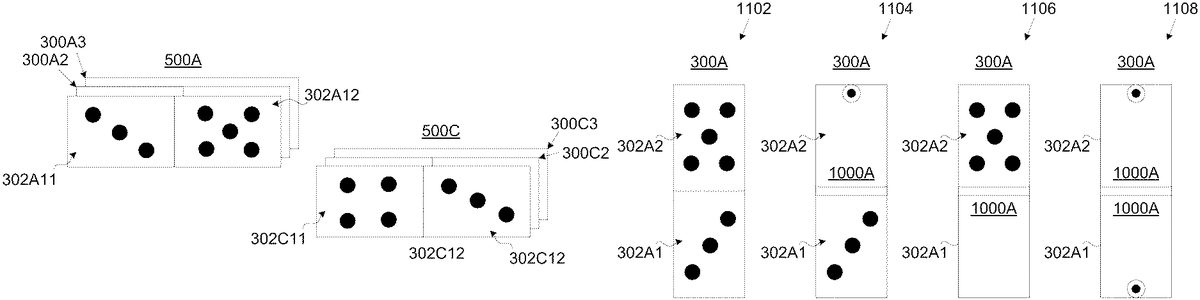
Reference is now made toFIG.11, which is a schematic illustration of an exemplary display of a computer game altered to periodically move exemplary lock marks between separable ends of selectable objects of a computer game, according to some embodiments of the present invention.
As seen in1102, an exemplary selectable object300A such as the selectable objects300of a computer game, for example, a domino tile of a domino based matching game displayed by a client device such as the client device200to a user such as the user202using the client device200to play the matching game. As described herein before, the selectable object300A may have a plurality of separable ends such as the separable ends302, for example, two separable ends302A1and302A2marked with three dots and five dots patterns respectively.
As seen1104, a game engine such as the game engine220may alter the display of the computer game, specifically the display of the selectable object300A to associate a lock mark with one or more of its separable ends302, for example, the second separable end302A2thus prohibiting the user202from matching the locked separable end302A2.
As seen1106, the game engine220may periodically alter the display of the selectable object300A, for example, after every move made by the user202to associate a lock mark with another one of its separable ends302, for example, the first separable end302A1thus prohibiting the user202from matching the locked separable end302A1.
As seen1108, when periodically altering the display of the selectable object300A, the game engine220may further alter the display of the selectable object300A to associate lock marks with both the separable ends302A1and302A2of the selectable object300A.
The descriptions of the various embodiments of the present invention have been presented for purposes of illustration, but are not intended to be exhaustive or limited to the embodiments disclosed. Many modifications and variations will be apparent to those of ordinary skill in the art without departing from the scope and spirit of the described embodiments. The terminology used herein was chosen to best explain the principles of the embodiments, the practical application or technical improvement over technologies found in the marketplace, or to enable others of ordinary skill in the art to understand the embodiments disclosed herein.
It is expected that during the life of a patent maturing from this application many relevant systems, methods and computer programs will be developed and the scope of the terms matching game, and game engine architecture are intended to include all such new technologies a priori.
As used herein the term “about” refers to ±10%.
The terms “comprises”, “comprising”, “includes”, “including”, “having” and their conjugates mean “including but not limited to”. This term encompasses the terms “consisting of” and “consisting essentially of”.
The phrase “consisting essentially of” means that the composition or method may include additional ingredients and/or steps, but only if the additional ingredients and/or steps do not materially alter the basic and novel characteristics of the claimed composition or method.
As used herein, the singular form “a”, “an” and “the” include plural references unless the context clearly dictates otherwise. For example, the term “a compound” or “at least one compound” may include a plurality of compounds, including mixtures thereof.
The word “exemplary” is used herein to mean “serving as an example, an instance or an illustration”. Any embodiment described as “exemplary” is not necessarily to be construed as preferred or advantageous over other embodiments and/or to exclude the incorporation of features from other embodiments.
The word “optionally” is used herein to mean “is provided in some embodiments and not provided in other embodiments”. Any particular embodiment of the invention may include a plurality of “optional” features unless such features conflict.
Throughout this application, various embodiments of this invention may be presented in a range format. It should be understood that the description in range format is merely for convenience and brevity and should not be construed as an inflexible limitation on the scope of the invention. Accordingly, the description of a range should be considered to have specifically disclosed all the possible subranges as well as individual numerical values within that range. For example, description of a range such as from 1 to 6 should be considered to have specifically disclosed subranges such as from 1 to 3, from 1 to 4, from 1 to 5, from 2 to 4, from 2 to 6, from 3 to 6 etc., as well as individual numbers within that range, for example, 1, 2, 3, 4, 5, and 6. This applies regardless of the breadth of the range.
Whenever a numerical range is indicated herein, it is meant to include any cited numeral (fractional or integral) within the indicated range. The phrases “ranging/ranges between” a first indicate number and a second indicate number and “ranging/ranges from” a first indicate number “to” a second indicate number are used herein interchangeably and are meant to include the first and second indicated numbers and all the fractional and integral numerals there between.
The word “exemplary” is used herein to mean “serving as an example, an instance or an illustration”. Any embodiment described as “exemplary” is not necessarily to be construed as preferred or advantageous over other embodiments and/or to exclude the incorporation of features from other embodiments.
The word “optionally” is used herein to mean “is provided in some embodiments and not provided in other embodiments”. Any particular embodiment of the invention may include a plurality of “optional” features unless such features conflict.
It is appreciated that certain features of the invention, which are, for clarity, described in the context of separate embodiments, may also be provided in combination in a single embodiment. Conversely, various features of the invention, which are, for brevity, described in the context of a single embodiment, may also be provided separately or in any suitable sub-combination or as suitable in any other described embodiment of the invention. Certain features described in the context of various embodiments are not to be considered essential features of those embodiments, unless the embodiment is inoperative without those elements.
Although the invention has been described in conjunction with specific embodiments thereof, it is evident that many alternatives, modifications and variations will be apparent to those skilled in the art. Accordingly, it is intended to embrace all such alternatives, modifications and variations that fall within the spirit and broad scope of the appended claims.
It is the intent of the applicant(s) that all publications, patents and patent applications referred to in this specification are to be incorporated in their entirety by reference into the specification, as if each individual publication, patent or patent application was specifically and individually noted when referenced that it is to be incorporated herein by reference. In addition, citation or identification of any reference in this application shall not be construed as an admission that such reference is available as prior art to the present invention. To the extent that section headings are used, they should not be construed as necessarily limiting. In addition, any priority document(s) of this application is/are hereby incorporated herein by reference in its/their entirety.
Claims
- A method of altering display of selectable objects having multiple matchable ends in a computer game, comprising: using at least one processor for: displaying a plurality of selectable objects of a computer game displayed by a client device, each of the plurality of selectable objects initially has a plurality of separable ends, each of the plurality of separable ends of each of the plurality of selectable objects is marked with one of a plurality of patterns;receiving user input comprising a match indication of at least one match between separable ends of at least two of the plurality of selectable objects marked with a common pattern of the plurality of patterns;and altering the display of at least one of the at least two selectable objects by breaking away and removing the matched separable end of the at least one selectable object in case the at least one match indicated by the match indication is correct, wherein the plurality of selectable objects are arranged in a plurality of stacks, each of the plurality of stacks initially comprises at least two selectable objects stacked such that each separable end of a higher layer of the respective stack conceals a corresponding separable end of each lower layer selectable object of the respective stack, wherein following a successful match of a final separable end of a bottom most selectable object of at least one of the plurality of stacks such that the at least one stack is empty, the display is altered to remove the empty stack.
- The method of claim 1, wherein the plurality of selectable objects are tiles having two separable ends each marked with a respective one of the plurality of patterns.
- The method of claim 1, wherein after at least one separable end of the top selectable object is broken away, a respective separable end of the lower layer selectable object is revealed and made available for matching.
- The method of claim 1, further comprising each of the plurality of stacks is fixed on a respective tray, wherein the display is altered to remove the tray of each stack that is empty following a successful match of a final separable end of a bottom most selectable object of the respective stack.
- The method of claim 1, further comprising altering the display to present at least one new stack of selectable objects which appears following the removal of the empty stack.
- The method of claim 5, further comprising the at least one new stack appears in the display to form a new level in the computer game.
- A system for altering display of selectable objects having multiple matchable ends in a computer game, comprising: a memory for storing program code;and at least one processor coupled to the memory, the at least one processor is configured to execute the program code, the program code comprising: code instructions to display a plurality of selectable objects of a computer game displayed by a client device, each of the plurality of selectable objects initially has a plurality of separable ends, each of the plurality of separable ends of each of the plurality of selectable objects is marked with one of a plurality of patterns, code instructions to receive user input comprising a match indication of at least one match between separable ends of at least two of the plurality of selectable objects marked with a common pattern of the plurality of patterns, and code instructions to alter the display of at least one of the at least two selectable objects by breaking away and removing the matched separable end of the at least one selectable object in case the at least one match indicated by the match indication is correct, wherein the plurality of selectable objects are arranged in a plurality of stacks, each of the plurality of stacks initially comprises at least two selectable objects stacked such that each separable end of a higher layer of the respective stack conceals a corresponding separable end of each lower layer selectable object of the respective stack, wherein following a successful match of a final separable end of a bottom most selectable object of at least one of the plurality of stacks such that the at least one stack is empty, the display is altered to remove the empty stack.
- A method of limiting match options for selectable objects having multiple matchable ends in a computer game, comprising: using at least one processor for: displaying a plurality of selectable objects of a computer game displayed by a client device, each of the plurality of selectable objects initially has a plurality of separable ends, each of the plurality of separable ends of each of the plurality of selectable objects is marked with one of a plurality of patterns;and altering the display of at least one of the plurality of selectable objects by associating a lock mark with at least one separable end of at least one of the plurality of selectable objects, the lock mark indicating that the associated at least one separable end is prohibited for matching with at least one separable end of at least another one of the plurality of selectable objects, wherein the lock mark is configured to conceal the pattern marked on the at least one separable end of the at least one selectable object.
- The method of claim 8, wherein the lock mark is configured such that the pattern marked on the at least one separable end of the at least one selectable object is visible.
- The method of claim 8, further comprising periodically altering the display to select at least one separable end of at least one of the plurality of selectable objects and associate the at least selected separable end with a lock mark.
- The method of claim 10, wherein the display is periodically altered to switch between separable ends of the at least one selectable object and associate at least another one separable end of the at least one selectable object with the lock mark.
- The method of claim 11, wherein the display is altered to switch between the separable ends of the at least one selectable object after every user move.
- A system for limiting match options for selectable objects having multiple matchable ends in a computer game, comprising: a memory for storing program code;and at least one processor coupled to the memory, the at least one processor is configured to execute the program code, the program code comprising: code instructions to display a plurality of selectable objects of a computer game displayed by a client device, each of the plurality of selectable objects initially has a plurality of separable ends, each of the plurality of separable ends of each of the plurality of selectable objects is marked with one of a plurality of patterns, and code instructions to alter the display of at least one of the plurality of selectable objects by associating a lock mark with at least one separable end of at least one of the plurality of selectable objects, the lock mark indicating that the associated at least one separable end is prohibited for matching with at least one separable end of at least another one of the plurality of selectable objects, wherein the lock mark is configured to conceal the pattern marked on the at least one separable end of the at least one selectable object.
Disclaimer: Data collected from the USPTO and may be malformed, incomplete, and/or otherwise inaccurate.