U.S. Pat. No. 12,115,426
Physical Sports and Recreation Equipment Enabled and Integrated with Mobile Computing Devices for Game Play Experiences
AssigneeIndividual
Issue DateJanuary 22, 2021
Illustrative Figure
Abstract
The present development is a system for participating in a multi-player game through IoT digital arenas. The IoT digital arena system of the present development comprises an interactive playing surface, and a means to interact with the playing surface and to receive feedback from the playing surface. Optionally, players may be digitally tagged to allow for digital interaction between the players and the playing surface and between the player and the means to interact with the playing surface.
Description
DETAILED DESCRIPTION OF THE PRESENT DEVELOPMENT The following description is intended to provide the reader with a better understanding of the invention. The description is not intended to be limiting with respect to any element not otherwise limited within the claims. For example, the present invention will be described in the context of use with a commonly known Cornhole platform, but the teachings herein are not limited to Cornhole games and are intended to be applicable for use with any system or platform wherein a projectile is used and the objective is to land in or upon or in a specified proximity to or to pass through or impact the projectile in a predetermined location. The present development is a system for participating in a multi-player projectile tossing game through IoT digital arenas. The system comprises a playing surface with a target wherein the target comprises a low-energy proximity sensor, a projectile tagged with a digital transponder, and a mobile computing device in wireless communication with the proximity sensor and the digital transponder. Optionally, a player may also be tagged with a digital transponder and be in wireless communication with the mobile computing device. The present development is best described by example, such as with a Cornhole game or bag toss game apparatus. As shown inFIGS.1-4, the bag toss game apparatus10of the present development comprises a Cornhole platform or board20that defines a playing surface12and an underside surface14, and that has at least one aperture22near a target end16. The aperture end16is slightly elevated for game play. As is known in the art, the platform elevation may be accomplished by use of legs90attached to the underside14of the platform20. Positioned in the platform aperture22is a disc30. The disc30defines a center C and a platform face30pand an underside face30uand has at least one disc ...
DETAILED DESCRIPTION OF THE PRESENT DEVELOPMENT
The following description is intended to provide the reader with a better understanding of the invention. The description is not intended to be limiting with respect to any element not otherwise limited within the claims. For example, the present invention will be described in the context of use with a commonly known Cornhole platform, but the teachings herein are not limited to Cornhole games and are intended to be applicable for use with any system or platform wherein a projectile is used and the objective is to land in or upon or in a specified proximity to or to pass through or impact the projectile in a predetermined location.
The present development is a system for participating in a multi-player projectile tossing game through IoT digital arenas. The system comprises a playing surface with a target wherein the target comprises a low-energy proximity sensor, a projectile tagged with a digital transponder, and a mobile computing device in wireless communication with the proximity sensor and the digital transponder. Optionally, a player may also be tagged with a digital transponder and be in wireless communication with the mobile computing device.
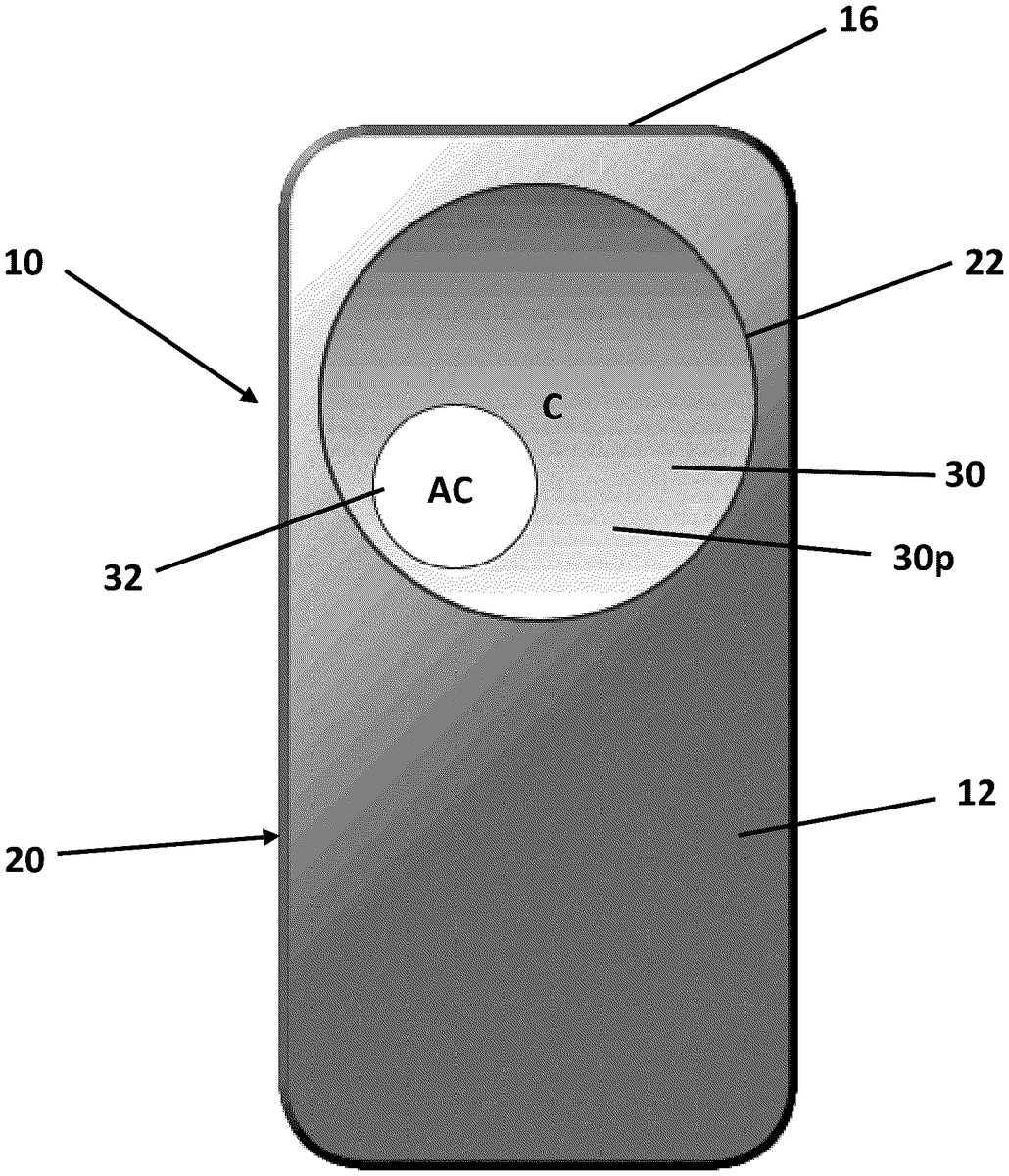
The present development is best described by example, such as with a Cornhole game or bag toss game apparatus. As shown inFIGS.1-4, the bag toss game apparatus10of the present development comprises a Cornhole platform or board20that defines a playing surface12and an underside surface14, and that has at least one aperture22near a target end16. The aperture end16is slightly elevated for game play. As is known in the art, the platform elevation may be accomplished by use of legs90attached to the underside14of the platform20.
Positioned in the platform aperture22is a disc30. The disc30defines a center C and a platform face30pand an underside face30uand has at least one disc aperture32having a fixed position. The disc aperture32defines a center AC and the aperture is positioned such that the disc aperture32is off-center relative to the center of the disc. That is, AC is not in linear alignment with C.
The disc30is adapted to rotate within the platform aperture22. Rotation of the disc is controlled by a set of gears34(not shown) that are adapted to be wirelessly commanded, controlled, communicated and interacted with by at least one mobile computing device40.
The disc aperture32comprises an IoT beacon ring36. The IoT beacon ring36is a low-energy proximity sensor, such as but not limited to a Bluetooth Gateway. In a preferred embodiment, the sensor36is positioned on the underside face of the disc30u, preferably close to the disc center C. Alternatively, if the playing surface is the target the sensor may be positioned within the playing surface. The IoT beacon36is configured to allow the IoT beacon36to be in wireless communication with digital Bluetooth (“BT”) tags, data receivers and mobile computing devices.
In an alternative embodiment, an exit chute (not shown) may be mounted on the platform underside surface14or on the disc underside surface30uto allow a bag70tossed through the disc aperture32to slide away from the ring36. In an exemplary embodiment, the exit chute is a right circular cone shaped half sphere or spinning top shaped object rotates in tandem with the disc30and that propels the bag70out of the underside area and out of the range of the ring36.
As is known in the art, the game of Cornhole is played by tossing a projectile, such as a bean bag,70or similar object from a predetermined distance onto the playing surface12of the Cornhole platform20. More specifically, the objective is to toss the bean bag through the aperture32. A player receives points if the bag70lands and remains on the platform face12or if the bag passes through the aperture32, but the player receives more points for tossing the bag through the aperture32, than for landing on the platform12.
By including a low-energy proximity IoT beacon36in the platform20of the present development, the platform20can be placed in wireless communication with a digital-transponder tagged projectile or bean bag70and concurrently with the at least one mobile computing device40. The digital tag for the bean bag70may be inserted into the bag as part of the bag contents or it may be imprinted on or affixed to the surface of the bag. As is known in the art, each digital tag can be programmed with a unique identifier so each bag can be individually recognized by the IoT beacon36. Exemplary low-energy proximity sensors include Bluetooth Low Energy (BLE) Beacon hardware, IoT tag hardware, or similar devices that broadcast a simple signal of basic information at a specific programmed interval. Exemplary digital tags include battery free Bluetooth transponders, stamps, tags or similar devices that interact with the signal broadcast by the IoT beacon “ring” to register game play events and interactions such as scoring, tracking, physical proximity, and play time. Game play experience events such as scoring, time, number of players or participants and other values are communicated from the ring and bags to electronic hardware and software on and within the game board to connected mobile computing devices.
Optionally, a player may be digitally tagged to allow for digital interaction between the player and the playing surface12or between the player and the means to interact with the playing surface or a combination thereof. The player's tag is similar to the projectile tag—that is, the player's tag is a digital transponder. As with the tagged bean bag70, the low-energy proximity IoT beacon36in the platform20can be placed in wireless communication with a digital-transponder tagged player and concurrently with the at least one mobile computing device40. As is known in the art, each digital tag can be programmed with a unique identifier so each player can be individually recognized by the IoT beacon36. The movements of the tagged player can then be tracked relative to the playing surface and the projectiles by the mobile computing device.
Exemplary mobile computing devices to be used with the present invention include but are not limited to: desktop-laptop-tablet computers, smartphones, smart wearable clothing/gear, gaming consoles, or such mobile computing devices that may connect to the Internet and Internet of Things (“IoT”) and may run software that enable connectivity to the present invention and platform to enable game play experiences.FIG.5shows a plurality of screenshots demonstrating variations of a software application for a mobile computing device platform ofFIG.1.
The following exemplary embodiment is provided to give the reader a mental picture of the development and is not intended to be limiting with respect to any element not otherwise limited within the claims. In the exemplary embodiment, the platform comprises a board having length and width dimension of about 48″ by about 24″, respectively. The board has a thickness of about 4″ and defines a face and a back. Optionally, a frame having a depth of about 3″ may attached to the back. A pair of legs are attached to the underside of the platform to raise the aperture end of the platform about 12″ off the ground. The opposing end rests on the ground. At the aperture end is the rotating disc having a diameter of about 18″. The disc aperture having a diameter of about 7″ is positioned about 0.75″ from the edge of the rotating disc. The rotating disc is controlled by a set of gears that, when activated, will cause the disc to rotate either clockwise or counterclockwise and that will adjust the speed of rotation. In a first embodiment, the gear direction is manually selected by a player within physical proximity of the bag toss game apparatus. In a second embodiment, the gear box may be in communication with the mobile computing device and a player may alter the direction or speed of the gearing by entering commands into the mobile computing device.
FIGS.6A-6Eare flowcharts showing exemplary processes for game play. There must always be at a minimum one physical player engaged in a game play experience. The simplest variation of play is demonstrated in the flowchart ofFIG.6A. In this game play variation, Variation A, one or more primary physical players toss one or more bags70at the one or more boards20—as is known in the art, traditional Cornhole is played with two boards—in accordance with game play rules. In Variation A, the board20is not connected to the IoT, and the game may be played with or without activation of the game electronic systems: if the game is in “Off” mode, the target area is not moving; if the game is in “On” mode, the target area of the board rotates automatically in either a clockwise or counter-clockwise direction at variable speeds and may start and stop, as randomly determined by the processor/servo motor apparatus. In game Variations B-E, in each embodiment, when the game electronics are activated, a series of self-diagnostic tests are conducted and then the sensor broadcasts a BLE continuous signal and a trigger event seeking transponders or tags. If tags are detected, the tag identifications are registered for game play. Colored lights may be included to indicate game events. When the sensor determines that a tagged bag has passed through the aperture, the sensor sends a signal to the mobile computing device to register and record a game event and, optionally, lights on the platform provide a visual display indicating a point score. Optionally, the game may be played with bean bags that have no digital tags and the apparatus may be programmed to provide a light display when the bag passes through the aperture. A further optional feature may include automatic shutdown after a predetermined period of inactivity to preserve battery life. Specifically, the flowchart ofFIG.6B, Variation B, is for game play with two or more players in the same geographic location. In Variation B, the board20is connected to the IoT—Bluetooth and the game is played with activation of the game electronic systems. The ring may or may not be activated: if the ring is in “Off” mode, the target area is not moving; if the ring is in “On” mode, the target area of the board rotates automatically in either a clockwise or counter-clockwise direction at variable speeds and may start and stop, as randomly determined by the processor/servo motor apparatus. Each player connects his or her Mobile Computing Device (MCD) via BT and a software application enabling Command, Control, Communication and Interaction (CCCI) with one of the game play boards—in a traditional Cornhole game, two boards are used. Only one player (physical or virtual) may connect to one board at any one time. Variation C ofFIG.6Cactivates the gameboard following steps similar to Variation B, however Variation C provides options to allow for more players to participate and for players to be in the same geographic location or participating from a distant geographic location or participating as virtual players or virtual participants. In Variation C, the primary player uses an MCD and a software application is enabled via a connection to the IoT (Wi-Fi/5G) to allow a virtual player or virtual participant to engage in a game play experience (GPE) during active GPE session. Virtual play can optionally control the rotation attributes of the target area via software on the MCD of said virtual player and/or tossing virtual bags at a virtual representation of a board on the virtual player's MCD during the game play experience. Alternatively, the virtual participation can be limited to primarily controlling the rotation attributes of the target area via software on the MCD of said virtual participant. Variation D ofFIG.6Dis similar to Variation C except the platform allows for many players to participate simultaneously, including virtual players or virtual participants, and the players may engage in tournament play. Variation E ofFIG.6Eis similar to Variation C except a virtual player or virtual participant is the digital manifestation (avatar) of a specific player's previous game interaction with a player's actual physical game, session or tournament wherein a virtual player/participant can engage in game play; without actually being physical present, active or even awake; by allowing their previous physical game play data, actions, events and response to be applied during another physical player/s game. There is no machine learning or artificial intelligence in this effort; as we have a limited amount of game play experience variables. It is merely taking the virtual player/s—participant/s previous actions and applying them during a physical game play experience via a MCD and a backend cloud server environment.
Game play participants may communicate, command, control and interact with the game platform by means of a software interface on a mobile computing device that interfaces with the electronic and mechanical components of the game board and backend server, such as a cloud service. The participant has the option of playing 1) stand alone, 2) connecting only to their local mobile computing device, 3) connecting to a local area network of physical or virtual (player/s and/or participant/s), or 4) connecting to their mobile computing device and connecting to a backend server/cloud environment. The virtual participant can connect via the backend server/cloud environment to any single or number of game boards and game play experiences.
Optionally, the disc30may be adapted to include features to enhance the entertainment value of the bag toss game apparatus10. For example, LED light strips may be included for color visual feedback or devices to include sound effects may be included. A battery connection and storage case may be included to allow the electronic elements of the apparatus to operate off the battery rather than requiring electric cords and electrical outlets.
As noted supra, the present development is intended to be used with any game that comprises a playing surface and a projectile. With the understanding that the general mechanics of each game are well known in the art, following are some other potential uses for the present invention.
Lawn Darts. The traditional game of Lawn Darts involves a player tossing a projectile, a lawn dart, with the objective being to have the lawn dart land within a ring placed on the ground. The present development can be implemented into the Lawn Darts game by placing an IoT beacon on the ground in place of the traditional ring and enabling the IoT beacon signal to be and define the ring or target area, and placing a digital transponder tag in each projectile, and having the IoT beacons and the projectile tags communicate with the mobile computing device.
Disc Golf. The traditional game of Disc Golf involves a player tossing a projectile, a flying disc, with the objective being to have the flying disc land within a basket mounted on a post. The present development can be implemented into the Disc Golf game by placing an IoT beacon into each basket and placing a digital transponder tag in each flying disc, and having the basket beacons and the disc tags communicate with the mobile computing device. As with the aperture in the Cornhole game, the positioning of the basket may be controllable remotely.
Bocce. The traditional game of Bocce involves a player tossing a projectile, a bocce ball, with the objective being to have the bocce ball land close to, and preferably abutting, a target ball or “jack”. The present development can be implemented into the Bocce game by placing an IoT beacon into the jack and placing a digital transponder tag in each bocce ball, and having the jack beacon and the ball tags communicate with the mobile computing device. As with the aperture in the Cornhole game, the positioning of the jack may be controllable remotely.
Curling. The traditional game of Curling involves a player pushing off a projectile, a curling stone, onto an ice surface with the objective being to have the curling stone stop its movement within a designed target area on the ice. To aid the curling stones movement and to direct the stone toward the target, the ice is broom swept by the stone's team members. The present development can be implemented into the Curling game by placing an IoT beacon within the target area and placing a digital transponder tag in each curling stone, and having the target beacon and the stone tags communicate with the mobile computing device. Similar to the variability that can be introduced by the rotating aperture in the Cornhole game, the movements on the “swept” ice may be controllable remotely.
Optionally, the “target” and/or “projectiles” may be one or more game players rather than inanimate objects. Using this option, the target would be the player carrying or wearing the beacon and the projectiles would be the player(s) carrying or wearing the transponder tags. The game could be conducted with an inanimate target and player projectiles or with a player target and inanimate projectiles or with a player target and player projectiles. Without limitation, following are some other potential uses applications with player roles.
Scavenger Hunt. The traditional game of Scavenger Hunt involves an object being hidden and players following clues to find the object. The present development can be implemented into the Scavenger Hunt game by placing an IoT beacon into each hidden object and placing a digital transponder tag on each player, and having the object beacons and the player tags communicate with the mobile computing device, such as to indicate when the player is within a predetermined distance of the hidden object.
9 Square in the Air: The traditional game of 9 Square in the Air involves a plurality of players arranged within a 3×3 pattern, wherein one player begins the game by tossing a projectile, a ball, into the air and all the players then try to keep the ball from hitting the ground. The present development can be implemented into the 9 Square game by placing an IoT beacon on each player and placing a digital transponder tag in the ball, and having the player beacons and the ball tags communicate with the mobile computing device, such as to indicate when the ball is within a given physical range of a particular player.
Hide and Seek. The traditional game of Hide and Seek involves one player finding a hiding and at least one other player searching for the hidden player. The present development can be implemented into the Hide and Seek game by placing an IoT beacon on the player designated to hide and placing a digital transponder tag on each player designated to seek, and having the hider's beacon and the seeker's tags communicate with the mobile computing device, such as to indicate when the seeker is within a given physical range of the hiding player.
The applications provided herein are for example purposes only and are not intended to be limiting with respect to any element not otherwise limited within the claims.
Unless defined otherwise, all technical and scientific terms used herein have the same meaning as commonly understood by one of ordinary skill in the art to which the presently disclosed subject matter pertains. Representative methods, devices, and materials are described herein, but are not intended to be limiting unless so noted.
The terms “a”, “an”, and “the” refer to “one or more” when used in the subject specification, including the claims.
Unless otherwise indicated, all numbers expressing quantities of components, conditions, and otherwise used in the specification and claims are to be understood as being modified in all instances by the term “about”. Accordingly, unless indicated to the contrary, the numerical parameters set forth in the instant specification and attached claims are approximations that can vary depending upon the desired properties sought to be obtained by the presently disclosed subject matter.
As used herein, the term “about”, when referring to a value or to an amount of mass, weight, time, volume, concentration, or percentage can encompass variations of, in some embodiments±20%, in some embodiments±10%, in some embodiments±5%, in some embodiments±1%, in some embodiments±0.5%, and in some embodiments to ±0.1%, from the specified amount, as such variations are appropriate in the disclosed application.
Specific dimensions relevant to the game apparatus are provided herein for the purpose of demonstrating the invention, but these dimensions are not intended to limit the scope of the invention. It is understood that, in light of a reading of the foregoing description, with ordinary skill in the art may make alterations and/or modifications to the present invention, and specifically to the embodiments shown and described herein, without departing from the scope of the invention.
Claims
- A system for a multi-player projectile-target game comprising (a) a playing surface with a target having a low-energy proximity sensor, wherein the target defines a configuration that can be altered during game play, (b) a projectile tagged with a digital transponder, and (c) at least one mobile computing device programmed with an application for a player to communicate, command, control and interact (“CCCI”) with the playing surface, target, projectile, a backend server, or a combination thereof, wherein the proximity sensor, the digital transponder, the mobile computing device, and the backend server are in wireless communication with each other, and wherein the playing surface is a cornhole board and the target is a platform aperture in the cornhole board and the tagged projectile is a tossing bag, and wherein the platform aperture further comprises a rotating disc, wherein the rotation of the disc is controlled by a set of gears that are adapted to be wirelessly commanded, controlled, communicated and interacted with by at least one mobile computing device.
- The system of claim 1 wherein the low-energy proximity sensor is selected from Bluetooth Low Energy (BLE) Beacon hardware, IoT tag hardware, devices that broadcast a simple signal of basic information at a specific programmed interval, or combinations thereof.
- The system of claim 1 wherein the digital transponder is selected from battery free Bluetooth transponders, stamps, tags devices that interact with a signal broadcast by an IoT beacon, or combinations thereof.
- The system of claim 3 wherein each digital transponder is programmed with a unique identifier so each projectile can be individually recognized by the proximity sensor.
- The system of claim 1 wherein the projectile is tagged with the digital transponder by inserting the transponder into the projectile or by imprinting the projectile with the transponder or by affixing the transponder to the surface of the projectile.
- The system of claim 1 wherein the mobile computing device is selected from a desktop computer, a laptop computer, a tablet computer, a smartphone, smart wearable clothing/gear, a gaming console, a device that connects to the Internet and Internet of Things (“IoT”) and runs software that enables connectivity to the present invention, or combinations thereof.
- The system of claim 1 wherein the tagged projectile is a physical projectile or a virtual projectile.
Disclaimer: Data collected from the USPTO and may be malformed, incomplete, and/or otherwise inaccurate.