U.S. Pat. No. 12,083,430
Dynamic Adjustment of Game Controller Sensitivity Based On Audio Analysis
AssigneeVoyetra Turtle Beach, Inc.
Issue DateJanuary 11, 2023
Illustrative Figure
Abstract
An electronic device may receive audio during play of a game on a game console over a network. The electronic device may detect one or more sounds during the monitoring of the audio. The electronic device may control, based on the detected one or more sounds, operation of a game controller that interacts with the game during play. The controlling of the operation of the game controller may comprise adjusting sensitivity of the game controller. The electronic device may determine directionality of the detected one or more sounds and adjust the sensitivity of the game controller based on the determined directionality of the detected one or more sounds. The electronic device may increase and/or decrease the sensitivity of the game controller in response to changes in the determined directionality of the detected one or more sounds.
Description
DETAILED DESCRIPTION Certain embodiments of the disclosure may be found in a method and system for dynamic control of game controller sensitivity based on audio analysis. In accordance with various embodiments of the disclosure, an electronic device, such as an audio headset and/or audio basestation, may receive a plurality of channels of game and/or chat audio during play of a game. The electronic device may detect one or more sounds on one or more of the audio channels during the monitoring of the plurality of audio channels. The electronic device may control, based on the detected one or more sounds, operation of a game controller that interacts with the game during play. The controlling of the operation of the game controller may comprise adjusting sensitivity of the game controller. The electronic device may determine directionality of the detected one or more sounds and adjust the sensitivity of the game controller based on the determined directionality of the detected one or more sounds. The electronic device may increase and/or decrease the sensitivity of the game controller in response to changes in the determined directionality of the detected one or more sounds. The electronic device may perform signal analysis on the plurality of channels. The electronic device may determine characteristics of the detected one or more sounds based on the signal analysis. The electronic device may adjust the sensitivity of the game controller based on the determined characteristics of the detected one or more sounds. The electronic device may increase and/or decrease the sensitivity of the game controller in response to changes in the determined characteristics of the detected one or more sounds. The electronic device may perform the increase and/or decrease of the sensitivity of the game controller dynamically (e.g., during game play while concurrently processing audio) and/or adaptively (e.g., based ...
DETAILED DESCRIPTION
Certain embodiments of the disclosure may be found in a method and system for dynamic control of game controller sensitivity based on audio analysis. In accordance with various embodiments of the disclosure, an electronic device, such as an audio headset and/or audio basestation, may receive a plurality of channels of game and/or chat audio during play of a game. The electronic device may detect one or more sounds on one or more of the audio channels during the monitoring of the plurality of audio channels. The electronic device may control, based on the detected one or more sounds, operation of a game controller that interacts with the game during play. The controlling of the operation of the game controller may comprise adjusting sensitivity of the game controller. The electronic device may determine directionality of the detected one or more sounds and adjust the sensitivity of the game controller based on the determined directionality of the detected one or more sounds. The electronic device may increase and/or decrease the sensitivity of the game controller in response to changes in the determined directionality of the detected one or more sounds. The electronic device may perform signal analysis on the plurality of channels. The electronic device may determine characteristics of the detected one or more sounds based on the signal analysis. The electronic device may adjust the sensitivity of the game controller based on the determined characteristics of the detected one or more sounds. The electronic device may increase and/or decrease the sensitivity of the game controller in response to changes in the determined characteristics of the detected one or more sounds. The electronic device may perform the increase and/or decrease of the sensitivity of the game controller dynamically (e.g., during game play while concurrently processing audio) and/or adaptively (e.g., based on feedback such as from the game controller and/or the game console on which the game is being played).
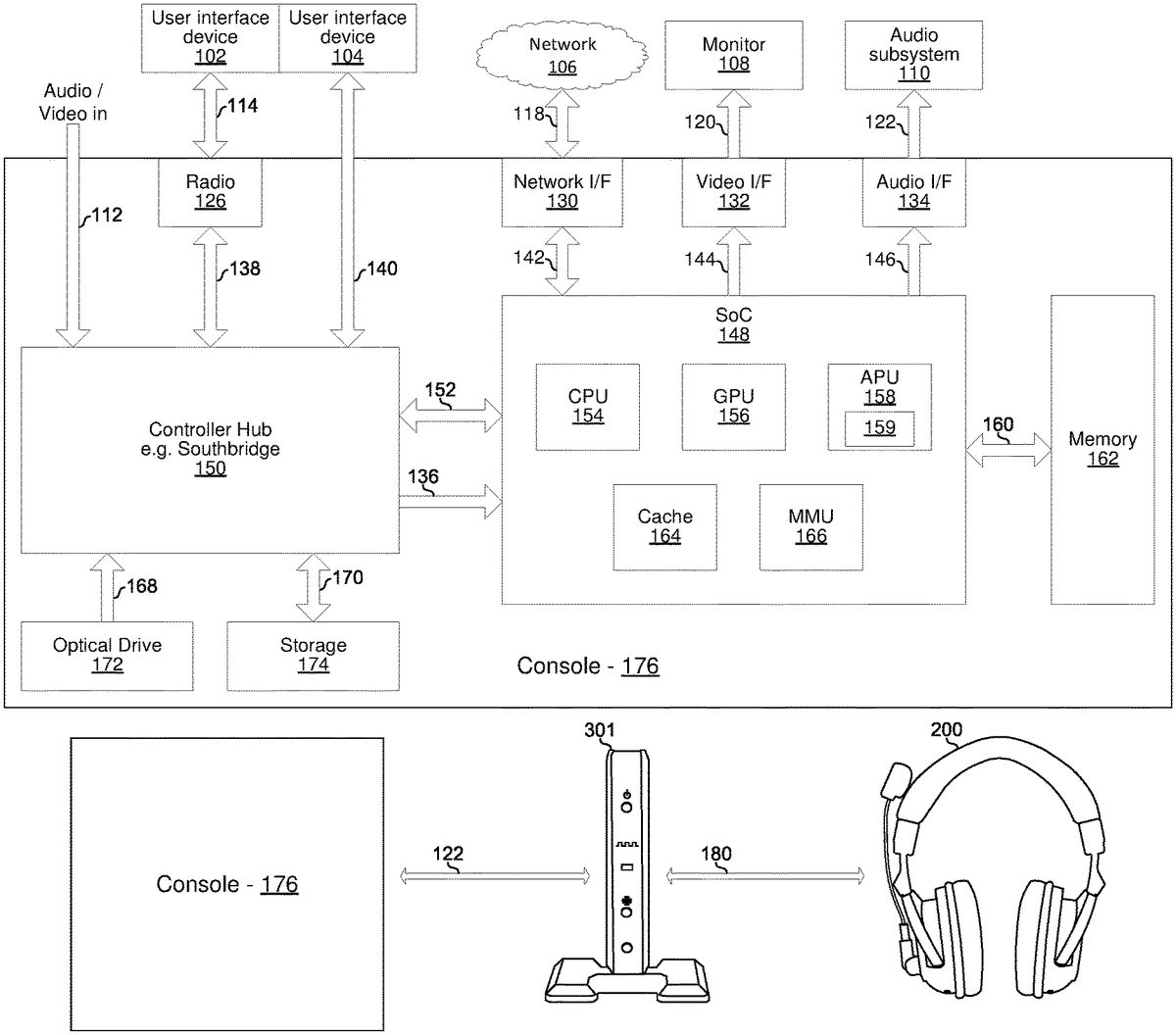
FIG.1Adepicts an example gaming console, which may be utilized to provide dynamic control of game controller sensitivity based on audio analysis, in accordance with various exemplary embodiment of the disclosure. Referring toFIG.1, there is shown a console176, user interface devices102,104, a monitor108, an audio subsystem110, and a network106.
The game console176may comprise suitable logic, circuitry, interfaces and/or code that may be operable to present a game to, and also enable game play interaction between, one or more local players and/or one or more remote players. The game console176which may be, for example, a Windows computing device, a Unix computing device, a Linux computing device, an Apple OSX computing device, an Apple iOS computing device, an Android computing device, a Microsoft Xbox, a Sony Playstation, a Nintendo Wii, or the like. The example game console176comprises a radio126, network interface130, video interface132, audio interface134, controller hub150, main system on chip (SoC)148, memory162, optical drive172, and storage device174. The SoC148comprises central processing unit (CPU)154, graphics processing unit (GPU)156, audio processing unit (APU)158, cache memory164, and memory management unit (MMU)166. The various components of the game console176are communicatively coupled through various buses/links136,138,142,144,146,152,160,168, and170.
The controller hub150comprises circuitry that supports one or more data bus protocols such as High-Definition Multimedia Interface (HDMI), Universal Serial Bus (USB), Serial Advanced Technology Attachment II, III or variants thereof (SATA II, SATA III), embedded multimedia card interface (e.MMC), Peripheral Component Interconnect Express (PCIe), or the like. The controller hub150may also be referred to as an input/output (I/O) controller hub. Exemplary controller hubs may comprise Southbridge, Haswell, Fusion and Sandybridge. The controller hub150may be operable to receive audio and/or video from an external source via link112(e.g., HDMI), from the optical drive (e.g., Blu-Ray)172via link168(e.g., SATA II, SATA III), and/or from storage174(e.g., hard drive, FLASH memory, or the like) via link170(e.g., SATA II, III and/or e.MMC). Digital audio and/or video is output to the SoC148via link136(e.g., CEA-861-E compliant video and IEC 61937 compliant audio). The controller hub150exchanges data with the radio126via link138(e.g., USB), with external devices via link140(e.g., USB), with the storage174via the link170, and with the SoC148via the link152(e.g., PCIe).
The radio126may comprise suitable logic, circuitry, interfaces and/or code that may be operable to communicate in accordance with one or more wireless standards such as the IEEE 802.11 family of standards, the Bluetooth family of standards, near field communication (NFC), and/or the like.
The network interface130may comprise suitable logic, circuitry, interfaces and/or code that may be operable to communicate in accordance with one or more wired standards and to convert between wired standards. For example, the network interface130may communicate with the SoC148via link142using a first standard (e.g., PCIe) and may communicate with the network106using a second standard (e.g., gigabit Ethernet).
The video interface132may comprise suitable logic, circuitry, interfaces and/or code that may be operable to communicate video in accordance with one or more wired or wireless video transmission standards. For example, the video interface132may receive CEA-861-E compliant video data via link144and encapsulate/format, etc., the video data in accordance with an HDMI standard for output to the monitor108via an HDMI link120.
The audio interface134may comprise suitable logic, circuitry, interfaces and/or code that may be operable to communicate audio in accordance with one or more wired or wireless audio transmission standards. For example, the audio interface134may receive CEA-861-E compliant audio data via the link146and encapsulate/format, etc. the video data in accordance with an HDMI standard for output to the audio subsystem110via an HDMI link122.
The central processing unit (CPU)154may comprise suitable logic, circuitry, interfaces and/or code that may be operable to execute instructions for controlling/coordinating the overall operation of the game console176. Such instructions may be part of an operating system of the console and/or part of one or more software applications running on the console.
The graphics processing unit (GPU)156may comprise suitable logic, circuitry, interfaces and/or code that may be operable to perform graphics processing functions such as compression, decompression, encoding, decoding, 3D rendering, and/or the like.
The audio processing unit (APU)158may comprise suitable logic, circuitry, interfaces and/or code that may be operable to perform audio processing functions such as volume/gain control, compression, decompression, encoding, decoding, surround-sound processing, and/or the like to output single channel or multi-channel (e.g., 2 channels for stereo or 5, 7, or more channels for surround sound) audio signals. The APU158comprises memory (e.g., volatile and/or non-volatile memory)159which stores parameter settings to affect processing of audio by the APU158. For example, the parameter settings may include a first audio gain/volume setting that determines, at least in part, a volume of game audio output by the console176and a second audio gain/volume setting that determines, at least in part, a volume of chat audio output by the console176. The parameter settings may be modified via a graphical user interface (GUI) of the console and/or via an application programming interface (API) provided by the console176.
The cache memory164may comprise suitable logic, circuitry, interfaces and/or code that may provide high-speed memory functions for use by the CPU154, GPU156, and/or APU158. The cache memory164may typically comprise DRAM or variants thereof. The memory162may comprise additional memory for use by the CPU154, GPU156, and/or APU158. The memory162, typically DRAM, may operate at a slower speed than the cache memory164but may also be less expensive than cache memory as well as operate at a higher speed than the memory of the storage device174. The MMU166controls accesses by the CPU154, GPU156, and/or APU158to the memory162, the cache164, and/or the storage device174.
InFIG.1A, the example game console176is communicatively coupled to the user interface device102, the user interface device104, the network106, the monitor108, and the audio subsystem110.
Each of the user interface devices102and104may comprise, for example, a game controller, a keyboard, a motion sensor/position tracker, or the like. The user interface device102communicates with the game console176wirelessly via link114(e.g., Wi-Fi Direct, Bluetooth, NFC and/or the like). The user interface device102may be operable to communicate with the game console176via the wired link140(e.g., USB or the like).
The network106comprises a local area network and/or a wide area network. The game console176communicates with the network106via wired link118(e.g., Gigabit Ethernet).
The monitor108may be, for example, a LCD, OLED, or PLASMA screen. The game console176sends video to the monitor108via link120(e.g., HDMI).
The audio subsystem110may be, for example, a headset, a combination of headset and audio basestation, or a set of speakers and accompanying audio processing circuitry. The game console176sends audio to the audio subsystem110via link(s)122(e.g., S/PDIF for digital audio or “line out” for analog audio). Additional details of an example audio subsystem110are described below.
FIG.1Bis a diagram that depicts an example gaming audio subsystem comprising a headset and an audio basestation, in accordance with various exemplary embodiments of the disclosure. Referring toFIG.1B, there is shown a console176, a headset200and an audio basestation301. The headset200communicates with the basestation301via a link180and the basestation301communicates with the console176via a link122. The link122may be as described above. In an example implementation, the link180may be a proprietary wireless link operating in an unlicensed frequency band. The headset200may be as described below with reference toFIGS.2A-2C. The basestation301may be as described below with reference toFIGS.3A-3B.
FIG.1Cis a diagram of an exemplary gaming console and an associated network of peripheral devices, in accordance with various exemplary embodiments of the disclosure. Referring toFIG.1C, there is shown is the console176, which is communicatively coupled to a plurality of peripheral devices and a network106. The example peripheral devices shown include a monitor108, a user interface device102, a headset200, an audio basestation301, and a multi-purpose device192.
The monitor108and the user interface device102are as described above. The headset200is as described below with reference toFIGS.2A-2C. The audio basestation is as described below with reference to, for example,FIGS.3A-3B.
The multi-purpose device192may comprise, for example, a tablet computer, a smartphone, a laptop computer, or the like and that runs an operating system such as Android, Linux, Windows, iOS, OSX, or the like. An example multi-purpose device is described below with reference toFIG.4. Hardware (e.g., a network adaptor) and software (i.e., the operating system and one or more applications loaded onto the device192) may configure the device192for operating as part of the GPN190. For example, an application running on the device192may cause display of a graphical user interface (GUI), which may enable a user to access gaming-related data, commands, functions, parameter settings, and so on. The graphical user interface may enable a user to interact with the console176and the other devices of the GPN190to enhance the user's gaming experience. Examples of such interactions between the device192and the other devices of the GPN190are described in above incorporated U.S. provisional patent application 61/878,728 titled “Multi-Device Gaming Interface.
The peripheral devices102,108,192,200,300are in communication with one another via a plurality of wired and/or wireless links (represented visually by the placement of the devices in the cloud of GPN190). Each of the peripheral devices in the gaming peripheral network (GPN)190may communicate with one or more others of the peripheral devices in the GPN190in a single-hop or multi-hop fashion. For example, the headset200may communicate with the basestation301in a single hop (e.g., over a proprietary RF link) and with the device192in a single hop (e.g., over a Bluetooth or Wi-Fi direct link), while the tablet may communicate with the basestation301in two hops via the headset200. As another example, the user interface device102may communicate with the headset200in a single hop (e.g., over a Bluetooth or Wi-Fi direct link) and with the device192in a single hop (e.g., over a Bluetooth or Wi-Fi direct link), while the device192may communicate with the headset200in two hops via the user interface device102. These example interconnections among the peripheral devices of the GPN190are merely examples, any number and/or types of links and/or hops among the devices of the GPN190is possible.
The GPN190may communicate with the console176via any one or more of the connections114,140,122, and120described above. The GPN190may communicate with a network106via one or more links194each of which may be, for example, Wi-Fi, wired Ethernet, and/or the like.
A database182which stores gaming audio data is accessible via the network106. The gaming audio data may comprise, for example, signatures (or “acoustic fingerprints”) of particular audio clips (e.g., individual sounds or collections or sequences of sounds) that are part of the game audio of particular games, of particular levels/scenarios of particular games, particular characters of particular games, etc. In an example implementation, the database182may comprise a plurality of records183, where each record183comprises an audio clip (or signature of the clip)184, a description of the clip185(e.g., the game it is from, when it occurs in the game, etc.), one or more gaming commands186associated with the clip, one or more parameter settings187associated with the clip, and/or other data associated with the audio clip. Records183of the database182may be downloadable to, or accessed in real-time by, one of more devices of the GPN190.
In instances where the user interface device102comprises a game controller that is operable to control game play, the sensitivity of the user interface device102may be controlled based on sounds that are detected during the game play. In this regard, the headset200may be operable to monitor a plurality of channels of game and/or chat audio and detect the sounds during game play. Based on the characteristics of the detected sounds, the headset200may be operable to control the sensitivity of the game controller. As sensitivity increases, the same amount of movement of a joystick or D-pad of the controller results in relatively larger or more rapid on-screen movements. Similarly, as sensitivity decreases, the same amount of movement of a joystick or D-pad of the controller results in relatively smaller or less rapid on-screen movements.
In some embodiments of the disclosure, the headset200may be operable to communicate directly with the game controller via, for example, a wireless communication link. In this regard, the headset200may be operable to communicate information that is used to control the sensitivity over the game controller over the wireless communication link. In some embodiments of the disclosure, the headset200may be operable to communicate indirectly with the game controller via the console176. In this regard, the headset200may be operable to communicate information that is used to control the sensitivity over the game controller to the console176and the console176may utilize that information to control the game controller and/or control its response to inputs from the game controller. In some embodiments of the disclosure, the console176may communicate the information that is received from the headset200to the game controller, and the game controller may utilize the received information to control its sensitivity. The communication link between the headset200and the game console176may comprise a wired and/or wireless communication link and the communication link between the game console176and the game controller may comprise a wired and/or wireless communication link.
In some embodiments of the disclosure, the basestation300(FIG.1B) may be operable to provide connectivity between the headset200, the console176and the user interface device102, which may comprise a game controller. In this regard, the basestation300may be operable to communicate game controller sensitivity information from the game headset to the user interface device102, which may comprise a game controller.
FIGS.2A and2Bare diagrams that depict two views of an example embodiment of a gaming headset, in accordance with various exemplary embodiments of the disclosure. Referring toFIGS.2A and2B, there are shown two views of an example headset200that may present audio output by a gaming console such as the console176. The headset200comprises a headband202, a microphone boom206with microphone204, ear cups208aand208bwhich surround speakers216aand216b, connector210, connector214, and user controls212.
The connector210may be, for example, a 3.5 mm headphone socket for receiving analog audio signals (e.g., receiving chat audio via an Xbox “talkback” cable).
The microphone204may comprise suitable logic, circuitry, interfaces and/or code that may be operable to convert acoustic waves (e.g., the voice of the person wearing the headset) to electric signals for processing by circuitry of the headset and/or for output to a device (e.g., console176, basestation301, a smartphone, and/or the like) that is in communication with the headset.
The speakers216aand216bmay comprise circuitry that may be operable to convert electrical signals to sound waves.
The user controls212may comprise dedicated and/or programmable buttons, switches, sliders, wheels, etc. for performing various functions. Example functions which the controls212may be configured to perform include: power the headset200on/off, mute/unmute the microphone204, control gain/volume of, and/or effects applied to, chat audio by the audio processing circuitry of the headset200, control gain/volume of, and/or effects applied to, game audio by the audio processing circuitry of the headset200, enable/disable/initiate pairing (e.g., via Bluetooth, Wi-Fi direct, NFC, or the like) with another computing device, and/or the like. Some of the user controls212may adaptively and/or dynamically change during gameplay based on a particular game that is being played. Some of the user controls212may also adaptively and/or dynamically change during gameplay based on a particular player that is engage in the game play. The connector214may be, for example, a USB, thunderbolt, Firewire or other type of port or interface. The connector214may be used for downloading data to the headset200from another computing device and/or uploading data from the headset200to another computing device. Such data may include, for example, parameter settings (described below). Additionally, or alternatively, the connector214may be used for communicating with another computing device such as a smartphone, tablet compute, laptop computer, or the like.
FIG.2Cis a diagram that depicts a block diagram of the example headset ofFIGS.2A and2B, in accordance with various exemplary embodiments of the disclosure. Referring toFIG.2C, there is shown a headset200. In addition to the connector210, user controls212, connector214, microphone204, and speakers216aand216balready discussed, shown are a radio220, a CPU222, a storage device224, a memory226, and an audio processing circuit230.
The radio220may comprise suitable logic, circuitry, interfaces and/or code that may be operable to communicate in accordance with one or more standardized (such as, for example, the IEEE 802.11 family of standards, NFC, the Bluetooth family of standards, and/or the like) and/or proprietary wireless protocol(s) (e.g., a proprietary protocol for receiving audio from an audio basestation such as the basestation301).
The CPU222may comprise suitable logic, circuitry, interfaces and/or code that may be operable to execute instructions for controlling/coordinating the overall operation of the headset200. Such instructions may be part of an operating system or state machine of the headset200and/or part of one or more software applications running on the headset200. In some implementations, the CPU222may be, for example, a programmable interrupt controller, a state machine, or the like.
The CPU222may also be operable to handle dynamic control of game controller sensitivity based on audio analysis of a plurality of audio channels. In this regard, the CPU222may be operable to dynamically and/or adaptively handle the adjustment of the sensitivity of one or more of the user interface devices102,104such as a game controller based on audio detected on one or more of a plurality of monitored audio channels and/or based on audio information, which may be stored in the storage device224and/or the memory226. The audio information may include information such as is stored in the database182ofFIG.1C. Characteristics of detected sounds may, for example, be input to a look-up table for a particular game to identify the particular sounds and, once the sounds are identified, a database record183corresponding to that sound may be accessed to, for example, determine controller sensitivity suited for interacting with a source of the sound.
The storage device224may comprise suitable logic, circuitry, interfaces and/or code that may comprise, for example, FLASH or other nonvolatile memory, which may be operable to store data comprising operating data, configuration data, settings, and so on, which may be used by the CPU222and/or the audio processing circuit230. Such data may include, for example, parameter settings that affect processing of audio signals in the headset200and parameter settings that affect functions performed by the user controls212. For example, one or more parameter settings may determine, at least in part, a gain of one or more gain elements of the audio processing circuit230. As another example, one or more parameter settings may determine, at least in part, a frequency response of one or more filters that operate on audio signals in the audio processing circuit230. As another example, one or more parameter settings may determine, at least in part, whether and which sound effects are added to audio signals in the audio processing circuit230(e.g., which effects to add to microphone audio to morph the user's voice). Example parameter settings which affect audio processing are described in the co-pending U.S. patent application Ser. No. 13/040,144 titled “Gaming Headset with Programmable Audio” and published as US2012/0014553, the entirety of which is hereby incorporated herein by reference. Particular parameter settings may be selected autonomously by the headset200in accordance with one or more algorithms, based on user input (e.g., via controls212), and/or based on input received via one or more of the connectors210and214.
The storage device224may also be operable to store audio information corresponding to a plurality of audio channels for a game play. The audio information may be utilized to control sensitivity of one or more of the user interface devices102,104such as a game controller. In one embodiment of the disclosure, the headset200may be operable to download the audio information for a particular game from a server and store the downloaded audio information in the storage device224. In this regard, the CPU222may be operable to configure the radio220to download the audio information for a particular game.
In an embodiment of the disclosure, the CPU222may be operable to configure the audio processing circuit230to perform signal analysis on the plurality of audio channels that are received via the connector210and/or the radio220. The CPU222may be operable to control the operation of the audio processing circuit230in order to store the results of the audio analysis along with an identifier of the game in the storage device224and/or upload the results to an online location such as the database182ofFIG.1C. The audio analysis may be executed the first time that the game is played using the headset200. The stored results of the audio analysis may be utilized by the headset200to control sensitivity of one or more of the user interface devices102,104such as a game controller.
The memory226may comprise suitable logic, circuitry, interfaces and/or code that may comprise volatile memory used by the CPU222and/or audio processing circuit230as program memory, for storing runtime data, etc. In this regard, the memory226may comprise information and/or data that may be utilized to control operation of the audio processing circuit230to perform signal analysis on the plurality of received audio channels. The memory226may comprise information and/or data that may be utilized by the headset200to control sensitivity of one or more of the user interface devices102,104such as a game controller.
The audio processing circuit230may comprise suitable logic, circuitry, interfaces and/or code that may be operable to perform audio processing functions such as volume/gain control, compression, decompression, encoding, decoding, introduction of audio effects (e.g., echo, phasing, virtual surround effect, etc.), and/or the like. As described above, the processing performed by the audio processing circuit230may be determined, at least in part, by which parameter settings have been selected. The processing performed by the audio processing circuit230may also be determined based on default settings, player preference, and/or by adaptive and/or dynamic changes to the game play environment. The processing may be performed on game, chat, and/or microphone audio that is subsequently output to speaker216aand216b. Additionally, or alternatively, the processing may be performed on chat audio that is subsequently output to the connector210and/or radio220.
The audio processing circuit230may be operable to perform signal analysis on the received channels of game and/or chat audio. In this regard, the audio processing circuit230may be operable to analyze the audio on each of the plurality of received audio channels in order to determine, for example, directionality of one or more detected sounds. Directionality of a particular sound may be determine by, for example: which surround channel(s) the sound is currently detected on, which surround channel(s) the sound was previously detected on, a current intensity of the sound, and/or a previous intensity of the sound. Based on the analysis, the audio processing circuit230may be operable to increase or decrease the sensitivity of one or more of the user interface devices102,104such as a game controller. For example, if the audio analysis determines that the detected sounds may be coming from the rear of the listener's game character, then the headset200may be operable to increase the sensitivity of the game controller so that the game controller becomes highly sensitive and may be utilized to rapidly spin the listener's game character in the direction of the detected sounds. When the audio processing circuit230determines that the detected sounds have moved to the center channel, the headset200may be operable to decrease the sensitivity of the game controller so the listener's game character may be maneuvered to a position where it may precisely interact with the source of the sounds.
In an exemplary operation of the disclosure, the CPU222may be operable to control the audio processing circuit230to detect sounds on one or more monitored audio channels for a game during game play. The CPU222may be operable to configure the headset200to control operation of one or more of the user interface devices102,104such as a game controller based on characteristics of the detected sounds. In this regard, the headset200may be operable to analyze the sounds that are detected on one or more of the monitored audio channels and may determine the directionality of the detected sounds. Based on the determined directionality, the CPU222may control the headset200to generate one or more signals for adjusting the sensitivity of the one or more of the user interface devices102,104such as a game controller by dynamically and/or adaptively increasing or decreasing the sensitivity of the game controller. The CPU222may also be operable to obtain stored audio information for the game from the storage device224. In this regard, the CPU222may detect or determine the identity of the game and may obtain or load the corresponding stored audio information for the detected or determined game from the storage device224and/or from an online source such as database182. The stored audio information may also be utilized by the headset200to control operation of the one or more of the user interface devices102,104such as a game controller.
FIG.3Ais a diagram that depicts two views of an example embodiment of an audio basestation, in accordance with various exemplary embodiments of the disclosure. Referring toFIG.3A, there is shown an exemplary embodiment of an audio basestation301. The basestation301comprises status indicators302, user controls310, power port324, and audio connectors314,316,318, and320.
The audio connectors314and316may comprise digital audio in and digital audio out (e.g., S/PDIF) connectors, respectively. The audio connectors318and320may comprise a left “line in” and a right “line in” connector, respectively. The controls310may comprise, for example, a power button, a button for enabling/disabling virtual surround sound, a button for adjusting the perceived angles of the speakers when the virtual surround sound is enabled, and a dial for controlling a volume/gain of the audio received via the “line in” connectors318and320. The status indicators302may indicate, for example, whether the audio basestation301is powered on, whether audio data is being received by the basestation301via connectors314, and/or what type of audio data (e.g., Dolby Digital) is being received by the basestation301.
FIG.3Bis a diagram that depicts a block diagram of the audio basestation301, in accordance with various exemplary embodiments of the disclosure. Referring toFIG.3B, there is shown an exemplary embodiment of an audio basestation301. In addition to the user controls310, indicators302, and connectors314,316,318, and320described above, the block diagram additionally shows a CPU322, a storage device324, a memory326, a radio320, an audio processing circuit330, and a radio332.
The radio320comprises suitable logic, circuitry, interfaces and/or code that may be operable to communicate in accordance with one or more standardized (such as the IEEE 802.11 family of standards, the Bluetooth family of standards, NFC, and/or the like) and/or proprietary (e.g., proprietary protocol for receiving audio protocols for receiving audio from a console such as the console176) wireless protocols.
The radio332comprises suitable logic, circuitry, interfaces and/or code that may be operable to communicate in accordance with one or more standardized (such as, for example, the IEEE 802.11 family of standards, the Bluetooth family of standards, and/or the like) and/or proprietary wireless protocol(s) (e.g., a proprietary protocol for transmitting audio to the headphones200).
The CPU322comprises suitable logic, circuitry, interfaces and/or code that may be operable to execute instructions for controlling/coordinating the overall operation of the audio basestation301. Such instructions may be part of an operating system or state machine of the audio basestation301and/or part of one or more software applications running on the audio basestation301. In some implementations, the CPU322may be, for example, a programmable interrupt controller, a state machine, or the like.
The storage324may comprise, for example, FLASH or other nonvolatile memory for storing data which may be used by the CPU322and/or the audio processing circuitry330. Such data may include, for example, parameter settings that affect processing of audio signals in the basestation301. For example, one or more parameter settings may determine, at least in part, a gain of one or more gain elements of the audio processing circuitry330. As another example, one or more parameter settings may determine, at least in part, a frequency response of one or more filters that operate on audio signals in the audio processing circuitry330. As another example, one or more parameter settings may determine, at least in part, whether and which sound effects are added to audio signals in the audio processing circuitry330(e.g., which effects to add to microphone audio to morph the user's voice). Example parameter settings which affect audio processing are described in the co-pending U.S. patent application Ser. No. 13/040,144 titled “Gaming Headset with Programmable Audio” and published as US2012/0014553, the entirety of which is hereby incorporated herein by reference. Particular parameter settings may be selected autonomously by the basestation301in accordance with one or more algorithms, based on user input (e.g., via controls310), and/or based on input received via one or more of the connectors314,316,318, and320.
The memory326may comprise volatile memory used by the CPU322and/or audio processing circuit330as program memory, for storing runtime data, etc.
The audio processing circuit330may comprise suitable logic, circuitry, interfaces and/or code that may be operable to perform audio processing functions such as volume/gain control, compression, decompression, encoding, decoding, introduction of audio effects (e.g., echo, phasing, virtual surround effect, etc.), and/or the like. As described above, the processing performed by the audio processing circuit330may be determined, at least in part, by which parameter settings have been selected. The processing may be performed on game and/or chat audio signals that are subsequently output to a device (e.g., headset200) in communication with the basestation301. Additionally, or alternatively, the processing may be performed on a microphone audio signal that is subsequently output to a device (e.g., console176) in communication with the basestation301.
FIG.4is a block diagram of an exemplary multi-purpose device192, in accordance with various exemplary embodiments of the disclosure. The example multi-purpose device192comprises an application processor402, memory subsystem404, a cellular/GPS networking subsystem406, sensors408, power management subsystem410, LAN subsystem412, bus adaptor414, user interface subsystem416, and audio processor418.
The application processor402comprises suitable logic, circuitry, interfaces and/or code that may be operable to execute instructions for controlling/coordinating the overall operation of the multi-purpose device192as well as graphics processing functions of the multi-purpose device1922. Such instructions may be part of an operating system of the console and/or part of one or more software applications running on the console.
The memory subsystem404comprises volatile memory for storing runtime data, nonvolatile memory for mass storage and long-term storage, and/or a memory controller which controls reads/writes to memory.
The cellular/GPS networking subsystem406comprises suitable logic, circuitry, interfaces and/or code that may be operable to perform baseband processing and analog/RF processing for transmission and reception of cellular and GPS signals.
The sensors408comprise, for example, a camera, a gyroscope, an accelerometer, a biometric sensor, and/or the like.
The power management subsystem410comprises suitable logic, circuitry, interfaces and/or code that may be operable to manage distribution of power among the various components of the multi-purpose device192.
The LAN subsystem412comprises suitable logic, circuitry, interfaces and/or code that may be operable to perform baseband processing and analog/RF processing for transmission and reception of cellular and GPS signals.
The bus adaptor414comprises suitable logic, circuitry, interfaces and/or code that may be operable for interfacing one or more internal data busses of the multi-purpose device with an external bus (e.g., a Universal Serial Bus) for transferring data to/from the multi-purpose device via a wired connection.
The user interface subsystem416comprises suitable logic, circuitry, interfaces and/or code that may be operable to control and relay signals to/from a touchscreen, hard buttons, and/or other input devices of the multi-purpose device192.
The audio processor418comprises suitable logic, circuitry, interfaces and/or code that may be operable to process (e.g., digital-to-analog conversion, analog-to-digital conversion, compression, decompression, encryption, decryption, resampling, etc.) audio signals. The audio processor418may be operable to receive and/or output signals via a connector such as a 3.5 mm stereo and microphone connector.
FIG.5is a block diagram illustrating an exemplary subsystem that may be utilized for adjusting game controller sensitivity during game play, in accordance with an embodiment of the disclosure. Referring toFIG.5, there is shown a game console502, a monitor503, a headset504, an external storage device506, and a game controller508. The headset504may comprise an audio processor504a, an internal storage device504b, a sensitivity controller504d, a radio504eand a CPU522. The internal storage device504bmay comprise a sounds database504c. The external storage device506may comprise a sounds database506a. The game controller508may comprise a controller sensitivity module508a.
The game console502may comprise suitable logic, circuitry, interfaces and/or code that may be operable to present a game to, and also enable game play interaction between, one or more local players and/or one or more remote players. The game console502may be substantially similar to the game console176, which is shown and described with respect toFIG.1A. The game console502may be operable to generate output video signals for a game over a video channel and output corresponding audio signals for the game over one or more of a plurality of audio channels. Exemplary audio channels may comprise a center (CTR) channel, a front right (FR) channel, a front left (FL) channel, a rear right (RR) channel, a rear left (RL) channel, a side right (SR) channel, and a side left (SL) channel. The video generated from the game console502during game play may be communicated to the monitor503to be displayed by the monitor503. In some embodiments of the disclosure, the game console502may be operable to adjust sensitivity of the game controller508for a game being played on the console502and displayed on the monitor503. In some embodiments of the disclosure, the game console502may be operable to receive game controller sensitivity information from the headset504and communicate the received game controller sensitivity information for the game play to the game controller508.
The monitor503may comprise suitable logic, circuitry, interfaces and/or code that may be operable to display corresponding audio and video that may be received from the game console502for the game during game play. The monitor503may comprise a television (TV), computer monitor, laptop display, and so on.
The headset504may comprise suitable logic, circuitry, interfaces and/or code that may be operable to receive the plurality of channels of game and/or chat audio. The headset504may be substantially similar to the headset200, which is shown and described with respect toFIGS.2A,2B and2C. The headset504may be operable to monitor and analyze the audio in order to determine characteristics of the sounds on the monitored channels and adjust sensitivity of the game controller508based on the determined characteristics of the audio. Exemplary characteristics may comprise directionality, pitch, tone, frequency of occurrence and/or intensity.
The external storage device506may comprise one or more suitable devices having suitable logic, circuitry, interfaces and/or code that may be operable to store audio information and/or game controller sensitivity information for a game. The audio information and/or game controller sensitivity information may be stored in, for example, the sounds database506a. The audio information and/or game controller sensitivity information may be utilized to control sensitivity of the game controller508based on characteristics of the analyzed audio signals. The stored audio information and/or game controller sensitivity information in the sounds database506amay be transferred from the external storage device506to the sounds database504cin the internal storage device504band be utilized to control sensitivity of the game controller508during game play.
The audio processor504amay comprise suitable logic, circuitry, interfaces and/or code that may be operable to monitor the plurality of channels of game and/or chat audio. The audio processor504amay be substantially similar to the audio processing circuit230, which is shown and described with respect toFIG.1A. The audio processor504amay be operable to utilize signal analysis to determine the characteristics of sounds in the monitored plurality of audio channels. In instances when the audio processor504adetects certain sounds and/or characteristics, the audio processor504amay be operable to cause the sensitivity controller504dto communicate game controller sensitivity information to the controller sensitivity module508a. The game controller sensitivity information may be communicated via the link510a, or via the links512aand512b. In some embodiments of the disclosure, the basestation300(FIG.1B) may be operable to provide connectivity between the headset504, the game console502and the game controller508. In this regard, the basestation300may be operable to communicate game controller sensitivity information from the game headset504to the game controller508.
The internal storage device504bmay comprise one or more suitable devices that may comprise suitable logic, circuitry, interfaces and/or code that may be operable to store audio information and/or game controller sensitivity information for a game. The internal storage device504bmay be substantially similar to the storage device224, which is shown and described with respect toFIG.2C. The audio information and/or game controller sensitivity information may be stored in, for example, the sounds database504c. The audio information and/or game controller sensitivity information for a particular game may be downloaded from the sounds database506a, which is in the external storage device506, by the headset504via, for example, a wireless connection. The downloaded audio information and/or game controller sensitivity information may be stored in the sounds database504c, which is in the internal storage device504b. The audio information and/or game controller sensitivity information may be retrieved from the internal storage device504bwhen a game is initiated.
The CPU522may comprise suitable logic, circuitry, interfaces and/or code that may be operable to execute instructions for controlling, managing and/or coordinating the overall operation of the headset504. In this regard, the CPU522may be operable to control, manage and coordinate operation of the components in the headset504, which comprises the audio processor504a, the internal storage device504b, the sensitivity controller504d, the radio504eand the sounds database504c. The CPU522may also be operable to coordinate and manage operations between the headset504, the game console502, and the external storage device506. The CPU522may also be operable to coordinate and manage operations for the sounds database504cand the sounds database506a. The CPU522may be substantially similar to the CPU222, which is shown and described with respect to, for example,FIG.2C. In an exemplary embodiment of the disclosure, the CPU522may be operable to control the headset504to adjust sensitivity of the game controller508.
The sensitivity controller504dmay comprise suitable logic, circuitry, interfaces and/or code that may be operable to determine how the game controller508should be adjusted based on the characteristics of the sounds that are detected within the monitored channels by the audio processor504a. The CPU522and/or the sensitivity controller504dmay be operable to utilize audio information and/or game controller sensitivity information that is stored in the sounds database504cto determine how the sensitivity of the game controller should be adjusted. In accordance with an embodiment of the disclosure, the CPU522and/or the sensitivity controller504dmay be operable to utilize the determined characteristics of the detected sound to extract game controller sensitivity information from the sounds database504c.
In an exemplary embodiment of the disclosure, in instances when the audio processor504adetects sounds whose characteristics in the FR, C, and FL channels indicate that the source of the sounds is moving quickly across a field of vision of the listener's game character, the sensitivity controller504dmay be operable to generate game controller sensitivity information that may be communicated to the controller sensitivity module508a. The game controller sensitivity module508amay be operable to utilize the received game controller sensitivity information to increase the sensitivity of the game controller508so that the player can track the quick moving sound source. In some embodiments of the disclosure, as the characteristics of the detected sound changed based on the results of the audio analysis, the CPU522and/or the sensitivity controller504dmay be operable to dynamically and/or adaptively adjust the sensitivity of the game controller508.
In an exemplary embodiment of the disclosure, in instances when the audio processor504adetects sounds whose characteristics in the FR, C, and FL channels indicate that the source of the sounds is moving slowly across a field of vision of the listener's game character, the sensitivity controller504dmay be operable to generate game controller sensitivity information that may be communicated to the controller sensitivity module508a. The game controller sensitivity module508amay be operable to utilize the received game controller sensitivity information to decrease the sensitivity of the game controller508so that the player can precisely track the slow moving sound source.
The radio504emay comprise suitable logic, circuitry interfaces and/or code that may be operable to communicate game controller sensitivity information between the headset504and the game console502and/or between the headset504and the game controller508. The radio504emay be substantially similar to the radio220, which is shown and described with respect to, for example,FIG.2C. In accordance with an embodiment of the disclosure, the headset504may be operable to utilize the radio504eto communicate game controller sensitivity information from the sensitivity controller504dto the game controller508via the communication link510aand/or to the game console502via the communication link512a. In instances where the game controller sensitivity information is communicated from the sensitivity controller504dto the game console502, the game console502may be operable to communicate the received game controller sensitivity information to the controller sensitivity module508a, which may adjust the sensitivity of the game controller508accordingly.
The game controller508may comprise suitable logic, circuitry interfaces and/or code that may enable a player to engage in game play and manipulate the listener's main character. In this regard, the game controller508may be operable to communicate with the headset504via the communication link510ain order to control information as well as game controller sensitivity information.
The controller sensitivity module508amay comprise suitable logic, interfaces and/or code that may enable the game controller508to receive game controller sensitivity information from the sensitivity controller504din the headset504. In an exemplary embodiment of the disclosure, the controller sensitivity module508amay be operable to communicate with the sensitivity controller504din order to acquire game controller sensitivity information for sounds that are detected by the audio processor504aduring the game play. The controller sensitivity module508amay be enabled to utilize the received game controller sensitivity information to adjust the sensitivity of the game controller508during the game play. The controller sensitivity module508amay also be operable to dynamically receive updated game controller sensitivity information for detected sounds from the sensitivity controller504dand accordingly update the corresponding sensitivity of the game controller508.
In operation, the audio processor504amay be operable to monitor the plurality of channels of game and/or chat audio from the game console502. In this regard, the audio processor504amay be operable to perform signal analysis on each of the plurality of received audio channels to determine the characteristics of sounds in the game and/or chat audio. The sensitivity controller504dmay be operable to determine game controller sensitivity information that may be utilized to adjust the game controller508to a particular level of sensitivity based on the detected characteristics and based on information in the sounds database504c. The sensitivity controller504dmay be operable to communicate the game controller sensitivity information to the controller sensitivity module508avia, for example, the communication link510a. The controller sensitivity module508amay adjust the sensitivity of the game controller508based on the game controller sensitivity information that is received from the controller sensitivity module508a. The headset504may also be operable to communicate the game controller sensitivity information from the sensitivity controller504dto the game console502via for example, the communication link512a. The game console502may be operable to communicate the game controller sensitivity information that is received from the sensitivity controller504dto the controller sensitivity module508avia the communication link512b. In some embodiments of the disclosure, the basestation300may be operable to communicate game controller sensitivity information from the game headset504to the game controller508.
FIG.6is a flow diagram illustrating exemplary steps for providing dynamic control of game controller sensitivity based on audio analysis, in accordance with various exemplary embodiments of the disclosure. Referring toFIG.6, there is shown a flow chart600comprising a plurality of exemplary steps, namely,602through612. In step602, the headset channels of game and/or chat audio during game play. In step604, the headset performs signal analysis on the monitored audio. In step606, the headset determines characteristics of detected sounds in the monitored audio based on the signal analysis. In step608, the headset generates game controller sensitivity information based on the determined characteristics of the detected sounds and/or stored information (e.g., in a look-up table and/or sounds database). In step610, the headset communicates the generated game controller sensitivity information to the game controller directly or via the game console. In step612, the game controller receives the game controller sensitivity information and adjusts its sensitivity.
FIG.7is a flow diagram illustrating exemplary steps for providing dynamic control of game controller sensitivity based on audio analysis, in accordance with various exemplary embodiments of the disclosure. Referring toFIG.7, there is shown a flow chart700comprising a plurality of exemplary steps, namely,702through710. In step702, the audio processor in the headset monitors channels of game and/or chat audio and performs signal analysis on the audio. In step704, the sensitivity controller504ddetermines game controller sensitivity information based on the signal analysis and/or stored information. In step706, the sensitivity controller504dcommunicates determined game controller sensitivity information to the controller sensitivity module. In step708, the controller sensitivity module receives the game controller sensitivity information. In step710, the controller sensitivity module adjusts the sensitivity of the game controller.
An electronic device (e.g., headset200and/or basestation300) may receive a plurality of channels of game and/or chat audio during play of a game. The electronic device may detect one or more sounds on one or more of the audio channels during the monitoring of the plurality of audio channels. The electronic device may control, based on the detected one or more sounds, operation of a game controller (e.g.,102) that interacts with the game during play. The controlling of the operation of the game controller may comprise adjusting sensitivity of the game controller. The electronic device may determine directionality of the detected one or more sounds and adjust the sensitivity of the game controller based on the determined directionality of the detected one or more sounds. The electronic device may increase and/or decrease the sensitivity of the game controller in response to changes in the determined directionality of the detected one or more sounds. The electronic device may perform signal analysis on the plurality of channels. The electronic device may determine characteristics of the detected one or more sounds based on the signal analysis. The electronic device may adjust the sensitivity of the game controller based on the determined characteristics of the detected one or more sounds. The electronic device may increase and/or decrease the sensitivity of the game controller in response to changes in the determined characteristics of the detected one or more sounds. The electronic device may perform the increase and/or decrease of the sensitivity of the game controller dynamically (e.g., during game play while concurrently processing audio) and/or adaptively (e.g., based on feedback such as from the game controller and/or the game console (e.g.,176) on which the game is being played).
As utilized herein the terms “circuits” and “circuitry” refer to physical electronic components (i.e. hardware) and any software and/or firmware (“code”) which may configure the hardware, be executed by the hardware, and or otherwise be associated with the hardware. As used herein, for example, a particular processor and memory may comprise a first “circuit” when executing a first one or more lines of code and may comprise a second “circuit” when executing a second one or more lines of code. As utilized herein, “and/or” means any one or more of the items in the list joined by “and/or”. As an example, “x and/or y” means any element of the three-element set {(x), (y), (x, y)}. As another example, “x, y, and/or z” means any element of the seven-element set {(x), (y), (z), (x, y), (x, z), (y, z), (x, y, z)}. As utilized herein, the terms “e.g.,” and “for example” set off lists of one or more non-limiting examples, instances, or illustrations. As utilized herein, circuitry is “operable” to perform a function whenever the circuitry comprises the necessary hardware and code (if any is necessary) to perform the function, regardless of whether performance of the function is disabled, or not enabled, by some user-configurable setting.
Throughout this disclosure, the use of the terms dynamically and/or adaptively with respect to an operation means that, for example, parameters for, configurations for and/or execution of the operation may be configured or reconfigured during run-time (e.g., in, or near, real-time) based on newly received or updated information or data. For example, an operation within a transmitter and/or a receiver may be configured or reconfigured based on, for example, current, recently received and/or updated signals, information and/or data.
The present method and/or system may be realized in hardware, software, or a combination of hardware and software. The present methods and/or systems may be realized in a centralized fashion in at least one computing system, or in a distributed fashion where different elements are spread across several interconnected computing systems. Any kind of computing system or other apparatus adapted for carrying out the methods described herein is suited. A typical combination of hardware and software may be a general-purpose computing system with a program or other code that, when being loaded and executed, controls the computing system such that it carries out the methods described herein. Another typical implementation may comprise an application specific integrated circuit or chip. Some implementations may comprise a non-transitory machine-readable (e.g., computer readable) medium (e.g., FLASH drive, optical disk, magnetic storage disk, or the like) having stored thereon one or more lines of code executable by a machine, thereby causing the machine to perform processes as described herein.
While the present method and/or system has been described with reference to certain implementations, it will be understood by those skilled in the art that various changes may be made and equivalents may be substituted without departing from the scope of the present method and/or system. In addition, many modifications may be made to adapt a particular situation or material to the teachings of the present disclosure without departing from its scope. Therefore, it is intended that the present method and/or system not be limited to the particular implementations disclosed, but that the present method and/or system will include all implementations falling within the scope of the appended claims.
Claims
- A system comprising: a wireless audio device with circuitry that is operable to: analyze audio received, over a network, during play of a game by a user on a computing device;and adjust, according to the analysis of the received audio, a sensitivity of a game controlling functionality.
- The system of claim 1, wherein the analysis comprises determining a directionality of a sound in the received audio.
- The system of claim 2, wherein the sensitivity adjustment comprises: setting the sensitivity to a higher level when the sound is behind the user;and setting the sensitivity to a lower level when the sound is in front of the user.
- The system of claim 2, wherein the sensitivity adjustment comprises: increasing the sensitivity as the sound moves away from the user;and decreasing the sensitivity as the sound moves toward the user.
- The system of claim 2, wherein the sensitivity adjustment comprises: increasing the sensitivity as the sound moves away from front and center of the user;and decreasing the sensitivity as the sound moves toward front and center of the user.
- The system of claim 1, wherein the analysis comprises a determination of one or more of: a pitch, a tone, and a frequency present in the received audio.
- The system of claim 1, wherein the analysis comprises a determination of an intensity of the received audio.
- The system of claim 1, wherein: the analysis comprises a determination of a speed of a source of a sound in the received audio;and the sensitivity is adjusted to track the speed of the source of the sound.
- The system of claim 1, wherein the circuitry is operable to communicate directly with the computing device.
- The system according to claim 1, wherein the computing device comprises a game console.
- A method comprising: in circuitry of a wireless audio device: analyzing audio received, over a network, during play of a game by a user on a computing device;and adjusting, according to the analysis of the received audio, a sensitivity of a game controlling functionality.
- The method of claim 11, wherein the analyzing comprises determining a directionality of a sound in the received audio.
- The method of claim 12, wherein the adjusting comprises: setting the sensitivity to a higher level when the sound is behind the user;and setting the sensitivity to a lower level when the sound is in front of the user.
- The method of claim 12, wherein the adjusting comprises: increasing the sensitivity as the sound moves away from the user;and decreasing the sensitivity as the sound moves toward the user.
- The method of claim 12, wherein the adjusting comprises: increasing the sensitivity as the sound moves away from front and center of the user;and decreasing the sensitivity as the sound moves toward front and center of the user.
- The method of claim 11, wherein the analyzing comprises determining one or more of: a pitch, a tone, and a frequency present in the received audio.
- The method of claim 11, wherein the analyzing comprises determining an intensity of the received audio.
- The method of claim 11, wherein: the analyzing comprises determining a speed of a source of a sound in the received audio;and the adjusting tracks the sensitivity to the speed of the source of the sound.
- The method of claim 11, wherein the circuitry is operable to communicate directly with the computing device.
- The method according to claim 11, wherein the computing device comprises a game console.
Disclaimer: Data collected from the USPTO and may be malformed, incomplete, and/or otherwise inaccurate.