U.S. Pat. No. 12,029,970
FURNITURE-TYPE APPARATUS FOR OPERATING MOVEMENT IN VIRTUAL SPACE
AssigneeIKEYA SEISAKUSHO CO., LTD.
Issue DateSeptember 6, 2023
Illustrative Figure
Abstract
A furniture-type apparatus on which a user can sit includes a leg sensor configured to be disposed on a surface in proximity to user legs and obtain a measurement value representing a displacement of each of the left and right legs as a virtual movement amount of the user in the virtual space, and a back sensor configured to be disposed on a part in proximity to a back of the user and recognize forward movement or backward movement in the virtual space, based on a displacement of the back, wherein the virtual movement amount and a recognition result indicating forward movement or backward movement are output as a virtual movement amount of forward movement or backward movement.
Description
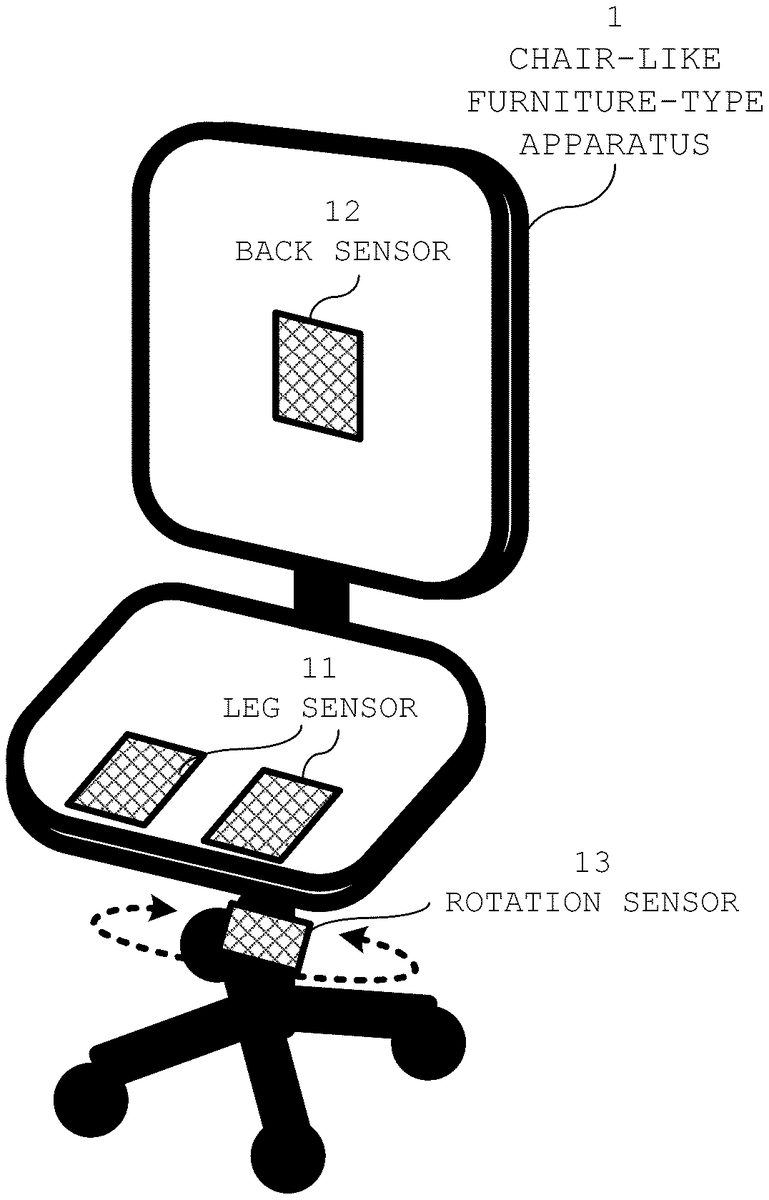
DESCRIPTION OF EMBODIMENTS Hereinafter, embodiments of the present invention will be described in detail with reference to the drawings. FIG.1is a schematic diagram illustrating a furniture-type apparatus in the form of a chair according to the present invention. FIG.1illustrates a furniture-type apparatus1in the form of a chair as one embodiment of the furniture-type apparatus according to the present invention. In the furniture-type apparatus1, at least one sensor is disposed on a surface in proximity to the body of a user. Each sensor outputs a measurement value representing a displacement of each of the left part and right part of the body of the user as a virtual movement amount of the user in the virtual space. As illustrated inFIG.1, the furniture-type apparatus1in the form of a chair includes a leg sensor11, a back sensor12, and a rotation sensor13. Of course, it is possible to dispose only one of these sensors. These sensors may be capable of transmitting their own outputs (information about the virtual movement amounts) to the outside (for example, a terminal2). Alternatively, a communication unit that receives the outputs from these sensors and transmits information about the virtual movement amounts to the outside (for example, the terminal2) may be provided. The leg sensor11is disposed on a surface in proximity to each thigh of the seated user. As illustrated inFIG.1, the leg sensor11is disposed on a surface in proximity to the back side of each thigh and detects a displacement corresponding to a motion of the user lowering the raised thigh to the surface. In addition, the leg sensor11outputs a measurement value representing a displacement of each of the left and right legs, which is caused by the motion of the user, as a virtual movement amount of forward movement of the user in the virtual space. In a ...
DESCRIPTION OF EMBODIMENTS
Hereinafter, embodiments of the present invention will be described in detail with reference to the drawings.
FIG.1is a schematic diagram illustrating a furniture-type apparatus in the form of a chair according to the present invention.
FIG.1illustrates a furniture-type apparatus1in the form of a chair as one embodiment of the furniture-type apparatus according to the present invention. In the furniture-type apparatus1, at least one sensor is disposed on a surface in proximity to the body of a user. Each sensor outputs a measurement value representing a displacement of each of the left part and right part of the body of the user as a virtual movement amount of the user in the virtual space.
As illustrated inFIG.1, the furniture-type apparatus1in the form of a chair includes a leg sensor11, a back sensor12, and a rotation sensor13. Of course, it is possible to dispose only one of these sensors. These sensors may be capable of transmitting their own outputs (information about the virtual movement amounts) to the outside (for example, a terminal2). Alternatively, a communication unit that receives the outputs from these sensors and transmits information about the virtual movement amounts to the outside (for example, the terminal2) may be provided.
The leg sensor11is disposed on a surface in proximity to each thigh of the seated user. As illustrated inFIG.1, the leg sensor11is disposed on a surface in proximity to the back side of each thigh and detects a displacement corresponding to a motion of the user lowering the raised thigh to the surface. In addition, the leg sensor11outputs a measurement value representing a displacement of each of the left and right legs, which is caused by the motion of the user, as a virtual movement amount of forward movement of the user in the virtual space. In a case where the left and right body parts whose displacements are to be detected are ankles, arms, or the like, the sensor11is disposed on a surface in proximity to each of the body parts.
The leg sensor11may include a pressure sensor such as micro electro mechanical systems (MEMS). For example, in the case of MEMS, pressure is detected as a deformation applied to a diaphragm. A type of pressure sensor that detects a change in capacitance or a distortion of a gauge may also be used. Further, the leg sensor11may include a Hall effect sensor. The Hall effect sensor can detect pressure in combination with a permanent magnet. Further, the leg sensor11may include a distance sensor, a speed sensor, or an acceleration sensor. In any case, the device included in the leg sensor11may detect a displacement of the body of the user, which is caused by a walking-like leg motion. In addition, it is preferable that the device is usable without physical contact and practically free from wearing out.
The back sensor12is disposed on a surface in proximity to the back of the seated user. When the back sensor12detects a displacement of the back caused by a motion of the user, the back sensor12recognizes that the user is moving backward in the virtual space and outputs a recognition result indicating backward movement. When the back sensor12does not recognize backward movement, the back sensor12may output a recognition result indicating forward movement in accordance with the output of the leg sensor11. As with the leg sensor11, the back sensor12may include a pressure sensor, a Hall effect sensor, a distance sensor, or the like. In addition, the back sensor12may include a bend sensor or an inclination sensor that is attached to a support of the backrest and is capable of measuring a degree of back bending.
The rotation sensor13is disposed on a part where rotation of the body of the seated user can be detected. For example, the rotation sensor13is disposed on a rotating part of a leg part of the furniture or a seat part on which the user sits. The rotation sensor13outputs a measurement value representing a displacement caused by a motion of the user rotating the body to the left or right, as a virtual rotation amount, which is a virtual movement amount to the left or right of the user in the virtual space.
The rotation sensor13is a sensor (for example, a rotary encoder) that detects a rotation difference between a rotating object and a non-rotating object. Such a device can also output a rotation angle or a rotation speed. The Hall effect sensor described above can also detect the rotation angle. As another embodiment, the rotation sensor may include an inertial measurement unit (IMU). By using the IMU, even when the furniture-type apparatus is in the form of a sheet, rotation can be detected by a gyro sensor. Of course, the IMU may be a sensor unit in which a plurality of physical information sensors (for example, an acceleration sensor, a rotation angle acceleration sensor, and the like) other than the gyro sensor are integrated into one package. By using the IMU, no adjustment or correction to the sensor is needed, and it is possible to acquire a highly accurate measurement value with an optimum degree of freedom. The furniture-type apparatus1in the form of a chair according to the present invention can also detect the rotation angle of the seat surface by incorporating the rotation sensor13not only in the leg part having a rotating shaft but also in the seat part, for example.
Note that the virtual rotation amount, which is the measurement value output by the rotation sensor13, is an amount representing the rotation of the entire body of the virtual object (the avatar or the character) in the virtual space. This virtual rotation amount includes, for example, information about the orientation of the body other than the head. The orientation of the head is detected by, for example, a posture sensor mounted on the HMD terminal.
FIGS.2A and2Bare schematic diagrams for explaining an arrangement of the leg sensor in the furniture-type apparatus in the form of a chair according to the present invention.
In the furniture-type apparatus1illustrated inFIG.2A, the seat surface is provided with a front curtain part, and the leg sensor11is disposed on the front curtain part. This leg sensor11is disposed on a surface in proximity to each calf (the back side of each calf) of each leg of the seated user. With this arrangement, the leg sensor11detects a displacement corresponding to a kicking motion in which the user moves the calf backward and kicks. In the furniture-type apparatus1illustrated inFIG.2B, the leg sensor11is disposed on a surface in proximity to each thigh (the front side of each thigh) of the seated user. With this arrangement, the leg sensor11detects a displacement corresponding to a motion in which the user pushes up the thigh. This leg sensor11also serves as a cover for covering, for example, the thighs of the user. That is, this leg sensor11also provides an effect of supporting the thighs so that the user immersed in the virtual space does not fall from the chair.
FIGS.3A and3Bare schematic diagrams for explaining user operations to the virtual space in the present invention.
The user can operate his or her own movement in the virtual space while sitting on the furniture-type apparatus1in the form of a chair according to the present invention. As illustrated inFIG.3A, the user wears an HMD terminal2on the head as inFIG.8A, and the HMD terminal2accesses a virtual space server3via wireless communication. As in FIG.1, the furniture-type apparatus1in the form of a chair illustrated inFIG.3Acan detect a displacement of each of (the back sides of) the left and right thighs. As another embodiment illustrated inFIG.3B, the user views a display of a terminal2as inFIG.8B, and the terminal2accesses the virtual space server3via the network. The furniture-type apparatus1in the form of a chair illustrated inFIG.3Bcan detect a displacement of each of (the front sides of) the left and right thighs of the user as inFIG.2B.
The terminal2communicates with (an information processing unit of) the furniture-type apparatus1in a wireless or wired manner, regards a virtual movement amount received from the furniture-type apparatus1as a movement amount of a virtual object (an avatar or a character) belonging to the user in a virtual space or a game space visually recognized by the user, and controls the movement of the virtual object.
FIGS.4A to4Care schematic diagrams for explaining virtual forward movement and backward movement in the present invention.
As illustrated inFIG.4A, the leg sensor11is disposed for each of the left and right legs of the user and outputs a measurement value representing a displacement detected by each of the left and right sensors as a detection result indicating a walking motion of the user in the virtual space. The user alternately moves the left and right thighs and/or calves up and down (in a walking-in-place or marching-in-place manner) as if the user were walking in the real space. In response to such motion, the leg sensor11detects displacements corresponding to the motion, outputs measurement values obtained from the detection as virtual movement amounts in the virtual space, and reflects the measurement values on walking in the virtual space.
As another embodiment, assuming that the virtual object in the virtual space needs to perform exercise for training the muscles of the legs and loins, the exercise of the legs performed by the user in the real space becomes the exercise of the virtual object in the virtual space.
The leg sensor11may output an amount of change in displacement per unit time, that is, the speed of displacement, as the speed of virtual movement amount. In this case, the movement of the virtual object in the virtual space becomes faster as the speed of alternately moving the left and right legs by the user in the real space becomes higher. Conversely, the movement of the virtual object in the virtual space becomes slower as the speed of alternately moving the left and right legs in the real space becomes lower.
In addition, the leg sensor11may output an amount of change in displacement speed per unit time in the sensor, that is, the acceleration of displacement, as the acceleration of virtual movement amount. In this case, the acceleration of the movement of the virtual object in the virtual space becomes larger as the change in pressure applied from the legs of the user in the real space becomes larger. Conversely, the acceleration of the movement of the virtual object in the virtual space becomes smaller as the change in pressure applied from the legs of the user becomes smaller.
Further, when the user moves both legs simultaneously in the real space, the leg sensor11may output a measurement value representing a displacement detected from such a motion as a virtual movement amount corresponding to a jump of the user and cause the virtual object in the virtual space to jump instantaneously.
As another embodiment, in a case where the virtual space is assumed to be underwater, when the user moves the left and right legs alternately in the real space, the virtual object may be set to be operated to move such that the virtual object is swimming in the water with flutter kicks. Further, when the user moves the legs simultaneously in the real space, the virtual object may be set to be operated to move such that the virtual object is swimming in the water with butterfly strokes.
In the embodiments described above, the virtual movement amount has been described as an amount corresponding to the movement distance of the avatar. In contrast, as another embodiment, the virtual movement amount may be set as an amount to be reflected in the joint angle of the avatar (virtual object) in the virtual space. When the avatar moves, the posture (joint angle) of the avatar also changes in accordance with the speed of the movement and the acceleration of the movement. From this regard, it is preferable that the virtual movement amount of the avatar in the virtual space serve as not only an amount used for just a movement of the avatar itself but also an amount used for affecting various video spaces that change in accordance with the movement of the avatar.
As illustrated inFIG.4B, the back sensor12recognizes and outputs a measurement value representing a displacement of the back of the user as an amount corresponding to the backward movement of the user in the virtual space. This is to determine the direction of movement of the virtual object as backward movement.
After the direction of movement of the virtual object is recognized to be backward movement as illustrated inFIG.4B, the user alternately moves the left and right thighs and/or calves up and down (in a walking-in-place or marching-in-place manner) as if the user were walking in the real space. That is, as an operation performed on the virtual object, the user in the real space moves the left and right legs alternately while keeping a state in which the user leans back with his or her back pressed against the backrest. By performing this operation, the virtual object in the virtual space moves backward in a walking backward manner.
FIG.5is a schematic diagram for explaining virtual rotation in the present invention.
The rotation sensor13is disposed, for example, on a rotation part of the leg part of the furniture. As illustrated inFIG.5, the rotation sensor13is disposed on a rotating shaft of the chair and can detect the rotation angle and the rotation speed of the chair.
According toFIGS.3A and3Bdescribed above, the furniture-type apparatus1communicates with the terminal2that provides the user with a virtual space. The terminal2is, for example, a terminal such as an HMD terminal or a personal computer and is a device that allows the user to visually recognize the virtual space.
In particular, when the user is wearing the HMD terminal on the head, the user is usually experiencing the virtual space while obtaining a sense of immersion. Therefore, the action of the user in the real space may cause a dangerous situation such as a fall. Therefore, when the virtual movement amount received from the furniture-type apparatus1satisfies, for example, the following condition 1 or 2, the terminal2transmits an alarm to the user.1. The obtained virtual movement amount is equal to or more than a first predetermined threshold.2. The obtained virtual movement amount continues to be equal to or less than a second predetermined threshold for a predetermined period of time.
For example, if the user leans back excessively, the chair may fall. Thus, when the virtual movement amount received from the back sensor12is equal to or more than a predetermined threshold, an alarm is transmitted to the user or a monitoring person. For example, in a case of a nursing facility for rehabilitation, the user may be a person in need of care, and the monitoring person may be a care worker. For example, in a case of a hospital, the user may be a patient, and the monitoring person may be a nurse. In addition, when the user has not moved the legs for a long time, the user may suffer an economy-class syndrome. In this case, when the virtual movement amount received from the leg sensor11continues to be equal to or less than a predetermined threshold for a predetermined period of time, an alarm is transmitted to the user or the monitoring person. For example, in a case where the furniture-type apparatus1is a seat on an airplane, the user may be a passenger, and the monitoring person may be a cabin attendant. Further, when the user repeats a leg motion, a back motion, or a rotation motion excessively, a dangerous situation may occur. When the virtual movement amount received from the furniture-type apparatus1indicates such a case, the terminal2transmits an alarm.
While the furniture-type apparatus1may be in the form of a chair as described above, the furniture-type apparatus1may be in the form of a wheelchair, a mat, or a sheet as another embodiment.
FIG.6is a schematic diagram illustrating a furniture-type apparatus in the form of a wheelchair according to the present invention.
As illustrated inFIG.6, a furniture-type apparatus1is provided in the form of a wheelchair. For example, when the user who is a physically disabled person in need of care wears an HMD terminal2and experiences a virtual space, it is also preferable for the user to use this furniture-type apparatus1in the form of a wheelchair. Accordingly, even the user with weak legs and loins can be immersed in the virtual space in a seated state. For example, when the user performs walking training as rehabilitation, the HMD terminal2projects, on its display, an image in which the user is walking by himself or herself in the virtual space. As a result, it is possible for the user to recognize that the user can walk by himself or herself in the virtual space while sitting on the wheelchair in the real space so that rehabilitation for recovering the walking nerves in the brain can also be performed.
FIG.7is a schematic diagram illustrating a furniture-type apparatus in the form of a mat and a furniture-type apparatus in the form of a sheet according to the present invention.
A furniture-type apparatus in the form of a mat may be a cushion or have a cushion shape. This cushion as the furniture-type apparatus is placed to be in proximity to the body of the user and can have a sensor incorporated therein. This cushion may be mountable on the seat surface and/or the backrest surface of the chair. Further, the furniture-type apparatus of the present invention may be in the form of a sheet. This sheet itself as the furniture-type apparatus is a sensor and is placed to be in proximity to the body of the user. For example, when this sheet is a built-in pressure-distribution sensor sheet and is a film-like sensor sheet having a thickness of approximately 0.1 mm, applied pressure can be detected in real time. Further, when such a sheet is applied to the leg sensor11, depending on the type of the sheet, the left and right pressures may be detected by only one sheet without using one sheet for each of the left and right legs (without using two sheets in total).
As described above in detail, the furniture-type apparatus according to the present invention is capable of providing a user with a sense of moving in a virtual space while the movement of the user in the real space is restricted as much as possible.
The foregoing embodiments are by way of examples of the present invention only and are not intended to limit thereto, thus many widely different alternations and modifications of the present invention may be constructed. Accordingly, the present invention is to be limited only as defined by the following claims and equivalents thereto.
REFERENCE SIGNS LIST
1Furniture-type apparatus;11Leg sensor;12Back sensor;13Rotation sensor;2Terminal; and3Virtual space server.
Claims
- A furniture-type apparatus on which a user can sit, the apparatus comprising: a leg sensor configured to be disposed on a surface in proximity to legs of the user and to obtain a measurement value representing a displacement of each of the left and right legs of the user as a virtual movement amount representing a magnitude of movement of the user in a virtual space;and a back sensor configured to be disposed on a part in proximity to a back of the user and to recognize whether a direction of movement of the user is forward or backward in the virtual space, based on a displacement of the back of the user, the virtual movement amount and a recognition result indicating whether the direction is forward or backward being output as a virtual movement amount of forward movement or a virtual movement amount of backward movement, each of which specifies a combination of the magnitude and the direction of movement of the user in the virtual space.
- The furniture-type apparatus as claimed in claim 1, wherein the leg sensor detects a speed of the displacement as a speed of the virtual movement amount, and the furniture-type apparatus outputs the speed of the virtual movement amount and the recognition result indicating whether the direction is forward or backward as a speed of the virtual movement amount of forward movement or a speed of the virtual movement amount of backward movement, and/or wherein the leg sensor detects an acceleration of the displacement as an acceleration of the virtual movement amount, and the furniture-type apparatus outputs the acceleration of the virtual movement amount and the recognition result indicating whether the direction is forward or backward as an acceleration of the virtual movement amount of forward movement or an acceleration of the virtual movement amount of backward movement.
- The furniture-type apparatus as claimed in claim 1, wherein the back sensor recognizes that the direction is backward when detecting leaning back of the user.
- The furniture-type apparatus as claimed in claim 1, wherein the leg sensor is disposed for each of the right leg and the left leg of the user and obtains a measurement value alternately from the right leg and the left leg to be used as a virtual movement amount corresponding to a walking motion of the user in the virtual space.
- The furniture-type apparatus as claimed in claim 1, wherein the leg sensor is disposed on a surface to which a thigh of the user is in proximity and/or a surface to which a calf of the leg of the user is in proximity.
- The furniture-type apparatus as claimed in claim 1, further comprising a rotation sensor configured to be disposed on a rotation part of a leg part of furniture or on a seat part on which the user sits and to output a measurement value representing a displacement in a motion of the user rotating his or her body to the left or right as a virtual movement amount to the left or right.
- The furniture-type apparatus as claimed in claim 1, wherein the furniture-type apparatus is in a form of a chair, a wheelchair, a mat, or a sheet.
- The furniture-type apparatus as claimed in claim 1, wherein the furniture-type apparatus causes a terminal to transmit an alarm to the user or a monitoring person when the virtual movement amount is equal to or more than a first predetermined threshold or when the virtual movement amount is continuously equal to or less than a second predetermined threshold for a predetermined period of time.
Disclaimer: Data collected from the USPTO and may be malformed, incomplete, and/or otherwise inaccurate.