U.S. Pat. No. 12,005,343
PLACEMENT OF VIRTUAL ELEMENTS IN A VIRTUAL WORLD ASSOCIATED WITH A LOCATION-BASED PARALLEL REALITY GAME
AssigneeNIANTIC, INC.
Issue DateAugust 25, 2021
Illustrative Figure
Abstract
Computer-implemented methods and systems for locating virtual elements that can be used or collected by players of a parallel reality game having a virtual world that parallels at least a portion of the real world are provided. In particular, the location of virtual elements in the virtual world is determined based on data associated with one or more real world conditions. Virtual elements can be located in the virtual world at locations corresponding to locations in the real world that encourage safe and effective game play. Locating virtual elements in the virtual world based on data associated with real world conditions improves the link between the parallel virtual world and the real world, enhancing the illusion that the virtual world is another dimension of the real world that the player can interact with through the parallel reality game.
Description
DETAILED DESCRIPTION Reference now will be made in detail to embodiments of the invention, one or more examples of which are illustrated in the drawings. Each example is provided by way of explanation of the embodiments, not limitation of the invention. In fact, it will be apparent to those skilled in the art that various modifications and variations can be made to the embodiments without departing from the scope or spirit of the invention. For instance, features illustrated or described as part of one embodiment can be used with another embodiment to yield a still further embodiment. Thus, it is intended that aspects of the present disclosure cover such modifications and variations. Overview Generally, the present disclosure is directed to locating virtual elements, such as virtual objects, virtual items, virtual energy, and other virtual elements, in a virtual world that parallels at least a portion of the real world. In particular, the location of virtual elements in the virtual world is determined based on data associated with one or more real world conditions. In this way, virtual elements can be located in the virtual world at locations corresponding to locations in the real world that encourage safe and effective game play. Moreover, locating virtual elements in the virtual world based on data associated with real world conditions improves the link between the parallel virtual world and the real world, further enhancing the illusion that the virtual world is another dimension of the real world that the player can perceive and interact with through the parallel reality game. A game server can host a location-based parallel reality game having a player gaming area that includes a virtual environment with a geography that parallels at least a portion of the real world geography. Players can navigate a virtual space in the virtual ...
DETAILED DESCRIPTION
Reference now will be made in detail to embodiments of the invention, one or more examples of which are illustrated in the drawings. Each example is provided by way of explanation of the embodiments, not limitation of the invention. In fact, it will be apparent to those skilled in the art that various modifications and variations can be made to the embodiments without departing from the scope or spirit of the invention. For instance, features illustrated or described as part of one embodiment can be used with another embodiment to yield a still further embodiment. Thus, it is intended that aspects of the present disclosure cover such modifications and variations.
Overview
Generally, the present disclosure is directed to locating virtual elements, such as virtual objects, virtual items, virtual energy, and other virtual elements, in a virtual world that parallels at least a portion of the real world. In particular, the location of virtual elements in the virtual world is determined based on data associated with one or more real world conditions. In this way, virtual elements can be located in the virtual world at locations corresponding to locations in the real world that encourage safe and effective game play. Moreover, locating virtual elements in the virtual world based on data associated with real world conditions improves the link between the parallel virtual world and the real world, further enhancing the illusion that the virtual world is another dimension of the real world that the player can perceive and interact with through the parallel reality game.
A game server can host a location-based parallel reality game having a player gaming area that includes a virtual environment with a geography that parallels at least a portion of the real world geography. Players can navigate a virtual space in the virtual world by navigating a corresponding geographic space in the real world. In particular, players can navigate a range of coordinates defining a virtual space in the virtual world by navigating a range of geographic coordinates in the real world.
In one aspect, the positions of players can be monitored or tracked using, for instance, a positioning system (e.g. a GPS system) associated with a player's mobile computing device (e.g. cell phone, smartphone, gaming device, or other device). As players move about in the real world, player position information can be provided to the game server hosting the parallel reality game over a network. The game server can update player positions in the parallel virtual world to correspond with the player positions in the real world.
The parallel reality game can include one or more virtual elements that players can interact with during the course of the parallel reality game. To interact with a virtual element, a player may have to travel to the corresponding location of the virtual element in the real world and perform any necessary interactions in the parallel reality game. According to aspects of the present disclosure, virtual elements are located in the virtual world based on data associated with real world conditions. The data associated with real world conditions can be analyzed to determine locations that are suitable and/or are not suitable for placement of virtual items in the virtual worlds. For instance, virtual elements can be located at positions that are readily accessible in the real world and that do not require players to travel to locations in the real world that are potentially unsafe or difficult to access in order to play the parallel reality game.
According to a particular aspect of the present disclosure, a game server can access data associated with one or more real world conditions, analyze the data, and adjust game data associated with the parallel reality game to locate virtual elements at locations determined to be suitable for placement of virtual elements based on the data associated with the one or more real world conditions. Exemplary data associated with real world conditions can include the aggregate locations of individuals and/or players in the real world; local data providing locations of cultural value, historic value, or commercial value; road map data providing the locations of roads, highways, and/or waterways; current and past locations of individual players of the game; hazard data, weather data; event calendar data; and other suitable data.
Tying the location of virtual elements to real world conditions permits the directing of players of the parallel reality game to places that are fun, safe, and appropriate to walk around in the real world and ensures that players find virtual elements to interact with in locations the players are likely to frequent. In this manner, the subject matter of present disclosure can have a technical effect of providing for an improved computer-based implementation of a parallel reality game that provides for the location of virtual elements in a virtual world that parallels the real world in a manner that encourages game play in a safe and effective manner and that improves the link between the real world and the parallel virtual world.
In one embodiment, a game server associated with a parallel reality game can access data associated with the aggregate locations of individuals in the real world. The data associated with the aggregate locations of individuals in the real world can be obtained or derived from any suitable source. The data associated with the aggregate locations of individuals in the real world can include the aggregate locations of mobile device users in the real world. In particular, users of mobile devices, such as smart phones, can optionally provide position information, in terms of geographic location in the real world, in order to enhance certain location-based features or other functionality. This data can be used to determine the placement of virtual elements in the parallel virtual world. It should be understood that location information associated with a mobile device user is accessed or utilized only if permission is granted by the user after the user has been notified that location information is to be accessed and how the location information is to be utilized. In addition, any location information associated with users will be stored and maintained in a manner to protect anonymity and privacy.
Data associated with the aggregate locations of individuals in the real world can also include data associated with the aggregate locations of players of the parallel reality game. In particular, the game server can receive position information from each of the plurality of players during play of the parallel reality game such that the game server can update the position of the player in the parallel virtual world associated with the parallel reality game. Alternatively or in addition, data associated with the aggregate locations of individuals in the real world can include population maps/data or other suitable data source. Population maps can be used to determine data associated with the aggregate locations of individuals in the real world that is not skewed towards smartphone users.
The game server can analyze the data associated with the aggregate locations of individuals in the real world and determine where to locate virtual elements in the virtual world based on the data. For instance, the game server can arrange for the location of virtual elements in the virtual world in high traffic areas based on the data associated with aggregate locations of the individuals in the real world. Placement of virtual objects in a virtual world at locations corresponding to high traffic areas can give players something to do in locations the players are more likely to visit and that are more likely to be safe and public.
In a particular implementation, the data associated with the aggregate locations of individuals in the real world can include a population heat map that represents the relative number of individuals at specific geographic locations in the real world. The heat map can include a plurality of cells with each cell being associated with a specific geographic location in the virtual world and corresponding location in the real world. The heat map can include different values for each cell depending on the number of individuals located in the cell. The game server can analyze the heat map and assign virtual elements to locations corresponding to cells with relatively high values. In this way, the game server can locate virtual elements in the virtual world at locations having a greater number of individuals in the real world.
The game server can locate virtual objects in the parallel virtual world based on other data associated with real world conditions. For instance, the game server can locate virtual objects based on local data providing locations of cultural, recreational, or commercial value, rod map data providing the locations of roads and highways, waterways, private property, and other unsafe locations, hazard data, weather data, event calendar data, and other suitable data. As an example, the game server can locate virtual elements at locations in the virtual world based on data associated with real world conditions corresponding to locations of public, educational, commercial, or recreational value, such as locations of public artwork, tourist attractions, scenic vistas, libraries, or hiking trails.
Other exemplary applications of data associated with real world conditions can include: (1) avoiding placement of virtual objects in the virtual world at locations corresponding to areas proximate or close to highways or waterways in the real world; (2) avoiding placement of virtual objects in the virtual world at locations corresponding to private property in the real world (as determined, for instance, from map data or from areas with low player density determined from, for instance, a heat map); (3) avoiding placement of virtual elements in locations corresponding to hazardous areas in the virtual world; (4) avoiding placement of virtual elements in locations corresponding to low pedestrian traffic at night; (5) placement of virtual elements in locations corresponding to sheltered locations in the real world during bad weather; (6) placement of virtual elements in locations corresponding to outdoor locations in the real world during good weather; (7) placement of virtual elements in locations corresponding to locations of sporting events, conferences, or other events (as determined, for instance, from event calendar data) that draw large crowds.
According to a particular aspect of the present disclosure, a game server can be configured to place virtual elements along a predicted path of a player determined, for instance, based on real world data associated with current player location and direction, past location history of the player, aggregate movement of other players, map data providing traversable paths that may be traversed by the player, and other data. Placement of virtual objects along a predicted path for a particular player encourages continued game play by the player by making sure the player continues to have something to interact with nearby in the parallel virtual world.
Exemplary Location-Based Parallel Reality Gaming System
Exemplary computer-implemented location-based gaming systems according to exemplary embodiments of the present disclosure will now be set forth. The present subject matter will be discussed with reference to a parallel reality game. A parallel reality game is a location-based game having a virtual world geography that parallels at least a portion of the real world geography such that player movement and actions in the real world affect actions in the virtual world and vice versa. Those of ordinary skill in the art, using the disclosures provided herein, should understand that the subject matter of the present disclosure is equally applicable to other gaming systems. In addition, the inherent flexibility of computer-based systems allows for a great variety of possible configurations, combinations, and divisions of tasks and functionality between and among the components of the system. For instance, the systems and methods according to aspects of the present disclosure can be implemented using a single computing device or across multiple computing devices.
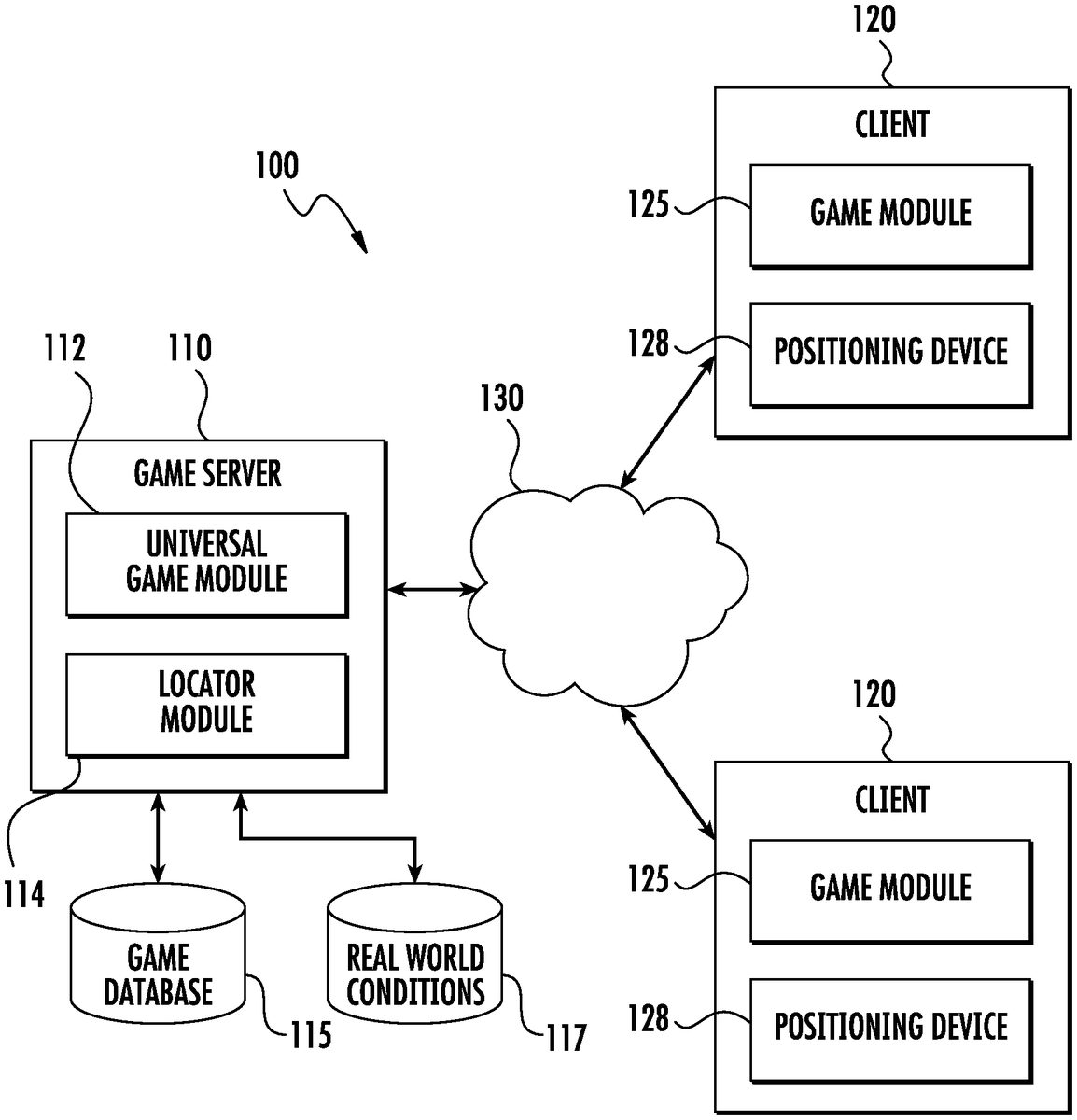
FIG.1illustrates an exemplary computer-implemented location-based gaming system100configured in accordance with an embodiment of the present disclosure. The location-based gaming system100provides for the interaction of a plurality of players in a virtual world having a geography that parallels the real world. In particular, a geographic area in the real world can be linked or mapped directly to a corresponding area in the virtual world. A player can move about in the virtual world by moving to various geographic locations in the real world. For instance, the system100can track a player's position in the real world and update the player's position in the virtual world based on the player's current position in the real world.
FIG.2depicts a conceptual diagram of a virtual world210that parallels the real world200that can act as the game board for all players of a location-based game according to an exemplary embodiment of the present disclosure. As illustrated, the virtual world210can include a geography that parallels the geography of the real world200. In particular, a range of coordinates defining a geographic area or space in the real world200is mapped to a corresponding range of coordinates defining a virtual space in the virtual world210. The range of coordinates in the real world200can be associated with a town, neighborhood, city, campus, locale, a country, continent, the entire globe, or other geographic area. Each geographic coordinate in the range of geographic coordinates in the real world200is mapped to a corresponding coordinate in a virtual space in the virtual world210.
A player's position in the virtual world210corresponds to the player's position in the real world200. For instance, the player A located at position212in the real world200has a corresponding position222in the virtual world210. Similarly, the player B located at position214in the real world has a corresponding position224in the virtual world. As the players move about in a range of geographic coordinates in the real world, the players also move about in the range of coordinates defining the virtual space in the virtual world210. In particular, a positioning system associated with a mobile device carried by the player (e.g. a GPS system) can be used to track a player's position as the player navigates the range of geographic coordinates in the real world200. Data associated with the player's position in the real world200is used to update the player's position in the corresponding range of coordinates defining the virtual space in the virtual world210. In this manner, players can navigate a continuous track in the range of coordinates defining the virtual space in the virtual world210by simply traveling among the corresponding range of geographic coordinates in the real world200without necessarily having to check in or periodically update location information at specific discrete locations in the real world200.
The location-based game can include a plurality of game objectives requiring players to travel to and/or interact with various virtual elements and/or virtual objects scattered at various virtual locations in the virtual world. A player can travel to these virtual locations by traveling to the corresponding location of the virtual elements or objects in the real world. For instance, a positioning system can continuously track the position of the player such that as the player continuously navigates the real world, the player also continuously navigates the parallel virtual world. The player can then interact with various virtual elements and/or objects at the specific location to achieve or perform one or more game objectives.
For example, referring toFIG.2, a game objective can require players to capture or claim ownership of virtual elements230located at various virtual locations in the virtual world210. These virtual elements230can be linked to landmarks, geographic locations, or objects240in the real world200. The real world landmarks or objects240can be works of art, monuments, buildings, businesses, libraries, museums, or other suitable real world landmarks or objects. To capture these virtual elements230, a player must travel to the landmark or geographic location240linked to the virtual elements230in the real world and must perform any necessary interactions with the virtual elements230in the virtual world210. For example, player A ofFIG.2will have to travel to a landmark240in the real world200in order to interact with or capture a virtual element230linked with that particular landmark240. The interaction with the virtual element230can require action in the real world, such as taking a photograph and/or verifying, obtaining, or capturing other information about the landmark or object240associated with the virtual element230.
Game objectives can require that players use one or more virtual items that are collected by the players in the location-based game. For instance, the players may have to travel the virtual world seeking virtual items (e.g. weapons or other items) that can be useful for completing game objectives. These virtual items can be found or collected by traveling to different locations in the real world or by completing various actions in either the virtual world or the real world. In the example shown inFIG.2, a player uses virtual items232to capture one or more virtual elements230. In particular, a player can deploy virtual items232at locations in the virtual world210proximate the virtual elements230. Deploying one or more virtual items232proximate a virtual element230can result in the capture of the virtual element230for the particular player or for the team and/or faction of the particular player.
In one particular implementation, a player may have to gather virtual energy as part of the location-based game. As depicted inFIG.2, virtual energy250can be scattered at different locations in the virtual world210. A player can collect the virtual energy250by traveling to the corresponding location of the virtual energy250in the actual world200. The virtual energy250can be used to power virtual items and/or to perform various game objectives in the game. A player that loses all virtual energy250can be disconnected from the game.
According to aspects of the present disclosure, the location-based game can be a massive multi-player location-based game where every participant in the game shares the same virtual world. The players can be divided into separate teams or factions and can work together to achieve one or more game objectives, such as to capture or claim ownership of a virtual element. In this manner, the location-based game can intrinsically be a social game that encourages cooperation among players within the game. Players from opposing teams can work against each other during the location-based game. A player can use virtual items to attack or impede progress of players on opposing teams.
The location-based game can have various features to enhance and encourage game play within the location-based game. For instance, players can accumulate a virtual currency or other virtual reward that can be used throughout the game. Players can advance through various levels as the players complete one or more game objectives and gain experience within the game. Players can communicate with one another through one or more communication interfaces provided in the game. Players can also obtain enhanced “powers” or virtual items that can be used to complete game objectives within the game. Those of ordinary skill in the art, using the disclosures provided herein, should understand that various other game features can be included with the location-based game without deviating from the scope of the present disclosure.
Referring backFIG.1, the computer-implemented location-based gaming system100will be discussed in more detail. The system100can include a client-server architecture, where a game server110communicates with one or more clients120over a network130. Although two clients120are illustrated inFIG.1, any number of clients120can be connected to the game server110over the network130. The server110can host a universal gaming module112that controls aspects of the location-based game for all players and receives and processes each player's input in the location based game. On the client-side, each client120can include a gaming module125that operates as a gaming application so as to provide a user with an interface to the system100. The game server110transmits game data over the network130to the client120for use by the gaming module125at the client120to provide local versions (e.g. portions of the virtual world specific to player locations) of the game to players at locations remote from the game server110. The server110can include a network interface for providing communications over the network130. A network interface can include any suitable components for interfacing with one more networks, including for example, transmitters, receivers, ports, controllers, antennas, or other suitable components.
It will be appreciated that the term “module” refers to computer logic utilized to provide desired functionality. Thus, a module can be implemented in hardware, firmware and/or software controlling a general purpose processor. In one embodiment, the modules are program code files stored on the storage device, loaded into memory and executed by a processor or can be provided from computer program products, for example computer executable instructions, that are stored in a tangible computer-readable storage medium such as RAM hard disk or optical or magnetic media.
The game server110can be any computing device and can include one or more processors and one or more computer-readable media. The computer-readable media can store instructions which cause the processor to perform operations. The game server110can include or can be in communication with a game database115. The game database115stores game data used in the location-based game to be served or provided to the client(s)120over the network130.
The game data stored in the game database115can include: (1) data associated with the virtual world in the location-based game (e.g. imagery data used to render the virtual world on a display device, geographic coordinates of locations in the virtual world, etc.); (2) data associated with players of the location-based game (e.g. player information, player experience level, player currency, current player positions in the virtual world/real world, player energy level, player preferences, team information, faction information, etc.); (3) data associated with game objectives (e.g. data associated with current game objectives, status of game objectives, past game objectives, future game objectives, desired game objectives, etc.); (4) data associated virtual elements in the virtual world (e.g. positions of virtual elements, types of virtual elements, game objectives associated with virtual elements; corresponding actual world position information for virtual elements; behavior of virtual elements, relevance of virtual elements etc.); (5) data associated with real world objects, landmarks, positions linked to virtual world elements (e.g. location of real world objects/landmarks, description of real world objects/landmarks, relevance of virtual elements linked to real world objects, etc.); (6) Game status (e.g. current number of players, current status of game objectives, player leaderboard, etc.); (7) data associated with player actions/input (e.g. current player positions, past player positions, player moves, player input, player queries, player communications, etc.); and (8) any other data used, related to, or obtained during implementation of the location-based game. The game data stored in the game database115can be populated either offline or in real time by system administrators and/or by data received from users/players of the system100, such as from one or more clients120over the network130.
As will be discussed in further detail below, the game server110can include or can also be in communication with a real world condition database117. The real world condition database117can be a part of, integral with, or separate from the game database115. The real world condition database117stores data associated with real world conditions, such as such as the aggregate locations of players in the real world; local data providing locations of cultural value or commercial value; map data providing the locations of roads, highways, and waterways; current and past locations of individual players; hazard data; weather data; event calendar data; and other suitable data. The data stored in the real world condition database117can be collected or obtained from any suitable source. For example, in one aspect, the real world condition database117can be coupled to, includes, or is part of a map database storing map information, such as one or more map databases accessed by a mapping service, virtual globe, or other geographic information system. According to another exemplary aspect, the real world condition database117can obtain or access data associated with past and current locations of players, for instance, from the game database115. According to yet another exemplary aspect, the real world condition database117can be coupled to one or more external data sources or services that periodically provide population data, hazard data, weather data, event calendar data, or other data to the real world condition database117.
The game server110can be configured to receive requests for game data from one or more clients120(for instance, via remote procedure calls (RPCs)) and to respond to those requests via the network130. For instance, the game server110can encode game data in one or more data files and provide the data files to the client120. In addition, the game server110can be configured to receive game data (e.g. player positions, player actions, player input, etc.) from one or more clients120via the network130. For instance, the client device120can be configured to periodically send player input, player location, and other updates to the game server110, which the game server110uses to update game data in the game database115to reflect any and all changed conditions for the game.
As illustrated, the game server110can include a universal game module112. The universal game module112hosts the location-based game for all players and acts as the authoritative source for the current status of the location-based game for all players. The universal game module112receives game data from clients120(e.g. player input, player position, player actions, player status, landmark information, etc.) and incorporates the game data received into the overall location-based game for all players of the location-based game. The universal game module112can also manage the delivery of game data to the clients120over the network130.
According to an exemplary embodiment of the present disclosure, the game server110can also include a locator module114. The locator module114can be a part of or separate from the universal game module112. The locator module114can be configured to access data associated with real world conditions, analyze the data, and determine locations in the virtual world to locate virtual elements in the virtual world based on the data associated with real world conditions. For instance, the locator module114can modify game data stored in the game database115to locate virtual elements in the virtual world at locations determined based on the data associated with real world conditions.
Other modules can be used with the game server110. Any number of modules can be programmed or otherwise configured to carry out the server-side functionality described herein. In addition, the various components on the server-side can be rearranged. For instance, the game database115and real world condition database117can be integrated into the game server110. Other configurations will be apparent in light of this disclosure and the present disclosure is not intended to be limited to any particular configuration.
A client120can be any portable computing device that can be used by a player to interact with the gaming system100. For instance, a client120can be a wireless device, a personal digital assistant (PDA), portable gaming device, cellular phone, smart phone, tablet, navigation system, handheld GPS system, wearable computing device, display with one or more processors, or other such device. In short, a client120can be any computer-device or system that can execute a gaming module125to allow a player to interact with the game system100.
The client120can include one or more processors and one or more computer-readable media. The computer-readable media can store instructions which cause the processor to perform operations. The client120can include various input/output devices for providing and receiving information from a player, such as a display screen, touch screen, touch pad, data entry keys, speakers, and/or a microphone suitable for voice recognition. The client120can further include a network interface for providing communications over the network130. A network interface can include any suitable components for interfacing with one more networks, including for example, transmitters, receivers, ports, controllers, antennas, or other suitable components.
The gaming module125executed by the client120provides an interface between a player and the location-based game. The gaming module125can present a user interface on a display device associated with the client120that displays a virtual world associated with the game and allows a user to interact in the virtual world to perform various game objectives. The gaming module125can also control various other outputs to allow a player to interact with the game without requiring the player to view a display screen. For instance, the gaming module125can control various audio, vibratory, or other notifications that allow the player to play the game without looking at the display screen. The gaming module125can access game data received from the game server110to provide an accurate representation of the game to the user. The gaming module125can receive and process player input and provide updates to the game server110over the network130.
Because the gaming system100is for a location-based game, the client120is preferably a portable computing device, such as a smartphone or other portable device, that can be easily carried or otherwise transported with a player. A player can interact with the virtual world simply by carrying or transporting the client120in the actual world. The client120can include a positioning device128that monitors the position of a player during game play. The positioning device128can be any device or circuitry for monitoring the position of the client120. For example, the positioning device128can determine actual or relative position by using a satellite navigation positioning system (e.g. a GPS system, a Galileo positioning system, the GLObal Navigation satellite system (GLONASS), the BeiDou Satellite Navigation and Positioning system), an inertial navigation system, a dead reckoning system, based on IP address, by using triangulation and/or proximity to cellular towers or WiFi hotspots, and/or other suitable techniques for determining position.
As the player moves around with the client120in the real world, the positioning device128tracks the position of the player and provides the player position information to the gaming module125. The gaming module125updates the player position in the virtual world based on the actual position of the player in the real world. In particular, the location of the player in the virtual world can correspond to the location of the player in the real world. The gaming module125can provide player position information to the game server110over the network130such that the universal gaming module112keeps track of all player positions throughout the game. It should be understood that location information associated with a player is utilized only if permission is granted after the player has been notified that location information of the player is to be accessed and how the location information is to be utilized in the context of the game (e.g. to update player position in the virtual world). In addition, any location information associated with players will be stored and maintained in a manner to protect player privacy.
The network130can be any type of communications network, such as a local area network (e.g. intranet), wide area network (e.g. Internet), or some combination thereof. The network can also include a direct connection between a client120and the game server110. In general, communication between the game server110and a client120can be carried via a network interface using any type of wired and/or wireless connection, using a variety of communication protocols (e.g. TCP/IP, HTTP, SMTP, FTP), encodings or formats (e.g. HTML, XML), and/or protection schemes (e.g. VPN, secure HTTP, SSL).
The technology discussed herein makes reference to servers, databases, software applications, and other computer-based systems, as well as actions taken and information sent to and from such systems. One of ordinary skill in the art will recognize that the inherent flexibility of computer-based systems allows for a great variety of possible configurations, combinations, and divisions of tasks and functionality between and among components. For instance, server processes discussed herein may be implemented using a single server or multiple servers working in combination. Databases and applications may be implemented on a single system or distributed across multiple systems. Distributed components may operate sequentially or in parallel.
In addition, in situations in which the systems and methods discussed herein access and analyze personal information about users, or make use of personal information, such as location information, the users may be provided with an opportunity to control whether programs or features collect the information and control whether and/or how to receive content from the system or other application. No such information or data is collected or used until the user has been provided meaningful notice of what information is to be collected and how the information is used. The information is not collected or used unless the user provides consent, which can be revoked or modified by the user at any time. Thus, the user can have control over how information is collected about the user and used by the application or system. In addition, certain information or data can be treated in one or more ways before it is stored or used, so that personally identifiable information is removed. For example, a user's identity may be treated so that no personally identifiable information can be determined for the user.
Exemplary Game Interface
FIG.3depicts one particular embodiment of a game interface300that can be presented on a display of a client120as part of the interface between a player and the gaming system100. The game interface300includes a display window310that can be used to display the virtual world210and various other aspects of the game, such as player position222and the locations of virtual elements230, virtual items232and virtual energy250in the virtual world210. The user interface300can also display other information, such as game data information, game communications, player information, and other information associated with the game. For example, the user interface can display player information315, such as player name, experience level and other information. The user interface300can include a menu320for accessing various game settings and other information associated with the game. The user interface300can also include a communications interface330that enables communications between the game system and the player and between one or more players of the location-based game.
According to aspects of the present disclosure, a player can interact with the location-based game by simply carrying a client device around in the real world. For instance, a player can play the location-based game by simply accessing an application associated with the location based game on a smartphone and moving about in the real world with the smartphone. In this regard, it is not necessary for the player to continuously view a visual representation of the virtual world on a display screen in order to play the location based game. As a result, the user interface300can include a plurality of non-visual elements that allow a user to interact with the game. For instance, the game interface can provide audible notifications to the player when the player is approaching a virtual element or object in the game or when an important event happens in the location-based game. A player can control these audible notifications with audio control340. Different types of audible notifications can be provided to the user depending on the type of virtual element or event. The audible notification can increase or decrease in frequency or volume depending on a player's proximity to a virtual element or object. Other non-visual notifications and signals can be provided to the user, such as a vibratory notification or other suitable notifications or signals.
Those of ordinary skill in the art, using the disclosures provided herein, should understand that numerous game interface configurations and underlying functionalities will be apparent in light of this disclosure. The present disclosure is not intended to be limited to any one particular configuration.
Exemplary Client-Server Flow Diagram for Locating Virtual Elements Based on Real World Conditions
FIG.4depicts an exemplary client-server flow diagram of an exemplary method (400) for locating virtual elements in a virtual of a parallel reality game according to an exemplary embodiment of the present disclosure. The exemplary method (400) can be implemented using any suitable client-server architecture, such as the location-based gaming system100ofFIG.1. In addition, althoughFIG.4depicts steps performed in a particular order for purposes of illustration and discussion, the methods discussed herein are not limited to any particular order or arrangement. One skilled in the art, using the disclosures provided herein, will appreciate that various steps of the methods disclosed herein can be omitted, rearranged, combined, and/or adapted in various ways without deviating from the scope of the present disclosure.
At (402), the game server110accesses data associated with one or more real world conditions. For instance, the locator module114implemented by game server110can access data associated with one or more real world conditions stored in the game database115and/or the real world condition database117. Alternatively, the locator module114can access one or more different data sources providing real world condition data, such as a third party data service or other data source. Exemplary data associated with one or more real world conditions accessed by the game server110can include the aggregate locations of individuals (e.g. players) in the real world; local time data; local data providing locations of cultural value, recreational value, historical value, commercial value, or other value; map data providing the locations of roads, highways, and waterways, public property, private property, and other information; current and past locations of individual players; hazard data; weather data; event calendar data; and other suitable data.
At (404), the game server110analyzes the data associated with the one or more real world conditions to determine a location for placement of a virtual element in the virtual world based on the data associated with the one or more real world conditions. For instance, the locator module114can analyze the data associated with the real world condition to identify or determine locations that are suitable and/or are not suitable for placement of a virtual element in the virtual world based on the data associated with the one or more real world conditions. The locator module114can determine locations for placement of any type of virtual element used in the parallel reality game, such as a virtual object, virtual item, virtual energy, or other virtual element that forms a part of the parallel reality game. Exemplary analysis techniques for analyzing data associated with real world conditions to determine a location for placement of virtual elements in the virtual world will be discussed in detail below.
At (406), the game server110can modify game data stored in, for instance, the game database115and/or served to clients120over the network130to locate one or more virtual elements at locations determined based on the data associated with real world conditions. For instance, the locator module114can create or add one or more data objects associated with virtual elements to the game database115and assign virtual coordinate information with the data objects. The virtual coordinate information can specify the virtual coordinates of the determined location of the virtual elements such that virtual elements are located in the virtual world at locations determined based at least in part on data associated with real world conditions. In addition to creating or adding data objects to the game database115, existing data objects stored in the game database115can be modified. For instance, virtual coordinate information for existing data objects can be adjusted to locate existing virtual elements at coordinates in the virtual world determined based on real world conditions.
At (408), the game server110serves game data for the parallel reality game to one or more clients120over the network130. For instance, the game server110can send files encoded with game data to a plurality of clients120over the network130. As set forth above, the game data can include data locating virtual elements in the virtual world according to any of the techniques disclosed herein.
At (410), a client120accesses the game data served by the game server110. For instance, the client120can send a request for game data and receive game data encoded in one or more data files from the game server110. The client120then presents the virtual world of the parallel reality game to the player (412). For instance, the client120displays a representation of the virtual world to the user on a display screen of the client120. The virtual world can include virtual elements at locations determined based at least in part on data associated with real world conditions. Other suitable interfaces can be provided to present the virtual world to a player, such as audio, vibratory, or other interfaces so that a player can interact with the virtual world without having to look at a display screen of the client device120.
At (414), the client120receives data indicative of player actions in the parallel reality game, such as data indicative of one or more player actions or player movement. Data indicative of player movement can be the location of the player in the real world determined by a positioning device128. At (416), the client120provides the data indicative of the player actions to the game server110. The game server receives the data (418) and updates the game data for the parallel reality game based on the received data (420).
Exemplary Analysis Techniques for Locating Virtual Elements Based on Real World Conditions
Exemplary analysis techniques that can be performed, for instance by a locator module114associated with the game server110, for locating virtual elements based on data associated with real world conditions will now be set forth. The analysis techniques set forth herein are provided for purposes of illustration and discussion. Those of ordinary skill in the art, using the disclosures provided herein, should understand that the subject matter of the present disclosure extends to any suitable process or method for determining the location of virtual elements in a virtual based on data associated with real world conditions.
Location of Virtual Elements Based on Aggregate Locations of Individuals in the Real World
In one embodiment, the data associated with one or more real world conditions can include data associated with the aggregate locations of individuals in the real world. The data associated with the aggregate locations of individuals in the real world can be obtained or derived from any suitable source, such as from population charts/maps or other data sources. In one embodiment the data associated with the aggregate locations of individuals in the real world can be obtained from position information optionally provided by mobile users via mobile devices. For instance, users of mobile devices may opt in to a location tracking feature to enhance user capability of the mobile device. For instance, a user may optionally provide current position information associated with the user's mobile device, to enhance location enabled features or other features on the user's mobile device. This information can be anonymonized, aggregated, and analyzed to place virtual elements in the virtual world associated with a parallel reality game. It should be understood that location information associated with a mobile device user is accessed and utilized only if permission is granted after the user has been notified that location information of the user is to be accessed and how the location information is to be used. In addition, any location information associated with users will be stored and maintained in a manner to protect privacy.
In another embodiment, the aggregate locations of individuals can be determined or based on the data associated with the position of players of the parallel reality game. For instance, data indicative of player positions in the real world can be received at the game server110over the network130from client devices120carried by players of the parallel reality game. This data can be aggregated and analyzed to place virtual elements in the virtual world associated with a parallel reality game.
The data associated with the aggregate locations of individuals in the real world can be analyzed, for instance by the locator module114, to identify real world locations with high individual traffic (i.e. a relatively large number of individuals). The locator module114can determine to locate virtual elements at locations in the virtual world corresponding to real world locations with high individual traffic. Real world locations with high individual traffic are typically public and readily accessible. As a result, placement of virtual elements at locations corresponding to areas of higher individual traffic allows players to more easily interact with virtual elements as part of the parallel reality game.
Alternatively or in addition, the data associated with the aggregate locations of individuals can be analyzed, for instance by the locator module114, to identify real world locations with low individual traffic (i.e. a relatively low number of individuals). Locations in the real world with low individual traffic can be private property, locations that are difficult to access in the real world, or locations otherwise not suitable for player interaction. As a result, the locator module114can avoid placement of virtual elements at locations in the virtual world corresponding to real world locations with low individual traffic.
In one particular implementation, the data associated with the aggregate locations of individuals, such as game players, can be analyzed in conjunction with time of day or local time data associated with a particular location in the real world. In this particular implementation, the locator module114can be configured to identify locations of low individual traffic at night based on the data associated with the aggregate locations of individuals and avoid placement of virtual elements in these areas at night so that players are not required to travel to potentially unsafe areas at night to play the parallel reality game.
FIG.5depicts a flow diagram of an exemplary method (500) for analyzing data associated with the aggregate locations of individuals in the real world to determine locations for virtual elements in the virtual world according to an exemplary aspect of the present disclosure. As shown inFIG.5, the method includes accessing data associated with aggregated individual positions (502) and generating or accessing a heat map of individual locations based on the player position data (504). The heat map can include a plurality of cells with each cell representative of a range of coordinates defining a space in the real world and its corresponding space in the parallel virtual world. Each cell in the heat map can be associated with a value representative of the number of individuals within the cell.
FIG.6depicts a visual representation of an exemplary heat map550according to an exemplary embodiment of the present disclosure. As illustrated, the heat map includes a plurality of cells552with each cell552representative of a range of coordinates defining a space in the real world. Each of the plurality of cells can include a color or shading representative of the number of players within the cell552. The darker colored or darker shaded cells (e.g. cell554) can be indicative of cells552with a higher number of players than lighter colored or lighter shaded cells (e.g. cell556). Other suitable representations of the number of players can be used without deviating from the scope of the present disclosure. In addition, the heat map does not have to be generated or provided in visible form. In one implementation, the heat map can simply be an array or listing of cells stored in memory with each cell associated with a numeric or other value representative of the number of individuals located in the cell.
Referring back toFIG.5at (506), the method can include analyzing the heat map to identify cells of the heat map associated with high individual traffic. For instance, the heat map can be analyzed to identify cells having values indicative of the number of individuals within the cell that exceed a predefined threshold. In the exemplary heat map550ofFIG.6, the method can include identifying the darker colored or darker shaded cells (e.g. cell554) as cells associated with high individual traffic.
Referring toFIG.5at (508), the method includes making a determination to locate virtual elements at locations in the virtual world corresponding to the locations of the identified cells. For instance, the method can include locating virtual elements at locations corresponding to the darker colored or darker shaded cells (e.g. cell554) of the heat map550. Alternatively, or in addition, the method can include making a determination not to locate virtual elements at locations corresponding to low traffic areas, such as areas corresponding to lighter colored or lighter shaded cells (e.g. cell556). In this manner, data associated with the aggregate locations of individuals can be used to identify areas that are suitable for placement of virtual elements that are public and easily accessible.
Location of Virtual Elements Based on Predicted Player Path
According to a particular embodiment of the present disclosure, data associated with real world conditions can be accessed and analyzed to predict a player travel path in the real world. Virtual elements can be located in the virtual world at locations corresponding to the predicted player path so that the game encourages further interaction of the player in the parallel reality game.
FIG.7depicts one exemplary method (600) for locating virtual elements in a predicted travel path. At (602), data associated with current and past player position for a particular player of the parallel reality game is accessed. For instance, the locator module114can access data associated with current and past player position for a particular player of the parallel reality game. Such data can be accessed, for instance, from the game database115which stores position information associated with players of the parallel reality game.
At (604), data associated with traversable paths proximate the player can be accessed. For instance, the locator module114can access map data providing the locations of traversable paths proximate the player. Other data associated with real world conditions can also be accessed, such as aggregate movement of other players in the area, paths taken previously by the player, or other suitable data.
At (606), the method includes predicting player path based on the accessed data. For instance, the locator module114can analyze current player position and direction, past player position and direction, the locations of traversable paths proximate the players and predict a future path for the player. At (608), the method can include locating a virtual element along the predicted player path.
FIG.8depicts a graphical representation of locating a virtual element along a predicted player path according to an exemplary embodiment of the present disclosure. As shown, player652has traveled along path654in virtual world650. The locator module114can analyze the data associated with real world conditions, such as past and current player position and data associated with traversable paths proximate the player to predict travel path656for the player. The locator module114can then locate a virtual element, such as virtual energy670, along the predicted player path656.
Location of Virtual Elements Based on Other Data Associated with Real World Conditions
In another embodiment, the data associated with real world conditions can include local data providing locations of cultural, recreational, or commercial value in the real world. For instance, the data associated with real world conditions can include locations, in the real world, of public artwork, historical markers, tourist attractions, scenic vistas, libraries, hiking trails, museums, universities, arenas, parks, and/or other locations. The locator module114can analyze the data and determine a location for placement of a virtual element at a location in the virtual world corresponding to the locations of cultural, recreation, or commercial value in the real world. In this way, virtual elements can be determined to be located in the virtual world in a manner to encourage players to travel to the locations of cultural, recreational, or commercial value in the real world in order to interact with the virtual element.
In another embodiment, the data associated with real world conditions can include map data providing the locations of roads, highways, waterways, private property, and/or other unsafe locations. The locator module114can analyze the data and determine a location for placement of a virtual element at a location in the virtual world based on the map data. For instance, the locator module114can determine a location that avoids placement of virtual object at locations corresponding to locations on or very close to roadways, highways, or waterways, on private property, or in other unsafe locations in the real world.
In yet another embodiment of the present disclosure, the data associated with the real world conditions can include hazard data. The locator module114can analyze the data and determine a location for placement of a virtual element at a location in the virtual world based on the hazard data. For instance, the locator module114can determine a location that avoids placement of a virtual element in hazardous areas.
In still another embodiment of the present disclosure, the data associated with real world condition can include weather data. The locator module114can analyze the data and determine a location for placement of a virtual element at a location in the virtual world based on the weather data. For instance, the locator module114can determine to provide more placements of virtual objects in sheltered locations during bad weather and to provide more placements of virtual objects outdoors during good weather.
In still another embodiment of the present disclosure, the data associated with real world conditions can include event calendar data that provides the locations of, for instance, sporting events, conferences, and/or other events that will draw large crowds. The locator module114can analyze the data and determine a location for placement of a virtual element at locations corresponding to the locations of the sporting events, conferences, and/or other events that will draw large crowds.
While the present subject matter has been described in detail with respect to specific exemplary embodiments and methods thereof, it will be appreciated that those skilled in the art, upon attaining an understanding of the foregoing may readily produce alterations to, variations of, and equivalents to such embodiments. Accordingly, the scope of the present disclosure is by way of example rather than by way of limitation, and the subject disclosure does not preclude inclusion of such modifications, variations and/or additions to the present subject matter as would be readily apparent to one of ordinary skill in the art.
Claims
- A computer-implemented method of locating virtual elements in a virtual world, the method comprising: hosting, at a server, a parallel reality game associated with the virtual world, the virtual world having a geography that parallels at least a portion of the real world such that a player can navigate the virtual world by moving to different geographic locations in the real world, the parallel reality game including interactions with virtual elements in the virtual world stored in a game database;receiving, at the server, data indicating geographic locations of mobile devices in the real world during a first time period, the mobile devices associated with a plurality of players of the parallel reality game;identifying, at the server and based on the data indicating the geographic locations of mobile devices in the real world during the first time period, a first area in the real world as a low traffic area during the first time period;responsive to the first area being the low traffic area during the first time period, determining, at the server, to not place a virtual element at a location in the virtual world corresponding to the first area during the first time period;determining, at the server and based on the data indicating the geographic locations of mobile devices in the real world during the first time period, a location for the virtual element in the virtual world;updating the game database to include the virtual element at the determined location;and transmitting, by the server to mobile devices associated with one or more of the plurality of players, information for displaying the virtual element at the determined location in the virtual world.
- The computer-implemented method of claim 1, wherein the virtual element is a first virtual element, the method further comprising, receiving data indicating geographic locations of mobile devices in the real world during a second time period;identifying, based on the data indicating the locations of mobile devices in the real world during the second time period, the first area in the real world as a high traffic area during the second time period;responsive to the first area being the high traffic area during the second time period, determining a location within the virtual world that corresponds to the first area at which to place a second virtual element during the second time period;updating the game database to include the second virtual element at the determined location;and transmitting, to other mobile devices associated with other players, information for displaying the second virtual element at the determined location in the virtual world.
- The computer-implemented method of claim 2, wherein the first time period corresponds to nighttime and the second time period corresponds to daytime.
- The computer-implemented method of claim 1, wherein the first area corresponds to a real world location comprising one or more of a park, hiking trail, or museum.
- The computer-implemented method of claim 1, wherein the data indicating geographic locations of mobile devices in the real world during the first time period indicates aggregate locations of a plurality of individuals and comprises a heat map generated based on the locations of the plurality of individuals in the real world.
- The computer-implemented method of claim 5, wherein the heat map includes a plurality of cells, each cell associated with a specific geographic location.
- The computer-implemented method of claim 6, wherein each cell in the heat map is associated with a value for a number of locations of individuals located within the specific geographic location corresponding to the cell.
- The computer-implemented method of claim 7, wherein identifying that the first area in the real world is the low traffic area during the first time period comprises determining that a cell in the heat map corresponding to the first area has a value that is below a first predefined threshold.
- A computer-based system for implementing a parallel reality game, the computer-based system comprising: a game server operable to host a parallel reality game associated with a virtual world, the game server including a computer-readable medium, a processor, and a network interface, wherein the virtual world has a geography that parallels at least a portion of the geography of the real world such that a player can navigate the virtual world by moving to different geographic locations in the real world, the parallel reality game including interactions with virtual elements in the virtual world;and a game database, communicatively coupled to the game server, configured to store locations of the virtual elements in the virtual world and interactions with virtual elements by players of the parallel reality game, wherein the game server is configured to: receive data indicating geographic locations of mobile devices in the real world during a first time period, the mobile devices associated with a plurality of players of the parallel reality game;identify, based on the data indicating the geographic locations of mobile devices in the real world during the first time period, a first area in the real world as a low traffic area during the first time period;responsive to the first area being the low traffic area during the first time period, determine to not place a virtual element at a location in the virtual world corresponding to the first area during the first time period;determine, based on the data indicating the geographic locations of mobile devices in the real world during the first time period, a location for the virtual element in the virtual world;update the game database to include the virtual element at the determined location;and transmit, to mobile devices associated with one or more of the plurality of players, information for displaying the virtual element at the determined location in the virtual world.
- The computer-based system of claim 9, wherein the virtual element is a first virtual element, and wherein the game server is further configured to: receive data indicating geographic locations of mobile devices in the real world during a second time period;identify, based on the data indicating the locations of mobile devices in the real world during the second time period, the first area in the real world as a high traffic area during the second time period;responsive to the first area being the high traffic area during the second time period, determine a location within the virtual world that corresponds to the first area at which to place a second virtual element during the second time period;update the game database to include the second virtual element at the determined location;and transmit, to other mobile devices associated with other players, information for displaying the second virtual element at the determined location in the virtual world.
- The computer-based system of claim 10, wherein the first time period corresponds to nighttime and the second time period corresponds to daytime.
- The computer-based system of claim 9, wherein the first area corresponds to a real world location comprising one or more of a park, hiking trail, or museum.
- The computer-based system of claim 9, wherein the data indicating geographic locations of mobile devices in the real world during the first time period indicates aggregate locations of a plurality of individuals and comprises a heat map generated based on the locations of the plurality of individuals in the real world.
- The computer-based system of claim 13, wherein the heat map includes a plurality of cells, each cell associated with a specific geographic location.
- The computer-based system of claim 14, wherein each cell in the heat map is associated with a value for a number of locations of individuals located within the specific geographic location corresponding to the cell.
- The computer-based system of claim 15, wherein identifying that the first area in the real world is the low traffic area during the first time period comprises determining that a cell in the heat map corresponding to the first area has a value that is below a first predefined threshold.
- A non-transitory computer-readable storage medium comprising instructions executable by a processor, the instructions comprising: instructions for sending, from a mobile device associated with a player, location data indicating a geographic location of the mobile device to a server, wherein the server hosts a parallel reality game associated with a virtual world, the virtual world having a geography that parallels at least a portion of the geography of the real world such that the player can navigate the virtual world by moving to different geographic locations in the real world, wherein the parallel reality game includes interactions with virtual elements in the virtual world stored in a game database;and instructions for receiving, by the mobile device, information from the game database for displaying a virtual element at a location in the virtual world that corresponds to the geographic location of the mobile device, wherein the location in the virtual world was determined by the server by: receiving data indicating geographic locations of mobile devices in the real world during a first time period, the mobile devices associated with a plurality of players of the parallel reality game;identifying, based on the data indicating the geographic locations of mobile devices in the real world during the first time period, a first area in the real world as a low traffic area during the first time period;responsive to the first area being the low traffic area during the first time period, determining to not place the virtual element at a location in the virtual world corresponding to the first area during the first time period;determine, based on the data indicating the geographic locations of mobile devices in the real world during the first time period, a location for the virtual element in the virtual world;update the game database to include the virtual element at the determined location;and transmit, to mobile devices associated with one or more of the plurality of players, information for displaying the virtual element at the determined location in the virtual world.
- The non-transitory computer-readable storage medium of claim 17, wherein the virtual element is a first virtual element, and wherein the location in the virtual world is further determined by the server by: receiving data indicating geographic locations of mobile devices in the real world during a second time period;identifying, based on the data indicating the locations of mobile devices in the real world during the second time period, the first area in the real world as a high traffic area during the second time period;responsive to the first area being the high traffic area during the second time period, determining a location within the virtual world that corresponds to the first area at which to place a second virtual element during the second time period;updating the game database to include the second virtual element at the determined location;and transmitting, to other mobile devices associated with other players, information for displaying the second virtual element at the determined location in the virtual world.
- The non-transitory computer-readable storage medium of claim 18, wherein the first time period corresponds to nighttime and the second time period corresponds to daytime.
- The non-transitory computer-readable storage medium of claim 17, wherein the first area corresponds to a real world location comprising one or more of a park, hiking trail, or museum.
Disclaimer: Data collected from the USPTO and may be malformed, incomplete, and/or otherwise inaccurate.