U.S. Pat. No. 11,931,652
SYSTEM AND METHOD FOR INTEGRATING HUMAN-ONLY READABLE MEDIA INTO GAME PLAY
AssigneeIndividual
Issue DateApril 14, 2022
Illustrative Figure
Abstract
A computer game system including a game screen that has at least one game play element, and at least one human-only readable medium, such that the human-only readable medium displays information about the at least one game play element instructing a player how to successfully accomplish a game task, and a device and non-transitory computer-readable medium having instructions to run such a system.
Description
DETAILED DESCRIPTION OF THE DISCLOSURE The following detailed description and the appended drawings describe and illustrate exemplary embodiments solely for the purpose of enabling one of ordinary skill in the relevant art to make and use the invention. As such, the detailed description and illustration of these embodiments are purely exemplary in nature and are in no way intended to limit the scope of the invention, or its protection, in any manner. It should also be understood that the drawings are not to scale and in certain instances details have been omitted, which are not necessary for an understanding of the present invention, such as conventional details of fabrication and assembly. As used herein, the terms “human-only readable medium” and “human-only readable media” are defined to mean an image, video, graphic, or sound that conveys a message to a human being that is difficult for a computer program to understand or interpret. This includes, but is not limited to CAPTCHAs, symbols, math equations, word problems, image relationships (for example: pilot/plane), honeypot (fake or invisible instructions to trick bots), biometric captchas (including unlocking information in the captcha via fingerprints or other biometric data). In certain embodiments a computer game system may include a game screen that may have at least one game play element, and at least one human-only readable medium, such that the human-only readable medium displays information about the at least one game play element instructing a player how to successfully accomplish a game task. In certain embodiments a device may include a processor and a display wherein the display may have a game screen that may have at least one game play element, and at least one human-only readable medium, such that the human-only readable medium displays information about the at least one game play element instructing a ...
DETAILED DESCRIPTION OF THE DISCLOSURE
The following detailed description and the appended drawings describe and illustrate exemplary embodiments solely for the purpose of enabling one of ordinary skill in the relevant art to make and use the invention. As such, the detailed description and illustration of these embodiments are purely exemplary in nature and are in no way intended to limit the scope of the invention, or its protection, in any manner. It should also be understood that the drawings are not to scale and in certain instances details have been omitted, which are not necessary for an understanding of the present invention, such as conventional details of fabrication and assembly.
As used herein, the terms “human-only readable medium” and “human-only readable media” are defined to mean an image, video, graphic, or sound that conveys a message to a human being that is difficult for a computer program to understand or interpret. This includes, but is not limited to CAPTCHAs, symbols, math equations, word problems, image relationships (for example: pilot/plane), honeypot (fake or invisible instructions to trick bots), biometric captchas (including unlocking information in the captcha via fingerprints or other biometric data).
In certain embodiments a computer game system may include a game screen that may have at least one game play element, and at least one human-only readable medium, such that the human-only readable medium displays information about the at least one game play element instructing a player how to successfully accomplish a game task.
In certain embodiments a device may include a processor and a display wherein the display may have a game screen that may have at least one game play element, and at least one human-only readable medium, such that the human-only readable medium displays information about the at least one game play element instructing a player how to successfully accomplish a game task.
In certain embodiments a non-transitory computer-readable medium comprising a set of instructions that when executed by a processor cause the processor to display a game screen that may include at least one game play element, and at least one human-only readable medium, such that the human-only readable medium displays information about the game play elements instructing a player how to successfully accomplish a game task.
In certain embodiments the at least one human-only readable medium may be displayed adjacent to the game screen. In certain embodiments the at least one human-only readable medium may be displayed within the game screen. In certain embodiments the at least one human-only readable medium may be displayed within, and adjacent to, the game screen. In certain embodiments the at least one human-only readable medium may play a sound. In certain embodiments, the at least one human-only readable medium may display an image.
In certain embodiments the at least one game play element comprises a first game play element. In certain embodiments the at least one human-only readable medium may identify the first game play element as one to be collected by the player. In certain embodiments the at least one human-only readable medium may identify the first game play element as one to be avoided by the player. In certain embodiments the at least one human-only readable medium may identify the first game play element as one to be targeted by the player. In certain embodiments the at least one human-only readable medium may identify the first game play element as one to be destroyed by the player. In certain embodiments the at least one human-only readable medium may identify the first game play element as one to be built by the player. In certain embodiments the at least one human-only readable medium may identify the first game play element as one to be interacted with by the player.
In certain embodiments instructions may be provided to give a player information about the relationship between the at least one game play element and the at least one human-only readable medium. In certain embodiments the instructions may be shown adjacent to the at least one human-only readable medium. In certain embodiments the instructions may direct a player to collect a game play element. In certain embodiments the instructions may direct a player to avoid a game play element. In certain embodiments the instructions may direct a player to target a game play element. In certain embodiments the instructions may direct a player to build a game play element. In certain embodiments the instructions may direct a player to interact with a game play element.
In certain embodiments the game screen may be of a snake game. In certain embodiments the game play elements may be a food pellet. In certain embodiments the game play elements may be a poison pellet. In certain embodiments the at least one human-only readable medium may identify the food pellet. In certain embodiments the at least one human-only readable medium may identify the poison pellet. In certain embodiments the human-only readable medium may identify the location of wall game play element, of the at least one game play element, that is not otherwise known.
In certain embodiments the game screen may be of a puzzle game. In certain embodiments the at least one human-only readable medium may identify a relationship between game play elements, such as a first and second game play element, necessary to solve a puzzle.
In certain embodiments the game screen is a shooting game. In certain embodiments the at least one game play element may be a target. In certain embodiments the game play elements may be items. In certain embodiments the at least one human-only readable medium may identify the target as one to be targeted. In certain embodiments the at least one human-only readable medium may identify the target as one to be avoided. In certain embodiments the at least one human-only readable medium may identify the item as one to be collected. In certain embodiments the at least one human-only readable medium may identify the item as one to be avoided.
In certain embodiments the game screen may be of a card game. In certain embodiments the human-only readable medium may identify card values that are substituted. In certain embodiments the human-only readable medium may identify card values that are swapped. In certain embodiments the human-only readable medium may identify wild cards.
In certain embodiments the game may be a racing game. In certain embodiments the game play element may be a power-up. In certain embodiments, the game play element may be a handicapping item. In certain embodiments the human-only readable medium may identify the power-up. In certain embodiments the human-only readable medium may identify the handicapping item.
In certain embodiments the game may be an action game. In certain embodiments the game play element may be a first and second weapon and an enemy. In certain embodiments the game play element may be a first and second armor and an enemy. In certain embodiments the human-only readable medium may identify which of the first and second weapon to use against the enemy. In certain such embodiments the human-only readable medium may identify which of the first and second armor to use to defend against the enemy.
In certain embodiments an overlay may be provided. In certain embodiments the overlay may show a wall that is not otherwise displayed on the game screen. In certain embodiments the overlay may show an image that is not otherwise shown on the game screen. In certain embodiments the overlay may show a game play element that is not otherwise shown on the game screen. In certain embodiments the overlay may display a human-only readable medium. In certain embodiments the overlay may display instructions.
Certain embodiments may further include a wager screen that may include controls that allow the player to select a wager amount for a competitive game and to initiate the competitive game such that the game screen is displayed when the competitive game is initiated. Certain embodiments may further include a ranking system such that player may have a player ranking. In certain embodiments the match making system may match the player with an opponent having a respective ranking that is similar to the player ranking of the player. In certain embodiments the player, upon winning the game, may be awarded with at least a portion of the amount wagered by the opponent.
In certain embodiments a system for competitive game play may include a client application that may run on a player's computing device that presents a player with controls that enable the player to select a wager amount for a competitive game and initiate a competitive game. The game may include a game screen that may have at least one game play element, and at least one human-only readable medium, such that the human-only readable medium displays information about the at least one game play element instructing a player how to successfully accomplish a game task. In certain embodiments the competitive game may be from a developer, and at least a portion of the amount wagered by the opponent may be awarded to the developer.
In certain embodiments the player may wager money. In certain embodiments the player may wager an amount of crypto currency tokens. In certain embodiments the player may wager points. In certain embodiments a match making system may be provided to match the player against an opponent. In certain embodiments the player may have a ranking. In certain embodiments the match making system may match the player with an opponent having a respective ranking that is similar to the ranking of the player. In certain embodiments the winning player may be awarded with at least a portion of the amount wagered by the losing player.
In certain embodiments the system may allow games from game developers. In certain embodiments at least a portion of the amount wagered by the losing player may be awarded to the game developer.
A device may include a processor and a display, wherein the processor and display may run any of the systems and games described above.
A non-transitory computer-readable medium comprising a set of instructions that when executed by a processor may cause the processor to run the any of the systems or games described above.
The disclosed concepts deal with linking one or more human-only readable media, such as a CAPTCHA, to one or more a game play element in order to put computerized bots at a disadvantage in playing against human players. For example, a human-only readable medium may display a color, shape, or number, together with instructions that relate that color, shape or number to a game play element displayed on a game screen so that a player knows how to properly interact with the game play elements to succeed at a game task, while a computer bot should fail at reading the human-only readable medium and will be playing the game without information crucial to success. In this manner, bots should consistently fail and lose to human players allowing human players to compete with a lessened risk that others will be cheating by using bots. The human-only readable medium may be a CAPTCHA, a specially prepared graphic, a sound, or any other suitable medium that is simple for a human to understand but that is difficult for a computer or bot program to decipher. When a player has accomplished one or more gameplay tasks (such as collecting an item or pellet, or attacking a particular target, or any other suitable task) in accordance with the human-only readable medium, a new human-only readable medium may be displayed to provide the player with new information relevant to game play.
The disclosed concepts may include instructions that explain how the information provided by the human-only readable medium is to be used. For example instructions may inform a player what game play elements to interact with or collect, and which to avoid or destroy.
A game play element may be anything that provides information to a user or that the user interacts with in playing the game in order to achieve game play objectives. Persons of skill in the art will recognize that the game play elements may vary drastically depending on the type of game. Shooter games may have target game play elements and object game play elements; card games may have card game play elements and rule game play elements; RPG games may have item game play elements, weapon game play elements, etc.
For example,FIG.1illustrates an exemplary “snake”-style game in accordance with the disclosed concepts. In a snake style game a player controls a snake that eats food and grows longer with every successful “feeding.” The player must avoid having the snake crash into itself, which becomes increasingly more difficult as the snake gets longer. Additionally, some versions of the game also introduce hazards that must be avoided by the player in order to succeed. Score may be kept by how long the snake gets, how long the game is played, how much food the player eats, by a combination of such metrics, or in any other suitable way.
As shown inFIG.1, a game play screen100may include several game play elements, including the player/snake101, a first pellet having a first color102, and a second pellet having a second color103. A human-only readable medium104may be included adjacent to the game screen, together with instructions105relating the human-only readable medium to a game play element. For example, inFIG.1, the first pellet is red and the second pellet is orange. The instructions105notify the player that the human-only readable medium104is identifying the “Poison”—a hazard to be avoided by the player. The human-only readable medium104inFIG.1is in image of the word “red.” Thus a human player playing the game can look at the instructions and the human-only readable medium and know that he must avoid the red pellets and therefore, that he should eat the orange pellets. In contrast, a bot playing the game will not be able to consistently read the human-only readable medium, and thus will eventually eat the wrong pellet and face the consequences—which may include damaging the snake/player, killing the snake or ending the game, or any other suitable consequences given the implementation of the game.
The human-only readable medium104may be shown in the proximity of the game screen100. As shown inFIG.1, that human-only readable medium104may be shown adjacent to the game screen100. Alternatively, the human-only readable medium104may be shown within the game screen100.
The instructions105may be shown in the proximity of the human-only readable medium104. In some embodiments, the instructions may be provided to the player prior to the beginning of the game so that instructions do not need to be displayed during the game. For example, the player may begin the game with the understanding that the human-only readable medium104will always be instructing the player what the “food” is to be collected, or what the “poison” is to be avoided.
The game screen may periodically change the human-only readable medium so that another color is the “poison” and/or may periodically change the instructions to identify the “food” rather than the “poison.” For example the colors of the pellets may change every time that the player eats the food, and a new human-only readable medium may replace the old one every time there is such a color change. Alternatively the human-only readable medium104may change while the colors stay the same, or the instructions105may change while the human-readable medium104stays the same. The human-only readable medium104may change in a predictable way (every X pellets or after X seconds of game time) or randomly. Persons of skill in the art will recognize that in addition to color, the game play elements may vary by shape, may include symbols, numbers. Thus, the human-only readable medium104may identify the “poison” or the “food” for games like the one shown inFIG.1by any such feature. The instructions may also be phrased in different ways so that a human player will understand them easily while a bot may have trouble deciphering what is meant. For example, the instructions105may specify “The Food is:” while the human-only readable medium104may display “Blue”; or the instructions105may specify “Avoid:” while the human-only readable medium104displays “Circles” or the instructions105may instruct the player to “Collect” while the human-only readable medium104may display “Apples”, and so on.
FIG.2illustrates a PacMan-style game. The game may have a game screen200, with several game play elements, including the player201, at least one pink ghost202and an orange ghost203. Again a human-only readable medium204identifies a feature of a game play element, in this case the color “Orange” and instructions205inform the player as to how to interact with that gameplay element in order to successfully accomplish a game task—inFIG.2the player is instructed to “save” the ghost identified by the human-only readable medium204, while in other instances the game may instruct the player to “kill”, “eat”, or “avoid” the ghosts identified by the human-only readable medium. Alternatively for a “PacMan”-style game, the game may feature multiple colored or shaped “power” pellets, and the human-only readable medium204and instructions205may inform the player which color “power” pellets are active and which are inert. Alternatively, the game may feature multiple types of “bonus” fruit, cherry, oranges, etc., and the human-only readable medium204and instructions205may inform the player which “bonus” fruit are active, or which are poisonous.
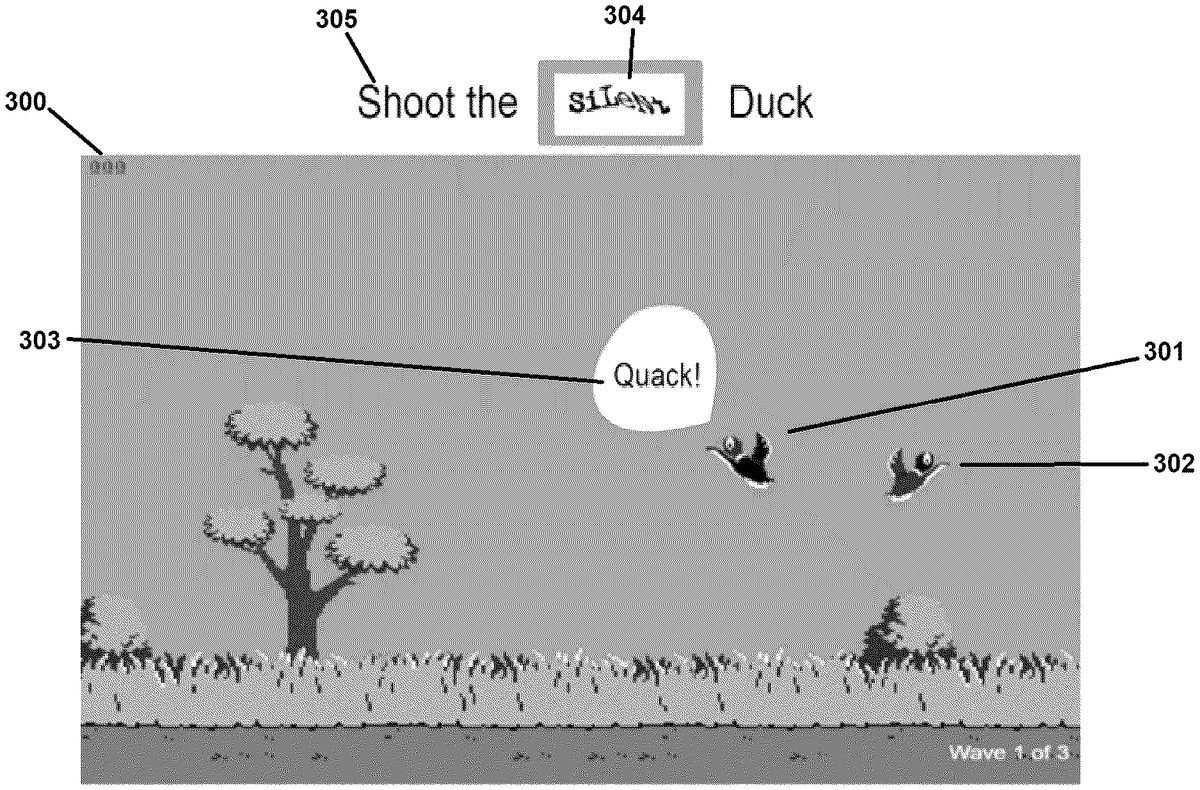
FIGS.3and4illustrate a “Duck Hunt”-style game where the player is instructed by the human-only readable medium304and instructions305which duck he should shoot in order to succeed at the game. A game screen300may include game play elements including a black duck301, a brown duck,302, and a noise indicator303. InFIG.3the player is instructed to shoot at the “silent” duck while inFIG.4the player is instructed to shoot at the “noisy” duck. The noise indicator303game play element may be a text bubble, as illustrated, an animation or graphical representation of noise, or any other suitable game play element that indicates to the player which duck is making noise such that the player can understand how to accomplish the goal set out by the instructions305and human-only readable medium304.
FIG.5illustrates a “black jack”-style card game in accordance with the disclosed concepts where a game screen400shows the card game with various game play elements in the form of cards401,402and betting instructions403. The instructions404and human-only readable medium405provide the player with game play information that affect decision making. For example inFIG.5, the instructions405and human-only readable medium404tell the player that the dealer's up card is a king, not a four as shown. As shown in this exemplary embodiment, the human-only readable404may be displayed and/or integrated with the game screen400, and need not be separate from it (as shown inFIGS.1-4). Additionally, the information provided by the instructions need not have an effect in every instance—for example the optimal betting strategy for a player's hand of 19 in a blackjack game is to stand regardless of whether a 4 or a king is showing. However, in other instances, such as when a player has a pair of sixes, it may be the difference between whether a four or a king is showing may change a player's strategy to hit, stand or split.
FIG.6illustrates a shooter-style game where a game screen500shows several game play elements, including aircraft501,502, and the active weapon503. The instructions505and human-only readable medium506instruct the player to shoot the aircraft that matches the equation “7-4”, or aircraft501that has been provided with an identifier504of “3”. Identifiers may be symbols, letters, numbers, shapes, or any other suitable identifier that may be identified by the human-only readable medium506. In this exemplary embodiment, a simple math equation has been added which has a minor impact on a human being's game play, but further complicates the task of deciphering the goal set out by the instructions505and human-only readable medium506. The instructions505and human-only readable medium506may alternate between providing such math equations, and providing simple instructions, such as the number or type of aircraft to shoot. Alternatively, the system in this embodiment could incorporate the weapon game play element503by providing instructions505to “Use Weapon” and using the human-only readable medium506to identify the weapon to be used, alternating between such instructions and the math equation instructions shown inFIG.6.
FIG.7illustrates another version of the snake-style game with multiple human-only readable media604a,604b, and an overlay607providing additional game information. As withFIG.1,FIG.7illustrates game play elements featuring differently colored foods601,602, the player-controlled snake603. In this embodiment there are two human-only readable media604a,604b, and a single set of instructions605. A text overlay607may be provided, in this case over the snake game play element603or in the center of the screen or in some other location, to instruct the player as to which of the two human-only readable media604a,604bis providing the correct information. Here the text overlay indicates that the “LEFT” instruction is correct, indicating that the “poison” is the green game play element601, and thus the player should avoid the green element601and eat the red element602. This overlay607may be provided within the game environment, or external to it (as text, as a sound, as an image or graphic, or as a third human-only readable medium).
FIG.8illustrates an image overlay707that may be used with the disclosed concepts. The image overlay707may inform the player of an obstacle in the game that is programmed into the game code, but that is not displayed via the game screen. The overlay may be separate from game play and may be displayed as a graphic or pop-up over the game screen. In this manner any bot monitoring the feed from the game may not know to monitor the web site or app that is displaying the game screen.
FIG.9illustrates a snake-style game with the image overlay707similar to that shown inFIG.8drawn over the game screen700. The overlay707provides additional barriers that a player will instantly recognize as hazards to be avoided, but a bot may have more difficulty in deciphering the nature of the image overlay. Image overlays of the type described may be used in any style of game, and may provide a human player with information that is crucial to success in the game, or otherwise give a human player that can understand the image an advantage over a bot player that cannot process the image.
FIG.10illustrates a system800for competitive game play in accordance with the disclosed concepts where players wishing to compete against one another contact an application server801with their computing devices803,804via a network802, such as the Internet. The application server801may be centralized or decentralized, and may utilize block chain technology to record transactions and game results. It may feature a match making service to match up players of similar skill level to ensure competitive play. It may keep a skill rating for players, such as an ELO rating, a win-loss percentage, or other suitable metric. It may also store data about a player's history and performance, including number of games played, number of games won, details about the length of match, list of past opponents, amount of points earned, amount of money bet money won, etc. The application server may also store information transmitted by players during game play to detect cheating by the players, or evaluate game play and function.
Player computing devices803,804may be any suitable device capable of running the game and connecting to the competitive play system800. The connecting network may be a specialized network, a VPN, the Internet, a LAN, or any other suitable network that can facilitate communication between the application server801and the player computing devices803,804.
The application server801may allow players to wager on the outcome of their game, with each player betting an amount of money, crypto currency tokens, in-game currency or points, or any other wagerable item, against the other player where the winner of the competitive game between the players gets at least a portion of the amount of the wager bet by the other player. The system may also reward players with points, cryptocurrency tokens, or any other suitable reward for each bet made, for the amount wagered, for each game played, or any other suitable reward system. Players that receive such reward or reward tokens may sell them to others, may hold them, or may stake them, purchase prizes with them, or use them within any other suitable reward system. The system800may include a reward system that pays a portion of the amount wagered by the losing player to reward token holders or to players who have staked their reward tokens. The system800may allow game developers to submit games to be played on the competitive game system and may reward such game developers by providing them at least a portion of the amount wagered by the losing player.
FIG.11illustrates an exemplary interface900that client application running on a player computing device803,804may present to the player. Interface900may include a token selection input901to allow a player to select which cryptocurrency token they wish to wager. Interface900may include an amount input:902which may allow a player to select an amount to wager. The player may write in a maximum amount to wager or may select from one of several options presented. Interface900may include a game selection input903to allow a player to select from a number of games that are available to be played. Interface900may provide a “find players” button904that the player can select to begin searching the system for another player willing to play with the game and wager settings. Interface900may include a staking control input905allowing the player to control how much of his free reward (“RWD”) tokens they wish to stake. Interface900may provide a statistics panel so that the player can see at a glance how much they've won/wagered over several time periods. Persons of skill in the art will recognize that these are just a few of numerous options for wagering and statistics that an interface may present to a player to allow them to control the manner of their participation in competitive gaming within the scope of the disclosed concepts. Other forms which are contemplated include but are not limited to: allowing multiple selections of tokens, wager amounts and games, to facilitate finding matches; allowing controls to restrict the level of competition a player is comfortable with (for example, using ELO ratings: unrated; 1000-1200; 1201-1400; etc.).
FIG.12illustrates a racing-style game where a game screen1000shows several game play elements, including the player's racer1001, coins1002, and obstacle trucks1003. This embodiment shows two sets of instructions1005, where one instructs a player to collect coins while racing and the other instructs the player to avoid coins while racing. The human-only readable medium1004may be an image of a man pointing at one or the other of the instructions in order to instruct the player to collect or avoid the coin game play elements1002.
FIG.13illustrates a puzzle-style game where a game screen1100shows several game play elements, including camels1101,1102,1103. This embodiment shows three human-only readable media1104a,1104b,1104c, which collectively provide instructions1105to the player instructing the instruct the player to “Circle two camels.” The first human-only readable medium1104aprovides a CAPTCHA of the word “CIRCLE”, the second human-only readable medium1104bshows a CAPTCHA of the number “2”, and the third human-only readable medium1104cshows an image of a camel that is different from the camels that are drawn in the puzzle. When the player accomplishes the task the game may provide new human-only readable media1104a,1104b,1104c, and new instructions1105, and/or may advance to another puzzle. Alternative instructions can ask the player to find and interact with other game play elements, provide information about the order in which puzzle pieces have to be interacted with, or inform the player of information regarding puzzle game play elements that are not visible on the screen.
Persons of skill in the art will recognize that any of the features of the disclosed concepts may be implemented with any suitable game to make it more difficult for bots to do well, while allowing players to wager and/or compete in such games with higher confidence that their opponents are human
While specific embodiments have been discussed to illustrate the invention, it will be understood by those skilled in the art that the descriptions herein are intended as illustrative, and not as limiting, and that variations in the embodiments can be made without departing from the spirit of the invention. Accordingly, the foregoing descriptions are intended as illustrative, and not as limiting.
Claims
- A computer game system comprising: a game screen comprising at least one game play element, at least one human-only readable medium;and a wager screen comprising controls that enable the player to select a wager amount for a competitive game and initiate a competitive game, such that the game screen is displayed when the competitive game is initiated;wherein the human-only readable medium displays information about the at least one game play element instructing a player how to successfully accomplish a game task;wherein the player, upon winning the game, is awarded with at least a portion of the amount wagered by an opponent;and wherein the game is from a game developer, and at least a portion of the amount wagered by the opponent is awarded to the game developer.
- The system of claim 1 wherein the at least one human-only readable medium is displayed adjacent to the game screen.
- The system of claim 1 wherein the at least one human-only readable medium is displayed within the game screen.
- The system of claim 1 wherein the at least one human-only readable medium is displayed within, and adjacent to, the game screen.
- The system of claim 1 wherein the at least one game play element comprises a first game play element and the at least one human-only readable medium identifies the first game play element as one to be collected by the player.
- The system of claim 1 wherein the at least one game play element comprises a first game play element and the at least one human-only readable medium identifies the first game play element as one to be avoided by the player.
- The system of claim 1 wherein the at least one game play element comprises a first game play element and the at least one human-only readable medium identifies the first game play element as one to be targeted by the player.
- The system of claim 1 wherein the at least one game play element comprises a first game play element and the at least one human-only readable medium identifies the first game play element as one to be destroyed by the player.
- The system of claim 1 wherein the at least one game play element comprises a first game play element and the at least one human-only readable medium identifies the first game play element as one to be built by the player.
- The system of claim 1 wherein the at least one game play element comprises a first game play element and the at least one human-only readable medium identifies the first game play element as one to be interacted with by the player.
- The system of claim 1 wherein further comprising instructions that give the player information about the relationship between the at least one game play element and the at least one human-only readable medium.
- The system of claim 1 further comprising an overlay that shows a wall or obstacle that is not otherwise displayed on the game screen.
- The system of claim 1 further comprising an overlay that shows an image that is not otherwise shown on the game screen.
- The system of claim 1 further comprising an overlay that shows an overlay game play element that is not otherwise shown on the game screen.
- The system for claim 1 further comprising a rank system such that the player has a player rank, and a match making system that matches the player with an opponent having a respective ranking that is similar to the ranking of the player.
- A device comprising: a processor and a display;wherein the display displays a wager screen comprising controls that enable the player to select a wager amount for a competitive game and initiate a competitive game, and a game screen comprising at least one game play element, and at least one human-only readable medium, such that the game screen is displayed when the competitive game is initiated;wherein the human-only readable medium displays information about the at least one game play element instructing a player how to successfully accomplish a game;wherein the player, upon winning the game, is awarded with at least a portion of the amount wagered by an opponent;and wherein the game is from a game developer, and at least a portion of the amount wagered by the opponent is awarded to the game developer.
- A non-transitory computer-readable medium comprising a set of instructions that when executed by a processor cause the processor to: display a wager screen comprising controls that enable a player to select a wager amount for a competitive game and initiate a competitive game, and display a game screen comprising at least one game play element;and least one human-only readable medium, such that the game screen is displayed when the competitive game is initiated;wherein the human-only readable medium displays information about the game play elements instructing a player how to successfully accomplish a game task;wherein the player, upon winning the game, is awarded with at least a portion of the amount wagered by an opponent;and wherein the game is from a game developer, and at least a portion of the amount wagered by the opponent is awarded to the game developer.
Disclaimer: Data collected from the USPTO and may be malformed, incomplete, and/or otherwise inaccurate.