U.S. Pat. No. 11,925,870
INTERACTIVE GAMEPLAY SYSTEM WITH PLAY AUGMENTED BY PLAYER-SELECTED CUSTOMIZATION PREFERENCES
AssigneeDisney Enterprises, Inc.
Issue DateJune 1, 2022
Illustrative Figure
Abstract
A system for providing user-driven customization and enhanced personalization of interactive experiences. The system includes data storage for storing player profiles, with each including customization preferences useful in enhancing or generating one of the interactive experiences. The system includes a gameplay space adapted to provide an interactive experience, which includes one or more interactive elements. The system includes a gameplay device configured to be worn or carried by a player. A detection device detects a presence of the player in the gameplay space and obtains a unique identifier for the gameplay device. The system includes a controller retrieving a set of the customization preferences in one of the player profiles associated with the identifier. During system operations, the interactive experience is provided to the player with interactive elements generated based on the retrieved set of customization preferences, whereby the player can affect and enhance their interactive experience in real time.
Description
DETAILED DESCRIPTION Embodiments described herein are directed toward a gameplay (or other interactive) system configured to provide enhanced individualized interactivity for each player or participant. The gameplay system includes a gameplay device or object, which may be worn or held by each player or participant. The system is configured to detect the gameplay device within a space (within an attraction, a themed land, or any other space in which an interactive experience is to be provided via system operations), and the gameplay device has a unique identifier that links it to a particular player and a centralized player profile. All potential players have a centralized player profile stored in data storage (e.g., within a database in a server accessible by the system controller(s)), and each profile stores a plurality of customization preferences for use in providing an interactive experience to each player. The gameplay system operates to use the player profile in a park, an attraction within the park, a land within the park, and so on to access a subset of the preferences associated with or assigned to the particular gameplay space in which the gameplay device (and the wearing player) are located to provide a player-chosen configuration for the interactive experience. During system operations, the player profile can be updated by the player to modify their interactive experience while at the park (or before or afterwards). The updating or selecting of customization preferences can be done in a number of ways. In one example, the player accesses a user interface displayed on a display of their gameplay device, such as a graphical user interface (GUI) that is populated with a subset of the preferences chosen by the system controller (which is in two-way wireless communications with the gameplay device) based on the present location of the gameplay device ...
DETAILED DESCRIPTION
Embodiments described herein are directed toward a gameplay (or other interactive) system configured to provide enhanced individualized interactivity for each player or participant. The gameplay system includes a gameplay device or object, which may be worn or held by each player or participant. The system is configured to detect the gameplay device within a space (within an attraction, a themed land, or any other space in which an interactive experience is to be provided via system operations), and the gameplay device has a unique identifier that links it to a particular player and a centralized player profile. All potential players have a centralized player profile stored in data storage (e.g., within a database in a server accessible by the system controller(s)), and each profile stores a plurality of customization preferences for use in providing an interactive experience to each player. The gameplay system operates to use the player profile in a park, an attraction within the park, a land within the park, and so on to access a subset of the preferences associated with or assigned to the particular gameplay space in which the gameplay device (and the wearing player) are located to provide a player-chosen configuration for the interactive experience.
During system operations, the player profile can be updated by the player to modify their interactive experience while at the park (or before or afterwards). The updating or selecting of customization preferences can be done in a number of ways. In one example, the player accesses a user interface displayed on a display of their gameplay device, such as a graphical user interface (GUI) that is populated with a subset of the preferences chosen by the system controller (which is in two-way wireless communications with the gameplay device) based on the present location of the gameplay device which is associated with a particular interactive experience (e.g., a space used to provide a scene in a ride or attraction, a space used to provide an themed interaction in a park land, and so on). This allows real-time (or near real-time) adjustments by the player of the interactive experience (e.g., turn the gameplay device from a laser weapon to a shield). The updating or selecting may also be completed using another communication device such as a computer adapted for wireless communication to access a network or a cellphone used to access the network, which may be used to access a website that is configured to allow a player to enter identifying and/or security data to access their player profile (which is associated with or linked to the gameplay device). Hence, the external (to the gameplay device) communication device can be used to adjust or modify all or a particular subset of the customization preferences for the gameplay device (e.g., adjust a subset for a ride in which the player is presently queued or at home or in a hotel prior to arriving at a park) to program the behavior and attributes of the gameplay device in the interactive experience ahead of time. The control components within an attraction retrieves the subset of customization parameters it needs to provide an interactive experience so as to respond to the player's preferred settings at a resolution that can be determined by the attraction (e.g., allow changes per experience, per scene, after a specific cue, and so on).
A park-wide or centralized system can be used to store the relevant data for each player and their visit. Each attraction or interactive experience facility can query the data as often as needed to provide its particular interactive experience to present the best and most up-to-date experience based on each set of player-provided/adjusted customization preferences. This data can also be used by non-attractions, such as by human actors or characters or park performers, to understand the visitor's preferences passively and implicitly. Further, meta-experience elements can be tracked and unlocked leading to even more entertaining park experiences. For example, a player can choose to be on a villain's team in an attraction and then be on a hero's team on a next visit to the attraction or on a different attraction to vary their interactive experiences.
The customization parameters may be used to control or vary an interactive experience in a wide variety of ways to implement the new gameplay system. It may be useful to provide a representative listing of gameplay attributes that can be linked to a player through the gameplay device they are wearing or holding within a gameplay or interactive space (e.g., the location and identity of the gameplay device is used to link a profile and all or subsets of customization preferences to a particular game player). The following is a non-exhaustive list of gameplay attributes that the gameplay device could be used to customize for a player or participant before or during an experience as allowed by the experience controller: (a) change your superhero or other powers; (b) change a visual style associated with a player; (c) select a team; (d) alter the level of gameplay; (e) alter difficulty of gameplay; (f) summon helpers in the experience; (g) alter the audio (e.g., volume level, language spoken, and so on); (h) alter the ride profile (e.g., intensity for more sensitive riders); (i) alter the game recap; (j) tie to the high-score table (which may include a name the player inputs on the user interface of the gameplay device); (k) tie to the land; (l) tie to the live entertainment in the land (e.g., trigger responses from robot or human actors in land); (m) adjust land-wide adventure; (n) tie to a mobile app; (o) tie to a home video game; and (p) toy versus toy battles, which may be outside park such as at home, such as with achievements in park affecting toy operations. In some cases, the gameplay device is also configured to function as an assisted listening device.
The gameplay system includes a plurality of gameplay devices or objects, such as pieces of themed merchandise, and each has associated with it an identifier, which can be used to provide a link to a player profile and their customization preferences. The gameplay system includes an object identification (or detection) assembly (or guest presence detector) configured to sense the presence of one (or more) of the gameplay devices or objects in a gameplay space and to determine the identity (or identifier) of the sensed device or object. In response, a game or system controller generates or modifies interactive features of the gameplay provided to a participant or player whose player profile is associated with the gameplay device to create a unique interactive experience for the participant.
In one particular implementation, the new gameplay system may be implemented at an amusement or theme park in one of its rides or attractions designed for interactivity (e.g., with vehicle riders). The regular gameplay experience is augmented or enhanced/modified by allowing participants such as vehicle riders to wear (or hold) gameplay devices or objects (or themed merchandise), which may be purchased onsite or offsite (e.g., online or a physical offsite store). One particular use case recognizes that characters such as superheroes often wear objects in the form of “power gauntlets” that can be activated to provide superhero-type abilities (e.g., shoot out weapons), and these power gauntlets (i.e., gameplay devices) may include a wristband or glove with a themed outer covering or body to be worn on the participants wrist or hand (and often extend over the wrist), which includes input/output (I/O) devices for communicating with a game or system controller (or the object identification assembly, in some cases) to receive preference settings for a subset of their customization preferences associated with the interactive experience to be provided in the gameplay space in which they are currently located.
In practice, participants that may be vehicle riders may be provided user-selectable interactive features or functions. For example, the participants wearing a gameplay device (e.g., a power gauntlet) will have their customization preferences for the current location and interactive experience displayed to them in a GUI on a display for their gameplay device and have the ability to modify these preferences (or the preference settings or values). In response, the game or system controller may operate the components (such as a display system) to create a player-selected interactive experience based on these customization preferences (or their settings). In one exemplary implementation, the player may experience visual types of projectiles rendered from the perspective of their wrist (or other portion of the body wear object is worn), e.g., projectiles rendered as if projected from the worn augmenting object. In some cases, the participants will also see that their projectiles, which were provided based on an identification of the gameplay device and retrieval of a player profile associated with that identification/identifier providing customization preferences, have a unique impact on the virtual projected environment or AR portion of the interactive experience that differs from other impacts associated with projectiles or other augmenting features/functionalities associated with other players and with interactions provided to those not wearing or holding any gameplay device. Stated differently, certain “powers” are given to those with the power gauntlets or gameplay devices by the gameplay system and will provide unique opportunities to affect the nearby physical or displayed scenic environment differently depending on their current customization preferences. In other cases, though, the gameplay system may extend outside a venue setting and allow the user of the gameplay device to role play at home, on a cruise ship, or other environment and, in some cases, to connect with other experiences like console and/or online games where their customization preferences defined in their player profile can also be utilized to affect interactive experiences.
The gameplay system with customization preferences is well-suited for interactive and responsive experiences. In this context, “responsive” may be an environment that is adapting/changing itself to the player's preferences, but the player may not necessarily or assertively “interact” with that environment. The gameplay system and customization preferences are configured such that the environment, or elements of the environment, are reacting and adapting to the player and their updatable preferences. Note, the player is effectively passive to them, which is different from how most people conventionally envision interactive experiences in an attraction.
The gameplay system may be considered a “super system” or a set of systems/technical ecosystems configured to allow a guest to interact through a number of interfaces. These interfaces may include, or make use of, conventional and wearable technology, gesture-based technology, and/or voice-based interfaces. The interfaces that allow individual players or park visitors to dynamically customize and enhance the context of their sensory and aesthetic experiences (or their family and friend's settings and experiences as well) in an attraction or within a park. There is a large potential for the gameplay system in terms of not only more fun, enjoyment, and entertainment in our experiences but also in terms of diversity and inclusion as the system can provide materially enhanced and increased accessibility for the differently able, for assisted listening and language preferences, and for enhanced communication, understanding, and enjoyment in a shared and immersive experience.
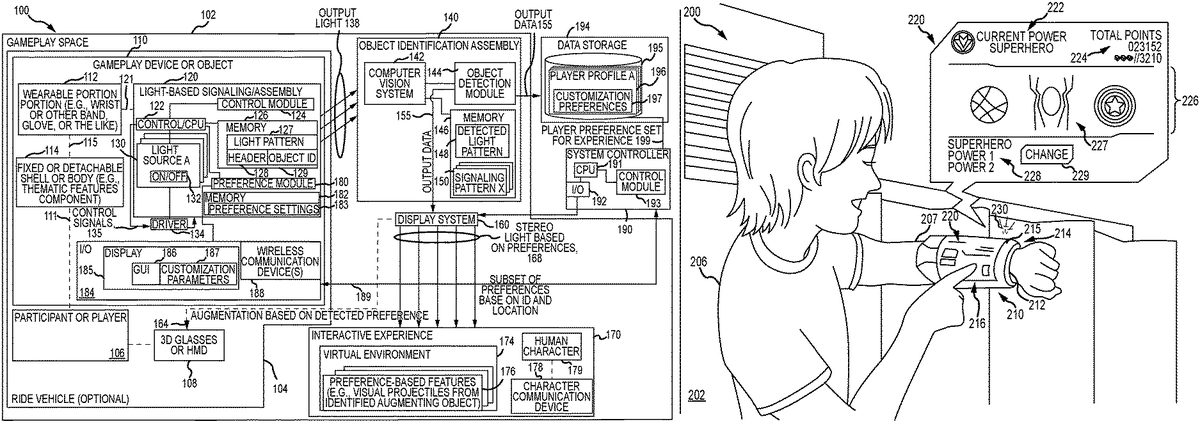
FIG.1is a functional block drawing of a gameplay system (which can mean nearly any interactive system)100to provide personalized or customizable interaction for participants or players106based on use and detection of a gameplay device or object (e.g., particular merchandise or a toy linked to the game)110of the present description. The system100includes a gameplay or interactive space102, which in the example of a park ride or attraction may be a space along a vehicle's ride path or a space in which visitors of the park enter to participate in gameplay. As shown, a human participant or player106has entered the space102, and, in a typical system100, there would be one, two, three, or more participants106.
The participant or player106may enter the space102on foot or may be brought into the space102in or on a ride vehicle104. The participant106may be wearing equipment to support a 3D virtual or augmented reality (VR or AR) display system160providing signals164such as by wearing 3D glasses or an HMD108. The signals164are used to provide an individualized interactive experience to the participant106by augmenting their interactive experience170in a manner based on whether or not they are wearing or holding a gameplay device110and based on an identification of the object110to provide a link to a database195stored in data storage194. The database195includes a plurality of player profiles196with each associated with one of the gameplay devices110(or to a player106using a gameplay device110), and each profile196includes a plurality of customization preferences197(e.g., settings or values for one-to-many interactive game parameters used to generate an interactive experience, with the list provide above providing some useful examples of preferences197). In other cases, though, the participant106may not wear any 3D headgear108and be provided the interactive experience including 3D visuals unique to them and their customization preferences197by having the display system160adapted for autostereoscopic projection or display via its output light168providing left and right eye images for the participant106at their present eye locations or by communicating a player preference set for a particular experience associate with the gameplay space102to a human character/cast member179via a character communication device178. The type of display system160used may vary to implement the gameplay system100as long as it is configured to provide audio and/or visual components that are linked to identification of the augmenting object110and associating it with a player profile196linked to the participant106so that the participant106perceives the interactive experience as being affected by their wearing or holding the gameplay device110and selecting the preferences197.
In the system100, the participant106is shown with dashed line111to be wearing or holding a gameplay device or object110. This object110may take a wide variety of forms including, but not limited to, toys or clothing articles or nearly any pieces of merchandise that a participant106may hold or wear such as on their hands, wrists, arms, heads, or other portions of their bodies (e.g., gloves or bands for fitting over a portion of a person's hands, an item that can be held on a person's arms with a wrist or arm band, a hat, a shirt, coat, uniform, vest, or the like). As shown, the object110includes a base portion112that typically will be wearable such as a wrist, arm, or hand band configured to retain the object110on the body of the participant106, and the object110further may include a shell or body114that may be fixed onto the base112or be detachable (both attachment types shown by dashed line115). The shell or body114may take nearly any form with some embodiments using it to provide thematic features to the object110such as to take on the appearance of articles of clothing, tools, or weapons associated with characters from media (e.g., a superhero moving character, a character from a children's animated feature, and so on). In some of the specific examples provided herein, the object110with its wearable portion112and shell/body114are designed to take on the appearance of a power gauntlet, but, with this example, those skilled in the arts will readily understand that the object110may be nearly any item that the public associates with characters from their favorite media or characters often associated with gameplay (e.g., from role play and so on).
The system100includes an object identification assembly or guest preference detector140that is adapted to detect the presence of the gameplay device or object110in the space102(and associate it with participant106or this function may be done by the game or system controller190) and to identify the detected object110, such as with an identifier associated with the device110that can be used to link the device110to a player106and/or their player profile196. The assembly140may be wholly or partially located onboard the vehicle104in some embodiments. The assembly140is also preferably adapted to determine where on the participant's body the object110is worn or otherwise located such as on which wrist or hand as this will allow the display system160to create visual augmentations or features176to the interactive experience170that are more realistic as they appear to emanate from or to be projected from that portion of the body or the location of the object110in the gameplay space102. This may also be useful it the participant106is wearing or holding more than one object110such as one on each of their wrists, hands, or arms (and each may be associated with a different player profile (e.g., a player may establish a different profile for each of their gameplay devices) to provide two (or more) differing or matching augmentations or interactive features176per player106during operations of the system100). The detection method implemented by the assembly140preferably is automatic and will not require the participant106to take any action (possibly other than powering on their object110) such as a special registration or tagging to hardware of the system100. Object detection is, in this way, more interesting and magical.
To this end, the augmenting object110further is shown to include a light-based signaling assembly120that is mounted upon or in the wearable or base portion112as shown with dashed line121. Other implementations, though, provide the assembly120on or in the shell or body114. The assembly120is adapted to generate or emit output light138in a manner that acts to provide a signal to the object identification assembly140, which acts as a unique identifier that the assembly140can process to detect and identify the augmenting object110in the space102. The assembly120includes a controller or processor122that manages operations of a control module124and memory (or data storage)126. The memory126stores a light pattern or signal definition127, which may take the form of a header128and an object identification129. In some embodiments, the output light138may be a series of flashes of light timed with the sampling frequency of the assembly140to communicate the bits of the header128and the bits of the object ID129, and the header128may be used to identify the presence of one of the augmenting objects110(e.g., to indicate presence of a power gauntlet) while the object ID129indicates the object110, which can be used to access one of the player profiles196associated with the object110.
The control module124may take the form of software and/or firmware124to provide the control functions described herein. The module124may include wireless communication devices to allow the assembly120to communicate with the object identification assembly140such as to receive a command or ping to initiate operations to provide the output light138(e.g., the object110may not provide the light signal or output138until interrogated by the assembly140in some cases). The light-based signaling assembly120includes one or more light sources130and a driver (e.g., a self-contained power supply or the like)134, and each of the sources130may respond to control signals135from the controller122to provide the output light138in the defined light pattern127(i.e., to signal a header128and an ID129) by alternating between on and off states132.
In one embodiment, the light sources130are each light emitting diodes (LEDs) that in some cases are infrared (IR) LEDs so that the output light138is not visible to the participant106so as to make the detection and identification by the object identification assembly140more magical or behind-the-scenes for the participant106. The use of two, three, or more light sources130operating based on the same light pattern127is desirable in some cases to increase the likelihood that the output light138is detected by the assembly140(e.g., is not blocked by portions of the player's body, by the vehicle104, by other participants106, and the like), and, typically, two or more sources130are used that are spaced apart some distance from each other on the base112. The shell or body114is configured to allow the light138from sources130to pass such as with windows transparent or transmissive to the light138or by being formed of a material that allows the light138to be transmitted through the shell or body114.
As shown, the object identification assembly140includes a computer vision system142that runs an object detection module144(e.g., software providing algorithms and/or machine learning processes). The assembly140further includes memory/data storage146storing a detected light pattern148from the output light138from the object110and a set of one-to-many signaling patterns150. The object detection module144works to compare detected light patterns148with the signaling patterns150to identify likely matches. Each signaling pattern150is associated with a particular augmenting object type (e.g., a particular piece of merchandise such as a power gauntlet for a character from a movie). The computer vision system142may take any form now understood in the arts or to be later developed, and it basically operates to capture video images of the space102including the participant106and any augmenting object110present.
In some embodiments, the computer vision system142operates to process these images to identify the presence and location of the participant106and then operates with the object detection module144to monitor for the presence of the output light138. The output light138is then processed to find a match among the patterns150. The module144or another element of the assembly140communicates this match or output data155to a system controller190, which can relay the output data with the player preference set as shown with arrow199to the display system and/or to the character communication device178for use by a cast member179. The output data155may include a location of the object110within the space102(e.g., within the vehicle104) and on or near the body of the participant106. The output data155also will identify the object110to the display system160. The display system160uses this information to generate (e.g., render) player-specific features176in the virtual environment174provided as part of the interactive experience170in the space102. For example, the display system160may render 3D imagery (signals164or light168) that produces visual projectiles176that appear to emanate or to be projected from the augmenting object110, and the projectiles176may be rendered to suit or based on a subset199of the customization preferences197linked to the player106and/or the gameplay device110(e.g., to suit the abilities or powers selected by the player106by adjusting or choosing the customization preferences197). In some embodiments, assembly120is configured to output RF or other wireless signals138(e.g., in response to a ping signal from the assembly140after determination of presence of player106in space102) that can be received and processed by the object ID assembly140to determine the ID of the gameplay device110(or to determine another identifier such as one for the player106) to be able to link to a particular player profile196.
As shown, the system controller190, which may be in the gameplay space102, includes a processor191that runs I/O devices to communicate with the object identification assembly140to receive the output data155, which includes the determined ID or identifier for the object110(or player106). The processor191runs software or firmware to provide the functions of a control module193that include, in response to receiving the ID, to retrieve or access a player profile196in the data storage194that is linked to the ID. Further, the control module193typically will process the customization preferences197to select a subset of these preferences197that are associated with the gameplay space102and/or with the interactive experience170, and this subset is provided as shown with arrow199to the display system160for use in generating the interactive experience170in a manner suited to the player's preferences. As shown with features176in the virtual environment174.
Further, as shown, the gameplay device110includes a preference module180, provided by the processor122(or another processor) running software or firmware. The module180manages access to memory182in which a plurality of preference settings183for all or a subset of the customization preferences197in the profile196for player106(or object110). For example, the preference settings183may be communicated as shown at189by the system controller190and include a subset of the preferences197in a player profile196that are chosen based on the ID (of the player106or gameplay device110) and also on the location of the gameplay space102, which indicates which interactive experience170will be provided and which preferences197are relevant to creating that experience170by the display system160and/or human character179.
The gameplay device110includes I/O devices184including a wireless communication device188to allow two-way communications with the system controller190to receive the subset of preferences189and also to allow user input modifying or choosing the preferences to be communicated back to the system controller190, which responds by updating the player profile196with the new or modified customization preferences197(e.g., to switch from one superpower to another during the interactive experience or before repeating the experience such as in a next ride). The I/O devices184also include a display or display device185, e.g., a touchscreen or the like, that is operated by the module180to display a user interface186that includes a plurality of customization parameters or preferences187, which are generated based on the received subset of preferences189(and/or on stored preference settings183). In this way, the user interface186may be more readily displayed and interacted with by the player106via a display185that may be relatively small (e.g., a touchscreen similar to those found in many handheld video games and cellphones). The I/O devices184include elements, such as a touchscreen, a keypad, voice control components, and the like, that allow the player106to enter user input to select and/or modify the displayed customization parameters187, and the wireless communication device188is operated, at least periodically, by the module180to transmit the user-updated subset of preferences189to the system controller190for use in updating the customization preferences197in the player profile196.
With an understanding of the system100in hand, one skilled in the art will readily recognize that the discussed implementation of system100and its components provide useful ways to implement the customization preferences described herein, but the description and accompanying claims are not limited to this exemplary system. For example, the system100is shown to use a light-based signaling assembly120for communications. However, many other technologies may be used including tracking technologies, optical communication systems, wireless communication devices and systems, and the like.
FIG.2illustrates an exemplary gameplay system200during exemplary use in a gameplay space202. As shown, a participant or player206has entered the gameplay space202, and, as discussed with reference toFIG.1, a guest presence detector would operate in the system200to detect the player's presence. The player206is shown to be wearing on their arm/wrist207a gameplay device210, which may be an exemplary implementation of the device110ofFIG.1. The gameplay device210includes a wearable portion212over which is provided a fixed or detachable shell or body214. On an outer surface215of the shell/body214, the gameplay device210includes a display or display element216, e.g., a touchscreen, a monitor, or the like. Further, the display220(or another portion of the device210) includes a speaker (not shown) that is operable to output, as shown with lines230, audio output as part of an interactive experience.
The display210is operated, by hardware and software as discussed for device110inFIG.1, to generate and display an interactivity GUI220(which is shown enlarged as well as on display216as would be viewed by the player206). The display216is configured to allow the player206to provide user input, e.g., selections or modifications of their customization preferences as is shown inFIG.2. To this end, the display216may take the form of a touchscreen or include a touch pad, keyboard, or voice activation/input device(s).
The interactivity GUI220may be configured to display game data or information such as a player's total points, remaining lives, and so on as shown at224. Further, though, the GUI220is used to display information useful to allow a player206to know a subset of their customization preferences that are relevant to the interactive experience provided in the gameplay space202by system200and to modify these existing preferences or switch to different available customization preferences. In this example, the interactivity GUI220displays as shown in region222information for a first customization preference (e.g., a present superhero/character selection for creating the interactive experience with its powers or capabilities and team alliances). The GUI also includes a second area or region226in which icons or buttons227are displayed of alternative customization preferences that can be selected by the player206to replace the first customization preference222.
In region or space228of the GUI220, data associated with the alternative customization preferences226can be displayed. In the illustrated example, the icon227is highlighted or selected by the player206via user input to the GUI220(e.g., a swipe of a touchscreen in region226), and the data/information related to the icon227is displayed including the name of the alternative superhero and their powers/abilities. A button229can be provided for the player206to select or change to the new or differing customization preference represented by icon227and as partially defined by data228(e.g., switch from Superhero X to Superhero Y). This change or updating of the first interactive preference222may be made before an interactive experience (outside the gameplay space202or within the space202) or during the interactive experience while in the gameplay space202. For example, the player206may decide that the powers associated with a second superhero/character would be more desirable in the interactive experience in gameplay space202(e.g., want a defensive tool versus an offensive weapon or vice versa to succeed in the gameplay space202or in the present interactive experience in which they are participating). Hence, a unique aspect of the gameplay system200is that the player206can view a subset of their customization preferences relative to the present gameplay space202and/or interactive experience in which they are participating in real-time (during the interactive experience) and modify or change one or more of these customization preferences in real-time.
FIG.3illustrates a flow diagram showing steps in a process300for player or participant (or guest/visitor) driven enhancement of an interactive experience, such as provided in a theme park ride or attraction or a themed land, through customization of one or more customization preferences (which may be labeled “personalizations” herein as shown inFIG.3). As shown, the participant, player, or guest/visitor (not shown but understood fromFIGS.1and2) may operate a wearable gameplay device310to access and modify their customization preferences. Alternatively, the player may operate other communication devices to access a communication network to access their centralized player profile and set and modify their customization preferences such as by accessing a customization website350. As shown, the communication devices may take the form of a cellphone or similar handheld device340adapted for wireless communications or a computing device or computer360(e.g., a laptop, a desktop, a pad, a notebook, or other computing device adapted for wireless (e.g., Wi-Fi) communication). A gameplay system may include a customization backend (e.g. a server running control software or the like to provide the system controller190inFIG.1) as well as data storage/memory devices to store a customizations database330in which a plurality of player profiles are stored each with a set of customization preferences/personalizations linked by one or more identifiers to a particular player (and/or gameplay device310).
The method300provides several ways in which a player may set, store, and customize their preferences. Again, these preferences may be used for general purposes such as special accommodation preferences, favorite characters choices, and so on, for themed lands such as to show a preference for a team or faction, and for a specific attraction and its interactive experience, which may involve choosing which character to be in the gameplay (or which powers or abilities to have in the gameplay). In a first access/customization approach312, a player operates their wearable or gameplay device310to select personalizations (e.g., review and edit customization preferences in a profile in the database330). As shown, the wearable310is communicatively linked to the customization backend320, which feeds a subset of the customization preferences to the wearable310for use in generating a GUI with all or some of the subset of preferences for review and editing by the player as shown at314. In response, the customization backend320acts to update and store the preferences as shown at324in the database330. The device310is typically used to access a more limited selection of the preferences so as to ensure a more intuitive and simple preference selection flow. In some cases, the wearable310instead communicates with the gameplay system via a guest presence detector to update their preferences.
In the second and third access/customization approaches342and362, a player uses a cellphone340or a computing device360to connect to the gameplay system via, for example, a website (or app installed on the cellphone340). The website350would be configured to allow the player to enter identifying and/or security information to access their player profile and the customization preferences stored in the database330. In these approaches342,362, the player typically will be provided access to all editable/selectable customization preferences, which may be sorted in a variety of ways to ease review such as by attraction and/or by interactive experience. This allows for much more detailed customization editing than typically provided with the wearable310. The customization approaches342,362may be utilized when the player is outside the park (e.g., some time before arriving at the park) or outside a gameplay space where use of the cellphone340or computer360are convenient (e.g., in a queue to an attraction, while dining, and so on). In these approaches342,362, the website350is shown at356to communicate to or set preferences in the customization backend356, which, in turn, stores the selected and/or update customization preferences in the database330in each player's profile as shown at324.
FIG.4illustrates a flow diagram showing steps in a process400for player or visitor-driven enhancement of a customizable attraction including initial detection steps performed by a gameplay system such as during operation of the system ofFIG.1when a player approaches an attraction operated in a gameplay system. The gameplay system is shown to include a gameplay device or wearable410, a guest presence detector420, a customization backend430, a customization database440with player profiles, an attractions cast member450, and an attraction460configured to provide an interactive experience to park visitors based at least in part on each player's customization preferences, e.g., by generating one or more interactive feature defined or selected based on the customization preferences or enhanced or modified based on the customization preferences.
When a guest or player406is within detection range of the gameplay system (such as when they enter an attraction or a gameplay space, the guest presence detector420acts to detect or recognize their presence such as with computer vision techniques. The detector420then (or initially without detection of the human player406) may function to detect the presence of the wearable410and obtain (via signal processing, via RF interrogation when the wearable410includes an RF chip or transceiver, via two-way communications, or other approach) the unique ID assigned to or associated with the wearable or gameplay device410. These steps are shown with arrow424inFIG.4.
In the method400, the guest presence detector420then triggers as shown with arrow428the customization backend430(which may be a park-wide system) passing the following information to the backend430: (a) unique identifier (of device410and, typically, player406); (b) unique identifier of attraction (or gameplay space); (c) current timestamp; and (d) local settings from player's wearable device410(e.g., present settings stored in device410memory of customization preferences (if any updates, yet provided)). As shown at432, the customization backend430requests data specific to the player406and the attraction from the customization database440and will update the customizations database440with any new data from the wearable device410(based on timestamp to determine if new or not). In some cases, the customization preferences from the player profile that are specific to the attraction (or to a gameplay space within the attraction) are communicated by the detector420back to the wearable410for display in or use in generating a GUI provided on a screen of a display of the wearable410.
As shown at434inFIG.4, the player and attraction-specific filtered data (i.e., customization preferences) is returned to the backend430. Note, in some cases, the method400may include an attraction (e.g., its detector420or a system controller) reading customization information for other attractions, too, and using one or more of these customization preferences to generate the interactive experience along with those displayed to the player in the GUI that are editable and specific to the attraction or its gameplay space. The backend430then at436acts to relay the customization preferences or those relevant to member or character interactions to an attraction cast member (or to their communication device(s)). For example, if the player406has requested or noted in their customization preferences any special accommodations (e.g., a disability, sensory difficulties, language preferences, and so on), these are passed at436from the backend430to the cast member450for use in providing one or more interactive element in a discreet manner (e.g., a cast-viewable screen, an audio cue, or the like).
Further, in the method400at438, the customization backend430operates to communicate the specific preferences for the player406(along with their unique identifier) to the attraction (or its controller). The attraction (or its controller) uses these player-specific customization preferences to enhance the interactive experience such as by enhancing or modifying or selecting one or more interactive element based on one or more of the customization preferences (e.g., display a particular projectile shooting from the wearable device410, visually or via audio indicate the player's affinity to one team in a competition, and so on). The preferences for the player406may be used immediately by the attraction or its controller or may be stored in local memory for linking or interacting with the player406at various parts of the attraction (at differing gameplay spaces) through further detection of the player406and/or wearable410in the attraction (e.g., a park ride or themed land). When and where appropriate as shown with arrow454, the cast member or character450transparently and efficiently caters to the player's needs as identified in the customization preferences.
Although the invention has been described and illustrated with a certain degree of particularity, it is understood that the present disclosure has been made only by way of example, and that numerous changes in the combination and arrangement of parts can be resorted to by those skilled in the art without departing from the spirit and scope of the invention, as hereinafter claimed.
The gameplay system and associated methods facilitate significant and real-time customization by participants or players. The gameplay system gives the players more agency during their park visit than they could ever previously experience, which can bring true magic to their day. With regard to attraction and park operators, the gameplay system allows the operators to provide a wealth of different experiences in the same physical locations rather than designing to the lowest common denominator to try to satisfy the majority of visitors. Players with special needs can enjoy attractions and experiences more transparently and more discreetly (e.g., private and/or hidden) than ever before, which helps them to focus on having fun instead of any attraction limitations. The gameplay system keeps visitors coming back to an attraction to try different things to get new experiences. The system lengthens the popularity, life, and possibilities of an attraction by making it a platform for different experiences and not letting it become stale by generating positive buzz around the attraction.
The new gameplay system allows a creative team to put more into an attraction and allows opening new attraction layers as new media gains popularity. The statistical data from player selections of the customization preferences can be leveraged to better understand park visitors and improve future offerings. The players may be able to use the gameplay system to modify the attraction in a non-narrative way, too. For example, a hyper-sensitive player may be able to select reduced ride vehicle motion, reduced lighting, or reduced audio intensity to make the experience more pleasurable to them. A player with a particular type of color blindness may enhance their experience by making choices of colors in the display portion of the interactive experience. The ability to customize an experience drives repeat visits to the same attractions and the interactive experience they generate because the experience can be changed each time.
Claims
- A system for providing user-driven interactive experiences, the system comprising: data storage storing a plurality of player profiles each including a plurality of customization preferences;a gameplay space adapted to provide an interactive experience that includes one or more interactive elements;a gameplay device configured to be worn or carried by a player;a detection device operable to detect a presence of the player in the gameplay space and, when the player is detected to be present in the gameplay space, obtain an identifier for the gameplay device;and a controller configured to receive the identifier from the detection device and retrieve, after receiving the identifier from the detection device, set of the plurality of customization preferences in one of the plurality of player profiles associated with the identifier received from the detection device, wherein the interactive experience is provided to the player with the one or more interactive elements being generated based on the set of the plurality of customization preferences.
- The system of claim 1, wherein the gameplay space includes a display system and wherein the one or more interactive elements comprise images or audio generated by the display system using the set of the plurality of customization preferences.
- The system of claim 1, wherein the controller communicates the set of the plurality of customization preferences to a communication device, carried by a human cast member, to cause the communication device to provide the one or more interactive elements, wherein the human cast member is different than the player, and wherein the communication device is separate from the gameplay device.
- The system of claim 1, wherein the identifier is a first identifier for the gameplay device, wherein the detection device is further operable to provide a second identifier associated with the gameplay space, an attraction in which the gameplay space is positioned, or the interactive experience, wherein the controller is further configured to: receive the second identifier from the detection device, retrieve, based on the first identifier, the one of the plurality of player profiles, and select, based on the second identifier, the set of the plurality of customization preferences from the plurality of customization preferences of the one of the plurality of player profits, and wherein the set of the plurality of customization preferences is a subset of the plurality of customization preferences selected based on the second identifier associated with the gameplay space, the attraction in which the gameplay space is positioned, or the interactive experience.
- The system of claim 1, wherein the gameplay device comprises a display operable to display at least one of the set of the plurality of customization preferences for viewing by the player.
- The system of claim 5, wherein the gameplay device includes an input device configured to receive user input from the player modifying or selecting a replacement for the at least one of the set of the plurality of customization preferences, wherein the modified or selected replacement for the at least one of the set of the plurality of customization preferences is communicated to the controller for use in updating the customization preferences in the one of the plurality of player profile associated with the identifier, and wherein the one or more interactive elements are generated based on the modified or selected replacement for the at least one of the set of the plurality of customization preferences.
- The system of claim 6, wherein the modifying or selecting a replacement are completed while the player is in the gameplay space before or during the interactive experience.
- The system of claim 6, wherein the gameplay device comprises a wireless communication device for communicating the user input to the detection device or the controller.
- The system of claim 1, further comprising a server serving a website and wherein the website is configured to receive user input from the player via a wireless communication device or a computing device and, in response, to modify or select one or more of the customization preferences in the one of the plurality of player profiles associated with the identifier.
- The system of claim 1, wherein the plurality of customization preferences include at least one of: (a) a superhero or other character and associated abilities;(b) a visual style associated with a player;(c) a team;(d) a level of gameplay;(e) a difficulty of gameplay;(f) a request for helpers in the interactive experience;(g) one or more audio parameters;(h) a ride profile;(i) a parameter associated with game recap;(j) a parameter associated with a high-scare table;(k) date related to the gameplay space;(l) a parameter associated with live or robotic entertainment in the gameplay space;(m) parameters associated with an adventure in a space within or including the gameplay space;(n) data associated with a mobile app;(o) data associated with a home video game;and (p) parameters associated with operation of a toy in toy battles.
- A system for providing user-driven interactive experiences, the system comprising: an interactive system configured to provide an interactive experience that includes one or more interactive elements;a gameplay device configured to be worn or carried by a player;a detection device operable to, obtain an identifier for the gameplay device, and provide the identifier;and a controller to: receive the identifier from the detection device, retrieve a player profile, of the player, using the identifier received from the detection device, and retrieve, from the player profile, a set of customization preferences associated with the identifier received from the detection device, wherein the interactive system is operated by the controller to provide the interactive experience to the player with the one or more interactive elements being generated based on the set of customization preferences.
- The system of claim 11, wherein the identifier is a first identifier, wherein the detection device is further operable to provide a second identifier associated with a gameplay space, an attraction in which the interactive system is provided, or the interactive experience, wherein the controller is further configured to: receive the second identifier from the detection device, and retrieve, using the second identifier, the set of customization preferences from the player profile, and wherein the set of customization preferences is a subset of customization preferences stored in the player profile.
- The system of claim 11, wherein the gameplay device comprises a display operable to display at least one of the set of customization preferences.
- The system of claim 13, wherein the gameplay device includes an input device configured to receive user input from the player modifying or selecting a replacement for the at least one of the set of customization preferences, wherein the modified or selected replacement for the at least one of the set of customization preferences is communicated to the controller for use in updating the customization preferences stored in data storage, and wherein the one or more interactive elements are generated based on the modified or selected replacement for the at least one of the set of customization preferences.
- The system of claim 14, wherein the replacement is modified or selected during the interactive experience and wherein the gameplay device comprises a wireless communication device for communicating the user input to the detection device or the controller.
- The system of claim 11, wherein the set of customization preferences include at least one of (a) a superhero other character and associated abilities;(b) a visual style associated with a player;(c) a team;(d) a level of gameplay;(e) a difficulty of gameplay;(f) a request for helpers in the interactive experience;(g) one or more audio parameters;(h) a ride profile;(i) a parameter associated with game recap;(j) a parameter associated with a high-score table;(k) date related to a gameplay space;(l) a parameter associated with live or robotic entertainment in the gameplay space;(m) parameters associated with an adventure in a space within or including the gameplay space;(n) data associated with a mobile app;(o) data associated with a home video game;and (p) parameters associated with operation of a toy in toy battles.
- A method of providing user-driven interactive experiences, the method comprising: providing to a gameplay device of a player, an interactive experience that includes one or more preference-based features;obtaining, from a detection device, an identifier for the gameplay device of the player;retrieving from data storage, a plurality of customization preferences linked to the identifier;filtering the plurality of customization preferences to obtain a set of customization preference;operating the gameplay device to display the set of customization preferences;receiving from the gameplay device a modification of one of the set of customization preferences;and in response to the receiving, modifying the interactive experience by providing the one or more preference-based features on the modification of the one of the set of customization preferences.
- The method of claim 17, wherein the obtaining comprises communicating with the gameplay device after detecting a presence of the player wearing or holding the gameplay device in a gameplay space.
- The method of claim 17, wherein the identifier is a first identifier, wherein the method further comprises receiving, from the detection device, a second identifier associated with a gameplay space in which the interactive experience is provided, an attraction in which the gameplay space is positioned, or the interactive experience, and wherein the filtering comprises filtering the plurality of the customization preferences based on the second identifier associated with the gameplay space, the attraction, or the interactive experience.
- The method of claim 17, wherein the obtaining, the retrieving, the operating, and the receiving are performed as part of providing the interactive experience.
Disclaimer: Data collected from the USPTO and may be malformed, incomplete, and/or otherwise inaccurate.