U.S. Pat. No. 11,883,745
SYSTEMS AND METHODS FOR PROVIDING A TAILORED VIDEO GAME BASED ON A PLAYER DEFINED TIME PERIOD
AssigneeActivision Publishing, Inc.
Issue DateNovember 3, 2021
Illustrative Figure
Abstract
The present specification describes systems and methods for customizing a video game to a player defined time period. Content units of a video game are selected based on at least one of multiple pre-defined criteria. Content units are then edited to fit into the player defined time period. Game gear required for playing the selected content units is determined. The edited content units and the selected game gear are provided to the player to play within the player defined time period.
Description
DETAILED DESCRIPTION In various embodiments, the present specification describes systems and methods for providing video game content that, in real-time, may be adjusted to fit within a player-defined time period, in accordance with an embodiment of the present specification. In embodiments, the present specification provides a method allowing a player to select both a video game and period of time for playing the game. The present specification provides systems and methods for selecting portions of the player-specified game and editing or adjusting the selected portions to fit within the player-specified time period, thereby allowing the player to enjoy the gameplay experience despite time constraints. In various embodiments, the present specification provides methods of selecting the portions of a video game based on multiple criteria (such as popularity ratings) for providing the player maximum enjoyment. While aspects of the present specification may be described herein with reference to particular types of video game genres, the system and method described in detail herein may be used in any genre of single or multiplayer video games. The present specification is directed towards multiple embodiments. The following disclosure is provided in order to enable a person having ordinary skill in the art to practice the invention. Language used in this specification should not be interpreted as a general disavowal of any one specific embodiment or used to limit the claims beyond the meaning of the terms used therein. The general principles defined herein may be applied to other embodiments and applications without departing from the spirit and scope of the invention. Also, the terminology and phraseology used is for the purpose of describing exemplary embodiments and should not be considered limiting. Thus, the present invention is to be accorded the widest scope encompassing numerous alternatives, modifications and equivalents consistent with the principles and features ...
DETAILED DESCRIPTION
In various embodiments, the present specification describes systems and methods for providing video game content that, in real-time, may be adjusted to fit within a player-defined time period, in accordance with an embodiment of the present specification. In embodiments, the present specification provides a method allowing a player to select both a video game and period of time for playing the game. The present specification provides systems and methods for selecting portions of the player-specified game and editing or adjusting the selected portions to fit within the player-specified time period, thereby allowing the player to enjoy the gameplay experience despite time constraints. In various embodiments, the present specification provides methods of selecting the portions of a video game based on multiple criteria (such as popularity ratings) for providing the player maximum enjoyment.
While aspects of the present specification may be described herein with reference to particular types of video game genres, the system and method described in detail herein may be used in any genre of single or multiplayer video games.
The present specification is directed towards multiple embodiments. The following disclosure is provided in order to enable a person having ordinary skill in the art to practice the invention. Language used in this specification should not be interpreted as a general disavowal of any one specific embodiment or used to limit the claims beyond the meaning of the terms used therein. The general principles defined herein may be applied to other embodiments and applications without departing from the spirit and scope of the invention. Also, the terminology and phraseology used is for the purpose of describing exemplary embodiments and should not be considered limiting. Thus, the present invention is to be accorded the widest scope encompassing numerous alternatives, modifications and equivalents consistent with the principles and features disclosed. For purpose of clarity, details relating to technical material that is known in the technical fields related to the invention have not been described in detail so as not to unnecessarily obscure the present invention.
In the description and claims of the application, each of the words “comprise” “include” and “have”, and forms thereof, are not necessarily limited to members in a list with which the words may be associated. It should be noted herein that any feature or component described in association with a specific embodiment may be used and implemented with any other embodiment unless clearly indicated otherwise.
As used herein, the indefinite articles “a” and “an” mean “at least one” or “one or more” unless the context clearly dictates otherwise. The term “plurality of programmatically separate video games” means more than one video game where each of the video games comprises one or more separate executable files and can be fully played and engaged with independent of any other video game.
The terms “user” and “player” are used interchangeably throughout this specification.
The term “real-time” refers to the substantially immediate response of a system in response to a user input. For example, in this case, the term “real-time” refers to the substantially immediate action, by the system, to curate or customize content to a user upon receiving an input from the user indicative of a time period available to play the video game. Such a substantially immediate action may mean less than 20 minutes, preferably less than 10 minutes, and even more preferably less than 5 minutes between receiving a user's input regarding a preferred game and time period available to play and the generation and provision of the customized gameplay session.
FIG.1illustrates a gaming system100, in accordance with an embodiment of the present specification. The system100comprises client-server architecture, where one or more game servers105,106are in communication with one or more remotely located client devices110over a network115. Users may access the system100via the client devices110that may include, but not be limited to, personal or desktop computers, laptops, Netbooks, handheld devices such as smartphones, tablets, and PDAs, gaming consoles and/or any other computing platform known to persons of ordinary skill in the art. Although three client devices110are illustrated inFIG.1, any number of client devices110can be in communication with the one or more game servers105,106over the network115. The one or more game servers105,106are responsible for hosting, running, or executing a video game, and the remotely located client devices110are configured to execute an instance of the video game.
The video game may be from any video game genre. Video game genres include 1) action games, such as platform, shooter, fighting, stealth, survival, and rhythm games, 2) action-adventure games, such as survival horror or metroidvania games, 3) adventure games, such as text, graphic, visual, interactive or real-time 3D adventures, 4) role-playing games, such as action RPG, MMORPG, Roguelikes, tactical RPG, sandbox RPG, first-person party-based RPG, cultural differences, choices, or fantasy games, 5) simulation games, construction and management simulation, life simulation, or vehicle simulation games, 6) strategy games, such as 4×, artillery, real-time strategy, real-time tactics, multiplayer online battle arena, tower defense, turn based strategy, turn based tactics, wargame, or grand strategy games, 7) sports games, such as racing, competitive, basketball, football, baseball, soccer, hockey, or sports-based fighting, or 8) the following other genres: MMO, casual, party, programming, logic, trivia, board, card, advergame, art, or educational.
The one or more game servers105,106may be any computing device having one or more processors and one or more computer-readable storage media such as RAM, hard disk or any other optical or magnetic media. The one or more game servers105,106include a plurality of hardware, software, and/or firmware components operating together to provide or implement a plurality of functional, operational or service-oriented modules. In some embodiments, the one or more game servers105,106include or are in communication with a game database system (not shown).
In one embodiment, each game server is associated with a separate game database system. In another embodiment, a common database system may serve two or more game servers. The game database system stores a plurality of game data associated with one or more games that are served or provided to the client devices110over the network115. In one embodiment, the game database system comprises a plurality of databases, each storing a different type, format, or kind of data. In some embodiments, the one or more game servers105,106may be implemented by a cloud of computing platforms operating together as game servers. In embodiments, a game server is another home console, a personal computing device, such as a laptop or tablet PC, or a dedicated server.
In one embodiment, the gaming system100comprises a plurality of distributed video game servers, wherein each of the distributed video game servers is configured to host and manage a video game title. As defined herein, the distributed game servers refer to a system of computing platforms that are capable of communicating and coordinating with one another. In one embodiment, the computing platforms comprising the distributed servers are hosted on the cloud. For the purpose of the present specification, a video game title is defined as an electronic game that involves interaction with a user interface to generate visual feedback on a display device.
In accordance with aspects of the present specification, the one or more game servers105,106provide or implement a plurality of modules such as, but not limited to, a selection module120and an editing module130. In one embodiment, the various modules are hosted on a cloud of computing platforms, collectively known as the backend. In the following description, the terms ‘game server’ and ‘backend’ are used interchangeably. In some embodiments, the one or more client devices110are configured to implement or execute one or more of the plurality of modules that are the same as or similar to the modules of the one or more game servers105. For example, in some embodiments the client devices110execute a client-side selection module120.
It should be appreciated that the term ‘module’ refers to computer logic utilized to provide a desired functionality, service or operation. In various embodiments, a module can be implemented in hardware, firmware and/or software controlling a general purpose processor. In one embodiment, the modules are programmatic codes or computer executable instructions stored on a storage system, such as the game database system, and executed by a processor.
In an embodiment, user input module125is configured to generate a plurality of interfaces designed to elicit and receive data from a user indicative of an amount of time available to play a video game and optionally, additional preferences for further customization. For example, the interface150of user input module125may present (via a drop-down menu, for example) a fixed set of time periods, such as 30 minutes, 1 hour, 2 hours, 5 hours, 8 hours, 10 hours, 20 hours, or any increment therein, that is shorter than the full video game experience assuming all content is experienced in a non-customized manner. Alternatively, the user interface may present a freeform input dialog box capable of receiving any time period. The user input module125is configured to receive the data indicative of a user-defined time period within which to play a game and store that data in one or more databases and/or communicate that data directly to the selection module120. In some embodiments, user input module125may be configured to receive one or more inputs that define game attributes/parameters that would enhance the gameplay experience for the user. In an embodiment, a user may be prompted to select games designed for a predefined age group of players, using a game rating system for example, which can be input via user input module125. In another embodiment a user may be prompted to enter a difficulty level of the games that the user would like to play, via the user input module125. In an embodiment, a user may input game selection criteria, via user input module125) such as but not limited to, a game type (role-play based game, for example); a character type (for example, but not limited to such example, any character, only wizards, or only knights); and/or a popularity level (for example, games that are tagged as most popular based on a large number of user ratings). In an embodiment, the user input module125may be configured to prompt a user to further customize the game playing experience by specifying attributes such as a storyline, one or more characters, type of events that must occur during gameplay, number of opponents, and skill level of the opponents.
FIG.1Bis a wireframe diagram of an exemplary graphical user interface (GUI) for obtaining and generating user game preferences, in accordance with an embodiment of the present specification. In various embodiments, display150is generated by the user input module125in order to obtain at least one user criterion or preference for designing a customized gameplay experience for the user. Display150comprises an input box or area151in which a user may input a time period or duration that the user would like to play the game. In embodiments, the user may input the time period as a number of hours or any increment therein. An input box152is provided on the display150for inputting (by a user) and receiving (by the system) a user's preference regarding a preferred user rating for a game that the user would like to play. In embodiments, the user may be prompted to select a rating from provided options such as, but not limited to, ‘>1’, >2′ . . .10, or the option ‘any’ if the user does not have any preference regarding the rating of the game. In embodiments, the game rating corresponds to the popularity of the game with 1 being least popular and 10 being most popular. Display150also comprises input boxes154,156,158,160and162for receiving the user's preferences regarding the type of game; difficulty level of the game; type of characters preferred in gameplay; number of opponents in the gameplay; and a skill level of the opponents in gameplay, respectively.
In embodiments, a user may be prompted to select one of a plurality of game types such as, but not limited to action games, action-adventure games, adventure games, role-playing games, simulation games, strategy games, sports games, and puzzle games, via the input box154. In embodiments, a user may be prompted to select one out of a predefined range of values, such as but not limited to values ranging from 1 to 5, to define a difficulty of game levels that the user would like to play via the input box156. In embodiments, a difficulty level of 1 is designated as easy, while a difficulty level of 5 is designated as the most challenging or difficult. In embodiments, a user may be prompted to select one of a plurality of game characters such as, but not limited to wizards, witches, ogres, aliens, king, queen, princess, and nerd, that the user would like in the gameplay, via the input box158. In an embodiment, the input box158may allow a user to select multiple characters. In an embodiment, the input box158includes “any” as a selection option so that the universe of characters is open to the player.
In embodiments, a user may be prompted to select one out of a predefined range of values, such as values ranging from a minimum of 1 player to an infinite number of players, or any increment therein, to define a number of opponents that the user would like to play with via the input box160. Further, Input box162may, in an embodiment, provide a predefined range of values, ranging from ‘>1’ to ‘>5’, for example, or any increment therein, wherein each value defines a selectable skill level of opponents for gameplay. For each of the inputs152,154,156,158,160, and162, a user may select the option ‘any’ if the user does not have any preference regarding the respective game attribute. Allowing a user to define various game attributes along with a time that the user can play the game for enables refinement of the selection of portions of gameplay based on the user's preferences, thereby further enhancing the user's gameplay experience.
In alternate embodiments, an input box may be provided on the display150for inputting (by a user) and receiving (by the system) a user's preference regarding a preferred age rating for a game that the user would like to play. In embodiments, the user may be prompted to select a rating from provided options such as, standard ESRB ratings. In embodiments, this may allow a user to filter out content that may not be acceptable for some audiences.
In embodiments, “n” number of input boxes may be provided to designate selection criteria or preferences. In embodiments, the inputs described above may be free-form. In alternate embodiments, user input module125ma generate selection criteria and provide a drop-down menu.
In an embodiment, the selection module120receives a user-defined time period either from the database or directly from the user input module and, based on that time period, selects portions of a video game that can be played in the user-defined time frame. In an embodiment, selection module120identifies content, which may be defined in terms of scenes, levels, or any discrete portion of the video game (collectively, content units), that, when combined into a structured gameplay session, would fit into the player-defined time period. The selection module120identifies content units by searching and/or scanning metadata associated with each content unit, determining an associated play time period based on such metadata, and determining if that play time period, when combined with other play time periods of other content, equals, is less than, or is greater than the user-defined time frame. If the collective play time period is less than the user-defined time frame, the selection module may identify additional content units to extend the collective play time. If the collective play time period is greater than the user-defined time frame, the selection module may eliminate identified content units to shorten the collective play time. If the collective play time period is equal to the user defined time frame, the selection module may transmit the identified content units to the editing module130.
Accordingly, the selection module120is configured to apply the player-defined time period as a filter to identify all the content that would fit (either unedited or in edited form as described below) into the user-defined time frame. For example, if a player desires to play a video game for 10 hours, the selection module120selects content units of the video game that, collectively, can be played within 10 hours.
It should be appreciated that each content unit may be stored in one or more databases associated with the game servers105,106and in association with metadata that defines a predefined time period required to play that content unit. Optionally, the predefined time period may be manually defined by one or more players. Optionally, the predefined time period may be determined by monitoring a time taken by a majority of players to complete the content unit, calculating a function of such time (such as taking an average of all such time periods), and defining that the predefined time period to be the calculated time period.
It should further be appreciated that each content unit may be stored in one or more databases in the system in association with metadata that defines a required relationship between content units. Accordingly, if one content unit is selected, the metadata may indicate that one or more other content units must also be selected, optionally in a particular order, or, conversely, the metadata may indicate that another content unit must not be selected.
It should further be appreciated that each content unit may be stored in one or more databases in the system in association with metadata that defines a plurality of descriptors which are indicative of different user tastes, interests, preferences, desires, likes or dislikes. Accordingly, where multiple combination of content units may satisfy the user-defined time frame, the selection of content units having metadata descriptors reflective of one or more tastes, interests, preferences, desires, or likes of the user may be prioritized for selection over other content units of similar length. Accordingly, content units may be selected based on user interest.
Each content unit may be further stored in one or more databases in the system in association with metadata that defines a plurality of other descriptors which are indicative of the subject matter of the content unit itself. For example, content units may be rated, and have their metadata reflect, other criteria, such as but not limited to, the most fun content, the most challenging experience, the scariest content, the easiest gameplay experience, or the content other similar players like the most. In embodiments, such content metadata may be determined by means of player votes or by recording how often players choose to engage with or play that content unit. In various embodiments, the selection module120may assign a prioritization/rating to each piece of content within a game based on specific parameters such as but not limited to: a rating obtained via average player vote, an editorial ranking provided by the game's designers and/or developers, specific types of content that the player has selected in the past (e.g. player really likes boss battles), or an importance to the overall story or narrative of the game.
Given the extent of different data which may be incorporated into the metadata, the content may be generally selected based on a plurality of criteria. In various embodiments, the selection module120selects content primarily based on the one or more user preferences obtained via the user input module125, such as but not limited to those illustrated inFIG.1B.
In an embodiment, selection module120selects content that maintains a narrative of the game, such as content that is rated as providing the best experience. In other embodiments, the content selected by selected module is based on certain criteria regardless of maintaining cohesion in the game's narrative. In other embodiments, content that is rated on other criteria, such as but not limited to, the most fun content (scenes or levels of the game) or rated as providing the most challenging experience, is selected by the selection module120. In embodiments, the content rating may be obtained by means of player votes or may be determined by recording maximum player interest/play. In various embodiments, content rating data may be obtained from one or more databases associated with the game servers105,106. In various embodiments, the selection module120assigns a prioritization/rating to each piece of content within a game based on specific parameters such as but not limited to: rating obtained via average player vote, editorial ranking provided by the game's creators, specific types of content that the player has selected in the past (e.g. player really likes boss battles), or importance to the overall story/narrative of the game. In an embodiment, a rating of each piece of content may be based on either player feedback or editorial feedback. In embodiments, player or editorial feedback may be obtained through in-game interfaces designed for receiving feedback. For example, after each level of gameplay a player may be prompted to rate the last completed level. In another embodiment, application interfaces specifically designed to enable players to provide feedback regarding video games or game levels may be used. In other embodiments, editorial ratings based on, for example, in-house video game developers or external game critics may be used to rate each piece of video game content. In an embodiment, video game developers may also be prompted to tag predefined sections of the game content based on how essential said section is to the plotline of the video game. For example, video game developers may be prompted to tag certain portions of the game as ‘essential’ and certain other portions as ‘non-essential’to an overall storyline of the game. These tags are then used by the selection module120for assigning a prioritization/rating to each piece of the content.
Optionally and additionally, the selection module120determines the extent and nature of virtual gear required by a player to play the scenes of the identified content units and allocates such virtual gear to the player. In various embodiments, the required virtual gear is determined by obtaining, from the metadata stored in association with each content unit, the preferred virtual gear required to play each content unit. The preferred virtual gear may be determined by the game's designers and/or developers or may be determined by monitoring the average amount and/or types of virtual gear used by other players.
In various embodiments, the selection module120identifies content that either fits into the user-defined time frame or may be culled to fit into the time frame. In embodiments, for video games comprising procedurally generated levels, an editing module130generates smaller levels to fit within the user-defined time frame. In an embodiment, the editing module130generates smaller culled levels from multiple procedurally generated levels to fit within the user-defined time frame and then stitches the smaller culled levels together. In other embodiments, where one or more portions of game comprise content that fit into the user defined time frame, said portions are selected and stitched together by the editing module130without modifying the content. For video games with procedurally generated levels, parameters such as, but not limited to numbers of enemies, level of the enemies, number of floors in the dungeon, number of mini-bosses, number of rooms, and/or number of dead ends may be modified (such as by increasing or decreasing) by the editing module130, in order to reduce the time needed to complete a level of the game.
In an embodiment, for video games comprising non-procedurally generated game levels, editing module130reduces the gameplay time needed for a specific piece of content by providing a player with high level gear or gear specific to the weaknesses of the enemies found in that content unit, by turning on full visibility on a game map or adding navigational guidance for the player, by adding auto-save functionality to prevent loss of time when the player loses a life in the game, or by any of the procedural generation modifiers mentioned above if the editing module130has access to the underlying object code of the video game.
In other embodiments, the editing module130stitches together selected content units as they exist in unedited form to make the game fit into the player defined time frame, rather than modifying the game content, in cases where one or more portions of a game comprise content that fit into the user defined time frame. In an embodiment, the editing module130also adds messages or bumpers before each content unit that explains any narrative gaps or game play moves that a player should know before launching into that game scene, as described below with respect toFIG.3.
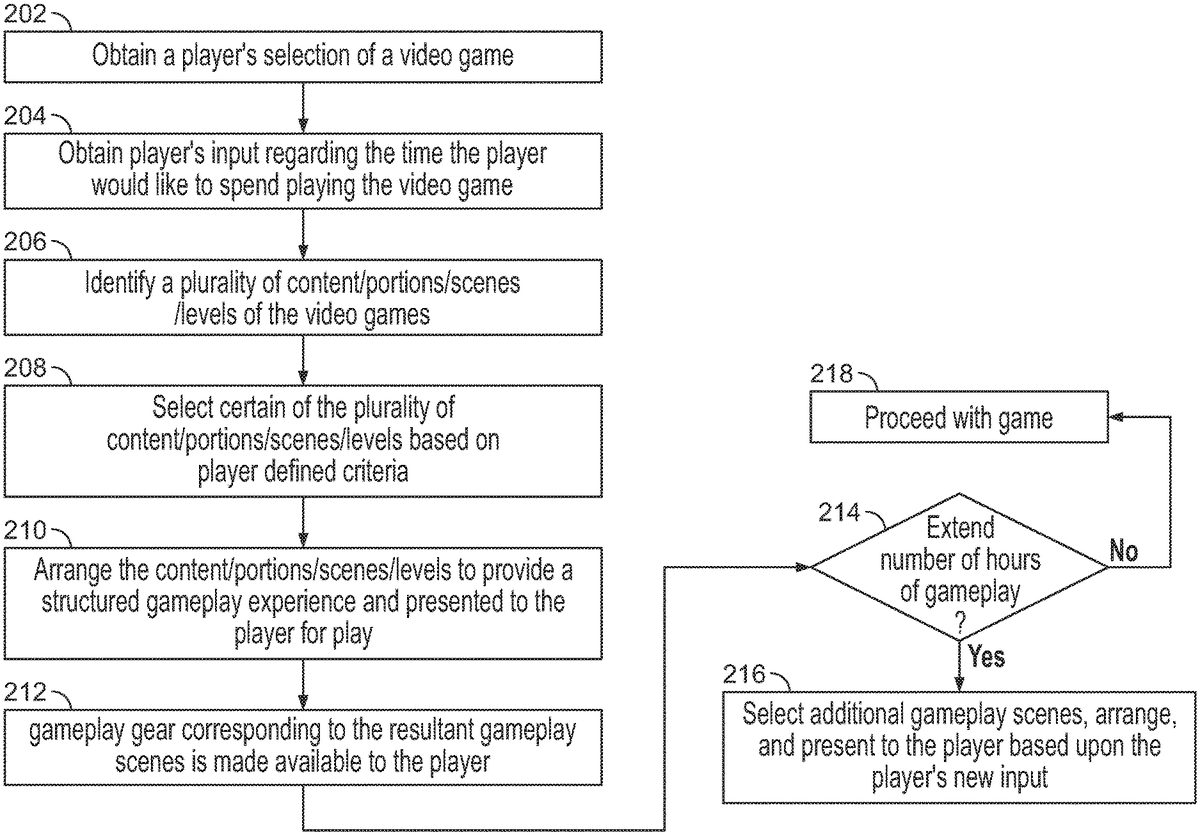
FIG.2is a flowchart showing a plurality of steps for a method of providing truncated video game content that fits within a player defined time period, in accordance with an embodiment of the present specification. With reference toFIGS.1and2, at step202, using the user input module125, the player provides the system with a video game selection. At step204, using the user input module125, the player provides the system with a time period for which the player would like to play the video game. At step206, using the user input module125, the player selects a plurality of descriptors, identifiers, or other criteria that, when used as filters and applied to the metadata associated with the content units, enable a selection of content units that may be aggregated into a player-defined permutation of the game.
In an embodiment, after receiving a player's selection of video game and based on the player's input, at step208, the selection module120of the system applies the player-defined filters to the game scenes and selects scenes/content based on a plurality of criteria.
As previously described, each content unit may be tagged using metadata tags wherein the metadata includes information that conveys different aspects of the content unit. In some embodiments, the metadata information comprises, but is not limited to, a time taken to complete a scene in the content unit, and body gear required to complete a scene in the content unit. In other embodiments, the metadata information comprises information defining an ‘experience’ associated with the content unit. For example, metadata tags may read ‘fun’, ‘challenging’, ‘scary’ or ‘easy’. In an embodiment, the metadata information comprises information defining the number of players required to play each of the content units. For example, a metadata tag may read as ‘2 players’ or ‘single player’ defining that the respective content unit is required to be played by two players or a single player respectively. In another embodiment, the metadata information comprises information defining a ‘category’ or ‘type’ of the content unit. For example, metadata tags may read ‘puzzle’, ‘battle’, ‘car-chase’, ‘action’, ‘adventure’ or ‘fantasy’, describing the kind of gameplay involved in a respective content unit.
The metadata tagging of each scene of video games may be performed by a game server and stored in a database coupled with the game server. In various embodiments, one or more scenes may be tagged as scenes that must be selected together and played linearly in order to maintain the game's narrative. In embodiments, certain scenes are defined or tagged as scenes that must be included in every gameplay. In other embodiments, a pre-defined sequence of scenes may be selected, wherein the scenes correspond to a predefined player rating. Such scenes may be tagged such that they are played only in the defined sequence within the time period defined by the player.
In an embodiment, the selection module120filters the selected content to ensure that it will fit within the number of hours input by the player, either in unedited or edited form. Optionally, the scenes or game content are curated by editing module130to reflect reduced levels so that they fit within the player-specified time period. In an embodiment, the selected scenes are time-tagged by determining an average amount of time players require for completing each selected scene so that the player-defined time period can be applied as a filter to identify all the content that would fit into said time period. In embodiments, the average amount of time that players require for completing each selected scene may be pre-recorded and may be obtained from a database coupled with the gaming system executing the present method. In another embodiment, the average amount of time that players require for completing each selected scene may be an editorially assigned amount of time, or the average amount of time it takes for players with a similar skillset as the player to complete said scenes of gameplay.
In an embodiment, selection module120selects content that maintains a narrative of the game, such as content that is rated as providing the best experience. In other embodiments, the content selected by selected module is based on certain criteria regardless of maintaining cohesion in the game's narrative, such as but not limited to, the most fun content (scenes or levels of the game) or rated as providing the most challenging experience, is selected by the selection module120. In embodiments, the content rating for the video game may be obtained by means of player votes or may be determined by recording maximum player interest/play. In embodiments, the content rating may be obtained by means of player votes or may be determined by recording maximum player interest/play. In some embodiments, said scene/content selection may be performed based on a prioritization/rating of each piece of content within the game based on specific parameters such as those described above (rating obtained via average player vote, editorial ranking provided by the game's creators, specific types of content that the player has selected in the past (e.g. player really likes boss battles), or importance to the overall story/narrative of the game).
At step210, in an embodiment, the editing module130aggregates the selected content for presentation to the player. In embodiments, the editing module aggregates the content units and stitches them together into a structured gameplay order, such as linear gameplay experience that fits within the number of hours input by the player. In embodiments, certain scenes tagged for a predefined sequential play are stitched in accordance with the defined order. In an embodiment, one or more messages or bumpers are added before each selected scene that explains any narrative gaps or game play moves that the player should know before launching into that scene.
FIG.3Aillustrates a screenshot of a message screen displayed to a user prior to commencement of an edited game scene, in accordance with an embodiment of the present specification. In an embodiment, the message is displayed after the user completes an edited game scene and before commencement of a subsequent stitched or edited game scene. Screenshot300comprises a message section302for displaying a message introducing to the player an upcoming scene and/or a game-story narrative that has occurred between the completed scene and the upcoming scene. The message section302also provides to the player any additional information required to play the up-coming game scene. InFIG.3, an exemplary message302conveys to the player the following narrative: “[a]fter the demise of the alien king a force of barbarians has taken over the planet. It is now up to you to save the planet by annihilating the barbarians. Hint: Only high energy laser blasters can kill a barbarian.” Screenshot300also comprises an optional section304for displaying an image indicative of the upcoming scene of the edited gameplay session.
FIG.3Bis a flowchart illustrating a method for aggregating the selected content for presentation to the player, in accordance with an embodiment of the present specification. At step350selected content units are identified. In embodiments, as explained above, the content units are selected by the selection module120(shown inFIG.1A) based on at least one user preference collected via the user input module125(shown inFIG.1B) and the metadata tags stored with respect to each content unit. At step352, the selected content units are recompiled to obtain a video game comprising only the selected content units. In an embodiment, the selected content units are recompiled to obtain a coherent sequential narrative of gameplay. At step354, the recompiled game is distributed to the user that had requested for the selected content. In another embodiment, where the game is streamed to the user, recompilation may not be required and each content unit may be sequentially arranged and streamed one after the other to the user. In yet another embodiment, a video game may be developed such that different versions of the gameplay are designed to fit a plurality of different time durations. In such a case, when a user requests to play a game for one of the plurality of said different durations, a corresponding version of gameplay is selected and conveyed to the user from a plurality of pre-built or pre-collated versions.
At step212, gameplay gear corresponding to the edited gameplay scenes is made available to the player. In various embodiments, the required game gear is determined by obtaining pre-recorded information regarding the gear required to play each scene of the game by an average player. In an embodiment, the player is allowed to choose the extent or nature of the gear by providing a GUI based slider or drop-down menu that can be pointed to options such as ‘minimum gear’, ‘average gear’, ‘well geared’, and ‘best possible gear at that point in the game’ before the commencement of each scene.FIG.4illustrates a screenshot of a screen presented to a user prompting the user to select gear, in accordance with an embodiment of the present specification. As shown inFIG.4, screenshot400comprises a slider frame402comprising sliders arrows406, which can be used by the player to select or toggle between gear levels on scale408, such as levels 1, 2, or 3. Screenshot400also comprises a section410which provides a guide to the scale408by displaying the definitions of the selection number. For example, 1 may be used to denote minimum gear, 2 may be used to denote average gear, and 3 may be used to denote maximum gear. As would be apparent, screenshot400displays only one out of a plurality of ways in which a game user may be prompted to select an extent of gear for aiding the user's gameplay. In embodiments, a different scale may be selected for the extent of gear. In embodiments, individual pieces of gear may be selected. In embodiments, a drop-down menu may be employed. In embodiments, a checkbox-type selection method may be employed.
In embodiments, during the gameplay of the edited scenes and at predefined intervals, the system determines if the player is completing the scenes within the time allocated to each scene. If the player is taking longer than the allocated time for any scene, the player is presented with options such as: moving to the next scene or piece of content, continuing to play the current scene, or causing the game content to be re-designed or reallocated to fit into the remaining time available with the player. In an embodiment, if the player chooses to continue to play the current piece of content, gameplay may either exceed the player-defined time period or may cease at the end of the player-defined time period in such a manner that the player may not be able to complete all selected and edited content. In another embodiment, the selected pieces of content may be recalculated or prioritized differently based on the time remaining. For example, if the player has played three hours of a five hour gameplay session, but is only 20% through the gameplay content that has been selected for the player, the player may choose an option of re-defining the gameplay content to fit in the remaining two hours.
At step214, during the gameplay of the selected scenes, it is determined if the player wishes to extend the gameplay experience by extending the numbers of hours of gameplay. If it is determined that the player would like to extend the gameplay experience by extending the numbers of hours of gameplay, additional gameplay scenes are selected, edited and presented to the player based upon the player's new input at step216. If the player does not wish to extent gameplay, at step218, the player proceeds through the game through the earlier player-defined time period.
In an embodiment, the method of the present specification may be extended to a plurality of video games, wherein scenes from multiple video games may be selected and edited to fit within a player defined time period. In such embodiments, a plurality of compatible video games are identified and selected based on one or more metadata tags of the games describing information such as, but not limited to a ‘genre’, ‘type’, ‘rating’ or ‘difficulty level’ of the games. In embodiments, content units may be selected from video games of a similar genre. In another embodiment, the content units may be selected from video games falling under different genres. For example, a player may provide a preference for boss battle-based games and a defined number of hours available for gameplay. In an embodiment, the system of the present specification may select boss battle based scenes from a plurality of video games and edit the selected content units to fit into the player defined time period. In embodiments, the selection of the games for making said scene selection may be made based on a plurality of criteria such as but not limited to the player's game playing history, ratings given by the player to games played in the past, ratings given by other players, and editorial selection. In some embodiments, content units may be tagged using universal metadata tags wherein the metadata comprises information conveying a plurality of aspects of the content units across multiple games and genres of games. In embodiments, metadata tags of content unit selected from different video games comprise information such as, but not limited to, age/content rating, difficulty, year of release, and language used for narrating the game-story.
In various embodiments, the cloud-based system architecture as described with reference toFIG.1enables seamless switching between games, thereby allowing players cross-game play sessions edited to fit within a desired time period.
In an embodiment, the systems and methods of the present specification may be used to provide a time-based play where multiple players may compete for completing a set of selected scenes based on a popular genre. In the time-trial challenge embodiment, a first player may select certain content, such as a set of boss battles, and challenge second or additional players to determine who can complete them the fastest. For example, video games based on racing allow users to compete against each other in time trials. In an embodiment, a user may select such time-trial based asynchronous challenges where players complete their runs while playing individually, and the results of each competing player is collected and sorted by the gaming system of the present specification. In another embodiment, a user may select to play time-trial based synchronous challenges where all the competing players play together, competing with each other to reach a finish line, and wherein the results of each player are determined by the gaming system.
In embodiments, players may choose to create entire leagues based on curated content gameplay. In such embodiments, challenges may be compiled and time scores may be tracked to determine rankings within the group or league. In embodiments, an e-sport athlete or social gaming influencers favorite content or top picks may be stitched together to form various time-based gameplay sessions, providing the player with “premium” or “VIP” content. In embodiments, these curated gameplay sessions may be 5, 10, 15, 20 hours or more or any increment therein.
The above examples are merely illustrative of the many applications of the system and method of present specification. Although only a few embodiments of the present specification have been described herein, it should be understood that the present specification might be embodied in many other specific forms without departing from the spirit or scope of the specification. Therefore, the present examples and embodiments are to be considered as illustrative and not restrictive, and the specification may be modified within the scope of the appended claims.
Claims
- A method for providing a tailored video game, wherein the tailored video game is a modified version of a video game having a standard gameplay time greater than a gameplay time of the tailored video game, the method comprising: receiving data indicative of the gameplay time of the tailored video game;selecting a portion of the video game based on the data indicative of the gameplay time of the tailored video game, wherein the portion has a time period associated therewith;editing the portion such that the portion's time period is equal to or less than the gameplay time of the tailored video game;generating the tailored video game comprising the edited portion;determining that the player is completing the portion within the edited portion's time period;and providing one or more options based upon said determination.
- The method of claim 1, wherein providing one or more options is not performed in the event that the player is not completing the portion within the gameplay time of the tailored video game.
- The method of claim 1, further comprising selecting one or more game gear items required for playing the portion based on at least one of a plurality of pre-defined criteria.
- The method of claim 1, wherein editing the portion such that the portion's time period is equal to or less than the gameplay time of the tailored video game is achieved by providing the player with at least one of improved gear items or gear specific to weaknesses of opponents in the portion.
- The method of claim 1, wherein editing the portion such that the portion's time period is equal to or less than the gameplay time of the tailored video game is achieved by increasing visibility on a game map of the portion.
- The method of claim 1, wherein editing the portion such that the portion's time period is equal to or less than the gameplay time of the tailored video game is achieved by increasing navigational guidance for the player.
- The method of claim 1, wherein the portion comprises a plurality of content units from the video game that are stitched together to form said portion.
- The method of claim 1, wherein editing the portion such that the portion's time period is equal to or less than the gameplay time of the tailored video game is achieved by modifying at least one of a number of enemies, a level of the enemies, a number of floors, a number of mini-bosses, a number of rooms, or a number of dead ends.
- The method of claim 1, wherein selecting the portion further comprises determining an amount of time required for completing the portion and applying data indicative of the gameplay time of the tailored video game as a filter to identify all of the portions having a time period that is less than or equal to the gameplay time of the tailored video game.
- The method of claim 9, further comprising editing the portion to provide a linear gameplay experience to the player.
- The method of claim 1, further comprising adding one or more messages before the portion to provide a narrative corresponding to the tailored gameplay session.
- A system for generating, in real-time, a tailored video game, wherein the tailored video game is a modified version of a video game having a standard gameplay time greater than a gameplay time of the tailored video game, the system comprising one or more game servers for hosting the game and a plurality of client processors for executing an instance of the game communicated by the one or more game servers via a network coupling the client processors to the game servers, said game servers comprising one or more processors configured to execute a plurality of executable programmatic instructions to generate, in real-time, the tailored video game, the programmatic instructions forming: a user input module which when executed receives data indicative of the gameplay time of the tailored video game;a selection module which when executed selects a portion of the video game based on the data indicative of the gameplay time of the tailored video game, wherein the portion has a time period associated therewith;and an editing module which when executed edits the portion such that the portion's time period is equal to or less than the gameplay time of the tailored video game for generating a tailored gameplay session comprising the edited portion;wherein the selection module is configured to determine that a player is completing the portion within the edited portion's time period and provide one or more options based on said determination.
- The system of claim 12, wherein the selection module is configured to not provide one or more options in the event that the player is not completing the portion within the gameplay time of the tailored video game.
- The system of claim 12, wherein the selection module is configured to select one or more game gear items required for playing the portion based on at least one of a plurality of pre-defined criteria.
- The system of claim 12, wherein the editing module is configured to edit the portion such that the portion's time period is equal to or less than the gameplay time of the tailored video game by providing the player with at least one of improved gear items or gear specific to weaknesses of opponents in the portion.
- The system of claim 12, wherein the editing module is configured to edit the portion such that the portion's time period is equal to or less than the gameplay time of the tailored video game by increasing visibility on a game map of the portion.
- The system of claim 12, wherein the editing module is configured to edit the portion such that the portion's time period is equal to or less than the gameplay time of the tailored video game by increasing navigational guidance for the player.
- The system of claim 12, wherein the portion comprises a plurality of content units from the video game that are stitched together to form said portion.
- The system of claim 12, wherein the editing module is configured to edit the portion such that the portion's time period is equal to or less than the gameplay time of the tailored video game by modifying at least one of a number of enemies, a level of the enemies, a number of floors, a number of mini-bosses, a number of rooms, or a number of dead ends.
- The system of claim 12, wherein the selection module is configured to determine an amount of time required for completing the portion and applying data indicative of the gameplay time of the tailored video game as a filter to identify all of the portions having a time period that is less than or equal to the gameplay time of the tailored video game.
Disclaimer: Data collected from the USPTO and may be malformed, incomplete, and/or otherwise inaccurate.