U.S. Pat. No. 11,872,475
STORAGE MEDIUM, INFORMATION PROCESSING SYSTEM, INFORMATION PROCESSING APPARATUS AND GAME CONTROLLING METHOD INVOLVING LINKABLE PLAYER CHARACTER AND SUB-CHARACTER
AssigneeNintendo Co., Ltd.
Issue DateFebruary 7, 2022
Illustrative Figure
Abstract
A game system that is a non-limiting example information processing system comprises a main body apparatus, and this main body apparatus is provided with a left controller and a right controller in a attachable and detachable manner. Each of the left controller and the right controller comprises a plurality of operation buttons and an analog stick. In a first operation mode, action of a player character is controlled according to an operation of a player. In a second operation mode, a sub-character appears, and action of the sub-character is automatically controlled except for a case where the sub-character attacks an enemy character according to depression of a ZL-button. In a third operation mode, movement of the player character and movement of the sub-character are respectively controlled according to an operation of the player.
Description
DETAILED DESCRIPTION OF NON-LIMITING EXAMPLE EMBODIMENTS A non-limiting example game system according to an exemplary embodiment will be described in the following. The non-limiting example game system1according to this embodiment comprises a main body apparatus (an information processing apparatus that functions as a game apparatus main body in this embodiment)2, a left controller3and a right controller4. The left controller3and the right controller4are attachable to or detachable from the main body apparatus2, respectively. That is, the game system1can be used as a unified apparatus formed by attaching each of the left controller3and the right controller4to the main body apparatus2. Moreover, in the game system1, the main body apparatus2, the left controller3and the right controller4can also be used as separate bodies (seeFIG.2). In the following, the hardware structure of the game system1according to this embodiment will be described, and then, the control of the game system1of this embodiment will be described. FIG.1is an illustration view showing an example of a state where the left controller3and the right controller4are attached to the main body apparatus2. As shown inFIG.1, the left controller3and the right controller4is respectively attached to the main body apparatus2, thereby to be unified it. The main body apparatus2is an apparatus for performing various processing (game processing, for example) in the game system1. The main body apparatus2comprises a display12. Each of the left controller3and the right controller4is a device comprising an operation section with which a user provides inputs. FIG.2is an illustration view showing an example of a state where the left controller3and the right controller4are detached from the main body apparatus2, respectively. As shown inFIG.1andFIG.2, each of the left controller3and the right controller4is attachable to and detachable from the main body apparatus2. In addition, it should be noted that the left controller3and the right controller4may be referred to collectively as a ...
DETAILED DESCRIPTION OF NON-LIMITING EXAMPLE EMBODIMENTS
A non-limiting example game system according to an exemplary embodiment will be described in the following. The non-limiting example game system1according to this embodiment comprises a main body apparatus (an information processing apparatus that functions as a game apparatus main body in this embodiment)2, a left controller3and a right controller4. The left controller3and the right controller4are attachable to or detachable from the main body apparatus2, respectively. That is, the game system1can be used as a unified apparatus formed by attaching each of the left controller3and the right controller4to the main body apparatus2. Moreover, in the game system1, the main body apparatus2, the left controller3and the right controller4can also be used as separate bodies (seeFIG.2). In the following, the hardware structure of the game system1according to this embodiment will be described, and then, the control of the game system1of this embodiment will be described.
FIG.1is an illustration view showing an example of a state where the left controller3and the right controller4are attached to the main body apparatus2. As shown inFIG.1, the left controller3and the right controller4is respectively attached to the main body apparatus2, thereby to be unified it. The main body apparatus2is an apparatus for performing various processing (game processing, for example) in the game system1. The main body apparatus2comprises a display12. Each of the left controller3and the right controller4is a device comprising an operation section with which a user provides inputs.
FIG.2is an illustration view showing an example of a state where the left controller3and the right controller4are detached from the main body apparatus2, respectively. As shown inFIG.1andFIG.2, each of the left controller3and the right controller4is attachable to and detachable from the main body apparatus2. In addition, it should be noted that the left controller3and the right controller4may be referred to collectively as a “controller” in the following.
FIG.3is six orthogonal views showing an example of the main body apparatus2. As shown inFIG.3, the main body apparatus2comprises a housing11having an approximately plate-shape. In this embodiment, a main surface (in other words, a surface on a front side, i.e., a surface on which the display12is provided) of the housing11has a generally rectangular shape.
In addition, a shape and a size of the housing11are optional. As an example, the housing11may be of a portable size. Moreover, the main body apparatus2alone or the unified apparatus obtained by attaching the left controller3and the right controller4to the main body apparatus2may be a mobile apparatus. The main body apparatus2or the unified apparatus may be a handheld apparatus. The main body apparatus2or the unified apparatus may be a handheld apparatus or a portable apparatus.
As shown inFIG.3, the main body apparatus2comprises the display12that is provided on the main surface of the housing11. The display12displays an image generated by the main body apparatus2. In this embodiment, the display12is a liquid crystal display device (LCD). However, the display12may be an arbitrary type display.
Moreover, the main body apparatus2comprises a touch panel13on a screen of the display12. In this embodiment, the touch panel13is of a type that allows a multi-touch input (e. g., a capacitive type). However, the touch panel13may be of any type, and for example, the touch panel13may be of a type that allows a single-touch input (e. g., a resistive type).
The main body apparatus2includes speakers (i.e., speakers88shown inFIG.6) within the housing11. As shown inFIG.3, speaker holes11aand11bare formed on the main surface of the housing11. Then, sounds output from the speakers88are emitted through the speaker holes11aand11b.
Moreover, the main body apparatus2comprises a left terminal17that is a terminal for the main body apparatus2to perform wired communication with the left controller3, and a right terminal21that is a terminal for the main body apparatus2performs wired communication with the right controller4.
As shown inFIG.3, the main body apparatus2comprises a slot23. The slot23is provided on an upper side surface of the housing11. The slot23has a shape to which a predetermined type of storage medium can be attached. The predetermined type of storage medium is, for example, a dedicated storage medium (e. g., a dedicated memory card) for the game system1or an information processing apparatus of the same type as the game system1. The predetermined type of storage medium is used to store, for example, data (e. g., saved data of an application or the like) used by the main body apparatus2and/or a program (e. g., a program for an application or the like) executed by the main body apparatus2. Moreover, the main body apparatus2comprises a power button28.
The main body apparatus2comprises a lower terminal27. The lower terminal27is a terminal through which the main body apparatus2performs communication with a cradle. In this embodiment, the lower terminal27is a USB connector (more specifically, a female connector). When the unified apparatus or the main body apparatus2alone is put on the cradle, the game system1can display on a stationary monitor an image generated by and output from the main body apparatus2. Moreover, in this embodiment, the cradle has the function of charging the unified apparatus or the main body apparatus2alone that is put on the cradle. Moreover, the cradle has a function of a hub device (specifically, a USB hub).
FIG.4is six orthogonal views showing an example of the left controller3. As shown inFIG.4, the left controller3comprises a housing31. In this embodiment, the housing31has a vertically long shape, i.e., is shaped to be long in an up-down direction (i.e., a y-axis direction shown inFIG.1andFIG.4). In a state where the left controller3is detached from the main body apparatus2, the left controller3can also be held in a direction that the left controller3is vertically long. The housing31has a shape and a size that when held in a direction that the housing31is vertically long, the housing31can be held with one hand, especially the left hand. Moreover, the left controller3can also be held in a direction that the left controller3is horizontally long. When held in the direction that the left controller3is horizontally long, the left controller3may be held with both hands.
The left controller3comprises an analog stick32. As shown inFIG.4, the analog stick32is provided on a main surface of the housing31. The analog stick32can be used as a direction input section capable of inputting a direction. The user tilts the analog stick32and thereby can input a direction corresponding to a tilted direction (and input a magnitude corresponding to a tilted angle). In addition, the left controller3may comprise a cross key or a slide stick capable of performing a slide input, or the like as the direction input section, instead of the analog stick. Moreover, in this embodiment, it is possible to provide an input by pressing the analog stick32.
The left controller3comprises various operation buttons. The left controller3comprises four (4) operation buttons33-36(specifically, a right direction button33, a down direction button34, an up direction button35and a left direction button36) on the main surface of the housing31. Furthermore, the left controller3comprises a record button37and a “−” (minus) button47. The left controller3comprises an L-button38and a ZL-button39in an upper left portion of a side surface of the housing31. Moreover, the left controller3comprises an SL-button43and an SR-button44on a surface at a side to be attached to the main body apparatus2out of side surfaces of the housing31. These operation buttons are used to input instructions according to various programs (e. g., an OS program and an application program) executed by the main body apparatus2.
Moreover, the left controller3comprises a terminal42for the left controller3to perform wired communication with the main body apparatus2.
FIG.5is six orthogonal views showing an example of the right controller4. As shown inFIG.5, the right controller4comprises a housing51. In this embodiment, the housing51has a vertically long shape, i.e., a shape long in the up-down direction. In a state where the right controller4is detached from the main body apparatus2, the right controller4can also be held in a direction that the right controller4is vertically long. The housing51has a shape and a size that when held in a direction that the housing51is vertically long, the housing51can be held with one hand, especially the right hand. Moreover, the right controller4can also be held in a direction that the right controller4is horizontally long. When held in the direction that the right controller4is horizontally long, the right controller4may be held with both hands.
Similar to the left controller3, the right controller4comprises an analog stick52as a direction input section. In this embodiment, the analog stick52has the same configuration as that of the analog stick32of the left controller3. Moreover, the right controller4may comprise a cross key or a slide stick capable of performing a slide input, or the like as the direction input section, instead of the analog stick. Moreover, similar to the left controller3, the right controller4comprises four (4) operation buttons53-56(specifically, an A-button53, a B-button54, an X-button55and a Y-button56) on the main surface of the housing51. Furthermore, the right controller4comprises a “+” (plus) button57and a home button58. Moreover, the right controller4comprises an R-button60and a ZR-button61in an upper right portion of a side surface of the housing51. Moreover, similar to the left controller3, the right controller4comprises an SL-button65and an SR-button66.
Moreover, the right controller4comprises a terminal64for the right controller4to perform wired communication with the main body apparatus2.
FIG.6is a block diagram showing an example of an internal configuration of the main body apparatus2. The main body apparatus2comprises components81-91,97and98shown inFIG.6in addition to components shown inFIG.3. Some of the components81-91,97and98may be mounted as electronic components on an electronic circuit board to be accommodated in the housing11.
The main body apparatus2comprises a processor81. The processor81is an information processing section that performs various types of information processing to be performed by the main body apparatus2, and may be composed only of a CPU (Central Processing Unit), or may be composed of a SoC (System-on-a-chip) having a plurality of functions such as a CPU function and a GPU (Graphics Processing Unit) function. The processor81executes an information processing program (e. g., a game program) stored in a storage section (specifically, an internal storage medium such as a flash memory84, an external storage medium attached to the slot23, or the like), thereby performing the various types of information processing.
The main body apparatus2comprises a flash memory84and a DRAM (Dynamic Random Access Memory)85as examples of internal storage media incorporated in the main body apparatus2. The flash memory84and the DRAM85are connected to the processor81. The flash memory84is a memory mainly used to store various data (or programs) to be saved in the main body apparatus2. The DRAM85is a memory used to temporarily store various data used for information processing.
The main body apparatus2comprises a slot interface (hereinafter, abbreviated as “I/F”)91. The slot I/F91is connected to the processor81. The slot I/F91is connected to the slot23, and reads and writes, in accordance with instructions from the processor81, data from and to the predetermined type of storage medium (e. g., a dedicated memory card) attached to the slot23.
The processor81appropriately reads and writes data from and to the flash memory84, the DRAM85and each of the above storage media, thereby performing the above-described information processing.
The main body apparatus2comprises a network communication section82. The network communication section82is connected to the processor81. The network communication section82performs communication (specifically, wireless communication) with external apparatus via a network. In this embodiment, as a first communication manner, the network communication section82is connected to a wireless LAN to perform communication with external apparatus by a system in conformity with the Wi-Fi standard. Moreover, as a second communication manner, the network communication section82performs wireless communication with a further main body apparatus2of the same type by a predetermined communication system (e. g., communication based on a unique protocol or infrared light communication). In addition, the wireless communication in the above-described second communication manner achieves a function of enabling so-called “local communication”, in which the main body apparatus2can perform wireless communication with further main body apparatus2placed in a closed local network area, and a plurality of main body apparatus2perform communication directly with each other to transmit and receive data.
The main body apparatus2comprises a controller communication section83. The controller communication section83is connected to the processor81. The controller communication section83performs wireless communication with the left controller3and/or the right controller4. Although communication system between the main body apparatus2and the left controller3and the right controller4is optional, in this embodiment, the controller communication section83performs communication with the left controller3and with the right controller4in conformity with Bluetooth (registered trademark) standard.
The processor81is connected to the left terminal17, the right terminal21and the lower terminal27. When performing wired communication with the left controller3, the processor81transmits data to the left controller3via the left terminal17and receives (or acquires) operation data from the left controller3via the left terminal17. Moreover, when performing wired communication with the right controller4, the processor81transmits data to the right controller4via the right terminal21and receives (or acquires) operation data from the right controller4via the right terminal21. Moreover, when performing communication with the cradle, the processor81transmits data to the cradle via the lower terminal27. Thus, in this embodiment, the main body apparatus2can perform both wired communication and wireless communication with each of the left controller3and the right controller4. Moreover, when the unified apparatus formed by attaching the left controller3and the right controller4to the main body apparatus2or the main body apparatus2alone is attached to the cradle, the main body apparatus2can output data (e. g., display image data and sound data) to the stationary monitor or the like via the cradle.
Here, the main body apparatus2can perform communication with a plurality of left controllers3simultaneously (in other words, in parallel). Moreover, the main body apparatus2can perform communication with a plurality of right controllers4simultaneously (in other words, in parallel). Therefore, a plurality of users can simultaneously provide inputs to the main body apparatus2, each using a set of the left controller3and the right controller4. As an example, a first user can provide an input to the main body apparatus2using a first set of the left controller3and the right controller4, and simultaneously, a second user can provide an input to the main body apparatus2using a second set of the left controller3and the right controller4.
The main body apparatus2comprises a touch panel controller86that is a circuit for controlling the touch panel13. The touch panel controller86is connected between the touch panel13and the processor81. Based on a signal from the touch panel13, the touch panel controller86generates, for example, data indicating a position where a touch input is performed, and outputs the data to the processor81.
Moreover, the display12is connected to the processor81. The processor81displays a generated image (e. g., an image generated by performing the above information processing) and/or an externally acquired image on the display12.
The main body apparatus2comprises a codec circuit87and speakers (specifically, a left speaker and a right speaker)88. The codec circuit87is connected to the speakers88and a sound input/output (I/O) terminal25and also connected to the processor81. The codec circuit87is a circuit for controlling an input/output of sound data to and from the speakers88and the sound input/output terminal25.
The main body apparatus2comprises a power control section97and a battery98. The power control section97is connected to the battery98and the processor81. Moreover, although not shown inFIG.6, the power control section97is connected to respective components of the main body apparatus2(specifically, components that receive power supplied from the battery98, the left terminal17and the right terminal21). Based on a command from the processor81, the power control section97controls power supply from the battery98to the above-described components.
Moreover, the battery98is connected to the lower terminal27. When an external charging device (e. g., the cradle) is connected to the lower terminal27, and power is supplied to the main body apparatus2via the lower terminal27, the battery98is charged with the supplied power.
FIG.7is a block diagram showing examples of internal configurations of the main body apparatus2, the left controller3and the right controller4. In addition, details of the internal configuration of the main body apparatus2are shown inFIG.6and thus are omitted inFIG.7.
The left controller3comprises a communication control section101that performs communication with the main body apparatus2. As shown inFIG.7, the communication control section101is connected to components including the terminal42. In this embodiment, the communication control section101can perform communication with the main body apparatus2through both wired communication via the terminal42and wireless communication not via the terminal42. The communication control section101controls a method of performing communication by the left controller3with the main body apparatus2. That is, when the left controller3is attached to the main body apparatus2, the communication control section101performs communication with the main body apparatus2via the terminal42. Moreover, when the left controller3is detached from the main body apparatus2, the communication control section101performs wireless communication with the main body apparatus2(specifically, the controller communication section83). The wireless communication between the communication control section101and the controller communication section83is performed in accordance with Bluetooth (registered trademark) standard, for example.
Moreover, the left controller3comprises a memory102such as a flash memory. The communication control section101is constituted by a microcomputer (also referred to as a microprocessor), for example, and executes firmware stored in the memory102, thereby performing various processing.
The left controller3comprises buttons103(specifically, the buttons33-39,43,44and47). Further, the left controller3comprises the analog stick (inFIG.7, indicated as “stick”)32. The respective buttons103and the analog stick32outputs information regarding an operation performed to itself to the communication control section101repeatedly at appropriate timings.
The communication control section101acquires information regarding an input(s) (specifically, information regarding an operation or the detection results of the sensors) from respective input sections (specifically, the buttons103, the analog stick32and the sensors104and105). The communication control section101transmits operation data including the acquired information (or information obtained by performing predetermined processing on the acquired information) to the main body apparatus2. In addition, the operation data is transmitted repeatedly, once every predetermined time period. In addition, the interval that the information regarding an input(s) is transmitted from each of the input sections to the main body apparatus2may or may not be the same.
The above-described operation data is transmitted to the main body apparatus2, whereby the main body apparatus2can obtain an input(s) provided to the left controller3. That is, the main body apparatus2can determine operations on the buttons103and the analog stick32based on the operation data.
The left controller3comprises a power supply section108. In this embodiment, the power supply section108has a battery and a power control circuit. Although not shown, the power control circuit is connected to the battery and also connected to components of the left controller3(specifically, components that receive power supplied from the battery).
As shown inFIG.7, the right controller4comprises a communication control section111that performs communication with the main body apparatus2. Moreover, the right controller4comprises a memory112connected to the communication control section111. The communication control section111is connected to components including the terminal64. The communication control section111and the memory112have functions similar to those of the communication control section101and the memory102, respectively, of the left controller3. Therefore, the communication control section111can perform communication with the main body apparatus2through both wired communication via the terminal64and wireless communication not via the terminal64(specifically, communication in conformity with the Bluetooth (registered trademark) standard), and a method of communication to be performed with the main body apparatus2is controlled by the right controller4.
The right controller4comprises input sections similar to the input sections of the left controller3. Specifically, the right controller4comprises buttons113and the analog stick52. These input sections have functions similar to those of the input sections of the left controller3and operate similarly to the input sections of the left controller3.
The right controller4comprises a power supply section118. The power supply section118has a function similar to the power supply section108of the left controller3, and operates similarly to the power supply section108.
Next, with reference toFIG.8-FIG.16, an outline of game processing of a virtual game executed in the game system1of this embodiment will be described.FIG.8is an illustration view showing a non-limiting first example game image displayed on a display (for example, the display12) when a virtual game application according to this embodiment is executed.
As shown inFIG.8, a game screen200as a game image of a first embodiment includes a player character202and an enemy character204.
However, the player character202is a character or object that execution of arbitrary action is controlled based on an operation of a player. The action of the player character202corresponds to moving, acquiring an item, attacking the enemy character204, defending attack of the enemy character204, etc.
Moreover, each of a plurality of non-player characters including the enemy character204is a character or object that action thereof is controlled by a computer (the processor81ofFIG.6) rather than by an operation of the player. The action of the non-player character corresponds to moving, attacking the player character202, defending attack of the player character202, etc.
Although illustration is omitted, the game image includes a background object(s). In this embodiment, the background object means mainly a terrain object arranged in the virtual space. Moreover, in this embodiment, the terrain means the ground (including roads, plazas, etc.), floors, trees, grass, flowers, buildings, stairs, caves, cliffs, walls, etc.
The main body apparatus2functions also as an image processing apparatus, and generates and outputs (displays) display image data corresponding to various kinds of screens such as the game screen200. The processor81arranges various kinds of objects and characters into the three-dimensional virtual space, whereby a certain sight or scene can be generated. An image that this scene is imaged by a virtual camera (viewed from a viewpoint) is displayed on the display12as a game image.
In this embodiment, the player makes the player character202move in the virtual space by operating the analog stick32, and attack the enemy character204by depressing (operating) the ZR-button61. A plurality of types of techniques for the player character202to attack the enemy character204are prepared. Each time the ZR-button61is depressed, the techniques are selected in a predetermined order. In addition, the technique may be selected at random, and the type of the technique may be selected by the player. Moreover, the technique may include a continuous technique or combo that attacks the enemy character204in succession.
Thus, a state where one character that can be operated by the player (in this embodiment, the player character202) is made to appear in the virtual space and only this character is operated is referred to as a first operation mode.
In this first operation mode, a virtual camera can also be moved by tilting the analog stick52. For example, the virtual camera can change its direction according to an operation of the player. At this time, a gazing point of the virtual camera is set to a predetermined point of the player character202(for example, a center of the head of the player character202), and the virtual camera is moved so as to turn to the gazing point. Moreover, the virtual camera is moved in a state where a distance with the player character202is maintained at a predetermined distance d.
Moreover, in the first operation mode, the virtual camera is arranged at a position that is behind the player character202by the predetermined distance d and above an arranging plane of the player character202(for example, the ground) by a predetermined height h, and an imaging direction thereof is set to a direction of the gazing point, thereby to follow the player character202.
Moreover, even if the virtual camera is moved according to an operation of the player, it is possible to reset, by depressing the analog stick52, the virtual camera to predetermined arrangement with respect to the player character202. Moreover, there is a case where the position and the imaging direction of the virtual camera may be controlled so as to forcibly image another character. For example, it may correspond to a case where an animation that a predetermined enemy character204such as a boss character appears in the virtual space is reproduced, or a case where an animation that the predetermined enemy character204falls (loses a battle) is reproduced, or the like.
Moreover, if the player depresses the ZL-button39in the first operation mode, the operation mode will be shifted to the second operation mode. In this embodiment, the second operation mode means a state where another character210that can be operated by the player (hereinafter, called “sub-character”) appears in the virtual space in addition to the player character202and the sub-character210is automatically controlled by the processor81when no operation by the player is applied to the sub-character210. In this embodiment, and the sub-character210appears into the virtual space so as to jump out from the player character202at a time of shifting to the second operation mode from the first operation mode. A direction of jumping is a direction of the imaging direction of the virtual camera or a direction parallel to the imaging direction. However, this is an example, and the direction that the sub-character210jumps out may be decided according to a direction of the player character202. These are the same for a moving direction when the sub-character210moves so as to jump out.
However, in the second operation mode, the player character202and the virtual camera can be operated by the player, as similar to the first operation mode. Duplicate description on the operation of the player character202and the virtual camera is omitted here. In the second operation mode, the player character202and the sub-character210are controlled so as to be settled in a field angle of the virtual camera. In this case, the gazing point of the virtual camera is set to the predetermined point of the player character202, as mentioned above.
FIG.9is an illustration view showing a non-limiting example game screen200corresponding to a game image in the second operation mode. The sub-character210and a connection object212are included in the game screen200shown inFIG.9in addition to the player character202and the enemy character204. The player character202and the sub-character210are connected by the connection object212. For example, one end of the connection object212is connected to a body of the sub-character210and the other end of the connection object212is held by the player character202, or is fixed to an arm (or a part) of the player character202. Therefore, a movable range of the sub-character210is restricted or decided by length of the connection object212. However, the length (the maximum length) of the connection object212is set in advance. Moreover, although action of the sub-character210is automatically controlled basically, it is settable that each time the ZL-button39is depressed, the sub-character210is made to be moved so as to jump out or move farer (or be separated) by a predetermined distance, or move closer by a predetermined distance when the enemy character204does not appear in the virtual space or when the enemy character204does not exist in the movable range of the sub-character210. At this time, the length of the connection object212is lengthened by predetermined length, or shortened by predetermined length.
As mentioned above, the action of the sub-character210is automatically controlled basically in the second operation mode. When the enemy character204appears in the virtual space, the sub-character210attacks the enemy character204automatically. In this case, the action of the sub-character210is controlled by the computer (processor81). However, when two or more enemy characters204appear, the action of the sub-character210is controlled so as to attack any one of the enemy characters204, for example, the enemy character204existing most close. The enemy character204that can be attacked by the sub-character210is an enemy character204that exists in the movable range of the sub-character210. In the following, the same applies when the sub-character210attacks the enemy character204.
Moreover, in the second operation mode, it is possible to make the sub-character210attack the enemy character204by operating the ZL-button39in addition to the above-mentioned automatic attack. In such a case, an attack motion by means of the automatic control by the processor81is interrupted, and an attack motion according to the operation by the player is performed. Moreover, when the player operates the ZL-button39at just timing, the sub-character210attacks the enemy character204so as to apply a damage effectively (larger). For example, when the player character202attacks the enemy character204with a continuous technique or combo, if the ZL-button39is depressed at a timing following the continuous technique, the sub-character210attacks the enemy character204with a technique capable of applying a more serious damage in succession to the continuous technique.
However, a physical strength value is assigned to the sub-character210, and if the physical strength value becomes 0 (zero), the sub-character210is erased (or not displayed), whereby being shifted to the first operation mode. At this time, if the physical strength value becomes 0 (zero), it becomes impossible for the sub-character210to put out a technique even if the ZL-button39is depressed timely to the continuous technique by the player character202.
In this embodiment, the physical strength value of the sub-character210is set at a maximum value (in this embodiment, “100”) at a time of start of the game, and if the sub-character210appears in the virtual space, the physical strength value is decreased by a first predetermined quantity (0.05, for example) for every first predetermined time (for example, one frame). In this embodiment, one frame is a unit time for screen update, for example, 1/60 seconds. However, if the sub-character210is erased, that is, if shifted to the first operation mode, in this first operation mode, the physical strength value is increased by a second predetermined quantity (0.05, for example) for every second predetermined time (for example, one frame).
In addition, although the first predetermined time and the second predetermined time are set as the same time period in this embodiment, these may be set to different values. Similarly, the first predetermined quantity (decreasing speed) and the second predetermined quantity (increasing speed) may be set to different values.
Thus, the physical strength value is set to the sub-character210, and since use of the sub-character210is restricted by the physical strength value, it is necessary to play the game with a strategy for properly using a case of using the sub-character201or a case of not using. For example, when the sub-character210is attacking the enemy character204by the automatic control, the player can operate the player character202to further attack the enemy character204. That is, it is possible to apply a lot of damage to the enemy character204or to back up the sub-character210. Therefore, as an example of the strategy, it may be considered that the sub-character210is used in a scene that a strong enemy exists or a plurality of enemies exist, a scene that the physical strength value is sufficient and a battle seems to finish immediately, etc., or that the sub-character210is not used whereby recovering the physical strength of the sub-character210in a scene that seems to require only the player character202, a scene that a strong enemy waits next, a scene with few physical strength values, etc.
In this embodiment, if the R-button60is depressed when the sub-character210appears in the virtual space, the sub-character210is erased from the virtual space. Then, the operation mode is shifted to the first operation mode from the second operation mode. That is, it is also possible to erase the sub-character210by the operation of the player.
As mentioned above, since it is necessary to consider the strategy that properly uses or does not use the sub-character210based on the physical strength value of the player character202, the physical strength value of the sub-character210may be displayed in the game screen200. For example, it is conceivable to display a remaining amount of the physical strength value as a numerical value, or display a remaining amount of the physical strength value as a pie chart or a bar graph.
Moreover, in this embodiment, if the physical strength value becomes 0 (zero), the sub-character210is erased automatically. In this case, it cannot make the sub-character210appear until the physical strength value becomes the maximum value of 100. However, when the sub-character210is erased by the operation of the player in a state where the physical strength value is larger than 0 (zero), even if the physical strength value does not become 100, it is possible to make the sub-character210re-appear by an operation of the player.
Furthermore, if the player continues to depress the ZL-button39in the second operation mode (in this embodiment, long-depression of 3 seconds), the operation mode is shifted to the third operation mode, and the third operation mode is maintained only during time the ZL-button39is kept depressed. Therefore, if depression of the ZL-button39is canceled, shifting to the second operation mode from the third operation mode is performed. However, when the R-button60is depressed in the third operation mode, the sub-character210is erased from the virtual space, and the operation mode is shifted to the first operation mode from the third operation mode.
In this embodiment, the third operation mode means a state where it is individually operable movement of the player character202and the sub-character210. The movement of the player character202is operated using the analog stick32similar to the first operation mode or the second operation mode. The movement of the sub-character210is operated using the analog stick52. Therefore, in the third operation mode, the virtual camera cannot be operated with the analog stick52, but automatically controlled. At this time, it is controlled so that the player character202and the sub-character210are both included in the field of view of the virtual camera.
Moreover, in the third operation mode, when the ZR-button61is depressed, the length of the connection object212is shortened by predetermined length. Accordingly, the player character202is moved so as to approach the sub-character210by predetermined length. At this time, the player character202is moved while floating in the virtual space. Therefore, the player character202can move while jumping over a place that the player character202cannot be usually moved (or passed), such as a dangerous place and a place without ground (or floor). For example, by depressing the ZL-button39in the second operation mode, the sub-character210is made to be moved so as to jump out, and then, by shifting to the third operation mode by performing the long depression of the ZL-button39, if the ZR-button61is depressed, the connection object212is shortened by the predetermined length, and therefore, the player character202is moved while floating in the air as mentioned above.
FIG.10-FIG.13are illustration views showing non-limiting example game screens200corresponding to a game image of a scene performing action to restrain the enemy character204in the third operation mode. InFIG.10-FIG.13, in order to simplify, views that the player makes only the sub-character210move and the player character202stay at that place are illustrated, but of course, both may be made to be moved through an operation.
InFIG.10, the game screen200of a manner that the sub-character210is moved in a right direction from a left side of the game screen200, thereby to come around behind the enemy character204is displayed. Moreover, inFIG.10, the connection object212starts to be moved or/and deformed so as to wind around the enemy character204according to movement of the sub-character210.
InFIG.11, the player character202stays at that place, and the sub-character210is further moved in the right direction from the position shown inFIG.10, and has arrived at a right side of the game screen200. Moreover, inFIG.11, the connection object212is further moved or/and deformed according to movement of the sub-character210, and a part thereof is caught in the enemy character204.
InFIG.12, the sub-character210is moved from the position shown inFIG.11to the left of the game screen200through between the player character202and the enemy characters204, and has arrived at a left side of the game screen200. Moreover, inFIG.12, the connection object212is further moved or/and deformed according to the movement of the sub-character210, and surrounds the enemy character204.
If the enemy character204is surrounded by the connection object212as shown inFIG.12, then, the player character202and the sub-character210perform automatically action that the enemy character204is bound by the connection object212, and as shown inFIG.13, the connection object212is deformed into a state of coiling around the enemy character204. At this time, the player character202and the sub-character210become a state where they are temporarily not connected by the connection object212, but are immediately connected by a new connection object212.
In this embodiment, the connection object212can give a damage only by contacting the enemy character204. For example, since a current flows or heat is generated in the connection object212, the enemy character204is damaged by the current or heat. Therefore, in case of a weak enemy character204, it may be possible to defeat the enemy character only by being bound with the connection object212. On the other hand, in case of a strong enemy character204, if brought into a state of being bound with the connection object212, it is possible to block motion of the enemy character204. Therefore, in case of the strong enemy character204, the player can make the player character202or/and the sub-character210attack the enemy character204that the motion is being blocked after shifting the operation mode to the second operation mode by cancelling the depression of the ZL-button39. However, after shifting the operation mode to the first operation mode by depressing the R-button60, the player character202may be operated to attack the enemy character204that the motion is being blocked.
In addition, since the maximum length of the connection object212is set in advance as mentioned above, in case of a comparatively large enemy character204, by binding a plurality of parts such as a hand or/and leg with the connection object212, respectively, it is possible to defeat the enemy character204, or block the motion of the enemy character204.
Moreover, although an example that the player character202is allowed to stay in that place inFIG.10-FIG.13, it is needless to say that the enemy character204may be bound by the connection object212by staying the sub-character210in that place and moving the player character202or the enemy character204may be bound by the connection object212by moving both the player character202and the sub-character210around the enemy character204in opposite directions, respectively.
FIG.14-FIG.16are illustration views showing non-limiting example game screens200corresponding to a game image of a scene that performing action of hooking the connection object on the enemy character204in the third operation mode.
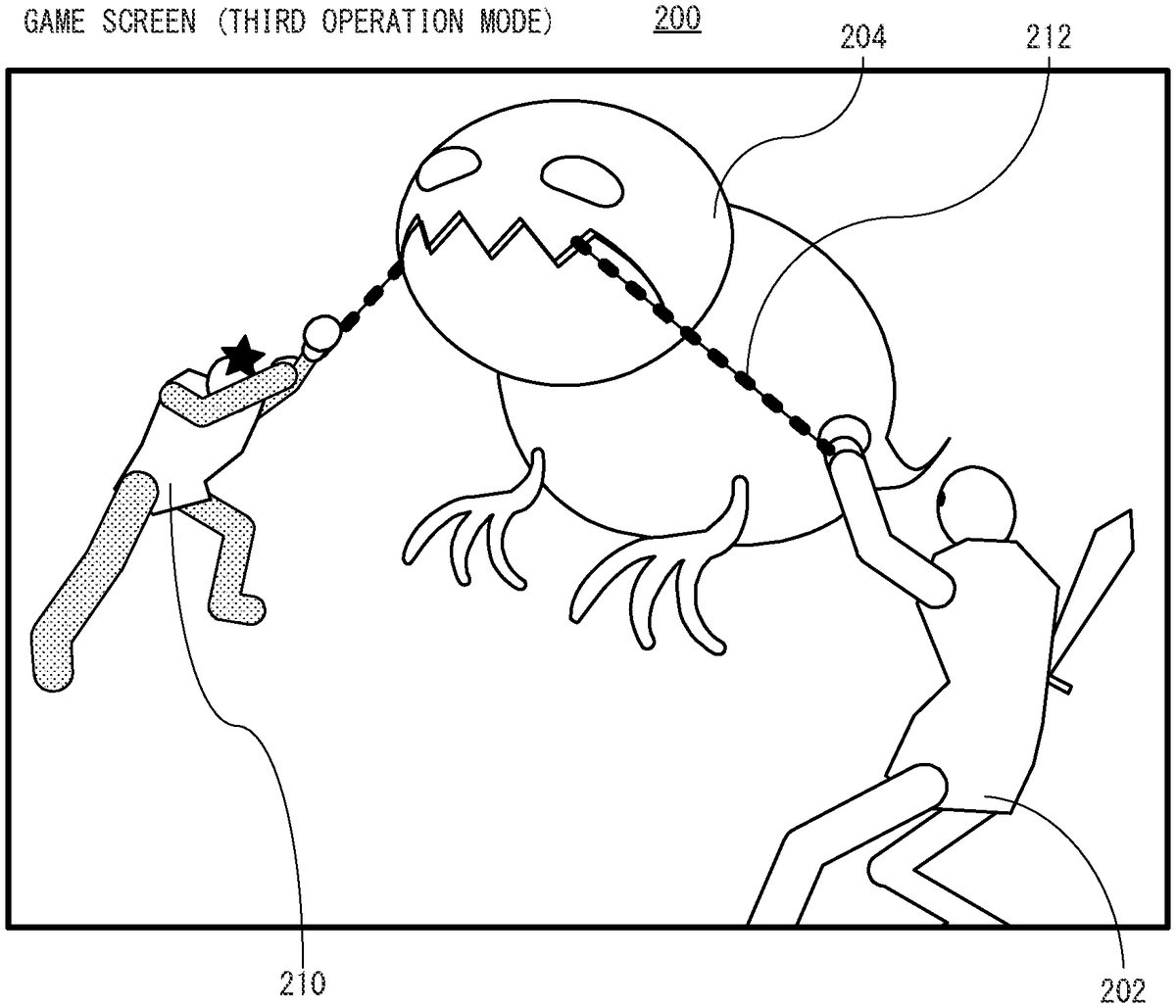
InFIG.14, the game screen200is displayed, in which the player character202is in a state stationary on a lower right side of the game screen200and the sub-character210is in a state stationary on an upper left side of the game screen200, and the connection object212is stretched between the player character202and the sub-character210. Moreover, the enemy character204larger than the player character202and the sub-character210is beginning to move to the lower left from an upper right side of the game screen200. At this time, the player character202and the sub-character210may not be stationary, and the connection object212may be stretched while making the both characters move in opposite direction, for example.
InFIG.15, the game screen200is displayed, in which the enemy character204moves to the lower left from a state shown inFIG.14, with taking the connection object212in its mouth. That is, a moment that the enemy character204is caught in the connection object212is shown.
InFIG.16, the game screen200is displayed, in which the enemy character204raises the head from a state shown inFIG.15. That is, the enemy character204is in a state where it is still caught in the connection object212.
Since the connection object212can give a damage to the enemy character204as mentioned above, it is possible to defeat the enemy character204by hooking the connection object212on the enemy character204. However, in case of a strong enemy character204, by hooking the connection object212, and thereafter, by performing predetermined action such as throwing off to apply damage to the strong enemy character204, it is possible to block the motion of the enemy character204some extent. Then, after shifting the operation mode to the second operation mode by cancelling the depression of the ZL-button39, the player operates the player character202or/and the sub-character210to attack the enemy character204that the motion is being blocked. Alternately, after shifting the operation mode to the first operation mode by depressing the R-button60, the player operates the player character202to attack the enemy character204that the motion is being blocked.
That is, in the example shown inFIG.14-FIG.16, the player estimates motion of the enemy character204and controls the movement of the player character202and the sub-character210so as to set the connection object212, and hooks the enemy character204on this connection object212.
Thus, in the third operation mode, by individually moving the player character202or/and the sub-character210, thereby making the connection object212be moved or/and deformed so as to bind the enemy character204with the connection object212or hook the connection object212on the enemy character204, it is possible to give a damage to the enemy character204from the connection object212.
In addition, in this embodiment, although only the movement is controlled by operating the player character202or/and the sub-character210in the third operation mode, the enemy character204may be attacked by operating the operation button except the operation concerning with switching of the operation mode and the movement of the characters. Alternately, by providing an inertia sensor such as an acceleration sensor or/and a gyro sensor on the main body apparatus2, the left controller3or the right controller4, the enemy character204may be attacked based on an output of the inertia sensor. For example, in a case where the main body apparatus2is attached with the left controller3and the right controller4, based on the output of the inertia sensor provided in the main body apparatus2, the left controller3or the right controller4, attack according to a posture or/and motion of the game system1is performed. Moreover, in a case where the main body apparatus2is not attached with the left controller3and the right controller4, based on the output of the inertia sensor provided in the left controller3or/and the right controller4, attack according to a posture or/and motion of the left controller3or/and the right controller4is performed. These are the same also in the first operation mode and the second operation mode.
Moreover, in this embodiment, three operation modes are settable, and the player controls only the motion of the player character202according to an operation (i.e., manual operation) of the player in the first operation mode, except depression of the ZL-button39, the sub-character210attacks the enemy character204with the automatic control in the second operation mode, and controls the movement of both the player character202and the sub-character210according to the operation of the player in the third operation mode. Therefore, as to the complexity of the operation, the first operation mode is simplest and the third operation mode is most complicated.
That is, when making the sub-character210appear or disappear by switching the operation mode, it is possible to select whether the sub-character210is to be controlled by an automatic operation or a manual operation when making the sub-character210appear. That is, there are many variations of the operation, but if feeling that the operation is difficult or complicated, or in a scene where a powerful attack is not required, it is possible to play with a simple operation.
FIG.17is a view showing a non-limiting example memory map850of the DRAM85shown inFIG.6. As shown inFIG.17, the DRAM85includes a program storage area852and a data storage area854. The program storage area852is stored with a program of a game application (i.e., game program). As shown inFIG.17, the game program includes a main processing program852a, an image generation program852b, an operation detection program852d, an operation mode switching program852e, a character control program852f, a parameter control programs8552g, etc. However, a function of displaying images such as a game image is a function that the main body apparatus2is provided with. Therefore, the image display program852cis not included in the game program.
Although detailed description is omitted, at a proper timing after the power of the main body apparatus2is turned on, a part or all of each of the programs852a-852gis read from the flash memory84or/and a storage medium attached to the slot23so as to be stored in the DRAM85. However, a part or all of each of the programs852a-852gmay be acquired from other computers capable of performing communication with the main body apparatus2.
The main processing program852ais a program for performing overall game processing of a virtual game of this embodiment. The image generation program852bis a program for generating, using image generation data854b, display image data corresponding to various kinds of images such as a game image. The image display program852cis a program for outputting to a display the display image data generated according to the image generation program852b. Therefore, the images (that is, the game screen200, etc.) corresponding to the display image data are displayed on the display such as the display12.
The operation detection program852dis a program for acquiring the operation data854afrom the left controller3or/and the right controller4. The operation mode switching program852eis a program for switching the operation mode based on an operation of the player or a numerical value of a parameter (in this embodiment, physical strength value) among the first operation mode, the second operation mode and the third operation mode. Although the operation mode cannot be switched from the first operation mode to the third operation mode directly in this embodiment, the operation mode may be switched directly to the third operation mode from the first operation mode by operating a predetermined operation button.
The character control program852fis a program for controlling the motion of the player character202or/and the sub-character210based on an operation of the player, or controlling the motion of the non-player character including the enemy character204irrespective of an operation of the player. Moreover, the character control program852fis also a program for making the sub-character210appear in the virtual space or disappear from the virtual space according to an operation of the player or the physical strength value.
The parameter control program852gis a program for increasing or decreasing (i.e., controlling) a numerical value of the parameter between a maximum value (in this embodiment, 100) and a minimum value (in this embodiment, 0).
In addition, the program storage area852is further stored with a sound output program for outputting a sound such as a BGM, a communication program for performing communication with other apparatuses, a backup program for storing data in a nonvolatile storage medium such as the flash memory84, etc.
Moreover, the data storage area854is stored with operation data854a, image generation data854b, operation mode data854c, current position data854d, physical strength value data854e, etc. Moreover, the data storage area854is provided with a timer854f, etc.
The operation data854ais operation data received from the left controller3or/and the right controller4. In this embodiment, when the main body apparatus2receives the operation data from both the left controller3and the right controller4, the main body apparatus2stores the operation data854aclassified into the left controller3and the right controller4, respectively.
The image generation data854bis data required for generating an image, such as polygon data and texture data. The operation mode data854cis data for determining the first operation mode, the second operation mode or the third operation mode, and specifically, data of identification information on a current operation mode.
The current position data854dis data about position coordinates at the current frame of the characters and the objects capable of moving in the virtual space, such as the player character202, the enemy character204, the sub-character210and the connection object212.
The physical strength value data854eis numerical value data of the physical strength value (that is, parameter) of the sub-character210, and as mentioned above, increased or decreased according to the parameter control program852g. That is, the physical strength value represented by the physical strength value data854eindicates a remaining amount of the physical strength value at the current frame. However, the physical strength value is set as the maximum value (in this embodiment, 100) when the virtual game starts.
The timer854fis a timer or counter for counting length of time period that the player continues to depress a predetermined operation button (in this embodiment, the ZL-button39). The timer854fstarts count when the player depresses the ZL-button39, and ends the count to be reset when the player releases (cancelling depression of) the ZL-button39in the second operation mode. In addition, although description is omitted, a start and end of the count of the timer854fare controlled according to the operation mode switching program852e.
Although illustration is omitted, the data storage area854is stored with other data, and provided with flags and other timers (counters).
FIG.18-FIG.20are flowcharts showing non-limiting example processing of the game program (game processing) by the processor81(or computer) of the main body apparatus2. Although the game processing is explained usingFIG.18-FIG.20in the following, duplicate description for a step(s) performing the same processing will be omitted.
However, processing of respective steps of the flowcharts shown inFIG.18-FIG.20are mere examples, and if the same or similar result is obtainable, an order of the respective steps may be exchanged. Moreover, in this embodiment, it will be described that the processor81basically performs the processing of each step of the flowcharts shown inFIG.18-FIG.20; however, some steps may be executed by a processor(s) or/and a dedicated circuit(s) other than the processor81.
When a power of the main body apparatus2is turned on, prior to execution of the overall game processing, the processor81executes a boot program stored in a boot ROM not shown, whereby respective units including the DRAM85, etc. are initialized. The main body apparatus2starts the game processing when the execution of the game program the game program of this embodiment is instructed by the user.
As shown inFIG.18, when the game processing is started, the processor81executes initial processing in a step S1. Here, the processor81places the player character202, the non-player character(s) and the background object(s) at their initial positions in the virtual space. However, when starting the game from the last time, the player character202, the non-player character(s) and the background object(s) are placed at positions at the time of saving. At this time, the coordinate data of the initial positions or the positions at the time of saving of the player character202and the non-player character(s) are stored in the data storage area854as the current position data854d. Moreover, the processor81sets the physical strength value corresponding to the physical strength value data854eas a maximum value while setting the identification information of the operation mode indicated by the operation mode data854cas the identification information of the first operation mode.
In a next step S3, the operation data is detected. Subsequently, it is determined, in a step S5, whether the operation is still being received. Here, the processor81determines whether the operation on the player character202and the sub-character210is received in any one of the first operation mode to the third operation mode. In this embodiment, the processor81does not receive the operation of the player during the operation mode is being changed, such as a case of reproducing an animation that makes the sub-character210appear in the virtual space, and a case of reproducing an animation that the player character202is erased from the virtual space. However, the connection object212is made to appear with the appearance of the sub-character210, and the connection object212is erased with erasure of the sub-character210. In addition to this, there is a period of not receiving the operation while reproducing a predetermined animation when performing a specific technique, when receiving a powerful attack by the enemy, or the like. Moreover, there are scenes where an operation of the player is not received, such as when reproducing an animation expressing game clear, reproducing an animation expressing game over, and when a predetermined event occurs. Hereinafter, in description of the game processing, such animations are called “predetermined animation”. However, since the detection processing (S3) of the operation data is performed even if an operation of the player is not being received, in this case, the detected operation data is not used for the processing of the processor81.
If “NO” is determined in the step S5, that is, if an operation is not being received, other processing is performed in a step S7, and then, the progress proceeds to a step S51shown inFIG.20. In this case, the operation data detected in the step S3is not used for the processing of the processor81. Moreover, the processor81advances the above-mentioned predetermined animation by one frame (or reproduces the animation by one frame) in the step S7. That is, the position and posture of each of the characters in the virtual space are updated by one frame.
On the other hand, if “YES” is determined in the step S5, that is, if an operation is being received, it is determine, in a step S9, whether the operation mode is the first operation mode. Here, the processor81determines, with reference to the operation mode data854c, whether the identification information of the first operation mode is described. The same or similar processing will be performed for a step S21mentioned later.
If “YES” is determined in the step S9, that is, if the operation mode is the first operation mode, the physical strength value is increased by a predetermined quantity (for example, 0.05) in a step S11. However, when the physical strength value is the maximum value, the processing of step S11is skipped.
Subsequently, it is determine, in a step S13, whether an appearance instruction of a sub-character (that is, sub-character210) is performed. Here, the processor81determines whether the operation data detected in the step S3indicates the depression of the ZL-button39.
If “YES” is determined in the step S13, that is, if executing the appearance instruction of the sub-character210, appearance of the sub-character210is started in a step S15. That is, the processor81starts to reproduce an animation making the sub-character210appear in the virtual space. In a subsequent step S17, the operation mode is shifted to the second operation mode, and then, the process proceeds to the step S51. In the step S17, the processor81rewrites the operation mode data854cto the identification information of the second operation mode. This is the same for steps S29, S33, S43and S47mentioned later.
On the other hand, if “NO” is determined in the step S13, that is, if not executing the appearance instruction of sub-character210, processing in the first operation mode is performed in a step S19, and then, the process proceeds to the step S51.
In the step S19, the processor81makes the player character202move according to an operation of the analog stick32, or makes the player character202perform attack according to an operation of the ZR-button61.
Moreover, in the step S19, the processor81makes a virtual camera move according to an operation of the analog stick52.
Furthermore, in the step S19, the processor81reproduces an animation at the time that the player character202receives the attack of the enemy character204, or an animation at the time that the enemy character204receives the attack of the player character202.
However, since a scan time of the steps S3-S55shown inFIG.18-FIG.20is one frame, in the step S19, the position of the player character202is moved, the posture (or body) accompanying the movement or attack is changed, or the animation is gone on or reproduced by one frame, respectively.
Moreover, if “NO” is determined in the above-mentioned step S9, that is, if the operation mode is not the first operation mode, it is determined, in the step S21, whether the operation mode is the second operation mode. If “YES” is determined in the step S21, that is, if the operation mode is the second operation mode, the process proceeds to a step S23shown inFIG.19. If “NO” is determined in the step S21, that is, if the operation mode is the third operation mode, the process proceeds to a step S37shown inFIG.20.
As shown inFIG.19, the physical strength value is reduced by a predetermined quantity (for example, 0.05) in the step S23, and it is determined, in a step S25, whether it is erasure of the sub-character210. Here, the processor81determines whether the operation data detected in the step S3indicates depression of the R-button60, and whether the physical strength value indicated by the physical strength value data854eis 0 (zero). The processor81decides to erase the sub-character210, when the operation data detected in the step S3indicating the depression of the R-button60, or when the physical strength value indicated by the physical strength value data854eis 0 (zero). On the other hand, the processor81decides not to erase the sub-character210, when the operation data detected in the step S3does not indicate of the depression of the R-button60, and when the physical strength value indicated by the physical strength value data854eis not 0 (zero).
If “YES” is determined in the step S25, that is, if it is the erasure of the sub-character210, the erasure of the sub-character210is started in a step S27. That is, the processor81starts to reproduce an animation erasing the sub-character210. In the next step S29, the operation mode is shifted to the first operation mode, and then, the process proceeds to the step S51.
On the other hand, if “NO” is determined in the step S25, that is, if it is not the erasure of the sub-character210, it is determined, in a step S31, whether it is a direct operation instruction. Here, the processor81determines whether a time period that the ZL-button39is continuously depressed exceeds a predetermined time period (for example, 0.5 seconds) with reference to a count value of the timer854f.
If “YES” is determined in the step S31, that is, if there is the direct operation instruction, the operation mode is shifted to the third operation mode in the step S33, and then, the process proceeds to the S51. On the other hand, if “NO” is determined in the step S31, that is, if there is not the direct operation instruction, the processing in the second operation mode is performed in a step S35, and then, the process proceeds to the S51.
The processor81controls the movement of the player character202in the step S35according to the operation of the analog stick32. That is, the position coordinate data of the current position of the player character202in the current position data854dis updated.
Moreover, in the step S35, the processor81moves the virtual camera according to the operation of the analog stick52.
Furthermore, in the step S35, the processor81controls, when the ZL-button39is not operated, the motion of the sub-character210so as to attack the enemy character204nearest to the sub-character210irrespective of other type operation. However, if the enemy character204does not exist in the virtual space or in the moving range of the sub-character210, the sub-character210is moved so as to follow the movement of the player character202. Following the movement of the player character202or the sub-character210, the connection object212is also moved and deformed.
Furthermore, in the step S35, if the ZL-button39is depressed when the enemy character204does not exist in the virtual space or in the movable range of the sub-character210, an animation is started to be reproduced, in which the sub-character210is moved (appears) so as to jump out in a direction from the player character202to the virtual camera (i.e., imaging direction).
Moreover, in the step S35, when the ZL-button39is operated in time with the attack by the continuous technique of the player character202, the processor81reproduces an animation that the sub-character210effectively attacks the enemy character204following the continuous attack of the player character202.
Furthermore, in the step S35, the processor81reproduces an animation at the time that the player character202or the sub-character210receives the attack of the enemy character204, or an animation at the time that the enemy character204receives the attack of the player character202or/and the sub-character210.
Furthermore, in the step S35, the processor81updates the timer854fwhen the ZL-button39is depressed, and resets the timer854fwhen the ZL-button39is not depressed.
However, since the scan time of the steps S3-S55shown inFIG.18-FIG.20is one frame as mentioned above, in the step S35, the position of the player character202or/and the sub-character210is moved, the posture (or body) of the player character202or/and the sub-character210accompanying the movement, or the posture (or body) of the sub-character210accompanying the attack of the sub-character210is changed by one frame, respectively. Moreover, following on the movement of the player character202or/and the sub-character210, the connection object212is moved or/and deformed by one frame. Furthermore, an animation for one frame is reproduced in the step S35. If making it not receive an operation during a predetermined time period after the animation reproduction starts, the animation is continued in step S7from a next frame until an operation becomes to be received. These are the same for a step S49mentioned later.
As shown inFIG.20, in the step S37, the physical strength value is reduced by the predetermined quantity. In a next step S39, it is determined whether it is erasure of the sub-character210. If “YES” is determined in the step S39, the erasure of the sub-character210is started in a step S41, and shifting to the first operation mode in the step S43, and then, the process proceeds to the step S51.
If “NO” is determined in the step S39, it is determined, in a step S45, whether it is cancel of the direct operation instruction. Here, it is determined that it is the cancel of the direct operation instruction if the operation data detected in the step S3does not indicate the depression of the ZL-button39. However, it is also determined that it is the cancel of the direct operation instruction when no operation data is detected in the step S3.
If “YES” is determined in the step S45, that is, if it is the cancel of the direct operation instruction, the operation mode is shifted to the second operation mode in the step S47, and the process proceeds to the step S51. Moreover, the processor81resets the timer854f. On the other hand, if “NO” is determined in the step S45, that is, if it is not the cancel of the direct operation instruction, the processing in the third operation mode is performed in the step S49, and the process proceeds to the step S51.
In the step S49, the processor81makes the player character202move according to the operation of the analog stick32, or moves the sub-character210according to the operation of the analog stick52. The current position data854dis updated at this time. However, since the operation mode is still the third operation mode, the ZL-button39is in a state of being depressed. The same applies hereinafter.
Moreover, in the step S49, the processor81shortens the connection object212according to the operation of the ZR-button61, and makes the player character202move so as to be brought close to the sub-character210.
Furthermore, in the step S49, the processor81hooks the connection object212on the enemy character204or winds the connection object212around the enemy character204according to a positional relationship of the player character202, the sub-character210and the enemy character204. Moreover, after winding the connection object212around the enemy character204one round, an animation that the player character202and the sub-character210bind the enemy character204using the connection object212is reproduced.
Furthermore, in the step S49, the processor81reproduces an animation at the time that the player character202or the sub-character210received the attack of the enemy character204, or an animation at the time that the enemy character204is attacked by hooking or winding the connection object212on the enemy character204.
In the step S51, the processing the other character or/and object is performed. Here, the processor81makes the non-player character including the enemy character204move, or the background object change.
In a next step S53, a game image generated based on the object(s) arranged in the virtual space through the above-mentioned processing. The generated game image is displayed on the display12. Then, it is determined, in a step S55, whether it is a game end. Here, the processor81determines whether it is a game clear or game over. In addition, when the operation data detected in the step S3indicates an instruction of the game end, the game is forcibly ended even during the game processing. Moreover, although illustration is omitted, a sound required for a game (hereinafter, a “game sound”) is generated simultaneously or almost simultaneously with the processing of the step S53, and the generated game sound is output from the speaker88(or sound input/output terminal25).
If “NO” is determined in the step S55, that is, if it is not the game end, the process returns to the step S3shown inFIG.18. On the other hand, if “YES” is determined in the step S55, that is, if it is the game end, the game processing is ended.
According to this embodiment, since it is possible, in accordance with selection by the player, to switch whether making the sub-character appear or not in the virtual space, or to switch whether the sub-character is to be controlled automatically or manually, whereby the variation of the operation can be increased, and thus, it is possible to play the game with a simple operation if needed. For example, when feeling that an operation is complicated, or in a scene where a complicated operation is not required, it is possible to play with switching to a simple operation.
Moreover, according to this embodiment, since the third operation mode is maintained during when the predetermined operation button such as the ZL-button is continuously depressed, whereby at least the movement of the player character and the sub-character can be controlled, respectively, it is necessary to perform an operation for continuing the third operation mode and an operation for at least making the player character and the sub-character move, respectively. That is, by making an operation that is difficult to maintain the third operation mode for a long time, instead of always playing the game in the third operation mode, it is possible to prompt the player to determine an appropriate situation and switch to the third operation mode. Accordingly, it is possible to induce the player to perform a difficult or complicated operation for a short time and to basically perform a relatively simple operation for a long time. In addition, the operation mode may be switched to the third mode by depressing a predetermined button once in another embodiment.
Furthermore, according to this embodiment, it is necessary for the player to consider strategy that makes the sub-character appear or disappear according to the physical strength value in order to control whether it is possible to use the sub-character according to the physical strength value. That is, by setting the physical strength value, it is possible to induce the player to return to a simple operation without continuing a difficult or complicated operation for a long time. In addition, the physical strength value may be another parameter including energy, vitality, etc. in another embodiment. Moreover, it is also possible not to use the physical strength value if needed.
In addition, although it is made to appear the sub-character in the virtual space, or disappear from the virtual space, it does not need to be limited to this. In another embodiment, a sub-character exists in the virtual space in an inoperable state in the first operation mode, but may appear in an operable state according to an operation of the player. In such a case, the sub-character is changed in the virtual space from an operable state to an inoperable state according to the operation of the player or the physical strength value having become 0 (zero). That is, the sub-character of an operable state is erased. For example, in the inoperable state in the virtual space, the sub-character is contained in a predetermined item possessed by the player character, or exists while being changed to another inoperable object or item. In such a case, when the sub-character appears in the virtual space in an operable state, the sub-character jumps out of the predetermined item, or is changed from the other inoperable object or item. That is, the sub-character appears in the virtual space in an operable state.
Moreover, in this embodiment, when the sub-character210is erased (that is, in the first operation mode), the numerical value of the parameter (that is, the physical strength value) is increased, and when the sub-character210appears in the virtual space (that is, in the second operation mode and the third operation mode), the numerical value of the parameter is decreased, but it does not need to be limited to this. Depending on a type of the parameter, the numerical value of the parameter may be decreased when the sub-character210is erased, and the numerical value of the parameter may be increased when the sub-character210appears in the virtual space. In such a case, the parameter may be a numerical value of the physical strength that the sub-character210exhausted, for example, and if the numerical value becomes a maximum value (for example, 100), it is erased from the virtual space, the sub-character210cannot be made to appear in the virtual space until the physical strength is recovered completely (the numerical value of the parameter becomes 0). However, when the sub-character210is erased before the numerical value of the parameter reaches the maximum value, even if it is before the numerical value of the parameter becomes 0, the sub-character210can be made to appear in the virtual space.
Furthermore, although the game system1is shown as an example of an information processing system in the above-mentioned embodiment, it does not need to be limited to such structure, and it is possible to adopt other structure. For example, although the above-mentioned “computer” is a single computer (specifically, the processor81) in the above-mentioned embodiment, it may be composed of a plurality of computers in another embodiment. The above-mentioned “computer” may be (a plurality of) computers provided in a plurality of apparatuses, for example, and more specifically, the above-mentioned “computer” may be constituted by the processor81of the main body apparatus2and the communication control sections (microprocessors)101and111provided in the controllers.
Furthermore, in another embodiment, the game processing shown inFIG.18-FIG.20may be executed by a server on a network such an internet. In such a case, the processor81of the main body apparatus2sends the operation data received from the left controller3and the right controller4to the above-mentioned server via the network communication section82and the network, and receives a result of the game processing executed by the server (that is, data of the game image and data of the game sound), thereby to display the game image on the display12and to output the game sound from the speaker88. That is, it is possible to constitute an information processing system that includes the game system1shown in the above-mentioned embodiment and the server on the network.
Moreover, the above-mentioned embodiment is described on a case where the game image is displayed on the display12, but it does not need to be limited to this. The game image can also be displayed on a stationary type monitor by connecting the main body apparatus2to the stationary type monitor (for example, television monitor) via a cradle. In such a case, it is possible to constitute an information processing system that includes the game system1and the stationary type monitor.
Furthermore, although the above-mentioned embodiment is described on a case where the game system1having structure that the left controller3and the right controller4are attachable and detachable to or from the main body apparatus2is used, it does not need to be limited to this. For example, it is possible to use an information processing apparatus such a game apparatus that an operation portion having operation buttons and analog sticks similar to those of the left controller3and the right controller4is provided integrally with the main body apparatus2or further electronic equipment capable of executing a game program. The further electronic equipment corresponds to smartphones, tablet PCs or the like. In such a case, an operation portion may comprise software keys.
Furthermore, specific numeral values and images shown in the above-described embodiment are mere examples and can be appropriately changed according to actual products.
Although certain example systems, methods, storage media, devices and apparatuses have been described herein, it is to be understood that the appended claims are not to be limited to the systems, methods, storage media, devices and apparatuses disclosed, but on the contrary, are intended to cover various modifications and equivalent arrangements included within the spirit and scope of the appended claims.
Claims
- A non-transitory computer-readable storage medium having stored therein an information processing program executable by a computer of an information processing apparatus, wherein the information processing program, when executed, is configured to cause one or more hardware processors of the computer to at least execute: acquiring operation data based on an operation input to an operation device by a player;controlling a player character in a virtual space based on the operation data;and in the controlling of the player character based on the operation data, in a first operation mode, controlling the player character based on a first operation input, and in response to a first switching instruction input different from an instruction to move the player character, making a sub-character appear in the virtual space and shifting to a second operation mode, in the second operation mode, controlling the player character based on the first operation input, automatically controlling an action of at least a part of the sub-character, and in response to a second switching instruction input, shifting to a third operation mode, and in the third operation mode, controlling the player character based on the first operation input, and controlling movement of at least the sub-character based on a second operation input, wherein a virtual camera is controlled based on the second operation input in the first operation mode and the second operation mode;and wherein the virtual camera is automatically controlled based on positions of the player character and the sub-character in the third operation mode.
- The storage medium according to claim 1, wherein the operation device is provided with a first direction input portion and a second direction input portion, and the first operation input is a direction input to the first direction input portion, and the second operation input is a direction input to the second direction input portion.
- The storage medium according to claim 1, wherein a connection object that connects the player character and the sub-character is connected to the sub-character, and the information processing program when executed is configured to further cause the one or more hardware processors of the computer to at least execute: controlling the connection object according to positions and motion of the player character and the sub-character in the second operation mode or the third operation mode.
- The storage medium according to claim 1, wherein the information processing program when executed is configured to further cause the one or more hardware processors of the computer to at least execute: making the player character attack an enemy character in the virtual space based on an attack instruction input.
- The storage medium according to claim 4, wherein a connection object that connects the player character and the sub-character is connected to the sub-character, and the information processing program when executed is configured to further cause the one or more hardware processors of the computer to at least execute: controlling the connection object according to positions and motion of the player character and the sub-character in the second operation mode or the third operation mode;and making the player character and the sub-character perform a predetermined action based on a positional relationship between the connection object and the enemy character.
- The storage medium according to claim 1, wherein the second switching instruction input is a continuation of an input to a predetermined key of the operation device, and the information processing program when executed is configured to further cause the one or more hardware processors of the computer to execute: shifting to the second operation mode when the input to the predetermined key is canceled in the third operation mode.
- An information processing system comprising an operation portion, and one or more hardware processors configured to at least execute: acquiring operation data based on an operation input to the operation portion;controlling a player character in a virtual space based on the operation data;and in the controlling of the player character based on the operation data, in a first operation mode, controlling the player character based on a first operation input, and in response to a first switching instruction input different from an instruction to move the player character, making a sub-character appear in the virtual space and shifting to a second operation mode, in the second operation mode, controlling the player character based on the first operation input, automatically controlling an action of at least a part of the sub-character, and in response to a second switching instruction input, shifting to a third operation mode, and in the third operation mode, controlling the player character based on the first operation input, and controlling movement of at least the sub-character based on a second operation input, wherein a virtual camera is controlled based on the second operation input in the first operation mode and the second operation mode;and wherein the virtual camera is automatically controlled based on positions of the player character and the sub-character in the third operation mode.
- The information processing system according to claim 7, wherein the operation portion is provided with a first direction input portion and a second direction input portion, and the first operation input is a direction input to the first direction input portion, and the second operation input is a direction input to the second direction input portion.
- The information processing system according to claim 7, wherein a connection object that connects the player character and the sub-character is connected to the sub-character, and the one or more hardware processors are configured to further execute at least: controlling the connection object according to positions and motion of the player character and the sub-character in the second operation mode or the third operation mode.
- The information processing system according to claim 7, wherein one or more hardware processors are configured to further execute at least: making the player character attack an enemy character in the virtual space based on an attack instruction input.
- The information processing system according to claim 10, wherein a connection object that connects the player character and the sub-character is connected to the sub-character, and the one or more hardware processors are configured to further execute at least: controlling the connection object according to positions and motion of the player character and the sub-character in the second operation mode or the third operation mode;and making the player character and the sub-character perform a predetermined action based on a positional relationship between the connection object and the enemy character.
- The information processing system according to claim 7, wherein the second switching instruction input is a continuation of an input to a predetermined key of the operation portion, and the one or more hardware processors are configured to further execute at least: shifting to the second operation mode when the input to the predetermined key is canceled in the third operation mode.
- An information processing apparatus comprising one or more hardware processors configured to at least execute: acquiring operation data based on an operation input to an operation device by a player;controlling a player character in a virtual space based on the operation data;and in the controlling of the player character based on the operation data, in a first operation mode, controlling the player character based on a first operation input, and in response to a first switching instruction input different from an instruction to move the player character, making a sub-character appear in the virtual space and shifting to a second operation mode, in the second operation mode, controlling the player character based on the first operation input, automatically controlling an action of at least a part of the sub-character, and in response to a second switching instruction input, shifting to a third operation mode, and in the third operation mode, controlling the player character based on the first operation input, and controlling movement of at least the sub-character based on a second operation input, wherein a virtual camera is controlled based on the second operation input in the first operation mode and the second operation mode;and wherein the virtual camera is automatically controlled based on positions of the player character and the sub-character in the third operation mode.
- A game control method, comprising: acquiring operation data based on an operation input to an operation device by a player;controlling a player character in a virtual space based on the operation data;and in the controlling of the player character based on the operation data, in a first operation mode, controlling the player character based on a first operation input, and in response to a first switching instruction input different from an instruction to move the player character, making a sub-character appear in the virtual space and shifting to a second operation mode, in the second operation mode, controlling the player character based on the first operation input, automatically controlling an action of at least a part of the sub-character, and in response to a second switching instruction input, shifting to a third operation mode, and in the third operation mode, controlling the player character based on the first operation input, and controlling movement of at least the sub-character based on a second operation input, wherein a virtual camera is controlled based on the second operation input in the first operation mode and the second operation mode;and wherein the virtual camera is automatically controlled based on positions of the player character and the sub-character in the third operation mode.
- The method according to claim 14, wherein the operation device is provided with a first direction input portion and a second direction input portion, and the first operation input is a direction input to the first direction input portion, and the second operation input is a direction input to the second direction input portion.
- The method according to claim 14, further comprising making the player character attack an enemy character in the virtual space based on an attack instruction input.
- The method according to claim 16, wherein a connection object that connects the player character and the sub-character is connected to the sub-character, and the method further comprises: controlling the connection object according to positions and motion of the player character and the sub-character in the second operation mode or the third operation mode;and making the player character and the sub-character perform a predetermined action based on a positional relationship between the connection object and the enemy character.
Disclaimer: Data collected from the USPTO and may be malformed, incomplete, and/or otherwise inaccurate.