U.S. Pat. No. 11,826,655
LEVERAGING ONLINE GAME GOALS AND ECONOMY TO DRIVE OFF-LINE BEHAVIORS
Issue DateJuly 5, 2022
Illustrative Figure
Abstract
A method and system to leverage non-virtual (or meta world) actions via a gaming analog or infrastructure to encourage actions in said non-virtual environment to achieve virtual or meta world benefits an interface interacts with Gameco servers; Gameco servers provide participant opportunities to acquire virtual world benefits by physical actions such as visiting specific geographic locations or areas within locations and, participant is provided a virtual reward by Gameco.
Description
In the Figures, like reference numerals designate corresponding parts throughout the different views. All callouts and annotations are hereby incorporated by this reference as if fully set forth herein. DETAILED DESCRIPTION Disclosed herein are systems and methods to encourage and/or direct actions and accomplishments in the non-virtual world visa via the goal of obtaining virtual world benefits, including but not limited to points, online game characters, accouterments, items, level-ups, advantages, prestige, fame, accolades, and collectables. Aspect of the methods and systems disclosed herein include the support for and/or promotion by Gameco of real world (non-virtual) positive conduct. Online gaming and gaming in general have been vilified by many for the seemingly habitual nature of some game environments to some persons. A method whereby Gameco encourages non-virtual world activities, and in particular positive activities, is a powerful tool to combat misperceptions about online gaming. Aspects of the methods and systems disclosed herein include support for and/or promotion of combining online or virtual world activities with engagement of the real (non-virtual) world. Aspects of the methods and systems disclosed herein include support for and/or promotion of local brick and mortar businesses and the related economies by combining online or virtual world activities with engagement of the real (non-virtual) world. Aspects of the methods and systems disclosed herein include leveraging a gaming infrastructure to encourage actions in a non-virtual environment to achieve virtual world benefits, the method comprising: participant has an account or identity on Gameco servers; application interacts with Gameco servers; Gameco servers provide participant opportunities to acquire virtual world benefits by visiting specific geographic locations which may include businesses; participants visits specified location; and, participant is provided a virtual reward by Gameco. Aspects of the methods and systems disclosed herein include leveraging a gaming infrastructure to encourage actions in a non-virtual ...
In the Figures, like reference numerals designate corresponding parts throughout the different views. All callouts and annotations are hereby incorporated by this reference as if fully set forth herein.
DETAILED DESCRIPTION
Disclosed herein are systems and methods to encourage and/or direct actions and accomplishments in the non-virtual world visa via the goal of obtaining virtual world benefits, including but not limited to points, online game characters, accouterments, items, level-ups, advantages, prestige, fame, accolades, and collectables.
Aspect of the methods and systems disclosed herein include the support for and/or promotion by Gameco of real world (non-virtual) positive conduct. Online gaming and gaming in general have been vilified by many for the seemingly habitual nature of some game environments to some persons. A method whereby Gameco encourages non-virtual world activities, and in particular positive activities, is a powerful tool to combat misperceptions about online gaming.
Aspects of the methods and systems disclosed herein include support for and/or promotion of combining online or virtual world activities with engagement of the real (non-virtual) world.
Aspects of the methods and systems disclosed herein include support for and/or promotion of local brick and mortar businesses and the related economies by combining online or virtual world activities with engagement of the real (non-virtual) world.
Aspects of the methods and systems disclosed herein include leveraging a gaming infrastructure to encourage actions in a non-virtual environment to achieve virtual world benefits, the method comprising: participant has an account or identity on Gameco servers; application interacts with Gameco servers; Gameco servers provide participant opportunities to acquire virtual world benefits by visiting specific geographic locations which may include businesses; participants visits specified location; and, participant is provided a virtual reward by Gameco.
Aspects of the methods and systems disclosed herein include leveraging a gaming infrastructure to encourage actions in a non-virtual environment to achieve virtual world benefits, the method comprising: participant has an account or identity on Gameco servers; Gameco servers monitor participants activities via permitted image capture, biometric or tag associated with participant. Gameco servers reward participant with world benefits by participants real world activities such as visiting geographic locations which identify participant.
Aspects of the methods and systems disclosed herein include leveraging a gaming infrastructure to encourage actions in a non-virtual environment to achieve virtual world benefits, the method comprising: a participant using a computing device logs on to an application or website which communicates with Gameco servers; from time to time Gameco servers contact the participant via the computing device to give notice of an opportunity to achieve virtual rewards in a gaming environment or virtual world via going to a location and performing some action in the real world; if the participant choses to meet the opportunity then he/she is identified at the location via location servers; Gameco servers then verify participant; and, Gameco servers determine if opportunity has been met and award virtual reward to participant. In some instances, servers decisioning that additional opportunities exist for a specific participant at or near a specific location and Gameco notifies participant of the opportunity. In some instances, Gameco servers contact client servers and request payment for virtual reward provided to participant.
Aspects of the methods and systems disclosed herein include identify location by placement of a visual image (QR Code) in the real world that is unique to that location and or event. Graphic image could be placed so that a digital camera captures QR code and picture image and sends a code to Gameco's servers identifying the location and or the event. In some instances, Gameco servers electronically “watermarks” photograph taken with QR code information. In addition, this image is watermarked with time and geo information from the digital camera. In some in stances Gameco servers then insert image in virtual environment so that it is available when user enters the virtual environment.
In some instances verifying the participation includes placement of a visual image or QR Code in the real world at the location which is unique to that location and or event. Graphic image could be placed so that a digital camera captures QR code and picture image and sends a code to Gameco's servers identifying the location and or the event. In some instance Gameco servers electronically watermark an image taken with QR code information and at least one of time and geo location information. In some instances Gameco servers insert the water marked image in virtual environment or a portion of a virtual environment and said water marked image is visible or displayed. In some instances the water marked image is only visible or displayed in the virtual environment or a portion thereof when the participant associated with the watermarked image is in the virtual environment or portion thereof. In some instances water marked image is only visible or displayed in the virtual environment or a portion thereof for one of a fixed or variable time or date.
Aspects of the methods and systems disclosed herein include leveraging a gaming infrastructure to encourage actions in a non-virtual environment to achieve virtual world rewards or items of desire, the method includes a participant using a computing device receive a notice from Gameco servers of an opportunity to act and achieve a virtual reward or benefit through actions outside of interacting with his/her computing device; participant selects an opportunity and performs an action in the real world; the participants is verified or confirmed as performing the activity by at least one of participants computing device and computing devices at client locations; Gameco servers then verify participant; and, Gameco servers determine if opportunity has been fulfilled and award virtual reward to participant. In some instances the method further comprising Gameco servers decisioning that additional opportunities exist for a specific participant at or near a specific location and Gameco notifies participant of the opportunity. In some instances Gameco servers and request payment for virtual reward for participant's activity. In some instances participant via computing device confirms to Gameco servers that he/she will chose an opportunity to act and Gameco servers record the confirmation. In some instances Gameco servers offer participant an enhanced or increased reward for making the confirmation after the participant completes the activity.
Aspects of the methods and systems disclosed herein include leveraging a gaming infrastructure to encourage commercial purchases in a non-virtual environment, the method includes a client contacts Gameco and agrees on an offer of virtual world benefits or rewards to be awarded participants in an online game for performing activities in a real world; Gameco servers populate the offer via a notification to the computing devices of at least some of the participants in the online game; if a participant performs the activity at any threshold level required a reward in the virtual game world is provided; and client pays Gameco for providing the virtual reward.
Aspects of the methods and systems disclosed herein include leveraging a gaming infrastructure to encourage commercial purchases in a non-virtual environment, the method includes a client contacts Gameco and agrees on an offer of virtual world benefits or rewards to be awarded participants in an online game for performing activities in a real world; Gameco servers populate the offer via a notification to the computing devices of at least some of the participants in the online game; and client pays Gameco for providing the notification.
The computing devices/smart devices disclosed herein operate with memory and processors whereby code is executed during processes to transform data, the computing devices run on a processor (such as, for example, controller or other processor that is not shown) which may include a central processing unit (“CPU”), digital signal processor (“DSP”), application specific integrated circuit (“ASIC”), field programmable gate array (“FPGA”), microprocessor, etc. Alternatively, portions DCA devices may also be or include hardware devices such as logic circuitry, a CPU, a DSP, ASIC, FPGA, etc. and may include hardware and software capable of receiving and sending information.
A scenario is established between a Gameco and one or more participants via computing devices in signal communication and clients who seek to utilize the online system as a mechanism to drive off-line activity.
Real world actions are actions beyond touching a keyboard, or mouse or touch screen to “surf” or use a computing device or interface to interact with websites or apps. Real world actions mean going somewhere and doing something physical that is not simply interacting with a computing device. However, part of the real-world action may include using the computing device to receive notices, to authenticate and verify the activity or a part thereof.
In some exemplary implementations the off-line activity includes commercial behaviors such as shopping, traveling to a particular location. Behavior or action may be required or desired within a particular time frame. In some instances, the virtual world reward (or value) associated with a behavior by the participant may be fixed. In some instances, the virtual world reward (or value) associated with a behavior by the participant may be dynamic and change as a function of supply, demand, subsidy, sponsorship and the like. The commercial value to Gameco can be a function of the demand of clients. The commercial value to Gameco may in some instances be generally approximated by the difference between the online purchases of upgrades by participants who do not participate in off-line behavior to ear virtual world benefits versus those who do. The commercial value to Gameco may in some instances be generally approximated by the difference between the online purchases of upgrades by participants who do not participate in off-line behavior to earn virtual world benefits versus those who do plus advertising/marketing fees paid to Gameco for leveraging its infrastructure to drive behavior for clients. The commercial value to Gameco may in some instances be generally approximated by the difference between the online purchases of upgrades by participants who do not participate in off-line behavior to earn virtual world benefits versus those who do plus subsidies paid by clients to Gameco for the virtual benefits it distributes to drive behavior for clients.
In some exemplary implementations the valuation methodology may also be part of a auction like system wherein clients compete, in some instances, for participant behaviors they desire by outbidding a different client for Gameco to motivate via the on line environment.
Off-line activities may also be dynamic such as real-world actions. Real world actions refer generally to actions that a participant completes in a non-virtual world environment and without interacting directly with the Gameco servers. Participant actions while interacting with the Gameco servers even the result of physical acts by the participant are not the non-virtual world actions referred to herein.
The scenario is beneficial to the participant as she/he is motivated by the opportunity to obtain a virtual world reward by spending some time in the non-virtual world including but not limited to travel, supporting local businesses, purchases, service (such as helping a political party get out vote) and the like.
Gameco derives revenue by linking one or more funding sources or subsidizers to its servers wherein actions or goals obtained by participants which earn participants rewards are paid for by such sources. Additionally, when participants activities i.e. visiting ABC sandwich shop is via the opportunity presented by Gameco, Gameco may also receive a percentage of the revenue collected by the “ABC” sandwich shop visa vie authentication of the participant by Gameco servers and in some instances assigning benefit and reward to participant after receiving confirmation of purchases via client servers. In some instance the participant's computing device (such as a parent or guardian) may hold the master account for a child wherein the computing device for the parent interacts with the ecosystem but earns rewards for the child's identified, specified or linked account at Gameco servers.
Gameco also obtains a positive impression in the society by actively offering opportunities to have participants spend some amount of time in a non-virtual world.
At a simplified level aspects of the system and method disclosed herein include utilizing hardware referred to as computing or smart devices which may include internet streaming systems, gaming system, desktop computers, laptops, tablets, smart phones, televisions to acquire, receive, measure or otherwise capture and then transmit via signal communication data associated with a participant.
FIG.1is a system block diagram of an example of an implementation of system100for providing a virtual world for a participant user102(herein referred to a “participant”) in accordance with the present disclosure. The system100includes a Gameco104, a network106, the user102, and a third-party entity108. The network106may be any computer based network such as, for example, the Internet, and is in signal communication with the Gameco104, the user102, and the third-party entity108. The Gameco104may include one or more servers110(also referred to interchangeably herein as Gameco servers110) that include one or more processors. When in operation, the Gameco104may run and maintain a virtual world112(also interchangeably referred to as a “meta world”) on the one or more servers110. In this example, the participant102is a person that desires to use and interact with the virtual world112of the Gameco104. The third-party entity108is a business organization that desires to either interact with, receive information about, and/or advertise to the participant102. The Gameco104is a business organization that runs and maintains the virtual world112that may be either a closed virtual “universe” or part of a larger virtual world/universe such as the “metaverse,” where the metaverse may be an iteration of the Internet as a single, universal and immersive virtual world that is facilitated by the use of virtual reality (VR) and augmented reality (AR) headsets.
In this example, the metaverse may be a network of three-dimensional virtual worlds focused on social connection where the metaverse is generally a cyberspace that may include a virtual reality, which is characterized by persistent virtual worlds that continue to exist even when the participant102is not interacting with the virtual worlds, and an augmented reality that combines aspects of the digital and physical worlds. At present, online game companies have already implemented components of metaverse technology within some known video games. Other known companies have also implemented components of metaverse technology into three-dimensional virtual worlds that incorporate aspect of social media where user (such as the participant102) are represented as avatars within the virtual worlds. In this example, Gameco104may be an online gaming company or other type of online company that allows the participant102to interact with the virtual world112. As an example, Gameco104may be a business that utilizes the virtual world112for online gaming, work productivity, interactive learning environments, e-commerce, real estate advertising and transactions, and fashion.
As discussed earlier, the third-party entity108is a business organization that desires to either interact with, receive information about, and/or advertise to the participant102. In this example, the third-party entity108may be a business entity that has real-world physical facilities or equipment that can be visited or used in combination with corresponding activities in the virtual world112. In this example, the third-party entity108may communicate virtually with the Gameco104via the network106. These communications may include requests to receive information about the participant102or provide the participate102with activities or advertisement from the third-party entity108. In response to these communications, Gameco104may modify aspects of the virtual world112, with the one or more servers110, to accommodate the requests from the third-party entity108. As a business transaction, the third-party entity108may compensate the Gameco104for these services.
InFIG.2, a system block diagram is shown of an example of an implementation of a server200of the one or more servers110of the Gameco104in accordance with the present disclosure. The server200includes one and more processors202, a memory204, one or more interfaces206, and a system bus208. The memory204may include a computer readable medium210and software212. The software212may include instructions214that are configured to control the one or more processors202. In this example, the server200runs and maintains the virtual world112which may be run on the memory204. The memory204may include one or more separate memory or storage devices that are configured to operate together. In this example, the system bus208is in signal communication with the one or more processors202, the memory204, and the one or more interfaces206. In this example, the one or more interfaces206is in signal communication with the network106.
In these examples, the network106may be one or more telecommunication networks that may include any type of wired and/or wireless network, including but not limited to local area networks (“LANs”), wide area networks (“WANs”), satellite networks, cable networks, Wi-Fi networks, WiMax networks, mobile communications networks (e.g., 3G, 4G, and so forth) or any combination thereof. The network106may utilize communications protocols, including packet-based and/or datagram-based protocols such as IP, transmission control protocol (“TCP”), user datagram protocol (“UDP”), or other types of protocols. Moreover, the network106may also include a number of devices that facilitate network communications and/or form a hardware basis for the networks, such as switches, routers, gateways, access points, firewalls, base stations, repeaters, backbone devices, and the like.
In some examples, the server200may further include devices that enable connection to a wireless network, such as a wireless access point (“WAP”). Examples support connectivity through WAPs that send and receive data over various electromagnetic frequencies (e.g., radio frequencies), including WAPs that support Institute of Electrical and Electronics Engineers (“IEEE”) 902.11 standards (e.g., 902.11g, 902.11n, and so forth), and other standards.
In this example, the server200may be a personal computer, portable computer, server, etc. In general, the server200may include one or more computing devices that operate in a cluster or other grouped configuration to share resources, balance load, increase performance, provide fail-over support or redundancy, or for other purposes. For instance, the computing server200may belong to a variety of classes of devices such as traditional server-type devices, desktop computer-type devices, and/or mobile-type devices.
In some implementations, the server200includes one or more input/output (“I/O”) interfaces206that enable communications with input/output devices including peripheral input devices (e.g., a keyboard, a mouse, a pen, a voice input device, a touch input device, a gestural input device, and the like) and/or output devices including peripheral output devices (e.g., a display, a printer, audio speakers, a haptic output device, and the like). The server200may also include a combination of two or more devices.
The server200may represent any type of computing device having the one or more processing units202(also known as one or more processors) in signal communication to the computer-readable media210via the system bus208, which in some instances may include one or more of a system bus, a data bus, an address bus, a PCI bus, a Mini-PCI bus, and any variety of local, peripheral, and/or independent buses. Executable instructions214stored on the computer-readable media210can include, for example, an operating system, a client communication module, a profile module, and other modules, programs, or applications that are loadable and executable by the one or more processing units.
InFIG.3, a system block diagram is shown of the implementation of the system100showing greater detail in accordance with the present disclosure. In this example, the participant102may utilize one or more computing devices that include, for example, a computer system300, smart phone, tablet, or other mobile device302, and a navigation system304in signal communication with one or more services110of the Gameco104via the network106. In this example, the Gameco104one or more servers110are in signal communication with one or more databases306, where information is stored.
In an example of operation, the participant102either sets up an account at the one or more servers110of the Gameco104or the one or more servers110capture information from the computing device300,304, or306(including but not limited to MAC address, IP address, serial number, geo-location, phone number, vehicle identification number, synthetic GPS, Cell ID, Wi-Fi, Terrestrial Transmitters) of the participant110to identify the participant102, which may include the location thereof and create records about the participant102. The communication may be intermittent and the participant102may utilize an application on the computing device300,304, or306and that application is in signal communication and intermittent contact with one or more servers110of the Gameco104.
In this example, the third-party entity108may be at least one client (i.e., first client308). For purposes of illustration the third-party entity108may include a plurality of clients including, for example, the first client308and a second client310. It is appreciated by those of ordinary skill that additional clients may also be included.
In an example of operation with just one client (i.e., first client308), Gameco104is in signal communication with the first client308via a first client server312. In this example, one or more servers110are in signal communication with the first client server314(which may be one or more servers) where Gameco's104rule and decision engines in the one or more servers110are scheduled with parameters of the first client308to control, or at least influence the behavior of the participant102with the desired parameters from the first client308. This determines what segment, if not all, of Gameco's104population of participants (including participant102) are to be broadcast or pushed with messaging to attempt to motivate the participant's102behavior outside the virtual/gaming world interaction whereby the participant102can achieve benefits in the virtual world for such real-world actions. In this example, the first server312is in signal communication with either a local or remote storage device314. In this example, the first client308may be a business entity that include one or more real-world locations316. In this example, the one or more real-world locations316may be as large as a geographic region or as small as one or more stores318,320, and322have one or more corresponding servers324,326, and328which are in signal communication with the first client server312, one or more servers110of Gameco104, and participants102computing device300,302, or304. In this example, the first client server312may provide all or some of their stored data (in database314) on sales, customer traffic, inventory, demographic of their customers, zip codes, and traffic flow during time periods to one or more servers110of Gameco104where the one or more servers110determine and identify opportunities to motivate participants (such as participant102) to interact with first client's308real-world locations316in general and specific ways.
Similarly, if the second client310is present in the third-party entity108, Gameco104is in signal communication with the second client310via a second client server330. In an example of operation with the second client310, the one or more servers110are in signal communication with the second client server330(which may be one or more servers) where Gameco's104rule and decision engines in the one or more servers110are scheduled with parameters of the second client310to control, or at least influence the behavior of the participant102with the desired parameters from the second client310. This determines what segment, if not all, of Gameco's104population of participants (including participant102) are to be broadcast or pushed with messaging to attempt to motivate the participant's102behavior outside the virtual/gaming world interaction whereby the participant102can achieve benefits in the virtual world for such real-world actions. In this example, the second server330is in signal communication with either a local or remote storage device332. In this example, the second client310may be a business entity that include one or more real-world locations334. In this example, the one or more real-world locations334may be as large as a geographic region or as small as one or more stores336,338, and340have one or more corresponding servers342,344, and346which are in signal communication with the second client server330, one or more servers110of the Gameco104, and participants102computing device300,302, or304. In this example, the second client server330may provide all or some of their stored data (in database332) on sales, customer traffic, inventory, demographic of their customers, zip codes, and traffic flow during time periods to one or more servers110of Gameco104where the one or more servers110determine and identify opportunities to motivate participants (such as participant102) to interact with second client's330real-world locations334in general and specific ways.
Gameco's104one or more servers110act to inform, motivate, urge some population of participants to behave in a desired way in response to Gameco104activities on behalf of a (in this example either first client308or second client310. As an example, the behavior may be a real-world travel to a real-world location (i.e., first client location316or second client location334) or purchases at real-world locations.
In either example, the one or more servers110of Gameco104require authentication of participant's102behavior to provide the participant102a virtual world benefit for the behavior. A non-exclusive list of authentication means include voice recognition at a client's location via a client's server. Facial recognition via a client's server or other biometric authentication via a client severs. Another authentication means includes obtaining a participant's102geolocation via participant's102computing device300,302, or304. Still another authentication means includes a changing image such as a clock, glyph, code or the like displayed at client and taken with participant's102computing device300,302, or304to compare the image and its encoded data (i.e. time, glyph code, including but not limited to bar codes, QR codes, audio and the like) with participant's102geolocation and computing device identity to validate. In other examples, a participant's102image, an affixed tag such as an RFID or other biometric is a means to validate. A specific code is provided for a participant102when he/she visits or checks in at a real-world location, which may be a client location316or334. As another example, when a participant102makes a purchase at the location (such as client locations300or334), if the participant's102computing device (or the participant102) can provide the client servers312or330with authentication data, the Gameco104one or more servers110have a record of participant's102purchase. As an example, when visiting an historical site, natural habitat, place of interest like a gallery, or museum on-site computing devices can communicate with participant's102computing device300,302, or304to authenticate the participant102. The geolocation purchase may trigger one or more benefits or rewards offered to participant102for reaching the location (i.e.,316or334) or making the purchase; and/or collect subsidy or payment from client to at least one of participant102and Gameco104for participant's102behavior at the location (i.e.,316or334).
In another example of an implementation, multiple participants in the real-world who come into close proximity and have been identified in close proximity to one another may as a virtual world reward be rewarded for coming together in the real-world and become, or be invited, to become part of a group, population, gang or posse in the meta world. Gameco's104one or more servers110can populate participants (e.g., participant102) directly into a virtual location together. That virtual location may be generally an equivalent of the real-world. For example, if participants were at a casino, they may continue at a corresponding analog casino in the virtual world. The analog may be in a virtual environment such as, for example, on an airship or undersea or on Mars.
In some instances, the group of participants in proximity of a location (i.e., client locations316or334) is time stamped and only the participants that have been time stamp are then permitted to be together at the analog in the meta world together. In some instances, the time participants together at the location (i.e., client locations316or334) are witnessed by their computing devices as an additional or alternative verification of the real-world activity. The time stamp may span the range for very short (seconds) to very long days, weeks or months and all hours, minutes between. The time stamp may also be a time range and a date range where participants who are at the location (i.e., client locations316or334) at a time range, which could be short (seconds, minutes, or hours), during selected calendar days may be permitted to be at the analog meta world location together. Another example is members of a church who attend a service together and are authenticated are invited to, or allowed to, attend together at the meta world church.
In another example, participants coming together in a real-world location or site and being validated or meeting a threshold activity may earn the virtual reward of VIP access to virtual world locations or events. If in the real-world, the participant102buys orchestra pit seating at a concert, a circus, or a performance, the participant102earns a virtual reward for that preferred location in a virtual world analog. If the participant102goes to a real-world location (i.e., first client location316or second client location334) and sits in a particular car (i.e., a vehicle) and tries on designer or branded clothes, jewelry, shoes, or accessories and is validated by a reporting server to Gameco servers110, the Gameco assigns rewards to the participant102. As an example, the participant102may be rewarded with a NFT or a crypto currency.
In another example, the participant's102reward for meeting the activity threshold is to achieve the use of the vehicle or branded clothes or accessories in the virtual world. Optionally, the virtual vehicle or branded products are sponsored products for which the real-world owners of the brands or associated intellectual property receive a royalty from Gameco104for permitting the use of the branded virtual product as a reward in the meta world and the use of which may be limited in duration, or location. Optionally, the real-world owners of the brands or associated intellectual property are a source of funds for Gameco104providing the branded virtual product as a reward in the meta world and the use of which may be limited in duration, or location. The brand owners are optionally using Gameco's104platform for marketing to participants (e.g., participant102) who needs to interact with real-world products to have meta world use of the same.
In another example, attendees at different locations (e.g., first client location316and second client location334) for a religious or non-religious institution, if they meet the time or date criteria when verified may be allowed to attend a single analog location in the meta world wherein they are brought together in the same venue although they were verified at a “franchise” or satellite location of the institution.
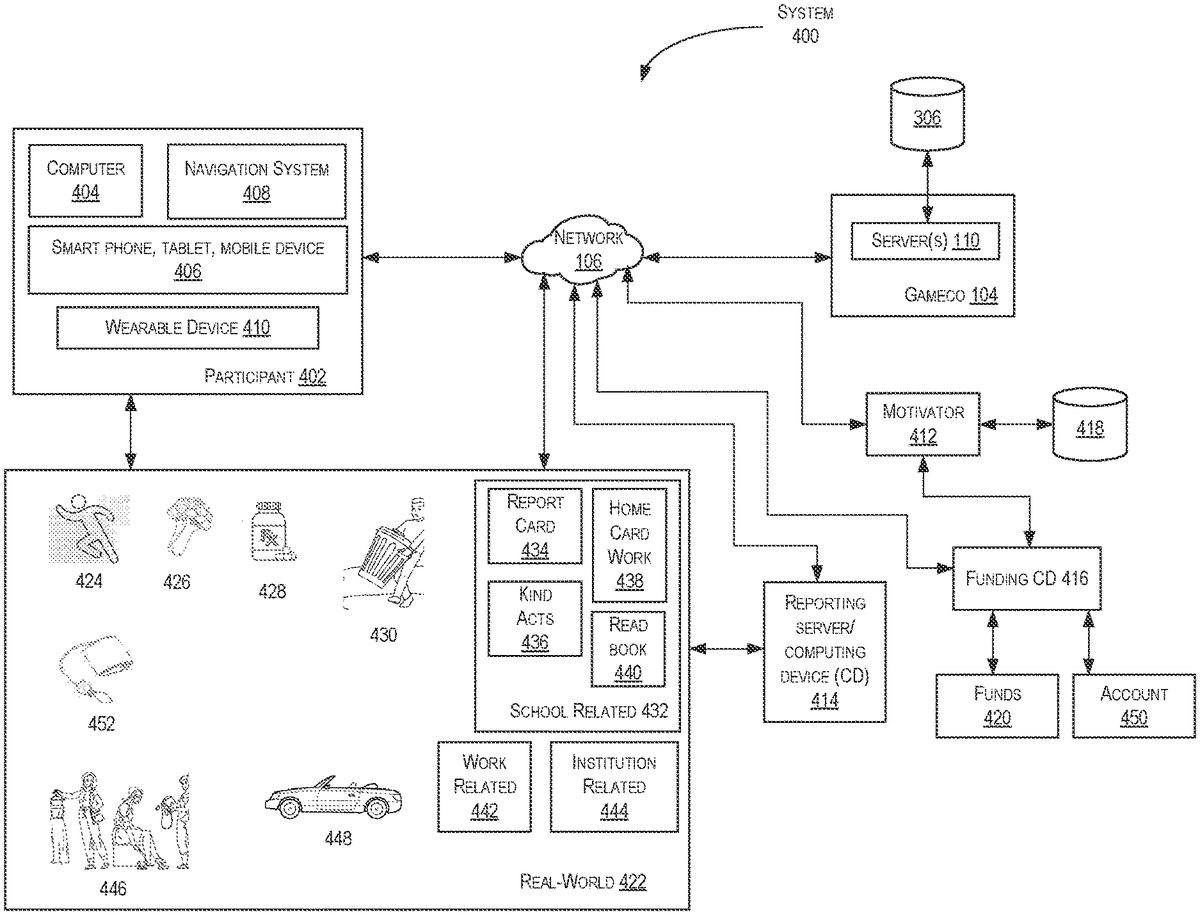
InFIG.4, a system block diagram is shown of another example of an implementation of a system400for providing a virtual world for the participant402in accordance with the present disclosure. In this example, the participant402may utilize one or more computing devices such as, for example, a computer system404, a smart phone, tablet, or mobile device406, navigation system408, and wearable device410in signal communication with a computing device and/or Gameco104and Gameco servers110via a network106.
In this example, the system400includes the participant402, Gameco104, the network106, a MOTIVATOR412, a reporting server/computing device (CD)414, a funding CD416, a database418, and funds420(also known as a funding source). In this example, the MOTIVATOR412may be the participant402, a parent, friend, spouse, teacher, school, employer or the like who are promoting or supporting participant's402positive, good and/or healthy choices and actions. As an example, the MOTIVATOR412may be a commercial entity, a medical or health entity, a governmental entity that is subsidizing or sponsoring good choice activities and healthy positive actions.
The MOTIVATOR412may be a robotic or autonomous programs or semi-autonomous carrying out instructions based on preferences. The MOTIVATOR412may also include servers that also may provide all or some of their stored data it has in its database418on the participant402such as records effecting choices or results the participant402has made or achieved which may include grades, turning in homework, going to a gym, medical measurements, food choice, compliance with health or medical needs where Gameco servers110receive, collect, parse, develop or record threshold levels of real-world activity or types of activity participant needs to accomplish to earn virtual rewards. The actives may be very specific and targeted to even a single participant based on the goals set. One or more of the participants or some a funding source420can utilize a computing device to provide Gameco servers110a payment such as crypto currency, bitcoin, currency, NFT, debit card, credit card or linked bank account to pay for or subsidize any earned virtual reward.
Visa vie an application installed on the participant's402computing device, linked device or interaction of the participant402via a computing device at a location316or334with Gameco's104website and servers110, the participant402receives notifications or reminders of activities he/she can perform in the real-world to earn virtual world benefits. The activities may be geo-linked, where if the participant402is at the gym, or a restaurant school he/she may receive a notification of activities he/she can act upon that are specific to the school, or home, or work environment. The participation may be both geo-linked to a location and require the presence of additional participants. In some instances, specific participants may be required to be at the geo-location at the specified time to meet a threshold activity which earns a virtual world reward.
The participant402may also chose to check in via his/her computing device at a location such as school, work or gym wherein he/she is providing the Gameco servers110data on actions or requesting that the location servers provide the data where the Gameco servers110are advised of the identity of the participant402engaged in the activity. At school and for graded work or test results, a school computerized grade systems can be linked via parent to Gameco104to compare result and determine if a threshold activity was met. If a threshold is met, then a reward may be given. As an example, a parent can set account with funds to pay for reward if the servers/system establishes threshold met. In some instances, funding may be subsidized by a school, work, or via advertiser. For children, a parent's computing device may be a verification server/system.
As an example, the participant402, when acting in the real-world422, can meet threshold levels of activity or actions to earn benefits and virtual world rewards. For example, these activities may include exercise424, health food choices426, medication compliance428, and chores430. The activities may also be school related432that include grade, test, or performance reports434at a threshold level, or kind acts (as reported or observed)436, turning in homework on time438, or things like reading a book440. Other actions or activities may be outside of school, but job related such as an employee at work442, where the employee (i.e., participant402) is on time, or does a good job and instead of getting an employee of the week button he/she will receive a virtual reward which may also be subsidized or paid for by the employer. Other activities may be institution related444. In some instances, the real-world422activity may be trying on clothes or accessories446or test driving or viewing a vehicle448or other durable goods.
Activities of the participant402is reported to Gameco servers110via the reporting server414via the network106. If the Gameco servers110determine that the participant's402activities have met the threshold level, then the Gameco104can verify and authorize the funding/payment via funding CD416and notify participant402of the obtainment of a virtual reward.
It is preferred that the participant402is authenticated by the Gameco servers110when he/she acts to provide participant402a virtual world benefit for the behavior. A non-exclusive list of authentication means include, voice recognition at a location via a server, facial recognition, other biometric authentication, and geolocation via participant's402computing device. In this example, data collection devices can also verify participant actions to Gameco servers110.
In this example, the participant402who may use one or more computing devices such as the computer system404, smart phone, tablet, mobile device406, navigation system408such as, for example, a car navigator system, and the wearable device410. All of these computing devices are in signal communication with the reporting server CD414and/or Gameco104and Gameco servers110via the network106. In this example, the wearable device410may be attached to any part of the body, or clothing of the participant402and have sensors to monitor some health aspects such as, for example, steps, climb, heart rate, location. In this example, the Gameco servers110are shown connected to one or more databases306where information is stored. In this example, the participant402may set up an account at Gameco servers110.
In an example of operation, the Gameco104communicates with at least one MOTIVATOR (e.g., MOTIVATOR412) visa vie a computing device. Gameco's104rule and decision engines set-up, schedule, determine, suggest and the like the parameters of MOTIVATOR's412desired participant402behavior to achieve benefits in the virtual world for real-world actions. The MOTIVATOR's412servers also may provide all or some of their stored data it has in its database418on participant such as grades, turning in homework, going to a gym, medical measurements, food choice, compliance with health or medical needs where Gameco's104servers110develop or record threshold levels of real-world activity or types of activity participant402needs to accomplish to earn virtual rewards. The actives may be very specific and targeted to even a single participant (e.g., participant402) based on the goals set. One or more of the participant402, MOTIVATOR412, and Gameco104determine the desired activities and thresholds. A funding source420, which may utilize the funding computing device (CD)416provides Gameco servers110a payment such as crypto currency or bitcoin, currency, debit card, credit card or linked bank account450to pay for or subsidize earned virtual reward.
Visa vie an application installed on the participant's402computing device, linked device or interaction of the participant402via a computing device with Gameco's104website and servers110, the participant402receives notifications or reminders of activities he/she can perform in the real-world to earn virtual world benefits. The activities may be geo-linked, where if participant402is at the gym, a restaurant, a school, home, or work environment, he/she may receive a notification of activities he/she can act upon that are specific to the gym, restaurant, school, or home, or work environment.
The participant402, when acting in the real-world422, can meet threshold levels of activity or actions to earn benefits and virtual world rewards. In this example, activities include exercise424, health food choices426, medication compliance428, chores430, health data threshold's452, trying on clothes or accessories446, test driving or physical going to a vehicle448. Some activities may be school related432and include grade or test or performance reports434at a threshold level, or kind acts (as reported or observed)436or turning in homework on time438or things like reading a book440. Other actions or activities may be being employed at work442, wherein the employee (participant402) is on time, or does a good job, gets high customer satisfaction feedback, reaches high efficiency, high sales, low defects etc., and instead of getting an employee of the week button he/she will receive a virtual reward in the gaming environment which may also be subsidized or paid for by the employer. Motivation to achieve such benefits or rewards in the gaming world (virtual) are well defined for participants and by reinforcing this known behavior via preferred interactions act work or school the society benefits, brick and mortar retail may benefit and the opportunity for social interactions outside the virtual world are supported.
Other actions or activities may be a parolee or other institutionally monitored participant444. Such as, the participant402may meet threshold levels of activity reported to Gameco104via the reporting servers414which might include meeting parole goals, sobriety, attending therapy, working, finishing education and the like then he/she will receive a virtual reward in the meta world which may also be subsidized or paid for by the institution or a sponsor. Motivation to achieve such rewards will reinforce behavior via preferred interactions at locations (i.e., first client location316and/or second client location334).
Activities of the participant402is reported to Gameco servers110via the reporting server414via the network106. If the Gameco servers110determine that participant's402activities have met the threshold level, then Gameco104can verify the funding/payment and notify participant402of the obtainment of a virtual reward.
In some instances, it may be preferred that the participant402is authenticated to Gameco servers110when he/she acts to provide participant402with a virtual world benefit for the behavior. A non-exclusive list of authentication means include voice recognition at a location via a server, facial recognition, other biometric authentication, verified with GPS and/or by participant interacting with check-in areas to capture a digital image or sound or code glyph, QR code and the like via participant's402computing device. Data collection devices can verify participant's402actions to the Gameco servers110.
In these examples, Gameco104may be in signal communication with at least the first client308and the second client310. In some instances, both the first client308and the second client310have Gameco104working to drive participants (i.e., participant102/402) to the client's location316and334, respectively. In this example the second client310real-world location334may be as large as a geographic region or as small as a store (336,338, and340) and the location(s) have servers (342,344, and346) which are in signal communications with the one or more servers110of Gameco104and the participant's102or402computing devices. In this example, online games provided by Gameco104may include online gambling as well as role pay and other games.
In an auction or competitive process wherein first client308and second client310are determined to be competing, Gameco104may direct a bidding or auction for time, date or location where Gameco104may limit for which client during what time it will act to motivate behavior through its online game.
It is appreciated by those skilled in the art that the circuits, components, modules, and/or devices of, or associated with, the system100are described as being in signal communication with each other, where signal communication refers to any type of communication and/or connection between the circuits, components, modules, and/or devices that allows a circuit, component, module, and/or device to pass and/or receive signals and/or information from another circuit, component, module, and/or device. The communication and/or connection may be along any signal path between the circuits, components, modules, and/or devices that allows signals and/or information to pass from one circuit, component, module, and/or device to another and includes wireless or wired signal paths. The signal paths may be physical, such as, for example, conductive wires, electromagnetic wave guides, cables, attached and/or electromagnetic or mechanically coupled terminals, semi-conductive or dielectric materials or devices, or other similar physical connections or couplings. Additionally, signal paths may be non-physical such as free-space (in the case of electromagnetic propagation) or information paths through digital components where communication information is passed from one circuit, component, module, and/or device to another in varying digital formats without passing through a direct electromagnetic connection.
InFIGS.5-6B, flowcharts are shown for illustrating aspects of several methods and systems disclosed herein including process. Turning toFIG.5, a flowchart is shown of an example of an implementation of a method500utilized by the system100is shown in accordance with the present disclosure.
The method starts502when the participant (Ptp) interacts504with Gameco servers110via the interaction (or communication) module. Via the interactions with Gameco servers110, participant, visa vie the computing device, will receive notifications506(from a Notice module) of opportunities to earn virtual rewards via behavior in the real-world. The Gameco servers110may choose to provide connected opportunities wherein the push notification may be shared with designated person, via there computing devices, in accordance with agreements to have their conduct in the real-world help earn virtual world rewards to the participant. A non-limiting example may be a friend, spouse or parent travelling to the location and/or making purchases wherein the virtual benefit or reward is distributed to the participant.
A participant will decide508whether to act. If the participant acts and goes to the specified location, then via an identification (ID) module, the servers at the location (place—identify)510that the participant travelled to agglomerate/capture or receive ID information of participant. The place servers then provide the identification to the Gameco servers110which utilize a verification module to determine512if the participant is authenticated for the rewards sought. The Gameco servers110thereafter decide514, applying rule and decision engines, on whether the reward requirements (which may include thresholds) have been met and whether and other opportunities exist at that location at that time.
If no other opportunities exist, then the Gameco servers110assign516reward. Gameco servers may also notify participant of the achievement. If additional opportunities for the identified and verified participant in or about the location, or on a route the participant is taking away from the location exist Gameco servers110may notify518participant and/or location servers of the opportunities. Additionally, opportunities may be purchasing goods or service at a client location. The method500then ends.
In some implementations, aspects include an interaction module where the participant becomes involved with the online game by one or more of installing or using an application on one of his/her computing devices and using the network106to interact with the Gameco servers110or logging on, with a computing device via a network106, to Gameco's104website/servers110.
Turning toFIG.6A, a partial functional system block diagram is shown of an example of an implementation of the functional steps of the method500in accordance with the present disclosure.FIG.6Bis the remaining partial functional system block diagram ofFIG.6A.
In this example, an interaction module600includes the participant installing602a Gameco104application on the computing device of the participant. The participant then logs604into an account at the Gameco104website via the network106and the gameco servers110.
Once the participant has become involved with the online Gameco104, a database containing information about that participant is populated and updated by Gameco servers110. Based on criteria set by Gameco servers110, which may also be limited by participants assets, achievements while playing the online game(s), age, preference, physical location or other factors will receive one or more notifications606from a Gameco104notification module608(from Gameco servers110) regarding a physical real-world location (i.e.,316or334) to be at to obtain a virtual reward. For Gameco104, the locations (i.e.,316or334) represent locations of clients (i.e.,308or310) for who Gameco104is leveraging its online community and infrastructure to drive real-world traffic and or sales.
The notification module608may be a hardware component or software module that may be tailored to target specific participants based on criteria such as age, location, user preference, economic profile, virtual world activity or conduct, gender, habits, likes/dislikes, buddies, groupings and the like. The Gameco servers110select and/or filter a population of participants and notify them of opportunities. Optionally, participant may select an opportunity to advise Gameco servers110he/she is going to attempt to achieve the reward. The optional notice back from participant is useful for Gameco servers110to dynamically adjust the number of notifications it sends out in a given time frame. Additional rewards may be assigned to participants who respond with a notice back and who complete the real-world behavior.
Optionally, there may also be a requirement of a threshold level of participation for the participant to achieve a virtual reward for real-world activity and notice of same may be given610. The threshold requirements may also be used as a criteria to filter out or identify participants who are more likely to be responsive to the notification and hence become a higher value participant for a particular response and/or for such a system and method.
Optionally, Gameco servers send or provide a virtual badge such as a specific or unique ID or code to a participant computing device for each opportunity612offered. If participant acts as intended by the motivation the participant earns the virtual badge such as an image, audio, or non-fungible token and the like. The virtual badge can be participant specific and therefore used to track participant actions in virtual world and the real world and therefore expand Gameco's104database on each participant to better select responsive populations. Optionally, Gameco servers110may push or notify a map application or navigation system which participant has specified or provided access to Gameco to with the location or directions to the location(s)614.
Once notified, a participant has the opportunity to make a decision616to act in the real-world and go to a physical location (e.g.,318,320,322,336,338, or340) and/or interact with servers (e.g.,324,326,328,342,344, or346) at that location. Once a participant arrives at a location (318,320,322,336,338, or340) the participant (or designee) needs to be identified to meet the opportunity requirements to achieve virtual rewards for real world conduct.
The participant interaction with place servers (324,326,328,342,344, or346) to have participant or designee identified618. Means of identification include but are not limited to participant's computing device present an RFID tag, or a wireless short range identification code to place servers620. Participant presents a physical badge such as a bracelet or bracket with an RFID tag and/or a virtual badge containing specific information provided by Gameco servers110to participant computing device that identifies participant with respect to the opportunity622. The participant may present his/her biometrics such as voice, image, breath, DNA, fingerprint, retinal scan and the like624to support identification.
Alternatively, the participant may establish reaching the real-world location via a code or identifier provided at the location626. Such codes may be communicated to the participants computing device via short range signal communication wirelessly, or it may be captured by user via camera in computing device or speakers. Location codes may be auditory or visual or RF, the location may set up a screen that displays images or codes which can be captured and via time comparison of capture time and code provided Gameco servers110can decision if the participant is at the location at the designated time. ID data from the participants computing device known to Gameco servers110can also be part of the identification. In some instances, once the code establishing participant's action is communicated to Gameco servers110. After the participant (or designee) has been identified at the location a verification procedure takes place where the Gameco servers one of receive the captured data associated with participant by place servers632or captured place (location) data is provided635by participants computing device to Gameco servers110. Optionally, place servers may provide633participant activity data including but not limited to time at location, geographic movements at location, and purchases at location to Gameco servers110.
In some instances, participant interacts with Gameco servers110via the interaction (or communication) module600. Via the interactions with Gameco servers110, participant, visa vie a computing device, will receive notifications (from the Notice module608) of opportunities to earn virtual rewards via behavior in the real world. Opportunities may be dynamic and changing based on a location of participant or a set of criteria regarding choices, actions and the like participant or MOTIVATOR seeks to encourage. A participant will then decide whether or not to act616. At this juncture, a participant may be identified via an ID module628or via a pre-verification module630. If identified without pre-verification, then Gameco servers110perform an additional step to verify the participant via a verification module634. The collected data about participant is transmitted642via computing device through the network to Gameco servers110.
If the decision to act/choice is made and participant acts/chooses to agglomerate data of participant's actions or choices the pre-verification module630may be utilized. For example health data collection devices either on participant or which can identify participant and agglomerate data about participant actions (for example heart rate, blood pressure, blood sugar, breath, excretion, breathing, food choices, exercise and the like) collects data and/or choices636. Third-party servers may receive records from a teacher, employer, parent and the like which are a measure of performance638. The third-party servers may collect data, such as food choices, exercise and the like640. The collected data about participant is transmitted644via computing device through the network to Gameco servers110. If the participant fails to act in decision step616, the process may repeat.
In some instances Gameco servers110after receiving the verification of participant connection with location data then decision if any necessary threshold(s) have been met650. If not met then Gameco servers110contact652participant advising he/she of same. If threshold(s) are met Gameco servers110determine if additional rewards/benefits are available at or near the location654. If no, then Gameco servers110award and/or notify participant of the virtual reward obtained656. If other opportunities are available, Gameco servers110notify the participant of such opportunities658. Gameco servers110may also notify participants of a multiplier effect for more actions in same location. A multiplier can, for a time or location or for a limited period, enhance or increase virtual rewards earned660. For example, a participant at a location following a map through store aisles, museums, historical sights, events, attractions, and the like. In a real-world venue participant may complete a threshold action such as, but not limited to, selecting goods A versus goods B to try on or for purchase. In a different venue the participant may earn the reward by moving to each selection such as a painting, sculpture, beach, mountain top, stage, or pub.
Turning back toFIGS.3and4client(s) servers312and330are in signal communication with Gameco servers110. For example, client servers (or client308/310) contact Gameco104(or Gameco servers110) and request that a notice be distributed to all or some of the population of participants102. The notification includes at least one of location of opportunity, date of opportunity, and time of opportunity. The notice may further include threshold activity required. A threshold activity will change based on client needs and Gameco's104agreements.
A few non-limiting examples which in no way are intended to limit the scope of the inventions may include be at location for “X” minutes, or go to a specified department of a store at the location, or be at location between hours of “##:##” and “##:##”, or find the yellow troll doll and take a picture of it next to a clock, or buy the “XYZ” subway sandwich and a large soda, or open a checking account at “ABC” bank.
Gameco104and clients (e.g.,308and310) may negotiate on the time(s) and location(s). Gameco104and clients agree on a value of one or more of participant notification and participant activity. The value may be reflected in virtual rewards which are awarded the participant and paid for or subsidized by client(s). Data of participant identification from the notice module608can be used to provide a count of the number of participant contacted. Notice back from participants may also be used as a measure of the initial response of participants to a particular opportunity. The raw data of notice back can later be compared to the actual activities of participants (data from the identification module628) to further determine the return on investment (ROI) for clients who pay Gameco104for notification. The data may also be sued by Gameco104to refine the opportunity notice to achieve higher actions on the part of participants. The system100may can be dynamic and versatile. For example, if client has an excess of inventory of sandwiches or t-shirts at a location a notification may be limited to participant acquiring those goods. Alternatively, if a client location has a lull in foot traffic during a particular time frame the location (for example a big box retailer, amusement park or a mall) may offer rewards for the participant who traverses the location which may be verified with GPS and/or by participant interacting with check-in areas to capture a digital image or sound or code glyph, QR code and the like. In a Las Vegas type example, it may be the casinos visited, or hotels visited, or street attractions. In a theme park environment, it may be the rides at the park taken. In a winter resort, it may be the number of trails taken or the number of chair lift or gondola rides. On a hike or climb codes along the path can advance participant. Gameco servers110also verify participant activity. In some instance the participant is authenticated via a public digital ledger of past transactions or the like.
The disclosure presented herein may be considered in view of the following:
Clause A, a method to leverage a gaming infrastructure to encourage actions in a non-virtual environment to achieve virtual world benefits, the method comprising: participant interacts with Gameco servers via smartphone; Gameco servers provide participant opportunities to acquire virtual world benefits by visiting specific geographic locations in the non-virtual environment, which may include businesses; participant visits the specified geographical location; Gameco servers determine if a threshold level of action has been met; and participant is provided a virtual reward by Gameco, wherein verifying that the participant is participating includes confirming that the participant is performing the activity by at least one of the computing device of the participant, a computing devices of a client at the specific geographical location, or both. In some instances participant may earn the reward by moving to locations which are or will be represented in a Gameco virtual world. Examples include, but are not limited to, one or more particular paintings in a museum to create a virtual world gallery based on the real world visitations the reward being the virtual world representation of the paintings participant contacts with. The same process applies to items in a retail location a participant by contacting with goods to meet the threshold level can receive the virtual world representations of the goods as the reward. A more specific example includes merchandise such as shoes, dresses, jackets any article or clothing that the participant meets the threshold level of interaction to collect the article of clothing as a virtual reward. Another example is a concert if participant attends a concert in real world and has a seat location virtual world can populate that seat for participant in virtual world to attend said concert again or to allow participant to have a virtual world seat which may be sold, traded or bartered with other participants in virtual world.
Clause B, a method to leverage a gaming infrastructure to encourage actions in a non-virtual environment to achieve virtual world rewards or benefits, the method comprising: from time to time Gameco servers contact a participant, via participant's computing device, to notify the participant of an opportunity to achieve virtual rewards in a gaming environment or virtual world via visiting a specific geographical location in the non-virtual environment and performing some action in the non-virtual environment; participant is verified as participating; and Gameco servers determine if opportunity has been met and award virtual reward to participant, wherein verifying that the participant is participating includes confirming that the participant is performing the activity by at least one of the computing device of the participant, a computing devices of a client at the specific geographical location, or both.
the example of clause B, wherein verifying that the participant is participating includes the participant is identified at the specific geographical location via location servers.
Clause D, a method to leverage a gaming infrastructure to encourage actions in a non-virtual environment to achieve virtual world rewards or benefits, the method comprising: from time to time Gameco servers contact a participant, via the participant's computing device, to notify the participant of an opportunity to achieve virtual rewards in a gaming environment or virtual world via visiting a specific geographical location in the non-virtual environment and performing some action in the non-virtual environment; participant is verified as participating; Gameco servers determine if the opportunity has been met and award virtual reward to participant; Gameco servers determine that additional opportunities exist for a specific participant at or near the specific geographical location; and Gameco notifying participant of the opportunity.
Clause E, the example of clause D, further comprising Gameco servers contact client servers and request payment for virtual reward provided to participant.
Clause F, a method to leverage a gaming infrastructure to encourage actions in a non-virtual environment to achieve virtual world rewards or benefits, the method comprising: from time to time Gameco servers contact a participant via a computing device, to notify the participant of an opportunity to achieve virtual rewards in a gaming environment or virtual world via visiting a specific geographical location in the non-virtual environment and performing some action in the non-virtual environment; participant is verified as participating; Gameco servers determine if opportunity has been met and award virtual reward to participant; Gameco servers determining that additional opportunities exist for a specific participant at or near a specific geographical location; and Gameco notifies the specific participant of the opportunity.
Clause G, the example of clause F, further comprising Gameco servers verifies participant's additional opportunity activity.
Clause H, the example of clause G, further comprising Gameco servers contact client servers and request payment for virtual reward for participant's additional opportunity activity.
Clause I, the example of clause H, further comprising participant, via computing device, confirms to Gameco servers that participant will chose an opportunity to act, and Gameco servers record the confirmation.
Clause J, the example of clause I, wherein Gameco servers offer participant an enhanced or increased reward after the participant completes the activity, for confirming that the participant will chose an opportunity to act.
Clause K, a method to leverage a gaming infrastructure to encourage commercial purchases in a non-virtual environment, the method comprising: a client contacts Gameco and agrees on an offer of virtual world benefits or rewards to be awarded participants in an online game for performing activities in a real world; Gameco servers populate the offer via a notification to the computing devices of at least some of the participants in the online game, wherein the participant must perform the activity at a threshold level to obtain a reward in the virtual game world; client pays Gameco for providing the notification; and client subsidizes at least part of the costs of the virtual reward.
Clause L, the example of clause K, further comprising a Motivator in signal communication with Gameco servers identifies the activity and threshold level.
It will be understood that various aspects or details of the invention may be changed without departing from the scope of the invention. It is not exhaustive and does not limit the claimed inventions to the precise form disclosed. Furthermore, the foregoing description is for the purpose of illustration only, and not for the purpose of limitation. Modifications and variations are possible in light of the above description or may be acquired from practicing the invention. The claims and their equivalents define the scope of the invention.
If multiple clients seek the same population for notice that may be used to create an auction or bidding process wherein the client offering to provide more revenue to Gameco for virtual rewards which will be awarded to participants can compete for the notice. Optionally, the client may offer a greater subsidy of virtual goods thereby offering participant a greater reward visa vie Gameco.
Additionally, a client may offer a percentage of sales made to participants who have been notified by Gameco and who make purchases at location. Verification of the sale or purchase may be via linking the sale to the participant via participant computing device (which can self authenticate to Gameco) and/or via client server which interfaces with at least one of participant and participant's computing device to provide Gameco server adequate data to assign virtual reward to proper participant.
It will be understood that various aspects or details of the disclosure may be changed without departing from the scope of the disclosure. It is not exhaustive and does not limit the claimed disclosures to the precise form disclosed. Furthermore, the foregoing description is for the purpose of illustration only, and not for the purpose of limitation. Modifications and variations are possible in light of the above description or may be acquired from practicing the disclosure. The claims and their equivalents define the scope of the disclosure. Moreover, although the techniques have been described in language specific to structural features and/or methodological acts, it is to be understood that the appended claims are not necessarily limited to the features or acts described. Rather, the features and acts are described as an example implementations of such techniques.
Conditional language such as, among others, “can,” “could,” “might” or “may,” unless specifically stated otherwise, are understood within the context to present that certain examples include, while other examples do not include, certain features, elements and/or steps. Thus, such conditional language is not generally intended to imply that certain features, elements and/or steps are in any way required for one or more examples or that one or more examples necessarily include logic for deciding, with or without user input or prompting, whether certain features, elements and/or steps are included or are to be performed in any particular example. Conjunctive language such as the phrase “at least one of X, Y or Z,” unless specifically stated otherwise, is to be understood to present that an item, term, etc. may be either X, Y, or Z, or a combination thereof.
Furthermore, the description of the different examples of implementations has been presented for purposes of illustration and description, and is not intended to be exhaustive or limited to the examples in the form disclosed. Many modifications and variations will be apparent to those of ordinary skill in the art. Further, different examples of implementations may provide different features as compared to other desirable examples. The example, or examples, selected are chosen and described in order to best explain the principles of the examples, the practical application, and to enable others of ordinary skill in the art to understand the disclosure for various examples with various modifications as are suited to the particular use contemplated.
It will also be understood that various aspects or details of the invention may be changed without departing from the scope of the invention. It is not exhaustive and does not limit the claimed inventions to the precise form disclosed. Furthermore, the foregoing description is for the purpose of illustration only, and not for the purpose of limitation. Modifications and variations are possible in light of the above description or may be acquired from practicing the invention. The claims and their equivalents define the scope of the invention.
The description of the different examples of implementations has been presented for purposes of illustration and description, and is not intended to be exhaustive or limited to the examples in the form disclosed. Many modifications and variations will be apparent to those of ordinary skill in the art. Further, different examples of implementations may provide different features as compared to other desirable examples. The example, or examples, selected are chosen and described in order to best explain the principles of the examples, the practical application, and to enable others of ordinary skill in the art to understand the disclosure for various examples with various modifications as are suited to the particular use contemplated.
Claims
- A method to leverage a gaming infrastructure to encourage actions in a non-virtual environment to achieve virtual world benefits, the method comprising: participant interacts with Gameco servers via smartphone;Gameco servers provide participant opportunities to acquire virtual world benefits by visiting specific geographic locations in the non-virtual environment, which may include businesses;participant visits the specified geographical location;Gameco servers determine if a threshold level of action has been met;and participant is provided a virtual reward by Gameco, wherein verifying that the participant is participating includes confirming that the participant is performing the activity by at least one of the computing device of the participant, a computing devices of a client at the specific geographical location, or both.
- A method to leverage a gaming infrastructure to encourage actions in a non-virtual environment to achieve virtual world rewards or benefits, the method comprising: from time-to-time Gameco servers contact a participant, via participant's computing device, to notify the participant of an opportunity to achieve virtual rewards in a gaming environment or virtual world via visiting a specific geographical location in the non-virtual environment and performing some action in the non-virtual environment;participant is verified as participating;Gameco servers determine if opportunity has been met and award virtual reward to participant, wherein verifying that the participant is participating includes confirming that the participant is performing the activity by at least one of the computing device of the participant, a computing devices of a client at the specific geographical location, or both.
- The method of claim 2, wherein verifying that the participant is participating includes the participant is identified at the specific geographical location via location servers.
- The method of claim 3 wherein verifying the participation includes placement of a visual image or QR Code in the real world at the location which is unique to that location and or event;Graphic image could be placed so that a digital camera captures QR code and picture image and sends a code to Gameco's servers identifying the location and or the event.
- The method of claim 4, the method further comprising Gameco servers electronically watermark an image taken with QR code information and at least one of time and geo location information.
- The method of claim 5, the method further comprising Gameco servers insert the water marked image in virtual environment or a portion of a virtual environment and said water marked image is visible or displayed.
- The method of claim 6, wherein the water marked image is only visible or displayed in the virtual environment or a portion thereof when the participant associated with the watermarked image is in the virtual environment or portion thereof.
- The method of claim 6, wherein the water marked image is only visible or displayed in the virtual environment or a portion thereof for one of a fixed or variable time or date.
- A system for leveraging a gaming infrastructure to encourage actions in a non-virtual environment to achieve virtual world benefits, the system comprising: one or more processers configured to execute code;a non-transitory computer-readable media storing instructions that, when executed by the one or more processers, cause the content server to perform operations comprising: participant interacts with Gameco servers via smartphone;Gameco servers provide participant opportunities to acquire virtual world benefits by visiting specific geographic locations in the non-virtual environment, which may include businesses;participant visits the specified geographical location;Gameco servers determine if a threshold level of action has been met;and participant is provided a virtual reward by Gameco, wherein verifying that the participant is participating includes confirming that the participant is performing the activity by at least one of the computing device of the participant, a computing devices of a client at the specific geographical location, or both.
Disclaimer: Data collected from the USPTO and may be malformed, incomplete, and/or otherwise inaccurate.