U.S. Pat. No. 11,813,531
TECHNIQUES FOR ADAPTING VIDEO GAME ASSETS BASED ON AN AGGREGATED MEASURE OF SOCIAL MEDIA INTERACTION AND RELATED SYSTEMS AND METHODS
AssigneeHarmonix Music Systems, Inc.
Issue DateJuly 6, 2022
Illustrative Figure
Abstract
Embodiments relate to adapting assets for a video game based on social media interaction. Instructions are sent to a computing device associated with a social media platform to create a social media post comprising at least one piece of multimedia content relating to a video game, the at least one piece of multimedia content produced by a player of the video game. Data is received from the computing device indicative of one or more indications of user interaction with the social media post. A score is determined for the player based at least in part on the received data indicative of the one or more indications of user interaction relating to the social media post. One or more assets of the video game are adapted for the player based at least in part on the determined score for the player.
Description
DETAILED DESCRIPTION As discussed above, some video games may be configured to share content to social media platforms. For instance, a user playing a video game may provide authentication information for one or more social media platforms to the video game, thereby allowing the video game to automatically share content on said platforms on behalf of the user. As one example, a video and/or audio capture of the user playing the video game may be shared to a social media platform automatically, upon request by the user or manually by the user. In some cases, a video and/or audio capture of a user playing a video game may be captured by a user by means other than the video game (e.g., by locally executed video capture software) and manually uploaded to a social media platform by the user. In each of the above cases, a result is that multimedia associated with a video game is shared via a social media platform. Sharing with a social media platform can generally include generally uploading, storing, modifying, and/or publishing content on the social media platform that is viewable by others in any suitable way. These and other terms used or discussed herein are used for illustrative purposes, and are not intended to be limiting. The inventors have recognized and appreciated that existing techniques in which video games share content to social media platforms are limited. In particular, these techniques are one-directional: while content may be produced inside or outside of the video game and provided to one or more social media platforms, there may be no subsequent interactions with the video game as a result of producing this content. The inventors have recognized and appreciated techniques for adapting video game assets based on user interactions from one or more social media platforms. In ...
DETAILED DESCRIPTION
As discussed above, some video games may be configured to share content to social media platforms. For instance, a user playing a video game may provide authentication information for one or more social media platforms to the video game, thereby allowing the video game to automatically share content on said platforms on behalf of the user. As one example, a video and/or audio capture of the user playing the video game may be shared to a social media platform automatically, upon request by the user or manually by the user. In some cases, a video and/or audio capture of a user playing a video game may be captured by a user by means other than the video game (e.g., by locally executed video capture software) and manually uploaded to a social media platform by the user. In each of the above cases, a result is that multimedia associated with a video game is shared via a social media platform. Sharing with a social media platform can generally include generally uploading, storing, modifying, and/or publishing content on the social media platform that is viewable by others in any suitable way. These and other terms used or discussed herein are used for illustrative purposes, and are not intended to be limiting.
The inventors have recognized and appreciated that existing techniques in which video games share content to social media platforms are limited. In particular, these techniques are one-directional: while content may be produced inside or outside of the video game and provided to one or more social media platforms, there may be no subsequent interactions with the video game as a result of producing this content. The inventors have recognized and appreciated techniques for adapting video game assets based on user interactions from one or more social media platforms. In some embodiments, the techniques provide for adapting video game assets by aggregating indications of user interaction from amongst a plurality of social media platforms. These techniques can allow, for example, treatment of social media interactions as a form of “currency” that can drive in-game mechanics, can further allow different types of social media interactions on different social media platforms to have individualized weightings in said currency, and/or the like. As discussed further herein, the techniques can be used to adapt any type of video game asset, including any stored data that may be accessed by the video game, used by the video game, and/or which may affect gameplay. The video game assets can include not only particular items within the video game, but also may include any user-specific data whose values affects any aspect(s) of gameplay.
As one non-limiting example, a user playing a video game may produce a piece of multimedia content relating to the game, such as a video recording of the user's gameplay. Through an interface provided by the video game (and/or otherwise), the user may create social media posts on one or more social media platforms in which the multimedia content is shared and/or information determined based on the user's gameplay and/or the multimedia content. Subsequently, other users may interact with the social media post(s) by liking the post, sharing it, and/or performing other interactions facilitated by the social media platforms. The number of such interactions may be used by the video game (e.g., as a form of currency) to drive in-game mechanics. In some cases, the types of interactions (e.g., a “like” versus a “share” interaction) and/or the social media platform through which the interactions occur may in part determine how the in-game mechanics are driven by the interactions.
Following below are more detailed descriptions of various concepts related to, and embodiments of, techniques for adapting video game assets based on an aggregated measure of social media interaction. It should be appreciated that various aspects described herein may be implemented in any of numerous ways. Examples of specific implementations are provided herein for illustrative purposes only. In addition, the various aspects described in the embodiments below may be used alone or in any combination, and are not limited to the combinations explicitly described herein.
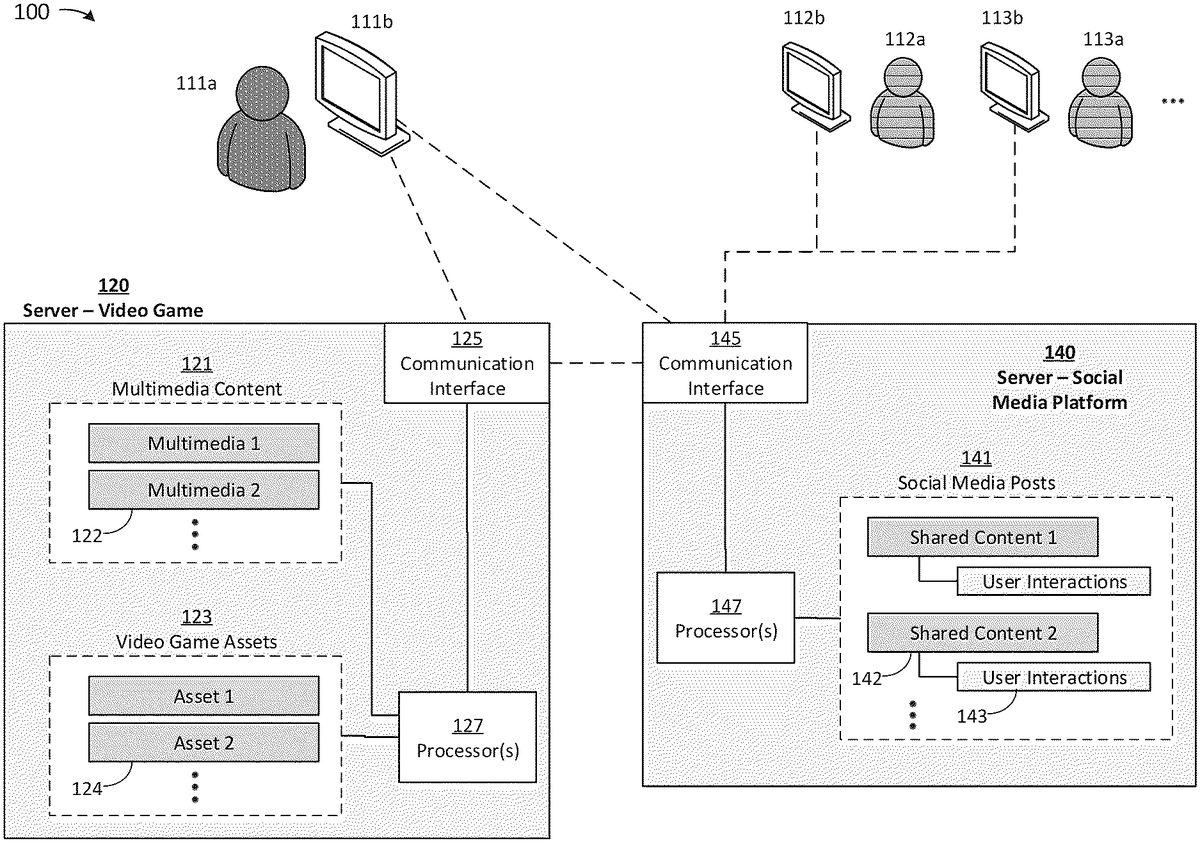
FIG.1illustrates a system suitable for practicing techniques described herein, according to some embodiments. In the example ofFIG.1, system100includes a user111awho may access a computing device111bon which a video game client may be executed. The video game client executing on computing device111bmay communicate with server120via communication interface125. The server120may communicate with servers of one or more social media platforms, of which server140is one example, to create one or more social media posts featuring shared content relating to the video game. Users112a,113a, . . . may interact with any one or more of these social media posts and results of such interactions may be stored on the server140. Subsequently, the server120may obtain indications of the user interactions from the server140, and processor(s)127may adapt video game assets123based on the number (and, in some cases, the types) of the interactions with the social media post.
In some embodiments, execution of various components of the video game and/or social media platform may be divided up between computing device111b, server120, server140, and/or any other devices in any suitable manner, including with server120and/or server140providing the social media functionality as discussed herein. For instance, in some embodiments, primary gameplay aspects of the video game (e.g., rendering of graphics and audio, generation of gameplay state, etc.) may be executed on the computing device111band the server120may be used and/or provided simply for the purposes of social media interactions. In some embodiments, computing device111bmay render graphics and/or audio locally but obtain a generated gameplay state from the server120and/or some other server (e.g., processor(s)127may generate said gameplay state in whole or in part).
In some embodiments, components of the video game executing on computing device111bmay be configured to provide authentication information associated with user111ato the server120to gain access to the social media functionality of the server (in addition to any components of the video game being executed on the server120).
According to some embodiments, computing device111bmay comprise any suitable computing device configured to execute one or more components of a video game. Illustrative computing devices may include a desktop computer, a mobile device, a tablet, or a gaming console. The computing device111bmay be any suitable system, including a desktop computer, a gaming console, a tablet, a mobile device, or the like. In some embodiments, the computing device111bmay be a dedicated game console, e.g., PLAYSTATION®3, PLAYSTATION®4, or PLAYSTATION® VITA manufactured by Sony Computer Entertainment, Inc.; WII™, WII U™, NINTENDO 2DS™, NINTENDO 3DS™, or NINTENDO SWITCH™ manufactured by Nintendo Co., Ltd.; or XBOX®, XBOX 360®, or XBOX ONE® manufactured by Microsoft Corp. In some embodiments, the computing device111bmay be a computer configured to run a virtual reality (VR) platform, such as those provided by Oculus, HTC, Sony, and/or the like, and discussed further herein. In other embodiments, the computing device111bcan be a general purpose desktop or laptop computer. In other embodiments, the computing device111bcan be a server connected to a computer network (e.g., including server120and/or server140). In other embodiments, the computing device111bcan be user equipment. The user equipment can communicate with one or more radio access networks and/or with wired communication networks. The user equipment can be a cellular phone. The user equipment can also be a smartphone providing services such as word processing, web browsing, gaming, and/or the like. The user equipment can also be a tablet computer providing network access and most of the services provided by a smartphone. The user equipment can operate using an operating system such as Symbian OS, iPhone OS, RIM's Blackberry, Windows Mobile, Linux, HP WebOS, and Android. The screen might be a touch screen that is used to input data to the mobile device, in which case the screen can be used instead of the full keyboard. The user equipment can also keep global positioning coordinates, spatial positioning information (e.g., roll, pitch, yaw, etc.), profile information, or other location information.
According to some embodiments, server120may be configured to receive multimedia content from the computing device111band store said multimedia content121on the server (e.g., multimedia item122). Such multimedia content may be generated by the computing device111band transmitted to the server120. For instance, computing device111bmay capture video and/or audio of gameplay of the video game and upload one or more files representing said captured video and/or audio to the server120. Additionally, or alternatively, user111amay produce multimedia content on computing device111b(e.g., by typing text) and transmit or upload the produced content to the server120. Transmission of multimedia content from the computing device111bto the server120may be initiated automatically by the video game executing on the computing device, in response to user111aproviding input requesting that such transmission take place, and/or the like.
In some embodiments, computing device111bmay capture video and/or audio of gameplay of the video game and upload one or more files representing said captured video and/or audio directly to the social media platform140(e.g., via the communication link between computing device111band social media platform140shown inFIG.1). In such cases, the user may provide information that indicates that the multimedia content relates to a particular video game, thereby allowing server120to recognize such content as being related to the game. For example, a user could tag (e.g., hashtag) or otherwise mark a social media post to indicate a video game associated with the uploaded multimedia content. In some embodiments, a social media post can be associated with the game using an identifier (ID). For example, when the computing device111b(e.g., a game client) posts a video to social media platform140, the social media server can include an ID (e.g., a unique ID) for the uploaded multimedia content as part of a reply to the computing device111b. The computing device111bcan report the ID to the game server120, and the game server120can keep track of which social media posts (e.g., by ID) are associated with the game.
According to some embodiments, server120may generate multimedia content and store said multimedia content121on the server. For instance, in embodiments in which server120executes a portion of the video game, processor(s)127may generate multimedia content and store said content121on the server.
As referred to herein, multimedia content may comprise any suitable combination of content, such as text, video, images and/or audio content. As also discussed herein, other content can be generated, including content based on gameplay and/or content generated based on the multimedia content.
As discussed above, in the example ofFIG.1, server120may be configured to communicate with servers of one or more social media platforms to create one or more social media posts featuring shared content relating to the video game. Such communication may comprise any suitable messages configured to request the social media platform to create the one or more social media posts, and can include information relating to the content of said one or more social media posts.
According to some embodiments, server120may be configured to generate request messages according to an Application Programming Interface (API) of a selected social media platform, wherein said request messages are configured to cause the social media platform to perform a particular action. For instance, processor(s)127of server120may be configured to generate one or more request messages to an API of the social media platform executed by server140to request that the platform create a social media post for user111a. Details of such a post may be specified by the API call and may include multimedia from amongst multimedia content121and/or may include links to such multimedia content. In some embodiments, request messages generated by the processor(s)127may comprise one or more messages in which authentication information for the user111aand the social media platform are provided so that the server120may initiate a social media post on behalf of the user111a.
In the example ofFIG.1, server120may be configured to transmit one or more items of multimedia content121(e.g., multimedia122) to the server140as part of the server120requesting that the server140create a social media post for the user111a. For instance, the multimedia item may be an image that is uploaded to the server140as part of a request to create a social media post comprising the image. Additionally or alternatively to transmitting the multimedia content, server120may be configured to transmit a suitable link to the multimedia content. For instance, server120may generate a URL to an item of the multimedia content121stored on the server120and transmit the URL to the server140as part of the request to create a social media post so that the social media post contains a link to the multimedia content. It will be appreciated that, in some instances, server120may also transfer multimedia to another server not shown inFIG.1and provide a link to the multimedia content on that server (e.g., through the use of a content delivery network, and/or the like), as this approach is not limited by the particular location at which the content is stored.
In the example ofFIG.1, server140is configured to store social media posts141which comprise shared content (e.g., content142) and have associated user interactions produced by users112a,113a, etc. In some embodiments, server140may generate a web page through which users112a,113a, etc. may view the social media posts and interact with the posts. Social media posts are generally referred to herein for illustrative purposes as comprising “shared content” rather than comprising “multimedia” since, as discussed above, a social media post may comprise a link to multimedia and/or may directly contain the multimedia. The shared content of a social media post141therefore represents any content, including multimedia content, that may be accessed through the server140, whether the content is stored on the server140itself or whether it is stored elsewhere and the server140stores a link to the content.
User interactions associated with the shared content stored by server140may comprise any one or more types of user interaction produced by users. For instance, a social media platform may provide multiple ways in which a user may interact with a social media post, and the user interactions stored by the server140may comprise indications of the number of each of the different types of interactions. As one example, a social media platform may allow users to indicate they approve of a social media post and may also allow users to share the post with their own social network. As a result, the user interactions stored by server140in association with a social media post comprising shared content may include an indication of how many times each of these two types of user interactions occurred with respect to the post.
According to some embodiments, user interactions with a social media post may include indications of approval (e.g., actions often referred to as a “like,” a “thumbs up,” an “upvote,” and/or other similar actions or interactions), indications of disapproval (e.g., actions often referred to as a “dislike,” a “thumbs down,” a “downvote,” and/or other similar actions or interactions), promulgation of the social media post (e.g., actions often referred to as sharing, “retweeting,” and/or other similar actions or interactions), views of the social media post (e.g., a number of impressions, a number of plays of a video, a number of views of a text-based post), or combinations thereof. In general, user interactions with a social media post as described herein may include any user interaction with the social media platform, including any user interaction for which the social media platform may create a metric based on the user interactions, such as a metric tracking the number of times such interactions occur. Moreover, indications of user interactions may include indications of any type of such user interactions.
In some cases, server140may infer indications of user interactions with a social media post from actions performed directly by users. For instance, in one social media platform users may interact with a social media post by submitting an upvote or a downvote, and server140may determine a fraction of users who upvoted and store said fraction as an indication of user interactions associated with the social media post.
As discussed above, in the example ofFIG.1, server120may be configured to obtain indications of the user interactions from the server140. According to some embodiments, server120may be configured to generate request messages according to an API of a selected social media platform, wherein said request messages are configured to request indications of the user interactions stored by server140that are associated with a particular social media post for a user that was previously created through interaction of the server120with the server140. In some cases, indications of the user interactions with a social media post may be publicly available (e.g., may be available on a public web page) and in such cases, server120may be configured to obtain said indications from the publicly accessible location (e.g., by parsing a web page) rather than by making an API call to the server140. In some embodiments, the server140may be configured to send data indicative of user interactions to the server120, such as periodically sending the data, sending the data based on a trigger, and/or the like.
According to some embodiments, server120requesting indications of user interactions from server140may be triggered by one or more messages received from computing device111b(e.g., user111aprovides input to the computing device111brequesting that the server obtain said indications). In some embodiments, server120may request indications of user interactions from server140for a particular social media post multiple times. In such cases, prior results of such requests may be stored by server120and later accessed as discussed below. In some embodiments, server120may request indications of user interactions from server140automatically (e.g., periodically, at certain times, etc.).
As discussed above, processor(s)127of server120may determine how to adapt in-game mechanics of a video game based on a number of interactions with a social media post. In the example ofFIG.1, processor(s)127may be configured to adapt one or more of video game assets123(e.g., asset124), which represent data associated with the video game. For instance, video game assets123may include data regarding the user111a's progress within the game (e.g., flags indicating whether portions of the game have been completed and/or values indicating a degree to which portions of the game have been completed), an in-game score (e.g., experience points (XP)), data indicating whether certain in-game items have been unlocked (e.g., skins, songs, weapons, characters, abilities, and/or other in-game items), data indicating an amount of an in-game currency (e.g., in-game money), or combinations thereof.
According to some embodiments, processor(s)127of server120may be configured to determine a score based on indications of user interactions received from server140and adapt video game assets123based on the determined score. In some cases, indications of user interactions relating to a particular social media post may have been previously received and stored by server120and, in such cases, determining the score may depend both on the previously received indications of user interactions in addition to newly-received indications of user interactions. For example, server120may have previously received and stored indications that a social media post had previously received 55 “likes,” and may subsequently receive indications that the social media post has now received 143 “likes.” Determining the score may, in some embodiments, be based upon the difference between the two indications (88 “likes” in this example).
According to some embodiments, processor(s)127of server120may be configured to determine a score for the user111abased at least in part on a number of instances of a user interaction represented by the received indications of user interactions. A score may, in some cases, be determined based on a linear relationship between the number of instances of the user interaction and the resulting score, e.g., score=(number of instances)×A, where A is a constant value. Other, non-linear relationships may also be applied, for example, relationships in which the determined score grows more slowly with additional instances as the number of instances increase (e.g., score=(number of instances)P×A, where P is a number between 0 and 1) and/or relationships in which the determined score grows faster (e.g., score=(number of instances)P×A, where P is greater than 1).
According to some embodiments, processor(s)127of server120may be configured to determine a score for the user111abased at least in part on a number of instances of different types of user interactions represented by the received indications of user interactions. A score may, in some cases, be determined by applying different weightings to different types of user interactions available for a given social media platform. For example, determining a score for a social media post on a social media platform that allows “likes” and “shares” as user interactions may weight a number of “likes” and a number of “shares” differently in determining the score. Alternatively, computing device111bmay perform at least part of such a determination. For instance, the server120or social media platform140may send data describing indications of user interactions received from social media platform140to computing device111b, which may compute a score for the received data. The resulting score may be, for example, sent to server120for storage. The data describing indications of user interactions received by computing device111bin this approach may comprise the indications of user interactions generated by social media platform140and/or one or more summaries of the received indications.
According to some embodiments, processor(s)127of server120may be configured to determine a score based at least in part on numbers of instances of user interactions represented by indications of user interactions received from different social media platforms. A score may, in some cases, be determined by aggregating numbers of user interactions from across multiple different social media platforms. For instance, a number of “likes” and/or views of a social media post on a first social media platform may be aggregated with a number of “likes” and/or views of a social media post on a second social media platform. In some examples, such aggregation may treat the user interactions from different platforms equally and/or may apply different weightings to user interactions from different social media platforms. In some examples, such aggregation may weigh the user interactions of viewers who are also players of the game differently from user interactions of viewers that do not play the game. Such a determination may also, in some cases, also weight different types of user interactions for a given social media platform differently as discussed above. The score can be used to influence the player who created the social media post, viewers that interact with the social media post, and/or the like. For example, in-game rewards relating to social media interactions can be awarded to the player who created a given social media artifact. As another example, players of the game who interact with the social media post (e.g., view and/or “like” the post) can be rewarded (e.g., a player can get rewarded for viewing someone else's video on social media).
According to some embodiments, processor(s)127of server120may be configured to adapt video game assets123, based on a score determined via any of the above-described techniques based on received indications of user interactions. Adapting video game assets123may comprise any operation by processor(s)127in which one or more of the video game assets123are modified, which may include altering data, adding data and/or removing data of the video game assets.
As a non-limiting example, adapting video game assets may include adjusting the user111a's progress within the video game (e.g., unlocking a new region, level, activity, song, and/or any other piece of content), adjusting an in-game score (e.g., increasing XP), unlocking in-game items or functions (e.g., unlocking a skin, a weapon, a new character, a new ability, and/or enabling access to other in-game items or functions), adjusting in-game currency (e.g., adding in-game money), or combinations thereof.
As examples and without limitation, suitable social media platforms as described herein may include Twitter®, Facebook®, Instagram®, Twitch®, Mixer®, Discord® or Reddit®. As referred to herein, social media platforms need not be limited to so-called social “networking” sites but may include any platform in which users may share content with other users.
FIG.2is a flowchart of a method of adapting assets of a video game of a user based on an aggregated measure of social media interaction, according to some embodiments. Method200may be performed by any suitable computing device or devices such as, for example, server120shown inFIG.1.
In act202, the computing device(s) performing method200transmits instructions to one or more social networking platforms to create a post on respective platforms in which multimedia content is shared. The multimedia content being shared relates to the video game and is created by the user. As discussed above in relation toFIG.1, such a request may in some cases be performed by generating a suitable request message for an API of the social networking platform. As such, act202may in some cases comprise generating multiple request messages according to different APIs of respective social networking platforms, wherein the messages are configured to share the same multimedia content across the different platforms. As discussed above, multimedia content may comprise text, audio, images and/or video and the multimedia content of the social media post may comprise multimedia transmitted to the social media platform and/or may comprise links to multimedia hosted elsewhere.
In some embodiments, transmitting instructions to one or more social networking platforms to create a post in act202may comprise a user accessing a social networking platform through a conventional front end (e.g., via a user interface of a web site or application) and creating a post comprising multimedia content (or linking to such content) via conventional means. As discussed above, such a post may be identified as corresponding to a particular video game by various techniques, including by the user tagging or otherwise marking the post as being associated with the video game and/or by the social media platform assigning the post an ID (e.g., which can be reported to the game server). In this case, act202may be performed by a different computing device than act204.
In act204, the computing device(s) performing method200obtains indications of user interaction with one or more social media posts from corresponding social media platforms. The indications of user interaction obtained in act204may correspond to the social media posts for which instructions were transmitted in act202and/or may correspond to other social media posts previously created through instructions transmitted by the computing device(s) performing method200to one or more social media platforms. In either case, the indications of user interaction obtained in act204relate to previously shared multimedia content from the video game.
In act206, the computing device(s) performing method200determines a score for the user based on the indications of user interactions obtained in act204. As one illustrative example,FIG.3depicts a lookup table for scoring various types of user interactions with posts on two illustrative social networking platforms, Facebook® and Twitter®. In the example ofFIG.3, lookup table300indicates, for a given social media platform310and a type of user interaction320associated with that social media platform, the corresponding effect on the score for each instance of that type of interaction.
For example, in act204indications of the following user interactions associated with social media posts comprising multimedia associated with the video game may be received: 24 Facebook® likes, 7 Facebook® shares, 154 Twitter® likes, 22 Twitter® retweets and 9 Twitter® comments. In act206, the computing device(s) performing method200may, as a result, by looking up the values330in lookup table300, generate a score of 2045=(24×10)+(7×50)+(154×5)+(22×25)+(9×15). While the values300in the example ofFIG.3are all positive, it will be appreciated that in general negative values may also be included in a lookup table (e.g., a downvote may decrease the determined score).
In act208of method200shown inFIG.2, one or more video game assets for the user are adapted based on the calculated score. In cases where a video game asset being adapted relates to a numerical quantity, the numerical value may be determined according to the determined score. For example, an in-game currency may be adjusted based on the score (e.g., proportionately), so in the above illustrative use case the score of 2045 may for instance result in an in-game currency gain for the user of $2,045.
In some embodiments, act206may comprise determining a change in the calculated score compared with an earlier calculated score for the same social media posts, and act208may adapt the video game assets according to the determined change. For example, if the social media posts in the above use case were previously examined and a score of 1420 was determined, video game assets may be adapted in act208based on the increase of 625 in the user's score determined by comparing the newly-determined score with the previously stored score. As a result, to avoid double-counting any in-game asset changes, adaptation of said assets may, in some embodiments, be performed according to the change in the score since assets were previously adapted according to the score.
FIGS.4A-4Ddepict a series of user interfaces to help illustrate the above-described techniques, according to some embodiments.FIG.4Aillustrates a user interface410for a video game in which a player named Adam has in-game currency assets of $23,591 and is a level 7 player according to info bar411. In the example ofFIG.4A, Adam has generated a video of him obtaining a high score in the video game, which is illustrated in user interface410via thumbnail412. User interface410includes two buttons413and414, each of which, when activated, will share the video to a respective social media platform.
FIG.4Bdepicts a user interface420of an illustrative social media platform's web site in which Adam has created a post of his video, which includes the text “Check out my HIGH SCORE video!”421. The post includes a thumbnail of the video422which may be activated by other users of the social media platform to view the video. Immediately after creating the post, it has zero likes or shares423.FIG.4Cdepicts a user interface430of the illustrative social media platform's web site shown inFIG.4Bat a subsequent time after Adam's post has received a number of likes and shares431.
FIG.4Dillustrates a user interface440for the video game after assets of the video game have been adapted based on the likes and shares that Adam's post received as shown inFIG.4C. The info bar441has been updated in view of the changes to Adam's in-game assets in which he received $3,700 of in-game currency and sufficient experience points (XP) to increase his level to level 8. It will be appreciated that these changes may be solely the result of the likes and shares that Adam's post received through the social media platform shown inFIG.4C, or may be the result of aggregating the likes and shares that Adam's post received through the social media platform shown inFIG.4Calong with user interactions with another post that Adam made relating to the same video on a different social media platform.
An illustrative implementation of a computer system500that may be used to perform any of the aspects of adapting video game assets based on an aggregated measure of social media interaction is shown inFIG.5. The computer system500may include one or more processors510and one or more non-transitory computer-readable storage media (e.g., memory520and one or more non-volatile storage media530). The processor510may control writing data to and reading data from the memory520and the non-volatile storage device530in any suitable manner, as the aspects of the invention described herein are not limited in this respect. To perform functionality and/or techniques described herein, the processor510may execute one or more instructions stored in one or more computer-readable storage media (e.g., the memory520, storage media, etc.), which may serve as non-transitory computer-readable storage media storing instructions for execution by the processor510.
In connection with techniques described herein, code used to, for example, generate request messages according to an API of a social media platform, transmit request messages, generate multimedia content for a video game, execute components of a video game, calculate a score based on received indications of user interactions, adapt video game assets based on a calculated score, etc. may be stored on one or more computer-readable storage media of computer system500. Processor510may execute any such code to provide any techniques for adapting video game assets based on an aggregated measure of social media interaction as described herein. Any other software, programs or instructions described herein may also be stored and executed by computer system500. It will be appreciated that computer code may be applied to any aspects of methods and techniques described herein. For example, computer code may be applied to interact with an operating system to transmit request messages or encode video or audio through conventional operating system processes.
The various methods or processes outlined herein may be coded as software that is executable on one or more processors that employ any one of a variety of operating systems or platforms. Additionally, such software may be written using any of numerous suitable programming languages and/or programming or scripting tools, and also may be compiled as executable machine language code or intermediate code that is executed on a virtual machine or a suitable framework.
In this respect, various inventive concepts may be embodied as at least one non-transitory computer readable storage medium (e.g., a computer memory, one or more floppy discs, compact discs, optical discs, magnetic tapes, flash memories, circuit configurations in Field Programmable Gate Arrays or other semiconductor devices, etc.) encoded with one or more programs that, when executed on one or more computers or other processors, implement the various embodiments of the present invention. The non-transitory computer-readable medium or media may be transportable, such that the program or programs stored thereon may be loaded onto any computer resource to implement various aspects of the present invention as discussed above.
The terms “program,” “software,” and/or “application” are used herein in a generic sense to refer to any type of computer code or set of computer-executable instructions that can be employed to program a computer or other processor to implement various aspects of embodiments as discussed above. Additionally, it should be appreciated that according to one aspect, one or more computer programs that when executed perform methods of the present invention need not reside on a single computer or processor, but may be distributed in a modular fashion among different computers or processors to implement various aspects of the present invention.
Computer-executable instructions may be in many forms, such as program modules, executed by one or more computers or other devices. Generally, program modules include routines, programs, objects, components, data structures, etc. that perform particular tasks or implement particular abstract data types. Typically, the functionality of the program modules may be combined or distributed as desired in various embodiments.
Also, data structures may be stored in non-transitory computer-readable storage media in any suitable form. Data structures may have fields that are related through location in the data structure. Such relationships may likewise be achieved by assigning storage for the fields with locations in a non-transitory computer-readable medium that convey relationship between the fields. However, any suitable mechanism may be used to establish relationships among information in fields of a data structure, including through the use of pointers, tags or other mechanisms that establish relationships among data elements.
Various inventive concepts may be embodied as one or more methods, of which examples have been provided. The acts performed as part of a method may be ordered in any suitable way. Accordingly, embodiments may be constructed in which acts are performed in an order different than illustrated, which may include performing some acts simultaneously, even though shown as sequential acts in illustrative embodiments.
The indefinite articles “a” and “an,” as used herein in the specification and in the claims, unless clearly indicated to the contrary, should be understood to mean “at least one.” As used herein in the specification and in the claims, the phrase “at least one,” in reference to a list of one or more elements, should be understood to mean at least one element selected from any one or more of the elements in the list of elements, but not necessarily including at least one of each and every element specifically listed within the list of elements and not excluding any combinations of elements in the list of elements. This definition also allows that elements may optionally be present other than the elements specifically identified within the list of elements to which the phrase “at least one” refers, whether related or unrelated to those elements specifically identified.
The phrase “and/or,” as used herein in the specification and in the claims, should be understood to mean “either or both” of the elements so conjoined, i.e., elements that are conjunctively present in some cases and disjunctively present in other cases. Multiple elements listed with “and/or” should be construed in the same fashion, i.e., “one or more” of the elements so conjoined. Other elements may optionally be present other than the elements specifically identified by the “and/or” clause, whether related or unrelated to those elements specifically identified. Thus, as a non-limiting example, a reference to “A and/or B”, when used in conjunction with open-ended language such as “comprising” can refer, in one embodiment, to A only (optionally including elements other than B); in another embodiment, to B only (optionally including elements other than A); in yet another embodiment, to both A and B (optionally including other elements); etc.
As used herein in the specification and in the claims, “or” should be understood to have the same meaning as “and/or” as defined above. For example, when separating items in a list, “or” or “and/or” shall be interpreted as being inclusive, i.e., the inclusion of at least one, but also including more than one, of a number or list of elements, and, optionally, additional unlisted items. Only terms clearly indicated to the contrary, such as “only one of” or “exactly one of,” or, when used in the claims, “consisting of,” will refer to the inclusion of exactly one element of a number or list of elements. In general, the term “or” as used herein shall only be interpreted as indicating exclusive alternatives (i.e. “one or the other but not both”) when preceded by terms of exclusivity, such as “either,” “one of,” “only one of,” or “exactly one of.” “Consisting essentially of,” when used in the claims, shall have its ordinary meaning as used in the field of patent law.
Use of ordinal terms such as “first,” “second,” “third,” etc., in the claims to modify a claim element does not by itself connote any priority, precedence, or order of one claim element over another or the temporal order in which acts of a method are performed. Such terms are used merely as labels to distinguish one claim element having a certain name from another element having a same name (but for use of the ordinal term).
The phraseology and terminology used herein is for the purpose of description and should not be regarded as limiting. The use of “including,” “comprising,” “having,” “containing”, “involving”, and variations thereof, is meant to encompass the items listed thereafter and additional items.
Having described several embodiments of the invention in detail, various modifications and improvements will readily occur to those skilled in the art. Such modifications and improvements are intended to be within the spirit and scope of the invention. Accordingly, the foregoing description is by way of example only, and is not intended as limiting. The invention is limited only as defined by the following claims and the equivalents thereto.
Claims
- A computer-implemented method of adapting a video game based on social media interaction, the method comprising using at least one computer hardware processor to perform: sending, to a computing device associated with a social media platform, instructions to create a social media post in a social media platform, the social media post comprising at least one piece of multimedia content relating to a video game, the at least one piece of multimedia content produced by a player of the video game;receiving, from the computing device, data indicative of user interaction with the social media post, wherein the user interaction with the social media post comprises an action tracked by the social media platform;and determining a score for the player based at least in part on a type of the action tracked by the social media platform indicated by the received data, wherein the type is one of a plurality of different types of possible interactions with the social media post.
- The computer-implemented method of claim 1, wherein the type comprises a like of the social media post, a share of the social media post, a retweet of the social media post, a comment of the social media post, or some combination thereof.
- The computer-implemented method of claim 1, wherein determining the score comprises determining the score based on the type of the action and a number of occurrences of the action.
- The computer-implemented method of claim 1, further comprising: receiving, from the computing device, second data indicative of second user interaction with the social media post, wherein the user interaction with the social media post comprises a second type of a second action tracked by the social media platform that is different than the type of the action;and determining the score for the player comprises determining the score based at least in part on: the type of the action tracked by the social media platform indicated by the received data;and the second type of the second action tracked by the social media platform.
- The computer-implemented method of claim 4, wherein determining the score comprises: weighting the type of the action according to a first weight;and weighting the second type of the second action according to a second weight that is different than the first weight.
- The computer-implemented method of claim 5, wherein determining the score comprises: weighting a first number of occurrences of the action according to the first weight;and weighting a second number of occurrences of the second action according to the second weight.
- The computer-implemented method of claim 1, further comprising modifying an aspect of gameplay within the video game for the player based at least in part on the determined score for the player.
- The computer-implemented method of claim 7, wherein modifying the aspect of gameplay within the video game comprises: generating, based on the received data indicative of user interaction with the social media post, a request to modify an account associated with the player of the video game to adapt one or more assets within the video game based on the score;and transmitting the request to one or more second computing devices associated with the video game.
- The computer-implemented method of claim 8, wherein the one or more second computing devices associated with the video game comprise a video game server providing one or more aspects of the video game.
- The computer-implemented method of claim 7, wherein modifying the aspect of gameplay within the video game comprises modifying an account associated with the player to adapt one or more assets within the video game.
- The computer-implemented method of claim 1, further comprising: receiving, from the computing device associated with the social media platform, second data indicative of one or more second indications of user interaction with the social media post;and wherein determining the score for the player comprises determining the score for the player based at least in part on: the received data indicative of the user interaction with the social media post;and the received second data indicative of the one or more second indications of user interaction with the social media post.
- The computer-implemented method of claim 1, further comprising: sending, to a second computing device associated with a second social media platform, second instructions to create a second social media post comprising the at least one piece of multimedia content relating to the video game;receiving, from the second computing device, second data indicative of one or more indications of user interaction with the second social media post;and wherein determining the score for the player comprises determining the score for the player based at least in part on: the received data indicative of the user interaction with the social media post;and the received second data indicative of one or more indications of user interaction with the second social media post.
- An apparatus for adapting a video game based on social media interaction, the apparatus comprising a processor in communication with a memory, the processor being configured to execute instructions stored in the memory that cause the processor to perform: sending, to a computing device associated with a social media platform, instructions to create a social media post in a social media platform, the social media post comprising at least one piece of multimedia content relating to a video game, the at least one piece of multimedia content produced by a player of the video game;receiving, from the computing device, data indicative of user interaction with the social media post, wherein the user interaction with the social media post comprises an action tracked by the social media platform;and determining a score for the player based at least in part on a type of the action tracked by the social media platform indicated by the received data, wherein the type is one of a plurality of different types of possible interactions with the social media post.
- The apparatus of claim 13, wherein the type comprises a like of the social media post, a share of the social media post, a retweet of the social media post, a comment of the social media post, or some combination thereof.
- The apparatus of claim 13, wherein determining the score comprises determining the score based on the type of the action and a number of occurrences of the action.
- The apparatus of claim 13, wherein the instructions further cause the processor to perform: receiving, from the computing device, second data indicative of second user interaction with the social media post, wherein the user interaction with the social media post comprises a second type of a second action tracked by the social media platform that is different than the type of the action;and determining the score for the player comprises determining the score based at least in part on: the type of the action tracked by the social media platform indicated by the received data;and the second type of the second action tracked by the social media platform.
- The apparatus of claim 16, wherein determining the score comprises: weighting the type of the action according to a first weight;and weighting the second type of the second action according to a second weight that is different than the first weight.
- The apparatus of claim 17, wherein determining the score comprises: weighting a first number of occurrences of the action according to the first weight;and weighting a second number of occurrences of the second action according to the second weight.
- The apparatus of claim 13, wherein the instructions further cause the processor to perform modifying an aspect of gameplay within the video game for the player based at least in part on the determined score for the player.
- At least one non-transitory computer-readable storage medium storing processor-executable instructions that, when executed by at least one computer hardware processor, cause the at least one computer hardware processor to perform the acts of: sending, to a computing device associated with a social media platform, instructions to create a social media post in a social media platform, the social media post comprising at least one piece of multimedia content relating to a video game, the at least one piece of multimedia content produced by a player of the video game;receiving, from the computing device, data indicative of user interaction with the social media post, wherein the user interaction with the social media post comprises an action tracked by the social media platform;and determining a score for the player based at least in part on a type of the action tracked by the social media platform indicated by the received data, wherein the type is one of a plurality of different types of possible interactions with the social media post.
Disclaimer: Data collected from the USPTO and may be malformed, incomplete, and/or otherwise inaccurate.