U.S. Pat. No. 11,794,097
VIDEO GAME CONTROLLER WITH AUDIO CONTROL
AssigneeVoyetra Turtle Beach, Inc.
Issue DateSeptember 16, 2021
Illustrative Figure
Abstract
This disclosure describes a system that allows a user to control the audio of a headset from a game controller. Audio controls are displayed on a screen of the game controller. In addition to the game controller, the disclosed system may comprise an app, on a device external from the game controller, that is also able to display the audio controls. The audio controls may be updated via the game controller or the app while the game controller and headset are being used.
Description
DETAILED DESCRIPTION This disclosure describes a game controller system that allows a user to access and adapt the features of a game controller as well as secondary actions associated with the gaming experience. The disclosed game controller system may comprise a mobile application (app), on a device external from the game controller, that is operable to adjust settings and profiles of the game controller. These settings and profiles are viewable, by the user, from a screen on the game controller. Certain embodiments of the disclosure may be found in a game controller with a user interface. In accordance with various embodiments of the disclosure, a device, such as a smartphone or tablet, may control settings and profiles, used by the game controller, that may be displayed on the user interface of the game controller. The device may adapt and adjust the settings and profiles even while the game controller is being actively used during a game. The device may communicate with the game controller wirelessly via Bluetooth, Wi-Fi, or any other wireless protocol. The game controller, disclosed herein, is not platform-specific and may communicate with a game console wired or wirelessly via Bluetooth, Wi-Fi, or any other wireless protocol. The disclosed game controller system offers responsive and reliable controls that improve a user's audio control. In addition, the disclosed game controller system also delivers innovative applications of technology that improve a user's experience. FIG.1illustrates an exemplary video game controller100with a graphical user interface101displaying a menu. The game controller100is configured to operate a video game and also comprises a memory, a processor and a screen101. The memory in the game controller100is configured to store data associated with the game controller100. The processor in the game controller100is configured to access the memory. The screen101is operably coupled to the processor and is configured ...
DETAILED DESCRIPTION
This disclosure describes a game controller system that allows a user to access and adapt the features of a game controller as well as secondary actions associated with the gaming experience. The disclosed game controller system may comprise a mobile application (app), on a device external from the game controller, that is operable to adjust settings and profiles of the game controller. These settings and profiles are viewable, by the user, from a screen on the game controller.
Certain embodiments of the disclosure may be found in a game controller with a user interface. In accordance with various embodiments of the disclosure, a device, such as a smartphone or tablet, may control settings and profiles, used by the game controller, that may be displayed on the user interface of the game controller. The device may adapt and adjust the settings and profiles even while the game controller is being actively used during a game. The device may communicate with the game controller wirelessly via Bluetooth, Wi-Fi, or any other wireless protocol. The game controller, disclosed herein, is not platform-specific and may communicate with a game console wired or wirelessly via Bluetooth, Wi-Fi, or any other wireless protocol.
The disclosed game controller system offers responsive and reliable controls that improve a user's audio control. In addition, the disclosed game controller system also delivers innovative applications of technology that improve a user's experience.
FIG.1illustrates an exemplary video game controller100with a graphical user interface101displaying a menu. The game controller100is configured to operate a video game and also comprises a memory, a processor and a screen101. The memory in the game controller100is configured to store data associated with the game controller100. The processor in the game controller100is configured to access the memory. The screen101is operably coupled to the processor and is configured to display the data to the user of the game controller100. The game controller100may comprise a wireless interface that is operable to communicate directly with a video game console. A dongle may be plugged into the video game console to allow the wireless communication. For example, a USB connection on the video game console may be adapted, via the dongle, to communicate with the game controller100via Bluetooth, Wi-Fi or any other wireless protocol.
The screen101is integrated into the game controller100. The screen101may comprise a graphical user interface and a touch screen. For example, the screen101may comprise a capacitive touch display. The screen101may also comprise a high resolution display with deep blacks and rich color. The screen101may be covered by a tempered glass that may be configured with smooth3D curves on the edges.
The screen101may display programmable settings, profiles, and/or metrics. What and how elements are displayed is adjustable, via the processor, even while the game controller100is in use. The display on the screen101may provide a quick, in-game access to the settings, profiles, and/or metrics. The game controller100may comprises one or more buttons117for controlling what is displayed on the screen101. The game controller100may also comprises one or more backlit controls115.
The graphical user interface101inFIG.1illustrates a menu of core features103, a user icon105, user name107, a communication setting109, a battery charge level111, and an estimate time113until a battery must be recharged. This menu is a user-customizable dashboard that can be designed and redesigned by a user as desired for easy access to most frequently used features and to provide an overview of the controller100status. For example, an intuitive user interface may allow a user to quickly and easily change settings as desired.
Because the screen101is operable to display a customizable, user interface, the user interface may be configured to indicate primary features of the game controller and secondary features/actions of the game experience. The menu carousel103may be selectable by touch or the core feature set hubs may be accessed using the button117. As illustrated inFIG.1, the core hubs may comprise Home, Loadouts, Audio, Audio control and Social. The Audio Control hub may comprise details on how secondary features in a headset are being controlled.
The user icon105and user name107may be selectable according to who is using the game controller100at any given time. The communication setting109may toggle between allowing and blocking communication via social media and other communication devices. The processor in the game controller100may be operable to control communication from an external device.
The game controller100may comprise a rechargeable battery. The battery charge level111and the estimate time113until a battery must be recharged are useful for indicating when a battery needs to be swapped or recharged. Recharging may be performed via a cable or a dedicated cradle.
FIG.2illustrates an exemplary video game controller100with a graphical user interface displaying an audio control screen201that is also identified via the audio control icon203.
Audio control screen201as illustrated comprises a mute/unmute toggle button205, a Superhuman Hearing® enable/disable toggle button207, a game volume slider209, a chat volume slider211, a mic monitor volume slider209, a selector for altering a user's microphone output215and a selector for altering a user's headphone output217.
The game volume slider209, chat volume slider211and mic monitor volume slider209provide full access to a game platform's audio controls for mixing game volume, chat and mic.
The selector for altering a user's microphone output215may enable clearer chat to teammates. Alternatively, the selector215may be used to disguise a user's voice. For example, a user could choose a preprogrammed robot voice as illustrated.
Audio features may also be programmed and selected for a user's headphone output217. Equalizer customization may be used to generate a number of profiles. These profiles may also be game-specific and/or user-specific. Equalizer setting may be linked to a particular loadouts so that an audio experience changes dynamically depending on the game that a user is playing.
The audio control screen201may also comprise the communication setting indicator109and the battery charge level indicator111as described with reference to the exemplary display101inFIG.1.
Audio control from the game controller100may be performed via edge and/or cloud computing. Historic audio response may be displayed to show volume levels over time. Core audio adjustment input may be shown on the screen. The layout of such audio adjustment input may be designed, controlled and revealed via an application that runs on the game controller100and/or via a mobile application (app) that runs on an external device.
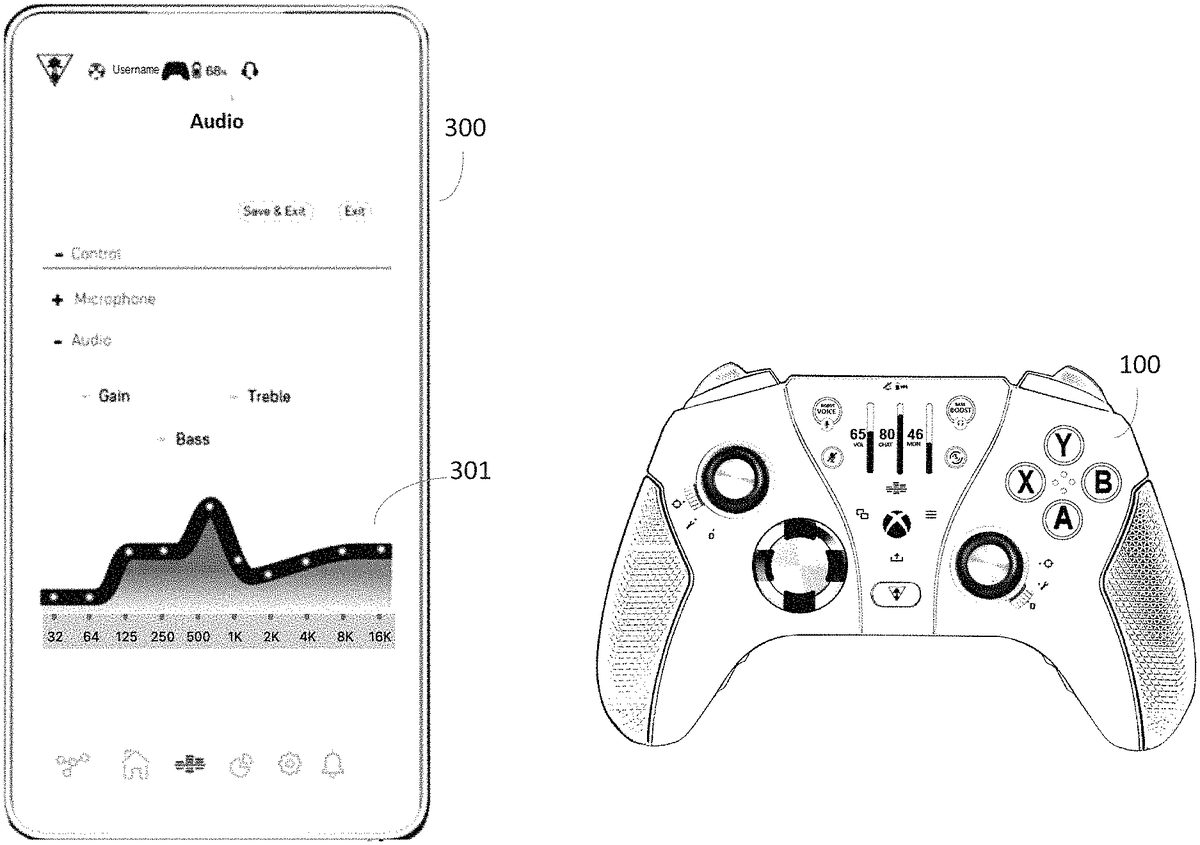
FIG.3illustrates an exemplary video game controller100and an associated app300running on a mobile device. As illustrated, the app300on the mobile device is used to configure and dynamically display the audio control screen201on the game controller100.
An app300may be configured to operate on a device external from the game controller100. The app300is operable to adjust the data used by the game controller100even while the game controller100is in use. The device may be, for example, a smartphone or a tablet. The game controller100may comprise a wireless interface that is operable to communicate directly with the device. For example, a particular screen layout design can be created on the companion app300and sent to onboard memory of the controller100. The app300may also be enabled to access storage of a cloud service provider and be powered by the cloud. The app300may provide full access to the game controller100to customize and improve audio control.
The companion app300may be used to create user-customized equalizer profiles for headphones and/or microphones that may be connected to headphones. Once created, the equalizer profiles may be sent to the controller100.
As illustrated, the app300may be used to create a microphone equalizer profile. An equalizer301can be controlled manually per band. Also, an overall gain, bass boost or treble boost may be applied on top of the manual adjustments. Similarly, one or more headphone equalizer profiles may be created and saved in the app300. Profiles for microphones and headphones may also be downloaded or shared between users.
While the present system has been described with reference to certain implementations, it will be understood by those skilled in the art that various changes may be made and equivalents may be substituted without departing from the scope of the present system. In addition, many modifications may be made to adapt a particular situation or material to the teachings of the present disclosure without departing from its scope. Therefore, it is intended that the present method and/or system not be limited to the particular implementations disclosed, but that the present system will include all implementations falling within the scope of the appended claims.
Throughout this disclosure, the use of the terms dynamically and/or adaptively with respect to an operation means that, for example, parameters for, configurations for and/or execution of the operation may be configured or reconfigured during run-time (e.g., in, or near, real-time) based on newly received or updated information or data. For example, an operation within a transmitter and/or a receiver may be configured or reconfigured based on, for example, current, recently received and/or updated signals, information and/or data.
The present method and/or system may be realized in hardware, software, or a combination of hardware and software. The present methods and/or systems may be realized in a centralized fashion in at least one computing system, or in a distributed fashion where different elements are spread across several interconnected computing systems. Any kind of computing system or other apparatus adapted for carrying out the methods described herein is suited. A typical combination of hardware and software may be a general-purpose computing system with a program or other code that, when being loaded and executed, controls the computing system such that it carries out the methods described herein. Another typical implementation may comprise an application specific integrated circuit or chip. Some implementations may comprise a non-transitory machine-readable (e.g., computer readable) medium (e.g., FLASH drive, optical disk, magnetic storage disk, or the like) having stored thereon one or more lines of code executable by a machine, thereby causing the machine to perform processes as described herein.
As utilized herein the terms “circuits” and “circuitry” refer to physical electronic components (i.e. hardware) and any software and/or firmware (“code”) which may configure the hardware, be executed by the hardware, and or otherwise be associated with the hardware. As used herein, for example, a particular processor and memory may comprise first “circuitry” when executing a first one or more lines of code and may comprise second “circuitry” when executing a second one or more lines of code. As utilized herein, “and/or” means any one or more of the items in the list joined by “and/or”. As an example, “x and/or y” means any element of the three-element set {(x), (y), (x, y)}. In other words, “x and/or y” means “one or both of x and y”. As another example, “x, y, and/or z” means any element of the seven-element set {(x), (y), (z), (x, y), (x, z), (y, z), (x, y, z)}. In other words, “x, y and/or z” means “one or more of x, y and z”. As utilized herein, the term “exemplary” means serving as a non-limiting example, instance, or illustration. As utilized herein, the terms “e.g.,” and “for example” set off lists of one or more non-limiting examples, instances, or illustrations. As utilized herein, circuitry is “operable” to perform a function whenever the circuitry comprises the necessary hardware and code (if any is necessary) to perform the function, regardless of whether audio control of the function is disabled or not enabled (e.g., by a user-configurable setting, factory trim, etc.).
Claims
- A system comprising: a game controller configured to operate a video game, the game controller comprising: a memory configured to store an audio processing setting in the game controller;a processor configured to access the audio processing setting;a wireless interface to communicate with a video game console and a device other than the video game console;and a screen, operably coupled to the processor, configured to display the audio processing setting to a user of the game controller, wherein: the screen comprises a graphical user interface and a touch screen, the graphical user interface is to access to a user-customizable dashboard, the user-customizable dashboard comprises an audio control hub to change the audio processing setting, and the audio processing setting adjusts, via the memory, the processor and the wireless interface, one or more of a video game volume, a chat volume and a microphone volume, the system comprises an application (“app”) configured to operate on the device external from the game controller, wherein the app is operable to display the audio processing setting.
- The system of claim 1, wherein the app is a mobile app and the device is a smartphone.
- The system of claim 1, wherein the app is a mobile app and the device is a tablet.
- The system of claim 1, wherein the audio processing setting is updated while the game controller is in use.
- The system of claim 1, wherein the processor is operable to control an audio signal that is sent to a headset.
- The system of claim 1, wherein the processor is operable to control an audio signal that is received from a microphone.
- A method comprising: communicating, via a wireless interface, with a video game console and a device other than the video game console;storing an audio processing setting in a memory of the game controller;accessing, via a processor of the game controller, the audio processing setting stored in the memory;displaying the audio processing setting on a screen of the game controller;changing the audio processing setting via an audio control hub of a user-customizable dashboard on a graphical user interface of the screen;according to the audio processing setting, adjusting, via the memory, the processor and the wireless interface, one or more of a video game volume, a chat volume and a microphone volume;and displaying the audio processing setting via an application (“app”) operating on the device external from the game controller.
- The method of claim 7, wherein the app is a mobile app and the device is a smartphone.
- The method of claim 7, wherein the app is a mobile app and the device is a tablet.
- The method of claim 7, wherein the audio processing setting is updated while the game controller is in use.
- The method of claim 7, wherein the method comprises: controlling an audio signal via a processor of the game controller, thereby generating a controlled audio signal;and sending the controlled audio signal to a headset.
- The method of claim 7, wherein the method comprises: receiving an audio signal from a microphone;and controlling the audio signal via the processor of the game controller.
- A non-transitory computer-readable medium storing a program, wherein when operated by a processor, the program configures a method comprising: communicating, via a wireless interface, with a video game console and a mobile device other than the video game console, wherein the mobile device, external to the video game controller, comprises the non-transitory computer-readable medium and the processor;updating, via an audio control hub of a user-customizable dashboard on a graphical user interface of a screen of the game controller, an audio processing setting that is stored in a video game controller;according to the audio processing setting, adjusting one or more of a video game volume, a chat volume and a microphone volume;and displaying the audio processing setting on the screen of the game controller.
- The non-transitory computer-readable medium of claim 13, wherein the video game controller comprises the non-transitory computer-readable medium and the processor.
- The non-transitory computer-readable medium of claim 13, wherein the mobile device is one of a smartphone and a tablet.
- The non-transitory computer-readable medium of claim 13, wherein the method comprises: controlling an audio signal, thereby generating a controlled audio signal;and sending the controlled audio signal to a headset.
- The non-transitory computer-readable medium of claim 13, wherein the method comprises: receiving an audio signal from a microphone;and controlling the audio signal.
Disclaimer: Data collected from the USPTO and may be malformed, incomplete, and/or otherwise inaccurate.