U.S. Pat. No. 11,771,990
GAME PROGRAM, GAME PROCESSING METHOD, AND INFORMATION PROCESSING APPARATUS
AssigneeGREE, Inc.
Issue DateFebruary 24, 2022
Illustrative Figure
Abstract
A game program causes a computer to implement: a screen information generating function of generating information for displaying, in a display area of a game screen, a field where a plurality of objects is arranged, a character capable of moving in the field, and a game medium having certain status information; and an instruction accepting function of accepting from a user an instruction regarding an operation of the character. The screen information generating function further includes a preceding object information generating function of generating information for displaying, in the display area of the game screen, preceding object information regarding a plurality of objects arranged in the display area as the character moves.
Description
DETAILED DESCRIPTION An information processing apparatus according to exemplary embodiments will be described in detail with reference to the drawings. Firstly, a configuration in which an information processing apparatus according to an exemplary embodiment functions as a mobile terminal, and a game program according to an exemplary embodiment is executed as a so-called native application (native game) by the mobile terminal will be described as a first embodiment. Subsequently, a configuration in which the information processing apparatus according to an exemplary embodiment functions as a server apparatus, the game program according to an exemplary embodiment is partially or entirely executed as a so-called web application (web game) by the server apparatus, and the execution result is returned to the mobile terminal will be described as a second embodiment. An information processing apparatus according to the first exemplary embodiment will be described with reference to exemplaryFIGS.1to9. An information processing apparatus100according to the embodiment may be a mobile terminal capable of executing a game program including processing described below. The information processing apparatus100is not specifically limited to a mobile terminal as long as this device can execute the processing, and the information processing apparatus100may be, for example, a smart phone, a tablet terminal, a home video game machine, a mobile game machine, a personal computer, or other electronic devices, as desired. ExemplaryFIG.1is a block diagram illustrating the main configuration of the information processing apparatus100. As illustrated in exemplaryFIG.1, the information processing apparatus100may include a controller10and an instruction acceptor20. The controller10may be operable to control various functions of the information processing apparatus100. The controller10may include a screen information generator11. ExemplaryFIG.2schematically illustrates a display area of a game screen displayed on the basis of information generated by the screen information generator11. As illustrated in exemplaryFIG.2, the screen information generator11can generate information for displaying a ...
DETAILED DESCRIPTION
An information processing apparatus according to exemplary embodiments will be described in detail with reference to the drawings.
Firstly, a configuration in which an information processing apparatus according to an exemplary embodiment functions as a mobile terminal, and a game program according to an exemplary embodiment is executed as a so-called native application (native game) by the mobile terminal will be described as a first embodiment.
Subsequently, a configuration in which the information processing apparatus according to an exemplary embodiment functions as a server apparatus, the game program according to an exemplary embodiment is partially or entirely executed as a so-called web application (web game) by the server apparatus, and the execution result is returned to the mobile terminal will be described as a second embodiment.
An information processing apparatus according to the first exemplary embodiment will be described with reference to exemplaryFIGS.1to9.
An information processing apparatus100according to the embodiment may be a mobile terminal capable of executing a game program including processing described below. The information processing apparatus100is not specifically limited to a mobile terminal as long as this device can execute the processing, and the information processing apparatus100may be, for example, a smart phone, a tablet terminal, a home video game machine, a mobile game machine, a personal computer, or other electronic devices, as desired.
ExemplaryFIG.1is a block diagram illustrating the main configuration of the information processing apparatus100. As illustrated in exemplaryFIG.1, the information processing apparatus100may include a controller10and an instruction acceptor20.
The controller10may be operable to control various functions of the information processing apparatus100. The controller10may include a screen information generator11.
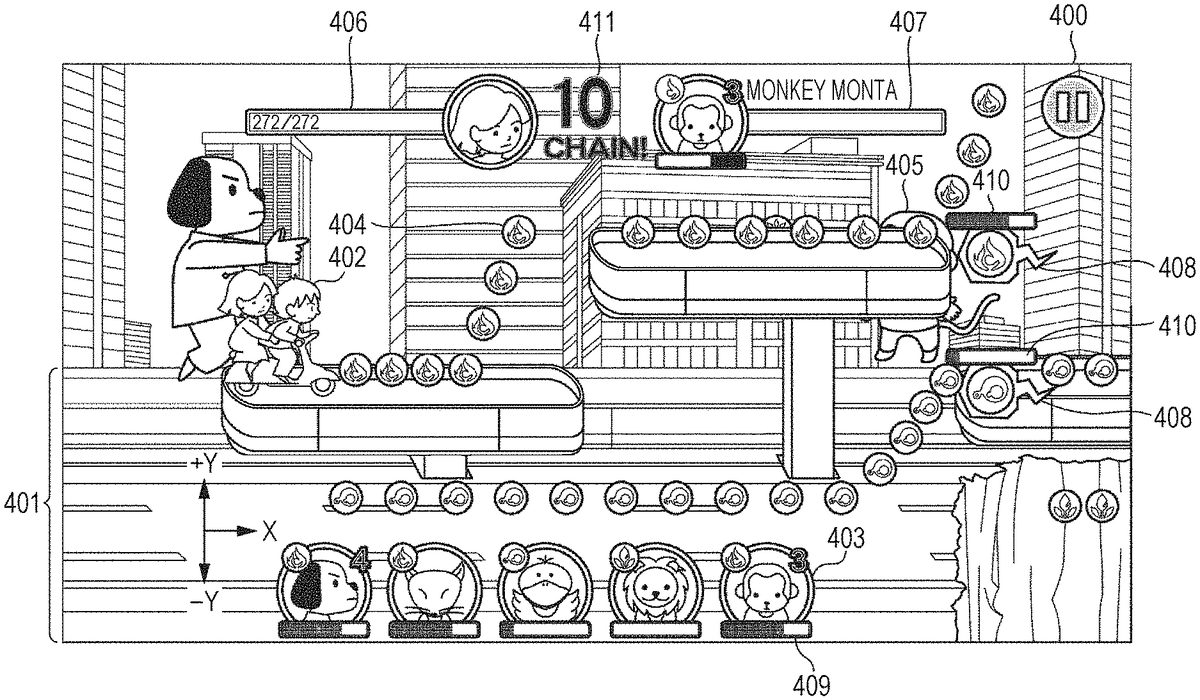
ExemplaryFIG.2schematically illustrates a display area of a game screen displayed on the basis of information generated by the screen information generator11. As illustrated in exemplaryFIG.2, the screen information generator11can generate information for displaying a field401, a character402, and a game medium403in a display area400of the game screen.
A number of objects404may be arranged in the field401.
The objects404may be circular, for example. However, the objects404are not limited to this shape and may have an arbitrary shape or shapes. In addition, attributes are set to the objects404, and the objects404are colored in colors corresponding to the attributes. The objects404may include an object without an attribute for recovering the health of a character. Furthermore, the objects404may be displayed in units of multiple objects404. Details will be described later in further exemplary embodiments.
The character402is capable of moving in the field401.
The character402may be operated by a user, and the character402may represent, for example, a human being, an animal, and/or a vehicle, as desired. In a game implemented by the exemplary embodiment, the character402can combat an opponent405. In addition, health, measured in hit points (HP), can be set for the character402and the opponent405, and the HPs of the character402and the opponent405may be displayed as a character health gauge406and an opponent health gauge407, respectively, in the display area400.
Movement of the character402can include, for example, forced horizontal forward movement in the field401(a direction of the arrow X in exemplaryFIG.2), movement in a direction of a resultant vector obtained by combining a vertical upward (a direction of the arrow +Y in exemplaryFIG.2) vector based on a jump instruction given from the user, as will be described later, and a vector of the direction of the arrow X, and movement in a direction of a resultant vector obtained by combining a vertical downward (a direction of the arrow −Y in exemplaryFIG.2) vector based on a drop instruction given from the user, as will be described later, and a vector of the direction of the arrow X.
The game medium403can have certain status information.
The game medium403can be used for a combat between the character402and the opponent405, and may represent, for example, a human being, an animal, and/or a vehicle, as desired. The game medium403may be stored in a later-described storage unit. A number of game media403may be arranged on a deck in accordance with selections made in advance by the user. Details will be described later.
The status information may include, for example, the attribute, level, health (HP), attack ability, recovery ability, cost, skill, leader skill, reality, or integrated information. The cost may be a value that consumes a cost set in advance on the deck when a game medium403is arranged on the deck. The skill may be a special action taken in the case where the number of actions taken by a game medium403becomes a certain number or greater, such as an action for recovering the health of the character402. The leader skill can be an effect caused when a game medium403is arranged as a leader on the deck, such as an effect of increasing the attack ability of a game medium403with a particular attribute. The integrated information will be described in detail later.
In addition, the status of a game medium403may be strengthened by combining the game medium403with another game medium403.
In addition, as illustrated in exemplaryFIG.1, the screen information generator11further can include a preceding object information generator12.
As illustrated in exemplaryFIG.2, the preceding object information generator12generates information for displaying, in the display area400of the game screen, preceding object information408regarding a plurality of objects404arranged in the display area400as the character402moves.
The shape of the preceding object information408is not limited to a particular shape as long as it is distinguishable from the objects404, for example, and the preceding object information408may have an arbitrary shape. Specifically, in order for the user to instantaneously recognize the attribute of an object404to be displayed next, it may be desired that the preceding object information408be represented in such a manner that the attribute of the next-displayed object404is identifiable by color.
The instruction acceptor20can accept from the user an instruction regarding an operation of the character402.
The instruction may include the above-mentioned jump instruction and drop instruction. In the case where the field401has a number of levels, for example, as illustrated in exemplaryFIG.3, the drop instruction may be given to move to a lower level.
Accordingly, a game implemented by the exemplary embodiment may be a game intended to reduce the health (HP) of the opponent405by causing the character402to jump up or drop down in the field401to obtain an object404, and to cause the game medium403to attack the opponent405on the basis of the obtained object404.
According to the configuration of the exemplary embodiment, displaying the preceding object information408in the display area400of the game screen can implement a game with a user-friendly game screen where information necessary for devising a strategy is easy to view, while requiring a user to devise a highly complex strategy.
In addition, the status information on a game medium403may include integrated information related to the status of the game medium403.
The integrated information may be information related to the degree of integration of an attribute parameter that changes in response to contact with an object404. The information related to the degree of integration may be, for example, an integration ratio of the integrated value of an attribute parameter with respect to a certain preset threshold. Specifically, when the character402contacts an object404, the attribute parameter of a game medium403including attribute information that matches the attribute information on the object404that the character402contacts may increase. The integrated information may be displayed as an attribute gauge409, for example, as illustrated in exemplaryFIG.2, along with the game medium403. Although the attribute gauge409may visually represent the ratio of the current integrated value with respect to the threshold, the integrated information is not limited thereto. Alternatively, the integrated information may be displayed as a numeral that represents the ratio of the current integrated value of an attribute parameter with respect to a certain threshold.
In addition, as illustrated in exemplaryFIG.1, the screen information generator11may further include an integrated information generator13.
As illustrated in exemplaryFIG.2, the integrated information generator13can generate information for displaying, in the display area400of the game screen, together with the preceding object information408displayed by the preceding object information generator12, integrated information on each game medium403corresponding to a corresponding one of a plurality of objects404arranged in the display area400as the character402moves.
Integrated information on each game medium403corresponding to a corresponding one of a plurality of objects404arranged in the display area400as the character402moves may be integrated information on each game medium403including attribute information that matches attribute information on a corresponding one of these objects404. Although the integrated information may be displayed as an attribute gauge410, the integrated information is not limited to the attribute gauge410, and, for example, a numeral representing the integration ratio of an attribute parameter may be displayed. In addition, the attribute gauge410may be displayed near the preceding object information408, and, more specifically, it may be desired the attribute gauge410be displayed at a position such that the user can simultaneously and instantaneously recognize the preceding object information408and the attribute gauge410.
As described above, the preceding object information408can include attribute information on a corresponding one of a plurality of objects404arranged in the display area400as the character402moves, and the integrated information includes the attribute information on each game medium403. The integrated information generator13may generate information for displaying the integrated information on each game media403including attribute information that matches attribute information on a corresponding one of a plurality of objects404arranged in the display area400as the character402moves.
Here, the above-mentioned attribute information on the objects404will be described in detail with reference to exemplaryFIGS.4aand4b.
As illustrated in exemplaryFIG.4a, for example, a fire attribute4a, a water attribute4b, a wood attribute4c, a darkness attribute4d, or a light attribute4eis set as attribute information on an object404, and an object404having each item of attribute information may be displayed in red, blue, green, purple, or yellow, respectively. In addition, a rainbow color object404is operable to change integrated information on all game media403, irrespective of the attributes of the game media403.
In addition, like the attribute information on the objects404, a fire attribute (red), a water attribute (blue), a wood attribute (green), a darkness attribute (purple), or a light attribute (yellow) is set as attribute information on each game medium403, and, as illustrated in exemplaryFIG.4b, the attribute information on each game medium403may be displayed in the upper left-hand part of a character of the game medium403. Similarly, attribute information is set for the opponent405, and the attributes of each game medium403and the opponent405have a power relationship such as that illustrated in exemplaryFIG.5. Specifically, the fire attribute can be stronger than the wood attribute and may be weaker than the water attribute. The water attribute can be stronger than the fire attribute and can be weaker than the wood attribute. The wood attribute can be stronger than the water attribute and can be weaker than the fire attribute. The light and darkness attributes can have a contrasting relationship. A stronger attribute may do double damage to a weaker attribute, and a weaker attribute may do half damage to a stronger attribute, for example.
In addition, as illustrated in exemplaryFIG.1, the controller10according to the exemplary embodiment of may include an integrated information changer14.
As illustrated in exemplaryFIG.2, in the case where the character402contacts an object404in the display area400, the integrated information changer14can change integrated information on a corresponding game medium403on the basis of the object404that the character402contacts. The integrated information changer14may also be configured to change, in a state where an enemy character is arranged on the screen, the integrated information in accordance with the attribute of the enemy character defeated by the user. Furthermore, the integrated information changer14may be configured to update the integrated information in accordance with the movement distance of the character402.
Specifically, as described above, in the case where the character402contacts an object404in the display area400, the integrated information changer14may increase the attribute parameter of a game medium403having attribute information that matches the attribute information on this object404. For example, in the case where the character402contacts an object404with the fire attribute, the integrated information changer14may increase the attribute parameter of a game medium403with the fire attribute, and changes display of the attribute gauge409.
In addition, as illustrated in exemplaryFIG.1, the controller10may include an action actuator15.
In the case where integrated information satisfies a particular condition, the action actuator15causes a game medium403corresponding to the integrated information to take an action.
The particular condition may be the attribute parameter of integrated information reaching a certain threshold. Even in the case where the attribute parameter exceeds the threshold, the attribute parameter may be integrated. For example, in the case where the attribute parameter is a value that is about 240% of the threshold, the action may be taken twice. In the case where a number of game media403is capable of taking actions, after the game media403take their actions in the first round, the game media403take their second actions. The remaining about 40% may not be consumed, and the attribute parameter, which is about 40% of the threshold, may be continuously integrated.
The action may be an action of making a normal attack on the opponent405, for example. This attack may decrease the health (HP) of the opponent405.
On the condition that the number of actions taken by the game medium403becomes a certain number or greater, the action actuator15may actuate a special action. The number of actions taken that may be necessary for actuating this special action may be displayed in the upper right-hand corner of the game medium403, as illustrated in exemplaryFIG.4b.
The special action can correspond to the above-mentioned skill, and may be, for example, an action of making an attack that is more powerful than the normal attack on the opponent405, an action of recovering the health of the character402, or an action of making the character402invincible. Note that this special action may be actuated in response to an actuation instruction from the user.
The preceding object information generator12may generate information for displaying the preceding object information408at a position that is forward in the movement direction of the character402in the display area400.
Specifically, the position that is forward in the movement direction may be an arbitrary position on the right end of the display area400illustrated in exemplaryFIG.2.
The preceding object information generator12may generate information for displaying the preceding object information408at a position corresponding to a position where objects404are arranged in the display area400as the character402moves.
Specifically, as illustrated in exemplaryFIG.3, in the case where objects404are arranged at a plurality of levels in the vertical direction of the display area400, the preceding object information408may be displayed at a position at a corresponding height.
The preceding object information generator12may display the preceding object information408in accordance with the distance between the character402and a plurality of objects404arranged in the display area400as the character402moves or the relative speed of the character402with respect to a plurality of objects404arranged in the display area400as the character402moves.
Specifically, the preceding object information generator12may display the preceding object information408in the case where the character402becomes closer to the objects404by a certain distance. This distance may be a distance at which the user is capable of recognizing the preceding object information408and operating the character402on the basis of the preceding object information408.
Alternatively, the preceding object information generator12may display the preceding object information408acertain seconds before the objects404are displayed, in accordance with the relative speed of the character402with respect to the objects404(the movement speed of the character402and/or objects404). It may be desired that the certain seconds correspond to a distance at which the user is capable of recognizing the preceding object information408and operating the character402on the basis of the preceding object information408.
The status information further includes information on the attack ability of the game medium403, and the controller10may further include an attack ability changer16, as illustrated in exemplaryFIG.1.
The attack ability changer16can change the attack ability of the game medium403on the basis of the contact circumstances of the character402in the display area400with the objects404arranged in the field401.
For example, as illustrated in exemplaryFIG.6, in the case where the objects404are displayed in units of multiple objects404(the objects404are displayed as a group A and a group B in exemplaryFIG.6), when the character402contacts all the objects404included in one group, the value of a contact parameter may increase by one. In accordance with this increase of the contact parameter value, the attack ability changer16may change and increase the attack ability of the game medium403.
The contact parameter value may increase in accordance with the number of consecutive objects404obtained by the user, irrespective of the display state of the objects404. In this case, when the consecutive obtaining of objects404is interrupted, the contact parameter may decrease.
The status information may include information on the defensive strength of the game medium403, and information on the number of actions taken that are necessary for actuating a special action, and the controller10may change the information on the basis of the contact circumstances of the character402in the display area400with the objects404arranged in the field401. Specifically, on the basis of the contact circumstances, the controller10may increase the defensive strength of the character402, decrease the defensive strength of the opponent405, or decrease the number of actions taken. Note that the information is not limited to that described above, and may include information on all parameters that are advantageous for the user.
The contact parameter value may be displayed as a numeral411in exemplaryFIG.2. In the case where the user suffers a disadvantage as will be described later, the contact parameter value may decrease, and accordingly the attack ability of the game medium403may be changed and decreased.
This game may be set to increase the difficulty of the game when the contact parameter value increases to a certain value, and to decrease the difficulty when the contact parameter value decreases. This difficulty may be adjusted by increasing or decreasing traps, as described later. Accordingly, the user may be able to play the game with a difficulty that suits the user's ability, without switching the difficulty while the user is playing the game.
In addition, this game may be configured to cause an effect advantageous to the user when the contact parameter value increases to a certain value. For example, objects404that are more than a normal case are temporarily arranged (bonus stage), or an attack more powerful than a normal attack (special attack) is made.
The game is a game in which the character402operated by the user may start moving at a certain speed from the start point in the field401, and, as illustrated in exemplaryFIG.1, the controller10may further include a speed changer17.
Specifically, when the stage starts, the character402starts moving in a horizontal direction (the direction of the arrow X in exemplaryFIG.2) at a certain speed from the start point in the field401. This movement may be enforced movement, instead of being based on a user operation.
The speed changer17can change the movement speed of the character402on the basis of the contact circumstances of the character402in the display area400with the objects404arranged in the field401.
Regarding the contact circumstances, as has been described above with reference to exemplaryFIG.6, in the case where the objects404are displayed in units of multiple objects404, when the character402contacts all the objects404included in one group, the value of the contact parameter may increase by one. In accordance with this increase of the contact parameter value, the speed changer17may change and increase the movement speed of the character402. In the case where the user suffers a disadvantage as will be described later, the contact parameter value may decrease, and accordingly the movement speed of the character402may be changed and decreased.
The controller10may further include a field changer18.
In the case where a particular condition is satisfied, the field changer18may change the field401to a field where disadvantages to be suffered by the character402from the field are reduced. In the case where a particular condition is satisfied, the field changer18may also change the number or types of objects404arranged in the field401. Specifically, while a particular condition is being satisfied, it may be configured that no objects404are arranged in the field401.
The particular condition is, for example, the condition that the user is likely to pay attention to things other than the character402, and/or the user's action for changing disadvantages to be suffered by the character402from the field401or the arrangement of the objects404may not be brought into effect. The former is, for example, the case of making an attack by the character402or by the opponent405, who is a character opposing the character402. Accordingly, the user operation in the field401can become alleviated, and the scene where each character402makes an attack, for example, may be dynamically displayed without blocking the user operation in the field401. The latter is, for example, the case where the user has not exhibited a skill that has an effect of reducing disadvantages to be suffered from the field401. Accordingly, it becomes possible to prevent the effect of a skill exhibited by the user from becoming inactive (meaningless).
The character402suffers disadvantages due to, for example, traps. As illustrated in exemplaryFIGS.7aand7b, the traps can include a hole1a, a fire ball1b, a meteor1c, and an iceberg1d. In response to contacting these traps, disadvantages such as reduction of the health of the character402and/or reduction of the contact parameter may be caused.
ExemplaryFIG.8can illustrate the field401before and after a change made by the field changer18. The field401before the point A in exemplaryFIG.8can be a normal field, and the field401after the point A is a field without disadvantages to be suffered by the character402. When the above-mentioned condition becomes unsatisfied or after a certain seconds elapse, the field401after the change may be changed back to a normal field where there are traps or the like.
In addition, the information processing apparatus100may further include an input unit30, a display unit40, a communication unit (not shown), and/or a storage unit50.
The input unit30may accept an operation61aof touching and/or dragging by the user. In the exemplary embodiment, the input unit30may be a touchscreen capable of detecting multi-touching, or a similar device. The method of entering an input to the information processing apparatus100is not limited to the operation61ausing the touchscreen (alternatively, for example, an input may be entered by pressing a certain input key).
Alternatively, the input unit30may be a device capable of detecting the operation61aperformed by the user (for example, a touch surface included in the touchscreen). The input unit30may output an input signal61b, in response to the operation61a, to the instruction acceptor20.
The instruction acceptor20may output information61cor the like, based on the timing of receiving an input of the input signal61bfrom the input unit30, to the controller10.
The communication unit can communicate with the outside via a communication network conforming to a certain communication system. In some exemplary embodiments, communication unit may only have an essential function that implements communication with an external device (such as another mobile terminal used by another user, or a server apparatus), and there are no limitations regarding a communication line, a communication system, or a communication medium. The communication unit may be a device such as an Ethernet® adapter. In addition, the communication unit may use a communication system or a communication medium such as Institute of Electrical and Electronic Engineers (IEEE) 802.11 wireless communication or Bluetooth (registered trademark). The communication unit includes a receiving section and a transmitting section.
The receiving section can receive information regarding a game medium403of another user from another mobile terminal operated by this other user and/or a server apparatus.
The transmitting section can transmit information regarding the game medium403of the user to another mobile terminal operated by another user and/or a server apparatus.
The display unit40may be a device that displays a game screen. In the exemplary embodiment, the display unit40may be a liquid crystal display. Note that exemplaryFIG.1separately illustrates the input unit30and the display unit40in order to clearly illustrate the functions of the input unit30and the display unit40. However, for example, in the case where the input unit30is a touchscreen and the display unit40is a liquid crystal display, it may be desired that the input unit30and the display unit40be integrally configured.
The storage unit50is a storage device configured by an arbitrary recording medium such as a non-transitory storage medium, hard disk, a silicon state drive (SSD), a semiconductor memory, or a digital versatile disc (DVD), and stores a game program capable of controlling the information processing apparatus100, and data.
Next, a specific flow of a game implemented by the information processing apparatus100will be described with reference to exemplaryFIG.9.
A game implemented by this exemplary embodiment can configure, for example, a drama action roll-playing game (RPG) that proceeds in which deck configuration, stage completing, collecting game media403, and strengthening game media403serve as one cycle, and a horizontal-scrolling run action game is played at each stage.
As illustrated in exemplaryFIG.9, the information processing apparatus100according to the exemplary embodiment can first accept selection of an arbitrary stage from the user, from among stages that are presented and playable, on a stage selecting screen (S1). Next, on a deck configuration screen, the information processing apparatus100can accept selection of a certain number of game media403from the user, from among game media403owned by the user, and can generate a deck with the selected game media403(S2). Thereafter, the information processing apparatus100can start a run action game on the selected stage, and displays a corresponding game screen (S3).
Next, the information processing apparatus100can accept an operation instruction from the user in order to operate the character402in the field401(S4). In the case where it is determined that the character402has contacted an object404(S5), the information processing apparatus100can change integrated information on a corresponding game medium403(S6). In the case where it is determined that the integrated information satisfies a certain condition (S7), the information processing apparatus100can cause the game medium403to take an action, such as making an attack on the opponent405(S8). In the case where it is determined that the stage is completed (S9), the information processing apparatus100can give the user a new game medium403or in-game money as a special reward (S10). In the case where it is determined that the stage is not completed (S9), the information processing apparatus100may not give the user a special reward, and can display the stage selecting screen (S1).
Information regarding a game medium403may be uploaded to a server apparatus connected to be capable of communicating with the information processing apparatus100, which is a mobile terminal. On the deck configuration screen, the user may arrange a game medium403of another user on the deck. Similarly, the game medium403of the user may be arranged on a deck of another user.
Game media403of other users, displayed as arrangeable game media403, may be extracted and presented by the server apparatus on a certain condition. For example, other users who have played this game for a time duration close to that of the user are extracted, and, among game media403owned by these extracted other users, a game medium403that has an attribute determined to be appropriate on the basis of the attribute of a game medium403arranged on the user's deck is presented.
Technology of the exemplary embodiments described herein may be applicable to a simulation game or a first-person shooter, for example, besides an action game including a horizontal-scrolling run game.
In the first exemplary embodiment described above, the case has been described in which the information processing apparatus100may be a mobile terminal including the controller10and the instruction acceptor20, and a game screen may be displayed on the display unit40included in the mobile terminal on the basis of information generated by the screen information generator11of the controller10.
Next, the case will be described in which the information processing apparatus100is a server apparatus including the controller10and the instruction acceptor20, and a game screen is displayed on a display unit included in a mobile terminal connected to the server apparatus via a network, on the basis of information generated by the screen information generator11of the controller10.
Next, the second exemplary embodiment of the present invention will be described with reference to exemplaryFIG.10. ExemplaryFIG.10is a schematic diagram illustrating the configuration of a game system300including mobile terminals70and an information processing apparatus200serving as a server apparatus. As illustrated in exemplaryFIG.10, the information processing apparatus200according to the exemplary embodiment can function as a server apparatus connected via a certain network80to be communicable with each mobile terminal70, and a game program according to the exemplary embodiment can be executed on the server apparatus.
The information processing apparatus200serving as a server apparatus can include some or all of the elements (particularly the controller10) described as being included in the information processing apparatus100serving as a mobile terminal in the first embodiment, and the information processing apparatus200can transmit a game output result to each mobile terminal70on the basis of an input given to the mobile terminal70.
A progress screen of this game may be web display displayed on each mobile terminal70on the basis of data generated by the information processing apparatus200, and other screens such as a menu screen may be native display displayed by a native application installed in the mobile terminal70. In doing so, the game may be a hybrid game where the information processing apparatus200and the mobile terminal70each perform part of the processing.
Even in the case where the game program according to the exemplary embodiment is implemented as a native application executed on each mobile terminal70, the mobile terminal70may access the information processing apparatus200as needed, and may download and use information regarding the progress of the game (such as information regarding the user, information regarding another user who is a friend of the user's, information regarding the accumulated points, items, and characters given to the user, and information regarding a ranking of the user). Further, the game may be a multi-playing game by having mobile terminals that are connected to be communicable with each other and synchronizing these mobile terminals (for example, so-called peer-to-peer communication such as short-distance wireless communication using Bluetooth®.
Next, a game processing method according to the exemplary will be described with reference to the drawings.
As illustrated in exemplaryFIG.11, the game processing method according to the exemplary embodiment can cause a computer to execute a screen information generating step S100and an instruction accepting step S200.
The screen information generating step S100can generate information for displaying, in the display area400of the game screen, a field401where a number of objects404are arranged, a character402capable of moving in the field401, and a game medium403having status information including certain integrated information. This screen information generating step S100may be processed by the above-described screen information generator11. The details have been described as above in the exemplary embodiments.
The instruction accepting step S200can accept, from the user, an instruction regarding an operation of the character402. This instruction accepting step S200may be processed by the above-described instruction acceptor20. The details have been described as above in the exemplary embodiments.
The screen information generating step S100can include a preceding object information generating step S300of generating information for displaying, in the display area400of the game screen, preceding object information408regarding a number of objects404arranged in the display area400as the character402moves. This preceding object information generating step S300may be processed by the above-described preceding object information generator12. The details have been described as above in the exemplary embodiments.
Finally, a game program according to the exemplary embodiment will be described.
The game program according to the exemplary embodiment can cause a computer to implement a screen information generating function and an instruction accepting function.
The screen information generating function can generate information for displaying, in the display area400of the game screen, a field401where a plurality of objects404is arranged, a character402capable of moving in the field401, and a game medium403having certain status information. This screen information generating function may be implemented by the above-described screen information generator11. The details have been described in exemplary embodiments above.
The instruction accepting function can accept, from the user, an instruction regarding an operation of the character402. This instruction accepting function may be processed by the above-described instruction acceptor20. The details have been described as above in the exemplary embodiments.
The screen information generating function can include a preceding object information generating function of generating information for displaying, in the display area400of the game screen, preceding object information408regarding a plurality of objects404arranged in the display area400as the character402moves. This preceding object information generating function may be implemented by the above-described preceding object information generator12. The details have been described as above in the exemplary embodiments.
A control block (for example, the controller10) of the information processing apparatus100or200may be implemented by a logic circuit (hardware) formed in an integrated circuit (integrated circuit (IC) chip) or the like or by software using a central processing unit (CPU). In the latter case, the information processing apparatus100or200can include the CPU that executes instructions of the game program which is software implementing the individual functions, a read-only memory (ROM) or storage device (referred to as a “recording medium” or “storage medium”) on which the game program and various kinds of data are recorded in a computer (or CPU) readable manner, and a random access memory (RAM) to which the game program is loaded. The computer (or the CPU) can read the game program from the recording medium and executes the game program, thereby attaining the object of the exemplary embodiments. As the recording medium, a “non-transitory tangible medium”, or “non-transitory storage medium”, for example, a tape, a disc, a card, a semiconductor memory, or a programmable logic circuit can be used. In addition, the game program may be provided to the computer via any given transmission media capable of transmitting the game program (such as a communication network or a broadcast wave). Exemplary embodiments described herein can be implemented as a data signal on a carrier wave, in which the game program is embodied by electronic transmission.
The game program can be written in, for example, a script language such as ActionScript or JavaScript® an object-oriented programming language such as Objective-C or Java® or a markup language such as HyperText Markup Language 5 (HTML5). The game system300including an information processing terminal (e.g., the mobile terminal70) which includes units that implement some of functions implemented by the game program and a server (e.g., the information processing apparatus200) which includes units that implement the rest of the functions different from the some functions is also within the scope of the present invention.
The above description only illustrates examples of the representative embodiments, and the present invention is not construed to be limited to these embodiments.
Claims
- A computer implemented method for controlling a game, comprising executing on a processor the steps of: generating and displaying, on a display area of a game screen, a game field comprising a plurality of objects and a character movable in the field;retrieving, from a storage memory, an initial enforced movement speed, and setting a speed of the character in an initial game state to the initial enforced movement speed;automatically moving the character according to the initial enforced movement speed in a first direction of movement prior to receiving player input, and, after moving the character according to the initial enforced movement speed, determining, based on progression of the game, an adjustment to at least one of the initial enforced movement speed and the first direction of movement, and updating at least one of a movement speed of the character to a new movement speed or a direction of movement to a new direction of movement based on the adjustment;displaying, in the display area of the game screen, with a preceding object information generating function, preceding object information regarding a plurality of objects to be arranged in the display area as the character moves;wherein the preceding object information generating function comprises: determining that a preceding object is outside of the display area and is approaching the display area, determining whether the preceding object is within a certain distance outside of the display area by determining whether the preceding object is less than or equal to the certain distance outside of an outer edge of the display area;when the preceding object is within the certain distance outside of the display area, changing a state of displaying the preceding object information from a disabled state to an enabled state;and when the preceding object is greater than the certain distance away from the display area, leaving the state of displaying the preceding object information in the disabled state and continuously adjusting a distance between the preceding object and the display area.
- The computer implemented method for controlling the game according to claim 1, wherein the adjustment is made to at least the initial movement speed;wherein determining the adjustment to the initial enforced movement speed comprises determining that the character has contacted an obstacle object;and wherein adjusting the movement speed to the new movement speed comprises applying a disadvantage to the character comprising a reduction in movement speed associated with contacting the obstacle object, and moving the character according to a reduced movement speed after applying the disadvantage.
- The computer implemented method for controlling the game according to claim 1, wherein the adjustment is made to at least the first direction of movement;wherein determining the adjustment to the first direction of movement comprises: receiving a control instruction from a user, said control instruction providing a movement direction instruction selected from at least two possible direction instructions;and updating the direction of movement to the new direction of movement based on a combination of the first direction of movement and the movement direction instruction.
- The computer implemented method for controlling the game according to claim 3, wherein updating the direction of movement to the new direction of movement comprises: representing the initial enforced movement speed in the first direction of movement as a first vector;generating, based on the movement direction instruction, a second vector;generating a resultant vector from the first vector and the second vector;and using a direction of the resultant vector as the new direction of movement.
- The computer implemented method for controlling the game according to claim 1, wherein the preceding object is associated with a particular color in a set of colors, and wherein changing the state of displaying the preceding object information from the disabled state to the enabled state further comprises displaying, on the display area of the game screen, a visual element having the particular color.
- The computer implemented method for controlling the game according to claim 1, further comprising executing, on the processor, steps of: obtaining, with the character, an object in the plurality of objects that is provided in the display area;determining whether an attribute of a game medium associated with the character matches attribute information of the object, wherein the attribute of the game medium associated with the character and the attribute information of the object are determined to match in a case where the attribute of the game medium associated with the character and the attribute information of the object are associated with at least one matching color;and in a case where the attribute of the game medium associated with the character and the attribute information of the object match, updating a status of the character based on the object.
- The computer implemented method for controlling the game according to claim 6, wherein the attribute information of the object is one of: associated with one matching color, or associated with every color in a set of colors including the one matching color.
- The computer implemented method for controlling the game according to claim 6, further comprising executing, on the processor, steps of: obtaining, with the character, a plurality of consecutive objects in the plurality of objects that is provided in the display area, and determining a number of consecutive objects obtained by the character;updating the status of the character based on the number of consecutive objects obtained with the character;after determining that the character has obtained the number of consecutive objects, identifying an interruption in consecutive obtaining of objects by the character;and reverting the status of the character to a previous status.
- The computer implemented method for controlling the game according to claim 8, wherein updating the status of the character comprises increasing, each time the number of consecutive objects obtained by the character is raised, a parameter of the character;and wherein reverting the status of the character to a previous status comprises lowering the parameter.
- A computer implemented method for controlling a game, comprising executing on a processor the steps of: generating and displaying, on a display area of a game screen, a game field comprising a plurality of objects and a character movable in the field;moving the character, and displaying, in the display area of the game screen, with a preceding object information generating function, preceding object information regarding a plurality of objects to be arranged in the display area as the character moves;wherein the preceding object information generating function comprises: determining that a preceding object is outside of the display area and is approaching the display area;determining that the preceding object is approaching the display area at a relative speed value, the relative speed value being a relative speed of the character with respect to a plurality of objects arranged in the display area as the character moves, and determining whether the preceding object is within a certain number of seconds from being displayed based on the relative speed value and a distance of the preceding object;when the preceding object is within the certain number of seconds from being displayed, changing a state of displaying the preceding object information from a disabled state to an enabled state;and when the preceding object is not within the certain number of seconds from being displayed, leaving the state of displaying the preceding object information in the disabled state and continuously adjusting the distance between the preceding object and the display area.
- The computer implemented method for controlling the game according to claim 10, further comprising executing, on the processor, steps of: moving the character according to an initial enforced movement speed in a first direction of movement;after moving the character according to the initial enforced movement speed, determining, based on progression of the game, an adjustment to at least one of the initial enforced movement speed and the first direction of movement;and updating at least one of a movement speed of the character to a new movement speed or a direction of movement to a new direction of movement based on the adjustment.
- The computer implemented method for controlling the game according to claim 11, wherein the adjustment is made to at least the initial movement speed;wherein determining the adjustment to the initial enforced movement speed comprises determining that the character has contacted an obstacle object;and wherein adjusting the movement speed to the new movement speed comprises applying a disadvantage to the character comprising a reduction in movement speed associated with contacting the obstacle object, and moving the character according to a reduced movement speed after applying the disadvantage.
- The computer implemented method for controlling the game according to claim 11, wherein the adjustment is made to at least the first direction of movement;wherein determining the adjustment to the first direction of movement comprises: receiving a control instruction from a user, said control instruction providing a movement direction instruction selected from at least two possible direction instructions;and updating the direction of movement to the new direction of movement based on a combination of the first direction of movement and the movement direction instruction.
- The computer implemented method for controlling the game according to claim 13, wherein updating the direction of movement to the new direction of movement comprises: representing the initial enforced movement speed in the first direction of movement as a first vector;generating, based on the movement direction instruction, a second vector;generating a resultant vector from the first vector and the second vector;and using a direction of the resultant vector as the new direction of movement.
- The computer implemented method for controlling the game according to claim 10, wherein the preceding object is associated with a particular color in a set of colors, and wherein changing the state of displaying the preceding object information from the disabled state to the enabled state further comprises displaying, on the display area of the game screen, a visual element having the particular color.
- The computer implemented method for controlling the game according to claim 10, further comprising executing, on the processor, steps of: obtaining, with the character, an object in the plurality of objects that is provided in the display area;determining whether an attribute of a game medium associated with the character matches attribute information of the object, wherein the attribute of the game medium associated with the character and the attribute information of the object are determined to match in a case where the attribute of the game medium associated with the character and the attribute information of the object are associated with at least one matching color;and in a case where the attribute of the game medium associated with the character and the attribute information of the object match, updating a status of the character based on the object.
- The computer implemented method for controlling the game according to claim 16, wherein the attribute information of the object is one of: associated with one matching color, or associated with every color in a set of colors including the one matching color.
- The computer implemented method for controlling the game according to claim 16, further comprising executing, on the processor, steps of: obtaining, with the character, a plurality of consecutive objects in the plurality of objects that is provided in the display area, and determining a number of consecutive objects obtained by the character;updating the status of the character based on the number of consecutive objects obtained with the character;after determining that the character has obtained the number of consecutive objects, identifying an interruption in consecutive obtaining of objects by the character;and reverting the status of the character to a previous status.
- An information processing system comprising: a computer having at least one processor, at least one memory, and a display, the computer further comprising: a screen information generator configured to generate information for displaying, in a display area of a game screen, a field where a plurality of objects is arranged and a character movable in the field;wherein the screen information generator includes a preceding object information generator configured to generate information for displaying, in the display area of the game screen, preceding object information regarding a plurality of objects to be arranged in the display area as the character moves;wherein the processor is configured to retrieve, from the memory, an initial enforced movement speed, and is configured to set a speed of the character in an initial game state of a game to the initial enforced movement speed;wherein the processor is further configured to automatically move the character according to the initial enforced movement speed in a first direction of movement prior to receiving player input;wherein the processor is further configured to, after moving the character according to the initial enforced movement speed, determine, based on progression of the game, an adjustment to at least one of the initial enforced movement speed and the first direction of movement, and is configured to update at least one of a movement speed of the character to a new movement speed or a direction of movement to a new direction of movement based on the adjustment;wherein the preceding object information generator is configured to execute steps of: determining that a preceding object is outside of the display area and is approaching the display area, determining whether the preceding object is within a certain distance outside of the display area by determining whether the preceding object is less than or equal to the certain distance outside of an outer edge of the display area;when the preceding object is within the certain distance outside of the display area, changing a state of displaying the preceding object information from a disabled state to an enabled state;and when the preceding object is greater than the certain distance away from the display area, leaving the state of displaying the preceding object information in the disabled state and continuously adjusting a distance between the preceding object and the display area.
- An information processing system comprising: a computer having at least one processor, at least one memory, and a display, the computer further comprising: a screen information generator configured to generate information for displaying, in a display area of a game screen, a field where a plurality of objects is arranged and a character movable in the field;wherein the screen information generator includes a preceding object information generator that generates information for displaying, in the display area of the game screen, preceding object information regarding a plurality of objects to be arranged in the display area as the character moves;wherein the preceding object information generator is configured to execute steps of: determining that a preceding object is outside of the display area and is approaching the display area;determining that the preceding object is approaching the display area at a relative speed value, the relative speed value being a relative speed of the character with respect to a plurality of objects arranged in the display area as the character moves, and determining whether the preceding object is within a certain number of seconds from being displayed based on the relative speed value and a distance of the preceding object;when the preceding object is within the certain number of seconds from being displayed, changing a state of displaying the preceding object information from a disabled state to an enabled state;and when the preceding object is not within the certain number of seconds from being displayed, leaving the state of displaying the preceding object information in the disabled state and continuously adjusting the distance between the preceding object and the display area.
Disclaimer: Data collected from the USPTO and may be malformed, incomplete, and/or otherwise inaccurate.