U.S. Pat. No. 11,751,796
SYSTEMS AND METHODS FOR NEURO-FEEDBACK TRAINING USING VIDEO GAMES
AssigneeBRAINCO, INC.
Issue DateJanuary 4, 2017
Illustrative Figure
Abstract
A method and system for neuro-feedback training are disclosed. According to certain embodiments, the method may include receiving, by a processor via a communication network, a brainwave signal measured by at least one sensor attached to a user. The method may also include determining, by the processor, a frequency distribution of the brainwave signal. The method may also include determining, by the processor, a reward in a video game when at least one first value indicative of an amount of the brainwave signal within a first frequency band meets a first criterion. The method may further include providing, to the user, a first feedback signal indicative of the reward.
Description
DETAILED DESCRIPTION This disclosure is generally directed to systems and methods for neuro-feedback training. In the disclosed embodiments, the systems collect and analyze brainwave signals of a human subject (i.e., a user of the neuro-feedback training system). Based on the user profile and the purpose of the neuro-feedback training, the systems determine which frequency band(s) of the brainwave signals should be rewarded and which frequency band(s) of the brainwave signals should be inhibited. The systems then provide feedback signals to the user in various manners, to guide and incentivize the user to reinforce the rewarded frequency band(s) and suppress the inhibited frequency band(s). In some embodiments, the system may provide the feedback signals in the form of various visual, audio, or tactile features in a video game. In some embodiments, the system may actuate a target device (e.g., a toy, a connected home appliance, or another IoT device) via a network. The resulted performance of the target device (e.g., whether the target device has successfully performed the intended actuation) provides an intuitive neuro-feedback to the user. FIG.1is a schematic diagram illustrating a headband10for measuring at least one brainwave signal, according to an exemplary embodiment. Referring toFIG.1, headband10may be worn by a user. In some embodiments, headband10may have a U-shaped body and can wrap around a user's head. In some embodiments, headband10may have an adjustable length and may be made of shape memory. For example, a portion of headband10may be elastic or otherwise stretchable. As another example, headband10may have a built-in extension portion that can be hidden, extended, or partially extended to adjust the length of headband10. As such, headband10can be adapted to closely fit different head dimensions. Headband10may include one or more sensors for measuring brainwave signals. For example, these sensors may be medical level hydrogel sensors capable of EEG ...
DETAILED DESCRIPTION
This disclosure is generally directed to systems and methods for neuro-feedback training. In the disclosed embodiments, the systems collect and analyze brainwave signals of a human subject (i.e., a user of the neuro-feedback training system). Based on the user profile and the purpose of the neuro-feedback training, the systems determine which frequency band(s) of the brainwave signals should be rewarded and which frequency band(s) of the brainwave signals should be inhibited. The systems then provide feedback signals to the user in various manners, to guide and incentivize the user to reinforce the rewarded frequency band(s) and suppress the inhibited frequency band(s). In some embodiments, the system may provide the feedback signals in the form of various visual, audio, or tactile features in a video game. In some embodiments, the system may actuate a target device (e.g., a toy, a connected home appliance, or another IoT device) via a network. The resulted performance of the target device (e.g., whether the target device has successfully performed the intended actuation) provides an intuitive neuro-feedback to the user.
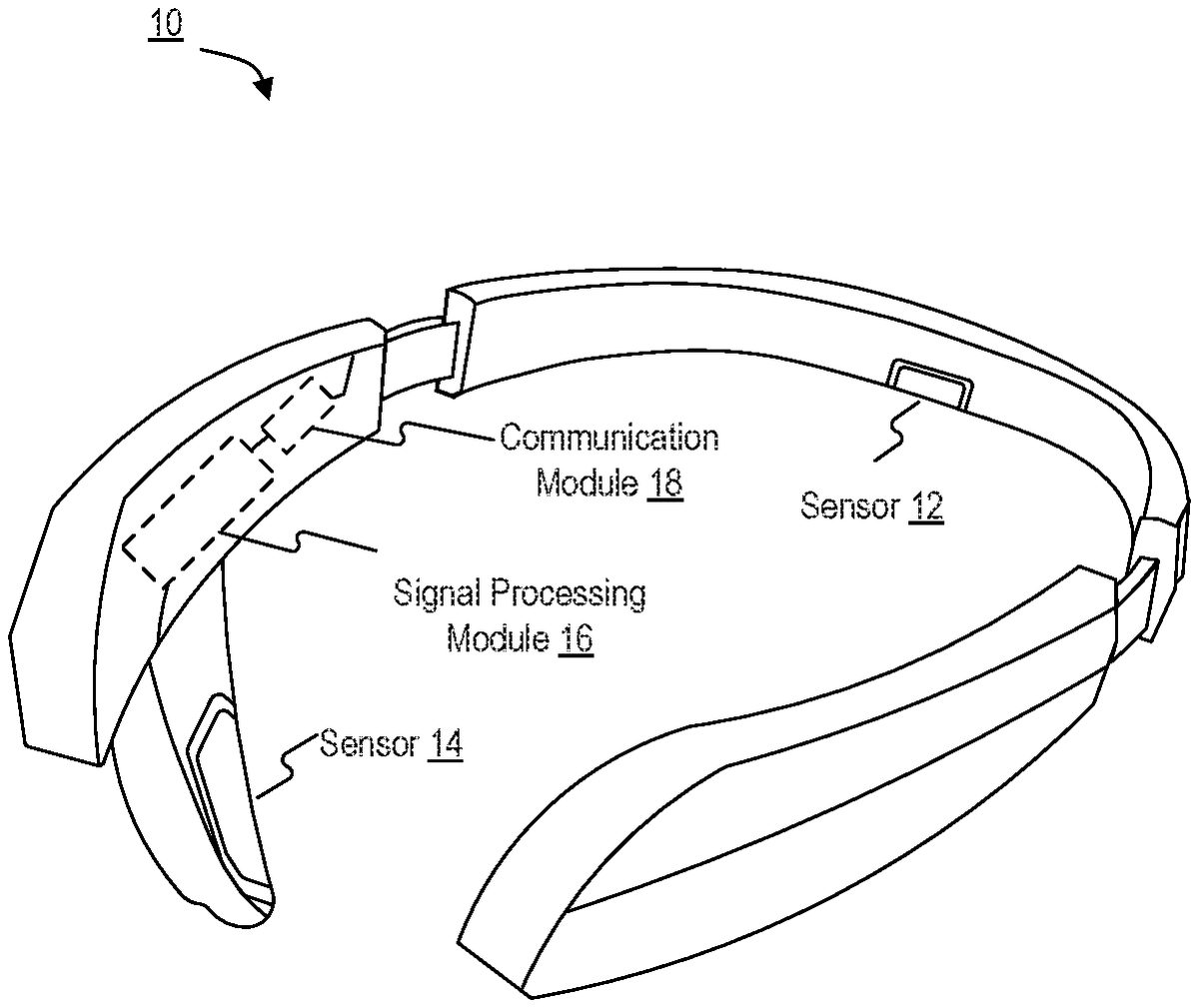
FIG.1is a schematic diagram illustrating a headband10for measuring at least one brainwave signal, according to an exemplary embodiment. Referring toFIG.1, headband10may be worn by a user. In some embodiments, headband10may have a U-shaped body and can wrap around a user's head. In some embodiments, headband10may have an adjustable length and may be made of shape memory. For example, a portion of headband10may be elastic or otherwise stretchable. As another example, headband10may have a built-in extension portion that can be hidden, extended, or partially extended to adjust the length of headband10. As such, headband10can be adapted to closely fit different head dimensions.
Headband10may include one or more sensors for measuring brainwave signals. For example, these sensors may be medical level hydrogel sensors capable of EEG detection. The sensors may be placed at different locations of headband10so that they become attached to different parts of the user's head when he wears headband10. As shown inFIG.1, in one embodiment, sensors12and14may be mounted at different positions on the surface of headband10, such that when headband10is worn by the user, sensor12touches the user's forehead, and sensor14touches one of the user's ears. The forehead is one of the commonly used scalp locations for detecting brainwave signals, while little or no brainwave signals can be recorded at the ears and their vicinities. As such, sensor14serves as a reference sensor, wherein the difference of the signals recorded by sensors12and14becomes the measured brainwave signal. It is contemplated sensors12and14are for illustrative purpose only. The present disclosure does not limit the number of sensors and the placements of these sensors on the scalp for recording the brainwave signals.
Headband10may also include an embedded signal processing module16for processing the signals measured by sensors12and14. For example, signal processing module16may include one or more application specific integrated circuits (ASICs), controllers, micro-controllers (MCUs), microprocessors, or other electronic components. For example, signal processing module16may include an amplifier circuit that determines the difference between the signals measured by sensors12and14, and amplifies the resulted brainwave signal for further analysis.
Headband10may also include an embedded communication module18configured to facilitate communication, wired or wirelessly, between headband10and other devices. In some embodiments, communication module18and signal processing module16may be integrated on the same circuit board. Communication module18can access a wireless network based on one or more communication standards, such as WiFi, LTE, 2G, 3G, 4G, 5G, etc. In one exemplary embodiment, communication module18may include a near field communication (NFC) module to facilitate short-range communications between headband10and other devices. In other embodiments, communication module18may be implemented based on a radio frequency identification (RFID) technology, an infrared data association (IrDA) technology, an ultra-wideband (UWB) technology, a Bluetooth (BT) technology, or other technologies. In the exemplary embodiments, signal processing module16may transmit, via communication module18, the processed brainwave signals to other devices for performing the disclosed methods for neuro-feedback training.
In various embodiments, headband10may also include certain components not shown inFIG.1. For example, in one embodiment, headband10may include one or more light-emitting diode (LED) lights for indicating the operation status of headband10, such as on/off of headband10, battery/power level, whether headband10is connected, etc. In another embodiment, headband10may include a micro-USB port which serves as a charging port. In another embodiment, headband10may include a light at the forehead position (hereinafter referred to as “forehead light”). The forehead light may indicate the current attention level as indicated by the brainwave signals detected by sensor12,14. For example, the forehead light may indicate the real-time attention level of the user by emitting different colors of light. For example, the red color may indicate the user is highly focused, the blue color may indicate the user is unfocused, and the green color may indicate the user is in transition between different attention levels. Additionally or alternatively, the forehead light may also indicate the user's mental state by changing the light intensities or light patterns (e.g., blinking at different frequencies). The present disclosure does not limit the method used by the forehead light to indicate the user's mental state.
In the disclosed methods for neuro-feedback training, the brainwave signals measured by headband10are used to generate incentives or penalties in various forms, to help the user master the control of the brain activities. For example, the incentives or penalties may be presented through a video game.FIG.2is a schematic diagram illustrating a video-game based system100for neuro-feedback training, according to an exemplary embodiment. Referring toFIG.2, system100may include headband10, one or more terminals20, and cloud server(s)30. Consistent with the disclosed embodiments, headband10may stream or otherwise transmit the measured brainwave signals to terminal20and/or cloud server30in real time. Both terminal20and cloud server30may be configured to store and/or process the measured brainwave signals.
Terminal20may be an electronic device with computing capabilities, such as a mobile phone, a tablet computer, a personal computer, a wearable device (e.g., a smart watch), a personal digital assistant (PDA), a remote controller, exercise equipment, an ebook reader, a MP4 (Moving Picture Experts Group Audio Layer IV) player, etc. The video games may be stored in cloud server30, and made downloadable to terminal20. After download, the video games may be installed on terminal20. When the user selects a video game and starts a neuro-feedback training session, terminal20may load the selected video game and generate the video-game data based on the brainwave signals received from headband10. In the disclosed embodiments, terminal20also includes a user interface through which the user can play the video games.
Alternatively and additionally, the video games may also be stored and run on one or more cloud servers30. Cloud server30may be a general purpose computer, a mainframe computer, or any combination of these components. Cloud server30may be implemented as a server, a server cluster consisting of a plurality of servers, or a cloud computing service center. Cloud server30may be operated by a third party service provider, an administrator of the neuro-feedback training, or a manufacturer or a supplier of headband10. In some embodiments, cloud server30may receive the brainwave signals from headband10and generate the video-game data based on the received brainwave signals. Cloud server30then streams the generated video-game data to terminal20, so that the user can play the video game on terminal20in real time.
FIG.3is a block diagram of system100ofFIG.2, according to an exemplary embodiment. Again, system100may include headband10, one or more terminals20, and cloud server(s)30, connected with each other through network90. Referring toFIG.3, headband10includes but not limited to sensors12and14, signal processing module16, and communication module18, consistent with the description in connection withFIG.1. Headband10may form a wired or wireless connection with terminal20and/or cloud server(s)30via network90. Network90may be any type of wired or wireless network that allows transmitting and receiving data. For example, the network may be a nationwide cellular network, a local wireless network (e.g., Bluetooth or WiFi), or a wired network.
Terminal20may include a controller210and a user interface220. Controller210may include, among other things, an I/O interface212, a processing unit214, a memory module216, and/or a storage unit218. These units may be configured to transfer data and send or receive instructions between or among each other.
I/O interface212may be configured for two-way communication between controller210and various devices. For example, as depicted inFIG.3, I/O interface212may send and receive signals to and from headband10, cloud server30, and user interface220. I/O interface212may send and receive the data between each of the components via communication cables, networks (e.g., network90), or other communication mediums.
I/O interface212may be configured to consolidate signals it receives from the various components and relay the data to processing unit214. Processing unit214may include any appropriate type of general purpose or special-purpose microprocessor, digital signal processor, or microprocessor. Processing unit214may be configured as a separate processor module dedicated to performing the disclosed methods for neuro-feedback training. Alternatively, processing unit214may be configured as a shared processor module for performing other functions of terminal20unrelated to neuro-feedback training.
Processing unit214may be configured to receive data and/or signals from components of system100and process the data and/or signals to provide the neuro-feedback training. For example, processing unit214may receive brainwave signals from headband10via I/O interface212. Processing unit214may further process the received brainwave signals to generated various visual and/or audio features presented in the video games. Moreover, if the video games are run on cloud server30, processing unit214may also receive video-game data from cloud server30via I/O interface212. In the exemplary embodiments, processing unit214may execute computer instructions (program codes) stored in memory module216and/or storage unit218, and may perform functions in accordance with exemplary techniques described in this disclosure. More exemplary functions of processing unit214will be described below in relation to the disclosed methods for neuro-feedback training.
Memory module216and/or storage unit218may include any appropriate type of mass storage provided to store any type of information that processing unit214may need to operate. Memory module216and/or storage unit218may be a volatile or non-volatile, magnetic, semiconductor, tape, optical, removable, non-removable, or other type of storage device or tangible (i.e., non-transitory) computer-readable medium including, but not limited to, a ROM, a flash memory, a dynamic RAM, and a static RAM. Memory module216and/or storage unit218may be configured to store one or more computer programs that may be executed by processing unit214to perform exemplary neuro-feedback training methods disclosed in this application. For example, memory module216and/or storage unit218may be configured to store program(s) that may be executed by processing unit214to determine the rewards/penalties used in the video games based on the brainwave signals, and generate visual and/or audio effects showing the determined rewards/penalties.
User interface220may include a display panel through which the video game may be provided. The display panel may include an LCD, a liquid crystal display (LED), a plasma display, a projection, or any other type of display, and may also include microphones, speakers, and/or audio input/outputs (e.g., headphone jacks) or may be coupled to an audio system of terminal20.
Additionally, user interface220may also be configured to receive input or commands from the user. For example, the display panel may be implemented as a touch screen to receive input signals from the user. The touch screen includes one or more touch sensors to sense touches, swipes, and other gestures on the touch screen. The touch sensors may not only sense a boundary of a touch or swipe action, but also sense a period of time and a pressure associated with the touch or swipe action. Alternatively or in addition, user interface220may include other input devices such as keyboards, buttons, joysticks, keyboards, and/or tracker balls. User interface220may be configured to send the user input to controller210.
Still referring toFIG.3, cloud server30may be connected to headband10and/or terminal20via network90. Cloud server30may include one or more controllers (not shown), similar to the configurations of controller210described above.
In some embodiments, the neuro-feedback training may also be performed by using the measured brainwave signals to actuate a target device. The target device may be any device that connected to an IoT and thus can be remotely controlled by a controller.FIG.4is a schematic diagram illustrating an IoT device based system200for neuro-feedback training, according to an exemplary embodiment. Referring toFIG.4, system200may include a headband10, one or more terminals20, one or more cloud servers30, and a target device40. Headband10, terminal20, and cloud server30may have similar structures and configurations as described above, and thus those descriptions are not repeated with respect toFIG.3.
Target device40may be a device with certain computing and/or communication capabilities, such as a smart home appliance (e.g., a lamp, a television, an air condition, an air purifier, a socket, etc.), a drone, a remote-controlled vehicle, a prosthetic hand, a robot, etc. Both terminal20and target device40may connect to the same IoT, such that terminal20can remotely control or actuate target device40. For example, if target device40is a lamp, terminal20may remotely turn on or off the lamp, and/or change the color of the light emitted by the lamp. As another example, if target device40is a TV, terminal20may remotely turn on or off the TV, and/or change the channel currently played by the TV. As another example, if target device40is a drone, terminal20may remotely control the rotation speed of the drone's propellers. For yet another example, if target device40is a prosthetic hand, terminal20may remotely actuate one or more fingers of the prosthetic hand to move, bend, or perform certain other actions.
In some embodiments, to perform neuro-feedback training, terminal20may control or actuate target device40based on the user's brainwaves. Specifically, after receiving the measured brainwave signals from headband10, terminal20may process the brainwave signals to determine whether they meet certain predetermined conditions. When the brainwave signals meet a predetermined condition, terminal20may generate a corresponding control signal for actuating target device40and transmit the control signal to target device40via the IoT.
Alternatively and additionally, target device40may also be controlled or actuated by cloud server30. For example, cloud server30may receive the brainwave signals directly from headband10or via terminal20. Similar to the above description regarding terminal20, cloud server30may then process the received brainwave signals and generate control signals that actuate target device40based on the brainwave signals.
FIG.5is a block diagram of the system200shown inFIG.4, according to an exemplary embodiment. Referring toFIG.5, headband10, terminal20, cloud server30, and target device40may communicate with each other, wired or wirelessly, via a network, such as network90. The structures and configurations of headband10, terminal20, and cloud server30have been described above, and thus are not repeated here. Moreover, target device40may include a controller410and one or more actuators420. Controller410may receive a control signal from terminal20and control actuator420to perform a task based on the control signal. Controller410may adopt any suitable structure. For example, controller410may include one or more of the units/modules described in connection with controller210(FIG.3). Actuator420may have various forms and structures. For example, actuator420may be a switch in a lamp or a TV, an electric motor in a drone or a prosthetic hand, a starter solenoid in a vehicle, etc.
Next, neuro-feedback training methods consistent with the present disclosure will be described. Without special explanation, the following description assumes the steps of the disclosed methods are performed by terminal20. However, it is contemplated some or all of the steps in the follow described methods may also be performed by headband10, cloud server30, and target device40.
According to the disclosed methods, the neuro-feedback training may be implemented by rewarding (i.e., reinforcing) one or more frequency band(s) of the brainwaves, and/or inhibiting (i.e., suppressing) one or more other frequency band(s). For example, often the lower frequency bands are associated with relaxation and day dreaming, the middle frequency bands are associated with focused thinking and problem solving, and the higher frequency bands may be indicative of anxiety, hyper vigilance, and agitation. As such, in order to improve the user's attention ability (i.e., stay focused), the mid-frequency bands, e.g., the low beta band (e.g., the band in between 13 Hz and 20 Hz) may be rewarded, while the theta band (e.g., the band in between 4 Hz and 8 Hz) and the high beta band (e.g., the band in between 22 Hz and 28 Hz) may be inhibited. Accordingly, a reward may be provided to the user when the brainwave signal has a high amplitude in the low beta band has, and a penalty may be provided when the theta band or high beta band has a high amplitude. This way, the user can be incentivized to gradually gain the abilities of reinforcing the rewarded band(s), and suppressing the inhibited band(s). Thus, the success of the neuro-feedback training depends on proper determination of the rewards and penalties (hereinafter collectively referred to as “feedback”).
It is contemplated that the specific frequency bands and the frequency ranges used in this description are for illustrative purpose only. The present disclosure does not limit which frequency bands and/or frequency ranges are to be rewarded and/or inhibited.
FIG.6is a flowchart of a method600for determining a feedback based on a brainwave signal, according to an exemplary embodiment. For example, terminal20may be installed with an application for neuro-feedback training. To start a neuro-feedback session, the user may put on headband10and activate headband10to record the brainwave signal. Meanwhile, the user may then initiate the application, such that terminal20may establish a wireless connection with headband10and perform method600. Referring toFIG.6, method600may include the following steps610-670.
In step610, terminal20accesses the user profile before the neuro-feedback training. For example, different people may have different EEG characteristics. That is, terminal20may require the user to input the user's age, gender, and other demographic information. For example, statistics show that the alpha peak range for people in different age groups may be different. In one embodiment, terminal20may set the alpha peak range for users under or at 10 years old to be [8.5 Hz, 9.5 Hz], and set the alpha peak range for users above 10 years old to be [9.5 Hz, 10.5 Hz]. This way, terminal20can select the proper frequency bands to be rewarded and/or inhibited.
In step620, terminal20determines a training protocol for the current neuro-feedback training session. Depending on the goal of the neuro-feedback training, terminal20may determine the rewarded frequency band(s) and the inhibited frequency band(s). For example, improving attention and focus may require rewarding the low beta band and inhibiting the theta and high beta bands; assisting with meditation or improving relaxation may require rewarding the alpha and theta bands; improving mental fitness may require inhibiting all the frequency bands, etc. As such, terminal20may prompt the user to select a goal for the neuro-feedback training. Based on the selection, terminal20may determine the proper rewarded and/or inhibited frequency bands.
In step630, terminal20receives one or more brainwave signals measured by headband10. The brainwave signals may be measured continuously over time, or during set time intervals. Terminal20may then apply a low-pass filter to remove the signal noise and derive the power spectrum of the brainwave signal, e.g., using mathematic methods such as a Fourier transform (step640). As described above, the amplitudes of the power spectrum may be grouped into different frequency bands. Besides the normal bands showing the brain activities, sometimes the power spectrum may also include one or more frequency bands corresponding to artifacts. For example, eye blinking, biting, and other facial muscle movements may give rise to one or more distinct artifact bands. When the amplitude of the artifact is high than certain level, the whole power spectrum may be distorted and render inaccurate feedback determination. Thus, in step650, terminal20may determine whether the power spectrum encompasses one or more predetermined artifact bands. If the artifact bands are present, terminal20may further determine whether the amplitude of the artifact bands exceeds their respective artifact threshold. If at least one artifact band has an amplitude higher the respective artifact threshold, terminal20may disregard the brainwave signal received during the period of time in which the artifact is detected (step660). Otherwise, terminal20may conclude the brainwave signal is valid and proceeds to step670.
In step670, terminal20determines one or more reward indexes indicative of the percentages of the brainwave signal in the rewarded frequency bands, and one or more inhibit indexes indicative of percentages of the brainwave signal in the inhibited frequency bands. Specifically, terminal20may divide the amplitudes of the rewarded and inhibited frequency bands by the overall amplitude of the full power spectrum, to determine the respective reward and inhibit indexes.
In step680, terminal120determines the rewards and/or penalties based on the determined reward and inhibit indexes. Specifically, terminal20may compare the reward and inhibit indexes to the respective reward and inhibit thresholds. Initial values may be assigned to the reward and inhibit thresholds at the beginning of the neuro-feedback training. In some embodiments, the reward threshold may take a value in the range of 0.5-0.9 (or alternatively 50%-90%). For example, the reward threshold may be set around 0.8 (or 80%). The inhibit threshold may take a value in the range of 0.05-0.3 (or 5%-30%), e.g., 0.2 (or 20%). The thresholds may be adjusted throughout the training based on the user's performance Generally, the user is expected to control the brainwave activities so as to keep the reward indexes above the respective reward thresholds and keep the inhibit indexes below the respective inhibit thresholds. As such, the reward and inhibit thresholds set the goal of the neuro-feedback training. If at least one inhibit index exceeds the corresponding inhibit threshold, terminal20may conclude that a penalty shall be assessed. In contrast, if no inhibit index exceeds the inhibit thresholds and at least one reward index exceeds the corresponding reward threshold, terminal20may conclude that a reward shall be assessed.
In some embodiments, the reward may have multiple levels corresponding to multiple reward thresholds. Specifically, terminal20may determine the reward level by comparing a reward index to the multiple reward thresholds. For example, three reward thresholds, 0.6. 0.7, and 0.8, may be set by terminal20, corresponding to a low reward level, a medium reward level, and a high reward level. Accordingly, reward index falling in between 0.6 and 0.7 is assigned the low reward level, while a reward index exceeding 0.8 is assigned the high reward level.
FIG.7is a flowchart of a method700for neuro-feedback training based on a video game, according to an exemplary embodiment. For example, method700may be performed by system100. Referring toFIG.7, method700may include the following steps710-760.
In step710, terminal20may determine whether an inhibit index exceeds the corresponding inhibit threshold. When the inhibit index exceeds the corresponding inhibit threshold, terminal20may conclude that a penalty should be generated in the video game and further determine the penalty (step720). Otherwise, terminal20may conclude that no penalty should be generated (step730).
Terminal20may also determine whether a reward index exceeds the corresponding reward threshold (step740). When the reward index exceeds the corresponding reward threshold, terminal20may conclude that a reward should be generated in the video game, and further determine the reward level if multiple reward levels are defined in the video game (step750). Otherwise, terminal20may conclude that no reward should be generated (step760). Here, the processes for determining the penalty and/or reward (or reward levels) may be similar to steps670-680.
In step770, terminal20may generate various visual, audio, and/or tactile features based on the results determined in steps720,730,750, and760.FIG.8is a schematic diagram illustrating a scene800of a video game for neuro-feedback training, according to an exemplary embodiment. As shown inFIG.8, the video game may feature a main character810, which can be controlled by the user to navigate around an oasis820. Oasis820may include multiple scenes, each of which may correspond to a training session and may last for a predetermined amount of time, e.g., 20-30 minutes. In each scene, main character810may encounter various characters830and animals840. Each scene may have a particular script that requires main character810to complete certain tasks. Characters830may interact with main character810and guide main character810to finish the tasks.
The video game may provide visual and/or audio features based on the determined rewards and penalties.FIGS.9A-9Care schematic diagrams illustrating certain exemplary visual features indicative of rewards achieved in the video game shown inFIG.8. Referring toFIGS.9A-9C, the video game may display a status ring indicating the progress of main character810in achieving the rewards. Specifically, the status ring fills at a speed proportional to the reward index. For example, in one embodiment, the video game may use four reward levels, represented by the integers “1,” “2,” “3,” and “4.” If the reward level is at 1, the status bar may fill up every 4 minutes. If the reward level is at 2, the status bar may fill up every 3 minutes. If the reward level is at 3, the status bar may fill up every 2 minutes. If the reward level is at 4, the status bar may fill up every 1 minute. Moreover, if there is no reward, the status bar will stay unchanged.
In some embodiments, a score may be given to main character810to record the user's progress in doing the neuro-feedback training. Referring toFIG.9C, when a status ring is filled up, terminal20may display a message814indicating the user has gained one more point. Meanwhile, terminal20may also generate a prompting sound, such as a beeping sound, to indicate to the user that a point has been gained. As such, the faster the status ring fills, the faster the user's score increases. This creates an incentive for the user to progress through the neuro-feedback training. AlthoughFIGS.9A-9Cshow a status ring associated with providing rewards, it is contemplated that other visual features, such as status bar (filling up horizontally or vertically), a water tank, a color changing palette, spinning reels as in a slot machine, etc. For example, the status bar or the water tank may fill up to reward attentions, and the speed it fills up may be proportional to the reward index or reward level. As another example, the reels may stop spinning and let the user gamble for a virtual jackpot when he is paying attention.
In some embodiments, the video game may also use certain visual features to indicate the penalties.FIG.10is a schematic diagram illustrating a visual feature indicative of penalties achieved in the video game shown inFIG.8, according to an exemplary embodiment. For example, as shown inFIG.10, the video game may include two fireflies816following main character810. The two fireflies816may correspond to two different inhibit indexes (i.e., two inhibited frequency bands) separately. When the inhibit indexes are low (i.e., no penalty), fireflies816may be displayed as normal, flying around main character810. However, as an inhibit index increases, the corresponding firefly816gradually fades. When the inhibit index exceeds the corresponding inhibit threshold, i.e., reaching a penalty, the corresponding firefly816completely disappears. In some embodiments, the video game may also use certain audio features to indicate the penalties. For example, terminal20may generate a prompting sound when a penalty is reached. As another example, terminal20may emit a warning sound continuously while an inhibit index stay above the corresponding inhibit threshold.
In some embodiments, terminal20may also generate tactile signals for indicating the rewards and/or penalties. For example, terminal20may be a mobile phone that can generate various types of vibrations. The vibrations may alert the user that a reward and/or a penalty has been achieved.
Consistent with the disclosed embodiments, the video game may contain various other mechanisms to generate the visual, audio, and/or tactile features.FIG.11is a schematic diagram illustrating a scene1100of a video game used for neuro-feedback training, according to an exemplary embodiment. As depicted inFIG.11, main character810is standing by a pond850. In some embodiments, scene1100may become more enjoyable, e.g., brighter, more colorful, having more aesthetic features, etc., whenever the user achieves a reward. For example, pond850may be initially empty. As the user progresses to accumulate the rewards, pond850may be filled with more and more water lilies and fishes. As such, scene1100may become more enjoyable at a pace proportional to the user's progress in achieving the rewards.
Referring back toFIG.7, in step780, terminal20adaptively adjusts the reward thresholds and/or inhibit thresholds based on the user's progress in achieving the rewards and/or penalties. For example, at the initial stage of the neuro-feedback training, the user may be unskilled in controlling the brainwave activities. If the user constantly receives a penalty and fails to achieve any reward, the user may easily accumulate frustration and quickly lose interest in playing the video game. Thus, terminal20may set the reward thresholds low and the inhibit thresholds high, so that it is easier for the user to achieve the reward and avoid the penalty. After the user engages the training for certain amount of time, the user may be able to achieve the rewards in a faster speed and can better avoid the penalties. As such, terminal20may gradually increase the reward thresholds and lower the inhibit thresholds, so as to gradually increase the difficulty level of the neuro-feedback training. As another example, terminal20may continuously monitor the pace of the user in completing the tasks in each scene and/or the speed in accumulating the required scores for each scene. When terminal20finds that the time spent by the user in a particular scene is longer than a predetermined amount of time (e.g., 30 minutes), terminal20may lower the reward thresholds and increase the inhibit thresholds, so as to prevent user frustration. In some embodiments, machine learning methods, such as regression algorithms or Bayesian algorithms, may be employed to study the user's historical performance in the video game and find the proper reward and inhibit thresholds that lead to an optimal incentive level for motivating the user to keep engaging the neuro-feedback training.
As described above, neuro-feedback training may also be provided by using the brainwave signal to control a target device connected to an IoT. In particular, the user's success or failure in actuating the target device provides intuitive guidance and incentive for the user to perform the neuro-feedback training. As such, the target device may serve as a “toy” or an educational tool for assisting the user in learning the skills of controlling the brainwave activities.
FIG.12is a flowchart of method1200for neuro-feedback training based on an IoT device, according to an exemplary embodiment. For example, method1200may be performed by system200. Referring toFIG.12, method1200may include the following steps1210-1270.
In step1210, terminal20establishes connection with target device40. In some embodiments, headband10and/or terminal20can only form a wireless connection, e.g., WiFi or Bluetooth™ connection, with a device located within a certain distance of terminal20or the user. As such, the user may first bring the distance between terminal20and target device40within the workable rage of WiFi or Bluetooth™ signals. Further, in order to provide feedback, target device40should be within a visible range from the user. The user may then operate terminal20to initialize an application for neuro-feedback training, after which terminal20may automatically scan for available IoT devices around terminal20. If terminal20finds target device40, headband10and/or terminal20may automatically pairs with target device40. In some embodiments, terminal20may discover multiple devices surrounding terminal20. In this case, the user may manually select target device40from among the discovered devices. Alternatively, terminal20may include a distance sensor configured to measure the distances between terminal20and the surrounding devices, and automatically choose the device with the closest proximity to terminal20or the user as target device40. In some embodiments, the distance sensor may be a GPS sensor.
After the connection is established, terminal20may determine whether a reward index stays above the corresponding reward threshold for longer than a first amount of time (step1220). If yes, terminal20may generate a first control signal to actuate target device40(step1230).
In some embodiments, terminal20is capable of controlling or actuating multiple target devices40. As such, the actuation may be preprogramed for target device40. In one embodiment, each target device40may be assigned a unique identifier, such as a media access control address (MAC address). By reading the unique identifier, terminal20may determine the identity of currently connected target device40and the type of actuation preprogramed for target device40. For example, when target device40is a lamp, the first control signal may be configured to instruct the lamp to turn on or off. Alternatively, the lamp may be turned on once the reward index exceeds the reward threshold, and the brightness of the lamp may be continuous dimmed as the index stays above the threshold. In another embodiment, when target device40is a drone, the first control signal may be configured to instruct the drone to take off from the ground. Alternatively, the drone may be program to take off once the reward index exceeds the reward threshold, and continue to be propelled as the index stays above the threshold.
In some embodiments, terminal20may actuate target device40differently based on the value of the reward index. In one embodiment, terminal20may control a lamp to change its light color based on the values of the reward index. For example, when the reward index is in between 0.6 and 0.7, the color may be set to be white; when the reward index is in between 0.7 and 0.8, the color may be changed to red; and when the reward index is above 0.8, the color may be changed to green. With the color change, the user can immediately know the current level of reward index and be motivated to work hard to increase the reward index.
In some embodiments, terminal20may also actuate target device40differently based on the period of time during which the reward index continuously stays above the reward threshold. In one embodiment, terminal20may rotate the propellers of a drone at a speed proportional to the time duration in which the user maintains the reward index above the reward threshold. That is, as the reward index stays above the reward threshold longer, the propellers rotate faster and finally the drone can take off. In another embodiment, the number of fingers of a prosthetic hand actuated by terminal20may be proportional to the time duration in which the reward index continuously stays above the reward threshold. For example, in the first 5 seconds, terminal20may only drive the index finger to move. In the next 5 seconds, terminal20may drive the middle finger to move. Such control schemes make the neuro-feedback training a rewarding and fun experience, and thus make it easier for the user to master the ability of maintaining a particular frequency pattern of the brainwaves.
Still referring toFIG.12, alternatively or additionally, terminal20may also actuate target device40based on the inhibit indexes. That is, terminal20may determine whether an inhibit index stays below the corresponding inhibit threshold for longer than a second amount of time (step1240). If yes, terminal20may generate a second control signal to actuate target device40(step1250). The detailed implementation of steps1240and1250are similar to the above description in connection with steps1220and1230, which is not repeated here.
In step1260, terminal20transmits the first control signal and/or the second control signal to target device40, such that target device40may perform the desired actuations based on the first control signal and/or the second control signal.
In step1270, terminal20adaptively adjusts the training parameters such as the reward threshold, the inhibit threshold, the reward frequency band, the inhibit frequency band, the first amount of time, and the second amount of time based on the user's performance in actuating target device40. Similar to step760(FIG.7), here terminal20may adjust the thresholds and amounts of time to fine tune the incentive level and/or difficulty level of the neuro-feedback training. In some embodiment, machine learning algorithms may be employed by terminal20to determine the proper values for the thresholds and amounts of time, so as to optimize the difficulty level of neuro-feedback training for each individual user. For example, as the user trains with target device40, terminal20may gradually increase the reward threshold and/or lower the inhibit thresholds, so as to increase the difficulty level of controlling target device40. As another example, when terminal20finds the user repeatedly fails to actuate target device40, terminal20may shorten the first amount of time and/or the second amount of time. By making it easier to control target device40, the user may be encouraged and motivated to stay with the training. This way, the effectiveness of the neuro-feedback training can be improved. Similar to the descriptions above with respect to step760, as part of step1270, the frequency bands may also be adaptively or dynamically adjusted during the neuro-feedback training based on the user's performance and brainwave characteristics learned during the process.
In the above description of method1200, although the first/second control signal and thus the neuro-feedback are generated based on the comparing of the reward/penalty index (i.e., percentages of the brainwave signal in the rewarded/inhibited frequency bands) to the reward/penalty threshold, terminal20may also use other information extracted from the brainwave signals to actuate target device40. For example, in some embodiments, terminal20may actuate target device40based on the presence, absence, and/or amplitudes of certain designated bands in the detected brainwave signals. Specifically, when terminal20determines that a designated band has an amplitude higher than a predetermined amplitude level, terminal20may generate a corresponding control signal for actuating target device40. For example, such designated band may correspond to eye blink, such that the user may control target device40by blinking one or both eyes.
In general, although methods600,700, and1200are described in connection with the frequency features of the brainwave signals, the present disclosure is not limited to the frequency features. Rather, it is intended that the disclosed methods and systems may use any suitable features of the brainwave signals. For example, one phenomena known as Event Related Potential (ERP) refers to a significant change in a brainwave signal following specific stimulus (e.g., viewing certain scenes or hearing a specific music). For example, a user's exposure to certain stimuli may create a significant change in the brainwave signal's amplitude approximately 300 milliseconds after the exposure (also known as “P300 ERP”). Such change may be used to detect the user's response to a stimuli and generate neuro-feedbacks.
In exemplary embodiments, the data used and generated by the disclosed methods for neuro-feedback training may be saved in, for example, memory module216and/or storage unit218for further study and analysis. In one embodiment, the data may be analyzed to optimize the neuro-feedback training for each individual user. For example, memory module216and/or storage unit218may store a user profile assisted with each user. The user profile may include but are not limited to each user's age, gender demographic information, EEG characteristics, and past brainwave signals generated during the neuro-feedback training. Machine learning methods, such as regression algorithms or Bayesian algorithms, may be employed to analyze the user profile and optimize (or customize) the neuro-feedback training for the individual user. For example, when the analysis of a particular user's past training data shows that the user responds to a first reward threshold better than a second reward threshold, the first reward threshold may be used more frequently for this user. As another example, when the analysis shows that a specific type of feedback (e.g., a particular type of feedback feature used in a video game or actuating a particular target device40) works best for the user, such type of feedback may be used more frequently for the user.
In another embodiment, the past training data for multiple users may be aggregated for big-data analysis. For example, the brainwave signals associated with multiple users and data indicating these users' performance in their neuro-feedback training may be aggregated. Various data-mining methods may be employed to study the aggregated data and discern patterns, trends, and any other types of statistics shown by the multiple users. The findings may be used to optimize the algorithm used in the disclosed methods for neuro-feedback training methods, and/or used for research purposes, such as brain medial research.
Another aspect of the disclosure is directed to a non-transitory computer-readable medium storing instructions which, when executed, cause one or more processors to perform the methods, as discussed above. The computer-readable medium may include volatile or non-volatile, magnetic, semiconductor, tape, optical, removable, non-removable, or other types of computer-readable medium or computer-readable storage devices. For example, the computer-readable medium may be the storage unit or the memory module having the computer instructions stored thereon, as disclosed. In some embodiments, the computer-readable medium may be a disc or a flash drive having the computer instructions stored thereon.
It is contemplated the disclosed methods for neuro-feedback training may have various applications, both medical and non-medical. For example, as mentioned above, the disclosed methods may be used for training and improving attention related behaviors. As such, the disclosed methods may be used for effectively relieving or treating attention related medical conditions, such as ADHD (attention deficit hyperactivity disorder). The present disclosure does not limit the application areas of the disclosed methods and systems.
It will be apparent to those skilled in the art that various modifications and variations can be made to the disclosed neuro-feedback training systems and related methods. Other embodiments will be apparent to those skilled in the art from consideration of the specification and practice of the disclosed neuro-feedback training system and related methods. It is intended that the specification and examples be considered as exemplary only, with a true scope being indicated by the following claims and their equivalents.
Claims
- A neuro-feedback training method performed by a video game application executed by a mobile terminal, the method comprising: repeatedly generating a plurality of types of feedback signals during a current neuro-feedback training session, the plurality of types of feedback signals comprising at least a visual cue, an audio cue, and a tactile cue;executing a machine learning algorithm to analyze data showing a user's performance during one or more past neuro-feedback training sessions, wherein the executing of the machine learning algorithm selects a first type of feedback signals from the plurality of types of feedback signals, the selecting being based at least partially on the user's neuro-feedback training performance in response to the plurality of types of feedback signals, respectively;generating, in the computer game, the first type of feedback signals at an increased frequency;receiving a brainwave signal, via a communication network, the brainwave signal being measured by at least one sensor attached to the user;determining a frequency distribution of the brainwave signal, wherein the frequency distribution comprises a first frequency band and a second frequency band;determining a reward in the video game application, in response to: a first value indicative of an amount of the brainwave signal within the first frequency band stays above an initial value of a first threshold for a first time period, and a second value indicative of an amount of the brainwave signal within the second frequency band is below a second threshold during the first time period;providing, to the user, a first feedback signal indicative of the reward, wherein the first feedback signal is one of the first type of feedback signals, and providing the first feedback signal comprises displaying, on the mobile terminal, a first animation corresponding to the first value and a second animation corresponding to the second value;and adaptively adjusting the first threshold or the first time period, based on a determination of whether the first value stays above the initial value of the first threshold for the first time period.
- The method of claim 1, wherein the first value is a percentage of the brainwave signal within the first frequency band.
- The method of claim 1, wherein displaying the first animation comprises: displaying a status bar which fills at a speed proportional to a progress of the user in achieving the reward.
- The method of claim 1, wherein: the reward has a plurality of reward levels;and displaying the first animation comprises: determining a reward level corresponding to the first value;and generating the first feedback signal based on the determined reward level.
- The method of claim 4, wherein: the user is associated with a score in the computer game;and the method further comprises: increasing the score at a speed proportional to the determined reward level.
- The method of claim 5, wherein displaying the first animation comprises: displaying a status bar representing a progress of the user in achieving the reward;and when the score increases, filling up the status bar.
- The method of claim 5, further comprising: when the score increases, generating a prompting sound indicating the score has changed.
- The method of claim 1, further comprising: when at least one second value meets a criterion, determining a penalty in the computer game;and providing, to the user, a second feedback signal indicative of the penalty, the second feedback signal being one of the first type of feedback signals.
- The method of claim 8, wherein providing the second feedback signal indicative of the penalty comprising: removing the second animation from the video game application.
- The method of claim 8, further comprising: adaptively adjusting the criterion based on a progress of the user in achieving the penalty.
- The method of claim 1, further comprising: assessing the user before the neuro-feedback training;and determining the first and second frequency bands based on the assessment.
- The method of claim 11, wherein assessing the user includes at least one of: determining an age of the user;or accessing characteristics of the brainwave signals of the user.
- The method of claim 1, wherein the mobile terminal is wirelessly connected with the at least one sensor.
- The method of claim 1, wherein the at least one sensor is mounted on a headband worn by the user.
- The method of claim 1, wherein the method is used to train attention related behaviors.
- The method of claim 15, wherein the method is used to treat attention deficit hyperactivity disorder (ADHD).
- A neuro-feedback training system, comprising: at least one sensor coupled with a mobile terminal, the at least one sensor being configured to: measure a brainwave signal when the at least one sensor is attached to a user;and transmit the brainwave signal to the mobile terminal;wherein the mobile terminal is configured to execute a video game application installed on the mobile terminal, the video game application being configured to: repeatedly generate a plurality of types of feedback signals during a current neuro-feedback training session, the plurality of types of feedback signals comprising at least a visual cue, an audio cue, and a tactile cue;execute a machine learning algorithm to analyze data showing a user's performance during one or more past neuro-feedback training sessions, wherein the executing of the machine learning algorithm selects a first type of feedback signals from the plurality of types of feedback signals, the selecting being based at least partially on the user's neuro-feedback training performance in response to the plurality of types of feedback signals, respectively;generate, in the computer game, the first type of feedback signals at an increased frequency;receive the brainwave signal from the at least one sensor;determine a frequency distribution of the brainwave signal, wherein the frequency distribution comprise a first frequency band and a second frequency band;determine a reward in the video game application, in response to: a first value indicative of an amount of the brainwave signal within the first frequency band stays above an initial value of a first threshold for a first time period, and a second value indicative of an amount of the brainwave signal within the second frequency band is below a second threshold during the first time period;provide, to the user, a feedback signal indicative of the reward, wherein the first feedback signal is one of the first type of feedback signals, and providing the first feedback signal comprises displaying, on the mobile terminal, a first animation corresponding to the first value and a second animation corresponding to the second value;and adaptively adjust the first threshold or the first time period, based on a determination of whether the first value stays above the initial value of the first threshold for the first time period.
- The system of claim 17, wherein the mobile terminal is further configured to: when at least one second value meets a criterion, determine a penalty in the computer game;and provide, to the user, a second feedback signal indicative of the penalty, the second feedback signal being one of the first type of feedback signals.
- The system of claim 17, wherein the mobile terminal is wirelessly connected with the at least one sensor.
- The system of claim 17, wherein the system is used to treat attention deficit hyperactivity disorder (ADHD).
- A non-transitory computer-readable medium storing instructions of a video game application which, when executed by a mobile terminal, cause the mobile terminal to perform a method for neuro-feedback training, the method comprising: repeatedly generating a plurality of types of feedback signals during a current neuro-feedback training session, the plurality of types of feedback signals comprising at least a visual cue, an audio cue, and a tactile cue;executing a machine learning algorithm to analyze data showing a user's performance during one or more past neuro-feedback training sessions, wherein the executing of the machine learning algorithm selects a first type of feedback signals from the plurality of types of feedback signals, the selecting being based at least partially on the user's neuro-feedback training performance in response to the plurality of types of feedback signals, respectively;generating, in the computer game, the first type of feedback signals at an increased frequency;receiving a brainwave signal via a communication network, the brainwave signal being measured by at least one sensor attached to the user;determining a frequency distribution of the brainwave signal, wherein the frequency distribution comprise a first frequency band and a second frequency band;determining a reward in the video game application, in response to: a first value indicative of an amount of the brainwave signal within the first frequency band stays above an initial value of a first threshold for a first time period, and a second value indicative of an amount of the brainwave signal within the second frequency band is below a second threshold during the first time period;and providing, to the user, a feedback signal indicative of the reward, wherein the first feedback signal is one of the first type of feedback signals, and providing the first feedback signal comprises displaying, on the mobile terminal, a first animation corresponding to the first value and a second animation corresponding to the second value;and adaptively adjusting the first threshold or the first time period, based on a determination of whether the first value stays above the initial value of the first threshold for the first time period.
- The method of claim 1, further comprising: filtering the received brainwave signal to generate a power spectrum of the brainwave signal, wherein the power spectrum includes the plurality of frequency bands.
- The system of claim 17, wherein the mobile terminal is further configured to: filter the received brainwave signal to generate a power spectrum of the brainwave signal, wherein the power spectrum includes the plurality of frequency bands.
- The method of claim 1, further comprising: before the reward is determined, detecting whether the plurality of frequency bands include a predetermined artifact band;in response to the plurality of frequency bands including the predetermined artifact band, determining whether the predetermined artifact band has an amplitude exceeding a first threshold;and in response to the predetermined artifact band having an amplitude exceeding the first threshold, disregarding the predetermined artifact band.
Disclaimer: Data collected from the USPTO and may be malformed, incomplete, and/or otherwise inaccurate.