U.S. Pat. No. 11,724,199
Parental Controls of Gameplay Sessions
AssigneeSony Interactive Entertainment LLC
Issue DateAugust 16, 2021
Illustrative Figure
Abstract
Systems and methods for monitoring gameplay for stopping points and applying a setting preference at a next predicted timing point. The monitored gameplay may be based on object data received from an object server. The supervising control server may predict one or more starting and/or stopping timing points in stopping periods within a gameplay session. The predicting of the one or more starting and/or stopping timing points may be based on a comparison of the gameplay data to historical gameplay data. Then, a setting preference set by a supervisory account may be applied to a next predicted timing point.
Description
DETAILED DESCRIPTION Aspects of the present disclosure include systems and methods for monitoring gameplay data for stopping points and relaying such information to a supervising control server. The monitored gameplay may be based on object data received from an object server. The supervising control server may predict one or more starting and/or stopping timing points in stopping periods within a gameplay session. The predicting of the one or more starting and/or stopping timing points may be based on a comparison of the gameplay data to historical gameplay data. A setting preference set by a supervisory account may be applied to a next predicted timing point. For example, the setting preference may cause the gameplay session to pause, to save, and/or to convey a message. FIG.1illustrates an exemplary network environment100in which a system for providing predictive customization of supervisory controls over gameplay may be implemented. The network environment100may include one or more interactive content source servers110that provide streaming content (e.g., interactive content titles, game titles, interactive video, podcasts, etc.), one or more platform servers120, one or more user devices130, and one or more databases140. Interactive content source servers110may maintain, stream, and host interactive media titles available to stream to a user device130over a communication network. Interactive content source servers110may include game servers and may be implemented in the cloud (e.g., one or more cloud servers). Each media title may include one or more sets of object data that may be available for participation with (e.g., viewing or interacting with an activity) by a user. Data about the object shown in the media may be stored by the media streaming servers110, platform servers120and/or the user device130, in an object file216(“object file”), as will be discussed in further detail with respect toFIGS.2and3. The platform servers120may be responsible for communicating with the different interactive ...
DETAILED DESCRIPTION
Aspects of the present disclosure include systems and methods for monitoring gameplay data for stopping points and relaying such information to a supervising control server. The monitored gameplay may be based on object data received from an object server. The supervising control server may predict one or more starting and/or stopping timing points in stopping periods within a gameplay session. The predicting of the one or more starting and/or stopping timing points may be based on a comparison of the gameplay data to historical gameplay data. A setting preference set by a supervisory account may be applied to a next predicted timing point. For example, the setting preference may cause the gameplay session to pause, to save, and/or to convey a message.
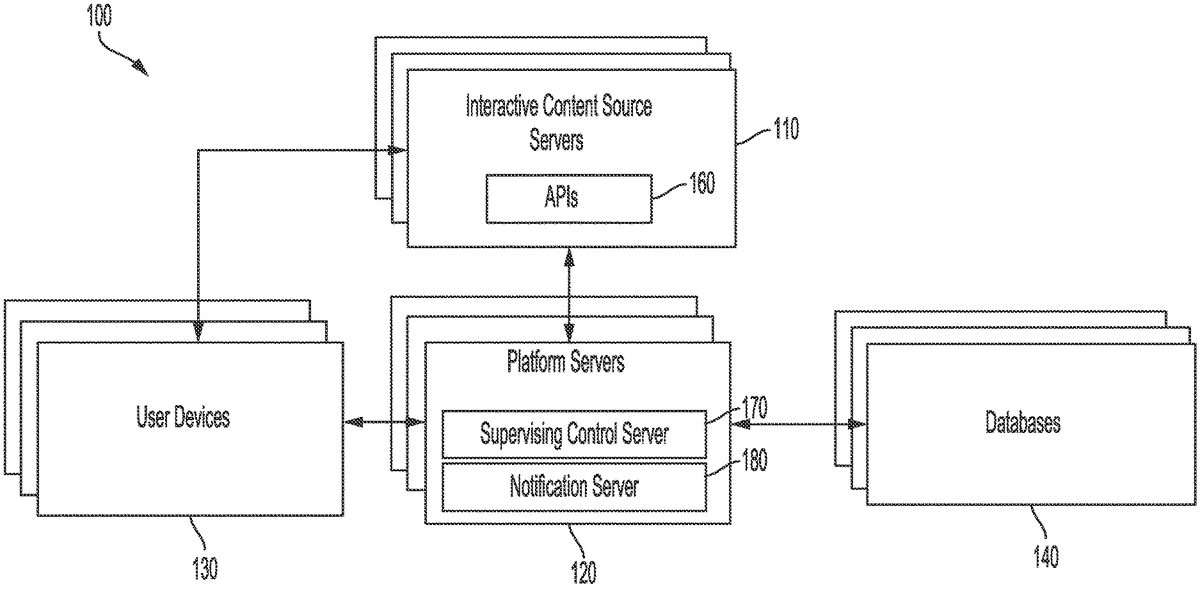
FIG.1illustrates an exemplary network environment100in which a system for providing predictive customization of supervisory controls over gameplay may be implemented. The network environment100may include one or more interactive content source servers110that provide streaming content (e.g., interactive content titles, game titles, interactive video, podcasts, etc.), one or more platform servers120, one or more user devices130, and one or more databases140.
Interactive content source servers110may maintain, stream, and host interactive media titles available to stream to a user device130over a communication network. Interactive content source servers110may include game servers and may be implemented in the cloud (e.g., one or more cloud servers). Each media title may include one or more sets of object data that may be available for participation with (e.g., viewing or interacting with an activity) by a user. Data about the object shown in the media may be stored by the media streaming servers110, platform servers120and/or the user device130, in an object file216(“object file”), as will be discussed in further detail with respect toFIGS.2and3.
The platform servers120may be responsible for communicating with the different interactive content source servers110, databases140, and user devices130. Such platform servers120may be implemented on one or more cloud servers. The platform servers120may include a supervising control server170and notification server180, each of which may further be associated with one or more databases140.
Supervising control server170may have access to a variety of databases140, including databases that store data regarding gameplay of various game titles by different players. Such stored gameplay data may include media files and activity files (described in further detail in relation toFIG.2). Supervising control server170may apply artificial intelligence, machine learning, and other analyses to the historical and real-time gameplay data within such files in order to identify gameplay patterns and generate predictions regarding a current gameplay session of a particular player. The historical and real-time gameplay data used in the analysis may be associated with the same player, but may also include gameplay data associated with other players identified as being similar to the player in relation to player profile and/or game parameters (e.g., similar skill levels, experience levels, game titles player, number of gameplay sessions, in-game achievements, rankings, team status). In addition, gameplay patterns identified for similar players may also be evaluated to determine whether the same gameplay patterns might be indicated for a current player. Such gameplay patterns may pertain to parameters regarding the player, the avatar, in-game avatar characteristics and status, game environment and associated in-game conditions, other players, in-game events, in-game objects, in-game characters, etc., associated with the current gameplay session.
Identified patterns—including emerging patterns that match previously identified patterns—may provide a basis for predictive analysis as to a player's current trajectory of gameplay. For example, a player's current gameplay pattern may align (within a predetermined margin of error) with patterns that are indicative of an imminent loss or win (or other imminent in-game event, such as completion of a goal or level). Using such patterns and pattern matching, supervising control server170may predict a likely stopping point (and/or next save point) for the player.
Supervising control server170—in conjunction with one or more databases140—may also store supervisory profiles for each supervising account, which may be made accessible to a parent, guardian, caretaker, or other individual having supervisory authority over a player. The supervisory profile may store any variety of rules, policies, or goals selected or otherwise set by a user of the supervising account. Such rules, policies, or goals may set limits, which may either be strictly enforced or automatically adjusted based on various conditions. For example, a rule may associate a specified time period of gameplay (e.g., an hour) with a specified time period (e.g., usable within the next 2 days) or expiration data (e.g., a week). Thus, a parent may reward a child player with additional gameplay time that cannot be hoarded over the course of multiple weeks or months. In another example, the rules, policies, or goals may also specify automatically throttling or otherwise limiting gameplay time during a school week, school year, or other specified time period ((e.g., finals week, ahead of school projects), as well as also automatically lifting such restrictions and allowing additional gameplay time on weekends, holidays, summers, etc.
Supervising control server170may identify when such predictions diverge beyond a predetermined threshold from a parent or supervisory control setting that is based on the stored rules, policies, or goals. For example, the parent or supervisor (e.g., via a supervisory application of a user device) may have selected or provided certain control settings pertaining to limits as to a total amount of time allowed on gameplay (e.g., by session, day, week, month, etc.). As the player engages in gameplay, therefore, real-time predictive analytics may be performed by supervising control server170to determine not just the likely end point of gameplay, but also whether the likely end point is approaching the time limit set by the supervisory application. Using such predictive analytics, supervising control server170may further operate to apply control settings. In some embodiments, each rule, policy, or goal may also be associated with a predetermined amount of transition or flexible time that may be used automatically adjust application of the specified gameplay time limit. Such automatic adjustment may further be based on a prediction that the additional time needed to complete a level falls within the specified gameplay time limit.
The platform servers120may also include a notification server180that receives predictive analytics and/or control setting instructions from supervising control server170. Such control setting instructions may be executed by notification server180to generate and send notifications to either the user device130of the player engaged in the gameplay session or another user device associated with the supervising user account. The supervising control server170may include the notification sever180or may be separate from the notification sever180. The user device of the player may be notified upon embarking on a tier or level predicted to end past a time limit of an applicable control setting, as well as notified at predetermined time periods before the time limit is met, when the time limit is met, and (if the player is allowed to and does continue playing) when a predetermined threshold past the time limit is met. Thus, the player may be provided with ample notice as to when and how quickly they are approaching a time limit so as to be able to transition smoothly out of the game session (e.g., save game data, hand off team duties, bid team, competitor(s), and friends good-bye) rather than be subject to an abrupt termination. The notification server180may send such message(s) to the user device130engaged in the gameplay session and present such message(s) within an overlay within a display of the user device130without pausing the gameplay session.
The notification server180may also send notifications to the supervising account regarding the predictive analytics, as well as whether a predicted remaining time period of gameplay left surpasses a limit set by the supervisory account. The estimated period of time may be calculated based on the next predicted stopping period, which may be calculated based on comparisons to historical gameplay data patterns. The message may be a customized message that is relayed from the supervising account or a message pertaining to an estimated period of time remaining before a next stopping point that falls within a total allotted time set by the supervising account. Some embodiments of the message may also provide the supervisor with selectable options for adding a new transition time (e.g., based on a small amount of remaining time left according to the prediction), adjusting a default or previously set transition time (e.g., as recommended based on the prediction), or strictly enforcing the limit. In some embodiments, the message may provide further options for coordinating messages to the player or applying control settings to the player's gameplay session based on the predictions.
The streaming servers110may communicate with multiple platform servers120, though the media streaming servers110may be implemented on one or more platform servers120. The platform servers120may also carry out instructions, for example, receiving a user request from a user to stream streaming media (i.e., games, activities, video, podcasts, User Generated Content (“UGC”), publisher content, etc.). The platform servers120may further carry out instructions, for example, for streaming the streaming media content titles. Such streaming media may have at least one object set associated with at least a portion of the streaming media. Each set of object data may have data about an object (e.g., activity information, zone information, actor information, mechanic information, game media information, etc.) displayed during at least a portion of the streaming media.
The streaming media and the associated at least one set of object data may be provided through an application programming interface (API)160, which allows various types of media streaming servers110to communicate with different platform servers120and different user devices130. API160may be specific to the particular computer programming language, operating system, protocols, etc., of the media streaming servers110providing the streaming media content titles, the platform servers120providing the media and the associated at least one set of object data, and user devices130receiving the same. In a network environment100that includes multiple different types of media streaming servers110(or platform servers120or user devices130), there may likewise be a corresponding number of APIs160.
The user device130may include a plurality of different types of computing devices. For example, the user device130may include any number of different gaming consoles, mobile devices, laptops, and desktops. Such user device130may also be configured to access data from other storage media, such as, but not limited to memory cards or disk drives as may be appropriate in the case of downloaded services. Such devices130may include standard hardware computing components such as, but not limited to network and media interfaces, non-transitory computer-readable storage (memory), and processors for executing instructions that may be stored in memory. These user devices130may also run using a variety of different operating systems (e.g., iOS, Android), applications or computing languages (e.g., C++, JavaScript). An example user device130is described in detail herein with respect toFIG.5.
The databases140may be stored on the platform server120, the media streaming servers110, any of the servers218(examples shown inFIG.2), on the same server, on different servers, on a single server, across different servers, or on any of the user devices130. Such databases140may store the streaming media and/or an associated set of object data. Such streaming media may depict one or more objects (e.g., activities) that a user can participate in and/or UGC (e.g., screen shots, videos, commentary, mashups, etc.) created by peers, publishers of the media content titles and/or third party publishers. Such UGC may include metadata by which to search for such UGC. Such UGC may also include information about the media and/or peer. Such peer information may be derived from data gathered during peer interaction with an object of an interactive content title (e.g., a video game, interactive book, etc.) and may be “bound” to and stored with the UGC. Such binding enhances UGC as the UGC may deep link (e.g., directly launch) to an object, may provide for information about an object and/or a peer of the UGC, and/or may allow a user to interact with the UGC. One or more user profiles may also be stored in the databases140. Each user profile may include information about the user (e.g., user progress in an activity and/or media content title, user id, user game avatars, etc.) and may be associated to media.
FIG.2illustrates an exemplary uniform data system (UDS)200that may be used to provide data to a system for providing predictive customization of supervisory controls over gameplay. As illustrated inFIG.2, UDS200may include an example console228and example servers218(e.g., a streaming server220, a UGC server224, and a supervising control server170, and an object server226), which may receive object data and media files recorded by the object recorder206and the content recorder202, respectively.
The console228may be implemented on the platform server120, a cloud server, or on any of the servers218. The console228may further includes a content recorder202and an object recorder210, described in more detail below, where content (e.g., media) may be recorded and outputted through the console228. The game titles230may be executed on the console228. Alternatively, or in addition to, the content recorder202may be implemented on the platform server120, a cloud server, or on any of the servers218.
Such content recorder202may receive and record content (e.g., media) from an interactive content title230(e.g., game servers110) onto a content ring-buffer208. Such ring-buffer208may store multiple content segments (e.g., v1, v2and v3), start times for each segment (e.g., V1_START_TS, V2_START_TS, V3_START_TS), and end times for each segment (e.g., V1_END_TS, V2_END_TS, V3_END_TS). Such segments may be stored as a media file212(e.g., MP4, WebM, etc.) by the console228. Such media file212(e.g., a portion of the streaming media) may be uploaded to the streaming server220for storage and subsequent streaming or use, though the media file212may be stored on any server, a cloud server, any console228, or any user device130. The media file212may be uploaded periodically and/or in real-time or close to real-time. Such start times and end times for each segment may be stored as a content time stamp file214by the console228. Such content time stamp file214may also include a streaming ID, which matches a streaming ID of the media file212, thereby associating the content time stamp file214to the media file212. Such content time stamp file214may be uploaded and stored to the UGC server224, though the content time stamp file214may be stored on any server, a cloud server, any console228, or any user device130.
Concurrent to the content recorder202receiving and recording content from the interactive content title230, an object library204receives object data from the interactive content title230, and an object recorder206tracks the object data to determine when an object beings and ends. Such object data may be uploaded periodically and/or in real-time or close to real-time. The object library204and the object recorder206may be implemented on the platform server120, a cloud server, or on any of the servers218. When the object recorder206detects an object beginning, the object recorder206receives object data (e.g., user interaction with the object, object ID, object start times, object end times, object results, object types, etc.) from the object library204and records the object data onto an object ring-buffer208(e.g., ObjectID1, START_TS; ObjectID2, START_TS; ObjectID3, START_TS). Such object data recorded onto the object ring-buffer208may be stored in an object file216.
Such object file216may also include object start times, object end times, an object ID, object results, object types (e.g., competitive match, quest, task, etc.), user or peer data related to the object. For example, an object file216may store data regarding an activity, an in-game item, a zone, an actor, a mechanic, a game media, as will be discussed in detail with respect toFIG.3. Such object file216may be stored on the object server226, though the object file216may be stored on any server, a cloud server, any console228, or any user device130.
Such object data (e.g., the object file216) may be associated with the content data (e.g., the media file212and/or the content time stamp file214). In one example, the object server226stores and associates the content time stamp file214with the object file216based on a match between the streaming ID of the content time stamp file214and a corresponding activity ID of the object file216. In another example, the object server226may store the object file216and may receive a query from the UGC server232for the object file216. Such query may be executed by searching for an activity ID of the object file216that matches a streaming ID of a content time stamp file214transmitted with the query. In yet another example, a query of stored content time stamp files214may be executed by matching a start time and end time of a content time stamp file214with a start time and end time of a corresponding object file216transmitted with the query. Such object file216may also be associated with the matched content time stamp file214by the UGC server232, though the association may be performed by any server, a cloud server, any console228, or any user device130. In another example, an object file216and a content time stamp file214may be associated by the console228during creation of each file214,216.
The supervising control server170may receive media files and activity files that include historical and real-time data used to identify gameplay patterns of a current gameplay session of a particular player, match the identified patterns to gameplay patterns of historical sessions, and make predictions regarding a likely trajectory of the current gameplay session. For example, object data (described in more detail below) may provide insights as to what is currently occurring during gameplay. The supervising control server170may further determine the natural stopping periods based on historical gameplay data or historical object data from a same player and/or other players playing a same game title. The historical object data may be associated with whether there are certain activity, zones, actors, or mechanics that would indicate that either the player is at a natural stopping period or not. Historical gameplay data may be associated with when other user accounts paused their respective gameplay sessions in their progression of gameplay of a respective interactive content title.
The supervising control server170may further receive content time stamp files214for determining relevant media files212that may be appropriate to send to the supervising account as context of where the player is at in the gameplay session. For example, when supervising account sends a query regarding the gameplay session, the supervising control server170may send a screenshot or a video in addition to the estimated period of time until a natural stopping period or point.
The supervising control server170may track a length of time of the gameplay session. Tracking the length of time may be used to determine whether the length of time passes a total allotted time set by the supervising account. The supervising control server170may further cause to send a notification, such as via the notification server180, to a user device associated with the player engaged in the gameplay session that gameplay will end at a predicted stopping point within a natural stopping period, such that the length of time does not pass a total allotted time set by the supervising account. Furthermore, the allotted segments of time may expire after a period of time such that allotted segments of time that are allotted over time are not rolled over.
FIG.3illustrates an exemplary table300of various objects and associated events, according to an aspect of the present disclosure. As shown in the example table300ofFIG.3, such object data (e.g., the object file216) may be associated with event information regarding activity availability change and may be related to other objects with associated object information. Media-object bindings may form telemetry between the objects shown in at least a portion of the streaming media and the streaming media. For example, such object data may be activity data302, zone data304, actor data306, mechanics data308, game media data310, and other gameplay-related data.
Such object data (e.g., the object file216) may be categorized as in in progress, open-ended, or competitive. Such activity data302may include optional properties, such as a longer description of the activity, an image associated with the activity, if the activity is available to players before launching the game, whether completion of the activity is required to complete the game, whether the activity can be played repeatedly in the game, and whether there are nested tasks or associated child activities. Such activity data302may include an activity availability change event for, which may indicate a list or array of currently available activities for the player. For example, this may be used to decide what activities to display in a game plan.
Such zone data304may indicate an area of an associated game world with a single coordinate system wherein the zone may have a 2-D map associated with it and may be used to display locations on the zone. If zone data304are applicable, each zone may include a zone ID and a short localizable name of the Zone. Such zone data304may be associated with a view projection matrix (4×4) to convert from 3-D world coordinates to a 2-D map position. Such zone data304may be associated with a location change event that indicates an update to a current in-game location of the player. Such location change event may be posted regularly, or whenever the player's in-game location changes significantly. The platform server120may store a latest value in ‘state.’ Such zone data304may include an x, y, z position of the player's avatar in the zone as well as an a, b, c vector indicating the player's avatars orientation or direction. Such zone data304may be associate with an activity start event and/or an activity end event and for the activity end event, an outcome of completed, failed, or abandoned may be associated to the activity (e.g., activity ID).
Such actor data306may be associated with an entity with behaviors in the game and can be player-controller or game-controlled, and can change dynamically during gameplay. Such actor data306may include an actor ID for the actor, a localizable name for the actor, an image of the actor, and/or a short description of the actor. Such actor data306may be associated with an actor select event that indicates that the player's selected actor(s) have changed. The selected actor(s) may represent the actors the player is controlling in the game and may be displayed on the player's profile and other spaces via the platform server120. There may be more than one actor selected at time and each game may replace its list of actors upon loading save data.
Such mechanics data308may be associated with an item, skill, or effect that can be used by the player or the game to impact gameplay (e.g., bow, arrow, stealth attack, fire damage) and may exclude items that do no impact gameplay (e.g., collectibles). Such mechanics data308may include a mechanic ID of the mechanic, a short name of the mechanic, an image of the mechanic, and/or a short description of the mechanic. Such mechanics data308may be associated with a mechanic availability change event that indicates that the mechanics available to the player have changed. Available may mean that the mechanic is available in the game world for the player to use, but may require the player to go through some steps to acquire it into inventory (e.g., buy from a shop, pick up from the world) before using it. Each game may replace its list of mechanics upon loading save data.
Such mechanics data308may be associated with a mechanic inventory change event that indicates that the player's inventory has changed. Inventory may refer to mechanics that are immediately usable to the player without having to take additional steps in the game before using it. Inventory information is used to estimate a player's readiness for various activities, which may be forwarded to the platform server120. Games may replace its list of mechanic inventory upon loading save data. Mechanics on cool down may be considered part of the inventory. Mechanic counts (e.g., ammunition, healing points) with any non-zero value may be treated as “in inventory.” Inventory mechanics may be considered a subset of available mechanics.
Such mechanics data308may be associated with a mechanic use event that indicates that a mechanic has been used by or against the player and may be used to be displayed as mechanic usage in a UGC context. Such mechanics data308may include a list or array of mechanics that were used (e.g., fire arrow, fire damage) or whether an initiator is the player, such that whether the mechanics were used by or against the player. Such mechanics data308may include an initiator actor ID, a current zone ID of the initiator actor, and/or a current x, y, z position of the initiator actor. Such mechanics data308may be associated with a mechanic impact event that indicates that a mechanic had impact on gameplay (e.g., an arrow hit an enemy) and may be used to display mechanic image in a UGC context. Mechanic use and mechanic image events may be not linked. Such mechanics data308may include the initiator action ID, the current zone ID of the initiator actor, the current x, y, z position of the initiator actor, a target actor ID, a current zone ID of the target actor, a current x, y, z of the target actor, and a mitigation mechanic that may mitigate the initiator mechanic.
Such game media data310may be include a game media ID of the game media, a localizable name for the game media, a media format (e.g., image, audio, video, text, etc.), a category or type of media (cut-scene, audiolog, poster, developer commentary, etc.), a URL or a server-provisioned media file, and/or whether the game media is associated with a particular activity. Such game media data310may be associated with a game media start event that indicates that a particular piece of game media has started in the game right now and a game media end event that indicates that the particular piece of game media has ended.
FIG.4illustrates a flowchart of an exemplary method400for providing predictive customization of supervisory controls over gameplay. Although method400depicts a particular sequence of operations, the sequence may be altered without departing from the scope of the present disclosure. For example, some of the operations depicted may be performed in parallel or in a different sequence that does not materially affect the function of the method400. In other examples, different components of an example device or system that implements the method400may perform functions at substantially the same time or in a specific sequence.
According to some examples, the method includes storing information in memory regarding a supervisory user account associated with one or more player accounts, the stored information including a setting preference at step405. For example, the database140illustrated inFIG.1may store information in memory regarding a supervisory user account associated with one or more player accounts, the stored information including a setting preference.
According to some examples, the method includes receiving data regarding gameplay of an interactive content title by one of the player accounts during a gameplay session, the gameplay data received from a user device over a communication network at step410. For example, the supervising control server170illustrated inFIGS.1and2may receive data regarding gameplay of an interactive content title by one of the player accounts during a gameplay session, the gameplay data received from a user device over a communication network.
According to some examples, the method400includes predicting one or more starting and/or stopping timing points in one or more natural stopping periods within the gameplay session at step415. For example, the supervising control server170illustrated inFIGS.1and2may predict one or more start and/or stop timing points in one or more natural stopping periods within the gameplay session. In some examples, predicting the one or more starting and/or stopping timing points is based on a comparison of the gameplay data to historical gameplay data.
According to some examples, the method includes applying the setting preference at a next predicted timing point at step420. For example, the supervising control server170illustrated inFIGS.1and2may apply the setting preference at a next predicted timing point.
According to some examples, the method includes recording the historical gameplay data when one or more user accounts pause their respective gameplay sessions of the interactive content title. For example, the supervising control server170illustrated inFIGS.1and2may record the historical gameplay data when one or more user accounts pause their respective gameplay sessions of the interactive content title. In some examples, the historical gameplay data includes activity data related to respective timestamps at which the respective gameplay sessions were paused. In some examples, recording segments of gameplay media based on timestamps associated with activity data.
According to some examples, the method includes providing a display of one or more segments of the gameplay media to the supervisory user account. For example, the supervising control server170illustrated inFIGS.1and2may provide a display of one or more segments of the gameplay media to the supervisory user account.
According to some examples, the method includes receiving a query from the supervisory user account regarding the gameplay session. For example, the supervising control server170illustrated inFIGS.1and2may receive a query from the supervisory user account regarding the gameplay session.
According to some examples, the method includes sending an estimated period of time to the supervisory user account. For example, the supervising control server170illustrated inFIGS.1and2may send an estimated period of time to the supervisory user account. In some examples, the estimated period of time is calculated based on a next natural stopping periods of the one or more natural stopping periods.
According to some examples, the method includes receiving a message from the supervisory user account. For example, the supervising control server170illustrated inFIGS.1and2may receive a message from the supervisory user account.
According to some examples, the method includes sending the message to a device displaying the gameplay session as an overlay notification without pausing the gameplay session. For example, the supervising control server170illustrated inFIGS.1and2may send the message to a device displaying the gameplay session as an overlay notification without pause the gameplay session.
According to some examples, the method includes tracking a length of time of the gameplay session. For example, the supervising control server170illustrated inFIGS.1and2may track a length of time of the gameplay session.
According to some examples, the method includes sending in the message that gameplay will end at a predicted stopping point within a natural stopping period of the one or more natural stopping periods. For example, the supervising control server170illustrated inFIGS.1and2may send in the message that gameplay will end at a predicted stopping point within a natural stopping period of the one or more natural stopping periods. In some examples, the length of time does not pass a total allotted time set by the supervisory user account. In some examples, allotted segments of time of the total allotted time expires after a period of time.
FIG.5is a block diagram of an exemplary electronic entertainment system500that may be used in embodiments of the present invention. The entertainment system500ofFIG.5includes a main memory505, a central processing unit (CPU)510, vector unit515, a graphics processing unit520, an input/output (I/O) processor525, an I/O processor memory530, a peripheral interface535, a memory card540, a Universal Serial Bus (USB) interface545, and a communication network interface550. The entertainment system500further includes an operating system read-only memory (OS ROM)555, a sound processing unit560, an optical disc control unit570, and a hard disc drive565, which are connected via a bus575to the I/O processor525.
Entertainment system500may be an electronic game console. Alternatively, the entertainment system500may be implemented as a general-purpose computer, a set-top box, a hand-held game device, a tablet computing device, a virtual reality device, an augmented reality device, or a mobile computing device or phone. Entertainment systems may contain more or less operating components depending on a particular form factor, purpose, or design.
The CPU510, the vector unit515, the graphics processing unit520, and the I/O processor525ofFIG.5communicate via a system bus585. Further, the CPU510ofFIG.5communicates with the main memory505via a dedicated bus580, while the vector unit515and the graphics processing unit520may communicate through a dedicated bus590. The CPU510ofFIG.5executes programs stored in the OS ROM555and the main memory505. The main memory505ofFIG.5may contain pre-stored programs and programs transferred through the I/O Processor525from a CD-ROM, DVD-ROM, or other optical disc (not shown) using the optical disc control unit570. I/O Processor525ofFIG.5may also allow for the introduction of content transferred over a wireless or other communications network (e.g., 4G, LTE, 1G, and so forth). The I/O processor525ofFIG.5primarily controls data exchanges between the various devices of the entertainment system500including the CPU510, the vector unit515, the graphics processing unit520, and the peripheral interface535.
The graphics processing unit520ofFIG.5executes graphics instructions received from the CPU510and the vector unit515to produce images for display on a display device (not shown). For example, the vector unit515ofFIG.5may transform objects from three-dimensional coordinates to two-dimensional coordinates and send the two-dimensional coordinates to the graphics processing unit520. Furthermore, the sound processing unit560executes instructions to produce sound signals that are outputted to an audio device such as speakers (not shown). Other devices may be connected to the entertainment system500via the USB interface545, and the communication network interface550such as wireless transceivers, which may also be embedded in the system500or as a part of some other component such as a processor.
A user of the entertainment system500ofFIG.5provides instructions via the peripheral interface535to the CPU510, which allows for use of a variety of different available peripheral devices (e.g., controllers) known in the art. For example, the user may instruct the CPU510to store certain game information on the memory card540or other non-transitory computer-readable storage media or instruct an avatar in a game to perform some specified action.
The present disclosure pertains to an application that may be operable by a variety of end user devices. For example, an end user device may be a personal computer, a home entertainment system (e.g., Sony PlayStation2® or Sony PlayStation3® or Sony PlayStation4® or Sony PlayStation5®), a portable gaming device (e.g., Sony PSP® or Sony Vita®), or a home entertainment system of a different albeit inferior manufacturer. The present methodologies described herein are fully intended to be operable on a variety of devices. Aspects of the present disclosure may also be implemented with cross-title neutrality and/or may be utilized across a variety of titles from various publishers.
Aspects of the present disclosure may be implemented in an application that may be operable using a variety of devices. Non-transitory computer-readable storage media refer to any medium or media that participate in providing instructions to a central processing unit (CPU) for execution. Such media can take many forms, including, but not limited to, non-volatile and volatile media such as optical or magnetic disks and dynamic memory, respectively. Common forms of non-transitory computer-readable media include, for example, a floppy disk, a flexible disk, a hard disk, magnetic tape, any other magnetic medium, a CD-ROM disk, digital video disk (DVD), any other optical medium, RAM, PROM, EPROM, a FLASHEPROM, and any other memory chip or cartridge.
Various forms of transmission media may be involved in carrying one or more sequences of one or more instructions to a CPU for execution. A bus carries the data to system RAM, from which a CPU retrieves and executes the instructions. The instructions received by system RAM can optionally be stored on a fixed disk either before or after execution by a CPU. Various forms of storage may likewise be implemented as well as other network interfaces and network topologies to implement the same.
In some aspects of the present disclosure, computer-readable storage devices, mediums, and memories can include a cable or wireless signal containing a bit stream and the like. However, when mentioned, non-transitory computer-readable storage media expressly exclude media such as energy, carrier signals, electromagnetic waves, and signals per se.
The foregoing detailed description of the technology has been presented for purposes of illustration and description. It is not intended to be exhaustive or to limit the technology to the precise form disclosed. Many modifications and variations are possible in light of the above teaching. The described embodiments were chosen in order to best explain the principles of the technology, its practical application, and to enable others skilled in the art to utilize the technology in various embodiments and with various modifications as are suited to the particular use contemplated. It is intended that the scope of the technology be defined by the claim.
Claims
- A method for applying controls on monitored gameplay, the method comprising: storing information in memory regarding a supervisory user account associated with one or more player accounts, the stored information including a setting preference;tracking data regarding historical gameplay of an interactive content title by an identified one of the player accounts during one or more gameplay sessions, the historical gameplay data received from a user device associated with the identified player account over a communication network;analyzing the historical gameplay data associated with the identified player account during past gameplay sessions, wherein a subset of the historical gameplay data indicates a gameplay pattern associated with one or more imminent in-game events within the past gameplay sessions;predicting one or more timing points corresponding to at least one of the imminent in-game events within a duration of a current gameplay session, wherein predicting the timing points is based on a comparison of gameplay data associated with the current gameplay session to the gameplay pattern indicated by the subset of the historical gameplay data;and applying the setting preference at one of the predicted timing points in the current gameplay session, wherein applying the setting preference includes executing a control action associated with the setting preference.
- The method of claim 1, further comprising recording the historical gameplay data regarding one or more user accounts, wherein the historical gameplay data include one or more pauses during respective gameplay sessions of the interactive content title and one or more timestamps for each of the pauses.
- The method of claim 2, further comprising: recording one or more segments of gameplay media for the current gameplay session of the identified player account based on the timestamps;and providing one or more of the segments to a user device associated with the supervisory user account.
- The method of claim 1, further comprising: receiving a query from the supervisory user account regarding the current gameplay session;and sending a predicted end time for the current gameplay session to the supervisory user account, wherein the predicted end time is based on a next predicted timing point.
- The method of claim 1, further comprising: receiving a message from the supervisory user account;and generating a display of the message as an overlay notification within a display device of the identified user, wherein the overlay notification is displayed without pausing the current gameplay session.
- The method of claim 1, wherein the setting preference specifies a time limit for the current gameplay session, and further comprising: tracking a duration of time of the current gameplay session;and generating an overlay notification within a display device of the identified user, the overlay notification including a comparison of the specified time limit and the tracked duration of time.
- The method of claim 1, wherein the setting preference is associated with a predetermined expiration time period.
- A system for applying controls on monitored gameplay, the system comprising: memory that stores information regarding a supervisory user account associated with one or more player accounts, the stored information including a setting preference;a communication interface that communicates over a communication network to track data regarding historical gameplay of an interactive content title by an identified one of the player accounts during one or more gameplay sessions, the historical gameplay data received from a user device associated with the identified player account over the communication network;and a processor that executes instructions stored in the memory, wherein the processor executes the instructions to: analyze the historical gameplay data associated with the identified player account during past gameplay sessions, wherein a subset of the historical gameplay data indicates a gameplay pattern associated with one or more imminent in-game events within the past gameplay sessions;predict one or more timing points corresponding to at least one of the imminent in-game events within a duration of a current gameplay session, wherein predicting the timing points is based on a comparison of gameplay data associated with the current gameplay session to the gameplay pattern indicated by subset of the historical gameplay data;and apply the setting preference at one of the predicted timing points in the current gameplay session, wherein applying the setting preference includes executing a control action associated with the setting preference.
- The system of claim 8, wherein the processor executes further instructions to record the historical gameplay data regarding one or more user accounts, wherein the historical gameplay data include one or more pauses during respective gameplay sessions of the interactive content title and one or more timestamps for each of the pauses.
- The system of claim 9, wherein the processor executes further instructions to record one or more segments of gameplay media for the current gameplay session of the identified player account based on the timestamps, and wherein the communication interface further provides one or more of the segments to the user device associated with the supervisory user account.
- The system of claim 8, wherein the communication interface further: receives a query from the supervisory user account regarding the current gameplay session;and sends a predicted end time for the current gameplay session to the supervisory user account, wherein the predicted end time is based on a next predicted timing point.
- The system of claim 8, wherein the communication interface further receives a message from the supervisory user account;and wherein processor executes further instructions to generate a display of the message as an overlay notification provided within a display device of the identified user, wherein the overlay notification is displayed without pausing the current gameplay session.
- The system of claim 8, wherein the setting preference specifies a time limit for the current gameplay session, and processor executes further instructions to: track a duration of time of the current gameplay session;and generate an overlay notification provided within a display device of the identified user, the overlay notification including a comparison of the specified time limit and the tracked duration of time.
- The system of claim 8, wherein the setting preference is associated with a predetermined expiration time period.
- A non-transitory, computer readable storage medium having embodied thereon instructions executable by a computing system to perform a method for applying controls on monitored gameplay, the method comprising: storing information in memory regarding a supervisory user account associated with one or more player accounts, the stored information including a setting preference;tracking data regarding historical gameplay of an interactive content title by an identified one of the player accounts during one or more gameplay sessions, the historical gameplay data received from a user device associated with the identified player account over a communication network;analyzing the historical gameplay data associated with the identified player account during past gameplay sessions, wherein a subset of the historical gameplay data indicates a gameplay pattern associated with one or more imminent in-game events within the past gameplay sessions;predicting one or more timing points corresponding to at least one of the imminent in-game events within a duration of a current gameplay session, wherein predicting the timing points is based on a comparison of gameplay data associated with the current gameplay session to the gameplay pattern indicated by the subset of the historical gameplay data;and applying the setting preference at one of the predicted timing points in the current gameplay session, wherein applying the setting preference includes executing a control action associated with the setting preference.
- The method of claim 1, wherein the historical gameplay data further includes data regarding historical gameplay data by a different player account having at least one game parameter that is similar to a game parameter of the identified player account.
- The method of claim 1, wherein predicting the timing points is further based on the gameplay data associated with the current gameplay session aligning with the gameplay pattern within a predetermined margin of error.
- The method of claim 1, further comprising determining to apply the setting preference at the one of the predicted timing points based on a comparison to a time limit.
Disclaimer: Data collected from the USPTO and may be malformed, incomplete, and/or otherwise inaccurate.