U.S. Pat. No. 11,724,190
SYSTEMS AND METHODS FOR MODIFYING GAME ASSETS OF AN ONLINE GAMING PLATFORM BASED ON TRADEABLE ITEMS
AssigneeMythical, Inc.
Issue DateDecember 17, 2021
Illustrative Figure
Abstract
Systems and methods for modifying game assets based on tradeable items that are associated with user accounts of users of the online gaming platform are disclosed. Exemplary implementations may: store, in electronic storage, item information associated with the tradeable items; obtain a first item identifier of a first tradeable item; obtain first user information of a first user account; link the first tradeable item with the first user account such that a first item-account connection is established; store the first item-account connection; obtain, based on the first item identifier, the first modification information; receive, from the first user, an indication of a selection of a first game asset to be modified based on the first modification information such that a first asset-item connection is established; and modify, based on the first modification information, the first attribute information in accordance with the first tradeable item.
Description
DETAILED DESCRIPTION FIG.1illustrates a system100configured for modifying game assets of an online gaming platform based on tradeable items that are associated with user accounts of users of the online gaming platform, in accordance with one or more implementations. In some implementations, system100may include one or more of servers102. Server(s)102may be configured to communicate with one or more client computing platforms104according to a client/server architecture and/or other architectures via one or more network(s)128. In some implementations, one or more network(s)128may include the Internet and/or other networks. Client computing platform(s)104may be configured to communicate with other client computing platforms via server(s)102and/or according to a peer-to-peer architecture, a client-server architecture, and/or other architectures. Users may access system100via client computing platform(s)104. In some implementations, system100and/or server(s)102may be configured to communicate with one or more of (online) gaming platform(s)126, gaming platform operator(s)122, distributed ledger124, and/or other components via one or more network(s)128. As used herein, gaming platform126may refer to either an individual game, a type of gaming console and its ecosystem, and/or any combination of these. Gaming platform126may include one or more (online) games. Gaming platform operator122may refer to a host, operator, owner, and/or other stakeholder of gaming platform126. In some implementations, distributed ledger124(e.g., a blockchain or another structure of blocks) may be maintained by a distributed computing platform (not shown inFIG.1). In some implementations, the distributed computing platform may be implemented by a set of client computing platforms and/or servers. The distributed computing platform may support a virtual machine (not shown inFIG.1). The distributed computing platform and/or the virtual machine may form a runtime environment for smart contracts. In some implementations, the distributed computing platform may include electronic storage configured to store part or all of distributed ledger(s)124. The smart contracts may be stored on distributed ledger(s)124. In some implementations, the distributed computing platform ...
DETAILED DESCRIPTION
FIG.1illustrates a system100configured for modifying game assets of an online gaming platform based on tradeable items that are associated with user accounts of users of the online gaming platform, in accordance with one or more implementations. In some implementations, system100may include one or more of servers102. Server(s)102may be configured to communicate with one or more client computing platforms104according to a client/server architecture and/or other architectures via one or more network(s)128. In some implementations, one or more network(s)128may include the Internet and/or other networks. Client computing platform(s)104may be configured to communicate with other client computing platforms via server(s)102and/or according to a peer-to-peer architecture, a client-server architecture, and/or other architectures. Users may access system100via client computing platform(s)104.
In some implementations, system100and/or server(s)102may be configured to communicate with one or more of (online) gaming platform(s)126, gaming platform operator(s)122, distributed ledger124, and/or other components via one or more network(s)128. As used herein, gaming platform126may refer to either an individual game, a type of gaming console and its ecosystem, and/or any combination of these. Gaming platform126may include one or more (online) games. Gaming platform operator122may refer to a host, operator, owner, and/or other stakeholder of gaming platform126.
In some implementations, distributed ledger124(e.g., a blockchain or another structure of blocks) may be maintained by a distributed computing platform (not shown inFIG.1). In some implementations, the distributed computing platform may be implemented by a set of client computing platforms and/or servers. The distributed computing platform may support a virtual machine (not shown inFIG.1). The distributed computing platform and/or the virtual machine may form a runtime environment for smart contracts. In some implementations, the distributed computing platform may include electronic storage configured to store part or all of distributed ledger(s)124. The smart contracts may be stored on distributed ledger(s)124. In some implementations, the distributed computing platform may be Ethereum. In some implementations, the distributed computing platform may be the EOSIO platform. In some implementations, the virtual machine may be a Turing-complete and decentralized virtual machine.
Distributed ledger(s)124may act as a decentralized database that stores a registry of assets and transactions across one or more networks128. A given asset may be owned by a particular user. An asset may include anything of material value or usefulness that is owned by or on behalf of a person or company, according to some implementations. A right pertaining to an object may be an asset, the object being a physical or a virtual item. Multiple rights may form a set of rights or a bundle of rights that may be transferred and/or otherwise acted on or operated on together. For example, rights may include a right to use, a right to sell, a right to destroy, and/or other rights.
In some implementations, distributed ledger(s)124may record ownership of assets. Alternatively, and/or simultaneously, distributed ledger(s)124may record transactions that modify ownership of assets. A smart contract may be a type of asset. In some implementations, once a smart contract has been added to the distributed ledger, the smart contract may be referred to as published, recorded, and/or posted. Elements of distributed ledger(s)124may be grouped together in units that are referred to as blocks. For example, an individual block may include one or more assets and one or more transactions.
Distributed ledger(s)124may be publicly accessible and append-only. In some implementations, existing blocks of a distributed ledger can substantially not be altered or deleted, unless multiple copies of the distributed ledger are altered. This is unlikely to happen provided that multiple copies of the distributed ledger are stored on different computing platforms, e.g., in different geographical locations. The distributed ledger may be replicated (in part or in its entirety) on multiple computing platforms, preferably in multiple different geographical locations.
Server(s)102may be configured by machine-readable instructions106. Machine-readable instructions106may include one or more instruction components. The instruction components may include computer program components. The instruction components may include one or more of an obtain component108, an account link component110, an asset link component112, a modify component114, game component130, and/or other instruction components.
Gaming platform126may include one or more user accounts associated with one or more users. For example, the users may include a first user, a second user, a third user, and so forth. The one or more user accounts may include individual user information. The user information may include user identification information, location information, statistic information and/or other user information of the individual user accounts. The user identification information may include first name, last name, username, email address, phone number, and/or other user identification information for identifying individual users. The location information may be obtained from client computing platform(s)104of the one or more individual users. The location information may represent one or more real-world locations, e.g., of the one or more individual users in the real world, of one or more individual tradeable items in the real world, and/or of other entities in the real world. The real-world locations may be locations (e.g., addresses, GPS coordinates, landmarks, point on a virtual map, etc.) input by the individual users, location of an internet service provider (ISP) client computing platforms104associated with the individual users is using, location from a GPS of client computing platforms104associated with the individual users, location from a GPS of client computing platform104associated with the individual users when the tradeable items are in proximity to client computing platform104, location of a GPS of client computing platform104associated with the individual users when client computing platform104identifies the tradeable items, and/or other real-world locations.
The statistic information may include values for a date of an individual user joining the online gaming platform, current level, experience points (XP), total number of tradeable items connected with, total number of tradeable items currently connected with, total number of game assets in an inventory, number of hours played within the online gaming platform, number of hours played with a particular game asset, and/or other statistic information.
Electronic storage118may be configured to store individual item information associated with one or more tradeable items. The individual tradeable items may be identified by one or more item identifiers. The individual tradeable items may be real-world physical items. By way of non-limiting example, the individual tradeable items may include a playing card, a toy figurine, and/or other real-world physical items. The one or more item identifiers may be item identifying information that identifies and distinguishes the tradeable items from each other. Physical manifestations of the one or more item identifiers may include a barcode, a QR code, radio frequency identifier (RFID), serial number, and/or other human-readable or machine-readable identifiers. A first tradeable item may be a real-world physical item identified by a first item identifier and associated with first item information stored in electronic storage118.
The individual item information stored in electronic storage118may include individual modification information that is useable to modify attribute information of one or more individual game assets. The modification information may include, for example, a set of code that, upon execution, modifies individual game assets, asset information, attribute information, and/or other information related to individual game assets. The game assets may be (collections and/or packages of) virtual items usable within an online gaming platform, such as gaming platform126. By way of non-limiting example, the game assets may include one or more of a weapon, character, tool, pet, clothing, vehicle, level, mission, assignment, chapter, task, mini-game, and/or other virtual items. Game assets may be usable within gaming platform126by an owner of a right to usage within gaming platform136. The owner of a first particular game asset may be a first user, the owner of a second particular game asset may be a second user, and so forth. The individual game assets may be defined by asset information. In some implementations, asset information may include one or more of the attribute information, a set of rules, and/or other information. In some implementations, attribute information may define one or more of a type of game asset, abilities, aesthetics, and/or other attributes of the individual game assets. The attribute information of the individual game assets may be within at least one of the one or more (online) games. The set of rules may pertain to the individual game assets simultaneously being modified by more than one of the modification information of more than one of the individual tradeable items. The set of rules may include a maximum value of tradeable items that can modify the individual game asset simultaneously, one or more types of tradeable item the individual game asset can be modified by, and/or other rules. The individual user accounts may include individual inventories of one or more game assets. The one or more game assets of the individual inventories may be game assets that the user account, or the user, owns, won, leases, found, stole, and/or otherwise possesses.
The individual item information associated with the individual tradeable items may further include one or more of a historical location record, a historical user record, user prerequisites, asset prerequisites, a type of tradeable item, and/or other item information. The historical location record may include the location information of the users whose user accounts have previously linked with the individual tradeable items, as described herein. The historical user record may include user information of the user accounts that the individual tradeable items have been previously linked with. These records are further described in the Detailed Description. The user prerequisites may be requirements for the user accounts that need to be satisfied for the user accounts to be linked with the individual tradeable items. In some implementations, the user prerequisites may be requirements for the user accounts that need to be satisfied before (attribute information of) game assets may be modified as described herein. The user prerequisites may include one or more of specific values of the statistic information, ranges of values of the statistic information, and/or other user prerequisites. The game asset prerequisites may be requirements that need to be satisfied for a game asset to be modified by the one or more tradeable items. The game asset prerequisites may include values of the attribute information, ranges of values of the attribute information, and/or other game asset prerequisites. The type of tradeable item may specifically pertain to a particular online gaming platform, such as gaming platform126. By way of non-limiting example, the types of tradeable items may include weapon modifiers, character modifiers, tool modifiers, vehicle modifiers, and/or other types depending on particular characteristics of gaming platform126.
Obtain component108may be configured to obtain the one or more item identifiers of the one or more tradeable items. The one or more item identifiers may be obtained upon the one or more users capturing an image that includes the item identifier via one or more associated client computing platform(s)104. The one or more tradeable items may be obtained by the one or more users by way of purchase, trading, discovery, and/or other obtainment. By way of non-limiting example, obtain component108may obtain the first item identifier of the first tradeable item. The first tradeable item may be associated with first item information that includes first modification information.
Obtain component108may be configured to obtain the one or more user information of the one or more user accounts. The user information may be obtained from client computing platform(s)104associated with the one or more users. The one or more users may be logged-in to gaming platform126via one or more associated client computing platform(s)104such that the one or more user information may be obtained by obtain component108.
By way of non-limiting example, obtain component108may obtain first user information of a first user account. The first user account may be associated with a first user. The first user information may include one or more of first user identification information, first location information, first statistic information, and/or other user information of the first user account. By way of non-limiting example, obtain component108may obtain second user information of a second user account. The second user account may be associated with a second user. The second user information may include one or more of second user identification information, second location information, second statistic information, and/or other user information of the second user account.
Account link component110may be configured to link the one or more tradeable items with the one or more user accounts within the online gaming platform such that item-account connections are established between the individual tradeable items and the individual user accounts. The linkage may be responsive to obtaining the individual item identifiers and the individual user information (e.g., the user identification information). Account link component110may be configured to store the item-account connections. By way of non-limiting example, account link component110may link the first tradeable item with the first user account within the gaming platform126such that a first item-account connection is established. The first user account may include a first inventory of game assets that includes a first game asset. The first item information may include a first historical location record that includes the location information of the users whose user accounts have previously linked with the first tradeable item (i.e., previous item-account connections of the first tradeable item). Upon the established of the first item-account connection, the first historical location record may include the first location information. In some implementations, individual user accounts may be linked with multiple tradeable items. In some implementations, individual tradeable items may be linked with multiple user accounts.
Account link component110may be configured to store the item-account connections. Storing the item-account connections may include recording to a distributed ledger, database(s) stored in electronic storage118, and/or other storing mechanism, components, and/or structures. By way of non-limiting example, in some implementations, account link component110may be configured to store the first item-account connection to distributed ledger124.
Asset link component112may be configured to receive one or more indications of selections of individual game assets to be modified based on the individual modification information. The individual game assets selected may be from the individual inventories of game assets of the individual user accounts. The indications may be received from client computing platforms104associated with the individual users. As previously mentioned, the individual modification information may be included in the individual item information that is associated with the individual tradeable items such that the selected game assets are to be modified in accordance with the individual tradeable items. By way of non-limiting example, asset link component112may receive, from the first user, an indication of a selection of the first game asset from the first inventory of game assets to be modified based on the first modification information. The first modification information may be included in the first item information that is associated with the first tradeable item such that the first game asset is to be modified in accordance with the first tradeable item.
Asset link component112may be configured to link the selected game asset to be modified, based on the individual modification information, with the associated individual tradeable item such that asset-item connections are established. By way of non-limiting example, asset link component112may link the first game asset with the first tradeable item such that a first asset-item connection is established. In some implementations, individual game assets may be linked with multiple tradeable items. In some implementations, individual tradeable items may be linked with multiple game assets.
In some implementations, asset link component112may be configured to record the asset-item connections indicating individual game assets as being modified in accordance with individual tradeable items. The asset-item connections may be recorded to the distributed ledger, database(s) stored in electronic storage118, and/or one or more other distributed ledgers. By way of non-limiting example, asset link component112may record, to distributed ledger124, the first asset-item connection indicating the first game asset as being modified in accordance with the first tradeable item. The first game asset may include first asset information. The first asset information may include first attribute information.
Modify component114may be configured to obtain modification information from electronic storage118. The obtainment may be based on the individual item identifiers that identify the individual tradeable items and thus the individual modification information. Modify component114may be configured to obtain item information from electronic storage118based on the corresponding individual item identifiers. By way of non-limiting example, modify component114may obtain, based on the first item identifier, the first modification information from electronic storage118.
Modify component114may be configured to modify the individual attribute information of the individual game assets in accordance with the individual tradable items such that the individual game assets are modified. The modifications to be made to the game assets may be based on the individual modification information. The modifications of the individual attribute information may occur upon the establishment and storage of the individual asset-item connections. Modifying the attribute information may include diminishing the attribute information, enhancing the attribute information, no change in the attribute information, and/or other modifications. In some implementations, modifying the individual attribute information of the individual game assets may include storing the individual modifications to the user account of particular users, storing the individual modifications to the inventory of game assets of particular user accounts, storing the individual modifications to the user information of particular users, storing the individual modifications to distributed ledger124, and/or others. By way of non-limiting example, modify component114may modify, based on the first modification information, the first attribute information in accordance with the first tradeable item such that the first game asset is modified.
In some implementations, modifying, based on the modification information, the individual attribute information in accordance with individual tradeable items may be based on the set of rules, past asset-item connections of the individual game assets (e.g., recorded to the distributed ledger), the values of the types of the individual tradeable items of the past asset-item connections involving the individual game assets (e.g., recorded to the distributed ledger), the type of the individual tradeable items, and/or other values. The asset-item connections of the individual game assets may indicate which particular tradeable item(s) the individual game assets are most currently being modified in accordance with. Based on these values, the modifying, based on the modification information, the attribute information may be rejected.
By way of non-limiting example, the types of the tradeable items may include fire type, water type, air type, land type, and/or other types. The first asset information may include a first set of rules limiting the first game asset to be modified in accordance with a water and air type of tradeable item simultaneously or with a land and fire type of tradeable item simultaneously only. Any other combination of types of tradeable items may reject individual tradeable items from modifying the first game asset. Distributed ledger124may have recorded a second asset-item connection indicating the first game asset as currently being modified in accordance with a second tradeable item, a fire type of tradeable item. The second tradeable item may include second item information that includes second modification information of which the first game asset is being modified based on. The first tradeable item may be a water type of tradeable item. Thus, based on the first set of rules, the asset-item connections involving the first game asset recorded to the distributed ledger (i.e., the second asset-item connection), the type of tradeable item the first game asset is currently being modified in accordance with (i.e., the second tradeable item that is fire type), and a value of the type of the first tradeable item (i.e., water type), modifying, based on the first modification information, the first attribute information may be rejected. In some implementations, rather than rejecting the modifying that is based on the first modification, the modifying that is based on the second modification information may be ceased and subsequently the first attribute information may be modified based on the first modification information (i.e., cease and/or replace modification information and/or effects thereof).
The (effects of executing the) modification information may be adjusted and/or otherwise varied based on one or more particular values such that the resulting modifications are a function of one or more of the historical location record, the user prerequisites, the game asset prerequisites, the historical user record, subsequent item-account connections, subsequent asset-item connections, individual attribute information of the one or more game assets that the individual tradeable item has previously modified, and/or other factors. In some implementations, the modification information itself may be adjusted upon obtainment from electronic storage. Alternatively, and/or simultaneously, in some implementations, or one or more particular modifications effectuated by the modification information may be adjusted. In some implementations, the individual modification information may be adjusted based on the individual historical location records of the individual tradeable items. For example, as mentioned above, the first historical location record may include the first location information that indicates the location of the first user. The first location information may indicate the first user is in Tokyo, Japan. The first modification information may be adjusted based on the first historical location record such that the first game asset (e.g., a weapon) is modified into a katana sword, for example, based on the location of the first user in addition to other modifications based on the first modification.
In some implementations, the individual modification information may be adjusted based on the individual user prerequisites of the individual tradeable items being met and further based on the values of the statistic information of the individual user information. By way of non-limiting example, the first item information may include a first set of user prerequisites that must be satisfied for the first tradeable item to be linked with the first user account. The first modification information may be adjusted based on the first set of user prerequisites being met and further based on values of the first statistic information. In other words, the first set of user prerequisites may require the first user be on level 10 (i.e., from the first statistic information), for example, for the first modification information to modify the first game asset to the fullest degree. Thus, upon the first user being on level 9 or below, the first modification information may be adjusted (e.g., lessened).
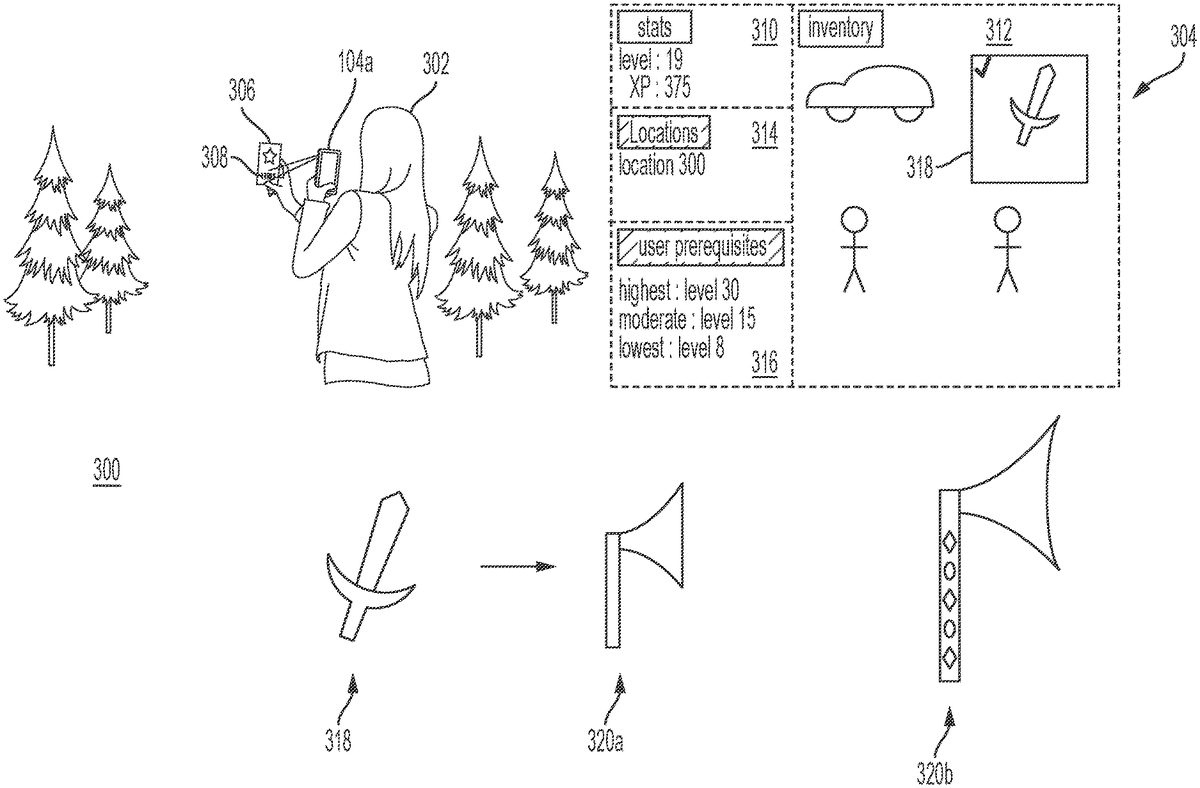
FIG.3Aillustrates an example implementation of the system configured for modifying game assets of an online gaming platform based on tradeable items that are associated with user accounts of users of the online gaming platform, in accordance with one or more implementations.FIG.3Amay illustrate user302playing gaming platform304in location300. Location300may be a woodland location. User302may possess playing card306by way of purchase, trading, discovery, and/or other obtainment. Playing card306(i.e., tradeable item) may include barcode308(i.e., item identifier) printed on one side. At location300, user302may image barcode308with smartphone104a. System100may obtain item information associated with playing card306from storage (similar to electronic storage118ofFIG.1) based on barcode308. System100may obtain user information of user302based on a user account of user302within gaming platform304. User302may be logged-in to gaming platform304such that the user information of user302may be obtained by system100. Upon obtaining the user information and the item information, an item-account connection may be established (and stored, e.g., to a distributed ledger) between the user account of user302and playing card306within gaming platform304. The user information of user302may include location300based on a GPS of smartphone104a, statistic information310, and inventory312. The item information may include modification information (not pictured) to enhance a game asset from inventory312, historical location record,314and user prerequisites316. User302may select weapon318(i.e., game asset) from inventory312to be modified by the modification information associated with playing card306. Weapon318may include attribute information that is to be modified by use of the modification information associated with playing card306. User prerequisites316may require user302to be on particular levels to benefit from particular degrees of enhancements of the modification information. Upon establishing and storing an asset-item connection between playing card306and weapon318, weapon318(i.e., the attribute information thereof) may be modified based on the modification information. Modifications to the attribute information of weapon318may be evident in the size and/or aesthetic of weapon318. The modification information may be adjusted based on historical location record314(i.e., woodland location300), user prerequisites316, and statistic information310(i.e., level 19) such that weapon318is modified into medium machete320a. Had statistic information indicated user302be on level 30, weapon318may have been modified into large machete320b.
Referring toFIG.1, in some implementations, the individual modification information may be adjusted based on the individual game asset prerequisites of the individual tradeable items and the values of the attribute information of the individual game assets. The individual item information of the individual tradeable items may include game asset prerequisites that must be satisfied for a particular effect of the modification information associated with the individual tradeable item. The particular effects of the modification information that are based on the satisfaction of the game asset prerequisites may include one or more of maximum enhancements, moderate enhancements, minor enhancement, no enhancement, maximum diminishments, moderate diminishments, minor diminishments, no diminishments, a particular color, a particular accessory, a particular length, a particular weight, and/or other effects. By way of non-limiting example, the first item information may include first game asset prerequisites that must be satisfied for black wheel rims (i.e., the particular effect) of the first modification information (i.e., wheel rim modification). The first game asset may be a vehicle. The first attribute information may define a color of the first game asset. The first game asset prerequisites may require that the individual game assets (i.e., the first game asset) be blue or red for the first modification information to modify the individual game assets with the particular effect (i.e., effectuate black wheel rims), otherwise the individual game assets may be modified differently (e.g., silver wheel rims). Upon the first attribute information defining the first game asset as blue, the first game asset prerequisites may be satisfied. Thus, the first modification information may be adjusted based on the first game asset prerequisites (i.e., requirement of blue or red) and values of the first attribute information (i.e., blue) such that first game asset is modified with black wheel rims. Conversely, had the first game asset been defined as green, the first game asset may have been modified by the first modification information with silver wheel rims.
By way of non-limiting example, obtain component108may be configured to obtain the second user information of the second user account. The second user account may be associated with the second user. The second user information may include second identification information, second location information, second statistic information, and/or other user information of the second user. The second user account may include a second inventory of game assets that includes a second game asset. The second game asset may include second asset information that includes attribute information. Subsequently, account link component110may be configured to link the first tradeable item with the second user account within gaming platform126such that a second item-account connection is established. Account link component110may be configured to store the second item-account connection.
Modify component114may be configured to modify the individual attribute information based on subsequent establishments of item-account connections between the individual tradeable items and one or more other user accounts. By way of non-limiting example, modify component114may modify the first attribute information upon establishment of the second item-account connection such that the first attribute information that was modified by the first modification information may be further modified because the first tradeable item is most currently linked to the second user account. The further modification of the first attribute information that was modified by the first modification information may include ceasing the effects of the first modification information, weakening the effects of the first modification information, enhancing the effects of the first modification information, and/or other changes.
In some implementations, modify component114may be configured to modify the individual attribute information based on subsequent asset-item connections between the individual tradeable items and one or more other game assets. By way of non-limiting example, modify component114may modify the first attribute information upon a third asset-item connection being established and recorded to the distributed ledger. The third asset-item connection may represent the second game asset being selected by the second user to be modified based on the first modification information. The first attribute information (already modified based on the first modification information), may further be modified because the first modification information is most currently modifying the second game asset. The further modifications of the first attribute information may include ceasing the effects of the first modification information, weakening the effects of the first modification information, enhancing the effects of the first modification information, and/or other changes.
FIG.3Billustrates an example implementation of the system configured for modifying game assets of an online gaming platform based on tradeable items that are associated with user accounts of users of the online gaming platform, in accordance with one or more implementations.FIG.3Bmay illustrate user322playing gaming platform304in location300. User322may possess playing card306by way of purchase, trading, discovery, and/or other obtainment. At location300, user322may capture an image that includes barcode308with smartphone104b. System100may obtain item information associated with playing card306from storage (similar to electronic storage118ofFIG.1) based on barcode308. System100may obtain user information of user322based on a user account of user322within gaming platform304. User322may be logged-in to gaming platform304such that the user information of user322may be obtained by system100. Upon obtaining the user information and the item information, an item-account connection may be established (and stored, e.g., to a distributed ledger) between the user account of user322and playing card306within gaming platform304. The user information of user322may include inventory324. The item information may include modification information (not pictured) to enhance a game asset from inventory324. User322may select weapon326a(i.e., game asset) from inventory324to be modified by use of the modification information associated with playing card306. Weapon326amay include attribute information that is to be modified by the modification information associated with playing card306. Upon the establishment of the item-account connection between the user account of user322and playing card306and/or an asset-item connection between playing card306and weapon326a, weapon320a(i.e., the attribute information thereof) may be further modified by the modification information such that weapon320amay be diminished to smaller weapon320c. Additionally, weapon326a(i.e., the attribute information thereof) may be modified based on the modification information into larger weapon326b. Modifications to the attribute information of weapon320aand/or weapon326amay be evident in the size and/or aesthetic of the respective weapons. Upon user322using weapon326bin a battle, weapon326bmay become damaged weapon328such that the attribute information (i.e., aesthetic, usability, etc.) thereof is diminished.
Referring toFIG.1, in some implementations, the individual modification information may be adjusted based on the values of the statistic information of the user information that are a part of the individual historical user records of the individual tradeable items. By way of non-limiting example, the first item information may include a first historical user record. The first historical user record may include the user information of the user accounts that the first tradeable item has been previously linked with. The first historical user record may include a third user information that is associated with a third user account. The third user account may be associated with a third user. The third user information of the third user account may include third statistic information. Subsequently, the first modification information may be adjusted based on values of the statistic information of the user information (e.g., the third statistic information) that are a part of the first historical user record such that the first modification information may be used to modify (e.g., only slightly enhance) the first game asset because the third user had 250 XP, for example.
In some implementations, the modification information may be adjusted based on values of the individual attribute information of the one or more game assets that the individual tradeable item has previously modified. In some implementations, the one or more game assets the individual tradeable item has previously modified may be based on the asset-item connections of the individual tradeable item recorded to the distributed ledger. By way of non-limiting example, distributed ledger124may, previous to the first asset-item connection, include a fourth asset-item connection indicating a third game asset as being modified in accordance with the first tradeable item. The third game asset may include third asset information that includes third attribute information. The first modification information may be adjusted based on the values of third attribute information such that the first game asset is diminished rather than enhanced because the third attribute information (e.g., of a car engine) indicated significant damage (e.g., from a past race).
FIG.3Cillustrates an example implementation of the system configured for modifying game assets of an online gaming platform based on tradeable items that are associated with user accounts of users of the online gaming platform, in accordance with one or more implementations.FIG.3Bmay illustrate user332playing gaming platform304in location300. User332may possess playing card306by way of purchase, trading, discovery, and/or other obtainment. At location300, user332may image barcode308with smartphone104c. System100may obtain item information associated with playing card306from storage (similar to electronic storage118ofFIG.1) based on barcode308. System100may obtain user information of user332based on a user account of user332within gaming platform304. User332may be logged-in to gaming platform304such that the user information of user332may be obtained by system100. Upon obtaining the user information and the item information, an item-account connection may be established (and stored, e.g., to a distributed ledger) between the user account of user332and playing card306within gaming platform304. The user information of user332may include inventory334. The item information may include modification information (not pictured) to enhance a game asset from inventory334. User332may select weapon336a(i.e., game asset) from inventory334to be modified by use of the modification information associated with playing card306. Weapon336amay include attribute information that is to be modified by the modification information associated with playing card306. Upon the establishment of the item-account connection between the user account of user332and playing card306and/or an asset-item connection between playing card306and weapon336a, weapon336a(i.e., the attribute information thereof) may be modified based on the modification information into smaller weapon336b. Modifications to the attribute information of weapon336amay be based on the attribute information (i.e., aesthetic, usability, etc.) of game assets previously modified by the modification information associated with playing card306. Thus, the modifications to the attribute information of weapon336amay be based on the attribute information (i.e., aesthetic, usability, etc.) of weapon328. The modifications may be evident in the size and/or aesthetic of weapon336b.
Referring toFIG.1, game component130may be configured to execute an instance of an online game within gaming platform126. Game component130may be configured to implement the instance of the online game by receiving and executing commands based on user input (e.g., from users, through client computing platforms104). At least part of the online game may take place in a virtual space that includes a simulated topography. The user input may be received from users through client computing platforms104associated with the users. Execution of the commands may facilitate interactions between the users. The execution of the commands may further facilitate locomotion of the one or more game assets controlled by the one or more users within the simulated topography of the virtual space. Implementing the instance of the online game may include determining view information for presentation of the online game to the players on client computing platforms104.
In some implementations, server(s)102, client computing platform(s)104, and/or external resources116may be operatively linked via one or more electronic communication links. For example, such electronic communication links may be established, at least in part, via a network such as the Internet and/or other networks. It will be appreciated that this is not intended to be limiting, and that the scope of this disclosure includes implementations in which server(s)102, client computing platform(s)104, and/or external resources116may be operatively linked via some other communication media.
A given client computing platform104may include one or more processors configured to execute computer program components. The computer program components may be configured to enable an expert or user associated with the given client computing platform104to interface with system100and/or external resources116, and/or provide other functionality attributed herein to client computing platform(s)104. By way of non-limiting example, the given client computing platform104may include one or more of a desktop computer, a laptop computer, a handheld computer, a tablet computing platform, a NetBook, a Smartphone, a gaming console, and/or other computing platforms.
External resources116may include sources of information outside of system100, external entities participating with system100, and/or other resources. In some implementations, some or all of the functionality attributed herein to external resources116may be provided by resources included in system100.
Server(s)102may include electronic storage118, one or more processors120, and/or other components. Server(s)102may include communication lines, or ports to enable the exchange of information with a network and/or other computing platforms. Illustration of server(s)102inFIG.1is not intended to be limiting. Server(s)102may include a plurality of hardware, software, and/or firmware components operating together to provide the functionality attributed herein to server(s)102. For example, server(s)102may be implemented by a cloud of computing platforms operating together as server(s)102.
Electronic storage118may comprise non-transitory storage media that electronically stores information. The electronic storage media of electronic storage118may include one or both of system storage that is provided integrally (i.e., substantially non-removable) with server(s)102and/or removable storage that is removably communicable with server(s)102via, for example, a port (e.g., a USB port, a firewire port, etc.) or a drive (e.g., a disk drive, etc.). Electronic storage118may include one or more of optically readable storage media (e.g., optical disks, etc.), magnetically readable storage media (e.g., magnetic tape, magnetic hard drive, floppy drive, etc.), electrical charge-based storage media (e.g., EEPROM, RAM, etc.), solid-state storage media (e.g., flash drive, etc.), and/or other electronically readable storage media. Electronic storage118may include one or more virtual storage resources (e.g., cloud storage, a virtual private network, and/or other virtual storage resources). Electronic storage118may store software algorithms, information determined by processor(s)120, information received from server(s)102, information received from client computing platform(s)104, and/or other information that enables server(s)102to function as described herein.
Processor(s)120may be configured to provide information processing capabilities in server(s)102. As such, processor(s)120may include one or more of a digital processor, an analog processor, a digital circuit designed to process information, an analog circuit designed to process information, a state machine, and/or other mechanisms for electronically processing information. Although processor(s)120is shown inFIG.1as a single entity, this is for illustrative purposes only. In some implementations, processor(s)120may include a plurality of processing units. These processing units may be physically located within the same device, or processor(s)120may represent processing functionality of a plurality of devices operating in coordination. Processor(s)120may be configured to execute components108,110,112, and/or114, and/or other components. Processor(s)120may be configured to execute components108,110,112, and/or114, and/or other components by software; hardware; firmware; some combination of software, hardware, and/or firmware; and/or other mechanisms for configuring processing capabilities on processor(s)120. As used herein, the term “component” may refer to any component or set of components that perform the functionality attributed to the component. This may include one or more physical processors during execution of processor readable instructions, the processor readable instructions, circuitry, hardware, storage media, or any other components.
It should be appreciated that although components108,110,112, and/or114are illustrated inFIG.1as being implemented within a single processing unit, in implementations in which processor(s)120includes multiple processing units, one or more of components108,110,112, and/or114may be implemented remotely from the other components. The description of the functionality provided by the different components108,110,112, and/or114described below is for illustrative purposes, and is not intended to be limiting, as any of components108,110,112, and/or114may provide more or less functionality than is described. For example, one or more of components108,110,112, and/or114may be eliminated, and some or all of its functionality may be provided by other ones of components108,110,112, and/or114. As another example, processor(s)120may be configured to execute one or more additional components that may perform some or all of the functionality attributed below to one of components108,110,112, and/or114.
FIG.2illustrates a method200for modifying game assets of an online gaming platform based on tradeable items that are associated with user accounts of users of the online gaming platform, in accordance with one or more implementations. The operations of method200presented below are intended to be illustrative. In some implementations, method200may be accomplished with one or more additional operations not described, and/or without one or more of the operations discussed. Additionally, the order in which the operations of method200are illustrated inFIG.2and described below is not intended to be limiting.
In some implementations, method200may be implemented in one or more processing devices (e.g., a digital processor, an analog processor, a digital circuit designed to process information, an analog circuit designed to process information, a state machine, and/or other mechanisms for electronically processing information). The one or more processing devices may include one or more devices executing some or all of the operations of method200in response to instructions stored electronically on an electronic storage medium. The one or more processing devices may include one or more devices configured through hardware, firmware, and/or software to be specifically designed for execution of one or more of the operations of method200.
An operation202may include storing, in electronic storage, item information associated with the tradeable items. The individual tradeable items may be identified by an item identifier. The tradeable items may include a first tradeable item. The item information may include modification information that is useable to modify attribute information of the individual game assets. Operation202may be performed by one or more hardware processors configured by machine-readable instructions including a component that is the same as or similar to electronic storage118, in accordance with one or more implementations.
An operation204may include obtaining a first item identifier of the first tradeable item. The first tradeable item may be associated with first item information that includes first modification information. Operation204may be performed by one or more hardware processors configured by machine-readable instructions including a component that is the same as or similar to obtain component108, in accordance with one or more implementations.
An operation206may include obtaining first user information of a first user account. The first user account may be associated with a first user. Operation206may be performed by one or more hardware processors configured by machine-readable instructions including a component that is the same as or similar to obtain component108, in accordance with one or more implementations.
An operation208may include linking the first tradeable item with the first user account within the online gaming platform such that a first item-account connection is established. Operation208may be performed by one or more hardware processors configured by machine-readable instructions including a component that is the same as or similar to account link component110, in accordance with one or more implementations.
An operation210may include storing the first item-account connection. Operation210may be performed by one or more hardware processors configured by machine-readable instructions including a component that is the same as or similar to account link component110, in accordance with one or more implementations.
An operation212may include obtaining, based on the first item identifier, the first modification information from the electronic storage. Operation212may be performed by one or more hardware processors configured by machine-readable instructions including a component that is the same as or similar to modify component114and electronic storage118, in accordance with one or more implementations.
An operation214may include receiving, from the first user, an indication of a selection of a first game asset from the first inventory of game assets to be modified based on the first modification information. Operation214may be performed by one or more hardware processors configured by machine-readable instructions including a component that is the same as or similar to asset link component112, in accordance with one or more implementations.
An operation216may include linking the first game asset with the first tradeable item such that a first asset-item connection is established. Operation216may be performed by one or more hardware processors configured by machine-readable instructions including a component that is the same as or similar to asset link component112, in accordance with one or more implementations.
An operation218may include modifying, based on the first modification information, the first attribute information in accordance with the first tradeable item. Operation218may be performed by one or more hardware processors configured by machine-readable instructions including a component that is the same as or similar to attribute information modify component114, in accordance with one or more implementations.
Although the present technology has been described in detail for the purpose of illustration based on what is currently considered to be the most practical and preferred implementations, it is to be understood that such detail is solely for that purpose and that the technology is not limited to the disclosed implementations, but, on the contrary, is intended to cover modifications and equivalent arrangements that are within the spirit and scope of the appended claims. For example, it is to be understood that the present technology contemplates that, to the extent possible, one or more features of any implementation can be combined with one or more features of any other implementation.
Claims
- A system for modifying game assets of an online gaming platform based on tradeable items that are associated with user accounts of users of the online gaming platform, wherein individual ones of the tradeable items are real-world physical items that include a first tradeable item, wherein the individual ones of the tradeable items are identified by an item identifier, wherein individual ones of the game assets are defined by asset information, the asset information including attribute information, the attribute information defining one or more of type of the individual ones of the game assets, abilities of the individual ones of the game assets, and aesthetics of the individual ones of the game assets, and wherein the online gaming platform is configured to execute an instance of an online game, the system comprising: electronic storage configured to store item information associated with the tradeable items, wherein the item information includes modification information that is usable to modify attribute information of individual game assets, wherein the individual game assets include one or more virtual items within the online gaming platform, and wherein the item information includes first item information that includes first modification information;and one or more processors configured by machine-readable instructions to: obtain a first item identifier of the first tradeable item, wherein the first tradeable item is associated with the first item information;obtain first user information of a first user account within the online gaming platform, wherein the first user account is associated with a first user, wherein the first user information includes first location information representing a real-world location;link the first tradeable item with the first user account within the online gaming platform such that a first item-account connection is established, wherein the first user account includes a first inventory of game assets;record the first item-account connection on a distributed ledger, wherein the distributed ledger implements a blockchain;receive, from the first user, an indication of a selection of a first game asset from the first inventory of game assets that is to be modified based on the first modification information, such that the first game asset is to be modified in accordance with the first tradeable item;subsequent to the selection, link the first game asset with the first tradeable item such that a first asset-item connection is established;record the first asset-item connection on the distributed ledger;perform a modification of the first game asset within the online gaming platform, based on the first modification information of the linked first tradeable item as established through the first asset-item connection, such that the first attribute information of the first game asset is modified in accordance with the first tradeable item;and adjust the modification of the first game asset based on location information for previously-linked user accounts that were previously linked with the first tradeable item, wherein the location information for previously-linked user accounts is based on previously-stored item-account connections that have been recorded on the distributed ledger.
- The system of claim 1, wherein the first item information includes a first historical location record including location information of the users whose user accounts have previously linked with the first tradeable item, wherein the first historical location record includes the first location information.
- The system of claim 1, wherein modifying the first attribute information includes diminishing the first attribute information.
- The system of claim 1, wherein modifying the first attribute information includes enhancing the first attribute information.
- The system of claim 1, wherein user information of the individual user accounts includes statistic information, the statistic information including values for a date of an individual user joining the online gaming platform, current level, experience points (XP), total number of tradeable items connected with, total number of tradeable items currently connected with, and/or total number of game assets in an inventory, wherein the first item information includes a first historical user record including user information of the user accounts that the first tradeable item has been previously linked with, wherein the first modification information is adjusted based on values of the statistic information of the user information that are part of the first historical user record.
- The system of claim 1, wherein the first modification information is adjusted based on values of the attribute information of the game assets the first tradeable item has previously modified based on past asset-item connections of the first tradeable item.
- The system of claim 1, wherein the first game asset includes one or more particular virtual items within the online gaming platform.
- The system of claim 1, wherein the one or more processors are further configured to obtain the first modification information, based on the first item identifier, from the electronic storage.
- A method for modifying game assets of an online gaming platform based on tradeable items that are associated with user accounts of users of the online gaming platform, wherein individual ones of the tradeable items are real-world physical items that include a first tradeable item, wherein the individual ones of the tradeable items are identified by an item identifier, wherein individual ones of the game assets are defined by asset information, the asset information including attribute information, the attribute information defining one or more of type of the individual ones of the game assets, abilities of the individual ones of the game assets, and aesthetics of the individual ones of the game assets, and wherein the online gaming platform executes an instance of an online game, the method comprising: storing, in electronic storage, item information associated with the tradeable items, wherein the item information includes modification information that is usable to modify attribute information of individual game assets, wherein the individual game assets include one or more virtual items within the online gaming platform, and wherein the item information includes first item information that includes first modification information;obtaining a first item identifier of the first tradeable item, wherein the first tradeable item is associated with the first item information;obtaining first user information of a first user account within the online gaming platform, wherein the first user account is associated with a first user, wherein the first user information includes first location information representing a real-world location;linking the first tradeable item with the first user account within the online gaming platform such that a first item-account connection is established, wherein the first user account includes a first inventory of game assets;recording the first item-account connection on a distributed ledger, wherein the distributed ledger implements a blockchain;receiving, from the first user, an indication of a selection of a first game asset from the first inventory of game assets that is to be modified based on the first modification information, such that the first game asset is to be modified in accordance with the first tradeable item;subsequent to the selection, linking the first game asset with the first tradeable item such that a first asset-item connection is established;recording the first asset-item connection on the distributed ledger;performing a modification of the first game asset within the online gaming platform, based on the first modification information of the linked first tradeable item as established through the first asset-item connection, such that the first attribute information of the first game asset is modified in accordance with the first tradeable item;and adjusting the modification of the first game asset based on location information for previously-linked user accounts that were previously linked with the first tradeable item, wherein the location information for previously-linked user accounts is based on previously-stored item-account connections that have been recorded on the distributed ledger.
- The method of claim 9, wherein the first item information includes a first historical location record including location information of the users whose user accounts have previously linked with the first tradeable item, wherein the first historical location record includes the first location information.
- The method of claim 9, wherein modifying the first attribute information includes diminishing the first attribute information.
- The method of claim 9, wherein modifying the first attribute information includes enhancing the first attribute information.
- The method of claim 9, wherein user information of the individual user accounts includes statistic information, the statistic information including values for a date of an individual user joining the online gaming platform, current level, experience points (XP), total number of tradeable items connected with, total number of tradeable items currently connected with, and/or total number of game assets in an inventory, wherein the first item information includes a first historical user record including user information of the user accounts that the first tradeable item has been previously linked with, wherein the first modification information is adjusted based on values of the statistic information of the user information that are a part of the first historical user record.
- The method of claim 9, wherein the first modification information is adjusted based on values of the attribute information of the game assets the first tradeable item has previously modified based on past asset-item connections of the first tradeable item.
- The method of claim 9, wherein the first game asset includes one or more particular virtual items within the online gaming platform.
- The method of claim 9, further comprising: obtaining the first modification information, based on the first item identifier, from the electronic storage.
Disclaimer: Data collected from the USPTO and may be malformed, incomplete, and/or otherwise inaccurate.