U.S. Pat. No. 11,673,046
SYSTEM AND METHOD OF UTILIZING A MULTIPLAYER GAME
AssigneeDell Products LP
Issue DateJanuary 12, 2021
Illustrative Figure
Abstract
In one or more embodiments, one or more systems, one or more methods, and/or one or more processes may determine first multiple subsegments of an image segment of first image segments associated with image coordinates; determine first multiple average color values respectively associated with the first multiple subsegments; receive user input from an information handling system (IHS) of the multiple information handling systems (IHSs); receive a second image frame of the game based at least on the user input; determine second multiple subsegments of an image segment of second image segments of the second image frame associated with the image coordinates; determine second multiple average color values respectively associated with the second multiple subsegments; determine that a comparison of the first multiple average color values with second multiple average color values meets or exceeds a threshold; and associate the image coordinates with the IHS of the multiple IHSs.
Description
DETAILED DESCRIPTION In the following description, details are set forth by way of example to facilitate discussion of the disclosed subject matter. It should be apparent to a person of ordinary skill in the field, however, that the disclosed embodiments are examples and not exhaustive of all possible embodiments. As used herein, a reference numeral refers to a class or type of entity, and any letter following such reference numeral refers to a specific instance of a particular entity of that class or type. Thus, for example, a hypothetical entity referenced by ‘12A’ may refer to a particular instance of a particular class/type, and the reference ‘12’ may refer to a collection of instances belonging to that particular class/type or any one instance of that class/type in general. In one or more embodiments, a multiplayer video game may permit multiple people (e.g., players) to play on an information handling system. In one example, a display associated with the information handling system may present each view of each person (e.g., player) on the display via a split-screen format. In another example, multiple people may play a video game via a network. For instance, the multiple people may utilize multiple information handling systems coupled to the network to play the video game. As an example, each of the multiple people may utilize a respective information handling system of the multiple information handling systems coupled to the network. In one or more embodiments, images of the video game may be presented to each of the multiple people utilizing his or her respective information handling system. In one example, when the multiple people view the images, a first person of the multiple people may be able to view what a second person of the multiple people is viewing. For instance, all of the multiple ...
DETAILED DESCRIPTION
In the following description, details are set forth by way of example to facilitate discussion of the disclosed subject matter. It should be apparent to a person of ordinary skill in the field, however, that the disclosed embodiments are examples and not exhaustive of all possible embodiments.
As used herein, a reference numeral refers to a class or type of entity, and any letter following such reference numeral refers to a specific instance of a particular entity of that class or type. Thus, for example, a hypothetical entity referenced by ‘12A’ may refer to a particular instance of a particular class/type, and the reference ‘12’ may refer to a collection of instances belonging to that particular class/type or any one instance of that class/type in general.
In one or more embodiments, a multiplayer video game may permit multiple people (e.g., players) to play on an information handling system. In one example, a display associated with the information handling system may present each view of each person (e.g., player) on the display via a split-screen format. In another example, multiple people may play a video game via a network. For instance, the multiple people may utilize multiple information handling systems coupled to the network to play the video game. As an example, each of the multiple people may utilize a respective information handling system of the multiple information handling systems coupled to the network. In one or more embodiments, images of the video game may be presented to each of the multiple people utilizing his or her respective information handling system. In one example, when the multiple people view the images, a first person of the multiple people may be able to view what a second person of the multiple people is viewing. For instance, all of the multiple people may view a same image. In another example, a first person of the multiple people may be able to view what a second person of the multiple people is viewing.
In one or more embodiments, when multiple people are playing a video game that portions a display, a first person of the multiple people may view a portion of the display associated with a second person of the multiple people. For example, the first person may see or “peek” at what the second person is doing in the video and/or where the second person is in the video game. For instance, the first person may gain an unfair advantage over the second person if the first person is able to see or “peek” at what the second person is doing in the video and/or where the second person is in the video game. In one or more embodiments, each image portion of multiple image portions may be provided to each information handling system of multiple information handling systems respectively associated with multiple people (e.g., multiple video game players). In this fashion, a first person of the multiple people may not be able to see or “peek” at what the second person is doing in the video game and/or where the second person is in a video game.
In one or more embodiments, one or more systems, one or more methods, and/or one or more processes may determine a multiple screen layout of a video game and may determine which players are controlling what screens of the multiple screen layout. For example, one or more systems, one or more methods, and/or one or more processes may determine multiple portions of an image layout of the video game. For instance, the one or more systems, the one or more methods, and/or the one or more processes may determine that a first player of the video game is controlling a first portion of the multiple portions of the image layout of the video game and may determine that a second player of the video game is controlling a second portion of the multiple portions of the image layout of the video game. In one or more embodiments, after image portions and player associations are determined, image portions may be provided to appropriate players such that a first player may view first image portion associated with the first player and may not view second image portion associated with a second player.
In one or more embodiments, an image of a video (e.g., a video stream of a video game) may be divided into multiple portions. For example, the image may be subdivided by a configurable amount. For instance, average red, green and blue color values for each subdivision may be determined and may be stored with an associated timestamp. In one or more embodiments, when a user input event is detected (e.g., gamepad button press actuation, a joystick movement, etc.), stored average red, green and blue color values may be utilized to determine if a portion of the multiple portions of the image associated with a player has changed. For example, determining control of a portion of a video game image may be based at least on user input that caused a change to the portion of the video game image. For instance, if user input changed a view of a player, then the player may control that view.
Turning now toFIG.1A, an example of an information handling system is illustrated, according to one or more embodiments. An information handling system (IHS)110may include a hardware resource or an aggregate of hardware resources operable to compute, classify, process, transmit, receive, retrieve, originate, switch, store, display, manifest, detect, record, reproduce, handle, and/or utilize various forms of information, intelligence, or data for business, scientific, control, entertainment, or other purposes, according to one or more embodiments. For example, IHS110may be a personal computer, a desktop computer system, a laptop computer system, a server computer system, a mobile device, a tablet computing device, a personal digital assistant (PDA), a consumer electronic device, an electronic music player, an electronic camera, an electronic video player, a wireless access point, a network storage device, or another suitable device and may vary in size, shape, performance, functionality, and price. In one or more embodiments, a portable IHS110may include or have a form factor of that of or similar to one or more of a laptop, a notebook, a telephone, a tablet, and a PDA, among others. For example, a portable IHS110may be readily carried and/or transported by a user (e.g., a person). In one or more embodiments, components of IHS110may include one or more storage devices, one or more communications ports for communicating with external devices as well as various input and output (I/O) devices, such as a keyboard, a mouse, and a video display, among others. In one or more embodiments, IHS110may include one or more buses operable to transmit communication between or among two or more hardware components. In one example, a bus of IHS110may include one or more of a memory bus, a peripheral bus, and a local bus, among others. In another example, a bus of IHS110may include one or more of a Micro Channel Architecture (MCA) bus, an Industry Standard Architecture (ISA) bus, an Enhanced ISA (EISA) bus, a Peripheral Component Interconnect (PCI) bus, HyperTransport (HT) bus, an inter-integrated circuit (I2C) bus, a serial peripheral interface (SPI) bus, a low pin count (LPC) bus, an enhanced serial peripheral interface (eSPI) bus, a universal serial bus (USB), a system management bus (SMBus), and a Video Electronics Standards Association (VESA) local bus, among others.
In one or more embodiments, IHS110may include firmware that controls and/or communicates with one or more hard drives, network circuitry, one or more memory devices, one or more I/O devices, and/or one or more other peripheral devices. For example, firmware may include software embedded in an IHS component utilized to perform tasks. In one or more embodiments, firmware may be stored in non-volatile memory, such as storage that does not lose stored data upon loss of power. In one example, firmware associated with an IHS component may be stored in non-volatile memory that is accessible to one or more IHS components. In another example, firmware associated with an IHS component may be stored in non-volatile memory that may be dedicated to and includes part of that component. For instance, an embedded controller may include firmware that may be stored via non-volatile memory that may be dedicated to and includes part of the embedded controller.
As shown, IHS110may include a processor120, a graphics processing unit (GPU)130, a volatile memory medium150, non-volatile memory media160and170, an I/O subsystem175, and a network interface180. As illustrated, GPU130, volatile memory medium150, non-volatile memory media160and170, I/O subsystem175, and network interface180may be communicatively coupled to processor120.
In one or more embodiments, one or more of GPU130, volatile memory medium150, non-volatile memory media160and170, I/O subsystem175, and network interface180may be communicatively coupled to processor120via one or more buses, one or more switches, and/or one or more root complexes, among others. In one example, one or more of GPU130, volatile memory medium150, non-volatile memory media160and170, I/O subsystem175, and network interface180may be communicatively coupled to processor120via one or more PCI-Express (PCIe) root complexes. In another example, one or more of I/O subsystem175and network interface180may be communicatively coupled to processor120via one or more PCIe switches.
In one or more embodiments, the term “memory medium” may mean a “storage device”, a “memory”, a “memory device”, a “tangible computer readable storage medium”, and/or a “computer-readable medium”. For example, computer-readable media may include, without limitation, storage media such as a direct access storage device (e.g., a hard disk drive, a floppy disk, etc.), a sequential access storage device (e.g., a tape disk drive), a compact disk (CD), a CD-ROM, a digital versatile disc (DVD), a random access memory (RAM), a read-only memory (ROM), a one-time programmable (OTP) memory, an electrically erasable programmable read-only memory (EEPROM), and/or a flash memory, a solid state drive (SSD), or any combination of the foregoing, among others.
In one or more embodiments, one or more protocols may be utilized in transferring data to and/or from a memory medium. For example, the one or more protocols may include one or more of small computer system interface (SCSI), Serial Attached SCSI (SAS) or another transport that operates with the SCSI protocol, advanced technology attachment (ATA), serial ATA (SATA), a USB interface, an Institute of Electrical and Electronics Engineers (IEEE) 1394 interface, a Thunderbolt interface, an advanced technology attachment packet interface (ATAPI), serial storage architecture (SSA), integrated drive electronics (IDE), or any combination thereof, among others.
Volatile memory medium150may include volatile storage such as, for example, RAM, DRAM (dynamic RAM), EDO RAM (extended data out RAM), SRAM (static RAM), etc. One or more of non-volatile memory media160and170may include nonvolatile storage such as, for example, a read only memory (ROM), a programmable ROM (PROM), an erasable PROM (EPROM), an electrically erasable PROM, NVRAM (non-volatile RAM), ferroelectric RAM (FRAM), a magnetic medium (e.g., a hard drive, a floppy disk, a magnetic tape, etc.), optical storage (e.g., a CD, a DVD, a BLU-RAY disc, etc.), flash memory, a SSD, etc. In one or more embodiments, a memory medium can include one or more volatile storages and/or one or more nonvolatile storages.
In one or more embodiments, network interface180may be utilized in communicating with one or more networks and/or one or more other information handling systems. In one example, network interface180may enable IHS110to communicate via a network utilizing a suitable transmission protocol and/or standard. In a second example, network interface180may be coupled to a wired network. In a third example, network interface180may be coupled to an optical network. In another example, network interface180may be coupled to a wireless network. In one instance, the wireless network may include a cellular telephone network. In a second instance, the wireless network may include a satellite telephone network. In another instance, the wireless network may include a wireless Ethernet network (e.g., a Wi-Fi network, an IEEE 802.11 network, etc.).
In one or more embodiments, network interface180may be communicatively coupled via a network to a network storage resource. For example, the network may be implemented as, or may be a part of, a storage area network (SAN), personal area network (PAN), local area network (LAN), a metropolitan area network (MAN), a wide area network (WAN), a wireless local area network (WLAN), a virtual private network (VPN), an intranet, an Internet or another appropriate architecture or system that facilitates the communication of signals, data and/or messages (generally referred to as data). For instance, the network may transmit data utilizing a desired storage and/or communication protocol, including one or more of Fibre Channel, Frame Relay, Asynchronous Transfer Mode (ATM), Internet protocol (IP), other packet-based protocol, Internet SCSI (iSCSI), or any combination thereof, among others.
In one or more embodiments, processor120may execute processor instructions in implementing at least a portion of one or more systems, at least a portion of one or more flowcharts, at least a portion of one or more methods, and/or at least a portion of one or more processes described herein. In one example, processor120may execute processor instructions from one or more of memory media150,160, and170in implementing at least a portion of one or more systems, at least a portion of one or more flowcharts, at least a portion of one or more methods, and/or at least a portion of one or more processes described herein. In another example, processor120may execute processor instructions via network interface180in implementing at least a portion of one or more systems, at least a portion of one or more flowcharts, at least a portion of one or more methods, and/or at least a portion of one or more processes described herein.
In one or more embodiments, processor120may include one or more of a system, a device, and an apparatus operable to interpret and/or execute program instructions and/or process data, among others, and may include one or more of a microprocessor, a microcontroller, a digital signal processor (DSP), an application specific integrated circuit (ASIC), and another digital or analog circuitry configured to interpret and/or execute program instructions and/or process data, among others. In one example, processor120may interpret and/or execute program instructions and/or process data stored locally (e.g., via memory media150,160, and170and/or another component of IHS110). In another example, processor120may interpret and/or execute program instructions and/or process data stored remotely (e.g., via a network storage resource).
In one or more embodiments, I/O subsystem175may represent a variety of communication interfaces, graphics interfaces, video interfaces, user input interfaces, and/or peripheral interfaces, among others. For example, I/O subsystem175may include one or more of a touch panel and a display adapter, among others. For instance, a touch panel may include circuitry that enables touch functionality in conjunction with a display that is driven by a display adapter.
As shown, non-volatile memory medium160may include an operating system (OS)162, and applications (APPs)164-168. In one or more embodiments, one or more of OS162and APPs164-168may include processor instructions executable by processor120. In one example, processor120may execute processor instructions of one or more of OS162and APPs164-168via non-volatile memory medium160. In another example, one or more portions of the processor instructions of the one or more of OS162and APPs164-168may be transferred to volatile memory medium150, and processor120may execute the one or more portions of the processor instructions of the one or more of OS162and APPs164-168via volatile memory medium150.
As illustrated, non-volatile memory medium170may include information handling system firmware (IHSFW)172. In one or more embodiments, IHSFW172may include processor instructions executable by processor120. For example, IHSFW172may include one or more structures and/or one or more functionalities of and/or compliant with one or more of a basic input/output system (BIOS), an Extensible Firmware Interface (EFI), a Unified Extensible Firmware Interface (UEFI), and an Advanced Configuration and Power Interface (ACPI), among others. In one instance, processor120may execute processor instructions of IHSFW172via non-volatile memory medium170. In another instance, one or more portions of the processor instructions of IHSFW172may be transferred to volatile memory medium150, and processor120may execute the one or more portions of the processor instructions of IHSFW172via volatile memory medium150.
In one or more embodiments, processor120and one or more components of IHS110may be included in a system-on-chip (SoC). For example, the SoC may include processor120and a platform controller hub (not specifically illustrated).
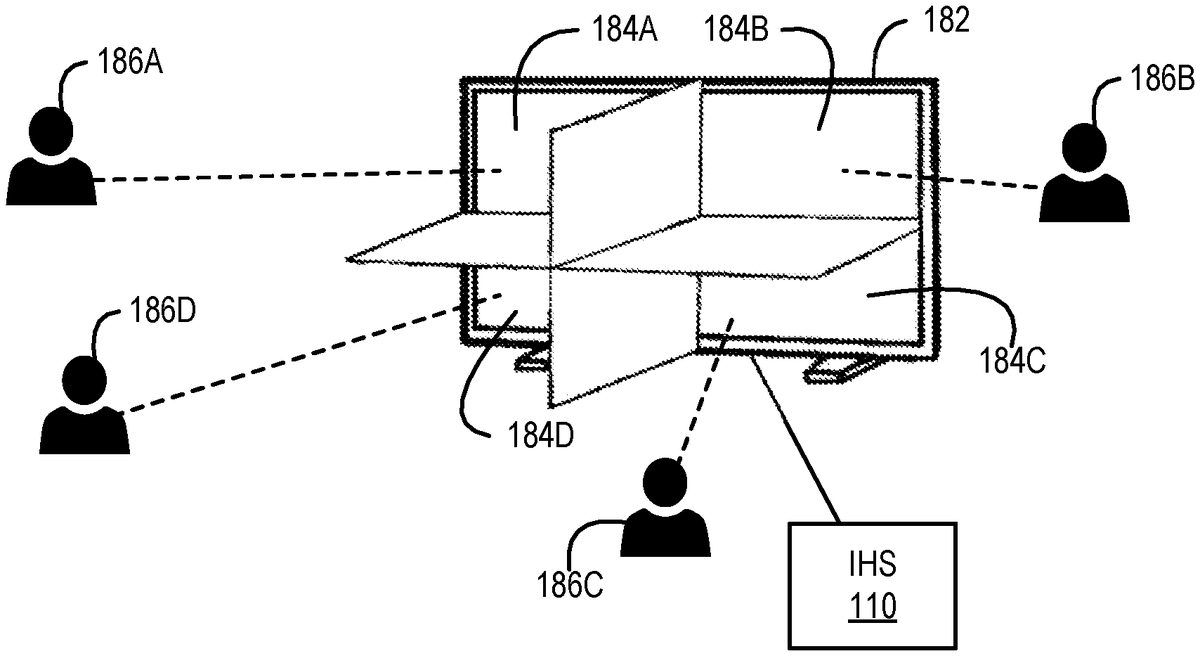
Turning now toFIG.1B, an example of a display coupled to an information handling system is illustrated, according to one or more embodiments. As shown, a display182may be coupled to IHS110. In one or more embodiments, display182may be segmented into multiple display portions. For example, a multiplayer game split screen game may be displayed via the multiple display portions. For instance, APP164may include the multiplayer game split screen game. As illustrated, display182may be segmented into display portions184A-184D. In one or more embodiments, a user186may be associated with a display portion184. For example, display portions184A-184D may be respectively associated with users186A-186D. For instance, the multiplayer game split screen game may be displayed via display portions184A-184D.
Turning now toFIG.1C, an example of information handling systems coupled to a network is illustrated, according to one or more embodiments. As shown, information handling systems (IHSs)110A-110E may be coupled to a network188. In one or more embodiments, network188may include a wired network, a wireless network, an optical network, or a combination of the foregoing, among others. For example, network188may include and/or be coupled to various types of communications networks. For instance, network188may include and/or be coupled to a LAN, a WAN (e.g., a private WAN, a corporate WAN, a public WAN, etc.), an Internet, a public switched telephone network (PSTN), a cellular telephone network, a satellite telephone network, or a combination of the foregoing, among others.
As illustrated, users186A-186D may be respectively associated with IHSs110A-110D. In one or more embodiments, IHS110E may include a server information handling system (e.g., a gaming server). For example, users186A-186D may play a game hosted by IHS110E. For instance, users186A-186D may play the game, hosted by IHS110E, via respectively associated IHSs110A-110D. In one or more embodiments, any of IHSs110A-110D may include a server information handling system (e.g., a gaming server). For example, users186A-186D may play a game hosted by any of IHSs110A-110D. For instance, users186A-186D may play the game, hosted by any of IHSs110A-110D, via respectively associated IHSs110A-110D.
Turning now toFIG.1D, an example of displays associated with information handling system is illustrated, according to one or more embodiments. As shown, users186A-186D may be respectively associated with displays182A-182D. In one or more embodiments, displays182A-182D may be respectively associated with IHSs110A-110D. For example, displays182A-182D may be respectively coupled to IHSs110A-110D. Although displays182A-182D are illustrated as external to IHSs110A-110D, one or more of IHSs110A-110D may respectively include one or more of displays182A-182D.
Turning now toFIG.1E, an example of an information handling system coupled to another information handling system is illustrated, according to one or more embodiments. As shown, IHSs110A-110D may be coupled to network188. As illustrated, users186A-186D may be respectively associated with IHSs110A-110D. As shown, an IHS110F may be coupled to IHS1D. In one or more embodiments, IHS110F may include a server information handling system (e.g., a gaming server). In one or more embodiments, IHS110F may include a gaming console. In one example, IHS110F may include a SONY® PLAYSTATION®. In a second example, IHS110F may include a MICROSOFT® XBOX®. In another example, IHS110F may include an APPLE® TV. In one or more embodiments, users186A-186D may play a game hosted by IHS110F. For example, users186A-186D may play the game, hosted by IHS110F, via respectively associated IHSs110A-110D.
In one or more embodiments, IHS110D may receive video from IHS110F. For example, the video from IHS110F may be segmented for multiple users (e.g., users186A-186D). For instance, segmenting the video from IHS110F may include sourcing display portions184A-184D (shown inFIG.1B) of the video from IHS110F. In one or more embodiments, IHS110D may convert display portions184A-184D of the video from IHS110F to multiple stream segments. For example, IHS110D may stream display portions184A-184D to users186A-186D via respectively associated IHSs110A-110D. In one or more embodiments, IHS110D may receive respective user input from users186A-186D via respectively associated IHSs110A-110D. For example, IHS110D may provide the respective user input from users186A-186D via respectively associated IHSs110A-110D to IHS110F. In one or more embodiments, IHS110D may associate user input from users186A-186D via respectively associated IHSs110A-110D with display portions184A-184D of the video from IHS110F.
Turning now toFIG.2, an example of a method of splitting a screen layout is illustrated, according to one or more embodiments. At210, the method may start. At212, multiple users may stream a split-screen game from a server IHS (e.g., a game server). For example, users186A-186D may stream a split-screen game from the server IHS. In one instance, IHSs110A-110D respectively associated with users186A-186D may stream a split-screen game from the server IHS. In a second instance, the server IHS may be IHS110E. In third instance, the server IHS may be any of IHSs110A-110D. In another instance, the server IHS may be IHS110F.
At214, a screen may be segmented. At216, a split-screen layout may be determined. In one or more embodiments, an image230associated with the game may be split into segments240A-240D. For example, volatile memory medium150of the server IHS may store image230. For instance, image230may be rendered in volatile memory medium150of the server IHS. In one or more embodiments, a stream of image frames of the game may include image230.
At218, player association may be utilized. At220, associations between each player and each screen segment may be determined. In one example, the server IHS may determine that segments240A-240D are respectively associated with users186A-186D. For instance, the server IHS may determine that segments240A-240D are respectively associated with IHSs110A-110D. In another example, IHS110D may receive image230from IHS110F and may determine that segments240A-240D are respectively associated with users186A-186D. For instance, IHS110D may determine that segments240A-240D are respectively associated with IHSs110A-110D.
At222, a correct screen segment may be streamed to each player. In one example, screen segment240A may be streamed to user186A. For instance, screen segment240A may be streamed to IHS110A. In a second example, screen segment240B may be streamed to user186B. For instance, screen segment240B may be streamed to IHS110B. In a third example, screen segment240C may be streamed to user186C. For instance, screen segment240C may be streamed to IHS110C. In another example, screen segment240D may be streamed to user186D. For instance, screen segment240D may be streamed to IHS110D.
In one or more embodiments, streaming a specific screen segment240may include providing the specific screen segment240to a specific IHS110via network188. For example, the specific IHS110may receive the specific screen segment240via network188. In one instance, if IHS110A is the specific IHS110, then the specific screen segment240may be provided to IHS110A via network188. In another instance, if IHS110A is the specific IHS110, then the specific screen segment240may not be provided to any of IHSs110B-110D via network188. In one or more embodiments, segments240A-240D may be displayed via respective displays182A-182D. In one example, user186A may view screen segment240A and may not view any of screen segments240B-240D. In a second example, user186B may view screen segment240B and may not view any of screen segments240A,240C, and240D. In a third example, user186C may view screen segment240C and may not view any of screen segments240A,240B, and240D. In another example, user186D may view screen segment240D and may not view any of screen segments240A-240C. At224, the method may end. For example, the method may end when a session is over (e.g., when a gaming session is over).
Turning now toFIG.3, two methods of segmenting a screen are illustrated, according to one or more embodiments. At310, a first method may start. In one or more embodiments, the first method may include method elements310-318. For example, the first method may be implemented via a first thread. For instance, the first thread may include a screen thread, which may be associated with one player's view (e.g., a single player's view). In one or more embodiments, a second method may include method elements330-340. For example, the second method may be implemented via a second thread. For instance, the second thread may include a user input thread. In one or more embodiments, method element216(illustrated inFIG.2) may include method elements310-318and method elements330-340, among others. In one or more embodiments, when the first method starts, a split-screen layout350may be received as input.
At312, color pixel values from a screen segment may be read. For example, color pixel values from a screen segment240may be read. In one instance, a color pixel value from a screen segment may include a red color value, a green color value, and a blue color value of a pixel (e.g., RGB color values of a pixel). In a second instance, a color pixel value from a screen segment may include a cyan color value, a magenta color value, a yellow color value, and a key color value of a pixel (e.g., CMYK color values of a pixel). In a third instance, a color pixel value from a screen segment may include a hue color value, a saturation color value, and a value color value of a pixel (e.g., HSV color values of a pixel). In another instance, a color pixel value from a screen segment may include a hue color value, a saturation color value, and a lightness color value of a pixel (e.g., HSL color values of a pixel).
At314, the screen segment may be segmented based at least on a known split screen layout. At316, the screen segments may be subsegmented a number of times to create subsegments for each player's view. For example, a screen segment240associated with a user186may be subsegmented a number of times to create subsegments. For instance, screen segment240may be subsegmented into subsegments360AA-360MN.
At318, average color values for each screen segment may be stored and may be associated with each player's view. For example, average color values for respective subsegments360AA-360MN may be determined. In one or more embodiments, an average color value of a screen segment may be a vector. For example, in determining an average color value of red values, green values, and blue values, the vector may include an average red value, an average green value, and an average blue value. In one or more embodiments, an average color value of a screen segment may be a scalar. For example, in determining an average color value of red values, green values, and blue values, the scalar may be determined via adding all the red values, green values, and blue values and dividing that sum by a sum of a number of red values, a number of green values, and a number of blue values.
In one or more embodiments, average color values of pixels respectively associated with associated with subsegments360AA-360MN may be stored. For example, the average color values of pixels respectively associated with associated with subsegments360AA-360MN may be stored via a database (DB)320. In one or more embodiments, the first method (e.g., the screen thread) may proceed to312.
At330, the second method may start. For example, the user input thread may start. In one or more embodiments, the screen thread and the user input thread may execute independently. For example, the screen thread and the user input thread may execute independently of each other.
At332, a check for user input may be performed. In one example, user input may include an actuation of a key of a keyboard. In a second example, user input may include a movement of a mouse. In a third example, user input may include a touch and/or swipe on a touchpad. In a fourth example, user input may include a movement of a joystick. In a fifth example, user input may include a movement of a trackball. In a sixth example, user input may include an actuation of a switch (e.g., a momentary switch) of a mouse, a touchpad, a game pad, a joystick, and/or a trackball, among others. In a seventh example, user input may include a gesture. In an eighth example, user input may include a tap (e.g., determined via an accelerometer). In another example, user input may include a rotation of an input device (e.g., a device that includes one or more of an accelerometer and a gyroscope, among others). In one or more embodiments, user input may be determined from any device configured to receive user input. In one example, a device configured to receive user input may include a firearm replica. In another example, a device configured to receive user input may include a flight simulator device. In one instance, a flight simulator device may include a flight simulator yoke. In a second instance, a flight simulator device may include a flight simulator throttle. In another instance, a flight simulator device may include a flight simulator switch panel.
At334, it may be determined if there was user input. If there was not user input, the second method may proceed to332, according to one or more embodiments. If there was user input, a comparison of a current screen with a previous screen may be determined, at336. In one or more embodiments, determining a comparison of a current screen with a previous screen may include determining a comparison of a current image of screen segment240at a current time with a previous image of screen segment240at a previous time. For example, determining the comparison of the current image of screen segment240at the current time with the previous image of screen segment240at the previous time may include determining comparisons of average color values associated with subsegments360AA-360MN of the current image of screen segment240with average color values associated with subsegments360AA-360MN of the previous image of screen segment240.
In one or more embodiments, determining comparisons of average color values associated with subsegments360AA-360MN of the current image of screen segment240with average color values associated with subsegments360AA-360MN of the previous image of screen segment240may include determining how many of the average color values associated with subsegments360AA-360MN of the current image of screen segment240differ from average color values associated with subsegments360AA-360MN of the previous image of screen segment240. In one or more embodiments, determining comparisons of average color values associated with sub segments360AA-360MN of the current image of screen segment240with average color values associated with subsegments360AA-360MN of the previous image of screen segment240may include determining how much of the average color values associated with subsegments360AA-360MN of the current image of screen segment240differ from average color values associated with subsegments360AA-360MN of the previous image of screen segment240. In one or more embodiments, determining comparisons of average color values associated with subsegments360AA-360MN of the current image of screen segment240with average color values associated with subsegments360AA-360MN of the previous image of screen segment240may include determining how many of the average color values associated with subsegments360AA-360MN of the current image of screen segment240differ from average color values associated with subsegments360AA-360MN of the previous image of screen segment240and how much of the average color values associated with subsegments360AA-360MN of the current image of screen segment240differ from average color values associated with subsegments360AA-360MN of the previous image of screen segment240.
At338, it may be determined if the comparison is at or above a threshold. For example, determining if the comparison is at or above the threshold may include determining if a number of the average color values associated with subsegments360AA-360MN of the current image of screen segment240that differs from average color values associated with subsegments360AA-360MN of the previous image of screen segment240is at or above a threshold number.
If the comparison is not at or above a threshold, the second method may proceed to332, according to one or more embodiments. If the comparison is at or above a threshold, an association of a player (e.g., a user186) and a screen segment (e.g., a screen segment240) may be stored. For example, the association of the player and the screen segment may be stored via a memory medium. In one instance, an association of user186A and screen segment240A may be stored via a memory medium. In a second instance, an association of user186B and screen segment240B may be stored via a memory medium. In a third instance, an association of user186C and screen segment240C may be stored via a memory medium. In another instance, an association of user186D and screen segment240D may be stored via a memory medium. In one or more embodiments, the second method may proceed to332.
Turning now toFIG.4, an example of a method of utilizing a multiplayer game with multiple displays respectively associated with multiple information handling systems is illustrated, according to one or more embodiments. At410, a first image frame of a game may be rendered. In one example, at least one of processor120and GPU130may render may render the first image frame. For instance, at least one of processor120and GPU130of a server information handling system may render may render the first image frame. In another example, a gaming console may render the first image frame. For instance, at least one of processor120and GPU130of a gaming console (e.g., IHS110F) may render the first image frame.
In one or more embodiments, the first image frame may include multiple first image segments respectively associated with multiple image coordinates. For example, the first image frame may be an image frame510A, illustrated inFIGS.5A-5C. In one or more embodiments, a stream image frames of the game may include the first image frame. As illustrated inFIG.5A, image frame510A may include multiple first image segments512A-512D. As shown inFIG.5B, first image segment512A may be associated with coordinates514AA and514AB. For example, first image segment512A may be determined via lower left coordinates514AA and upper right coordinates514AB. As also shown inFIG.5B, first image segment512B may be associated with coordinates514BA and514BB. For example, first image segment512B may be determined via lower left coordinates514BA and upper right coordinates514BB.
In one or more embodiments, a first coordinate of coordinates514may be associated with a horizontal axis, and a second coordinate of coordinates514may be associated with a vertical axis. For example, coordinates514may include a form (X, Y). In one or more embodiments, an image segment may be determined via (XLower Left, YLower Left) and (XUpper Right, YUpper Right). In one or more embodiments, an image segment may be determined via (XLower Left, YLower Left) and (XLower Left+XOffset, YLower Left+YOffset). In one or more embodiments, one or more other segment shapes and/or one or more other coordinate systems may be utilized.
As illustrated inFIG.5C, first image segment512C may be associated with coordinates514CA and514CB. For example, first image segment512C may be determined via lower left coordinates514CA and upper right coordinates514CB. As also illustrated inFIG.5C, first image segment512D may be associated with coordinates514DA and514DB. For example, first image segment512D may be determined via lower left coordinates514DA and upper right coordinates514DB.
Referring again toFIG.4, at415, the first image frame may be received. In one example, memory medium150may receive the first image frame. In another example, an information handling system may receive the first image from a gaming console. For instance, IHS110D may receive the first image from IHS110F (e.g., a gaming console). In one or more embodiments, IHS110D may receive the first image from IHS110F (e.g., the gaming console) via at least one of a high-definition multimedia interface (HDMI), a digital visual interface (DVI), a DisplayPort interface, a video graphics array (VGA) interface, and a USB interface, among others.
At420, the first image frame may be provided to multiple information handling systems coupled to a network respectively associated with multiple users of the game. For example, image frame510A may be provided IHSs110A-110D, coupled to network188, respectively associated with multiple users186A-186D of the game.
At425, first multiple subsegments of an image segment of the first image segments associated with image coordinates of multiple image coordinates may be determined. For example, as illustrated inFIG.5D, first multiple subsegments516AA-516MN of an image segment512of the first image segments512A-512D associated image coordinates of multiple image coordinates514AA-514DB may be determined.
At430, first multiple average color values respectively associated with the first multiple subsegments may be determined. For example, first multiple average color values respectively associated with first multiple subsegments516AA-516MN may be determined. For instance, an average color value of the first multiple average color values may include an average color value of pixels of a subsegment516. As an example, (Redaverage, Greenaverage, Blueaverage) of the first multiple average color values may be determined as an average color value of pixels of a subsegment516. For instance, an average color value of the first multiple average color values may include a tuple or vector (Redaverage, Greenaverage, Blueaverage).
At435, user input from an information handling system of the multiple information handling systems may be received. For example, user input from an information handling system of information handling systems110A-110D may be received. For instance, the user input may be received by the information handling system server (e.g., one of IHSs110A-110E). In one or more embodiments, the user input may be provided to the gaming console. For example, the user input may be received by the gaming console. For instance, the user input may be received by IHS110D, provided to IHS110F, and/or received by IHS110F (e.g., the gaming console).
At440, a second image frame of the game may be rendered. In one example, at least one of processor120and GPU130may render may render the second image frame. For instance, at least one of processor120and GPU130of the server information handling system may render may render the second image frame. In another example, the gaming console may render the second image frame. For instance, at least one of processor120and GPU130of the gaming console (e.g., IHS110F) may render the second image frame. In one or more embodiments, the second image frame of the game may be based at least on the user input. For example, the second image frame of the game may be rendered based at least on the user input. In one or more embodiments, the second image frame may include multiple second image segments respectively associated with the multiple image coordinates.
In one or more embodiments, the second image frame may include multiple second image segments respectively associated with the multiple image coordinates. For example, the second image frame may be an image frame510B, illustrated inFIGS.5E-5G. In one or more embodiments, the stream image frames of the game may include the second image frame. As illustrated inFIG.5E, image frame510B may include multiple second image segments522A-522D. As shown inFIG.5F, second image segment522A may be associated with coordinates514AA and514AB. For example, second image segment522A may be determined via lower left coordinates514AA and upper right coordinates514AB. As also shown inFIG.5B, second image segment522B may be associated with coordinates514BA and514BB. For example, second image segment522B may be determined via lower left coordinates514BA and upper right coordinates514BB. As illustrated inFIG.5G, second image segment522C may be associated with coordinates514CA and514CB. For example, second image segment522C may be determined via lower left coordinates514CA and upper right coordinates514CB. As also illustrated inFIG.5G, second image segment522D may be associated with coordinates524DA and514DB. For example, second image segment512D may be determined via lower left coordinates514DA and upper right coordinates514DB.
Referring again toFIG.4, at445, the second image frame may be received. In one example, memory medium150may receive the second image frame. In another example, an information handling system may receive the second image from the gaming console. For instance, IHS110D may receive the second image from IHS110F (e.g., the gaming console).
At450, second multiple subsegments of an image segment of the second image segments associated with the image coordinates of the multiple image coordinates may be determined. For example, second multiple subsegments526AA-526MN of an image segment522of the second image segments522A-522D associated image coordinates of multiple image coordinates514AA-514DB may be determined, as illustrated inFIG.5H.
At455, second multiple average color values respectively associated with the second multiple subsegments may be determined. For example, second multiple average color values respectively associated with second multiple subsegments526AA-526MN may be determined. For instance, an average color value of the second multiple average color values may include an average color value of pixels of a subsegment526. As an example, (Redaverage, Greenaverage, Blueaverage) of the second multiple average color values may be determined as an average color value of pixels of a subsegment526. For instance, an average color value of the second multiple average color values may include a tuple or vector (Redaverage, Greenaverage, Blueaverage).
At460, a comparison of the first multiple average color values with second multiple average color values may be determined. At465, it may be determined that the comparison meets or exceeds a threshold. At470, the image coordinates may be associated with the information handling system of the multiple information handling systems associated with the user. For example, a segment associated with the image coordinates of additional image frames of the stream image frames of the game may be provided to the information handling system of the multiple information handling systems associated with the user. For instance, the segment associated with the image coordinates of additional image frames of the stream image frames of the game may be provided to the information handling system of the multiple information handling systems associated with the user and may not be provided to other users of the multiple users. In one or more embodiments, associating the image coordinates with the information handling system of the multiple information handling systems associated with the user may be performed in response to determining that the comparison meets or exceeds the threshold.
In one or more embodiments, one or more of the method and/or process elements and/or one or more portions of a method and/or a process element may be performed in varying orders, may be repeated, or may be omitted. Furthermore, additional, supplementary, and/or duplicated method and/or process elements may be implemented, instantiated, and/or performed as desired, according to one or more embodiments. Moreover, one or more of system elements may be omitted and/or additional system elements may be added as desired, according to one or more embodiments.
In one or more embodiments, a memory medium may be and/or may include an article of manufacture. For example, the article of manufacture may include and/or may be a software product and/or a program product. For instance, the memory medium may be coded and/or encoded with processor-executable instructions in accordance with at least a portion of one or more flowcharts, at least a portion of one or more systems, at least a portion of one or more methods, and/or at least a portion of one or more processes described herein to produce the article of manufacture.
The above disclosed subject matter is to be considered illustrative, and not restrictive, and the appended claims are intended to cover all such modifications, enhancements, and other embodiments which fall within the true spirit and scope of the present disclosure. Thus, to the maximum extent allowed by law, the scope of the present disclosure is to be determined by the broadest permissible interpretation of the following claims and their equivalents, and shall not be restricted or limited by the foregoing detailed description.
Claims
- An information handling system, comprising: at least one processor;and a memory medium, coupled to the at least one processor, that stores instructions executable by the at least one processor, which when executed by the at least one processor, cause the information handling system to: receive a first image frame of a game, wherein the first image frame includes a plurality of first image segments respectively associated with a plurality of image coordinates;provide the first image frame to each of a plurality of information handling systems coupled to a network respectively associated with a plurality of users of the game;determine a first plurality of subsegments of an image segment of the first image segments associated with particular image coordinates of the plurality of image coordinates;determine a first plurality of average color values respectively associated with the first plurality of subsegments;receive user input from a particular information handling system of the plurality of information handling systems;receive a second image frame of the game, wherein the second image frame is based at least on the user input and wherein the second image frame includes a plurality of second image segments respectively associated with the plurality of image coordinates;determine a second plurality of subsegments of an image segment of the second image segments associated with the particular image coordinates of the plurality of image coordinates;determine a second plurality of average color values respectively associated with the second plurality of subsegments;determine a comparison of the first plurality of average color values with second plurality of average color values;determine that the comparison meets or exceeds a threshold;and in response to determining that the comparison meets or exceeds the threshold, associate the particular image coordinates with the particular information handling system of the plurality of information handling systems associated with the user input, and providing only frame segments of additional image frames of the game associated with the particular image coordinates to the particular information handling system, and excluding frame segments of the additional image frames of the game associated with other image coordinates to the particular information handling system.
- The information handling system of claim 1, wherein, to receive the first image frame, the instructions further cause the information handling system to receive the first image frame from at least one of a processor of a server information handling system and a graphics processing unit of the server information handling system;and wherein, to receive the second image frame, the instructions further cause the particular information handling system to, receive the second image frame from the at least one of the processor of the server information handling system and the graphics processing unit of the server information handling system.
- The information handling system of claim 2, wherein the instructions further cause the information handling system to: wherein the at least one of the processor of the server information handling system and the graphics processing unit of the server information handling system is configured to render the first image frame;and wherein the at least one of the processor of the server information handling system and the graphics processing unit of the server information handling system is further configured to render the second image frame.
- The information handling system of claim 2, wherein the plurality of information handling systems includes the server information handling system.
- The information handling system of claim 1, wherein, to receive the first image frame, the instructions further cause the particular information handling system to receive the first image frame from a gaming console;and wherein, to receive the second image frame, the instructions further cause the particular information handling system to receive the second image frame from the gaming console.
- The information handling system of claim 5, wherein, to receive the first image frame from the gaming console, the instructions further cause the particular information handling system to receive the first image frame from the gaming console via a video interface;and wherein, to receive the second image frame from the gaming console, the instructions further cause the particular information handling system to receive the second image frame from the gaming console via the video interface.
- The information handling system of claim 6, wherein the video interface includes at least one of a high-definition multimedia interface (HDMI), a digital visual interface (DVI), a DisplayPort interface, a video graphics array (VGA) interface, and a universal serial bus (USB) interface.
- A method, comprising: receiving a first image frame of a game, wherein the first image frame includes a plurality of first image segments respectively associated with a plurality of image coordinates;providing the first image frame to each of a plurality of information handling systems coupled to a network respectively associated with a plurality of users of the game;determining a first plurality of subsegments of an image segment of the first image segments associated with particular image coordinates of a plurality of image coordinates;determining a first plurality of average color values respectively associated with the first plurality of subsegments;receiving user input from a particular information handling system of the plurality of information handling systems;receiving a second image frame of the game based at least on the user input, wherein the second image frame is based at least on the user input and wherein the second image frame includes a plurality of second image segments respectively associated with the plurality of image coordinates;determining a second plurality of subsegments of an image segment of the second image segments associated with the particular image coordinates of the plurality of image coordinates;determining a second plurality of average color values respectively associated with the second plurality of subsegments;determining a comparison of the first plurality of average color values with second plurality of average color values;determining that the comparison meets or exceeds a threshold;and in response to the determining that the comparison meets or exceeds the threshold, associating the particular image coordinates with the particular information handling system associated with the user input, and providing only frame segments of additional image frames of the game associated with the particular image coordinates to the particular information handling system, and excluding frame segments of the additional image frames of the game associated with other image coordinates to the particular information handling system.
- The method of claim 8, wherein the receiving the first image frame includes receiving the first image frame from at least one of a processor of a server information handling system and a graphics processing unit of the server information handling system;and wherein the receiving the second image frame includes receiving the second image frame from the at least one of the processor of the server information handling system and the graphics processing unit of the server information handling system.
- The method of claim 9, further comprising: rendering, by the at least one of the processor of the server information handling system and the graphics processing unit of the server information handling system, the first image frame;and rendering, by the at least one of the processor of the server information handling system and the graphics processing unit of the server information handling system, the second image frame.
- The method of claim 9, wherein the plurality of information handling systems includes the server information handling system.
- The method of claim 8, wherein the receiving the first image frame includes receiving the first image frame from a gaming console;and wherein the receiving the second image frame includes receiving the second image frame from the gaming console.
- The method of claim 12, wherein the receiving the first image frame from the gaming console includes receiving the first image frame from the gaming console via a video interface;and wherein the receiving the second image frame from the gaming console includes receiving the second image frame from the gaming console via the video interface.
- The method of claim 13, wherein the video interface includes at least one of a high-definition multimedia interface (HDMI), a digital visual interface (DVI), a DisplayPort interface, a video graphics array (VGA) interface, and a universal serial bus (USB) interface.
- A computer-readable non-transitory memory medium that includes instructions that, when executed by at least one processor of an information handling system, cause the information handling system to: receive a first image frame of a game, wherein the first image frame includes a plurality of first image segments respectively associated with a plurality of image coordinates;provide the first image frame to each of a plurality of information handling systems coupled to a network respectively associated with a plurality of users of the game;determine a first plurality of subsegments of an image segment of the first image segments associated with particular image coordinates of the plurality of image coordinates;determine a first plurality of average color values respectively associated with the first plurality of subsegments;receive user input from a particular information handling system of the plurality of information handling systems;receive a second image frame of the game, wherein the second image frame is based at least on the user input and wherein the second image frame includes a plurality of second image segments respectively associated with the plurality of image coordinates;determine a second plurality of subsegments of an image segment of the second image segments associated with the particular image coordinates of the plurality of image coordinates;determine a second plurality of average color values respectively associated with the second plurality of subsegments;determine a comparison of the first plurality of average color values with second plurality of average color values;determine that the comparison meets or exceeds a threshold;and in response to determining that the comparison meets or exceeds the threshold, associate the particular image coordinates with the particular information handling system of the plurality of information handling systems associated with the user input, and providing only frame segments of additional image frames of the game associated with the particular image coordinates to the particular information handling system, and excluding frame segments of the additional image frames of the game associated with other image coordinates to the particular information handling system.
- The information handling system of claim 15, wherein, to receive the first image frame, the instructions further cause the information handling system to receive the first image frame from at least one of a processor of a server information handling system and a graphics processing unit of the server information handling system;and wherein, to receive the second image frame, the instructions further cause the particular information handling system to, receive the second image frame from the at least one of the processor of the server information handling system and the graphics processing unit of the server information handling system.
- The information handling system of claim 16, wherein the plurality of information handling systems includes the server information handling system.
- The information handling system of claim 15, wherein, to receive the first image frame, the instructions further cause the particular information handling system to receive the first image frame from a gaming console;and wherein, to receive the second image frame, the instructions further cause the particular information handling system to receive the second image frame from the gaming console.
- The information handling system of claim 18, wherein, to receive the first image frame from the gaming console, the instructions further cause the particular information handling system to receive the first image frame from the gaming console via a video interface;and wherein, to receive the second image frame from the gaming console, the instructions further cause the particular information handling system to receive the second image frame from the gaming console via the video interface.
- The information handling system of claim 19, wherein the video interface includes at least one of a high-definition multimedia interface (HDMI), a digital visual interface (DVI), a DisplayPort interface, a video graphics array (VGA) interface, and a universal serial bus (USB) interface.
Disclaimer: Data collected from the USPTO and may be malformed, incomplete, and/or otherwise inaccurate.