U.S. Pat. No. 11,663,652
SYSTEMS AND METHODS FOR SELLING VIRTUAL ITEMS ON MULTIPLE ONLINE SALES PLATFORMS SIMULTANEOUSLY, THE VIRTUAL ITEMS BEING USEABLE WITHIN AN ONLINE GAME
AssigneeMythical, Inc.
Issue DateDecember 17, 2021
Illustrative Figure
Abstract
Systems and methods for selling virtual items on multiple online sales platforms simultaneously are disclosed. Exemplary implementations may: receive a sales request that indicates the selling user will be offering for sale a particular virtual item through at least two online sales platforms simultaneously; assign ownership of the particular virtual item temporarily to a holding account; generate sales listings of the particular virtual item for publications on the at least two online sales platforms; effectuate the publications of the sales listings; receive indications of offers to purchase the particular virtual item; determine an accepted offer that is accepted; notify the at least two online sales platforms of whether the offers have been accepted or denied; identify a buyer's account of the buying user; effectuate assignment of the ownership of the particular virtual item to the buyer's account.
Description
DETAILED DESCRIPTION FIG.1illustrates a system100configured for selling virtual items on multiple online sales platforms105simultaneously, in accordance with one or more implementations. The virtual items may be useable within an online game. For example, the online game may be provided and/or hosted by one or more gaming platforms103. In some implementations, system100may include one or more servers102, one or more processors138, electronic storage136, one or more client computing platforms104, one or more gaming platforms103, online sales platforms105, one or more decentralized databases135, one or more user interfaces137, and/or other components. Server(s)102may be configured to communicate with one or more client computing platforms104according to a client/server architecture and/or other architectures. Client computing platform(s)104may be configured to communicate with other client computing platforms via server(s)102and/or according to a peer-to-peer architecture and/or other architectures. Users may access system100via client computing platform(s)104. The users may include one or more selling users, one or more buying users, and/or other users. For example, the users may include a first selling user, a second selling user, a first buying user, a second buying user, a first user, a second user, a third user, and so forth. Server(s)102may be configured by machine-readable instructions106. Machine-readable instructions106may include one or more instruction components. The instruction components may include computer program components. The instruction components may include one or more of account component108, sale request component110, ownership component112, listing component114, publication component116, sales information component118, winner component120, sale platform notification component122, consideration component124, buyer component126, user input component128, sharing component130, selling information request component132, and/or other instruction components. Account component108may be configured to manage user accounts for users, including but not limited to the users in an online game. In some implementations, account component108may be configured to manage user inventories for users, including but not limited to the users in an online ...
DETAILED DESCRIPTION
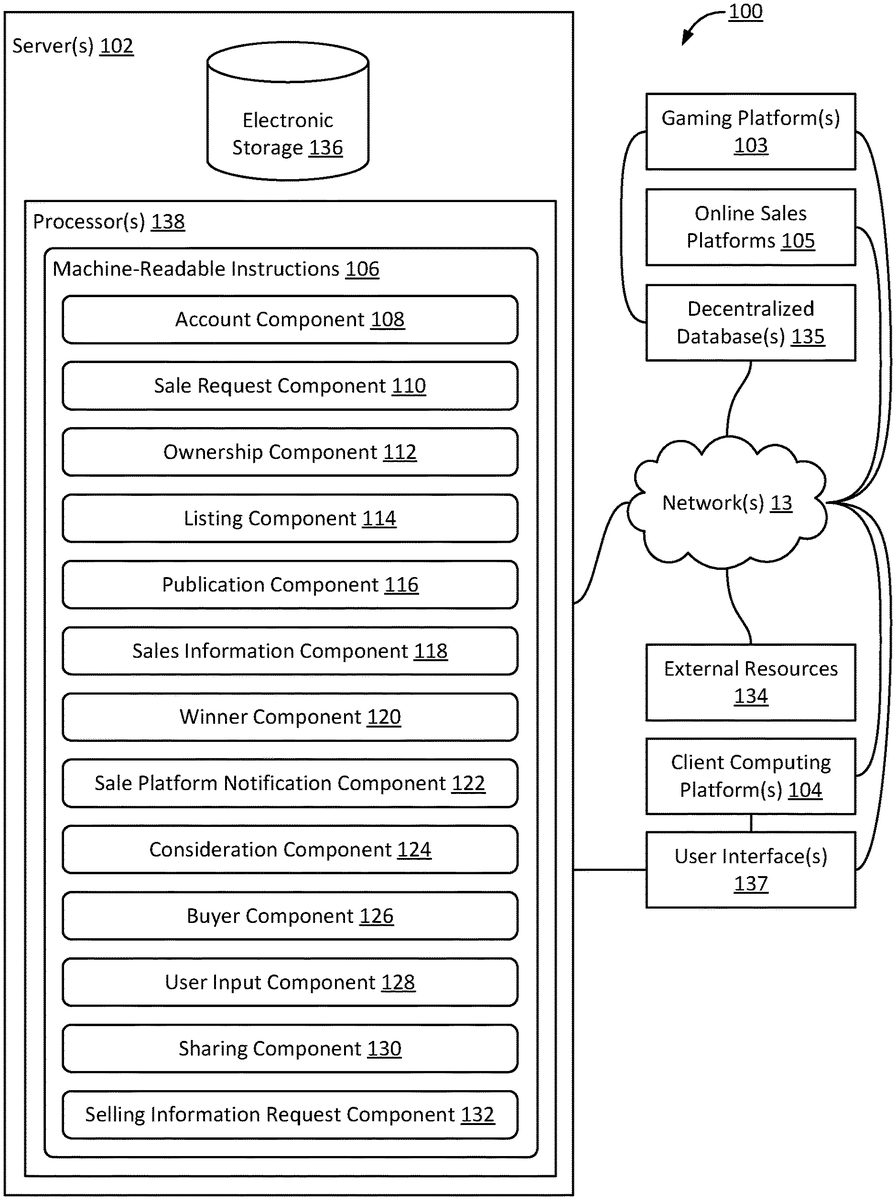
FIG.1illustrates a system100configured for selling virtual items on multiple online sales platforms105simultaneously, in accordance with one or more implementations. The virtual items may be useable within an online game. For example, the online game may be provided and/or hosted by one or more gaming platforms103. In some implementations, system100may include one or more servers102, one or more processors138, electronic storage136, one or more client computing platforms104, one or more gaming platforms103, online sales platforms105, one or more decentralized databases135, one or more user interfaces137, and/or other components. Server(s)102may be configured to communicate with one or more client computing platforms104according to a client/server architecture and/or other architectures. Client computing platform(s)104may be configured to communicate with other client computing platforms via server(s)102and/or according to a peer-to-peer architecture and/or other architectures. Users may access system100via client computing platform(s)104.
The users may include one or more selling users, one or more buying users, and/or other users. For example, the users may include a first selling user, a second selling user, a first buying user, a second buying user, a first user, a second user, a third user, and so forth.
Server(s)102may be configured by machine-readable instructions106. Machine-readable instructions106may include one or more instruction components. The instruction components may include computer program components. The instruction components may include one or more of account component108, sale request component110, ownership component112, listing component114, publication component116, sales information component118, winner component120, sale platform notification component122, consideration component124, buyer component126, user input component128, sharing component130, selling information request component132, and/or other instruction components.
Account component108may be configured to manage user accounts for users, including but not limited to the users in an online game. In some implementations, account component108may be configured to manage user inventories for users, including but not limited to the users in an online game. Individual ones of the user accounts may be associated with individual ones of the users. For example, a seller's account may be associated with a selling user (also referred to as a seller), a buyer's account may be associated with a buying user (also referred to as a buyer), a first user account may be associated with a first user, a second user account may be associated with a second user, and so forth. The individual ones of the user accounts may include individual user inventories of virtual items that are usable within the online game by the individual ones of the users. For example, the seller's account may include a seller's inventory, the buyer's account may include a buyer's inventory, the first user account may include a first user inventory, the second user account may include a second user inventory, and so forth. The virtual items included in an inventory may include virtual objects, characters, avatars, skills, abilities, virtual currency, virtual content of the online game, access rights within the online game, rights to (future) benefits within the online game, and/or other valuables within the online game. In some implementations, individual user accounts may be specific to a particular online game. In some implementations, individual user accounts may be managed in the context of one or more gaming platforms103.
In some implementations, account component108may be configured to manage user accounts in one or more online sales platforms105. In some implementations, account component108may be configured to facilitate a link or connection between user accounts of users within the online game, user accounts in one or more online sales platforms105, and/or other user accounts.
Sale request component110may be configured to receive requests from users, including but not limited to sales requests that indicates users will be offering for sale particular virtual items from their inventories through at least two online sales platforms105simultaneously. In some implementations, a request may involve a modification in the ownership of one or more virtual items. The at least two online sales platforms105may include a first online sales platform105that allows buyers to make purchases using a fiat currency, a second online sales platform105that allows buyers to make purchases using a cryptocurrency, and/or other online sales platforms105. Examples of a fiat currency may be U.S. dollars, euros, Japanese yen, and/or other currencies. Examples of a cryptocurrency may be Bitcoin, Litecoin, Ether, Ripple, EOS, and/or other currencies. As used herein, auctions may be considered a type of sale.
In some implementations, a particular user may offer a virtual item for sale if the particular user owns the virtual item and/or if the particular owner owns the right to sell the virtual item (or the right to offer the virtual item for sale). In some implementations, ownership of virtual items may be established by and/or based on the virtual items being included in particular inventories. In some implementations, ownership of virtual items may be established by and/or based on assignment of the ownership to particular user accounts and/or inventories. In some implementations, ownership of virtual items may be recorded in a digital ledger, decentralized database, blockchain, and/or other mechanism that includes electronic storage. For example, assignments of the ownership of the particular virtual item may be recorded on decentralized database135that stores a registry of assets and transactions. In some implementations, the assets of decentralized database135may include the particular virtual item. In some implementations, ownership of the particular virtual item may be assigned, prior to a sale, to the seller's account. This may be referred to as the seller owning the particular virtual item. In some implementations, decentralized database135may implement a blockchain.
Ownership component112may be configured to determine, assign, and/or otherwise modify ownership of virtual items, including but not limited to virtual items that are usable within one or more online games. For example, ownership component112may be configured to assign the ownership of a particular virtual item to a particular user account. In some implementations, modifications of ownership may be temporary. For example, ownership component112may be configured to assign the ownership of a particular virtual item temporarily to a holding account. For example, the holding account may be not associated with (and/or otherwise under control of) user accounts such as a seller's account or a buyer's account. In some implementations, the holding account may hold virtual items in escrow during transactions between users. In some implementations, assigning the ownership of the particular virtual item temporarily to the holding account may be performed such that the selling user is further unable to transfer, sell, and/or otherwise use the particular virtual item within the online game (e.g., at least while ownership is assigned to the holding account). This may prevent changes to the particular virtual item during a sales transaction. In some implementations, actions performed by ownership component112(e.g., determinations, assignments, and/or modifications) may be performed in response to actions performed by other components of system100, including but not limited to sale request component110. In some implementations, the holding account may be an account on a permissioned blockchain. In some implementations, the holding account may be an account of one or more gaming platforms103. Assignments of the ownership of the particular virtual item may be recorded on decentralized database135that stores a registry of assets and transactions. In some implementations, assigning the ownership of the particular virtual item temporarily to the holding account may be performed such that the selling user is henceforth unable to use the particular virtual item within the online game.
In some implementations, ownership component112may be configured to effectuate a lock or hold on a particular virtual item that is for sale. For example, by placing a lock or hold on the particular virtual item, the particular virtual item may be safeguarded from being modified and/or destroyed while being listed for sale.
In some implementations, ownership component112may be configured to assign the ownership of a particular virtual item to a buyer's account, e.g., responsive to receipt of sales information indicating the particular virtual item has been purchased by a buyer. Subsequent to such an assignment, the particular virtual item may be included in a buyer's inventory and accessible to be used by the buying user within the online game.
In some implementations, ownership component112may be configured to assign the ownership of a particular virtual item to the seller's account, responsive to receipt of sales information indicating the particular virtual item has not been purchased. For example, a seller may have offered the particular virtual item for sale (such that the ownership was assigned to a holding account). Responsive to a determination that the particular virtual item has not been sold (e.g., not sold within some predetermined time period that has expired), ownership component112may be configured to assign the ownership back to the seller's account (e.g., from the holding account).
Listing component114may be configured to generate and/or prepare sales listings of virtual items for publications on online sales platforms105, in particular the at least two online sales platforms105. Even when a single particular virtual item is intended to be sold (and only sold exactly once to exactly one buyer), listing component114may generate different sales listings for publication on different online sales platforms105; in particular, at least a first sales listing for the first online sales platform105, and a second sales listing for the second online sales platform105. The first and second sales listings may be published at the same time (or such that users of both online sales platforms105can be presented with the listings at the same time, simultaneously, and/or otherwise concurrently). The individual sales listings may include pricing information for prospective buying users and descriptive information that describes the particular virtual item. Generating the sales listings of a particular virtual item may include converting price information (e.g., as included in the sales request) to either the fiat currency or the cryptocurrency. In some implementations, a sales listing may include multiple required fields and one or more optional fields or other units of relevant information. In some implementations, one or more fields may be filled automatically, e.g., by listing component114, based on information received by sale request component110. In some implementations, a seller may be prompted to provide and/or confirm information for one or more fields such that generation of a particular sales listing may be completed, e.g., through selling information request component132. The sales listings for a particular virtual item may include a first sales listing for the first online sales platform105, a second sales listing for the second online sales platform105, and/or other sales listings for other online sales platforms105. In some implementations, publication of the first sales listing may effectuate an auction having a limited duration.
Publication component116may be configured to effectuate publication of sales listings on online sales platform105. In some implementations, a particular sales listing may be published for a limited duration. For example, an auction may have a limited duration. In some implementations, a particular online sales platform105may support an Application Programming Interface (API) for the publication of sales listings. In some implementations, one or more online sales platforms105may be external to gaming platform103and/or system100. For example, in some implementations, online sales platforms105may include one or more of eBay™, Amazon™, Etsy™, and/or another platform that supports online sales transactions. In some implementations, publication component116may be configured to effectuate the publications of the sales listings of the particular virtual item on the at least two online sales platforms105, in accordance with a received sales request. For example, in some implementations, a seller may select on which of the available online sales platforms105a particular virtual item will be offered for sale. In some implementations, publications of sales listings may be effectuated subsequent to a verification whether the selling user has ownership of the particular virtual item.
Sales information component118may be configured to receive information from online sales platforms105, including but not limited to sales information. In some implementations, sales information may include indications of offers and/or attempts to purchase particular virtual items. In some implementations, sales information may indicate whether a particular sales listing has received a bid and/or other offer. In some implementations, sales information from online sales platform105pertaining to a particular sales listing may be received upon expiration of a limited duration that is associated with the particular sales listing. In some implementations, the indications of the offers may include a first indication of a first offer received through first online sales platform105, a second indication of a second offer received through second online sales platform105, and/or other indications. In some implementations, sales information may be time-stamped, e.g., according to the moment of receipt by sales information component118, the moment online sales platforms105were notified and/or otherwise alerted by prospective buyers, and/or other particular moments in time. In some implementations, time stamps may allow sales information and/or offers from different prospective buyers to be organized in chronological order.
Winner component120may be configured to determine and/or decide an accepted offer (e.g., regarding the sale of a particular virtual item) that is accepted. In some implementations, winner component120may be configured to decide which of the received offers to purchase a particular virtual item will be accepted, or is intended to be accepted (barring any issues such as non-payment and/or other issues). The accepted offer (also referred to as “winning offer”) for a particular virtual item may be exactly one of the offers to purchase the particular virtual item. Winner component120may be further configured to determine a buying user that provided the accepted offer. In some implementations, determinations and/or decisions regarding the winner offer and/or the buying user may be based on one or more factors and/or considerations, including but not limited to ranking/rating/reputation of prospective buyers, estimated and/or anticipated costs/fees/revenue/profit of prospective purchases to any or all of the pertinent parties in a transaction, chronological information, and/or other factors and considerations.
In some implementations, winner component120may be configured to perform verifications pertaining to sales activities. For example, a verification may verify whether a particular sales request is associated with a user and/or a user account. For example, a verification may verify whether a particular sales request is associated with a user account of a user that is allowed to initiate sales transactions. In some implementations, determining the accepted offer may include a verification whether one or more requirements as stipulated by the selling user in the sales request have been met. For example, the one or more requirements may include geographical restrictions, restrictions related to in-game player statistics and/or parameters for the prospective buyer, and/or other restrictions. In some implementations, performance of one or more verifications may be based on information in the registry that is stored in decentralized database135. In some implementations, decentralized database135may represent a blockchain, and a particular verification may be based on information in the registry that is stored in the blockchain.
Sale platform notification component122may be configured to notify online sales platforms105. For example, a notification may indicate whether particular offers from prospective buyers have been accepted or denied. In some implementations, one or more online sales platforms105may deactivate publications of sales listings, e.g., subsequent to notifications whether particular offers have been accepted or denied.
Consideration component124may be configured to receive amounts of consideration from buying users. Consideration may include fiat currency, cryptocurrency, and/or other types of currencies. Consideration component124may be configured to transfer payments between different accounts and/or different users, including a seller's account, a buyer's account, and/or other user accounts. In some implementations, consideration component124may be configured to convert one or more currencies of a first type into one or more currencies of a second type. For example, in some implementations, received currency from the buyer may be converted to a preferred currency of the seller. In some implementations, consideration component124may receive payments on behalf of buyers, e.g. from one or more online sales platform105. In some implementations, consideration component124may receive payments on behalf of sellers. In some implementations, consideration component124may be configured to transfer at least a portion of a sales amount received from a buying user to a seller's account. In some implementations, for example in case of a refund, consideration component124may be configured to receive at least a portion of the sales amount from the original seller's account. In some implementations, for example in case of a refund, consideration component124may be configured to transfer at least a portion of a sales amount to the original buyer's account. Consideration component124may be configured to share portions of payments with other stakeholders, including but not limited to online sales platform105(e.g., a sales service fee or a transaction fee), gaming platform(s)103, an original creator or designer of the sold virtual item, and/or other interested parties.
Buyer component126may be configured to identify accounts, including but not limited to user accounts of buyers of virtual items. For example, buyer component126may be configured to identify a buyer's account of a buying user that has effectuated a purchase of a particular virtual item through a particular online sales platform105. In some implementations, identification may be performed responsive to receipt of sales information indicating a particular virtual item has been purchased. The buyer's account may include a buyer's inventory of virtual items that are usable by the buying user within the online game. In some implementations, identifying the buyer's account of the buying user may include generating a redemption code for the particular virtual item. In some implementations, assigning the ownership of the particular virtual item to the buyer's account may be performed responsive to redemption of the redemption code, e.g., by the buyer. In some implementations, a buyer may have a user account with a particular online sales platform105(i.e., at the moment of the purchase of a particular virtual item), but not with a particular gaming platform103. In such a case, buyer component126may be configured to facilitate the creation of a buyer's account with a particular gaming platform103. Once the buyer's account is created and subsequently identified, ownership of a purchased virtual item may be assigned to the buyer's account. The particular virtual item that may be included in the buyer's inventory may be available to be used by the buying user within the online game.
In some implementations, ownership component112may be configured to effectuate assignment of the ownership of a particular virtual item to a particular buyer's account, such that the particular virtual item is included in the particular buyer's inventory. In some implementations, effectuating the assignment of the ownership of the particular virtual item to the buyer's account may include assigning the ownership from the holding account to the particular buyer's account.
Sharing component130may be configured to transfer at least a portion of the amount of consideration received from the buying user to the seller's account. In some implementations, sharing component130may be configured to share portions of payments with other stakeholders, including but not limited to online sales platform105(e.g., a sales service fee or a transaction fee), gaming platform(s)103, an original creator or designer of the sold virtual item, and/or other interested parties.
By way of non-limiting example,FIG.3illustrates a transactional diagram30of actions and transactions performed in system100. A first transaction in transactional diagram30represents a sale of a particular virtual item from a user11to a user12or a user14, and is initiated by a sales request31from user11to a particular gaming platform103. Subsequent to sales request31, an assignment32assigns the ownership of the particular virtual item to a holding account on decentralized database135(e.g., on a permissioned blockchain that is configured to record ownership of certain virtual items). In some implementations, assignments may be initiated by gaming platform103and implemented by decentralized database135. Subsequent to assignment32, at least two listings33are generated and published on at least two different online sales platforms105. Subsequent to publishing the sales listings, user12and user14each provide offers to purchase the particular virtual item, through purchase offers34(which may be accompanied by sales amounts, not depicted). Subsequently, a determination is made which of the purchase offers is accepted, e.g., by decentralized database135. The at least two different online sales platforms105and/or users12and14are notified through notifications35whether individual purchase offers are accepted or denied. Exactly one purchase offer is accepted. Next, the buyer's account is identified (in this example, either the account of user12or user14). Subsequently, an assignment36assigns the ownership of the particular virtual item to the buyer's account (e.g., of user12or user14, and, e.g., an account in gaming platform103). A payment37(presumably the lion share received from the buyer user) is transferred to the seller, user11. The order of the actions in transactional diagram30is exemplary and not intended to be limiting. Sales transactions in accordance with this disclosure may include additional and/or different actions and/or steps then depicted inFIG.3, which is merely intended to be exemplary.
Referring toFIG.1, selling information request component132may be configured to request, from a selling user, selling information related to the sale of a particular virtual item. In some implementations, generation of one or more of the sales listings (e.g., by listing component114) may be based on information requested by selling information request component132, such as, e.g., selling information. In some implementations, receipt of the selling information may confirm the selling user consents to the publications of the sales listings.
User input component128may be configured to receive user input from users, for example through client computing platforms104. In some implementations, user input component may receive user input from a selling user, a buying user, and/or other users. For example, user input may confirm a selling user's consent to offer a particular virtual item for sale, and/or publish a particular sales listing. In some implementations, publication of one or more sales listings may be effectuated subsequent to receipt of particular user input from the selling user. In some implementations, user input component132may be implemented through user interfaces137.
User interfaces137may be configured to facilitate interaction between users and system100and/or between users and client computing platforms104. For example, user interfaces137may provide interfaces through which users may provide information to and/or receive information from system100. In some implementations, a particular user interface137may include one or more of a display screen, touchscreen, monitor, a keyboard, buttons, switches, knobs, levers, mouse, microphones, sensors to capture voice commands, sensors to capture body movement, sensors to capture hand and/or finger gestures, and/or other user interface devices configured to receive and/or convey user input. In some implementations, one or more user interfaces137may be included in one or more client computing platforms104. In some implementations, one or more user interfaces137may be included in system100.
In some implementations, server(s)102, client computing platform(s)104, and/or external resources134may be operatively linked via one or more electronic communication links. For example, such electronic communication links may be established, at least in part, via one or more networks13such as the Internet and/or other networks. It will be appreciated that this is not intended to be limiting, and that the scope of this disclosure includes implementations in which server(s)102, client computing platform(s)104, and/or external resources134may be operatively linked via some other communication media.
A given client computing platform104may include one or more processors configured to execute computer program components. The computer program components may be configured to enable an expert or user associated with the given client computing platform104to interface with system100and/or external resources134, and/or provide other functionality attributed herein to client computing platform(s)104. By way of non-limiting example, the given client computing platform104may include one or more of a desktop computer, a laptop computer, a handheld computer, a tablet computing platform, a NetBook, a Smartphone, a gaming console, and/or other computing platforms.
External resources134may include sources of information outside of system100, external entities participating with system100, and/or other resources. In some implementations, some or all of the functionality attributed herein to external resources134may be provided by resources included in system100.
Server(s)102may include electronic storage136, one or more processors138, and/or other components. Server(s)102may include communication lines, or ports to enable the exchange of information with a network and/or other computing platforms. Illustration of server(s)102inFIG.1is not intended to be limiting. Server(s)102may include a plurality of hardware, software, and/or firmware components operating together to provide the functionality attributed herein to server(s)102. For example, server(s)102may be implemented by a cloud of computing platforms operating together as server(s)102.
Electronic storage136may comprise non-transitory storage media that electronically stores information. The electronic storage media of electronic storage136may include one or both of system storage that is provided integrally (i.e., substantially non-removable) with server(s)102and/or removable storage that is removably connectable to server(s)102via, for example, a port (e.g., a USB port, a firewire port, etc.) or a drive (e.g., a disk drive, etc.). Electronic storage136may include one or more of optically readable storage media (e.g., optical disks, etc.), magnetically readable storage media (e.g., magnetic tape, magnetic hard drive, floppy drive, etc.), electrical charge-based storage media (e.g., EEPROM, RAM, etc.), solid-state storage media (e.g., flash drive, etc.), and/or other electronically readable storage media. Electronic storage136may include one or more virtual storage resources (e.g., cloud storage, a virtual private network, and/or other virtual storage resources). Electronic storage136may store software algorithms, information determined by processor(s)138, information received from server(s)102, information received from client computing platform(s)104, and/or other information that enables server(s)102to function as described herein.
Processor(s)138may be configured to provide information processing capabilities in server(s)102. As such, processor(s)138may include one or more of a digital processor, an analog processor, a digital circuit designed to process information, an analog circuit designed to process information, a state machine, and/or other mechanisms for electronically processing information. Although processor(s)138is shown inFIG.1as a single entity, this is for illustrative purposes only. In some implementations, processor(s)138may include a plurality of processing units. These processing units may be physically located within the same device, or processor(s)138may represent processing functionality of a plurality of devices operating in coordination. Processor(s)138may be configured to execute components108,110,112,114,116,118,120,122,124,126,128,130, and/or132, and/or other components. Processor(s)138may be configured to execute components108,110,112,114,116,118,120,122,124,126,128,130, and/or132, and/or other components by software; hardware; firmware; some combination of software, hardware, and/or firmware; and/or other mechanisms for configuring processing capabilities on processor(s)138. As used herein, the term “component” may refer to any component or set of components that perform the functionality attributed to the component. This may include one or more physical processors during execution of processor readable instructions, the processor readable instructions, circuitry, hardware, storage media, or any other components.
It should be appreciated that although components108,110,112,114,116,118,120,122,124,126,128,130, and/or132are illustrated inFIG.1as being implemented within a single processing unit, in implementations in which processor(s)138includes multiple processing units, one or more of components108,110,112,114,116,118,120,122,124,126,128,130, and/or132may be implemented remotely from the other components. The description of the functionality provided by the different components108,110,112,114,116,118,120,122,124,126,128,130, and/or132described below is for illustrative purposes, and is not intended to be limiting, as any of components108,110,112,114,116,118,120,122,124,126,128,130, and/or132may provide more or less functionality than is described. For example, one or more of components108,110,112,114,116,118,120,122,124,126,128,130, and/or132may be eliminated, and some or all of its functionality may be provided by other ones of components108,110,112,114,116,118,120,122,124,126,128,130, and/or132. As another example, processor(s)138may be configured to execute one or more additional components that may perform some or all of the functionality attributed below to one of components108,110,112,114,116,118,120,122,124,126,128,130, and/or132.
FIG.2illustrates a method200for selling virtual items on multiple online sales platforms simultaneously, the virtual items being useable within an online game, in accordance with one or more implementations. The operations of method200presented below are intended to be illustrative. In some implementations, method200may be accomplished with one or more additional operations not described, and/or without one or more of the operations discussed. Additionally, the order in which the operations of method200are illustrated inFIG.2and described below is not intended to be limiting.
In some implementations, method200may be implemented in one or more processing devices (e.g., a digital processor, an analog processor, a digital circuit designed to process information, an analog circuit designed to process information, a state machine, and/or other mechanisms for electronically processing information). The one or more processing devices may include one or more devices executing some or all of the operations of method200in response to instructions stored electronically on an electronic storage medium. The one or more processing devices may include one or more devices configured through hardware, firmware, and/or software to be specifically designed for execution of one or more of the operations of method200.
An operation202may include managing user accounts for users in the online game. Individual user accounts may be associated with individual users. The individual user accounts may include individual user inventories of virtual items that are usable within the online game by the individual users. The users may include a selling user associated with a seller's account. The seller's account may include a seller's inventory of one or more virtual items that are usable by the selling user within the online game. Operation202may be performed by one or more hardware processors configured by machine-readable instructions including a component that is the same as or similar to account component108, in accordance with one or more implementations.
An operation204may include receiving a sales request that indicates the selling user will be offering for sale a particular virtual item from the seller's inventory through at least two online sales platforms simultaneously. The at least two online sales platforms may include a first online sales platform that allows buyers to make purchases using a fiat currency and a second online sales platform that allows buyers to make purchases using a cryptocurrency. Operation204may be performed by one or more hardware processors configured by machine-readable instructions including a component that is the same as or similar to sale request component110, in accordance with one or more implementations.
An operation206may include assigning ownership of the particular virtual item temporarily to a holding account such that the selling user is unable to transfer or modify the ownership of the particular virtual item while the ownership of the particular virtual item is assigned to the holding account. Operation206may be performed by one or more hardware processors configured by machine-readable instructions including a component that is the same as or similar to ownership component112, in accordance with one or more implementations.
An operation208may include generating sales listings of the particular virtual item for publications on the at least two online sales platforms. The individual sales listings may include pricing information for prospective buying users and descriptive information that describes the particular virtual item. The sales listings may include a first sales listing for the first online sales platform and a second sales listing for the second online sales platform. Operation208may be performed by one or more hardware processors configured by machine-readable instructions including a component that is the same as or similar to listing component114, in accordance with one or more implementations.
An operation210may include effectuating the publications of the sales listings of the particular virtual item on the at least two online sales platforms. Operation210may be performed by one or more hardware processors configured by machine-readable instructions including a component that is the same as or similar to publication component116, in accordance with one or more implementations.
An operation212may include receiving indications of offers to purchase the particular virtual item. The indications of the offers may include a first indication of a first offer received through the first online sales platform and a second indication of a second offer received through the second online sales platform. Operation212may be performed by one or more hardware processors configured by machine-readable instructions including a component that is the same as or similar to sales information component118, in accordance with one or more implementations.
An operation214may include determining an accepted offer that is accepted. The accepted offer may be exactly one of the offers to purchase. Operation214may include determining a buying user that provided the accepted offer. Operation214may be performed by one or more hardware processors configured by machine-readable instructions including a component that is the same as or similar to winner component120, in accordance with one or more implementations.
An operation216may include notifying the at least two online sales platforms of whether the offers have been accepted or denied. Operation216may be performed by one or more hardware processors configured by machine-readable instructions including a component that is the same as or similar to sale platform notification component122, in accordance with one or more implementations.
An operation218may include receiving an amount of consideration from the buying user. Operation218may be performed by one or more hardware processors configured by machine-readable instructions including a component that is the same as or similar to consideration component124, in accordance with one or more implementations.
An operation220may include identifying a buyer's account of the buying user. The buyer's account may include a buyer's inventory. Operation220may be performed by one or more hardware processors configured by machine-readable instructions including a component that is the same as or similar to buyer component126, in accordance with one or more implementations.
An operation222may include effectuating assignment of the ownership of the particular virtual item to the buyer's account, such that the particular virtual item is included in the buyer's inventory. Operation222may be performed by one or more hardware processors configured by machine-readable instructions including a component that is the same as or similar to ownership component112, in accordance with one or more implementations.
An operation224may include transferring at least a portion of the amount of consideration received from the buying user to the seller's account. Operation224may be performed by one or more hardware processors configured by machine-readable instructions including a component that is the same as or similar to sharing component130, in accordance with one or more implementations.
Although the present technology has been described in detail for the purpose of illustration based on what is currently considered to be the most practical and preferred implementations, it is to be understood that such detail is solely for that purpose and that the technology is not limited to the disclosed implementations, but, on the contrary, is intended to cover modifications and equivalent arrangements that are within the spirit and scope of the appended claims. For example, it is to be understood that the present technology contemplates that, to the extent possible, one or more features of any implementation can be combined with one or more features of any other implementation.
Claims
- A system configured for offering to sell virtual items on multiple online sales platforms simultaneously, the virtual items being usable within an online game, the system comprising: one or more hardware processors configured by machine-readable instructions to: manage user accounts for users in the online game, wherein individual user accounts are associated with individual users, wherein the individual user accounts include individual user inventories of virtual items that are usable within the online game by the individual users, wherein the users include a selling user associated with a seller's account, and wherein the seller's account includes a seller's inventory of one or more virtual items that are usable by the selling user within the online game;receive a sales request that indicates the selling user offers for sale a particular virtual item from the seller's inventory through at least two online sales platforms simultaneously, wherein the at least two online sales platforms include a first online sales platform that allows purchases using a fiat currency and a second online sales platform that allows purchases using a cryptocurrency;assign ownership of the particular virtual item temporarily to a holding account such that the selling user is unable to modify the ownership of the particular virtual item while the ownership of the particular virtual item is assigned to the holding account;effectuate publications of sales listings of the particular virtual item on the at least two online sales platforms, wherein the sales listings include a first sales listing and a second sales listing;receive indications of offers to purchase the particular virtual item, wherein the indications of the offers include a first indication of a first offer received through the first online sales platform and a second indication of a second offer received through the second online sales platform;determine an accepted offer that is accepted, wherein the accepted offer is exactly one of the offers to purchase;determine a buying user that provided the accepted offer and a buyer's account of the buying user;notify the at least two online sales platforms of whether the offers have been accepted or denied;effectuate assignment of the ownership of the particular virtual item to the buyer's account;and transfer at least a portion of an amount of consideration received from the buying user to the seller's account.
- The system of claim 1, wherein the one or more hardware processors are further configured by machine-readable instructions to: request, from the selling user, selling information related to the sale of the particular virtual item;and generate the first sales listing and the second sales listing based on the selling information.
- The system of claim 2, wherein generating the sales listings of the particular virtual item includes converting price information to either the fiat currency or the cryptocurrency.
- The system of claim 1, wherein the at least two online sales platforms deactivate the publications of the sales listings, subsequent to notifications whether the offers have been accepted or denied.
- The system of claim 1, wherein publication of the first sales listing effectuates an auction having a limited duration.
- The system of claim 1, wherein determining the accepted offer includes a verification whether one or more requirements as stipulated by the selling user in the sales request have been met.
- The system of claim 1, wherein effectuating the assignment of the ownership of the particular virtual item to the buyer's account includes assigning the ownership from the holding account to the buyer's account.
- The system of claim 1, wherein the holding account is an account on a permissioned blockchain.
- The system of claim 1, wherein the particular virtual item is available to be used by the buying user within the online game.
- The system of claim 1, wherein assignments of the ownership of the particular virtual item are recorded on a decentralized database that stores a registry of assets and transactions, wherein the assets include the particular virtual item, wherein the decentralized database represents a blockchain, wherein the publications of the sales listing are effectuated subsequent to a verification whether the selling user has ownership of the particular virtual item, and wherein the verification is based on information in the registry that is stored in the decentralized database.
- A method for offering to sell virtual items on multiple online sales platforms simultaneously, the virtual items being usable within an online game, the method comprising: managing user accounts for users in the online game, wherein individual user accounts are associated with individual users, wherein the individual user accounts include individual user inventories of virtual items that are usable within the online game by the individual users, wherein the users include a selling user associated with a seller's account, and wherein the seller's account includes a seller's inventory of one or more virtual items that are usable by the selling user within the online game;receiving a sales request that indicates the selling user offers for sale a particular virtual item from the seller's inventory through at least two online sales platforms simultaneously, wherein the at least two online sales platforms include a first online sales platform that allows purchases using a fiat currency and a second online sales platform that allows purchases using a cryptocurrency;assigning ownership of the particular virtual item temporarily to a holding account such that the selling user is unable to modify the ownership of the particular virtual item while the ownership of the particular virtual item is assigned to the holding account;effectuating publications of sales listings of the particular virtual item on the at least two online sales platforms, wherein the sales listings include a first sales listing and a second sales listing;receiving indications of offers to purchase the particular virtual item, wherein the indications of the offers include a first indication of a first offer received through the first online sales platform and a second indication of a second offer received through the second online sales platform;determining an accepted offer that is accepted, wherein the accepted offer is exactly one of the offers to purchase;determining a buying user that provided the accepted offer and a buyer's account of the buying user;notifying the at least two online sales platforms of whether the offers have been accepted or denied;effectuating assignment of the ownership of the particular virtual item to the buyer's account;and transferring at least a portion of an amount of consideration received from the buying user to the seller's account.
- The method of claim 11, further comprising: requesting, from the selling user, selling information related to the sale of the particular virtual item;and generating the first sales listing and the second sales listing based on the selling information.
- The method of claim 12, wherein generating the sales listings of the particular virtual item includes converting price information to either the fiat currency or the cryptocurrency.
- The method of claim 11, wherein the at least two online sales platforms deactivate the publications of the sales listings, subsequent to notifications whether the offers have been accepted or denied.
- The method of claim 11, wherein publication of the first sales listing effectuates an auction having a limited duration.
- The method of claim 11, wherein determining the accepted offer includes a verification whether one or more requirements as stipulated by the selling user in the sales request have been met.
- The method of claim 11, wherein effectuating the assignment of the ownership of the particular virtual item to the buyer's account includes assigning the ownership from the holding account to the buyer's account.
- The method of claim 11, wherein the holding account is an account on a permissioned blockchain.
- The method of claim 11, wherein the particular virtual item is available to be used by the buying user within the online game.
- The method of claim 11, wherein assignments of the ownership of the particular virtual item are recorded on a decentralized database that stores a registry of assets and transactions, wherein the assets include the particular virtual item, wherein the decentralized database represents a blockchain, wherein the publications of the sales listing are effectuated subsequent to a verification whether the selling user has ownership of the particular virtual item, and wherein the verification is based on information in the registry that is stored in the decentralized database.
Disclaimer: Data collected from the USPTO and may be malformed, incomplete, and/or otherwise inaccurate.