U.S. Pat. No. 11,652,887
DYNAMIC ONLINE GAME IMPLEMENTATION ON A CLIENT DEVICE
AssigneeKabam, Inc.
Issue DateMarch 29, 2022
Illustrative Figure
Abstract
A system and method for providing online games on client devices based on capabilities of the client devices are disclosed. Device capability information may be obtained from the client devices during the online game. Values of one or more capability parameters may be determined based on the device capability information obtained. Device profiles may be assigned to the client devices based on the determined values of the capability parameters. One or more game features may be adjusted in accordance with the assigned device profile for implementing the online game on the client devices. The adjustable game features may include frame rate, level of detail of rendering, level of 3D graphics, level of collision effects, animation type, gameplay available for user interaction, gameplay content for user interaction, communication mode, physics effects available for display, level of artificial intelligence, and/or any other features of the online game.
Description
DETAILED DESCRIPTION FIG.1illustrates one example of a system100configured to facilitate providing online games on individual client devices based on capability of the client devices in accordance with the disclosure. In some implementations, as shown in this example, system100may include a server102configured to host online game over a communications network. As shown, the server102may communicate with one or more client devices104according to a client/server architecture. The users may access system100via client devices104. As shown, server102may comprise processors108configured to execute computer-readable instructions to implement system components. The computer program components may include one or more of a game component112, a device information component114, a device capability determination component116, a device profile management component118, a device profile assignment component120, an adjustment component122, and/or other components. The game component112may be configured to execute an instance of an online game. The instance of the online game executed by the game component112may be implemented by client devices104for presentation to and interaction by the users of the online game. Within the instance of the online game executed by the game component112, users may interact with elements in the online game and/or with each other through gameplays provided by the online game. The gameplays may include role-playing, first-person shooter, real-time strategy, turn-based strategy, simulation, music or rhythm playing, card playing, board game, social interaction, twitching, and/or any other gameplays. The execution of the instance of the online game by game component112may include determining a state associated with the online game. The state may be communicated (e.g., via streaming visual data, object/position data, and/or other state information) from server102to client devices104for presentation to users. The state determined and transmitted to a given client device104may correspond to a view for a user character being controlled by a user via the given client device104. The state determined and transmitted to a ...
DETAILED DESCRIPTION
FIG.1illustrates one example of a system100configured to facilitate providing online games on individual client devices based on capability of the client devices in accordance with the disclosure. In some implementations, as shown in this example, system100may include a server102configured to host online game over a communications network. As shown, the server102may communicate with one or more client devices104according to a client/server architecture. The users may access system100via client devices104. As shown, server102may comprise processors108configured to execute computer-readable instructions to implement system components. The computer program components may include one or more of a game component112, a device information component114, a device capability determination component116, a device profile management component118, a device profile assignment component120, an adjustment component122, and/or other components.
The game component112may be configured to execute an instance of an online game. The instance of the online game executed by the game component112may be implemented by client devices104for presentation to and interaction by the users of the online game. Within the instance of the online game executed by the game component112, users may interact with elements in the online game and/or with each other through gameplays provided by the online game. The gameplays may include role-playing, first-person shooter, real-time strategy, turn-based strategy, simulation, music or rhythm playing, card playing, board game, social interaction, twitching, and/or any other gameplays. The execution of the instance of the online game by game component112may include determining a state associated with the online game. The state may be communicated (e.g., via streaming visual data, object/position data, and/or other state information) from server102to client devices104for presentation to users. The state determined and transmitted to a given client device104may correspond to a view for a user character being controlled by a user via the given client device104. The state determined and transmitted to a given client device104may correspond to a location in a game space associated with the online game. The view described by the state for the given client device may correspond, for example, to the location from which the view is taken, the location the view depicts and/or other locations, a zoom ratio, a dimensionality of objects, a point-of-view, and/or view parameters of the view. One or more of the view parameters may be selectable by the user.
The instance of the online game may be persistent. That is, the online game may continue on whether or not individual users are currently logged in and/or participating in the online game. A user that logs out of the online game and then logs back in some time later may find the game space associated with the online game has been changed through the interactions of other users with the game space during the time the user was logged out. These changes may include changes to the simulated physical space, changes in the user's inventory, changes in other users' inventories, changes experienced by non-user characters, and/or other changes.
The instance of the online game may comprise a simulated game space, e.g., a game space that is accessible by users via clients (e.g., client devices104) that present the views of the game space to a user. The game space may have a topography, express ongoing real-time interaction by one or more users, and/or include one or more objects positioned within the topography that are capable of locomotion within the topography. In some instances, the topography may be a two-dimensional topography. In other instances, the topography may be a three-dimensional topography. The topography may include dimensions of the space and/or surface features of a surface or objects that are “native” to the space. In some instances, the topography may describe a surface (e.g., a ground surface) that runs through at least a substantial portion of the space. In some instances, the topography may describe a volume with one or more bodies positioned therein (e.g., a simulation of gravity-deprived space with one or more celestial bodies positioned therein). The instance executed by the computer components may be synchronous, asynchronous, and/or semi-synchronous.
The instance of the online game may comprise game space entities automatically controlled in the instance of the online game. Such game space entities may not be associated with any user. As such, the automatically controlled game space entities may be generated and/or developed by artificial intelligence configured with the server102by provider(s), administrator(s), moderator(s), and/or any other entities related to the online game. These automatically controlled entities may evolve within the game space associated with the online game free from user controls and may interact with the entities controlled by or associated with the users, other automatically controlled game space entities, as well as the topography of the game space. Certain manifested traits may be associated with the automatically controlled entities in accordance with the artificial intelligence configured with the server102.
The above description of the manner in which the state of the game space associated with the online game as determined by game component112is not intended to be limiting. The game component112may be configured to express the game space in a more limited, or richer, manner. For example, views determined for the game space representing the state of the instance of the game space may be selected from a limited set of graphics depicting an event in a given place within the game space. The views may include additional content (e.g., text, audio, pre-stored video content, and/or other content) that describes particulars of the current state of the place, beyond the relatively generic graphics. For example, a view may include a generic battle graphic with a textual description of the opponents to be confronted. Other expressions of individual places within the game space are contemplated. As another example, the game space may be simply expressed as a background for card playing actions, e.g., simple art depicting a table top. As yet another example, the game space may be expressed as a game board on which game pieces associated with the users may be moved.
Within the instance of the online game executed by game component112, the users may participate in the instance of the online game by controlling one or more of an element in the game space associated with the online game. The user-controlled elements may include avatars, game space characters, game space units (e.g., troops), objects (e.g., weapons, horses, vehicle and so on), simulated physical phenomena (e.g., wind, rain, earthquakes, and/or other phenomena), and/or other user-controlled elements. The user-controlled avatars may represent the users in the game space. The user characters may include heroes, knights, commanders, leaders, generals, and/or any other game space entities that may possess strength, skills, abilities, magic powers, knowledge, and/or any other individualized attributes. The game space units controlled by the user may include troops and/or any other game space entities that may be trained, recruited, captured, and/or otherwise acquired by the users in groups or en-mass. The objects controlled by the users may include weapons, vehicles, projectiles, magic items, wardrobes, boots, armor, knapsacks, medicine, healing potions, and/or any other virtual items that may be employed by the users for interaction within the online game.
In any case, the user-controlled elements may move through and interact with the game space (e.g., the automatically controlled entities, elements controlled by other users, and/or topography in the game space) associated with the online game. The elements controlled by a given user may be created and/or customized by the given user. The given user may have an “inventory” of virtual goods and/or currency usable within the game space.
Controls of virtual elements in the game space may be exercised through commands inputted by a given user through client devices104. The given user may interact with other users through communications exchanged within the game space. Such communications may include one or more of textual chat, instant messages, private messages, voice communications, and other communications (if any). Communications may be received and entered by the users via their respective client devices104. Communications may be routed to and from the appropriate users through server102(e.g., through game component112).
A given user may input commands with specific parameters to undertake specific deeds, actions, functions, spheres of actions, and/or any other types of interactions within the game space. For example, the given user may input commands to construct, upgrade, and/or demolish virtual buildings; harvest and/or gather virtual resources; heal virtual user-controlled elements, automatically controlled entities, and/or elements controlled by other users; train, march, transport, reinforce, reassign, recruit, and/or arrange troops; attack, manage, create, demolish, and/or defend cities, realms, kingdoms, and/or any other game space locations controlled by or associated with the users; craft or transport virtual items; interact with and/or compete against or along with non-user entities and/or game space elements controlled by other users in combats; research technologies and/or skills; mine and/or prospect for virtual resources; complete missions, quests, and/or campaigns; exercise magic power and/or cast spells; draw and/or deal cards; move pieces on a game board; and/or perform any other specific deeds, actions, functions, or sphere of actions within the game space. In some examples, the given user may input commands to compete against elements in an environment within the game space—i.e., User vs. Environment (PvE) activities. In some examples, the given user may input commands to compete against each other within the game space—i.e., User vs. User (PvP) activities.
The game component112may be configured to execute user actions to facilitate interaction of the users with the game space and/or each other in response to receiving game space commands input by the users. Execution of the user action by the game component112may produce changes to the game state, which may reflect progression and/or results of the user actions. In some examples, state changes caused by the execution of the user actions may be recorded in the electronic storage110to facilitate persistency throughout the instance of the online game. In some examples, execution of the user actions may not produce persistent changes to the game state (e.g., a user character jumping forward and backward successively may not produce any perceivable game state changes to other users).
Within the instance of the game space, virtual currencies may be provided to store and/or exchange of game space values. Units of the virtual currencies (for example, gold, gem, silver, coin, token, and/or any other types of virtual currencies) may reflect game space values as determined by a provider, administrator, moderator, user, and/or any other entities related to the game space. Through one or more units of virtual currencies, game space values may be captured, stored, and circulated in the game space. As one non-limiting example, combinations of user actions, skills, virtual items, time, and/or any other game space elements may be captured, stored, and circulated through virtual currencies to reflect game space values created by user labor in interacting with the game space. For instance, a user may be provided 1,000 gems after prospecting and mining for the gems in the game space for a period of time with certain required mining equipment operable only by a skilled game space miner, which the user has expanded labor to become.
Within the instance of the game space executed by the game component112, virtual currencies may be collected, earned, purchased, gifted, or otherwise acquired by the users. For example, the users may purchase the virtual currencies with real-world money consideration (e.g., credit payment through credit card, electronic vouchers provided by the provider of the online game, physical tokens, and/or any other types of real-world currencies) through a virtual store. The users may earn the virtual currencies, for example through gameplays provided in the game space (e.g., PvP activities, PvE activities, in-game tournaments, tasks, quests, missions, and/or any other gameplays in the game space). By way of non-limiting example, a given user may earn a predetermined amount of virtual currencies after completing an in-game task in the game space. In some examples, the provider of the online game may simply make a certain amount of virtual currencies available to the users, for instance through treasure troves in the game space such that the users may gratuitously collect the virtual currencies by exploring for the treasure troves. In some other examples, the users may acquire virtual currencies by receiving gifts that comprise virtual currencies from other users. One of ordinary skills in the art will appreciate that there are other ways for the users to acquire virtual currencies in the game space.
Within the instance of the game space executed by the game component112, resources may be, for example, generated, cultivated, mined, harvested, purchased, earned, consumed, traded, and/or gifted over time by units, characters, pets, buildings, facilities, and/or any other infrastructure or entity in the game space for the user. Resources may be prospected. Resources may be virtual items of value that can be accumulated through participation in the game space, rather than virtual currencies that store values in the game space as described above. As such, resources may be used to satisfy resource requirements in the game space. By way of non-limiting examples, game space resources may include food (e.g., rice, fish, wheat, etc.), minerals (e.g., wood, iron, ore, coal, oil, stone, crystal, etc.), plants, animals, and/or any other resources appropriate for the game space. Transfer of resources between users may be reflected through user inventories such that the transferor user's inventory reduces an amount of the transferred resources that are added to the transferee user.
One or more features of the online game executed by the game component112may be dynamically implemented on client device104. As will be described in great detail, the features of the online game may be dynamically implemented on client device104in accordance with a device profile assigned to the client device. The dynamically implemented features of the online game for a given client device104may include frame rate, level of detail for game rendering, level of 3D graphics effects, level of collision effects, type of animation, gameplay available for user interaction, game content available for user interaction, music available, communication mode, physics effects available for display, level of sound quality, level of artificial intelligence, frequency of game notifications, and/or any other features.
The device information component114may be configured to obtain device capability information regarding capabilities of the client devices. Obtaining device capability information from the client devices by the device information component114may involve communicating with the client devices104, detecting if the client devices have transmitted information indicating their capabilities, paring such information, and/or any other operations. In some implementations, the device information component114may be configured to passively receive the device capability information from the client devices104in a “push” mode. For example, in those implementations, a client device104may be configured to push its device capability information to server102. For instance, the client device104may be configured to collect various capability information at a predetermined stage of the online game (e.g., during the startup of the online game on the client device104). In some implementations, the device information component114may be configured to activity obtain the device capability information from the client device in a “poll” mode. For example, in those implementations, the server102via device information component114may send a request to the client device104for obtaining the device capability information regarding the client device104at a predetermined stage of the online game.
In some implementations, the device information component114may be configured to intermittently obtain the device capability information from a client device104. For example, the device information component114may be configured to obtain the device capability information periodically, e.g., once every hour. However, this is not necessarily the only case. In some examples, the device information component114may be configured to obtain the device capability information from the client device104in accordance with the user interaction with the online game. For example, the device information component114may be configured to obtain device capability information from the client device104when the user completes a first stage of the online game (e.g., complete a first event or a first chapter in the online game), and obtain the device capability information from the client device104when the user completes a second stage of the online game (e.g., complete a second event or a second chapter in the online game). By way of illustration, for example, the device information component114may be configured to obtain the device capability information from the client device104after the user has completed a first race track in the online game providing car race gameplays, and obtain the device capability information from the client device104after the user has completed a second race track in the online game.
FIG.2illustrates one example of device capability information that may be obtained from the client device104. It will be described with reference toFIG.1. As shown, the server102may obtain the device capability information regarding various capabilities of the client device104at various time points during the online game. As also shown, the device capability information202obtained by the server102at a given point of time T may include processing power information202a, graphics information202b, communication speed information202c, battery information, and/or any other capability information. The processing power information202amay reflect processing speed of one or more processors configured to execute machine-readable instructions on the client device104. For example, the processing power information202amay include various information regarding the manufacturer, brand, type, model number, serial number, specified speed, number of CPU (or Baseband Processor For Mobile Devices) included on board, and/or any other processor information that can be obtained from a specification provided by the provider(s) of the processor(s) on the client device104. It should be noted such processing power information does not necessarily indicate the actual processing power of the client device104, but rather is specified by the provider(s) of the processor(s). For the actual processing power of the client device104, various information such as current CPU (or Baseband Processor For Mobile Devices) load, current percentage of CPU (or Baseband Processor For Mobile Devices) usage, current threads running in the CPU (or Baseband Processor For Mobile Devices), the number of processes running, processor time by individual process, total memory used by all running processes, and any other real-time information regarding the state of the processors on the client device104may be obtained from the client device104. In some examples, as in this example, benchmark test may be run on the client device104to test various aspects of the processor(s) and the test result may be transmitted to the server102as part of the device capability information202.
The graphics information202bmay include various information regarding the manufacturer, brand, type, model number, serial number, specified speed, number of graphics processing units (GPU) on board, and/or any other graphics processing information that can be obtained from a specification provided by the provided by the provider(s) of the GPU(s) on the client device104. It should be noted such graphics information regarding the client device104does not necessarily indicate the actual graphics processing power of the client device104, but rather is specified by the provider(s) of the graphics processor(s). For the actual graphics processing power of the client device104, various information such as current GPU load, current rendering time, total memory used by the GPU, and any other real-time information regarding the state of the graphics processor(s) may be obtained from the client device104. In some examples, as in this example, benchmark test may be run by the client device104to test various aspects of the processor(s) and the test result may be transmitted to the server102as part of the device capability information.
The communication speed information202cmay include various information indicating the network communication speed of the client device104. For example, as shown, the communication speed information202cmay include various specified information regarding one or more network interface devices (e.g., WIFI, Bluetooth, Wired LAN and/or any other types of network interface cards) employed by the client device104; may include specified link speed of the network interface cards; may include actual link speed as reported by the network interface cards; network utilization rate or percentage; and/or any other information regarding the network interface devices of the client device104. In some examples, the results of network speed tests such as ping test between the client device104and the server102may be obtained to reflect communication speed of the client device104. For instance, the client device104(or the server102) may be configured to run the ping test to determine the round-trip data transmission speed on the network(s) between the server102and the client device104. Other communication speed information regarding the client device104is contemplated.
Other device capability information that may be obtained from client device104may include battery information indicating specified battery capacity, battery power remaining and/or any other information regarding one or more batteries on the client device104; display capability information indicating size of the display, refresh rate, type of the display, and/or any other information regarding one or more displays of the client device104; input means information indicating the type of input means (e.g., keyboard, pointing device, mouse, touch screen, voice) available via the client device104; camera information regarding one or more cameras available on the client device104; audio input/out information regarding one or more audio I/O available on the client device104(e.g., microphone and speaker); application information regarding one or more applications available on the client device104(e.g., Photoshop®, Skeype®, Word®, etc.); and/or any other device capability information.
Returning toFIG.1, the device capability determination component116may be configured to determine values of capability parameters for a client device104based on the device capability information obtained from the client device104. A set of capability parameters may be configured into the device capability determination component116or may be obtained by the device capability determination component116. For example, the list of capability parameters may include specified/current CPU (or baseband processor for mobile device) speed, current CPU (or baseband processor for mobile device) load, specified/current memory size, current memory usage, specified/current GPU speed, current rendering time for a frame, specified/current network speed, current network communication load, display size, display refresh rate, the range of display resolution supported, display mode supported, input means supported, camera capability, audio I/O supported, and/or any other parameters. For instances, the capability parameters may be preset by the provider, administrator, moderator, and/or any other entities related to the online game and stored in a configuration file that may be obtained by the device capability determination component116. The device capability determination component116may be configured to examine the device capability information obtained by the device information component114, extract information relevant to the set of capability parameters from the device capability information, determine the values for the capability parameters in the set, and/or any other operations. As illustration, the device capability determination component116may determine the values of for the CPU (or baseband processor for mobile device) speed is 1.8 GHZ, the current CPU load (or usage) is 50%, the number of currently running processes is 25, specified memory size is 2G, current memory usage is 56%, current graphics rendering time for a frame is 1/48 second, network link speed is 48 Mbps, ping speed between the server102and client device104is 0.4 second, the specified display size of the client device104is 4.8 inch, resolution is 1080×480 pixels, the refresh rate is 48 HZ, the operating system on the client device104is android 5.1, and/or any other values for the device capability parameters.
The device profile management component118may be configured to manage device profiles for assignment to individual client devices104. The device profiles managed by the device profile management component118may specify corresponding threshold values for the capability parameters.FIG.3illustrates exemplary device profiles302managed by device profile management component118. As shown, the device profiles302managed by the device profile management component118may be stored and retrieved at the electronic storage110shown inFIG.1. A given device profile such as profile302ashown inFIG.3may specify one or more threshold values for capability parameters of different aspects such that if the values of capability parameters for a client device104as determined by the device information component114have breached one or more corresponding threshold values included in the device profile302a, the device profile302amay be assigned to that client device104. As illustration, the device profile #1 as shown in this example may specify that client devices assigned to this device profiles should have CPU speed at least 1.8 GHZ, current CPU load is less than 30%, total number of currently running processes should be less than 30, GPU rendering time for a frame should be less than 1/30 second, GPU load should be less than 30%, communication speed should be at least 24 Mbps, the ping speed should less than 0.5 seconds, and/or any other criteria as reflected by the threshold values included in the device profile #1.
Returning toFIG.1, device profile assignment component120may be configured to determine one or more values of the capability parameters for the client device104have breached corresponding threshold values included in a given device profile managed by the device profile management component118. The determination by the device profile assignment component120may involve comparing the values of the capability parameters with corresponding threshold values. For example, without limitation, the device profile assignment component120may be configured to compare the value of the CPU speed for the client device104as determined by the device capability determination component116with a CPU speed threshold value included in a device profile and determine whether the determined value of the CPU speed for the client device104has breached the corresponding threshold value.
The device profile assignment component120may be configured to assign device profile to a client device based on the determination that one or more values of capability parameters determined for the client device104have breached corresponding threshold values specified a given device profile. In some implementations, the device profile assignment component120may be configured to simply determine if all of the threshold values specified by the given device profile have been breached by the corresponding values of capability parameters as determined by the device capability determination component116; and assign the given device profile only when this is the true. However, this is not necessarily the only case. In some implementations, the device profile assignment component120may be configured to use weighted sum of the determined values of the capability parameters to assign the device profile. For example, without limitation, the device profile assignment component120may be configured to assign scores to individual values of the determined capability parameters for the client device104in accordance with predetermined scoring function. As illustration, the speed of CPU of a client device104may be given a first score using a CPU speed scoring function, the CPU load of a client device104may be given a second score using a CPU load scoring function, the size of the display of the client device104may be given a third score using a display size scoring function, and/or may be given any other scores using any other scoring functions. The scores given to the capability parameter values may then be added by the device profile assignment component120. In one example, the device profile assignment component120may be configured to assign scores to the threshold values specified by a given device profile, and compare the summed score for the determined values of the capability parameters with the summed score for the threshold values. In the case if the summed score for the determined values of the capability parameters has breached summed the score for the threshold values specified by a given device profile, the device profile assignment component120assign that device profile to the client device104.
In some implementations, a subset of threshold values specified in a given device profile may be used by the device profile assignment component120for assigning the given device profile. As illustration, it may be preset such that if determined values of capability parameters have breached five of the threshold values in the device profile, the device profile assignment component120may assign that device profile to the client device104. For instance, a priority list may be specified by provider, administrator, moderator, and/or any other entities related to the online game—the priority list may specify a number of threshold values: CPU speed greater than 1.8 GHZ, CPU less than load 30%, GPU rendering time of a frame less than 1/30 second, display size greater than 4 inch, network speed greater than 24 Mbps, and any other threshold values. In that instance, the device profile assignment component120may assign the device profile specifying these threshold values to the client device104if four of the determined values of the capability parameters have breached the threshold values on the priority list.
In some implementations, the device profile assignment component120may assign the device profile to the client device104based on differences of between the values of the capability parameters determined for the client device104and corresponding threshold values specified in the device profile. As illustration, in those implementations, the device profile assignment component120may determine a difference between a determined value of a capability parameter, say CPU speed at 2.4 GHZ, with the threshold value of capability parameter specified by the device profile, say CPU speed at 1.8 GHZ; and calculate the difference between the two values, say 0.8 GHZ. In those implementations, the device profile assignment component120may assign the device profile based on such differences. For example, the device profile assignment component120may determine a weighted sum of the determined differences in a manner similar to the disclosure of weighted sum of the determined values of the capability parameters.
In some implementations, the device profile assignment component120may be configured to transmit the device profile assigned to the client device104to the client device104for storage and/or processing on the client device104. For example, the device profile assignment component120may be configured to transmit information indicating the assigned device profile to the client device104. In some examples, the device profile assignment component120may simply transmit device profile identification (ID) indicating that the device profile identified by the device profile ID has been assigned to the client device104. In those examples, the client device104may be configured to store a set of device profile on the client device104and to retrieve any one the stored device profile using an ID.
The adjustment component122may be configured to adjust runtime features of the online game for a given client device104in accordance with the device profile assigned to the given device profile. For achieving this, a set of online game features may be associated with the given device profile such that the features of the online game is provided on the client device104in accordance with those features with the device profile that is assigned to the client device104. Some examples of adjustable game features are described below for illustration.
Frame rate is a feature that defines how often the online game rendered for display on the client device104may be updated within a second. For example, the online game may be rendered at 24, 30, 60, 90, 120 frames per second. Typical factors that may affect the frame rate for a given client device104may include the refresh rate of the display of the client device104, communication speed of client device104, the graphics processing speed of client device104, and/or any other factors. For instance, a typical smartphone's display has a refresh rate at 30 HZ, while a typical LCD screen for a laptop or desktop computer has refresh rate at 60 HZ. Accordingly, frame rate may be set differently for displaying the online game on a smartphone than on a laptop computer.
Level of detail of rendering is a feature that defines how much detail of the game space of is rendered for display on the client device104. For example, the online game may be rendered at a detail level such that every facet of a building has well defined features that can be perceived by the user or rendered at a detail level such that only the front facing facet of the building has defined features that can be perceived by the user. Typical factors that may affect the level of detail of rendering the online game on or for the client device104may include CPU (or baseband processor for mobile devices) processing power, current CPU (or baseband processor for mobile devices) load, GPU (graphics processing unit) processing power, current GPU load, memory size, display refresh rate, frame rate, and/or any other factors. For instance, some smartphones may be equipped with more powerful and capable GPUs than some other smartphones. For those smartphones with such GPUs, the level of detail for rendering the online game for display on those smartphones may be high as compared with the level of detail for rendering the online game for display on smartphones with less power GPUs.
Level of 3D graphics is a feature that defines how much 3D graphics may be presented when displaying the online game on client device. For example, the online game may be presented on the client device104with 3D graphics such that the game space is presented in 3D models with highly defined features, texture, lighting, and/or visibility; or the online game may be presented on the client device such that the game space is presented in 3D models but with somewhat defined features, texture, lighting, and/or visibility; or the online game may be presented on the client device in 2D. Typical factors affect the level of 3D graphics for presenting the online game on the client device104may include CPU (or baseband processor for mobile device) processing power, current CPU (or baseband processor for mobile device) load, GPU (graphics processing unit) processing power, current GPU load, memory size, display refresh rate, frame rate, and/or any other factors. For instance, some smartphones may be equipped with more powerful and capable GPUs than some other smartphones. For those smartphones with such GPUs, the level of 3D graphics for presenting the online game on those smartphones may be high as compared with the level of 3D graphics for presenting the online game on smartphones with less power GPUs.
Level of collision effects is a feature that defines how collisions in the game space are simulated and presented on the client device104. For example, the online game may be presented on the client device104with a realistic collision (rigid body dynamics) simulation; or may be presented on the client device with semi-realistic collision simulation. Typical factors affect the level of collision effects for presenting the online game on the client device104may include CPU (or baseband processor for mobile device) processing power, current CPU (or baseband processor for mobile device) load, GPU (graphics processing unit) processing power, current GPU load, memory size, and/or any other factors.
Type of animation is a feature that defines the type of animation may be implemented in the online game when presenting the online game on the client device104. Typical types of animation implemented in a game may include sprite/texture animation, rigid body hierarchy animation, skeletal animation, morph targets, and/or any other types of animation. For example, skeletal animation permits a detailed 3D character mesh to be presented using a system of bones. As the bones move, the vertices of the 3D mesh move with them. Sprite/texture animation is a technique that places a sprite, or a single graphic image, into a large scene, and creates many of the sprite for a series scenes such that the sprite appears to be moving. Relatively speaking, skeletal animation requires more resources (e.g., GPU or CPU (or baseband processor for mobile device) processing) to be implemented in the online game than sprite/texture animation. Typical factors affect the type of animation implemented in the online game on the client device104may include CPU (or baseband processor for mobile device) processing power, current CPU (or baseband processor for mobile device) load, GPU (graphics processing unit) processing power, current GPU load, memory size, and/or any other factors.
Gameplay available for user interaction is a feature that defines how the user may interact with the online game via the client device104. For example, certain gameplays involving interactions between the various entities in the game may be available on certain client devices104, but not on others. For instance, gameplays that require tapping or touch input from users may not be available on desktop computer that uses keyboard and mouse as input device. Typical factors that affect gameplay available on the client device104may include input means provided by the client device104, CPU (or baseband processor for mobile device) processing power, type of display provided by the client device104, and/or any other factors.
Gameplay content for user interaction is a feature that may define what content are available in the online game for the user to interact. For example, certain game contents may require an associated action figure or figurine present on the client device104. Such game content may only be available on certain client devices104that has the corresponding action figures or figurine available. For instance, certain game content may be implemented in the online game only when corresponding action figure(s) is detected to be present on the client device104.
Communication mode is a feature that may define how users of the client devices104may communicate with each other in the online game. Certain client devices104may have a camera and have a fast network connection. For those client devices104, video communication may be enabled within the online game enabling the user to chat with each other using video cameras. Certain client devices104may not have a camera or may not have a fast network connection. For those client devices104, video communication may not be enabled, while textual communication may be enabled.
Physics effects available for display is a feature that defines how physics simulation in the online game may be implemented when the online game is presented on the client device104. A physics simulation may need to be updated at a first amount of times per second in order to remain stable, at a second amount of time per second in order to appear realistic, and at a third amount of time per second in order to appear spectacular. For client devices104with less CPU (or baseband processor for mobile device) processing power or low display capability, the level of physics effects available for display may be set low. For client devices104with more CPU (or baseband processor for mobile device) processing power or high display capability, the level of physics effects available for display may be set high.
Level of audio quality is a feature that defines how audio is presented on the client devices104for the online game. For example, the audio library of the online game may need to be called once every 1/60 second in order to keep the audio buffers filled and prevent audible glitches such that the audio quality of the online game is passable, once every 1/30 second to have a good audio quality and so on. For client devices104with low audio output means, the level audio quality may be set low. For client devices104with high audio output means, the level of audio quality may be set high.
Level of artificial intelligence is a feature that defines how the artificial intelligence system of the online game may perform when the online game is presented on the client device104. For example, a non-user character's artificial intelligence system may need to “think” at least once every second to prevent the appearance of stupidity, at least three times every second to appear responsive, at least 5 times every second to appear intelligent, and so on. For client devices104with low CPU (or baseband processor for mobile device) processing power, the level of artificial intelligence (e.g., how often the non-character's artificial intelligence system thinks) may be set low. For client device104with high CPU (or baseband processor for mobile device) processing power, the level of artificial intelligence may be set high.
FIG.4illustrates one example of associating device profiles with one or more online game features in accordance with one embodiment of the disclosure. As shown, a relational table400may be used to associate online game features to corresponding device profiles. In accordance with the table400shown inFIG.4, the adjustment component122may adjust the implementation of the online game on the client device104. For example, as illustration, if a client device104is assigned to device profile #1 at a first time point T, the adjust component122may adjust the online game features in accordance with row402asuch that the frame rate of online game is set to a first rate, the 3D graphics effects of the online game is turned on, the audio quality of the online game is set to a first quality, the collision simulation in the online game is set to a first level, and/or any other feature settings. At a time point T+1, the client device104may be assigned to device profile #2: for example, the CPU load of the client device104has increased from that at time T and/or the actual rendering time of a frame on client device104has slowed to 1/20 second as compared to that of time T when the rendering time of the frame was 1/30. In accordance with table400—i.e., row402b, the adjustment component122may adjust the online game features in accordance with the game features specified in row402bsuch that the frame rate of the online game is set to a second rate, the 3D graphics effects is turned off, the audio quality of the online game is set to a second quality, the collision simulation in the online game is set to a second level, and/or any other feature settings.
The server102, client devices104, and/or external resources106may be operatively linked via one or more electronic communication links. For example, such electronic communication links may be established, at least in part, via a network such as the Internet and/or other networks. It will be appreciated that this is not intended to be limiting, and that the scope of this disclosure includes implementations in which servers102, client devices104, and/or external resources106may be operatively linked via some other communication media.
A given client device104may include one or more processors configured to execute computer program components. The computer program components may be configured to enable an expert or user associated with the given client device104to interface with system100and/or external resources106, and/or provide other functionality attributed herein to client devices104. By way of non-limiting example, the given client device104may include one or more of a desktop computer, a laptop computer, a handheld computer, a tablet computing platform, a NetBook, a Smartphone, a gaming console, and/or other computing platforms.
The external resources106may include sources of information, hosts and/or providers of virtual environments outside of system100, external entities participating with system100, and/or other resources. In some implementations, some or all of the functionality attributed herein to external resources106may be provided by resources included in system100.
The server102may include electronic storage110, one or more processors108, and/or other components. The server102may include communication lines or ports to enable the exchange of information with a network and/or other computing platforms. Illustration of server102inFIG.1is not intended to be limiting. The server102may include a plurality of hardware, software, and/or firmware components operating together to provide the functionality attributed herein to server102. For example, server102may be implemented by a cloud of computing platforms operating together as server102.
Electronic storage110may comprise electronic storage media that electronically stores information. The electronic storage media of electronic storage110may include one or both of system storage that is provided integrally (i.e., substantially non-removable) with server102and/or removable storage that is removably connectable to server102via, for example, a port (e.g., a USB port, a FireWire port, etc.) or a drive (e.g., a disk drive, etc.). Electronic storage110may include one or more of optically readable storage media (e.g., optical disks, etc.), magnetically readable storage media (e.g., magnetic tape, magnetic hard drive, floppy drive, etc.), electrical charge-based storage media (e.g., EEPROM, RAM, etc.), solid-state storage media (e.g., flash drive, etc.), and/or other electronically readable storage media. The electronic storage110may include one or more virtual storage resources (e.g., cloud storage, a virtual private network, and/or other virtual storage resources). Electronic storage110may store software algorithms, information determined by processor108, information received from server102, information received from client devices104, and/or other information that enables server102to function as described herein.
Processor(s)108is configured to provide information processing capabilities in server102. As such, processor108may include one or more of a digital processor, an analog processor, a digital circuit designed to process information, an analog circuit designed to process information, a state machine, and/or other mechanisms for electronically processing information. Although processor108is shown inFIG.1as a single entity, this is for illustrative purposes only. In some implementations, processor108may include a plurality of processing units. These processing units may be physically located within the same device, or processor108may represent processing functionality of a plurality of devices operating in coordination. The processor108may be configured to execute components112,114,116,118,120,122, and124. Processor108may be configured to execute components112,114,116,118,120, and122,124by software; hardware; firmware; some combination of software, hardware, and/or firmware; and/or other mechanisms for configuring processing capabilities of processor108.
It should be appreciated that although components112,114,116,118,120,122are illustrated inFIG.1as being co-located within a single processing unit, in implementations in which processor108includes multiple processing units, one or more of components112,114,116,118,120,122may be located remotely from the other components. The description of the functionality provided by the different components112,114,116,118,120,122described below is for illustrative purposes, and is not intended to be limiting, as any of components112,114,116,118,120,122may provide more or less functionality than is described. For example, one or more of components112,114,116,118,120,122may be eliminated, and some or all of its functionality may be provided by other ones of components112,114,116,118,120,122. As another example, processor108may be configured to execute one or more additional components that may perform some or all of the functionality attributed below to one of components112,114,116,118,120,122.
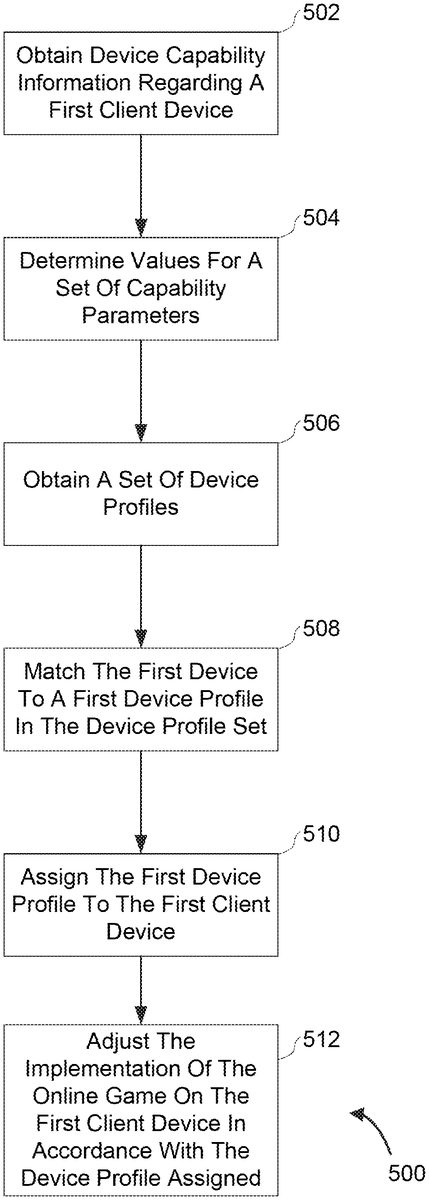
FIG.5illustrates one exemplary method500for providing online games on individual client devices based on capability of the client devices in accordance with the disclosure. The operations of method500presented below are intended to be illustrative. In some embodiments, method500may be accomplished with one or more additional operations not described, and/or without one or more of the operations discussed. Additionally, the order in which the operations of method500are illustrated inFIG.5and described below is not intended to be limiting.
In some embodiments, method500may be implemented in one or more processing devices (e.g., a digital processor, an analog processor, a digital circuit designed to process information, an analog circuit designed to process information, a state machine, and/or other mechanisms for electronically processing information). The one or more processing devices may include one or more devices executing some or all of the operations of method500in response to instructions stored electronically on an electronic storage medium. The one or more processing devices may include one or more devices configured through hardware, firmware, and/or software to be specifically designed for execution of one or more of the operations of method500.
At an operation502, device capability information regarding a first client device may be obtained. Obtaining device capability information regarding the first client device at502may involve communicating with the first client device, detecting if the first client device has transmitted information indicating its capabilities, parsing received client device information regarding the first client device, and/or any other operations. In some implementations, the device capability information regarding the first client device may be passively obtained from the client devices in a “push” mode at502. In some implementations, the device capability information regarding the first client device may be obtained from the client device in a “poll” mode at502. In some implementations, the device capability information regarding the first client device may be intermittently obtained from client devices. In some implementations, operation502may be performed by a device information component the same as or similar to device information component114(shown inFIG.1and described herein).
At an operation504, values for a set of capability parameters may be determined based on the device capability information regarding the first client device obtained at operation502. In some implementations, operation504may be performed by device capability determination component the same as or similar to device capability determination116(shown inFIG.1and described herein).
At an operation506, a set of device profiles may be obtained. The device profiles obtained at506may specify threshold values preset for device capability parameters. In some implementations, operation506may be performed by a device profile management component the same as or similar to probability item device profile management component118(shown inFIG.1and described herein).
At an operation508, a first device profile may be matched to the first client device based on the values of the set of capability parameters determined at504and the threshold values for the capability values specified in the first client device profile. This may involve comparing the values of the set of capability parameters determined at504with corresponding threshold values specified in the first client device profile. In some implementations, operation508may employ weighted sum of the determined values of the set of capability parameters to match the first device profile to the first client device. In some implementations, a subset of threshold values specified in a the first client device profile may be employed by operation508to match the first device profile to the first. In some implementations, operation508may be performed by device profile assignment component the same as or similar to device profile assignment component120(shown inFIG.1and described herein).
At an operation510, the first device profile may be assigned to the first client device. In some implementations, operation510may involve transmitting the first device profile to the first client device for storage and/or implementation of the online game. In some implementations, operation510may involve recording an association between the first client device and first device profile in a relational table stored in a database related to the online game. In some implementations, operation510may be performed by a device profile assignment component the same as or similar to device profile assignment component120(shown inFIG.1and described herein).
At an operation512, the implementation of the online game n the first client device may be adjusted in accordance with the first device profile assigned to the first client device. Some examples of game features that may be adjusted at operation512may include frame rate, level of detail of rendering, level of 3D graphics, level of collision effects, animation type, gameplay available for user interaction, gameplay content for user interaction, communication mode, physics effects available for display, level of artificial intelligence, and/or any other features of the online game In some implementations, operation512may be performed by an adjustment component the same as or similar to adjustment component122(shown inFIG.1and described herein).
Although the present technology has been described in detail for the purpose of illustration based on what is currently considered to be the most practical and preferred implementations, it is to be understood that such detail is solely for that purpose and that the technology is not limited to the disclosed implementations, but, on the contrary, is intended to cover modifications and equivalent arrangements that are within the spirit and scope of the appended claims. For example, it is to be understood that the present technology contemplates that, to the extent possible, one or more features of any implementation can be combined with one or more features of any other implementation.
Claims
- A system for presenting an online game on client devices based on particular capabilities of the client devices, wherein the client devices include a first client device and a second client device, the system comprising one or more physical processors configured by machine-readable instructions to: obtain first capability information regarding a first set of capabilities of the first client device, wherein the first set of capabilities include one or more hardware-based device-specific capabilities of the first client device;obtain second capability information regarding a second set of capabilities of the second client device, wherein the second set of capabilities include one or more hardware-based device-specific capabilities of the second client device;determine a first value of a first capability parameter based on the first capability information;determine a second value of a second capability parameter based on the second capability information;automatically make a selection, by the one or more physical processors, of one or more software-controllable game-specific settings that control presentations of the online game on the client devices, wherein the one or more software-controllable game-specific settings include at least one of (i) a frame rate for rendering the online game, (ii) a level of detail for rendering the online game, (iii) an audio quality for presenting the online game, (iv) a level of graphic effects for presenting the online game, and (v) a level of physics effects for presenting the online game, wherein the selection is based on both the first value of the first capability parameter and the second value of the second capability parameter;and present the online game on the first client device and on the second client device in accordance with the selection, wherein presenting the online game includes a first presentation of the online game on the first client device and a second presentation of the online game on the second client device, wherein the first presentation of the online game is controlled by the one or more software-controllable game-specific settings of the selection, and wherein the second presentation of the online game is controlled by the one or more software-controllable game-specific settings of the selection.
- The system of claim 1, wherein the selection is based on which of the first client device and second client device has a lower value for the first capability parameter or the second capability parameter.
- The system of claim 1, wherein the one or more physical processors are further configured to: determine whether the first value of the first capability parameter has breached a first threshold value for the first capability parameter;and transmit the first value of the first capability parameter to the first client device.
- The system of claim 3, wherein the one or more physical processors are further configured to make a second determination whether the second value of the second capability parameter has breached a second threshold value for the second capability parameter, and wherein the selection is further based on the second determination.
- The system of claim 4, wherein the selection is further based on a weighted sum of the first threshold value and the second threshold value.
- The system of claim 4, wherein the selection is further based on a difference between the first value of the first capability parameter and the first threshold value, and a second difference between the second value of the second capability parameter and the second threshold value.
- The system of claim 1, wherein the first capability information is obtained intermittently, and wherein the first value of the first capability parameter is determined intermittently subsequent to the first set of capabilities of the first device being obtained intermittently.
- The system of claim 7, wherein the first capability information is obtained after a first event has been completed in the online game by a first user associated with the first client device.
- The system of claim 1, wherein the one or more hardware-based device-specific capabilities of the first client device include at least one of processing power of the first client device, graphics processing speed of the first client device, display capability of the first client device, current transmission speed of the first client device, and remaining battery power of the first client device, wherein the one or more hardware-based device-specific capabilities of the second client device include at least one of processing power of the second client device, graphics processing speed of the second client device, display capability of the second client device, current transmission speed of the second client device, and remaining battery power of the second client device.
- A method for presenting an online game on client devices based on particular capabilities of the client devices, wherein the client devices include a first client device and a second client device, the method being implemented in one or more physical processors configured to execute machine-readable instructions, the method comprising: obtaining first capability information regarding a first set of capabilities of the first client device, wherein the first set of capabilities include one or more hardware-based device-specific capabilities of the first client device;obtaining second capability information regarding a second set of capabilities of the second client device, wherein the second set of capabilities include one or more hardware-based device-specific capabilities of the second client device;determining a first value of a first capability parameter based on the first capability information;determining a second value of a second capability parameter based on the second capability information;automatically making a selection of one or more software-controllable game-specific settings that control presentations of the online game on the client devices, wherein the one or more software-controllable game-specific settings include at least one of (i) a frame rate for rendering the online game, (ii) a level of detail for rendering the online game, (iii) an audio quality for presenting the online game, (iv) a level of graphic effects for presenting the online game, and (v) a level of physics effects for presenting the online game, wherein the selection is based on both the first value of the first capability parameter and the second value of the second capability parameter;and presenting the online game on the first client device and on the second client device in accordance with the selection, wherein presenting the online game includes a first presentation of the online game on the first client device and a second presentation of the online game on the second client device, wherein the first presentation of the online game is controlled by the one or more software-controllable game-specific settings of the selection, and wherein the second presentation of the online game is controlled by the one or more software-controllable game-specific settings of the selection.
- The method of claim 10, wherein the selection is based on which of the first client device and second client device has a lower value for the first capability parameter or the second capability parameter.
- The method of claim 10, further comprising: determining whether the first value of the first capability parameter has breached a first threshold value for the first capability parameter;and transmitting the first value of the first capability parameter to the first client device.
- The method of claim 12, further comprising: making a second determination whether the second value of the second capability parameter has breached a second threshold value for the second capability parameter, and wherein the selection is further based on the second determination.
- The method of claim 13, wherein the selection is further based on a weighted sum of the first threshold value and the second threshold value.
- The method of claim 13, wherein the selection is further based on a difference between the first value of the first capability parameter and the first threshold value, and a second difference between the second value of the second capability parameter and the second threshold value.
- The method of claim 10, wherein the first capability information is obtained intermittently, and wherein the first value of the first capability parameter is determined intermittently subsequent to the first set of capabilities of the first device being obtained intermittently.
- The method of claim 16, wherein the first capability information is obtained after a first event has been completed in the online game by a first user associated with the first client device.
- The method of claim 10, wherein the one or more hardware-based device-specific capabilities of the first client device include at least one of processing power of the first client device, graphics processing speed of the first client device, display capability of the first client device, current transmission speed of the first client device, and remaining battery power of the first client device, wherein the one or more hardware-based device-specific capabilities of the second client device include at least one of processing power of the second client device, graphics processing speed of the second client device, display capability of the second client device, current transmission speed of the second client device, and remaining battery power of the second client device.
Disclaimer: Data collected from the USPTO and may be malformed, incomplete, and/or otherwise inaccurate.