U.S. Pat. No. 11,636,729
ONLINE GAME MOBILE CONTROLLER
AssigneeCRISTALTEC S.P.A.
Issue DateJanuary 29, 2021
Illustrative Figure
Abstract
Embodiments of the present invention are directed to an online gaming mobile controller. A computer-implemented method is provided that generates, using a processor, a QR code containing a web address for a gaming session and provides, using the processor, the QR code to a monitor. The method receives, using the processor, a request for serving a web page for the web address from a user device and provides, using the processor, an authentication page for entering a PIN code to the user device. The method provides, using the processor, a PIN code to the monitor and receives, using the processor, an entered code from the user device. When the entered code matches the PIN code, the method associates the user device with the gaming session.
Description
DETAILED DESCRIPTION Currently, it is possible to run an online casino game on a variety of platforms, including, but not limited to, personal computers (via a browser, for example), a mobile device, a television/monitor browser, or a mobile application (app). The primary means of controlling these platforms is through conventional input means, such as mice, keyboards, or touch. This necessitates that a player or user is within arms-reach of the platform where the game is running. This gives the player the same experience as writing in a word processor with a keyboard and mouse. Prior systems attempted to remedy this problem by relying upon dedicated controllers or dedicated apps running on a user device. This could be cumbersome and oft-putting, as users frequently do not have access to a dedicated device as they walk through a casino and are reluctant to download and put a dedicated app on their phone due to privacy and safety concerns. Embodiments consistent with the present invention remove this tethering and provides for a game controller to run on a user's user device, such as her mobile phone, and that connects with a game session running on a nearby computer or monitor. This permits the player to control the game from her device, while providing additional functionality that improves the game experience. Customized controls may be provided for each game, and sound effects can come, not just from the gaming monitor, but also from the user device that she is using as a controller. In addition, multiple user devices may be used by respective multiple players to all play the same game, for example, blackjack. FIG.1depicts an exemplary embodiment of a gaming system consistent with the present invention. The gaming system comprises a gaming server110connected with a gaming monitor130and a user device140by way of a ...
DETAILED DESCRIPTION
Currently, it is possible to run an online casino game on a variety of platforms, including, but not limited to, personal computers (via a browser, for example), a mobile device, a television/monitor browser, or a mobile application (app). The primary means of controlling these platforms is through conventional input means, such as mice, keyboards, or touch. This necessitates that a player or user is within arms-reach of the platform where the game is running. This gives the player the same experience as writing in a word processor with a keyboard and mouse.
Prior systems attempted to remedy this problem by relying upon dedicated controllers or dedicated apps running on a user device. This could be cumbersome and oft-putting, as users frequently do not have access to a dedicated device as they walk through a casino and are reluctant to download and put a dedicated app on their phone due to privacy and safety concerns.
Embodiments consistent with the present invention remove this tethering and provides for a game controller to run on a user's user device, such as her mobile phone, and that connects with a game session running on a nearby computer or monitor. This permits the player to control the game from her device, while providing additional functionality that improves the game experience. Customized controls may be provided for each game, and sound effects can come, not just from the gaming monitor, but also from the user device that she is using as a controller. In addition, multiple user devices may be used by respective multiple players to all play the same game, for example, blackjack.
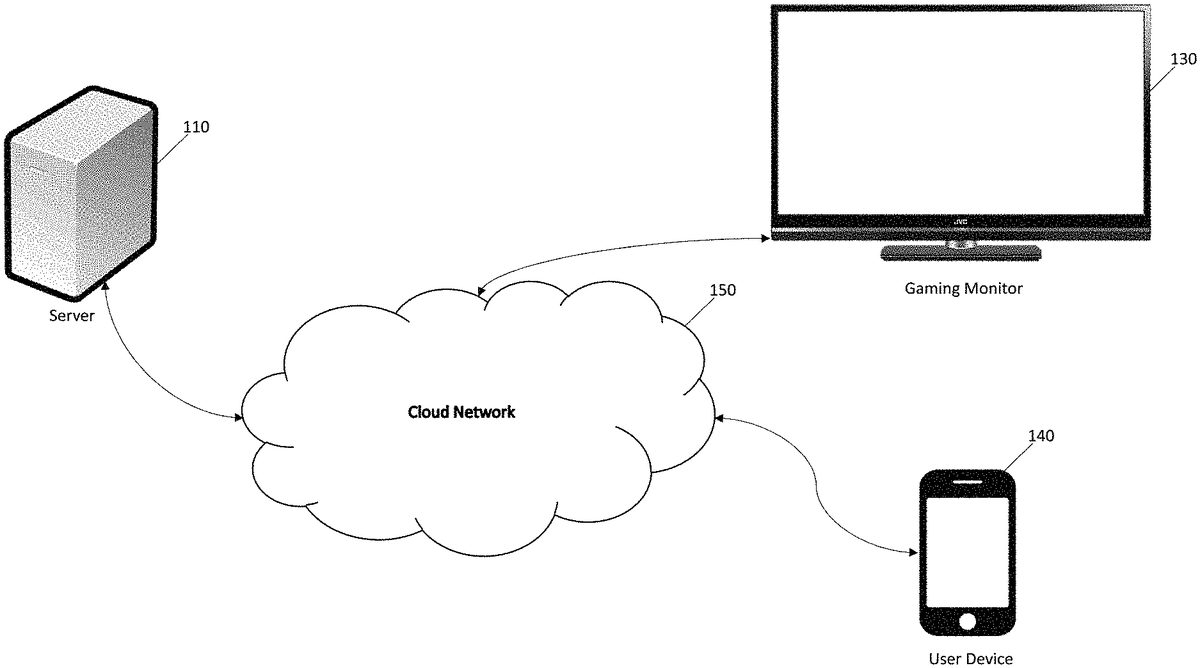
FIG.1depicts an exemplary embodiment of a gaming system consistent with the present invention. The gaming system comprises a gaming server110connected with a gaming monitor130and a user device140by way of a network, such as Internet150. These may operate in a cloud computing environment. The user device is typically a smart phone or a tablet computer, but is not limited to those devices. The gaming server110and gaming monitor130do not need to be remote from each other, as embodiments consistent with the present invention will also operate with a gaming server110that connects directly with gaming monitor130. As another example, the user device140may connect directly with the gaming monitor130and/or the gaming server110via local network, mesh network, WIFI network, or Bluetooth. The gaming server110, gaming monitor130, and user device140may be implemented as described with respect to the computer discussed inFIG.2.
FIG.2depicts a high-level block diagram computer system200, which can be used to implement one or more aspects of the present invention. More specifically, computer system200can be used to implement some hardware components of embodiments of the present invention. Although one exemplary computer system200is shown, computer system200includes a communication path255, which connects computer system200to additional systems (not depicted) and can include one or more wide area networks (WANs) and/or local area networks (LANs) such as the Internet, intranet(s), and/or wireless communication network(s). Computer system200and additional system are in communication via communication path255, e.g., to communicate data between them.
Computer system200includes one or more processors, such as processor205. Processor205is connected to a communication infrastructure260(e.g., a communications bus, cross-over bar, or network). Computer system200can include a display interface215that forwards graphics, text, and other data from a communication infrastructure260(or from a frame buffer not shown) for display on a display unit225. Computer system200also includes a main memory210, preferably random access memory (RAM), and can also include a secondary memory265. Secondary memory265can include, for example, a hard disk drive220and/or a removable storage drive230, representing, for example, a floppy disk drive, a magnetic tape drive, or an optical disk drive. The removable storage drive230reads from and/or writes to a removable storage unit240in a manner well known to those having ordinary skill in the art. Removable storage unit240represents, for example, a floppy disk, a compact disc, a magnetic tape, or an optical disk, etc. which is read by and written to by removable storage drive230. As will be appreciated, removable storage unit240includes a computer readable medium having stored therein computer software and/or data.
In alternative embodiments, secondary memory265can include other similar means for allowing computer programs or other instructions to be loaded into the computer system. Such means can include, for example, a removable storage unit245and an interface235. Examples of such means can include a program package and package interface (such as that found in video game devices), a removable memory chip (such as an EPROM, or PROM) and associated socket, and other removable storage units245and interfaces235, which allow software and data to be transferred from the removable storage unit245to computer system200.
Computer system200can also include a communications interface250.
Communications interface250allows software and data to be transferred between the computer system and external devices. Examples of communications interface250can include a modem, a network interface (such as an Ethernet card), a communications port, or a PCM-CIA slot and card, etcetera. Software and data transferred via communications interface250are in the form of signals, which can be, for example, electronic, electromagnetic, optical, or other signals capable of being received by communications interface250. These signals are provided to communications interface250via communication path (i.e., channel)255. Communication path255carries signals and can be implemented using wire or cable, fiber optics, a phone line, a cellular phone link, an RF link, and/or other communications channels.
In the present description, the terms “computer program medium,” “computer usable medium,” and “computer readable medium” are used to generally refer to media such as main memory210and secondary memory265, removable storage drive230, and a hard disk installed in hard disk drive220. Computer programs (also called computer control logic) are stored in main memory210and/or secondary memory265. Computer programs can also be received via communications interface250. Such computer programs, when run, enable the computer system to perform the features of the present invention as discussed herein. In particular, the computer programs, when run, enable processor205to perform the features of the computer system. Accordingly, such computer programs represent controllers of the computer system.
FIG.3depicts a screen of a gaming monitor and a screen of a user device consistent with the present invention. The gaming monitor130displays a quick response (QR) code310overlay on top of the game screen. The QR code is a machine-readable matrix barcode. The QR code310encodes a web site address uniform resource locator (URL). A user using a user device140uses a photography or QR code reading app320to focus the user device's camera on to the QR code310. The photography or QR code reading app320detects the QR code310on the game screen and translates the code to display a prompt410on the display of the user device140.
The gaming server110can be configured to display the QR code on the gaming monitor130at various instances. The gaming server110can monitor a progress of a game displayed on the gaming monitor130. The gaming server110can be configured to display a QR code310so as to not interrupt the flow of the game. For example, the gaming server can monitor a game of blackjack and display a QR code310before a round of blackjack has begun and another QR code310after the round has completed and prior to a next round of blackjack. In certain instances, the gaming session can be organized in a tournament format, in which some players are eliminated, but new players are not permitted to enter a game. In these instances, the gaming server110can be configured to display a QR code310on the gaming monitor130prior to the tournament beginning and refrain from displaying another QR code310until after a round is completed. For example, the gaming server110can cause a QR code310to be displayed on the gaming monitor130prior to a Texas hold'em style poker tournament. The gaming server110detects the play of each player in the tournament. Upon completion of a round, the gaming server110can further transmit a distinct secondary PIN code (not shown) to the user device140of the tournament players who have advanced to a subsequent round. As a subsequent round begins, the gaming server110cause another QR code310to be displayed on the gaming monitor130. The gaming server110can request a user to enter the secondary PIN code into their user device140as verification of eligibility to advance to the subsequent round.
FIG.4depicts a screen of a gaming monitor and a screen of a user device consistent with the present invention. After the QR code310is read on by the QR code reading app320, the user device140will provide a prompt410to the user confirming that the user wants to load a web browser and go to the URL encoded within the QR code310. The user can use the touchscreen functionality of the display of the user device140to confirm that the user wants to load the web browser and go to the website associated with the URL.
FIG.5depicts a screen of a gaming monitor and a screen of a user device consistent with the present invention. When the user elects to follow the URL encoded within the QR code310, a browser is brought up on the user device140, which connects to the URL encoded within the QR code310. A web site is served from gaming server110to the user device140. In addition, a PIN code510is provided by the gaming server110and displayed on the gaming monitor130. The PIN code510is an alphanumeric code. Displayed on the user device is field520for entering the PIN as well as an optional field530for entering a username. Once these are entered, the user device140returns the entered code and optional username to the gaming server110. The gaming server110verifies that the entered PIN matched the PIN code510provided by the gaming server110to the gaming monitor130. Once the entered PIN is verified, the user device140is linked to the gaming server110and the gaming monitor130. If the entered PIN is not correct, the user device140is not connected to the gaming server110and the gaming monitor130, and the user is prompted to try again.
FIG.6depicts a screen of a gaming monitor and a screen of a user device consistent with the present invention. Once the entered PIN is verified, the QR code310is removed as an overlay from the gaming monitor and the PIN code510is also removed as an overlay from the gaming monitor. The web browser used to enter the PIN and username on the user device140remains running on the user device140, and the gaming server may optionally prompt the user to rotate the user device140.
FIG.7depicts a screen of a gaming monitor and a screen of a user device consistent with the present invention. Once the user device140is in a correct orientation, either because it was originally oriented correctly or because a user rotates the user device140following a rotation, the user device140display user controls that she can use to control the game displayed on the gaming monitor130. The user controls on the user device140are served from the gaming server110to the web browser running on the user device140. The user controls may be customized for each game, and sound effects may be emitted from the user device140at the direction of the gaming server110.
As described above, multiple user devices may be used by respective multiple players to all play the same game. For example, multiple players can engage in a bingo game. The gaming server110can cause a QR code310to overlay on top of the gaming monitor130. Each user can use their user device140to scan the QR code310displayed on the gaming monitor130. After the QR code310is read by each QR code reading app320, each user device140will provide a prompt410to a respective user confirming that the user wants to load a web browser and go to the URL encoded within the QR code310. Each user elects to follow the URL encoded within the QR code310, a browser is brought up on each user device140, which connects to the URL encoded within the QR code310. A web site is served from gaming server110to the user device140. In addition, a PIN code510is provided by the gaming server110and displayed on the gaming monitor130. Each user device displays a field520for entering the PIN code510as well as a field530for entering a username and an optional field for a secondary PIN code. The gaming monitor displays a PIN code510and each user can use the same PIN code510. Once these are entered, each user device140returns the entered code and their username and/or secondary PIN code to the gaming server110. The gaming server110verifies that each user's entered PIN matches the PIN code510provided by the gaming server110to the gaming monitor130. The gaming server110also verifies that each user has entered a unique username for the game, such that one username does not match another username. If one or more of the users has entered the same username, the gaming server110will cause a prompt to be displayed on the offending user's user devices to select an alternate username. Once the gaming server verifies each entered PIN and that each username is unique, each user device140is linked to the gaming server110and the gaming monitor130. If any entered PIN is not correct or username is a duplicate, the offending user device140is not connected to the gaming server110and the gaming monitor130, and the user is prompted to try again.
FIG.8depicts a flow chart of a method of connecting and interacting with a user device consistent with the present invention. A QR code310is generated by the gaming server and send to a gaming monitor130. (Block810). The QR code310includes an encoded URL for a gaming website that allows a user to access a current gaming session. A user scans the QR code310on his user device140through a photography or QR code310reading app and then follows, using the user device's web browser, a link embedded within the QR code310to a URL hosted on the gaming server110. An authentication page is served to the user device's web browser from the gaming server110, a PIN is placed on the gaming monitor130, and the QR code310is removed from the gaming monitor130. (Block820). The authentication page has a field for the user to enter the PIN code510displayed on the gaming monitor130and, in some embodiments of the present invention, a field to enter her username.
A user enters a PIN into the PIN code field on the user device140and optionally enters her username into the username field and secondary PIN in a secondary PIN code field (not shown). The gaming server110receives the entered PIN and optionally the username. (Block830). If the entered PIN matches the displayed PIN, the gaming server110provides a user interface to the user via the web browser on the user device140. (Block840). Game information, e.g., button mashes and text entry, entered by the user on the user device140is then received by the gaming server110. (Block850). As described above, in some instances, a user is playing in a tournament style game. For example, the user may advance to a subsequent round and be in a position to carry over winnings from a previous round to the subsequent round. Furthermore, the user may take a break between rounds. In these instances, the gaming server110can encode the user's winnings into a secondary PIN code, such that upon entering the secondary PIN code into the user device140, the gaming server110translates the encoded secondary PIN code to determine the user's winning from a previous round. The gaming server110then causes the user's winnings from a previous round to be displayed on the user's device140. In some embodiments of the present invention, the gaming server110further causes the winnings to be displayed on the gaming monitor130. The encoded secondary PIN code can be an alphanumeric code that encrypts the value of a user's winnings. The winnings can include cash, tokens, credits, or other valuables used to play the game.
The terms “first,” “second,” and the like, do not denote any order, quantity, or importance, but rather are used to distinguish one element from another. The terms “a” and “an” and “the” do not denote a limitation of quantity and are to be construed to cover both the singular and the plural, unless otherwise indicated herein or clearly contradicted by context. “Or” means “and/or” unless clearly stated otherwise. Reference throughout the specification to “some embodiments”, “an embodiment”, and so forth, means that a particular element described in connection with the embodiment is included in at least one embodiment described herein, and may or may not be present in other embodiments. In addition, it is to be understood that the described elements may be combined in any suitable manner in the various embodiments. A “combination thereof” is open and includes any combination comprising at least one of the listed components or properties optionally together with a like or equivalent component or property not listed
Unless defined otherwise, technical and scientific terms used herein have the same meaning as is commonly understood by one of skill in the art to which this application belongs. All cited patents, patent applications, and other references are incorporated herein by reference in their entirety. However, if a term in the present application contradicts or conflicts with a term in the incorporated reference, the term from the present application takes precedence over the conflicting term from the incorporated reference.
While particular embodiments have been described, alternatives, modifications, variations, improvements, and substantial equivalents that are or may be presently unforeseen may arise to applicants or others skilled in the art. Accordingly, the appended claims as filed and as they may be amended are intended to embrace all such alternatives, modifications variations, improvements, and substantial equivalents.
Claims
- A computer-implemented method comprising: generating, using a processor, a quick response (QR) code containing a web address for a gaming session;providing, using the processor, the QR code to a monitor;receiving, using the processor, a request for serving a web page for the web address from a user device;providing, using the processor, an authentication page for entering a PIN code to the user device;providing, using the processor, a PIN code to the monitor;receiving, using the processor, an entered code from the user device;and when the entered code matches the PIN code, associating the user device with the gaming session.
- The computer-implemented method of claim 1, wherein the authentication page further includes a username field.
- The computer-implemented method of claim 2, further comprising receiving, using the processor, a username from the user device.
- The computer-implemented method of claim 1, further comprising providing, using the processor, gaming controls to the user device.
- The computer-implemented method of claim 4, further comprising receiving, using the processor, gaming inputs from the user device.
- The computer-implemented method of claim 1, further comprising associating, using the processor, a second user device with the gaming session.
- The computer-implemented method of claim 6, wherein associating the second user device comprises: receiving, using the processor, a second entered code from the second user device;matching, using the processor, the second entered code to the provided PIN code;receiving, using the processor, a second username associated with the second user device;and verifying, using the processor, that the second username does not match a username associated with the user device.
- A system comprising: a memory;a processor coupled to the memory, the processor operable to execute instructions stored in the memory, the instructions causing the processor to: generate a quick response (QR) code containing a web address for a gaming session;provide the QR code to a monitor;receive a request for serving a web page for the web address from a user device;provide an authentication page for entering a PIN code to the user device;provide a PIN code to the monitor;receive an entered code from the user device;and when the entered code matches the PIN code, associate the user device with the gaming session.
- The system of claim 8, wherein the authentication page further includes a username field.
- The system of claim 9, wherein the instructions further cause the processor to receive a username from the user device.
- The system of claim 8, wherein the instructions further cause the processor to provide gaming controls to the user device.
- The system of claim 11, wherein the instructions further cause the processor to receive gaming inputs from the user device.
- The system of claim 8, further wherein the instructions further cause the processor to associate a second user device with the gaming session.
- The system of claim 13, wherein associating the second user device comprises: receiving a second entered code from the second user device;matching the second entered code to the provided PIN code;receiving a second username associated with the second user device;and verifying that the second username does not match a username associated with the user device.
- A computer program product for controlling a process comprising a non-transitory computer readable storage medium having program instructions embodied therewith, the program instructions executable by a computer, to cause the computer to perform a method comprising: generating, using a processor, a quick response (QR) code containing a web address for a gaming session;providing, using the processor, the QR code to a monitor;receiving, using the processor, a request for serving a web page for the web address from a user device;providing, using the processor, an authentication page for entering a PIN code to the user device;providing, using the processor, a PIN code to the monitor;receiving, using the processor, an entered code from the user device;and when the entered code matches the PIN code, associating the user device with the gaming session.
- The computer program product of claim 15, wherein the authentication page further includes a username field.
- The computer program product of claim 16, further comprising receiving, using the processor, a username from the user device.
- The computer program product of claim 15, further comprising providing, using the processor, gaming controls to the user device.
- The computer program product of claim 18, further comprising receiving, using the processor, gaming inputs from the user device.
- The computer program product of claim 15, further comprising associating a second user device with the gaming session.
Disclaimer: Data collected from the USPTO and may be malformed, incomplete, and/or otherwise inaccurate.