U.S. Pat. No. 11,628,363
GAME PROCESSING METHOD AND RECORDING MEDIUM
AssigneeKOEI TECMO GAMES CO., LTD.
Issue DateApril 1, 2021
Illustrative Figure
Abstract
A game processing method executed by an information processing device includes moving an ally character on a field in accordance with a player's operation, executing a fight with an enemy character on the field in accordance with the player's operation when the ally character encounters the enemy character, and adding a second motion for vibrating the enemy character to a first motion being executed by the enemy character, when an attack of the ally character hits the enemy character.
Description
DETAILED DESCRIPTION OF THE EMBODIMENTS An embodiment of the present invention will now be described with reference to the drawings. 1. Overall Configuration of the Game System First, an example of an overall configuration of a game system1according to this embodiment will be described with reference toFIG.1. As shown inFIG.1, the game system1includes an information processing device3, a game controller5, and a display device7. The game controller5and the display device7are each communicably connected to the information processing device3in a wired or wireless manner. The information processing device3is a stationary game machine, for example. However, the information processing device3is not limited thereto and may be a portable game machine integrally including an input part and a display part. Other than the game machine, for example, the information processing device3may be one of those manufactured and sold as computers such as server computers, desktop computers, notebook computers, and tablet computers or those manufactured and sold as telephones such as portable telephones, smartphones, and phablets. The player uses the game controller5to input various operations. In the example shown inFIG.1, the game controller5has a cross key9and multiple buttons11, for example. Alternatively, or additionally, the game controller5may have a joystick and a touch pad, for example. 2. Outline of Content of Game Description will be made of an example of an outline of content of a game according to this embodiment, i.e., a game provided by the information processing device3executing a game program and a game processing method of the present invention. The game according to this embodiment is a so-called action role-playing game in which an ally character advances a story while fighting with enemy characters. The ally character is operated by the player, and the enemy characters are automatically controlled by a predetermined algorithm (so-called game AI) defined by the game program. When ...
DETAILED DESCRIPTION OF THE EMBODIMENTS
An embodiment of the present invention will now be described with reference to the drawings.
1. Overall Configuration of the Game System
First, an example of an overall configuration of a game system1according to this embodiment will be described with reference toFIG.1. As shown inFIG.1, the game system1includes an information processing device3, a game controller5, and a display device7. The game controller5and the display device7are each communicably connected to the information processing device3in a wired or wireless manner.
The information processing device3is a stationary game machine, for example. However, the information processing device3is not limited thereto and may be a portable game machine integrally including an input part and a display part. Other than the game machine, for example, the information processing device3may be one of those manufactured and sold as computers such as server computers, desktop computers, notebook computers, and tablet computers or those manufactured and sold as telephones such as portable telephones, smartphones, and phablets.
The player uses the game controller5to input various operations. In the example shown inFIG.1, the game controller5has a cross key9and multiple buttons11, for example. Alternatively, or additionally, the game controller5may have a joystick and a touch pad, for example.
2. Outline of Content of Game
Description will be made of an example of an outline of content of a game according to this embodiment, i.e., a game provided by the information processing device3executing a game program and a game processing method of the present invention.
The game according to this embodiment is a so-called action role-playing game in which an ally character advances a story while fighting with enemy characters. The ally character is operated by the player, and the enemy characters are automatically controlled by a predetermined algorithm (so-called game AI) defined by the game program. When multiple ally characters exist, the ally characters may include characters operated by the game program (so-called non-player characters). When the ally character moves on a field and encounters an enemy character, a fight is performed directly on the screen of the field. During the fight, the ally character acts in real time in conjunction with a player's operation.
In the case of the example described in this embodiment, the characters appearing in the game are human characters (e.g., military commanders, resourceful generals, and cavalry, including men and women). However, in addition to the human characters, for example, the characters may be animals other than humans, creatures other than humans and animals, virtual creatures (e.g., monsters, ghosts, and yokai), robots, and objects such as articles and goods.
If an attack of the ally character hits the enemy character during the fight performed on the screen of the field as described above, the enemy character is temporarily vibrated by adding a second motion to a first motion being executed. This will hereinafter be described in detail.
3. Functional Configuration of Information Processing Device
An example of a functional configuration of the information processing device3will be described with reference toFIG.2.
As shown inFIG.2, the information processing device3includes a fight execution processing part13, a character determination processing part15, a motion execution processing part17, a motion addition processing part19, a movement stop processing part21, and an attack determination processing part23.
The fight execution processing part13executes a fight between the ally character and the enemy character. Specifically, the fight execution processing part13moves the ally character on the field in accordance with a player's operation, and when the ally character encounters the enemy character, the fight execution processing part13executes the fight with the enemy character on the field. The term “encounter” as used herein means that a predetermined fight starting condition is satisfied such as that at least one of the ally character and the enemy character attacks the other character or that the ally character and the enemy character approach each other within a predetermined distance. The fight is performed directly on the field without switching from a screen of the field displaying the movement of the ally character to another screen for a fight (e.g., a fight screen in which the fight proceeds in turn, or a screen on which the player selects a character's action from menu items prepared in advance). In other words, the movement of the ally character and the fight with the enemy character are seamlessly performed on the field. However, on the field screen, an effect may be inserted between a movement phase and a fight phase, or a character may be enlarged, reduced, rotated, etc. by camera work. During the fight, the ally character executes actions (e.g., movement, attack, avoidance, defense) related to the fight corresponding to the player's operation in real time in conjunction with the player's operation.
The character determination processing part15determines whether the enemy character hit by the attack of the ally character is a weak enemy character (so-called normal character) that can relatively easily be defeated, or a strong enemy character (so-called boss character) that is tough and hard to defeat. The weak enemy character is an enemy character that can be defeated by, for example, one or several attacks of the ally character, and the strong enemy character is an enemy character that requires, for example, 10 or more attacks or a special attack (attack using a special item, skill, magic, etc.) for defeating.
The motion execution processing part17executes motions that are various actions of the ally character and the enemy characters during the fight. Specifically, the motion execution processing part17executes motions such as movement, attack, avoidance, and defense during fight (hereinafter, appropriately referred to as “fight motion”) for each of the ally character, the strong enemy character, and the weak enemy character, for example, and a motion (hereinafter, appropriately referred to as “beaten motion”) representing that a character has been attacked or defeated for each of the ally character, the strong enemy character, and the weak enemy character, for example.
When the attack of the ally character hits the strong enemy character, the motion addition processing part19adds a vibrating motion (an example of the second motion) for vibrating the strong enemy character to the fight motion (an example of the first motion) being executed by the strong enemy character in accordance with the motion execution processing part17. Specifically, the motion addition processing part19executes a process of adding a relative movement value from the fight motion for vibrating the strong enemy character to the fight motion being executed by the strong enemy character. As a result, vibration can be applied regardless of the motion of the strong enemy character. The motion addition processing part19executes the process only for the strong enemy character and does not execute the process for the weak enemy character.
The number of vibrations is set to, for example, once so that the vibration temporarily occurs at the timing when the attack of the ally character hits the strong enemy character. Therefore, the motion addition processing part19adds one vibrating motion to the fight motion being executed by the strong enemy character. However, the vibrating motion may be applied so that the strong enemy character vibrates multiple times.
A direction of vibration is set to a direction corresponding to the direction in which the strong enemy character is attacked. Therefore, the motion addition processing part19adds the vibrating motion so that the strong enemy character vibrates in the direction corresponding to the direction of being hit by the attack. For example, the vibrating motion is added such that the enemy character attacked from the front or back vibrates in the front-back direction, that the enemy character attacked from the right or left vibrates in the left-right direction, and that the enemy character attacked in a diagonal direction from the front or back vibrates in the diagonal direction.
A range of the vibration is set to a slight amount (e.g., an amount smaller than a width in the vibration direction of the body of the enemy character) on both sides in the vibration direction across the position of the enemy character at the time of application of the vibration such that the attacked enemy character is depicted as shaking. This range is set to a different value in accordance with the kind of the enemy character and is kept as a resource of each character. Therefore, the motion addition processing part19adds the second motion having a different range based on the kind of the enemy character hit by the attack of the ally character.
For example, when the enemy character equipped with soft and easily-shaking equipment is largely vibrated, the character is unnaturally depicted if the equipment does not shake, so that the character is vibrated with a relatively small range. For example, if the enemy character in a stable posture (e.g., a character in a firmly standing posture or a cavalryman) is largely vibrated, the character is unnaturally depicted, so that the character is vibrated with a relatively small range. Conversely, for example, when the enemy character equipped with hard and hardly-shaking equipment is largely vibrated, the character is not depicted unnaturally even if the equipment does not shake, so that the character is vibrated with a relatively large range. For example, even if the enemy character in an unstable posture (e.g., a floating character or an infantry) is largely vibrated, the character is not depicted unnaturally, so that the character is vibrated with a relatively large range. In addition to the equipment and posture, the range may be changed in accordance with the character's body type, gender, ability value, other status, etc.
When the attack of the ally character hits the strong enemy character, the movement stop processing part21stops the movement of the ally character in a direction parallel to the field regardless of the player's operation. “Movement in a direction parallel to the field” means, for example, a horizontal direction when the field is a horizontal plane (ground, a floor surface of a building, etc.), and a direction parallel to a slope when the field is inclined (hill, mountain road, stairs, etc.). Additionally, the movement stop processing part21stops the movement of the ally character during execution of an attack motion (an example of a third motion) that is an action of the attack of the ally character having hit the enemy character and cancels the stop when the attack motion ends.
The movement stop processing part21executes the process only for the strong enemy character and does not execute the process for the weak enemy character. Additionally, the movement stop processing part21stops the movement of the ally character if an attack determination processing part23described later determines that the attack of the ally character having hit the enemy character is a short-range attack and does not execute the process if the attack is determined as a long-distance attack.
The attack determination processing part23determines whether the attack of the ally character having hit the enemy character is a short-range attack or a long-range attack. The “short-range attack” is an attack performed by the ally character against the enemy character at relatively short range, for example, a hand-to-hand attack using the limbs, an attack using a non-projectile weapon such as a katana, a sword, a spear, or an ax, and a special attack (magic, skill, etc.) activated at short range. The “long-distance attack” is an attack performed by the ally character against the enemy character at relatively long range, for example, an attack using a projectile weapon such as a bow and arrow, a stone, and a gun, and a special attack (magic, skill, etc.) activated at long range.
The processes etc. or the processing parts are not limited to the example of allocation of these processes and, for example, the processes may be executed by a fewer number of processing parts (e.g., one processing part) or may be executed by more finely divided processing parts. The functions of the processing parts are implemented by a game program executed by a CPU101(seeFIG.10) described later or may partially be implemented by actual devices such as dedicated integrated circuits including ASICs and FPGAs, and other electric circuits, for example.
4. Game Screen
An example of the game screen will be described with reference toFIGS.3to8. InFIGS.3to8, an ally character25is shown in white and enemy characters29are shown by hatching for easy distinction.
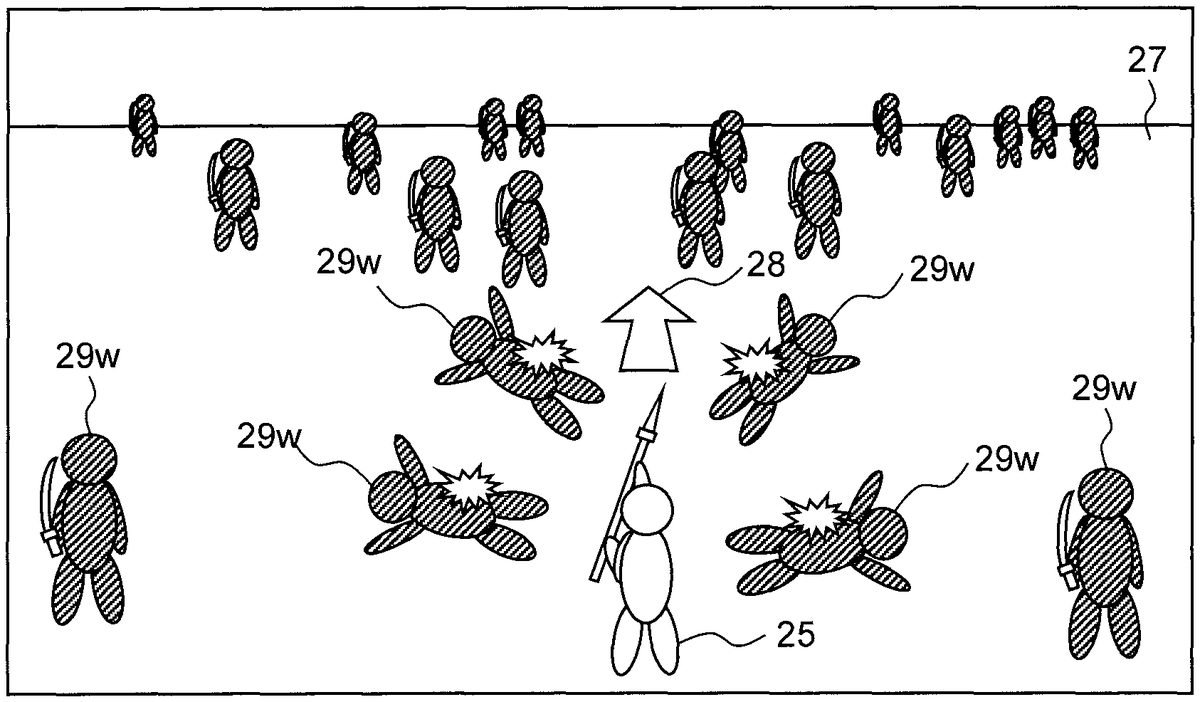
The fight execution processing part13moves the ally character25on a field27in accordance with a player's operation. As shown inFIG.3, when the ally character25encounters the enemy characters29, a fight with the enemy characters29is directly executed on the screen of the field27without transition from the screen of the field27to another fight screen. For example, inFIG.3, the ally character25moves and rushes into a large number of the enemy characters29in a screen depth direction (direction of an arrow28) to engage in a fight. The arrow28is shown for convenience of explanation and is not displayed on the game screen (the same applies toFIGS.4and5described later).
As shown inFIG.4, when the attack of the ally character25hits the enemy character29, the character determination processing part15determines whether the enemy character29hit by the attack is a weak enemy character29wor a strong enemy character29s. The motion execution processing part17then executes a motion in accordance with a determination result. For example, inFIG.4, the ally character25attacks the enemy characters29while moving in the direction of the arrow28, and the enemy characters29hit by the attack is determined as the weak enemy characters29w, and the “beaten motion” is executed to represent that the weak enemy character29wis blown off and knocked down.
FIG.5shows the case that the enemy characters29include the strong enemy character29s. In this example, the strong enemy character29sis a cavalryman commanding the weak enemy characters29wthat are infantry soldiers, for example. InFIG.5, the ally character25moves and rushes into the multiple weak enemy characters29wand the strong enemy character29sin the direction of the arrow28.
As shown inFIG.6, when the attack of the ally character25hits the strong enemy character29s, the motion addition processing part19adds to the fight motion being executed by the strong enemy character29sthe vibrating motion causing the strong enemy character29sto vibrate with a range w. In the example shown inFIG.6, the ally character25is equipped with a spear31as a weapon and swings the spear31in a direction of an arrow33to attack so that the strong enemy character29sis attacked from the right when viewed from the ally character25(from the left when viewed from the strong enemy character29s). As a result, the strong enemy character29svibrates in the left-right direction, for example, once at the moment when the attack hits, in addition to the fight motion being executed.
InFIG.6, the attack determination processing part23determines whether the attack of the ally character25having hit the strong enemy character29sis the short-range attack or the long-range attack, and it is determined in accordance with the determination result whether the movement stop processing part21executes a movement stop process for the ally character25. In the example shown inFIG.6, since the ally character25is attacking with the spear31, the attack is determined as the short-range attack. As a result, even if the player is performing a movement operation of the ally character25, the movement stop processing part21stops the movement of the ally character25in the direction parallel to the field27(horizontal direction). The movement of the ally character25in a direction perpendicular to the field27(e.g., jump) is not restricted. Therefore, for example, a motion such as a jump of the ally character25is executed. When the attack motion using the spear31of the ally character25having hit the strong enemy character29sends, the stop is cancelled, so that the ally character25can move in the direction parallel to the field27.
FIG.7shows the case that the attack of the ally character25having hit the strong enemy character29sis the long-range attack. In the example shown inFIG.7, the ally character25is equipped with a bow35as a weapon and shoots an arrow37to the strong enemy character29sin a direction of an arrow39so that the strong enemy character29sis attacked in the direction of the ally character25(from the front when viewed from the strong enemy character29s). As a result, the strong enemy character29svibrates in the front-back direction, for example, once at the moment when the attack hits, in addition to the fight motion being executed.
In the case ofFIG.7, since the attack is the long-range attack, the movement stop process for the ally character25is not executed by the movement stop processing part21. Therefore, the ally character25can move freely even when the attack hits.
FIG.8shows the case that the ally character25defeats the strong enemy character29s. InFIG.8, the motion execution processing part17executes the “beaten motion” representing that the strong enemy character29sis defeated.
5. Process Procedures Performed by Information Processing Device
Description will be made of an example of process procedures performed by the CPU101of the information processing device3when a fight between the ally character25and the enemy character29is executed, with reference toFIG.9.
At step S5, the information processing device3uses the fight execution processing part13to move the ally character25on the field27in accordance with the player's operation.
At step S10, the information processing device3uses the fight execution processing part13to determine whether the ally character25has encountered the enemy character29. If the ally character25has not encountered the enemy character29(step S10: NO), the process returns to step S5. On the other hand, if the ally character25has encountered the enemy character29(step S10: YES), the process goes to step S15.
At step S15, the information processing device3uses the fight execution processing part13to start a fight between the ally character25and the enemy character29on the screen of the field27.
At step S20, the information processing device3uses the fight execution processing part13to determine whether an attack of the ally character25has hit the enemy character29. If the attack has not hit (step S20: NO), the process goes to step S70described later. On the other hand, if the attack has hit (step S20: YES), the process proceeds to step S25.
At step S25, the information processing device3uses the character determination processing part15to determine whether the enemy character29hit by the attack of the ally character25is the weak enemy character29wor the strong enemy character29s. If the enemy character29hit by the attack is the weak enemy character29w(step S25: YES), the process goes to step S30.
At step S30, the information processing device3uses the motion execution processing part17to execute the “beaten motion” representing that the weak enemy character29wis attacked or defeated. Subsequently, the process returns to step S5.
On the other hand, at step S25, if the enemy character29hit by the attack is the strong enemy character29s(step S25: NO), the process goes to step S35.
At step S35, the information processing device3uses the motion addition processing part19to add the vibrating motion for vibrating the strong enemy character29sto the fight motion being executed by the strong enemy character29s.
At step S40, the information processing device3uses the attack determination processing part23to determine whether the attack of the ally character25having hit the strong enemy character29sis the short-range attack or the long-range attack. If the hitting attack is the long-range attack (step S40: NO), the process goes to step S60described later. On the other hand, if the hitting attack is the short-range attack (step S40: YES), the process goes to step S45.
At step S45, the information processing device3uses the movement stop processing part21to stop the movement of the ally character25in the horizontal direction on the field27.
At step S50, the information processing device3uses the movement stop processing part21to determine whether the attack motion of the hitting attack by the ally character25has ended. This step S50is repeated until the attack motion ends (step S50: NO), and when the attack motion has ended (step S50: YES), the process goes to step S55.
At step S55, the information processing device3uses the movement stop processing part21to cancel the stop of the movement of the ally character25in the horizontal direction.
At step S60, the information processing device3uses the fight execution processing part13to determine whether the strong enemy character29sis defeated. If the strong enemy character29sis not defeated (step S60: NO), the process goes to step S70described later. On the other hand, when the strong enemy character29sis defeated (step S60: YES), the process goes to step S65.
At step S65, the information processing device3uses the motion execution processing part17to execute the “beaten motion” representing that the strong enemy character29sis defeated. Subsequently, the process returns to step S5.
At step S70, the information processing device3uses the fight execution processing part13to determine whether the ally character25is defeated. If the ally character25is not defeated (step S70: NO), the process returns to step S20. On the other hand, when the ally character25is defeated (step S70: YES), the process goes to step S75.
At step S75, the information processing device3uses the motion execution processing part17to execute the “beaten motion” representing that the ally character25is defeated. This flow is then terminated.
The process procedures described above are an example, and the procedures may at least partially be deleted or changed or a procedure other than the above may be added. The order of the procedures may at least partially be changed, or multiple procedures may be combined into a single procedure.
6. Effect of Embodiment
As described above, the game program of this embodiment drives the information processing device3to act as the fight execution processing part13moving the ally character25on the field27in accordance with the player's operation and executing a fight with the enemy character29on the screen of the field27when the ally character25encounters the enemy character29, and the motion addition processing part19adding the vibrating motion for vibrating the enemy character29to the fight motion being executed by the enemy character29when the attack of the ally character25hits the enemy character29.
As a result, the enemy character29can be vibrated in accordance with the hit of the attack of the ally character25regardless of an action performed by the enemy character29. Therefore, a response to the hit of the attack can be represented, so that the amusing property of the game can be improved.
Particularly in this embodiment, the motion addition processing part19adds the vibrating motion so that the enemy character29vibrates in the direction corresponding to the direction in which the character is attacked.
As a result, the enemy character29can be vibrated in accordance with the direction of the attack of the ally character25. Therefore, the response to the hit of the attack can more naturally be represented.
Particularly in this embodiment, the game program drives the information processing device3to further act as the movement stop processing part21stopping the movement of the ally character25in a direction parallel to the field27regardless of a player's operation when the attack of the ally character25hits the enemy character29.
This makes it possible to represent the response to the collision with the enemy character29and the weight of the enemy character29, so that the amusing property of the game can be improved. For example, in a game in which the ally character25moves on the field27while routing a large number of the weak enemy characters29w, the movement is stopped when the ally character25encounters and hits the strong enemy character29s, so that the ally character25can be prevented from passing through the strong enemy character29sand has difficulty in fighting. This makes it possible to represent the response to the collision and the weight of the enemy character when the strong enemy character29sis the opponent while retaining the lightness and exhilaration of subduing the weak enemy characters29w, and the ease of fighting can be improved. This is particularly effective in a game having a function of a dashing attack etc. enabling the ally character25to move faster than usual while attacking the enemy characters29.
Particularly in this embodiment, the game program drives the information processing device3to further act as the attack determination processing part23determining whether the attack of the ally character25having hit the enemy character29is the short-range attack or the long-range attack, and the movement stop processing part21stops the movement of the ally character25when the attack is determined as the short-range attack.
In this embodiment, the movement of the ally character25is not stopped when the long-range attack hits the enemy character29, and the movement of the ally character25is stopped only when the short-range attack hits the enemy character29. As a result, the response to the collision and the weight of the enemy character29can be represented only when the attack is made near the enemy character29, so that a more natural representation can be achieved.
Particularly in this embodiment, the movement stop processing part21stops the movement of the ally character25during execution of the attack motion, which is the action of the attack of the ally character25having hit the enemy character29, and cancels the stop when the attack motion ends.
As a result, the ally character25can move or perform the next attack action at the same time as the end of the action of the hitting attack so that the ease of fighting is not impaired while the response to the collision with the enemy character29and the weight of the enemy character29are represented.
Particularly in this embodiment, the motion addition processing part19adds the vibrating motion having a different range w based on the type of the enemy character29hit by the attack of the ally character25.
As a result, for example, the enemy character29equipped with soft and easily-shaking equipment and the enemy character29in a stable posture are vibrated with a small range w and, for example, the enemy character29equipped with hard and hardly-shaking equipment and the enemy character in an unstable posture can be vibrated with a large range w. As a result, the vibration caused by the vibrating motion can be prevented from becoming unnatural, and a more natural representation can be achieved.
7. Hardware Configuration of the Information Processing Device
An exemplary hardware configuration will be described for the information processing device3achieving the processing parts implemented by a program executed by the CPU101described above, with reference toFIG.10.
As shown inFIG.10, the information processing device3has the circuitry including a CPU101, a ROM103, a RAM105, a GPU106, a dedicated integrated circuit107constructed for specific use such as an ASIC or an FPGA, an input device113, an output device115, a storage device117, a drive119, a connection port121, and a communication device123. These constituent elements are mutually connected via a bus109and an input/output (I/O) interface111such that signals can be transferred.
The game program can be recorded in a ROM103, the RAM105, and the storage device117such as an hard disk device, for example.
The game program can also temporarily or permanently (non-transitory) be recorded in a removable recording medium125such as magnetic disks including flexible disks, various optical disks including CDs, MO disks, and DVDs, and semiconductor memories. The recording medium125as described above can be provided as so-called packaged software. In this case, the game program recorded in the recording medium125may be read by the drive119and recorded in the storage device117through the I/O interface111, the bus109, etc.
The game program may be recorded in, for example, a download site, another computer, or another recording medium (not shown). In this case, the game program is transferred through a network NW such as a LAN or the Internet and the communication device123receives this program. The program received by the communication device123may be recorded in the storage device117through the I/O interface111, the bus109, etc.
The game program may be recorded in appropriate external connection device127, for example. In this case, the game program may be transferred through the appropriate connection port121and recorded in the storage device117through the I/O interface111, the bus109, etc.
The CPU101executes various process in accordance with the program recorded in the storage device117to implement the fight execution processing part13, the motion addition processing part19, the movement stop processing part21, and the attack determination processing part23, etc. In this case, the CPU101may directly read and execute the program from the storage device117or may be execute the program once loaded in the RAM105. In the case that the CPU101receives the program through, for example, the communication device123, the drive119, or the connection port121, the CPU101may directly execute the received program without recording in the storage device117.
The CPU101may execute various processes based on a signal or information input from the input device113such as the game controller5described above, a mouse, a keyboard, and a microphone as needed.
The GPU106executes processes for displaying images such as a rendering processing based on a command of the CPU101.
The CPU101and the GPU106may output a result of execution of the process from the output device115such as the display device7or an audio output device, for example. And the CPU101and the GPU106may transmit this process result to the communication device123or the connection port121as needed or may record the process result into the storage device117or the recording medium125.
8. Modification Example Etc.
The present invention is not limited to the embodiment and may variously be modified without departing from the spirit and the technical ideas thereof.
For example, although the motion addition processing part19adds the vibrating motion only to the strong enemy character29swithout adding to the weak enemy character29w, the vibrating motion may be added regardless of the type of the enemy characters. For example, if multiple attacks by the ally character25are required for defeating the weak enemy character29w, the motion execution processing part17may add a vibrating motion (an example of the second motion) for vibrating the weak enemy character29wto the fight motion (an example of the first motion) being executed by the weak enemy character29weach time the attack of the ally character25hits the weak enemy character29wuntil the enemy character is defeated. Even in this case, the same effect as the embodiment can be achieved.
Techniques by the embodiment and each modified example may be appropriately combined and utilized in addition to the examples having already described above. Although exemplification is not performed one by one, the embodiment and each modified example are carried out by various changes being applied thereto without departing from the technical idea of the present disclosure.
Claims
- A game processing method executed by an information processing device, comprising: moving an ally character on a field in accordance with a player's operation;executing a fight with an enemy character on the field in accordance with the player's operation when the ally character encounters the enemy character;and adding a second motion that is a shaking motion of the enemy character to a first motion that is movement, attack, or avoidance being executed by the enemy character so that the enemy character executes the second motion in conjunction with the first motion by adding a relative movement value from the first motion to the first motion, when an attack of the ally character hits the enemy character, wherein the adding the second motion comprises adding the second motion so that a shaking direction of the enemy character changes based on a direction of being hit by the attack of the ally character.
- The game processing method according to claim 1, further comprising: stopping a movement of the ally character in a direction parallel to the field regardless of the player's operation when the attack of the ally character hits the enemy character.
- The game processing method according to claim 2, further comprising: determining whether the attack of the ally character having hit the enemy character is a short-range attack or a long-range attack, wherein the stopping the movement comprises stopping the movement of the ally character when the attack is determined as the short-range attack.
- A game processing method executed by an information processing device, comprising: moving an ally character on a field in accordance with a player's operation;executing a fight with an enemy character on the field in accordance with the player's operation when the ally character encounters the enemy character;adding a second motion that is a shaking motion of the enemy character to a first motion being executed by the enemy character, when an attack of the ally character hits the enemy character;and stopping a movement of the ally character in a direction parallel to the field regardless of the player's operation when the attack of the ally character hits the enemy character, wherein the stopping the movement comprises stopping the movement of the ally character during execution of a third motion that is an action of the attack of the ally character having hit the enemy character, and wherein the stopping the movement comprises cancelling a stop of the movement of the ally character when the third motion ends.
- The game processing method according to claim 1, wherein the adding the second motion comprises adding the second motion has a different range based on a kind of the enemy character hit by the attack of the ally character.
- The game processing method according to claim 4, wherein the adding the second motion comprises adding the second motion so that the enemy character shakes in a direction corresponding to a direction of being hit by the attack of the ally character.
- The game processing method according to claim 4, further comprising: determining whether the attack of the ally character having hit the enemy character is a short-range attack or a long-range attack, wherein the stopping the movement comprises stopping the movement of the ally character when the attack is determined as the short-range attack.
- The game processing method according to claim 4, wherein the adding the second motion comprises adding the second motion has a different range based on a kind of the enemy character hit by the attack of the ally character.
- A non-transitory recording medium readable by an information processing device, the recording medium storing a game program programmed to cause the information processing device to: move an ally character on a field in accordance with a player's operation;execute a fight with an enemy character on the field in accordance with the player's operation when the ally character encounters the enemy character;and add a second motion that is a shaking motion of the enemy character to a first motion that is movement, attack, or avoidance being executed by the enemy character so that the enemy character executes the second motion in conjunction with the first motion by adding a relative movement value from the first motion to the first motion, when an attack of the ally character hits the enemy character, wherein the adding the second motion comprises adding the second motion so that a shaking direction of the enemy character changes based on a direction of being hit by the attack of the ally character.
Disclaimer: Data collected from the USPTO and may be malformed, incomplete, and/or otherwise inaccurate.