U.S. Pat. No. 11,596,860
GAME SERVER DEVICE, SERVER CONTROL METHOD, AND SERVER CONTROL PROGRAM
AssigneeGREE, Inc.
Issue DateJune 28, 2019
Illustrative Figure
Abstract
The server device according to the invention includes: a storage unit that associates and stores multiple first characteristic data sets for each user and associates and stores second characteristic data for each group to which the multiple first characteristic data sets belong; a different-user-selecting unit that selects a different user when a predetermined event occurs while a game is being played; a group formation-assessing unit that determines whether or not all of the first characteristic data sets belonging to a group are included in the first characteristic data sets associated with the user and the different user; and an action-executing unit that executes predetermined actions using, in addition to the first characteristic data sets associated with the user and the different user, the second characteristic data associated with the group for which it has been determined that all of the pertinent first characteristic data sets are included.
Description
DESCRIPTION OF EMBODIMENTS First Embodiment Hereinafter, with reference to the drawings, various embodiments will be described. The server device according to the present embodiment carries out a game in response to a request from a terminal device. The terminal device requests the server device to carry out a game, in response to an instruction by a user, and receives a result obtained by carrying out the game, from the server device. In this embodiment, the game carried out by the server device is a so-called card battle game using card data sets which are examples of characteristic data, including a parameter (or parameters) indicating ability to execute a predetermined action. In the card battle game, by using the card data sets, a user battles with enemies which are prepared in a game program and which appear as the game proceeds. Each user can possess an arbitrary number of card data sets. Each card data set includes parameters indicating the level, the attack power, the defense power, and the like, and the user can cause damage to each enemy according to the parameters. Each user can also call for cooperation to different users (each referred to as a “guest user” below). The user can use both the card data sets possessed by the user himself/herself and the card data sets possessed by the guest users. At predetermined timing while the game is being carried out, an enemy appears as an example of an event which requires execution of a predetermined action. When an enemy appears, the server device performs event processing. Specifically, before performing battle processing, which is an example of a predetermined action, the server device selects one or more guest users and also extracts the card data sets possessed by the user and the guest users. For each card ...
DESCRIPTION OF EMBODIMENTS
First Embodiment
Hereinafter, with reference to the drawings, various embodiments will be described.
The server device according to the present embodiment carries out a game in response to a request from a terminal device. The terminal device requests the server device to carry out a game, in response to an instruction by a user, and receives a result obtained by carrying out the game, from the server device.
In this embodiment, the game carried out by the server device is a so-called card battle game using card data sets which are examples of characteristic data, including a parameter (or parameters) indicating ability to execute a predetermined action. In the card battle game, by using the card data sets, a user battles with enemies which are prepared in a game program and which appear as the game proceeds. Each user can possess an arbitrary number of card data sets. Each card data set includes parameters indicating the level, the attack power, the defense power, and the like, and the user can cause damage to each enemy according to the parameters. Each user can also call for cooperation to different users (each referred to as a “guest user” below). The user can use both the card data sets possessed by the user himself/herself and the card data sets possessed by the guest users.
At predetermined timing while the game is being carried out, an enemy appears as an example of an event which requires execution of a predetermined action. When an enemy appears, the server device performs event processing. Specifically, before performing battle processing, which is an example of a predetermined action, the server device selects one or more guest users and also extracts the card data sets possessed by the user and the guest users. For each card data set, a group is set to which the card data set belongs. When all the card data sets belonging to a predetermined group are included in the card data sets which are possessed by the user and the guest user and are to be used in the battle processing, the server device also extracts a card data set of a limited card for the group (referred to as a “robo card” below), to thereby enable a robo card data set to be used in the battle processing. In this way, the server device can enhance users' interest.
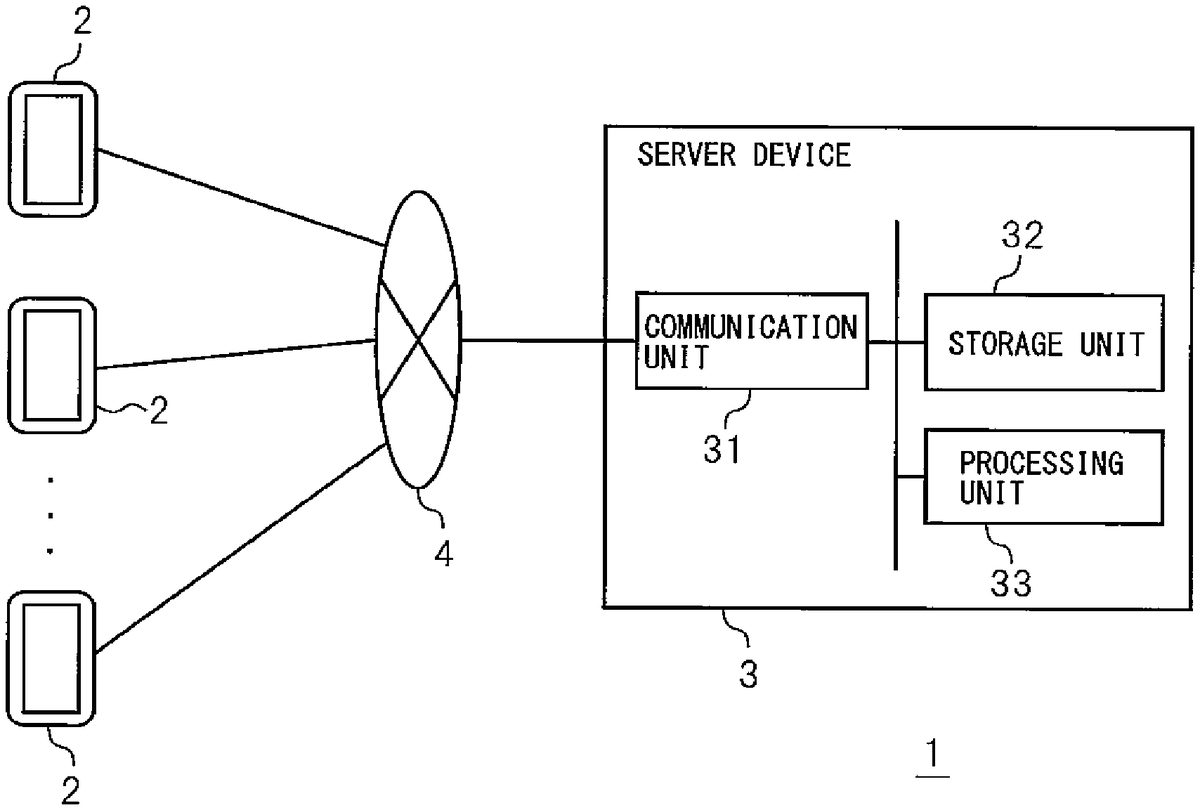
FIG.1is a schematic configuration diagram of a game system. As illustrated inFIG.1, a game system1includes at least one terminal device2, and a server device3. The terminal device2and the server device3are connected to each other via a communication network4such as a public communication network or a wireless communication network, for example.
The terminal device2requests the server device3to carry out a game, in response to an operation (such as pressing of a button) by a user. The terminal device2also receives a result obtained by carrying out the game, from the server device3. The terminal device2may be any device, as long as being capable of communicating with the server device3, operating the game, and displaying a result obtained by carrying out the game. Examples of such a device are a so-called smartphone and feature phone, etc.
FIGS.6A to6Dare schematic views illustrating examples of display screens of the terminal device2.FIG.6Aillustrates a display screen401displayed before initiation of the game. An image of a user is displayed on an upper part of the display screen401, while parameters of the cards possessed by the user are displayed on a lower part of the display screen401. In addition, four buttons are displayed on a middle part of the display screen401. According to an instruction provided via a “story” button402, the terminal device2requests the server device3to carry out the game.
In response to the request from the terminal device2, the server device3carries out a game. Moreover, when an enemy appears while the game is being carried out, the server device3performs the event processing. For the processing, the server device3includes a communication unit31, a storage unit32, and a processing unit33.
The communication unit31includes a communication interface circuit for connecting the server device3to the communication network4. The communication unit31transfers data received from the terminal device2via the communication network4, to the processing unit33. Moreover, the communication unit31transmits data received from the processing unit33, to the terminal device2via the communication network4.
The storage unit32includes at least one of a semiconductor memory, a magnetic disk device, and an optical disk device, for example. The storage unit32stores various programs and data to be used to control the server device3. The storage unit32stores a program for carrying out the game and then outputting a result of the game, for example. Moreover, the storage unit32also stores a program for performing the event processing when an enemy appears while the game is being carried out. Furthermore, the storage unit32also stores a table representing the association of the identification number (ID) of each user and card data sets possessed by the user (referred to as a “user table” below), as well as a table representing the association of the ID of each group, card data sets belonging to the group, and the robo card data set of the group (referred to as a “group table” below). In addition, the storage unit32may also store temporary data related to predetermined processing.
FIG.2is a schematic view illustrating an example of a card data set. As illustrated inFIG.2, the card data set includes parameters101indicating corresponding energy, attack power, defense power, and the like, image data to be used for display on a terminal device, and the like. Each user can possess multiple card data sets each including such data, and can determine as he/she desires how many and which data sets to allocate for a predetermined event (e.g., a deck for a battle).
In addition, the robo card data set also includes similar data.
FIG.3is a schematic view illustrating an example of a group table. As illustrated inFIG.3, a first column202of a group table201includes group IDs, a second column203includes the types of the cards belonging to each group, and a third column204includes the type of the robo card of each group. For example, the group table201specifies that the cards belonging to Group1are {a, b, c, d, e}, and the robo card of Group1is a robo card A.
It should be noted that a single card may belong to multiple groups. Moreover, the number of cards belonging to the group may differ from group to group.
The processing unit33includes one or multiple processors and peripheral circuits thereof. The processing unit33carries out the game, and performs processing for outputting the result of the game. In addition, when an enemy appears while the game is being carried out, the processing unit33performs the event processing.
FIG.4is a functional block diagram of the processing unit33of the server device3. The processing unit33includes a control unit34, a guest-user-selecting unit35, a group formation-assessing unit36, and an action-executing unit37. Each of the units included in the processing unit33is a functional module implemented by a computer program to be executed by the processor included in the processing unit33. Alternatively, each of the units included in the processing unit33may be provided as a firmware on the server device3.
The control unit34makes the game proceed according to the programs. Moreover, the control unit34makes each enemy appear as the game proceeds. When an enemy appears, the control unit34notifies the guest-user-selecting unit35of the appearing of the enemy, and also notifies the group formation-assessing unit36of the user ID of the corresponding user.
The guest-user-selecting unit35selects at least one guest user. For example, the guest-user-selecting unit35randomly selects, as a guest user, at least one user from the users registered on the server device3by using a pseudo-random number generated on the basis of current time or the like. The guest-user-selecting unit35notifies the group formation-assessing unit36of the user ID of the selected guest user.
FIG.6Billustrates a display screen403displayed after selection of guest users. A user404is displayed on an upper part of the display screen403, while selected guest users405are displayed on a lower part of the screen403.
The group formation-assessing unit36refers to the user table stored in the storage unit32, and extracts the card data sets associated with the user and the guest users (the users corresponding to notified user IDs). Then, the group formation-assessing unit36refers to the group table stored in the storage unit32, and determines, for each group, whether or not all the card data sets belonging to the group are included in the card data sets associated with the user and the guest users. When all the card data sets belonging to a group are included, the group formation-assessing unit36determines that the conditions of forming the group are satisfied. By contrast, when even a single one of the card data sets belonging to a group is missing, the group formation-assessing unit36determines that the conditions of forming the group are not satisfied. The group formation-assessing unit36notifies the action-executing unit37of the group ID of each formed group.
FIG.5is a schematic view illustrating an example of group formation-assessment processing. For simplicity, in the following, assume that only one guest user is to be selected. A user301possesses cards {a, b, c, d, f}. In addition, a guest user303possesses cards {a, e}, while a guest user305possesses cards {a, h}. In a group table309, Groups1to3are listed, and the combinations of cards belonging to the respective groups are {a, b, c, d, e}, {a, b, c, d, g}, and {a, b, c, d, i}.
When the guest user303is selected as a guest user in the above condition, the cards possessed by the user301are {a, b, c, d, f} and the cards possessed by the guest user303are {a, e}, consequently obtaining the combination of cards {a, b, c, d, e, f}. Since the combination of the cards of Group1{a, b, c, d, e} are included in the obtained combination, the group formation-assessing unit36determines that Group1is formed, and hence a robo card A is retrieved.
By contrast, when the guest user305is selected as a guest user, the cards possessed by the guest user305are {a, h}, consequently obtaining the combination of cards {a, b, c, d, f, h}. However, this combination does not include, for any of the groups, all the cards belonging to the group. Consequently, the group formation-assessing unit36determines that none of the groups is formed, and hence no robo card is retrieved.
When the group formation-assessing unit36determines, for any one of the groups, that the group is formed, the action-executing unit37refers to the group table stored in the storage unit32, and extracts the robo card data set of the group (the group corresponding to a notified group ID). Then, the action-executing unit37performs the battle processing by using the robo card data set in addition to the card data sets associated with the user and the guest user. For example, the action-executing unit37causes damage to an enemy according to the total attack power of the card data sets.
FIG.6Cillustrates a display screen406displayed while the battle processing is being performed. An enemy407is displayed on an upper part of the display screen406, while extracted cards408are displayed on a lower part of the display screen406. Moreover, when a robo card has also been extracted, the display screen406is switched to a display screen409illustrated inFIG.6D, at predetermined timing. The enemy407is displayed on a right part of the display screen409, while an extracted robo card410is displayed on a left part of the display screen409.
FIG.7is an operation flowchart of the event processing. The event processing is performed every time an enemy appears. The guest-user-selecting unit35selects at least one guest user (step S101).
The group formation-assessing unit36refers to the user table stored in the storage unit32, and extracts the card data sets associated with the user and the guest user (step S102). Moreover, the group formation-assessing unit36refers to the group table stored in the storage unit32, and retrieves the card data sets belonging to each group (step S103). The group formation-assessing unit36determines, for each group, whether or not all the card data sets belonging to the group are included in the card data sets associated with the user and the guest user (step S104).
When all the card data sets belonging to any one of the groups are included in the card data sets associated with the user and the guest user (Yes in step S104), the action-executing unit37refers to the group table stored in the storage unit32, and extracts the robo card data set of the group for which the group formation-assessing unit36has determined that all the card data sets belonging to the group are included. Then, the action-executing unit37performs the battle processing by using the robo card data set in addition to the card data sets associated with the user and the guest user (step S105).
By contrast, when for each of the groups, even a single card data set among the card data sets belonging to the group is missing from the card data sets associated with the user and the guest user (No in step S104), the action-executing unit37performs the battle processing by using only the card data sets associated with the user and the guest user (step S106). After the battle processing is finished, the control unit34terminates the event processing.
As has been described above, when all the cards belonging to a certain group are included in the cards possessed by the user and the guest user at the time an enemy appears during the game, the server device according to this embodiment provides a robo card of the group. Accordingly, contribution of their cards possessed by the user and the guest user results in a synergetic effect of obtaining a robo card. In addition, a different guest user is selected every time an enemy appears, consequently changing whether a group is formed or not formed. Such features can increase the interest of the users. Along with the increase in users' interest, users' wish to participate in the game is also expected to increase.
It should be noted that, according to a modified example, the guest-user-selecting unit35may let the user select one or more guest users. For example, the server device3may transmit, to the terminal device2, the user names of users who are in friend status with the user, and then cause the terminal device2to display the user names on the screen, to receive one or more selected user names from the user, and then return the one or more selected user names to the server device3. In this case, the server device3preferably transmits only the user names to the terminal device2without transmitting the types of the cards possessed by the users, to avoid revealing whether any group is to be formed or not.
Moreover, the guest-user-selecting unit35may use, as identification information of each guest user, identification information other than the user name in the data relating to the guest user himself/herself. Examples of such identification information are a user ID, the combination of a user ID and a user attribute (such as the age, the gender, or the area (country) in which the user lives, having been set in the social networking service (SNS)), and the like.
Furthermore, the guest-user-selecting unit35may select one or more guest users by using a user attribute (such as the age, the gender, or the area (country) in which the user lives, having been set in the SNS) as a condition, instead of selecting one or more guest users randomly.
In addition, in this embodiment, description has been given that the user can use the card data sets possessed by the user himself/herself and the card data sets possessed by the guest users. However, the card data sets which the user can use are not limited to these.
For example, the following configuration may be used instead. First, each user selects, in advance, card data sets to use in a certain battle from among the card data sets possessed by the user himself/herself. The storage unit32stores, as a second user table, each user ID and the card data sets selected by the corresponding user in advance in association with each other. Then, the group formation-assessing unit36refers to the second user table stored in the storage unit32, and determines, for each group, whether or not all the card data sets belonging to the group are included in the card data sets selected in advance by the user and the guest users.
According to such a configuration, selection of card data sets by each user made in advance in addition to selection of users as guest users affects whether any group is formed or not. Hence, users' interest can be further increased.
In addition, in this embodiment, description has been given that a robo card data set is additionally provided according to the combination of card data sets possessed by the user and the guest users. However, the card data sets with which a group has formed may be discarded, and a corresponding robo card data set may be provided instead. Note that each parameter included in the provided robo card data set is supposed to be the total of the corresponding parameters of the respective card data sets belonging to the formed combination, or a value different from the total.
Moreover, in this embodiment, description has been given that each card data set has one attribute, i.e., type. However, each card data set may include two or more attributes. Examples of such attributes may be the type and color of hero characters (occupation may be used instead of color, and concrete examples are soldier, hero, martial artist, witch, monk, and the like).
In this case, a group table is configured as illustrated in Table 1, for example. In Table 1, Groups1to6are listed. Each of Groups1to5illustrates a case of including all the colors of a particular hero character (any one of a to e), while Group6illustrates a case of including different hero characters (a to e) in a particular color (red). The group formation-assessing unit36may determine whether any group is formed on the basis of such multiple attributes included in each card data set.
TABLE 1Group TableGroup IDCardRobo card1(a-red) (a-blue) (a-yellow) (a-white) (a-pink)A2(b-red) (b-blue) (b-green) (b-yellow) (b-pink)B3(c-red) (c-black) (c-blue) (c-green) (c-yellow)C4(d-red) (d-blue) (d-green) (d-brown) (d-white)D5(e-red) (e-black) (e-blue) (e-purple) (e-pink)E6(a-red) (b-red) (c-red) (d-red) (e-red)F
Furthermore, in this embodiment, description has been given of the first characteristic data by taking cards as an example. However, other kinds of game items, such as weapons, jewels, or products, for example, may be used instead.
Similarly, description has been given of the second characteristic data by taking a “robo card”, which is a kind of game item, as an example. However, other kinds of game items, such as strong weapons, or items may be used instead. The second characteristic data also may be based on an act, such as a powerful trick or magic, occurring in the game, instead of a game item.
Second Embodiment
The functions of the server device according to the first embodiment can be implemented by a stand-alone game device.FIG.8is a schematic configuration diagram of such a game device. A game device5includes a communication unit51, a storage unit52, a processing unit53, an operation unit54, and a display unit55.
The communication unit51includes a communication interface circuit, for communicating with a different game device5, which is in conformity with a communication standard such as IrDA (registered trademark in Japan), Bluetooth (registered trademark in Japan), or ZigBee (registered trademark in Japan), for example. The communication unit51is used for exchanging card data sets with a different game device5, for example.
The storage unit52and the processing unit53correspond to the storage unit32and the processing unit33of the server device3according to the first embodiment, respectively, while being different from the storage unit32and the processing unit33in that the storage unit52and the processing unit53handle the user of a different game device5as a guest user.
The operation unit54may be any device, as long as being capable of operating the game device5, and examples are a touch pad, a keyboard, and the like. Moreover, the display unit55may be any device, as long as being capable of displaying a game screen, and examples are a liquid crystal display, an organic EL display, and the like.
The game device according to this embodiment has functions equivalent to those of the server device according to the first embodiment, and can produce an effect equivalent to that produced by the server device according to the first embodiment.
A computer program for causing a computer to execute the respective functions of the processing unit of the server device according to the first embodiment and the processing unit of the game device according to the second embodiment may be provided in a form recorded on a computer readable recording medium such as a magnetic recording medium or an optical recording medium.
It should be noted that the present invention is not limited to the application to a card battle game and card data, but is also applicable to other games and data which have similar structures.
It should be understood that various changes, substitutions, and modifications can be made to the present invention by those skilled in the art without departing from the spirit and scope of the present invention.
REFERENCE SIGNS LIST
1game system
2terminal device
3server
31communication unit
32storage unit
33processing unit
34control unit
35guest-user-selecting unit
36group formation-assessing unit
37action-executing unit
4communication network
5game device
51communication unit
52storage unit
53processing unit
54operation unit
55display unit
Claims
- A computer for carrying out a battle game against a game card, the computer comprising: a memory circuit configured to store information regarding the game card, information regarding first game cards associated with a first user, information regarding second game cards associated with each of a plurality of second users, information regarding a plurality of conditions associated with the first game cards, second game cards, or both the first and second game cards, information regarding third game cards each of which is associated with each of the plurality of conditions;and circuitry configured to select a cooperative user among the second users upon appearance of an enemy in the battle game, the cooperative user cooperating with the first user based on appearance of an enemy in the battle game, the game card corresponding to the enemy, display, on a display of a terminal device used by the first user, the game card used in the battle game played by the first user, and the first game cards and the second game cards associated with the cooperative user which battle the game card, and display the game card, and a fourth game card which battles the game card, wherein the fourth game card is one of the third game cards associated with one condition of the plurality of conditions, the one condition being satisfied by at least part of the first game cards and the second game cards associated with the cooperative user.
- The computer of claim 1, wherein the conditions are associated with combination of the first and/or second game cards, and the one condition is satisfied by combination of at least part of the first game cards and the second game cards associated with the cooperative user.
- The computer of claim 1, wherein the circuitry is configured to display, on the display, the game card, the first game cards and the second game cards associated with the cooperative user, after which, display, on the display, the game card and the fourth game card.
- The computer of claim 1, wherein the conditions are associated with combination of the first game cards, the second game cards, or both the first and second game cards, and the circuitry is configured to, when combination of the first game cards and the second game cards associated with the cooperative user satisfies one of the plurality of conditions, extract the third game card associated with the satisfied condition as the fourth game card.
- A control method for controlling a computer which carries out a battle game against a game card, the computer including: a memory circuit configured to store information regarding the game card, information regarding first game cards associated with a first user, information regarding second game cards associated with each of a plurality of second users, information regarding a plurality of conditions associated with the first game cards, the second game cards, or both the first and second game cards, information regarding third game cards each of which associated with each of the plurality of conditions, the computer method comprising: selecting, by circuitry of the computer, a cooperative user among the second users upon appearance of an enemy in the battle game, the cooperative user cooperating with the first user based on appearance of an enemy in the battle game, the game card corresponding to the enemy;displaying, by the circuitry of the computer, on a display of a terminal device used by the first user, the game card used in the battle game played by the first user, and the first game cards and the second game cards associated with the cooperative user which battle the game card;and displaying, by the circuitry of the computer, the game card, and a fourth game card which battles the game card, wherein the fourth game card is one of the third game cards associated with one condition of the plurality of conditions, the one condition being satisfied by at least part of the first game cards and the second game cards associated with the cooperative user.
- The control method according to claim 5, wherein the conditions are associated with combination of the first game cards, the second game cards, or both the first and second game cards, and the one condition is satisfied by combination of at least part of the first game cards and the second game cards associated with the cooperative user.
- The control method according to claim 5, the computer method further comprising: displaying, by the circuitry of the computer, on the display, the game cards, the first game cards and the second game cards associated with the cooperative user, after which, displaying, by the circuitry of the computer, on the display, the game cards and the fourth game card.
- The control method according to claim 5, wherein the conditions are associated with combination of the first and/or second game cards, and the computer method comprising: when combination of the first game cards and the second game cards associated with the cooperative user satisfies one of the plurality of conditions, extracting, by the circuitry of the computer, the third game cards associated with the satisfied condition as the fourth game cards.
- A non-transitory computer-readable recording medium having recorded thereon a control program for controlling a computer which carries out a battle game against a game card, the computer including: a memory circuit configured to store information regarding the game card, information regarding first game cards associated with a first user, information regarding second game cards associated with each of a plurality of second users, information regarding a plurality of conditions associated with the first game cards, the second game cards, or both the first and second game cards, information regarding third game cards each of which associated with each of the plurality of conditions, the control program causing the computer to execute a process comprising: selecting, by circuitry of the computer, a cooperative user among the second users upon appearance of an enemy in the battle game the cooperative user cooperating with the first user based on appearance of an enemy in the battle game, the game card corresponding to the enemy;displaying, by the circuitry of the computer, on a display of a terminal device used by the first user, the game card used in the battle game played by the first user, and the first game cards and the second game cards associated with the cooperative user which battle the game card;and displaying, by the circuitry of the computer, the game card, and a fourth game card which battles the game card, wherein the fourth game card is one of the third game cards associated with one condition of the plurality of conditions, the one condition being satisfied by at least part of the first game cards and the second game cards associated with the cooperative user.
- The non-transitory computer-readable recording medium according to claim 9, wherein the conditions are associated with combination of the first game cards, the second game cards, or both the first and second game cards, and the one condition is satisfied by combination of at least part of the first game cards and the second game cards associated with the cooperative user.
- The non-transitory computer-readable recording medium according to claim 9, the control program causing the computer to execute a process comprising: displaying, by the circuitry of the computer, on the display, the game card, the first game cards and the second game cards associated with the cooperative user, after which, displaying, by the circuitry of the computer, on the display, the game card and the fourth game card.
- The non-transitory computer-readable recording medium according to claim 9, wherein the conditions are associated with combination of the first and/or second game cards, and the control program causing the computer to execute a process comprising: when combination of the first game cards and the second game cards associated with the cooperative user satisfies one of the plurality of conditions, extracting, by the circuitry of the computer, the third game cards associated with the satisfied condition as the fourth game card.
Disclaimer: Data collected from the USPTO and may be malformed, incomplete, and/or otherwise inaccurate.